Sunday, October 25, 2026
Home Blog Page 74

Twitter Says It Suspended 360,000 Suspected Terrorist Accounts in a Year

0

TWITTER IS STILL actively combating terrorism on its platform, and it wants you to know so. Really and truly, the company says, it is making progress.

For Twitter, fighting terrorism on its platform is a particularly sensitive problem. While Facebook has taken a hardline stance on terrorism and removes any and all posts that carry even a trace of suspicious content, Twitter has continually attempted to strike a balance between protecting free speech and cracking down on players who use its service as a way to promote violence or threats. As a recent WIRED feature reported, Twitter is often still the “main engine” for ISIS propagandists to promote their cause and find new recruits.

The company said in a post today that it’s applying an even more aggressive strategy to eradicate violent extremism on its platform. Since the company announced its first efforts to combat terrorism back in February, it says it has suspended an additional 235,000 accounts, bringing the total number of suspensions in violation of its terrorism policy to 360,000 in about a year. According to the company, it is also suspending accounts faster—daily, suspensions are up over 80 percent since last year, which helps to stop dangerous accounts from gaining significant followings. And Twitter is continuing its investment in proprietary spam-fighting tools to identify suspicious accounts, and broadening its partnerships with organizations working to counter violent extremism, including law enforcement agencies around the world.

The response from Twitter comes at a time when it may be feeling particularly defensive. Twitter, after all, is at a crucial point in its life as a company: its business is ailing, and in recent months it has come under fire for what many perceive to be a slow reaction to abuse and harrassment, prompting many high-profile users to leave the platform. Not to mention, as the election cycle continues on, politicians have been putting pressure on the company—and others in Silicon Valley—to acknowledge that social media can indeed be a crucial tool for terrorist groups in the recruitment and radicalization of sympathizers. Twitter needs to show that it not only knows terrorism and abuse is an issue on its platform. It needs to prove it’s doing something about it. This announcement today attempts to address the terrorism problem, but the question of how it will curb abuse on the platform in general remains open.

Brexit Armageddon was a terrifying vision but it simply hasn’t happened

0

Brexit Armageddon was a terrifying vision  but it simply hasn't happened

Unemployment would rocket. Tumbleweed would billow through deserted high streets. Share prices would crash. The government would struggle to find buyers for UK bonds. Financial markets would be in meltdown. Britain would be plunged instantly into another deep recession.

Remember all that? It was hard to avoid the doom and gloom, not just in the weeks leading up to the referendum, but in those immediately after it. Many of those who voted remain comforted themselves with the certain knowledge that those who had voted for Brexit would suffer a bad case of buyer’s remorse.

It hasn’t worked out that way. The 1.4% jump in retail sales in July showed that consumers have not stopped spending, and seem to be more influenced by the weather than they are by fear of the consequences of what happened on 23 June. Retailers are licking their lips in anticipation of an Olympics feelgood factor.

The financial markets are serene. Share prices are close to a record high, and fears that companies would find it difficult and expensive to borrow have proved wide of the mark. Far from dumping UK government gilts, pension funds and insurance companies have been keen to hold on to them.

City economists had predicted an immediate rise in the claimant count measure of unemployment in July. That hasn’t happened either. This week’s figures show that instead of a 9,000 rise, there was an 8,600 drop.

Some caveats are in order. It is still early days. Hard data is scant. Survey evidence is still consistent with a slowdown in the economy in the second half of 2016. Brexit may be a slow burn, with the impact only becoming apparent in the months and years to come.

But it is obvious that the sky has not fallen in as a result of the referendum, and those who said it would look a bit silly. By now, Britain was supposed to be reeling from the emergency budget George Osborne said would be necessary to fill a £30bn black hole in the public finances caused by a plunging economy. The emergency budget is history, as is Osborne.

In a way, Project Fear did work. It put the wind up businesses, making them warier about investing in new kit. And at least some of the people who voted remain did so because they were worried about the economic consequences of leaving. That was hardly surprising, given the regular and lurid warnings – from the Treasury, the Bank of England, the International Monetary Fund and the Organisation for Economic Cooperation and Development – about the dire consequences that would inevitably flow from Brexit.

The British state did an abrupt U-turn on 24 June. Having failed to secure a yes vote, the official position had to change fast. The imperative was to get all those people who had been frightened witless to chill out. Some surveys since the Brexit vote did indeed pick up an abrupt drop in consumer confidence. The government feared a recession of its own making.

So instead of telling the public how hard life was going to be outside the EU, ministers and officials sought to reassure, to administer large doses of soothing balm, to insist that the UK could cope just fine on its own.

The economy would certainly have had a tough time had the Treasury and the Bank of England done nothing in the wake of the referendum, but that was never going to happen. There was no passive acceptance of the result: it was an all-action approach. Before his defenestration by Theresa May, Osborne ditched his plan to run a budget surplus by the end of the parliament, while his successor Philip Hammond has said he might “reset” fiscal policy in the autumn statement. There will now be a more measured – and sensible – approach to reducing the budget deficit.

Meanwhile, Bank of England governor Mark Carney has been sweet-talking the City, making it clear that the banks could have access to unlimited quantities of cheap cash. Interest rates, which stood at 0.5% for more than seven years, have been cut to 0.25%, with a strong hint they will be cut again during the autumn.

Project Everything’s OK has worked well so far. Again, this is understandable. There were millions who thought Project Fear was well over the top, which it was, or didn’t think life could become much tougher. The remain camp was ill-advised to rely so heavily on its warnings of economic Armageddon, when only two regions of the country – London and the south-east – had seen GDP per head rise above the level before the 2008-9 recession. After weighing up the pros and cons, plenty of voters didn’t think they were risking all that much.

As far as it is possible to tell, there was a collective sharp intake of breath in the aftermath of the vote, but then consumers carried on regardless. The latest monthly health-check of household sentiment found a sharp drop in optimism in July followed by a rapid recovery in August. John Lewis and Next – two bellwethers of activity in the high street – say trading has not been affected by Brexit.

This doesn’t mean everything is fine. Britain has deep structural economic problems that would have to be addressed inside or outside the EU. Investment has been weak, productivity has flatlined since the recession, earnings growth is running at half its 4-5% pre-financial crisis level and, except in times of war, the balance of payments deficit has never been higher.

Brexit has forced the government to take a long, hard look at the British economy

Brexit could make some of these challenges more acute. Investment is likely to remain subdued, while the fall in value of the pound since the referendum will push up inflation by making imports more expensive. That will put the squeeze on consumer spending power.

But in other respects, Brexit has been a help. It has forced the government to take a long, hard look at the British economy – something that would not have happened without the shock administered by the referendum. It’s brought home the fact that most of Britain feels disconnected from the economic story peddled by successive governments.

For decades, there’s been a tendency for businesses to meet rising demand by employing cheap labour rather than by investing in modern equipment. Large chunks of the economy are characterised by low skills, low wages, and low productivity. As the Resolution Foundation noted this week, companies that rely on the ability to import low-cost employees from the EU are going to have to rethink their business models. This is not necessarily a bad thing.

The government has responded to Brexit by soft-pedalling on austerity, by contemplating spending more on infrastructure and by committing itself to an industrial strategy. A degree of scepticism is warranted here. The referendum has made change possible: it doesn’t guarantee it will happen. It remains to be seen how many new roads and railways get built, or whether the industrial strategy amounts to anything more than a new name for Whitehall’s business department.

When I voted for Brexit on 23 June, I did so for three reasons: because the European Union is a failed project; because Europe is moving in an increasingly free-market direction; and because I wanted to shake up the status quo. It would take an extremely deep and prolonged recession to make me regret my choice. That prospect seems even more remote than it did eight weeks ago.

Obamacare Is a Money-Loser for Insurers, Who Are Giving Up

0

With almost $2 billion in losses this year, big insurance companies are pulling out of the health-care program.

Last November, when UnitedHealth Group said it expected to post big losses on its Obamacare policies in 2016, rivals such as Anthem and Aetna signaled their Affordable Care Act businesses were doing fine. The Obama administration used that as evidence to refute claims that systemic problems were brewing in its landmark insurance program.

Now, there’s no denying it. The four biggest U.S. health insurers admit they’re each losing hundreds of millions of dollars on their Obamacare plans. Rather than expand coverage, many are pulling out of the exchanges that were set up by the ACA so people can shop for insurance plans, often with the help of government subsidies.

UnitedHealth expects to lose $850 million on Obamacare in 2016, while Aetna, Anthem, and Humana are all on track to lose at least $300 million each on their ACA plans this year, according to company reports and estimates from Bloomberg Intelligence. UnitedHealth says it’s quitting 31 of the 34 states where it sells ACA policies. Humana is exiting 8 of 19 states and reducing its presence to just 156 counties, from 1,351 a year ago. Anthem hasn’t announced plans to change its participation in the program.

On Aug. 15, Aetna said it will stop selling Obamacare plans in 11 of the 15 states where it had participated in the program, reversing its plan to expand into five new state exchanges in 2017. “The exchanges are a mess as they exist today,” says Aetna Chief Executive Officer Mark Bertolini. “They’re losing a lot of money for a lot of people.”

Since its passage in 2010, Obamacare has brought insurance to some 20 million people who previously lacked it, pushing the uninsured rate in the U.S. to a record low. Yet as the law approaches its fourth full year of providing coverage, it’s beginning to show its limitations, particularly when it comes to fostering competition and lowering prices.

When the exchanges open for business on Nov. 1, many consumers will face fewer options and higher prices. On average, insurers are looking to raise premiums by about 24 percent in 2017, estimates Charles Gaba of ACASignups.net, a website that tracks the health-care law. As many as a quarter of all U.S. counties, mainly in rural areas, are at risk of having just a single insurer for next year, according to Cynthia Cox, who tracks the markets for the Kaiser Family Foundation. With Aetna’s exit, one county in Arizona currently has no insurer offering coverage through the ACA for next year.

After surviving numerous legal challenges and attacks by Republicans in Congress, plus a botched rollout in 2013, Obamacare now faces what is perhaps its most serious threat: The program is a clear money loser for the nation’s biggest insurance companies. While Obamacare can compel individuals to buy insurance—a mandate upheld by the U.S. Supreme Court in 2012—the law has no authority to force insurance companies to offer plans through its exchanges.

Obamacare advocates had hoped that big government subsidies to consumers would persuade healthy people to sign up for the ACA plans. But the policies have largely been taken out by older, less healthy people who are more expensive to insure. “What we are left with … is a highly subsidized program for relatively low-income people,” says Dan Mendelson, the CEO of consulting firm Avalere Health. “We’re not getting to the broader vision of a robust private market structure that enables a broad swath of Americans to purchase their insurance.”

President Obama recently revived the idea of introducing a public plan to compete with private insurers, something that was debated and ultimately left out of the final version of the law. He’s also said increased government subsidies could help draw more people into the ACA’s markets. Another option is to simply give insurance companies more government money, but that would require action from a Republican Congress that would rather repeal Obamacare than fix it. “There’s going to be absolutely zero interest among Republicans in bailing out Obamacare by giving it more money,” says Avik Roy, a health-care expert who’s advised Republican presidential candidates Mitt Romney, Rick Perry, and Marco Rubio on health policy.

Insurance companies were hoping that a wave of mergers would help them cope with ACA-related red ink. In July 2015, Aetna struck a deal to buy Humana and Anthem agreed to buy Cigna. But the U.S. Department of Justice sued to block both transactions, saying they’d harm competition. “The synergies from the two mergers would have subsidized a lot of losses,” says Ana Gupte, an analyst at Leerink Partners. “That could have helped them manage some of the pressure they’re seeing on the exchanges.” The big insurance companies are still poised to reap fat profits this year. Analysts estimate that Aetna is on pace to make $2.5 billion in 2016 and UnitedHealth will earn some $7 billion.

Not everyone’s losing money on Obamacare. Centene and Molina Healthcare have been able to turn a profit on the exchanges by offering Medicaid-like health plans. These plans tend to have narrower networks, at lower premiums, than those available from employers.
There are lots of ways to make the ACA’s individual market work better for more insurers. The tough part is figuring out which could surmount political hurdles. Kevin Counihan, who oversees the health insurance markets for the federal government, has raised the idea of creating a special fund to help insurers cover particularly costly patients, perhaps ones who rack up more than $2 million in medical bills in a year. In a blog post, he suggested states could take steps to help insurers by shouldering some of the costs of particularly sick people.

Some insurers want to widen the difference between what they charge their oldest and youngest customers. Under the ACA, premiums for the oldest are typically limited to three times those for the youngest. Widening that ratio would theoretically help draw in more young, healthy people by lowering their premiums, but it would also raise costs for older people. Regulators are also working to improve a program known as risk adjustment, which is supposed to transfer funds from insurers with healthier customers to those with sick ones.
The fate of the exchanges rides, in part, on the November election. While Donald Trump has said he’ll repeal Obamacare, he hasn’t said exactly what would replace it. Hillary Clinton has backed the creation of a public insurance plan, as well as offering people 55 and older the option of buying Medicare coverage.

Joel Ario, a managing director at Manatt Health who worked on the exchanges at the U.S. Department of Health & Human Services, says enrollment is probably high enough to prevent a failure. Still, he says, more can be done. “I think you will see corrective action taken, assuming a Clinton administration,” he says. “We need to do some regulatory tweaking here, maybe more than tweaking.”

The bottom line: Obamacare has no authority to force insurance companies to offer plans; faced with mounting losses, they’re pulling out.

Global central banks dump U.S. debt at record pace

0

Global central banks are unloading America's debt.

In the first six months of this year, foreign central banks sold a net $192 billion of U.S. Treasury bonds, more than double the pace in the same period last year, when they sold $83 billion.

China, Japan, France, Brazil and Colombia led the pack of countries dumping U.S. debt.
Powered by SmartAsset.com.  It's the largest selloff of U.S. debt since at least 1978, according to Treasury Department data.

160516173150-us-debt-dump-780x439

"Net selling of U.S. notes and bonds year to date thru June is historic," says Peter Boockvar, chief market analyst at the Lindsey Group, an investing firm in Virginia.

U.S. Treasurys are considered one of the safest assets in the world. A lot of countries keep their cash holdings in U.S. government bonds.
Many countries have been selling their holdings of U.S. Treasuries so they can get cash to help prop up their currencies if they're losing value.

The selloff is a sign of pockets of weakness in the global economy. Low oil prices, China's economic slowdown and currencies losing value are all weighing down global growth, which the IMF described as "fragile" earlier in the year.

Despite all the selling by these countries, private demand for the bonds has sky rocketed. Demand is so high that the U.S. can afford to pay historically low interest rates. The 10-year U.S. Treasury hit a record low of 1.34% earlier this year, before bouncing back to about 1.58%, currently.

ES Morning Update August 19th 2016

0

96123353-3bf2-49c7-a1fb-a3d5df9d8f13

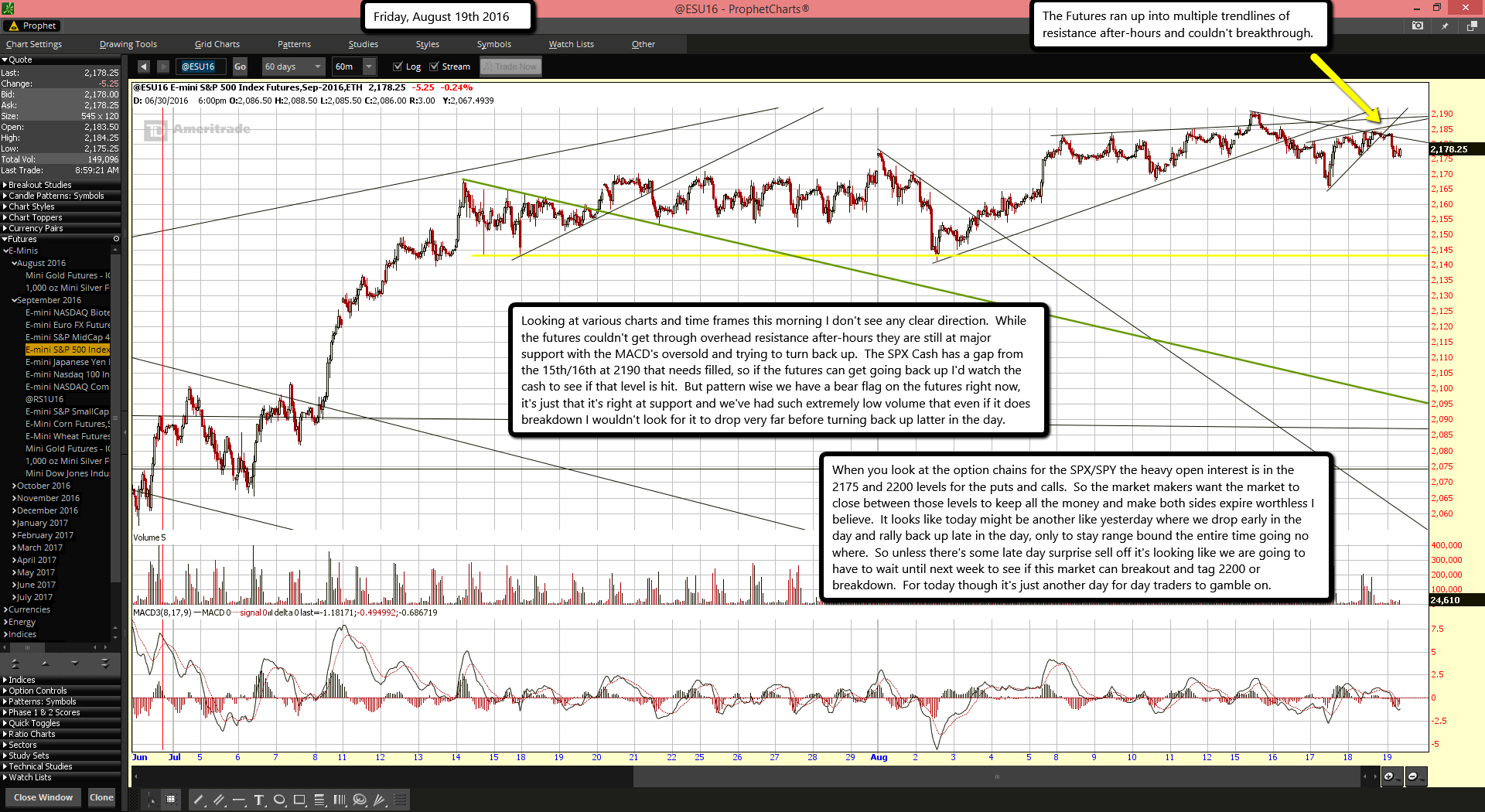
The Futures ran up into multiple trendlines of resistance after-hours and couldn't breakthrough.

Looking at various charts and time frames this morning I don't see any clear direction.  While the futures couldn't get through overhead resistance after-hours they are still at major support with the MACD's oversold and trying to turn back up.  The SPX Cash has a gap from the 15th/16th at 2190 that needs filled, so if the futures can get going back up I'd watch the cash to see if that level is hit.  But pattern wise we have a bear flag on the futures right now, it's just that it's right at support and we've had such extremely low volume that even if it does breakdown I wouldn't look for it to drop very far before turning back up latter in the day.

When you look at the option chains for the SPX/SPY the heavy open interest is in the 2175 and 2200 levels for the puts and calls.  So the market makers want the market to close between those levels to keep all the money and make both sides expire worthless I believe.  It looks like today might be another like yesterday where we drop early in the day and rally back up late in the day, only to stay range bound the entire time going no where.  So unless there's some late day surprise sell off it's looking like we are going to have to wait until next week to see if this market can breakout and tag 2200 or breakdown.  For today though it's just another day for day traders to gamble on.

Hillary Would Give Us a Disastrous Third Obama Term

0

Hillary Would Give Us a Disastrous Third Obama Term

When it comes to unity, the Democrats talk a good game — but in the end they promote disunity because their electability depends on dividing society into groups and inciting anger, resentment and distrust.

I don’t need to cite examples of Democrats’ blaming Republicans for divisiveness and falsely extolling their own aspirations of unity. They are everywhere. It’s what they do, from their talk of our “common humanity,” to their glorification of all kinds of diversity, except diversity of thought, to their proclaimed monopoly on tolerance.

It’s ironic that Democrats get away with this lie. It is Republicans, or at least the conservatives among them, who preach that a rising tide lifts all boats — that economic growth across the board will help the most people.

Democrats simply can’t be honest about economic policy. They have to demonize the wealthy to incite class warfare. They must perpetuate and expand government dependency programs, which means creating incentives for people to remain out of the work force. They must vilify the rich for not paying their fair share of taxes, despite the undeniable fact that upper-income earners pay far more taxes — actual and percentage — and that the lower half of income earners pay no income taxes at all. How much “fairer” can it be for them?

I am old enough to remember then-Senator Barack Obama’s 2008 campaign promise to bring all people together in a spirit of harmony and healing. I also remember him doing just the opposite once elected.

And I remember Obama’s 2012 gamble of appealing directly to minorities and alienating other groups, apparently on the theory that disaffected groups outnumber the sum of all others — or at least that agitating them would increase their turnout and ensure his victory. If a Republican candidate had dared such overt divisiveness, the mainstream media would have tarred and feathered him.

The Democrats are having a field day attacking Trump, and he’s giving them way too much ammunition. But no matter whom Republicans put up, Democrats will viciously disparage them. To them, almost all Republican candidates and officeholders are mean-spirited bigots.

If only Republicans could successfully communicate their case that perpetual malaise, which is the only thing Democrats offer anymore, is unnecessary and correctable. If only they could demonstrate that the Democrats’ socialistic and regulatory policies thwart prosperity for all groups of people — except, ironically, the very wealthy.

But we haven’t made our case, or it’s falling on deaf ears, because Democrats are paying people, in effect, to remain on their plantations. They are encouraging them not to be productive members of society. They are deliberately undermining the nuclear family. They are fomenting envy and disharmony. It’s tragic.

Look at Hillary Clinton’s ballyhooed economic plan. What an utter package of deceit! She tells us she’s going to create more than 10 million new jobs — by continuing the same miserably failed policies of Barack Obama. Obama and Clinton claim they saved the economy from collapse after the 2008 financial crisis, which their policies caused. But eight years later we’ve yet to see appreciable economic growth from this team. For them, 1 percent growth is the new 5 percent. Obamanomics has given us the worst recovery since World War II. Indeed, it is an insult to the term “recovery” to designate this mess as such.

No matter what he says now, President Obama promised his obscene $800 billion “stimulus” package would actually stimulate, and it did the opposite.

But Clinton would continue the ruse, expecting us to believe four more years of this insanity will produce different results. Her five-part plan is more of the same nonsense: 1) Investing in infrastructure. (Deja vu, anyone?) 2) Make college available for all. (But how will graduates get jobs in their recessionary economy?) 3) Make companies share more profits with their employees. (And these people claim they’re not socialists). 4) Make corporations, the wealthy and Wall Street pay their fair share. (I’ve covered this.) 5) Create policies that “support 21st-century families” — equal pay, paid leave, reduced child care costs.

Seriously, which of these strategies could conceivably unleash sustained economic growth? Other than the infrastructure spending (which also won’t create long-term growth), these ideas have nothing to do with expanding the economic pie, but only with redistribution. Not only is Clinton’s five-point plan destined for failure, she will expand the regulatory state, which is smothering small businesses.

If Democrats ever believed in economic growth, they’ve long since abandoned it, going with the myth that we have a finite pie and that they, as Big Sister, must control how it’s allocated, the free market be damned.

I repeat: The Democrats’ viability requires keeping us at each other’s throats. They must divide us. Consider Clinton’s recent shunning of police unions. She is so desperate to retain 90 percent of the African-American vote that she told the 335,000-member National Fraternal Order of Police she won’t seek their endorsement.

The chilling truth is that Hillary Clinton would give us a third Obama term, and I don’t know how we can come back from it.

How Hyperloop One Went Off the Rails

0

The transportation startup is trying to make a pod levitate in a tunnel, but can it rise above founder clashes and employee lawsuits?

800x-1

Hyperloop tubes are displayed during the first test of the propulsion system at the Hyperloop One Test and Safety site on May 11, in Las Vegas.

In December 2014, an engineer with the unlikely name Brogan BamBrogan was in the driveway of his clapboard Los Angeles house, loading up his car for a holiday road trip to Northern California, when venture capitalist Shervin Pishevar messaged him for a favor.

The two were founders of Hyperloop One, a startup building futuristic tubes to zip people from city to city. Shervin Pishevar, a partner at Sherpa Capital, was the money guy; BamBrogan the chief technical officer. Pishevar's brother, Afshin Pishevar, was driving west from Washington to join the company as general counsel, and needed a place to stay. BamBrogan and his wife stopped packing, cleaned the bathroom, and tucked a spare key under the front mat of his Los Feliz home. When they returned a few days later, Afshin Pishevar was still there. Their houseplants were littered with cigarette butts.

Twenty months later, neither BamBrogan nor Afshin Pishevar work at Hyperloop One, and in June, BamBrogan and three other former employees filed a lawsuit against the Pishevar brothers and the company, also naming Chief Executive Officer Robert Lloyd and investor Joseph Lonsdale in the suit. It alleges the men didnt have the companys interests at heart, and also makes claims of assault and defamation. In its countersuit against BamBrogan and the other ex-employees, Hyperloop One said the insurgent employees were trying to start a competing firm. One dispute surrounds a long, looped rope BamBrogan discovered on his office chair one morning, in the shape of a noose or a lasso, depending on your perspective. There is no mystery over who left it there: his former houseguest, Afshin Pishevar.

Startups, including success stories Facebook and Twitter, often suffer founder clashes, executive churn, and squabbles over equity. But at Hyperloop One, a high-profile company spawned from an idea by Tesla founder and CEO Elon Musk, things got very toxic, very fast. The dueling lawsuits and lurid accusations threaten to sully the company's idealistic mission to create a new form of transportation.

A lawyer representing Hyperloop One, Orin Snyder, a partner at Gibson Dunn, said: "We are confident that at the end of the day it will be obvious that their entire lawsuit was a crass publicity stunt based on lies and smears intended to cover up a failed coup and illegal plot to steal intellectual property and create a competing hyperloop company." BamBrogan and his co-plaintiffs deny they were attempting a coup. Through his lawyer David Willingham, Afshin Pishevar denied leaving the cigarette butts in BamBrogan's home.

The company, now run by Lloyd, former Cisco president, is moving forward with plans to make a viable transportation mode out of large pods zooming through tubes. Early next year, Lloyd said, they'll have their "Kitty Hawk moment," aiming to levitate a pod inside a tunnel. The test is crucial for persuading investors to sink more money into Hyperloop, whose projects will likely each cost billions of dollars.

These are big steps for a company thats only 20 months old, he said. Although the events of the past few weeks are not something I would have hoped for, Lloyd believes they will ultimately make the company stronger. We all come together more closely when somebody surprises us, or we feel attacked, he said.

-1x-1

Photos from BamBrogan's lawsuit: BamBrogan, finding the rope on his chair, and security footage of Afshin Pishevar walking through the office with a rope.

In his proposal in 2013, Elon Musk dubbed the hyperloop "a cross between a Concorde and a railgun and an air hockey table, and dared engineers everywhere to build it.

The Hyperloop idea resembles magnetic-levitation trains: magnets levitate driverless circular carriages, a few centimeters above a track, propelled along by an electric motor. Operating inside a low-pressure tube, the theory goes, the Hyperloop would encounter so little resistance that the carriages could whisk along at airplane speeds. If the technology works, commercial Hyperloop routes could open in a few years.

Shervin Pishevar, a well-connected entrepreneur turned venture capitalist, made his name through an early investment in Uber, after having moved to the U.S. from Iran as a child in the late 1970s. He likes to name drop his famous friends, and once flew to Cuba with Musk and actor Sean Penn to try, unsuccessfully, to negotiate for a U.S. political prisoners release.

Inspired by Musk's vision, Shervin Pishevar searched for a technology prodigy to execute it, settling on BamBrogan, a wiry, handlebar-mustachioed former SpaceX engineer. Until 2014, his name had been Kevin Brogan, but he legally changed it to merge names with his wife, Bambi. At Musk's SpaceX, BamBrogan was employee #23, and a polarizing figure. Known back then as K-Bro, he was the cool kid among the brainy engineers. BamBrogan would organize parties and other diversions for the over-worked 20-somethings. He had plenty of enemies there, though, particularly those who did not feel like part of the BamBrogan clique.

Shervin Pishevar offered him six percent of the company and started raising funds, bringing in Lonsdale, co-founder of the data-analysis behemoth Palantir Technologies. BamBrogan began drawing up designs.

BamBrogan instilled a hard-charging, fast-moving culture at Hyperloop One. He angered quickly, but commanded considerable loyalty. Many employees kept fake million-dollar bills with his image on them taped to their desks. A few months after the company had moved into a former factory in Los Angeles, BamBrogan announced another expansion by bursting through a wall wearing a Kool-Aid suit.

Shervin Pishevars brother Afshin worked as a lawyer near Washington for years, with one of his cases landing on Washingtonian Magazines 2014 list of top personal-injury verdicts. That year, tragedy struck when his son died in a flying accident, according to the countersuit. Hyperloop offered a fresh start.

Afshin Pishevar eventually found his own apartment, but he and BamBrogan started butting heads. BamBrogan chafed when he thought Afshin Pishevar was slow with paperwork, according to a person familiar with the situation. Through his lawyer Willingham, Afshin Pishevar said startups sometimes act hastily, entering into agreements against their best interests, and it is the chief legal officers role to make sure actions are within the letter of the law.

Hyperloop One could sometimes feel like college. Workers stayed late, batting around ideas, playing board games, and eating leftovers from the day's catered lunchtacos, curries, burgers. But tight deadlines and regular changes of plan also created stress and led to tiffs, according to former employees. Hyperloop employees often had to tidy up for VIPs arriving for tours. Hosting celebrities like Katy Perry has its perks, but the visits and parties started to wear thin on some. A spokesman for the company, Farrell Sklerov, denied that the events were frequent.

NORTH LAS VEGAS, NV - MAY 11:  (L-R) Hyperloop One Co-Founder & Executive Chairman Shervin Pishevar, Hyperloop One Chief Executive Officer Rob Lloyd and Co-Founder & Chief Technology Officer Brogan BamBrogan speak during the first test of the propulsion system at the Hyperloop One Test and Safety site on May 11, 2016 in North Las Vegas, Nevada. The company plans to create a fully operational hyperloop system by 2020.  (Photo by David Becker/Getty Images,)
Shervin Pishevar, Lloyd, and BamBrogan at the first test of the propulsion system in May.

BamBrogan was for a time the interim CEO of Hyperloop One, but a reluctant corporate leader.

Last summer, the board hired Lloyd, who started in September. The staff had just received raises, and spirits ran high. To celebrate, everyone whacked at a piata that spilled out fake bank notes emblazoned with images of Lloyd and other executives.

Meanwhile, Afshin Pishevar was the subject of several complaints alleging unprofessional outbursts, according to the July lawsuit filed by BamBrogan and other former Hyperloop employees. In one instance, learning of an internal meeting that didn't include him, Afshin Pishevar joined the gathering and in a raised voice demanded to know why he wasn't invited, where one of the participants went to college, and when he had graduated, according to a person present at the meeting. BamBrogan and others hoped Lloyd would rein in Afshin Pishevar. Lloyd declined to discuss Afshin Pishevar's tenure. Through Willingham, Afshin Pishevar denied behaving unprofessionally.

At first, Lloyd promised overhauls, and some hoped that meant the departure of Afshin Pishevar, people familiar with the situation said. Sklerov denied Lloyd ever said he would fire Afshin Pishevar.  

In an interview, Lloyd was reluctant to rehash the past, but made plain he preferred spending time on areas where his big-company background makes a difference, such as negotiating partnerships and hiring top-notch staff. You focus on the things you can control, Lloyd said, speaking generally.

Lloyd oversaw a major funding push, raising an additional $80 million this year, bringing total capital raised to over $100 million. But to some, the fundraising exacerbated another grievance: employee equity. BamBrogan had received additional shares as the company arranged the $80 million fundraising round, according to Hyperloop Ones counterlawsuit, but most employees had not. Some wanted more.

Meanwhile, Lloyd had his own frustrations with BamBrogan, meeting with him on at least five occasions to discuss negative and disruptive behavior," according to the countersuit. BamBrogan said the meetings were to discuss Lloyds performance, not his.

In one instance, BamBrogan smashed a beer bottle when angered, according to the countersuit; BamBrogan acknowledged smashing the bottle outside.

By late spring, BamBrogan believed the time had come to hold a frank discussion with Shervin Pishevar to press him again on the employee equity and other issues. He was able to corner Shervin Pishevar at the test site in the Nevada desert where the company was gearing up to show off its propulsion system. The two exchanged "tough words" about equity, the tours, and other concerns, BamBrogan said, but they agreed to work things out.

The propulsion system test in mid-May was successful: They managed to accelerate a sled on a track to 116 miles per hour in just over a second. Reporters gathered around BamBrogan, Lloyd and Shervin Pishevar embracing. But things were still tense. And back in Los Angeles, little seemed to change.

By late May, a group of top employees decided to take action. They convened in Ripley, a conference room named after the monster-battling character in the movie Alien." They drew up demands, including engineering representation on the board in the form of BamBrogan and engineering president Josh Giegel, more equity for staff, and an end to Shervin Pishevars tenure as executive chairman, according to the litigation. The group hoped that Lloyd, just back from a China business trip, would sign the letter, too. They called him, but he declined.

The company has its own take. In its countersuit, Hyperloop One said BamBrogan, former vice president of business development Knut Sauer, former assistant general counsel David Pendergast, and former finance vice president William Mulholland were seeking to take over the company or start a rival company, even purchasing the domain name Hyperlooptoo.com. The plaintiffs issued a statement labeling the countersuit complete fiction, but added that once their attempted intervention antagonized board members, it wasnt surprising they considered looking for other work.

Lloyd wasn't caught off guard by the letter's demands, but something else gnawed at him. I was surprised by the tone, and the aggression, he said. And suggested there were better ways to work things out.

Board member Justin Fishner-Wolfson was deputized to patch things up.

On May 31, he met for seven hours with the disgruntled employees, having worked over Memorial Day weekend with other board members on a response that incorporated many of the employees demands, including changing equity provisions, according to the countersuit.

The group kept coming to work. On the morning of June 15th, employees who signed the letter were gathering once again in Ripley, preparing to meet with Fishner-Wolfson and Lloyd. BamBrogan entered, wheeling his desk chair. On it rested a rope, looped at the end. To BamBrogan, it was a noose and a threat. The company insists it was a lasso, saying in its countersuit that Afshin Pishevar intended it for someone acting like a cowboy. Through Willingham, Afshin Pishevar said designating the rope a noose amounts to an ill-fated attempt to bolster a meritless lawsuit.

Gathered around the reception desk reviewing security video footage, several staff members watched a grainy image of Afshin Pishevar walking toward BamBrogans desk late the night before, rope in hand. He was angry that BamBrogan had notified Russian investors of the groups grievances shortly before Shervin Pishevar was due to meet with them, according the countersuit.

The countersuit cited a text Shervin Pishevar had sent his brother on the night of the incident: One comment and guidance. Act completely calm and dont show any emotion. Dont say anything negative or provide any ammunition for them to use against us, our family, or our company. Thanks. Willingham declined to comment on the text.

Afshin Pishevar admitted leaving the rope, according to the countersuit. Another person familiar with the situation characterized the rope as a "prank." Prank or threat, within the hour, he was fired and escorted out of the building. The police arrived. Lawyers convened.

By days end, Pendergast was also fired. The next day, BamBrogan, Sauer and Mulholland resigned, and weeks later, they and Pendergast filed their lawsuit alleging breach of fiduciary duty and other claims. Within days, the company responded with its countersuit, also alleging claims including breach of fiduciary duty.

Today, engineering head Giegel holds a board seat and the equity plan for staff has improved. Giegel and six other signatories of the May letter still work at the company. During a recent visit, engineers tinkered with designs on their computers, some hunched over pages of handwritten calculus. In large sheds out back, technicians were cutting through sheets of metal. Hyperloop employs 170 people, set to rise to as many as 250 by years end, Lloyd said.

Lloyd is moving full bore on projects he had been developing long before the employee rebellion, including landing a new chief financial officer. He said he has doubled down on negotiations to enlist new partners, in addition to existing ones such as French railway SNCF and engineering giant Arup. We are the team thats got the capital, thats got the capabilities, he said.

Afshin Pishevar, still in Los Angeles, is taking some time off. So is BamBrogan, who said he still believes in the concept of the hyperloop. The lawsuits are winding their way through the courts.

How to stop the next Bernie Madoff

0

Financial regulators cant do their jobs because they are still using 1930s technology to fight digital crime. Whats needed is data reform and fast

12-12-13 Bernie Madoff Portfolio Magazine

During the fallout of the Madoff Ponzi scheme, the Securities and Exchange Commissions inspector general issued a scathing report on why the agency failed to detect the massive fraud. One of its most damning findings was that multiple SEC offices simultaneously scrutinized Madoff without even realizing it.

From 1992 to 2008, the SEC received at least six complaints about Madoffs firm that should have outed his fraud. The agency conducted two investigations and three examinations over the years. But the left hand didn't know what the right was doing. At one point, according to the inspector general, two examinations were open at the same time in different offices without either knowing the other one was conducting an identical examination. Madoff slipped through the cracks, and Americans lost billions of dollars.

This fraudster was able to fool financial regulators because they are still using 1930s pen and paper technology to handle today's digital challenges. This hurts investors, markets and the regulators own missions. And that's why, along with some 34 other members of the House of Representatives, I am a sponsor of the Financial Transparency Act, HR 2477.

For the most part, the major regulators collect information as plaintext documents, rather than searchable, open data. Many of these documents date back to post-stock market crash compliance regulations passed during the Great Depression.

The SEC alone requires public companies, mutual funds and other entities to file hundreds of different forms, including Exhibit 21, which requires public companies to identify all subsidiaries. Most are uploaded as PDF documents, from which it is notoriously difficult to retrieve valuable information. Some tech companies try using a tedious workaround to extract data from PDFs known as scraping, but it is unreliable. In addition, the SEC still lacks a consistent identification code for each entity it regulates to allow it to quickly view a firms filings, history, and external data sources.

Repeat this same collection process across eight major financial agencies, hundreds of reporting systems, thousands of forms and the scope of the problem becomes clear and a legislative solution is needed.

The Financial Transparency Act requires each of the nine main financial regulators to adopt consistent data fields and formats for the information they are collecting under existing laws.

For certain crucial data fields like identifying regulated entities the Financial Transparency Act also pushes the regulating agencies to coordinate with each other and adopt the same identification code.

Such data standards would create a myriad of benefits.

If the regulators adopted consistent data fields and formats for the information they already collect, instead of using PDF documents, they would have a better chance of catching fraudsters like Bernie Madoff and would make better decisions in crises.

In addition, data standards would help financial regulators more easily detect risk.

In the 1990s, the IRS and state tax authorities worked together to create consistent data fields and formats for individual tax returns. That is what made it possible for companies like Intuit to invent software like TurboTax which is used by many Americans each tax season.

If financial regulators switched from documents to data, then existing software could help banks, public companies and other financial firms automate compliance efforts, just as TurboTax does today for taxpayers.

In fact, if several regulators adopted the same fields and formats, then software could consolidate reporting tasks to all of them. Standardizing data to consolidate reports to multiple regulators is already happening in Australia, the Netherlands, the UK and elsewhere. The United States needs to catch up.

Dumping documents for data would also create new opportunities for the tech industry. Technology firms could republish financial data for investors decisions, analyze it to find hidden risk, and automate reporting to reduce compliance costs.

Why haven't our regulators already figured this out? As the bureaucratic adage goes: Its not my job.

For example, as Commissioner Kara Stein has pointed out, the SEC has no chief data officer responsible for surveying the agency's whole data landscape. Instead, responsibility for data is split between all the dozens of different offices that handle the agency's different reporting regimes.

But there is precedent for a legislative solution like the Financial Transparency Act to bring our regulators into the 21st Century. In 2014 Congress unanimously passed, and President Obama signed, the Data Act which mandates a single, government-wide data structure for federal government spending information. The Data Act means better transparency for taxpayers, better internal government management and automatic reporting for grantees and contractors.

Think of the Financial Transparency Act as a Data Act for financial regulation. It isn't about collecting more or different information from the financial industry and consumers. The federal government already collects enough information on Americans as it is. Instead, this legislation makes better use of the information already being collected, and collects it more efficiently. This improves transparency and cuts down on time consumers and businesses spend each year on unnecessary paperwork.

As seen in the Madoff debacle, the backwardness of US regulators isnt just an embarrassing contrast to the data-driven industry they are supposed to protect. Its actively harming our investors, markets and consumers.

That's why the transformation of financial regulation from outdated documents into searchable data will be good news for those who report or use it. Better decisions by investors and regulators, and lower compliance costs, will translate to faster economic growth and greater consumer confidence in our economy.

I urge my colleagues and the financial industry to get behind the Financial Transparency Act, and help get us into the digital century.

Powerful NSA hacking tools have been revealed online

0

Some of the most powerful espionage tools created by the National Security Agency’s elite group of hackers have been revealed in recent days, a development that could pose severe consequences for the spy agency’s operations and the security of government and corporate computers.

A cache of hacking tools with code names such as Epicbanana, Buzzdirection and Egregiousblunder appeared mysteriously online over the weekend, setting the security world abuzz with speculation over whether the material was legitimate.

The file appeared to be real, according to former NSA personnel who worked in the agency’s hacking division, known as Tailored Access Operations (TAO).

“Without a doubt, they’re the keys to the kingdom,” said one former TAO employee, who spoke on the condition of anonymity to discuss sensitive internal operations. “The stuff you’re talking about would undermine the security of a lot of major government and corporate networks both here and abroad.”

Said a second former TAO hacker who saw the file: “From what I saw, there was no doubt in my mind that it was legitimate.”

The file contained 300 megabytes of information, including several “exploits,” or tools for taking control of firewalls in order to control a network, and a number of implants that might, for instance, exfiltrate or modify information.

The exploits are not run-of-the-mill tools to target everyday individuals. They are expensive software used to take over firewalls, such as Cisco and Fortinet, that are used “in the largest and most critical commercial, educational and government agencies around the world,” said Blake Darche, another former TAO operator and now head of security research at Area 1 Security.

NSA_Phone_Records_Fact_Check-0a56c-899The software apparently dates back to 2013 and appears to have been taken then, experts said, citing file creation dates, among other things.

“What’s clear is that these are highly sophisticated and authentic hacking tools,” said Oren Falkowitz, chief executive of Area 1 Security and another former TAO employee.

Several of the exploits were pieces of computer code that took advantage of “zero-day” or previously unknown flaws or vulnerabilities in firewalls, which appear to be unfixed to this day, said one of the former hackers.

The disclosure of the file means that at least one other party — possibly another country’s spy agency — has had access to the same hacking tools used by the NSA and could deploy them against organizations that are using vulnerable routers and firewalls. It might also see what the NSA is targeting and spying on. And now that the tools are public, as long as the flaws remain unpatched, other hackers can take advantage of them, too.

The NSA did not respond to requests for comment.

“Faking this information would be monumentally difficult, there is just such a sheer volume of meaningful stuff,” Nicholas Weaver, a computer security researcher at the University of California at Berkeley, said in an interview. “Much of this code should never leave the NSA.”

The tools were posted by a group calling itself the Shadow Brokers using file-sharing sites such as BitTorrent and DropBox.

As is typical in such cases, the true identity of whoever put the tools online remains hidden. Attached to the cache was an “auction” note that purported to be selling a second set of tools to the highest bidder: “!!! Attention government sponsors of cyber warfare and those who profit from it !!!! How much you pay for enemies cyber weapons?”

The group also said that if the auction raised 1 million bitcoins — equivalent to roughly $500 million — it would release the second file to the world.

The auction “is a joke,” Weaver said. “It’s designed to distract. It’s total nonsense.” He said that “bitcoin is so traceable that a Doctor Evil scheme of laundering $1 million, let alone $500 million, is frankly lunacy.”

One of the former TAO operators said he suspected that whoever found the tools doesn’t have everything. “The stuff they have there is super-duper interesting, but it is by far not the most interesting stuff in the tool set,” he said. “If you had the rest of it, you’d be leading off with that, because you’d be commanding a much higher rate.”

TAO, a secretive unit that helped craft the digital weapon known as Stuxnet, has grown in the past decade or so from several hundred to more than 2,000 personnel at the NSA’s Fort Meade, Md., headquarters. The group dates to the early 1990s. Its moniker, Tailored Access Organization, suggests a precision of technique that some officials have likened to brain surgery. Its name also reflects how coding whizzes create exquisite tools from scratch, in the same way a fine tailor takes a bolt of wool and fashions a bespoke suit — only the computer geeks more often work in jeans and T-shirts. “We break out the Nerf guns and have epic Nerf gun fights,” one of the former hackers said.

Some former agency employees suspect that the leak was the result of a mistake by an NSA operator, rather than a successful hack by a foreign government of the agency’s infrastructure.

When NSA personnel hack foreign computers, they don’t move directly from their own covert systems to the targets’, fearing that the attack would be too easy to trace. They use a form of proxy server called a “redirector” that masks the hackers’ origin. They use one or more such servers to make it difficult to trace a hack.

“NSA is often lurking undetected for years on the . . . [proxy hops] of state hackers,” former agency contractor Edward Snowden tweeted Tuesday. “This is how we follow their operations.”

At the same time, other spy services, like Russia’s, are doing the same thing to the United States.

It is not unprecedented for a TAO operator to accidentally upload a large file of tools to a redirector, one of the former employees said. “What’s unprecedented is to not realize you made a mistake,” he said. “You would recognize, ‘Oops, I uploaded that set’ and delete it.”

Critics of the NSA have suspected that the agency, when it discovers a software vulnerability, frequently does not disclose it, thereby putting at risk the cybersecurity of anyone using that product. The file disclosure shows why it’s important to tell software-makers when flaws are detected, rather than keeping them secret, one of the former agency employees said, because now the information is public, available for anyone to employ to hack widely used Internet infrastructure.

Snowden, Weaver and some of the former NSA hackers say they suspect Russian involvement in the release of the cache, though no one has offered hard evidence. They say the timing — in the wake of high-profile disclosures of Russian government hacking of the Democratic National Committee and other party organizations — is notable.

Tweeted Snowden: “Circumstantial evidence and conventional wisdom indicates Russian responsibility.” He said that the disclosure “is likely a warning that someone can prove U.S. responsibility for any attacks that originated from this” redirector or malware server by linking it to the NSA.

“This could have significant foreign policy consequences,” he said in another tweet. “Particularly if any of those operations targeted U.S. allies” or their elections.

“Accordingly,” he tweeted, “this may be an effort to influence the calculus of decision-makers wondering how sharply to respond to the DNC hacks.”

In other words, he tweeted, it looks like “somebody sending a message” that retaliating against Russia for its hacks of the political organizations “could get messy fast.”

ES Morning Update August 18th 2016

0

feac66f4-09a0-43e3-ae83-e01822c66167

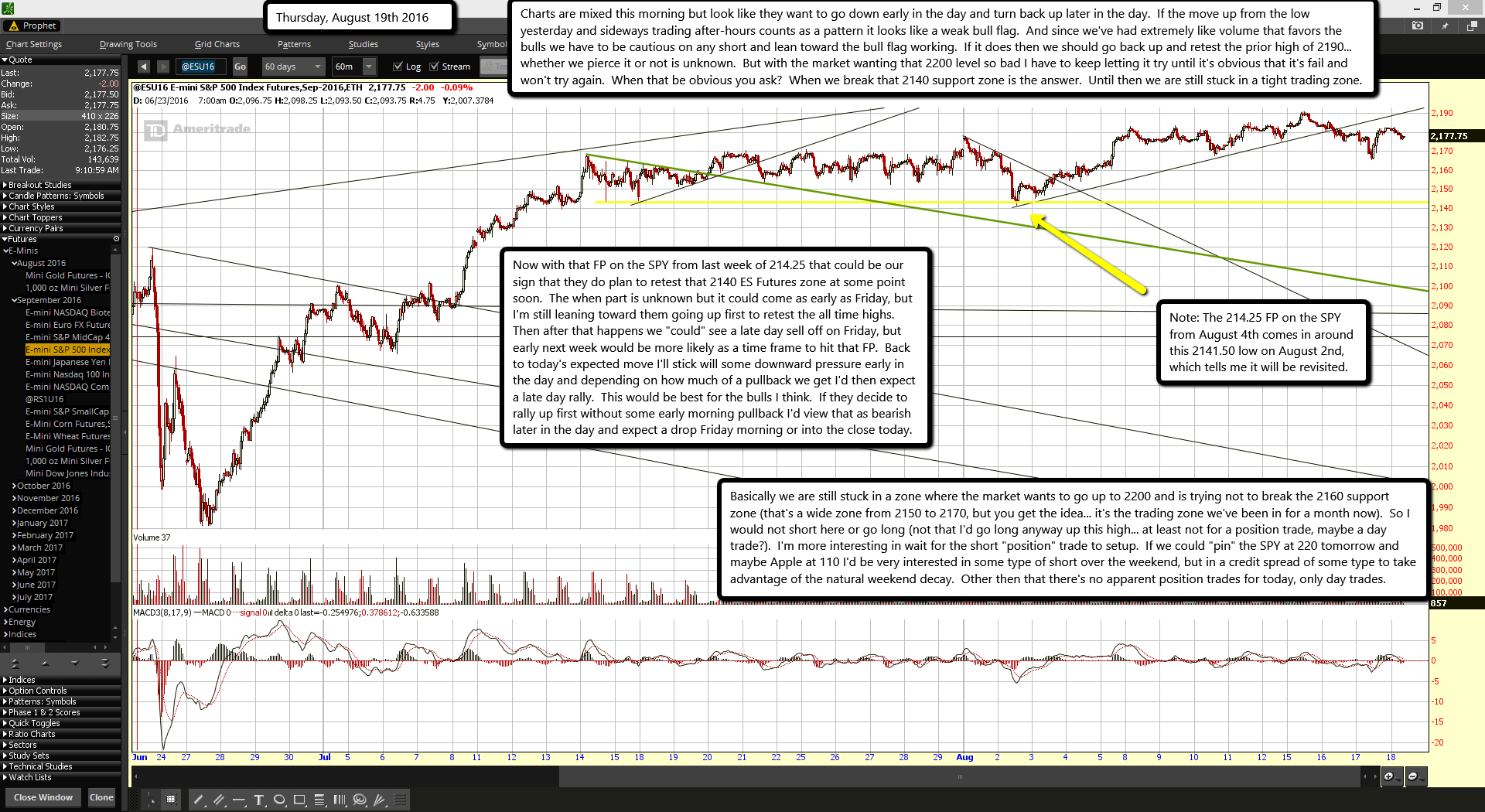
Note: The 214.25 FP on the SPY from August 4th comes in around this 2141.50 low on August 2nd, which tells me it will be revisited.

Charts are mixed this morning but look like they want to go down early in the day and turn back up later in the day.  If the move up from the low yesterday and sideways trading after-hours counts as a pattern it looks like a weak bull flag.  And since we've had extremely like volume that favors the bulls we have to be cautious on any short and lean toward the bull flag working.  If it does then we should go back up and retest the prior high of 2190... whether we pierce it or not is unknown.  But with the market wanting that 2200 level so bad I have to keep letting it try until it's obvious that it's fail and won't try again.  When that be obvious you ask?  When we break that 2140 support zone is the answer.  Until then we are still stuck in a tight trading zone.

Now with that FP on the SPY from last week of 214.25 that could be our sign that they do plan to retest that 2140 ES Futures zone at some point soon.  The when part is unknown but it could come as early as Friday, but I'm still leaning toward them going up first to retest the all time highs.  Then after that happens we "could" see a late day sell off on Friday, but early next week would be more likely as a time frame to hit that FP.  Back to today's expected move I'll stick will some downward pressure early in the day and depending on how much of a pullback we get I'd then expect a late day rally.  This would be best for the bulls I think.  If they decide to rally up first without some early morning pullback I'd view that as bearish later in the day and expect a drop Friday morning or into the close today.

Basically we are still stuck in a zone where the market wants to go up to 2200 and is trying not to break the 2160 support zone (that's a wide zone from 2150 to 2170, but you get the idea... it's the trading zone we've been in for a month now).  So I would not short here or go long (not that I'd go long anyway up this high... at least not for a position trade, maybe a day trade?).  I'm more interesting in wait for the short "position" trade to setup.  If we could "pin" the SPY at 220 tomorrow and maybe Apple at 110 I'd be very interested in some type of short over the weekend, but in a credit spread of some type to take advantage of the natural weekend decay.  Other then that there's no apparent position trades for today, only day trades.

Soros sent an email to Hillary Clinton about Albania..Clinton did exactly what she was told

0

c48f224888efd83a470a9b3f11aa38d6_XL

download


no text required..just read it..what he demands..and what occurs..but we are the crazy ones to discuss conspiracies involving soros..

Target cuts outlook as it sees fewer customers in stores

0
The Associated Press

This Wednesday, June 29, 2016, photo shows a Target store in Hialeah, Fla. Target reports financial results Wednesday, Aug. 17.

NEW YORK (AP) — Target Corp. cut its profit forecast and a key sales outlook Wednesday as it saw fewer customers in its stores and acknowledged it didn't push the second part of its "Expect More, Pay Less" slogan.

The Minneapolis-based discounter's second-quarter net income fell nearly 10 percent, though that was better than what most had expected. Sales at stores open at least a year fell 1.1 percent, reversing seven straight quarters of gains.

Target's shares fell nearly 7 percent in morning trading.

Customer traffic fell for the first time in a year and a half. The company attributed that to it falling short on the "Pay Less" position, turning off shoppers looking for essentials like detergent or basic T-shirts. Target also cited issues in the quarter that were both company-specific and industrywide. They ranged from a lack of new products in its electronics area to disappointing business in perishables like fruits and vegetables and disruptions caused by its sale of its pharmacy business to CVS. The deal was completed in December of 2015.

Target also saw a wide variability in sales by markets, noting weakness on the East Coast but pockets of strength in parts of California.

"Our No. 1 focus is driving traffic back to our stores and accelerating business to our site," Chief Executive Brian Cornell told analysts on a conference call.

To boost sales and traffic, Target plans to increase marketing for its essentials and work with key vendors like Apple to push more innovation and to also improve presentations. In the pharmacy areas, it's working with the pharmacists to have them play a key role in the departments. It's still trying to reinvent its food area.

Target is also developing specific marketing plans to address key regional areas that have seen slower sales. And it's expanding its online services — doubling the number of stores that will be used to ship products directly to online shoppers' homes, which will result in speedier deliveries. Online sales rose 16 percent in the second quarter, lower than the 23 percent gain in the first quarter.

"Our progress in apparel and home has been really significant," said Cornell. "And we've got to make sure we never lose track of the other side of our brand promise and that's the "Pay Less" side. And that's all about those core household essentials that we have to make sure are presented effectively."

The quarter underscores challenges Target and other retailers face from Amazon and shoppers who remain somewhat cautious.

Target has been trying to reinvigorate itself under Cornell. He wants to restore the retailer's cheap-chic status and make Target more nimble after a series of headline-grabbing setbacks, including a pre-Christmas 2013 debit and credit card breach that hurt sales and profits for months. But striking the balance between offering stylish clothing and bedspreads while cultivating the perception that it's also a place to buy toothpaste and detergent at a good price is tricky.

Under Cornell, Target is focusing on categories like fashion, home furnishings and wellness products. The company has spruced up its presentation and created vignettes to feature its home products. Target is also creating new brands such as Cat & Jack, a children's clothing that is expected to generate annual sales of $1 billion. The collection hit stores this summer in time for the crucial back-to-school season.

It's also trying to reinvigorate grocery sales, which represent about 20 percent of its total business. It's marketing more organic, natural or gluten-free products. Target's nonperishable items have been doing well, but it's still having trouble getting shoppers to pick up fruits and vegetables, according to analysts.

Target's electronics department was a "significant drag," Cornell said. Apple product sales were down 20 percent in the quarter.

The company now expects earnings this year in the range of $4.80 to $5.20 per share, lower than the $5.20 to $5.40 it had projected earlier. Same-stores sales could fall as much as 2 percent in the second half of the year, Target said.

Net income for the quarter was $680 million, or $1.16 per share. That compares with $753 million, or $1.18 per share, in the year-ago quarter. Adjusted per-share earnings were $1.23, beating projections of $1.14 from Wall Street, according to a survey by Zacks Investment Research. Revenue fell 7 percent to $16.2 billion.

Shares fell $4.95 to $70.53 in morning trading Wednesday.

Trump shakes up campaign, names combative news executive in senior role

0

Republican U.S. presidential nominee Donald Trump holds a campaign rally at the Ziegler Building at the Washington County Fair Park; Conference Center in West Bend, Wisconsin

WASHINGTON (Reuters) - Republican Donald Trump hired the pugnacious head of a conservative news website and promoted a woman in a shakeup of his troubled presidential campaign, an indication he is determined to maintain his combative style while honing his message to the voters who have taken him this far.

Stephen Bannon, the head of Breitbart News, the conservative website that is seen as one of the unorthodox candidate's most enthusiastic and steadfast backers, was hired to a new position of campaign CEO. Pollster Kellyanne Conway, who has been an adviser, will take on the role of campaign manager, the Trump campaign announced on Wednesday.

The shake-up comes as Trump faces criticism from many Republicans over a series of controversial statements and opinion polls show him falling behind Democratic candidate Hillary Clinton in the race for the Nov. 8 election.

Bannon's appointment suggested that Trump is aiming not so much to tone down his aggressive style but to be more disciplined in emphasizing themes that resonate strongly with the voters he is trying to court, such as his stances on immigration and criticism of Clinton.

Corey Lewandowski, Trump's former campaign manager who was ousted in June, said on CNN that Bannon was "a street fighter," like himself. The campaign statement announcing the changes touted a Bloomberg Politics article that dubbed Bannon "the most dangerous political operative in America."

Brian Walsh, a Republican strategist who has been critical of Trump in the past, said his embrace of Bannon seemed to indicate the New York businessman had no intention of changing tactics.

"He's rejecting efforts by political professionals to professionalize his campaign and he's going the route he went in the primaries: hard right. It's proven to be a disaster in the general election," Walsh said.

"Anyone who knows anything about politics would look at the current situation and realise he's losing because he's losing moderates, women and minorities. This would actually take it in the opposite direction from where it should be going."

Lewandowski said Conway, who ran a group of Super PACs backing U.S. Senator Ted Cruz's primary campaign, could help Trump with "any gender gap problems that he has."

A New Jersey-based pollster, Conway has worked in Republican polling since the 1980s, including for former House Speaker Newt Gingrich’s unsuccessful presidential campaign. She also worked for vice presidential nominee Mike Pence in his earlier races.

Conway, who presents conservative viewpoints in frequent appearances on political talk shows, has worked to improve the Republican Party's standing with women voters and to push back on the Democratic accusations that Republicans are waging a "war on women."

Conway and Bannon may prove to be opposing forces in Trump’s campaign. Conway is analytical and numbers-driven and often offers a more pragmatic approach to winning campaigns. Bannon is brash and bombastic, likes to push the limits of polite conversation and revels in taking the fight up a notch.

'WHATEVER IT TAKES'

Trump, a former reality TV star who has never held elected office, drew criticism for comments insulting women, Muslims and Mexican immigrants during the campaign for the Republican White House nomination, which he formally secured last month.

Since then, he has faced a barrage of criticism from Republicans over his freewheeling campaign style and his refusal to stick to a policy message.

In particular, he has been rebuked for his prolonged feud with the family of a Muslim U.S. Army captain who was killed in the Iraq war, and for his unfounded accusation that President Barack Obama and Clinton were the co-founders of the Islamic State militant group. Trump later backed off the comments about Islamic State.

The campaign's announcement on Wednesday quoted Trump as saying he was “committed to doing whatever it takes to win” the election. The campaign also said it would make its first major television commercial purchase later this week.

The staff changes, first reported in the Wall Street Journal, are the second time in two months that Trump has shifted his campaign's leadership. In June, he fired longtime aide Lewandowski as campaign manager and handed more power to senior campaign aide Paul Manafort.

The statement from the Trump campaign said Manafort would remain as campaign chairman and chief strategist.

Manafort drew unwelcome attention to the campaign this week when the New York Times reported that Manafort's name was on secret ledgers showing cash payments designated to him of more than $12 million from a Ukrainian political party with close ties to Russia. Manafort denied any impropriety on Monday.

Ukrainian officials confirmed Manafort's name appeared on a ledger and that more than $12 million had been allocated as an expenditure, but added that the presence of his name did not mean he received the funds.

Bannon, a former Goldman Sachs <GS.N> banker who also served in the U.S. Navy, came under criticism as not supporting Michelle Fields, a reporter who said she was grabbed and bruised by Lewandowski at a March campaign event in Florida. Lewandowski was charged with battery but the charge was later dropped.

Ben Shapiro, a Breitbart editor who resigned from the organisation along with Fields, called Bannon a bully who sold out to "another bully, Donald Trump," to protect Trump's man.

John Feehery, a Republican strategist, said Conway may be able to help Trump among women voters.

"Trump's biggest problem is the women vote. Women can't stand him. I think Kellyanne can help message to that demographic.”

ES Morning Update August 17th 2016

0

333b4a26-e98b-4c4c-9628-1f7a641da0f2

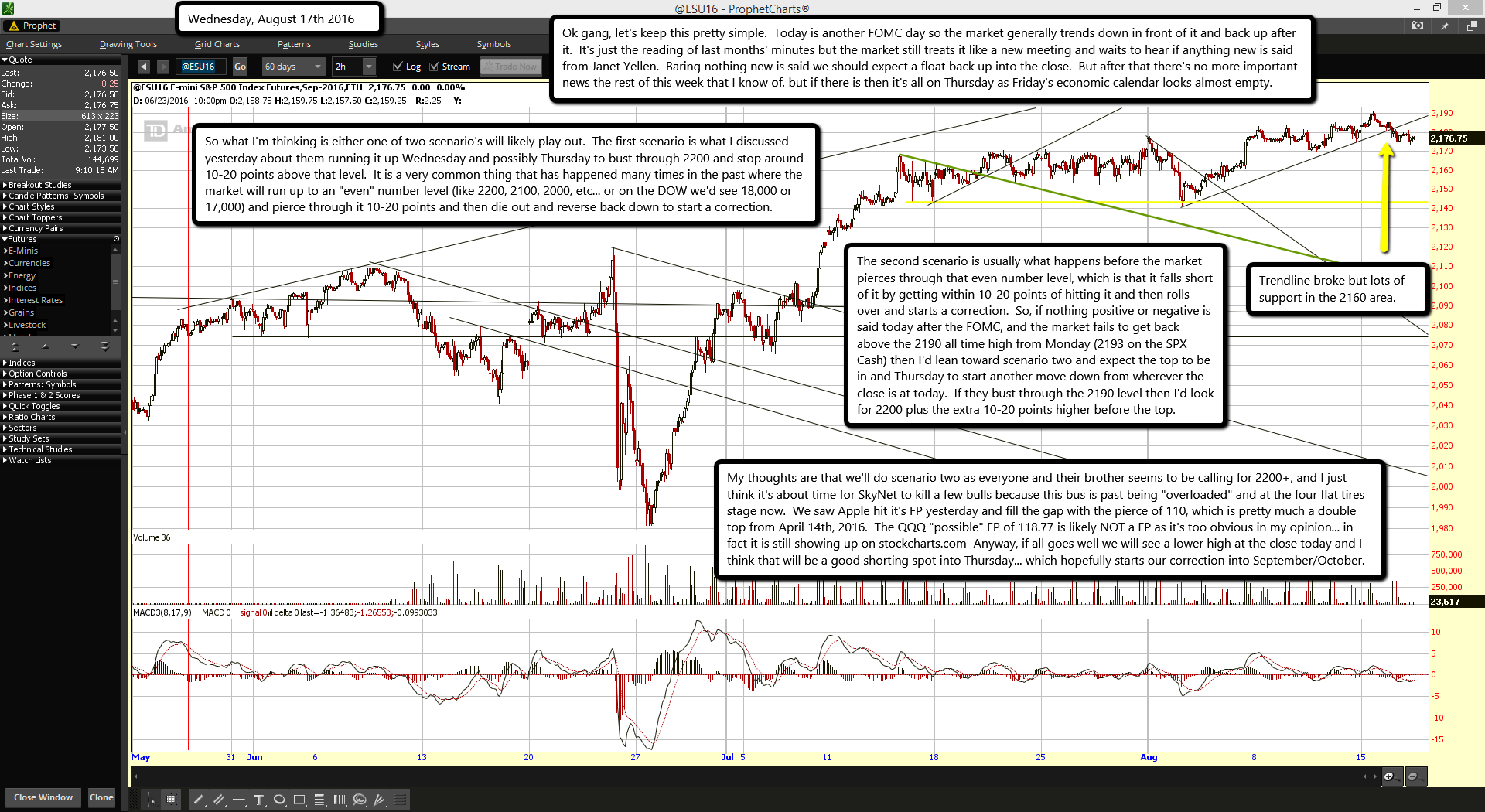
Trendline broke but lots of support in the 2160 area.

Ok gang, let's keep this pretty simple.  Today is another FOMC day so the market generally trends down in front of it and back up after it.  It's just the reading of last months' minutes but the market still treats it like a new meeting and waits to hear if anything new is said from Janet Yellen.  Baring nothing new is said we should expect a float back up into the close.  But after that there's no more important news the rest of this week that I know of, but if there is then it's all on Thursday as Friday's economic calendar looks almost empty.

So what I'm thinking is either one of two scenario's will likely play out.  The first scenario is what I discussed yesterday about them running it up Wednesday and possibly Thursday to bust through 2200 and stop around 10-20 points above that level.  It is a very common thing that has happened many times in the past where the market will run up to an "even" number level (like 2200, 2100, 2000, etc... or on the DOW we'd see 18,000 or 17,000) and pierce through it 10-20 points and then die out and reverse back down to start a correction.

The second scenario is usually what happens before the market pierces through that even number level, which is that it falls short of it by getting within 10-20 points of hitting it and then rolls over and starts a correction.  So, if nothing positive or negative is said today after the FOMC, and the market fails to get back above the 2190 all time high from Monday (2193 on the SPX Cash) then I'd lean toward scenario two and expect the top to be in and Thursday to start another move down from wherever the close is at today.  If they bust through the 2190 level then I'd look for 2200 plus the extra 10-20 points higher before the top.

My thoughts are that we'll do scenario two as everyone and their brother seems to be calling for 2200+, and I just think it's about time for SkyNet to kill a few bulls because this bus is past being "overloaded" and at the four flat tires stage now.  We saw Apple hit it's FP yesterday and fill the gap with the pierce of 110, which is pretty much a double top from April 14th, 2016.  The QQQ "possible" FP of 118.77 is likely NOT a FP as it's too obvious in my opinion... in fact it is still showing up on stockcharts.com  Anyway, if all goes well we will see a lower high at the close today and I think that will be a good shorting spot into Thursday... which hopefully starts our correction into September/October.

Macy’s is closing another 100 stores

0

MACYS

In a sign of how dramatically the retail shopping landscape is changing, Macy's is closing 100 of its stores nationwide.

Macy's announced the closures Thursday. They represent about 15% of all Macy's department stores. The iconic retailer did not disclose the locations of stores, but said most of them will be shut down in early 2017.

The Macy's move is the latest in a wave of store closures amid the rise and success of Amazon and other online shopping options.

For instance, Walmart announced plans in January to shut down 269 stores this year and just this week, inked a $3.3 billion deal to acquire Amazon rival Jet.com.

Sports Authority, once the nation's largest sporting goods retailer, is shutting all 450 of its stores after filing for bankruptcy. Other traditional retailers such as Target, JC Penney,Kmart, Sears and Kohl's have also pulled the plug on hundreds of stores in recent months.

It's a grim picture for retail store workers -- there have been around 44,000 retail layoffs announced so far this year alone, according to Challenger, Gray & Christmas data. Walmart's closures alone impacted 16,000 workers.

Macy's closures come amid a sixth-straight quarterly decline in sales. However, sales fell less than feared and the company said it's "encouraged" by recent sales trends. Wall Street applauded the dramatic store closures, sending the stock surging 17%, its best day since 2008.

Macy's said its new strategy is to concentrate its financial firepower and talent on its best-performing locations. The department store plans to invest in strong stores by highlighting new vendors, increasing the size and quality of its staff and investing in new technology.

"We operate in a fast-changing world, and our company is moving forward decisively to build further on Macy's heritage," Macy's CEO Terry Lundgren said in a statement.

Macy's said the store closures could result in the loss of about $1 billion in sales, even after accounting for shoppers who would go online and to other Macy's locations. The company plans to offset that loss in sales by cutting costs, even beyond shutting down these stores.

It's not clear how many jobs will be impacted by these moves. Macy's told CNNMoney it won't detail layoffs until it finalizes its store closure list.

Macy's said employees at stores slated for closure may be offered positions in nearby stores "where possible," Macy's said. Workers who are laid off will be offered severance benefits.

"Macy's is committed to treating associates affected by store closings with respect and openness," the company said.

Karen Hoguet, Macy's chief financial officer, said most of the stores being closed are "underperformers, or are in weak locations."

The Macy's move is the latest blow to malls, many of which rely on the iconic department store to serve as an "anchor" tenant. Those malls impacted risk losing a major source of revenue and a suffering a traffic slowdown in traffic that is likely to hurt other stores. Struggles for other department stores make filling the hole left by Macy's even more challenging.

Shares of major mall owners General Growth Properties(GGP) and Simon Property Group (SPG)slumped 3% and 2%, respectively, on Thursday.

Even some premiere Macy's locations could eventually be scaled back. The company said it continues to "analyze possibilities" of bringing in alternative tenants into its flagship Herald Square location in Manhattan as well as the downtown stores in Chicago and Minneapolis. Macy's revealed it's also in talks to sell its Men's Store on Union Square in San Francisco for redevelopment.

Neil Saunders, CEO of research firm Conlumino, said the Macy's store closures are "sensible," but largely the result of a "self-inflicted defeat."

"Macy's has simply not bothered with a large rump of stores for many years: they have lacked investment, been devoid of management attention, and now look distressed and dispirited," Saunders wrote in a report.

The key will be whether Macy's is truly committed to rejuvenating its remaining stores in a way that gives consumers a reason to shop in person rather than online.

Soros hacked, thousands of Open Society Foundations files released online

0

Business magnate George Soros

More than 2,500 files from the raft of organizations run by billionaire George Soros have been leaked by hackers.

Saturday’s leak, published by DC leaks, includes hundreds of internal documents from multiple departments of Soros’ groups, predominantly the Open Society Foundations.

The files are grouped into sections such as geographical region, the World Bank and the President’s Office, and cover the period from 2008 up until 2016, according to The Daily Caller.

They reveal work plans, strategies, priorities and other activities by Soros, and include reports on European elections, migration and asylum in Europe.

DC Leaks claims to be the work of American activists who want to present the truth about the “US decision-making process as well as about the key elements of American political life.”

US security experts however are blaming the leak on Russian hackers, according to Bloomberg, in a similar reaction seen in the wake of the DNC leaks.

The DC Leaks hackers previously released data from the Open Society Foundations in June, a breach that was reported to the FBI, according to spokeswoman Laura Silber. She said an investigation by a security firm found the intrusion was limited to an intranet system used by board members, staff and foundation partners.

DC Leaks also revealed emails from former NATO general Philip Breedlove which showed he tried to provoke President Obama to start US conflict  against Russia. Breedlove claimed to CNN in July that the emails were stolen as part of a state-sponsored intelligence operation.

An email leaked by WikiLeaks earlier this week showed Soros had advised Hillary Clinton during her tenure as Secretary of State on how to handle unrest in Albania – advice she acted on.

Soros’ Open Society Foundations provides funding to the International Consortium for Investigative Journalists, which came under the spotlight earlier this year after the release of the Panama Papers, which included millions of records from law firm Mossack Fonseca showing how the wealthy are using tax havens.

The Panama Papers leak came under criticism from WikiLeaks, who claimed the US government and Soros funded the project to attack Russia and President Vladimir Putin.

ES Morning Update August 16th 2016

0

99d40613-1e7b-4515-89e2-9932a7c47115

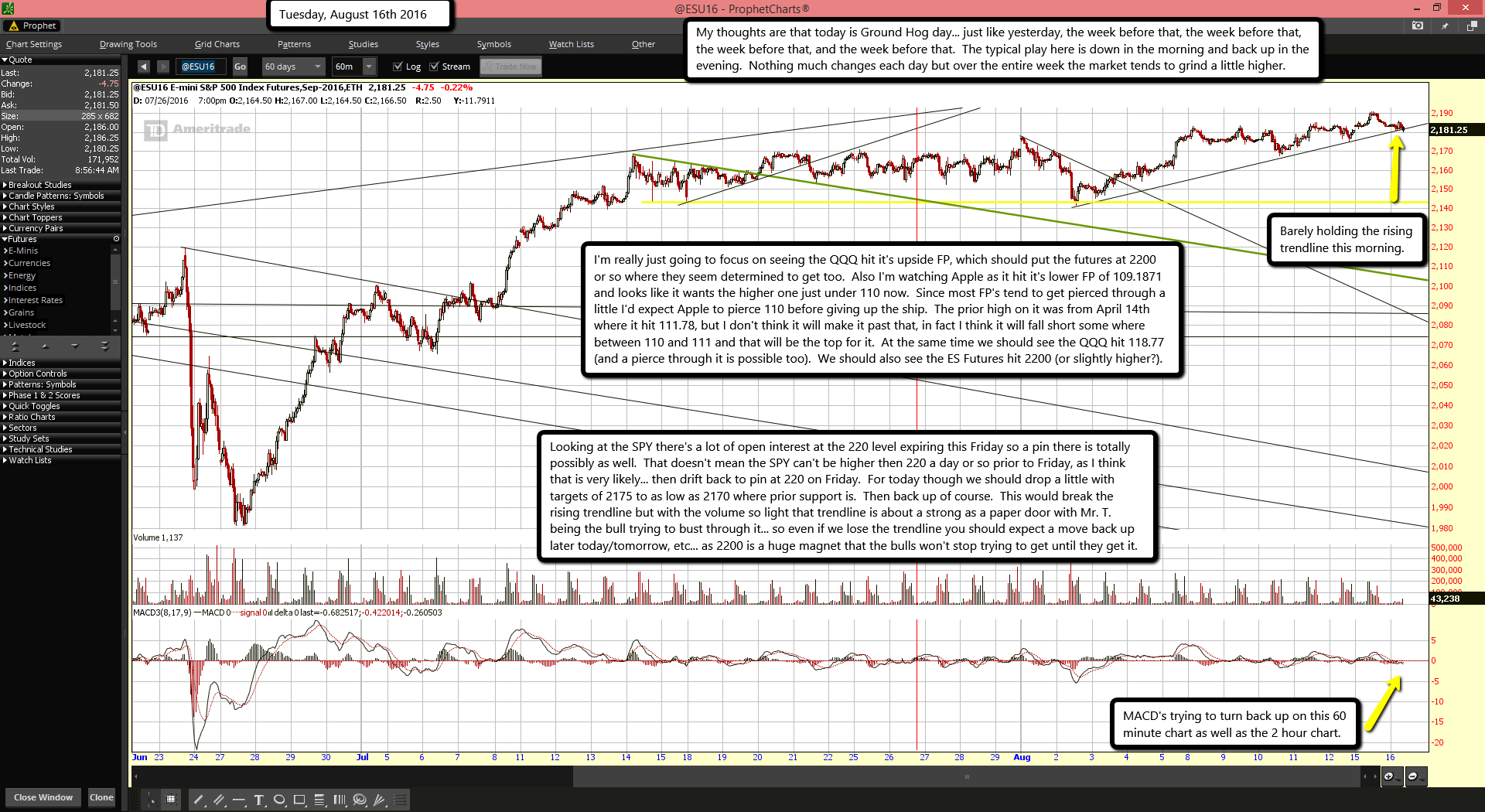
Barely holding the rising trendline this morning.

MACD's trying to turn back up on this 60 minute chart as well as the 2 hour chart.

My thoughts are that today is Ground Hog day... just like yesterday, the week before that, the week before that, the week before that, and the week before that.  The typical play here is down in the morning and back up in the evening.  Nothing much changes each day but over the entire week the market tends to grind a little higher.

I'm really just going to focus on seeing the QQQ hit it's upside FP, which should put the futures at 2200 or so where they seem determined to get too.  Also I'm watching Apple as it hit it's lower FP of 109.1871 and looks like it wants the higher one just under 110 now.  Since most FP's tend to get pierced through a little I'd expect Apple to pierce 110 before giving up the ship.  The prior high on it was from April 14th where it hit 111.78, but I don't think it will make it past that, in fact I think it will fall short some where between 110 and 111 and that will be the top for it.  At the same time we should see the QQQ hit 118.77 (and a pierce through it is possible too).  We should also see the ES Futures hit 2200 (or slightly higher?).

Looking at the SPY there's a lot of open interest at the 220 level expiring this Friday so a pin there is totally possibly as well.  That doesn't mean the SPY can't be higher then 220 a day or so prior to Friday, as I think that is very likely... then drift back to pin at 220 on Friday.  For today though we should drop a little with targets of 2175 to as low as 2170 where prior support is.  Then back up of course.  This would break the rising trendline but with the volume so light that trendline is about a strong as a paper door with Mr. T. being the bull trying to bust through it... so even if we lose the trendline you should expect a move back up later today/tomorrow, etc... as 2200 is a huge magnet that the bulls won't stop trying to get until they get it.

BBC: Can Hillary Clinton give a straight answer on emails?

0

_90619057_gettyimages-584669890

Despite all the Trump-related good fortune that has been showered on Hillary Clinton over the past week, there has been a bit of a dark lining on her silver cloud. She still can’t seem to come up with an effective response to questions surrounding her use of a private email server while secretary of state.

On Sunday Mrs Clinton gave her first television interview since accepting the Democratic nomination last week. Perhaps as part of her strategy to reach out to disaffected Republicans, she chose to appear in that bastion of conservatism, Fox News, for the first time in five years.

Not surprisingly, it didn’t take long for the email topic to come up.

When host Chris Wallace asked the Democrat if she was being truthful to the American people when she said that she did not send classified emails on her personal account, Mrs Clinton cited FBI Director James Comey’s public state mention the investigation into the matter as corroboration.

“Director Comey said my answers were truthful, and what I’ve said is consistent with what I have told the American people, that there were decisions discussed and made to classify retroactively certain of the emails,” she said.

FBI Director James Comey testifies before congresson on his investigation into Hillary Clinton's private email server.
FBI Director James Comey has declined to comment on whether Hillary Clinton lied to the American people about classified material on her email server

Comey’s “truthful” description only applied to Mrs Clinton’s conversations with the FBI, however – not her public statements. According to the FBI’s findings, Mrs Clinton did indeed send emails that contained information that were classified at the time of transmission – a few of which contained “top secret” information.

Mrs Clinton also appeared to direct some of the blame for the whole imbroglio to her subordinates. After acknowledging that she “made a mistake” not using separate email addresses for personal and work messages, she said she had relied on the “judgements of the professionals” with whom she worked.

“In retrospect, maybe some people are saying, well, among those 300 people, they made the wrong call,” she said. “At the time, there was no reason in my view to doubt the professionalism and the determination by the people who work every single day on behalf of our country.”

Media fact-checkers have offered harsh reviews of Mrs Clinton’s response. The Washington Post gave it four “Pinocchios”, its lowest rating. Politifact labelled her statement “pants on fire”.

“Clinton is cherry-picking statements by Comey to preserve her narrative about the unusual setup of a private email server,” writes the Post’s Glenn Kessler. “This allows her to skate past the more disturbing findings of the FBI investigation.”

The challenge for Mrs Clinton is that to answer Wallace’s question accurately would require her to acknowledge one of two unpleasant truths.

Either she knew there was classified information on her email server and willfully tried to deceive the American people, or she wasn’t “particularly sophisticated with respect to classified information”, in the words of Comey, revealing a lack of knowledge that plays directly against the claims of hyper-competency that under gird her presidential campaign.

There’s little doubt the email controversy has had a negative effect on Mrs Clinton’s standing with the US public – particularly in surveys that ask whether she is “honest and trustworthy”.

A presidential preference tracking poll of Hillary Clinton v Donald Trump.

Following Comey’s press conference in which he announced that Mrs Clinton would not face criminal charges but was “extremely careless” in her handling of classified material, the then-presumptive nominee’s approval ratings dropped and head-to-head presidential match-ups with Donald Trump narrowed to a statistical tie.

In a mid-July poll conducted by ABC and the Washington Post, 57% of respondents said the email controversy made them “very” or “somewhat” worried about how Mrs Clinton would handle presidential responsibilities if she were elected.

A CNN poll found Mrs Clinton’s favor-ability ratings dropped from 48% favorable on 1 May to only 39% on 24 July.

Her numbers have rebounded somewhat, thanks in part to a successful Democratic National Convention and Mr Trump’s smorgasbord of controversial statements and questionable campaign moves.

The matter is far from resolved, however, given that the State Department has reopened its investigation into whether Mrs Clinton or her aides violated government policy and should receive some form of sanction. Before too long, the Democratic nominee may once again be called onto offer an explanation for her actions under the glare of the national media spotlight.

The matter is far from resolved, however, given that the State Department has reopened its investigation into whether Mrs Clinton or her aides violated government policy and should receive some form of sanction. Before too long, the Democratic nominee may once again be called onto offer an explanation for her actions under the glare of the national media spotlight.

Donald Trump speaks at a rally in Ashburn, Virginia.
Donald Trump's ongoing controversies are burying any fallout from Hillary Clinton's Fox News interview on Sunday

Until Mrs Clinton finds a way to answer questions about her email server without making statements that blame-shift, appear nakedly evasive or are easily debunked by fact-checkers, her campaign will continue to have a glaring soft spot.

Maybe Mr Trump will be able to refocus and exploit the weakness. Maybe he won't. But even if Mrs Clinton prevails in November, she will need a base level of support and trust from the American people to govern effectively.

At least at this point, there's no guarantee that she'll have it.

Why China’s Plan to Build a Nautical Silk Road Runs Through Singapore

0

Nautical Silk RoadAs the son of a man who journeyed from China to Singapore and founded a shipping business a half century ago, Teo Siong Seng sees his life as one immersed in the ancient trading networks of Asia.

So the managing director of the Pacific International Lines Group is seeking to benefit as China rejuvenates its Silk Road routes to the Middle East and Europe. He is setting up a joint venture with China Cosco Shipping Corporation Ltd. to help China’s largest shipping group build connections in Southeast Asia and beyond.

“Chinese companies alone may not have enough experience to carry out their investments in other countries,” said Teo, who’s also chairman of the Singapore Business Federation. “To cooperate with companies like us would also make their businesses smoother. They have to learn the way we deal with local people and the way we do business.”

Two people watch the Singapore-flagged Clemens Schulte cargo ship as it arrives in Dar es Salaam, Tanzania, on August 27, 2015. The 255 metre long container ship is the longest vessel to have ever berthed at Dar es Salaam's port. Clemens Schulte is expected to discharge 250 containers and load 1,300 containers at the port. Dar es Salaam port is undergoing a transformation to improve its physical infrastructural capacity and enhance operational efficiency. AFP PHOTO / DANIEL HAYDUK        (Photo credit should read Daniel Hayduk/AFP/Getty Images)
Two people watch the Singapore-flagged Clemens Schulte cargo ship as it arrives in Dar es Salaam, Tanzania, on August 27, 2015. The 255 metre long container ship is the longest vessel to have ever berthed at Dar es Salaam’s port. Clemens Schulte is expected to discharge 250 containers and load 1,300 containers at the port. Dar es Salaam port is undergoing a transformation to improve its physical infrastructural capacity and enhance operational efficiency. AFP PHOTO / DANIEL HAYDUK (via Bloomberg)

The venture underscores Singapore’s potential as a gateway to Southeast Asia for China as President Xi Jinping seeks to export excess industrial capacity while building influence overseas.

Lured by shared cultural bonds and the former British colony’s legal and financial systems, the number of Chinese companies registered locally has almost doubled in the past five years to more than 7,500.

Exploiting Singapore’s regional familiarity could help Chinese companies navigate local politics complicated by tensions over China’s territorial claims in the South China Sea. It could also help them avoid pitfalls from prior investment in Africa and Latin America, where China has faced criticism at times for a heavy-handed approach, insisting for example its companies and laborers carry out the bulk of a contract.

“From all the failures, Chinese have learned that they need a local broker,” said Gao Zhikai, a board member of coking coal distributor Winsway Enterprises Holdings and former vice president of crude oil giant CNOOC Ltd. “Chinese companies believe Singapore companies are easier to deal with and they know how to deal with different markets.”

Xi is offering vasts amounts of money to Southeast Asia for infrastructure projects for the maritime portion of his revitalized Silk Road. Combined with an overland route through Eurasia, the project is known as “One Belt, One Road.”

For Beijing, the project is a solution to the industrial overcapacity that has built up in many sectors. It’s also the economic carrot of Xi’s push to make China a regional power and challenge decades of U.S. dominance in Asia. Greater trade and investment could blunt concern over the country’s military expansion and its territorial ambitions.

Investment company Fosun International — one of the largest private groups in China — set up its Southeast Asian headquarters in Singapore last year. “Chinese companies have to pick the right platform and springboard before making an international move, and Singapore is a very good choice,” said chief executive officer Liang Xinjun.

China’s relations with Southeast Asia are deeply rooted in history and the region’s trading culture.

Some Chinese Singaporeans, like Teo’s father, migrated from Chinese provinces like Fujian during the second Sino-Japanese War in the 1930s, and ethnic Chinese traders had been plying routes in the area for centuries before.

China has looked to Singapore before: The country in late 2015 hosted the first summit between Taiwan and China in seven decades, while late leader Lee Kuan Yew was seen as a regional voice of counsel on China relations. Many Chinese officials tread a path each year to Singapore to study its political model.

Singapore has the largest ethnic Chinese population in the region, at nearly 75 percent, and is China’s largest foreign investor. More than 20 percent of its gross domestic product is linked to China, according to Natixis SA.

Chinese business flowing through Singapore could help as its economy faces what could be its slowest-growth year since the global financial crisis, hurt by a slowdown in trade, weak commodity prices and job cuts in the banking industry.

Still, while Southeast Asian nations are hungry for infrastructure funds to meet the demands of their growing populations, China shouldn’t expect an unconditional open door.

‘More Cautious’

“Many countries in Southeast Asia are becoming more cautious when dealing with Chinese companies, which have a relatively bad track record in implementing deals over the past decade,” said Winsway’s Gao, who is also director of the China National Association of International Studies.

“Given the growing tensions over the South China Sea, Chinese firms have to be even more careful in putting the deals in practice,” Gao said. “Even a small mistake could cause a major negative reaction.”

China may look to Singapore to help smooth over the territorial frictions it has with some Southeast Asian nations. The U.S. navy uses Singapore as a gateway to the South China Sea for its ships and surveillance planes, and Singapore has called on China to tread carefully.

On a company level, there is progress. Singapore’s Ascendas-Singbridge Group created a joint venture last year with China Machinery Engineering Corporation to invest in industrial and technology parks in Asia. Ascendas-Singbridge Chief Customer Solutions Officer Aylwin Tan said the venture expects to announce its first project within six months.

“We find that trust is the most important element in the Chinese business culture,” Tan said by e-mail. “Singaporeans can better appreciate the Chinese culture, and understand the spoken and unspoken rules of doing business in China.”

Still, there will be difficulties ahead, according to Bernard Chan, president of Asia Financial, an investment holding company. Some nations in the region have relatively opaque — and complex — regulatory and financial reporting systems that can be harder for outsiders to navigate.

Also, China companies in some cases “have absolutely no clue of what they are buying, but they have to buy,” said Chan. “It looks like a recycling of what happened 20 years ago to the Japanese. Hopefully Chinese companies could learn from them and minimize the mistakes. But I’m sure they will walk through that cycle once again.”

Distressed Assets Pile Up at Life Insurers, and More Are Coming

0

North American life insurers have accidentally doubled their distressed-debt holdings in just six months. In the future, they are poised to build on that mound by design.

Companies including Prudential Financial Inc. and MetLife Inc. held $1.32 billion of bonds that were in default, or close to it, at the end of the second quarter, their highest level since the middle of 2011, according to Bloomberg Intelligence data.

They did not intend to buy distressed debt: In many cases they bought investment-grade bonds from energy drillers and retailers that ended up heading south. Insurance companies’ trouble with these bonds underscores how even conservative investors have been hurt by plunging oil prices.

In the coming years, the companies are likely to buy more risky junk debt, said David Havens, a bond analyst covering insurers at brokerage Imperial Capital. For one thing, they need the income as central banks globally keep bond yields low, cratering investment returns for the industry. Also, proposed regulatory changes may make it cheaper for insurers to own the bonds, he said.

"They don’t really have a lot of alternatives to buying this stuff in this environment," Havens said on the telephone in an interview. While insurers are unlikely to buy more distressed bonds, they will probably buy more junk-rated debt that is at least four steps below investment grade, he said. That debt is more likely to fall to distressed levels when the credit cycle changes for the worse.

Energy bonds looked fairly safe to many insurers because oil and gas companies had high levels of assets relative to their debt, according to Mike Collins, a portfolio manager at Prudential’s fixed income unit, which oversees $652 billion for external investors. But as oil prices have plunged, so has the value of the assets, and the bonds have proven to be far riskier than they appeared, Collins said. He was speaking generally and not about Prudential in particular.

“I don’t think anybody expected oil to fall as much as it did,” Collins said, referring to the price of a barrel of oil, which plunged from more than $100 in 2014 to less than $26 in February. “That caught a lot of people by surprise, and a lot of companies have gone from looking like they’re in great shape to distressed very quickly."

Prudential Financial held $535 million of distressed debt measured by fair value in the second quarter, the most of any insurer in the peer group tracked by Bloomberg Intelligence in absolute terms but less than one tenth of a percent of its overall assets. The company had $383 million of distressed bonds at the end of 2015.

Still Cautious

Distressed bonds are a small percentage of most life insurers’ investments, accounting for less than a tenth of a percent of the industry’s assets, and the companies can hold onto them for a long time, giving them leeway to work out difficulties and recover as much money as possible. The firms are refraining from taking excessive risk now, said Peter Wirtala, a strategist at Asset Allocation & Management Co., which manages $17.9 billion for about 100 insurance clients.

"Even as urgently as everyone needs yield, they’ve been cautious on the asset front," Wirtala said.

Still, distressed assets are likely to keep piling up at insurers as the price of oil remains around $40 a barrel, said Sasha Kamper, a senior research analyst focusing on distressed holdings at Principal Financial Group Inc.’s asset manager.

"We are near the peak of the credit cycle, and we will expect to see increased defaults going forward," Kamper said.

S&P Global Ratings said on Thursday that 111 companies globally have defaulted so far this year, the highest number since 2009, during the financial crisis. Energy and natural resources account for about 53 percent of those defaults.

Even if distressed holdings are largely accidental now, regulators are considering proposals that could ease the amount of capital life insurers can use to fund junk bonds, which makes it more profitable for the companies to increase their investment risk. Life insurance companies are seeking more income as low bond yields globally corrode their investment returns.

Under current rules from the National Association of Insurance Commissioners, which sets standards for the U.S. industry, a bond with a rating four steps below junk needs to be funded with capital equal to at least 10 percent of the bond’s value before taxes. The NAIC is considering a proposal to lower that to around 6 percent.

Investors are likely to respond by buying more speculative-grade bonds, said AAM strategist Wirtala. They will probably also buy more investment-grade bonds with ratings close to the top of the spectrum, which can be funded with less capital, he said. The higher-quality assets can offset the lower quality ones from a capital use standpoint, he said.

"This is really something we’re telling people to keep an eye on," Wirtala said.

s2Member®