Friday, September 25, 2026
Home Blog Page 83

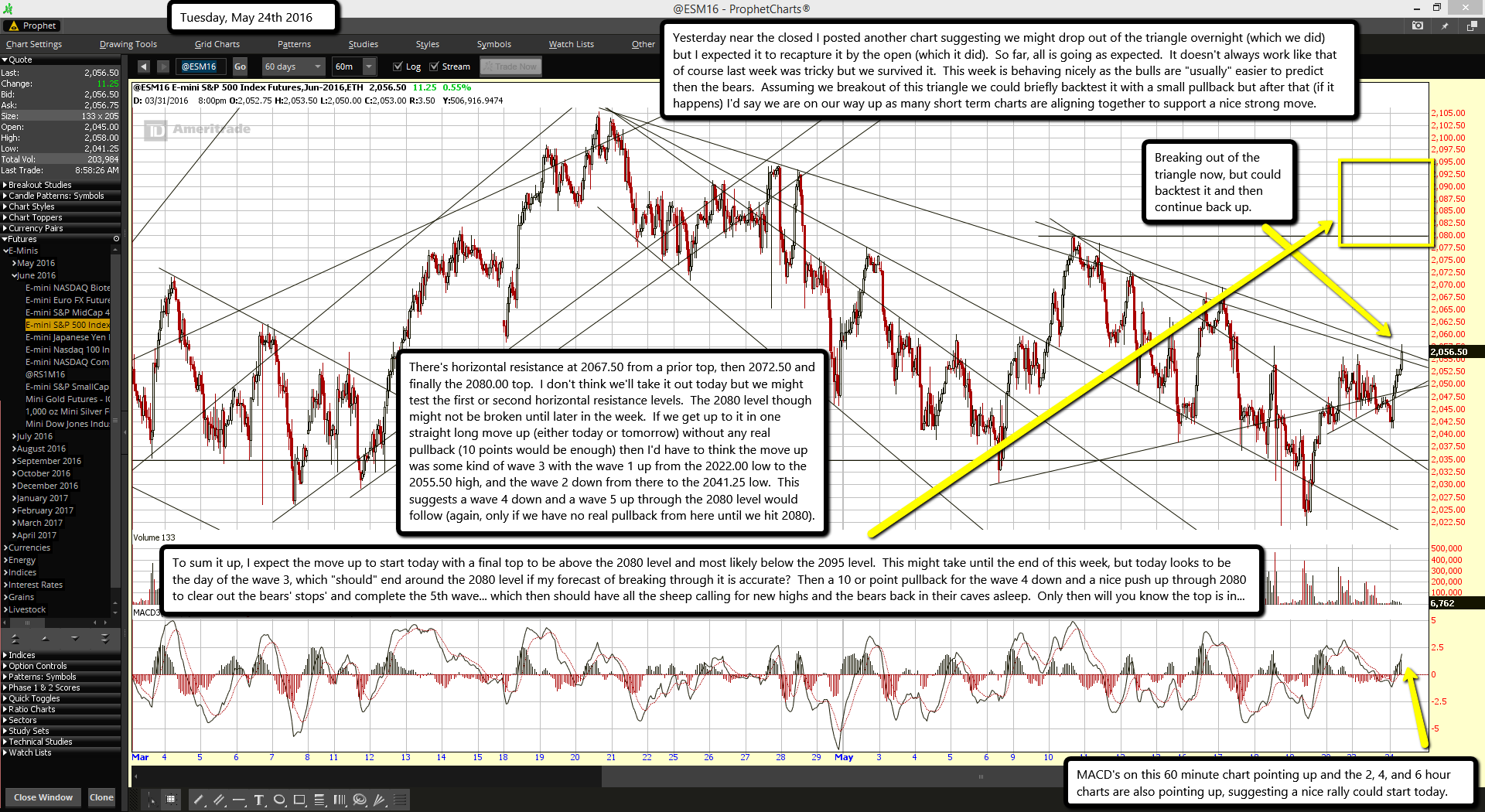
ES Morning Update May 24th 2016

0

81750d89-fa0e-482d-8c9c-d871b1a8b21f

Breaking out of the triangle now, but could backtest it and then continue back up.

MACD's on this 60 minute chart pointing up and the 2, 4, and 6 hour charts are also pointing up, suggesting a nice rally could start today.

Yesterday near the closed I posted another chart suggesting we might drop out of the triangle overnight (which we did) but I expected it to recapture it by the open (which it did).  So far, all is going as expected.  It doesn't always work like that of course last week was tricky but we survived it.  This week is behaving nicely as the bulls are "usually" easier to predict then the bears.  Assuming we breakout of this triangle we could briefly backtest it with a small pullback but after that (if it happens) I'd say we are on our way up as many short term charts are aligning together to support a nice strong move.

There's horizontal resistance at 2067.50 from a prior top, then 2072.50 and finally the 2080.00 top.  I don't think we'll take it out today but we might test the first or second horizontal resistance levels.  The 2080 level though might not be broken until later in the week.  If we get up to it in one straight long move up (either today or tomorrow) without any real pullback (10 points would be enough) then I'd have to think the move up was some kind of wave 3 with the wave 1 up from the 2022.00 low to the 2055.50 high, and the wave 2 down from there to the 2041.25 low.  This suggests a wave 4 down and a wave 5 up through the 2080 level would follow (again, only if we have no real pullback from here until we hit 2080).

To sum it up, I expect the move up to start today with a final top to be above the 2080 level and most likely below the 2095 level.  This might take until the end of this week, but today looks to be the day of the wave 3, which "should" end around the 2080 level if my forecast of breaking through it is accurate?  Then a 10 or point pullback for the wave 4 down and a nice push up through 2080 to clear out the bears' stops' and complete the 5th wave... which then should have all the sheep calling for new highs and the bears back in their caves asleep.  Only then will you know the top is in...

Sports Authority strikes out

0

135636330545497.bMzn9uiEYomgRRRZkzVq_height640Sports Authority has officially struck out. After filing for bankruptcy protection 3 months ago, the sporting goods retailer will be shuttering all 460 of its stores, according to a court document obtained by The Associated Press.

Sports Authority had initially planned to close about 30% of its stores in a restructuring, but now plans to shut them all down. The court filing says going-out-of-business sales will start around Wednesday of this week and may continue through August.

The company reportedly intends to sell its store leases in an upcoming auction.

Online shopping presents tough competition

Sports Authority has struggled to stay afloat as more athletic-minded shoppers head to the internet for convenience, deals and discounts. In March, when the  company filed for bankruptcy and initially said it would close 140 of its brick-and-mortar stores, CEO Michael Foss blamed an increase in online shopping.

“We are taking this action so that we can continue to adapt our business to meet the changing dynamics in the retail industry,” Foss said at the time. “We intend to use the Chapter 11 process to streamline and strengthen our business both operationally and financially so that we have the financial flexibility to continue to make necessary investments in our operations.”

Sports Authority is far from the only retailer grappling with fierce competition from online shopping. Earlier this month, department store giants including Macy’s, J.C. Penney’s and Nordstrom reported dismal first quarter earnings, and sporting goods chain City Sports filed for bankruptcy last year.

Here come the closeout sales

Shoppers looking to stock up on athletic shoes, workout gear or sporting equipment should make plans to take advantage of Sports Authority's upcoming closeout sales. Currently, the retailer’s website is littered with deals advertising the chain's "biggest BOGO sale of the season" and "50% off Memorial Day deals."

But consumers should hold out a few days to take advantage of the best sales.

Source link

Lyft is testing a way to schedule rides in advance, but right now it’s only for employees

0
lyft

Lyft is going where Uber has not gone before: letting users schedule rides in advance.

But there are still lots of questions to be worked out before this is introduced to actual Lyft passengers.

The experiment will let Lyft employees schedule a ride up to 24 hours in advance. In the app, there will be an option to hail a Lyft now — the way the service is currently used — or schedule one for at least 30 minutes later.

But, the drivers themselves won't be booked in advanced. Instead, when a rider sets a ride for 1:30 p.m. for example, a normal request for a ride will go out a few minutes before.

It's a feature that many riders would love to have, but companies like Uber and Lyft have been hesitant to offer advanced-scheduling because of how it would affect surge pricing.

Lyft employs its own version of surge pricing, called Prime Time. Normally, if the demand is too high, riders are charged a multiple if they want to request and drivers are incentivized to come online.

This system could become a problem if you're trying to book in advance. Lyft wouldn't say whether it will charge its employees the higher Prime Time price when they request or when they're picked up. It's testing multiple scenarios for the best interest for its riders and drivers, a spokesperson said.

Deciding on Prime Time will matter a lot to riders in the future if they request a $20 ride only to find that the Prime Time triples it to $60. The same goes for drivers: They may not be incentivized to pick up a scheduled rider if they're paying a cheaper price because the surge pricing doesn't apply.

For now, scheduled rides is just a limited test to the company's San Francisco employees, but Lyft will have to work out the logistics of ensuring fair pay and pricing before it rolls it out to everyone else.
Source link

Germans accuse Fiat Chrysler of cheating emissions test

0

Fiat Chrysler Automobiles NV is reportedly being accused of cheating emissions testing by Germany’s Federal Motor Transport Authority.

German newspaper Bild am Sonntag on Sunday reported that testing of a Fiat model showed the emission control system shut down after 22 minutes — two minutes after the end of a standard test. Without the system, the vehicle, according to the report, released more than 10 times the permitted level of nitrogen oxide.

A Fiat Chrysler spokesman referred questions to a Feb. 2 statement that all of the company’s vehicles “do not have a mechanism to either detect that they are undergoing a bench test in a laboratory or to activate a function to operate emission controls only under laboratory testing.”

Fiat Chrysler shares on the New York Stock Exchange at about 1 p.m. were trading down 4.7 percent at $6.71 per share.

The report out of Germany follows a report from Bloomberg on Friday that the dispute between Fiat Chrysler and German regulators came to a forefront when the company “refused to meet with German Transport Minister Alexander Dobrindt to discuss findings of an emissions probe.”

Italian Minister of Infrastructure and Transport Graziano Delrio, according to a recent statement on the organization’s website, sent a letter to Dobrindt saying there would be “full and complete availability on the part of the manufacturer FCA, whose vehicles are homologated in Italy, to provide all necessary information on its emission control strategies to the competent authority.”

The Italian ministry confirmed that the dialog has to take place between the two countries, but not involve Fiat Chrysler. Under European Union rules, Italy is responsible for testing Fiat cars because the automaker’s regional operations are centered in the country.

The claims about Fiat Chrysler follow Volkswagen AG’s admission in September that it rigged software on diesel engines to pass emissions tests. U.S. regulators found the German automaker had installed the defeat devices on more than 550,000 diesel vehicles.

Mitsubishi Motors Corp. last month also acknowledged last month that it had intentionally lied about fuel economy data for some of its models since 1991, following an internal investigation.

Source link

Schlumberger (SLB) Stock Gains, Goldman: Secular Winner, Adds to ‘Conviction Buy’ List

0

NEW YORK (TheStreet) -- Schlumberger  (SLB)  shares are advancing 0.89% to $75.63 on Monday morning after Goldman Sachs issued a bullish note earlier today, saying the company is a secular winner with numerous advantages.

The firm added the oilfield services company to its "Conviction Buy" list with a price target of $94, a 29% upside.

Analysts believe Schlumberger is best positioned in the current oil market, given its exposure to regions forecasted to be incremental sources of oil supply, its technological advantage and its balance sheet.

In addition, when oil prices go up, the company usually outperforms the S&P 500. Given these catalysts, analysts have increased confidence in its future.

Separately, TheStreet Ratings currently has a "Hold" rating on the stock with a letter grade of C.

Among the primary strengths of the company is its solid financial position based on a variety of debt and liquidity measures that we have evaluated. At the same time, however, we also find weaknesses including a generally disappointing performance in the stock itself, feeble growth in the company's earnings per share and premium valuation.

Recently, TheStreet Ratings objectively rated this stock according to its "risk-adjusted" total return prospect over a 12-month investment horizon. Not based on the news in any given day, the rating may differ from Jim Cramer's view or that of this article's author.

You can view the full analysis from the report here: SLB

Source link

Atlanta gas prices rising for Memorial Day (as usual)

0

Just as you’re nearly done loading the car, here it comes again: that Memorial Day hike in the price of gasoline.

The fill-up cost hit a nine-month high a few days ago and the experts say you can expect the price to slide up a few more cents by Memorial Day.

Atlanta prices of late have tracked the national averages, and U.S. gas prices will average nearly $2.40 a gallon for Memorial Day, said Brian Milne, an energy analyst for Schneider Electric, a French company with U.S. headquarters in Boston.Atlanta gas prices rising for Memorial Day (as usual) photo

As the holiday and summer driving approach, look for higher gas prices (but lower than in years past).

Ah, but the good news: This will be the cheapest summer gasoline since 2005, said Patrick DeHaan, senior petroleum analyst for GasBuddy. “As we kick off driving season, gas prices will be nearly a dollar per gallon lower than the ten-year Memorial Day average of $3.15 per gallon.”

Gasoline in metro Atlanta is about 45 cents a gallon cheaper than it was a year ago, according to GasBuddy.

The average price in metro Atlanta [on Friday] was $2.26 a gallon, up 61 cents from the ebb of the winter, although there was at least one station still selling below $2 a gallon, according to GasBuddy.

One in four motorists are more inclined to drive somewhere this summer because of the low prices, according to a GasBuddy survey. (Last year, just 17 percent of drivers said so.)

Three out of four drivers are planning a road trip this summer, up slightly from a year ago. And more than half – 56 percent – said they will be driving at least 400 miles round trip.

Pollsters say gas prices often predict consumer moods: perhaps because gas prices are the common piece of economic information – visible to virtually all consumers every day. Rising prices can send consumer confidence into the gutter.

Moreover, because gasoline is a huge, regular – and for many, an unavoidable – expense, it is an important factor in the nation’s economic equation. Most recessions since World War II have come after gas price spikes.

Conversely, a drop in prices gives American more disposable income.

Five years ago, gas prices were their highest for the start of the summer, DeHaan said. “Nationally, we’ll be saving $2.6 billion over the long weekend this year versus the highest-priced Memorial Day weekend in 2011.”

Behind the prices along the highway, far up the distribution chain, the forces of supply and demand are pulling in various directions.

Americans have generally been driving ever-more efficient vehicles, which use less gasoline. Meanwhile, overall production – especially in the United States – has been strong, so supplies are above normal, said energy economist Wally Tyner of Purdue University.

That should push prices down. Yet the price of crude oil has nearly doubled in the past five months.

That is because production is down elsewhere: Nigeria is struggling with civil war, Venezuela with political unrest and Kuwait with labor-related stoppages.

Source link

GE says to double Saudi workforce as economy reforms

0

The logo of Dow Jones Industrial Average stock market index listed company General Electric is shown at their subsidiary company GE Aviation in Santa Ana, California April 13, 2016. REUTERS/Mike Blake Thomson ReutersThe logo of Dow Jones Industrial Average stock market index listed company General Electric DUBAI (Reuters) - Saudi Arabia won support for its economic reform plan from one of the world's biggest companies on Monday as General Electric Co (GE) said it would double its workforce in the kingdom to 4,000 people by 2020.

GE will cooperate with the government's Saudi Arabian Industrial Investments Co (SAIIC) to develop joint ventures that boost Saudi industrial capacity, chief executive Jeffrey Immelt said in a statement during a visit to the kingdom.

SAIIC was established in 2014 with capital of 2 billion riyals ($533 million) as a venture between some of the country's most powerful institutions: the Public Investment Fund (PIF), national oil firm Saudi Aramco and government-controlled Saudi Basic Industries Corp .

Under reforms announced by Deputy Crown Prince Mohammed bin Salman last month, the PIF is to be developed into a $2 trillion sovereign fund that creates jobs and jump-starts new industries with strategic investments that reduce Saudi Arabia's reliance on oil exports.

Immelt said GE was working on several new projects in Saudi Arabia as part of the reform drive, including a $400 million forging and casting venture with Aramco that would supply materials to the marine and energy industries. The facility will be operating by 2020, creating over 2,000 jobs, he said.

GE is also developing a maintenance facility for military aviation engines and a manufacturing facility for light-emitting diode (LED) lighting products, as well as training, biotechnology and radiology operations, he added.

The projects will help increase the number of Saudi suppliers to GE to 300 from 150, as the company aims eventually to export more than $100 million of products and services annually from Saudi Arabia, it said.

Source link

Uber Uses This Vital Information Against You To Force You To Accept Surge Pricing

0

Uber users are more likely to accept surge pricing if their phone is low on battery, according to a recent company study.

In an interview with NPR's Hidden Brain podcast, Uber's head of economic research, Keith Chen, revealed that riders with a smartphone that is almost running out of juice is willing to pay more for the trip than someone with an amply charged phone.

The ride-sharing app service can tell when your device is running low on battery because its app is collecting information so it can switch into power-saving mode. However, Chen assures that Uber would never use the personal data of customers to raise fees.

"We absolutely don't use that to kind of like push you a higher surge price, but it's an interesting kind of psychological fact of human behavior," Chen, a behavioral economist at UCLA, told NPR.

The app's surge pricing uses a complex algorithm that determines how many users are requesting Uber rides in an area at any given time, Mashable noted. Customers are less likely to believe that when the multiplier is a round number, such as 2.0 or 3.0.

"One of the strongest predictors of whether or not you are going to be sensitive to surge-in other words, whether or not you are going to kind of say, oh, [fares are] 2.2, 2.3 [times higher than usual], I'll give it 10 to 15 minutes to see if surge goes away-is how much battery you have left on your cell phone," Chen explained.

Surge price increases as much as 9.9 times the company's normal price.

"This basic question of how psychologically painful the experience of paying a price is something I worry about every day," Chen said.

Uber's infamous surge pricing feature has been the subject of scrutiny in the past for increasing prices during mass emergencies. In 2014, the company apologized for gouging people who were trying to escape during the hostage crisis in Sydney, Australia.

"The only way to get everyone who lives in a dense part of a city a car within five minutes was to do that through dynamic pricing," Chen asserted.

Source link

Corporate governance crisis at Viacom: Redstone v. Dauman

0
split dauman redstone viacom

Sumner Redstone has officially broken with his protege and friend of 30 years, Viacom CEO Phillippe Dauman.

In a blistering statement on Sunday night, a self-described spokesman for Redstone detailed the split between the two men and accused Viacom -- the company Redstone controls -- of saying "false and unfair" things about him.

The spokesman, Mike Lawrence, said Redstone removed Dauman and another confidant, George Abrams, from his trust because Redstone believes it's in "the best interests of beneficiaries and shareholders."

The lengthy statement also seemed to confirm news reports that Redstone is opposed to Dauman's plan to sell a minority stake in Viacom's Paramount Pictures movie studio.

"Unless Viacom's board presents a concrete plan that convinces him otherwise, Mr. Redstone continues to believe that it is in the best interest of Viacom that Paramount Pictures should remain wholly owned by the parent company," Lawrence said.

The Sunday night statement heightened the stakes in a corporate governance crisis at Viacom, one of the biggest media companies in the world.

Viacom owns MTV, Nickelodeon, Comedy Central, Paramount, and a long list of other television and movie assets.

And right now Redstone, the controlling shareholder, is publicly at war with the CEO.

Many observers suspect that Redstone, who is in very poor health, is being influenced by his daughter Shari. But both father and daughter -- once estranged, now back in each other's lives -- have rejected those assertions via statements from representatives.

Clearly something cataclysmic is going on. Redstone and Dauman have been exceedingly close since the late 1980s, but no more.

On Friday evening, lawyers for Redstone said the ailing 92-year-old mogul had decided to remove Dauman and Abrams from the trust that will control both Viacom and CBS after his death. The move appeared to give Shari Redstone more control over the sprawling media empire.

Viacom, speaking for Dauman, called the moves "invalid and illegal" and alleged that Redstone is "being manipulated and used by his daughter."

As statements flew back and forth, Shari said, "I fully support my father's decisions and respect his authority to make them."

Redstone is barely able to speak. A recent court case involving an ex-girlfriend raised questions about Redstone's competency to make decisions, but the judge sided with Redstone.

During the court proceedings, Dauman was on Redstone's side, testifying that Redstone was "engaged" and "attentive" despite his difficulty communicating.

Now, however, Dauman is challenging Redstone's competency and blaming Shari for the rupture.

Earlier this year, when Redstone gave up his Viacom chairman position, Shari was the sole board member to vote against Dauman's ascension to the chair.

Sunday night's statement by Lawrence ticked through all the weekend's claims by Dauman's camp.

Lawrence, a Boston-based public relations executive, has not previously represented Redstone. But he said Redstone's lawyers have been meeting with him "frequently, including today. They are quite clear about his wishes and the strength of his feelings, from those meetings."

Lawrence began by saying that, "Viacom's claim that members of the board have been 'denied access' to Sumner Redstone is untrue."

He asserted that Redstone "asked to briefed" about Viacom's business by Abrams and another board member, Fred Salerno, last Monday, "but the board leadership did not respond."

Viacom responded on Sunday night by noting that Redstone listened in to board meetings for the next two days, last Tuesday and Wednesday.

"Despite numerous requests," Salerno and a "fellow board member, who represent all shareholders, have still been unable to meet with Mr. Redstone," the company's statement said.

The Viacom statement added, "The Sumner Redstone we knew would never refuse a meeting about his businesses and he certainly would not want advisors to stand in for him."

Those board meetings would still like to meet with Redstone, Viacom said.

But Lawrence said earlier in the evening that "Viacom's false and unfair statements to the media, as well as Mr. Dauman's opportunistic claims of incapacity, now make it problematic to move forward with any direct meeting and briefing as Mr. Redstone had previously requested."

"However," Lawrence added, "Mr. Redstone remains intent on receiving the briefing through his advisers -- a request that still has not been responded to despite Mr. Redstone's rights as a director."

Source link

Whether Clinton or Trump, Baby Boomers will reclaim White House next year

0

Ten years ago, a writer named Barack Obama recalled his fatigue with Baby Boomer politics, as epitomized by the battles in the 1990s between President Bill Clinton and House Speaker Newt Gingrich, and the 2000 and 2004 presidential elections:

"I sometimes felt,’’ he wrote in The Audacity of Hope, “as if I were watching the psychodrama of the Baby Boom generation — a tale rooted in old grudges and revenge plots hatched on a handful of college campuses long ago — played out on the national stage."

Two years later, Obama personally ended a 16-year Boomer lock on the presidency. His campaign emphasis on consensus, dialogue and pragmatism seemed to rebuke the Boomer tendencies personified by his predecessors, Clinton and George W. Bush.

TheSan Jose Mercury News declared “the end of the baby boomer presidency." Andrew Sullivan, a columnist two years Obama’s junior, voiced hope that the new president would move “past the debilitating, self-perpetuating family quarrel of the Baby Boom generation that has long engulfed us."

Next January, however, Obama will almost certainly turn the White House back to Donald Trump (b. 1946) or Hillary Clinton (1947), two very different members of the very same generation.

When it comes to political “psychodrama," Boomers just won’t get off the stage.

“It’s endless," says Morley Winograd, co-author of Millennial Momentum: How a New Generation Is Remaking America. “Everybody wants to see the curtain come down." Amen, says Jayne Clarkson, a 26-year-old New York City production assistant: “I feel like it’s time for someone else to have a chance."

Even Boomers are sick of Boomers. Eight years ago, says veteran St. Louis Post-Dispatch columnist Bill McClellan, “it seemed the country was done with us. ... Why can’t we just go away?"

The Baby Boom, which officially began Jan. 1, 1946, was "the single greatest demographic event in U.S. history,'' according to Steven Gillon, the historian who wrote Boomer Nation. The generation’s 77 million members "wrapped our culture around itself like no generation before or since."

The Boomers were followed by Generation X, generally defined as those born from the early 1960s to the early 1980s, and the Millennials, born between the early ‘80s and around 2000.

Resentment of Boomers spans these successor generations. John Della Volpe is polling director at Harvard’s Institute of Politics: “Half of Millennials believe the American dream is dead. And who killed it? Their parents" — Boomers, whose stewardship of Congress, Wall Street and the news media is also blamed for the decline in trust in those institutions.

Unless Bernie Sanders — born before Pearl Harbor as part of the “Silent Generation” (one that has yet to produce a president) — upsets Clinton, a Boomer will be president. If he/she wins a second term, it would end 32 years after Bill Clinton became the first Boomer president.

Whether this represents a continuation of Boomer hegemony or a return to it depends on whether you view Obama (b. 1961) as Boomer or Xer.

Demographers, who note birth rates rose to 1964, tend to view ‘61 babies as Boomers; historians and sociologists, focused on culture, generally call them Xers. They say if you can’t remember the Kennedy assassination, you’re at most a “shadow boomer’’ or “cusper.’’

Obama is clearly an Xer in spirit, if nothing else. In his 2008 race against Clinton, for example, he accused her of “fighting some of the same fights since the ‘60s."

A generation 'at war with itself'

Does the candidates’ generation suggest traits that could shape a presidency?

Possibly the Boomer generation’s most striking characteristic is its own internal division. “It was always at war with itself," says Gillon, “and the cultural civil war of the ‘60s is still playing out in the presidential election."

That means more talk about social issues, which tend to defy compromise and make people mad. The irony is that Boomers, about 10,000 of whom turn 70 each day, are affected by other issues — the shortfall in retirement savings, the rising incidence of Alzheimer’s — that could get lost in the shuffle, says Ken Dychtwald, an expert on generational change.

He sees in Trump’s promise not to touch Social Security the candidate’s attention to the sensitivities of fellow Boomers, and one reason why Trump prevailed over those who touted generational change but also promoted entitlement reform. For most voters, a candidate’s generation is secondary or tertiary.

Every generation has all sorts of different traits and tendencies. But those who look at the two leading presidential candidates through a generational lens see classic boomer characteristics, even though neither fought in Vietnam or attended Woodstock.

Clinton personifies female Boomers, whom Dychtwald calls “the most educated, powerful, accomplished, complex, outspoken and demanding women in history.’’ A 1964 GOP “Goldwater girl" who became a Vietnam protester and feminist, Clinton also epitomizes the generation’s extreme shifts.

Trump represents boomer egocentrism, says Dychtwald: “He makes his own rules. He wants to impress." He’s materialistic, brash and confident – classic boomer traits, despite the popular image of Boomers as all about peace and love.

Neil Howe, a prominent generational theorist, agrees: “Trump’s ego strength — ‘I can fill a stadium!’ — that’s all Boomer."

Howe, co-author of The Fourth Turning, says Boomers have always been better at tearing things down than building them up, and this year the Republican primary electorate “wanted a wrecking ball. Trump is perfect if you believe the system is so bad it shouldn’t tweaked or patched.’’

'This is our time'

For Gen X, the election cycle started out hopefully. Although Boomers Clinton and Jeb Bush (b. 1953) were the early Democratic and Republican front runners, the GOP field included six candidates born after Obama. Four were unquestionably Xers — Scott Walker (b. 1967), Ted Cruz (1970) and Bobby Jindal and Marco Rubio (1971).

Rubio, who would have been the third youngest president, played the generation card. He released a web ad, This Election is a Generational Choice; derided opponents’ ideas as not just wrong but “outdated;" and used the phrase “21st century’’ at every turn – seven times in the Nov. 10 debate in Milwaukee.

Cruz also boarded the bandwagon, saying, ''Gen-Xers, this is our time!''

(The boomers have not talked much about their generational affiliations, although Clinton admitted in one debate that "I come from the '60s, a long time ago.")

In the end, though, the young Republicans — including Chris Christie (b. 1962) and Rand Paul (1963) — lost to a man who was born less than six months after the boomer era began; who was the only major GOP candidate born before 1950; and who talked not so much about creating the future as recapturing past greatness.

“My generation just keeps dropping the ball," says Michael A. Smith, a Gen Xer who teaches at Emporia State University in Kansas.

Xer candidates looked to Millennials, because this is the first presidential election in which people 18 to 29 account for roughly the same share of eligible voters as Baby Boomers. But Boomers vote. In the last presidential election, 72% of people 65 and older cast ballots, compared to 45% of those 18 to 29.

Now, the survivors are Trump, 69, who’d be the oldest person to be first elected president; Clinton, 68, who’d be second oldest (behind Ronald Reagan); and Sanders, 74, who with his talk of revolution is, Dychtwald observes, “behaving most like a Boomer’’ and enjoys the biggest following among the youngest voters.

And it’s possible the Boomers’ reign is nowhere near over. Given their vast numbers, increased longevity and boundless self-confidence, Dychtwald says, “Boomers could conceivably be running for president for years to come."

If Sanders’ age is the standard, Boomers Rick Perry (b. 1950), Ben Carson (1951) and John Kasich (1952) could still run eight years from now, in 2024 (Elizabeth Warren will be 75). Carly Fiorina (1954), Mike Huckabee (1955) and Andrew Cuomo (1957) could run in 2028.

The Xer-in-chief might ruefully describe it as the audacity of hope.

Source link

ES Morning Update May 23rd 2016

0

5b8b6c0c-b536-4209-b8ea-f58a590e30cc

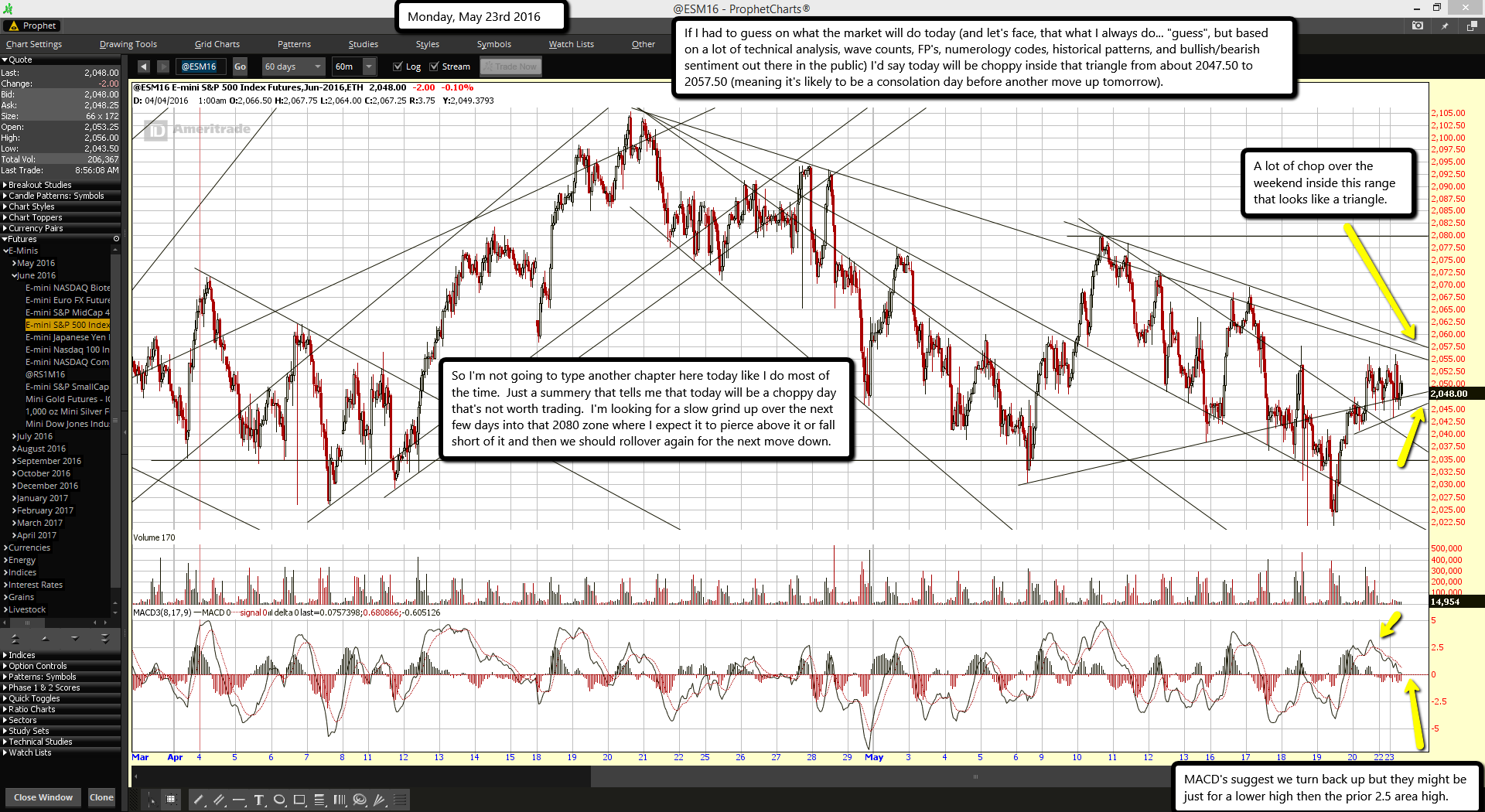
A lot of chop over the weekend inside this range that looks like a triangle.

MACD's suggest we turn back up but they might be just for a lower high then the prior 2.5 area high.

If I had to guess on what the market will do today (and let's face, that what I always do... "guess", but based on a lot of technical analysis, wave counts, FP's, numerology codes, historical patterns, and bullish/bearish sentiment out there in the public) I'd say today will be choppy inside that triangle from about 2047.50 to 2057.50 (meaning it's likely to be a consolation day before another move up tomorrow).

So I'm not going to type another chapter here today like I do most of the time.  Just a summery that tells me that today will be a choppy day that's not worth trading.  I'm looking for a slow grind up over the next few days into that 2080 zone where I expect it to pierce above it or fall short of it and then we should rollover again for the next move down.

ES Morning Update May 20th 2016

0

3ff3d2bb-e0a9-4310-9108-5ccf23c6a3b3

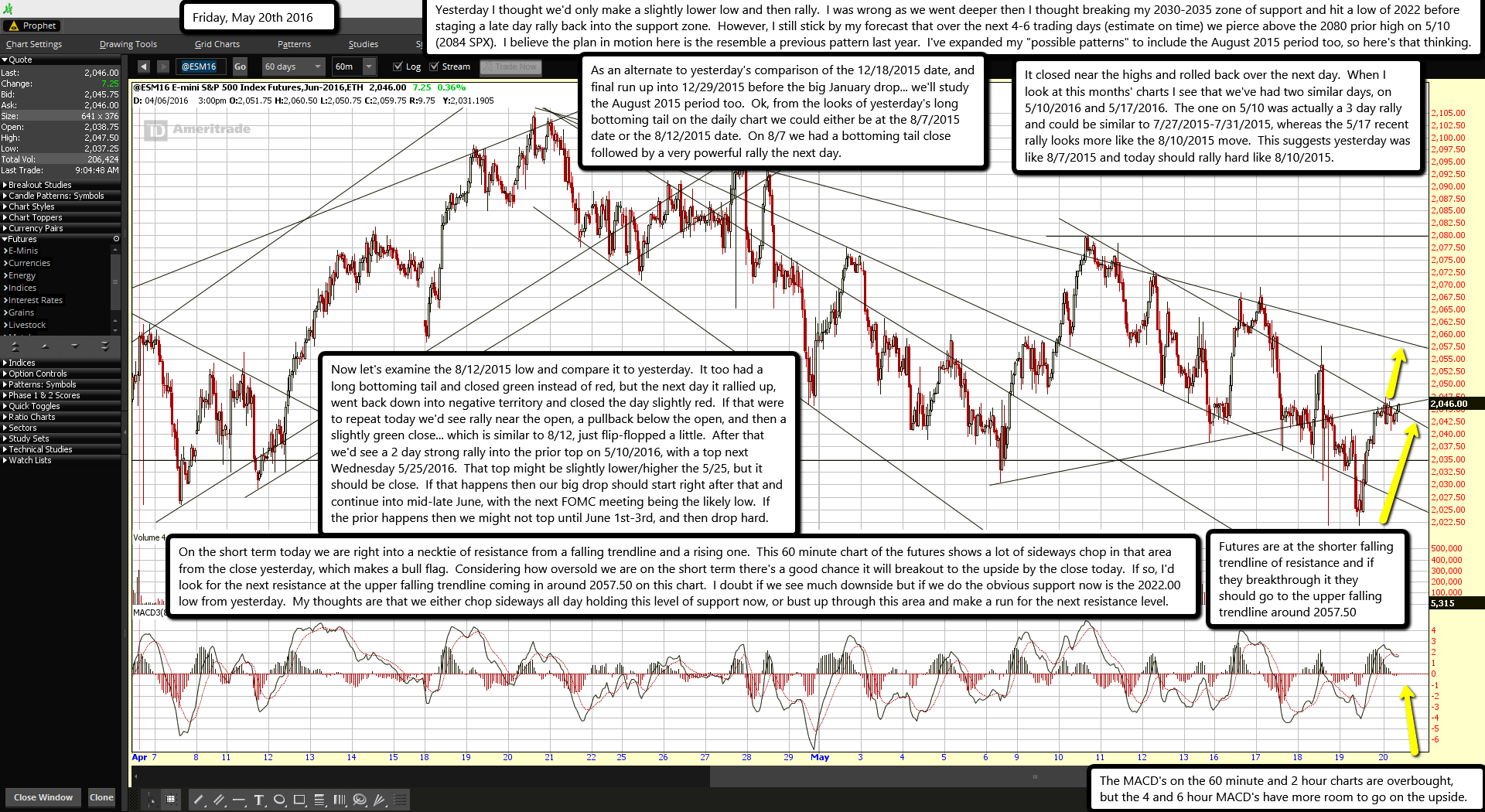
Futures are at the shorter falling trendline of resistance and if they breakthrough it they should go to the upper falling trendline around 2057.50

The MACD's on the 60 minute and 2 hour charts are overbought, but the 4 and 6 hour MACD's have more room to go on the upside.

Yesterday I thought we'd only make a slightly lower low and then rally.  I was wrong as we went deeper then I thought breaking my 2030-2035 zone of support and hit a low of 2022 before staging a late day rally back into the support zone.  However, I still stick by my forecast that over the next 4-6 trading days (estimate on time) we pierce above the 2080 prior high on 5/10 (2084 SPX).  I believe the plan in motion here is the resemble a previous pattern last year.  I've expanded my "possible patterns" to include the August 2015 period too, so here's that thinking.

As an alternate to yesterday's comparison of the 12/18/2015 date, and final run up into 12/29/2015 before the big January drop... we'll study the August 2015 period too.  Ok, from the looks of yesterday's long bottoming tail on the daily chart we could either be at the 8/7/2015 date or the 8/12/2015 date.  On 8/7 we had a bottoming tail close followed by a very powerful rally the next day.  It closed near the highs and rolled back over the next day.  When I look at this months' charts I see that we've had two similar days, on 5/10/2016 and 5/17/2016.  The one on 5/10 was actually a 3 day rally and could be similar to 7/27/2015-7/31/2015, whereas the 5/17 recent rally looks more like the 8/10/2015 move.  This suggests yesterday was like 8/7/2015 and today should rally hard like 8/10/2015.

Now let's examine the 8/12/2015 low and compare it to yesterday.  It too had a long bottoming tail and closed green instead of red, but the next day it rallied up, went back down into negative territory and closed the day slightly red.  If that were to repeat today we'd see rally near the open, a pullback below the open, and then a slightly green close... which is similar to 8/12, just flip-flopped a little.  After that we'd see a 2 day strong rally into the prior top on 5/10/2016, with a top next Wednesday 5/25/2016.  That top might be slightly lower/higher the 5/25, but it should be close.  If that happens then our big drop should start right after that and continue into mid-late June, with the next FOMC meeting being the likely low.  If the prior happens then we might not top until June 1st-3rd, and then drop hard.

On the short term today we are right into a necktie of resistance from a falling trendline and a rising one.  This 60 minute chart of the futures shows a lot of sideways chop in that area from the close yesterday, which makes a bull flag.  Considering how oversold we are on the short term there's a good chance it will breakout to the upside by the close today.  If so, I'd look for the next resistance at the upper falling trendline coming in around 2057.50 on this chart.  I doubt if we see much downside but if we do the obvious support now is the 2022.00 low from yesterday.  My thoughts are that we either chop sideways all day holding this level of support now, or bust up through this area and make a run for the next resistance level.

ES Morning Update May 19th 2016

0

b22a06ba-da89-4a07-bee4-82494cb232ee

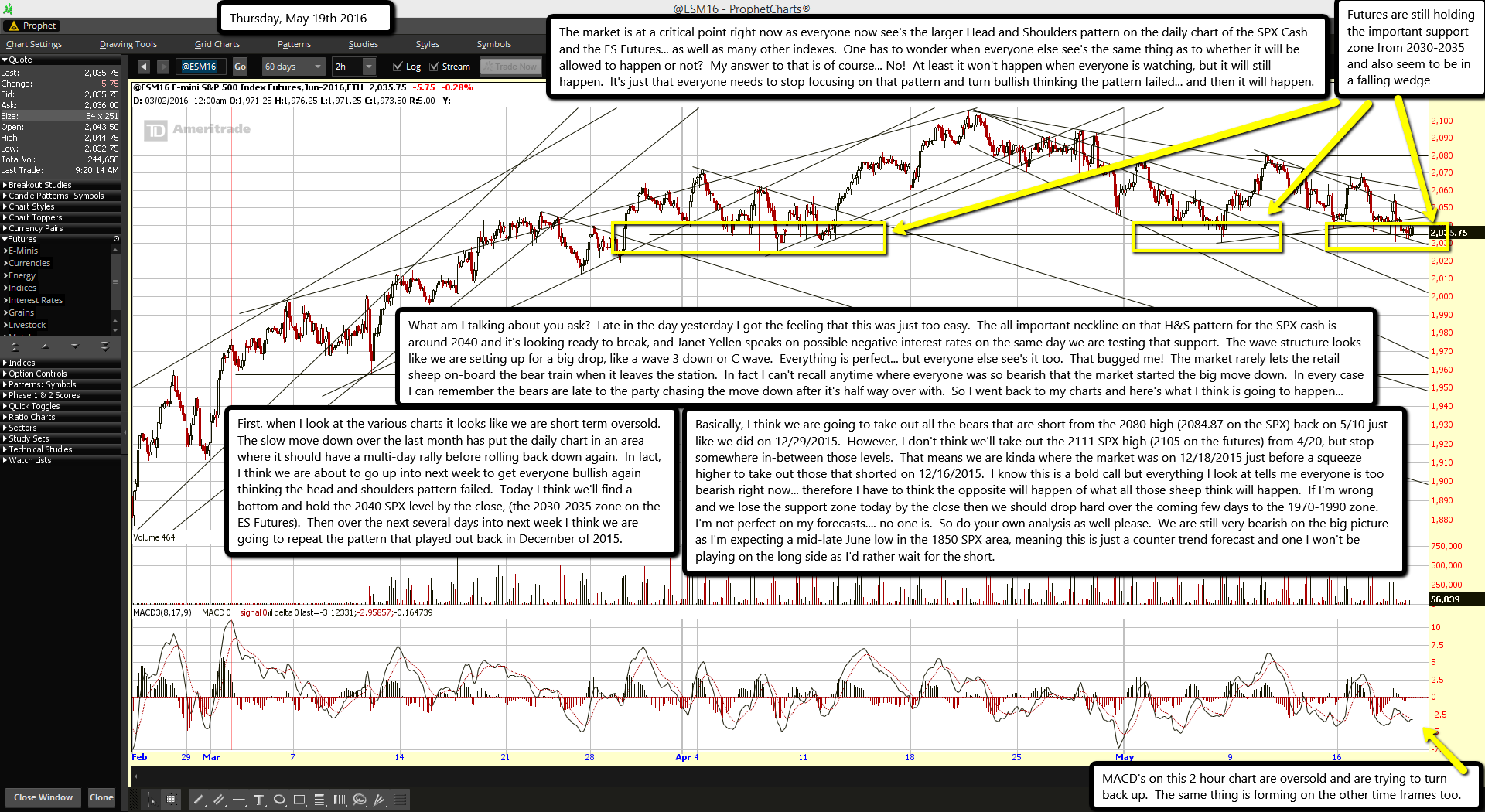
Futures are still holding the important support zone from 2030-2035 and also seem to be in a falling wedge

MACD's on this 2 hour chart are oversold and are trying to turn back up.  The same thing is forming on the other time frames too.

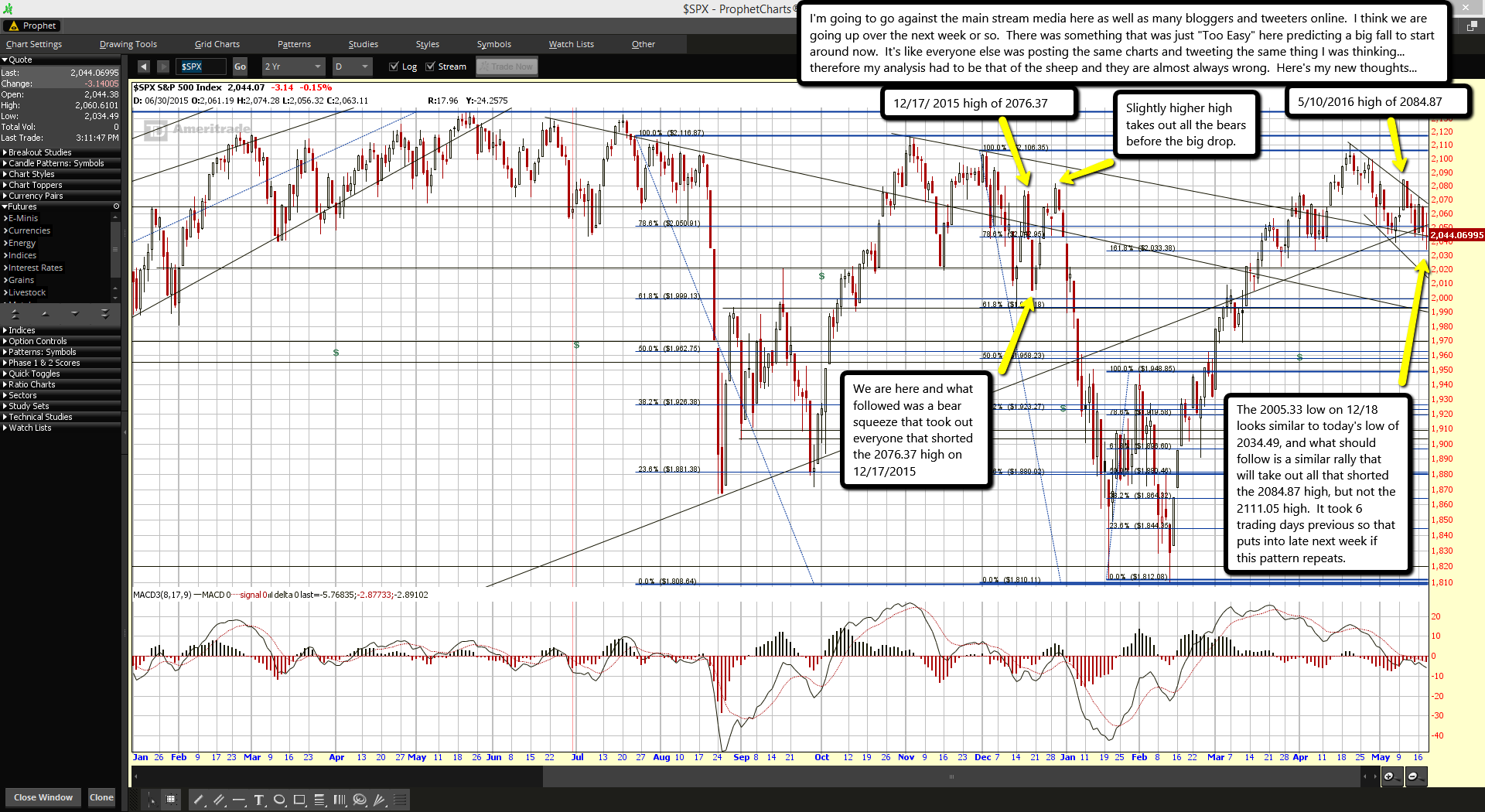
The market is at a critical point right now as everyone now see's the larger Head and Shoulders pattern on the daily chart of the SPX Cash and the ES Futures... as well as many other indexes.  One has to wonder when everyone else see's the same thing as to whether it will be allowed to happen or not?  My answer to that is of course... No!  At least it won't happen when everyone is watching, but it will still happen.  It's just that everyone needs to stop focusing on that pattern and turn bullish thinking the pattern failed... and then it will happen.

What am I talking about you ask?  Late in the day yesterday I got the feeling that this was just too easy.  The all important neckline on that H&S pattern for the SPX cash is around 2040 and it's looking ready to break, and Janet Yellen speaks on possible negative interest rates on the same day we are testing that support.  The wave structure looks like we are setting up for a big drop, like a wave 3 down or C wave.  Everything is perfect... but everyone else see's it too.  That bugged me!  The market rarely lets the retail sheep on-board the bear train when it leaves the station.  In fact I can't recall anytime where everyone was so bearish that the market started the big move down.  In every case I can remember the bears are late to the party chasing the move down after it's half way over with.  So I went back to my charts and here's what I think is going to happen...

First, when I look at the various charts it looks like we are short term oversold.  The slow move down over the last month has put the daily chart in an area where it should have a multi-day rally before rolling back down again.  In fact, I think we are about to go up into next week to get everyone bullish again thinking the head and shoulders pattern failed.  Today I think we'll find a bottom and hold the 2040 SPX level by the close, (the 2030-2035 zone on the ES Futures).  Then over the next several days into next week I think we are going to repeat the pattern that played out back in December of 2015.

Basically, I think we are going to take out all the bears that are short from the 2080 high (2084.87 on the SPX) back on 5/10 just like we did on 12/29/2015.  However, I don't think we'll take out the 2111 SPX high (2105 on the futures) from 4/20, but stop somewhere in-between those levels.  That means we are kinda where the market was on 12/18/2015 just before a squeeze higher to take out those that shorted on 12/16/2015.  I know this is a bold call but everything I look at tells me everyone is too bearish right now... therefore I have to think the opposite will happen of what all those sheep think will happen.  If I'm wrong and we lose the support zone today by the close then we should drop hard over the coming few days to the 1970-1990 zone.  I'm not perfect on my forecasts.... no one is.  So do your own analysis as well please.  We are still very bearish on the big picture as I'm expecting a mid-late June low in the 1850 SPX area, meaning this is just a counter trend forecast and one I won't be playing on the long side as I'd rather wait for the short.

70a8b5a5-2c14-426a-8c7b-08f320647012

ES Morning Update May 18th 2016

0

d9dc8fc2-1e0c-4a32-9956-d4f22791345d

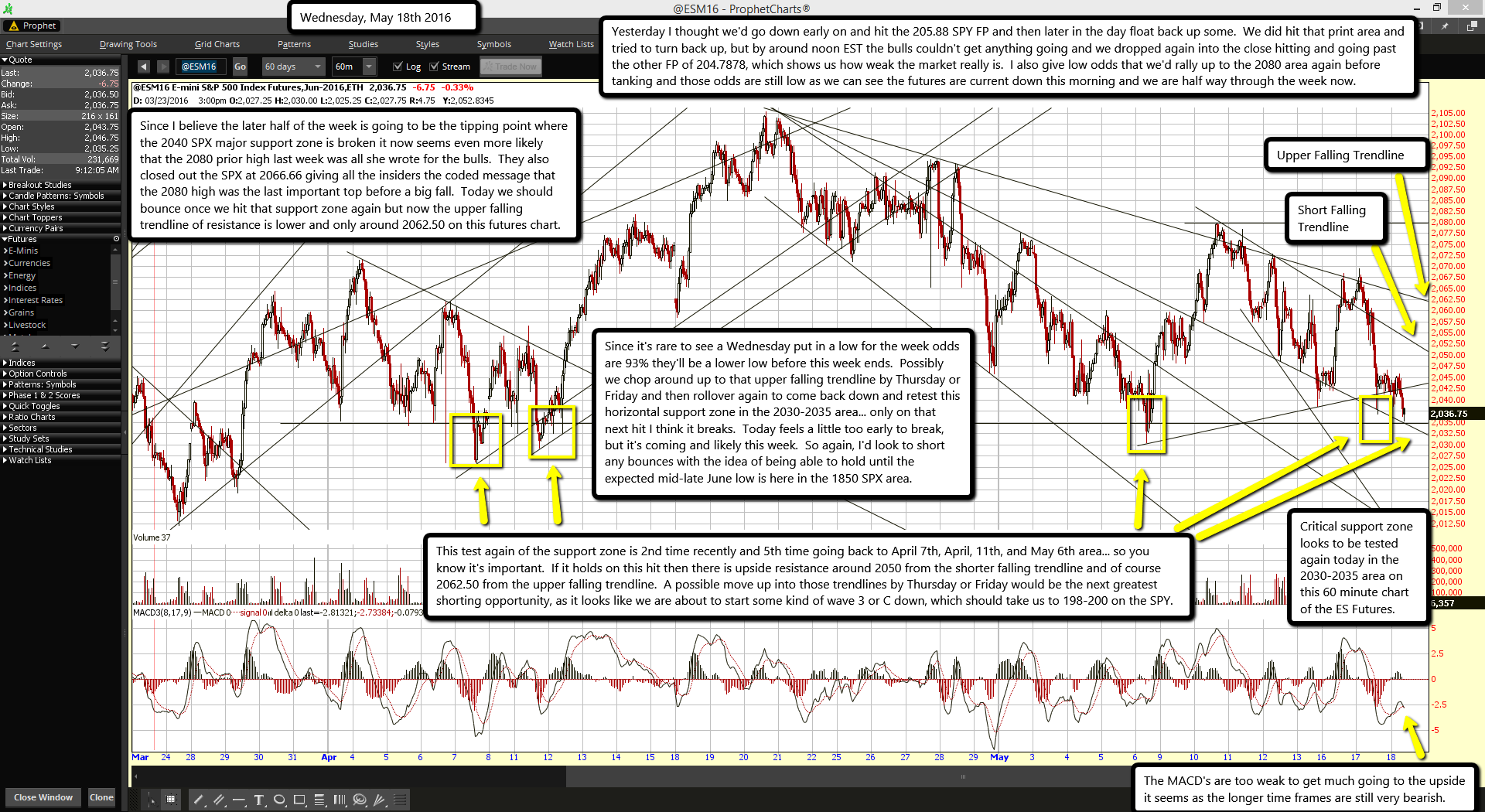
Critical support zone looks to be tested again today in the 2030-2035 area on this 60 minute chart of the ES Futures.

The MACD's are too weak to get much going to the upside it seems as the longer time frames are still very bearish.

Yesterday I thought we'd go down early on and hit the 205.88 SPY FP and then later in the day float back up some.  We did hit that print area and tried to turn back up, but by around noon EST the bulls couldn't get anything going and we dropped again into the close hitting and going past the other FP of 204.7878, which shows us how weak the market really is.  I also give low odds that we'd rally up to the 2080 area again before tanking and those odds are still low as we can see the futures are current down this morning and we are half way through the week now.

Since I believe the later half of the week is going to be the tipping point where the 2040 SPX major support zone is broken it now seems even more likely that the 2080 prior high last week was all she wrote for the bulls.  They also closed out the SPX at 2066.66 giving all the insiders the coded message that the 2080 high was the last important top before a big fall.  Today we should bounce once we hit that support zone again but now the upper falling trendline of resistance is lower and only around 2062.50 on this futures chart.

Since it's rare to see a Wednesday put in a low for the week odds are 93% they'll be a lower low before this week ends.  Possibly we chop around up to that upper falling trendline by Thursday or Friday and then rollover again to come back down and retest this horizontal support zone in the 2030-2035 area... only on that next hit I think it breaks.  Today feels a little too early to break, but it's coming and likely this week.  So again, I'd look to short any bounces with the idea of being able to hold until the expected mid-late June low is here in the 1850 SPX area.

This test again of the support zone is 2nd time recently and 5th time going back to April 7th, April, 11th, and May 6th area... so you know it's important.  If it holds on this hit then there is upside resistance around 2050 from the shorter falling trendline and of course 2062.50 from the upper falling trendline.  A possible move up into those trendlines by Thursday or Friday would be the next greatest shorting opportunity, as it looks like we are about to start some kind of wave 3 or C down, which should take us to 198-200 on the SPY.

ES Morning Update May 17th 2016

0

9d0500d0-de59-4a23-b304-9ea9f8d88a70

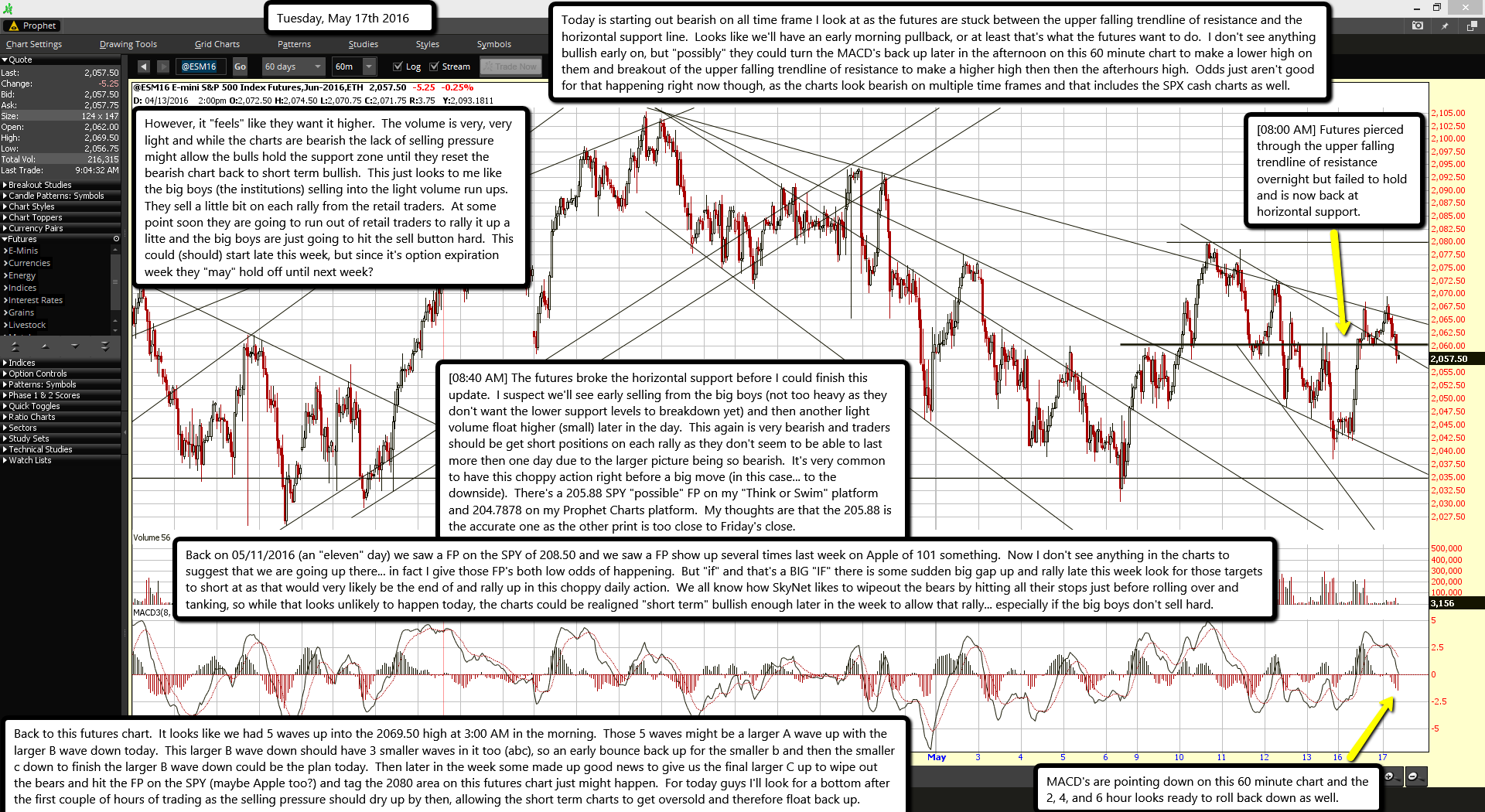
[08:00 AM] Futures pierced through the upper falling trendline of resistance overnight but failed to hold and is now back at horizontal support.

MACD's are pointing down on this 60 minute chart and the 2, 4, and 6 hour looks ready to roll back down as well.

Today is starting out bearish on all time frame I look at as the futures are stuck between the upper falling trendline of resistance and the horizontal support line.  Looks like we'll have an early morning pullback, or at least that's what the futures want to do.  I don't see anything bullish early on, but "possibly" they could turn the MACD's back up later in the afternoon on this 60 minute chart to make a lower high on them and breakout of the upper falling trendline of resistance to make a higher high then then the afterhours high.  Odds just aren't good for that happening right now though, as the charts look bearish on multiple time frames and that includes the SPX cash charts as well.

However, it "feels" like they want it higher.  The volume is very, very light and while the charts are bearish the lack of selling pressure might allow the bulls hold the support zone until they reset the bearish chart back to short term bullish.  This just looks to me like the big boys (the institutions) selling into the light volume run ups.  They sell a little bit on each rally from the retail traders.  At some point soon they are going to run out of retail traders to rally it up a litte and the big boys are just going to hit the sell button hard.  This could (should) start late this week, but since it's option expiration week they "may" hold off until next week?

[08:40 AM] The futures broke the horizontal support before I could finish this update.  I suspect we'll see early selling from the big boys (not too heavy as they don't want the lower support levels to breakdown yet) and then another light volume float higher (small) later in the day.  This again is very bearish and traders should be get short positions on each rally as they don't seem to be able to last more then one day due to the larger picture being so bearish.  It's very common to have this choppy action right before a big move (in this case... to the downside).  There's a 205.88 SPY "possible" FP on my "Think or Swim" platform and 204.7878 on my Prophet Charts platform.  My thoughts are that the 205.88 is the accurate one as the other print is too close to Friday's close.

Back on 05/11/2016 (an "eleven" day) we saw a FP on the SPY of 208.50 and we saw a FP show up several times last week on Apple of 101 something.  Now I don't see anything in the charts to suggest that we are going up there... in fact I give those FP's both low odds of happening.  But "if" and that's a BIG "IF" there is some sudden big gap up and rally late this week look for those targets to short at as that would very likely be the end of and rally up in this choppy daily action.  We all know how SkyNet likes to wipeout the bears by hitting all their stops just before rolling over and tanking, so while that looks unlikely to happen today, the charts could be realigned "short term" bullish enough later in the week to allow that rally... especially if the big boys don't sell hard.

Back to this futures chart.  It looks like we had 5 waves up into the 2069.50 high at 3:00 AM in the morning.  Those 5 waves might be a larger A wave up with the larger B wave down today.  This larger B wave down should have 3 smaller waves in it too (abc), so an early bounce back up for the smaller b and then the smaller c down to finish the larger B wave down could be the plan today.  Then later in the week some made up good news to give us the final larger C up to wipe out the bears and hit the FP on the SPY (maybe Apple too?) and tag the 2080 area on this futures chart just might happen.  For today guys I'll look for a bottom after the first couple of hours of trading as the selling pressure should dry up by then, allowing the short term charts to get oversold and therefore float back up.

Amazon private labels could hit Millennial sweet spot

0
AFP 547531596 I FIN CGO DEU BR

SAN FRANCISCO — Amazon's reported shift into private label grocery offerings takes a page out the basic retail strategy book it's aggressively pursued, often to the chagrin of brick and mortar competitors.

But Amazon has an even bigger incentive than Target and Wal-Mart did when they expanded into private-label products over a decade ago: Millennials.

The generation that's grown up with the Internet has shown more loyalty to distributors — say flight-and hotel-aggregator Kayak.com or delivery services Uber Eats — than the end brand that provides the good or service, says Phil Lempert, a Los Angeles-based consumer analyst who focuses on food trends.

In the case of an Amazon-branded coffee or detergent, Amazon already “owns” the customers' loyalty and trust, which means its own name carries weight, says Lempert. The private label means the item is likely to be cheaper — a draw for America's largest living generation, who are now in their 20s and early 30s.

“Millennials care about quality and price and taste; they’re brand agnostic. It's a sweet spot for Amazon,” he said.

Along with detergent and diapers, the Seattle-based online retailer plans to sell private label nuts, spices, tea, coffee, baby food and vitamins, according to a report in the Wall Street Journal. Amazon would not comment on the report.

The product expansion can help Amazon continue to be the go-to choice for the connected generation, as well as reshape consumer perception about where they can go to get the things they need every day, according to Market Track, a Chicago-based market analysis firm. That's something that traditionally happened in brick and mortar stores but which Amazon wants to move online.

Private labels popular

The move is not completely foreign to Amazon, which already sells electronics accessories and home goods such as bed sheets and knife sets under its Amazon Basics brand.

It's had some missteps in the past. In late 2014 it dabbled in private label grocery items, including baby diapers bundled with wipes called Amazon Elements. Unlike its Amazon Basics label, Elements did not catch on with consumers and the company cancelled the product after customer complaints around a month after launch.

In the grocery world, private label brands are a big money maker. The items are often produced in the same plants as name- brand items but are labeled with a store brand, saving all the cost of advertising and thus allowing them to be sold for less.

A full 88% of consumers say they buy private label, primarily because of price, according to Market Track. If they have to make a decision between a private label and a national brand, and the private label brand has a lower price, they go for the the private label at a rate of 80%, the firm's survey's show.

“Due to Amazon’s size and scale they have the ability to offer pricing that is highly competitive,” said Traci Gregorski, vice president of marketing at Market Track.

All about the Prime

The products will only be available to Amazon Prime members, according to the Wall Street Journal. Members pay $99 a year for two-day delivery, free streaming video and a host of other extras. The build out is part of Amazon’s long term plan to further pull Americans into its retail world with Prime membership.

“The entire Amazon ecosystem revolves around Prime,” said David Smith, an Amazon analyst with Gartner.

That's because Prime members are so lucrative. They  spend on average about $1,100 per year, compared to about $600 per year for non-members, according to Consumer Intelligence Research Partners.

There were 54 million Prime members in the United States at the end of 2015, 21% of the U.S. adult population, a CIRP report from January found.

Amazon itself doesn't disclose Prime membership numbers, beyond saying it has tens of millions of Prime members.

The move shouldn’t have come as a surprise to anyone in the grocery business, where house brands are part of the playbook of every major retail account. They look at what sells and then produce it on their own for higher margins, said Sucharita Mulpuru, a senior Amazon analyst with Forrester.

“It's not like this is as complex as flying to Mars. This is what the club warehouses and Trader Joe's do all day,” she said.

A miss on the names

Some of the brand names Amazon may use for its new lines include Happy Belly, Wickedly Prime, Presto! and Mama Bear, according to the Journal report.

Happy Belly would be the brand for nuts, spices, tea and cooking oil. Wickedly Prime will be the name for snacks while Mama Bear would be the name used for baby food and diapers. Detergents and home goods would fall under the Presto! name.

If those are the names, it's a stumble on Amazon's part, said Lempert..

“"They’re weird, they’re trying to to be too hip and cool,” he said.

Source link

Andrew Left Takes Long Stance on Valeant, Awaiting ‘Bounce’ in Shares

0

It appears Citron Research's Andrew Left is changing tack on beleagured Canadian drugmaker Valeant Pharmaceuticals (VRX).

The activist short seller -- who helped send shares of Valeant into a tailspin last fall -- said in a Monday interview with Real Money that he "wouldn't be surprised if there's a bounce" in the drugmaker's stock, which has fallen more than 90% since last summer.

"I'm long for Valeant, but I also own some out-of-the-money puts," he said, noting he's unfazed by Valeant's decision today to broaden discounts on two drugs, Nitropress and Isuprel. (Out-of-the-money puts are a common investment vehicle used in short selling.) "I don't think they're going to make any decisions that are going to torpedo their company," Left added.

The most important metric in gauging Valeant's recovery, according to Left, will be sales of its flagship Xifaxin, which was obtained as part of Valeant's $11 billion of Salix last April. Robust sales will be crucial to spur growth, especially as Valeant looks to offload a roughly $20 billion debt burden, Left added.

Valeant has long been trying to extricate itself from intense media scrutiny surrounding allegations that its unfairly hiked drug prices to exorbitant levels, with its former CEO, Michael Pearson, appearing before the Senate Special Committee on Aging last month to apologize for having said shareholder interests were his top priority, interests above patient and hospital concerns.

On Monday, its new CEO, Joseph Papa, reiterated his mission to rebrand the company's image as a patient-first drugmaker, as part of his broadening of product discounts.

"I also want to thank the Senate Committee on Aging and the House Committee on Oversight and Government Reform for the attention they have brought to this issue, and specifically to gaps they identified in the previous program," he said in a Monday statement. "We are committed to getting this right."

Source link

Apple buy sign of change at Buffett’s Berkshire

0

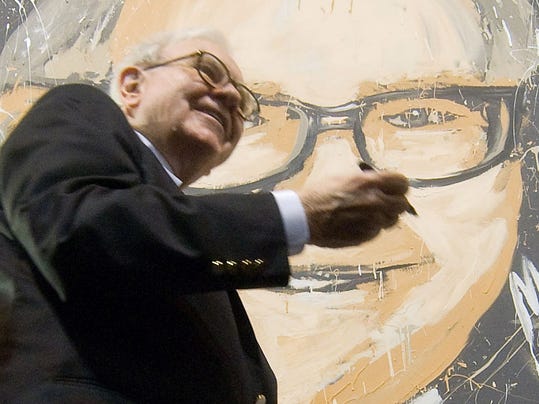
Billionaire investor Warren Buffett's Berkshire Hathaway has taken a stake in Apple currently worth $900 million. David Craig for USA TODAY.

Today’s Berkshire Hathaway isn’t your grand-dad’s Berkshire.

Berkshire’s frontman is still billionaire investor Warren Buffett, now 85. But change is afoot at the giant conglomerate, witnessed by a more aggressive move into areas of the stock market that Buffett once steered clear of -- such as tech stocks -- and increasing signs that decisions on what stocks to buy and sell appear to be shifting to investment lieutenants brought in by Buffett himself a few years back.

Buffett’s Berkshire made big news Monday when it revealed in a regulatory filing that in the first quarter it had built a 9.8 million share stake in iPhone maker Apple worth nearly $1.1 billion at the end of March. But as USA TODAY sources had theorized, and which Buffett confirmed to the Wall Street Journal via e-mail, the Apple buy was not the work of the Oracle of Omaha himself, but instead executed by one of the two ex-hedge fund managers he hired a few years ago that now manage a big chunk of Berkshire’s stock portfolio.

Indeed, the Apple stock purchase was likely the brainchild of Todd Combs or Ted Weschler, the money managers Buffett brought in to pick stocks for the conglomerate when he’s gone. The addition of the two stock pickers is resulting in a broadening out of the types of stocks Berkshire invests in – and which ones are jettisoned. Buffett, of course, is better known for his own stock picks, which include iconic American companies such as Coca-Cola and American Express.


The fact that the new Apple position has the fingerprints of either Combs or Weschler all over it suggests that the transition away from everything Buffett is moving forward. Indeed, while Buffett has repeatedly said he loves his job and has no plans to quit, there are signs that the transfer of responsibility on the stock picking side of the business is well underway.

“It continues the transition away from Buffett and the broadening of the portfolio away from areas of the market only Buffett is comfortable with and towards areas that Ted and Todd are comfortable with,” says Jeff Matthews, general partner at hedge fund Ram Partners and an author of Buffett-related books, including Pilgrimage to Warren Buffett’s Omaha.

Buffett's name also made headlines over the weekend and early Monday when he confirmed to CNBC that he would consider helping to finance Quicken Loans' Dan Gilbert's bid to buy Yahoo. But Buffett admitted that tech is still not his thing and that he would not take an equity stake in Yahoo.

"Yahoo is not the type of thing I'd ever be an equity partner in," Buffett told CNBC. "I don't know the business and wouldn't know how to evaluate it, but if Dan needed financing, with proper terms and protections, we would be a possible financing help."

The biggest Buffett-chosen tech stock investment was IBM, which he bought in mass back in 2011. His IBM stake at the end of the third-quarter was $12.3 billion, according to regulatory filings. And despite being underwater on the investment by a sizable amount, Buffett defended his IBM holding at last month’s shareholder meeting and added slightly to his position in the just-completed first quarter by about 200,000 shares, according to SEC filings.

The influence of Combs and Weschler on Berkshire’s holdings were apparent when Buffett recently cited Combs’ stock investment and positive impression of aerospace parts maker Precision Castparts as a key reason why Buffett made Precision its biggest acquisition ever, a $37 billion deal which closed in January.

Still, while things are changing at Berkshire, the investment philosophy of buying established companies with staying power and top-flight management at good prices remains very much the same at Berkshire.

“Honestly, I don’t think (the Apple buy) signifies any dramatic change at Berkshire,” says Matthews. “(Berkshire is) always looking for investments that they think make sense. And they think Apple makes sense. Don’t forget Apple is a great consumer products company with a great business model and strong franchise that’s trading at an attractive valuation.”

What’s changing at Berkshire is the people making many of the buy-and-sell decisions.

“The big takeaway is Buffett is getting less involved in investment decisions but at the same time Berkshire is still looking for what they consider is good value,” says Vahan Janjigian, chief investment officer at Greenwich Wealth Management and author of Even Buffett Isn’t Perfect: What You Can – and Can’t – Learn from the World’s Greatest Investor.

Apple, Janjigian says, is “not Buffett’s kind of investment,” adding that the billionaire investor has “famously” avoided tech stocks in the past.

Building a stake in Apple, however, is a sign the new blood at Berkshire is diversifying into parts of the market that Buffett once avoided.

“Tech has become such a big part of the economy that it would sound foolish to say I would never invest in tech,” Janjigian argues. The information technology sector now accounts for 19.79% of the S&P 500 and is the biggest of the 10 major sectors, according to S&P Dow Jones Indices. At the end of 2015, the weighting of Berkshire’s public tech stock holdings was around 10%, according to S&P Capital IQ.

And even though Apple is a tech stock, the investment still jibes with the Berkshire’s time-tested investment philosophy.

The Apple stock purchases, for example, follows a more than 30% drop in the price of Apple’s shares since its post-split peak of $133 per share on Feb. 23, 2015. It comes at a time when the iPhone maker is selling at a cheap valuation. Apple is also a great brand with a strong management team. With Apple now trading at just 10 times earnings –  well below the broad U.S. stock market valuation of 17 times earnings – it’s not nearly as expensive as some other popular tech stocks selling at outrageous prices relative to earnings.

The Apple purchase “does tell us that the people making many of the investment decisions at Berkshire are picking more modern and up-to-date names that are much more popular with everyone else,” Janjigian  explains. “But these are not companies like Tesla or Amazon which you could make the case are tremendously overvalued. They’re still looking for investments that show value and that they can buy at a cheap price.”

Apple wasn’t the only stock moves Buffett cited in its regulatory filing. Berkshire added to its investment in IBM, which is also trading at an attractive P-E multiple, despite falling about 14% since hitting a 52-week high in May 2015. On IBM, which has consistently bought back its own shares in recent years, and has a well-known brand and CEO that Buffett backs, “Buffett is staying true to his word,” says Robert R. Johnson, president and CEO at The American College of Financial Services. Despite IBM’s poor performance, Buffett told CNBC recently that “we feel fine (about IBM) or we won't own it. I think I can safely say we would be much more likely to buy more in the next 12 to 24 months than we would be to sell shares."

Johnson also had this to say about Berkshire’s other moves:

On selling all of its remaining AT&T stake: “The latest moves are a continuation of recent moves of paring of holdings of AT&T. Likely simply a sale because there were other, more attractive stocks to purchase like Apple and Phillips 66.”

On dumping nearly all of its shares of consumer products maker Procter & Gamble: “It is a terrific company, and has many wonderful brand names, but I believe the valuation over 27 times earnings was simply too rich and the Berkshire team could put that capital to better use in some undervalued companies.”

On reducing its Walmart stake by nearly 950,000 shares to 55.2 million shares. “Walmart’s business model is under pressure. Growth is slowing -- particularly same store sales. There also is pressure to raise employee pay, as Walmart has a very unhappy and increasingly unstable worker base when compared to competitors such as Costco. The WMT model could come under increased pressure as minimum wages rise across the U.S.”

Source link

Apple’s latest billion-dollar business: Venture capital?

0

Apple has a trendy new business that could impact the lives of millions and help it make big money in the future.

No, not the Apple Watch. We're talking about Apple getting into venture capital.

On Thursday night, Apple shocked many by announcing a $1 billion investment in Didi Chuxing, the top ride-hailing service in China.

The investment re-ignited rumors about Apple's intentions to build a car and apparently even caused some relationship issues for the CEO of Uber and his girlfriend. Others framed it as a play to improve Apple's status in China, a key growth market.

But there's a more immediate and less discussed impact. Apple, a business with more than $200 billion in cash and marketable securities, is suddenly acting like a venture capital firm for the first time in years.

"As far as I can tell, Apple’s investment in Didi is its biggest venture investment ever and the first investment since the turn of the century," says Stephanie Cook, a spokesperson for Pitchbook, a data provider for venture capital and private equity deals.

The closest Apple has come to venture capital during those years, according to Cook, has been partnering with the investment firm Kleiner Perkins in 2008 to launch the $100 million iFund for iPhone app developers.

With even a small fraction of its billions in available cash, Apple could cement itself as one of the largest and most influential venture investors in the technology industry, not unlike some of its main competitors.

Google, for example, has launched not one but two venture capital arms, which have invested in prominent businesses like Slack, ClassPass and Didi-rival Uber. (Yes, even when it comes to venture investments, Google and Apple are rivals.) IBM and Twitter have similar investment operations.

This investment tactic allows leading tech companies to build stronger partnerships with promising upstarts, peek into some of their financials and potentially gain a leg-up on acquisitions, as happened when Google backed and later bought Nest.

Apple, never one to relinquish control easily, has shown a preference for acquiring dozens of businesses in recent years rather than backing them with capital and letting them do their thing, as the chart below from VC database CB Insights makes clear.

Apple's investment and acquisition activity leans heavily toward the latter.

"[It's] hard to say whether this is a fundamental change for Apple or not," says Van Baker, an Apple analyst with Gartner. "It could just be Apple putting what is a lot of cash spread around the world to work."

Apple finds itself in a nearly unfathomable position today. It makes more profit per quarter than any business in history, but its once unstoppable sales growth engine is finally showing signs of petering out. The iPhone is flatlining, the iPad is declining fast and it's still unclear whether the Apple Watch is making a dent in sales.

After years of letting its cash pile build up, Apple has shown a willingness to put more of that money to work through massive share buybacks, more frequent acquisitions, increased R&D spending (Apple Car anyone?) and, perhaps for the first time, significant venture capital returns.

"Of course, we believe it will deliver a strong return for our invested capital over time as well," Apple CEO Tim Cook told Reuters about the Didi investment.

Didi may not be as well known in the U.S. as Uber, but it actually delivers more rides (all in China) and represents a similarly promising opportunity for investors. Apple now owns a chunk of a startup valued at around $20 billion — and growing fast.

Anand Sanwal, CEO of CB Insights, points out Apple likely also has "some ownership" now in other leading ride-hailing startups like Lyft, Grab and Olacabs through its Didi investment because Didi has itself invested in and partnered with these services in its efforts to take on Uber globally. 

That's not such a bad investment portfolio, considering Apple is just getting started.

Have something to add to this story? Share it in the comments.

Source link

Gannett raises offer to buy Tribune to $15 per share

0


Tribune Publishing shares plummet after the company revises 2015 revenue, earnings estimates.(Photo: Frederic J. Brown, AFP/Getty Images)

Gannett Co., which owns USA TODAY and more than 100 local news properties nationwide, said Monday it raised its offer to buy Tribune Publishing Co. to $15 per share, dialing up the pressure after its earlier bid was rejected by Tribune’s board of directors despite some shareholders’ call for a negotiation.

The revised offer values Tribune (TPUB), which owns the Los Angeles Times, Chicago Tribune and nine other dailies, at about $479 million. Gannett (GCI) also offered to assume about $385 million of Tribune’s debt, valuing the total deal at about $864 million.

Revised after Gannett met with Tribune shareholders, the heightened offer represents a premium of 99% to Tribune’s closing price of $7.52 per share on April 22, the last trading day before Gannett revealed its initial offer of $12.25.

Shares of Tribune Publishing rose 27% in pre-market trading Monday to $14.52.

"After further review, we have greater confidence in our ability to yield additional operational improvements in this transaction,” Gannett’s CEO Robert Dickey wrote in a letter Monday to Tribune’s board. The McLean, Va.-based company also said it was confident it can receive the antitrust clearance necessary to complete the deal.

Seeking to acquire newspapers and affiliated digital news properties in markets where Gannett lacks a presence, Dickey sent on April 12 a private letter – outlining his all-cash offer -- to Justin Dearborn, Tribune’s CEO, and Michael Ferro, the largest Tribune shareholder who is also its board chairman.

Unable to get a formal negotiation started, Gannett then revealed the offer publicly on April 25, forcing Tribune to hire advisers to begin reviewing the bid. On May 4, Tribune’s board unanimously rejected the offer, saying the company is poised to grow on its own.

In an earnings announcement on the same day, Tribune also told investors and analysts that it was in “the early stages of a compelling transformation” that seeks greater revenue through digital platforms and leveraging the Los Angeles Times brand.

Tribune created a new business unit, called Tronc, that plans to aggregate its in-house digital resources and use software and widgets to better profile its readers for more relevant content and higher digital advertising rates. It also plans to open seven new foreign bureaus for the Los Angeles Times.

Tribune also said on May 4 that its first quarter net loss totaled $6.5 million vs. $2.5 million of net profit in the year-ago period. Revenue remained flat at $398.2 million as print advertising sales continued to tumble.

“By not engaging constructively with Gannett and continuing to pursue an unproven strategy based on its Tronc platform, we believe Tribune is jeopardizing its shareholders’ investment and disregarding their best interests,” Dickey said.

The second-largest shareholder of Tribune, Oaktree Capital, also wasn’t fully convinced of Tribune’s turnaround plan. Earlier this month, the investment firm, which owns about 15% of Tribune, urged Tribune’s management to begin discussions with Gannett.

John Jeffry Louis, chairman of Gannett’s board, intimated that there were other shareholders who were eager to see a deal. “It is evident from our discussions with Tribune shareholders that there is overwhelming support for the companies to engage immediately regarding our proposed transaction,” Louis said Monday.

Sensing growing pressure, Tribune Publishing has adopted a “shareholder rights plan,” known to investors as a poison pill, to thwart Gannett’s bid. Tribune plans to issue new shares if Gannett, or another investor, acquires 20% or more of the company. The move would dilute the acquirer’s stake, thus discouraging in advance any large-stake acquisition plans by an outside investor.

Meanwhile, Gannett is urging Tribune shareholders to withhold their votes next month for election of eight nominees to Tribune’s board of directors.

“By increasing our offer at this time, we are reaffirming Gannett’s belief that this transaction would deliver significant value to both companies’ stakeholders and that the time to act is now,” Louis said.

Source link

s2Member®