Doctors could soon start prescribing an unusual solution to help stroke victims in the US: virtual reality goggles.
That's the hope of Switzerland-based MindMaze, which on Wednesday got a $100 million investment to bring its blend of virtual reality hardware and neuroscience to market. The four-year-old startup's technology has already won approval from regulators in Europe, where its applications for brain injury victims showcase what could soon be possible in the United States.
MindMaze's 34-year-old founder and CEO Tej Tadi explains how: Imagine a stroke victim who's lost control of her left hand but can still move her right hand. After putting on MindMaze goggles, the patient sees a 3-D image, or avatar, of her left hand that moves as she moves her right hand.
"That triggers areas in the brain to say, 'Wait, let's regain control of this hand'," says Tadi. "The hand that was not working now works." And that process of tricking the brain into seeing something that's actually not there in the real world accelerates recovery, he says.
Already in use in Europe, startup MindMaze wants to begin treating American stroke victims using virtual reality this year. Now, it's got $100 million to do it.
Garo/Phanie Sarl/Corbis
This is the year that VR is set to take off. Almost every major tech company -- from Samsung and HTC to Facebook's Oculus and Sony -- has either released a VR headset or plans to do so. Their investments, as well as those made by smaller but well-funded startups like Jaunt, NextVR and Magic Leap, are expected to change the way we play video games and how we watch sports, presidential debates, porn or a Hollywood movie.
The investment in MindMaze, led by multinational conglomerate Hinduja Group, underscores just how VR could shake up medicine. In fact, Hinduja's nine-figure bet places MindMaze, a 55-person company, among the top three best-funded virtual reality startups in the world, according to PitchBook, a venture capital research firm.
"If there's a short list of areas where virtual reality will be really helpful or usable, health care is on that list," says Brian Blau, vice president of research at information technology research firm Gartner.
For Blau, who's been studying virtual reality since the 1990s, the potential impact on health care makes sense. VR works by tricking the brain into believing what it's seeing is three-dimensional and, often, lifelike. More than most other professions or markets, health care demands realism.
"There's so much that needs to be immersive," says Blau.
Since the 1990s, virtual reality has been used to help patients suffering from phobias overcome their fears. One early study showed how VR was a useful tool to help overcome fears of spiders.
Now, the increasingly powerful displays in VR goggles are helping emergency room doctors prepare for situations that are dangerous, costly or simply impossible to replicate in real life.
For example, instead of using actual cadavers, medical students can "work through mock surgeries" in VR, according to PitchBook, whose 2015 report concluded "the use of VR to provide zero-risk environments to conduct training can be invaluable."
To be sure, health care will still play a smaller role in VR than gaming or entertainment, according to Gartner. Only 8 percent of the 121 venture capital investments in virtual reality startups in 2014 and 2015 went to health care projects, according to Pitchbook.
But for millions of Americans suffering from brain injuries and looking to regain control over their limbs, 2016 could be more than just the year that playing Call of Duty or Grand Theft Auto got a lot cooler.
MindMaze won't say how much its device and software will cost in the US. (In Europe, the company's service costs upwards of $30 per month for individuals). But CEO Tadi is confident his solution will soon be in the hands, or on the heads, of patients.
"In 2016, they'll have an FDA-approved medical-grade virtual reality device in clinics," says Tadi.
AkzoNobel announced it has made an offer to acquire BASF’s Industrial Coatings business for €475 million ($528 million USD).
The transaction would include technologies, patents and trademarks, as well as securing supply to customers worldwide. Two manufacturing plants – one in the U.K. and one in South Africa – also will be transferred to AkzoNobel. The business generated revenue of about €300 million ($334 million) in 2015 and supplies products for a number of end uses, including coil, furniture foil and panel coatings, wind energy and general industry and commercial transport.
“This proposed acquisition will strengthen our position in the important coil coatings market and fits well with our existing business, allowing us to offer essential solutions to our customers,” said AkzoNobel CEO Ton Büchner. “We are continuing to deliver on our strategy to achieve our vision of leading market positions delivering leading performance.”
The planned transaction is expected to be complete in the second half of 2016, subject to regular consultation with employee representatives and satisfaction of certain closing conditions, including receipt of required regulatory approval.
Fresh loans since the start of the year prompted analysts to caution against the risks reckless borrowing may pose to China’s financial system. Recent reports warn that China’s debt piles up fast, and there may be hard-to-manage consequences.
Standard & Poor recently noted that the country’s debt, which has seen a big increase relative to its GDP in recent months, may put a strain on its credit ranking. Experts believe that a boost in credit could spell big trouble for the Chinese economy, the currency, and stocks.
Other experts believe that the country’s central bank may have lost regulatory control on credit. As of January, China’s debt mounted to a staggering 3.42 trillion yuan, or 525 billion U.S. dollars.
Analysts believe that the recent loans were only conjectural, but they warned that, if the situation continues, the country may experience a surge in bad debts as businesses would no longer find profitable projects to engage in. Plus, China currently struggles with the slowest economic growth in the past 25 years.
George Magnus of the UBS Group believes that while credit expansion may help the Chinese economy maintain momentum on the short run, it may cause ‘big problems’ later on. Magnus, a chief economic adviser for the USB Group, has accurately forecast the July slump on the Chinese stock market.
Nevertheless, Magnus did not tout the idea of a meltdown. He only counseled cautiousness until the end of the year. China’s debt versus GDP jumped 209 percent in the last quarter. Bloomberg experts noted that it is the highest jump since they started to gather the data in 2003. Bad debt spiked 7 percent at the end of last year to 1.27 trillion yuan.
Currently, China’s S&P credit rating is AA, but according to a report released last fall, the country could be downgraded if the government attempted to boost economic expansion by pumping more credit into investment spending.
Experts, however, do not believe that Beijing may repeat the 2008 and 2009 moves when it urged lenders to lend as much as they could. Yet, analysts are concerned that the country’s leadership is not willing to curb leverage, despite the official rhetoric that they are working to fix the country’s rampant debt.
The People’s Bank of China and several state agencies pledged Tuesday that they would take measures to fight off overcapacity and prevent loans from being granted to ‘zombie’ businesses.
Magnus noted that most of these promises are empty talk since there aren’t any concrete measures set in place to rein in the tidal wave of new credit impacting the economy.
A former U.S. treasury secretary has taken a public stand against high denomination bil
Larry Summers argues in a piece for the Washington Post that large notes like the 500-euro or $100 bill should no longer be issued.
His commentary was inspired by a recently published paper from the Harvard Kennedy School titled, "Making it Harder for the Bad Guys: The Case for Eliminating High Denomination Notes."
In the paper, researchers discuss the flow of money from illegal activities and write that "By eliminating high denomination, high value notes we would make life harder for those pursuing tax evasion, financial crime, terrorist finance and corruption."
Summers largely agrees, recalling similar concerns he expressed about the 500-euro note, which is worth more than $550, when the currency was being planned out.
In fact, he points to the note's nickname as the "Bin Laden"—a point mentioned in the paper—as proof of its link to illegal activities.
The famed economist ultimately states that placing "a moratorium on printing new high denomination notes would make the world a better place."
SAN MATEO, Calif. — The ID passcode to the iPhone the FBI wants Apple to hack for information about one of the San Bernardino, Calif., terrorists was changed less than a day after the government gained possession of it, Apple executives said in a phone briefing with reporters Friday afternoon.
Had the passcode not been changed, Apple said, a backup of the information the government is seeking could have been viewed. It is unclear who changed the Apple ID passcode while it was in the government’s possession, the executive said.
The disclosure was made with a small group of reporters during a 30-minute briefing, including USA TODAY. Apple asked that its executive not be identified because of the sensitive nature of the legal matter.
The call with the reporters marked the latest twist in a now-public dispute between the U.S. government and the world's most valuable company over whether Apple should be forced to break into a phone used by one of the killers in the San Bernardino, Calif. shootings that left 14 dead in December.
On Friday, the Justice Department swung back, filing a motion seeking to force Apple to comply with the court order and saying its refusal was "based on concern for its business model and public brand marketing strategy."
DOJ concurs: password was rest
In the government’s Friday filing, the Justice Department acknowledged that the password was re-set in the hours after the attack by authorities with San Bernardino County. The county owned the phone and provided it to Syed Farook, one of the attackers.
The county action, the government contends, had the effect of eliminating the possibility of a back-up of the device’s contents. The documents also reflect that the government discussed this dilemma with Apple representatives.
Apple had been in regular talks with the government since early January, Apple executives said in an earlier call covered by other news outlets. It proposed four ways to recover the information, including connecting the phone to a known Wi-Fi network.
Apple sent engineers to try that method, but was unsuccessful, Apple said. That was when it was discovered the Apple ID passcode of shooter Syed Rizwan Farook's iPhone 5c had been changed under government custody.
If the FBI is successful in its request, it will open a floodgate of requests from prosecutors nationwide, the executive said, and district attorneys have lined up with hundreds of requests to unlock iPhones to solve criminal cases, the executive said.
The executive said no such request has been made from China or any other country outside the U.S.
The U.S. government has refuted Apple's assertion, an argument echoed by other tech companies including Google and Yahoo, that creating software to unlock the San Bernardino shooter's iPhone would lead to wave of government requests in other criminal cases and make consumer devices more vulnerable to hackers.
In court documents Friday, lawyers for the Department of Justice said the order "does not provide hackers and criminals access to iPhones."
"It does not require Apple to hack its own users or de-crypt its own phones; it does not give the government the power to reach into anyone's device without a warrant or court authorization,'' Justice Department lawyers said.
Data gathered by Manhattan District Attorney Cyrus Vance Jr. in New York City illustrate the legal stakes facing Apple and U.S. law enforcement: Investigators were unable to execute search warrants for suspects' smartphones in approximately 155 cases to date because the devices run on Apple's iOS8 operating system, Vance told USA TODAY.
Thomson ReutersA view shows the Federal Reserve building in WashingtonBy Aaradhana Ramesh
BENGALURU (Reuters) - Growing concerns about weak global growth and inflation are unlikely to deter the U.S. Federal Reserve from tightening policy, according to a Reuters poll that suggested two interest rate hikes are likely this year.
The Fed's December decision to raise rates for the first time in nearly a decade has been under scrutiny recently, with some market players suggesting it was a mistake and that Chair Janet Yellen may have to backtrack.
But most economists disagree.
The poll of over 80 analysts predicted another hike would come in the second quarter and penciled in one more towards the end of the year, which would leave rates between 0.75 and 1.00 percent.
That would be one less rate hike than they forecast in a survey taken last month but still more than financial markets expect, further underscoring the growing divide between the two groups.
"Unless the economy rolls over, there is still a very high likelihood of at least one rate hike this year," said Sam Bullard, senior economist at Wells Fargo.
Analysts who answered an additional question assigned a 75 percent chance of at least one hike this year, in contrast with markets pricing in just a 1-in-3 chance.
Markets predict no move until mid-2017, by which time economists expect the Fed to have raised rates four times to 1.25-1.50 percent.
In her testimony before U.S. Congressional panels last week, Yellen also indicated the Fed is likely to stick to its plan of gradually raising rates this year, despite persistent worries over slowing growth in China and volatile financial markets.
At the December policy meeting the Fed's dot plot, a colloquial name for a chart in the central bank's quarterly "Summary of Economic Projections", suggested four rate rises in 2016. That, however, looked too aggressive for economists who assigned a less than 10 percent probability to that path.
"The Fed dots are very likely to come down again in March. The question is whether the Fed dots remain relevant at all," said Thomas Costerg, senior U.S. economist at Standard Chartered.
Costerg is the only forecaster in the survey who expects the Fed to cut rates by the end of the year and said the risk of a recession is high.
According to the poll median there is a 20 percent chance of a U.S. recession over the next 12 months, up from last month's 15 percent and December's 10 percent.
Annual growth and inflation forecasts for 2016 were also downgraded from last month with growth expected to average 2.2 percent and CPI inflation 1.3 percent, down from January's 2.5 and 1.6 percent respectively.
Core PCE prices - the main inflation gauge monitored by the Fed - will average only 1.5 percent this year and 1.8 percent next, largely unchanged from January's predictions.
"This is as good as it gets and if the Fed wants to have a buffer in the form of higher interest rates ahead of the next recession, now is the time to act," said Handelsbanken's U.S. economist Petter Lundvik.
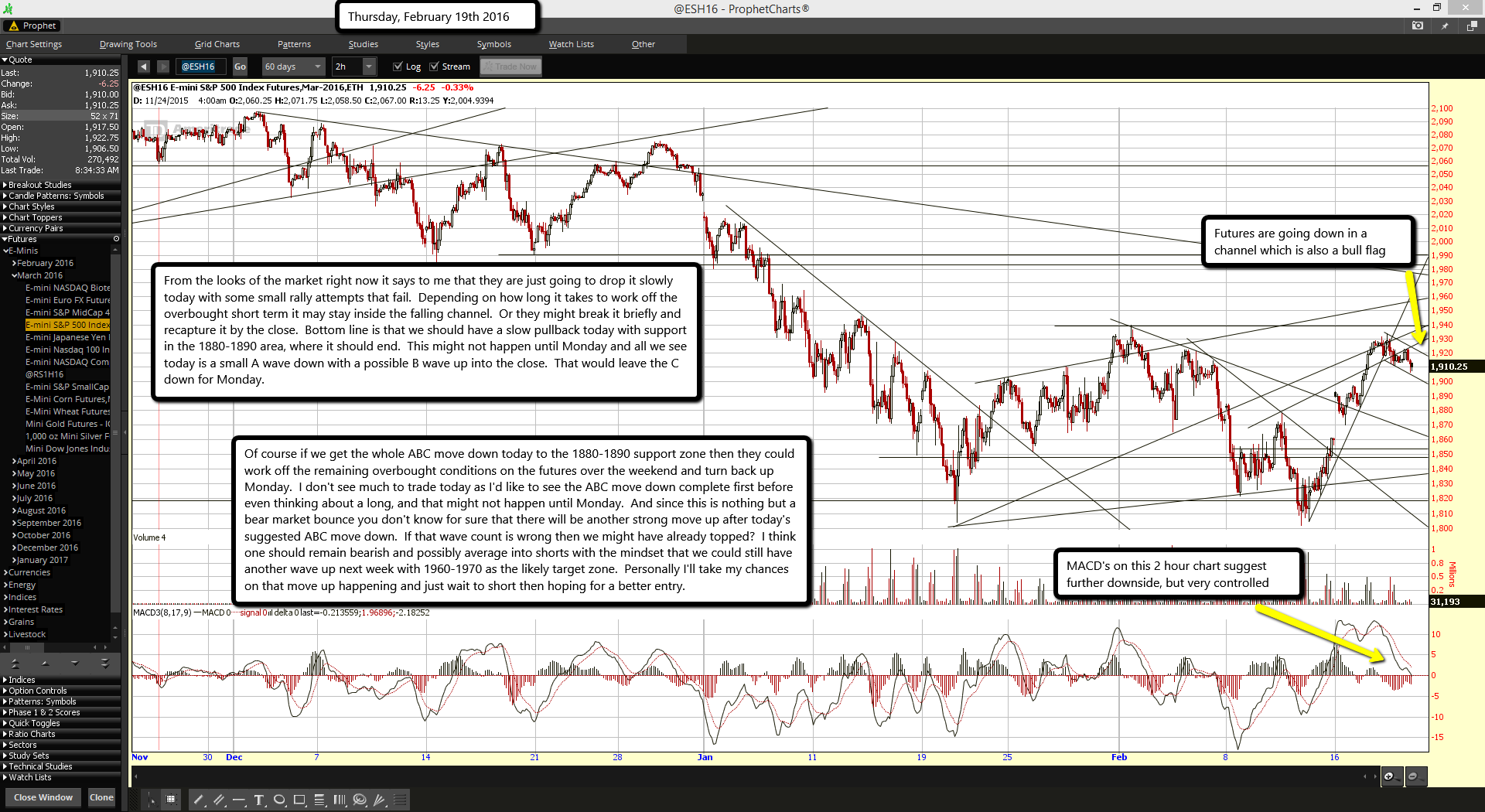
Futures are going down in a channel which is also a bull flag
MACD's on this 2 hour chart suggest further downside, but very controlled
From the looks of the market right now it says to me that they are just going to drop it slowly today with some small rally attempts that fail. Depending on how long it takes to work off the overbought short term it may stay inside the falling channel. Or they might break it briefly and recapture it by the close. Bottom line is that we should have a slow pullback today with support in the 1880-1890 area, where it should end. This might not happen until Monday and all we see today is a small A wave down with a possible B wave up into the close. That would leave the C down for Monday.
Of course if we get the whole ABC move down today to the 1880-1890 support zone then they could work off the remaining overbought conditions on the futures over the weekend and turn back up Monday. I don't see much to trade today as I'd like to see the ABC move down complete first before even thinking about a long, and that might not happen until Monday. And since this is nothing but a bear market bounce you don't know for sure that there will be another strong move up after today's suggested ABC move down. If that wave count is wrong then we might have already topped? I think one should remain bearish and possibly average into shorts with the mindset that we could still have another wave up next week with 1960-1970 as the likely target zone. Personally I'll take my chances on that move up happening and just wait to short then hoping for a better entry.
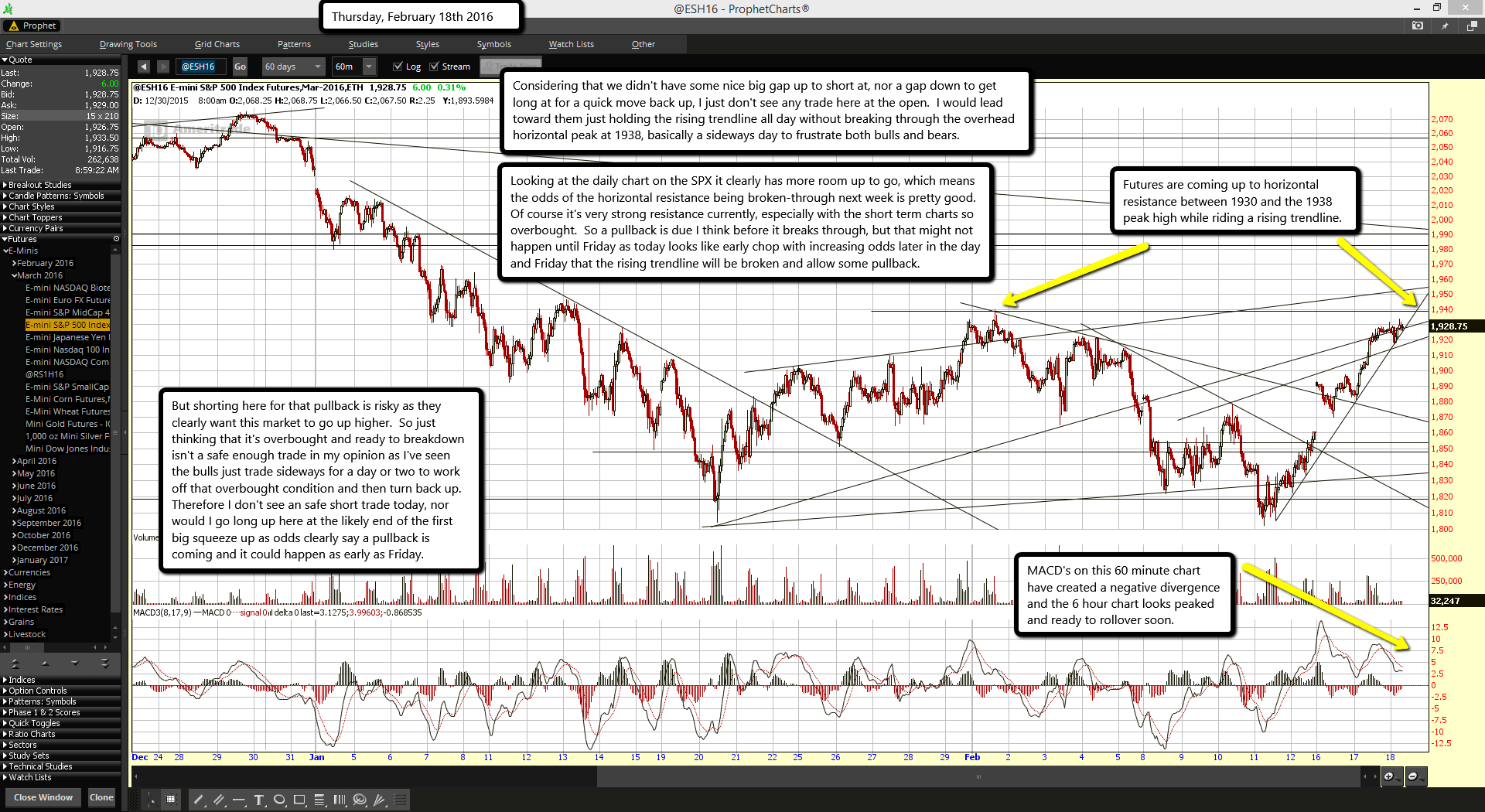
Futures are coming up to horizontal resistance between 1930 and the 1938 peak high while riding a rising trendline.
MACD's on this 60 minute chart have created a negative divergence and the 6 hour chart looks peaked and ready to rollover soon.
Considering that we didn't have some nice big gap up to short at, nor a gap down to get long at for a quick move back up, I just don't see any trade here at the open. I would lead toward them just holding the rising trendline all day without breaking through the overhead horizontal peak at 1938, basically a sideways day to frustrate both bulls and bears.
Looking at the daily chart on the SPX it clearly has more room up to go, which means the odds of the horizontal resistance being broken-through next week is pretty good. Of course it's very strong resistance currently, especially with the short term charts so overbought. So a pullback is due I think before it breaks through, but that might not happen until Friday as today looks like early chop with increasing odds later in the day and Friday that the rising trendline will be broken and allow some pullback.
But shorting here for that pullback is risky as they clearly want this market to go up higher. So just thinking that it's overbought and ready to breakdown isn't a safe enough trade in my opinion as I've seen the bulls just trade sideways for a day or two to work off that overbought condition and then turn back up. Therefore I don't see an safe short trade today, nor would I go long up here at the likely end of the first big squeeze up as odds clearly say a pullback is coming and it could happen as early as Friday.
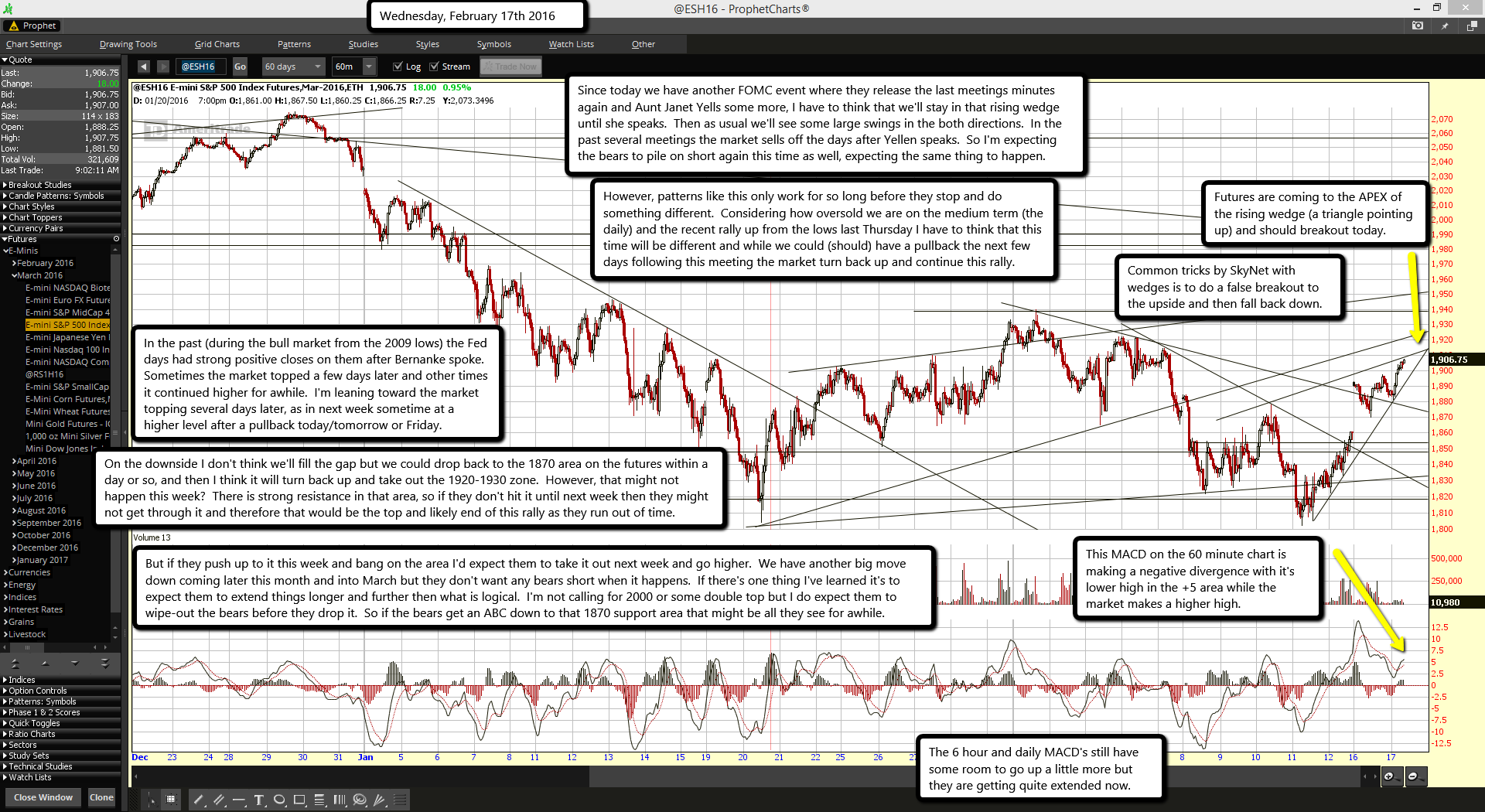
Futures are coming to the APEX of the rising wedge (a triangle pointing up) and should breakout today.
Common tricks by SkyNet with wedges is to do a false breakout to the upside and then fall back down.
This MACD on the 60 minute chart is making a negative divergence with it's lower high in the +5 area while the market makes a higher high.
The 6 hour and daily MACD's still have some room to go up a little more but they are getting quite extended now.
Since today we have another FOMC event where they release the last meetings minutes again and Aunt Janet Yells some more, I have to think that we'll stay in that rising wedge until she speaks. Then as usual we'll see some large swings in the both directions. In the past several meetings the market sells off the days after Yellen speaks. So I'm expecting the bears to pile on short again this time as well, expecting the same thing to happen.
However, patterns like this only work for so long before they stop and do something different. Considering how oversold we are on the medium term (the daily) and the recent rally up from the lows last Thursday I have to think that this time will be different and while we could (should) have a pullback the next few days following this meeting the market turn back up and continue this rally.
In the past (during the bull market from the 2009 lows) the Fed days had strong positive closes on them after Bernanke spoke. Sometimes the market topped a few days later and other times it continued higher for awhile. I'm leaning toward the market topping several days later, as in next week sometime at a higher level after a pullback today/tomorrow or Friday.
On the downside I don't think we'll fill the gap but we could drop back to the 1870 area on the futures within a day or so, and then I think it will turn back up and take out the 1920-1930 zone. However, that might not happen this week? There is strong resistance in that area, so if they don't hit it until next week then they might not get through it and therefore that would be the top and likely end of this rally as they run out of time.
But if they push up to it this week and bang on the area I'd expect them to take it out next week and go higher. We have another big move down coming later this month and into March but they don't want any bears short when it happens. If there's one thing I've learned it's to expect them to extend things longer and further then what is logical. I'm not calling for 2000 or some double top but I do expect them to wipe-out the bears before they drop it. So if the bears get an ABC down to that 1870 support area that might be all they see for awhile.
Victoria’s Secret’s CEO has resigned, the lingerie store’s parent company announced Friday.
Sharen Jester Turney, who had been CEO of Victoria’s Secret since 2006, attributed her departure to wanting to prioritize her family.
“After 16 years and a record fourth quarter at Victoria’s Secret, I have decided to prioritize my family and my personal life and consider what’s next for me professionally,'' she said in a statement.
Leslie Wexner, chairman and CEO of parent company L. Brands, will take the helm of Victoria’s Secret, while Turney remains as an adviser.
“We are very grateful to Sharen for her leadership and all that she has accomplished,’’ Wexner said in a statement. “Victoria’s Secret sales have increased more than 70% to $7.7 billion and profit has increased substantially during her nine years as CEO. ... We have strong confidence in the strength of the brand and our growth opportunities, and I look forward to taking on a more active role and working with the talented leadership team at Victoria’s Secret.”
L Brands has more than 3,000 company-owned specialty stores around the world, and owns such brands as Bath & Body Works, Henri Bendel along with Victoria’s Secret.
The minutes of the January meeting should reveal more concern among Fed officials about the global backdrop and the tightening of financial conditions, but stop well short of suggesting the Fed will postpone rate hikes in March or later.
At the January meeting the FOMC indicated it would be “closely monitoring” these risks. In recent speeches, Yellen, Fischer and Dudley each said that deteriorating financial conditions need to be “persistent” to prove a risk to the outlook; the January minutes should contain a similar assessment and may give additional information about what conditions would change the Fed’s outlook. The minutes may also suggest that Fed officials could be collecting data right up to the March meeting before deciding what action to take. That said, given the FOMC effectively dropped its discussion of the balance of risks and cited greater uncertainty to the outlook in the statement, we expect a modestly dovish tone to the minutes overall.
We have been struck by how much some Fed officials (most notably Yellen) have cited the need to start gradual rate hikes to preclude having to tighten more aggressively later. This gradual approach, it has been argued, should actually help reduce the risk of a recession. However, we expect this view to have been challenged by more dovish participants at the January meeting. There is likely to be some debate over how much slack remains and how much that would put up wages and prices. Meanwhile, we expect greater uncertainty around the inflation outlook, particularly as the US dollar has appreciated further while oil and other commodity prices have continued to fall. Notable would be any discussion of how much inflation expectations would need to drift lower before the Committee became more concerned. (Some clarification of the dissent on the updated “Statement of Longer-Run Goals and Monetary Policy Strategy” by St. Louis Fed President Bullard might be useful as well.)
The combination of near-term uncertainty in the inflation outlook and greater downside risks from the global financial market selloff might well be enough to postpone a rate hike in March. But the January minutes are only likely to hint at that possibility, in our view. Nonetheless, we continue to expect the Fed to hold policy steady in March and then hike again in June, under the assumption that markets calm down and the labor market continues to improve.
FX: What Minutes?
In normal times, FOMC Minutes usually aren’t a key market focus. The sharp risk-off tone to markets in recent weeks further reduces their importance. The market’s response to Chair Yellen’s testimony this week is telling. Chair Yellen failed to capitulate on the FOMC’s base case view for gradual pace of rate hikes based on labor market strength, despite the rates market now pricing more than 30% chance of cuts this year. While Chair Yellen did recognize the downside US growth risks from China-induced volatility, the global slowdown, and the USD, her tone doesn’t sound like someone ready to drop the prospects for hikes altogether. The market response however continues to suggest it is uncomfortable with Fed hikes when ex-employment growth momentum is so slow, suggesting it will continue to question the Fed’s ability to hike. Indeed, the Critical Stress Signal (CSS) within BOFAML’s Global Financial Stress Index (GFSI) flipped to “risk off” for the first time since August.
Historically, a “risk off” signal has seen at least a 5% decline in the S&P in 11 0f 18 occurrences since 2000. What’s different this time is that the Fed is no longer there to soothe the market with additional easing as it has during periods of stress since 2009 (Chart 1). With risk likely to remain under pressure in the near-term, we see continued risk of USD weakness as USD long positions are unwound as rate differentials continue to suggest the USD is overvalued at current levels.
In this Tuesday, Jan. 26, 2016, photo, a man installs a roof on a new home under construction in Atlanta. On Tuesday, Feb. 16, 2016, the National Association of Home Builders/Wells Fargo releases its February index of builder sentiment. (AP Photo/John Bazemore)
U.S. homebuilders are feeling slightly less confident about their sales prospects ahead of the spring home-selling season, though they remain positive overall that the housing market will continue to improve this year.
The National Association of Home Builders/Wells Fargo builder sentiment index released Tuesday slipped to 58 this month, down three points from a revised reading of 61 in January.
A massive, 404-carat diamond was recovered in the southern African country of Angola, the Lucapa Diamond Company announced Monday.
The 404.2-carat diamond is the biggest diamond ever found in Angola and the 27th biggest recorded diamond in the world. Angola is one of the world's top four diamond producing nations, the company said.
Lucapa Diamond Company
Lucapa Diamond Company says this 404 carat Lulo gem, pictured in an undated handout photo, is the biggest recorded diamond ever found in Angola.
The diamond was recovered from a Lulo Diamond Project mine in Angola's Lunda Norte province, the Australian company said in a statement. The Lulo mine accounts for nearly 75 percent of Angola’s annual diamond production, Lucapa said.
Republican presidential candidate Sen. Ted Cruz (R-TX) stands with his wife Heidi. (Photo by Christopher Furlong/Getty Images)
Republican Presidential candidate Ted Cruz’s plan to impose a flat 10 percent tax on all personal income and greatly lower the corporate tax rate would cost the federal government at least $8.6 trillion over a decade, according to a new analysis.
Republican presidential candidates have been quick to campaign on promises to cut taxes, but because most have yet to detail how they would slash spending to offset this lost revenue, analysts have projected their proposals would be deficit busters.
Cruz’s plan also falls short of fulfilling the Texas senator’s promise that his flat tax system would be so simple that taxpayers would file their returns on a postcard.
Cruz would eliminate nearly every tax deduction except those for charitable contributions and mortgage interest and would increase the standard deduction to make doing your taxes easier. He would also eliminate all credits except the earned income tax credit for low income workers and the child tax credit.
The streamlined system is the simplest plan released by any presidential candidate, but analysts said Cruz’ proposals would still require most people to fill out more than a postcard.
“I would think the form would have to look not that different than what you do now,” said Tax Policy Center Co-Director Eric Toder.
The Cruz campaign declined to respond to questions Tax Policy Center staff sent about the plan, which meant it had to make some assumptions about Cruz’s proposal in areas where there was a lack of detail.
The proposal also falls short of Cruz’s promise that under his plan every income-level would see double-digit increases in after-tax income.
Analysts found that while most workers would receive a tax cut, the lowest income workers would see their after-tax income decline by 0.6 percent.
There would be a 16 percent flat business tax under Cruz’s proposal, which functions like an across-the-board consumption tax that would increase the amount workers are taxed by their employers. Those low-income workers who don’t make enough to file taxes wouldn’t benefit from the expanded standard deduction that is meant to offset the payroll-side increases.
“Somebody below the standard deduction amount, they cannot benefit much,” said Tax Policy Center Director Leonard Burman, who served in the Treasury Department during the Clinton administration. “They would benefit very little from repealing the corporate income tax so on net they would end up paying higher taxes under the Cruz plan.”
Cruz’s business tax has also been criticized by fellow presidential candidate Sen. Marco Rubio (R-Fla.), who compared it to a European-style value added tax. Burman said Rubio is correct and Cruz’s system would impose a version of the consumption tax system popular in much of Western Europe. The center estimates Rubio’s tax proposal would cost the government at least $6.8 billion in lost revenue over the next decade.
The biggest beneficiaries under Cruz’s plan would be the top 0.1 percent of earners. People earning over $3.7 million per year would see an average tax break of more than $2 million in the first year, according to the analysis.
The plan would add $10.2 trillion to the national debt in the first decade, according to the center, when you include interest payments on the additional government borrowing that would occur.
Cruz isn’t alone in crafting a tax plan that would cost the federal government trillions while delivering big benefits for the wealthy, all of the Republicans running for president are doing it.
“All of the plans benefit high income people more than low income people,” Burman said. “They are enormous tax cuts compared to the current system and they are enormously regressive.”
Analysts said the lost revenues could be reduced through spending cuts, including Cruz’s plan to repeal the Affordable Care Act, but Cruz and most other Republican candidates have yet to provide detailed lists of the cuts that should be made.
Burman said the plan would make it easier and more beneficial for businesses and individuals to invest. Lower tax rates and benefits for businesses would likely encourage major investments in the early years of the plan, but analysts said they expect interest rates would increase and the economy would decline as a result of the ballooning debt.
“The plan by itself, not including the unspecified spending cuts, would surely depress the economy,” Burman said.
Neel Kashkari was a Treasury Department official in the George W. Bush and Obama administrations.
WASHINGTON — During the 2008 financial crisis, Neel Kashkari worked tirelessly to save the nation’s largest banks. As a senior Treasury Department official in the George W. Bush and Obama administrations, he helped those banks grow larger than ever.
On Tuesday, he said it was time to think about breaking them up.
“I believe the biggest banks are still too big to fail and continue to pose a significant, ongoing risk to our economy,” Mr. Kashkari said at the Brookings Institution, delivering his first public speech as the new president of the Federal Reserve Bank of Minneapolis.
He described the threat of another crisis that might force the government to bail out large banks, as it did in 2008, as a rare instance of a clear and preventable problem.
“The question is whether we as a country have the courage to actually take action now,” he said.
“There are lines in your speech I can imagine a Bernie Sanders or Elizabeth Warren saying,” David Wessel, a former economics editor at The Wall Street Journal who moderated the Brookings event, told Mr. Kashkari during a panel discussion after the speech. “It’s not what one expects from a Goldman Sachs Republican.”
Mr. Kashkari, who joined the Minneapolis Fed in January after a postcrisis stint at the investment management firm Pimco and an unsuccessful run for governor of California, responded that he was calling things as he saw them. He said his views on financial regulation were shaped by the crisis, convincing him that strong, simple safeguards are the most sensible.
“If I’m not willing to stand up and share my concerns, then I wouldn’t be doing my job,” he said.
Other Fed officials are divided over the adequacy of postcrisis reforms. Eric S. Rosengren, president of the Federal Reserve Bank of Boston and an influential voice on regulatory issues, said in a recent speech that the government had made “substantial progress.” He said new regulation had reduced both the probability and the cost of a large-bank failure.
Donald L. Kohn, who worked with Mr. Kashkari during the crisis as the Fed’s vice chairman, said after the speech that he had greater confidence than Mr. Kashkari in the 2010 Dodd-Frank Act, which grants regulators new powers to constrain and, if necessary, dismantle large banks.
“I think the new regime, once it’s fully in place, probably will work,” he said.
Mr. Kashkari said the cost of large crises underscored the importance of minimizing risk. “It’s not simply the cost of the bailout,” he said. “It’s the economic damage that’s inflicted across society.”
He said the Minneapolis Fed would begin a research effort to consider “more transformational measures” the government could pursue, and that he hoped to publish a proposal by the end of the year. Asked by reporters whether he had consulted the Fed’s chairwoman, Janet L. Yellen, or other officials, he responded, “I’m looking forward to getting their feedback.”
Mr. Kashkari outlined a number of potential options for restraining large banks, although he emphasized that the list was not intended to be comprehensive.
The first and most familiar is forcing large banks to break into smaller pieces, the approach favored by Mr. Sanders, who released a statement on Tuesday saying he was “delighted” by the speech.
Big banks argue they play a unique role in the global economy, and that foreign rivals would take up the slack. They also say big banks are stronger in some ways, and that regulations are adequate.
“Breaking up the U.S.-based global financial institutions would ensure that one of the United States’ most competitive global industries serving companies small and large is turned over to banks based outside the United States,” said John Dearie, acting chief executive of the Financial Services Forum, which represents the interests of large financial firms.
Alternatively, the government could limit risk-taking by increasing the share of funding banks must raise in the form of capital rather than borrowed money. Mr. Kashkari compared this to the safeguards imposed on nuclear power plants, where failure is regarded as unacceptable. Anat R. Admati, a Stanford finance professor, is a leading proponent of this approach.
A third, broader approach would impose a tax on borrowing throughout the financial system, reducing risk-taking not just by banks but a wide range of other financial intermediaries. The role of banks in the financial system has declined over time, and many experts regard the rest of the financial system, relatively less regulated, as a more likely source of future crises.
Critics of both the second and third approaches argue that economic growth requires risk-taking, and preventing risk-taking by banks will shift activity to less regulated sectors.
Mr. Kashkari said that limiting the risks posed by large banks could allow the government to ease regulation of smaller banks. He also took a pre-emptive shot at the banking industry, noting the “endless objections” its lobbyists have raised to proposals for stronger regulation.
“We need to move before we as a society have forgotten the lessons of ’08,” he said.
The airline claims competitor ViaSat can offer faster service.
American Airlines may be saying goodbye to Gogo.
The Texas-based airline on Friday filed a lawsuit against Gogo, saying it has found a competing in-flight Internet provider — ViaSat — that offers faster service, as was first reported by the Fort Worth Star-Telegram. As part of their contract, American Airlines can renegotiate or terminate its agreement with Gogo if it finds another in-flight Internet provider that offers better service.
Apparently American Airlines found that in ViaSat, which currently offers in-flight Internet services for United Airlines, Jet Blue, and Virgin America.
"After carefully evaluating the new technology and services in the marketplace, American has decided to exercise its rights under the Agreement and recently notified Gogo that ViaSat offers an in-flight connectivity system that materially improves on Gogo's air-to-ground system," the airline said in its suit, according to the newspaper.
In a statement sent to PCMag Tuesday, American Airlines said it continually evaluates in-flight connectivity service. "We've notified Gogo of a competitor's offering, and we will evaluate all of our options," the airline said.
Meanwhile, Gogo, in a statement to PCMag, said the issue only involves about 200 American Airlines planes — not the airline's entire fleet of more than 800 Gogo-equipped aircraft. Gogo said it plans to submit a competing proposal to install its latest satellite technology — dubbed 2Ku — on the fleet in question.
"We believe that 2Ku is the best performing technology in the market and look forward to discussing our offer with American," Gogo said.
PCMag's Sascha Segan recently tested Gogo's new 2Ku satellite system, and said it allowed for "smooth streaming video with no buffering" and that streaming "Netflix was absolutely no problem." Another benefit of the new system: it may be the first to work well during tarmac delays.
[ad_2]
The lawsuit says alternative service providers offer faster, more reliable wireless internet service.
Some American Airlines customers could see faster internet service via a new in-flight wifi provider.
The airline filed suit Friday against GoGo, an internet service provider, in Tarrant County District Court, notifying the company that a competitor was offering a faster service.
The suit notes that GoGo's existing system, which utilizes ground-based cellular towers to connect airline passengers to the internet, can make it difficult for passengers to stream video and use other data-heavy entertainment tools on a flight.
According to the suit, "alternative service providers are offering faster, more reliable and less expensive satellite-based wifi services to airlines like United, Southwest, JetBlue and Virgin America."
"Whereas Gogo’s system provides 3 Mbps (or at most, 10 Mbps (megabits per second)) of bandwidth shared among all users on a flight, and blocks most video content, these new satellite-based services offer 12 Mbps per device — more than enough for passengers to stream music, movies, and television," the suit notes.
Casey Norton, American Airlines' director of corporate communications, said the airline has multiple contracts with GoGo. This particular suit focuses on one contract that covers about 200 of the airline's older model planes, including Boeing 737s that are primarily used on regional and domestic flights.
AA's fleet includes approximately 1,600 planes.
"We haven't made any decisions yet," Norton said. "All we've done is notify them of a competitor's offering."
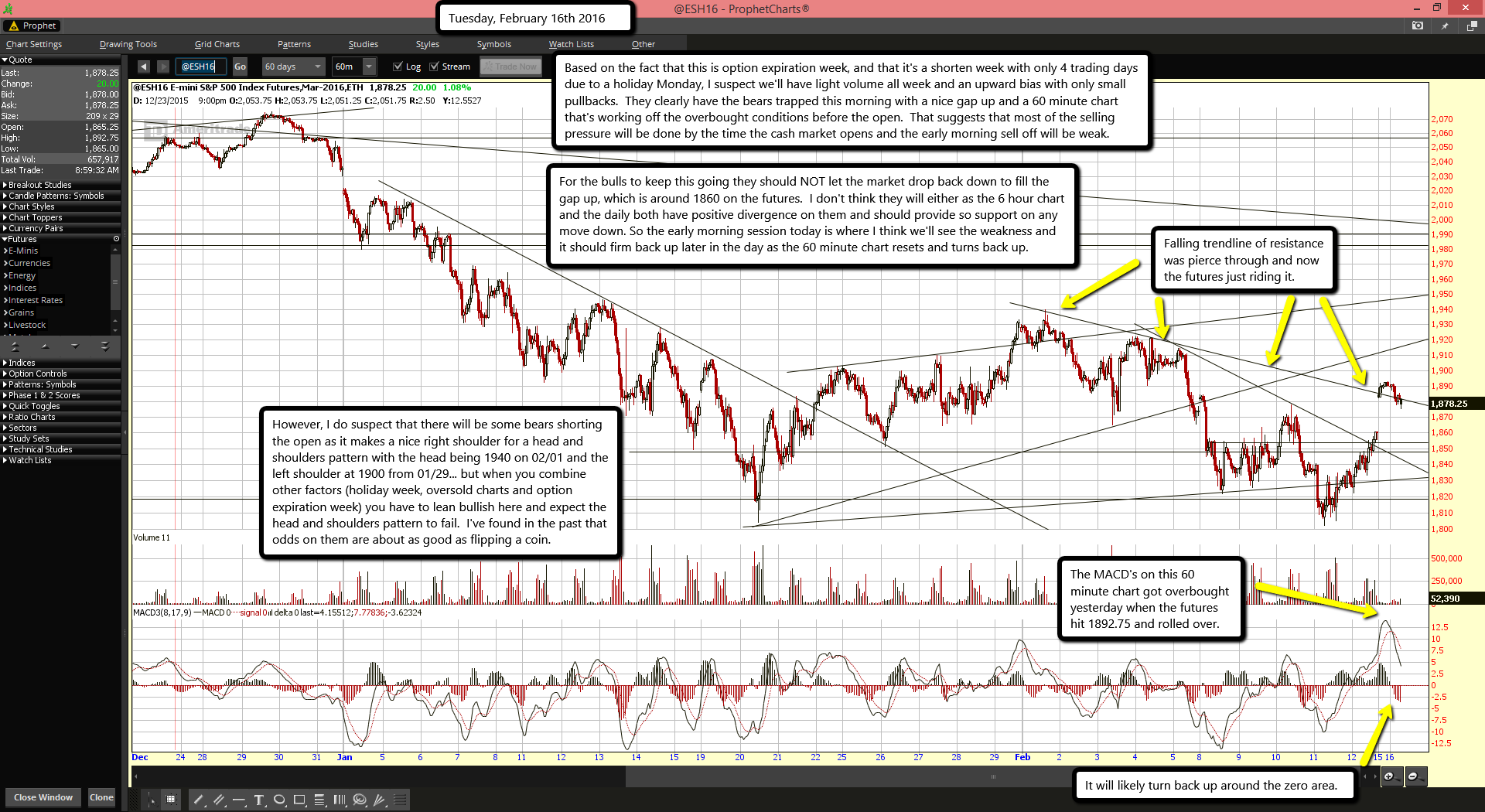
Falling trendline of resistance was pierce through and now the futures just riding it.
The MACD's on this 60 minute chart got overbought yesterday when the futures hit 1892.75 and rolled over. It will likely turn back up around the zero area.
Based on the fact that this is option expiration week, and that it's a shorten week with only 4 trading days due to a holiday Monday, I suspect we'll have light volume all week and an upward bias with only small pullbacks. They clearly have the bears trapped this morning with a nice gap up and a 60 minute chart that's working off the overbought conditions before the open. That suggests that most of the selling pressure will be done by the time the cash market opens and the early morning sell off will be weak.
For the bulls to keep this going they should NOT let the market drop back down to fill the gap up, which is around 1860 on the futures. I don't think they will either as the 6 hour chart and the daily both have positive divergence on them and should provide so support on any move down. So the early morning session today is where I think we'll see the weakness and it should firm back up later in the day as the 60 minute chart resets and turns back up.
However, I do suspect that there will be some bears shorting the open as it makes a nice right shoulder for a head and shoulders pattern with the head being 1940 on 02/01 and the left shoulder at 1900 from 01/29... but when you combine other factors (holiday week, oversold charts and option expiration week) you have to lean bullish here and expect the head and shoulders pattern to fail. I've found in the past that odds on them are about as good as flipping a coin.
The Moving Averages on the monthly chart crossed and confirmed that the market is headed for a crash within the next year.
Learn how to double or triple your money every month trading the stock market through the e-mini futures, SPY, and Forex instruments.
Before I go over the charts and forecast the coming weeks and months I want to talk about an incredible opportunity to learn how to trade right along side of someone who made $90 million dollars trading.
The system that this master trade used to make that money is now available for everyone to follow and profit from. Last year he set up an account and tested the system fully on autopilot, and it averaged 15%-17% per month for 12 straight months. There were NO losing months!
Sure, there were trades that lost but the overall win to lose ratio made a steady profit every month completely on autopilot. This is perfect for someone who has a day job and can't trade everyday. This could be used on their 401k program instead of letting some broker trade it for them. The yearly gains would be around 200% or so... way better then what any other 401k program will make.
Then in December of 2015 this master trader with other great traders opened up the daily chatroom and made 200-300% in ONE Month!
Having the chance to go into a chatroom like this and learn from, and/or follow master traders like this is HUGE! In fact they have setup a way for you to link your own personal account up with one of these master traders and follow his every trade. When he places a trade in his account an identical trade will be place in your personal account automatically.
You know me by now, and you know how I think about the elite criminals banksters that rig the market and cheat with their software system that front runs buy and sell orders by milli-seconds (think Goldman Sachs), who never have a losing day trading. How is that even possible... unless you cheat?
Of course all of this big banksters have some kind of trading system that analysis the market and places trades based on all kinds of technical data that we retail traders don't have access to. It's a game rigged for the big institutions and it's something they guard heavily and don't let us know about.
Here's someone that developed his own trading system and while he doesn't win all the time like the banksters, he's mastered it to the point that he's made himself very wealthy. He wasn't an elite growing up, in fact he came from Brooklyn and grew up in a tough neighborhood with very little money. Now he wants to help give back to the average person.
Just imagine having access to follow "trade for trade" someone that's made $90 million dollars trading!
If you have be following me for very long (I started this blog in 2009) you know I don't get impressed easily. But after doing some research on this guy I do think he's the "real deal" and something everyone should take a serious look at. I decided to join to get access to the live trading chatroom and if you really want to learn how to trade profitably you should too.
We all know the market is rigged and run by a supercomputer that I call SkyNet. So it only makes sense to use a computer software system to analysis the market and help you make trades against SkyNet. Use a computer to fight against another computer. We traders need all the help we can get as I know I (and you too I'm sure) have made trades based on your emotions... which usually end up being a loser.
I've been there... and it sucks. I've just never had access to a computer trading software that will do all the technical analyst for me, but now I do. You know I talk about Elliottwave counts, Fibonacci levels, Turn dates, Fake Prints, etc... and why I get a lot right the times I get them wrong can really hurt your pocketbook if you are stuck in a trade.
So if you want a change... something that can really help you make money, then I urge you to watch the recorded webinar above and learn as much as you can about the company. I have my own free chatroom on this blog and I'm in there everyday during normal market hours. There's about 40 people that signed up and 6-8 regulars that come in and out of the room daily.
The room will stay FREE as I've decided that I don't want to be responsible for giving out trades, which would be something I'd have to do with a paid room. So instead, I just want to help as many people as possible for free, with nothing asked in return. I want to spend my time learning how to trade from a master trader and use his automatic trading software to scan for great trades.
So come join me in my chatroom if you like and I help you any way I can. You have questions about the automatic trading system? Come ask me and I do my best to answer them. There's going to be millions made in this company and missing out on the chance to join them is something I wouldn't advise. Watch the webinar and decide for yourself.
On this monthly chart we can now see the 10 month moving average at 2017.53 and the 20 month moving average at 2023.95 SPX, which is the first time it's crossed since the 2007 prior high and later crash.
While it's not impossible for the market to turn back up and make a higher high the odds of that happening are very slim. Trying to think about what the Fed's could do to cause such a rally and I honestly can't think of anything? We are near zero interest rates, exhausted several QE programs... which have little to NO effect now. So what's left? I don't see anything that can save the market from a crash now.
On the shorter term...
We now have a clear 5 wave pattern down from the late December 2015 high, and what looks like the start of a multi-day or multi-week rally.
I have a turn date for February the 24th, so that "could" be the top of the coming oversold rally. I'm expecting at least a 50% retrace of the recent sell off, which would be around the 1946 SPX level, but I wouldn't be surprised if they squeeze it up higher to the 61.8% (1978) or the 78.6% (2023) level to get all the bears out before the next move down.
If the rally extends up to a higher Fibonacci level then my "turn date" could be wrong and/or off by a bit, as I'd expect it to take 2-4 weeks for the whole rally to complete and the higher it goes the longer period in "time" it should take. Naturally I can't rule out some kind of massive relentless "day after day" straight up move that just kills the bears and hits the higher levels, as then it could still end on my turn date.
After it's done we should see another big drop in the market that takes out the 1810 SPX recent low. Downside targets are the 1780 area first, then the 1730 area. This should be some larger (Major) wave C down. This should take all of the month of March to bottom with an expected low in early April.
Then another rally should take us up into May followed by another drop into June where I think we'll have a strong multi-month rally start from. This should take us into the August/September period where many crashes start. It's to early at this point to make a forecast on what to expect then so I won't even try.
One thing remember is that we have the Presidential Election in November so I'd think there will be some wild rallies up and big moves back down in the 2nd half of this year as they attempt to fool all of us retail traders telling us everything is "ok" just before the market falls off a cliff and scare us to death just before a powerful rally.
Everything is fluid and changing so be sure to follow my daily chart updates and come join me in my free chatroom for more up to date information, and any new FP's (fake prints) I find or ritual coded dates like the Lucy passport from the August 24th, 2015 crash.
Red.
P.S. If you have problems joining my chatroom just email me "red (at) reddragonleo (dot) com" as I've had to install more security to stop all the brute force attacks where spam bots try to setup fake email accounts on the registration page.
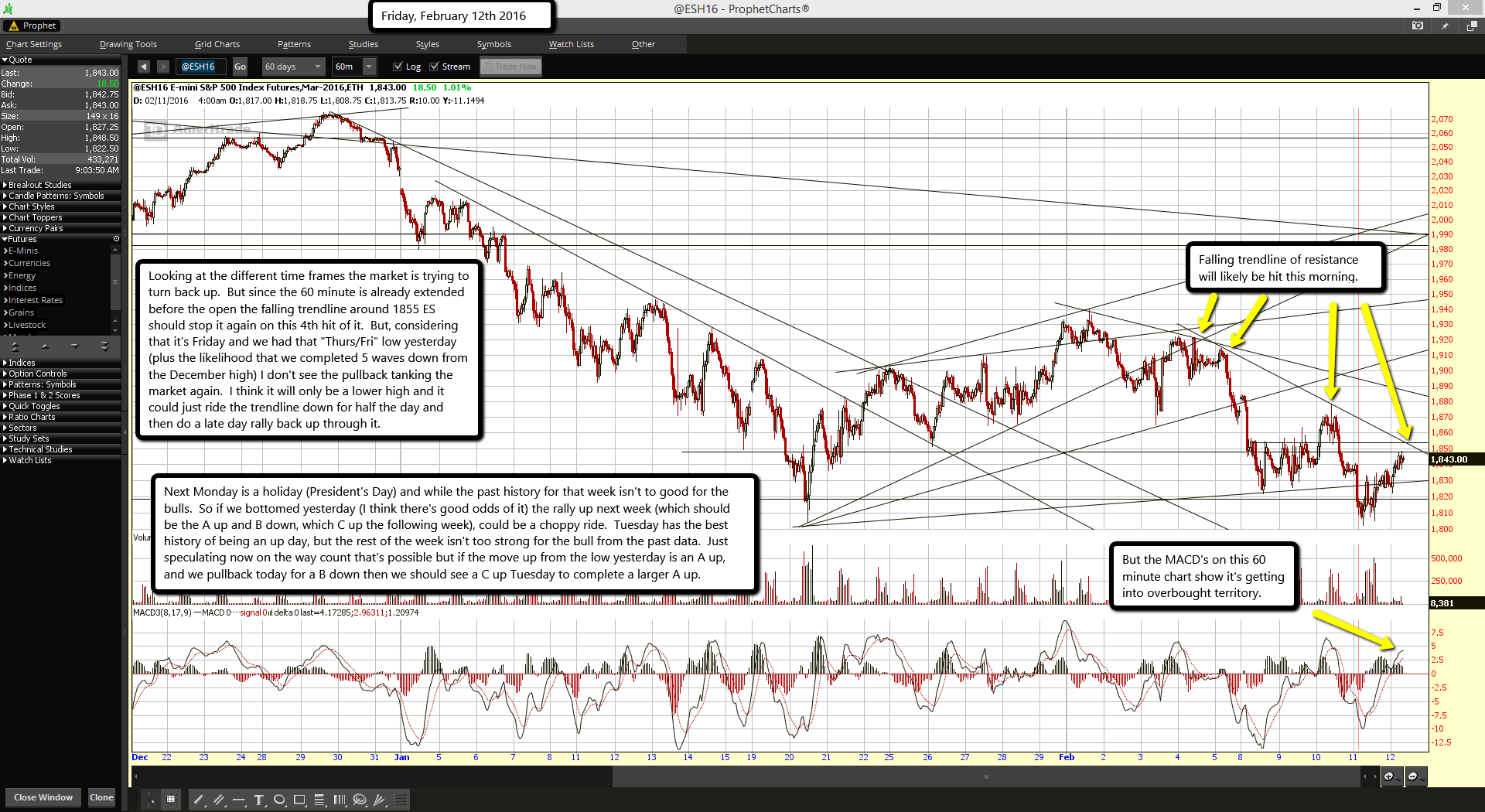
Falling trendline of resistance will likely be hit this morning.
But the MACD's on this 60 minute chart show it's getting into overbought territory.
Looking at the different time frames the market is trying to turn back up. But since the 60 minute is already extended before the open the falling trendline around 1855 ES should stop it again on this 4th hit of it. But, considering that it's Friday and we had that "Thurs/Fri" low yesterday (plus the likelihood that we completed 5 waves down from the December high) I don't see the pullback tanking the market again. I think it will only be a lower high and it could just ride the trendline down for half the day and then do a late day rally back up through it.
Next Monday is a holiday (President's Day) and while the past history for that week isn't to good for the bulls. So if we bottomed yesterday (I think there's good odds of it) the rally up next week (which should be the A up and B down, which C up the following week), could be a choppy ride. Tuesday has the best history of being an up day, but the rest of the week isn't too strong for the bull from the past data. Just speculating now on the way count that's possible but if the move up from the low yesterday is an A up, and we pullback today for a B down then we should see a C up Tuesday to complete a larger A up.