Jobs site Careerbuilder recently released a survey suggesting more employees will be looking for a new job in 2016. If you plan to be one of them, what kind of job should you look for?
Another employment site, Glassdoor.com, has released a list of what it says will be the 25 best jobs in America in 2016.
The best position, according to the survey, is data scientist, with an estimated 1,736 job openings and a base salary of $116,840.
Number two on the list is tax manager. Glassdoor predicts 1,574 job openings for that job with a median base salary of $108,000.
In third place is solutions architect, with 2,906 job openings and a median base pay of $119,500.
Filling out the top 10
Other occupations in the top 10 include engagement manager, mobile developer, HR manager, physician assistant, product manager, software engineer, and audit manager.
What's at the bottom of the list? Software engineer comes in at number 25. It's still a pretty good job. According to Glassdoor, it pays a median base salary of $130,000 – but is highly competitive, since Glassdoor counts only 653 openings.
The Careerbuilder survey found that 21% of employees were determined to leave their current employers in 2016, an increase of 5% from those who expressed that sentiment in the 2014 survey. Younger workers expressed the strongest desire to make a move.
Of the 18 to 34 age group, 30% said they expect to have a new job by the end of 2016, compared to 23% the previous year.
“Just because a person is satisfied with their job doesn’t necessarily mean they aren’t looking for new work,” said Rosemary Haefner, chief human resources officer at CareerBuilder. “Because of this, it’s critical to keep up with your employees’ needs and continue to challenge them with work they feel is meaningful.”
A barista works at a Starbucks coffee shop in the Pike Place Market, Seattle. (AP Photo/Elaine Thompson)
Retailer after retailer has announced in recent weeks that they saw tepid or downright disappointing sales during the crucial holiday season.
And then came Starbucks, dropping a blockbuster earnings report on Thursday that stands out as a clear bright spot in retail. The coffee giant announced that revenue soared 12 percent to a record $5.4 billion. Sales at its U.S. restaurants open more than a year were up 9 percent, and nearly half of that growth came from a surge in foot traffic.
The contrast suggests that Starbucks is outgunning its peers, at least for the moment, in tackling some of the problems that have befuddled the industry. One place where this is evident is in its digital strategy, which has centered heavily on incorporating mobile devices into the in-store experience. The company’s app accounted for over 21 percent of transactions in the quarter. At a time where shoppers have not widely embraced mobile payments, Starbucks appears to have built a digital ecosystem that customers have found especially useful.
It may be tempting to think that this doesn’t mean much for Starbucks’s bottom line, because you might presume that people are buying the same latte and croissant they always did, but just paying for it differently. But that overlooks some key, if not immediately obvious, benefits that Starbucks gets from adoption of the app.
For starters, Starbucks is getting reams of data about customers who use the app and the related loyalty program, allowing the chain to personalize offers to individual users and to generally better understand what menu items and price points are clicking with their most devoted followers.
Starbucks recently rolled out a new facet to its app, a “mobile order and pay” tool in which customers can order and pay for their frappuccino from afar and then walk in, skip the line and pick it up at the counter. The retailer said it is now processing 6 million such transactions a month, a relatively small share for a company that processes 85 million transactions globally each week. So, while this offering probably didn’t contribute massively to overall earnings in the quarter, its potential to move the sales needle in the future could be major.
Adam Brotman, the company’s chief digital officer, said on a Thursday call with investors that Starbucks is seeing an incremental sales boost from mobile order and pay. In particular, he said the system is boosting sales at the chain’s busiest stores during peak hours. (Think about it: How many times have you skipped out on your second coffee of the day when you’ve seen a bewilderingly long line at Starbucks and couldn’t be bothered to wait in it?)
This suggests something powerful for Starbucks: Mobile ordering is making it possible to wring more sales out of existing stores, important for a chain that already has almost 10,000 locations in the United States. That sales growth may not come without a related expense; executives said they may have to look at adding staff in stores to fill these orders if adoption continues to grow like executives think it will. But mobile ordering, along with pilots of delivery service, could be an important avenue for growth going forward.
As it works to build up its digital capabilities, Starbucks has also been moving to diversify beyond its core coffee business to sell more food items and to develop stronger business in lunch and dinner hours. There was evidence this quarter that Starbucks is getting this move right: The retailer said it has seen a 20 percent year-over-year increase in revenue from food sales at its stores, with particularly strong growth coming from breakfast sandwiches and its lunch-oriented Bistro Boxes, which include fare such as an edamame hummus wrap or prosciutto-and-mozzarella pinwheels.
Growing outside the core business has also meant a bigger push into grocery stores with products such as its K-Cups, the pods designed for use Keurig coffee machines that produce just a single serving of coffee. Starbucks said Thursday that sales of these items have shot up 20 percent and, in the quarter, accounted for a record share of the company’s overall sales. This growth is yet another bit of evidence that the company is broadening its reach, either generating more sales from Starbucks loyalists or bringing in new customers who mostly prefer to drink coffee in their pajamas at home.
While Starbucks disappointed investors Thursday with a lower-than-expected earnings outlook, the chain is still forecasting figures that are surely the envy of many of its industry peers: Global comparable sales growth is expected to be “somewhat above mid-single digits;” revenue growth is forecast to be 10 percent. In other words, it looks like the retailer’s caffeine high will continue for months to come.
Sarah Halzack is The Washington Post's national retail reporter. She has previously covered the local job market and the business of talent and hiring. She has also served as a Web producer for business and economic news.
Real people are losing real money. The average investor is down about 9% so far this year, according to Openfolio, a free app where investors compare their portfolios and performance.
But put that into the bigger context: Stocks have soared about 200% since March 2009. The recent pullback is a minor haircut, not a decapitation.
Plenty of experts argued stock prices had been bid up too high, especially tech and bio tech shares, and they needed a reality check.
The sell-off has brought stock prices back to more reasonable levels. Many investors gauge how expensive the market is by looking at the price-to-earnings (P/E) ratio. The S&P 500 is now trading at 15.6 times forward earnings, according to S&P Capital IQ. That's cheaper than the 15-year average.
2. Is the world (and U.S.) on the verge of another 2008 crisis?
It's highly unlikely. Banks and individuals have a lot less debt and a lot more cash on hand than they did heading into 2008. Companies too are sitting on over $1 trillion of cash. All of this money acts as a rainy day fund that gives businesses and people a cushion if the economy really tanks. The world didn't have that in 2008.
It's also telling that as investors have been fleeing stocks, they have been purchasing more bonds than gold. Typically, when investors fear the worst, they pour into gold.
The biggest concerns today are China and cheap oil. But China is sitting on its own massive pile of cash. It may be dwindling, but it's still huge. China is likely to spend that cash if the nation's economy dives into recession.
As for oil, it's only about 6% of the stock market and overall U.S. economy. The energy sector may be hurting, but as long as consumers keep spending, America can keep growing.
The one legitimate concern today versus 2008 is that central banks can't provide as big of a life jacket. Typically when the economy slows, central banks cut interest rates to help jumpstart growth. But interest rates in the U.S. and Europe are already at or near historic lows. There's not much left to cut.
That said, central banks continue to pledge they will do everything in their power to intervene if the economy sours. On Thursday, Europe's top banking chief Mario Draghi said he's "ready to act" again to literally pump money into the economy, if needed. Immediately after that, stocks rallied.
3. If not a full-blown crisis, are we headed for a recession?
Unlikely. The U.S. and China are the big players in the world economy. Right now, both are growing, and the U.S. just had two stellar years of job growth.
The global gloom comes from slowing growth, especially in China. It's like going on a diet. It's not a fun feeling, especially at the beginning, as adjustments have to be made.
There's a lot of debate about just how deep China's slowdown is. The government still claims it's chugging along at 6.9% rate of economic growth. A lot of independent experts think the real figure is half that. But it's difficult to know.
If China continues to decelerate and stocks stay in slump mode for months, yes, there is a possibility of a recession. It impacts confidence. People get nervous and they no longer want to spend and banks get fearful and cut back on lending, making it harder for businesses to grow.
"If sustained, we believe the current sell-off also poses a serious threat to world growth," wrote Capital Economics. If it lasts through most of this year, it could cut world GDP by about 0.5% to 1%.
But the point is the downturn in stocks and China's economy have to get a lot worse to trigger a global or U.S. recession.
"Capital markets are a lot like dogs. They try to communicate as best they can, but their repertoire is limited at best. A dog barking could mean 'Play with me' or 'there's an escaped convict at the front door,'" says Nicholas Colas, chief market strategist at Convergex, a global brokerage company in New York.
CNNMoney (New York) First published January 22, 2016: 1:45 AM ET
FILE - In this Monday, Aug. 24, 2015, file photo, a trader looks at his phone outside the New York Stock Exchange, as world stock markets plunged after China's main index sank to its biggest drop since the early days of the global financial crisis. The slide on Wall Street could damage public-employee pension funds around the country that have yet to recover from the Great Recession. Since the start of 2016, stocks have been down by about 8 percent.
FILE - In this Monday, Aug. 24, 2015, file photo, a trader looks at his phone outside the New York Stock Exchange, as world stock markets plunged after China's main index sank to its biggest drop since the ... more
Photo: Seth Wenig, AP
Stock market tumble could keep pension funds behind
The slide on Wall Street could damage public employee pension funds around the country, most of which haven't even recovered from the Great Recession, and the burden could end up falling on taxpayers.
Stocks have been tumbling in the first weeks of 2016, with the Dow Jones industrial average and the S&P 500 down nearly 9 percent since the start of the year.
If there's a quick rebound, the slump won't make much difference. If the tumble continues, it could be bad news for pensions. Somewhere down the line, states may have to either cut benefits — which can be legally or politically difficult — or pump more tax dollars into their pension funds to make sure retirees get what they were promised.
Pension funds for government employees in many places are already struggling to bring in enough money to cover future payouts. Data compiled by the Pew Charitable Trusts found that only four states — Oklahoma, Rhode Island, South Dakota and Wisconsin — had amassed funding for a bigger portion of their pension liabilities in 2013 than in 2007, a year before stocks fell dramatically.
The average state-run plan went from being 86 percent funded before the Great Recession to 72 percent in 2013, the last year for which data was available. Despite strong returns on Wall Street from 2009 through mid-2015, most states saw funding declines for a variety of reasons, including higher payouts because of longer lifespans and generous benefits that were promised during flush times.
States such as California, Illinois, Kentucky and New Jersey didn't come close to making the taxpayer contributions they are required to make to their pension funds.
Pension fund officials in states as varied as California and West Virginia said they are not worried about short-term market fluctuations because they are diversified, long-term investors.
"For the most part, we are in it for the long haul," said Christine Radogno, the Republican state Senate leader in Illinois, which faces the nation's largest unfunded pension liability, at more than $100 billion, and is in a tough spot because the courts have ruled that employees' benefits can't be cut. "We look at 30-year returns, and the market is always up and down."
Keith Brainard, research director at the National Association of State Budget Administrators, noted that market drops can be a good opportunity to buy low on stocks that will rise in value before long. "These funds measure themselves in terms of their performance over decades rather than months, days and years," he said.
But some people who track government finance say even short-term returns are important.
"They can say they're long-term investors, but they have fixed payments that they must meet come hell or high water," said Don Boyd, director of fiscal studies at the Rockefeller Institute of Government, part of the State University of New York. "Illinois is very different than, say, a rich family creating a trust fund for a wayward son." While the family could reduce the son's payout when returns are low, there's little wiggle room for states to shrink payments to growing numbers of retirees, he said.
Boyd issued a report this week that found that from July through September of 2015, stock market losses led to a $268 billion increase in pension fund debt across the country, bringing the total to $1.7 trillion. He said he believes a strong end of the year on the stock market canceled out those losses, but the past few weeks erased the gains and then some.
Until the 1970s, pension funds were made up almost entirely of relatively safe investments such as bonds. Since then, it's become tougher to make big returns with bonds, so investment managers have turned to stocks, hedge funds, real estate and other holdings with the potential for larger gains but big losses, too.
CalPERS, the California public employee retirement fund that ranks as the nation's largest, now has more than half its funds in publicly traded stocks and nearly 10 percent in private equity. In New Jersey, U.S. stocks are 30 percent of the portfolio, the single largest type of investment.
Associated Press reporters Jonathan Mattise in Charleston, West Virginia, and Sophia Tareen in Chicago contributed to this article.
The Grasberg copper and gold mine complex near Timika, in the eastern region of Papua, Indonesia, is among Freeport-McMoRan’s “trove of treasures.” Credit
Antara Foto/Reuters
For a look at the damage that the plunging price of commodities — especially oil — is inflicting on the global economy, consider the plight of the venerable Freeport-McMoRan.
Freeport has long embodied the American swagger that conquered the West in the 19th century and enabled it to find significant copper and gold deposits in some of the world’s most remote regions. In 2007, flush from rising commodity prices, it bought Phelps Dodge, which traces its roots to pre-Civil War cotton traders and laid railroads on the American frontier. Its board, which has included a Whitney, a Rockefeller and Henry Kissinger, was long a who’s who of the corporate establishment.
About three years ago, to diversify its business, Freeport plunged into oil and gas under the leadership of its chairman, the Texas wildcatter James Moffett. With oil prices then nearing $100 a barrel, the company bought two companies, McMoRan Exploration and Plains Exploration and Production. The deals cost $20 billion, and to get them done Freeport sharply increased its debt load. (McMoRan had been spun off from Freeport in 1994.)
Oil Prices: What’s Behind the Drop? Simple Economics
The oil industry, with its history of booms and busts, is in a new downturn.
OPEN Multimedia Feature
When some investors questioned the rationale and ethics of the deal, Mr. Moffett highlighted his own management skills with characteristic bravado. “I don’t want to pat us on the back, but we’ve got extraordinary capabilities,” he said at the time. “We found the biggest gold and copper mine in the world, and I’ve said it three or four times, but I got the right to say it. Joe Namath said it isn’t bragging if you can do it.”
The deal now looks like a major blunder. In December 2010, Freeport’s stock peaked at over $60 a share. This week it dropped below $4.
“The stock is trading like they’re going to file for bankruptcy,” said Paul Massoud, a mining analyst with Stifel Nicolaus who in August of 2014 downgraded Freeport shares.
Freeport is hardly alone in getting battered by plummeting commodities prices. Banks’ earnings this month have taken a hit as they have marked down the value of their loans to energy companies. Many of the world’s largest commodities producers, including oil-rich countries like Saudi Arabia and Venezuela, or corporate behemoths like the Swiss company Glencore, are suffering after borrowing large sums of money at ultralow interest rates during the commodities boom.
In previous price slumps, commodities producers cut back. But this time, many have continued to flood the market with oil and copper even at depressed prices, confounding many economists. One explanation is that they need to generate the cash to meet debt obligations. In its last quarter, Freeport actually increased its oil production and barely cut back on copper despite falling prices.
Now, Freeport, which is based in Phoenix, needs to reduce its heavy debt burden, which at more than $20 billion is more than four times the company’s current market value of $4.8 billion. Once an aggressive bidder for trophy assets, it now finds itself in the position of a desperate seller. It’s also cutting jobs and slashing capital spending, the lifeblood of any mining company.
For its most recent quarter, Freeport reported a quarterly loss of $3.8 billion, bringing its loss for the first nine months of its fiscal year to $8.2 billion, mostly because of write-downs in the value of its oil and gas assets.
Photo
Freeport-McMoRan’s copper and gold mining complex in Indonesia is among the largest in the world. Credit
Dadang Tri/Bloomberg
When it last announced earnings in October, Freeport said its 2016 projections were based on an average oil price of $56 a barrel. This week oil dropped below $27 a barrel, though it rallied on Thursday. So expectations for Freeport’s latest quarter and full year results, which will be announced next week, are grim. (A Freeport spokesman said the company couldn’t comment because of the impending earnings release.)
Under pressure from the activist investor Carl Icahn, who disclosed an 8.5 percent stake in Freeport last fall, Mr. Moffett, 76, stepped down as chairman late last month.
Freeport “is getting hit by everything,” said Anthony Young, a mining analyst at the Macquarie Group. “It’s the fall in copper prices and metals, the plunge in oil and natural gas, and the amount of debt on the balance sheet. It’s going to take some pretty dramatic steps by management to right this ship.”
Still, however much Freeport is being battered by market forces beyond its control, it’s hard to feel too bad for the company’s management and shareholders, given how many of its woes seem self-inflicted during a woeful lapse in corporate governance standards.
As a pure mining company that had endured over a century of commodity booms and busts, Freeport had long shunned debt and never acted as if it expected good times to last indefinitely — time-honored notions that Mr. Moffett and his allies appear to have discarded when they pushed into oil and gas. Investors “loved this company for so long because they never took on much debt and never hedged,” Mr. Massoud said. “They were a pure proxy for commodities. No matter the price, they’d survive.”
Many Freeport investors were furious over the company’s audacious debt-financed move into oil and gas. As Evy Hambro, chief investment officer for BlackRock’s natural resources team, said in the company’s investor call to discuss the deal: “I haven’t heard anything on this call that in any way justifies why these companies should be put together, and I find it incredibly disappointing that as a management team, you’ve chosen to break the trust with investors from what the business was that we chose to invest in.”
The deal was all the more troubling given that it was rife with conflicts of interest. At the time, Mr. Moffett was McMoRan’s chief executive while also serving as Freeport’s chairman. (The “Mo” in the company’s name stands for Moffett.)
A glut of crude oil on the markets is pushing the price of oil down to levels not seen since the global financial crisis.
OPEN Graphic
Freeport’s chief executive, Richard Adkerson, was McMoRan’s co-chairman. Nine Freeport directors owned stock in McMoRan totaling about 6 percent of the shares. Freeport agreed to buy McMoRan for $2.1 billion — a 74 percent premium over its market price before the deal was struck. Mr. Moffett himself was paid $73 million.
Moreover, Plains owned 31 percent of McMoRan, enough to block any deal. Freeport eliminated that possibility when it bought Plains. And James Flores, Plains’s chief executive, who now runs Freeport’s oil and gas operations, was also a director of McMoRan. He made $200 million on the deal.
“Would it be possible to find out if anybody on the call from your side is not conflicted?” Mr. Hambro asked pointedly during the conference call.
Freeport officials denied any wrongdoing and justified the deal by saying that committees of independent directors at all the companies approved the transactions. Last year it agreed to pay $137.5 million to resolve shareholder lawsuits over conflicts of interest related to the deal. (All costs to the individual executives were covered by directors’ liability insurance, the company said.)
Even now, Mr. Moffett hasn’t exactly been sent packing. He received a severance package valued at $79.4 million, according to company filings. He keeps the title of chairman emeritus and will be paid $1.5 million a year as a consultant. Mr. Adkerson remains Freeport’s chief executive.
There’s no easy way out for Freeport. The company earlier said it would explore selling all or part of its oil and gas assets, but given current market conditions, any sale would be at fire sale prices. With its stock so depressed, it doesn’t make sense to raise more money in the equity markets, and it would be hard pressed to borrow more, either from banks or in the debt market (where some of its bonds are already trading at distressed levels).
Freeport still owns what Mr. Moffett called its “trove of treasures” — the Grasberg gold and copper operations in Indonesia; the Morenci copper mine in Arizona; and majority stakes in the Cerro Verde copper mine in Peru and Tenke Fungurume, the largest copper mine in the Democratic Republic of Congo. Freeport recently valued its interest in Grasberg alone at $16.2 billion.
“There’s a lot of concern about the company’s long-term solvency,” Mr. Young of Macquarie said. “But they do have some valuable assets that could alleviate the pressure.” He said investors were anxiously waiting to see what strategy the company unveils next week.
Freeport’s salvation may come from a rally in the commodities markets. But just as prices looked as if they would never go down during the commodities boom, they now look as if they won’t go up substantially any time soon. “Unfortunately for them, if you extend these low commodity prices indefinitely,” the Stifel analyst Mr. Massoud said, “there’s zero equity value there.”
Correction: January 21, 2016 An earlier version of this article misstated the date when Paul Massoud, a mining analyst, downgraded the shares of Freeport-McMoRan. It was August of 2014, not August of 2015.
SAN FRANCISCO - Amazon is now offering full refunds for customers who bought hoverboards, the popular electric self-balancing riding devices which have been implicated in multiple fires and explosions.
The Consumer Product Safety Commission so far has investigated 40 such incidents.
The most recent occurred Tuesday in Santa Rosa, Calif., where a girl who got a hoverboard for the holidays had left it plugged in in her bedroom.
From the burn patterns, “investigators were able to pinpoint the location where the fire began,” said Paul Lowenthal, Santa Rose assistant fire marshal.
The family was away for the evening but their two dogs, a Labradoodle and a Boston terrier, were killed by the smoke. Firefighters tried but weren’t able to resuscitate the animals, Lowenthal said. The fire also caused close to $250,000 damage to their home.
The flammability of the lithium-ion batteries used to power the popular devices is a serious concern to the Consumer Product Safety Commission, which is currently investigating them.
On Wednesday, chairman Elliot Kaye said he was "pleased" that Amazon will now allow customers to return hoverboards for a full refund.
"I want to commend Amazon for voluntarily stepping up, providing a free remedy and putting customer safety first. I encourage consumers to take advantage of Amazon’s offer.
He called on other retailers and manufacturers to take action and offer refunds as well.
"I also expect responsible large-volume online sellers in particular to stop selling these products until we have more certainty regarding their safety," he said in a statement on the commission's web site.
The commission is currently investigating 13 hoverboard manufacturers, importers or distributors. They are:
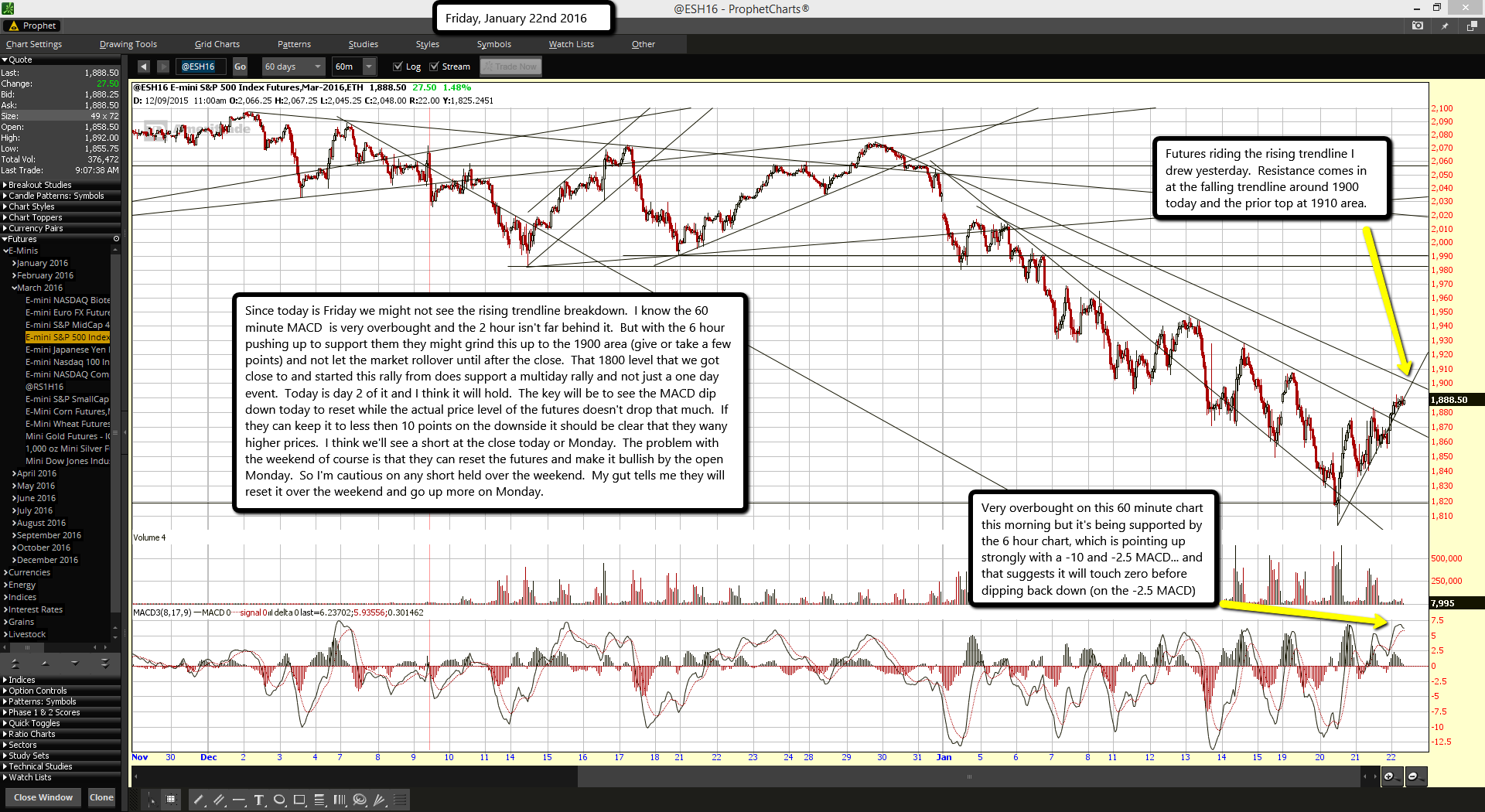
Futures riding the rising trendline I drew yesterday. Resistance comes in at the falling trendline around 1900 today and the prior top at 1910 area.
Very overbought on this 60 minute chart this morning but it's being supported by the 6 hour chart, which is pointing up strongly with a -10 and -2.5 MACD... and that suggests it will touch zero before dipping back down (on the -2.5 MACD)
Since today is Friday we might not see the rising trendline breakdown. I know the 60 minute MACD is very overbought and the 2 hour isn't far behind it. But with the 6 hour pushing up to support them they might grind this up to the 1900 area (give or take a few points) and not let the market rollover until after the close. That 1800 level that we got close to and started this rally from does support a multiday rally and not just a one day event. Today is day 2 of it and I think it will hold. The key will be to see the MACD dip down today to reset while the actual price level of the futures doesn't drop that much. If they can keep it to less then 10 points on the downside it should be clear that they wany higher prices. I think we'll see a short at the close today or Monday. The problem with the weekend of course is that they can reset the futures and make it bullish by the open Monday. So I'm cautious on any short held over the weekend. My gut tells me they will reset it over the weekend and go up more on Monday.
SAN FRANCISCO - Amazon is now offering full refunds for customers who bought hoverboards, the popular electric self-balancing riding devices which have been implicated in multiple fires and explosions.
The Consumer Product Safety Commission so far has investigated 40 such incidents.
The most recent occurred Tuesday in Santa Rosa, Calif., where a girl who got a hoverboard for the holidays had left it plugged in in her bedroom.
From the burn patterns, “investigators were able to pinpoint the location where the fire began,” said Paul Lowenthal, Santa Rose assistant fire marshal.
The family was away for the evening but their two dogs, a Labradoodle and a Boston terrier, were killed by the smoke. Firefighters tried but weren’t able to resuscitate the animals, Lowenthal said. The fire also caused close to $250,000 damage to their home.
The flammability of the lithium-ion batteries used to power the popular devices is a serious concern to the Consumer Product Safety Commission, which is currently investigating them.
On Wednesday, chairman Elliot Kaye said he was "pleased" that Amazon will now allow customers to return hoverboards for a full refund.
"I want to commend Amazon for voluntarily stepping up, providing a free remedy and putting customer safety first. I encourage consumers to take advantage of Amazon’s offer.
He called on other retailers and manufacturers to take action and offer refunds as well.
"I also expect responsible large-volume online sellers in particular to stop selling these products until we have more certainty regarding their safety," he said in a statement on the commission's web site.
The commission is currently investigating 13 hoverboard manufacturers, importers or distributors. They are:
Yeah, Amazon only stepped up as they didn't want some huge lawsuit against them. Not that I have anything against them but it's just smart business to put out a fire before it starts (no pun intended... LOL)
NEW YORK --Even as Wall Street braces for more cuts to jobs and bonuses, JPMorgan Chase CEO Jamie Dimon was paid $27 million in 2015, up from $20 million the year before, the company said Thursday.
The pay raise comes after JPMorgan announced record annual profits last week, thanks to cost-cutting that helped to offset stagnating revenue growth.
JPMorgan's board paid Dimon a $1.5 million salary, a $5 million cash bonus and $20.5 million in performance-based stock grants, the company said in a regulatory filing.
Last year, Dimon was paid a $7.4 million cash bonus and $11.1 million in stock awards. His $1.5 million salary has remained unchanged.
This year's stock grants are tied to new, three-year performance metrics. This could could help alleviate criticisms, which bubbled up last year, that Dimon's pay is not properly tied to performance.
JPMorgan "is now one of the few, if not the only, large financial institution that does not tie any element of CEO pay to achievement of goals for a specific metric or metrics," proxy advisory firm ISS said last year ahead of a controversial shareholder vote on the bank's pay.
Banks emerged from a tough 2015 only to face worsening conditions this year, including rising costs tied to souring energy loans.
As a result, bank CEOs are expected to take the ax to personnel costs — their single largest expense — as they scout for new ways to boost profits.
Morgan Stanley and Bank of America have already said they are planing to slash expenses this year through either layoffs or by moving jobs to cheaper cities.
In 2015, JPMorgan cut staff by 3%, or 6,761 jobs. Compensation costs at the New York bank fell by 1% last year.
Follow USA TODAY reporter Kaja Whitehouse on Twitter: @kajawhitehouse
Read or Share this story: http://usat.ly/1Vc90wx
What a total criminal Jaime dimon is... the guy should be arrested for fraud. He's stole more money from the public then Bernie Madoff ever will!
Starbucks shares slid late Thursday after its outlook overshadowed an estimate-beating quarter of profits.
The coffee chain empire said revenue rose nearly 12% to $5.37 billion in its fiscal first quarter, generating a profit of $687 million, down 30% from a year ago, the company announced after markets closed Thursday.
Starbucks (SBUX) earnings per share of 46 cents per share topped brokerage estimates 44 to 45 cents a share as compiled by S&P Capital IQ Consensus Estimates. Sales were largely in line with forecasts of $5.39 billion.
For its current quarter, Starbucks told investors it expects to make 38-39 cents a share in adjusted earnings. That's a little short of what Wall Street expected.
The results, announced after markets closed, sent Starbucks shares down 3.5% in after-hours trading.
The Seattle-based company’s growth was driven in part by a 4% increase in global customer traffic.
Same-store sales in the Americas increased 9%,. Meanwhile, sales in the China and Asia Pacific segment increased 5%.
The company reported that 1 in 6 American adults received a Starbucks Card for the holidays, up from 1 in 7 in the first quarter of fiscal year 2015.
A record $1.9 billion was loaded onto Starbucks cards in the United States and Canada over the holiday season, Starbucks reported.
Starbucks has continued to build out its mobile order and payment app in the United States, where it was launched in 2014 and went nationwide in 2015. The app allows customers to order and pay for drinks ahead of time without having to wait in line.
Starbucks continues to be bullish on Asia and especially China, said Starbucks President and COO Kevin Johnson.
“Asia had a great quarter, it delivered 5% comp store sales. That's a combination of our finishing our acquisition of Starbucks Japan combined with 281 net new stores in China and the Asia Pacific. Revenues there were up 32%” year over year, he said.
Read or Share this story: http://usat.ly/1RC2PEa
How does starbucks stay in business in my question? Who in their right mind is still dumb enough to pay $10.00 for a cup of coffee?
Three more airlines – United, Southwest and Alaska – reported Thursday big profits for the fourth quarter, largely thanks to lower fuel prices.
Cheap fuel has allowed the airlines to reward shareholders with stock buybacks and dividends, and to thank workers with profit sharing. They're also buying planes to update their fleets.
“This was by far our best year for earnings in the company’s history,” Southwest Airlines CEO Gary Kelly told reporters during a conference call, crediting low fuel prices, full planes and more seats to fill with fliers. “The convergence of all of these things made 2015 a very successful year.”
Airlines are reporting record profits —at least since Congress deregulated the industry in 1978. A glut of oil that's led to low fuel prices is helping.
Cheap fuel may continue to be a boon for airlines, at least in the near-term. Southwest expects fuel costs to drop another 30 cents per gallon during January, February and March.
"On the cost side, we continue to benefit from significantly lower jet fuel prices and our fleet modernization,” Kelly said.
Southwest said profits nearly tripled in the fourth quarter to $536 million. In 2015, the airline returned $1.4 billion to shareholders through dividends and share buybacks. Kelly said the company expects to buy back an additional $500 million in stock in 2016.
To reward workers on the “exceptional” results, Southwest distributed $620 million in profit sharing last year, up from the previous record of $355 million in 2014.
Alaska Airlines shared a similar story with investors. Profits rose 29% in the fourth quarter, partly owing to lower fuel costs. Total fuel cost of $213 million for October, November and December, and $954 million for the year, was one-third lower than in 2014. The carrier also increased passenger revenues by 6% in the quarter, to nearly $1.2 billion.
"We're operating safely and on time, our customer satisfaction ratings remain strong, our customer base is growing at a record pace, and our costs and fares are coming down - all a result of the hard work and dedication of our employees,” CEO Brad Tilden said in a statement.
The company announced a 38% increase in its quarterly dividend, to 27.5 cents per share and it awarded a company record $120 million in incentive pay to workers last year, or more than one month’s pay for most employees.
While Southwest and Alaska are enjoying the benefits of lower fuel prices, United Continental is feeling some pressure.
Lower oil prices fueled a sharp decline in operating expenses, which fell 8.4% to $8 billion for the quarter, compared to a year earlier. But the airline, with a major hub in Houston, where many energy industry executives are based, said high energy prices have led to a decline in corporate travel. In response, Jim Compton, vice chairman and chief revenue officer for United said the company would reduce capacity in Houston and shift it to "other growing markets like Denver and San Francisco."
United is battling other issues. During the quarter CEO Oscar Munoz was sidelined by a health crisis. Munoz had a heart attack in October and underwent a heart transplant in early January. Revenue fell 3% in the quarter.
In a surprise, Munoz appeared on a conference call Thursday with investors and media, saying he is steadily increasing his participation in company activities.
"I am certainly darn glad to be here," Munoz said. "I certainly will be back full-time by the end of the first quarter, if not sooner."
Munoz took office in September after a period of chronic delays and computer issues for United, which was ranked as the ninth of 10 North American airlines for on-time performance.
"We are working extremely hard to become the consistently reliable airline our customers can depend on," Brett Hart, acting CEO of United, told investors on Thursday.
Despite its challenges and lower revenue performance, United was able to increase fourth quarter net income to $823 million from $28 million. United workers enjoyed $698 million in profit-sharing for the year.
All three airlines are buying new planes, in some cases to upgrade their fleets and in some cases to expand.
United announced it would buy 40 new Boeing 737-700 aircraft to enter the fleet in mid-2017. The goal is to reduce its reliance on 50-seat aircraft that are less profitable.
Southwest said its delivery schedule includes 33 737-800s and the conversion of 25 737-700s to 737-800s. The wifi-equipped planes will replace existing capacity of the airline’s classic fleet by mid-2018, three years faster than previously expected. Alaska added 11 737-900ERs and one Bombardier Q400 last year.
After a big sell-off Wednesday, U.S. stocks climbed back in early trading Thursday. (Michael Nagle/Bloomberg)
NEW YORK — After some early losses, U.S. stocks bounced back Thursday, potentially offering investors a brief respite from the rocky trading that has already wiped out trillions in market value over the past few weeks.
Slowing growth in China and plummeting oil prices have sparked weeks of volatile trading across the globe. On Wednesday, the big swings continued, with the Dow Jones industrial average falling more than 500 points, or 3 percent, during the day before closing down about 1.6 percent. All of the major U.S. indexes are down about 10 percent from their record highs, and market watchers worry that it could take weeks, or perhaps months, before investor anxiety eases and stocks see a sustainable rebound.
But some of that anxiety appeared to dissolve Thursday, as oil prices rebounded above $30 a barrel after falling to a 13-year low earlier in the week.
The Dow Jones industrial average, a barometer of 30 blue-chip stocks, and the Standard & Poor’s 500-stock index, a broader view of the market, bounced between positive and negative territory Thursday morning. By noon, the Dow and S&P were both up more than 1.5 percent.
U.S. stocks are off to one of their worst yearly starts in history, surprising even some seasoned market analysts. It may be, some say, that Wall Street is sensing weaknesses in the global economy that are not yet apparent, while others say that, fueled by paranoia, traders are steering the wild stock market ride.
“Recent market moves probably overstate the likelihood of a slump in global growth this year,” Paul Sheard, chief global economist and head of global economics and research at Standard & Poor’s, said in article published Thursday.
Contributing to the volatility have been falling oil prices, which dropped to $26 a barrel Wednesday. Despite Thursday’s rebound, oil prices are still down significantly over the past year, weighing down energy companies and banks that have lent them money.
“Certainly oil plays a significant role in it, but there is much more to it,” said Bob Andres, chief investment officer and founder of Andres Capital Management. The fall in oil prices has “exposed the underbelly of an equity market that is way overvalued.”
Much of the global market anxiety has been focused on China, the world’s second-largest economy. Signs that the country’s economy has started to slow have sent stocks there down 20 percent. That continued Thursday despite another aggressive move by China’s central bank to pump money into the country’s financial system.
The People’s Bank of China offered more than $100 billion in short- and medium-term loans on Thursday, but that was not enough to slow the downward march of Asian stocks.
China’s Shanghai index fell another 3 percent, while Japan’s Nikkei was down 2 percent.
In Europe, investors were more upbeat after the European Central Bank left its main interest rate unchanged and ECB President Mario Draghi indicated that the bank may reconsider its policy stance at its next meeting, in March. The FTSE 100 and France’s CAC 40 both climbed more than 1.5 percent.
Renae Merle covers white collar crime and Wall Street for The Washington Post.
In another move to get ahead of trends that will shape the automotive future, General Motors announced Thursday that it will be building its own car-sharing service called Maven.
The news comes fast on the heels of a $500 million investment in Lyft and shortly after the automaker acquired Sidecar, another rival to ride-hailing service Uber.
One of the reasons that GM invested in Lyft was to get ahead of competitors on developing self-driving cars. The Maven announcement makes GM's interest in making its own foray into that territory - as well as the realms of Uber and car-sharing service Zipcar - even more explicit.
“With the launch of our car-sharing service through Maven, the strategic alliance with ride-sharing company Lyft, and building on our decades of leadership in vehicle connectivity through OnStar, we are uniquely positioned to provide the high level of personalized mobility services our customers expect today and in the future, GM President Dan Ammann said in a press release.
Billed as a “personal mobility brand,” Maven will initially serve residents of Ann Arbor, Mich., specifically targeting students and faculty at the University of Michigan. Users will initially be able to find GM vehicles at 21 locations throughout Ann Arbor using an app. The app will also enable them to unlock their selected car and control heating and cooling settings.
Maven will be phased gradually into other cities throughout the country later this year, including Chicago and New York. GM is currently testing more possible ways to expand the service at its corporate campuses in the US, Germany, and China.
Julia Steyn, GM’s vice president of Urban Mobility Programs said in the press release that “Maven is a key element of our strategy to changing ownership models in the automotive industry.”
However, the program is also a signal that GM is preparing for a future in which more people are likely to use a car-sharing or ride-hailing service than own a car themselves. Recent research from the University of Michigan has found that the number of people in nearly every age group getting their drivers’ licenses has been on the decline since 2008. There has been a particularly sharp decline among the number of young people pursuing this once-traditional rite of passage.
Still, the auto industry is having one of its best years ever. Car sales increased to approximately 17.5 million in 2015, but that increase has been coupled with ride-hailing apps like Uber increasing in popularity. The trend is especially pronounced among Millennials for whom living in cities is once again popular: in New York City, Uber saw a fourfold increase in the number of requested rides during July 2015, up from the same period a year earlier.
GM is not the only car company that has invested in building its own car-sharing service or explored the option of doing so in order to both protect and expand its brand. In 2011, BMW partnered with Sixt SE to launch a car-sharing program called “Drive Now” in Europe, and in 2015 expanded its London offerings by introducing a fleet of 30 electric cars. In part, BMW made that move to weather the financial crisis, which officially ended in 2009 but had a long-term impact on car sales.
After a big sell-off Wednesday, U.S. stocks climbed back in early trading Thursday. (Michael Nagle/Bloomberg)
NEW YORK — After some early losses, U.S. stocks bounced back Thursday, potentially offering investors a brief respite from the rocky trading that has already wiped out trillions in market value over the past few weeks.
Slowing growth in China and plummeting oil prices have sparked weeks of volatile trading across the globe. On Wednesday, the big swings continued with the Dow Jones industrial average falling more than 500 points or 3 percent during the day before closing down about 1.6 percent. All of the major U.S. indexes are down about 10 percent from their record highs, and market watchers worry that it could take weeks, or perhaps months, before investor anxiety eases and stocks see a sustainable rebound.
But that some of that anxiety appeared to dissolve Thursday as oil prices rebounded above $30 a barrel, after falling to a 13-year low earlier in the week.
The Dow Jones industrial average, a barometer of 30 blue-chip stocks, and the Standard & Poor’s 500-stock index, a broader view of the market, bounced between positive and negative territory Thursday morning. By noon, the Dow and S&P were both up more than 1.5 percent.
U.S. stocks are off to one of their worst yearly starts in history, surprising even some seasoned market analysts. It may be, some say, that Wall Street is sensing weaknesses in the global economy that are not yet apparent. While others say that, fueled by paranoia, traders are steering the wild stock market ride.
“Recent market moves probably overstate the likelihood of a slump in global growth this year,” Paul Sheard, chief global economist and head of global economics and research at Standards & Poors said in article published Thursday.
Contributing to the volatility has been falling oil prices, which dropped to $26 a barrel Wednesday. Despite Thursday’s rebound, oil prices are still down significantly over the past year, weighing down energy companies and banks that have lent them money.
“Certainly oil plays a significant role in it, but there is much more to it,” said Bob Andres, chief investment officer and founder of Andres Capital Management. The fall in oil prices has “exposed the underbelly of an equity market this is way overvalued.”
Much of the global market anxiety has been focused on China, the world’s second-largest economy. Signs that the country’s economy has started to slow have sent stocks there down 20 percent. That continued Thursday despite another aggressive move by China’s central bank to pump money into the country’s financial system.
The People’s Bank of China offered more than $100 billion in short-and-medium term loans on Thursday, but that was not enough to slow the downward march of Asian stocks.
China’s Shanghai index fell another 3 percent, while Japan’s Nikkei was down 2 percent.
In Europe, investors were more upbeat after the European Central Bank left its main interest rate unchanged and European Central Bank President Mario Draghi indicated the bank may reconsider its policy stance at its next meeting, in March. The FTSE 100 and Germany’s CAC 40 both climbed more than 1.5 percent.
Renae Merle covers white collar crime and Wall Street for The Washington Post.
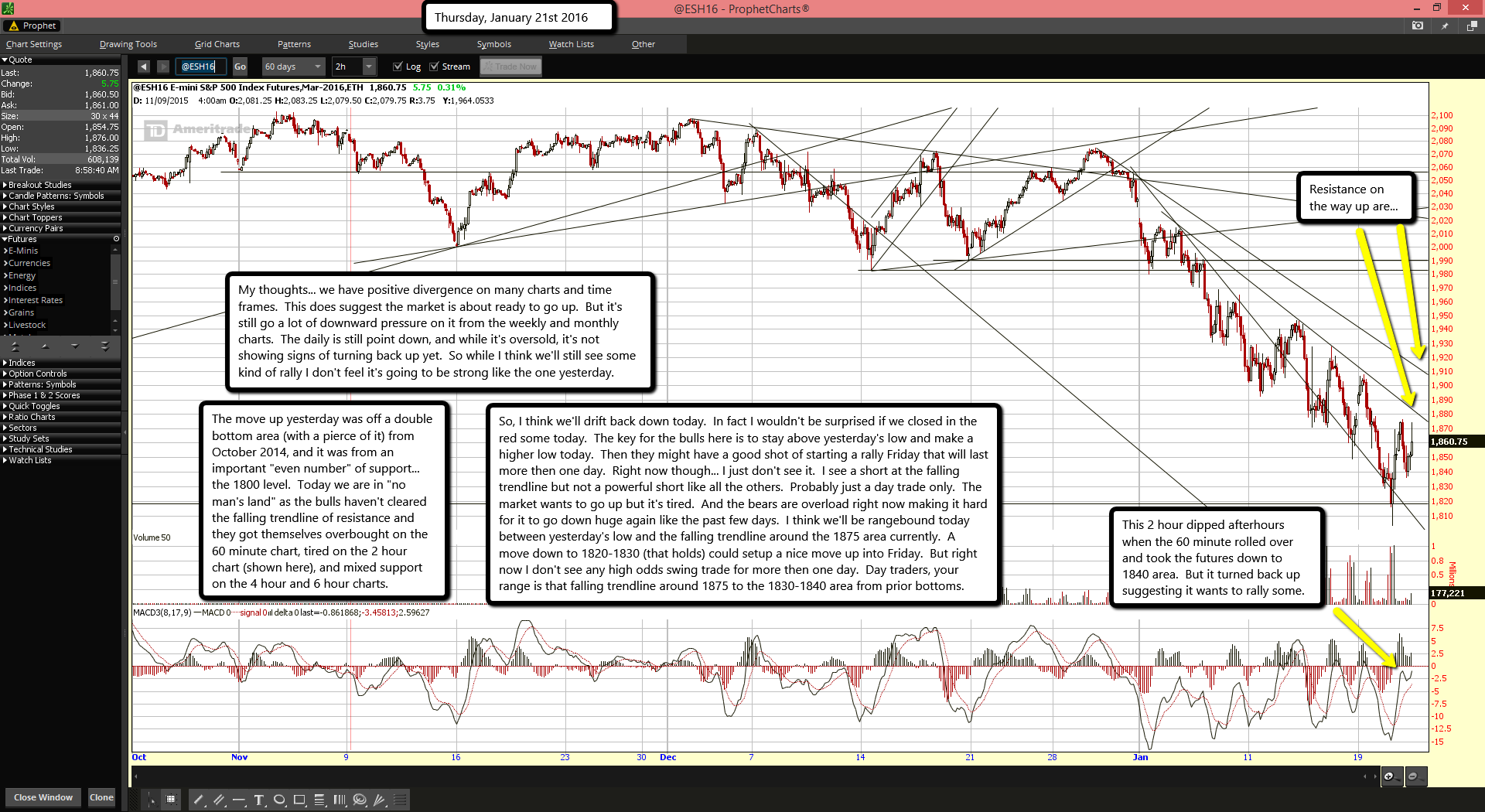
This 2 hour dipped afterhours when the 60 minute rolled over and took the futures down to 1840 area. But it turned back up suggesting it wants to rally some.
My thoughts... we have positive divergence on many charts and time frames. This does suggest the market is about ready to go up. But it's still go a lot of downward pressure on it from the weekly and monthly charts. The daily is still point down, and while it's oversold, it's not showing signs of turning back up yet. So while I think we'll still see some kind of rally I don't feel it's going to be strong like the one yesterday.
The move up yesterday was off a double bottom area (with a pierce of it) from October 2014, and it was from an important "even number" of support... the 1800 level. Today we are in "no man's land" as the bulls haven't cleared the falling trendline of resistance and they got themselves overbought on the 60 minute chart, tired on the 2 hour chart (shown here), and mixed support on the 4 hour and 6 hour charts.
So, I think we'll drift back down today. In fact I wouldn't be surprised if we closed in the red some today. The key for the bulls here is to stay above yesterday's low and make a higher low today. Then they might have a good shot of starting a rally Friday that will last more then one day. Right now though... I just don't see it. I see a short at the falling trendline but not a powerful short like all the others. Probably just a day trade only. The market wants to go up but it's tired. And the bears are overload right now making it hard for it to go down huge again like the past few days. I think we'll be rangebound today between yesterday's low and the falling trendline around the 1875 area currently. A move down to 1820-1830 (that holds) could setup a nice move up into Friday. But right now I don't see any high odds swing trade for more then one day. Day traders, your range is that falling trendline around 1875 to the 1830-1840 area from prior bottoms.
The global sell-off intensified wednesday. Stocks plunged more than 500 points. Oil dipped below $27 a barrel for the first time since 2003. Wochit
Wednesday was a wild roller coaster on Wall Street, with stocks moving off of earlier, huge losses and the Nasdaq almost landing in positive territory.
After skydiving more than 500 points earlier in the day, the Dow ended down about 250. The Nasdaq, after being hammered earlier, ended down 0.1%.
In the previous session, the Dow had eked out a 28-point gain.
The sell-off that has engulfed global stock markets early in 2016 intensified from the market open, with the Dow plunging as much as 565 points and oil breaking below $27 a barrel for the first time since 2003, Japanese stocks skidding into bear market territory and European shares shedding more than 3%.
"It is fear based selling," says Nick Sargen senior investment advisor at Fort Washington Investment Advisors. But it is not yet "panic selling" like back in 2008, he adds.
Sparking Wednesday's stock sell-off around the world were many of the same worries that have dragged down shares all year: fears of slowing growth around the globe and the continued plunge in oil at a time when markets are craving stabilization in the oil patch. U.S.-produced crude, which tumbled as low as $26.19, was down $1.85 a barrel around 2:15 p.m. ET, or 6.5%, to $26.63, its lowest level since May 2003.
For now, as many Wall Street pros have been saying, "As oil goes, so goes the stock market." Unfortunately, signs of stabilization in the oil patch have not appeared amid a supply gut, slowing global growth and Iran brining on more supply after economic sanctions were lifted.
.
"De-risking remains the name of the game in today's financial markets," David Rosenberg, chief economist and strategist at Gluskin Sheff, noted in a report.
The broader Standard & Poor's 500 stock index was off 2% to 1843, and if that drop sticks it will put the closely followed U.S. stock benchmark below its closing low in August at the bottom of the market's last correction. A drop below that key 1867.61 level, pros say, could signal even lower prices with the next support around 1800 to 1820, stock chart watchers say.
The S&P 500 is trading at levels not seen since October 2014, and was also flirting with a close below the intraday low of 1820.66 back on Oct. 15, 2014, which occurred at the height of the panic selling during the Ebola virus scare.
"Stocks are stress testing the August lows," Robert Sluymer, a technical stock analyst at RBC Capital Markets told clients in a report.
Sluymer pointed out to clients that even though the market is oversold and beaten down, the S&P 500 "has yet to show any meaningful evidence of bottoming."
Key levels to watch on the S&P 500, Sluymer says, is the 1867 level (or the low in August). If that doesn't hold, the next key support for the broad U.S. stock gauge is the low of around 1820 in the fourth quarter of 2014.
The Nasdaq composite pared it losses and was down 1.1%.
Investors were shedding risk and heading to the safety of perceived havens, such as the 10-year U.S. Treasury note, where prices were rising and yields were falling. The yield on the 10-year note dipped to 1.96%. The last time the yield closed at that low level was back in mid-October.
"Risky assets (are) retreating as oil prices hit new lows and growth concerns remain elevated," Guillermo Felices of Barclays told clients in a note. "The pick-up in risk aversion has spread ... ."
Heading into Wednesday's trading session, the Dow was down 8.1% for the year and 12.5% from its May record close. The S&P 500 was down 8% for 2016 and off 11.7% from its May peak. The Nasdaq composite kicks off the day off 10.6% in the new year and down 14.2% from its July all-time closing high.
In a sign of the market's recent pain, a wide swatch of stock indexes around the world are now in bear market territory, or more than 20% below recent highs. Japan's Nikke 225 is now in a bear market. In Europe the Stoxx Europe 600 dipped into bear territory last week. Here at home, the small-cap Russell 2000 stock index kicks off the day 23.2% below its June high, and the Dow Transportation average, another key index, is also down more than 20%.
In another rough market session overseas, Japan's Nikkei 225 index fell 3.7%, leaving it down more than 20% from its recent high. Hong Kong's Hang Seng index fell 3.8%, while mainland China's Shanghai composite fell 15.
The selling was intense in Europe. The broad Stoxx Europe 600 index was down 3.3%. Germany's DAX index was off 2.8% and the CAC 40 in Paris was down 3.5%.
How should the average investor react as global stocks experience volatility? Charisse Jones with five tips for the every day investor.
Stocks in the United States had a wild day of trading as worries about economic growth and the continued slump in oil prices weighed on investors.
Markets had been steadily falling all day on Wednesday but staged a turnaround in the last hour of the trading day. At the close of trading, the benchmark Standard & Poor’s 500-stock index was down about 1 percent, after being off as much as 3.7 percent.
The Dow Jones industrial average, which had been down more than 500 points earlier in the day, fell about 250 points, or 1.5 percent. The tech-heavy Nasdaq was nearly unchanged.
The Dow had been hit hard earlier in the day after IBM, one of the 30 blue-chip stocks in the gauge, reported a drop in its fourth-quarter profit after the markets closed on Tuesday.
It has been a month of heavy selling and globally, more than $3.6 trillion has been lost in January, said Howard Silverblatt, a senior index analyst at S.&P. Dow Jones Indices.
Related Coverage
“That’s money taken out, even if it’s on paper,” Mr. Silverblatt said.
Photo
A trader on the floor of the New York Stock Exchange on Wednesday. Credit
Brendan McDermid/Reuters
Traders will be closely scrutinizing earnings of the S.&P. stocks next week to see how 2016 will go, he added.
“If they don’t come through well, there’s not a lot of support there,” he said.
Oil prices continued their monthslong sell-off, with the price of a barrel of crude oil at the lowest level since May 2003. Crude oil futures were down 6.7 percent on Wednesday to settle at $26.55 a barrel in trading on the New York Mercantile Exchange.
On Wednesday, Royal Dutch Shell warned that it expected its profit for the fourth quarter of 2015 to be about half of what it was in the comparable period a year earlier.
In addition, traders see no signs of the oil glut easing as Iran now has permission to sell into the world markets now that sanctions have been lifted as part of a nuclear deal.
6 Tips for Investors When the Stock Market Tumbles
The impulse when the stock market falls hard for a few days in a row is to do something but it probably doesn’t make much sense to overhaul an investment strategy based on a blip of market activity.
The worldwide drop in stocks signaled nervousness among global investors despite a sanguine reaction earlier in the week to data showing that China’s economic growth continued to slow. Concerns about China’s prospects, as well as the drop in oil prices and signs of weakness elsewhere, have affected global markets in recent months.
The sell-off earlier in the day hit a broad range of investments. European stocks ended sharply lower, with the Euro Stoxx 50 index down 3.3 percent. The FTSE 100 in London closed the day down 3.46 percent.
Stocks in Japan closed 3.7 percent lower, bringing the Nikkei 225’s total decline since its near-term high in June to more than 20 percent — a level that analysts generally regard as a bear market. In addition to worries about China, investors have also grown concerned that economic overhauls championed by Prime Minister Shinzo Abe, called Abenomics, are faltering. Despite Mr. Abe’s pledges to increase economic growth, which were accompanied by a huge program of monetary easing carried out by the central bank, the Japanese economy continues to dip in and out of recession.
The latest round of market turmoil started at the beginning of the year in China, where Beijing’s continued intervention sent stocks down sharply and led to an unexpected weakening of the country’s currency, the renminbi. That added to concerns about the underlying state of the Chinese economy. On Tuesday, China reported its slowest quarterly growth since 2009.
Concerns have broadened in recent weeks, as oil prices have continued to tumble and as volatility spread across global markets.
Japan’s drop followed a broader slump in Asia. In Hong Kong, the Hang Seng closed 3.8 percent lower, while stocks in Shanghai closed down 1 percent.
The headquarters of Goldman Sachs in New York. The bank’s business opportunities were diminished in the fourth quarter by new regulations and volatility in the global markets. Credit
Mark Lennihan/Associated Press
Goldman Sachs made a strong commitment to its Wall Street business model on Wednesday after announcing lower revenue and profit for the fourth quarter.
Earnings were dragged down, in part, by a recent government settlement over mortgage securities the bank produced before the financial crisis.
But the firm’s revenue also fell 5 percent in the fourth quarter from the same quarter a year ago, bringing revenue down 2 percent for all of 2015.
New regulations and volatility in the global markets have diminished business opportunities for the bank, considered by many to be the most elite firm in the industry.
“Clearly, it has been a challenging environment for the entire industry,” the firm’s chief financial officer, Harvey M. Schwartz, said in a call with analysts on Wednesday.
But Mr. Schwartz said that the recent difficulties had not led the company’s executives to question their mix of businesses.
“We run the firm for multiple years,” he said. “We see opportunities.”
Many other firms on Wall Street have recently announced big cuts to businesses on which Goldman is heavily reliant — most of all the fixed-income trading businesses that has been hit hard by new regulations.
Investors are eagerly awaiting guidance from management about when higher short-term interest rates will impact the banks’ bottom lines.
On Tuesday, one of Goldman’s closest competitor, Morgan Stanley, detailed significant cutbacks in fixed income and elsewhere. The firm’s chief executive, James P. Gorman, argued that regulation had changed the firm’s long-term business outlook in ways that it had not anticipated a year ago.
Goldman Sachs has also been struggling in fixed income, a business that comes with much higher regulatory costs than it has in the past. In the fourth quarter, the business reported 8 percent lower revenue than it did a year ago. For the year, fixed-income revenue was down 13 percent.
But Mr. Schwartz reiterated the bank’s belief that with so many competitors leaving the field, Goldman will benefit when there is any sort of turnaround in the global markets.
That did not quiet all the questions from analysts, some of whom asked when the continuing slide in revenue would convince Goldman that it, like other banks, needed to take more drastic action.
Mr. Schwartz defended Goldman’s more cautious approach and said that it had been making cuts slowly over time, often ahead of competitors, but did not want to overreact to recent events.
“We’re certainly not sitting still here,” he said.
The lower revenue helped push the bank’s fourth-quarter profit down to $765 million, or $1.27 a share, compared with $2.17 billion, or $4.38 a share, in the final quarter of 2014.
Goldman said that $1.8 billion in provisions for the mortgage settlement reduced fourth-quarter earnings by $3.41 a share. Analysts polled by Thomson Reuters had expected a profit of $3.53 a share.
Shares of Goldman fell more than 2 percent on a day when financial stocks and the overall market were sharply lower.
The firm’s profit for the year as a whole declined 31 percent, to $5.6 billion.
Goldman Sachs has kept investors satisfied largely because it has kept profits high, particularly relative to competitors like Morgan Stanley.
Goldman’s business of advising companies continued to perform well, growing 27 percent from a year earlier. But nearly every other major business line produced smaller revenue, including the stock trading division that has been doing so well in recent quarters.
The Big Bang Data exhibition at Somerset House in London. According to the careers web site Glassdoor, data scientists, who can make sense of the exponentially growing amount of data today's companies receive, have the most career and earnings potential of any job in America. (Peter Macdiarmid/Getty Images for Somerset House)
What's the best job in America right now? Being a test driver for Tesla? A visual effects designer for Lucasfilm? A taster in the quality control department of New Belgium Brewing Co.?
At least according to the folks at Glassdoor, it's something far less flashy. A new ranking by the careers web site put data scientists -- people with a background in computer science, statistics and math who can help companies analyze the mountains of data available now -- at the top of its second annual list of the "25 Best Jobs in America."
The top five also included tax manager, solutions architect, engagement manager and mobile developer. (Sorry kids, but astronaut, rock star and baseball player don't make a showing.)
The ranking analyzes median salaries, total openings per job category and career growth opportunities -- which are based on employee ratings about room for advancement -- combining those factors to create an overall "job score" for each career type. The list isn't based on job satisfaction, in other words, but on the potential for career and earnings growth. "This report looks at three of the prime reasons job seekers indicate they consider most when making a job decision -- earning potential, career opportunities and hiring opportunity," said Scott Dobroski, Glassdoor's career trends analyst. "Job satisfaction can really play a role depending on the company you work at."
Cross-reference it with Glassdoor's list of the best jobs for work-life balance, however, and a few jobs seem like they could be winners. User experience designers, quality assurance managers and those who do software development are on both lists; data scientists, meanwhile, took the top spot on each ranking.
The list, unsurprisingly, is heavy on job categories in the technology field -- nearly half of the 25 stem from the engineering or software industries, or require a technical foundation of some kind. Health care also makes a good showing (physician assistant and nurse practitioner are both ranked) as does finance (audit manager and finance manager both appear).
Meanwhile, Bloomberg reports that Glassdoor revealed four jobs that are among the worst in America, at least according to the "job score" it calculated. They were guest services managers, accounts payable specialists, insurance agents and -- uh oh -- reporters.
US banks reported last month stronger-than-expected revenues
and much better profits for the fourth quarter of 2015, showing
that pro-longed cost-cutting efforts have left them resilient
earners.
As they now hope finally to emerge from an era of large
regulatory fines and legal bills, banks could become once again
a useful payer of dividends to investors.
For the full year 2015, JPMorgan delivered its record net income
of $24.4 billion. Bank of America produced its best profit
since before the financial crisis, at $15.9 billion. Citigroup brought in $17.1 billion of
profit for 2015, its best result since 2006.
Shareholders – and the analysts who had failed to
predict these strong results – reacted in quite
predictable fashion. They dumped the banks’
stocks.
Citigroup’s share price fared worse, falling 7%
after results and dragging the bank’s market
valuation down to just 0.7 of tangible book value per share.
JPMorgan’s stock fell a more measured 2.5% and
Bank of America’s fell just 2%.
However, even stock-market darling Wells Fargo saw its share
price fall by 5.5% in the days after it announced $23 billion
in net income for 2015, a year in which, after 13 consecutive
quarters of declines in non-performing assets, it generated so
much capital that regulators allowed it to return around $3
billion in dividends and stock buy-backs each quarter.
In part, the banks simply got caught up in the general stock
market sell off at the start of the year, amid fears over
slowing Chinese and global growth and further possible declines
in the oil price.
The International Energy Agency
(IEA) estimates that weakening growth will subdue
demand for oil, even as Iran returns to an already
over-supplied market as a big producer. It sees supply
exceeding demand by 1.5 million barrels per day in the first
half of this year, with global inventories rising to a notional
1.285 billion barrels and straining storage infrastructure.
As the oil price fell below $30 per barrel in January,
analyst began to predict further declines to $25 or $20.
"Unless something changes, the oil market could drown in
over-supply," says the IEA. "So the answer to our question [can
the price fall even lower] is an emphatic yes."
Investors are focusing on banks’ exposure to
the
oil and gas sector, as well as to second-order effects on
other types of credit. JPMorgan reserved $550 million against
exposure to the oil and gas sector in 2015 and expects to add
more in 2016.
New credit crisis
Analysts are starting to worry that, as companies have
leveraged up once more to reward shareholders with the benefit
of cheap debt, a new credit crisis is upon us and that banks
might not be building reserves fast enough.
JPMorgan chief executive Jamie Dimon told analysts: "You
know me, I’d put up more if I could but accounting
rules dictate what you can do."
Dimon seemed to suggest that banks would almost be compelled
to keep lending to oil companies to prevent a crisis as other
market sources of funding disappear.
"The oil folks have been surprisingly resilient," says
Dimon. "Remember, these are asset-backed loans. A bankruptcy
doesn’t necessarily mean your loan is bad."
He admits: "If banks just completely pull out of markets
every time something gets volatile and scary,
you’ll be sinking companies left and right."
If the stresses now hitting the oil and gas and metals and
mining sectors are the canary in the coal mine, JPMorgan
isn’t sucking gas just yet, according to chief
financial officer Marianne Lake.
"We’re watching very closely industries that
could have knock-on effects like industrials and
transportation, but we’re not seeing anything
broadly in our portfolio right now," she says.
Mindful of second-order effects, it built another $300
million across the rest of its portfolio and predicts credit
costs in its wholesale business of $600 million for the first
half of this year. And that is based on oil at $30 per
barrel.
John Gerspach, Citigroup’s chief financial
officer, admits: "If oil were to drop to say $25 a barrel and
then stay there for a sustained period of time, then that
first-half cost of credit number that I gave you [$600 million]
might double."
Citigroup’s overall exposure to the oil sector,
including funded loans and unfunded commitments, is $58
billion, with 80% of that to companies for now-rated investment
grade.
Bank of America chief financial officer Paul Donofrio says
that while the bank has $21 billion of utilized exposure to the
energy sector, that represents just 2% of total loans, and of
that $21 billion just $8.3 billion is to borrowers in the two
high-risk sectors of exploration and production and oil field
services.
The bank has reserves on those exposures of $500 million and
believes that if oil stayed around $30 per barrel for nine
quarters, losses would be about $700 million.
"Outside of energy, we are not seeing asset-quality change
nor are we seeing a reduction in appetite for our credit," says
Donofrio.
The banks are desperately trying to make the case that if
the oil price falls simply because of over-supply –
and not because of more worrying collapse in demand –
then contagion will not spread form the oil sector and that
other sectors might well benefit.
Their problem is that the market just doesn’t
buy it.
"We estimate that US high-yield market is pricing a 6.1%
default rate in 2016 versus a current default rate of 3.2%,"
says Alberto Gallo, head of global macro credit research at
RBS.
"However, defaults could spread beyond the energy sector,
into retail and manufacturing – each 5% of the US
high-yield market. We estimate that 10% of high-yield
manufacturing firms have exposure to the energy sector."

 Jobs site Careerbuilder recently released a survey suggesting more employees will be looking for a new job in 2016. If you plan to be one of them, what kind of job should you look for?