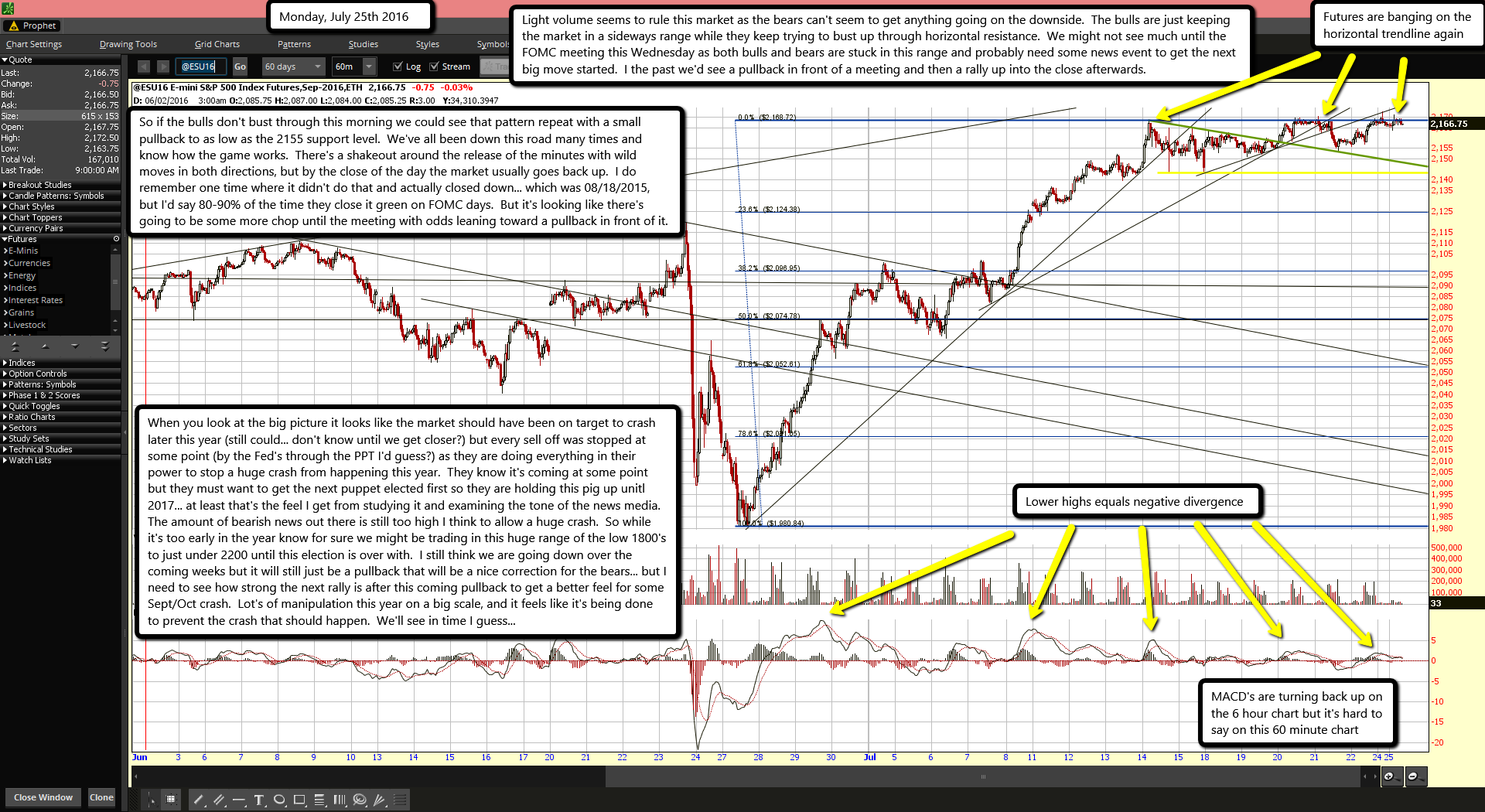
Futures are banging on the horizontal trendline again
MACD's are turning back up on the 6 hour chart but it's hard to say on this 60 minute chart
Light volume seems to rule this market as the bears can't seem to get anything going on the downside. The bulls are just keeping the market in a sideways range while they keep trying to bust up through horizontal resistance. We might not see much until the FOMC meeting this Wednesday as both bulls and bears are stuck in this range and probably need some news event to get the next big move started. I the past we'd see a pullback in front of a meeting and then a rally up into the close afterwards.
So if the bulls don't bust through this morning we could see that pattern repeat with a small pullback to as low as the 2155 support level. We've all been down this road many times and know how the game works. There's a shakeout around the release of the minutes with wild moves in both directions, but by the close of the day the market usually goes back up. I do remember one time where it didn't do that and actually closed down... which was 08/18/2015, but I'd say 80-90% of the time they close it green on FOMC days. But it's looking like there's going to be some more chop until the meeting with odds leaning toward a pullback in front of it.
When you look at the big picture it looks like the market should have been on target to crash later this year (still could... don't know until we get closer?) but every sell off was stopped at some point (by the Fed's through the PPT I'd guess?) as they are doing everything in their power to stop a huge crash from happening this year. They know it's coming at some point but they must want to get the next puppet elected first so they are holding this pig up unitl 2017... at least that's the feel I get from studying it and examining the tone of the news media. The amount of bearish news out there is still too high I think to allow a huge crash. So while it's too early in the year know for sure we might be trading in this huge range of the low 1800's to just under 2200 until this election is over with. I still think we are going down over the coming weeks but it will still just be a pullback that will be a nice correction for the bears... but I need to see how strong the next rally is after this coming pullback to get a better feel for some Sept/Oct crash. Lot's of manipulation this year on a big scale, and it feels like it's being done to prevent the crash that should happen. We'll see in time I guess...
There’s no doubt the economy perked up in the second quarter after limping the previous six months. But by how much? And is its mixed revival enough to prompt a wary Federal Reserve to raise interest rates in September? A report on economic growth in the April-June period and a Federal Reserve meeting highlight this week’s economic news and could help answer both questions.
Consumer confidence bounced back in June, but that survey was taken before the United Kingdom’s “Brexit” vote to leave the European Union, a decision that shook markets. Stocks have more than rebounded, reaching record highs. But the economic and market fallout from the referendum is still uncertain. As a result, economists expect the Conference Board to report Tuesday that its closely watched measure of consumers’ outlook gave back some of the recent gains in July but still clocked a solid reading.
Those generally optimistic consumers have supported the recovering housing market. And a limited supply of existing homes for sale has bolstered housing starts and new-home sales. After surging in April, new-home sales dipped in May. But single-family construction permits have trended higher, a good sign for new-home sales, says Nomura economist Lewis Alexander. Economists reckon sales of newly built homes rose 1.6% in June to a solid seasonally adjusted annual rate of 560,000.
Business investment has languished on the negative side of the economy’s ledger, with a key measure falling 0.7% in May and 3.6% so far this year. A strong dollar, weak global economy and oil industry slump have constrained exports and spending. A generally weaker dollar and rising oil prices this year have kindled hopes that company outlays should stabilize, though the U.K.’s Brexit vote has muddied the outlook. Economists expect the Commerce Department to announce Wednesday that non-defense capital goods orders excluding aircraft — a proxy for business investment — rose a modest 0.2% in June.
Federal Reserve policymakers are likely to struggle to make sense of the economy’s jumbled picture. Consumer spending has been strong and employers added 287,000 jobs in June, easing concerns after two weak showings. But Fed officials have indicated they want to see a few payroll reports to confirm the labor market has not lost momentum. Policymakers also are still worried about further market fallout from the Brexit vote. As a result, economists don’t expect the Fed to raise its benchmark interest rate. And while officials will probably upgrade their outlook, they may not tip their hand about a September hike until they see jobs reports for July and August.
The Jekyll and Hyde economy persisted in the second quarter, but economists believe robust consumption more than outweighed sluggish business investment. Economists expect Commerce to report Friday that gross domestic product grew a solid 2.6% in the period.
Roger Ailes, CEO of Fox News Channel, has resigned amidst sexual harassment allegations, including claims from broadcasters Gretchen Carlson and Megyn Kelly. USA TODAY
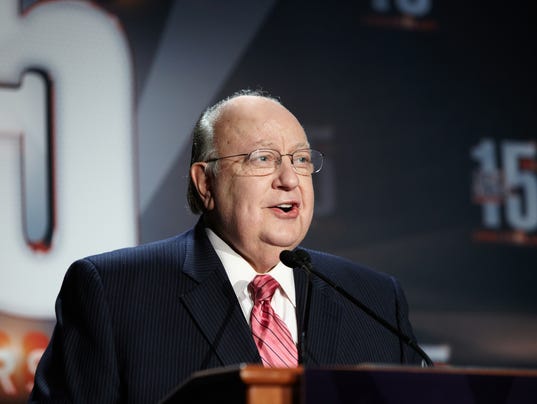
Roger Ailes is discussing a plan that would lead to his departure as chairman of 21st Century Fox.(Photo: 2011 photo by2MK Studio/Fox News via AP)
Roger Ailes, chairman and CEO of Fox News Channel, stepped down Thursday, a startling fall from grace for one of the most powerful figures in American journalism.
The resignation, effective immediately, was announced by the network's parent company, 21st Century Fox. Two weeks ago, Ailes was sued for sexual harassment by Gretchen Carlson, a former host of Fox & Friends who left the company last month when her contract wasn't renewed.
Carlson said her career was sabotaged after she refused Ailes' sexual advances. She “reported disparaging treatment in the newsroom,” including what she said was a "sexist and condescending" way her co-host, Steve Doocy, dealt with her, her lawsuit claimed.
Ailes has vigorously denied Carlson's claims. But 21st Century Fox immediately launched an internal investigation, interviewing other employees. Earlier this week, a lawyer for Megyn Kelly, the network's rising star, acknowledged that she spoke to the investigators from law firm Paul, Weiss. In the interview, she revealed that she was also sexually harassed by Ailes in the past, according to a report by New York magazine. Other women have also recently told New York magazine's Gabriel Sherman that they were sexually harassed by Ailes prior to his founding of Fox News in 1996.
With the scandal erupting rapidly, Fox executives began negotiating the 76-year old executive's departure. On Tuesday, Ailes' lawyer, Susan Estrich, confirmed his negotiation with 21st Century Fox for severance. The company didn't immediately comment on the severance package. But Sherman tweeted Thursday that it could be as much as $60 million, paid out over time and including fees for consulting Fox after Ailes' formal exit.
Twenty-first Century Fox and Fox News couldn't immediately be reached for comment.
"Within just two weeks of her filing a lawsuit against Roger Ailes, Gretchen Carlson's extraordinary courage has caused a seismic shift in the media world," Carlson's lawyers said in a statement Thursday. "We hope that all businesses now understand that women will no longer tolerate sexual harassment and reputable companies will no longer shield those who abuse women. We thank all the brave women who spoke out about this issue."
Rupert Murdoch, executive chairman of 21st Century Fox, will assume the role of chairman and acting CEO of Fox News Channel and Fox Business Network. He will be aided by three of Ailes' deputies in running the network: Bill Shine, Jay Wallace and Mark Kranz.
“Roger Ailes has made a remarkable contribution to our company and our country," Murdoch said. "Roger shared my vision of a great and independent television organization and executed it brilliantly over 20 great years."
Murdoch didn't directly address the sexual harassment scandal in his statement. But Murdoch's sons, who were negotiating closely with Ailes for his departure -- Lachlan Murdoch, 21st Century Fox's co-executive chairman, and James Murdoch, the company's CEO -- jointly issued a statement that said they continue their "commitment to maintaining a work environment based on trust and respect."
"We take seriously our responsibility to uphold these traditional, long-standing values of our company,” they said.
"It is always difficult to create a channel or a publication from the ground up and against seemingly entrenched monopolies," Murdoch said. "To lead a flourishing news channel, and to build Fox Business, Roger has defied the odds."
Murdoch said he's also "personally committed to ensuring that Fox News remains a distinctive, powerful voice."
Fox didn't issue a statement from Ailes Thursday. But in a letter Ailes wrote to Murdoch -- obtained by the Drudge Report -- Ailes said he was "proud" of building Fox News and Fox Business Channels into "powerful and lucrative news organizations."
"I take particular pride in the role that I have played advancing the careers of the many women I have promoted to executive and on-air positions," Ailes wrote. "Having spent 20 years building this historic business, I will not allow my presence to become a distraction from the work that must be done every day to ensure that Fox News and Fox Business continue to lead our industry."
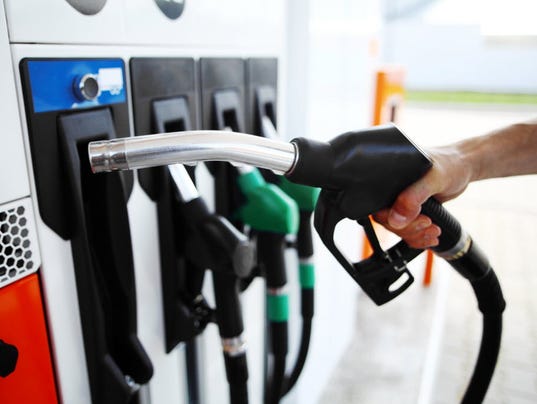
A photo from iStockphoto shows a gas station.(Photo: Thinkstock)
Even with the peak travel season in full swing, gasoline prices are stuck in reverse.
Gas prices have plunged to their lowest July level in 12 years, according to AAA, even as Americans are racking up more miles.
In fact, gas prices have dropped in 39 out of the last 40 days, lopping 20 cents a gallon off in total during that span, according to AAA.
"Gas is getting cheaper as we're moving into the busiest part of summer travel," AAA spokesman Michael Green said. "Those are real savings that add up...And we've seen that cheaper gas prices are motivating people to drive more and to take long trips this summer."
World "petro-politics" is the cause. Leaders in Saudi Arabia, one of the world's top oil producers, have held down prices to dampen production in other nations, including the resurgent oil industry in the U.S.. “It's their goal to maintain their market share and to have the price where it is now so that they can have long term success in the future,” Green said.
In the U.S, the outlook for the rest of 2016 is for even cheaper gas, partly because of the change in seasons. Prices typically fall as the summer wraps up and vacationers head for home.
Amid a global glut of oil inventories that has kept oil prices below $50 per barrel for most of 2016, the national average price of gas dropped to $2.19 on Thursday, marking its lowest average for this time of year since 2004, according to AAA. Making the difference even more profound, the numbers aren't adjusted for inflation. It's the cheapest average since April 28.
U.S. gas prices, which hit an all-time peak of $4.11 a gallon in July, 2008, are now about 57 cents cheaper per gallon than last year and $1.38 per gallon cheaper than in 2014.
That translates into savings of $15 to $35 per fill-up, compared to two years ago. Some 30% of U.S. gas stations are selling gas for less than $2 per gallon, says the AAA.
"It does make a difference," said Chris Carroll, a home remodeler from Lehigh Acres, Fla., when asked about regular unleaded gas prices hovering around $2 a gallon as he filled up. Every bit of savings helps, he says, especially since he uses premium in his big Ram work truck and logs 8,000 miles a month.
Demand for gasoline is among the highest it's been in recent years, said Patrick DeHaan, senior petroleum analyst for GasBuddy, a group that studies retail fuel pricing.
DeHaan projected that about 75% of the nation's 135,000 gas stations would be below $2 per gallon by Thanksgiving, barring any unexpectedly disruptive event.
With the lower prices, U.S. drivers are saving around $239 million per day on gas compared to last year, and $626 million per day compared to 2014, according to GasBuddy.
"Who knows where it's going in the economy, but there's a lot of money that is not being spent at the pump that was two years ago," DeHaan said.
That's in spite of increased gas taxes in the state of Washington and Maryland that took effect earlier this month.
The cheapest statewide average is South Carolina at $1.87, followed by Tennessee, Missouri and Alabama, as of Thursday, according to AAA. The three priciest states are California at an average of $2.83 per gallon, followed by Hawaii and Washington state.
Contributing: Casey Logan, Ft. Myers (Fla.) News-Press
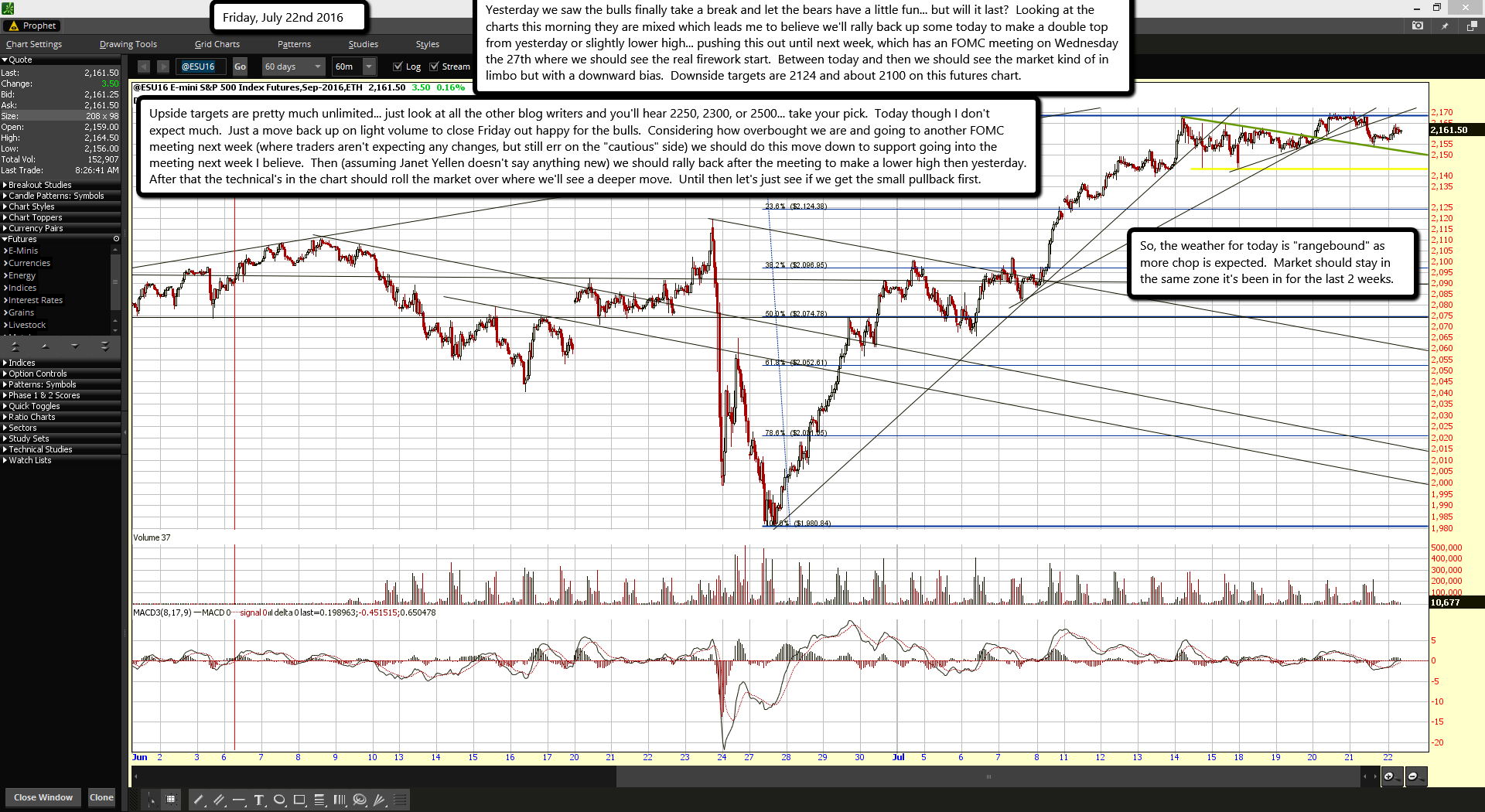
Yesterday we saw the bulls finally take a break and let the bears have a little fun... but will it last? Looking at the charts this morning they are mixed which leads me to believe we'll rally back up some today to make a double top from yesterday or slightly lower high... pushing this out until next week, which has an FOMC meeting on Wednesday the 27th where we should see the real firework start. Between today and then we should see the market kind of in limbo but with a downward bias. Downside targets are 2124 and about 2100 on this futures chart.
Upside targets are pretty much unlimited... just look at all the other blog writers and you'll hear 2250, 2300, or 2500... take your pick. Today though I don't expect much. Just a move back up on light volume to close Friday out happy for the bulls. Considering how overbought we are and going to another FOMC meeting next week (where traders aren't expecting any changes, but still err on the "cautious" side) we should do this move down to support going into the meeting next week I believe. Then (assuming Janet Yellen doesn't say anything new) we should rally back after the meeting to make a lower high then yesterday. After that the technical's in the chart should roll the market over where we'll see a deeper move. Until then let's just see if we get the small pullback first.
Papa John's has completed a major transition toward building a cleaner menu.
As of July 1, the pizza chain has completed its transition to poultry raised without antibiotics and fed a vegetarian diet for grilled-chicken pizza toppings and chicken poppers, the company told Business Insider.
This makes Papa John's the first national delivery-centric pizza chain to make such a switch.
"This transition is where the industry is going — consumers want raised-without-antibiotics chicken," Sean Muldoon, Papa John's chief ingredient officer, told Business Insider. "We're proud to be the first."
Papa John's announced plans to make the switch to antibiotic-free chicken last December because of growing consumer concerns regarding the practice of farmers' overreliance on the drugs.
The use of antibiotics is a hot topic in the pizza industry.
Take-and-bake pizza chain Papa Murphy's announced on Monday that it began serving chicken raised without antibiotics across its entire menu in late June, making it the first and currently only pizza chain to do so. Pizza Hut has pledged to cut chicken produced with antibiotics important to human medicine by March 2017.
Research, including a 2013 report from the US Centers for Disease Control and Prevention, offers evidence that antibiotic overdose is contributing to the rise of super-strong bacteria that no longer respond to antibiotics.
If the problem is allowed to continue, then it could mean a future in which we can no longer treat infections using antibiotics, thanks to the rise of superbugs.
Muldoon says that Papa John's focus on what the company calls its "clean label journey" is inspired by a mix of consumer demand and scientific research.
"We're a very consumer-centric company," says Muldoon, with Papa John's drawing from research on consumer trends and discussions with its supply chain. "We're not always just chasing the next shiny object ... but we try to be very clear in terms of how we define 'clean label' — what that means to us, and where those lines are."
The company reports that its "Better Ingredients, Better Pizza" promise costs the company $100 million a year. In January, Papa John's became the first national pizza chain to cut artificial ingredients from its food menu.
Next on the list: converting to cage-free eggs and completing the promise to cut 14 "unwanted" additives from the menu by the end of the year.
But at the core of any restaurant chain remains the question of taste, something that Papa John's says will not be compromised by changes. According to Muldoon, Papa John's conducted months of testing, including a side-by-side taste test, to ensure that the new chicken's flavor remained the same.
The chain's commitment to quality is paying off. In June, Papa John's was named the top pizza chain in the American Customer Satisfaction Index (ACSI), with a score of 82 out of 100. This is the 15th time out of the previous 17 years in which the chain has earned top marks in the pizza industry in overall customer satisfaction.
The probable departure of founder and Chief Executive Roger Ailes may not come at an ideal time for Fox News Channel, but the momentum of record ratings amid the most sensational U.S. presidential election in decades may give the cable network some breathing room to recover, media buyers and Wall Street analysts said.
However, Ailes' successor faces the twin challenges of retaining Fox News' established on-air stars such as Bill O'Reilly and Megyn Kelly, while making the network attractive to younger viewers, a demographic it has consistently missed.
Roger Ailes, chairman and CEO of Fox News and Fox Television Stations. REUTERS/Fred Prouser/File Photo REUTERS
"You have a few months right now where you are pretty much well assured that you won't have an audience issue, so it is a good time to lock up talent and make sure the course is corrected," said Brian Wieser, an analyst with Pivotal Research Group in New York.
Seventy-six-year-old Ailes, who in 20 years built Fox News into a highly profitable ratings juggernaut, is in negotiations over his departure with parent company Twenty-First Century Fox, a person briefed on the discussions told Reuters on Tuesday.
Twenty-First Century Fox declined comment.
Earlier this month Ailes was sued by former Fox News anchor Gretchen Carlson, who claimed he sexually harassed her. Ailes denies the charges. Fox News hired a law firm to conduct an internal investigation, which it says is not yet complete.
The scandal has brought unwelcome attention to Fox, but seems unlikely to dent viewer ratings in the middle of an unpredictable presidential campaign pitting outspoken businessman Donald Trump against former secretary of state Hillary Clinton, who would be the first female president.
Fox News, known for a lineup of politically conservative commentators, is the most-watched channel in basic cable television this year, with an average of 2.2 million prime-time viewers.
That gives some room for maneuver to Twenty-First Century Fox's top executives, James and Lachlan Murdoch, who last year took over from their father Rupert Murdoch, to make a management change without a big risk of losing viewers.
"Advertisers would have to see a drop in viewers before they would do anything," said Barry Lowenthal, president of the Media Kitchen, a media buyer. He said he has not heard from a single concerned client since reports surfaced on Monday that Ailes could be leaving the network.
Talent Exodus?
Whether Fox News can survive a leadership change without a drop in ratings is largely dependent on whether it can keep its top talent, analysts said. Network stars O'Reilly and Kelly's contracts are up in 2017, according to media reports.
"It would be a much bigger deal for advertisers if one of them left, because that is why viewers are tuning in," said a media buyer, who asked to remain anonymous because he is not permitted to speak to the media.
O'Reilly, Greta Van Susteren and Sean Hannity all have clauses in their contracts that allow them to leave the network if Ailes departs, according to a report in the Financial Times this week.
The next big challenge for Ailes' successor is its aging viewers. Fox News, like many of its peers, has an older audience, with a median age of over 65, higher than MSNBC and CNN, whose viewers are a median age of 64 and 60 respectively, according to Nielsen data. Advertisers generally seek out a much younger market.
That could mean adjusting its political outlook, said Media Kitchen's Lowenthal. "Fox News represents the former Republican establishment and they can use this as a way to reflect the modern American conservative view," he said.
Keeping Fox News relevant is important financially. It contributed $1.35 billion in earnings before interest, tax, depreciation and amortization (EBITDA), or 20 percent of parent Twenty-First Century Fox's total EBITDA in fiscal 2016, according to estimates by Anthony DiClemente, an analyst with Nomura.
No Clear Successor
There is no clear successor to Ailes within the network, industry insiders said, but possible contenders who have been mentioned in media circles include David Rhodes, a former Fox News staffer who now runs CBS News; Neil Cavuto, a senior vice president and anchor for both Fox News and Fox Business Network; and Bill Shine, senior executive vice president of programming at Fox Business.
Rhodes, Cavuto and Shine did not reply to requests for comment.
A former adviser to several U.S. Republican presidents, including George H.W. Bush, Ailes built Fox News into the most-watched U.S. cable news channel. He has been a confidant of media mogul and Twenty-First Century Fox Executive Chairman Rupert Murdoch, who named Ailes founding chief executive of Fox News in 1996.
Ailes positioned the network as an alternative to mainstream media that conservatives have long complained carries a liberal bias, promising "fair and balanced" coverage.
Nevertheless, analysts believe the channel will survive Ailes' departure.
"If this had happened 15 years ago, it would have a much greater impact," said John Janedis, an analyst with Jefferies. "At this point, Fox News' growth is beyond one person."
Transportation Security Administration agents examine a traveler’s luggage. (Andrew Burton/Reuters)
Relief might be on the way for hordes of travelers who have dealt with gargantuan security lines at major air hubs this summer.
New automated security lanes will soon serve customers at three major airports, the Transportation Security Administration said Wednesday. The robotic lanes — set to be installed at Newark Liberty, Chicago O’Hare and Los Angeles international airports later this year — promise to reduce wait times up to 30 percent by improving the flow of luggage and reducing the impact of holdups.
[TSA scrambling resources to deal with long lines of travelers]
Sadly, for D.C.-area travelers, Dulles International Airport is not among the airline’s hubs that will be part of the pilot program. But officials with the Metropolitan Washington Airports Authority, which manages Dulles and Reagan National said they are keenly aware that travelers in the nation’s capitol are also eager to find way to speed their trips.
Margaret McKeough, chief operating officer at the authority, said they will continue to work with the airlines and with their partners at TSA to find innovative ways to move passengers through security more quickly. She noted that Dulles and Reagan were not among the airports where passengers have been stuck in long security lines over the past few months. Even so, they are anxious to prevent that from happening during the busy summer and upcoming holiday travel season.
She added that they are interested in seeing if the pilot programs work and what lessons they can take from them.
Newark will receive the first of the new lanes this fall. When installation is finished, the airport’s C terminal will feature 17 automated lanes, according to United Airlines, who is partnering with TSA on the initiative. The security agency said the technology aims to improve safety.
“Our main priority is to protect the traveling public in an evolving threat environment,” TSA Administrator Peter Neffenger said in a statement. “We continue to test and deploy state-of-the-art technologies to ensure that we remain current.”
But the lanes will likely be a welcome innovation for air travelers if they can expedite the screening process. Mammoth security lines have sprouted at airports since spring as a consequence of a TSA staffing shortage, which has resulted in tens of thousands of missed flights.
The new lanes feature automated belts that feed bags into the X-ray machines, and send bins back into the queue after the screening concludes, the TSA said. Also, potentially threatening bags can be diverted so bins behind them can proceed along the conveyor without holding up lines.
[How long is the TSA line at my airport right now?]
As part of the enhancements, new, 25-percent-larger bins are equipped with radio tags so they can be tracked throughout the security lane. TSA says the bins will also be photographed.
United joins American and Delta as the only domestic carriers to host the modernized lanes, which allow up to five customers to fill their bins at the same time. United said lines will proceed faster even if TSA agents need to perform additional screening on customers further up the line.
Delta was the first domestic airline to install the technology. It opened two automated lanes at Hartsfield-Jackson Atlanta International Airport in May at a cost of $1 million, according to the Atlanta Journal-Constitution. American Airlines is adding the screening stations at O’Hare, Dallas/Fort Worth, Los Angeles and Miami airports this fall at a cost of $5 million, the Dallas Morning News reported.
United said its modernized lanes will be installed in Chicago and Los Angeles later this year, though it did not announce a specific date.
With the holiday frenzy about to begin, most people are afraid, or rather cautious of visiting the UK after their vote to leave the EU. Will the application process change? How do you apply for a trip to Europe after Brexit? Most people are wondering what will happen after Britain voted out of EU. Will this affect their occasional travels to the UK? Now that the pound has dropped, does this mean prices will hike up? This article will look at the effects of Brexit and what they mean to travelers.
Having voted to leave the EU, most Britons are wondering how that will affect their travel to other European countries. As of now, there will be no alteration to their trip since there have been no legislation of this put to law. Having said that, Britons can travel freely through Europe as they have always done before Brexit.
Below are some of the constituents you need to know when planning to travel around Europe.
Will holiday cost hike up?
Having mentioned the drop in the pound value to the lowest, we have seen in years; there will be a consequent rise in prices ranging from the smallest commodities like a glass of wine to a night out in Porsche restaurant.
With the drop in the pound, this means a consequent rise in the dollar since the pound is in proportion to the dollar. What does this indicate to people traveling across Europe? Since most commodities are priced in dollars, ranging from clothes to petroleum, the dollar will hike up, and that means there will be an increase in prices of goods and services across Europe.
Flight travel cost will rise after an increase in petrol price. What does this mean for travelers? If you have had a fixed, or recycled budget that you use for holidays across Europe, you will have to adjust that to the current market economy as the pound has dropped with a significant percentage.
What traveling documents do you need?
There have been many debates about a change of passports after Brexit. Do you need a Visa to travel to Europe? How do you apply for travel to Europe? Well, as we stated in the introduction, as of now, there has been no law put in place concerning travel visa and passports. So that should not be of worry as of now.
Another factor discouraging European countries from sidelining Britain after Brexit is due to its tourist export to other nations. Saying that the EU will force Britons to have special passports on arrival in their countries will significantly affect their tourism imports as Britain ranks among the highest tourist exporter in Europe.
Where across Europe can Britons visit?
Basically in the first two years after a state decides to leave the EU, all legislation remains the same. What does this mean? Good news for travelers, very little or nothing at all will change. You can travel across Europe without fear of being fined for trespassing without the required documents.
What about flights? Will Brexit reduce flight to and from Britain? In any case, Britain is a hub for both products and services. If a country chooses to reduce flight to and from Britain, they stand to lose more on their trade revenue.
How will the tourism industry in Britain be affected?
Brexit has benefitted the tourism sector in Britain, a bunch. How so? Well, with the drop in sterling, that means a rise in the dollar about the pound. People in other countries will exchange the pound sterling at a cheaper rate. What does this mean to Britons? They will have to pay more to trade pound for dollars when traveling to other European countries.
Trips to other countries for holidays will cost more than having your holiday in Britain. We will experience a reduction in the number of tourists Britain exports to Europe and significantly increase the domestic tourism across Britain. In this way, the tourism sector will be boosted high by local tourist.
In conclusion, we can see that Brexit in its entirety has affected the Britain tourism industry both positively and negatively. Britons have about two years before they can feel the total impact of Brexit despite the drop in sterling. According to Article 50, that is exacted, after a nation decides to exit the EU, every legislation should remain unchanged up to two years. After the two years have ended, Britain will have to strategize their law.
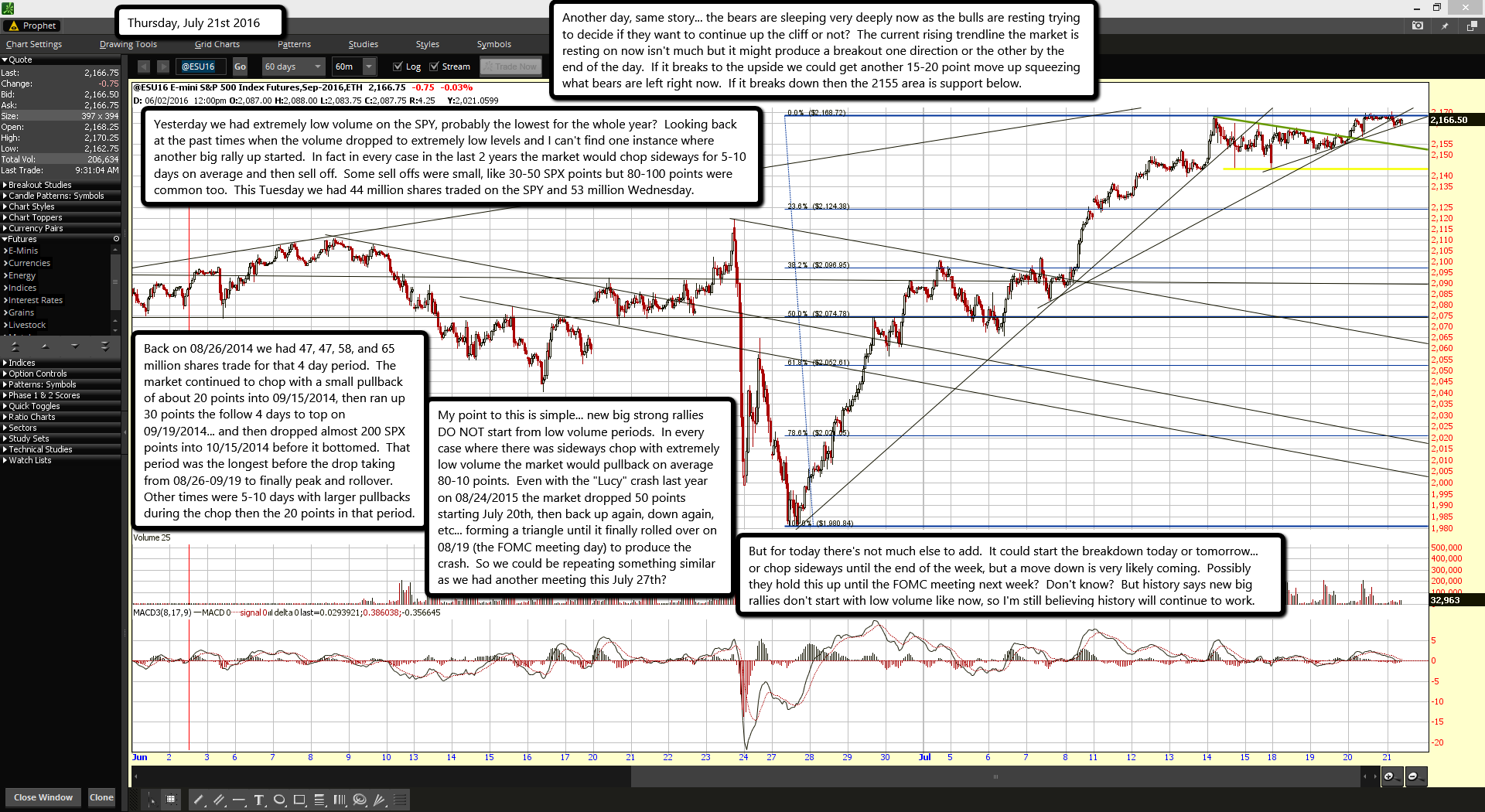
Another day, same story... the bears are sleeping very deeply now as the bulls are resting trying to decide if they want to continue up the cliff or not? The current rising trendline the market is resting on now isn't much but it might produce a breakout one direction or the other by the end of the day. If it breaks to the upside we could get another 15-20 point move up squeezing what bears are left right now. If it breaks down then the 2155 area is support below.
Yesterday we had extremely low volume on the SPY, probably the lowest for the whole year? Looking back at the past times when the volume dropped to extremely low levels and I can't find one instance where another big rally up started. In fact in every case in the last 2 years the market would chop sideways for 5-10 days on average and then sell off. Some sell offs were small, like 30-50 SPX points but 80-100 points were common too. This Tuesday we had 44 million shares traded on the SPY and 53 million Wednesday.
Back on 08/26/2014 we had 47, 47, 58, and 65 million shares trade for that 4 day period. The market continued to chop with a small pullback of about 20 points into 09/15/2014, then ran up 30 points the follow 4 days to top on 09/19/2014... and then dropped almost 200 SPX points into 10/15/2014 before it bottomed. That period was the longest before the drop taking from 08/26-09/19 to finally peak and rollover. Other times were 5-10 days with larger pullbacks during the chop then the 20 points in that period.
My point to this is simple... new big strong rallies DO NOT start from low volume periods. In every case where there was sideways chop with extremely low volume the market would pullback on average 80-10 points. Even with the "Lucy" crash last year on 08/24/2015 the market dropped 50 points starting July 20th, then back up again, down again, etc... forming a triangle until it finally rolled over on 08/19 (the FOMC meeting day) to produce the crash. So we could be repeating something similar as we had another meeting this July 27th?
But for today there's not much else to add. It could start the breakdown today or tomorrow... or chop sideways until the end of the week, but a move down is very likely coming. Possibly they hold this up until the FOMC meeting next week? Don't know? But history says new big rallies don't start with low volume like now, so I'm still believing history will continue to work.
More than $3.5 billion traveled a trail of fraud from Malaysia through a web of shell companies, with some fueling a spending binge on Monet paintings and luxury real estate and at least $700 million flowing back into accounts controlled by Malaysia’s prime minister.
Some of the money was handled by international banks including Goldman Sachs Group Inc., JPMorgan Chase & Co., Standard Chartered Plc and Deutsche Bank AG. A chunk of it funded a Hollywood blockbuster, “The Wolf of Wall Street.” More than $13 million of it was wired to an account at a Las Vegas casino by a stepson of Malaysia’s prime minister who gambled with an unidentified actor whose description matches that of Leonardo DiCaprio.
It’s all laid out in a dozen filings Wednesday by U.S. prosecutors who detailed an alleged scheme of international money laundering and misappropriation stretching from 2009 to 2015. The Justice Department is seeking to seize more than $1 billion worth of assets it says went through U.S. banks from Malaysian development fund 1Malaysia Development Berhad, known as1MDB, and was ultimately used to illegally acquire assets.
Timeline: Malaysia’s Spiraling 1MDB State Fund Controversy
The U.S. complaints lays the groundwork for tension with Malaysia, a longtime ally on issues including counterterrorism and trade. Prosecutors refer to a top Malaysian official who controlled accounts that received hundreds of millions of dollars. The official isn’t accused of wrongdoing.
The anonymous description lines up with that of Prime Minister Najib Razak, who until a few months ago served as the chairman of 1MDB’s advisory board.
It’s unclear how local law enforcement will respond in Malaysia, where officials have taken pains to keep criticisms from surfacing, have cleared Najib of any wrongdoing and closed its own investigations. U.S. prosecutors sought to recover assets they linked to Najib’s stepson, Riza Aziz, and other associates.
The prime minister didn’t immediately respond to a request for comment. He has consistently denied wrongdoing.
“Unfortunately and tragically, a number of corrupt officials treated this public trust as a personal bank account,” Attorney General Loretta Lynch said at a news conference in Washington. The civil action and asset seizures represent the “largest single action ever brought” by the Justice Department’s six-year-old Kleptocracy Asset Recovery Initiative, she said.
Lynch declined to comment on the identity of the unnamed top Malaysian official.
QuickTake Q&A: Malaysia’s 1MDB Fund Spawns Worldwide Probes
1MDB said in a statement that it will fully cooperate with investigators and had not been contacted by the Justice Department. It said it “is not a party to the civil suit, does not have any assets in the United States of America, nor has it benefited from the various transactions described in the civil suit.”
Also on Wednesday, Swiss authorities said U.S. prosecutors had sent them a request in May for information about bank accounts that might have been used to move money from the fund.
Web of Companies
The U.S. complaints also lay out how a handful of global banks, while not accused of wrongdoing, were ensnared as hundreds of millions bounced between a web of shell companies. Money was pilfered from the government fund based on false representations made by 1MDB officials and representatives of the shell companies, prosecutors said. Even when bank officials raised questions about the beneficiaries of various accounts, compliance departments were unable to detect or halt the alleged fraud.
The diverted cash was used to purchase a breathtaking catalog of loot that prosecutors moved on Wednesday to seize. There’s a stake in the Viceroy L’Ermitage Beverly Hills Hotel as well as homes, condos and penthouses from Los Angeles and Beverly Hills to Manhattan’s Central Park South to London’s Belgravia. There’s a $35 million Bombardier jet, as well as more than $200 million worth of art -- a pen-and-ink drawing by Vincent Van Gogh (“La Maison de Vincent a Arles”) and two Claude Monet paintings, including a pastel study of water lilies, “Nympheas Avec Reflets de Hautes Herbes.”
Hollywood Link
And in a twist worthy of Hollywood, the U.S. is also laying claim to profits and royalties from a movie about wealthy abandon: It says that more than $100 million in funds from 1MDB went to finance 2013’s “The Wolf of Wall Street,” by Red Granite Pictures Inc. -- a production company co-founded by Najib’s stepson, Riza.
1MDB in April said it had “never invested in nor transferred funds to Red Granite Pictures, whether directly or via intermediaries,” and has denied wrongdoing more broadly over its finances. Red Granite said in May that all money it received had been proper and from a variety of sources including top-tier U.S. commercial and investment banks.
Jho Low Coterie
At the heart of the scheme, the U.S. alleges, was a small coterie of Malaysians led by a Malaysian financier named Low Taek Jho. They diverted money from 1MDB into personal accounts disguised to look like legitimate businesses, the U.S. said, and kicked back some of those funds to officials. Low, who has been linked socially with Paris Hilton and is a close friend of Riza, has said he provided consulting to 1MDB that didn’t break any laws.
In one of the complaints filed in federal court in California, running 136 pages, federal prosecutors alleged the unnamed top official whose description matches Najib’s received payments of $20 million in 2011, $30 million in late 2012 and then $681 million in March 2013. In August 2013, prosecutors said, some $620 million was transferred out of the top official’s account and back into an account controlled by one of the defendants in the U.S. actions.
Najib stepped down from his role as chairman of 1MDB’s advisory board when it wasdissolved in May. He is also the country’s finance minister. The Ministry of Finance is the sole shareholder of 1MDB.
The Malaysian attorney general said this year that the $681 million that appeared in Najib’s accounts before the 2013 election was a personal contribution from the Saudi royal family and that most was later returned. He cleared Najib of wrongdoing. Saudi Foreign Minister Adel Al-Jubeir said in April that the large donation to Najib was “genuine,” and Saudi authorities were aware of the gift which came without strings.
The Justice Department account contradicts that statement. The $681 million came from Tanore, an entity controlled by a friend and associate of Low’s. Najib paid the money back to Tanore, according to the complaint.
Three Phases
The Malaysia fund is at the center of several international investigations into alleged corruption and money laundering by public officials. Prosecutors in at least four countries -- Singapore, Switzerland, Luxembourg and the U.S. -- are looking into money flows from the investment vehicle, which was established for national development.
The suspected fraud occurred in three phases in which money was laundered through bank accounts in Singapore, Switzerland, Luxembourg and the U.S., prosecutors said.
In 2009, after 1MDB was set up to pursue development projects, officials of 1MDB and others, under the pretense of investing in a joint venture between 1MDB and a Saudi oil company, transferred more than $1 billion to a Swiss bank account, according to the Justice Department.
In 2012, 1MDB officials and others diverted proceeds raised through two separate bond offerings arranged by Goldman Sachs Group Inc., according to the Justice Department. More than 40 percent of the proceeds, or $1.4 billion, were transferred to a Swiss bank account belonging to a British Virgin Islands entity. More than $1 billion was diverted from another bond offering arranged by Goldman Sachs in 2013.
Goldman Ties
Goldman Sachs, which enjoyed a lucrative relationship with 1MDB, did the bidding for fund officials even as many Goldman employees questioned whether Low was involved, prosecutors said. The bank also circulated misleading offering statements when raising money for 1MDB, though the complaint doesn’t indicate that Goldman employees were aware of whether the statements were misleading.
Goldman Sachs said in a statement: “We helped raise money for a sovereign wealth fund that was designed to invest in Malaysia. We had no visibility into whether some of those funds may have been subsequently diverted to other purposes.”
Compliance ‘Overkill’
E-mails and recorded phone calls between 1MDB and several banks show how billions of dollars were siphoned out of 1MDB accounts under false pretenses, according to the complaints, underscoring the weaknesses of bank compliance systems.
A handful of global banks were used to shift money improperly without confirming who the recipients were, other than information provided by 1MDB, according to the complaint. At times, when compliance officers raised questions, they were brushed aside and the transfers were eventually approved.
In one phone call cited in the documents, prosecutors say a 1MDB employee pressed a Deutsche Bank supervisor to approve transfers into Swiss accounts, complaining he was “under tremendous pressure” to get the deal done.
“Let me must convince my compliance person,” the Deutsche Bank employee said, according to prosecutors. ”It’s a little bit sticky with this.”
”They cannot wait for this, you know,” the 1MDB official added. ”If they’re going to overkill on the compliance thing, uh, they have to be responsible, you know.”
The transaction went through.
Deutsche Bank declined to comment as did JPMorgan, which was also mentioned in the documents. Standard Chartered said it is cooperating with all relevant investigations and declined to comment further.
Art Purchases
Low or his associates used some of the misappropriated funds to buy artworks, the complaint alleges. Low then used part of his collection -- which he valued at more than $300 million, according to an e-mail cited in the complaint -- as collateral for a loan from Sotheby’s Financial Services, a unit of Sotheby’s.
He used 17 pieces, including the two Monets and the Van Gogh, to secure a loan of $107 million loan that went to a company owned by Low, according to the complaint.
By May 2016, Sotheby’s had recovered enough from the sale of several works pledged as collateral to cover the outstanding balance of the loan, according to the complaint. Then Sotheby’s released its security interest in the artwork, it said. As of June 7, Sotheby’s still had the three works in its possession, according to the complaint.
Sotheby spokeswoman Lauren Gioia said the company always cooperates with government investigations. “As set forth in the complaint, Sotheby’s has no continuing security interest or relationship to the three works that are the subject of the action, and is not in a position to comment on any potential seizure,” she said.
Vegas Trip
Low and Riza were also at the center of a gambling spree in Las Vegas in July 2012, using money that had come through 1MDB, according to prosecutors. A few weeks after Riza wired $41 million from a Red Granite account to one controlled by an associate, Eric Tan, the two of them went to Vegas, where over several days they wired $13 million into an account maintained by Las Vegas Sands Corp., the parent of the Venetian Casino.
Sands, which hasn’t been accused of wrongdoing, declined to comment.
The two of them -- joined by Low and a producer of the “Wolf of Wall Street” -- gambled at the Venetian for three days. They were joined on July 15 by what the complaint identifies as a lead actor in the film, who it noted ultimately won a Golden Globe award for his performance.
That actor is DiCaprio, who isn’t accused of wrongdoing. His publicist, Shawn Sachs, didn’t immediately respond to a request for comment.
The case is U.S. v. “Wolf of Wall Street,” 16-05362, U.S. District Court for the Central District of California.
Airbnb, the popular site that lets people rent rooms and houses, is hoping to fight racism and discrimination on its platform — and it's recruited former Attorney General Eric Holder to help.The company has spent more than a month reviewing its policies, after widespread reports of a pattern of bias against people of color looking to rent rooms.
The review is still ongoing, the company said in a blog post Wednesday, but they've already started taking some steps to address the problem, including bringing in Holder and other experts to help write a new anti-discrimination policy.
The site also plans to offer training about "unconscious bias" to more hosts, and hire employees "whose full-time job will be to detect and address instances of discrimination."
This spring, NPR's Hidden Brain explored the issue of racial bias on Airbnb. Quirtina Crittenden, a user on the site, described getting declined for room after room — until she changed her profile image to a landscape photo, and shortened her name to "Tina." After that, getting a room was no problem.
Researchers have found a widespread pattern of racial discrimination on Airbnb. Here's Hidden Brain:
"Michael Luca and his colleagues Benjamin Edelman and Dan Svirsky at Harvard Business School ... sent out 6,400 requests to real AirBnb hosts in five major American cities—Baltimore, Dallas, Los Angeles, St. Louis, and Washington.
"All the requests were exactly the same except for the names they gave their make-believe travelers. Some had African American-sounding names like Jamal or Tanisha and others had stereotypically white-sounding names like Meredith or Todd.
"Luca and his colleagues found requests with African American sounding names were roughly 16 percent less likely to be accepted than their white-sounding counterparts. They found discrimination across the board: among cheap listings and expensive listings, in diverse neighborhoods and homogenous neighborhoods, and with novice hosts as well as experienced hosts. They also found that black hosts were also less likely to accept requests from guests with African American-sounding names ...
"In a separate study, Luca and his colleagues have found that guests discriminate, too, and black hosts earn less money on their properties on Airbnb."
Another study found that Asian-American hosts make less money than white ones.
When NPR's Code Switch reached out to individual Asian-American hosts, they said they didn't feel like race played a factor in their room prices. But researchers examining the issue — like researchers looking into bias against black Airbnb users — noted that subconscious bias can play a powerful role in decision-making.
In the company's Wednesday blog post on the issue, Airbnb co-founder Brian Chesky opened by mourning the recent shootings in Minnesota, Louisiana and Texas, and expressing support for both the Black Lives Matter movement and for police officers. He continued:
"We aren't so naïve to think that one company can solve these problems, but we understand that we have an obligation to be honest about our own shortcomings, and do more to get our house in order. That's why we've been talking more openly about discrimination and bias on our platform, and are currently engaged in a process to prevent it. ...
"We will not simply 'address the issue' by doing the least required for liability and PR purposes. I want us to be smart and innovative and to create new tools to prevent discrimination and bias that can be shared across the industry."
Former Attorney General Holder will be assisting as outside counsel, working with civil rights attorney John Relman to help write a new anti-discrimination policy.
In a statement, Holder said he's looking forward to helping Airbnb "craft policies that will be the model for companies who share Airbnb's commitment to diversity and inclusion."
Airbnb says they will require all users to read and commit to the policy.
Chesky also admits that the company has failed on this issue in the past — with inadequate transparency, and with a "lack of urgency" on addressing discrimination.
"Joe [Gebbia], Nate [Blecharczyk], and I started Airbnb with the best of intentions, but we weren't fully conscious of this issue when we designed the platform," Chesky wrote. "I promise you that we have learned from the past and won't repeat our prior mistakes and delays."
Following the bell today, Qualcomm reported earnings for its third fiscal quarter of 2016 that met analyst expectations in terms of earnings per share, and exceeded expectations in terms of revenue. The company attributed its results to progress with the number of licensees in China.
For the quarter ending June 26, the San Diego, California-based semiconductor and telecommunications products maker posted net income of $1.44 billion, up 22 percent from $1.18 billion.
Non-GAAP revenue surged 3.6 percent to $6.04 billion, or $1.16 cents per share, up from $5.8 billion a year ago.
Analysts had been expecting Qualcomm to report per-share earnings of 97 cents on revenue of $5.58 billion.
“We are continuing to make progress in our licensing business and expect that momentum to continue,” said Steve Mollenkopf, CEO of Qualcomm Incorporated, during a conference call.
Right after the CEO’s statement, president Derek Aberle explained that Qualcomm is continuing to execute new license agreements in China, and that the company is still actively negotiating with the key remaining Chinese OEMs.
Mollenkopf added that regulators around the world are beginning to allocate spectrum for 5G consistent with the company’s 5G design and development effort: “Recent spectrum regulatory decisions and movement in the U.S. and Europe, combined with progress on the spectrum regulatory front in China, Japan and Korea, are good indications that the world is preparing for 5G.”
For the nine months ending in June 2016, Qualcomm posted net income of $4.11 billion, or $2.74 per diluted share, down 2.4 percent from $4.21 billion, or $2.53 per share in the 2015 comparable period. Revenues decreased 12.4 percent to $17.37 billion from $19.83 billion the year before.
In after-market trading, Qualcomm shares were up 6.8 percent after the earnings announcement.
Michael Dubin will remain CEO of the company. YouTube: Dollar Shave Club
Being a disrupter might land you a billion dollar deal. That's the case for Dollar Shave Club, which has reached an agreement with Unilever for the consumer packaged goods giant to acquire the male grooming company for a reported $1 billion price tag.
Founded in 2012, Dollar Shave Club initially made headlines for its pithy advertising, which featured the company's CEO Michael Dubin as an endearingly passionate pitchman arguing that consumers didn't need brand name razors.
The work, which was created by the company's in-house creatives and continued to feature Dubin prominently, became a point of differentiation for Dollar Shave Club beyond its mail-order business model.
It makes sense then that the company's advertising strategy will stay in-house, instead of shifting to one of Unilever's myriad agencies once it is under Unilever's brand umbrella. "Things aren't changing," according to a spokeswoman for the Dollar Shave Club.
Unilever declined to comment beyond its press release.
"If Unilever is smart it won't muck with it," said Allen Adamson, founder of Brand Simple Consulting. "Typically, with an acquisition like this, most companies will homogenize the company they acquire and force their way of doing things on it, force them to use their agencies, do it their way and in doing it that way they miss a big opportunity to change how they market and how they advertise."
He added: "Because it's such a different business I don't think they're going to do that here. They will let it do what made it successful and see how they can help."
Patrick Collins, CEO of Grace Blue Acquisitions doesn't think Dollar Shave Club should be "worried that [their] ad approach or brand would be limited by this acquisition. Looking at their experience with Axe, Unilever has allowed that brand to flourish and have fun, which is proof for DSC that when a brand and a message work, Unilever leaves it alone."
Britt Bulla, senior director of strategy for branding firm Siegel + Gale agreed. "I think it's not going to change much," said Bulla, noting that the brand experience of Dollar Shave Club might be more important than its advertising strategy. "If Unilever keeps that pure I'm not worried; if Unilever doesn't, they probably lose a customer."
Since it was founded five years ago Dollar Shave Club has grown significantly; it now has 3.2 million members and it made $152 million in sales last year. The company has also evolved from solely a razor subscription service, adding a skin care line and other grooming products as well as its own men's lifestyle site, Mel.
"Dollar Shave Club is an innovative and disruptive male grooming brand with incredibly deep connections to its diverse and highly engaged consumers," said Kees Kruythoff, president of Unilever North America in a statement.
He added: "In addition to its unique consumer and data insights, Dollar Shave Club is the category leader in its direct-to-consumer space. We plan to leverage the global strength of Unilever to support Dollar Shave Club in achieving its full potential in terms of offering and reach."
Dubin will remain CEO of the company. "DSC couldn't be happier to have the world's most innovative and progressive consumer-product company in our corner," said Dubin in a statement.
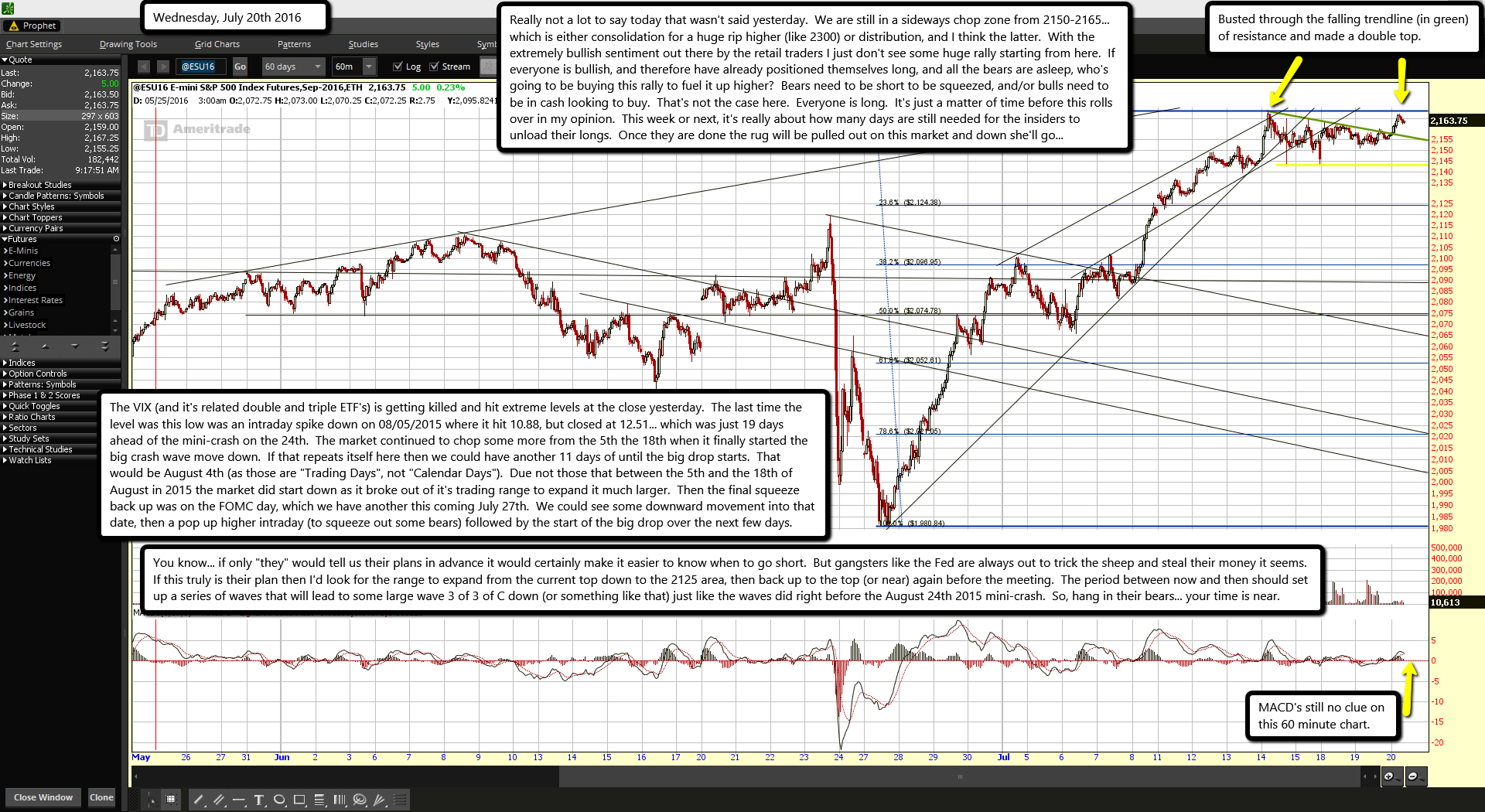
Busted through the falling trendline (in green) of resistance and made a double top.
MACD's still no clue on this 60 minute chart.
Really not a lot to say today that wasn't said yesterday. We are still in a sideways chop zone from 2150-2165... which is either consolidation for a huge rip higher (like 2300) or distribution, and I think the latter. With the extremely bullish sentiment out there by the retail traders I just don't see some huge rally starting from here. If everyone is bullish, and therefore have already positioned themselves long, and all the bears are asleep, who's going to be buying this rally to fuel it up higher? Bears need to be short to be squeezed, and/or bulls need to be in cash looking to buy. That's not the case here. Everyone is long. It's just a matter of time before this rolls over in my opinion. This week or next, it's really about how many days are still needed for the insiders to unload their longs. Once they are done the rug will be pulled out on this market and down she'll go...
The VIX (and it's related double and triple ETF's) is getting killed and hit extreme levels at the close yesterday. The last time the level was this low was an intraday spike down on 08/05/2015 where it hit 10.88, but closed at 12.51... which was just 19 days ahead of the mini-crash on the 24th. The market continued to chop some more from the 5th the 18th when it finally started the big crash wave move down. If that repeats itself here then we could have another 11 days of until the big drop starts. That would be August 4th (as those are "Trading Days", not "Calendar Days"). Due not those that between the 5th and the 18th of August in 2015 the market did start down as it broke out of it's trading range to expand it much larger. Then the final squeeze back up was on the FOMC day, which we have another this coming July 27th. We could see some downward movement into that date, then a pop up higher intraday (to squeeze out some bears) followed by the start of the big drop over the next few days.
You know... if only "they" would tell us their plans in advance it would certainly make it easier to know when to go short. But gangsters like the Fed are always out to trick the sheep and steal their money it seems. If this truly is their plan then I'd look for the range to expand from the current top down to the 2125 area, then back up to the top (or near) again before the meeting. The period between now and then should set up a series of waves that will lead to some large wave 3 of 3 of C down (or something like that) just like the waves did right before the August 24th 2015 mini-crash. So, hang in their bears... your time is near.
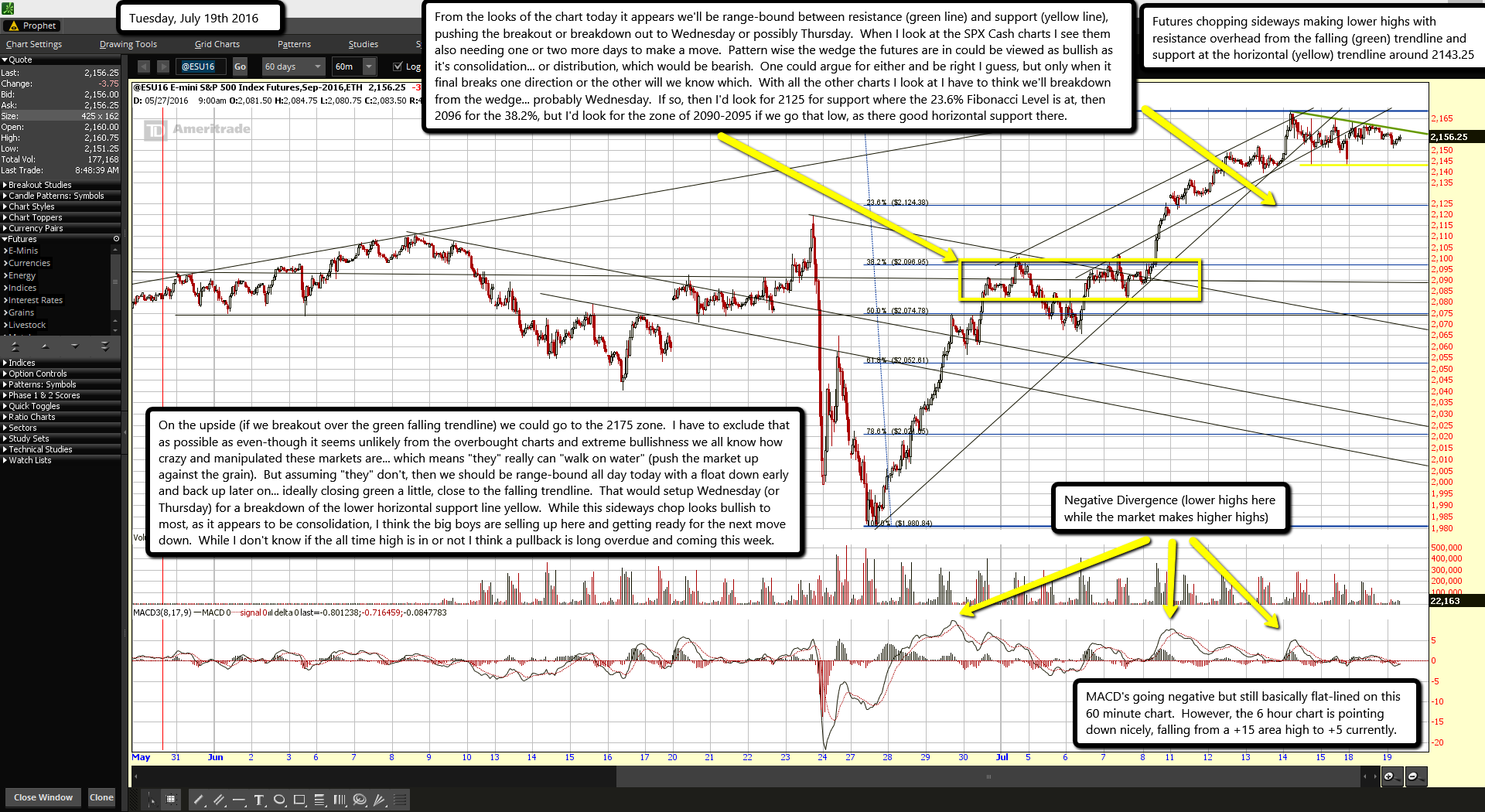
Futures chopping sideways making lower highs with resistance overhead from the falling (green) trendline and support at the horizontal (yellow) trendline around 2143.25
MACD's going negative but still basically flat-lined on this 60 minute chart. However, the 6 hour chart is pointing down nicely, falling from a +15 area high to +5 currently.
From the looks of the chart today it appears we'll be range-bound between resistance (green line) and support (yellow line), pushing the breakout or breakdown out to Wednesday or possibly Thursday. When I look at the SPX Cash charts I see them also needing one or two more days to make a move. Pattern wise the wedge the futures are in could be viewed as bullish as it's consolidation... or distribution, which would be bearish. One could argue for either and be right I guess, but only when it final breaks one direction or the other will we know which. With all the other charts I look at I have to think we'll breakdown from the wedge... probably Wednesday. If so, then I'd look for 2125 for support where the 23.6% Fibonacci Level is at, then 2096 for the 38.2%, but I'd look for the zone of 2090-2095 if we go that low, as there good horizontal support there.
On the upside (if we breakout over the green falling trendline) we could go to the 2175 zone. I have to exclude that as possible as even-though it seems unlikely from the overbought charts and extreme bullishness we all know how crazy and manipulated these markets are... which means "they" really can "walk on water" (push the market up against the grain). But assuming "they" don't, then we should be range-bound all day today with a float down early and back up later on... ideally closing green a little, close to the falling trendline. That would setup Wednesday (or Thursday) for a breakdown of the lower horizontal support line yellow. While this sideways chop looks bullish to most, as it appears to be consolidation, I think the big boys are selling up here and getting ready for the next move down. While I don't know if the all time high is in or not I think a pullback is long overdue and coming this week.
CLEVELAND — The Republican National Convention was thrown into disarray Monday as delegates opposing Donald Trump made their final stand.
The Colorado delegation walked out of the GOP convention floor after delegates seeking a roll-call vote to change the rules were denied.
At around 4 p.m. ET, the convention's rules were put up for a vote, and the Stop Trump movement wanted to force a roll-call vote to try and change the rules so they could come up with a new nominee.
However, the party passed the rules with a voice vote.
Ken Cuccianelli, the former Virginia attorney general and a leader in the movement to stop Trump's nomination, told MSNBC "this is infuriating to watch."
"Here we've got [the] RNC trampling over their own grassroots delegates, and for most of us here, this is about getting good grassroots rules and getting a voice in the vote," he said. "They cheated."
This is just another source of tension surrounding the RNC.
Outside of the convention, there are several anti-Trump protests expected throughout the week, with some already taking place Monday.
The city of Cleveland was awarded a $50 million federal grant for security during the convention.
That said, Monday's defeat of the anti-Trump movement's last-ditch effort clears the path for the business magnate to be the GOP standard bearer.
Despite reporting Q2 subscriber rates that missed expectations, most analysts think Netflix's growth trajectory will improve sooner or later.
The company reported in its Q2 letter to shareholders on Monday that it added 1.7 million subscribers, a steep drop from its forecast of 2.5 million. The U.S. added 160,000 subscribers compared to projection of 500,000, while international subscriber additions totaled 1.5 million compared to the 2.0 million forecast. The stock, already down year-to-date, sank in the after hours, dropping more than 15 percent.
The company said that while total additions were on target, the unsubscribing rate was "up slightly and unexpectedly." Netflix claimed the churn was tied to press coverage in April around its plans to raise prices for long-term members, saying that consumers thought the price effect would occur immediately instead of over a longer period. (The price increase should be completed by the end of the year, the company said on its earnings call.)
Despite missing its guidance, Netflix's quarterly earnings beat expectations. It posted second quarter earnings of 9 cents per share, compared to 6 cents per share year over year. Revenue was at $2.11 billion, compared to $1.65 billion the year prior.
Thompson Reuters consensus estimate was $2.11 billion in revenue, with the company expected to post earnings of 2 cents a share.
Still, many analysts are undeterred. EMarketer senior analyst Paul Verna said Netflix is on the right path, but the fact it is so subscription-based makes its model a little more risky than their competitors like Amazon or YouTube, which have more kinds of revenue streams.
"Amazon has a lot of money to invest in content," said Verna. "They're not looking for the content subscriptions on their own. They're looking to drive e-commerce, and content is part of a much bigger strategy. For Netflix, content is everything."
Mike Goodman, director of digital media strategies for Strategy Analytics, said this earnings report was especially telling for Netflix considering it hasn't met expectations for two quarters. Goldman said Netflix had hit its saturation point for subscribers in the U.S., but the real sign for growth was among international numbers. With lower than expected rates in that realm, the future is a bit murkier for Netflix.
"I don't want to paint a major black cloud over the top of Netflix," Goodman said. "In general, I think they are very strong company, but they're facing growing pains."
The company also has a potential goldmine in distribution revenue if it continues to produce original content that people want to watch.
The model echoes HBO's business plan, said TruOptik CEO Andre Swanson. It wasn't until the network released "The Sopronos" in 1999 — 27 years after it launched — did it start deriving revenue from original content.
"Syndication has historically been a big part of the television industry – and you have to think of Netflix as a television channel. They're not an over-the-air broadcaster. They're distribution channel is online in terms of the way they operate their business, but their ability to own content helps them better monetize. "
Already, Netflix has developed a respectable slate of original series like "Orange is the New Black," "House of Cards" and "Making A Murderer." It confirmed that it it would continue to do so. These shows and movies can be a draw for international viewers attracted to English-language programming, and can help increase subscriber rates. It also gives Netflix a large opportunity for TV distribution rights revenue in different countries.
In addition, the company is working on developing more non-English language series and films in more than a dozen countries, including Brazil, Germany, India, Italy, Japan, Mexico, Columbia, South Korea, Argentina and Spain. Earlier this year, it announced a deal with Univision to broadcast "Narcos," (which is mostly in Spanish, as well as a joint production for an upcoming "El Chapo" series.
Still, it could be little longer until we see Netflix's true potential.
"[Distribution revenue] is another one of those things that doesn't show up immediately," Verna said.
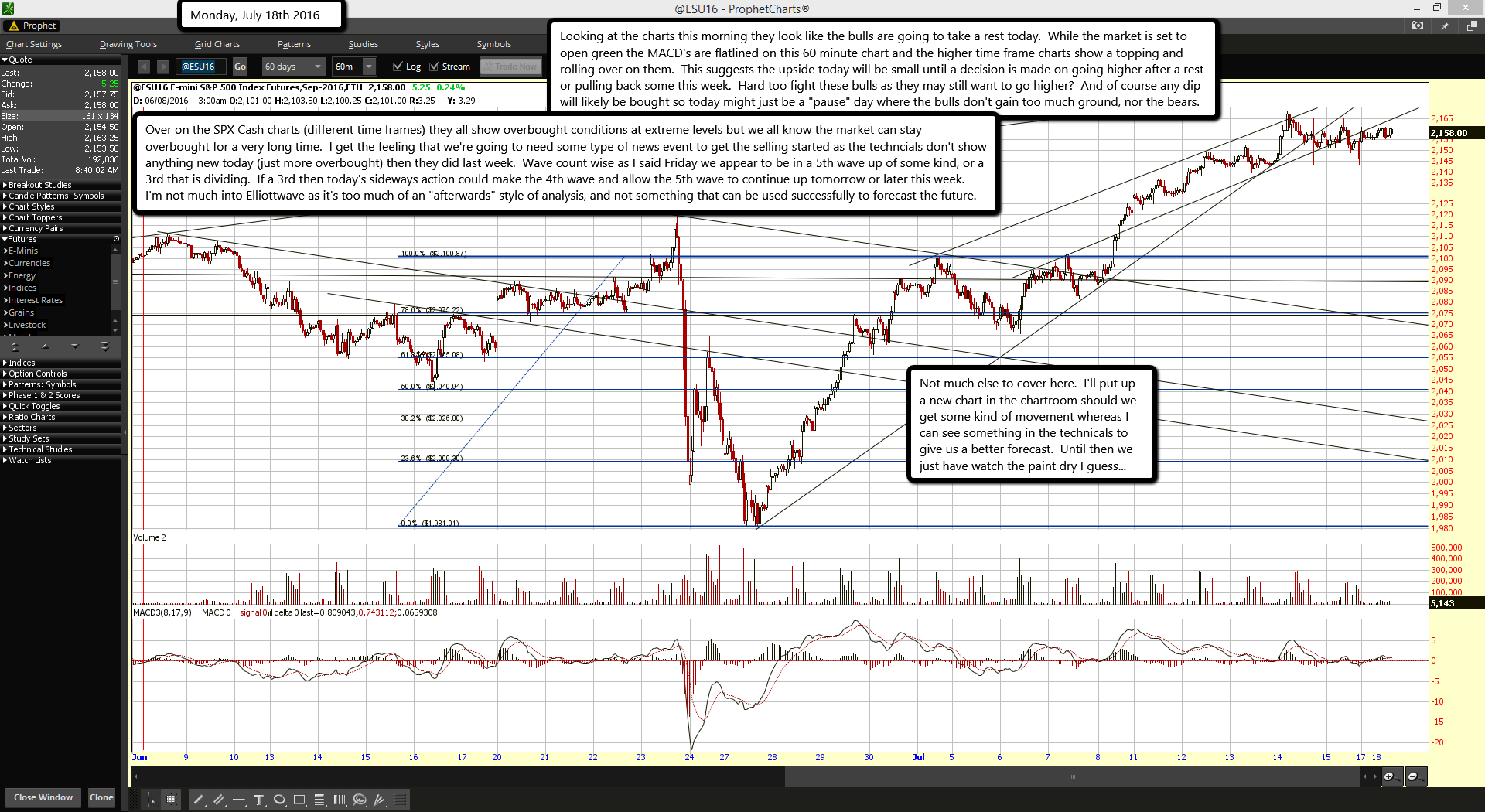
Looking at the charts this morning they look like the bulls are going to take a rest today. While the market is set to open green the MACD's are flatlined on this 60 minute chart and the higher time frame charts show a topping and rolling over on them. This suggests the upside today will be small until a decision is made on going higher after a rest or pulling back some this week. Hard too fight these bulls as they may still want to go higher? And of course any dip will likely be bought so today might just be a "pause" day where the bulls don't gain too much ground, nor the bears.
Over on the SPX Cash charts (different time frames) they all show overbought conditions at extreme levels but we all know the market can stay overbought for a very long time. I get the feeling that we're going to need some type of news event to get the selling started as the techncials don't show anything new today (just more overbought) then they did last week. Wave count wise as I said Friday we appear to be in a 5th wave up of some kind, or a 3rd that is dividing. If a 3rd then today's sideways action could make the 4th wave and allow the 5th wave to continue up tomorrow or later this week. I'm not much into Elliottwave as it's too much of an "afterwards" style of analysis, and not something that can be used successfully to forecast the future.
Not much else to cover here. I'll put up a new chart in the chartroom should we get some kind of movement whereas I can see something in the technicals to give us a better forecast. Until then we just have watch the paint dry I guess...
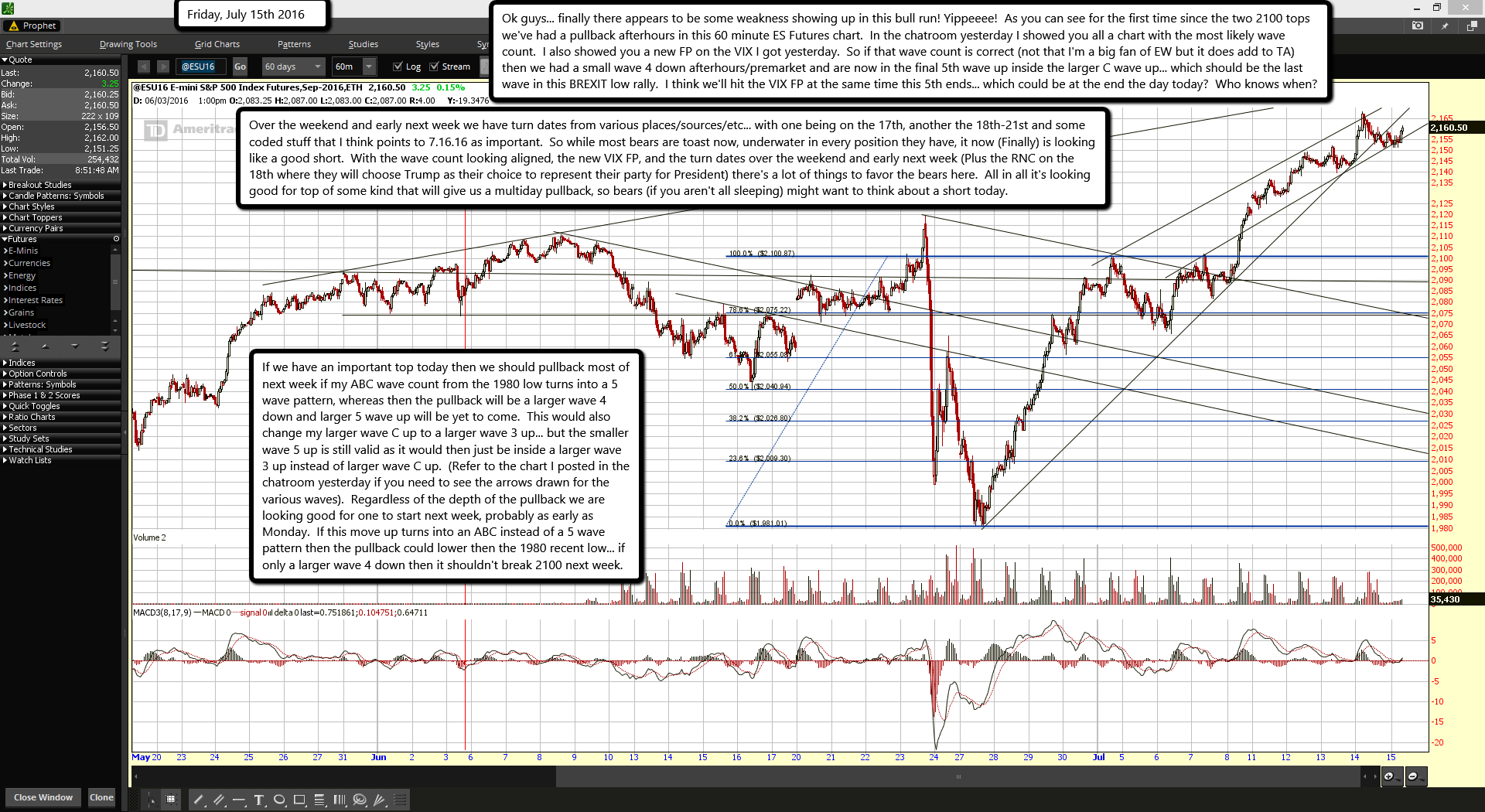
Ok guys... finally there appears to be some weakness showing up in this bull run! Yippeeee! As you can see for the first time since the two 2100 tops we've had a pullback afterhours in this 60 minute ES Futures chart. In the chatroom yesterday I showed you all a chart with the most likely wave count. I also showed you a new FP on the VIX I got yesterday. So if that wave count is correct (not that I'm a big fan of EW but it does add to TA) then we had a small wave 4 down afterhours/premarket and are now in the final 5th wave up inside the larger C wave up... which should be the last wave in this BREXIT low rally. I think we'll hit the VIX FP at the same time this 5th ends... which could be at the end the day today? Who knows when?
Over the weekend and early next week we have turn dates from various places/sources/etc... with one being on the 17th, another the 18th-21st and some coded stuff that I think points to 7.16.16 as important. So while most bears are toast now, underwater in every position they have, it now (Finally) is looking like a good short. With the wave count looking aligned, the new VIX FP, and the turn dates over the weekend and early next week (Plus the RNC on the 18th where they will choose Trump as their choice to represent their party for President) there's a lot of things to favor the bears here. All in all it's looking good for top of some kind that will give us a multiday pullback, so bears (if you aren't all sleeping) might want to think about a short today.
If we have an important top today then we should pullback most of next week if my ABC wave count from the 1980 low turns into a 5 wave pattern, whereas then the pullback will be a larger wave 4 down and larger 5 wave up will be yet to come. This would also change my larger wave C up to a larger wave 3 up... but the smaller wave 5 up is still valid as it would then just be inside a larger wave 3 up instead of larger wave C up. (Refer to the chart I posted in the chatroom yesterday if you need to see the arrows drawn for the various waves). Regardless of the depth of the pullback we are looking good for one to start next week, probably as early as Monday. If this move up turns into an ABC instead of a 5 wave pattern then the pullback could lower then the 1980 recent low... if only a larger wave 4 down then it shouldn't break 2100 next week.









 Michael Dubin will remain CEO of the company.