Thursday, September 24, 2026
Home Blog Page 96

Mortgage rates trending lower — time to stop sitting the fence?

0

Mortgage rates trending lower -- time to stop sitting the fence?

Just a short while ago, it was generally presumed in most financial circles that super-low mortgage rates were a dying breed. There’d been a period of plenty for homebuyers and refinance loan applicants alike, but the general consensus was one of ‘you snooze, you lose’ for want of a better description. After all, it’s hard even for expert analysts to predict interest rate gyrations.

Though this was not the first time pundits warned of this possibility, the fact that the Federal Reserve eventually raised short-term interest rates for the first time in almost a decade cast a pall upon the prospects of potential homebuyers and fence-sitters hoping for low rates. Fears of similar spikes to what happened in 2013 when the Fed began talks of paring its economic stimulus were quite common. However, the opposite has happened, as long-term mortgage interest rates are almost 40 basis points lower from where they were at the start of the year.

As of February 25, 2016, Freddie Mac’s average rate on 30-year fixed-rate mortgages is 3.62 percent, down from 4.01 percent on January 1. That’s a rate that hasn’t been seen in close to a year, and one close enough to all-time record lows. With that in mind, many analysts and economists have revised their forecasts to indicate a more optimistic tenor for mortgage rates.

While HSH.com’s Weekly Mortgage Rates Radar showed a slight increase in 30-year FRMs this week, with rates ticking up five basis points to 3.74 percent, and a bigger (11-basis point) increase for 5/1 hybrid adjustable rate mortgages, HSH vice president Keith Gumbinger believes that a spike in rates is not too likely, and consumers need not panic despite this first weekly increase for calendar 2016.

“While there’s little likelihood of a spike in rates, it’s reasonable to think that there’s potentially more upside than downside for them, especially if the economy continues to chug along,” said Gumbinger in a blog post. “That said, even if they should edge higher, mortgage rates are in a good position to support a positive spring home buying season, provided there are desirable homes to buy at affordable prices.”

Indeed, it looks like the time is right for fence-sitters to start making a move and buying a new home at the current rates. According to Bankrate.com chief financial analyst Gregory McBride, this reduction in interest rates could “create some much-needed breathing room” in families’ household budgets. But considering that nobody can really tell for sure how long rates would stay low, another number-cruncher, Realtor.com chief economist Jonathan Smoke, believes consumers should seize the day as “it’s completely uncertain how long this opportunity (to take advantage of low rates) is going to be there.”

Source link

Mortgage Rates : Right Time to Refinance Your Houses Due to Lowered Mortgage Rates

0

Mortgage Rates – As the New Year we have experienced many good news and the drops in the mortgage rates are one of them. According to a post published in the Washington Post mortgage rates are decreasing day by day and this year especially the following months will be a good time for the house owners to consider refinancing their current houses.

The first decline started in the December, 2015 and this trend still continues for the last three months. Most of the house owners already paid a visit to their banks to discuss the possible opportunities to save money from their current deals.

It is still a mystery whether the rates will continue to drop however we believe that this will be the right time to do what you are planning to do because a quick rise in the rates will make your morale upside down. There are also some citizens who are regretful because they went to their banks to soon right after the decrease in the rates. Which one you will be? Are you going to pay a visit to your bank soon or you will wait a bit more since you believe that the rates will fall more in the following months.

Right Time to Refinance Your Houses Due to Lowered Mortgage Rates

Mortgage rates are falling again

Average long-term U.S. mortgage rates fell last week as anxiety over the global economy persisted. Long-term rates resumed their decline after being unchanged the previous week following six straight weeks of easing.

Mortgage buyer Freddie Mac said Thursday the average rate on a 30-year, fixed-rate mortgage slipped to 3.62 percent from 3.65 percent a week earlier. That puts it well below the 3.80 percent it marked a year ago.

The average rate on 15-year fixed-rate mortgages declined to 2.93 percent from 2.95 percent the previous week.

Mortgage rates have continued to fall despite the Federal Reserve’s decision in December to raise the short-term rate it controls for the first time since 2006.

Mortgage Refinance House

Global economic worries and turbulence in world stock markets have pushed up prices of U.S. government bonds as investors seek safety. That has depressed the yields on the bonds, which mortgage rates follow. The yield on the 10-year Treasury bond has dropped to strikingly low levels below the significant 2-percent mark.

The benchmark yield stood at 1.75 percent Wednesday, down from 1.81 percent a week earlier. The yield fell further to 1.72 percent Thursday morning. That compares with 2.27 percent before the Fed’s rate increase Dec. 16.

Despite the decline in mortgage rates this year, new government data show that Americans stepped back from buying new homes in January, as purchases plunged sharply in Western states where prices are typically higher.

The Commerce Department said Wednesday that new-home sales fell 9.2 ; percent last month to a seasonally adjusted annual rate of 494,000.

To calculate average mortgage rates, Freddie Mac surveys lenders across the country at the beginning of each week. The average doesn’t include extra fees, known as points, which most borrowers must pay to get the lowest rates. One point equals 1 percent of the loan amount.

The average fees for a 30-year mortgage rose to 0.6 point from 0.5 point last week. The fee for a 15-year loan was unchanged at 0.5 point.

Rates on the adjustable five-year mortgage averaged 2.79 percent last week, down from 2.85 percent the previous week. A year ago, the 5-year ARM averaged 2.99 ; ; percent.

With mortgage rates defying all expectations and dropping even lower since the start of the year, this could be a good time for homeowners to consider refinancing, says the Washington Post. Back in December, as the Federal Reserve stood poised to raise interest rates for the first time in years, many sensible homeowners rushed to refinance their properties, locking-in low rates before the expected hike in mortgage rates.

A hike that never came. In fact, those who waited, or just didn’t get themselves organized in time, may now be reaping the rewards, as, contrary to expectations, rates have since dropped to levels approaching their all-time low. According to Freddie Mac, the rate of the average thirty-year fixed mortgage has fallen from 4.01 to 3.62 percent since the beginning of January.

Economists have since adjusted their forecasts for 2016’s rates. Speaking to the Post, Anders Liljehom from Portland said he refinanced his home back in December, just days before the Fed raised rates. At the time, Mr Liljehom was pleased to have “outsmarted” the economy, but mortgage rates are now lower now than when Liljehom refinanced and he said it hurt to know he could have gotten a lower rate if he’d waited:

I could have saved more money if I’d waited […] My interest rate is still quite low, but it does sting a little knowing it could have been lower.

Refinancing your mortgage at a lower rate could save you a lot of money over the years, says a recent San Francisco Chronicle report on refinancing. Refinancing would allow you to divert money saved on interest payments towards other purposes – such as paying for children’s education, carrying out upgrades to increase the value of your home, our investing in more profitable ventures.

However refinancing may not be the best move for absolutely everyone: if you are in the position to pay off your mortgage entirely, this would likely be the best plan of action, as it would allow you to save a large sum of money that you would otherwise pay out in interest on the loan over time.

Although, in the SF Chronicle report, Bernie Katzmann of Vanguard Properties warned that anyone considering this latter option should make sure they have sufficient liquid assets available to cover any unexpected eventualities – such as the need for emergency medical treatment or loss of employment – before deciding to pay off their loan.

Source link

Retirement Planning: 4 Things Baby Boomers Need to Know

0

WwwWith Americans living longer than we used to decades ago, retirement planning has become more important than ever. Fail to plan, save, and invest effectively, and you may find yourself in a precarious financial condition in retirement. This is most important for Baby Boomers, as they're already approaching or living in retirement. Here are four important things they need to know.

Matt Frankel: Baby Boomers are generally thought of as people who were born between 1946 and 1964, so today they would be between about 52 and 70 years old. One common misconception, particularly among younger Baby Boomers, is that Social Security is going "broke." While it's true that Social Security isn't completely sustainable in its current form, I'd like to set the record straight.

Social Security is not bankrupt. The system is simply taking in less money than it's paying out, so the trust funds are being depleted, and the latest projections indicate that the trust funds will be empty in 2034. At this point, the revenue coming in from payroll taxes would still cover about three-fourths of benefits.

Many changes are being proposed to strengthen Social Security, including a handful of potentially negative changes, such as raising the retirement age, cutting benefits for higher-income workers, and decreasing the rate of cost-of-living increases. However, few (if any) politicians want to make any such changes for individuals getting close to retirement.

Finally, history shows that something will likely be done to shore up Social Security before the situation gets much worse. What exactly it will be is anyone's guess at this point, but if you're in the 52-to-70 age group, you should not be worried too much about your future Social Security benefits.

Images

Many retirees will live very long lives -- requiring a substantial nest egg. Photo: Iain Farrell, Flickr.

Dan Caplinger: One thing that many retirees fail to understand is just how long they might live after they retire. A common mistake is to look at life expectancies as of birth, and project them forward. For instance, overall life expectancies have slowly risen from about 70 years half a century ago to 78 years currently, and so many retirees believe that they should plan only to live that long.

The problem with that method is that it ignores the fact that life expectancies at birth account for things that can happen to you before you reach retirement age. In other words, because you've already survived many of the things that can lead to a premature death, your life expectancy at 65 is longer than than the expectancy you would calculate using figures based on birth.

For instance, the tables that the IRS uses to calculate life expectancy at retirement age estimate that those who are 65 can expect to live for 21 years beyond their current age. Those who are 70 have a life expectancy of 17 years.

In planning your investments, it's important to account for the need for growth to stretch your assets as far as they can go. Otherwise, you could end up running out of money when you most need it.

Business Idea

Image: Pixabay

Jason Hall: If you're a Boomer who's set to retire in the next few years, one of the most important things you need to really know is how to live on the expected level of income you'll draw in retirement.

According to the Social Security Administration, the average man recently received $1,488 per month in retirement benefits in 2014, and the average woman received $1,167 per month. And according to Vanguard, one of the largest retirement account managers in the U.S., the median 401(k) balance of the accounts it manages for those 55 and over is less than $77,000. That's good for about $3,100 per year in sustainable income. While these two numbers don't include all of the potential sources of retirement income you may have, you need to understand how much income you'll actually be able to count on in retirement.

But that's just the first step. Once you've established how much income you can count on, you need to start forming the right spending habits before you retire, or you could end up in trouble. If your income will drop significantly in retirement, it's probably a good idea to go ahead and start living on your retirement budget well in advance of actually retiring. Not only will this help you adjust to the level of spending you'll need to become accustomed to, but it will also be one less major change in your life you have to figure out when you actually retire.

Man

It's rarely too late to make your retirement more successful. Image: Pixabay.

Selena Maranjian: If you're not where you should be with your savings for retirement, know that you're not alone. According to a recent survey by BlackRock, the average retirement nest egg for Boomers aged 55 to 65 was just $136,200. If that doesn't seem so bad, imagine withdrawing 4% of it, as many advisors suggest, as your income in your first year of retirement: You'll collect just $5,448.

So what can you do? Well, even if you're only a decade away from retirement, you can make a big difference by getting very serious about saving and investing for tomorrow. The table below shows how much you can accumulate by regularly saving certain amounts. I'll assume that you start with that average nest egg of $136,200:

Starting with an initial stake of $136,200:

Invested Annually Over 10 Years Growing at 8% Growing at 10% Growing at 12%
$5,000 $372,273 $440,924 $521,289
$10,000 $450,501 $528,579 $619,562
$15,000 $528,728 $616,235 $717,835
$20,000 $606,955 $703,891 $816,108

What if you're below average, without that $136,200? Well, you can still accumulate a heck of a lot, by being aggressive. Check it out:

Starting with $0:

Invested Annually Over 10 Years Growing at 8% Growing at 10% Growing at 12%
$5,000 $78,227 $87,656 $98,273
$10,000 $156,455 $175,312 $196,546
$15,000 $234,682 $262,968 $294,819
$20,000 $312,910 $350,623 $393,092

Enjoy looking at the 12% growth columns, because you could earn that kind of return. But the stock market's long-term average is closer to 10%, and many 10-year periods will feature much slower growth. The more you can sock away, though, the more you'll be able to accumulate. It can be well worth working an extra year or two, even, to plump up your savings further. If you just get to $300,000, drawing 4% will amount to $12,000, or $1,000 per month, a rather useful sum.

Don't leave your retirement to chance or to wishful thinking. Read up, learn more, and develop a good plan.

The $15,978 Social Security bonus most retirees completely overlook
If you're like most Americans, you're a few years (or more) behind on your retirement savings. But a handful of little-known "Social Security secrets" could help ensure a boost in your retirement income. In fact, one MarketWatch reporter argues that if more Americans knew about this, the government would have to shell out an extra $10 billion annually. For example: one easy, 17-minute trick could pay you as much as $15,978 more... each year! Once you learn how to take advantage of all these loopholes, we think you could retire confidently with the peace of mind we're all after. Simply click here to discover how you can take advantage of these strategies.

Source link

Experts Weight In as Mortgage Rates Keep Going Down

0

Experts Weight In as Mortgage Rates Plummet to Surprise Lows

Just a short while ago, it was generally presumed in most financial circles that super-low mortgage rates were a dying breed. There’d been a period of plenty for homebuyers and refinance loan applicants alike, but the general consensus was one of ‘you snooze, you lose’ for want of a better description. After all, it’s hard even for expert analysts to predict interest rate gyrations.

Though this was not the first time pundits warned of this possibility, the fact that the Federal Reserve eventually raised short-term interest rates for the first time in almost a decade cast a pall upon the prospects of potential homebuyers and fence-sitters hoping for low rates. However, the opposite has happened, as long-term mortgage interest rates are almost 40 basis points lower from where they were at the start of the year.

As of February 25, 2016, Freddie Mac’s average rate on 30-year fixed-rate mortgages is 3.62 percent, down from 4.01 percent on January 1. That’s a rate that hasn’t been seen in close to a year, and one close enough to all-time record lows. With that in mind, many analysts and economists have revised their forecasts to indicate a more optimistic tenor for mortgage rates.

While HSH.com’s Weekly Mortgage Rates Radar showed a slight increase in 30-year FRMs this week, with rates ticking up five basis points to 3.74 percent, and a bigger (11-basis point) increase for 5/1 hybrid adjustable rate mortgages, HSH vice president Keith Gumbinger believes that a spike in rates is not too likely, and consumers need not panic despite this first weekly increase for calendar 2016.

“While there’s little likelihood of a spike in rates, it’s reasonable to think that there’s potentially more upside than downside for them, especially if the economy continues to chug along,” said Gumbinger in a blog post. “That said, even if they should edge higher, mortgage rates are in a good position to support a positive spring home buying season, provided there are desirable homes to buy at affordable prices.”

Indeed, it looks like the time is right for fence-sitters to start making a move and buying a new home at the current rates. According to Bankrate.com chief financial analyst Gregory McBride, this reduction in interest rates could “create some much-needed breathing room” in families’ household budgets. But considering that nobody can really tell for sure how long rates would stay low, another number-cruncher, Realtor.com chief economist Jonathan Smoke, believes consumers should seize the day as “it’s completely uncertain how long this opportunity (to take advantage of low rates) is going to be there.”

Source link

America’s Nuclear Shield: Time to Modernize?

0
The Navy is planning to replace its aging Ohio-class ballistic nuclear missile submarines, one element of America's nuclear triad that includes strategic bombers and intercontinental ballistic missiles. (US Navy photo)

The Navy is planning to replace its aging Ohio-class ballistic nuclear missile submarines, one element of America's nuclear triad that includes strategic bombers and intercontinental ballistic missiles.

VANDENBERG AIR FORCE BASE, Calif. -- In describing how little room the Pentagon has to extend the life of its decades-old nuclear forces, the top US nuclear war-fighting commander, Navy Adm. Cecil Haney, says "we're at the brick wall stage."

Time to begin modernizing the country's nuclear weapons is running short, he and other Pentagon leaders say. They contend the force is still in fighting shape -- "safe, reliable and effective" is the official mantra. But they also argue the time has come to begin modernizing the force or risk eroding its credibility as a deterrent to attack by others.

They don't face brick wall-like resistance in Congress, but the debate over spending hundreds of billions of dollars to build and field a new generation of nuclear-capable bombers, submarines and land-based missiles is just beginning.

Critics say full-scale modernization is neither affordable nor necessary.

The debate is influenced not only by the perceived need to fully replace aging weapons but also by worries about North Korea's nuclear ambitions and concern over what Defense Secretary Ash Carter calls Russia's "nuclear sabre-rattling."

Robert Work, the deputy secretary of defense, said the Pentagon will need an estimated $18 billion a year between 2021 and 2035 to modernize the three "legs" of the US nuclear triad -- weapons capable of being launched from land, sea and air.

"We need to replace these," Work said. "We can't delay this anymore."

The enormous sums needed are at risk of getting squeezed by high-priority requirements for non-nuclear, conventional weapons. And Work's numbers don't include the billions that would be needed to modernize the nuclear warheads on the business end of missiles and bombs.

"Modernization now is not an option" -- it must happen, Haney, the commander of US Strategic Command, said in an interview on Friday, just hours after watching a test launch of an unarmed Minuteman 3 intercontinental ballistic missile, or ICBM. The Minuteman, which has been on constant 24-hour alert since 1970, has long surpassed its 10-year life expectancy.

Haney said the US stockpile of nuclear warheads is the oldest it has ever been. As head of Strategic Command he is the military's top nuclear war-fighter.

"We have to realize we can't extend things forever," Haney said, noting that the Navy is planning to replace its aging Ohio-class ballistic nuclear missile submarines, while the Air Force intends to build a new nuclear-capable bomber to replace the B-52.

Work said that although the Pentagon is closely monitoring Russia's nuclear modernization, which includes development of new versions of its ICBMs, those moves are not driving US decisions about how quickly and broadly it should modernize its nuclear forces.

Some private analysts, however, see the US and Russia entering a new arms competition.

"It's disturbing how quickly both the United States and Russia are sliding back toward the Cold War, both rhetorically and operationally," said Stephen Schwartz, an independent nuclear policy analyst and author.

"Worse still, both the United States and Russia are now using each other's nuclear programs and military activities to justify and rationalize their own," he added.

Haney and Work both were present Thursday night for the Minuteman 3 test launch, which was the second such test of the year. Work said Friday that the test was successful, with the missile's payload landing within a targeted area of water near Kwajalein Atoll in the south Pacific. He said it was the eighth consecutive successful Minuteman test launch, which would mean the last unsuccessful test was in December 2013, according to a chronology provided by the Air Force.

Source link

Sharp liabilities list covered worst-case scenarios

0

A logo of Sharp Corp is seen above Chinese tourists standing outside an electronics retail store in Tokyo, Japan, February 26, 2016.  REUTERS/Yuya Shino A logo of Sharp Corp is seen above Chinese tourists standing outside an electronics retail store in Tokyo.

Sharp Corp's list of liabilities that prompted Taiwan's Foxconn to suspend signing a takeover deal was an unverified study of worst-case scenario risks, rather than liabilities requiring disclosure, a source briefed on the matter said.

The list, sent to Foxconn on Wednesday, included previously undisclosed potential liabilities worth around 300 billion yen ($2.6 billion), prompting Foxconn founder and billionaire Terry Gou to hold off signing the estimated $5.8 billion deal, separate sources have said.

Reuters was unable to ascertain why the list was sent to Foxconn, formally known as Hon Hai Precision Industry Co. Top Sharp officials had not examined the list and had not planned to share it with Foxconn, the source told Reuters on Saturday, declining to be identified because of the sensitivity of the matter.

The items included unlikely events or risks, and the amount was far higher than contingent liabilities that require disclosure, the source added, without elaborating.

Sharp declined to comment. It said in a statement on Friday that it has been properly disclosing its contingent liabilities, which stood at around 80 billion yen as of end-2015.

Foxconn agreed with Sharp late on Friday to extend a deadline for the takeover talks by one or two weeks beyond Monday's planned expiry, another source said.

If Sharp and Foxconn overcome the latest hitch and sign a deal, it would be the largest acquisition by a foreign company in Japan's insular technology sector.

Source link

Tennessee I-75 closure could last for weeks

0

PIONEER, Tenn. — A rock slide Friday on Interstate 75 near here could keep the major north-south artery closed in both directions for weeks, forcing a 33-mile detour, state highway officials said.

While the slide at mile marker 141.5 about 35 miles north of Knoxville primarily affected northbound lanes, Tennessee Department of Transportation officials closed the road in both directions because debris traveled into the median and they need to evaluate the stability of the slope, spokesman Mark Nagi said.

“We won’t allow a roadway to be open to the public if we feel it presents a danger to the motoring public, and right now that roadway is not safe for travel," Nagi said Saturday.

Officials will spend the weekend evaluating the hillside that gave way, he said. No injuries or rocks hitting cars were reported in the 3:45 p.m. ET Friday call to Campbell County officials.

Almost 1.5 inches of rain fell in the area four days before the slide followed by a half-inch the next day, according to Weather Underground records. And rain, close to an inch Tuesday and more than an inch Wednesday, is forecast in the coming week.

Northbound traffic is being shifted to U.S. 25W at the Caryville exit, mile marker 134, and returns to I-75 at Jellico, mile marker 160, Nagi said.

Southbound traffic will have less of a detour, about 25 miles. Vehicles must leave the interstate at the Jellico exit and use U.S. 25W to Tennessee 297 to Tennessee 63. Vehicles return to I-75 at Pioneer Exit 141, the Campbell County Sheriff's Office said.

Trucks with wide or heavy loads are being advised to detour almost 150 miles: Northbound, they should leave I-75 in Knoxville, head east on I-40 and I-81, then take U.S. 25E at the Morristown exit and rejoin I-75 in Corbin, Ky. Southbound heavy-truck traffic reverses the route.

Source link

Foxconn Acquisition Of Sharp Hits A Snag: Is The $6.2 Billion Deal In Jeopardy?

0
Foxconn

Foxconn and Sharp have agreed to extend the deadline to complete the acquisition talks by up to two weeks due to new information being revealed regarding the latter. Is the deal pushing through, or is it in danger of being cancelled?

Foxconn, an Apple supplier, was reported to have agreed to acquire struggling Sharp for a price of $6.2 billion. While Foxconn was previously only interested in acquiring Sharp's liquid panel display business, a recent report revealed that the purchase would rather be for the whole company.

There were reservations in the deal before Sharp agreed to Foxconn's offer, as the Japanese government hoped to keep the company's technology within the country, and so preferred for Sharp to agree to be purchased by a Japanese entity.

It would seem that these concerns were set aside in the agreement between Foxconn and Sharp. However, new details have emerged that somehow further complicate the matters concerning the acquisition.

The two companies are said to have agreed to extend the deadline for discussions regarding the purchase, as "new material information" has arisen.

The extension will be for an additional one to two weeks, as Foxconn will take time to review the information that was not revealed to the company during the negotiations for the acquisition.

The undisclosed detail is said to be liabilities of Sharp amounting to 300 billion yen, which is equivalent to $2.7 billion. The amount is almost twice that of the 160 billion yen capital of Sharp and much higher compared to the liabilities of only 100 billion yen that Foxconn thought Sharp had when it conducted its due diligence for the deal.

Sharp said in a statement that the company has disclosed its liabilities to Foxconn. Nevertheless, the deal could be in jeopardy as Foxconn did not expect the liabilities at such a level for Sharp. In fact, creditor banks of the company also said that they did not know that Sharp had such liabilities.

A cancellation of the deal would further tarnish the history between the two companies, as back in 2012, Foxconn already agreed to acquire a stake in Sharp before deciding not push through with its plan.

However, if Foxconn is able to work around the situation and continue to acquire Sharp, it would become a more valuable Apple supplier as it could use Sharp's assets to mass produce OLED displays by 2018, which fits the timeline for Apple to adopt the displays to be used in its iPhones. As such, Foxconn would move up from only assembling Apple products to manufacturing parts for Apple, allowing Apple to lessen its reliance on rival Samsung for certain components.

Source link

Mortgage rates suddenly plunge, shocking industry experts

0

Mortgage rates suddenly plunge, shocking industry expertsThe industry had expected an increase due to the Fed's boost of the baseline rate, but that hasn't happened.

Mortgage rates have plunged to start 2016, a surprising twist that could be a big boon to buyers.

The drop could lead to a rush on houses this spring with borrowing costs so low. Rates on a 30-year fixed rate mortgage dipped to 3.62 percent, close to a record and below the 4.01 percent rate in December, according to a Tribune-Review report.

The numbers are based on a weekly survey by mortgage lender Freddie Mac.

It’s a big surprise for industry experts who thought mortgage costs would start rising after the Federal Reserve boosted its baseline interest rate at the end of last year. However, that hasn’t been the case so far in 2016.

Experts think that the ups and downs of the stock market in 2016 might be keeping rates down.

With lower rates in place, buyers are able to buy more expensive homes, and renters could accelerate plans to buy a home for the first time, leading to a stronger housing market.

These realities certainly have manifested themselves in terms of available housing as people snap up homes on the market. Housing inventory at the end of January saw a decline at 2.2 percent lower compared to the same time last year. The amount of homes on the market might not be enough to keep up with the demand.

“Yields on the 10-year Treasury continued their downward trend this week after a small rally the previous two weeks,” said Sean Becketti, Freddie Mac chief economist, in a statement. “The 30-year mortgage responded, falling 3 basis points to 3.62 percent. Since the beginning of 2016, 30-year rates have fallen almost 40 basis points helping housing markets sustain their momentum into this year. Earlier this week, the National Association of Realtors announced existing home-sales were up 4 percent month-over-month in January and up 11 percent from last year.”

Source link

Air Force Secretary Unveils B-21 Bomber

0
The US Air Force's new B-21 bomber will be similar in appearance to the B-2 Stealth Bomber (pictured over St. Louis), which has been in service since 1997. (Air Force photo/Justin Pyle)

The US Air Force's new B-21 bomber will be similar in appearance to the B-2 Stealth Bomber (pictured over St. Louis), which has been in service since 1997.

The Air Force has revealed an artist's rendition of the B-21, a highly secretive, next-generation stealth bomber to replace an aging fleet of older planes flying missions around the world.

Secretary of the Air Force Deborah Lee James unveiled the illustration -- which bears a strong resemblance to the B-2 Spirit stealth bomber -- for the first time on Feb. 26 at an Air Force Association convention in Orlando, Fla.

"We have an image, we have a designation, but here's what we don't have," she told the audience. "We don't yet have a name."

James called on airmen and others to suggest names for the stealthy aircraft under development -- until now known simply as the Long Range Strike-Bomber, or LRS-B.

"The main reason for releasing this picture is to make the program real for legislators who up to now have seen it as kind of an abstraction or concept rather than a concrete item," said Loren B. Thompson, a senior defense analyst with the Virginia-based Lexington Institute and a defense industry consultant.

The Air Force could buy between 80 to 100 of the Northrop Grumman bombers. Costs are not finalized but the program could reach up to $80 billion by one estimate when research and development and procurement are factored in.

Designated as the first "21st-century bomber," the B-21 eventually would replace the workhorse B-52 Stratofortress, first flown in the 1950s, and the swing-wing B-1 Lancer, launched in the 1980s. The new bomber jet would join the fleet in the mid-2020s.

Congressional legislators will scrutinize the secretive bomber because the Air Force cannot afford all the new weapons programs targeted in future years, Thompson said.

"The Air Force is trying to bolster the case for its new bomber in a Washington political culture that is suspicious of anything secret," he said. "Sen. John McCain's statement this week that he would oppose open-ended funding of the bomber's development underscores the political challenge the Air Force faces."

McCain, R-Ariz., is chairman of the Senate Armed Services Committee.

The new design corrects issues with the B-2 that rendered it more detectable in some situations, Thompson added.

"The only thing an adversary can learn from looking at this picture (of the B-21) is that most of their existing radars are going to be useless in being able to detect it," he said.

The B-21 design was chosen over a rival Boeing and Lockheed Martin team to build the next generation jet. Boeing filed a protest with the Government Accountability Office last year over losing the contract, but the GAO this month upheld the Air Force selection of Northrop Grumman.

The Air Force also bypassed the Fighters and Bombers Directorate headquartered at Wright-Patterson and gave oversight of the secretive plane's research and development to the Rapid Capabilities Office in Washington, D.C.

The new stealth bomber would be built to fly from the continental United States and penetrate increasingly sophisticated air defenses of potential adversaries, Air Force officials have said.

Source link

Zenefits Is Laying Off Roughly 250 Employees

0


Zenefits is laying off around 17 percent of its employees, or 250 people, with the layoffs largely concentrated in the company’s sales division, according to an email sent to the company by CEO David Sacks.

“When I became CEO of Zenefits, I promised on Day 1 to reset our culture, refocus our strategy on serving small businesses, and create a new beginning for success in the future,” Sacks wrote. “Today I have to make a very difficult set of decisions about how we do that. In fact, this is the most difficult decision I’ve had to make in my career, but it is necessary for Zenefits to move forward successfully.”

This follows regulatory concerns pertaining to the company — specifically pertaining to an internal program dubbed “the Macro” that allowed employees to pad the hours they said they committed for pre-certification in California, which led to an investigation by the state.

Zenefits as a company has run into regulatory issues across multiple markets as a result of all this. The company allowed unlicensed brokers to sell health insurance, according to a BuzzFeed report. BuzzFeed most-recently reported that 80 percent of the company’s deals in the state of Washington were done by unlicensed brokers.

Compliance issues also led to the company’s CEO, Parker Conrad, leaving both the company and the board of directors. That led Sacks, the former CEO of Yammer — which sold to Microsoft for $1.2 billion — to take over the company and promptly begin clearing house. Zenefits quickly grew to a $4.5 billion valuation over the course of just a few years.

“During my years in Silicon Valley, I’ve seen a number of attempted tech turn-arounds. Frankly, they don’t have a very good track record,” Sacks wrote in the email. “But that’s because those companies had become obsolete technologies; they had lost their product-market fit. That is not Zenefits. Zenefits has made mistakes but it never lost its product-market fit.”

Zenefits gives small- and medium-sized businesses human resource management tools that are supposed to work in a simpler fashion than existing tools. They also began offering payroll services recently, breaching into territory to which other startups like Gusto have been trying to bring a similar model. The company offers its software for free and makes money by receiving commissions.

Sacks explained in the memo that part of the reasoning behind the layoffs was Zenefits’ growth, which was “too fast, stretching both our culture and our controls.” That’s not too surprising for fast-growing startups, though at times it did seem out of control — like having to tell its employees not to have sex in stairwells, according to a report by The Wall Street Journal.

“This reduction enables us to refocus our strategy, rebuild in line with our new company values, and grow in a controlled way that will be strategic for our business and beneficial for our customers,” Sacks wrote.

Source link

ES Morning Update February 29th 2016

0

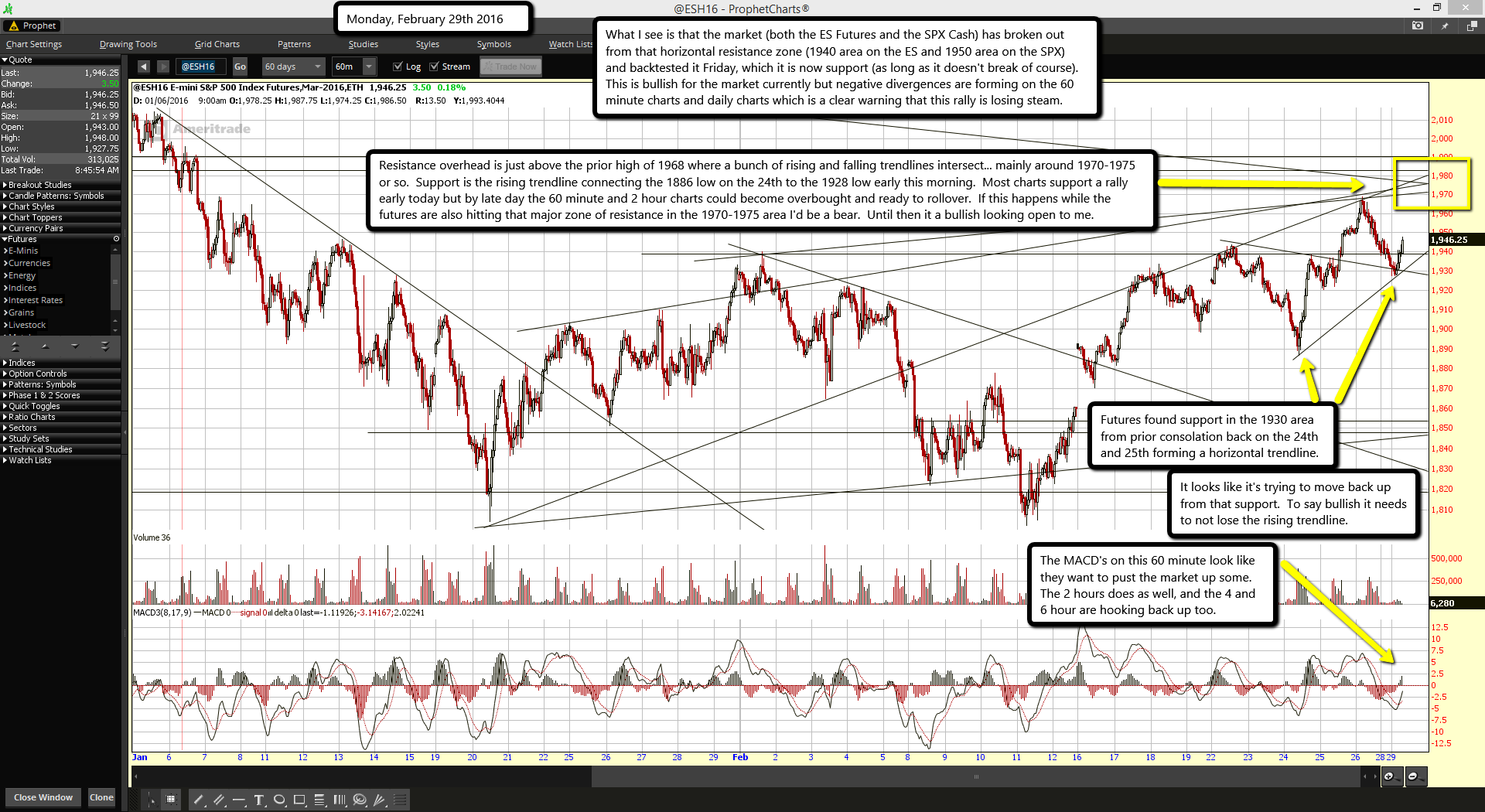
14158118-1814-4373-a4b4-4f027111e458Futures found support in the 1930 area from prior consolation back on the 24th and 25th forming a horizontal trendline.

It looks like it's trying to move back up from that support.  To say bullish it needs to not lose the rising trendline.

The MACD's on this 60 minute look like they want to pust the market up some.  The 2 hours does as well, and the 4 and 6 hour are hooking back up too.

What I see is that the market (both the ES Futures and the SPX Cash) has broken out from that horizontal resistance zone (1940 area on the ES and 1950 area on the SPX) and backtested it Friday, which it is now support (as long as it doesn't break of course).  This is bullish for the market currently but negative divergences are forming on the 60 minute charts and daily charts which is a clear warning that this rally is losing steam.

Resistance overhead is just above the prior high of 1968 where a bunch of rising and falling trendlines intersect... mainly around 1970-1975 or so.  Support is the rising trendline connecting the 1886 low on the 24th to the 1928 low early this morning.  Most charts support a rally early today but by late day the 60 minute and 2 hour charts could become overbought and ready to rollover.  If this happens while the futures are also hitting that major zone of resistance in the 1970-1975 area I'd be a bear.  Until then it a bullish looking open to me.

Freddie Mac (2/25/16) – Rates on all popular mortgages down

0

Freddie Mac (2/25/16) - Rates on all popular mortgages down

Mortgage interest rates for long-term and adjustable-rate products were down on the most recent Freddie Mac survey released Thursday, continuing the downward trend manifested for most of calendar year 2016. Experts attributed this to easing global concerns, as well as encouraging home sales statistics from January 2016.

30-year fixed rate mortgages, which were at 3.65 percent last week, dropped slightly, easing by three basis points to 3.62 percent for the week ended February 25, 2016. One year ago, 30-year FRMs averaged 3.80 percent, or 18 hundredths of a percentage point higher. 15-year FRMs were at 2.93 percent this week, a slight two-basis point downtick from last week’s 2.95 percent, and 14 basis points lower than the year-ago figure of 3.07 percent. Last week, long-term mortgage interest rates didn’t move, following six consecutive weeks of declines.

5-year Treasury-indexed hybrid adjustable-rate mortgages took the biggest fall this week, while remaining relatively flat. Rates for 5-year ARMs edged down from 2.85 percent to 2.79 percent. Last year, 5-year ARMs averaged 2.99 percent.

In his weekly statement, Freddie Mac Chief Economist Sean Becketti attributed this week’s declines to recent figures released by the National Association of Realtors, which showed existing home sales improving considerably last month.

“Yields on the 10-year Treasury continued their downward trend this week after a small rally the previous two weeks. The 30-year mortgage responded, falling 3 basis points to 3.62 percent,” said Becketti. “Since the beginning of 2016, 30-year rates have fallen almost 40 basis points helping housing markets sustain their momentum into this year. Earlier this week, the National Association of Realtors announced existing home-sales were up 4 percent month-over-month in January and up 11 percent from last year.”

Source link

IRS taxpayer data theft seven times larger than originally thought

0

NEW YORK — For the second time, the IRS has revised the estimated damage of a criminal syndicate’s massive theft of American taxpayer data.

In May 2015, the government agency said criminals used a tool on the IRS website to steal the tax forms of 104,000 people. Then in August, it revised that number up to 330,000.

On Friday, the tax-collection agency revealed that number is now closer to 720,000.

The latest number is the result of a nine month investigation by the U.S. Treasury Inspector General for Tax Administration.

Investigators found that “390,000 additional taxpayer accounts” were affected. Fraudsters tried to target an additional 295,000 taxpayer transcripts than previously thought, but “access was not successful,” the IRS said.

“We appreciate the work of the Treasury Inspector General for Tax Administration to identify these additional taxpayers whose accounts may have been accessed. We are moving quickly to help these taxpayers,” IRS Commissioner John Koskinen said in a statement.

Starting next week, the IRS will send letters to those taxpayers to warn them about potential identity theft, offer free credit protection and give them an extra PIN to protect future tax filings.

Until the spring of last year, the IRS website provided a tool called “Get Transcript.” It was meant to help taxpayers who lose track of old tax documents. They could easily download several years of tax forms for tasks like applying for a mortgage or college financial aid.

It was a popular tool. Americans used it to download 23 million transcripts in the first few months of 2015, the agency said.

To keep out fraudsters, the “Get Transcript” tool asked for lots of personal information before granting access: Social Security numbers, birthdays, physical addresses and more.

An unidentified cybermafia used previously acquired stolen information to dupe the “Get Transcript” tool and downloaded millions of tax documents related to the 720,000 people whose tax forms had been stolen.

Tax forms contain much more sensitive information, including salary, family information, and property and investment values. With this additional stolen information, criminals can claim bogus tax refunds — or open fraudulent credit lines.

The cybermafia members posed as legitimate taxpayers and tried to download forms between January 2014 and May 2015, the IRS said. That means the fraud stretched back more than year earlier than previously thought.

The IRS disabled the online document tool last year to prevent further fraud.

This incident is a curious one. It wasn’t a hack — or even a data breach. These fraudsters didn’t manage to break into IRS computers at all. They just turned a useful IRS feature into a leaky faucet — by answering all the verification questions correctly.

This data leak shows how difficult it is nowadays to verify true identities.

That’s one reason the IRS has started an experimental program in which it gives select taxpayers a six-digit PIN. It’s an additional layer of protection, like a passcode.

PINs are currently only available to tax fraud victims and residents of Florida, Georgia and Washington. The agency wants to take this pilot program nationwide.

The IRS is extending this PIN to the 720,000 people whose tax documents were exposed in this incident. However, it’s not offering that protection to the other 575,000 people — even though they arguably need it too (given that criminals already have their Social Security numbers and can already claim tax refunds in their names).

IRS law enforcement agents are hunting for the fraudsters who did this.

Source link

IRS to warn 685000 tax filers of ID theft

0

More and more, it looks like the IRS "Get Transcript" online service played a part in a "Get Cash" now strategy for ID crooks. Beginning Monday, another 685,000 tax filers nationwide will get the word of potential problems with ID theft.

"Get Transcript" is designed to be an easy online system for tax filers to obtain tax returns from previous years. Information from those records can be helpful in the process of completing current returns. Taxpayers can use transcripts for verifying income when applying for a mortgage or a student loan, too.

But the crooks can use this data on "Get Transcript" to craft even more realistic fake tax returns to cook up generous tax refunds for themselves. Tax refund fraud is a major concern in the tax industry and tops the IRS list of its "Dirty Dozen" tax season scams.

New mailings from the IRS to tax filers who are caught in this latest ID theft hacking mess will begin Feb. 29.

We first heard reports on this issue last May. But on Friday, the Internal Revenue Service stated that a further review found that 390,000 additional taxpayer accounts from January 2014 through May 2015 were potentially accessed by ID thieves. On top of that, another 295,000 taxpayer transcripts were targeted but the con artists didn't get the transcripts or tax records.

The numbers just keep getting bigger. Last May, the IRS said it was sending letters to more than 200,000 taxpayers to notify them that hackers made attempts to access certain IRS accounts with the "Get Transcript" program. To do that, the hackers reportedly already had their hands on some Social Security numbers and other data that was obtained earlier from a non-IRS source and then the crooks tried to use that information to get more key data via "Get Transcript."

In May 2015, the IRS said hackers gained access to about 114,000 taxpayer accounts and another 111,000 had transcripts that were targeted but not accessed.

In August 2015, the IRS announced it had identified another 220,000 accounts that were accessed via "Get Transcript" and another 170,000 failed attempts.

Add up the numbers, which the IRS did not in its news release, and we're looking at 1.3 million tax filers on edge here for potential ID theft. In that group, it looks like 724,000 tax filers saw their "Get Transcript" accounts accessed by fraudsters at some point from January 2014 through May 2015.

The Treasury Inspector General for Tax Administration or TIGTA, spent nine months investigating the "Get Transcript" fiasco and went back to January 2014 to look for additional suspicious activity. The criminals already had some sensitive ID information obtained elsewhere, the IRS said, before attempts were made on the "Get Transcript" accounts.

The IRS is notifying consumers who were hit or had attempts made on their "Get Transcript" accounts. Tax filers who were victims in this hacking case will receive free identity protection services and special PINs to file their tax returns.

The "Get Transcript" application has been offline since May 2015 and continues to be offline.

IRS Commissioner John Koskinen said in a statement that the IRS will move quickly to help these taxpayers who were identified as part of the work done by TIGTA.

The IRS is notifying by mail those taxpayers whose transcripts were accessed, as well as those involved with failed attempts to access accounts.

Criminals may have some information on the taxpayers and taxpayers would be wise to obtain a free annual credit report at www.annualcreditreport.com to spot any other activity.

Taxpayers whose transcripts were accessed can request an Identity Protect PIN by completing Form 14039, the Identity Theft Affidavit.

An IP PIN provides an additional layer of protection for the taxpayer's Social Security Number on the federal tax return.

State governments also will receive some information about the incident to prevent some refund fraud on the state level.

Source link

Air Force reveals B-21 Long Range Strike Bomber concept

0

Air Force reveals B-21 Long Range Strike Bomber concept

The U.S. Air Force revealed on Friday the first concept image of the B-21 Long Range Strike Bomber, showing off the artist rendering at the Air Force Association’s Air Warfare Symposium in Orlando.

The B-21 Long Range Strike Bomber will be manufactured by Northrop Grumman, and may be based mainly on the concept rendering, as there aren’t any prototypes to work with at the present. The upcoming aircraft, which was previously known internally as the Long Range Strike Bomber, or LRS-B, is the U.S. military’s first bomber of the 21st century.

“This aircraft represents the future for our Airmen, and (their) voice is important to this process,” said Air Force Secretary Deborah Lee James in a statement hyping the B-21 and encouraging Airmen to help give the aircraft an official name. “The Airman who submits the selected name will help me announce it at the (Air Force Association) conference this fall.”

An Air Force press release further underscores the importance of the B-21 Long Range Strike Bomber, which highlights the Air Force’s focus on modernization.

“The platforms and systems that made us great over the last 50 years will not make us great over the next 50,” said Air Force Chief of Staff Mark Welsh at the military branch’s 2017 posture statement earlier this month. “There are many other systems we need to either upgrade or recapitalize to ensure viability against current and emerging threats… the only way to do that is to divest old capability to build the new.”

In the Air Force press release, James explained that the B-21 will allow the Air Force to launch air strikes on any global location. The B-21, according to James, closely resembles the current B-2 stealth bomber, another aircraft manufactured by Northrop Grumman, but was designed from the ground up “based on a set of requirements that allows the use of existing and mature technology.”

Source link

Cyber hack breached more than 700000 IRS accounts

0

A 2015 cyber hack of the IRS potentially gained access to personal data from more than 700,000 taxpayer accounts, more than double the total previously estimated, the tax agency said Friday.

The information potentially stolen includes Social Security numbers, birth dates and other data that cyber thieves could use to impersonate a real taxpayer, file a false federal tax return and collect a refund.

The unidentified electronic attackers got in, giving the IRS an embarrassing black eye, by taking taxpayer information they acquired elsewhere and using it to correctly answer personal identity-verification questions in the "Get Transcript" application on the agency's website.

The function, disabled after the IRS discovered the breach last May, enabled legitimate taxpayers to view their tax account transactions or line-by-line tax return information for a specific tax year.

The IRS initially said approximately 100,000 taxpayer accounts had been compromised, then raised the total to as many as 334,000 in August. Friday's estimate added an additional 390,000 accounts, boosting the estimated total to more than 700,000.

The cyber thieves unsuccessfully tried to gain access to more than 500,000 other taxpayer accounts, the IRS said. That total is also far higher than previously estimated.

The heightened threat to U.S. taxpayers was documented in a nine-month review conducted by the Treasury Inspector General for Tax Administration, which oversees the IRS. The cyber thieves gained access to taxpayer accounts between January 2014, the launch for the Get Transcript function, and May 2015, the IRS said.

TIGTA officials are expected to release an audit report on the findings later this year.

IRS Commissioner John Koskinen said his agency plans to mail notifications and assistance offers to taxpayers whose accounts showed signs of suspicious access. The offers include a free Equifax identity theft protection product for one year, along with IRS personal identification numbers.

Additionally, the IRS is placing extra scrutiny on taxpayers' Social Security numbers, and sharing information about the attack with state tax officials.

"The IRS is committed to protecting taxpayers on multiple fronts against tax-related identity theft, and these mailings are part of that effort," said Koskinen.

The cyber breach represents one of many computer problems the IRS has confronted in recent years.

An electronic outage caused by sequential failure of a voltage regulator and backup regulator on a computer that handles tax returns for millions of Americans halted processing for approximately 30 hours early this month before service was restored.

The tax agency also disclosed this month that it had detected unauthorized efforts to gain access to e-file personal identification numbers for more than 450,000 Social Security numbers. Approximately 101,000 of those efforts, which occurred in January, succeeded in accessing an e-file ID number, the IRS said.

Separately, at least seven federal audits and other reports from 2007 to 2014 outlined computer dangers that ranged from failures in IRS database controls to hiring an ex-convict without a background check and failing to screen  other workers who had access to personal data for millions of taxpayers.

"Computer security has been problematic for the IRS since 1997," the IRS inspector general warned in an an October 2014 report .

Rep. Jason Chaffetz, R-Utah, chairman of the House Committee on Oversight and Government Operations, accused the IRS of incompetency over the two hacking incidents during a hearing earlier this month. "The IRS doesn't have its house in order at any level," said Chaffetz, who has urged the House to impeach Koskinen.

Contributing: Elizabeth Weise

Source link

GDP Revisions Leave Nothing Revised

0

The advance estimate for Q4 GDP was not appreciably different than the preliminary figures, changing +0.6% into +1.00033%. It wasn't anywhere close to enough of a revision to meaningfully alter the picture of the 2015 economy.

The average growth in 2015 was just 2.40% (until the next revision next month) compared to 2.43% in 2014; while the average of SAAR continuously compounded rates was hugely disappointing at only 1.86%.

ABOOK Feb 2016 GDP AvgsABOOK Feb 2016 GDP Avgs by Qtr

Economists also use an additional calculation for yearly growth, comparing any year's Q4 estimate with the prior year's Q4. On that basis, the US economy also seriously underperformed with the latest upward revision being inconsequential.

ABOOK Feb 2016 GDP Avgs Q4Q4

GDP growth via this standard was as bad in 2015 as in 2011 or 2012. It has been rare (recession rare) to find growth below 2% in any yearly comparison, yet three have appeared in this one "cycle" alone. Having encompassed six years now, it offers still more compelling evidence that there was a paradigm alteration during the Great Recession; or, more specifically, the Great Recession revealed the extent of prior economic damage done.

SABOOK Feb 2016 Never About Oil Money to Economy GR Eurodollar Decay

In terms of cyclicality, GDP is largely unhelpful in determining any inflections as it is, but in this current environment I suspect that post hoc revisions will make it even more difficult to find here. In other words, as deficient as 2015 was in GDP, it's not at all clear that we have any idea to what actual degree.

Take the case of 2012 which held a very significant number of parallels in estimates and the behavior of economic accounts which remained outside of GDP for several years (the initial runs for GDP showed only one significantly weak quarter, Q4 2012). It wasn't until the Census Bureau's bi-decadal Enterprise Census that GDP was scaled back to better match contemporary indications showing at the time much more severe weakness. As I wrote last summer:

The 2012 slowdown, now finding its way to GDP, shows the same permanent alteration in trajectory as so many other non-adjusted economic accounts. That has great implications for our current circumstances, not least of which is how GDP in 2014 (and likely 2015) might be similarly overstating the post-slowdown economy.

If retail sales, capital goods orders, import activity (China's economy, Brazil, etc., etc.) all found the slowdown years before GDP, then it is reasonable to assume similar circumstances where the same divergence shows up again; i.e., right now. That is especially true when these other accounts are considerably worse now than they were in 2012 and early 2013.

The basis for those revisions (updated in July last year) was consumer spending that prior benchmark guesses (trend-cycle) were sure was happening but never did. In other words, the statistics were modeled such that consumers were behaving closer to how they had in past recoveries; only to admit years later that the mountain of evidence and anecdotes disagreeing was, in fact, correct.

The case for 2015 in the same category as 2012 will likely be determined along the same lines. One constant has been consumer spending weakness throughout last year, even though all the fuss about oil prices as some kind of "tax cut." The GDP figures themselves show no such thing, as spending on non-durable goods declined but were never offset by additional spending in either other forms of non-durables or durable goods. In fact, durable goods spending decelerated throughout last year, too, leaving the combined category of overall goods very much confirming why there might be a "manufacturing recession."

ABOOK Feb 2016 GDP Goods PCE NondurablesABOOK Feb 2016 GDP Goods PCE

That leaves just services spending and inventory to round out GDP as merely deficient rather than fully recessionary as the goods estimates suggest. In fact, the upward revisions to Q4 were primarily due to shifting activity out of consumer spending and back into inventory again.

The pace of inventory is thus continued as extreme, even though it has cooled only somewhat in the second half of last year. In that narrow view, at least GDP accounts agree with other economic estimates where the manufacturing recession has already arisen on weak consumer spending alone without yet the weight of the inventory adjustment - which remains still enormous and broad despite significant contraction in the whole supply chain already.

ABOOK Feb 2016 GDP Inventory

Beside the effect of services spending imputations (the largest single component of PCE Services is completely fabricated and does not actually exist: owner's equivalent rent), lower inflation calculations "aided" GDP from making a worse comparison.

Nominal GDP growth, Q4/Q4, in 2015 was just 3.07%. Less than 4% is actually quite rare and in fact is usually associated with, as you can guess, recession or near recession circumstances. NGDP in 2001 was 2.2%, for example, while in 2007 was 4.4%; in 1990, it was 4.5% and even 3.8% in the severe contraction of 1982.

ABOOK Feb 2016 GDP Nominal Avgs Q4Q4

Therefore where there was a smaller deceleration in calculated real GDP, the difference in nominal terms was much larger and more significant (especially since NGDP in 2014 wasn't especially robust either).

The price index for gross domestic purchases increased 0.4 percent in 2015, compared with an increase of 1.5 percent in 2014.

Current-dollar GDP increased 3.4 percent, or $594.8 billion, in 2015 to a level of $17,942.9 billion, compared with an increase of 4.1 percent, or $684.9 billion, in 2014.

That difference of about $100 billion is activity that consumers were supposed to undertake due to all the oil and gasoline "tax cuts" they received particularly in the beginning of the year - which would have led to increased activity overall throughout the rest of the calendar leaving the oil crash "transitory." That none of that happened, and goods spending remains recessionary even in the current estimates (before coming benchmark revisions), suggests "something" wrong in the economy more so than the usual longer term structural problems associated with the shrunken system.

This updated version of GDP accounts, then, changes nothing about what was already suspected: consumers are in a huge hole, that is why they did not respond to oil prices unless you think services spending estimates are real and accurate (which would only raise the issue why aren't services firms then increasing their activities to offset the huge declines in goods); inventory growth was massive, at historical extremes; and that the best case scenario for the economy is one that remains highly unstable, which isn't much of an offsetting position given that nominal growth is falling along with consumers rather than suggesting a turnaround.

Source link

IRS taxpayer data theft seven times larger than originally thought

0

hackers steal tax refund

For the second time, the IRS has revised the estimated damage of a criminal syndicate's massive theft of American taxpayer data.

In May 2015, the government agency said criminals used a tool on the IRS website to steal the tax forms of 104,000 people. Then in August, it revised that number up to 330,000.

On Friday, the tax-collection agency revealed that number is now closer to 720,000.

The latest number is the result of a nine month investigation by the U.S. Treasury Inspector General for Tax Administration.

Investigators found that "390,000 additional taxpayer accounts" were affected. Fraudsters tried to target an additional 295,000 taxpayer transcripts than previously thought, but "access was not successful," the IRS said.

"We appreciate the work of the Treasury Inspector General for Tax Administration to identify these additional taxpayers whose accounts may have been accessed. We are moving quickly to help these taxpayers," IRS Commissioner John Koskinen said in a statement.

Related: IRS audits lowest in more than a decade

Starting next week, the IRS will send letters to those taxpayers to warn them about potential identity theft, offer free credit protection and give them an extra PIN to protect future tax filings.

Until the spring of last year, the IRS website provided a tool called "Get Transcript." It was meant to help taxpayers who lose track of old tax documents. They could easily download several years of tax forms for tasks like applying for a mortgage or college financial aid.

It was a popular tool. Americans used it to download 23 million transcripts in the first few months of 2015, the agency said.

To keep out fraudsters, the "Get Transcript" tool asked for lots of personal information before granting access: Social Security numbers, birthdays, physical addresses and more.

Related: 7 steps to avoid becoming a tax scam victim

An unidentified cybermafia used previously acquired stolen information to dupe the "Get Transcript" tool and downloaded millions of tax documents related to the 720,000 people whose tax forms had been stolen.

Tax forms contain much more sensitive information, including salary, family information, and property and investment values. With this additional stolen information, criminals can claim bogus tax refunds -- or open fraudulent credit lines.

The cybermafia members posed as legitimate taxpayers and tried to download forms between January 2014 and May 2015, the IRS said. That means the fraud stretched back more than year earlier than previously thought.

The IRS disabled the online document tool last year to prevent further fraud.

Related: Coming soon: New steps to prevent tax refund fraud

This incident is a curious one. It wasn't a hack -- or even a data breach. These fraudsters didn't manage to break into IRS computers at all. They just turned a useful IRS feature into a leaky faucet -- by answering all the verification questions correctly.

This data leak shows how difficult it is nowadays to verify true identities.

That's one reason the IRS has started an experimental program in which it gives select taxpayers a six-digit PIN. It's an additional layer of protection, like a passcode.

PINs are currently only available to tax fraud victims and residents of Florida, Georgia and Washington. The agency wants to take this pilot program nationwide.

The IRS is extending this PIN to the 720,000 people whose tax documents were exposed in this incident. However, it's not offering that protection to the other 575,000 people -- even though they arguably need it too (given that criminals already have their Social Security numbers and can already claim tax refunds in their names).

IRS law enforcement agents are hunting for the fraudsters who did this.


Source link

Oil Stays in the Driver’s Seat on Wall Street

0

It was another up-and-down week with the bulls and bears fighting for dominance and sparking market volatility.

Both sides agreed on one thing, though: oil remained in the driver's seat.

Crude determined market direction for much of the week, moving up from Monday after Venezuela, Saudi Arabia and Qatar, members of the Organization of Petroleum Exporting Countries, agreed to further negotiations with Russia next month over a production freeze.

Further gains in oil were curbed by Saudi Arabian Oil Minister Ali Al-Naimi's dismissal of production cuts. He argued instead that maintaining output will enable the market to rebalance over time as demand improves.

"Oil continues to impact investor sentiment and broad market returns," said Terry Sandven, chief equity strategist at U.S. Bank. "Continued supply/imbalance, implications of Iran increasing production and adding to global supplies, potential production agreement between key players (such as Saudi Arabia and Russia) are among factors adding to equity volatility and uncertainty."

Oil prices touched 13-year lows earlier this year on record production levels, global oversupply, and signs of weaker demand. West Texas Intermediate crude ended the week more than 3% higher, paring its year-to-date drop to 16%.

Oil's weekly rise drove equities higher, pushing the S&P 500 to close with weekly gains for only the fourth time this year. For the week, the S&P 500 added 1.6%, the Dow Jones Industrial Average increased 1.5%, and the Nasdaq rose 1.9%.

For the year, the S&P 500 has tumbled 4.7%. The benchmark index is now down 8.7% from its 52-week high, out of correction territory.

Retail earnings were in focus as the reporting season continued to wind down. Around 95% of S&P 500 companies have reported so far and headline earnings are likely to be down 3.2% overall, the third straight quarter of declines. The bulk of the blame can be placed on energy companies, which have bled profitability as crude oil prices slumped.

The retail sector showcased a mixed bag. Home-improvement retailer Home Depot (HD - Get Report) reported an 8.9% increase in U.S. same-store sales as the do-it-yourself market remained robust. Meanwhile, competitor Lowe's (LOW - Get Report) sank after profit slumped to a penny a share as charges mounted over its exit from the Australian market. Department store chains Macy's (M) , Kohl's (KSS - Get Report) , Target (TGT - Get Report) and J.C. Penney (JCP - Get Report) all surpassed quarterly estimates on stronger holiday sales.

Federal Reserve chatter kept traders on their toes throughout the week. The central bank's rate hike plans remain a mystery after Fed Vice Chairman Stanley Fischer reiterated that members "do not know" what the exact timeline looks like, emphasizing a continued focus on incoming data in a speech on Tuesday night.

Fischer also commented on recent market volatility. "We have seen similar periods of volatility in recent years -- including in the second half of 2011 -- that have left little visible imprint on the economy, and it is still early to judge the ramifications of the increased market volatility of the first seven weeks of 2016," he noted.

Source link

s2Member®