Thursday, September 24, 2026
Home Blog Page 95

Major changes coming to Target as it focuses on grocery, customer service

0

NEW YORK — Shopping at Target will not be the same a year from now.

It will be easier, less frustrating and more convenient, executives said a meeting with analysts here Wednesday. Starting a shopping trip through Target's app or online and finishing it in a store will become more seamless, with text notifications when online orders for in-store pickup are ready and dedicated areas of the store for these orders. Online orders will ship faster, as Target transitions more of its physical stores to double as fulfillment centers.

Those capabilities are part of a plan laid out by Target executives to become the ultimate one-stop grocery, apparel and home destination for American families as it continues a transformation to become a more digitally-focused, personalized and reliable retailer.

Target wants to be the store where customers can just as easily buy a blue Star Wars lightsaber as last minute dinner ingredients, a new bikini for spring break, a stylish sports bra or updated accent pillows for a living room renovation. And perhaps refill a prescription and restock on diapers.

The company will test more personalized customer service and better inventory management that will keep shelves more consistently in stock. Store floor space will be reorganized to highlight merchandise in more appealing ways. Target is rolling out more premium products in home, beauty and apparel.

Many of these new services will be tested simultaneously in 25 Los Angeles-area stores this spring, though some are already making their way to other stores, such as mannequins for apparel and more visual merchandising in other categories like home. Internal data show these displays lead to improved sales growth for those products than if they were just on a shelf.

Customers can also expect major changes in Target's grocery selection, where CEO Brian Cornell, addressing analysts at a meeting here, said the company "will transform virtually every element of the business." That means more organic products, fresh produce and less concentration in middle-of-the-store dry goods.

All of these transformations are part of Target's bid to grow sales by 1.5% to 2.5% this year and by at least 3% annually in 2017, while reducing costs with more back-end efficiency in technology and the company's supply chain.

Target has proven to be a powerful force in retail since Cornell came to the company in 2014 and helped refocus its priorities and aggressively tackle growth in digital traffic, sales and experiences. Target renewed its focus on style, both in apparel and home decor. It made a commitment to offer better merchandise in baby and kids, including a new gender-neutral kids brand called Pillowfort that launched in late February and has already seen double-digit growth since.

In a highly competitive fourth quarter when competitors saw weak sales, Target saw its sixth consecutive quarter of same-store sales increases, driven by the core categories Cornell is targeting: home, baby, kids and wellness. Sales were up 1.9% at stores open at least a year and digital sales grew a whopping 34%.

Still, executives readily admit that Target still has missteps to address. Shelves are too often empty; lack of options in grocery have left customers "underwhelmed and disappointed"; customer service isn't specialized enough.

"We have to be focused on driving traffic to our stores and business to our site," Cornell said, and part of that includes giving customers better reasons to shop with Target beyond price, which Cornell says had become too much of a priority in recent years at the expense of compelling merchandise. "We're making sure we’re focused on innovation, we’re elevating our focus on trend, we’re certainly elevating the quality we’re putting back in the product," he said.

Target has seen considerable success with smaller stores in urban areas and college campuses, opening nine in 2015. At least two more are coming near Penn State and several Boston colleges this year. The merchandise is heavily localized, such as displays with water bottles and game-day merchandise in the Boston store near Fenway Park. College campus-based stores get more solo cups and ping pong balls.

The stores aren't meant to be glorified convenience shops, said Chief Operating Officer John Mulligan. "This isn’t a stop and go pick up some food," he said. "It’s really about bringing the totality of Target to that neighborhood."

Another change in the pipeline: a simplified loyalty program aimed at attracting more customers than currently take part in Target's coupon app Cartwheel or REDCard credit and debit card. Target has been testing a separate program called REDPerks in North Carolina that rewards customers based on a point system for dollars spent.


Source link

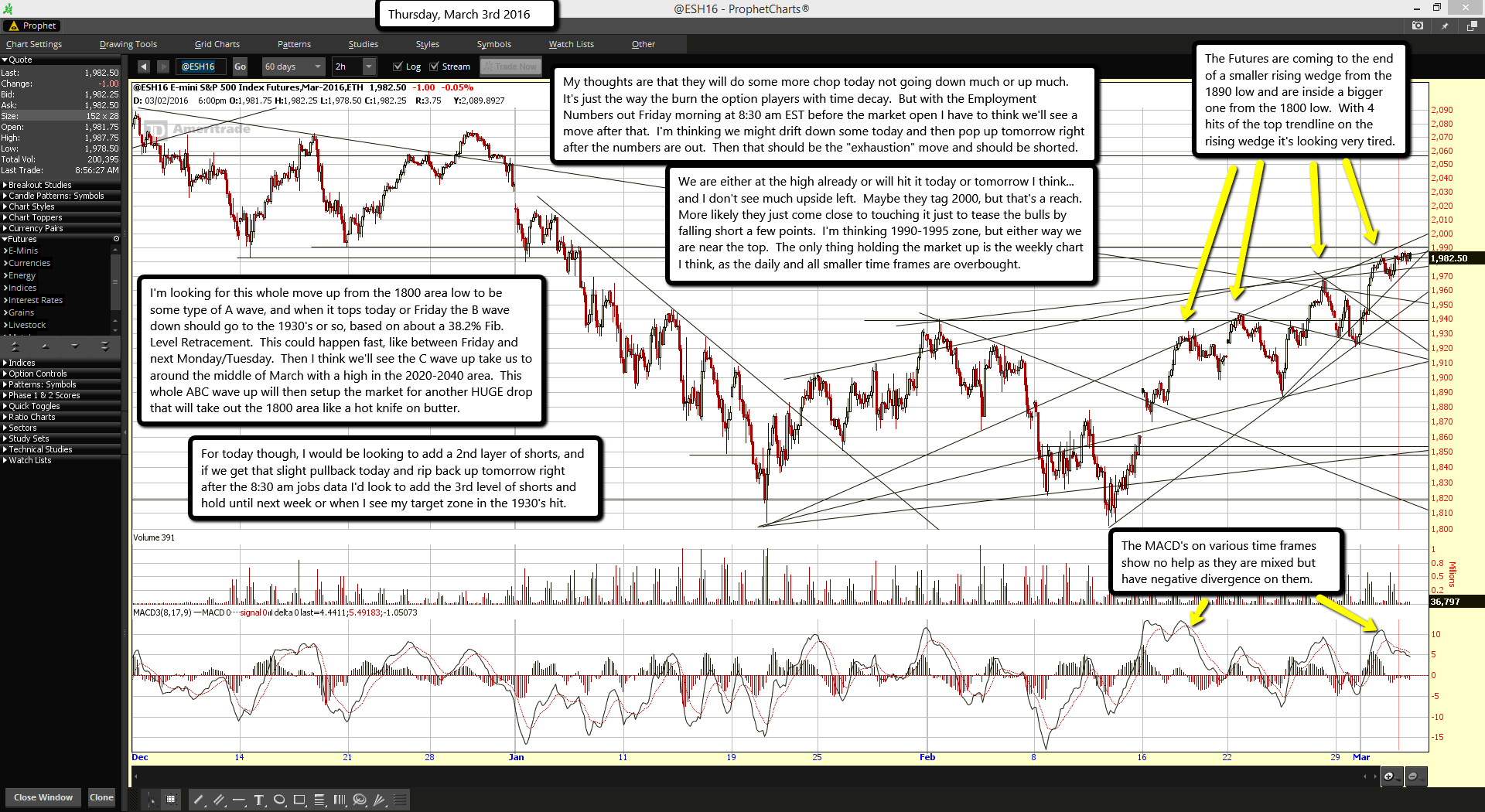
ES Morning Update March 3rd 2016

0

5c75dbca-440c-469a-af48-4f07c0c6de26The Futures are coming to the end of a smaller rising wedge from the 1890 low and are inside a bigger one from the 1800 low.  With 4 hits of the top trendline on the rising wedge it's looking very tired.

The MACD's on various time frames show no help as they are mixed but have negative divergence on them.

My thoughts are that they will do some more chop today not going down much or up much.  It's just the way the burn the option players with time decay.  But with the Employment Numbers out Friday morning at 8:30 am EST before the market open I have to think we'll see a move after that.  I'm thinking we might drift down some today and then pop up tomorrow right after the numbers are out.  Then that should be the "exhaustion" move and should be shorted.

We are either at the high already or will hit it today or tomorrow I think... and I don't see much upside left.  Maybe they tag 2000, but that's a reach.   More likely they just come close to touching it just to tease the bulls by falling short a few points.  I'm thinking 1990-1995 zone, but either way we are near the top.  The only thing holding the market up is the weekly chart I think, as the daily and all smaller time frames are overbought.

I'm looking for this whole move up from the 1800 area low to be some type of A wave, and when it tops today or Friday the B wave down should go to the 1930's or so, based on about a 38.2% Fib. Level Retracement.  This could happen fast, like between Friday and next Monday/Tuesday.  Then I think we'll see the C wave up take us to around the middle of March with a high in the 2020-2040 area.  This whole ABC wave up will then setup the market for another HUGE drop that will take out the 1800 area like a hot knife on butter.

For today though, I would be looking to add a 2nd layer of shorts, and if we get that slight pullback today and rip back up tomorrow right after the 8:30 am jobs data I'd look to add the 3rd level of shorts and hold until next week or when I see my target zone in the 1930's hit.

Should Abercrombie change its name to Hollister?

0
hollister california broomfield colorado

Should Abercrombie & Fitch change its corporate name to Hollister?

The controversial apparel retailer, which is in the midst of a turnaround, reported its latest earnings on Wednesday. And to, paraphrase Charles Dickens, it was a tale of two clothing chains.

It was the best of times for Hollister. Same-store sales were up 4% in the fourth quarter. That's the second consecutive quarter of growth.

But it remains the worst of times for the core Abercrombie brand. Same-store sales fell 2%, continuing a trend of sales declines. If you want to put a positive spin on it though, sales didn't fall as much as they did in previous quarters. Still, down is down.

Wall Street couldn't seem to figure out what to make of the overall results. The stock (ANF) initially surged as much as 8% shortly after the market opened and hit a new 52-week high in the process. But shares pulled back sharply later in the morning.

Related: No more sex at Abercrombie & Fitch

Abercrombie & Fitch's new management team, led by former Sears (SHLD) CEO Arthur Martinez (who left before Eddie Lampert turned Sears into the laughing stock of retail), has done a solid job so far of righting the ship.

Former Abercrombie CEO Mike Jeffries stepped down in 2014. Under his watch, the retailer was known for having scantily clad (and young) models in ads, its catalogs and the stores.

Loud music and the overbearing odor of cologne were the norm in the company's stores.

Jeffries was also criticized for cultivating a "cool kid" image. In an infamous 2006 interview, he proudly admitted that the retailer was "exclusionary."

Want more investing news? Subscribe to CNNMoney's Quest Means Business newsletter!

Since Jeffries' departure, Abercrombie has announced that it would stop "sexualized marketing." It also said it would change the dress code for its employees and tone down the music and cologne in order to create a "more pleasurable shopping experience."

This seems to be working for Hollister so far, but less so for Abercrombie.

Hollister is now bigger than Abercrombie. Hollister reported total sales of $1.88 billion last year compared to $1.64 billion for Abercrombie.

During a conference call with analysts Wednesday, Abercrombie & Fitch president and chief merchandising officer Fran Horowitz said Hollister has been busy remodeling stores and has a new management training program to improve customer service.

She also said that shirts, dresses and accessories were hits with women and girls while denim jeans were big sellers for men.

Horowitz was promoted from president of Hollister in December to her new role overseeing both brands.

And she added that Hollister has done a better job with digital commerce and social media lately. Hollister has new mobile apps and has been focusing more on interacting with shoppers on Snapchat and Instagram.

Related: America's most hated retailer is ...

But the Abercrombie brand name still may be rubbing consumers the wrong way.

The American Customer Satisfaction Index recently rated Abercrombie & Fitch as the most disliked retailer in its latest survey. It was Abercrombie's first time on the list. Not an auspicious debut, huh?

It also appears that Abercrombie & Fitch overall is doing a better job of winning back customers overseas than in the United States. Same-store sales for the whole company rose 6% internationally in the fourth quarter and were down 1% in America.

That may explain why Wall Street is still a little skeptical about the company's turnaround.

Susan Anderson, an analyst with FBR & Co., wrote in a report that Abercrombie "continues to have trouble driving traffic into its stores."

And Cowen and Company analyst Oliver Chen noted in a report that the stock could be volatile because many short sellers are still betting against it. That's a potential sign that many investors don't believe the turnaround can last.

Abercrombie & Fitch will definitely need to get its core brand back on track to prove to Wall Street that its comeback is legit.

Until then, the company might want to roll with the hot hand and emphasize what's working for it.

Just as Dayton Hudson eventually became Target (TGT) and Woolworth morphed into Foot Locker (FL), Abercrombie might be better off if it changed its name to Hollister.

Source link

Forbes Outs World’s Billionaires List: 1810 Individuals, $6.48 Trillion Net Worth (Stolen From The Sheep)

0
Bill Gates

Forbes has released its World's Billionaire's List for 2016, which contains 1,810 individuals with a total net worth of $6.48 trillion. Bill Gates remains the richest man in the world for the third straight year.

Forbes has released its World's Billionaire's List for this year, with the total net worth of the 1,810 individuals appearing on the list at a whopping $6.48 trillion.

The list saw 221 individuals drop out due to their net worth plunging below the $1 billion threshold, but there were also 198 newcomers. The total net worth of the people on the list, however, was lower compared to $7.05 trillion last year.

The list covers individuals coming from every corner of the world, with their wealth coming from various industries.

The Richest Person In The World

With a net worth of $75 billion, Microsoft co-founder Bill Gates remained the richest person in the world for the third year in a row. While his net worth dipped from the $79.2 billion posted last year, Gates remained on top of the annual list, which he has been included in for 17 of the previous 22 years.

Following Gates in the list are Amancio Ortega, with a net worth of $67 billion amassed from his fashion chain Zara; investor and business magnate Warren Buffett, with a net worth of $60.8 billion; Carlos Slim Helu, with a net worth of $50 billion from telecommunications and; and Amazon CEO and founder Jeff Bezos, with a net worth of $45.2 billion.

Facebook Wealth

Facebook CEO and co-founder Mark Zuckerberg climbed to the sixth spot, with a net worth of $44.6 billion. Co-founders of the social network, Dustin Moskovitz and Eduardo Saverin, are also on the list, with net worth of $8.9 billion and $6.2 billion, respectively. Facebook COO Sheryl Sandberg, meanwhile posted a net worth of $1.2 billion.

Jan Koum and Brian Acton, co-founders of the WhatsApp messaging service that was acquired by Facebook, also make the list with net worth of $8.6 billion and $4.4 billion, respectively.

Tech Money

Six out of the top 15 richest people in the world gained their wealth through the tech industry. Joining Gates, Bezos and Zuckerberg are Oracle founder Larry Ellison, with a net worth of $43.6 billion, and Google co-founders Larry Page, with a net worth of $35.2 billion, and Sergey Brin, with a net worth of $34.4 billion.

Other notable tech billionaires are Alibaba co-founder Jack Ma, with a net worth of $20.5 billion; Laurene Powell Jobs, the widow of Apple co-founder Steve Jobs, with a net worth of $16.7 billion; and Snapchat co-founder Evan Spiegel, with a net worth of $2.1 billion at just 25 years old.

Top 500 Richest People

While all the world's 1,810 billionaires have a total net worth of $6.48 trillion, that value is concentrated in the top 500 richest people in the world, whose collective total is $4.16 trillion. Of the top 500 richest people in the world, 183 are from the United States, 149 are from Europe, 119 are from the Asia-Pacific region, 32 are from the rest of the Americas and 17 are from the Middle East and Africa.

New York City Still Billionaire Capital

Previous reports claimed that Beijing in China has overtaken New York City as the city with the most number of billionaires. However, that seems not to be the case, as New York City is the home of 79 billionaires compared to 51 billionaires in Beijing.

The city with the second most number of billionaires is Hong Kong, followed by Moscow and then Beijing. Rounding out the top five is London.

Source link

Feds indict former Chesapeake Energy CEO

0
Solar energy to power... oil fields?

A federal grand jury has indicted the former CEO of Chesapeake Energy for allegedly conspiring to rig the price of oil and natural gas leases in Oklahoma.

The Department of Justice believes that Aubrey McClendon, who served as Chesapeake's CEO for nearly 25 years, orchestrated a conspiracy between two large oil and gas companies between December 2007 and March 2012.

McClendon said that the charges against him are "wrong and unprecedented."

"I have been singled out as the only person in the oil and gas industry in over 110 years since the Sherman Act became law to have been accused of this crime in relation to joint bidding on leasehold," he said in a statement. "Anyone who knows me, my business record and the industry in which I have worked for 35 years knows that I could not be guilty of violating any antitrust laws."

Chesapeake did not respond to requests for comment.

Related: Chesapeake Energy denies bankruptcy rumors

The indictment alleges that two large energy firms would decide ahead of time who would be the top bidder on leases in northwest Oklahoma. The winner would then allocate an interest in the lease to the other company.

The Justice Department said McClendon "instructed his subordinates to execute the conspiratorial agreement," which kept prices low and "put company profits ahead of the interests of leaseholders."

McClendon left Chesapeake in 2013 after Reuters reported that he had taken out more than $1 billion in loans against his personal stakes in the company's wells.

Chesapeake subsequently revealed that it was the subject of an inquiry from the Securities and Exchange Commission, and announced that the program through which McClendon acquired his stakes would be terminated.


Source link

These Are the 10 Biggest Retail Bankruptcies of the Last Decade

0

Sports Authority finally filed for bankruptcy after weeks of speculation and with that, the chain joined the ranks of the largest retail bankruptcies the industry has seen in the past decade.

With assets of up to $1 billion, the athletic gear retailer will land in the seventh spot in a tally led by Circuit City, Linens & Things, and General Atlantic & Pacific Tea (A&P).

The bankruptcy filing of Sports Authority is interesting because it actually participates in a growing pocket of the broader retail industry. Athletic gear popularity has increased as more Americans wear sneakers, athletic tops and t-shirts around town, not just for the purpose of working out.

But that success had led to more competition. Retailers like Target tgt and Kohl’s kss have entered the space by moving to sell more athletic wear. Meanwhile, manufacturers like Nike nke and Under Armour ua have increasingly focused on selling their gear through their own channels, including their e-commerce platforms. Other players, like Lululemon, completely sell their gear through their own store channels.

All of those factors made it difficult for Sports Authority to compete.

Here is a look at the 10 largest retail bankruptcies in recent years, as ranked by assets at time of the initial court filing. Data is from BankruptcyData.com as well as court filings.

Source link

Fiat Chrysler says Feb. sales rose 12 pct. from a year ago

0

This Wednesday, Nov. 4, 2015, photo, shows the front of a 2016 Dodge Ram 3500 Heavy Duty pickup at a Fiat Chrysler dealership in Doral, Fla. Industry analysts expect February sales to bounce back after a slight decline in January. All automakers report their monthly sales figures on Tuesday, March 1, 2016. (AP Photo/Alan Diaz)Wednesday, Nov. 4, 2015, photo, shows the front of a 2016 Dodge Ram 3500 Heavy Duty pickup at a Fiat Chrysler dealership in Doral, Fla. Industry analysts expect February sales to bounce back after a slight decline in January.

All automakers report their monthly sales figures on Tuesday, March 1, 2016. (AP Photo/Alan Diaz)DETROIT (AP) — Automakers posted big U.S. sales gains in February as consumers returned to showrooms after a snowy January.

Ford's sales rose 20 percent over last February, while Fiat Chrysler's were up 12 percent. Nissan's sales rose nearly 11 percent.

General Motors said its sales fell 1.5 percent, partly due to a 39-percent decrease in sales to rental car companies. GM is trying to lower its reliance on rental sales, which are less profitable and can hurt vehicle resale values.

Industry analysts had expected February sales to bounce back after a slight decline in January. Consulting firm LMC Automotive consulting firm predicts an 8.1 percent increase over a year ago to 1.36 million new vehicles. With an annual selling rate of 17.7 million cars and trucks, last month would be the best February in 16 years.

Automakers report their monthly sales figures on Tuesday.

"Consumers seem to be shrugging off the volatility in the stock market and higher interest rates," said Jeff Schuster, senior vice president of forecasting for LMC. "Very low fuel prices and many new vehicles in showrooms should help drive another strong year for auto sales."

LMC is predicting sales of 17.8 million new vehicles this year, up from 17.46 million last year. But the growth rate is slowing from previous years and many are expecting a plateau.

In the meantime, proof of consumers' continued spending power is everywhere. Sales of the Cadillac Escalade, an SUV that starts at $73,000, were up 22 percent over last February. Nissan's $30,000 Murano SUV saw an 86-percent jump in sales.

GM said its Chevrolet and GMC brands saw declines in February but sales improved at Cadillac and Buick. GM's best seller, the Chevrolet Silverado pickup, saw a 5-percent sales decline. GM sold 227,825 cars and trucks last month.

Ford's luxury Lincoln brand saw sales jump 30 percent after sales of its new MKX SUV more than doubled over last February. Sales of Ford's best seller, the F-Series pickup, were up 10 percent. Ford sold 217,192 vehicles.

Fiat Chrysler was led by the Jeep brand and the Ram pickup. Both reported sales increases of 23 percent. The company's truck sales rose 27 percent, but its car sales fell by the same percentage. Fiat Chrysler sold 149,188 trucks and SUVs last month but only 33,691 cars.

At Nissan, car sales were up nearly 8 percent while truck and SUV sales rose 15 percent. Overall, the Nissan and Infiniti brands sold nearly 131,000 vehicles.

Source link

Aubrey McClendon Is Charged With Conspiracy in Oil and Natural Gas Bidding

0

Aubrey McClendon, former chief executive of Chesapeake Energy.

HOUSTON — The Justice Department announced Tuesday night that it had charged Aubrey K. McClendon, an Oklahoma wildcatter who turbocharged the shale revolution by buying up gas fields across the United States, with conspiring to suppress prices paid for oil and natural gas leases.

The indictment says that Mr. McClendon, who led Chesapeake Energy before he was forced to step down three years ago, orchestrated a conspiracy in which two oil and gas companies colluded not to bid against each other for the purchase of several leases in northwestern Oklahoma from late 2007 to early 2012.

According to the Justice Department, the companies decided who would win the leases, with the winning bidder allotting an interest in the leases to the other company.

“McClendon instructed his subordinates to execute the conspiratorial agreement, which included, among other things, withdrawing bids for certain leases and agreeing on the allocation of interests in the leases between the conspiring companies,” the department said in a statement.

“His actions put company profits ahead of the interests of leaseholders entitled to competitive bids for oil and gas rights on their land,” said William J. Baer, assistant attorney general for the antitrust division. “Executives who abuse their positions as leaders of major corporations to organize criminal activity must be held accountable for their actions.”

The indictment was filed on Tuesday in United States District Court for the Western District of Oklahoma. The department said this was the first case resulting from a continuing federal antitrust investigation into price fixing, bid rigging and other anticompetitive conduct in the oil and natural gas industry.

It did not mention anyone else or any other company, nor did it say how many leases were involved.

Mr. McClendon released a statement late Tuesday denying all charges, arguing that for 35 years he has worked to create jobs and help Oklahoma’s economy while providing plentiful energy for the entire country.

“The charge that has been filed against me today is wrong and unprecedented,” Mr. McClendon said. “I have been singled out as the only person in the oil and gas industry in over 110 years since the Sherman Act became law to have been accused of this crime in relation to joint bidding on leasehold.”

Gordon Pennoyer, a spokesman for Chesapeake, said the company “has been actively cooperating for some time” with the antitrust investigation. He added, “Chesapeake does not expect to face criminal prosecution or fines relating to this matter.”

Mr. McClendon was nothing if not audacious as Chesapeake’s chief executive. He became a billionaire as the company he helped found aggressively outbid competitors for land leases and drilled highly productive wells in virtually every major shale gas field in the country.

Under Mr. McClendon’s leadership, Chesapeake and a handful of other companies transformed the face of energy in the United States, turning the country from an energy importer to an exporter and pioneering hydraulic fracturing in newly explored shale fields with ample global financing.

In the end, they produced a glut of natural gas that sent Chesapeake and several other companies to the brink of bankruptcy as gas prices collapsed.

Chesapeake’s stock price, which is now under $3 a share, has been sinking for most of the last five years, especially since it was revealed that Mr. McClendon had taken a personal stake in Chesapeake wells and then used those investments as collateral for up to $1.1 billion in loans used mostly to pay for his share of the cost of drilling those wells.

His interests ranged far and wide, as he acquired trophy assets like the Oklahoma City Thunder basketball team, interests in a French winery and a $12 million antique map collection.

He was once fined $250,000 by the National Basketball Association for bragging that he and his partners did not buy the Seattle SuperSonics to keep the team in Seattle — a statement that was at odds with the N.B.A. commissioner’s intentions. The Sonics moved to Oklahoma City for the 2008-9 season, and they became the Thunder. They play in Chesapeake Energy Arena.

Mr. McClendon donated millions of dollars to the Sierra Club from 2007 to 2010, money that the environmental group neglected to disclose even as it advocated increased use of natural gas to replace coal burning.

The Sierra Club cut its ties to the natural gas industry as environmentalists raised concerns over pollution caused by fracking and the disposal of fracking fluids.

The indictment follows a four-year federal investigation that began after Reuters revealed in 2012 that Chesapeake had discussed with Encana, a rival Canadian energy giant, how to suppress land lease prices in Michigan.

Last year, Chesapeake settled charges of antitrust, fraud and racketeering violations by agreeing to pay $25 million as compensation to landowners with leases.

Mr. McClendon is now the chairman of American Energy Partners, a private company that seeks investments in shale fields globally. It recently signed an agreement with YPF, the Argentine national oil company, to help develop a shale field in Patagonia.

Source link

Starbucks COO Takes Permanent Coffee Break

0

Starbucks sbux said on Tuesday that one of the executives instrumental to its ascent would not be returning to the coffee company now that his year-long sabbatical is over.

Chief Operating Officer Troy Alstead resigned a year after he went on an indefinite leave of absence, Starbucks said in a regulatory filing. Alstead was seen as Starbucks’ second-in-command to CEO Howard Schultz. Alstead’s resignation was effective February 29.

Alstead went on sabbatical (a “Coffee Break” in Starbucks’ corporate parlance) just over a year ago, saying he wanted to spend time with his family. At the time he said that the talent bench at Starbucks was deep enough for him to feel he could go on indefinite leave. He had been with the company for 23 years prior to the sabbatical and played a major role in helping Schultz shake off an 8-year business slump.

Despite his absence, Starbucks has thrived, with comparable sales rising in the United States in 2015 and the company continuing to expand globally, including a plan to enter Italy.

Alstead became operations chief in 2014, and was at one point seen as a possible CEO to succeed Schultz. He had also served as finance chief, and chief administrative officer in previous roles at Starbucks.

Last year, Starbucks named Kevin Johnson, a former CEO of tech company Juniper, to fill in, a move that has helped the coffee giant’s development of services like mobile ordering and its industry leading app.

Source link

Zynga founder Pincus steps down as CEO, again

0

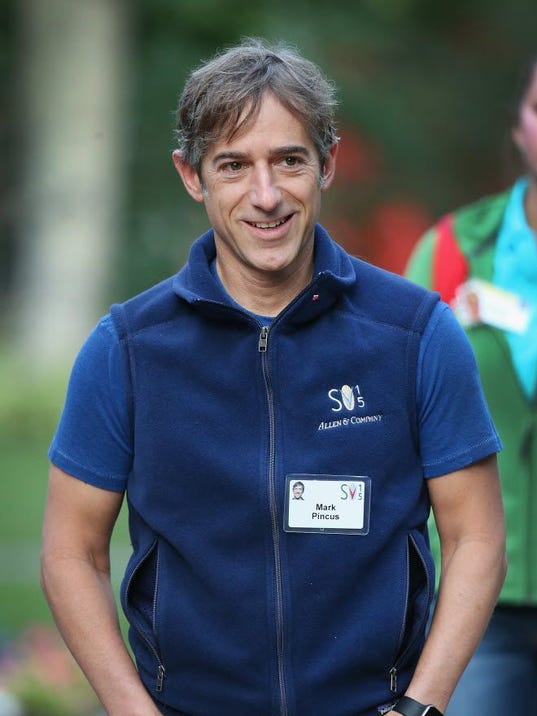
SAN FRANCISCO — Zynga founder Mark Pincus is stepping down as CEO from the gaming company he started. Again.

The once-highflying gaming company, whose stock is down 87% since March 2012, announced the move Tuesday. Zynga board member Frank Gibeau will step in as CEO on March 7, while Pincus will serve as executive chairman of the board.

After founding the company in July 2007, Pincus stepped down as CEO in July 2013 and returned in April 2015. The founder comeback story is a familiar one in tech. Twitter is now being run again by Jack Dorsey. In the past, similar returns to the helm were made by Steve Jobs, Larry Page, Michael Dell and LinkedIn's Reid Hoffman.

“I recruited Frank seven months ago to become an active board member to advise and coach our teams," Pincus said in a statement. "Frank has mentored product teams, led road map meetings and delivered inspiring talks to our game-making and PM communities. Frank has also been a big supporter of our move to smaller, more nimble teams. Equally important, we have worked well together and share a common vision for Zynga around mobile and social gaming."

Gibeau added in a statement that “despite the success of mobile games, Mark and I believe that the full promise of Zynga and social gaming has yet to be fully realized. We believe that Zynga has an opportunity to create new social experiences to connect even more players together. We will continue to invest in our talent and build on our empowered, entrepreneurial culture."

Pincus is a billionaire (he is worth $1.08 billion, according to Forbes' latest billionaire list) due not only to Zynga's 2011 initial public offering, which raised $1 billion and valued the company at $9 billion, but also because of early investments in Twitter and Facebook. Today, Zynga is valued at less than $2 billion, in keeping with a growing downward reassessment of tech company valuations.

But things quickly went south as the company, while popular because of games such as FarmVille, never showed that it could grow to profitability. With first-year stock plunges of 85% and 74%, respectively, Groupon and Zynga earned the dubious distinction of being the worst-performing tech IPOs of recent years.

Zynga also recently put its large downtown headquarters up for sale. The onetime U.S. headquarters for Sega was purchased for $228 million in 2012, and could be worth significantly more, given the rise in Bay Area real estate. Zynga's headcount has shrunk from nearly 4,000 to about 2,300.

Pincus first stepped down as CEO to make way for Don Mattrick, the former head of Microsoft's Xbox division. Mattrick oversaw the company's shift from Web games to the smartphone and tablet. Zynga's mobile bookings — money spent by consumers on games — represented 27% of their overall revenue when Mattrick started. As of last year, that percentage swelled to 60%.

When Pincus returned last summer, he wrote an email to employees saying that the time away from running day-to-day operations helped him take a breath. "I was able to really reflect on a lot of things I did right and wrong. One of the qualities I've grown to respect in leaders is patience," Pincus wrote.

Zynga (ZNGA) stock jumped 7% in after hours trading to $2.16.

Source link

Owner of NYSE Confirms Interest in London Stock Exchange

0

The Atlanta offices of IntercontinentalExchange.

LONDON — The Intercontinental Exchange, the owner of the New York Stock Exchange, said on Tuesday that it was considering making a competing offer for the London Stock Exchange Group.

The announcement came a week after the London Stock Exchange and Deutsche Börse said they were in talks on a possible all-share merger, the third time the two big European exchanges have contemplated a tie-up since 2000. It also followed news reports on Monday that the IntercontinentalExchange, which is known as ICE, might be considering a competing bid.

ICE did not provide details on Tuesday of what it might be willing to pay for the London Stock Exchange, saying it had yet to approach the exchange’s board.

“No decision has yet been made as to whether to pursue such an offer,” ICE said in a news release. “There can be no certainty that any offer will be made, nor as to the terms on which any offer will be made.”

The possibility of an offer for the London Stock Exchange came just over eight months after ICE, which is based in Atlanta, spun out Euronext, which operates stock exchanges across Europe, in an initial public offering in June. Euronext was acquired as part of an international push by the New York Stock Exchange in 2007, before ICE took over the two exchanges.

It also followed ICE agreeing to buy the Interactive Data Corporation, a big publisher of financial data, for about $5.2 billion in October.

Deutsche Börse itself tried to acquire the parent of the New York Stock Exchange before ICE, but it dropped those plans in 2012 after European antitrust regulators threatened to block the deal.

Later that year, IntercontinentalExchange agreed to buy NYSE Euronext for about $8.2 billion. The acquisition was approved by European regulators in November 2013.

On Friday, Deutsche Börse and the London Stock Exchange provided more details about their “merger of equals,” saying the combined company would most likely be based in London and be led by the German exchange’s top executive, Carsten Kengeter. Xavier Rolet would step down from his role as chief executive of the London Stock Exchange.

The London Stock Exchange-Deutsche Börse merger would create a giant in an industry that has rapidly consolidated. It would also allow London, which has served as a financial gateway to Europe, to maintain economic ties to the Continent, even as Britons are set to vote in June on whether to leave the European Union.

The companies have said any potential merger would not be conditioned on the outcome of the June 23 referendum, but a decision by Britain to leave the European Union could “well affect the volume or nature of the business conducted in the different financial centers served by the combined group.”

Source link

IBM Adds Post-Cyber Attack Planning With Resilient Systems Acquisition

0


The RSA security conference is being held this week in San Francisco where security pros come together to discuss strategy. IBM made several security announcements this morning ahead of the conference, headlined by the purchase of Resilient Systems.

Instead of trying to prevent an attack, Resilient gives customers a plan to deal with a breach after it’s happened. While IBM offers pieces for protecting and defending the network, no security system is fool-proof and there will be times when hackers slip through the defenses (or the attack comes from within).

“What happens when an attack happens, which unfortunately has become an inevitably. You need resilience to get back up and running and minimize the damage. There has to be muscle memory of what you will do and how you will react,” Caleb Barlow vp of security at IBM told TechCrunch.

To help companies establish post-breach plans before attacks happen, IBM also announced a new services component called the IBM X-Force Incident Response Services team.

The idea is to provide expertise around this type of planning in the same way companies plan for other types of disasters before they happen, so they have a set of procedures in place.

The final piece is a partnership with Carbon Black, a company that provides a full incident record that lets a customer trace the incident all the way back to its origin (such as clicking on a phishing link) and see the impact it’s had across the organization. Barlow described the Carbon Black tool like rewinding a video tape.

He says when you combine these three pieces, it gives IBM a comprehensive incident response package. Many companies don’t know what to do when a breach occurs or the responsibilities are too spread out across large organizations. This provides a post-breach planning tool, consulting services to help executive teams and IT think about those plans before an incident occurs and a way to do post-incident forensic analysis.

Resilient walks companies through exactly what they need to do based on their state or country. This could include activities like informing the right law enforcement officials, contacting the insurance company, shutting down the affected workstations and so forth.

As Barlow explained every company has an emergency response system for a variety of potential disasters, but they often lack a coherent plan for dealing with a cyber security attack.

The IBM security division was formed 4 years ago with the purchase of QRadar. Since then the division has grown to 7300 employees and $2 billion in revenue. It added a thousand employees last year alone, Barlow said.

With the purchase of Resilient, IBM gets 100 employees, who are post-breach subject experts and 30 of the Fortune 500 customers Resilient has in its portfolio (along with its other customers).

A report from XConomy pegged the purchase price at $100 million, but neither IBM nor Resilient would confirm that price with Barlow simply saying, “We never discuss the price of private acquisitions.” The purchase has to pass regulatory approval before it becomes official.

This acquisition did not come out of the blue. There is a technical link between the two already. Resilient has been on IBM’s radar as a business partner that built an application on top of the QRadar platform.

Today’s announcements have to be seen against the backdrop of IBM’s transformation strategy centered on cloud, analytics, Watson cognitive computing and security. The company has yet to see great financial results from this transition with 15 straights quarters of diminishing revenue, but it keeps pushing along trying to beef up these different components through acquisitions. Today’s announcements are part of that overall approach.

Source link

Argentina’s Debt Settlement Ends 15-Year Battle

0

The Argentinian Navy’s training ship, the Libertad, in port in Ghana in 2012.

The announcement of a $4.65 billion agreement between the Argentine government and four “holdout” hedge funds promises to end a 15-year battle that started when the government defaulted on $100 billion in debt in 2001.

The hedge funds refused to accept a steep discount in two restructurings over the years, while others took 30 cents on the dollar. The agreement announced on Monday gives the four holdouts — Paul Singer’s NML Capital, Mark Brodsky’s Aurelius Capital Management, Davidson Kempner Capital Management and Bracebridge Capital — 75 percent of their claims. Two other hedge funds struck an earlier agreement for 75 percent of their claims. The deal is subject to approval by Argentina’s Congress.

Here’s a look at some crucial moments of the fight over the years.

Oct. 11, 2012 Mr. Singer’s NML Capital persuaded the government of Ghana to freeze the Argentine Navy’s training ship, the Libertad, in port until Argentina put up millions of dollars. Months later, a United Nations tribunal ordered Ghana to release the ship, and it was allowed to sail home.

Graffiti in Buenos Aires depicting an American judge and “vulture” investors behind bars.

June 15, 2014 The United States Supreme Court refused to hear the Argentine government’s appeal on court orders to pay back the debt to the American hedge funds. It also voted 7-1 that bondholders could force Argentina to reveal where it owned property around the world.

June 15, 2014 Argentina’s president, Cristina Fernández de Kirchner, said she would refuse to pay back $1.5 billion to the “vulture” hedge funds despite a court order. She called it extortion and said paying it could set off $15 billion in cash payments to other bondholders, which would be half Argentina’s central bank’s foreign reserves.

Sept. 29, 2014 Judge Thomas P. Griesa of the Federal District Court in Manhattan ruled that Argentina was in contempt of court, saying it would face repercussions for going against his orders on payments to bondholders.

2014 Graffiti around Argentina’s capital, Buenos Aires, called the hedge funds “vultures” and popularized slogans such as “Homeland or vultures” and “Sovereignty or vulture swindle.” Judge Griesa’s caricature appeared in graffiti depicting vultures behind prison bars.

Nov. 22, 2015 Argentina elected Mauricio Macri as its new president, promising free-market policies in contrast to President Fernandez’s refusal to negotiate with the hedge funds. He has moved quickly to settle with bondholders, including a $1.3 billion deal with Italian investors.

Feb. 19, 2016 Judge Griesa lifted an injunction that barred Argentina from raising new money in bond markets or paying its creditors. The ruling depends on two things: Argentina has to repeal a law that prevents it from paying the holdout hedge funds, and it has to make full payments to bondholders who settle by Monday.

Source link

Deflation is back: Cue more money printing

0
The story behind oil's plunge

Deflation has returned to Europe and that can only mean one thing: More official action to boost the economy.

Consumer prices fell by 0.2% in February, pulled down by the plunging cost of energy. That's the first time inflation has turned negative since September last year.

Equally troubling the European Central Bank and its president Mario Draghi will be the drop in "core inflation" to 0.7% from 1% in January. That measure strips out energy prices, which tend to bounce around month to month.

Economists believe Draghi will fire another bazooka at financial markets when the bank next meets on March 10.

"Pressure is mounting on the ECB to deliver a major package of measures," said IHS chief economist Howard Archer.

When the central bank last discussed interest rates in January, Draghi made clear the ECB would pump out more money in March if necessary. He cited a deteriorating outlook for the economy due to uncertainty about global growth, volatile markets and geopolitical risks.

Since then, Japan has introduced negative interest rates to boost an economy that is now shrinking again, and China has told its banks they're free to lend more cash in the hope of supporting growth.

Closer to home, the refugee crisis is slowly undoing decades of European integration, and Britain is gearing up for a vote on whether to leave the EU -- a decision the G20 said Saturday would "shock" the global economy.

Here's what Draghi could announce on March 10, and one weapon he's likely to keep in reserve:

1. Buy more government bonds

The ECB began buying government bonds and other assets at a rate of 60 billion euros ($65 billion) a month in March 2015. It is likely to buy even more in the future. The rate could rise to between 70 billion and 90 billion euros a month, according to economists.

It may also buy bonds for longer than planned. The current program is due to run at least until March 2017 -- Draghi could extend the minimum duration by six months.

Central bank asset purchases, often known as quantitative easing, in theory encourage investors to pump more money into the economy by reducing the returns they can make on government debt.

2. Cut interest rates again

Interest rates for the 19 eurozone countries are already at record lows, and they seem certain to go even lower.

The rate paid on cash that banks deposit with the ECB could be cut to minus 0.40% or even minus 0.50% from its current level of minus 0.30%. Negative rates are a way of penalizing banks for not lending to firms and households.

But they're already hurting bank earnings. So the ECB may try to limit the pain by introducing a tiered rate that reduces the penalty on normal deposits, while introducing more negative rates for truly "excess" deposits.

3. Buy corporate bonds

The ECB could extend quantitative easing to include bonds issued by companies and bonds. That would be an effective way of pumping more money into the economy but would likely be hugely controversial, particularly in Germany where the existing asset purchase program has already been challenged.

"We see this as a measure the ECB would take in a deep crisis, but not in the modest market turmoil now," said Berenberg chief economist Holger Schmieding.

Source link

Ask Matt: Is Berkshire Hathaway a buy?

0

Q: Is Berkshire Hathaway a buy?

A: Warren Buffett looked like much of an Oracle of Omaha lately. But analysts think his Berkshire Hathaway (BRKA) is an opportunity.

Shares of Buffett’s Berkshire have been struggling. Shares of class A shares are down 11% over the past 12 months closing at $198,191 each - trailing the roughly 7% decline by the Standard & Poor’s 500. Investors have hurt the stock on fears some of Berkshire’s most economically sensitive businesses could slow in a weak economy.

Investors are hoping for better profit margins from the company’s insurance businesses, for instance. Additionally, Berkshire has taken some lumps on its public holdings. American Express (AXP) is one of Berkshire’s biggest investments. But shares of the company have fallen by a third over the past year.

Investors also seem to be pricing in a flat year for revenue in 2016. Analysts expect Berkshire’s revenue this year to drop 0.4% to $209.6 billion. Analysts, though, think Berkshire is an opportunity. Berkshire’s insurance business stands to gain market share in 2016, says Catherine Seifert of S&P Global. All told, analysts see the company’s adjusted earnings to jump 17% this year. Analysts think Berkshire’s shares will be 21% higher in 18 months.

Source link

Record Low Interest Rates lead to rise in refinancing: MBA Data

0

*Record Low Interest Rates lead to rise in refinancing: MBA Data*

Interest rates have been hovering around all-time lows for the past many quarters. Recently, the Federal Reserve raised the interest rates slightly. Federal Reserve had also indicated that rates could be increased in future as well but the decision on further interest rate hike would be taken only after considering the factors impacting economy.

The average interest rate on 30-year fixed mortgage has declined from 4.01 percent to 3.62 percent since the start of this year. Freddie Mac said that interest rates have touched a yearly low. Long term mortgage rates are quite close to their all-time low. Economists have reduced their estimates for interest rates in year 2016 after considering macro-economic factors and indications from the Federal Reserve. In her comments, Federal Reserve Chair Janet Yellen had advocated for gradual interest rate hike in future but situation has changed since the last Federal Reserve meeting.

However, considering the current economic situation and uncertainty, economists feel that interest rates might stay at the same level, at least for couple of quarters. Economists are also not sure about the path to recovery and the future growth of the U.S. and world economy. Instead of rate hike from the Federal Reserve, some economists are also not ruling out the possibility of rate cut. Rate cut seems highly unlikely, considering the fact that they have been raised slightly, and only once in the last few years.

Some customers were thinking about refinancing their mortgage to get immunity from further rate increase. However, that situation might not come till year 2017. Low interest rates will likely continue for the current year.

The Mortgage Bankers Association’s index of refinance activity witnessed 16 percent increase within a week. The increase was noticed as the mortgage rates touched their lowest level in the last few months. According to MBA data, nearly 75 percent of 30-year fixed mortgages issued by Fannie Mae or Freddie Mac are below 4 percent.

Many procrastinators have benefited from the grace period for low interest rate regime. However, economists are suggesting that we are already in the ultra-low interest rate period and those who want to refinance their mortgage, shouldn’t wait any further and grab the opportunity. In 2012, record low for long term home loan interest was witnessed at 3.35 percent. Current interest rate of 3.62 percent seems like a pretty good deal comparing the economic situation right now to that in 2012.

Meanwhile, economists are almost sure that Federal Reserve will not raise interest rates in its next policy meeting next month.

According to a Washington Post report, “The Mortgage Bankers Association this month lowered its forecast for 30-year fixed-rate rates at the end of the year to 4.3 percent, down from the 4.6 percent expected in January, on the expectation of fewer Fed rate hikes.”

Low crude oil prices have also led to economic fears for many economies across the world. This could lead to lower demand for goods and could eventually lead to slower recovery for some of the manufacturing hubs.

Source link

With Humility, Starbucks to Enter Italian Market

0

Howard D. Schultz, chairman and chief executive of Starbucks, in Milan.

MILAN — Standing in the art-soaked splendor of a Milanese parlor as an array of A-list Italian business leaders listened intently, Howard D. Schultz, chairman and chief executive of Starbucks, recited a remarkable statistic on Friday: Each week, roughly 90 million people pass through a Starbucks somewhere on earth.

“There are very few markets and stores that I’m as intimately involved in as this,” he said in an interview after the announcement. He added, “We’re going to come here with great humility.”

Starbucks has always been careful in Europe, aware that the Continent’s coffee aficionados have refined tastes and an abundance of good coffee shops — and might take offense at the idea that an American company is needed for a better espresso. Yet Starbucks has marched successfully into Britain, France and Germany, and it has even found success in Vienna, the Austrian capital, which gave birth to the coffeehouse.

Italy, though, is Italy.

“I think young people will try it out, for curiosity,” said Orlando Chiari, the 82-year-old owner of Camparino, a century-old coffee bar in central Milan, “but I doubt it will become a major player in Italy.”

Mr. Chiari, impeccable in a gray suit and light blue shirt, said that about 1,500 clients came to his bar every day, and that few were titillated by “new trends.” He decided against deliveries of the sports drink Red Bull because it simply would not sell at Camparino.

“We worship coffee in Italy, while Americans drink coffee on the go in large cups,” he elaborated. “It’s two extremely different cultures.”

Mr. Schultz credits Italy’s distinct coffee culture for inspiring him to create the Starbucks of today. In 1983, he visited Milan for a trade show and wandered into coffee bars in the city. Then, he was marketing director for Starbucks, a chain of four stores in Seattle that sold coffee for people to make at home. His visit to Milan’s coffee bars convinced him that the coffee shop was an experience and culture that could work in the United States.

Mr. Schultz has returned to Italy at least once a year since then, befriending business leaders while studying the local market. His lunchtime announcement ceremony, held in the refined, 19th-century setting of an elegant apartment, was an open embrace from Italy’s business elite: Brunello Cucinelli, the fashion designer and cashmere specialist, mingled with Nerio Alessandri, founder and president of Technogym, a maker of fitness equipment. Cristina Nonino, chief executive of one of Italy’s most famous producers of grappa, was there, as was Renzo Rosso, chairman of OTB Group, parent company of Diesel and other clothing brands.

“Here, he was inspired,” said Leonardo Ferragamo, a director of the luxury Salvatore Ferragamo line, who met Mr. Schultz for the first time on Friday. “He understood the tradition of drinking coffee at the bar, which is unique to Italy.”

Word began to leak out in October that Starbucks was looking at Italy. The company will partner with Percassi, the Italian retail and real estate group, which will own and operate the stores as licensee. Mr. Schultz said the first store in Milan would open early next year, followed by others in the city before the company expands elsewhere in Italy. And as has happened in other countries, Starbucks will tailor itself to local coffee habits.

“There will definitely be a bar,” Mr. Schultz said, alluding to the Italian custom of standing at a bar for a shot of espresso or a morning cappuccino. He also said Starbucks would be competitive on price; an espresso shot costs a euro or less in Italy, well below the typical price point for Starbucks. And Italians tend to drink coffee in small portions, rather than the large ones familiar to Starbucks patrons.

“We’re not coming here to teach Italians to make coffee — nothing like that at all,” Mr. Schultz said, adding that Starbucks should not be perceived as a threat to local coffee bars. “We have to earn the respect.”

Mr. Schultz said Starbucks planned to develop a proprietary coffee blend for the Italian market, and he predicted that the quality of Starbucks coffee “is going to surprise people in Italy.” But also important is an atmosphere intended to appeal to young Italians (as well as the promise of seamless Wi-Fi). Company surveys show that brand recognition is high and a surprising number of younger Italians have tried Starbucks coffee, despite the absence of domestic stores.

Mr. Schultz said he was “involved in every detail of this opening,” underscoring the sentimental and strategic importance he assigns to Italy. Coming back to the place he considers the taproot of the Starbucks experience does bring risks, especially if the company falls flat with Italian customers. But success would bring rewards, especially symbolic, as Mr. Schultz returns to the country synonymous with great coffee.

“He loves Italy more than many Italians,” said Gianmario Tondato Da Ruos, chief executive of Autogrill, the global food and beverage operator for travelers, which is a partner of Starbucks in the United States. “Really.”

Source link

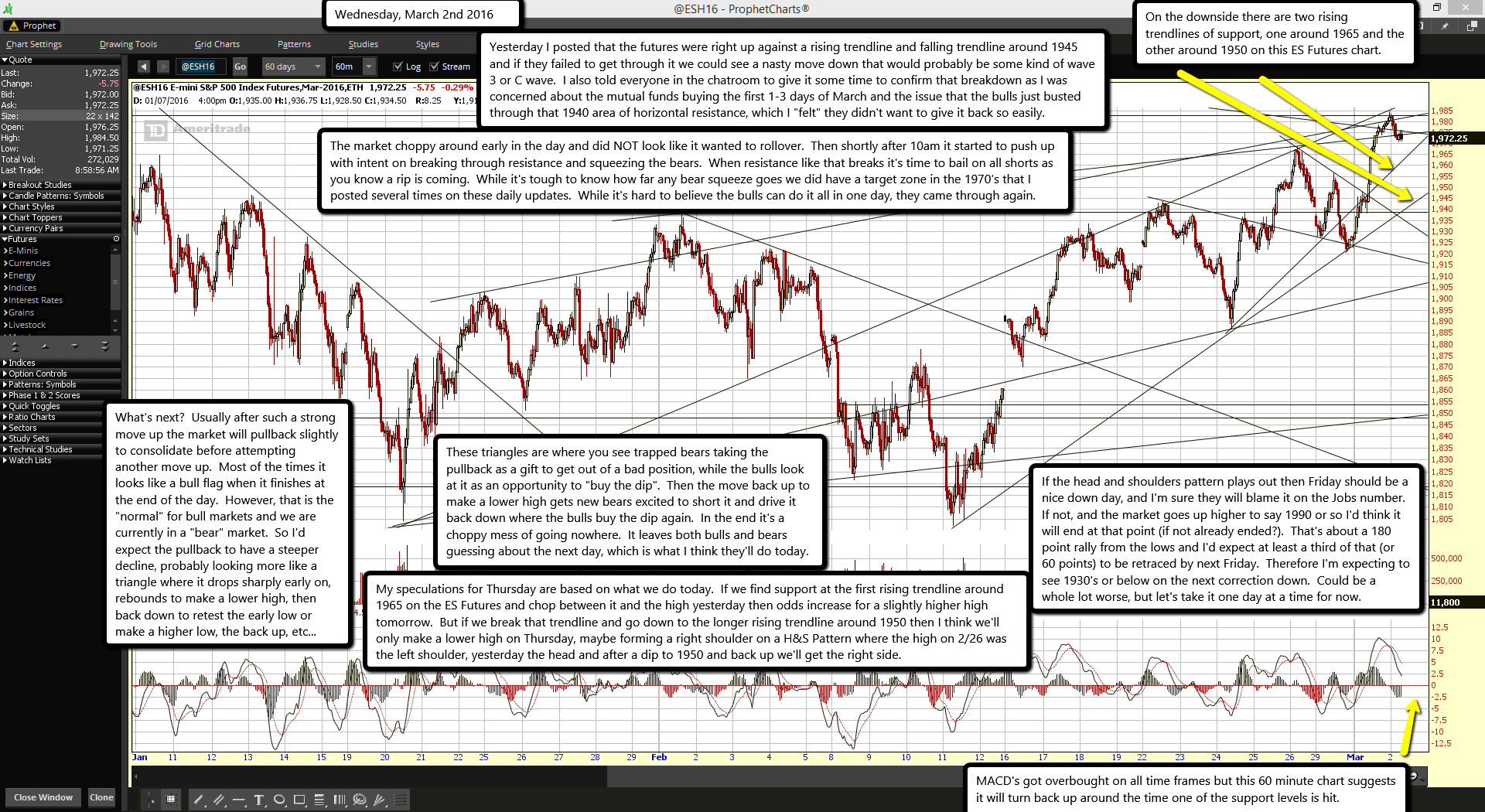
ES Morning Update March 2nd 2016

0

d8115227-9f83-46ad-8437-99cb8e3f04ceOn the downside there are two rising trendlines of support, one around 1965 and the other around 1950 on this ES Futures chart.

MACD's got overbought on all time frames but this 60 minute chart suggests it will turn back up around the time one of the support levels is hit.

Yesterday I posted that the futures were right up against a rising trendline and falling trendline around 1945 and if they failed to get through it we could see a nasty move down that would probably be some kind of wave 3 or C wave.  I also told everyone in the chatroom to give it some time to confirm that breakdown as I was concerned about the mutual funds buying the first 1-3 days of March and the issue that the bulls just busted through that 1940 area of horizontal resistance, which I "felt" they didn't want to give it back so easily.

The market choppy around early in the day and did NOT look like it wanted to rollover.  Then shortly after 10am it started to push up with intent on breaking through resistance and squeezing the bears.  When resistance like that breaks it's time to bail on all shorts as you know a rip is coming.  While it's tough to know how far any bear squeeze goes we did have a target zone in the 1970's that I posted several times on these daily updates.  While it's hard to believe the bulls can do it all in one day, they came through again.

What's next?  Usually after such a strong move up the market will pullback slightly to consolidate before attempting another move up.  Most of the times it looks like a bull flag when it finishes at the end of the day.  However, that is the "normal" for bull markets and we are currently in a "bear" market.  So I'd expect the pullback to have a steeper decline, probably looking more like a triangle where it drops sharply early on, rebounds to make a lower high, then back down to retest the early low or make a higher low, the back up, etc...

These triangles are where you see trapped bears taking the pullback as a gift to get out of a bad position, while the bulls look at it as an opportunity to "buy the dip".  Then the move back up to make a lower high gets new bears excited to short it and drive it back down where the bulls buy the dip again.  In the end it's a choppy mess of going nowhere.  It leaves both bulls and bears guessing about the next day, which is what I think they'll do today.

My speculations for Thursday are based on what we do today.  If we find support at the first rising trendline around 1965 on the ES Futures and chop between it and the high yesterday then odds increase for a slightly higher high tomorrow.  But if we break that trendline and go down to the longer rising trendline around 1950 then I think we'll only make a lower high on Thursday, maybe forming a right shoulder on a H&S Pattern where the high on 2/26 was the left shoulder, yesterday the head and after a dip to 1950 and back up we'll get the right side.

If the head and shoulders pattern plays out then Friday should be a nice down day, and I'm sure they will blame it on the Jobs number.  If not, and the market goes up higher to say 1990 or so I'd think it will end at that point (if not already ended?).  That's about a 180 point rally from the lows and I'd expect at least a third of that (or 60 points) to be retraced by next Friday.  Therefore I'm expecting to see 1930's or below on the next correction down.  Could be a whole lot worse, but let's take it one day at a time for now.

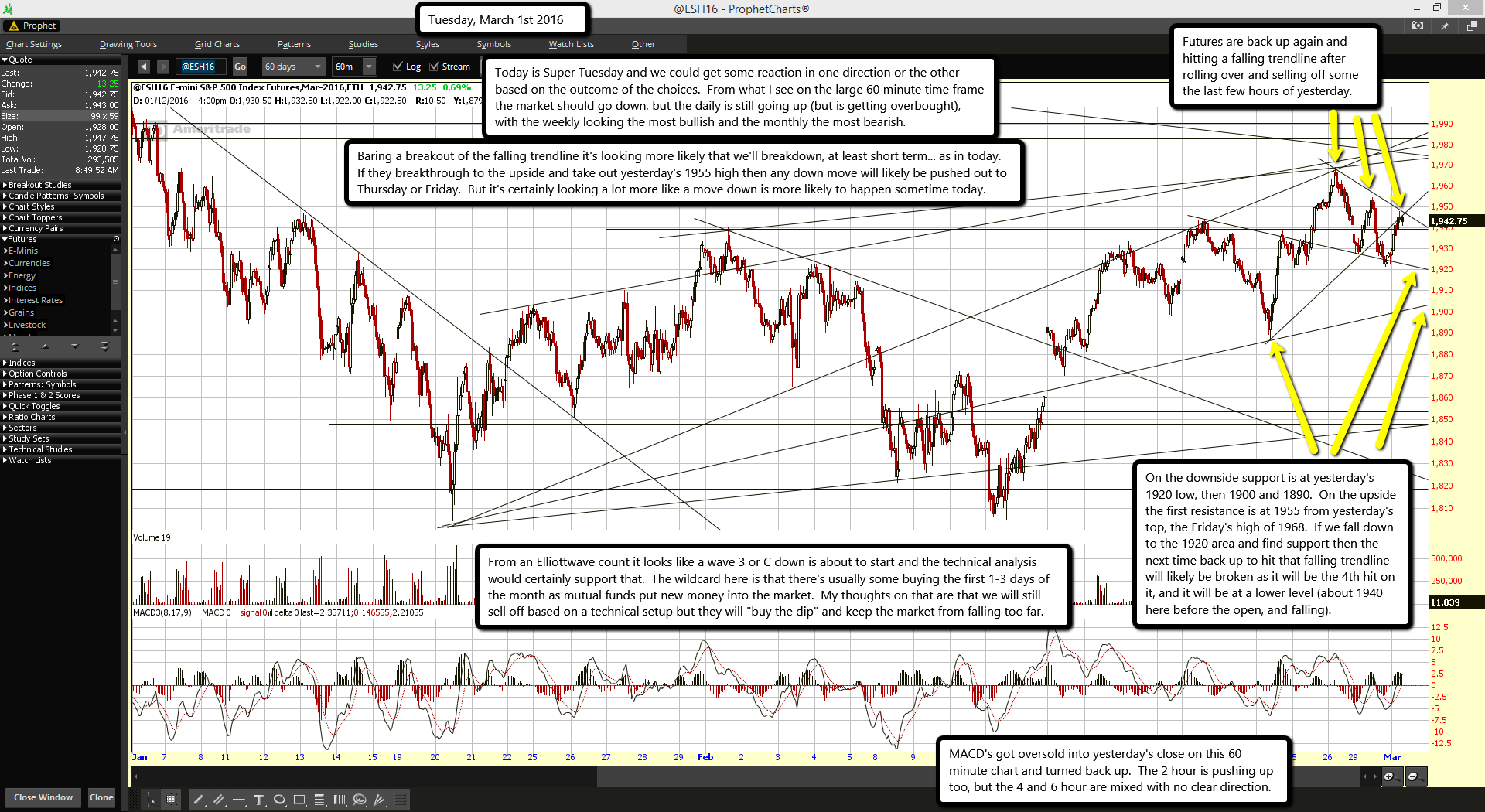
ES Morning Update March 1st 2016

0

0ffd83f9-2acf-4a3c-9fb4-6e70b4e6736dFutures are back up again and hitting a falling trendline after rolling over and selling off some the last few hours of yesterday.

MACD's got oversold into yesterday's close on this 60 minute chart and turned back up.  The 2 hour is pushing up too, but the 4 and 6 hour are mixed with no clear direction.

Today is Super Tuesday and we could get some reaction in one direction or the other based on the outcome of the choices.  From what I see on the large 60 minute time frame the market should go down, but the daily is still going up (but is getting overbought), with the weekly looking the most bullish and the monthly the most bearish.

Baring a breakout of the falling trendline it's looking more likely that we'll breakdown, at least short term... as in today.  If they breakthrough to the upside and take out yesterday's 1955 high then any down move will likely be pushed out to Thursday or Friday.  But it's certainly looking a lot more like a move down is more likely to happen sometime today.

From an Elliottwave count it looks like a wave 3 or C down is about to start and the technical analysis would certainly support that.  The wildcard here is that there's usually some buying the first 1-3 days of the month as mutual funds put new money into the market.  My thoughts on that are that we will still sell off based on a technical setup but they will "buy the dip" and keep the market from falling too far.

On the downside support is at yesterday's 1920 low, then 1900 and 1890.  On the upside the first resistance is at 1955 from yesterday's top, the Friday's high of 1968.  If we fall down to the 1920 area and find support then the next time back up to hit that falling trendline will likely be broken as it will be the 4th hit on it, and it will be at a lower level (about 1940 here before the open, and falling).

This whole week is getting support from the strength of the weekly chart push up strongly in my opinion and will limit the down moves.  But there's heavy resistance overhead in the 1970's on this ES Futures chart, which I don't see broken any time this week.  Maybe we get up close to it later this week?  It's possible, but all of the smaller time frames want to go back down.  This makes for a chop week as every time they try to fall the weekly chart saves them and pushes back up.  For now, it's a day traders market.  Sell resistance and buy support.

Berkshire Hathaway’s Q4 Earnings Show Buffett Still Has It

0

Wow, Buffett knocked it out of the park:  Berkshire Hathaway 4th-quarter profit up 32 percent.  Berkshire Profit Gains 32% to $5.48 Billion, Capping Record Year

Berkshire’s Earnings: A Surprise Boost From Kraft Heinz, But an Off Year at Geico

Warren Buffett Attacks Wall Street Over ‘Phony’ Earnings

Buffett says it’s possible that the offending analysts “don’t know better.” But more likely, Buffett says, the analysts go along with the phony numbers because they fear losing access to management, which is key to a Wall Street analyst’s job these days. Buffett also says analysts may be swept up by a herd mentality and go along with these inflated financials because everyone else is doing it. None of these reasons lets them off the hook, Buffett says.

“Whatever their reasoning, these analysts are guilty of propagating misleading numbers that can deceive investors,” Buffett writes.

Based on pro-forma earnings, profits for the S&P 500 rose an average of 0.4% in 2015. But if you stick with figures that conform to official accounting rules, profits actually plunged nearly 13%.


Oddly, Buffett’s denouncement of executives who doctor their earnings comes during a section of the his annual letter in which he does a bit of his own selective accounting. Buffett says that Berkshire shareholders would do better ignoring a portion of the company’s amortization costs. Buffett acknowledges the slight contradiction by saying that he gives that advice with “some trepidation.” But he says amortization, unlike compensation, is not a real expense. What’s more, Buffett says investors when calculating Berkshire’s true earnings should include depreciation, which he says is a often true expense, but doesn’t normally get counted.

“When CEOs or investment bankers tout pre-depreciation figures such as EBITDA as a valuation guide, watch their noses lengthen while they speak,” writes Buffett.

And, by the way, to anyone who doubts the value of compounding those slow, steady gains:

I guess I really need to stress this more often because it's so hard for people to get their heads around the value of this strategy because, in the first 5 years - it simply doesn't seem that sexy.  Even if you make a steady 20% a year for 5 years, you go from $100,000 to $120,000 to $144,000 to $172,000 to $207,000 to $250,000 and there will be many points along the way when the market is going against you or when you have a friend tell you their guy has them up 50% that year or whatever and that's TEMPTATION which you have to avoid.

Look at Ackman, for example, his fund was up 40% in 2014 but last year the fund dropped 20.5% and already this year it's down another 17.3% and the gains are all gone - two wasted years.  Why?  Because he's arrogant and he didn't cash out and he stuck with a winning strategy for too long.  Hedge fund managers are often like gamblers at a casino who bet black on the roulette wheel and, if they get a win, they let it ride and then again they let it ride and, if they get black 3 or 4 times in a row, they get to go on TV and act like geniuses and people will throw money at them and they will be treated as heroes.  Even if the 5th time is red and wipes them and their investors out - they simply close down that fund and start another one using their famous name and one-time win to attract new investors.

Think about it, I just told you this but next time Bill Ackman's on TV you'll listen to him as if he knows something.  It's the same thing with Venture Capital firms, they only want to swing for the fences because there's no glory in hitting a bunch of singles and doubles - they all chase the fabled 10-bagger so they can brag about it to their big swinging friends and, sadly, that's just the truth of human nature.

Barry Bonds (cheater), Hank Aaron and Babe Ruth are very, very famous because they are the top 3 home run hitters and yes, we all know Ty Cobb (.366 lifetime) but what about Ed Delahanty (.346)?  Billy Hamilton (.344)?  Harry Heilmann (.342)?  Peter Browning (.341)?  Those guys are all in the top 10 hitters of all time but no home runs so no one remembers.  You have to go really far down the list of home run hitters to find one you've never heard of (Albert Pujols is #14 already!).

Anyway, home runs put fans in the seats and, for hedge funds and VCs, they bring in the investors but home run hitters also tend to lead the league in strikeouts as well - as you have to commit big to swing for the fences.  That's fine in baseball, because after you're wiped out they give you another turn at the bat but it's not fine for individual investors, who spend a lifetime building their investment savings and can't afford to have it wiped out, right?

Babe Ruth isn't wrong and his attitude is fine (he also had a .342 lifetime batting average, he simply missed big when he did miss) - if you are going to get another chance.  The marginal cost of striking out for Babe Ruth is low because he was going to get 8,399 at bats in his lifetime so his 1,330 strikeouts were a cost of doing business along the way.

If we allocate our portfolios correctly and avoid putting all of our eggs in one basket, we too can swing for the fences once in a while because getting wiped out on a small investment is not a big deal compared to the occasional 10-bagger BUT - you have to be realistic about your chances of both and that is where most investors (and fund managers) fail.  

One thing people tend to forget about Berkshire Hathaway is that they made $17.4Bn from the companies they actually run and "only" $6.1Bn in their stock portfolio.  Nothing is better than having a steady flow of income and that allows Berkshire to take the occasional risk in the market, without worrying about seriously impacting the company's future if it doesn't work out.  It also allows Berkshire to ride out market downturns with more cash coming in to press "losing" bets on the way down.

PSW Investments has a similar structure, using the cash-flow from PSW to fund long-term investments in start-up companies.  We don't gamble with money we can't afford to lose but that doesn't mean we don't gamble at all!  It's also the strategy we preach at Philstockworld - playing a conservative, long-term growth strategy with the bulk (80%) of your investing capital and taking shorter-term, opportunistic trades with your remaining investment money.  That way, even if you are wiped out of the short-term funds (-20% of 20% = 4%), if you make just 5% on the long-term funds (5% of 80% = 4%), you still don't lose.

That's also why we tend to use our Short-Term Portfolio to hedge our Long-Term Portfolio, the short-term trades can be quickly entered and exited while we give our long-term positions the time they need to mature.  As of Friday's close, our Long-Term/Short-Term paired portfolios were up over 100% in two years and I noted to Members I would love to just cash out here - as it's easier than managing the bumpy road that lies ahead.

Buffett's top long-term holdings are also up 100% but his 100% is $54Bn while ours are only up $600,000 but he does have 48 more years of growth than we do, so early innings!

In Buffett's recent letter to shareholders, he mentions that the company's growth really took off in the 90s BECAUSE he moved away from the investing model and more into the ownership model.  At PSW Investments, we never thought otherwise but, as Buffett notes, he learned from experience and we, in turn, learned from Buffett.

Buffett talks about "normalized" earning power and that too is something we teach our Members at PSW.  When we are very bullish in our portfolios, generally that would be 70% bullish and maybe, in an extreme (like 2009), 80% but we always leave room for the possibility we could be wrong.  If you are 70/30 bullish and the market drops 50% then your 70 becomes 35 but, because we leverage our hedges, the 30 becomes 60 and your net is 95 while the rest of the market is on a half-priced sale.

If the market, however, goes up 50% then your 70 becomes 140 and your 30 is maybe 15 and that's 155 and you are only slightly ahead of the S&P but we'd rather make 50% in good years and 5% in bad years than go up and down like a yo-yo.  Of course, that's when we're wrong - sometimes we get it right in either direction - as we have for the past two years.

As long as we always have access to cash that allows us to pick up companies when they are on sale, our portfolios are set up for great long-term growth, no matter what market conditions we have to endure over the short run. 

As Buffett notes:  "At Berkshire, we much prefer owning a non-controlling but substantial portion of a wonderful company to owning 100% of a so-so business. It’s better to have a partial interest in the Hope Diamond than to own all of a rhinestone.  Our appetite for either operating businesses or passive investments doubles our chances of finding sensible uses for Berkshire’s endless gusher of cash."

Similarly, when people ask me what's an appropriate amount of money to have to retire I tell them to just keep working as long as they can and let the investment income grow on the side.  The bigger you let your retirement savings get, the less work they will have to do in your golden year and the less risk you will have of having to downgrade your lifestyle down the road (see "How to Get Rich Slowly").

Buffett likes to tend to his core holdings and add "bolt-on" acquisitions, which compliment his core businesses but he makes it clear how please he is to make large acquisitions and outright invites any Fortune 500 company to call him if they are interested in selling (Buffett will not go hostile).  With 30 or 40 more years to go before we're gobbling up F500 companies, we are employing similar techniques in our own modest portfolios.  And, as Buffett wisely notes.

Of course, a business with terrific economics can be a bad investment if it is bought at too high a price. We have paid substantial premiums to net tangible assets for most of our businesses, a cost that is reflected in the large figure we show for goodwill and other intangibles. Overall, however, we are getting a decent return on the capital we have deployed.

Patience is, by far, the hardest thing we have to teach our Members.  Having a long-term outlook is much easier when you are an 85 year-old Billionaire and, keep in mind, Buffett has been doing this since the 60s.  It's not just about age, it's about the experience of actually trading the markets for, let's say 100,000 hours.  At PSW, we use Gladwell's rule of thumb that it takes about 10,000 hours of practice to become an expert trader/investor.  Buffett has put his time in in spades!

Looking forward to our next decade of investing!

Source link

s2Member®