Thursday, September 24, 2026
Home Blog Page 101

ES Morning Update February 18th 2016

0

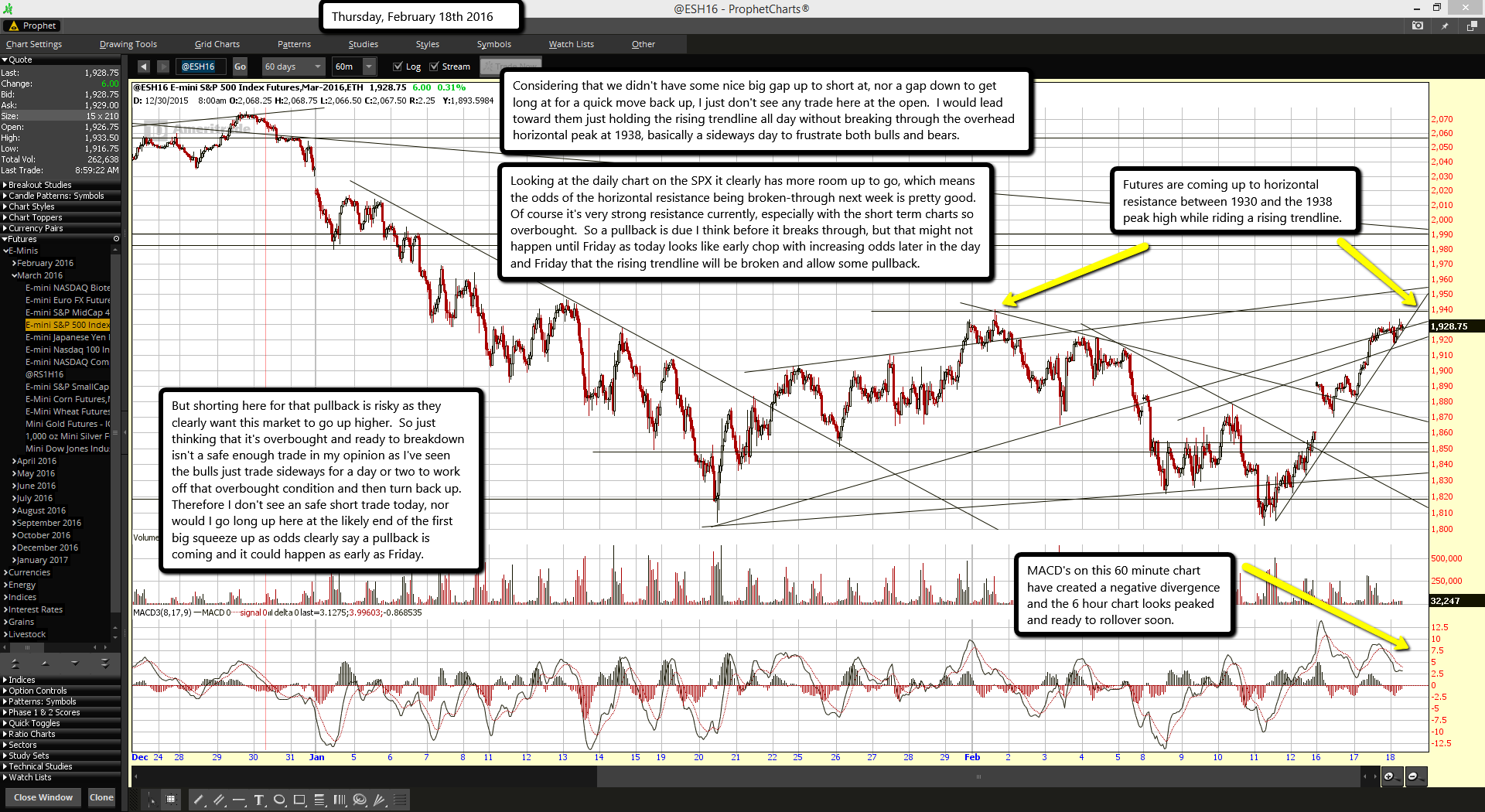
b8a35a14-51f7-45e0-bb7b-b99e65bb7b28Futures are coming up to horizontal resistance between 1930 and the 1938 peak high while riding a rising trendline.

MACD's on this 60 minute chart have created a negative divergence and the 6 hour chart looks peaked and ready to rollover soon.

Considering that we didn't have some nice big gap up to short at, nor a gap down to get long at for a quick move back up, I just don't see any trade here at the open.  I would lead toward them just holding the rising trendline all day without breaking through the overhead horizontal peak at 1938, basically a sideways day to frustrate both bulls and bears.

Looking at the daily chart on the SPX it clearly has more room up to go, which means the odds of the horizontal resistance being broken-through next week is pretty good.  Of course it's very strong resistance currently, especially with the short term charts so overbought.  So a pullback is due I think before it breaks through, but that might not happen until Friday as today looks like early chop with increasing odds later in the day and Friday that the rising trendline will be broken and allow some pullback.

But shorting here for that pullback is risky as they clearly want this market to go up higher.  So just thinking that it's overbought and ready to breakdown isn't a safe enough trade in my opinion as I've seen the bulls just trade sideways for a day or two to work off that overbought condition and then turn back up.  Therefore I don't see an safe short trade today, nor would I go long up here at the likely end of the first big squeeze up as odds clearly say a pullback is coming and it could happen as early as Friday.

ES Morning Update February 17th 2016

1


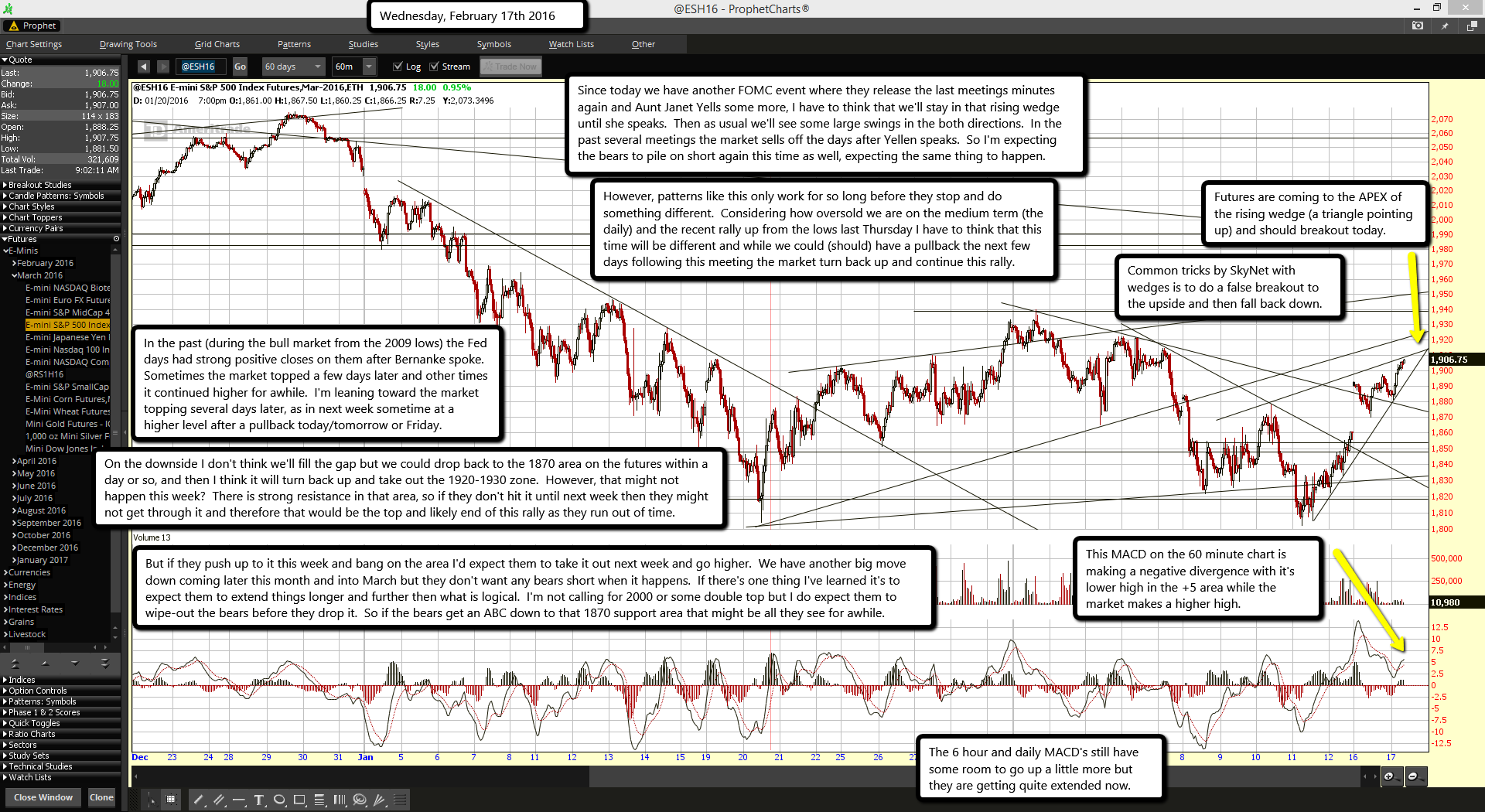
428485df-a072-4c10-9747-e03e73001ac1Futures are coming to the APEX of the rising wedge (a triangle pointing up) and should breakout today.

Common tricks by SkyNet with wedges is to do a false breakout to the upside and then fall back down.

This MACD on the 60 minute chart is making a negative divergence with it's lower high in the +5 area while the market makes a higher high.

The 6 hour and daily MACD's still have some room to go up a little more but they are getting quite extended now.

Since today we have another FOMC event where they release the last meetings minutes again and Aunt Janet Yells some more, I have to think that we'll stay in that rising wedge until she speaks.  Then as usual we'll see some large swings in the both directions.  In the past several meetings the market sells off the days after Yellen speaks.  So I'm expecting the bears to pile on short again this time as well, expecting the same thing to happen.

However, patterns like this only work for so long before they stop and do something different.  Considering how oversold we are on the medium term (the daily) and the recent rally up from the lows last Thursday I have to think that this time will be different and while we could (should) have a pullback the next few days following this meeting the market turn back up and continue this rally.

In the past (during the bull market from the 2009 lows) the Fed days had strong positive closes on them after Bernanke spoke.  Sometimes the market topped a few days later and other times it continued higher for awhile.  I'm leaning toward the market topping several days later, as in next week sometime at a higher level after a pullback today/tomorrow or Friday.

On the downside I don't think we'll fill the gap but we could drop back to the 1870 area on the futures within a day or so, and then I think it will turn back up and take out the 1920-1930 zone.  However, that might not happen this week?  There is strong resistance in that area, so if they don't hit it until next week then they might not get through it and therefore that would be the top and likely end of this rally as they run out of time.

But if they push up to it this week and bang on the area I'd expect them to take it out next week and go higher.  We have another big move down coming later this month and into March but they don't want any bears short when it happens.  If there's one thing I've learned it's to expect them to extend things longer and further then what is logical.  I'm not calling for 2000 or some double top but I do expect them to wipe-out the bears before they drop it.  So if the bears get an ABC down to that 1870 support area that might be all they see for awhile.

Victoria’s Secret CEO steps down to prioritize family

1

[ad_1]

Victoria’s Secret’s CEO has resigned, the lingerie store’s parent company announced Friday.

Sharen Jester Turney, who had been CEO of Victoria’s Secret since 2006, attributed her departure to wanting to prioritize her family.

“After 16 years and a record fourth quarter at Victoria’s Secret, I have decided to prioritize my family and my personal life and consider what’s next for me professionally,'' she said in a statement.

Leslie Wexner, chairman and CEO of parent company L. Brands, will take the helm of Victoria’s Secret, while Turney remains as an adviser.

“We are very grateful to Sharen for her leadership and all that she has accomplished,’’ Wexner said in a statement. “Victoria’s Secret sales have increased more than 70% to $7.7 billion and profit has increased substantially during her nine years as CEO. ... We have strong confidence in the strength of the brand and our growth opportunities, and I look forward to taking on a more active role and working with the talented leadership team at Victoria’s Secret.”

L Brands has more than 3,000 company-owned specialty stores around the world, and owns such brands as Bath & Body Works, Henri Bendel along with Victoria’s Secret.

[ad_2]

Source link

FOMC Minutes: Preview Strategy – BofA Merrill

0

[ad_1]

FOMC Minutes Preview:

The minutes of the January meeting should reveal more concern among Fed officials about the global backdrop and the tightening of financial conditions, but stop well short of suggesting the Fed will postpone rate hikes in March or later.

At the January meeting the FOMC indicated it would be “closely monitoring” these risks. In recent speeches, Yellen, Fischer and Dudley each said that deteriorating financial conditions need to be “persistent” to prove a risk to the outlook; the January minutes should contain a similar assessment and may give additional information about what conditions would change the Fed’s outlook. The minutes may also suggest that Fed officials could be collecting data right up to the March meeting before deciding what action to take. That said, given the FOMC effectively dropped its discussion of the balance of risks and cited greater uncertainty to the outlook in the statement, we expect a modestly dovish tone to the minutes overall.

We have been struck by how much some Fed officials (most notably Yellen) have cited the need to start gradual rate hikes to preclude having to tighten more aggressively later. This gradual approach, it has been argued, should actually help reduce the risk of a recession. However, we expect this view to have been challenged by more dovish participants at the January meeting. There is likely to be some debate over how much slack remains and how much that would put up wages and prices. Meanwhile, we expect greater uncertainty around the inflation outlook, particularly as the US dollar has appreciated further while oil and other commodity prices have continued to fall. Notable would be any discussion of how much inflation expectations would need to drift lower before the Committee became more concerned. (Some clarification of the dissent on the updated “Statement of Longer-Run Goals and Monetary Policy Strategy” by St. Louis Fed President Bullard might be useful as well.)

The combination of near-term uncertainty in the inflation outlook and greater downside risks from the global financial market selloff might well be enough to postpone a rate hike in March. But the January minutes are only likely to hint at that possibility, in our view. Nonetheless, we continue to expect the Fed to hold policy steady in March and then hike again in June, under the assumption that markets calm down and the labor market continues to improve.

FX: What Minutes?

In normal times, FOMC Minutes usually aren’t a key market focus. The sharp risk-off tone to markets in recent weeks further reduces their importance. The market’s response to Chair Yellen’s testimony this week is telling. Chair Yellen failed to capitulate on the FOMC’s base case view for gradual pace of rate hikes based on labor market strength, despite the rates market now pricing more than 30% chance of cuts this year. While Chair Yellen did recognize the downside US growth risks from China-induced volatility, the global slowdown, and the USD, her tone doesn’t sound like someone ready to drop the prospects for hikes altogether. The market response however continues to suggest it is uncomfortable with Fed hikes when ex-employment growth momentum is so slow, suggesting it will continue to question the Fed’s ability to hike. Indeed, the Critical Stress Signal (CSS) within BOFAML’s Global Financial Stress Index (GFSI) flipped to “risk off” for the first time since August.

Historically, a “risk off” signal has seen at least a 5% decline in the S&P in 11 0f 18 occurrences since 2000. What’s different this time is that the Fed is no longer there to soothe the market with additional easing as it has during periods of stress since 2009 (Chart 1). With risk likely to remain under pressure in the near-term, we see continued risk of USD weakness as USD long positions are unwound as rate differentials continue to suggest the USD is overvalued at current levels.

[ad_2]

Source link

US homebuilder sentiment slips in February

0

[ad_1]

 U.S. homebuilders are feeling slightly less confident about their sales prospects ahead of the spring home-selling season, though they remain positive overall that the housing market will continue to improve this year.

The National Association of Home Builders/Wells Fargo builder sentiment index released Tuesday slipped to 58 this month, down three points from a revised reading of 61 in January.

[ad_2]

Source link

Massive 404-Carat Diamond Discovered in Angola

0

[ad_1]

A massive, 404-carat diamond was recovered in the southern African country of Angola, the Lucapa Diamond Company announced Monday.

The 404.2-carat diamond is the biggest diamond ever found in Angola and the 27th biggest recorded diamond in the world. Angola is one of the world's top four diamond producing nations, the company said.

PHOTO: Lucapa Diamond Company says this 404 carat Lulo gem, pictured in an undated handout photo, is the biggest recorded diamond ever found in Angola.Lucapa Diamond Company
Lucapa Diamond Company says this 404 carat Lulo gem, pictured in an undated handout photo, is the biggest recorded diamond ever found in Angola.

The diamond was recovered from a Lulo Diamond Project mine in Angola's Lunda Norte province, the Australian company said in a statement. The Lulo mine accounts for nearly 75 percent of Angola’s annual diamond production, Lucapa said.

Lucapa Chairman Miles Kennedy said the "spectacular" white diamond could be valued at more than $20 million, the Australian Broadcasting Corporation reported.

This is the fourth 100-plus carat diamond recovered from Lulo to date, according to Lucapa.

[ad_2]

Source link

Cruz tax plan would cost $8.6 trillion, second only to Trump

0

[ad_1]

DES MOINES, IA - FEBRUARY 01: Republican presidential candidate Sen. Ted Cruz (R-TX) stands with his wife Heidi as he addresses supporters after winning at the caucus night gathering at the Iowa State Fairgrounds on February 1, 2016 in Des Moines, Iowa. Cruz beat out frontrunner Donald Trump and Marco Rubio (R-FL) to win the Iowa caucuses. (Photo by Christopher Furlong/Getty Images)Republican presidential candidate Sen. Ted Cruz (R-TX) stands with his wife Heidi. (Photo by Christopher Furlong/Getty Images)

Republican Presidential candidate Ted Cruz’s plan to impose a flat 10 percent tax on all personal income and greatly lower the corporate tax rate would cost the federal government at least $8.6 trillion over a decade, according to a new analysis.

The plan would be the second most expensive tax proposal in the GOP presidential field, with only businessman Donald Trump offering a proposal that would add more in government debt over the next 10 years, according to data released Tuesday by the nonpartisan Urban Brookings Tax Policy Center. 

[A $9.5 trillion price tag for Trump’s tax plan]

Republican presidential candidates have been quick to campaign on promises to cut taxes, but because most have yet to detail how they would slash spending to offset this lost revenue, analysts have projected their proposals would be deficit busters.

Cruz’s plan also falls short of fulfilling the Texas senator’s promise that his flat tax system would be so simple that taxpayers would file their returns on a postcard.

Cruz would eliminate nearly every tax deduction except those for charitable contributions and mortgage interest and would increase the standard deduction to make doing your taxes easier. He would also eliminate all credits except the earned income tax credit for low income workers and the child tax credit.

The streamlined system is the simplest plan released by any presidential candidate, but analysts said Cruz’ proposals would still require most people to fill out more than a postcard.

“I would think the form would have to look not that different than what you do now,” said Tax Policy Center Co-Director Eric Toder.

The Cruz campaign declined to respond to questions Tax Policy Center staff sent about the plan, which meant it had to make some assumptions about Cruz’s proposal in areas where there was a lack of detail.

The proposal also falls short of Cruz’s promise that under his plan every income-level would see double-digit increases in after-tax income.

Analysts found that while most workers would receive a tax cut, the lowest income workers would see their after-tax income decline by 0.6 percent.

There would be a 16 percent flat business tax under Cruz’s proposal, which functions like an across-the-board consumption tax that would increase the amount workers are taxed by their employers. Those low-income workers who don’t make enough to file taxes wouldn’t benefit from the expanded standard deduction that is meant to offset the payroll-side increases.

“Somebody below the standard deduction amount, they cannot benefit much,” said Tax Policy Center Director Leonard Burman, who served in the Treasury Department during the Clinton administration. “They would benefit very little from repealing the corporate income tax so on net they would end up paying higher taxes under the Cruz plan.”

Cruz’s business tax has also been criticized by fellow presidential candidate Sen. Marco Rubio (R-Fla.), who compared it to a European-style value added tax. Burman said Rubio is correct and Cruz’s system would impose a version of the consumption tax system popular in much of Western Europe. The center estimates Rubio’s tax proposal would cost the government at least $6.8 billion in lost revenue over the next decade.

[The VAT tax fight between Rubio and Cruz]

The biggest beneficiaries under Cruz’s plan would be the top 0.1 percent of earners. People earning over $3.7 million per year would see an average tax break of more than $2 million in the first year, according to the analysis.

The plan would add $10.2 trillion to the national debt in the first decade, according to the center, when you include interest payments on the additional government borrowing that would occur.

Cruz isn’t alone in crafting a tax plan that would cost the federal government trillions while delivering big benefits for the wealthy, all of the Republicans running for president are doing it.

“All of the plans benefit high income people more than low income people,” Burman said. “They are enormous tax cuts compared to the current system and they are enormously regressive.”

Analysts said the lost revenues could be reduced through spending cuts, including Cruz’s plan to repeal the Affordable Care Act, but Cruz and most other Republican candidates have yet to provide detailed lists of the cuts that should be made.

Burman said the plan would make it easier and more beneficial for businesses and individuals to invest. Lower tax rates and benefits for businesses would likely encourage major investments in the early years of the plan, but analysts said they expect interest rates would increase and the economy would decline as a result of the ballooning debt.

“The plan by itself, not including the unspecified spending cuts, would surely depress the economy,” Burman said.

[ad_2]

Source link

Fed’s Neel Kashkari Says Banks Are ‘Still Too Big to Fail’ – New York Times

0

[ad_1]

Neel Kashkari was a Treasury Department official in the George W. Bush and Obama administrations.

WASHINGTON — During the 2008 financial crisis, Neel Kashkari worked tirelessly to save the nation’s largest banks. As a senior Treasury Department official in the George W. Bush and Obama administrations, he helped those banks grow larger than ever.

On Tuesday, he said it was time to think about breaking them up.

“I believe the biggest banks are still too big to fail and continue to pose a significant, ongoing risk to our economy,” Mr. Kashkari said at the Brookings Institution, delivering his first public speech as the new president of the Federal Reserve Bank of Minneapolis.

He described the threat of another crisis that might force the government to bail out large banks, as it did in 2008, as a rare instance of a clear and preventable problem.

“The question is whether we as a country have the courage to actually take action now,” he said.

“There are lines in your speech I can imagine a Bernie Sanders or Elizabeth Warren saying,” David Wessel, a former economics editor at The Wall Street Journal who moderated the Brookings event, told Mr. Kashkari during a panel discussion after the speech. “It’s not what one expects from a Goldman Sachs Republican.”

Mr. Kashkari, who joined the Minneapolis Fed in January after a postcrisis stint at the investment management firm Pimco and an unsuccessful run for governor of California, responded that he was calling things as he saw them. He said his views on financial regulation were shaped by the crisis, convincing him that strong, simple safeguards are the most sensible.

“If I’m not willing to stand up and share my concerns, then I wouldn’t be doing my job,” he said.

Other Fed officials are divided over the adequacy of postcrisis reforms. Eric S. Rosengren, president of the Federal Reserve Bank of Boston and an influential voice on regulatory issues, said in a recent speech that the government had made “substantial progress.” He said new regulation had reduced both the probability and the cost of a large-bank failure.

Donald L. Kohn, who worked with Mr. Kashkari during the crisis as the Fed’s vice chairman, said after the speech that he had greater confidence than Mr. Kashkari in the 2010 Dodd-Frank Act, which grants regulators new powers to constrain and, if necessary, dismantle large banks.

“I think the new regime, once it’s fully in place, probably will work,” he said.

Mr. Kashkari said the cost of large crises underscored the importance of minimizing risk. “It’s not simply the cost of the bailout,” he said. “It’s the economic damage that’s inflicted across society.”

He said the Minneapolis Fed would begin a research effort to consider “more transformational measures” the government could pursue, and that he hoped to publish a proposal by the end of the year. Asked by reporters whether he had consulted the Fed’s chairwoman, Janet L. Yellen, or other officials, he responded, “I’m looking forward to getting their feedback.”

Mr. Kashkari outlined a number of potential options for restraining large banks, although he emphasized that the list was not intended to be comprehensive.

The first and most familiar is forcing large banks to break into smaller pieces, the approach favored by Mr. Sanders, who released a statement on Tuesday saying he was “delighted” by the speech.

Big banks argue they play a unique role in the global economy, and that foreign rivals would take up the slack. They also say big banks are stronger in some ways, and that regulations are adequate.

“Breaking up the U.S.-based global financial institutions would ensure that one of the United States’ most competitive global industries serving companies small and large is turned over to banks based outside the United States,” said John Dearie, acting chief executive of the Financial Services Forum, which represents the interests of large financial firms.

Alternatively, the government could limit risk-taking by increasing the share of funding banks must raise in the form of capital rather than borrowed money. Mr. Kashkari compared this to the safeguards imposed on nuclear power plants, where failure is regarded as unacceptable. Anat R. Admati, a Stanford finance professor, is a leading proponent of this approach.

A third, broader approach would impose a tax on borrowing throughout the financial system, reducing risk-taking not just by banks but a wide range of other financial intermediaries. The role of banks in the financial system has declined over time, and many experts regard the rest of the financial system, relatively less regulated, as a more likely source of future crises.

Critics of both the second and third approaches argue that economic growth requires risk-taking, and preventing risk-taking by banks will shift activity to less regulated sectors.

Mr. Kashkari said that limiting the risks posed by large banks could allow the government to ease regulation of smaller banks. He also took a pre-emptive shot at the banking industry, noting the “endless objections” its lobbyists have raised to proposals for stronger regulation.

“We need to move before we as a society have forgotten the lessons of ’08,” he said.


[ad_2]

Source link

American Airlines Sues Gogo Over Slow In-Flight Internet

0

[ad_1]

The airline claims competitor ViaSat can offer faster service.

Gogo In-Flight Internet American Airlines may be saying goodbye to Gogo.


Connected TravelerThe Texas-based airline on Friday filed a lawsuit against Gogo, saying it has found a competing in-flight Internet provider — ViaSat — that offers faster service, as was first reported by the Fort Worth Star-Telegram. As part of their contract, American Airlines can renegotiate or terminate its agreement with Gogo if it finds another in-flight Internet provider that offers better service.

Apparently American Airlines found that in ViaSat, which currently offers in-flight Internet services for United Airlines, Jet Blue, and Virgin America.

"After carefully evaluating the new technology and services in the marketplace, American has decided to exercise its rights under the Agreement and recently notified Gogo that ViaSat offers an in-flight connectivity system that materially improves on Gogo's air-to-ground system," the airline said in its suit, according to the newspaper.

In a statement sent to PCMag Tuesday, American Airlines said it continually evaluates in-flight connectivity service. "We've notified Gogo of a competitor's offering, and we will evaluate all of our options," the airline said.

Meanwhile, Gogo, in a statement to PCMag, said the issue only involves about 200 American Airlines planes — not the airline's entire fleet of more than 800 Gogo-equipped aircraft. Gogo said it plans to submit a competing proposal to install its latest satellite technology — dubbed 2Ku — on the fleet in question.

"We believe that 2Ku is the best performing technology in the market and look forward to discussing our offer with American," Gogo said.

PCMag's Sascha Segan recently tested Gogo's new 2Ku satellite system, and said it allowed for "smooth streaming video with no buffering" and that streaming "Netflix was absolutely no problem." Another benefit of the new system: it may be the first to work well during tarmac delays.
[ad_2]

Source link

Better, faster internet service for American Airlines?

0

[ad_1]

The lawsuit says alternative service providers offer faster, more reliable wireless internet service.

Some American Airlines customers could see faster internet service via a new in-flight wifi provider.

The airline filed suit Friday against GoGo, an internet service provider, in Tarrant County District Court, notifying the company that a competitor was offering a faster service.

The suit notes that GoGo's existing system, which utilizes ground-based cellular towers to connect airline passengers to the internet, can make it difficult for passengers to stream video and use other data-heavy entertainment tools on a flight.

According to the suit, "alternative service providers are offering faster, more reliable and less expensive satellite-based wifi services to airlines like United, Southwest, JetBlue and Virgin America."

"Whereas Gogo’s system provides 3 Mbps (or at most, 10 Mbps (megabits per second)) of bandwidth shared among all users on a flight, and blocks most video content, these new satellite-based services offer 12 Mbps per device — more than enough for passengers to stream music, movies, and television," the suit notes.

Casey Norton, American Airlines' director of corporate communications, said the airline has multiple contracts with GoGo. This particular suit focuses on one contract that covers about 200 of the airline's older model planes, including Boeing 737s that are primarily used on regional and domestic flights.

AA's fleet includes approximately 1,600 planes.

"We haven't made any decisions yet," Norton said. "All we've done is notify them of a competitor's offering."

GoGo has 45 days to respond.


[ad_2]

Source link

ES Morning Update February 16th 2016

2

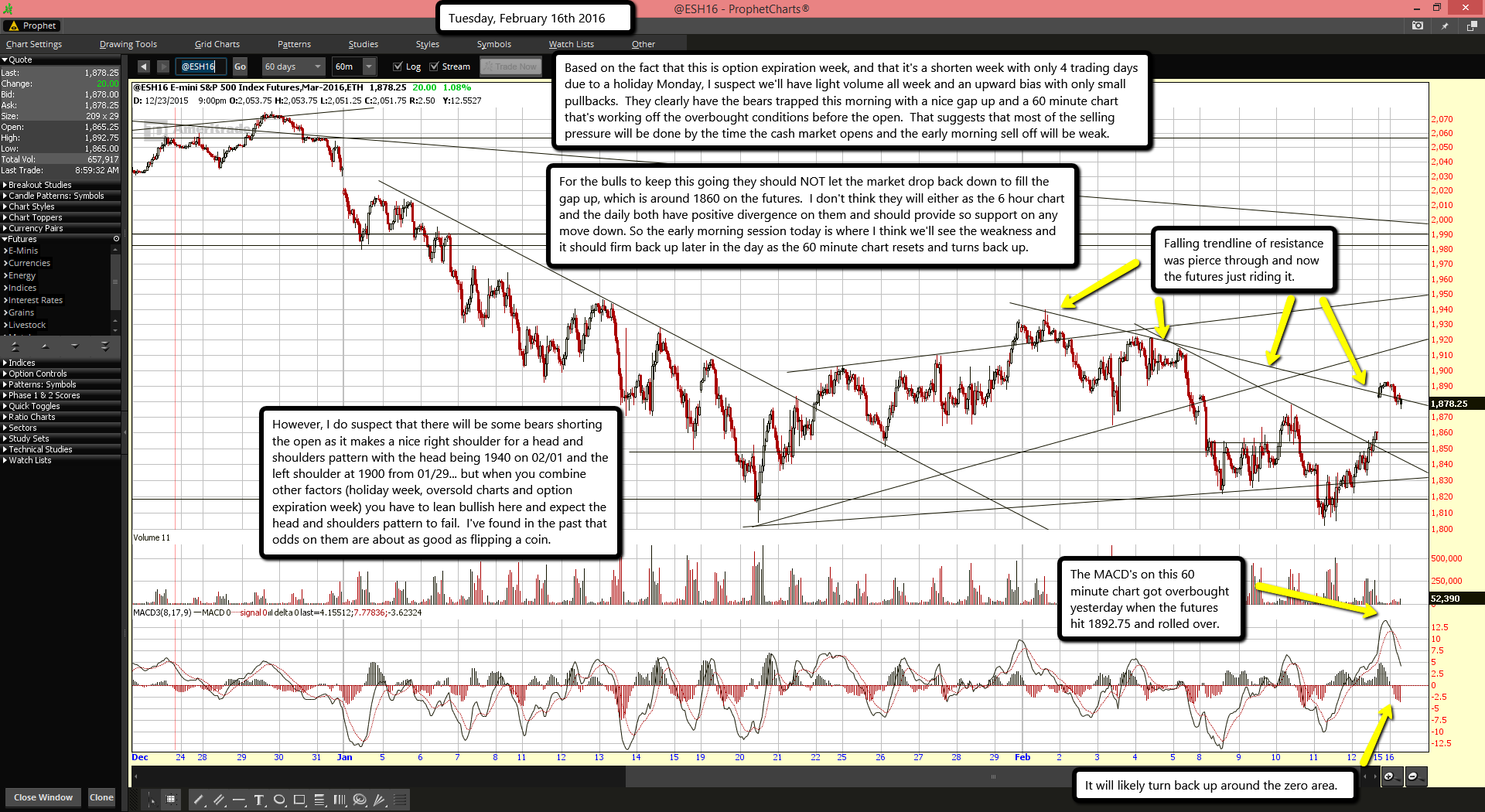
43170ace-2f3f-4c50-b0d4-747205c529f3Falling trendline of resistance was pierce through and now the futures just riding it.

The MACD's on this 60 minute chart got overbought yesterday when the futures hit 1892.75 and rolled over.  It will likely turn back up around the zero area.

Based on the fact that this is option expiration week, and that it's a shorten week with only 4 trading days due to a holiday Monday, I suspect we'll have light volume all week and an upward bias with only small pullbacks.  They clearly have the bears trapped this morning with a nice gap up and a 60 minute chart that's working off the overbought conditions before the open.  That suggests that most of the selling pressure will be done by the time the cash market opens and the early morning sell off will be weak.

For the bulls to keep this going they should NOT let the market drop back down to fill the gap up, which is around 1860 on the futures.  I don't think they will either as the 6 hour chart and the daily both have positive divergence on them and should provide so support on any move down. So the early morning session today is where I think we'll see the weakness and it should firm back up later in the day as the 60 minute chart resets and turns back up.

However, I do suspect that there will be some bears shorting the open as it makes a nice right shoulder for a head and shoulders pattern with the head being 1940 on 02/01 and the left shoulder at 1900 from 01/29... but when you combine other factors (holiday week, oversold charts and option expiration week) you have to lean bullish here and expect the head and shoulders pattern to fail.  I've found in the past that odds on them are about as good as flipping a coin.

Stock Market Crash Confirmed For Late 2016 Or Early 2017, And How To Double Your Money Every Month

2

The Moving Averages on the monthly chart crossed and confirmed that the market is headed for a crash within the next year.

Learn how to double or triple your money every month trading the stock market through the e-mini futures, SPY, and Forex instruments.

Before I go over the charts and forecast the coming weeks and months I want to talk about an incredible opportunity to learn how to trade right along side of someone who made $90 million dollars trading.

The system that this master trade used to make that money is now available for everyone to follow and profit from.  Last year he set up an account and tested the system fully on autopilot, and it averaged 15%-17% per month for 12 straight months.  There were NO losing months!

Sure, there were trades that lost but the overall win to lose ratio made a steady profit every month completely on autopilot.  This is perfect for someone who has a day job and can't trade everyday.  This could be used on their 401k program instead of letting some broker trade it for them.  The yearly gains would be around 200% or so... way better then what any other 401k program will make.

Then in December of 2015 this master trader with other great traders opened up the daily chatroom and made 200-300% in ONE Month!

Learn More At: http://theprelaunch.com/

Or Join Here: https://reddragonleo.com/iml

Having the chance to go into a chatroom like this and learn from, and/or follow master traders like this is HUGE!  In fact they have setup a way for you to link your own personal account up with one of these master traders and follow his every trade.  When he places a trade in his account an identical trade will be place in your personal account automatically.

You know me by now, and you know how I think about the elite criminals banksters that rig the market and cheat with their software system that front runs buy and sell orders by milli-seconds (think Goldman Sachs), who never have a losing day trading.  How is that even possible... unless you cheat?

Of course all of this big banksters have some kind of trading system that analysis the market and places trades based on all kinds of technical data that we retail traders don't have access to.  It's a game rigged for the big institutions and it's something they guard heavily and don't let us know about.

Here's someone that developed his own trading system and while he doesn't win all the time like the banksters, he's mastered it to the point that he's made himself very wealthy.  He wasn't an elite growing up, in fact he came from Brooklyn and grew up in a tough neighborhood with very little money.  Now he wants to help give back to the average person.

Just imagine having access to follow "trade for trade" someone that's made $90 million dollars trading!

If you have be following me for very long (I started this blog in 2009) you know I don't get impressed easily.  But after doing some research on this guy I do think he's the "real deal" and something everyone should take a serious look at.  I decided to join to get access to the live trading chatroom and if you really want to learn how to trade profitably you should too.

We all know the market is rigged and run by a supercomputer that I call SkyNet.  So it only makes sense to use a computer software system to analysis the market and help you make trades against SkyNet.  Use a computer to fight against another computer.  We traders need all the help we can get as I know I (and you too I'm sure) have made trades based on your emotions... which usually end up being a loser.

I've been there... and it sucks.  I've just never had access to a computer trading software that will do all the technical analyst for me, but now I do.  You know I talk about Elliottwave counts, Fibonacci levels, Turn dates, Fake Prints, etc... and why I get a lot right the times I get them wrong can really hurt your pocketbook if you are stuck in a trade.

So if you want a change... something that can really help you make money, then I urge you to watch the recorded webinar above and learn as much as you can about the company.  I have my own free chatroom on this blog and I'm in there everyday during normal market hours.  There's about 40 people that signed up and 6-8 regulars that come in and out of the room daily.

The room will stay FREE as I've decided that I don't want to be responsible for giving out trades, which would be something I'd have to do with a paid room.  So instead, I just want to help as many people as possible for free, with nothing asked in return.  I want to spend my time learning how to trade from a master trader and use his automatic trading software to scan for great trades.

So come join me in my chatroom if you like and I help you any way I can.  You have questions about the automatic trading system?  Come ask me and I do my best to answer them.  There's going to be millions made in this company and missing out on the chance to join them is something I wouldn't advise.  Watch the webinar and decide for yourself.

Learn more or join here: https://reddragonleo.com/iml


Back to the market...

On this monthly chart we can now see the 10 month moving average at 2017.53 and the 20 month moving average at 2023.95 SPX, which is the first time it's crossed since the 2007 prior high and later crash.

spx-monthly-chart-02-13-2016While it's not impossible for the market to turn back up and make a higher high the odds of that happening are very slim.  Trying to think about what the Fed's could do to cause such a rally and I honestly can't think of anything?  We are near zero interest rates, exhausted several QE programs... which have little to NO effect now.  So what's left?  I don't see anything that can save the market from a crash now.

On the shorter term...

We now have a clear 5 wave pattern down from the late December 2015 high, and what looks like the start of a multi-day or multi-week rally.

I have a turn date for February the 24th, so that "could" be the top of the coming oversold rally.  I'm expecting at least a 50% retrace of the recent sell off, which would be around the 1946 SPX level, but I wouldn't be surprised if they squeeze it up higher to the 61.8% (1978) or the 78.6% (2023) level to get all the bears out before the next move down.

If the rally extends up to a higher Fibonacci level then my "turn date" could be wrong and/or off by a bit, as I'd expect it to take 2-4 weeks for the whole rally to complete and the higher it goes the longer period in "time" it should take.  Naturally I can't rule out some kind of massive relentless "day after day" straight up move that just kills the bears and hits the higher levels, as then it could still end on my turn date.

After it's done we should see another big drop in the market that takes out the 1810 SPX recent low.  Downside targets are the 1780 area first, then the 1730 area.  This should be some larger (Major) wave C down.  This should take all of the month of March to bottom with an expected low in early April.

Then another rally should take us up into May followed by another drop into June where I think we'll have a strong multi-month rally start from.  This should take us into the August/September period where many crashes start.  It's to early at this point to make a forecast on what to expect then so I won't even try.

One thing remember is that we have the Presidential Election in November so I'd think there will be some wild rallies up and big moves back down in the 2nd half of this year as they attempt to fool all of us retail traders telling us everything is "ok" just before the market falls off a cliff and scare us to death just before a powerful rally.

Everything is fluid and changing so be sure to follow my daily chart updates and come join me in my free chatroom for more up to date information, and any new FP's (fake prints) I find or ritual coded dates like the Lucy passport from the August 24th, 2015 crash.

Red.

P.S.  If you have problems joining my chatroom just email me "red (at) reddragonleo (dot) com" as I've had to install more security to stop all the brute force attacks where spam bots try to setup fake email accounts on the registration page.


ES Morning Update February 12th 2016

2

3cec6713-3ec8-410a-b578-d3b9778ff482

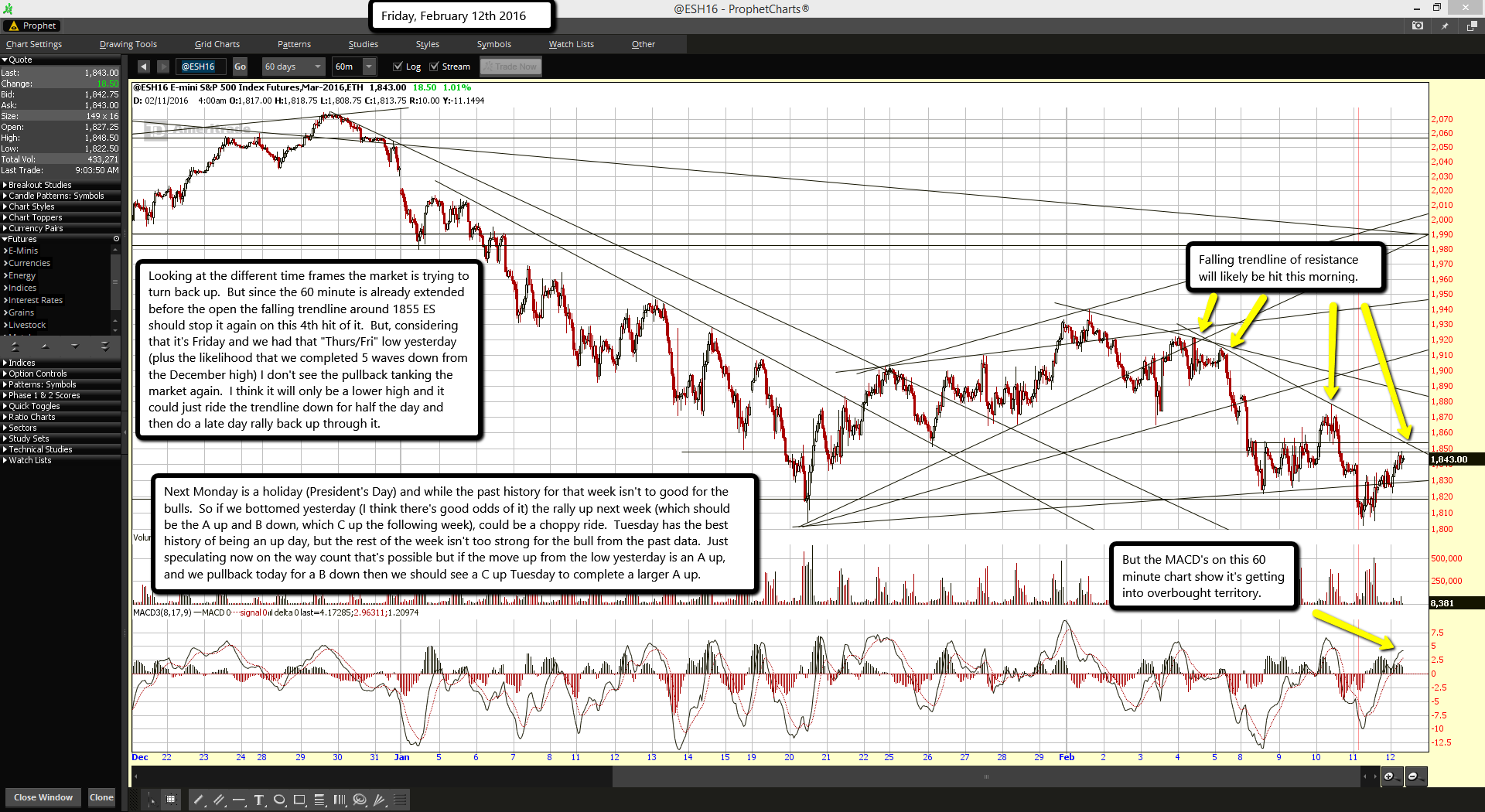
Falling trendline of resistance will likely be hit this morning.

But the MACD's on this 60 minute chart show it's getting into overbought territory.

Looking at the different time frames the market is trying to turn back up.  But since the 60 minute is already extended before the open the falling trendline around 1855 ES should stop it again on this 4th hit of it.  But, considering that it's Friday and we had that "Thurs/Fri" low yesterday (plus the likelihood that we completed 5 waves down from the December high) I don't see the pullback tanking the market again.  I think it will only be a lower high and it could just ride the trendline down for half the day and then do a late day rally back up through it.

Next Monday is a holiday (President's Day) and while the past history for that week isn't to good for the bulls.  So if we bottomed yesterday (I think there's good odds of it) the rally up next week (which should be the A up and B down, which C up the following week), could be a choppy ride.  Tuesday has the best history of being an up day, but the rest of the week isn't too strong for the bull from the past data.  Just speculating now on the way count that's possible but if the move up from the low yesterday is an A up, and we pullback today for a B down then we should see a C up Tuesday to complete a larger A up.

The problem with Whole Foods’ plans for a new grocery chain

4

[ad_1]
A customer builds a salad at the new Whole Foods Market store in downtown Los Angeles.  The year ahead could be a pivotal one for Whole Foods Market. The grocery chain is facing steep competition, and its reputation for being a wallet-buster isn’t helping.

Which likely explains the motivation behind two major efforts the company has announced to better compete in the increasingly crowded organic grocery wars. In November, it outlined plans to gin up profitable growth at existing stores by boosting its prepared foods business and offering more discounts, among other measures. And, in its biggest gamble, it is launching a new chain this year called 365 by Whole Foods Market that it hopes will appeal particularly to millennials and budget-conscious shoppers.

The twin strategies raise questions about how Whole Foods will prevent one brand of stores from cannibalizing the business of the other. And on Wednesday, the company’s latest quarterly financial results underscored what a big challenge Whole Foods faces as it tries to hang onto the organics crown.

[The popularity of organics is both good and bad news for Whole Foods]

Whole Foods reported that total sales in the most recent quarter rose 3 percent. However, sales fell 1.8 percent at stores open more than a year, and the company said that was due to both a decline in the number of transactions and a decrease in “basket size,” or in how much money was spent per transaction.

Executives said on a conference call with investors that some of the decline was because the grocer has gotten more aggressive with promotions, offering deals such as a three-day sale on supplements. Those promotions are not going away anytime soon. Whole Foods announced Wednesday it was launching digital coupons within its mobile app, and executives said they were continuing to find places to slash prices outside of temporary promotions.

“There are certain very important categories that we know that we need to be competitive on an everyday basis on and so we are working to systemically identify those and move pricing on those to make sure we’re competitive,” said A.C. Gallo, the company’s president, on the investor call.

The boost in overall sales could be attributed largely to the fact that the grocer operates more stores than it once did. But that expansion appears to be slowing. Whole Foods added 38 stores in 2016, but has plans to add about 30 in 2016, including the new 365 outposts.  In other words, that means the pressure is really going to be on for the chain to figure out how to deliver more sales from its existing stores, and from digital avenues such as its partnership with Instacart.

The renewed emphasis on price-cutting comes as Walmart, Target, Kroger and others have undercut Whole Foods with their own organics offerings. But the discount strategy is somewhat perplexing when you consider what the new 365 chain is supposed to be: Executives have billed it as a smaller store that allows the company to offer a more convenient experience and reach less affluent shoppers. If both concepts are going to be pushing hard to communicate value, are they really going to appeal to different types of customers or different shopping occasions?

That’s not an idle concern. For the third straight quarter, Whole Foods said cannibalization among existing stores contributed to a decline in sales at stores open more than a year. If 365 isn’t differentiated enough, the risk for that could only grow.

[Why supermarkets are in trouble]

Co-chief executive John Mackey sought to draw distinctions between the two chains Wednesday, pledging that traditional Whole Foods stores would be more experiential, offer more prepared foods and be a destination for innovation. On the other hand, 365 would be more convenience-oriented and offer a tightly-edited assortment of goods.

And yet, go to the website for 365 by Whole Foods, and the lines seem less clear. The website says executives are looking for partner businesses whose services or products can be incorporated in the new chain, saying: “Record shops? Tattoo parlors? Maybe!”

If 365 were to include something as decidedly experiential as getting inked, it’s hard to see how that is much different than the vibe executives want to cultivate in Whole Foods.

Still, by Mackey’s description, the relationship between Whole Foods Market and 365 is starting to sound a lot like the relationship between Walmart and its recently-folded Walmart Express concept. Walmart launched Express to help it better compete for fill-in trips and to penetrate markets and shopping centers where it wouldn’t make sense to install one of its massive supercenters. But ultimately, the concept was axed because it didn’t gain traction.

Perhaps the Whole Foods story will be different: After all, there are surely major differences between Whole Foods and Walmart when it comes to the composition and size of their existing store fleets and in the kind of shopper they are trying to court.

Whole Foods can point to other signs for optimism. It is slashing operating costs successfully, thanks in part to new labor scheduling program. And it said Christmas and Thanksgiving week results were “outstanding,” with more than a quarter of their stores pulling down over $1 million in sales during the week of each of those holidays.

“We see customers do trade up and see that they trust us with their family meal,” said David Lannon, executive vice president of operations, on the investor call.

Still, investors appear to have some doubts. Shares of Whole Foods are down 45 percent over the last year.

Sarah Halzack is The Washington Post's national retail reporter. She has previously covered the local job market and the business of talent and hiring. She has also served as a Web producer for business and economic news.

[ad_2]

Source link

The CEO of Myspace tells us why he just sold the company to Time Inc.

1

[ad_1]

Tim VanderhookMichael Seto/Business InsiderViant CEO Tim Vanderhook

Myspace surprisingly popped back into the tech headlines again on Thursday when Time Inc. announced it is acquiring the social network's parent company Viant.

Viant is a big ad tech player, founded by brothers Chris and Tim Vanderhook. Viant also owns the Specific Media ad network and an "Advertising Cloud" that connects with a database of more than 1 billion registered users.

We caught up with Viant cofounder and CEO Tim Vanderhook over the phone shortly after the deal was announced.

He explained why Viant chose to sell to a magazine company, how Myspace is about to be revitalized through the distribution of Time Inc. content, and why the doomsayers on the ad tech sector have got it wrong because more "traditional" media players — TV, magazine, and radio companies — are about to flood into the ad tech space.

Business Insider: How did the deal come about?

Tim Vanderhook: Viant was out raising money. We started raising money the end of Q1 last year, Q2 I would say, and we started looking at what we need in our business to continue to grow. What we still need to address the weaknesses of our business in the marketplace.

As we went through that process, we were talking to a number of private equity groups, but then we started to shift our focus. Money is fine and there's lots of private equity groups with available capital, but really what we needed was a strategic that we could pair up with.

We always felt like we had better data than anyone else, this incredible first-party dataset. We had great programmatic technology in an ad tech stack that's end-to-end that's been built over a decade and modified to be for people-based data. But one of the big things we saw that we were missing was quality content, or premium content.

joseph rippTime Inc.Time Inc. CEO Joseph Ripp described the acquisition of Viant as "game changing."Being able to leverage this data now in such a high-quality environment of the 60 digital properties Time Inc. has that reach in the US over 120 million people every single month. Being able to take this first-party dataset and marry that with a premium content environment, we saw as a game-changing opportunity.

We engaged with Time Inc. about six months ago when we had our first discussions with them and they were looking for a partner that could activate their first-party data that they have and were looking for a platform that they could get behind to really target ads in the same way that Facebook and Google are using registration data. They have the dataset, but they didn't have the technology platform to be able to activate against it. We had our own dataset and the technology platform, but we're missing the quality premium content on where the ads show up on exchanges that are out there today.

It really was an incredible win-win from us being able to use to combine Time Inc.'s data set with Viant's dataset, we now have the size, scale, and accuracy that Google and Facebook have from a first-party data perspective. But we have married that with high-quality content that is being produced on a daily basis across the incredible brands that Time Inc. has. We think the combination of data and premium content really raises the bar on the whole ecosystem and changes the entire landscape compared to third-party cookies, or anonymous segment cookie data that you're targeting in an open exchange that has very low viewability.

We think this is what the industry needs. Time Inc. was excited about it and so are we.

BI: That said, you did have a content platform already by way of Myspace. You were and still are a media owner. If the private equity money was there, why did you choose to sell to a media owner rather than take on more cash and build a premium content destination yourself through Myspace?

TV: Myspace is an incredible amount of first-party data where you have user accounts, and users are uploading photos and sharing them, and we manage 15 billion photos for 1 billion users online, people have written blogs in the early days of Myspace that we still host and manage, young and aspiring artists are uploading audio on a daily basis to Myspace as a platform to reach consumers, and video too.

Myspace is different. When I say premium content I'm really talking about storytelling, high-quality editorial that's representative of Time Inc. Myspace is a great publishing platform, it has incredible potential to distribute content across its network and in the social graph that exists across there

One way we've talked about historically is leveraging the email addresses that we have at Myspace and being to re-active and re-touch with consumers. But the key when you do that is having quality content that a consumer wants to read. And by being able to plug in Time Inc.'s content into Myspace as well and start pushing it through, we see synergies.

MySpaceMySpaceThe acquisition will see MySpace distributing Time Inc. content.But Time Inc. is a whole different level of quality content that I think everyone recognizes, this is an iconic company with iconic brands that have been critical in US history. So being able to leverage Myspace's distribution capability and marry that with the content production capabilities that Time Inc. has, and being able to match marketers' messages using first-party data really is game-changing and we're exciting to deliver on it.

BI: So in summary: Why try and take on money and hire in lots of journalists in order to build a media brand yourself, when there are 94-years of legacy and trust in Time's brands?

TV: That's right. I mean, look, the reality is we said we need to move from a pure-play ad tech company. We've got to have a direct relationship with consumers. It's the only way to generate first-party data and have that dataset — have a real property and real consumers that engage with you.

When the Myspace acquisition came around: You can't replicate Myspace. Can someone replicate or an invent an app in the world that reaches 1 billion users? Certainly it's in the realms of possibility but a very low probability. You also simultaneously can't just invent another Time Inc. The level of quality content, the amount they produce, the brand that they have and the consumer awareness that they have over a 94-year history can't be replicated and that's why I say Time Inc. is in a league of its own when it comes to quality content and everyone recognizes that.

BI: What happens with yourself, Chris [Vanderhook, Tim's brother and Viant cofounder and COO] and the Viant properties? Do those continue on autonomously? Do you continue on autonomously? Or are you becoming part of Time and some of these properties might be rebranded?

chris vanderhook tim vanderhookFrederick M. Brown/Getty ImagesChris Vanderhook and Tim VanderhookTV: No, not at all. We are a 100% independent company. We are run by our own board of directors. Chris and I wouldn't have done this deal if we were going to sail off into the sunset. We are incredibly excited and passionate about the opportunity of putting Time Inc. and Viant together, so we will remain as CEO and COO of Viant

What the announcement means today is that our product just got simply better. If you loved the dataset that Viant Inc. was offering last year through the Ad Cloud, you're going to be even more excited now we're able to pull Time Inc's 60 properties and all of the subscriber data they have as well too. That is a huge boost and a shot in the arm for Viant in being able to grow our database to rival that of Facebook and Google. That's one area we're really excited about.

The second area is really being able to look at the premium content opportunities and being able to marry it up with that dataset. That is something that, when we deliver it into the marketplace, people are going to recognize this really was a game-changing day when Time Inc. made this decision to get behind Viant and really contribute significantly to the strength of the assets they have. It makes them a huge player in digital advertising and I think it's really going to change the way people look at Time Inc. and look at Viant.

To directly answer your question: We're not going anywhere. We're not Time Inc. employees. We are employees of Viant, which is a subsidiary of Time Inc. — I don't know, maybe I'll have to sign a Time Inc. employment agreement, I'm not sure how that works. But we have no intention of going anywhere and we report to a board of directors. Our board changes out a bit more now with Time Inc. doing this transaction.

Time Inc.Time Inc.Time Inc.'s brands range from Fortune to Horse & Hound.

BI: Can I ask more about the transaction itself? Was it an all-cash deal? What were the terms? 

TV: Unfortunately, since Time Inc. is public company, I have to defer everything around the transaction to what they've chosen and they've chosen to not disclose any of the terms of that transaction. Any of the terms would have to run by them due to the public nature of that company.

BI: What do you think this transaction says about the ad tech market in 2016? Lots has been written by the doomsayers when you look at the majority of public ad tech stocks, and there haven't been many big exits for quite some time. Do you think this deal will help people look on the ad tech market in a different light, or do you think actually this isn't reflective of the market at all?

TV: I would say there's a couple of issues in the ad tech ecosystem in general. I think the majority of the ad tech community when you read the trades, and look at the positioning of companies, and the products, and the technology positioning, there has been a huge investment in laying the pipes and the plumbing in what you see.

Really what most companies bet on is that value creation will happen through pipes and plumbing. I think what you're seeing is that pipes and plumbing means a commodity and it's not really about pipes and plumbing — those are important — but when you have hundreds of companies that have laid the same pipes and the same plumbing that feed into exchanges, you have a commodity situation.

The value-creator in ad tech is not around the pipes and plumbing, it's around data and content. When you take first-party data, that's the highest-value data set. If you use third-party data, it's better than not having any, but it doesn't equal first-party data. I think Facebook and Google's revenue can clearly be attributed to first-party data.

 

Most Workers Don’t Think Women Get Paid Less Than Men — But They Do

2

[ad_1]

You've probably heard the phrases "pay gap" and "wage gap" more than ever in the last year, thanks to open complaints about unequal pay for women from celebrities like Jennifer Lawrence and Gillian Anderson. But that's the world of celebrity, right? It doesn't apply to regular, non-famous working people, right?Think again.

A new study by Glassdoor, out today, highlights the global perception about the gender pay gap — and there's good news and bad news.

Among the 8,254 adults from seven countries (the U.S., the U.K., the Netherlands, France, Germany, Switzerland, and Canada), Glassdoor discovered that the vast majority believes in equal pay for equal work. In fact, 93% of workers in the U.S. want to see equal compensation for employees; in Germany and the Netherlands 90% agree, and 87% are like-minded in Canada and the U.K.

But there's bad news, too: No one seems to think wage inequity is a problem where they work. Seven in 10 employees — that's men and women — in these countries believe that their current employers pay them equally.

That's very optimistic — and highly unlikely — given the facts. A recent study by the American Association of University Women (AAUW) found that in 2014, the median annual earnings in the U.S. for women and men working full-time, year-round were $39,621 and $50,383, respectively. The gap is even larger when comparing women of color to white men. It's largest for Latina women, who were paid only 54% of what white men were paid in 2014, according to the AAUW.
"There's clearly a disconnect here. There are multiple studies out there showing that there's a gender pay gap, but everyone isn’t aware of it," Scott Dobroski, Glassdoor community expert, tells Refinery29 in a phone interview. "That means there needs to be further education for men and women employees in all countries."But Glassdoor's study isn't just a wake-up call for employees. Employers need to take note: No one wants to work for a place that's known for having a gender wage gap. In fact, 67% of Americans said they're not likely to apply for a job at a company where there's a pay gap; 69% in Canada and 66% in the U.K. agree.

"Employers need to know if they’re not up front about their pay structures, that could raise a red flag for a job seeker in this day and age," Dobroski says, noting that pay information is readily available online. "Smart employers are already sharing this information with their workforce and with their candidates."
There is one way in which the U.S. differs greatly from the other six countries in the study — fewer Americans think it's the government's job to fix pay disparity.

In the U.S., 45% of employees who believe there is a gender pay gap think new workplace policies would improve the situation. But fewer than 32% of Canadians and fewer than 30% in each of the European countries surveyed agree. They want to see government policies to ensure equal compensation.

Dobroski echoes the belief of most experts — that the answer to pay disparity would be some combination of the two: government policies and employer policies — plus, employees who are educated and confident in asking questions about compensation.

He tells R29, "This idea of equal pay for equal work — it’s a global problem; it affects everyone. The responsibility is on everyone to fix it, not a single entity."

[ad_2]

Source link

Stock rout intensifies in flight to safety: Dow plunges 300+, gold surges

2

[ad_1]

Stocks are set for another sell-off today. Wall Street follow Asian markets and European equities with deep losses. Crude oil is trading below $27 a barrel.
Newslook

The 2016 stock market rout intensified Thursday with the Dow tumbling almost 400 points as investors spooked by plunging bank stocks in Europe, a further slide in oil prices and angst over Federal Reserve interest rate policy dumped stocks and fled to the safety of havens such as U.S. government bonds and gold.

The Dow Jones industrial average was down 320 points, or 2%, at midday after dropping as much 395. The Standard & Poor's 500 was off 1.7% and the Nasdaq composite was 1.2% lower and in danger of falling into bear market territory. Heading into Thursday's session the Nasdaq was down nearly 18% from its July 2015 peak of 5218.86.

The continued slide in stocks sent investors into major risk-off mode and in search of safe places to park their cash. Money piled into the 10-year U.S. Treasury note, pushing the yield down as low as 1.53%, a fresh 52-week low. Gold, often viewed as a haven during periods of market turbulence, jumped 4.3%, or more than $50 an ounce to $1,246 an ounce.

The perfect storm working against markets picked up steam overnight, with bank stocks in Europe getting crushed again after a profit warnings from French bank Societe Generale sparked fresh fears about the health of Europe banks, struggling under the weight of weak growth, low interest rates and fears of rising bad debts. Adding to the angst was another swoon in oil prices, with U.S.-produced crude slipping another 3% and below the $27 per barrel mark to $26.56.

Wall Street was also digesting comments from Federal Reserve Chair Janet Yellen's two day of testimony before Congress, which were less dovish, or market-friendly, than market participants had hoped for. While Yellen noted that recent market turbulence and slowing growth could impede the U.S. economy, she said the Fed had still not seen much evidence of a negative feedback loop at home.

Wall Street interpreted that message as a sign that the Fed is still leaving rate hikes on the table for later this year, despite pretty much ruling out a rate hike at its March meeting.

The stock rout began across the pond in Europe, with the broad Stoxx Europe 600 falling 3.2%, and shares of the German DAX dropping 2.4% and the CAC 40 in Paris down 3.3%, due in large part to a big hit to banking stocks, which as a group were down nearly 6% across Europe.

Bank stocks in Europe suffered the brunt of the selling with French bank Societe Generale falling more than 12%, German financial institution Deutsche Bank dropping more than 7% and Swiss bank UBS dipping nearly 3%.

[ad_2]

Source link

AIG Will Give Board Seats to 2 Activists Who Want a Breakup – New York Times

2

[ad_1]

Carl C. Icahn, the activist investor, will gain a seat on A.I.G.’s board. Mr. Icahn and his various investment funds own 42.7 million shares of A.I.G., or 3.46 percent.

Two billionaire investors who have been agitating for the breakup of American International Group have gotten seats at the table of the giant insurer.

Carl C. Icahn, the activist investor, and John Paulson, the hedge fund manager, will gain two seats on A.I.G.’s board, though Mr. Icahn said on Thursday that he would appoint an associate of his investment firm instead of himself because he is occupied with several other companies.

The agreement reached on Thursday will add two directors to the board at A.I.G.’s annual shareholder meeting in May, expanding the board to 16 seats from 14 seats.

The announcement puts to an end nearly four months of bitter debate between the activists and A.I.G., which has resisted calls to break apart.

The investors had been pressuring A.I.G. to split up to get out from under the federal government label of being a “systemically important financial institution,” a designation that brings extra regulatory scrutiny and costs.

But A.I.G.’s management rebuffed the idea that smaller was better. The two sides continued talking in the last few weeks.

Along with Carl C. Icahn, John Paulson, above, the hedge fund manager, will gain a seat on A.I.G.’s board.


In a statement on Thursday, Mr. Icahn said, “We continue to believe that smaller and simpler is better and look forward to working collaboratively with the board and management to help catalyze a turnaround.”

A.I.G. announced last month plans to streamline through cost-cutting, a spinoff of its mortgage insurance business and the sale of its financial advisory unit. A.I.G. is also dividing its operations into distinct units that will make them easier to sell or spin off in the future, based on their performance.

But that fell far short of the demands of Mr. Icahn and other shareholders. Mr. Icahn and his various investment funds own 42.7 million shares of A.I.G., or 3.46 percent.

In several recent securities filings, he has hinted as his plans to propose his own slate of directors. Participants in any proxy solicitation would include various funds associated with Mr. Icahn and could include Samuel Merksamer and Courtney Mather, both lieutenants of Mr. Icahn’s who have board seats at other companies in which Mr. Icahn holds a stake, the filings said.

In three letters to A.I.G.’s board and management since October, which he also released to the public, Mr. Icahn increased the pressure, saying he had the support of other investors, including Mr. Paulson, the president of Paulson & Company. He declined to comment.

They had demanded a more radical shift — the separation of A.I.G.’s life insurance business from its property and casualty division, plus the sale or spinoff of the mortgage insurance unit.

Mr. Icahn has been talking with A.I.G. management and the chairman but has expressed frustration and impatience with the pace of the talks. In November he said he would be preparing a consent solicitation for shareholders that may propose to add a new director who could succeed A.I.G.’s current chief executive, Peter Hancock.

The company’s strategic plan, outlined on Jan. 26, didn’t completely quiet the skeptics. Josh Stirling, an analyst with Sanford C. Bernstein who also has been critical of A.I.G.’s management, said in a recent research note: “We like many are torn between the incremental positives the firm revealed and the frustrating feeling that A.I.G.’s leadership does not have the vision or credibility to truly handle the job.”

A.I.G. also reported a $1.3 billion fourth-quarter loss after Thursday’s market close, or $1.10 a share.

Shares of A.I.G. fell 3.7 percent on Thursday.


[ad_2]

Source link

For Tesla and SolarCity It’s a Year of Curbing Costs, Sort of…

0

[ad_1]

Is this the year that Elon Musk’s grand plans to spend billions of dollars on upending the energy and auto industries become decidedly more sober?

On Wednesday, electric car maker Tesla Motors announced its fourth quarter and 2015 year earnings, and emphasized how the company is shooting to soon be cash flow positive and even profitable on a quarterly basis later this year.

Tesla’s new chief financial officer Jason Wheeler, who was previously Google’s vice president of finance for 13 years, said on a call that his marching orders from Tesla CEO Elon Musk were that “cash is king.” Wheeler said that he’s tasked with helping manage the growth in cash expenses this year and to help lower the costs of making its cars.

A day earlier, solar installer SolarCity Tesla, where Musk is chairman and a major investor, posted its own earnings and highlighted how the company is looking to grow much more slowly this year and reduce its reoccurring losses. SolarCity SCTY CEO Lyndon Rive, Musk’s cousin, said on their Tuesday earnings call that “the primary focus of our company in 2016 is our goal of generating positive cash by year-end.”

SolarToppingOff
Workers build SolarCity’s solar factory in upstate New York. Photograph by Philip Kamrass — Office of Governor Andrew M. Cuomo

Make no mistake, each company will continue to invest pretty heavily in growing their own businesses. Tesla plans to spend another $1.5 billion this year—about the same that it did last year—on building its battery factory, designing its low cost car the Model 3 and expanding its retail outlets. Meanwhile, SolarCity said it will actually see its losses grow in the first quarter of the year (compared to the previous year) as it spends on building out its own solar panel factory, as well as sales and marketing efforts in a brutally competitive industry.

But both companies are using markedly similar rhetoric to underscore more modest, and potentially market-friendly, goals for the year. That message is compared to a year ago, when Musk almost casually threw out that Tesla would spend “a staggering amount” of money in the year to grow into a company that could have the same valuation as Apple AAPL

One reason for the sober messages could be because of the volatility in the stock market and fears over a broader tech and general economic downturn. Musk was running Tesla, helping with SolarCity, and funding both companies, through the global recession of 2008, and has often recalled the extreme hardships of those years as outside financing abruptly dried up. Both companies were at the point of shuttering at times in those years.

Does Musk see a hard macro year ahead that could batter his companies? Indeed, rock bottom oil prices have started to put pressure on consumer demand for electric cars, which could affect Tesla.

SolarCity has faced its own hurdles in recent months. Some utilities and state regulators have pushed for new policies that make solar panels less attractive to consumers. Following such a policy in Nevada, SolarCity pulled out of the state, losing some important business there in the short term.

Get Data Sheet, Fortune’s technology newsletter.

Individually, Tesla and SolarCity’s stocks have both plummeted since the beginning of the year. Musk has lost hundreds of millions of dollars, if not billions, in personal wealth on his investments.

Each company has now passed the decade mark. Tesla is thirteen years old, while SolarCity is ten. They’ve both been public companies for years now.

At some point, investors expect a turn of the ship when it comes to expenses, losses and positive cash flow. Looks like this could be the year, at least in message, which the companies are starting to try to prove that they’re economically sustainable, not just environmentally sustainable.

That said, both companies are still attempting to disrupt much larger, entrenched industries. Tesla’s 100,000 electric cars on roads is a small drop in the bucket of global car sales. The energy generated by the solar panels that SolarCity installed last year is on par with one large natural gas or nuclear plant. Such disruption, will no doubt take a lot more cash to fund.

[ad_2]

Source link

Google’s UK tax grilling was more a way to vent public anger than to reach a greater truth

0

[ad_1]

If 2015 was a year of transatlantic tussles between U.S. tech firms and E.U. lawmakers, 2016 is shaping up to be more of the same.

Google faced yet another grilling today by the U.K. Parliament’s Public Accounts Committee over the way the company pays taxes. This follows the 2012 public tax-avoidance probe by the Committee into Google, Amazon, and Starbucks over the way they set their businesses up to minimize the amount of tax they pay.

The latest brouhaha centered on Google’s recent deal with the U.K. tax body HMRC, which would involve Google paying £130 million ($190 million) in back taxes covering a 10-year period. This has been labeled a “sweetheart deal” and “derisory” by critics, so as a result of the uproar, Matt Brittin, president of Google Europe, Middle East, and Africa, and Tom Hutchinson, a tax expert and vice president at Google, were called to give their side of the story.

Matt Brittin: Google

The tone of the Q&A was aggressive from the offset, with Meg Hillier, chair of the Public Accounts Committee, becoming almost personally abusive toward Brittin.

The overall goal of the hearing was to establish one thing: Google has a lot of money, and it’s not paying enough tax into the U.K. coffers. After agreeing that the U.K. accounts for 11 percent of Google’s sales globally, with revenues over the past 18 months of £1.18 billion and profits of £106 million, things moved on to Mr. Brittin himself.

Meg Hillier (MH): “Mr. Brittin, we’re here, the tax payers in Britain — do you hear the anger and frustration out there, that with those huge figures, that you settled for a figure of £130 million?”

Matt Brittin (MB): “Absolutely, and I welcome the chance to come and talk to you about this. I understand the anger.”

MH (voice getting louder): “Do you really understand the anger Mr. Brittin? What do you get paid Mr. Brittin?”

MB: “If that’s relevant, I’ll happily disclose that to the committee.”

MH: “No, I’m asking you what you get paid.”

MB: “I don’t have the figure, but…”

MH: “You don’t know what you get paid? Tax payers, our constituents, are very angry — they live in a different world to the world that you live in, if you can’t even tell us what you’re actually paid. I wonder if you’ve got tin ears? That you can’t hear this? You went out there publicly to parade this tax deal…”

Brittin calmly interjected to reiterate his understanding of Britain’s anger, but the tone of the subsequent discussion was set. Oftentimes it appeared that members of the committee, of various political persuasions, were rounding on the Google duo more as a way of venting public anger at the company than in any attempt to establish a greater “truth” behind the company’s tax affairs.

The bottom line is that we already knew the answers to most of the questions, because Google has trotted out the same answers a million times before: Its complex global setup, which involves subsidiaries in Bermuda, Ireland, and elsewhere, may well be “tax-efficient,” but it operates entirely within the legal frameworks permitted by the countries involved. Tax experts on Twitter were quick to counter Google’s well-rehearsed responses, but ultimately that will count for squat.

After Google left the stage, the panel questioned HMRC officials about the £130 million settlement, the result of a six-year investigation. In explaining why Google wasn’t fined for “underpaying” previously, Jim Harra, HMRC’s head of business taxation, explained simply that proving deliberate deceit “was very difficult.”

In short, we didn’t learn a whole lot of new facts today about Google’s so-called tax avoidance, but we did receive a big reminder that the knives are out for the Internet giant. Whether this ultimately translates into more tax being paid remains to be seen.

Elsewhere in Europe, news emerged yesterday that Google and other search engines will have to expand the scope of compliance with “right-to-be-forgotten” legislation, which means that search results in such cases will be scrubbed from all global variants of search engines for web users in any E.U. country.

To recap, the right-to-be-forgotten ruling was designed to help individuals hide web pages that hosted irrelevant or out-of-date information about them. However, the ruling so far has meant that only E.U. versions of search engines — such as .co.uk, .de, or .fr — were impacted. With the latest development, which is the result of a request made by France last year, search engines will have to de-index web pages from all local search portals, including Google.com.

Google filed a public appeal against France’s initial request last year. “This is a troubling development that risks serious chilling effects on the Web,” Peter Fleischer, global privacy counsel at Google, said at the time. But the French regulator rejected these objections and said that if Google did not comply it would recommend sanctions or fines against the company. It wasn’t clear who would emerge victorious from this standoff, but if these latest reports prove to be correct, it seems we may have a winner.

We’re only six weeks into the new year, but 2016 is shaping up to be another turbulent twelve months of wrangling between U.S. tech companies and Europe officials, with issues such as Android and anti-competition still to be resolved, not to mention the renegotiation of the Safe Harbor data-transfer pact, which has yet to be finalized.

[ad_2]

Source link

s2Member®