Friday, October 23, 2026
Home Blog Page 105

Despite billions in fresh cash, Symantec will cut costs and go into debt

0

[ad_1]

Symantec Inc. just completed the sale of its Veritas storage business for $5.3 billion in after-tax proceeds, following a late discount. On Thursday, the security-software company also announced a fresh investment of $500 million from Silver Lake Partners.

This company appears to be rolling in gold like Scrooge McDuck, so how does it celebrate? By cutting costs, including potential future staff changes, and going into debt.

Huh?

Basically, Symantec SYMC, -0.52% will push all of the proceeds from the Veritas sale back to investors, with plans for an immediate special dividend of $4 a share — costing $2.7 billion — and $2.3 billion in share buybacks, which adds to $2.1 billion in stock repurchases executed since April 2014. Because some of the proceeds of the Veritas deal are overseas, Symantec will use Silver Lake’s $500 million — which will get the investment firm a board seat — as well as raise debt to pay off its total $5.5 billion shareholder-return plan, the company confirmed Thursday.

Meanwhile, Symantec will look to cut $400 million in costs from its business during the next two years, a process that could eventually include layoffs.

“Over a two-year time period, we will achieve most of the cost savings in a few ways — removing stranded costs from the Veritas sale, continuing to modernize our infrastructure, simplifying our processes and managing our portfolio,” a Symantec spokesperson said. “These efforts may change the way we work and, in some cases, change the need for, or scope of, certain roles.”

The cash return to investors can be seen as payback for believing in Symantec during a rough few years, as the company struggled to succeed with Veritas — which it agreed to buy in 2004 for nearly twice what it agreed to sell it for in 2015 — and saw young startups capitalize on businesses’ growing security needs while Symantec focused on a shrinking consumer business.

Symantec Chief Executive Michael Brown has refocused the business on enterprise sales, but revenue and profit continue to shrink. Quarterly results released Thursday showed sales dropped 6% from the same quarter a year ago, and net income fell 23%. Through three quarters of its fiscal year, Symantec sales have fallen 11% against the year before, while profit has declined 37%.

“Overall, growth remains a challenge for Symantec, but cost cutting is exactly what the doctor ordered and investors will like this news,” FBR Capital Markets analyst Daniel Ives said Thursday afternoon, adding that the Silver Lake investment will also be welcomed by the Street.

Investors’ payback comes with a big cost, however: Symantec’s war chest for potential acquisitions.

As the company rebuilds its business with a focus on selling to companies instead of consumers, a necessity as attackers have increasingly moved to large-scale attacks against corporate networks, it could have shopped for fresh talent among the gaggle of security startups in Silicon Valley and beyond. Startup valuations appear to be adjusting to a point where acquisitions would be more palatable for established companies like Symantec, but the type of move that could make a significant difference will be difficult without cash to close the deal.

Brown said the capital-return program won’t limit flexibility for acquisitions, but admitted that recent small acquisitions were the model for future moves.

“We’re going to continue to be very judicious as we think about, ‘What are the right assets?’” Brown said on Thursday’s conference call. “They need to be tightly aligned with the strategy and they need to make financial sense.”

Going into debt while bringing in nearly $6 billion doesn’t seem to make financial sense, but investors jumped at the short-term rewards Symantec promised Thursday, pushing the stock 9% higher in after-hours trading. That move takes only a small bite out of Symantec’s 25.1% drop over the past year, however, and the security firm will still have to figure out its long-term growth issues without the financial ammunition its latest deals could have provided.
[ad_2]

Source link

Existing Homeowners Are Not Taking Advantage of Historically Low Rates

0

[ad_1]

MoneyJust when the industry thought mortgage interest rates could not get any lower, they dropped further for the fifth consecutive week to unexpected lows.

This might seem to provide existing homeowners with a perfect chance to refinance; however, the data suggests that they are not taking advantage of this opportunity.

Freddie Mac's Primary Mortgage Market Survey (PMMS) showed that mortgage rates deceased "amid ongoing market volatility" and troubled Treasury yields. The report showed that the 30-year fixed mortgage rate is at its lowest point since April 30, 2015 when it averaged 3.68 percent.

For the week ending February 4, 2016, the 30-year fixed-rate mortgage (FRM) averaged 3.72 percent with an average 0.6 point, according to the survey. Last week it averaged 3.79 percent and a year ago at this time, the 30-year FRM averaged 3.59 percent.

Freddie Mac said that the 15-year FRM this week averaged 3.01 percent with an average 0.5 point, down from 3.07 percent last week. One year ago, the 15-year FRM averaged 2.92 percent.

The 5-year Treasury-indexed hybrid adjustable-rate mortgage (ARM) averaged 2.85 percent this week with an average 0.4 point, down from last week when it averaged 2.90 percent, the report noted. A year ago, the 5-year ARM averaged 2.82 percent.

pmms_chart (1)"These declines are not what the market anticipated when the Fed raised the Federal funds rate in December," said Sean Becketti, Chief Economist at Freddie Mac. "For now, though, sub-4-percent mortgage rates are providing a longer-than-expected opportunity for mortgage borrowers to refinance."

Becketti continued, "Market volatility—and the associated flight to quality—continued unabated this week. The yield on the 10-year Treasury dropped another 15 basis points, and the 30-year mortgage rate fell 7 basis points as well, to 3.72 percent. Both the Treasury yield and the mortgage rate now are in the neighborhood of early-2015 lows."

Although mortgage interest rates continue remain at historical lows, however, potential buyers and refinancers are steering clear of the housing market.

For the week ending January 29, 2016, mortgage applications decreased 2.6 percent from one week earlier, according to the Mortgage Bankers Association's (MBA) Weekly Mortgage Applications Survey.

Matthew Pointon, Property Economist at Capital Economics, noted that the low interest rates "might seem counterintuitive given that the Fed hiked interest rates in December. But the flight to safety triggered by the turmoil in the oil and equity markets has pushed down Treasury yields and therefore mortgage rates. And although we think rates will increase this year, a strong labor market and easing in lending standards will ensure applications for home purchase see further gains."

[ad_2]

Source link

‘Pharma bro’ Shkreli stays silent before Congress, calls lawmakers ‘imbeciles’ in tweet

0

[ad_1]

Martin Shkreli, the controversial former CEO known as "Pharma Bro," was subpoenaed to testify on Capitol Hill Feb. 4., but repeatedly invoked his Fifth Amendment right not to incriminate himself. (AP)

This story has been updated.

Martin Shkreli has left the building.

Shkreli, the former chief executive of Turing Pharmaceuticals, who gained notoriety for jacking up a little-known drug's price, was excused from a House hearing on drug prices after he refused to answer any questions -- other than how to pronounce his name correctly, or to confirm that, yes, he was listening.

After minutes of refusal to answer questions, during which Shkreli fidgeted, looked away and appeared to smirk at times, he gave his parting remarks on Twitter:

Five minutes were set aside for opening remarks that could shed light on Shkreli's controversial decision to raise the price of Daraprim, a drug for a rare but severe infection that afflicts people with compromised immune systems. But Shkreli declined to make any. Instead, Rep. Jason Chaffetz (R-Utah), chairman of the House Committee on Oversight and Government Reform, began asking him questions about patients affected by the price and remarks he had made previously. Shkreli gave the same composed answer to each question:

"On the advice of counsel, I invoke my Fifth Amendment privilege against self-incrimination and respectfully decline to answer your question," Shkreli said. Repeatedly.

Shkreli didn't come willingly to Thursday's hearing. He was compelled by a subpoena that he threatened to ignore and that his lawyers argued against vehemently.

Wearing a slim-cut black jacket, Shkreli sat at the end of a row of witnesses called before the committee with hands folded, fidgeting a bit and smiling uncomfortably at times -- tics his attorney, Benjamin Brafman, called the "nervous energy" of the 32-year-old former hedge fund manager, not meant to show disrespect to any member of Congress.

Rep. Elijah Cummings (D-Md.) described Turing as a "Ponzi scheme" in his opening remarks, saying the research and development that Turing has claimed it is doing to justify its high prices is simply research on which new drugs it could acquire to raise their prices.

Shkreli smirked.

"It's not funny, Mr. Shkreli. People are dying," Cummings said.

During a hearing on drug pricing Feb. 4, Rep. Elijah Cummings (D-Md.) told controversial hedge fund manager Martin Shkreli that steep drug price rises are "not funny" because "people are dying." (AP)

One of the few questions he did answer, asked by Rep. Trey Gowdy (R-S.C.), was whether the congressman had pronounced Shkreli's last name correctly.

When Gowdy told Shkreli he could answer questions without incriminating himself, since they would not bear on the securities fraud charges being brought against him in a separate matter, he said, "I intend to follow the advice of my counsel, not yours."

Eventually, Shkreli was excused, trailed by a media scrum.

The hearing focused on two companies that drove up the price of drugs they didn't invent -- by more than 5,000 percent in the case of Daraprim. After Shkreli's departure, the rest of the witnesses testified. Among them was Turing's current chief commercial officer, Nancy Retzlaff. Howard Schiller, the interim chief executive of Valeant Pharmaceuticals International, another company that has been accused of operating more like a hedge fund than a drug company, appeared. Janet Woodcock, the director of the Center for Drug Evaluation and Research at the Food and Drug Administration, and Mark Merritt, the president of the Pharmaceutical Care Management Association, a trade group that represents pharmacy benefit companies, was also present.

Turing and Valeant both turned over tens of thousands of pages of documents. Some highlights were presented in two memos released earlier this week. Although there are fascinating details taken from internal emails that draw back the curtain on the tactics of drug pricing, the main finding thus far is simple: Both companies strove to maximize profits.

There are still thousands of pages of documents for the committee to mine for clues about how to prevent a practice that has been called "price gouging." But at least so far, the evidence appears to echo the revelations of a previous Senate investigation of an $84,000 hepatitis C drug. That company, Gilead, also sought to maximize profits, even as its price affected patients' access to the drug.

High drug prices hit a nerve with the public and with politicians, but so far, congressional hearings have generated lots of buzz and few solutions.

Carolyn Johnson is a reporter covering the business of health. She previously wrote about science at The Boston Globe.

[ad_2]

Source link

Stocks rise for 2nd straight day as Dow up 80

0

[ad_1]

If you like roller coaster rides, 2016 has been your type of stock market. When will the volatility end? Adam Shell with America’s Markets.

Financial markets remained volatile Thursday as the Dow and S&P 500 managed to close higher for a second straight day in choppy trading.

U.S. stocks are fighting to gain traction in the new year, as a growth scare continues to hang over global markets and volatility in the energy patch persists.

The Dow Jones industrial average rose 80 points, or 0.5%, to close at 16, 417 and the broader Standard & Poor's 500 stock index managed to post a 0.1% gain, rising 2 points to 1915. The tech-heavy Nasdaq composite rose 6 points, or 0.1%, to 4510.

Volatility in oil prices continued to keep markets on edge as oil prices pulled back after surging 8% Wednesday. After falling as low as $31.68 per barrel earlier in the session Thursday, the price of U.S.-produced crude jumped as high as $33.60 before retreating again to close at $31.72, down 1.7%.

Investors encountered some fresh negative news on economic growth in the U.S. and the eurozone. Citing a slowdown in China and emerging markets and negative fallout from the refugee crisis, the European Union trimmed its 2016 eurozone growth forecast to 1.7%, down from 1.8%.

The EU growth downgrade dragged down shares in Europe, where Germany's DAX index fell 0.4% and the broad Stoxx Europe 600 was off 0.1%.

Mixed U.S. economic data added to the more pessimistic sentiment. Initial jobless claims in the most recent week rose 8,000 to 285,000 and fourth-quarter 2015 U.S. productivity fell 3%, worse than the 2% drop expected.

Not even continued weakness in the U.S. dollar -- which had been super strong this year and hurting commodities and U.S. multinationals in the process -- could lift stocks Thursday. After a sizable drop in the dollar Wednesday, the Wall Street Journal dollar index was down another 0.9% against a basket of foreign currencies Thursday and the euro spiked higher versus the dollar.

Asian stocks were were mixed. Shares of Japan's Niikei 225 fell 0.9%, while stocks in Hong Kong rose 1% and shares in mainland China's Shanghai composite jumped 1.5%.

[ad_2]

Source link

Media mogul Sumner Redstone resigns from Viacom, a day after stepping down at CBS – Washington Post

0

[ad_1]
A day after stepping down from CBS Corp. amid reports of declining health, media mogul Sumner Redstone on Thursday also resigned as board chairman at Viacom, the massive entertainment company he controls that includes cable channels such as MTV and Nickelodeon and the Paramount Movies studio.

But unlike at CBS, where longtime CBS executive Leslie Moonves took over with widespread support, the Viacom transition already has hit a bump, revealing a rift in Redstone’s sprawling media empire – which he built over 50 years from a small chain of movie theaters into a conglomerate worth $40 billion.

Viacom’s board elected Viacom CEO Philippe Dauman, the protégé of the 92-year-old Redstone, to the vacated leadership post over the objections of Redstone’s daughter Shari Redstone. She cast the lone dissenting vote. Her father voted in favor of Dauman.

Shari Redstone, who holds the title of vice board chair, lodged her objections to Dauman in a statement issued Wednesday, saying the company needs an independent leader not connected with the Redstone family trust.

The Redstone family company National Amusements owns about 80 percent of the voting stock in both CBS and Viacom. Upon Redstone’s death, the stake in National Amusements is set to pass to a trust controlled by seven trustees, including Shari Redstone and Dauman.

Doubts about future control of the family company have grown alongside reports of Redstone’s health problems.

He stopped making public appearances about a year ago. In November, a former longtime companion of Redstone named Manuela Herzer alleged in a Los Angeles court filing that his mental acuity had been diminished to “faint shadows of what they had once been for the once vital, towering figure.” That characterization was countered by Dauman, among others, who asserted the mogul was alert and attentive.

The dispute comes as Viacom’s media properties have struggled in the face of intensifying competition. Viacom’s stock price has plummeted 33 percent since April.

After the board’s vote on Thursday, Shari Redstone vowed to continue the fight.

“Shari is going to continue to advocate for what she believes to be in the best interests of Viacom shareholders,” her publicist said in a statement.

Viacom board member William Schwartz issued a statement supporting Dauman, saying in part: “In choosing a successor to Sumner, the Board considered the need for seasoned leadership in this time of unprecedented change, Philippe’s business experience and unparalleled knowledge of Viacom, and his long-term vision for the Company. We believe his becoming Executive Chairman is in the best interests of the company and all shareholders.”

Todd C. Frankel is a reporter covering people and policy. You can follow him on Twitter: @tcfrankel.

[ad_2]

Source link

ES Morning Update February 5th 2016

0

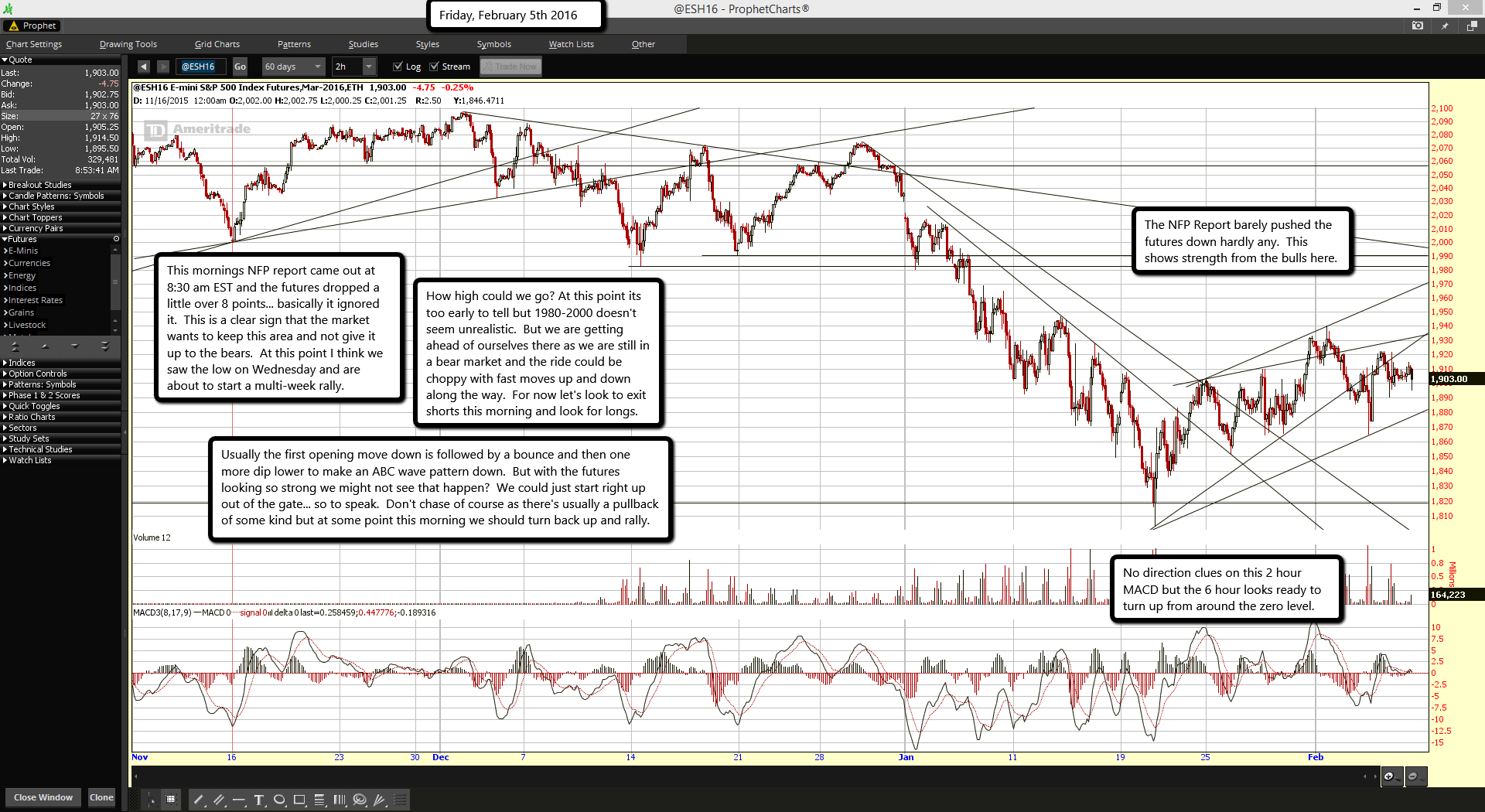
07a927ef-1890-4693-ad18-02bc48cacb88The NFP Report barely pushed the futures down hardly any.  This shows strength from the bulls here.

No direction clues on this 2 hour MACD but the 6 hour looks ready to turn up from around the zero level.

This mornings NFP report came out at 8:30 am EST and the futures dropped a little over 8 points... basically it ignored it.  This is a clear sign that the market wants to keep this area and not give it up to the bears.  At this point I think we saw the low on Wednesday and are about to start a multi-week rally.

How high could we go? At this point its too early to tell but 1980-2000 doesn't seem unrealistic.  But we are getting ahead of ourselves there as we are still in a bear market and the ride could be choppy with fast moves up and down along the way.  For now let's look to exit shorts this morning and look for longs.

Usually the first opening move down is followed by a bounce and then one more dip lower to make an ABC wave pattern down.  But with the futures looking so strong we might not see that happen?  We could just start right up out of the gate... so to speak.  Don't chase of course as there's usually a pullback of some kind but at some point this morning we should turn back up and rally.

SS UNITED STATES To Crystal?

0

[ad_1]

After 47 years, the impossible dream may finally be realized for a retired American icon. Will she sail again?

When the SS United States Conservancy announced that there were new plans for the salvation of the SS United States, most understandably assumed that meant in some sort of static form as a casino, hotel or even an office space/floating storage unit. For most, just seeing the ship get a second chance at life again was enough. But this morning, hope arises once more that the historic liner will actually sail again.

P1040626 copy

Indeed, there was a cryptic message from a friend aboard the CRYSTAL SERENITY last night leaking the news but now it is official: Crystal Cruises has announced that it intends to “Save The SS UNITED STATES”!

Why does this make sense? Over a decade ago, there were many studies done to attest whether the ship could be re-purposed for cruising under the NCL banner. At that time, the ship’s then-owner, Norwegian Cruise Line, was a subsidiary of Genting-owned Star Cruises, whose chairman Tam Sri Lim Kok Thai was especially keen on the project. Now that Genting owns Crystal, the dream is alive again and yet more feasible especially since Genting also owns the Lloyd Werft shipyard in Bremerhaven.

After being “dormant” for years, Crystal is already in the midst of an unprecedented expansion under Genting with a luxury airline, a new “yacht” cruise ship, a deluxe river cruise line and two giant Polar-class luxury cruise newbuilds on its plate. The SS UNITED STATES’ revival would actually add a completely new facet to the company in that the ship was built in the U.S. and could operate between U.S. ports to comply with the Jones Act.

The return of the ship to active cruising is not set in stone. But for now, there is hope as Crystal covers the ship’s $60,000 per month mooring fees in Philadelphia to conduct a new feasibility study. If all goes as intended, a few purists will have their field day as the SS UNITED STATES will not re-emerge as the same ship but as a vastly rebuilt, modern cruise ship that accommodates a mere 800 guests. According to the press release, “She will boast 400 suites measuring approximately 350-square-feet with dining, entertainment, spa and other luxury guest amenities that are true to the ship’s storied history. Features of the original SS United States such as the Promenade and Navajo Lounge will be retained, while new engines and sophisticated marine technology will be installed to maintain her title as the fastest cruise vessel in the world.”

United States by Crystal Cruises in NYC copy

Proposed itineraries for the SS UNITED STATES would include transatlantic voyages and cruises from key U.S. ports as well as world cruises.

“Crystal’s ambitious vision for the SS United States will ensure our nation’s flagship is once again a global ambassador for the highest standards of American innovation, quality and design,” said Susan Gibbs, executive director of the SS United States Conservancy and granddaughter of the ship’s designer, William Francis Gibbs. “We are thrilled that the SS United States is now poised to make a triumphant return to sea and that the ship’s historical legacy will continue to intrigue and inspire a new generation.”

“The prospect of revitalizing the SS United States and reestablishing her as ‘America’s Flagship’ once again is a thrilling one. It will be a very challenging undertaking, but we are determined to apply the dedication and innovation that has always been the ship’s hallmark,” says Crystal President and CEO Edie Rodriguez. “We are honored to work with the SS United States Conservancy and government agencies in exploring the technical feasibility study so we can ultimately embark on the journey of transforming her into a sophisticated luxury cruise liner for the modern era.”

Adds Rodriguez: “It is truly a privilege for the world’s most awarded luxury cruise line to be entrusted with the opportunity of restoring a ship that served as a symbol of patriotism and maritime supremacy and bring her into the modern day, while also giving guests a taste of a bygone era of luxury travel.”

Crystal has appointed retired U.S. Coast Guard Rear Admiral Tim Sullivan to head the project. According to the press release, “With 36 years of active service, Admiral Sullivan has extensive experience in ship operations as a Commanding Officer of numerous Coast Guard cutters, and over the years has engaged in high level of interaction with a myriad of U.S. government agencies and international regulatory entities.”

“Tim’s integrity and leadership will help ensure the feasibility study is conducted with appropriately wide consultation, and rigorous adherence to both safety and environmental awareness,” said Rodriguez.

Meanwhile, according to the press release, “The Conservancy will continue to expand its curatorial and archival collections as it advances its mission of educating the public about the SS United States’ history. The organization will work with Crystal to establish shipboard displays and other educational programs. Planning is also underway for a land-based museum dedicated to preserving the legacy of America’s Flagship along with broader design, innovation, and discovery themes. The museum will feature a wide range of original artifacts and historic components from the ship’s heyday.”

By coincidence, MaritimeMatters’ Co-Editor Peter Knego has just disembarked Crystal Cruises’ award-winning, deluxe CRYSTAL SERENITY and is in the midst of posting reports from the voyage, a seventeen night Miami to Los Angeles transcanal sailing.

[ad_2]

Source link

‘It’s not funny, Mr. Shkreli’: Drug exec grins before Congress

0

[ad_1]

Drug executive Martin Shkreli, who vigorously defends his decision to hike the price of a life-saving drug, went silent and smirked as he appeared at a Congressional hearing on Thursday.
VPC

Embattled drug entrepreneur Martin Shkreli — who vigorously defended his decision to hike the price of a life-saving drug from $13.50 to $750 — suddenly went silent Thursday at a Congressional committee, smirking and grinning instead of answering questions.

Now facing an unrelated federal criminal indictment, the typically loquacious Shkreli refused to testify, repeatedly citing his Fifth Amendment right not to incriminate himself.

Members of Congress launched into fiery lectures directed at Shkreli, whose previous company, Turing Pharmaceuticals, came under scrutiny when it raised the price of Daraprim more than 5,000%.

"Drug company executives are lining their pockets at the expense of some of the most vulnerable families in our nation," U.S. Rep. Elijah Cummings, D-Maryland, said. "It's not funny, Mr. Shkreli. People are dying and they're getting sicker and sicker."

The boyish-faced Shkreli sat quietly at the witness table, clasping his hands tightly and slowly rubbing his fingers together as he was lectured. He smirked several times and appeared on the verge of laughter at one point when Cummings was speaking.

After the hearing, he removed any doubt about his feelings.

"Hard to accept that these imbeciles represent the people in our government," Shkreli said on Twitter, where he proceeded to retweet several users who posted supportive messages.

Pelted with hostile questions, Shkreli repeatedly recited a prepared statement that he would not testify on the advice of his counsel. He is facing multiple criminal securities charges over allegations that he took stock from a previous biotech company to pay off business debts and lied about the investment returns of his former hedge fund.

U.S. Rep. Trey Gowdy, R-South Carolina, professed to be flabbergasted at Shkreli's silence on drug-price-hiking issues, telling the entrepreneur that he could testify on those matters without incriminating himself.

"I intend to follow the advice of counsel, not yours," Shkreli told Gowdy.

At one point, Shkreli's attorney, Ben Brafman, stood up in the crowd and tried to intervene. But U.S. Rep. Jason Chaffetz, R-Utah, chairman of the committee, quickly rejected Brafman's efforts.

"No you are not recognized and you will be seated," Chaffetz said.

After less than an hour, Chaffetz dismissed Shkreli from the hearing since he was refusing to say anything.

In a brief press conference afterward, Brafman sought to explain Shkreli's dismissive facial expressions, saying his client was just "nervous." Shkreli did not comment during the press conference, but tweeted moments later.

In days before the hearing, he blasted Congress and made sarcastic jokes on Twitter about the subpoena he received to testify.

"I'm not going to say anything other than the 5th Amendment," he said recently. "They just want this to be a circus."

U.S. Rep. Buddy Carter, R-Georgia, the only pharmacist in Congress, said during the hearing that he supports free-market principles but was "disgusted" by drug-price-hiking companies.

"What was done here was different," Carter said. "Perverse business practices were employed."

The charismatic persona that Shkreli has cultivated — paying $2 million for the only copy of a new Wu Tang Clan album and setting up a web cam to film himself working — amplified the tension with Congress.

"People in my district are not on the Forbes billionaire list — they can’t buy Wu Tang Clan albums for $2 million," Cummings said. "Like many Americans they struggle every single month to pay for the increasing cost of housing, education and health care. They live from paycheck to paycheck and sometimes from no check to no check."

In addition to Shkreli, several other executives were also set to appear before the committee.

Howard Schiller, interim CEO of Valeant Pharmaceuticals, which has also come under fire for its business model and drug prices, cited the company's recent price-cutting deal with Walgreens as an example of its responsiveness.

"We’re listening and we’re changing," he said. "We have more to do."

Schiller pledged that any future drug price increases would be "much more modest" than the increases that enraged Congress.

[ad_2]

Source link

Lawmakers anxious to hear from Shkreli, but he’s taking 5th

0

[ad_1]

WASHINGTON (AP) — Pharmaceutical chief Martin Shkreli has arrived at a hearing where U.S. lawmakers want to hear from about severe hikes for a drug sold by a company that he acquired.

But it's unlikely the former CEO of Turing Pharmaceuticals will answer questions in his appearance Thursday before the House Oversight and Government Reform Committee. Shkreli, widely scorned for hiking the price of a long-established and potentially lifesaving drug by more than 5,000 percent, has said he's exercising his Fifth Amendment right against self-incrimination.

[ad_2]

Source link

Wells To Pay $1.2 Billion In Mortgage Accord

0

[ad_1]

(FROM THE WALL STREET JOURNAL 2/4/16)

By Emily Glazer, Aruna Viswanatha and Joe Light

Wells Fargo & Co. said Wednesday that it would pay $1.2 billion to settle a long running mortgage-lending suit by regulators that the bank had previously vowed to fight.

The plan announced Wednesday dealt with civil charges brought by the Justice Department, two U.S. attorneys and the Department of Housing and Urban Development. It would be one of the largest FHA-related settlements on record.

Regulators settled with other big U.S. banks on the FHA issues more than a year ago. The $1.2 billion, if finalized, would be Wells Fargo's third-largest fine, following $5.3 billion in the industrywide 2012 National Mortgage Settlement, and $1.95 billion in 2013 over foreclosures.

Wells Fargo, the world's largest bank by market value, hasn't paid as many large fines for mortgage-related abuses as its peers. In this case, however, the legal tab grew after the disintegration in 2014 of earlier settlement talks focused on a deal worth less than $500 million.

The latest negotiations started gaining traction late last year, people familiar with the matter said. The price tag grew as the investigation broadened to include more regulators and a 10-year time frame through 2010, these people said.

The Justice Department has led the negotiations for the government.

In the talks, Wells Fargo wanted to settle as much as possible to avoid future fines over similar topics, these people said. The government came back with a figure around $1.5 billion and the sides negotiated to reach $1.2 billion, the people said. Wells Fargo executives met to discuss the settlement late last week, people familiar with the discussions said.

The government's suit claimed Wells Fargo improperly certified certain FHA mortgage loans for HUD insurance that didn't qualify for the program. The government further argued Wells Fargo shouldn't have received insurance proceeds from HUD when some of the loans later defaulted.

The government earlier said the bank may have known that some of the mortgages didn't qualify for the insurance, and Wells Fargo didn't disclose those deficiencies to HUD before making the insurance claims.

The bank had previously indicated it would fight the case and denied the allegations when the government brought its case in 2012. It is unclear whether the bank will admit any allegations as part of the settlement.

Last February, the bank said the long-running lawsuit would take longer to resolve after settlement discussions fell apart, leaving the bank "again engaged in discovery," according to a securities filing at the time.

As a result of the tentative pact, Wells Fargo said it has added to its legal accrual for 2015. That reduces its profit for last year by $134 million, or three cents a share. The company's 2015 profit is now $22.9 billion, or $4.12 a share.

The FHA program backs mortgages with a down payment of as little as 3.5% and a credit score of 580, on a scale of 300 to 850, making it one of the most popular avenues for homeownership for first-time home buyers and others with little wealth.

Over the past several years, the Justice Department and FHA have sought major settlements from lenders for errors made on the loans, using the federal False Claims Act, a Civil War-era law that allows the government to collect treble damages. The Justice Department also has used a savings-and-loan crisis-era law to heighten financial penalties.

In 2014 other U.S. banks announced fines over similar issues, including Atlanta-based SunTrust Banks Inc., Bank of America Corp. and J.P. Morgan Chase & Co.

Some bank officials have said the government has pursued them for huge damages even for minor errors. Partly as a result, some major banks have pulled back from the FHA program by imposing their own more stringent requirements on FHA
loans.

[ad_2]

Source link

Home Depot Inc (HD) Lifted to Buy at Vetr Inc.

0

[ad_1]

Home Depot Inc (NYSE:HD) was upgraded by research analysts at Vetr from a “hold” rating to a “buy” rating in a report issued on Wednesday, MarketBeat reports. The brokerage currently has a $130.17 target price on the home improvement retailer’s stock. Vetr‘s price objective suggests a potential upside of 5.15% from the stock’s previous close.

A number of hedge funds have bought and sold shares of HD. Wedbush Securities Inc. raised its stake in Home Depot by 12.6% in the fourth quarter. Wedbush Securities Inc. now owns 17,078 shares of the home improvement retailer’s stock valued at $2,259,000 after buying an additional 1,913 shares during the last quarter. IFC Holdings Incorporated FL raised its stake in Home Depot by 163.6% in the fourth quarter. IFC Holdings Incorporated FL now owns 59,149 shares of the home improvement retailer’s stock valued at $7,833,000 after buying an additional 36,708 shares during the last quarter. Leisure Capital Management raised its stake in Home Depot by 0.8% in the fourth quarter. Leisure Capital Management now owns 20,633 shares of the home improvement retailer’s stock valued at $2,729,000 after buying an additional 167 shares during the last quarter. Penobscot Investment Management Company Inc. raised its stake in Home Depot by 179.6% in the fourth quarter. Penobscot Investment Management Company Inc. now owns 10,235 shares of the home improvement retailer’s stock valued at $1,354,000 after buying an additional 6,575 shares during the last quarter. Finally, Community Bank N.A. raised its stake in Home Depot by 11.5% in the fourth quarter. Community Bank N.A. now owns 7,223 shares of the home improvement retailer’s stock valued at $955,000 after buying an additional 743 shares during the last quarter.

A number of other equities analysts also recently weighed in on the company. Telsey Advisory Group boosted their target price on Home Depot from $133.00 to $148.00 and gave the stock an “outperform” rating in a research note on Monday, December 7th. Deutsche Bank upgraded Home Depot from a “hold” rating to a “buy” rating and boosted their target price for the stock from $122.76 to $135.00 in a research note on Monday, January 25th. They noted that the move was a valuation call. JPMorgan Chase & Co. restated a “buy” rating on shares of Home Depot in a research note on Thursday, January 21st. Credit Suisse boosted their target price on Home Depot from $134.53 to $135.00 and gave the stock an “outperform” rating in a research note on Monday, December 7th. Finally, Robert W. Baird restated an “outperform” rating and issued a $150.00 target price (up previously from $140.00) on shares of Home Depot in a research note on Monday, December 7th. One equities research analyst has rated the stock with a sell rating, six have issued a hold rating and sixteen have assigned a buy rating to the stock. The stock has a consensus rating of “Buy” and an average target price of $136.19.

Shares of Home Depot (NYSE:HD) traded down 1.18% during midday trading on Wednesday, hitting $123.79. The company’s stock had a trading volume of 7,485,657 shares. The firm has a market cap of $156.95 billion and a P/E ratio of 23.23. Home Depot has a 52-week low of $92.17 and a 52-week high of $135.47. The stock’s 50 day moving average is $126.59 and its 200-day moving average is $122.54.

Home Depot (NYSE:HD) last announced its earnings results on Tuesday, November 17th. The home improvement retailer reported $1.36 earnings per share for the quarter, topping analysts’ consensus estimates of $1.32 by $0.04. During the same quarter in the previous year, the firm earned $1.11 EPS. The business earned $21.80 billion during the quarter, compared to analysts’ expectations of $21.77 billion. Home Depot’s quarterly revenue was up 6.4% on a year-over-year basis. Equities analysts predict that Home Depot will post $5.34 EPS for the current fiscal year.

The Home Depot, Inc (NYSE:HD) is a home improvement retailer. The Home Depot stores sell an assortment of building materials, home improvement products and lawn and garden products and provide services. The Home Depot stores average approximately 104,000 square feet of enclosed space, with approximately 24,000 additional square feet of outside garden area.

12 Month Chart for NYSE:HD

[ad_2]

Source link

National-Oilwell Varco, Inc. (NOV) Position Cut by Catawba Capital Management VA

0

[ad_1]

Catawba Capital Management VA reduced its position in shares of National-Oilwell Varco, Inc. (NYSE:NOV) by 3.8% during the fourth quarter, according to its most recent filing with the SEC. The fund owned 73,768 shares of the oil and gas exploration company’s stock after selling 2,875 shares during the period. Catawba Capital Management VA’s holdings in National-Oilwell Varco were worth $2,470,000 at the end of the most recent reporting period.

A number of other hedge funds and other institutional investors have also added to or reduced their stakes in NOV. Beacon Financial Group boosted its position in National-Oilwell Varco by 26.8% in the fourth quarter. Beacon Financial Group now owns 11,649 shares of the oil and gas exploration company’s stock worth $393,000 after buying an additional 2,459 shares in the last quarter. Kiltearn Partners boosted its stake in National-Oilwell Varco by 58.6% in the fourth quarter. Kiltearn Partners now owns 1,591,357 shares of the oil and gas exploration company’s stock valued at $53,295,000 after buying an additional 588,157 shares during the period. Natixis Asset Management boosted its stake in National-Oilwell Varco by 5.7% in the third quarter. Natixis Asset Management now owns 7,544 shares of the oil and gas exploration company’s stock valued at $284,000 after buying an additional 408 shares during the period. Chicago Trust Company boosted its stake in National-Oilwell Varco by 44.3% in the fourth quarter. Chicago Trust Company now owns 36,628 shares of the oil and gas exploration company’s stock valued at $1,227,000 after buying an additional 11,252 shares during the period. Finally, Creative Planning boosted its stake in National-Oilwell Varco by 13.1% in the fourth quarter. Creative Planning now owns 19,291 shares of the oil and gas exploration company’s stock valued at $646,000 after buying an additional 2,227 shares during the period.

Shares of National-Oilwell Varco, Inc. (NYSE:NOV) traded down 8.71% on Wednesday, reaching $28.00. The company’s stock had a trading volume of 29,172,973 shares. National-Oilwell Varco, Inc. has a 52-week low of $26.10 and a 52-week high of $56.64. The stock has a 50-day moving average of $31.88 and a 200 day moving average of $37.20. The company has a market cap of $10.52 billion and a price-to-earnings ratio of 8.33.

National-Oilwell Varco (NYSE:NOV) last issued its quarterly earnings data on Wednesday, February 3rd. The oil and gas exploration company reported $0.23 earnings per share for the quarter, missing the Zacks’ consensus estimate of $0.47 by $0.24. The firm earned $2.72 billion during the quarter, compared to analysts’ expectations of $3.12 billion. The business’s revenue was down 52.3% on a year-over-year basis. During the same quarter in the prior year, the company posted $1.69 EPS. On average, equities research analysts forecast that National-Oilwell Varco, Inc. will post $2.94 earnings per share for the current year.

NOV has been the topic of several research reports. Evercore ISI reduced their price target on National-Oilwell Varco to $37.00 in a report on Thursday, October 29th. Seaport Global Securities reduced their price target on National-Oilwell Varco from $49.00 to $40.00 in a report on Thursday, October 29th. Citigroup Inc. reduced their price target on National-Oilwell Varco from $34.00 to $32.00 in a report on Wednesday, January 13th. Raymond James reduced their price target on National-Oilwell Varco from $42.00 to $37.00 in a report on Thursday, January 14th. Finally, Robert W. Baird reduced their price target on National-Oilwell Varco from $39.00 to $34.00 in a report on Thursday, January 21st. Six research analysts have rated the stock with a sell rating, twenty have issued a hold rating and five have given a buy rating to the company. The company currently has an average rating of “Hold” and an average price target of $42.06.

In other news, Director David D. Harrison sold 16,352 shares of National-Oilwell Varco stock in a transaction that occurred on Monday, November 9th. The stock was sold at an average price of $38.79, for a total value of $634,294.08. Following the sale, the director now directly owns 40,087 shares in the company, valued at approximately $1,554,974.73. The sale was disclosed in a filing with the SEC, which is available through this link.

National Oilwell Varco, Inc (NYSE:NOV) is engaged in providing design, manufacture and sale of equipment and components used in oil and gas drilling, completion and production operations. The Company also provides oilfield services to the upstream oil and gas industry.

12 Month Chart for NYSE:NOV

[ad_2]

Source link

Why Would Amazon Want To Be the New Barnes and Noble?

0

[ad_1]

Customers in Amazon’s first brick-and-mortar bookstore, in Seattle. According to reports, the company plans to open many more in the near future.
Credit Photograph by David Ryder / Bloomberg / Getty

On Tuesday, Sandeep Mathrani, the chief executive of a national shopping-mall operator, said during an earnings call that Amazon.com was planning to open as many as four hundred physical bookstores in the next few years. At first, the news, which was reported in the Wall Street Journal but wasn’t confirmed by the company, sounded almost too strange to be true. Amazon opened its first retail bookstore, in Seattle, only this past November, and, although book sales form the historical core of its business, it now makes the vast majority of its money off of its highly profitable Web-services division. Moreover, Amazon’s identity is so tied to e-commerce that a purported plan to create its own version of the defunct Borders chain defied our expectations of ongoing digital progress.

The Times, citing an anonymous source, has since confirmed that the company plans to expand its physical presence, albeit at a much more modest scale than Mathrani suggested. But even four hundred stores might have been one of the most logical moves that Amazon has ever made, not to mention one that other online-first retailers, such as Warby Parker, Blue Nile, and Birchbox, have already cleared the way for. Amazon is unrivalled in its ability to sell and ship people books and other goods more cheaply and smoothly than anyone else, but, long after it established itself as the world’s de-facto bookseller, Amazon has failed (if purposefully, in many respects) to fulfill the simplest promise of the digital-commerce revolution: making a profit by selling goods online.

When Amazon began selling books in 1995, its business model seemed brilliantly simple. Without the costs and hassles of physical stores and their staff, and with limitless capacity for inventory, it was able to offer books at lower prices than other competitors could, including big chains such as Barnes & Noble, whose deep discounts had already threatened independent booksellers. Amazon could also grow more quickly than physical retailers, and, because of this, achieve unmatched economies of scale. The company’s success kicked off a revolution in online retailing, with countless startups and traditional retailers selling every possible product online. E-commerce transactions now make up close to ten per cent of all retail transactions in the United States, and that number continues to grow annually.

Launching an e-commerce business is relatively simple, especially when compared with opening a brick-and-mortar store. But it has proven to be difficult to make a profit from selling stuff online—a problem that is rarely acknowledged by the technology industry. E-commerce companies tend to point to sales, revenues, and other markers of growth, while eliding figures that speak to the most basic goal of retail: selling things for more than they cost. Most e-commerce startups fail to turn any profit at all, and those that eventually do succeed operate with extremely slim margins. This is why a company such as Gilt Groupe, which was once valued at more than a billion dollars, just sold to a traditional department-store chain for two hundred and fifty million dollars.

There are strong economic reasons that e-commerce struggles to make a profit. One is pricing. Deprived of most of the tools that physical stores can rely on (the presence of the object, nice locations, window displays, salespeople), online retailers rely heavily on offering the lowest possible price. And competition on price is intense, because a better offer is always just a click away (often, to Amazon’s vast digital catalog).

Then there’s shipping. Here, too, Amazon has established a difficult standard for the market, by offering discounted and free shipping on its products, and free returns as well. Most other e-commerce companies have been forced to follow Amazon’s lead. But as the retail consultant, onetime e-commerce entrepreneur (of the failed gift retailer Red Envelope), and New York University professor Scott Galloway pointed out in a widely discussed talk last year, all of this shipping costs tremendous amounts of money. That is, there is no such thing as “free” shipping. The U.P.S. driver doesn’t work for free, and the gas in the truck isn’t free, either. Amazon and other online retailers must absorb these costs, cutting into their potential profits and placing further stress on their pricing strategies.

To reduce these costs, many traditional retailers with e-commerce divisions, including Walmart, Macy’s, and Best Buy, have rolled out “click and collect” services, which allow customers to pick up online purchases in physical stores, saving both the customer and the retailer the cost of shipping that purchase. Amazon has already started to do this, with Amazon Locker, paving the way for a potential larger investment in a national brick-and-mortar retail chain. Amazon stores would serve as local warehouses, distribution centers, and someday, perhaps, drone-delivery airports.

The move from e-commerce to physical retail makes sense for deeply human reasons, too. Shopping has never been purely a transactional exchange of cash for goods. It’s also what we do on vacation, on weekends, and when we walk down a street. We shop to be with people, to have a place to go, to touch things, to indulge our consumption fantasies. Online shopping can offer a kind of digital mimesis of these things, but it doesn’t reward consumers in the same way as a physical store. Right now, Amazon might be the best place to find any book on Earth and purchase it at the lowest possible price, but the experience of shopping there remains impoverished. Even with all of the resources at its disposal, the company’s Web site is a morass of scattered graphics, random reviews, and predictable recommendations. (I just read a book about the history of Detroit—I don’t need ten more.)

The report of new Amazon stores comes at a time when independent bookstores are experiencing a surprisingly robust resurgence. According to the American Booksellers Association, the number of new bookstores in the U.S. has grown by more than twenty-five per cent in the past six years, while in-store sales have also grown. In New York, neighborhood stores such as Greenlight and Book Culture have added locations in the past few years to meet demand, selling books to their customers at prices that are often markedly higher than Amazon’s.

Aware of the advantages of physical space, some e-commerce companies are already opening stores or deepening their investments. Some are putting tremendous effort into making their shops as pleasurable as possible. Warby Parker’s showrooms have turned the act of purchasing eyeglasses into a sort of Wes Anderson–approved theme-park ride, complete with attendants in custom-designed blue smocks, photo booths, and jars of free pencils and school erasers. And while the stores look beautiful, and have been leased, designed, and staffed at a great cost, according to the company they’re also making money.

The great secret, too, for e-commerce companies with physical spaces, is that the stores can be arranged to offer the benefits of both the retail location and online shopping, drawing people in but driving online sales, too. This is what Amazon appears to have done with its test store in Seattle, integrating consumer product reviews on its shelf displays, stocking books that sell well online (including self-published titles), allowing for instant payment with Amazon technology, and offering unified online and in-store pricing.

These advantages, coupled with Amazon’s size, suggest a potentially fascinating development in the retail industry, and one that would make a good deal of sense for the company, especially given all the cash it has on hand. We would also see the company continue to tacitly admit that, for all the advantages of selling things online, you can’t be an everything store without actually having a shop or two.

[ad_2]

Source link

IRS computer problems shut down e-file system

0

[ad_1]

its

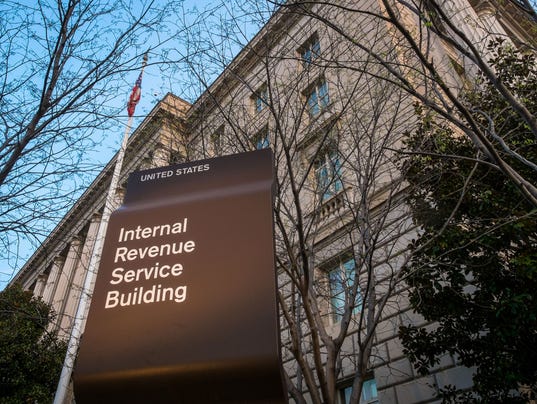
The Internal Revenue Service suffered a "hardware failure" on Wednesday afternoon, which left many of its tax processing systems unavailable Wednesday night, the agency announced in a statement.

The agency stopped accepting electronically filed tax returns because of the problem. The outage could affect refunds, but the agency said it doesn't anticipate "major disruptions."

"The IRS is still assessing the scope of the outage," the agency said. "At this time, the IRS does not anticipate major refund disruptions; we continue to expect that nine out of 10 taxpayers will receive their refunds within 21 days."

The IRS.gov website remains available, but "Where's My Refund" and other services are not working.

Some systems will be out of service at least until Thursday, the agency said. "The IRS is currently in the process of making repairs and working to restore normal operations as soon as possible," the IRS said.

Taxpayers can continue to send electronic returns to companies that serve as middlemen between taxpayers and the IRS. But those companies have to hold on to the tax returns until the IRS systems are up and running again, the IRS said.

People who have already filed returns don't need to do anything more, the IRS said.

[ad_2]

Source link

Taco Bell is using one key advantage to overtake Chipotle

0

[ad_1]

taco bellChris McGrath/GettyDiners enjoy their meals inside the new Taco Bell store during the official opening on April 21, 2015 in Tokyo, Japan.Taco Bell has one goal: to win the hearts of millennials.

"Taco Bell’s goal is to be America’s favorite millennial brand, and we are making substantial strides to deliver on that aspiration," CEO Greg Creed told analysts in a conference call last year.

In recent years, the fast food company has been working hard to shake its "Taco Hell" image of selling cheap, unsafe food.

Traditional millennial favorites like Apple, Chipotle, and Nike have a more luxurious image than the fast-food chain.

Still, Taco Bell seems to be thriving.

Sales increased 4% in the most recent quarter, outpacing the rest of the industry. There are indications Taco Bell is benefiting from Chipotle's brush with E. coli, which caused sales to plummet 36% in January.

The company has made progress with 18 to 35-year-olds with bestselling menu items like the Doritos Locos Taco and the breakfast Waffle Taco.

It's also pledged to start selling cage-free eggs, a key measure in the era of food transparency.

Taco Bell also has another advantage over other millennial favorites: it's cheap.

People in their 20s and 30s say they favor fast-casual joints like Chipotle, Five Guys, and Panera Bread. They claim they care about things like food quality, customization, and ethics.

"Increasingly, younger diners are seeking out fresher, healthier food and chains that offer customizable menu options for little more than the price of a combo meal," The Wall Street Journal reported recently.

But a recent report by Morgan Stanley reveals the difference between what millennials say and what they do.

McDonald's is still the most visited restaurant for the demographic thanks to its value menu, according to analysts at Morgan Stanley. Taco Bell comes in 3rd place while Chipotle comes in 11th.

[ad_2]

Source link

Target opening CVS pharmacies in stores is scary news for consumers

0

[ad_1]

patients at cvs pharmacy in target 4 HRCVS HealthThis week, CVS is opening its first pharmacy inside a Target store.

Over the next six to eight months, all 1,660 of Target’s pharmacy locations will become CVS-branded units. Additionally, the discount retailer’s 80 in-store health clinics will rebrand as CVS MinuteClinic locations.

When CVS announced its $1.9 billion acquisition of Target’s pharmacy business in June, many worried it could set off a series of similar partnerships as cost pressures hurt profits at grocery-store pharmacies. In October, Walgreens and Rite Aid — the second- and third-largest pharmacy chains in the US, after No. 1 CVS — announced a $9.4 billion merger.

While these acquisitions may help the bottom line at companies, it could be bad news for shoppers.

Mergers mean less competition in the market, which could lead to higher prices for consumers. If CVS and Walgreens acquire more pharmacy businesses, this effect could be even greater.

lining up at targetThe mergers additionally significantly reduce competition in the retail clinic business, reports the Washington Post’s Ariana Eunjung Cha. The acquisitions combine the No. 1 provider of retail clinics (CVS MinuteClinic) with the No. 5 provider (Target), as well as the No. 2 provider (Walgreens) with No. 6 (Rite Aid).

Generally, more competition means lower prices for consumers.

The Post also notes that the deals could result in conflicts of interest.

A CVS pharmacy is seen in New York City July 28, 2010. REUTERS/Mike Segar Thomson ReutersA CVS pharmacy is seen in New York City

"Some analysts worry that medical professionals staffing retail clinics could face pressure to overprescribe in order to boost their employers' bottom lines," Cha writes.

Target and CVS maintain that the change will simply increase convenience and accessibility for consumers.

“Our heart is in every prescription we fill, and providing accessible, supportive and personalized health care is part of our DNA,” Helena Foulkes, the president of CVS Pharmacy, wrote on CVS Health’s website on Wednesday. “On behalf of all of us at CVS Health, I am delighted to invite Target guests to experience our innovative pharmacy care services and unique digital offerings.”

[ad_2]

Source link

Deadline upcoming in $48 Million Settlement in the CVS Corporation (NYSE: CVS) Investor Lawsuit

0

[ad_1]

CVS Corporation Logo The Shareholders Foundation announced that a deadline is coming up on March 23, 2016 in the settlement reached in the securities class action lawsuit filed on behalf of investors who purchased shares of CVS Corporation (NYSE: CVS) between October 30, 2008 and November 4, 2009.

Investors who purchased a significant amount of shares of CVS Corporation (NYSE: CVS) between October 30, 2008 and November 4, 2009, have certain options and should contact the Shareholders Foundation by email at mail@shareholdersfoundation.com or call +1(858) 779 – 1554.

The settlement proof of claim form or detailed settlement notice for the settlement in the CVS Corporation (NYSE: CVS) Investor Securities Class Action Lawsuit can be downloaded at: http://shareholdersfoundation.com/case/cvs-corporation-nyse-cvs-investor-securities-class-action-lawsuit-11172009

In order to submit a claim an investor has to submit the claim proof to the class action claim administrator in a timely manner. The deadline to submit the proof with the class administrator is March 23, 2016. The class action administrator for this case is A.B. Data, Ltd.

The lawsuit was originally filed in the U.S. District Court for the District of Rhode Island against CVS Corporation over alleged violations of Federal Securities Laws in connection with certain allegedly false and misleading statements made between October 30, 2008 and November 4, 2009. According to the complaint the plaintiff alleges that CVS Corporation and certain of its officers and directors violated the Securities Exchange Act of 1934 by issuing between October 30, 2008 and November 4, 2009 numerous positive statements regarding CVS Corporation’s financial condition, business and prospects and failing to disclose operating problems in the PBM business, the more than $6 billion in contractual losses for 2010 and the adverse impact this would have on its 2010 financial results. According to the complaint, CVS Corporation disclosed that the Federal Trade Commission (“FTC”) had begun a “nonpublic investigation” in August 2009 into whether CVS Corporation’s business practices and service offerings violated antitrust laws. Among the business practices of CVS Corporation that the FTC is reportedly investigating is the improper use of pricing and patient data from its retail pharmacy operations to steer its PBM members to CVS Corporation stores, so the lawsuit. Then on November 5, 2009, CVS Corporation issued a press release announcing the disclosures of the adverse material facts concerning the PBM business and their adverse impact on CVS Corporation’s financial results for 2010, and the FTC investigation.

Those who purchased shares of CVS Corporation have certain options and should contact the Shareholders Foundation.

Contact:
Shareholders Foundation, Inc.
Michael Daniels
3111 Camino Del Rio North – Suite 423
92108 San Diego
Phone: +1-(858)-779-1554
Fax: +1-(858)-605-5739
mail@shareholdersfoundation.com

[ad_2]

Source link

Yahoo CEO ‘confident’ in strategic plan

0

[ad_1]

Yahoo CEO Marissa Mayer took to the business TV news circuit Wednesday to discuss the company's plans, but stopped short of saying the Net media company is actively seeking a buyer.

The troubled online and mobile advertising and media company is streamlining its workforce and its product offerings while also looking to separate its 15% stake in Alibaba, worth about $25 billion, while considering offers for all or parts of its core Internet business.

That was the message from the company's fourth quarter earnings announcement Tuesday. However, when CNBC's David Faber and Jim Kramer asked Mayer about whether the company was for sale, Mayer was coy.

"I can't speculate," said Mayer, adding that she would no comment on what all "strategic alternatives" the company might consider.

"On the whole, our focus here is to maximize the tremendous potential we see at Yahoo," she said on CNBC's Squawk on the Street. The company has 1 billion monthly users including 600 million on mobile, she said.

Investors weren't reassured. Shares of Yahoo (YHOO) were down more than 7% Wednesday to $26.84, setting a new 52-week low. Shares have fallen nearly 40% over the past 12 months.

Mayer also declined to comment on a potential sale when she appeared on Bloomberg TV a few minutes later.

"I will say Yahoo’s situation is complicated," Mayer said. "Particularly with some of the assets we have with Yahoo Japan (it owns 36%) and Alibaba plus the core (business). We need to have a somewhat complicated solution  … because we need to address how do we really see the most value we can from the operating business and how do we realize the most value we can, in particular from the Alibaba stake but also maximizing Yahoo Japan."

Investors weren't reassured. Shares of Yahoo (YHOO) were down more than 7% Wednesday to $26.84, setting a new 52-week low.

Yahoo chief finance officer Ken Goldman offered a clearer answer to Barron’s on Tuesday saying that the company would consider offers.  “A number of companies have said they want to look at us, and there are a number of private equity firms that are interested in looking at us," he told Barron's. "I’m not saying that we’ve received offers. I’m not saying that at all. I’m saying parties have expressed interest in us. And what we’re saying is that we’ll be open to that.”

Mayer said it had taken Yahoo longer to build its mobile advertising platform than expected and the company is tempering expectations for 2016. The company's forecasts call for a decline in revenue of at least 14% in the first quarter and as much as 12% for the full year.

The company also took a $4.5 billion impairment charge, meaning that it considers the value of assets such as Tumblr, Flurry and Polyvore have fallen by that amount.

Mayer said she understands now how long it would take to build its mobile business "and do it really well. ...We feel good about our plan and we are confident in that plan but I do think it makes sense for us to have a more reasoned perspective in terms of how quickly we can really move it."

The complex plan and tempered forecasts left Nomura Global Markets Research analyst Anthony DiClemente discouraged, he said in a note to investors Wednesday. The firm lowered its target price for shares to $34 from $40, keeping its Neutral rating, citing "the complexities of navigating the three different strategies at the same time."

Yahoo has sidestepped answering how industrious it would be about a sale, said SunTrust Robinson Humphreys Internet equity analyst Robert Peck noted. "The Board plans to engage on qualified strategic proposals, and recognizes that a parallel process is in the best interest of shareholders. However, no word was given on the Active or Passive nature of the process," he said in a note Wednesday.

Yahoo's core business could be worth $4 billion to $8 billion, depending on the buyer, said Peck, who maintained a $40 target price for Yahoo stock. "The mere separation of the core from Alibaba ... would make ANY monetization of the core a positive for shareholders."

Investment firm AllianceBernstein dropped its target price to $42 from $44, but kept an "Outperform" rating saying Yahoo remains "primarily a bet on Alibaba's value," said senior analyst Carlos Kirjner in a note Wednesday.

The "threat of a proxy war" when board slots come open this summer could be catalyst to the company's move to simplify the business, he said. "It may be too little, too late."

[ad_2]

Source link

Home Depot hiring 80000 seasonal workers

0

[ad_1]

HOME DEPOT-HIRING

Home Depot (HD) is on a hiring spree as the company boosts seasonal staffing for its busiest selling period.

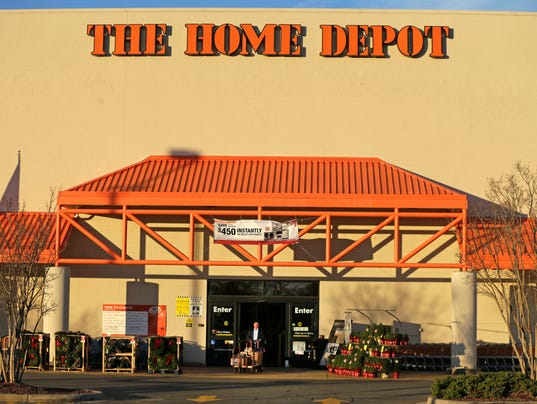
The nation's largest home improvement retailer said it plans to hire more than 80,000 sales associates nationwide to ensure that Home Depot's nearly 2,000 stores are staffed and ready to welcome spring 2016.

The hiring, roughly equivalent to spring season staffing in recent years, includes job opportunities in sales, operations and cashier positions across all departments, the company said. Merchandising teams also seek new associates to set product displays, maintain store appearance and help keep products customer-ready, Home Depot said.

Applications should be submitted online at Home Depot's careers site, www.careers.homedepot.com, the company said.

The company estimates that more than half of seasonal hires transition to permanent Home Depot jobs. The working time that new hires accrue during the seasonal assignments will apply to eligibility for benefits if they transition to permanent positions, the company said.

"There's no better time to join our team than spring, whether you're a college student, recent grad or a veteran hoping to build a career, a retiree who wants a fund job, or anyone who simply enjoys home improvement," said Tim Crow, Home Depot's executive vice president-Human Resources.

Atlanta-based Home Depot in December reaffirmed its sales and earnings-per-share guidance for fiscal year 2015. The company forecast an approximately 5.7% increase in sales for the year, with earnings per share rising roughly 14% to $5.36.

Home Depot also projected total sales of approximately $101 billion for the year.

The company is scheduled to report its fourth-quarter financial earnings on Feb. 23. The consensus forecast of financial analysts surveyed by S&P Capital IQ projects earnings per share of $1.10 on sales of nearly $20.4 billion.

More information about working at home and remote careers can be found here:

https://www.carefulcents.com/work-from-home-jobs

[ad_2]

Source link

ADP National Employment Report: Private Sector Employment Increased by 205000 Jobs in January

0

[ad_1]

ADP National Employment Report: Private Sector Employment Increased by 205,000 Jobs in January

Private sector employment increased by 205,000 jobs from December to January according to the January ADP National Employment Report®. Broadly distributed to the public each month, free of charge, the ADP National Employment Report is produced by ADP® in collaboration with Moody's Analytics. The report, which is derived from ADP's actual payroll data, measures the change in total nonfarm private employment each month on a seasonally-adjusted basis.

January 2016 Report Highlights*

View the ADP National Employment Report Infographic at www.adpemploymentreport.com.

Total U.S. Nonfarm Private Employment: 205,000

* Sum of components may not equal total, due to rounding.

Payrolls for businesses with 49 or fewer employees increased by 79,000 jobs in January, down from December's upwardly revised 101,000. Employment among companies with 50-499 employees increased by 82,000 jobs, up still further from December's upwardly revised 77,000. Employment at large companies -- those with 500 or more employees -- came in at 44,000, half of December's downwardly revised 88,000. Companies with 500-999 added 15,000 jobs, while companies with over 1,000 employees gained 30,000 jobs.

Goods-producing employment rose by 13,000 jobs in January, well off from December's upwardly revised 30,000. The construction industry added 21,000 jobs, which was roughly in line with the average monthly jobs gained during 2015. Meanwhile, manufacturing neither added nor lost jobs.

Service-providing employment rose by 192,000 jobs in January, down from an upwardly revised 237,000 in December. The ADP National Employment Report indicates that professional/business services contributed 44,000 jobs, down from 69,000 in December. Trade/transportation/utilities grew by 35,000, up slightly from a downwardly revised 33,000 the previous month. The 19,000 new jobs added in financial activities were the most in that sector since March 2006.

"One of the main reasons for lower overall employment gains in January was the drop off in jobs added at the largest companies compared to December. These businesses are more sensitive to current economic conditions than small and mid-sized companies," said Ahu Yildirmaz, VP and head of the ADP Research Institute. "Over the past year, businesses with less than 500 employees have created nearly 80 percent of new jobs."

Mark Zandi, chief economist of Moody's Analytics, said, "Job growth remains strong despite the turmoil in the global economy and financial markets. Manufacturers and energy companies are reducing payrolls, but job gains across all other industries remain robust. The U.S. economy remains on track to return to full employment by mid-year."

To see Chart 1. Change in Total Nonfarm Private Employment, please click here: http://media.marketwire.com/attachments/201602/MOD-23985_Chart1.ChangeinTotalNonfarmPrivateEmployment.jpg

To see Chart 2. Historical Trend -- Change in Total Nonfarm Private Employment, please click here: http://media.marketwire.com/attachments/201602/MOD-23986_Chart2.HistoricalTrendChangeinTotalNonfarmPrivateEmployment.jpg

To see Chart 3. Change in Nonfarm Private Employment by Selected Industry, please click here: http://media.marketwire.com/attachments/201602/MOD-23987_Chart3.ChangeinNonfarmPrivateEmploymentbySelectedIndustry.jpg

To see Chart 4. Change in Nonfarm Private Employment by Company Size, please click here: http://media.marketwire.com/attachments/201602/MOD-23988_Chart4.ChangeinNonfarmPrivateEmploymentbyCompanySize.jpg

The matched sample used to develop the ADP National Employment Report was derived from ADP payroll data, which represents 411,000 U.S. clients employing nearly 24 million workers in the U.S. The December total of jobs added was revised from 257,000 to 267,000.

To obtain additional information about the ADP National Employment Report, including additional charts, supporting data and the schedule of future release dates, or to subscribe to the monthly email alerts and RSS feeds, please visit www.adpemploymentreport.com.

The February 2016 ADP National Employment Report will be released at 8:15 a.m. ET on March 2, 2016.

About the ADP National Employment Report®
The ADP National Employment Report® is a monthly measure of the change in total U.S. nonfarm private employment derived from actual, anonymous payroll data of client companies served by ADP®, a leading provider of human capital management solutions. The report, which measures nearly 24 million U.S. workers, is produced by the ADP Research Institute®, a specialized group within the company that provides insights around employment trends and workforce strategy, in collaboration with Moody's Analytics, Inc.

Each month, ADP issues the ADP National Employment Report as part of the company's commitment to adding deeper insights into the U.S. labor market and providing businesses, governments and others with a source of credible and valuable information. The ADP National Employment Report is broadly distributed to the public each month, free of charge.

The data for this report is collected for pay periods that can be interpolated to include the week of the 12th of each month, and processed with statistical methodologies similar to those used by the U.S. Bureau of Labor Statistics to compute employment from its monthly survey of establishments. Due to this processing, this subset is modified to make it indicative of national employment levels; therefore, the resulting employment changes computed for the ADP National Employment Report are not representative of changes in ADP's total base of U.S. business clients.

For a description of the underlying data and the statistical model used to create this report, please see "ADP National Employment Report: Development Methodology" at http://adpemploymentreport.com/common-legacy/docs/ADP-NER-Methodology-Full-Detail.pdf.

About Moody's Analytics
Moody's Analytics helps capital markets and risk management professionals worldwide respond to an evolving marketplace with confidence. The company offers unique tools and best practices for measuring and managing risk through expertise and experience in credit analysis, economic research and financial risk management. By providing leading-edge software, advisory services, and research, including the proprietary analysis of Moody's Investors Service, Moody's Analytics integrates and customizes its offerings to address specific business challenges. Moody's Analytics is a subsidiary of Moody's Corporation (NYSE: MCO), which reported revenue of $3.3 billion in 2014, employs approximately 10,200 people worldwide and maintains a presence in 35 countries. Further information is available at www.moodysanalytics.com.

About ADP (NASDAQ: ADP)
Powerful technology plus a human touch. Companies of all types and sizes around the world rely on ADP's cloud software and expert insights to help unlock the potential of their people. HR. Talent. Benefits. Payroll. Compliance. Working together to build a better workforce. For more information, visit ADP.com.

The ADP logo, ADP, the ADP National Employment Report and the ADP Research Institute are registered trademarks of ADP, LLC. ADP A more human resource. is a service mark of ADP, LLC. All other marks are the property of their respective owners. Copyright © 2016 ADP, LLC.

[ad_2]

Source link

s2Member®