Investors navigated cramped hotel hallways and hustled between company presentations on the opening day of the J.P. Morgan Healthcare Conference on Monday while staring incredulously at their smartphones. Biotech stocks large and small were plummeting, and the painful start to 2016 was turning torturous.
The largest and most important healthcare conference held in San Francisco at this time each year is supposed to generate news and excitement to get investors in the mood to buy biotech stocks. But this year, there were very few market-moving announcements.
Shire(SHPG - Get Report) finally clinched its $32 billion acquisition of Baxalta(BXLT) , but the deal had been discussed for months and was therefore widely expected by investors. No other significant biotech M&A deals were announced Monday.
Celgene(CELG - Get Report) offered 2016 revenue and earnings guidance at the conference, but it was largely in line with current consensus expectations, so investors shrugged. None of the other large-cap biotech companies provided guidance Monday.
Vertex Pharmaceuticals(VRTX - Get Report) offered a limited and conservative sales outlook for one of its cystic fibrosis drugs, Kalydeco, while holding off on providing guidance on a second, more important drug, Orkambi.
Nearly every other company deciding to disclose 2016 sales guidance Monday told investors what they already knew. Almost across the board, company guidance was "in line" with consensus expectations.
A dull start to the J.P Morgan Healthcare conference contributed to a bad day for biotech stocks. The SPDR S&P Biotech ETF(XBI) fell 6% Monday to 57.08, a level it had not visited since November 2014. In the early afternoon Monday, the XBI was down more than 8%.
The XBI, the ETF with the broadest portfolio of biotech stocks, has now lost more than 18% to start 2016.
Among large cap biotech stocks, Celgene closed down 5%. Vertex lost 6% and Alexion Pharmaceuticals(ALXN - Get Report) fell 3%. Gilead Sciences(GILD) managed to close flat, which should be considered a major victory.
Bad news announced Monday was punished severely. Genvec(GNVC) fell 61% because enrollment for clinical trial of a gene therapy for hearing loss was stopped for a patient safety check.
Bluebird Bio(BLUE) dropped 18% after the company said it would wait until next December to present updated results on its gene therapy clinical trials in beta-thalassemia and sickle cell disease.
"Biotech stocks were on sale today," a healthcare investor remarked to me while waiting for a company presentation to begin. "The scarier thing is that prices could be marked down even lower in the coming days."
Thermo Fisher Scientific(TMO - Get Report) is buying Affymetrix(AFFX - Get Report) for $1.3 billion, and, despite paying a steep 20 times Ebitda for the business, the medical device maker still appears to be financially nimble to make more acquisitions, according to analysts.
"The nice part about this deal is that it gives them the flexibility with capital allocation to do more deals," said Matthew Mishan of KeyBanc Captial Markets in a phone interview. "In diagnostics, specifically, specialty diagnostics, they haven't done a deal. That's a higher-margin, higher-growth business they could look to expand."
Thermo announced Friday it had agreed to pay $1.3 billion, or $14 per share, for Santa Clara, Calif.-based Affymetrix, which provides genetic analysis of biological systems that help drug developers identify and understand disease mechanisms. The deal is Thermo's largest since it acquired Life Technologies Corp. for about $13.6 billion on Feb. 3, 2014.
Jack Mohr, co-portfolio manager for Jim Cramer's charitable portfolio, Action Alerts PLUS, said the acquisition is a good strategic fit for the company and "is well aligned with our view that TMO is constantly -- yet selectively -- identifying ways to create value for shareholders."
In addition, the size of the transaction "is in line with our views on the company’s M&A strategy, which we see as Thermo Fisher’s best use of capital. From management’s recent commentary, it has been clear that the company expects to maintain a disciplined capital deployment strategy with tuck-in M&A as the preferred use of cash, followed by share repurchase," according to Mohr.
Even after the $1.3 billion acquisition, "we believe TMO -- as a direct result of its robust free- cash-flow generation and high operating margins -- can deploy an incremental $2.5 billion of capital through dividends, buybacks and/or further accretive tuck-in acquisitions this year. This would still allow Thermo to end the year with a net debt to Ebitda (i.e., leverage) ratio within its targeted range of 2.5 times to 3 times."
Exclusive Look Inside:
You see Jim Cramer on TV. Now, see where he invests his money and why. Learn more now.
Thermo will integrate Affymetrix into its Life Sciences Solutions business, which provides services to the pharma and biotech industry. Affymetrix's technology is used in a variety of clinical and applied markets, including reproductive health and agricultural biotechnology.
"Overall, we are inclined to view the deal as a prelude as TMO possibly re-enters an era of re-accelerated capital deployment, now that debt post the Life transaction has been reduced," wrote Stifel Financial analyst Miroslava Minkova in a note Monday.
Apple(AAPL - Get Report) rose Tuesday after Bank of America Merrill Lynch analysts upgraded the stock, saying they're bullish on the launches of the new Apple Watch, the iPhone 6c and the iPhone 7 along with the company's large cash balance.
In addition, the bank's China survey showed that iPhone is the most popular brand there, and about half of current users plan to buy a new iPhone in the next year. That could give Apple a gain in market share.
The iPhone 6c will likely be priced lower and may "drive increased conversions from feature phones," analyst Wamsi Mohan and his team wrote.
Also, investors have largely discounted worries over a lackluster cycle for the iPhone 6s, which had prompted the bank's August downgrade, the analysts wrote.
Google CEO Sundar Pichai has put a key deputy in charge of forming a dedicated division for VR computing, according to Re/code. Clay Bavor, vice president for product management is focusing on VR products after having overseen Google's apps, including Gmail, Drive and Docs, and the Google Cardboard VR device. Senior Vice President Diane Greene will be taking over the apps division, the news organization reported, saying that Google had confirmed the moves but declined to comment on them.
Many in the industry had been questioning Google's dedication to VR after the company fumbled with Google Glass, Re/code wrote. Bavor's move shows that Google is taking seriously the threat from Facebook and its Oculus product, which currently has 400 people working on it, according to the article.
Google parent Alphabet rose 1.7% to $745.34 on Tuesday, while Facebook gained 1.9% to $99.37 and Microsoft advanced 1% to $52.78.
Twitter(TWTR - Get Report) , whose shares have suffered amid flat user growth and concerns about the CEO's split focus, announced a new feature meant to keep users from leaving the social-media service's timeline by enhancing their real-time experience.
Live video broadcasts from the sister app Periscope will now start playing automatically from users' Twitter feeds, so viewers will no longer have to launch a separate app, the company said. Twitter bought Periscope last year.
Periscope said it is rolling out the feature for Twitter on iOS over the next few days and will launch Android and web versions "as soon as they're ready."
Shares of Intel (INTC - Get Report) are up Tuesday thanks to an upgrade to buy from hold at Mizuho.
The company also received positive coverage from J.P. Morgan, TheStreet's Jim Cramer, co-manager of the Action Alerts PLUS portfolio, said on CNBC's "Mad Dash" segment.
These types of reports are "very bullish" for a stock heading into earnings, Cramer added. Intel reports Thursday.
Cramer praised CEO Brian Krzanich for doing a "wonderful job reinventing the company," especially after its acquisition of Altera. As the company shifts its business away from personal computers, look for the stock to trade with a higher price-to-earnings valuation, he said.
Turning to Darden Restaurants (DRI - Get Report) , Cramer pointed out that activist investor Starboard Value sold 1.3 million shares of the company. But investors shouldn't panic because the fund still holds an 8.1% stake in the stock.
"Don't sell Darden on a trim by a hedge fund that has a big gain. That's not a good reason to sell," Cramer explained. "The last quarter for Darden was extremely well," and the restaurant company is a big beneficiary of lower gas prices, he added.
Aside from Darden, few others have cited low gasoline as a positive catalyst. Some of those include Six Flags (SIX - Get Report) , Cedar Fair (FUN - Get Report) and Carnival (CCL - Get Report) .
Now that most of their hedges have expired, the airlines should also benefit from lower fuel costs, Cramer said. As a result, he likes this industry.
Wall Street and most buy-side analysts expected regional banks to benefit from higher interest rates as soon as the Federal Reserve began to raise interest rates. The Fed raised the federal funds rate on Dec. 16 but regional bank stocks did not rally; instead, they declined into correction territory more than 10% below multiyear or all-time highs set in July 2015.
From a technical standpoint, higher interest rates have not been positive for regional banks, based on data from the Federal Deposit Insurance Corporation and comments from the FDIC Chairman, Martin Gruenberg. That's why I said it was time to take profits on regional banks. This was based on continued FDIC concerns about credit risks as banks extend out the yield curve to pick up net interest margins.
Here's a scorecard for the five key regional banks.
Let's focus is on the daily charts as these stocks cascade below their Fibonacci retracements from their all-time or multiyear highs set in July to their "flash crash" lows of Aug. 24 or lower later in 2015.
The daily chart for BB&T shows the stock ended 2015 below its 50% Fibonacci retracement of $38.07. The horizontal lines are the retracements from the multiyear high of $41.90 set on July 23 to the 2015 low of $34.24 set on Oct. 2.
As 2016 began the stock plunged below its 38.2% retracement of $37.17. Then, on Jan. 7, the stock gapped below its 23.6% retracement of $36.05. The stock closed Tuesday at $34.90 in correction territory 16.7% below the July 23 high. The stock is just 1.9% above the low set on Oct. 2.
Note in a "sell on strength" strategy investors could have reduced holdings at its 61.8% retracement of $38.98 between Nov. 6 and Dec. 7.
Investors looking to buy BB&T should place a good till canceled limit order to buy the stock if it drops to $32.71, which is a key level on technical charts until the end of 2016.
BB&T is scheduled to report quarterly earnings before the opening bell on Jan. 21 and analysts expect the bank to earn 70 cents a share.
Here's the daily chart for M&T Bank Corp.
Courtesy of MetaStock Xenith
The daily chart for M&T shows the stock ended 2015 below its 50% Fibonacci retracement of $122.74. The horizontal lines are the retracements from the multiyear high of $134 set on July 23 to the 2015 low of $111.50 set on Oct. 2.
As 2016 began the stock plunged below its 38.2% retracement of $120.08. Then, on Jan. 6, the stock crashed below its 23.6% retracement of $116.79. The stock closed Tuesday at $110.49 in correction territory 19.2% below the July 23 high. The stock set a lower low of $108.32 on Jan. 11.
In a sell on strength strategy investors could have reduced holdings at its 61.8% retracement of $125.40 between Oct. 28 and Dec. 17.
Investors looking to buy M&T should place a good till canceled limit order to buy the stock if it drops to $95.68, which is the April 2013 low.
M&T is scheduled to report quarterly earnings on Jan. 19 and analysts expect the bank to earn $1.95 a share.
The prospect of four straight quarters of earnings declines is staring investors in the face on top of the worst multiweek selloff for stocks in years, and the worst start of the year ever.
For the year, the Dow Jones Industrial Average DJIA, -2.39% and the S&P 500 index SPX, -2.16% are down at least 8%, and the Nasdaq Composite Index COMP, -2.74% shed more than 10%.
Stocks also rang up a third week of losses for their largest multiweek percentage drop since the four weeks ended Aug. 19, 2011, according to FactSet data. Over the past three weeks, both the S&P 500 and the Dow industrials have declined 8.9%, and the Nasdaq has fallen 11.1%. For the four weeks ended Aug. 19, 2011, the S&P 500 has fallen 16.5%, the Dow is down 14.7%, and the Nasdaq dropped 18.1%.
Those hefty losses come as earnings season ramps up during the holiday-shortened week. Several companies on the S&P 500, along with seven Dow components, report quarterly results. And earnings season isn’t looking promising.
Total earnings for the S&P 500 in the fourth quarter are expected to decline from the previous year, even factoring that Wall Street forecasts’ have been lowered.
Over the past four years, estimates for S&P 500 earnings at the end of a given quarter have been an average three percentage points lower than the actual earnings results, according to John Butters, senior earnings analyst at FactSet.
Earnings were estimated to decline by 4.9% at the end of the fourth quarter, that would translate to a 1.9% decline if the average holds up. Currently, earnings are on pace for 5.7% drop.
Plus, current-quarter earnings estimates have taken a notable downturn in the past week.
First-quarter earnings for the S&P 500 are expected to decline from the year-ago period by 0.6%, compared with estimated growth of 0.9% at the beginning of the quarter, according to FactSet data.
Among Dow components: UnitedHealth Group Inc.UNH, -1.35% and International Business Machines Corp.IBM, -2.17% report Tuesday; Goldman Sachs Group Inc.GS, -3.58% reports Wednesday; Verizon Communications Inc.VZ, -0.98%American Express Co.AXP, -0.60% and Travelers Cos.TRV, -1.76% report Thursday; and General Electric Co.GE, -1.96% reports Friday.
Tenable Network Security, a Columbia-based cybersecurity firm co-founded by Ron Gula (pictured), raised $250 million in venture capital last year. (Tim Teeling/Courtesy of Tenable Network Security)
Washington-area businesses raised more venture capital in the fourth quarter than they had in any quarter since 2001 — largely due to a few large deals.
The surge is not likely to be repeated soon given the recent stock market turmoil. Indeed, venture funding nationally declined during the period.
In all, though, 29 area companies received $556.22 million in venture capital last quarter, a 53 percent increase from a year earlier, according to a report released Friday by PricewaterhouseCoopers and the National Venture Capital Association, with data by Thomson Reuters.
For the full year, the region’s companies secured 169 deals totaling $1.41 billion, up from 197 deals totaling $1.09 billion in 2014. On average, the region’s firms received $8.4 million in venture capital in 2015, up from $5.5 million a year earlier.
“The average deal size was up, and it was up significantly,” said Brad Phillips, a director at PwC.
The flow of deals is likely to slow this year. Nationally, U.S. companies raised $11.34 billion in venture capital during the fourth quarter, a 28 percent decrease from the year before, as a wobbly stock market gave investors pause.
During the fourth quarter, “it appears the volatility in the financial markets affected [venture capital] funding,” Phillips said. “Equity market declines were broad-based.”
In Washington, however, fourth-quarter funding remained robust.
Tenable Network Security, a Columbia, Md.-based cybersecurity firm, led the way with a nearly $250 million investment from Accel Partners and Insight Venture Partners. It was the region’s second-largest deal in the report’s 20-year history. (The largest was for XM Satellite Radio Holdings in 1999 for $250 million, $100 more than the Tenable deal.)
“It’s a record-setting deal,” said Ron Gula, chief executive of Tenable. “Not only is this good for our company, it’s generally a really, really good message for the industry and our approach to doing cybersecurity.”
Tenable has plans to open six international offices this year, including in Ireland and the United Arab Emirates, Gula said. The company hired roughly 200 new employees last year, and plans to add even more workers in 2016.
“An investment of this size allows us to accelerate even faster,” he said.
Throughout the region, software and biotechnology companies continued to receive the largest share of venture capital, or about 84 percent of total dollars awarded during the fourth quarter.
The recipients of the largest deals included Precision for Medicine, a Bethesda, Md.-based biotechnology firm (which received $75 million); IronNet Cybersecurity, a Fulton, Md.-based software company ($25 million); and ZeroFox, a Baltimore software company ($22.04 million).
“It’s a pretty good quarter when the two traditionally strong industries went up and we still saw other industries land funding as well,” Phillips said.
Businesses in Maryland received 81.3 percent of fourth-quarter funding in the Washington area, which the report defines as Maryland, Virginia, West Virginia and the District.
Abha Bhattarai is a business reporter for The Washington Post. She has previously written for The New York Times, The Wall Street Journal, Reuters and the St. Petersburg Times.
This story has been amended to add Elevate Credit’s statement in its prospectus that it seeks to comply with applicable laws and regulations. Also, the story now states that the company appears to do less than traditional lenders to ensure consumers can pay off their loans. Earlier, the story stated the company does little to ensure this.
Elevate
Elevate filed to go public with a price range of $20 to $22. Final pricing is expected Jan. 21.
As the payday loan industry faces a crackdown in the United States, an online service that also offers small loans with high interest rates to people with poor credit is preparing to take Wall Street’s biggest stage, even though it admits that its practices could lead to its own doom.
is set to be the first venture-backed initial public offering of 2016, with plans to sell shares this month in a deal that could bring in almost $80 million. The online lender uses its own proprietary technology to offer “approval in seconds” to consumers for two installment loan products and one line of credit.
But those automated approvals and the high interest rates that follow come with a slew of regulatory issues and questionable tactics. Despite the focus on its technology, Elevate appears to be nothing more than an online version of an industry that preys on the poor with loans they can’t obtain from banks, at interest rates banks could never charge.
“I think they’re the new face of payday lending,” said Lauren Saunders, associate director at the National Consumer Law Center.
Elevate — which declined to comment for this article, citing its pre-IPO “quiet period” — takes pains to separate itself from the controversial, and potentially illegal, payday lenders. The company says those lenders have an average annual percentage return of close to 400% and typically require one large payment due at the end of the loan term, while Elevate mandates customers pay off their loans throughout the loan period.
Saunders said Elevate is just expanding the loan length and definition of payday lenders, and the rates Elevate charges its customers are much higher than other types of loans. The average weighted annual percentage rate for its three products are 176% for Rise, 255% for United Kingdom-focused Sunny, and 88% for Elastic, the line of credit.
And while Elevate calls its customers the “New Middle Class,” it appears to do less than traditional lenders to ensure that consumers can afford to pay off the loans they receive, a similar issue to what the Consumer Financial Protection Bureau is investigating with payday lenders. Elevate automates more than 90% of its loan applications, with humans reviewing the other 10%.
Elevate doesn’t detail the exact metrics it uses to assess consumers, but says it uses data from the National Consumer Reporting Association for “prime-ish” customers and data from Clarity and Teletrak, non-prime credit bureaus for the second tier. For those with no credit history, Elevate uses data including how long the consumer has used the same phone number or email address.
The company says using more documentation to evaluate creditworthiness would just slow them down.
“If Elevate products were required to receive and review additional documentation from consumers such as bank statements, photo identification or pay stubs, this added inconvenience may result in lower consumer applications and loans, which would adversely affect our growth,” the company says in its prospectus.
The company also stated in its filing, “Where applicable, we seek to comply with” laws and regulations.
Beyond establishing creditworthiness, Elevate and its affiliates are subject to several federal and state regulations, including the Truth in Lending Act, a section of the Dodd-Frank Act and the Fair Debt Collection Practices, most of which concern deceptive lending practices and reporting. But Elevate discloses in its prospectus that it may not always follow these laws.
“We may not always have been, and may not always be, in compliance with these laws. Compliance with these laws is also costly, time-consuming and limits our operational flexibility,” the company said in its prospectus.
Elevate has tried to fight those laws through lobbyists. Crossroads Strategies LLC lobbied against CFPB regulations and other laws for the firm, according to disclosure filings, and Polaris Government Relations LLC worked against the implementation of Dodd-Frank on the company’s behalf in 2014 and 2015.
Those lobbyists should expect more paychecks. Regulators have been cracking down on the consumer lending business, particularly those targeting sub-prime consumers and with high interest rates, and Elevate lists several upcoming regulations and laws as risks in the prospectus.
For example, Elevate’s loans use the Automated Clearing House system to take funds owed directly out of the consumer’s bank account, with customer authorization. The U.S. Department of Justice and other regulators, particularly in New York, have taken steps to discourage banks from working with online and short-term loan providers, Elevate says in its prospectus. The Rise product is currently available in 15 states — not New York — and it doesn’t make loans directly in Texas and Ohio.
Its product in the United Kingdom, Sunny, is operating on an interim permission, while the UK increases regulation on the “short-term, high-cost credit industry with the stated expectation that some firms will exit the market.” Due to previous regulation, Elevate had to change Sunny to an installment loan, instead of a line of credit, and it awaits the UK’s decision on the loans by April 1.
“There is no guarantee that we will receive full authorization to continue offering consumer loans in the UK,” the company said in the prospectus.
Because of the possible new regulations, as well as other factors, Lynn Turner, managing director of consulting firm Litinomics and formerly chief accountant at the Securities and Exchange Commission, said investors would be taking a serious gamble.
Beyond regulation, the company’s financial structure scares some analysts. Formed in 2014 as a spin-off of Think Finance Inc., a technology licensing platform as well as a lender to consumers with less-than-stellar credit, Elevate reported $2.6 billion in loan originations from 2002 to 2015, involving 1.3 million customers.
The funding for many of those loans, through the Rise and Sunny offerings, comes from one source, Victory Park Management LLC. Elevate owed Venture Park Capital $247.3 million as of Sept. 30, and had an outstanding balance of $50 million in debt to Elastic SPV. Elevate said it plans to use “all or a portion” of its proceeds from the IPO to pay off the Venture Park debt.
Elastic lines of credit are originated through third-party lender Republic Bank, which uses Elevate’s software for loan approval. Elastic SPV, a special purpose vehicle Cayman Island entity that receives its funding from Victory Park Capital, then can buy a 90% participation interest, but Elevate takes on the loan-loss risk.
And those risks are substantial. The company reported net charge-offs, or debt owed to a company that likely won’t be recovered, as a percentage of revenues at 51% for 2014, 43% for 2013 and 48% so far this year, the company said in its prospectus.
Because of the risks and the spin-off from Think Finance, Max Wolff, chief economist at Manhattan Venture Partners, said he’s suspicious of the offering.
“It looks like a cash-out spin-off, not a traditional IPO,” Wolff wrote in an email. “The deal has the full set of caution flags and this model remains to be tested by a coming rise in interest rates and also a recession.”
Elevate can point to its growing revenues, from $72 million in 2013 to $274 million in 2014, with net losses of $45 million and $55 million. It also has well-known venture backers in Sequoia Capital and Technology Crossover Ventures, and company executives, Venture Park Management and Technology Ventures have all indicated intent to buy shares of common stock in the offering at the initial public offering price.
Kathleen Smith, principal at Renaissance Capital, a manager of IPO-focused ETFs, cited those as positives for the company’s IPO, along with ownership of proprietary technology and a customer base in an “under-served market. But the way it assesses creditworthiness, as evidenced by the net charge-offs, causes concern.
“It’s a financial company where you don’t know the [consumer’s] credit history,” Smith said. “The model is still unproven when it comes to their track record.”
- Francine McKenna contributed to this article.
[ad_2]
The American economy is underperforming where it could and should be, said John Snow, former secretary of the Treasury.
"The participation rate in the workforce is way down, it's the lowest we've seen in decades," said Snow. "So while our labor markets are improving, they are not where they should be, and while we have reasonable growth it's not where it should be."
Snow currently manages JWS Associates, a consulting firm he founded in 2006. From February 2003 until June 2006, Snow served as United States Treasury Secretary under President George W. Bush. Prior to that post, Snow held the positions of chairman and CEO of CSX(CSX - Get Report) , a global transportation company, between 1989 and 2003. Between 1994 and 1996, Snow served as chairman of the Business Roundtable, a business policy group comprised of 250 chief executive officers of the nation's largest companies.
Despite his worries about the economy, Snow said he approved of the Federal Reserve's interest rate hike last month, saying it was about time the central bank moved on from emergency measures instituted during the credit crisis. Still, he said he would be "surprised if we see more than one or two" more rate increases this year.
Regarding China's recent stock market swoon, which is dragging down U.S. stocks in 2016, Snow said the country is in for a hard road after years of debt-fueled spending on construction projects and housing that is now likely vacant or abandoned.
"I think their leadership recognizes that they have to keep their eye on the short term and not allow this to become a cascading problem, but also keep their eye on the long term in getting that economy working in the right way," said Snow.
He said the reduction in oil prices has been a double-edged sword as consumers have benefited at the pump, but investment in the energy sector has plummeted. As for the drop in coal prices, Snow said it has weighed heavily on the railroad industry including his former company CSX.
"We are not building any new coal-fired plants and that's a big hit to the railroads," said Snow. "It's going to be a test of railroad management to cope with that situation and still produce pretty good earnings and they will have to do that through tight cost management."
Walmart abruptly announced Friday that it was abandoning a promise to build stores in Washington’s poorest neighborhoods, an agreement that had been key to the deal allowing the retailer to begin operating in the nation’s capital.
The giant retailer cited increasing costs for the new projects and disappointing performance at the three D.C. stores it opened over the past several years. But news that Walmart would pull out of two supercenters planned for east of the Anacostia River, where its wares and jobs are wanted most, shocked D.C. leaders. In one case, the city had already committed $90 million to make a development surrounding one of the stores viable.
“I’m blood mad,” said D.C. Mayor Muriel E. Bowser (D) at a Friday news conference.
“It’s an outrage,” said former mayor Vincent C. Gray (D), who in 2013 completed the handshake deal for the stores. “This is devastating and disrespectful to the residents of the East End of the District of Columbia.”
The decision to withdraw from the planned D.C. locations came as part of a broader strategic move by the nation’s largest retailer to shutter 269 of its stores around the world — but not the existing D.C. stores, the company confirmed — a plan Walmart hopes will allow it to focus on becoming a more serious player in online shopping and to improve its remaining fleet of supercenters and grocery stores.
People walk past a Walmart Express store in Richfield, N.C. District officials are upset over the company’s cancellation of planned supercenters east of the Anacostia River. (Jason E. Miczek/Bloomberg)
But in the nation’s capital, the two stores were more than statistics. For D.C. leaders, they amounted to Walmart breaking a promise that had allowed it to win a public relations coup at a critical point for the company.
After saturating the nation’s rural landscape with big-box stores at the turn of the decade, Walmart had been blocked by liberal politicians and unions in New York and Boston from its next frontier, remaking retail in the nation’s urban core. But in the District, Walmart won the right to open stores surrounding the U.S. Capitol — and a symbolic victory for its belief that low-price goods help its poor customers more than low-wage jobs hurt its workers.
Under the initial deal, Walmart could build stores almost anywhere in the District, as long as it opened two stores in its poorest wards and areas of the city sometimes referred to as food deserts, with few — if any — options for fresh produce and groceries. One was planned for Skyland Town Center in Southeast Washington and the other at Capitol Gateway Marketplace in Northeast Washington.
The deal came at significant cost, however. Pushed by labor unions, a majority of the D.C. Council at first pushed back against welcoming Walmart to the city. Opponents cited Walmart’s large profits and refusal to let workers unionize, as well as its reputation for low wages.
But as recently as last week, all of that seemed like a distant memory. In her list of first-year accomplishments, Bowser had included a ribbon-cutting ceremony at the city’s latest Walmart, at Fort Totten, in a video montage and listed a technical deal signed in the fall that cleared a final roadblock for construction at Skyland.
Then on Friday, the deal was off. Walmart officials entered the mayor’s office early in the morning and apologized, saying plans and economics had changed. Large urban Walmarts were more expensive to build and less profitable to operate than expected — especially, it turned out, in the District.
Mike Moore, Walmart’s executive vice president of supercenters, said in an interview that the decision to pull out of the projects at Skyland and Capital Gateway was based on fresh assumptions the company was making about the potential profitability of those stores. The officials said that they did not feel confident that the planned stores would generate healthy sales volume. Their latest math suggested that construction and operating expenses were going to be higher than they had originally budgeted for.
So far, Moore added, the three stores Walmart has opened — one blocks from Union Station in the trendy NoMa neighborhood and two in gentrifying areas along Georgia Avenue and at Fort Totten — were underperforming and “just not anywhere close to your expectation.”
Council member Jack Evans (D-Ward 2) head of the council’s finance committee, sat in on the meeting Friday morning with Walmart officials and Brian Kenner, Bowser’s deputy mayor for planning and economic development.
Evans said that, behind closed doors, Walmart officials were more frank about the reasons the company was downsizing. He said the company cited the District’s rising minimum wage, now at $11.50 an hour and possibly going to $15 an hour if a proposed ballot measure is successful in November. He also said a proposal for legislation requiring D.C. employers to pay into a fund for family and medical leave for employees, and another effort to require minimum work weeks for hourly workers were compounding costs and concerns for the retailer.
“They were saying, ‘How are we going to run the three stores we have, let alone build two more?’ ” Evans said.
“The optics of this are horrible; they are not going to build the stores east of the river, in largely African American neighborhoods? That’s horrible; you can’t do that,” Evans said. “A deal’s a deal.”
It was immediately clear that Walmart’s announcement could also reverberate in a city election year. Gray, who is considering an effort to resurrect his political career after prosecutors dropped an investigation into his first mayoral run, said he was outraged.
Gray cast blame on Bowser’s team, saying he had met with the project’s developers two weeks before he left office last year, and “everything was on track.”
“What did the administration do to stay on top of this? There is no bigger project going on than this one, maybe in all of the East End,” he said of Skyland.
Gray could run against Ward 7 Council member Yvette M. Alexander (D), or in an at-large race. But on Friday, he sounded more like a mayoral candidate.
“If I were mayor, I’d get on a plane and go Bentonville,” to Walmart’s global headquarters in Arkansas, Gray said. “They should be held accountable.”
Speaking to reporters, Bowser was more muted. She said she was disappointed but stressed that the District’s three existing Walmarts were not on the closure list.
Michael Czin, her communications director, said that Walmart had signed a lease at Skyland, but attorneys for the administration and the developer were still analyzing if either could be entitled to liquidated damages.
“We’re assessing options and looking at everything,” he said. “We continue to talk to legal counsel. It’s still somewhat early; folks are looking into how everything was written.”
Staff writer Fenit Nirappil contributed to this report.
Aaron Davis covers D.C. government and politics for The Post and wants to hear your story about how D.C. works — or how it doesn’t.
Sarah Halzack is The Washington Post's national retail reporter. She has previously covered the local job market and the business of talent and hiring. She has also served as a Web producer for business and economic news.
WASHINGTON — When 2010 began, the United States economy seemed to be on the mend and leaders of the Federal Reserve discussed how they would unwind their extraordinary rescue efforts from the crisis that erupted in 2008. The term “exit strategy” was mentioned 37 times in their first two policy meetings of the year.
By the time the year ended, the Fed was pumping a further $75 billion a month into the financial system by buying bonds, aiming to keep the young expansion from falling apart. And though they did not know it at the time, Fed officials were on the path toward another half-decade of zero interest rates and creating trillions of dollars from thin air.
Transcripts of the Fed’s 2010 policy meetings, released Friday after the customary five-year lag, show how it got from Point A to Point B. The central bank’s officials forged a halting, unsure path toward greater activism as they realized that the global financial crisis, which had seemed over when the year started, had really just entered a new stage — a sovereign debt crisis in Europe and the threat of economic stagnation in the United States.
How the Bernanke Fed Decided to Pump Billions Into the Economy
Transcripts from Federal Reserve meetings in 2010 show, in real time, how the central bank under chairman Ben S. Bernanke came to the conclusion that the economy was in greater peril than it had initially seemed.
During the eight meetings of the Federal Open Market Committee that year, plus two unscheduled emergency conference calls, Chairman Ben S. Bernanke and his colleagues concluded that the economy was in greater peril than it had seemed at the start of the year. They agreed upon fresh actions intended to guard against a new recession or falling into a deflationary trap.
Janet L. Yellen, the current chairwoman who served in two senior roles in 2010, emerged as a major ally of Mr. Bernanke and an early voice in favor of more activism.
“Given the tenuous state of business and consumer confidence, I consider it critical at this juncture that this committee not be perceived as falling behind the curve, being unwilling to act, or being out of touch with the mounting concerns we see in the markets and on Main Street,” Ms. Yellen, then the president of the San Francisco Fed, said at the Aug. 10 policy meeting. “The data show a considerable slowing of the economy during the summer, and the near-term outlook has been marked down appreciably.”
At that meeting, she also urged her Fed colleagues to consider options to ease monetary policy further, even though “our quiver has fewer arrows than I’d like.” It would take three more months before the committee as a whole agreed with her and undertook a $600 billion effort at “quantitative easing,” or bond buying, frequently referred to as “QE2” because it was the second such move by the Fed.
The start of QE2 — Mr. Bernanke hated that term, he made clear in one meeting, as he unsuccessfully urged his colleagues to refer to the program by what as he viewed as the more technically precise “large-scale asset purchases” — was a controversial move inside and outside the Fed.
After the decision, which coincided with an election that swept a Republican Congress skeptical of government intervention into power, the Fed faced sharp criticism from conservative lawmakers and from Germany and Brazil, among other countries. Objections included the ways bond buying could distort financial markets and foreign exchange prices, and the burden the Fed was taking on itself to right an economy with problems that went deeper than insufficiently easy monetary policy.
What was less well understood at the time, but is made plain by the new transcripts, is how the internal debate at the Fed resembled the external one, with many of the objections outsiders raised to the Fed’s monetary activism also articulated behind closed doors at the central bank’s Washington headquarters.
“My views are increasingly out of step with the views of most people around this table,” Kevin M. Warsh, a Fed governor who was a close adviser to Mr. Bernanke on financial market matters, told his fellow policy makers at the November meeting.
“The path that you’re leading us to, Mr. Chairman, is not my preferred path forward,” he continued. “I think we are removing much of the burden from those that could actually help reach these objectives, particular the growth and employment objectives, and we are putting that onus strangely on ourselves rather than letting it rest where it should lie.”
He added: “The benefits strike me as small and fleeting. The risks strike me as unknown, uncertain, and potentially large.”
Mr. Warsh ultimately voted for the action, saying he would dissent if not for personal loyalty to Mr. Bernanke and because “I wouldn’t want to undermine at this important moment the chance that this program could be successful.”
The transcripts also show how Fed officials grappled with the crisis in the eurozone, especially Greece, that nearly spiraled out of control in the spring and in the fall. But the signature action of the Fed in 2010 was the decision in November to start its second round of quantitative easing.
Several other supporters of the action were also uneasy. “This is a difficult decision for me, and I think it was a difficult decision for most of you,” said Daniel K. Tarullo, another Fed governor. “The only people I worry about are the people who think that the decision was easy, whether to do nothing or to do precisely this, because I do think that, as many people have pointed out, there are nontrivial costs and nontrivial benefits.”
At the same time, the transcripts contain a couple of prescient references to the action setting the stage for “QE3,” as a round of bond buying that would commence in September 2012 was frequently called.
“Quantitative easing is like kudzu for market operators,” said Richard W. Fisher, then president of the Dallas Fed. “You’re familiar with this analogy because you’re a Southerner, Mr. Chairman. It grows, and it grows and it may be impossible to trim off once it takes root in the minds of market operators.”
After all the officials had spoken, Mr. Bernanke, who often displayed a collaborative style that aimed to unite officials, set up the final vote with this reminder: Nonaction is a type of action, too.
“Any action we take or don’t take is going to expose us to the judgment of history if we make the wrong decision,” he said. “Not taking action is a risky step, just as taking action is a risky step.”
The Obama administration declared a halt Friday to any new coal leases on federal land, saying it would conduct a sweeping review of the economic and climate impact of extracting vast amounts of taxpayer-owned coal throughout the West.
The moratorium, which could last up to three years, will probably have a modest immediate effect on the nation’s struggling coal industry. But it provided fresh ammunition for environmental activists now intent on keeping the nation’s remaining fossil fuels in the ground. And it signaled the White House’s determination to press ahead with an ambitious environmental agenda — even as conservatives become more aggressive in pushing back against the federal government’s management of public lands in the West.
The review also highlights how long it can take to shift the way government operates: The leasing program first came under fire as uncompetitive and not sufficiently profitable for taxpayers in 1983, and has come under intensifying legal and political pressure for much of the president’s time in office.
Interior Secretary Sally Jewell said in a conference call with reporters that the last time rules were put in place, “that was a time, 30 years ago, when our nation had very different priorities and needs. The result was a federal coal program designed to get as much coal out of the ground as possible. And in many ways, that’s the program that we’ve been operating ever since.”
Coal production on federal lands accounts for roughly 41 percent of the nation’s total coal production. The vast majority of that mining — 86 percent — takes place in the Powder River Basin, which spans northeastern Wyoming and southeastern Montana.
Unlike offshore oil and gas drilling, in which the federal government identifies areas that should be put up for leasing and others that should be off-limits, companies in the Powder River Basin propose lease sites to the Bureau of Land Management, which is then obligated to consider them. The companies also pay a much lower royalty rate to the government — between 8 and 12.5 percent — than do offshore leasing firms, which pay an 18.75 percent rate.
Over the past decade, according to a 2014 Government Accountability Office report, roughly 90 percent of the competitive lease sales held in the region had just one bidder, and the government accepted 83 percent of the firms’ initial bids. Sen. Edward J. Markey (D-Mass.), who commissioned the report, estimated that taxpayers have lost hundreds of millions of dollars in royalties in recent lease sales.
Now, Markey said, the combination of concerns over coal’s impact on the climate and the fact that taxpayers were “getting shortchanged” tipped the scale in favor of reform.
The administration’s move is part of a broader effort to “modernize” the nation’s energy system, said BLM Director Neil Kornze, a push that has led to rapid growth of solar and wind energy. As the coal industry has shrunk, employment has grown in the renewable sector, which is now cost-competitive with coal and other fossil fuels in some parts of the country.
The Powder River Basin produces 400 million tons of coal annually; analysts had projected that production would increase slightly through 2030. Tom Sanzillo, director of finance for the Institute for Energy Economics and Financial Analysis, said he would now project a decline in coal production of 1 percent a year through 2030, cutting the amount extracted from the region over the next 15 years by almost 1 billion tons.
There are “almost 20 years of supply in industry hands” already, Kornze said, noting that the moratorium includes exemptions for small modifications to existing leases and emergency leases if companies face less than a three-year coal reserve. He estimated that out of roughly 50 pending lease applications, 18 might qualify for an exemption and move forward.
Industry officials said that they did not think the pause during the review process would deliver a serious blow, but called it misguided.
Peabody Energy spokeswoman Kelley Wright said in an email that the firm has “more than 20 years of production through our superior Powder River Basin coal reserve position, representing long-term security of supply and a competitive strength. Nonetheless, the administration’s actions represent poor policy and a flawed way to accomplish carbon goals.”
Several top Republican lawmakers decried the administration’s action. House Speaker Paul D. Ryan (R-Wis.) said in a statement the effect would be “immediate and severe: lost growth, lost jobs and lost revenue that would have gone to schools, bridges and roads.”
Several environmental groups, such as Friends of the Earth, Defenders of Wildlife and WildEarth Guardians, have sued the government in recent years for not factoring into its leasing decisions how extracting coal affects the climate. David Hayes, who served as deputy secretary of Interior from January 2009 until June 2013, said he and others discussed reflecting climate impacts into the royalty rate shortly before he left the administration, “You can’t move a policy battleship in a short time frame. Generally, it takes a lot of thoughtful analysis.”
Many environmentalists — and some politicians, including Democratic 2016 hopefuls Sen. Bernie Sanders (I-Vt.) and former Maryland governor Martin O’Malley — have expressed support for the “keep it in the ground” movement, arguing that the vast amount of remaining fossil fuels will have to remain untapped to avert dangerous levels of warming.
“For years we’ve been arguing we need to combine action on our tailpipes and smokestacks with a supply-side strategy to keep dirty fuels in the ground, and in the last few months, we’ve made tremendous progress,” said Sierra Club Executive Director Michael Brune, whose group also sued over the coal leases.
While states such as Montana and Wyoming have come to rely on revenues from federal coal sales, — they get 50 percent — some people who live near massive strip mines say that the region’s assets are being given without regard to the costs to local communities. Local concerns deepened earlier this week after Arch Coal, one of the largest U.S. coal producers, declared bankruptcy, sparking fears that some of the region’s moonscape-like strip mines will be abandoned without a proper cleanup.
Montana rancher Steve Charter, whose cattle grazes on lands above a large underground mine, said the coal program has long been skewed to benefit a few wealthy companies. “Public lands and public resources should be managed for the public good,” he said, “not for the bottom lines of private corporations.”
At a time when hostility toward the federal government is running high in some rural areas — as shown by the armed occupation of a federal building in southeast Oregon’s Malheur National Wildlife Refuge — administration officials have emphasized their support for communities transitioning away from coal. Obama pledged in his State of the Union address Tuesday to fund transportation projects in these areas.
In the year ahead, Kornze said, the BLM will ensure “were not a remote entity working on this, we’re at the table with people impacted in a whole series of ways.”
Ultimately, the next administration will decide when and where coal leasing takes place, and it appears likely that a Republican president would probably revive the old system.
“But this is an important conversation that needs to happen, and it needs to start now,” Jewell said, even as she noted her successor would make the final decision.
Juliet Eilperin is The Washington Post's White House bureau chief, covering domestic and foreign policy as well as the culture of 1600 Pennsylvania Avenue. She is the author of two books—one on sharks, and another on Congress, not to be confused with each other—and has worked for the Post since 1998.
Joby Warrick joined the Post’s national staff in 1996. He has covered national security, intelligence and the Middle East, and currently writes about the environment.
The futures couldn't hold the rally yesterday as you can see they tanked again this morning. I was thinking that because it was option expiration day that they would hold the market up today and save this move down for Monday. But the bulls just can't seem to hold anything right now.
Chartwise we were overbought on the 60 minute MACD's yesterday and getting there on the 2 hour chart. The 4 hour and 6 hour still had room to go on the upside at that point.
My thoughts were one of two scenario's... one, that we'd see the 60 minute chart rollover today and reset for another move up later in the day if it pullbacked small at the open. Or two, I thought they extend it up into even more overbought territory and start the rollover later in the day.
Neither happened as obviously they have different plans. Rollover afterhours and premarket and wiping out every bulls that went long yesterday seems to be the plan. They squeezed the bears with the rally yesterday and now the bulls.
What's next? Odds are there wasn't many bears taking a short yesterday after the squeeze, so that means we could continue falling all day if they want. Not saying we are going to crash today but it's pretty ugly right now before the open.
At this point I don't have a clear direction. I was expecting the rally yesterday as the charts suggested that, but this morning we are mixed. I certainly can't see another huge rally again like from yesterday, but it's possible they retrace some of this early move down. But let's face it... huge gap downs like this catch the bears off guard and bounces are usually weak because the bears want to short them and the trapped bulls want out.
So I don't expect much of a rally "if" we have any at all? Best to just sit today out I think as I have no edge to see where we are going. Markets closed Monday for Martin Luther King Jr. holiday, so have a good weekend.
Yesterday I thought we would rollover either that day or today (Thursday) for a B wave down. I thought it would be 20-30 points instead of the 5-10 points from prior pullbacks last year as I see us in a bear market now with more downward pressure on the market then in the past.
I thought we might hit the falling trendline of resistance before rolling over but it couldn't make it and rolled over at the open.
This 60 minute chart got massively oversold yesterday and is now pointing up strongly. The 2hr, 4hr, and 6hr are also pointing up, and should support the 60, allowing it to go up past the zero level on this move up today.
My thoughts are that we'll rally today as I do think the move down yesterday wiped out all the bulls looking for the same ABC rally that I was. Resistance will be at yesterday's high around the 1940 area, and that will probably meet that falling trendline at the same time. I doubt if it gets through it today. That would be your exit for anyone going long. But at the open we could "should" see some pullback as trapped bulls from yesterday bail from this small move up. We could see a retest of the premarket lows, but I wouldn't bet on it. Considering that the wiped out all the bulls yesterday the market is fully loaded with bears now and the best moves up from oversold conditions don't do a backtest, and instead just squeeze the bears all day long. On another note, while I think one should exit at that resistance zone around 1940 I wouldn't flip to short again as we could chop sideways at that area and continue the bear squeeze up tomorrow.
Possible point to hit and then rollover is this falling trendline around 1960.
This 4 hour chart shows the MACD's up near the zero level, so we could see another pullback soon.
Maybe not today, but by Thursday I think this will rollover as the 6 hour chart hits the zero area (it's at -7.5 to .15 now). The 2 hour chart is at +3.5 to +5 right now and running out of momentum. The 60 minute MACD is already extended reaching +5 area, rolling over, and trying to go back up now.
My thoughts are that eventhough we are oversold on many timeframes there isn't likely to be another straight up bear squeeze with few pullbacks like in the past. The short term time frames are going to be overbought between the open today and sometime Thursday (that's from the 60 minute up to the 6 hour).
This suggests that we'll see some good pullbacks each time the short term gets overbought as the daily and weekly charts still put a lot of downward pressure on the market. So when a resistance level is hit and the market rolls the moves down should be deeper then the ones in the past where we only saw 5-10 point pullbacks.
I'm not sure if we are really to break the low from Monday on any pullback this week, as I think we'll just put in a "higher low" and then turn back up early next week for another rally attempt. So from a wave count the move up so far is likely some kind of A wave up with another scary B wave down to start either today or Thursday... followed by a C wave up next week.
But again, this market is very likely in a bear market now and even if that C wave up next week looks strong and powerful, like it's going to breakout to a new high, odds are very good that it will only put in lower high and then take an even bigger move down into the end of January. We could see 2000-2020 by the end of the C wave next week I guess.
Should roll back down at some point today and make a "higher low" while the market makes a "lower low" or a double bottom retest.
The Futures gapped down Sunday night to break 1900 and are now rebounding this Monday morning. This first rally should NOT hold and will likely be sold. We are still looking for the FP on the SPY to be hit and until it is I don't see any big rallies. I'm not sure when it will be hit of course but today would be ideal... of course we sheep don't always get want we want, but odds are good for the futures to retest the overnight lows at some point during normal market hours. If they did so, then it should come close enough to the FP to fulfill it.
This 60 minute chart of the ES Futures is already up at the zero line, using most of it's energy overnight to rally the market up. The 2 hour, 4 hour and 6 hour at -5, -13, and -18 so they will add support for this 60 minute chart should it rollover today.
My thoughts are that we'll hold the rally up today and NOT go back down to make a lower low. However, there's been a lot of technical damage for the bulls as the daily and weekly charts are still bearish and will add downward pressure again next week. We could easily see another down move on Monday, that could take us to the FP level on the SPY.
I guess it depends on how high this rally goes? It's trying to break the first level of resistance from the falling trendline, and did pierce it earlier this morning. Odds say it will get through it today but we could see some early selling at the open from trapped bulls first. But I don't think the early selling will make any lower low... it probably won't even go red.
Then I think we could see it rally back up later in the day to recapture the premarket high, and maybe more. I think we are heading toward that other falling trendline that's coming in around 1995 in this chart, but we might not see it until Monday morning, and it will be lower then.
If you look back at January 19th, 2010 to the low on February 5th, 2010 I think we could follow a similar pattern. Meaning we stop short of the the FP low yesterday (comparable to 01/29/2010) then rally for a few days before dropping again for the final low. Of course it won't follow exactly but the point is that the low is very likely NOT in yet.
So, let's look for some early morning selling that doesn't break yesterday's low. Then after a few hours in the morning the selling pressure should dry up and then we might see the late day "Friday rally" happen.... maybe around noon? Not sure? But we should close up today.
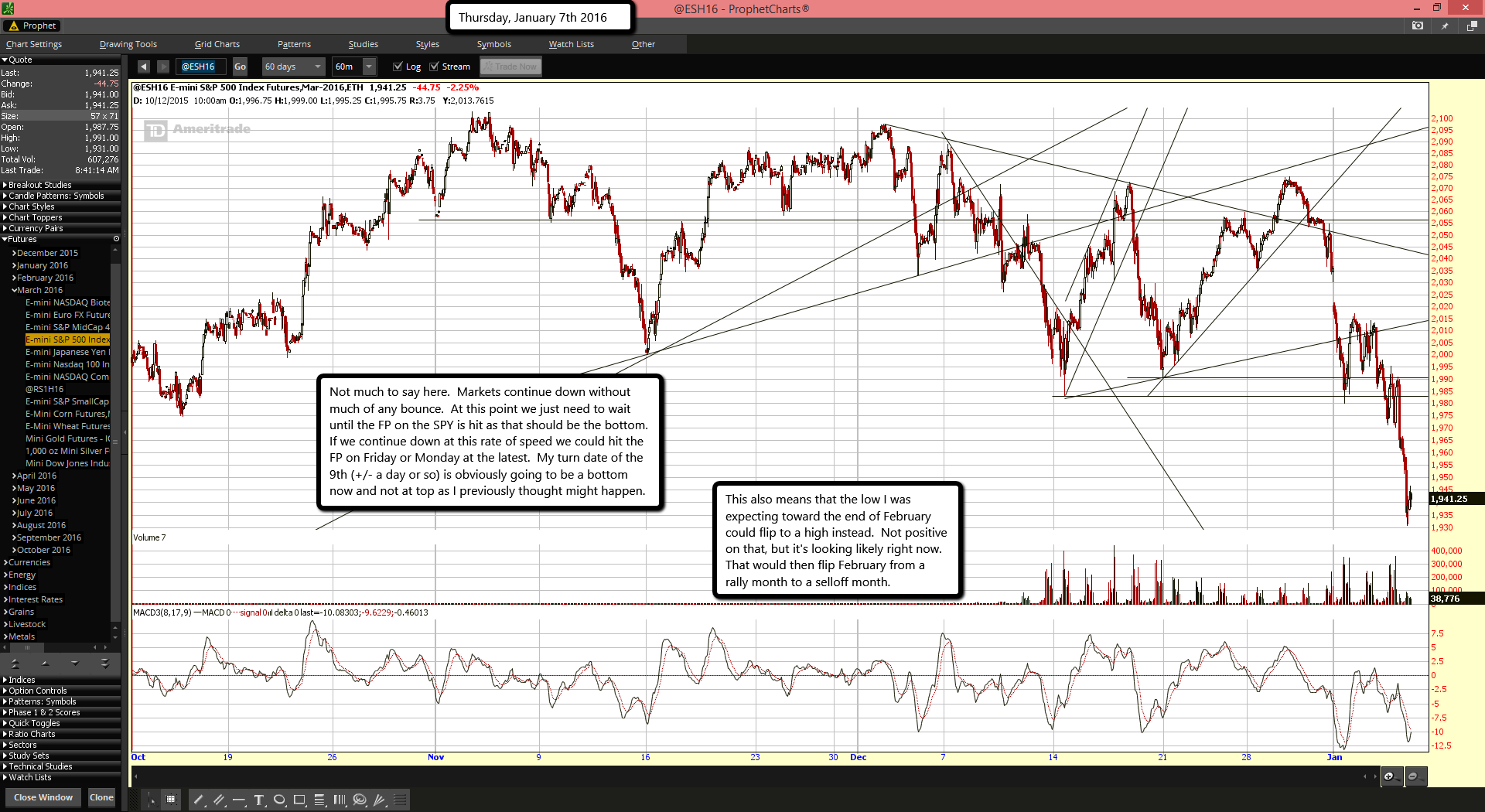
Not much to say here. Markets continue down without much of any bounce. At this point we just need to wait until the FP on the SPY is hit as that should be the bottom. If we continue down at this rate of speed we could hit the FP on Friday or Monday at the latest. My turn date of the 9th (+/- a day or so) is obviously going to be a bottom now and not at top as I previously thought might happen.
This also means that the low I was expecting toward the end of February could flip to a high instead. Not positive on that, but it's looking likely right now. That would then flip February from a rally month to a selloff month.
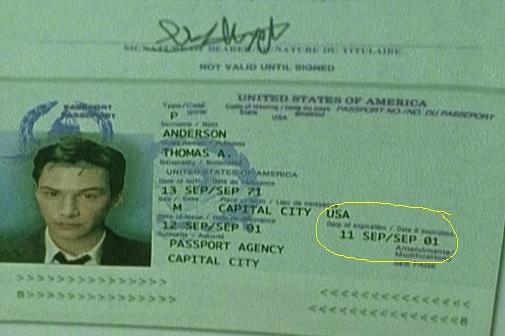
The recent mini-crash we had on August 24th, 2015, as forecasted in the movie Lucy on Scarlett Johansson's passport expiration date, and told here in the previous post 2 months before the event will be just a blip when compared to what is coming in 2016.
While I'm not positive on whether we have already topped already this year in 2015, or if we have one more slightly higher high coming in 2016, I will say with 100% confidence that we are in for another crash next year.
This coming week we have the Evil Reptilian Pope coming to visit the White House on September 22, 2015 (http://www.popefrancisvisit.com/schedule/arrival-in-washington-d-c/)... which I can't see as anything positive. This satan worshiping snake is surely making some kind of evil deal with our gangster run government leaders. What it is, I don't know? But it's clear to me that we are nearing the ending period for this stock market as when these people meet it's never good for us sheep. I'm not saying we are going to crash right after he meets but it's coming soon thereafter... like within a few months.
Over in China we have their government banning shorting their stock market back in July of this year (http://www.theguardian.com/world/2015/jul/09/china-bans-major-shareholders-from-selling-their-stakes-for-next-six-months), which spells disaster in my mind. When you don't let traders short the market you don't have any bears to squeeze, and that means you don't have any way to rally a market up from a sell off except for tricking the sheep into buying, and that's probably not possible after you scare them with a big drop.
Next to the sheep buying you have the big institutions buying the sell off, but they aren't dumb either and won't buy it without seeing some trapped shorts to squeeze... which of course gets the market going up big time as they all have to cover at a loss. This is exactly how over here in America our government has keep they market up as high as it's at now. Without shorts in the market to squeeze you will go "no bid" and just crash... and that is precisely what's been happening in China. And I don't think it's over with yet. When America crashes next year China will go down again.
There's your clues in the news that tell you the stage is set to crash in 2016!
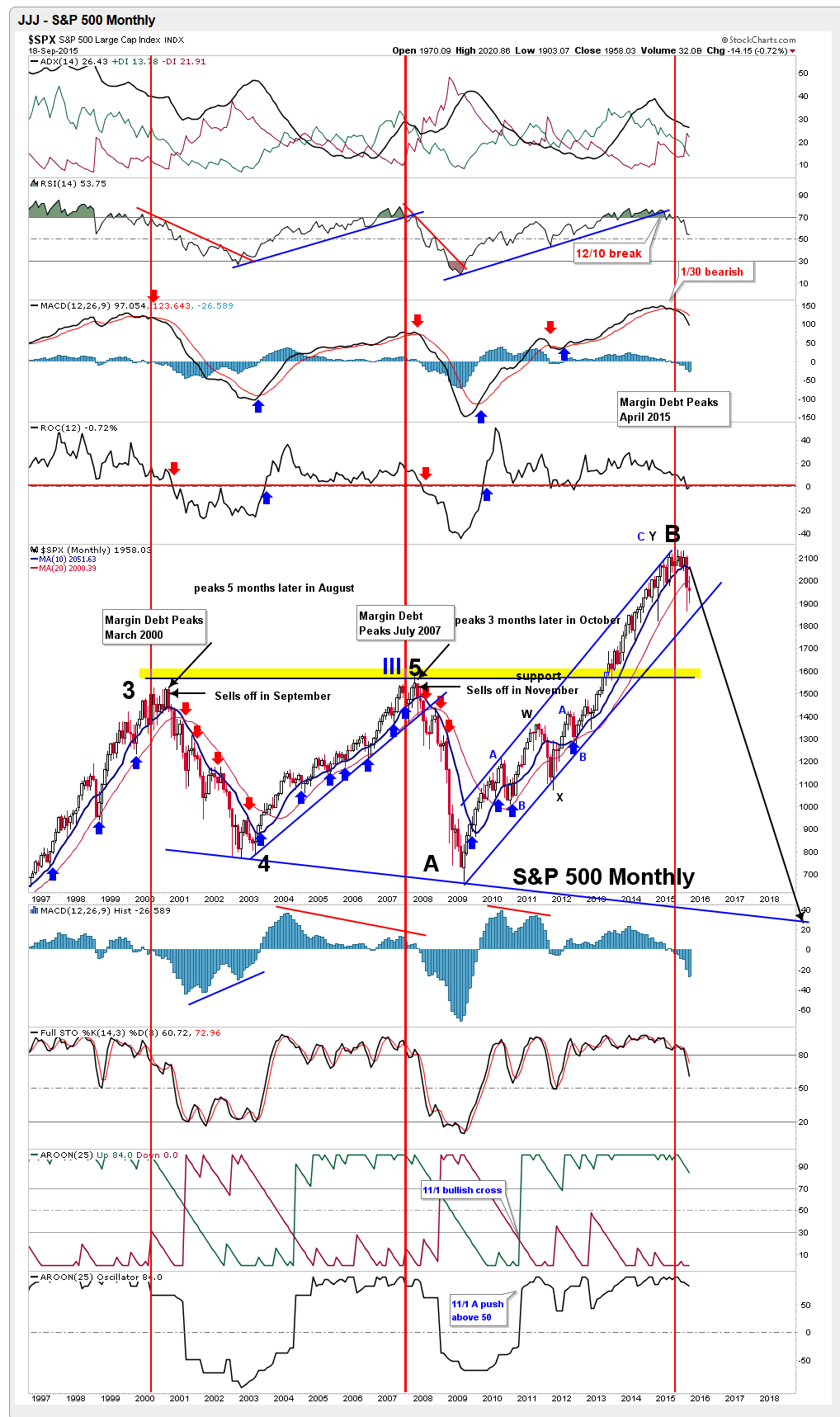
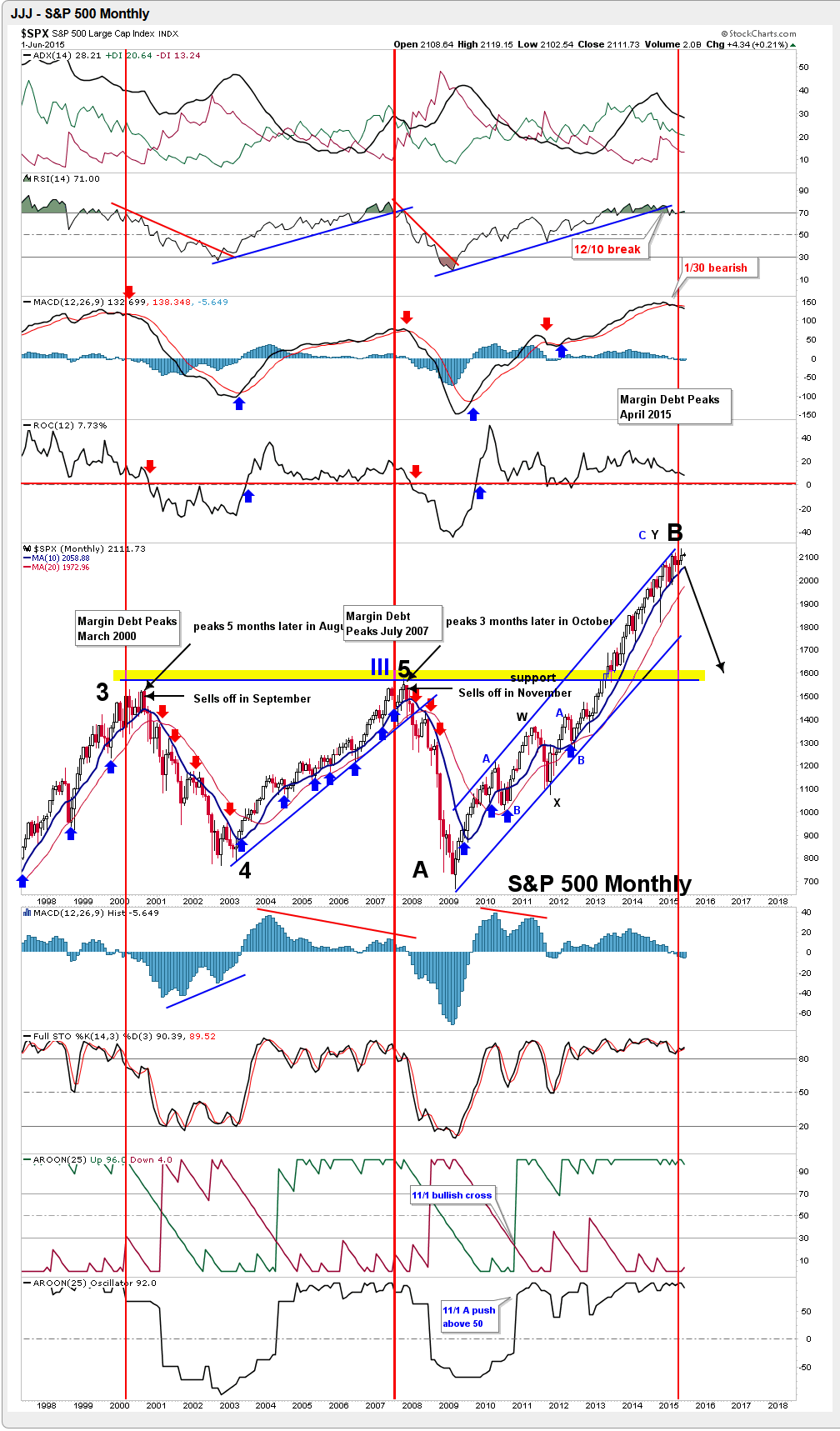
Looking at the technical picture we have the monthly chart now looking a lot like it did in 2000 and 2007 before it crashed the following year. The rising channel lines drawn on that chart point to about the 1820 area for the lower rising blue trendline to be support if this month of September were to go down further. So, we should expect that level to hold on a monthly close on it's first hit of that trendline.
With the current down trendline being labeled Primary Wave 4 down by Tony Caldaro I'll continue to refer to it that way as well since his Elliotwave count seems to be the most accurate I've found. Not that I trade off of it on a day to day basis as I find it mostly helpful in seeing what's behind us and not too predictive for the futures due to it's many alternative wave counts.
However, on the bigger picture it's pretty good and looking forward. Basically we started Primary Wave 1 up from the 666 SPX low in March of 2009 and ended that wave in May, 2011 at 1370 SPX. Then Primary Wave 2 down happened into the 1074 low in October of 2011. Following that we had the super long Primary Wave 3 up that ended in May of 2015 at 2135 SPX. Currently we are in Primary Wave 4 down that should end around the first week of October, 2015.
Once it ends we will be starting Primary Wave 5 up, which should last 2-6 months, and may or may not make a new all time high. If it does make a new high then I'd expect it to last closer to 6 months and top out just above 2200 SPX. If it doesn't make a new high then I'd expect it to last closer to 2 months and would then be called a "truncated" Primary Wave 5... which is common and what I expect to happen.
Since I focus mostly on the technical analysis side of charting and not so much on the Elliotwave side I will say that from a TA side I don't see any new high coming and instead think we'll make a lower high on this Primary Wave 5 rally. In fact, I would not be surprised if they don't have some tricky big squeeze up for the month of October, peaking in early November for this final wave up.
That would then end the entire 5 wave series since the 2009 low and start the next cycle of waves down, that should erase 50%-80% of the entire market over the next couple of years. Should it only be 50% or so then we will likely stop and hold around the 1050-1100 SPX area where a rising trendline of support comes in at. It started at the 1974 low of 62, then the 1982 low of 101 SPX and connects to the 2009 low of 666 SPX. If that fails then we will find ourselves falling to another rising trendline from the 1929-1932 Stock Market crash low that connects to the 1942 low. That rising trendline is pointing to the low 400's on the SPX right now. Yeah, that's one scary low!
Of course we'll find support a the 2009 low of 666 first before it finally breaks and drops to the low 400's on the SPX, but that's too far out to predict right now. We only know that the evil gangsters who run the world want to create their insane New World Order where we sheep are even bigger slaves (and much poorer) then we already all. They want full control of every aspect of our lives, and crashing to the 1050-1100 SPX area doesn't seem too me to be deep enough to get the sheep into putting chips in their head or hands for the "Mark of the Beast" as foretold in the Bible.
But crashing to the low 400's on the SPX should would...
It would scare the sheep into giving up all their last freedoms to be saved from the severe poverty state that Satan's minions would put them into with a stock market wipeout like that! Naturally I don't want to see that happen, but I can't control it... I can only warn people that it is possible. It's possible from not only a charting point of view using technical analysis, but also from an "end times" model that we appear to be in right now... or at least those that rule the world think we are in.
Moving back to the short term I think we'll have a low in the market in the first week of October of this year. It should be a lower low then the recent 1867 SPX low on August 24th, but I'm not expecting something crazy like 1700 or so... like many others are forecasting due to the Shemitah September 28th date and the Blood Moon that happens too. I'm thinking in the low 1800 area for that bottom into early October.
Then we rally into mid to late October, topping out early November and dropping again the rest of that month with some bottom near the end of it and then the December Santa Claus rally starts until the first of 2016.
How low we go in November is not known yet?
Since Primary Wave 5 up should take 2-6 months I'd think we don't take out the expected Primary Wave 4 low around the low 1800's, but some massive squeeze up to 2100 SPX in October could change my mind? I'd rather see some steady 3 wave (ABC) pattern up to 2100 by the end of this year instead, because that would line up more inside the 2-6 months window for Primary Wave 5 up.
Doing the entire move in one month (October) would be very unusual and should then lead to a drop in November well below 1800 with the 1700's being the target zone. I personally don't think that will happen though, but I did want to point it out as "possible". Just visit this blog post daily to see new updated comments to stay up to date.
What would make more sense to happen is some low in the 1800 area early October or late September. Then start the A wave up for Primary Wave 5 up, that should top out mid to late October. Then down early in November for the B wave down inside Primary Wave 5 up, which should of course make a "higher low" then the start of the A wave up. Follow that by some C wave up in December to end the Primary Wave 5 up in early January, 2016 (or late December, 2015) that I think will hit 2100 area making a lower high then the Primary Wave 3 up all time high of 2135 in May of 2015.
While it's possible to make a new "higher high" for Primary Wave 5 up I just don't see it in the charts... from a technical point of view of course. The only thing that would make me believe we could see a "higher high" for Primary Wave 5 up is for the month of September to close above 2000 SPX, and I just don't think that will happen with the next 2 weeks being so bearish as seen in this chart below.
We just had the Fed's big September FOMC meeting where everyone expected them to raise interest rates and they announced that they wouldn't be doing that just yet. We sold off from that positive news, and that's not a good sign. If there was anything that should have been used to rally the market up to above 2100 by the end of September it would have been that good news.
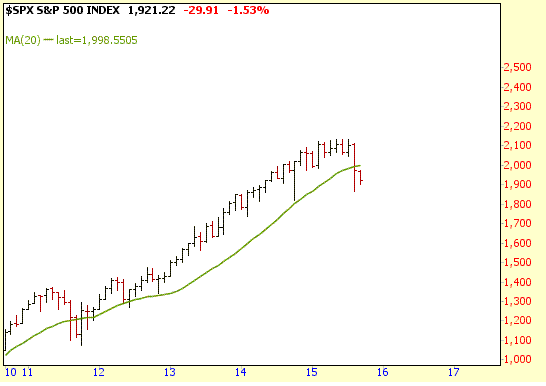
Instead they did the announcement in the middle of September knowing very ware that the market would sell off after the news and drop lower into the end of the month. If they planned to extend this stock market higher into next year they would have made sure to give out some positive news near the end of this month to close it above it's 20 Month Moving Average... which is currently at 2000 SPX.
Here's a post done by Amateur Investor showing what happened in the past when the market makes 2 closes below the 20 Month MA.
Weekend Analysis
(9/5/15)
As I talked about last weekend there have only be "5" times since 1900 when the following conditions have been met.
1. Dow or S&P Composite dropped 10% in 5 Days or less.
2. Dow and S&P Composite were within 4 months of an "All Time High"
3. Shiller PE was 20 or above
4. The 20 Month Moving Average was tested.
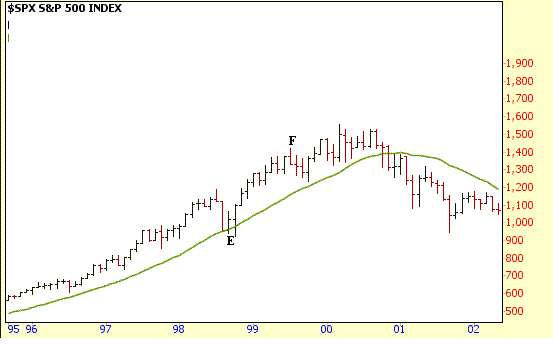
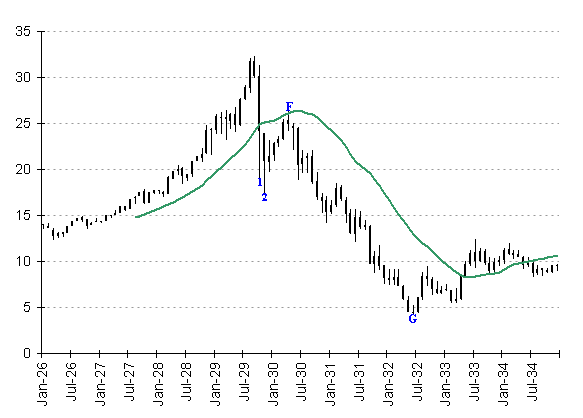
Prior to the most recent event these conditions were met in January of 2008, April of 2000, August of 1998 and October of 1929. This month will be pivotal for the S&P 500 depending on whether it closes a 2nd Month in a row below its 20 Month Moving Average or not.
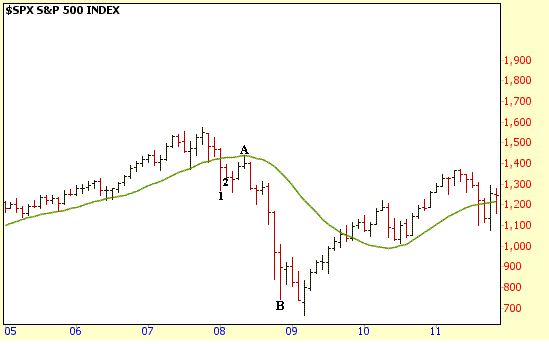
Let's see what happened with the prior "4" events and the 20 Month Moving Average. Starting with the last event in late 2007/early 2008 there were "2" monthly closes below the 20 Month MA in January and February of 2008. In this case the S&P 500 rallied back to its 20 Month MA which was then followed by another significant drop (points A to B).
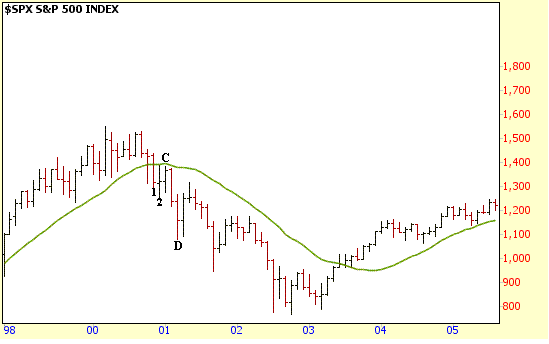
The next case was in 2000 as the S&P 500 closed below its 20 Month MA "2" months in a row in November and December. Once again notice the S&P 500 rebounded back to its 20 Month MA before selling off again (points C to D).
Meanwhile in the Fall of 1998 notice the S&P 500 failed to close below its 20 Month MA in September and October although it did briefly drop below it two months in a row (point E). This was then followed by another significant rally through the Spring of 1999 (points E to F).
Finally the last event was in the Fall of 1929 as the S&P closed below its 20 Month MA in October and November. In this case the S&P rallied back to its 20 Month MA before another sharp sell off occurred (points F to G).
Currently the 20 Month MA in the S&P 500 is at 1999 sp this value won't change much over the next three weeks. Thus this will be a key level to watch by the end of the month and may have significant implications for the market in the future depending on whether the S&P 500 closes above or below it.
Clearly you can see that odds are very low that we'll make a higher high with Primary Wave 5 up when you have 2 monthly closes below the 20 Month MA... which I think we'll see by the end of this month.
To summarize, I'm looking for this week and next week to go down to make a lower low (then the 1867 SPX August 24th low) to complete Primary Wave 4 down. Then a rally into mid-late October for the first wave A up of Primary Wave 5... which should be somewhere in the 1950-2000 range I suspect. After that we should see a B wave down (inside Primary Wave 5 up) to lure in some more bears and scare the bulls out. This should NOT break the low of Primary Wave 4 down. Possible targets are 1850-1900 area. This should end in mid-late November. Finally we should have a C wave up (inside Primary Wave 5 up) that I suspect will reach around 2100 by the end of this year.
I'm losing my bearishness right now as the weekly chart is getting into oversold area where "turns" usually occur. Bears beware, we could see a new high coming soon.
July 29th, 2015 ... after the FOMC meeting Update
Well, the Fed's said nothing about a rate hike at today's FOMC meeting. So that rumor last week of a .35 rate increase in September was NOT confirmed yet. I suspect the retail traders will view this as positive and buy the market now. That tells me we will top out tomorrow or Friday instead.
I posted on the blog (in the comment section) the following after I did this newest video update...
"While I think we are "close" to having a breakout to a new high soon I just can't get excited about going long with the VIX so low and all those bulls still onboard from the 2040 SPX area over the last several months. If SkyNet would just flush them out with some drop to 2000-2020 I'd become a bull again.
They never filled the VIX gap at 16.60 and that leaves some hope that they might just be planing another drop to get the Weekly chart oversold and then allow for a bottom to form. All the bears would pile on below 2040 and once SkyNet gets the bus full it should be plenty of fuel to squeeze them up hard like the rip from the 1820 SPX low last year in October."
... and then this
"With the news from the FOMC today of them NOT announcing a scheduled rate hike in September as the rumor last week told us it would be .35% I have too think traders will get bullish now... and that should mean the opposite will happen and we'll drop again."
Finally I posted this...
"Do "NOTE" that even though the weekly chart is turning back up slightly this move up needs to happen fast... like before breaking that rising trendline on the weekly chart. If for some reason we break that support (that goes back to the 1074 SPX low in 2011) we could fall off a cliff and bury the MACD's, Histogram Bars, and Stochastic's on both the daily and weekly chart."
My thoughts are simple... we are at a critical conjunction where the weekly chart can take us up to new highs with 2200 area being a real target zone, OR we can break the rising trendline of support from the 1074 SPX low in 2011 and drop like a rock. I just don't know which one yet?
However, with the VIX still very low and near the long time support zone of 12 or so I don't see the bulls having the strength to power on up through the current overhead resistance right now. That leads me to believe we are still in this choppy zone until either the downside 2040 SPX support zone breaks (and breaks the weekly support trendline) or takes out the 2135 all time high.
With that support trendline rising in price level every week now (it looks to be around 2080 now) this "zone" we are in will likely break one direction or the other this week or next week. If we close below that 2080 area this week then next week could be an "all down week" as mutual funds and hedge funds hit the "SELL" button due to the long time weekly support line breaking. Remember, "computer trading" looks for certain levels to hold or break and once one occurs BIG moves in one direction or the other just happens automatically. Humans aren't doing but about 30-40% of trading now as "algo's" make up 60-70% of all trading according to many estimates.
As we all know the Elite that run the world 100% control the "Main Stream Media" (MSM) and constantly mislead the sheep that watch TV, read the newspaper or listen to the radio. But what about the Internet? Do they control it fully too? NO is the answer as we sheep have the opportunity to publish our own thoughts on blogs like this or various social media outlets. However don't just assume that "they" are still busy spreading their "dis-information" stories throughout the Internet to dis-credit true and factual information as I'm 100% positive they are do that every day.
Remember, their entire "motto" of life is to do everything in their power to steal from you, poison you, lie to you, use you, and kill you off when you are no longer a profitable debt slave. So you should NEVER assume that even though they are bound to tell in advance of the things they plan to do to you that they will do it in a timely manner where you can profit from it... as the opposite is true.
While I think Lindsey Williams is probably a very good man and truly wants to help people I also think his elite source gives him information that is timed to benefit the elite by "suggesting" though his leaked messages that us sheep go long gold near the top, short the dollar near the bottom and of course miss the entire move down recently in oil.
Without a doubt if you traded from his information you would go broke!
Of course he clearly doesn't tell you to trade from what he tells you but we all know that people will still listen to his stories and base their trading around the trend that they expect to happen from his information. This would again result in losing you money as every thing he's told us over the last 5+ years hasn't been correct. The dollar hasn't crashed, gold hasn't went up strongly and oil... well he claims his elite contacts never caused the sharp move down as that was apparently all done by Obama trying to push Russia president Putin.
Well, regardless of whether or not the elite crashed oil or Obama we sheep never seen it coming and didn't profit from it... so the facts are still the same, "You can't trade off Lindsey's information (unless you do the opposite?)", as it's clearly been wrong since I've started to follow him. That's been 5-7 years now I guess.
Since I wasn't following him when he claims to have successfully told everyone in advance of the 2004-2008 big move up in oil and the fall back down hard into the 2009 low I can't know if that was timed out where the sheep could have profited from his information or not? I only know that since I've known about him his information has been wrong.
So how do you use this information if it's timed to get the sheep into the stock market on the wrong side when the prediction is expected to happen?
Simple really... you assume we'll be bottoming when this September, 2015 Stock Market Crash is forecasted and looking for a shorting opportunity several months in advance of it. When I look back at the 2011 mini-crash I notice that we had the most powerful crash wave (the wave 3 down) in August and then we had 1-2 months of a wild and crazy wave 4 up before the final wave 5 down to 1074 SPX early October low.
Clearly it was very tough to make any money on the wave 5 down as you would have be shaken out many times as the wave 4 up had so many ups and downs in it that most bears would have be puking their guts out from week to week waiting on that final leg down. The big money (and safer wave to ride) was being short from late July, 2011 into the early August low for the wave 3 down. This is the wave I personally want to catch (if possible?) and just pass on the expected wild ups and downs in September and October of 2015.
Past evidence on prior moves down is clearly shown in these charts of the DOW as explained in this video about "The Shemitah"...
I've looked a several other video's about The Shemitah and how it points to September 13th, 2015 as being the "Elul 29" and just like this one the best. It's done by someone named James Trivette, a preacher I guess? Anyway, I think it's well worth your time to watch.
Eclipses in 2015 March 20: Total solar eclipse April 4: Total lunar eclipse
September 13: Partial solar eclipse
September 28: Total lunar eclipse
Eclipses in 2016
March 9: Total solar eclipse
March 23: Penumbral lunar eclipse
September 1: Annular solar eclipse
September 16: penumbral lunar eclipse
My thoughts on this forecast again of something bad happening (like a stock market crash) in or around September 13th, 2015 are that it will be a bottoming period, so we should be looking to get short much sooner. When you ask? We'll as most of you long time follows of this site know all about Legatus I'll point out that we have a meeting this coming June 15th-17th, 2015 and coincidentally an FOMC meeting June 16th-17th as well.
That meeting is the one that many people are expecting the Fed's to tell the market that they will be raising interest rates in September of this year. While I don't know if they will state that news in that meeting I do believe that if they do say it we'll see a top in the market as traders will start bailing out long before the actual rate hike happens 3 months later. So by the time September comes the bulk of the panic should be over with... which again leads me to believe it will be a bottoming period.
This also tells me that we should have another big "Wave 3" down (the crash wave) somewhere before that September 13th "Shemitah"date and/or September "Interest Rate Hike". Past history tells us that August is a bad month for the market and if you look at 2011 you'll see that the biggest move down was indeed in August, not September.
Quite possibly we will top in mid-June and start the first waves 1 down and 2 up from there until late July where another big crash wave happens into August? Of course it shouldn't follow the 2011 pattern exactly as that would be too easy for us sheep to figure out... and you know "they" won't make it easy for us to profit from. If fact they will do everything in their power to make us lose all our money so they can take it from us as they profit wildly from the crash they created.
What about Legatus?
In that Legatus meeting I'm sure they will make the final decision on whether or not the "Stock Market Crash" is still on for 2015 or if they are going to push it out one more year into 2016. I don't know the answer of course but I do believe without a doubt that it will happen before Obama leaves office as they want to blame this whole crash on him. He will be the "scapegoat" for the coming collapse even though it was planned many decades ago.
These elite are just a bunch of crust old white vampires that will get a kick out of setting up the first black gay American president... which is why they put him in office in the first place I'm sure. I kind of feel sorry for him in some ways as it's not his fault for what's coming. But they seem to have NO Feeling at all of compassion for other humans and will do whatever it takes to fulfill their sick agenda.
I can't tell you the exact date of the top or the bottom (assuming the crash still happens) as I'm sure that any date I put out there will (could?) be off simply because I said it would happen. I'm just saying that if too many people (sheep only, as the elite know the date) discover the exact day the market will top then they will be forced to change it.
I remember back in 2013 when I did several posts saying that we'd top on May 22nd, 2013 because it was right in the middle of a Legatus meeting and a ritual "33" day (https://reddragonleo.com/2013/05/06/we-are-just-weeks-away-from-the-start-of-a-200-or-more-point-drop-in-the-spx). I told everyone about it for 2-3 months prior to it happening. I thought it would be the top for the year, and we'd crash from there into a low later that year. While it did top out and drop from 1687 SPX to 1560 by June 24th it wasn't the high of the year, nor was it a crash.
I don't know if they plans were changed or not (due to the fact that there could have been too many sheep aware of the date after I posted it?), but I've changed a lot since then in my charting analysis and simply post what I think is possible, but give NO promises of "it will be the top" or "we must crash"... as I now know how quickly "they" can change the plans to make us blog writers and stock market forecasters look like fools.
Therefore I'll just point out "possibilities" with some supporting evidence that whatever date or time frame I might a forecast for "could" be accurate. My personal trading method today is "day trading", and I've do very well with this method over the last year or so... much more profitable then trying to forecast which direction the market will be going at a week or two from now.
This is one of the main reasons I don't post as much anymore. The other reasons are that the better I get at day trading the less information I can find out there to post on that will be correct in the near future. There just isn't enough "darkside information" available that is accurate. Ritual numbers and ritual dates are too abundant to call everyone of them and expect a turn in the market.
So I just do my best to post comments on whatever the current blog post is, which are there to inform everyone of what I see short term for the market. Then I re-post via my twitter account. Sometimes (if I remember?) I post it on my facebook account too.
Why is Walmart closing stores around the county claims plumbing problems and then NOT filing for a plumbing permit?
There's a lot of posts around the internet talking about the mysterious closings of all these Walmart stores for some plumbing problems and then blacking out all their store windows and hiring police officers (not security guards as most stores would) to guard the place. Then on top of that are all these military vehicles being spotted going to these stores. Are they planning on marshall law in the near future to put the sheep in? If so, what event would cause this?
Walmart Closing Five Stores For 'Plumbing Problems'
I know we've seen of a lot this stuff before in the past and nothing ever became of it (at least in the "stock market crash" forecasting), but it's still worth knowing about as at some point in the future I'm sure they will do something bad to us sheep so they can put these Walmart stores to use locking up certain people that go crazy when the economy collapses and they have no job, no home, and no food to eat.
Whether all this happens in late 2015 or they push it out until 2016 is unknown, but I firmly believe it will start before Obama leaves office. If the Fed's decide to announce the future interest rate hike in September, 2015 during this coming June 16th-17th FOMC meeting then we should all expect it to start this year. If not, then possibly they decide to push it out one more year?
However, I certainly get the feeling that it will start this year... bottom in Sept/Oct and rally up into 2016 before they pull the rug out completely and slaughter this fat pig of a market. Let's face it... the monthly chart of the SPX looks eerily similar to the 2011 period before a nasty mini-crash happened.
What about any FP's? (fake prints)
I don't have any new ones (on the large scale) but I'm still thinking this old one from January 2014 "could" still be in play. It's one showing the NYA at 11334.65 high.
There's also the old TVIX FP showing 35.9599 from 11/14/2013...
So not much to say on that subject. Those prints could both be nothing as they are old and plans could have changed from then to now. But I wanted to include them should the market put in a top in mid-June and start crashing into September as they could be targets?
I'm still not sure all the pieces are in place for the total collapse though as the ECB is still supporting their markets in Europe with their version of Quantitative Easing and isn't scheduled to end until September of 2016 (https://www.ecb.europa.eu/press/pr/date/2015/html/pr150122_1.en.html). But, that doesn't mean we can't get started this year here in America and have the first larger "Wave 1" down, followed by a mufti-month "Wave 2" up into mid-2016. Then the "Super Crash Wave 3" down into the end of 2016 and probably some of 2017 could happen.
In both the 2000 and 2007 tops and crashes that followed we had a month chart that produced a wave 1 down and wave 2 up before their wave 3 "crash wave" down happen... therefore we should expect something similar to happen this time around as well. That gives us a strong possibility that it will indeed start in 2015 but get worse in 2016. So let's keep our minds sharp and open to the fact that we do have some very good odds of a major turn down this year.
Final Clues: Has the elite already warned us of "The Crash Date"?
As we go back to September of 2001 we remember the both the movie called "The Matrix", TV show called "The Lone Gunmen" and the famous episode of "The Simpsons" where we were told in advance of something BIG happening on 9/11. In the matrix it was shown on Neo's expiration date that said 9/11/2001. On the lone gunmen episode it was a hijacked plane that was on a collision course for the twin towers, and finally on the Simpsons it was the cover of a flyer that showed the twin towers in the background with a big $9 to the left of it for the cost of the pamphlet.
No one but the insiders knew what that all meant as I seriously doubt it if there was one "red pill taker" sheep that seen all three (or just one or two) of those messages and figured out the meaning before it happened. If so, he or she certainly didn't post it on the internet for all to see (not that many would have seen it anyway as youtube wasn't around back then).
So I'm not going to tell you what I've seen that points to another date of something really bad happening but instead tell you to think like the matrix and go watch a movie called "Lucy" with Scarlett Johansson and you'll see the date I think we're going to crash. Enough said...
Red
P.S. Interesting how VERY BEARISH the week after the June 15th-17th is, which is based on prior history.
Just more evidence of a very important week starting June 15th and ending on "Triple Witching" Friday the 19th...



 Elevate