Friday, September 25, 2026
Home Blog Page 81

Orlando Pulse club attack: gunman identified as police investigate motive

0

Gunman who opened fire with assault rifle, and equipped with suspicious device, reportedly a 29-year-old US citizen

The gunman behind a suspected terrorist attack that killed 50 people at an LGBT nightclub in Orlando is believed to be Omar Mateen, 29, from Florida, a US citizen of Afghan heritage.

The gunman opened fire at the Pulse Club in the early hours of Sunday, taking hostages, killing many and injuring 53. Raising the alarm in the early hours of Sunday morning, staff at the venue posted on Facebook: Everyone get out of pulse and keep running. .

Orlando confirmed police said the shooting was being treated as an act of domestic terrorism. The FBI said it had a positive identification of the shooter but it was not releasing a name as it was in the process of notifying his family.

The gunman was killed during a shootout with police as they broke into the nightclub to rescue 30 people held hostage there. No motive for the attack has been offered by police. The Guardian has not been able to independently verify the identity of the shooter.

Police initially said about 20 people had been killed and 42 injured in the attack, but later revised the toll up to 50 dead and 53 hospitalised, the latter including one police officer who had been shot in the head and whose life had been saved by his Kevlar helmet. They said the gunman was armed with an assault rifle, handgun and some kind of device.

At a press conference on Sunday morning, an FBI spokesman said investigators believed the attacker may have had extremist beliefs, but cautioned that they were pursuing multiple leads.

Orlando Police (@OrlandoPolice) June 12, 2016

Shooting at Pulse Nightclub on S Orange. Multiple injuries. Stay away from area. pic.twitter.com/5Di2mc6XUY

An explosion was heard at the club at about 5am local time, which police said was a distractionary device used as part of the rescue mission to get to the hostages. The explosion caused some panic on the ground, which led to Orlando police tweeting to say it had been a controlled explosion and warning the media about reporting inaccuracies.

Police said the incident began at 2am when the gunman started firing and an officer on duty at the club exchanged shots with him. They said it then descended into a hostage situation. The situation was resolved three hours later when a Swat team stormed the nightclub after receiving messages from club patrons who were hiding in the club while the gunman was still at large.

A little after 0500 hours we made a decision to go in and conduct a rescue. We were being contacted by people in the bathroom, about 15 people. Our biggest concern was future loss of life, said John Mina, the chief of police.

Several explosives and an armoured vehicle were used to break through a wall of the nightclub and rescue approximately 30 hostages. The suspect was shot by a police officer during this intervention.

Orlando Police (@OrlandoPolice) June 12, 2016

We can confirm this is a mass casualty situation. Support from local/state/federal agencies. We expect to brief media shortly.

Orlando Police (@OrlandoPolice) June 12, 2016

Pulse Shooting: The shooter inside the club is dead.

Police said several suspicious devices were found in and around the nightclub, including one on the gunman and one on his car.

This is an incident, as I see it, that we can definitely classify as a domestic terrorism incident, said the Orange County sheriff, Jerry Demings.

When asked whether the suspect was thought to have any affiliation with Islamic State, the FBI assistant agent in charge, Ron Hopper, said: We do have suspicions that the individual may have leanings toward that ideology. When pushed as to what led him to believe that, he clarified that all possibilities were being investigated.

Earlier in the evening one witness told Sky News there had been more than 100 people inside the venue for the clubs Latin night when the gunman entered the building and began firing into the ceiling and into the crowd.

Richard Negroni said: We just heard shots, it was less than a minute, it felt longer. There was a brief pause and we just ran. Everybody was just faces to the floor. I had someone over me, I really didnt see [how many gunmen there were]. All I can tell you was the club was packed, there were over 100 people there, if the gunman came in through the front door people were injured or worse.

In a Facebook post, Negroni wrote that the shooter opened fire at about 2am and people on the dancefloor and bar got down on the floor. He said some people near the bar and back exit managed to escape quickly.

Pulse nightclub, Orlando, Florida

Mina Justice told the Associated Press that her 30-year-old son Eddie, who was in the club when the attack took place, texted her asking her to call the police. Justice said Eddie had run into a bathroom to hide. He then texted her: Hes coming.

The next text said: He has us, and hes in here with us, she said. That was the last conversation.

Orlandos mayor, Buddy Dyer, praised the efforts of law enforcement agencies, saying that many were saved by [their] heroic efforts.We had a crime that will have a lasting effect, we need to stand strong, we need to support victims and their families, he said.

The
The scene of the shooting at the Pulse nightclub in Orlando. Photograph: EPA

Family members were waiting throughout the morning to hear about the safety of their loved ones. Many of the injured were brought to the Orlando regional medical center (ORMC) located close to the nightclub, and they announced in the early hours of the morning that they were in lockdown and admitting entry only to essential workers. They have since instructed those who believe their family might have been brought there to come to the family meeting area at the hospital.

Staff at the club posted a message on Facebook thanking people for their concern during the nights tragic event.

As soon as we have any information we will update everyone, read the Facebook statement. Please keep everyone in your prayers as we work through this tragic event. Thank you for your thoughts and love.

Witnesses describe Pulse nightclub terror shooting

Read more: http://www.theguardian.com/us-news/2016/jun/12/orlando-shooting-nightclub-pulse-gunman

Has Oil Risen Too Far Too Fast?

0

Oil Pump At Sunset

Crude oil has been on a remarkable run since bottoming out earlier this year. After crashing into the mid-$20s to start the year, crude has rocketed higher passing $50 a barrel this week despite the fact that OPEC hasn't done a thing to help the oil market. Instead, what has fueled crude's surge is a combination of temporary supply outages and the growing belief that supply and demand will move back into balance by the end of the year due to the anticipation for steep global production declines. That said, if those catalysts don't hold it's quite possible that crude could give up some of its recent gains.

Supply disruptions mount

One of the big weights on the price of crude over the past year was the fact that there was an abundance of oil supply on the market thanks in part to limited supply disruptions. That has changed this year after growing political unrest in places like Libya, Venezuela, and Nigeria caused output in those countries to come offline. Nigeria's oil industry, in particular, has been hard hit after militants blew up a number of oil wells and pipelines.

In fact, just this week militants blew up another Chevron (NYSE:CVX) oil well in the country. It was the fourth attack in as many weeks on a facility operated by Chevron, which has also had to halt operations at a 160,000 barrel a day export facility. Because of these militant attacks nearly half of Nigeria's 2.4 million barrels per day of production is currently off-line, with militants threatening to cut Nigeria's oil output down to zero.

On top of these geopolitical supply disruptions, wildfires in Canada knocked out a third of that country's oil production at the peak, or well over 1 million barrels per day. Some of those facilities are just starting to come back online, with ConocoPhillips (NYSE:COP), for example, recently restarting one of its key facilities in the region. However, it could be another month before ConocoPhillips and its peers are back to their pre-fire production levels. Further, the fires are not completely extinguished and have recently threatened additional facilities in the country causing several producers to shut down production.

These supply disruptions have clearly had an impact on the price of oil this year. However, as Canada's oil industry gets back up to its prior peak it will add more supplies to a still oversupplied market. Likewise, if the attacks in Nigeria cease that country could start resuming some of its lost output. In other words, these supply disruptions aren't likely to be permanent.

An uncertain forecast

The other big fuel driving oil prices higher this year is the belief that global oil production will decline due to a significant underinvestment in new supplies, with U.S. production expected to see the deepest drop. In fact, in the International Energy Agency's latest oil market report it has revised its forecast for the fall of non-OPEC production. It now sees this output declining by 800,000 barrels per day from last year's average, which is 100,000 barrels per day steeper than its prior forecast.

Having said that, oil production from several U.S. producers has come in well above their own expectations, which is leading many to increase their production guidance for the balance of the year. Production at Pioneer Natural Resources (NYSE:PXD), for example, averaged 222,000 barrels of oil equivalent per day, or BOE/d, during the first quarter, which was well above its guidance range of 211,000 to 216,000 BOE/d for the quarter. Because of this Pioneer Natural Resources increased its production growth outlook for 2016, with it now expecting to grow its output by 12%, up from its prior view of 10% growth. Not only that, but with oil over $50 a barrel the company is seriously considering adding additional rigs, which could boost its output even more by the end of the year. Further, Pioneer Natural Resources was far from the only producer to increase its full-year production guidance, which suggests that oil production might not decline as much as the IEA and other analysts expect.

Investor takeaway

While the price of crude oil has surged in recent weeks, downside risks still remain. Not only was its recent rally ignited by what could just be temporary supply outages, but full year decline projections might not come to fruition due to stronger-than-anticipated production from shale. In other words, there is still the risk that oil might not be done going down, which is why investors could be better off steering clear of riskier oil stocks for the time being.

A secret billion-dollar stock opportunity
The world's biggest tech company forgot to show you something, but a few Wall Street analysts and the Fool didn't miss a beat: There's a small company that's powering their brand-new gadgets and the coming revolution in technology. And we think its stock price has nearly unlimited room to run for early in-the-know investors! To be one of them, just click here.

Source link

Uber takes U-turn, lets riders schedule trips in advance

0

Passport, check. Toothbrush, check. Scheduled Uber pickup, check.

The ride-hailing company announced that users on their way to the airport, or in need of any pre-scheduled ride, will be able to reserve one up to 30 days in advance. The service started Thursday in Seattle, the home of Microsoft, and will expand to other “top business travel cities,” Uber wrote on its blog.

Uber is not the first ride-hailing service to offer this feature. Lyft announced in May it has started to test a similar program in San Francisco, while Gett has offered scheduled-ahead service for more than a year where it operates, USA Today reported.

As these companies upend the taxi and limousine industries, Uber’s announcement shows that it, Lyft, and Gett have found that they shouldn’t discard too many taxi and limo features in the name of “on-demand.”    

“Even though we’re an on-demand company, we totally get it,” Tom Fallows, Uber’s director of global experiences, told Wired.com. “Sometimes you just want that extra reassurance that your Uber will be there when you want to leave.”

Through Uber’s new feature, a user will be able to schedule a ride 30 minutes to 30 days in advance. The feature will be offered to start just through Uber X, its less expensive, private vehicle option. A user can cancel any time before their ride is on its way, at no cost to them. Pre-scheduling won’t impact drivers, who will not be able to match with riders ahead of time, according to The Boston Globe. And users won’t be able to avoid surge pricing, in which the cost of a ride climbs at peak hours, either.

Schedule-ahead service is a reversal of Uber’s long-held stance about how, and when, it serves its customers.

“Uber is an on-demand service,” it writes on its website, on a page titled “Can I make a reservation?” “Use the Uber app to request a trip when you’re ready to ride. There’s no need to make a reservation in advance.”

Travis Kalanick, Uber’s chief executive, reaffirmed this mindset in September, when he spoke one-on-one with Salesforce CEO Mark Benioff at the cloud computing company’s Dreamforce conference.

“Do you schedule time with your shower?” said Mr. Kalanick, when asked by Mr. Benioff if Uber would introduce scheduled rides, reported Forbes.

And yet, ever since it started six years ago, Uber said it has received requests from customers for pre-scheduled rides  “so they can rest assured that an Uber will be available when they need it, even if it’s for a 4 a.m. ride to the airport,” wrote Uber in Thursday’s blog post.

Taxis and limos have long offered schedule-ahead services. In fact, it’s a foundation of the limousine industry. Gett, which operates in Europe, Russia, Israel, and New York City, recognized this when it launched the service more than a year ago. Lyft was next. It started to pilot service in San Francisco about two weeks ago, and plans to expand it to other cities sometime this summer, reported PC Magazine. Lyft, though, will allow users to reserve a ride up to 24 hours in advance, compared to up to 30 days through Uber.

Uber introduced pre-scheduling in part to keep up with its rivals. Yet it’s also an indication that ride-hailing companies are learning they can’t do away with too much of the traditional model.

“If you want to really, truly upend the market, then you have to focus on perfecting the tools people use to create change,” wrote Kevin Harrington, the inventor of the infomercial, in a Forbes article. “In the end, companies don’t upend markets – customers do.”

Source link

4 Facts About Retirement Every Baby Boomer Should Know

0

With our nation's population of baby boomers going strong at roughly 76 million, it's estimated that a good 10,000 baby boomers turn 65 every day. What this means is that more and more boomers are getting closer to retirement, and with that comes a host of important decisions. If you're a baby boomer, here are four key retirement facts to help you navigate this significant milestone.

Older Couples Carrying Carpet

1. People are living longer

According to the Social Security Administration, the average 65-year-old man today can expect to live until age 84.3, while the average 65-year-old woman today can expect to live until age 86.6. Of course, these are just averages. The Social Security Administration also reports that about one out of every four 65-year-olds today will live past 90, while one out of every 10 will live past 95.

While increased life expectancies are a good thing in theory, they pose a financial challenge to today's retirees. Living longer means needing more savings to cover life's expenses in retirement -- savings that many boomers are sorely lacking.

2. Most baby boomers are behind on retirement savings

While there are certainly exceptions, most boomers have a lot of catching up to do when it comes to retirement savings. According to a 2016 report from the Insured Retirement Institute (IRI), only 55% of baby boomers have begun saving independently for retirement.

Among those who have saved, 42% admit to having less than $100,000 socked away. And while $100,000 might seem like a decent sum at first glance, over the course of 20 years, that translates into less than $7,000 a year in retirement income.

3. You probably can't live off Social Security alone

The National Academy of Social Insurance reports that a good 65% of beneficiaries rely on Social Security for the majority of their retirement income, and that it's the only source of income for almost 25% of those 65 and older. The IRI study confirms these findings, with 59% of boomers stating that they expect Social Security to serve as a significant source of income once they exit the workforce.

While Social Security can provide a nice stream of income for retirees, it's only designed to replace about 40% of the average worker's pre-retirement income. Most people need 70% to 80% of their pre-retirement income once they stop working, which means that relying on Social Security alone can leave them with a pretty sizable gap. In 2015, the average monthly Social Security benefit was $1,335, which is just not enough for many people to live on.

4. Many baby boomers worry they won't have enough money in retirement

Confidence among baby boomers regarding retirement is waning. According to the IRI study, only 24% of baby boomers are confident they'll have enough savings to last throughout retirement. This is the lowest level of confidence since IRI began its study in 2011, at which point 37% of boomers expressed the same level of confidence.

Of course, it's not necessarily the case that boomers are growing more pessimistic. Rather, it could be that many are getting more realistic about their finances and retirement needs. And on a positive note, some boomers are taking steps to improve their financial picture.

During the past year, 30% of boomers postponed their retirement plans, and 26% say they're now aiming to retire at age 70, or later. This is a pretty big jump from 2011, when only 17% of boomers planned to retire at or after 70.

Take action now

If you're on the verge of retirement, and aren't confident about your savings, you still have some options for improving your financial outlook. For starters, consider working a few extra years to build up more savings. For 2016, anyone 50 and older can contribute up to $24,000 to a 401(k), and $6,500 to an IRA. If your employer offers a matching program, that's even more (free) money coming your way for retirement.

Here's another benefit of postponing retirement and working a few extra years. If you hold off on taking Social Security past your full retirement age -- which, for baby boomers, is either 66 or 67, depending on the year you were born -- you'll get an 8% increase in benefits for every year you postpone up until age 70, at which point this incentive runs out. And that 8% increase isn't just temporary; it will remain in effect for as long as you continue to receive Social Security benefits.

Deciding when to retire is a major decision not to be taken lightly. Before you jump in, take a hard look at your goals and finances to see where you stand. You may find that an extra year or two of working could mean the difference between a comfortable retirement and one that starts on financially shaky ground.

The $15,834 Social Security bonus most retirees completely overlook
If you're like most Americans, you're a few years (or more) behind on your retirement savings. But a handful of little-known "Social Security secrets" could help ensure a boost in your retirement income. For example: one easy trick could pay you as much as $15,834 more... each year! Once you learn how to maximize your Social Security benefits, we think you could retire confidently with the peace of mind we're all after. Simply click here to discover how to learn more about these strategies.

Source link

How Would Bernie Sanders Change Social Security?

0

Bernie Sanders Ss

It's no secret that presidential candidate Bernie Sanders wants to expand Social Security. In fact, he introduced legislation last year intended to do just that. Here are the details of Sanders' stance on Social Security, how he wants to expand the program, and how he intends to pay for it.

Bernie Sanders' position on Social Security

Sanders believes that Social Security has been a highly successful program, for the most part. For one thing, the senior citizen poverty rate in the U.S. is 10% today, down from nearly 50% before Social Security started. Social Security has also paid all of the benefits it has ever promised and has done so in a timely manner.

However, he feels there is still a lot of work to be done and that Social Security is more important now than ever, since more than one-third of seniors are practically 100% dependent on their Social Security benefits. In Sanders' mind, no retiree should be living in poverty and Social Security should be expanded for all retirees. He also believes cost-of-living adjustments should be more reflective of the actual inflation rate experienced by seniors.

The current state of Social Security

As I've written before, Social Security is unsustainable in its current form, but it's far from "broke" or "in crisis," as many in the media would have you believe. In fact, between the money in the Social Security trust fund and the payroll taxes coming in, Social Security can pay every cent it's promised to current and future retirees until 2034, and three-fourths of those benefits afterwards, according to the Social Security Trustees' report.

Having said that, it's what happens after 2034 and in the meantime that's the concern. Only being able to pay three-fourths of benefits after that date means that Social Security isn't completely sustainable in its current form, so changes will need to be made to preserve retirees' benefits. There are only two main ways to fix it – benefit reductions or tax increases.

How Sanders wants to fix Social Security

Not only does Sanders want to preserve benefits; he wants to expand Social Security for most retirees. In 2015, Sanders introduced a bill known as The Social Security Expansion Act, which would make the following changes:

  1. An average $65-per-month benefit increase for most Social Security recipients.
  2. A change in the index used for cost-of-living adjustments from the Consumer Price Index for Urban Wage Earners and Clerical Workers to the Consumer Price Index for the Elderly. The CPI-E has grown 0.2% faster on average than the CPI-W currently being used.
  3. An increase in the minimum benefit amount for lifetime low-income workers.

This expansion would be paid for by two tax increases on high-income Americans. First, all earned income above $250,000 would be subject to the payroll tax (it isn't now), which is 6.2% for both employers and employees. Second, investment income, such as capital gains and dividends, above $250,000 would also be subject to a 6.2% tax.

According to the legislation, not only would these increases be enough to fund the proposed expansion, but it would also extend the solvency of Social Security for the next 45 years (50 years, according to Sanders' campaign website).

What it could mean to you

Unless you're in the upper income brackets, Sanders' plan wouldn't result in higher Social Security taxes for you and your family.

Lower-income workers would experience the biggest change. As of 2015, the minimum Social Security benefit for a worker with 30 or more "years of coverage" is $829.80 per month ($9,957.60 per year). The federal poverty level for individuals is currently $11,880, and since one of the primary objectives of Sanders' plan is to dramatically reduce the number of seniors living in poverty, it's likely that the new minimum benefit would make up the difference.

For most other Social Security beneficiaries, the $65 monthly increase could result in a significant lifestyle boost. This translates to $780 per year, and since the average Social Security benefit for a retired worker is just over $16,000 per year, this represents a "raise" of nearly 5%.

To sum it up, Sanders' Social Security plan is to raise taxes on the top 1.5% of earners, while increasing Social Security benefits for virtually everyone else.

The $15,834 Social Security bonus most retirees completely overlook
If you're like most Americans, you're a few years (or more) behind on your retirement savings. But a handful of little-known "Social Security secrets" could help ensure a boost in your retirement income. For example: one easy trick could pay you as much as $15,834 more... each year! Once you learn how to maximize your Social Security benefits, we think you could retire confidently with the peace of mind we're all after. Simply click here to discover how to learn more about these strategies.

Source link

This Snapshot of Social Security’s Investment Holdings Shows Why the Program Is in Trouble

0

Retired Senior Couple Looking Over Bills Getty

The importance of Social Security simply cannot be overstated, especially for today's retirees. Tens of millions of people rely on Social Security benefits right now, and tens of millions more are counting on it being there when they need it in the future. Yet when you take a close look at the program, you can see some flaws that could endanger its ability to provide the financial support you need in retirement.

Social Security is vital for a majority of seniors

When Gallup questioned retirees about their reliance on the program, nearly 6 in 10 admitted that it was a major source of their monthly income. Another 3 in 10 pegged Social Security income as a minor source. A similar study conducted even more recently by the Insured Retirement Institute on pre-retiree baby boomers found almost identical data, with 59% of boomers expecting Social Security to be a major source of their income. This was up from 43% when IRI last asked boomers about their expected reliance on the program.

Yet, for such a vital program, Social Security is hardly on solid footing. A major uptick in the number of seniors retiring due to boomers leaving the workforce is going to add tens of millions of new beneficiaries to the program in the decades to come. This is expected to push the worker-to-beneficiary ratio from 2.8-to-1 in 2015 to 2.1-to-1 by 2035. Also, people are living longer than ever -- and while that's great for us, that's bad news for the Social Security Trust, which is already strained.

The result? According to the Social Security and Medicare Board of Trustees, the Old-Age, Survivors and Disability Insurance Trust Fund is expected to exhaust its cash reserves, which currently sits at $2.83 trillion as of the end of April 2016, by 2034. To be clear, this doesn't mean the program will then be bankrupt. What it does mean is that if lawmakers choose not to put forth a workable solution to bring in more revenue and/or reduce benefits, a benefit cut of up to 21% could be needed to sustain the program an additional 55 years. Not exactly an ideal scenario for seniors who are dependent on Social Security income as their primary source to pay their bills.

This Social Security snapshot reveals a big concern

But there's another concern with the OASDI besides the ongoing retirement of baby boomers that's often overlooked. A problem that I'd opine is just as serious. Namely, the investment holdings of the OASDI Trust.

G
Image source: Social Security Administration.

Above you can see a snapshot of the investment holdings of the OASDI as of the end of April 2016, all $2.83 trillion worth. As you'll note, the OASDI only invests in special issue bonds and certificates of indebtedness, which are offered by the federal government just for trusts and are not available to the public. In the past, the OASDI did invest in publicly traded bonds backed by the U.S. government, but ceased doing so many years ago.

As you can see from the OASDI's investment holdings, it's currently earning as average yield of 3.206%, which is indeed higher than the current rate of inflation. But there's a dilemma. The Federal Reserve has been walking on eggshells for more than seven years due to weakened U.S. and global economic performance. The result is that we've seen near-historic low lending rates in the U.S. pretty much since Dec. 2008. Again, that's great for the consumer who's looking to buy a home, or the business looking to take on debt in order to expand, but it's terrible news for seniors and the OASDI, which are reliant on interest-bearing assets.

Take a look above and you'll see that the highest interest-bearing assets are all due to mature within the next six years (and many by the end of 2017). The remainder of the OASDI's investment holdings are in interest-bearing special issues with yields of 1.375% to 4% that could, in many cases, stretch out an additional 14 years. In fact, the bonds with the furthest maturity dates are all at sub-3% interest rates. While secure, the income generated from these bonds simply isn't cutting it. In other words, the Federal Reserve's long-term accommodative monetary policy is potentially expediting the exhaustion of the OASDI's excess cash reserves.

You need a Plan B

What the above data adds to an already lopsided argument is that you need to have a Plan B available when you retire. Simply hedging your bets on Social Security probably isn't going to be a wise move, even if you manage to work until age 70 and maximize your benefit payout.

Instead, regardless of your age, you'll need to focus on the bread and butter of retirement: saving more and investing wisely.

Worried Millennial Woman Holding Piggy Bank Getty

Nowadays, it's not enough to simply sock some money away and hope it performs well in an investment portfolio. With so many seniors reliant on Social Security, and baby boomers expected to be reliant on Social Security, it obvious that people aren't optimizing their savings. It's somewhat understandable considering that boomers and current retirees didn't have the ease of use that comes with budgeting software when they were saving for retirement. However, there are no valid excuses anymore. Budgeting software is practically everywhere, and with about 30 minutes and a few clicks you can have a straightforward plan to optimize and adjust your saving habits on a month-to-month basis.

A few suggestions you may want to consider to truly ignite your savings potential include setting up an automatic money transfer on a weekly, biweekly, or monthly basis that transfers money to an investment account to hold yourself accountable. Accountability can also be improved by getting everyone in your household, including kids, grandkids, and grandparents, involved with budgeting. The more you surround yourself with people who have similar goals, the more likely you'll be to succeed.

Senior Magnifying Glass Dollar Signs Getty

On the investment end, the wisest thing you can do is contribute to tax-savvy retirement tools. Matching a 401(k) contribution from your employer is often a smart move, since you're essentially being given free money, though you'll owe taxes on your 401(k) once you begin making withdrawals during retirement. More employers are using 401(k) matches as a talent retention tool, so make sure you're taking advantage of yours if one is offered.

By a similar token, a Roth IRA can be a great investment tool for people of all ages. A Roth IRA allows your money to grow tax-free for life, although you'll want to ensure you meet the income requirements that allow you to contribute to a Roth IRA. Of course, if you earn too much, you're likely not going to be counting on Social Security and living paycheck-to-paycheck in the first place. A Roth IRA also has no restrictions on age for continued contributions, and there's no required minimum distribution as with a 401(k) or Traditional IRA, meaning your money can continue to grow if you choose to let it do so.

In sum, Social Security will be there for you when you retire, but make sure it's not your only option when you hang up your work gloves for good.

The $15,834 Social Security bonus most retirees completely overlook
If you're like most Americans, you're a few years (or more) behind on your retirement savings. But a handful of little-known "Social Security secrets" could help ensure a boost in your retirement income. For example: one easy trick could pay you as much as $15,834 more... each year! Once you learn how to maximize your Social Security benefits, we think you could retire confidently with the peace of mind we're all after. Simply click here to discover how to learn more about these strategies.

Source link

Solar Impulse 2, airplane powered by sun’s energy, lands in New York City

0

NEW YORK -- Solar Impulse 2, the solar-powered airplane on a globe-circling voyage that began more than a year ago in the United Arab Emirates, reached a milestone Saturday, completing a trip across the United States with a Statue of Liberty fly-by before landing in New York.

The Swiss-made plane landed at John F. Kennedy International Airport at 4 a.m. after a 4 hour 41 minute flight of about 165 miles from Lehigh Valley International Airport in Pennsylvania. Its trip across the U.S. mainland began April 24, when Solar Impulse landed in San Francisco from Hawaii.

"Si2 is now safe in New York, JFK airport ... Our new home is Hangar 19 in John F. Kennedy International Airport!" the pilots' logbook read.

Solar Impulse 2, the solar airplane piloted by Swiss adventurer Andre Borschberg, flies over Manhattan on June 11, 2016, shortly before landing at John F. Kennedy airport.

Solar Impulse 2, the solar airplane piloted by Swiss adventurer Andre Borschberg, flies over Manhattan on June 11, 2016, shortly before landing at John F. Kennedy airport.

Andre Borschberg, Jean Revillard/SI2/Handout via Reuters

Pilots Andre Borschberg, who flew the plane to New York, and Bertrand Piccard, who will start the next leg of the journey, expect to leave "soon" to cross the Atlantic Ocean for Europe or South Africa on their way to completing an aviation engineering feat to advance environmentally compatible technology.

They take turns piloting the plane and sometimes sleep in 20-minute shifts. Piccard said on "CBS This Morning: Saturday" that he uses "self-hypnosis" to be able to go into "a very deep regeneration very quickly" and that Borschberg uses yoga techniques to keep his energy up.

"It's a question of mindset," Borschberg said. "You know, when you board the airplane, you think five days' flight is going to be long, it will be very long. If you think it's a great experience, something fantastic, something special, something for you, it's completely different."

Across the U.S., they stopped in Phoenix; Tulsa, Oklahoma; Dayton, Ohio, home of aviation pioneers Orville and Wilbur Wright; and Allentown, Pennsylvania.

The Solar Impulse 2's wings, which stretch wider than those of a Boeing 747, are equipped with 17,000 solar cells that power propellers and charge batteries. The plane runs on stored energy at night. Ideal flight speed is about 28 mph, although that can double during the day when the sun's rays are strongest.

The plane originally was scheduled to head to the Big Apple Monday night but showers and thunderstorms moving through the area caused it to be grounded.

The trip began in March 2015 from Abu Dhabi, the capital of the United Arab Emirates, and made stops in Oman, Myanmar, also known as Burma, China and Japan. The plane had a five-day trip from Japan to Hawaii, where the crew was forced to stay in Oahu for nine months after the plane's battery system sustained heat damage on its trip from Japan.

Source link

Gawker files for Chapter 11 bankruptcy protection

0

Peter Thiel, tech billionaire and co-founder of PayPal, spent $10 million helping Hulk Hogan win his case against Gawker Media. (Daron Taylor,Jhaan Elker/The Washington Post)

Gawker Media Group, the parent of the news and gossip site Gawker, filed for Chapter 11 bankruptcy protection Friday and put itself up for sale, two moves designed to limit the financial fallout since losing a $140.1 million privacy-invasion lawsuit to professional wrestler Hulk Hogan in March.

Gawker has appealed the judgment against the company, its chief executive, Nick Denton, and its former editor, A.J. Daulerio, and had asked that it be reduced or stayed while its appeal is pending.

But on Friday, the judge in the case, Pamela Campbell, denied Gawker’s request for a stay, triggering Gawker’s bankruptcy-protection filing and its auction plans. It has no plans to cease operations while it appeals.

In addition to Gawker, Gawker Media owns six other Web brands, including the sports site Deadspin and the tech blog Gizmodo. It was founded in 2002 by Denton, a former staffer at the Financial Times.Nick Denton, founder of Gawker, talks with his legal team before Terry Bollea, a.k.a. Hulk Hogan, testifies in court, in St. Petersburg, Fla., on March 8. (John Pendygraft, pool/Reuters

Gawker identified Ziff Davis, an all- digital media company, as the first bidder for its assets; people close to the company said Ziff has offered $90 million. But Ziff Davis’s bid isn’t final: Under a court-supervised auction, Gawker would be free to accept higher offers.

Like all publishers, Ziff Davis, perhaps best known as the publisher of PC Magazine, has been hurt by the decline in print advertising, and it has attempted to recast itself on the Web through such sites as AskMen.com, Computer Shopper and ExtremeTech.

“We are encouraged by the agreement with Ziff Davis, one of the most rigorously managed and profitable companies in digital media,” Denton said, in a statement. “A combination would marry Ziff Davis’ strength in e-commerce, licensing and video with [Gawker Media’s] premium media brands.”

A Chapter 11 filing, which requires the approval of a bankruptcy court, protects a company’s assets from creditors and enables it to reorganize its finances under the court’s supervision. Many companies, including General Motors, have survived after filing under Chapter 11 of the bankruptcy code.

Gawker’s largest unsecured creditor is Hogan.

Hogan, whose real name is Terry Bollea, sued Gawker in 2012 after it posted excerpts of a sex tape featuring him and Heather Clem, the wife of a friend. After a two-week trial, a Tampa jury awarded Hogan a total of $140.1 million in general and punitive damages.

The legal dispute took on a new coloration last month when billionaire technology investor Peter Thiel — a target of Gawker stories — revealed that he had bankrolled Hogan’s suit. The revelation suggested that Thiel was intent on financially crippling the company as payback for its reporting on him.

Thiel, a co-founder of PayPal and a Facebook board member, has long been upset with the site’s coverage of him, particularly a 2007 story by a now-defunct Gawker-owned site that disclosed he is gay.

Thiel said he has spent as much as $10 million to secretly support Hogan’s lawsuit. In an interview with the New York Times, he said Gawker published articles that were “very painful and paralyzing for people who were targeted,” adding: “I thought it was worth fighting back.”

The bankruptcy filing won’t prevent Gawker from appealing the Hogan verdict, said Christopher Ward, vice chairman of the bankruptcy practice at the Polsinelli law firm in Wilmington, Del. However, the filing will give Gawker the opportunity to argue that it isn’t required to post the $50 million bond that Campbell, the judge, ordered while Gawker’s appeal moves forward, he said. Gawker’s attorneys have already sought relief from the bond from an appeals court.

Ward also said the bankruptcy code allows Gawker to change course and forgo a sale if “circumstances warranted,” such as winning the Hogan case on appeal.

As a practical matter for the news media, the bankruptcy filing “intensifies what’s been the message of the Hogan case all along — that in this day and age, the media can’t necessarily be as confident as they once were that they can publish with impunity,” said Samantha Barbas, an associate professor at the University of Buffalo’s law school.

Over the past four decades, she said, the Supreme Court has gradually extended greater liability protection to media organizations. But Gawker’s legal ordeals suggest that “freedom of the press and the First Amendment may no longer be near-absolute shields for the media. . . . The Hogan episode indicates that the tide may be beginning to turn” in law and public opinion.

Source link

ES Morning Update June 10th 2016

0

f410d024-fffa-428c-a8be-e23a8c8dba9b

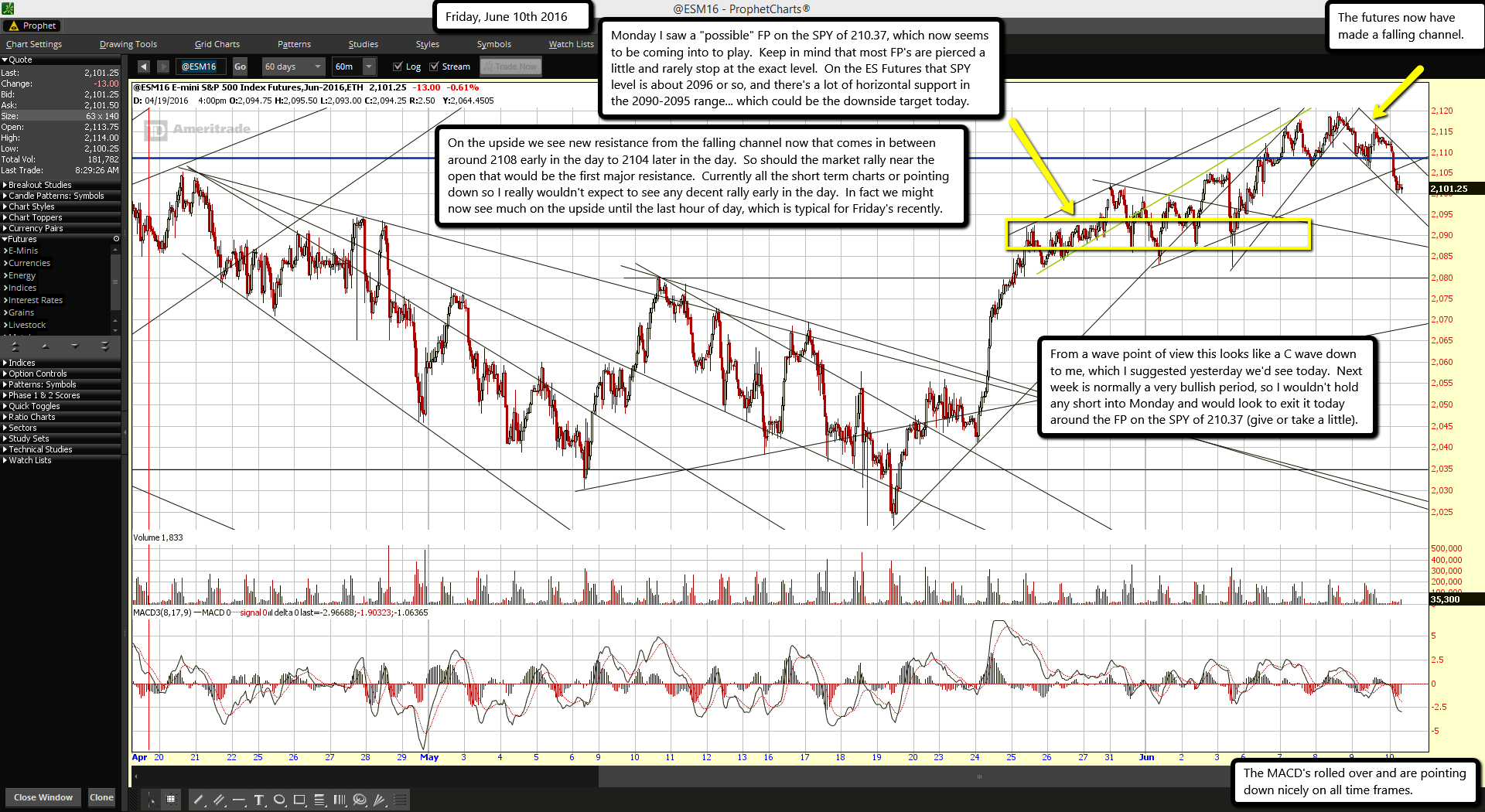
The futures now have made a falling channel.

The MACD's rolled over and are pointing down nicely on all time frames.

Monday I saw a "possible" FP on the SPY of 210.37, which now seems to be coming into to play.  Keep in mind that most FP's are pierced a little and rarely stop at the exact level.  On the ES Futures that SPY level is about 2096 or so, and there's a lot of horizontal support in the 2090-2095 range... which could be the downside target today.

On the upside we see new resistance from the falling channel now that comes in between around 2108 early in the day to 2104 later in the day.  So should the market rally near the open that would be the first major resistance.  Currently all the short term charts or pointing down so I really wouldn't expect to see any decent rally early in the day.  In fact we might now see much on the upside until the last hour of day, which is typical for Friday's recently.

From a wave point of view this looks like a C wave down to me, which I suggested yesterday we'd see today.  Next week is normally a very bullish period, so I wouldn't hold any short into Monday and would look to exit it today around the FP on the SPY of 210.37 (give or take a little).

Viacom Rumblings: Stacking the Board and Maybe Remerging With CBS

0

Philippe P. Dauman, left, Viacom’s chief, was ousted last month from the board of National Amusements and the trust that will control Sumner Redstone’s companies after he dies or is declared incompetent.

National Amusements, the theater chain through which Sumner M. Redstone controls his $40 billion empire, is preparing to replace a handful of directors on the Viacom board, a move that is expected to serve as a prelude to the ouster of the entertainment company’s embattled chief executive.

In consideration for board positions are Kenneth Lerer, a venture capitalist, co-founder of the Huffington Post and chairman of Buzzfeed, and Nicole Seligman, a former Sony executive and lawyer who represented President Bill Clinton during his impeachment trial, according to three people briefed on the discussions.

Also on the list is Judith McHale, the former Discovery Communications chief and general counsel for MTV Networks in the 1980s, and Thomas J. May, the chairman of Eversource Energy utility company and Bank of America director, said the people, who spoke on the condition of anonymity.

The development signals a move to reshape the Viacom board with the ultimate goal of firing Philippe P. Dauman as chairman and chief executive of the company. Viacom, which owns the MTV, Nickelodeon and Comedy Central cable networks and the Paramount Pictures film and television studio, has struggled over the last year.

It is not clear whether the people under consideration have formally accepted the positions, and the choices, as well as the strategy, could change.

One possibility being discussed is that the new Viacom board would serve a short term before National Amusements pushes to merge Viacom with CBS, the other entertainment company it controls, two of the people said.

Viacom and CBS were split into separate companies in 2006.

The new directors are likely to be aligned with Mr. Redstone’s daughter, Shari Redstone, who was long estranged from her father but has recently reconciled with him. She has publicly opposed Mr. Dauman’s ascent at the company and, according to court documents, has “frequently repeated to the Viacom board” that Mr. Dauman should be replaced.

Mr. Dauman has said Mr. Redstone, 93, lacks the mental capacity to make business decisions about his companies, and that Ms. Redstone is manipulating her father. Mr. Redstone’s representatives have said he is acting independently.

Ms. Redstone is not expected to grab the chairman position at Viacom for herself; she turned it down when her father ceded the role in February.

Representatives for National Amusements, Mr. Redstone and Ms. Redstone could not immediately be reached for comment. Carl Folta, a spokesman for Viacom, declined to comment.

The Dynamic of Disputes in the Battle for Sumner Redstone’s Empire

War has spread across the empire of Sumner Redstone, one of the entertainment industry’s most tenacious titans. At stake are the fortunes of his family and confidants, as well as the fate of Viacom and CBS.

Rather than dismiss the entire Viacom board, one possibility being considered is for National Amusements to remove a few of the directors who are allies of Mr. Dauman, two of the people briefed on the discussions said.

Mr. Redstone and Ms. Redstone both are Viacom directors. If four new directors who are aligned with the Redstones were to replace board members loyal to Mr. Dauman, the Redstones would have a majority on the 11-member board.

Six directors loyal to Mr. Dauman vowed last month that they would fight any moves to eject them from the board and said they had made preparations to challenge any dismissal in court.

In a statement on May 27, Mike Lawrence, a spokesman for Mr. Redstone, said: “Sumner Redstone will make every decision with the same deliberation and consideration with which he removed Philippe Dauman and George Abrams as trustees, based on the best interests of shareholders.”

War broke out across Mr. Redstone’s $40 billion media empire last month. Through National Amusements, Mr. Redstone controls about 80 percent of the voting shares in Viacom and CBS. That control will pass to an irrevocable trust after Mr. Redstone’s death or if he is declared incompetent.

On May 20, Mr. Redstone unexpectedly ejected Mr. Dauman and George Abrams, two longtime confidants, from the trust and the board of National Amusements. Mr. Dauman and Mr. Abrams immediately filed suit in Massachusetts, challenging Mr. Redstone’s mental competency and whether he had been unduly influenced by his daughter.

Lawyers for Mr. Redstone shot back with a petition in Los Angeles, asking that the court confirm the validity of the changes that were made to the trust and the board. Ms. Redstone has stated that her father is making his own decisions.

At his prime, Mr. Redstone was known to monitor quarter-point fluctuations in Viacom’s stock price and to quickly dismiss chief executives who did not live up to his expectations.

The company’s stock price has declined about 35 percent in the last year, when the company has reported continued weak earnings. Since news broke on May 20 signaling the potential for new leadership, Viacom’s stock price has increased about 15 percent.

Earlier Thursday, Mr. Dauman said that the entertainment company was continuing its efforts to sell a stake in Paramount Pictures but that it would miss its June target for reaching an agreement for the film and television studio.

Speaking at an investor conference in Manhattan, Mr. Dauman said that “naturally, recent events” had slowed the sales process.

He was alluding to the internal and external turmoil engulfing Viacom, which owns Paramount.

Mr. Redstone has said through representatives that he disapproves of a deal for Paramount, referring to the studio as his “baby.”

Correction: June 9, 2016 An earlier version of the headline on this article described incorrectly a deal that Viacom wants to make involving Paramount Pictures. Viacom wants to sell a stake in Paramount, not buy one.

Source link

This restaurant just unseated Chipotle as the most popular Mexican chain

0
636010713426270234-Behind-the-Line-Interior-1-.jpg

People with a hankering for a burrito are no longer beelining for Chipotle first. Or second, or third, or fourth.

Moe's Southwest Grill, a Tex-Mex chain with less than half the number of locations as Chipotle, has unseated the former fast casual king as the most popular brand selling Mexican-inspired food, according to an annual survey out Thursday from Harris Poll that measures how people feel about restaurant brands. Moe's has more than 650 restaurants to Chipotle's more than 1,900.

Moe's, which is owned by the same company that operates shopping mall mainstays Auntie Anne's and Cinnabon, claimed the "Brand of the Year" title for fast casual Mexican restaurants for the first time, while Chipotle fell hard. The No. 1 pick for the past three years, it's now ranked below not only Moe's but Taco Bell, Qdoba and Baja Fresh.

The survey is yet another sign of the harsh impact Chipotle's food-safety issues have had on the brand in the past year. Chipotle has been grasping at a former semblance of its reputation as a purveyor of fresh food in the months since dealing with multiple incidences of E. Coli and norovirus at restaurants across the country. Sales tanked, a rude awakening for a brand that had been wildly popularity for years.

The company has said customers are coming back around though, and has tried to lure customers back with offers for free burritos and buy one, get one deals. In the first quarter, sales at stores open at least a year fell nearly 30%, though the company said transaction volume improved as the quarter went on. A a free burrito offer in February had a 67% redemption rate.

But beyond Chipotle's issues, the fast casual restaurant landscape has also become more competitive as chains have gone head to head to offer customers healthier food and new menu options. Qdoba rolled out a new taco menu last year with fillings like tequila lime chicken, steak and bacon; Taco Bell has gained prominence for its breakfast menu and started selling alcohol in some restaurants last year. Moe's is known for a wide selection of ingredients for build-your-own tacos, quesadillas and burrito bowls — the brand also frequently offers limited time menu additions, such as an ancho chili lime rice bowl and seasonal salsas like ghost pepper and mango tomatillo.

Chipotle, meanwhile, has rarely introduced new menu items, and some say the company hasn't done enough to show customers its food is safe to eat, even though it has adopted new food safety protocols.

"Their sales have been under tremendous pressure," says Andrew Charles, an equity research analyst with Cowen and Co. who follows both Chipotle and Qdoba. "Brand perception is down. In retrospect, I just don't think they did enough to convince customers that Chipotle food was safe to eat," pointing out that there are no signs in stores alerting customers to the changes and announcements on social media have been scarce.

Moe's rose to the top for ranking the highest in familiarity, quality and purchase consideration. Harris Poll surveyed more than 97,000 U.S. consumers for their thoughts on more than 3,800 brands. Moe's has benefited from a rapid expansion in recent years, which has given the brand a stronger position as a Chipotle alternative, says Lisa Recoussine, vice president of client services at Nielsen, which owns Harris Poll. Moe's opened 70 new restaurants last year, when sales hit nearly $640 million.

To be sure, Chipotle still has much larger market share and sales, which were $4.5 billion in 2015. According to Placed Insights, an analytics firm that measures traffic trends, just 2.3% of the U.S. population visited a Moe's last month, while nearly 9.4% visited a Chipotle.

Though the poll results show Moe's may be poised to steal more customers, says David Shim, CEO of Placed Insights.

"Moe’s has an opportunity to continue to convert that brand equity into restaurant visits," Shim says, "closing the visitation gap with Chipotle."

Source link

Here’s a Reason Why Cliffs Natural Resources (CLF) Stock Is Falling Today

0

NEW YORK (TheStreet) -- Cliffs Natural Resources (CLF) stock is retreating 5.35% to $5.13 in afternoon trading on Thursday after the company announced it will restart operations of a mining facility in Minnesota ahead of schedule.

The Cleveland-based mining company will resume operations at the United Taconite mining facility in August, two months earlier than expected because of a new contract.

Cliffs Natural Resources gained a new contract with U.S. Steel Canada, a subsidiary of U.S. Steel (X), to supply iron ore pellets in the third and fourth quarters of this year.

The new iron ore order led the company to increase its sales volume guidance to 18 million long tons for the year, compared with the previous outlook of 17.5 million long tons.

"Cliffs' business continues to gain very positive momentum, with the improvement of the existing business with our long established clients and the addition of new ones," CEO Lourenco Goncalves said in a statement.

Many steel-related stocks tend to move with commodity prices, which are declining today, TheStreet's Jim Cramer, portfolio manager of the charitable trust Action Alerts PLUS, wrote in a post on Real Money. Cramer recommends investing in companies based on their fundamentals and other factors.

Separately, Cliffs Natural Resources has a "sell" rating and a letter grade of D at TheStreet Ratings because of the company's feeble earnings per share growth, poor profit margins and disappointing stock performance.

TheStreet Ratings objectively rated this stock according to its "risk-adjusted" total return prospect over a 12-month investment horizon. Not based on the news in any given day, the rating may differ from Jim Cramer's view or that of this article's author.

Source link

FAA encourages pilots to seek mental-health treatment

0
AFP 552123756 I TAC TAC FRA AL

WASHINGTON – The Federal Aviation Administration announced steps Thursday to encourage pilots with mental-health problems to seek treatment, in the wake of an intentional Germanwings crash a year ago.

But the FAA won't initiate psychological testing for pilots or change the locked cockpit doors that were hardened after the terrorist attacks Sept. 11, 2001.

FAA Administrator Michael Huerta said training would be enhanced for aviation medical examiners, who test pilots for hiring and then at least annually. Airlines and pilot unions will expand pilot assistance programs, Huerta said.

“What we’re trying to do is create an environment where people are self-reporting and looking out for each other,” he said. “We need to do more to remove the stigma surrounding mental illness in the aviation industry so pilots are more likely to self-report, get treated and return to work."

The goal is break down resistance to seeking treatment because pilots can be grounded for certain medical problems or medications.

"Most pilots have conditions that are in fact treatable," Huerta said.

The recommendations came from a committee of industry experts who reviewed pilot testing after the crash of Germanwings flight 9525 on March 24, 2015. The pilot, Andreas Lubitz, intentionally crashed intentionally into the Alps while flying from Barcelona to Dusseldorf, killing 150 people aboard.

The number of intentional airline crashes is exceedingly small, with perhaps a half-dozen in the last three decades. But they draw tremendous attention and scrutiny.

In at least two cases, EgyptAir flight 990 crash off Massachusetts in 1999 and SilkAir flight 185 in Indonesia in 1997, investigators detected pilots fighting for control of a plane before it crashed. But in cases like Germanwings, the pilot acted alone, and Huerta said the U.S. policy to always have two people in the cockpit is intended to always have crew members evaluating each other for health problems.

"That backstops what might be going on in an individual’s personal situation," Huerta said.

Dr. Michael Berry, FAA’s deputy federal air surgeon who co-chaired the committee, said psychological testing for suicide or homicide is a snapshot on the day of a test and wouldn’t be effective in annual medical exams for younger pilots or six-month exams for pilots at least 40 years old

“We did not see the benefit of doing that,” Berry said.

Doctors ask general questions about how pilots are feeling during the tests, and Huerta said training will be enhanced to spot signs of mental illness. Questionnaires that are part of the exams ask pilots about mental-health problems and prescription usage.

“There is a lot of self-reporting that they are supposed to put on there,” Berry said. “They’re really not looking for severe psychiatric disease.”

Capt. Paul Morell, vice president for safety at American Airlines who co-chaired the committee, employee-assistance programs that have focused on drug and alcohol abuse among airline workers will be enhanced to focus on mental-health referrals.

Capt. Joe DePete, who has flown for 37 years for FedEx and the military and who represented the Air Line Pilots Association on the committee, said pilots are regularly checked medically, with simulators and other grading that are “very stringent.”

“My career is a psychological exam,” DePete said. “We are the most scrutinized profession in the world.”

The American Medical Association will debate next week different approaches to mental-health testing, Berry said.

Source link

Uber fined $900000 in France for running illegal transportation operations with UberPOP

0

Nearly a year after suspending UberPOP in France, Uber will now have to pay a fine. A criminal court in Paris has sanctioned Uber for its UberPOP operations between February 2014 and July 2015. The court is asking for $900,000 (€800,000) — half of it is a suspended sentence. Two of Uber’s executives are also getting fined.

UberPOP has been the most controversial part of Uber in Europe, and many countries have been trying to ban the service. It was banned in Brussels, the Netherlands and, yes, France. But Uber tried to push the limits a bit too much in France.

Last summer, a French anti-Uber protest turned became a guerrilla warfare as taxi drivers were protesting against Uber’s illegal competition with UberPOP.

With UberPOP, anyone could become a driver without any special professional license. Many taxi drivers saw the service as unfair competition. And according to the French law, a service like UberPOP was illegal. So when an UberPOP driver got fined, Uber paid for the fine.

A few days later, in an unrelated investigation, two Uber France executives were arrested for running an illegal taxi company. The two executives were charged with two different allegations.

First, according to them, Uber is running illegal taxi operations. Uber has been struggling with this charge in many countries, starting with the U.S. In 2010, the company had to change its original name from UberCab to Uber as taxi companies didn’t want to create any confusion.

Second, the police said that Uber France was concealing digital documents. It’s hard to tell what the police was looking for when they raided the French office in March 2015. But apparently, some documents were missing and slowed down the investigation.

In July 2015, Uber finally pulled the plug on UberPOP in France — Uber is still operating in France with professional black car drivers.

Uber France CEO Thibaud Simphal and Uber Europe GM Pierre-Dimitri Gore-Coty also got fined by the court in Paris as they’re personally held responsible for UberPOP. They’ll have to pay $34,000 and $23,000 (€30,000 and €20,000). Similarly, half of these fines are suspended sentences.

Uber can still appeal the judgement, but it doesn’t look like UberPOP is coming back in France any time soon. And these fines shouldn’t hurt Uber too much given that the company just raised $3.5 billion.

Source link

Airbnb CEO Chesky vows site overhaul with racism in mind

0

SAN FRANCISCO — Airbnb CEO Brian Chesky opened the company's Open Air technical conference Wednesday by addressing recent racist incidents that have taken place on the $25-billion company's home sharing site.

Beyond expressing outrage at the incidents that have impacted African-Americans and transgender guests, Chesky said the company plans to pursue technological innovations to guard against future discriminatory events.

Chesky did not get specific about what those tech solutions could be, but his presence at the event — which was not listed in the program — speaks to both the urgency and seriousness of the issue for the company. Peer-to-peer start-ups such as Uber and Airbnb rely to an unprecedented degree on individuals behaving in respectable ways. Recent events indicate engineering safeguards against bad behavior may be critical to the continued growth of these businesses.

"There's been a lot of news about prejudice and bias on our platform, and this is a huge issue for us," said Chesky in a brief statement before handing the microphone to vice president of engineering Mike Curtis.

"We have zero tolerance for it and we will take swift action," said Chesky. "In the next months, we will be revisiting the design of our site from end to end to see how we can create a more inclusive platform. We're open to ideas. It's a really, really hard problem and we need help solving it. We want to move this forward. I myself have engaged with people who have been victims of discrimination on the platform. We take this seriously."

Racism represents a new hurdle for the start-up, which to date has been in the news due to its battles with cities such as New York and San Francisco over short-term rental rules. On Tuesday, San Francisco's Board of Supervisors voted unanimously to require short-term rental websites like Airbnb to only post rental listings by residents who have registered with the city. If the city finds the residents haven't registered, Airbnb and rivals face fines up to $1,000 a day, per listing.

San Francisco has a chronic housing shortage and the law is aimed at ensuring that the city's housing stock isn't depleted by landlords who are pulling their residential listings in order to make more money through short-term rentals.

As significant as such zoning issues are for Airbnb, racist hosts could well put a bigger dent in its "Belong Anywhere" slogan. It remains to be seen just how tech innovations can help solve for racist incidents, but Open Air's sessions proposed various ways into the issue with topics such as "Scaling the Human Touch with Machine Learning," "Inequality Across Online and Offline Contexts in the 21st Century" and "Can We Use AI to Achieve Gender Neutrality?"

Rapid advances in machine learning and artificial intelligence suggest that there could be ways to better track racist activity on the site.

On Airbnb, users identify themselves with their real name and a photograph — information some hosts use to avoid renting to African Americans.

A Harvard Business School study found widespread discrimination by Airbnb hosts against guests whose names sounded distinctly black. Black Airbnb users have shared their stories of discrimination under the hashtag #AirbnbWhileBlack, and entrepreneurs have started two temporary lodging services in response to the issue called Noirbnb and Noirebnb. "Noir" is black in French.

An African-American man is suing Airbnb for racial discrimination, alleging it did nothing when he was rejected by a host because of his race. And Airbnb banned a host in North Carolina last week after he used racist language to reject a 28-year-old Nigerian woman trying to reserve his home because she was black.

Earlier this week, Shadi Petosky, a Hollywood producer who identifies as transgender, told USA TODAY that she complained to Airbnb last summer when a Minneapolis "super host" declined her booking because she felt uncomfortable. "They (Airbnb) let it slide," said Petosky.

On Monday, Airbnb said a new program is in the works to recruit more underrepresented minorities in computer science and data science. It also tapped civil rights advocate Laura Murphy, the former head of the American Civil Liberties Union’s Washington D.C. Legislative Office, to help lead a "comprehensive" review of how hosts who rent their homes on Airbnb pick guests.

Curtis noted that "everyday we have the challenge of unconscious bias and other sad realities of the human experience. But we're committed to halting this with every tool at our disposal. Our goal is to create a world where everyone can belong everywhere. We take this seriously and we're taking action. But no one company, and no company at all probably, can solve this problem alone. So we're hoping today we can learn from each other."

As for inclusion within its own walls, Airbnb says it will be conducting a company-wide review of its community that will conclude in September with an eye toward making Airbnb more inclusive. Like most tech companies, Airbnb is staffed mostly by white and Asian males.

"We don't have all the answers, but it's a top priority for us," said David King, Twitter's new director of diversity and belonging. "We're going to train on unconscious bias and intercultural communication with our host community. And we'll examine machine learning models that we can implement to affect change on our platform. We believe smart rules and smart tools can make a difference."

While diversity issues took center stage at the gathering, Airbnb also announced three product additions to its site.

Collaborative Wish Lists allows groups planning a trip to collaborate during the booking process in order to select an option that the group agrees on.

For the 11% of people booking through Airbnb for Business who are booking for someone else, Business Travel Booking allows travel managers and executive assistance greater ease in booking travel for co-workers.

And Multi-Party Reviews is aimed at helping guests establish a reputation with Airbnb hosts, and allows hosts to comment on individual members of a visiting party as opposed to just the person who made the booking.

Source link

ES Morning Update June 9th 2016

0

3adaa20a-0c8c-410a-a4ca-1bc4cd91ad07

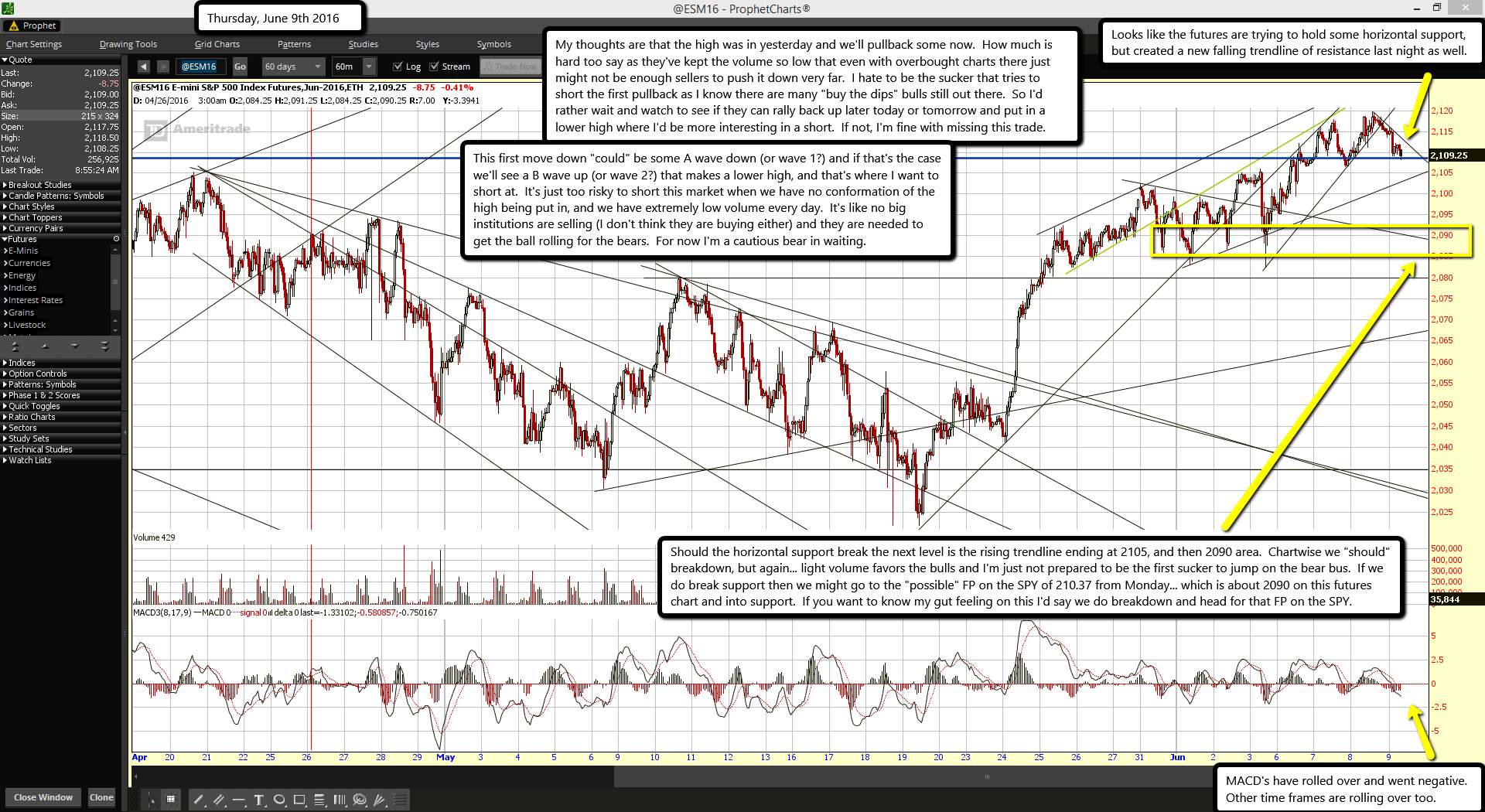
Looks like the futures are trying to hold some horizontal support, but created a new falling trendline of resistance last night as well.

MACD's have rolled over and went negative.  Other time frames are rolling over too.

My thoughts are that the high was in yesterday and we'll pullback some now.  How much is hard too say as they've kept the volume so low that even with overbought charts there just might not be enough sellers to push it down very far.  I hate to be the sucker that tries to short the first pullback as I know there are many "buy the dips" bulls still out there.  So I'd rather wait and watch to see if they can rally back up later today or tomorrow and put in a lower high where I'd be more interesting in a short.  If not, I'm fine with missing this trade.

This first move down "could" be some A wave down (or wave 1?) and if that's the case we'll see a B wave up (or wave 2?) that makes a lower high, and that's where I want to short at.  It's just too risky to short this market when we have no conformation of the high being put in, and we have extremely low volume every day.  It's like no big institutions are selling (I don't think they are buying either) and they are needed to get the ball rolling for the bears.  For now I'm a cautious bear in waiting.

Should the horizontal support break the next level is the rising trendline ending at 2105, and then 2090 area.  Chartwise we "should" breakdown, but again... light volume favors the bulls and I'm just not prepared to be the first sucker to jump on the bear bus.  If we do break support then we might go to the "possible" FP on the SPY of 210.37 from Monday... which is about 2090 on this futures chart and into support.  If you want to know my gut feeling on this I'd say we do breakdown and head for that FP on the SPY.

ES Morning Update June 8th 2016

0

8071c0fc-2656-455d-9b25-4d1a368c58be

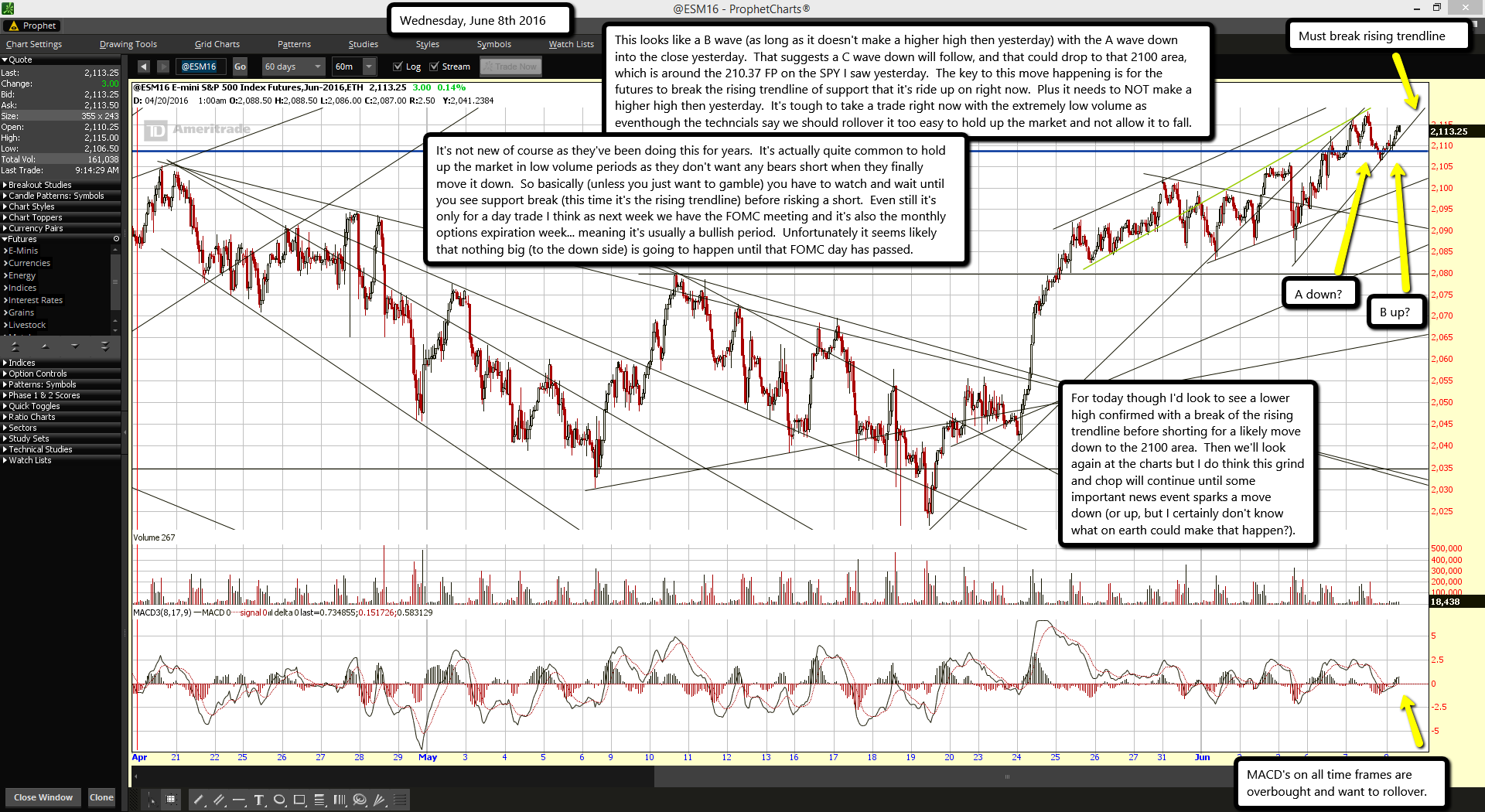
MACD's on all time frames are overbought and want to rollover.

This looks like a B wave (as long as it doesn't make a higher high then yesterday) with the A wave down into the close yesterday.  That suggests a C wave down will follow, and that could drop to that 2100 area, which is around the 210.37 FP on the SPY I saw yesterday.  The key to this move happening is for the futures to break the rising trendline of support that it's ride up on right now.  Plus it needs to NOT make a higher high then yesterday.  It's tough to take a trade right now with the extremely low volume as even-though the techncials say we should rollover it too easy to hold up the market and not allow it to fall.

It's not new of course as they've been doing this for years.  It's actually quite common to hold up the market in low volume periods as they don't want any bears short when they finally move it down.  So basically (unless you just want to gamble) you have to watch and wait until you see support break (this time it's the rising trendline) before risking a short.  Even still it's only for a day trade I think as next week we have the FOMC meeting and it's also the monthly options expiration week... meaning it's usually a bullish period.  Unfortunately it seems likely that nothing big (to the down side) is going to happen until that FOMC day has passed.

For today though I'd look to see a lower high confirmed with a break of the rising trendline before shorting for a likely move down to the 2100 area.  Then we'll look again at the charts but I do think this grind and chop will continue until some important news event sparks a move down (or up, but I certainly don't know what on earth could make that happen?).

ES Morning Update June 7th 2016

0

3fb06ee1-84ff-457b-a6e7-d9f527769640

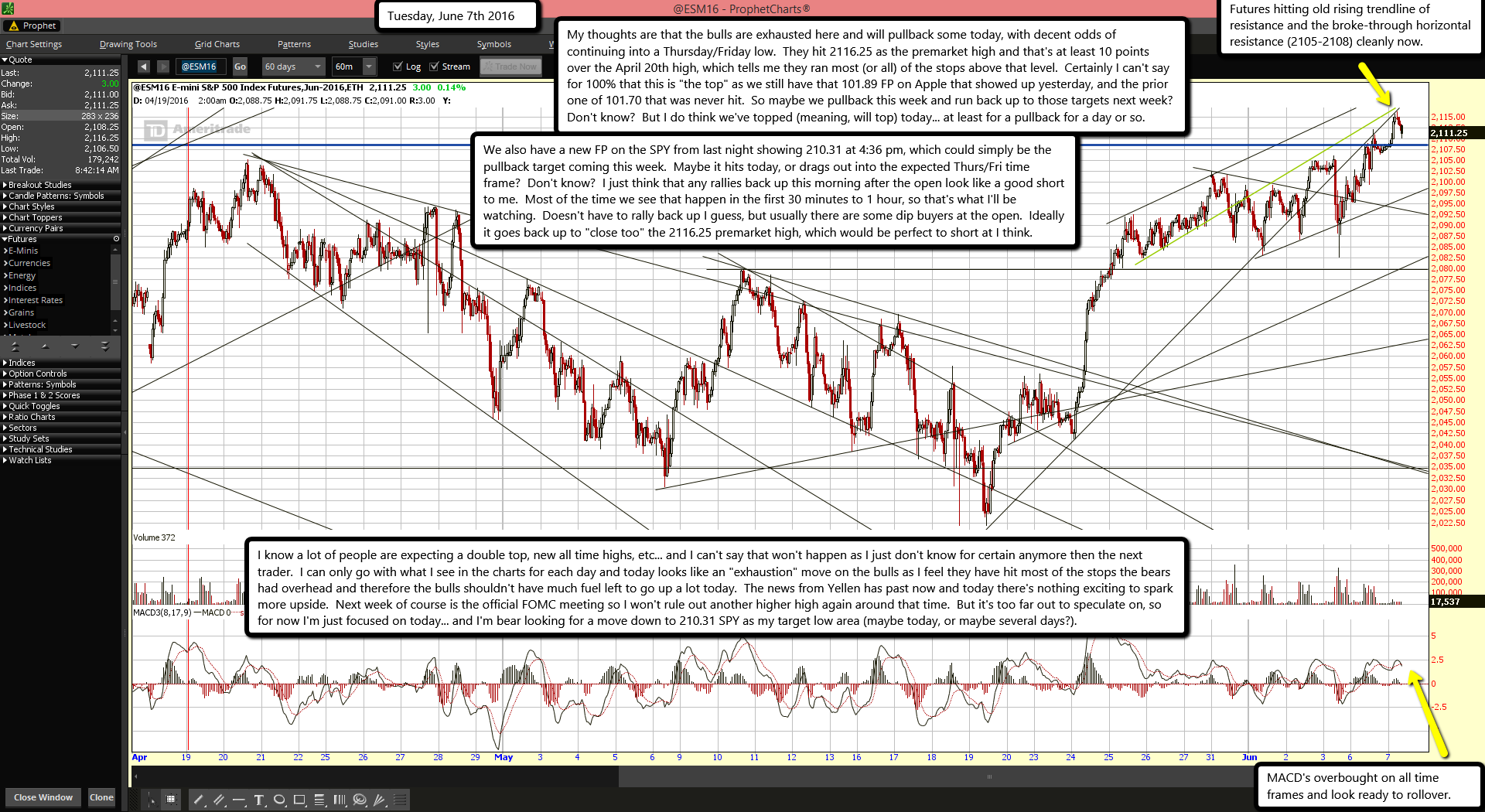
Futures hitting old rising trendline of resistance and the broke-through horizontal resistance (2105-2108) cleanly now.

MACD's overbought on all time frames and look ready to rollover.

My thoughts are that the bulls are exhausted here and will pullback some today, with decent odds of continuing into a Thursday/Friday low.  They hit 2116.25 as the premarket high and that's at least 10 points over the April 20th high, which tells me they ran most (or all) of the stops above that level.  Certainly I can't say for 100% that this is "the top" as we still have that 101.89 FP on Apple that showed up yesterday, and the prior one of 101.70 that was never hit.  So maybe we pullback this week and run back up to those targets next week?  Don't know?  But I do think we've topped (meaning, will top) today... at least for a pullback for a day or so.

We also have a new FP on the SPY from last night showing 210.31 at 4:36 pm, which could simply be the pullback target coming this week.  Maybe it hits today, or drags out into the expected Thurs/Fri time frame?  Don't know?  I just think that any rallies back up this morning after the open look like a good short to me.  Most of the time we see that happen in the first 30 minutes to 1 hour, so that's what I'll be watching.  Doesn't have to rally back up I guess, but usually there are some dip buyers at the open.  Ideally it goes back up to "close too" the 2116.25 premarket high, which would be perfect to short at I think.

I know a lot of people are expecting a double top, new all time highs, etc... and I can't say that won't happen as I just don't know for certain anymore then the next trader.  I can only go with what I see in the charts for each day and today looks like an "exhaustion" move on the bulls as I feel they have hit most of the stops the bears had overhead and therefore the bulls shouldn't have much fuel left to go up a lot today.  The news from Yellen has past now and today there's nothing exciting to spark more upside.  Next week of course is the official FOMC meeting so I won't rule out another higher high again around that time.  But it's too far out to speculate on, so for now I'm just focused on today... and I'm bear looking for a move down to 210.31 SPY as my target low area (maybe today, or maybe several days?).

ES Morning Update June 6th 2016

0

3cf6a80d-0b2a-442f-b1e2-e3433531f10b

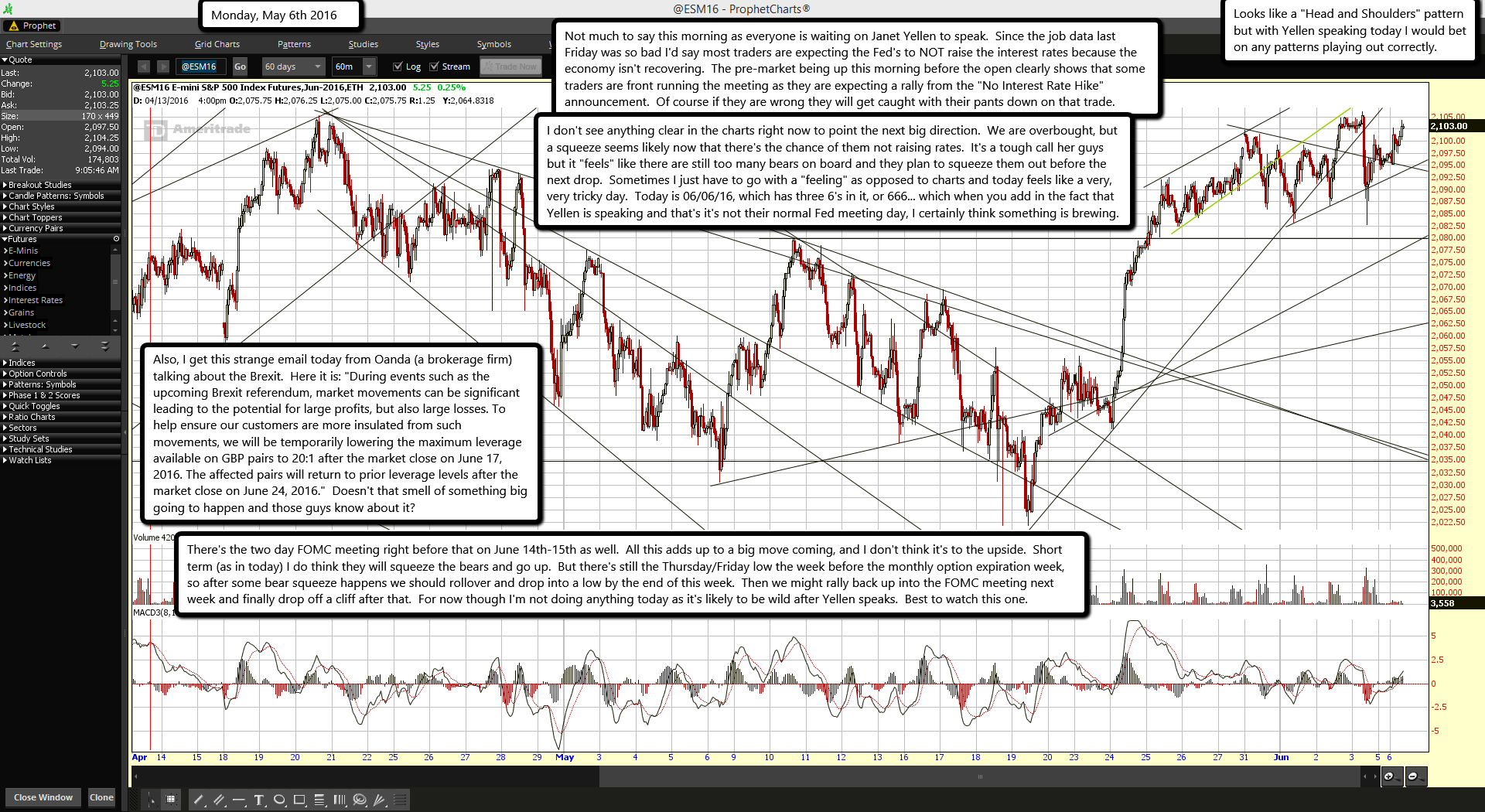
Looks like a "Head and Shoulders" pattern but with Yellen speaking today I would bet on any patterns playing out correctly.

MACD's pointing up on this 60 minute chart and several other time frames as well.

Not much to say this morning as everyone is waiting on Janet Yellen to speak.  Since the job data last Friday was so bad I'd say most traders are expecting the Fed's to NOT raise the interest rates because the economy isn't recovering.  The pre-market being up this morning before the open clearly shows that some traders are front running the meeting as they are expecting a rally from the "No Interest Rate Hike" announcement.  Of course if they are wrong they will get caught with their pants down on that trade.

I don't see anything clear in the charts right now to point the next big direction.  We are overbought, but a squeeze seems likely now that there's the chance of them not raising rates.  It's a tough call her guys but it "feels" like there are still too many bears on board and they plan to squeeze them out before the next drop.  Sometimes I just have to go with a "feeling" as opposed to charts and today feels like a very, very tricky day.  Today is 06/06/16, which has three 6's in it, or 666... which when you add in the fact that Yellen is speaking and that's it's not their normal Fed meeting day, I certainly think something is brewing.

Also, I get this strange email today from Oanda (a brokerage firm) talking about the Brexit.  Here it is: "During events such as the upcoming Brexit referendum, market movements can be significant leading to the potential for large profits, but also large losses. To help ensure our customers are more insulated from such movements, we will be temporarily lowering the maximum leverage available on GBP pairs to 20:1 after the market close on June 17, 2016. The affected pairs will return to prior leverage levels after the market close on June 24, 2016."  Doesn't that smell of something big going to happen and those guys know about it?

There's the two day FOMC meeting right before that on June 14th-15th as well.  All this adds up to a big move coming, and I don't think it's to the upside.  Short term (as in today) I do think they will squeeze the bears and go up.  But there's still the Thursday/Friday low the week before the monthly option expiration week, so after some bear squeeze happens we should rollover and drop into a low by the end of this week.  Then we might rally back up into the FOMC meeting next week and finally drop off a cliff after that.  For now though I'm not doing anything today as it's likely to be wild after Yellen speaks.  Best to watch this one.

JPMorgan Chase Embraces Business Casual

0

The relaxed dress code at JPMorgan Chase reflects the informal style of the technology industry, which now competes with Wall Street companies for recruits.

Wall Street may be known as the home of one of the most buttoned-up industries in the country, but JPMorgan Chase is letting its employees relax a little bit.

The firm told its 237,420 workers on Friday that it was making business casual its everyday dress code, according to an internal memorandum reviewed by DealBook.

The move makes JPMorgan the latest company to acquiesce to the more casual nature of today’s work. Even the most staid of corporations, including General Electric and IBM, have moved away from uniforms of white shirts and dark ties. It is also a nod to the informal style of the tech industry, which has been successful in recruiting workers who might have once preferred more traditional careers.

The tech industry and Silicon Valley have influenced Wall Street fashion in the past, when an earlier generation of dot-com start-ups burned bright. For proof of today’s impact, look at how G.E. is trying to court software developers — not exactly known for wearing double-breasted blazers — in some of its latest commercials.

“More clients are dressing informally, and many parts of our business are already business casual,” JPMorgan’s operating committee wrote in the memo, which was reported on Friday by The Wall Street Journal. “And while it may not be possible to dress business casual at all times or in all areas, we believe having a firmwide guideline is the right thing to do.”

JPMorgan employees have been dressing slightly more casually in recent years, sometimes drawing inspiration from their leadership. Jamie Dimon, the bank’s chief executive, went tieless at a meeting with employees in Bournemouth, England, on Friday. Joining him in the business casual look was George Osborne, the British chancellor of the Exchequer.

Information technology workers and other behind-the-scenes employees already dress more informally. And bankers in certain regions, like Silicon Valley, sometimes wear khakis and sweaters in lieu of Ermenegildo Zegna suits or Diane von Furstenberg dresses. Even the company’s most traditional of deal makers, the former vice chairman James B. Lee Jr. — known for his slicked-back hair and business shirts with white collars and cuffs — directed his bankers to dress in hoodies during the run-up to Facebook’s initial public offering of stock.

Do not expect bankers to switch out their hand-tailored suits for worn denim at their next meeting with a titan of industry as a matter of course, however. The memo specifies that employees should “dress for that client” — which still gives deal makers some sartorial leeway if they are meeting with, say, a technology entrepreneur used to wearing hoodies and sneakers.

And denim generally isn’t considered appropriate, unless the employee has permission to wear it.

Employees at bank branches still need to wear specific Chase apparel, unless the managers have specifically allowed otherwise.

If employees try to push the boundaries of the dress code, they do so at their peril. A set of frequently asked questions about corporate attire warns that if employees are not dressed appropriately, they “may be subject to disciplinary action, up to and including termination of employment.”

Here is what is considered acceptable under JPMorgan’s new guidelines:

• Formal business attire

• Casual pants, capri pants, dresses and skirts of appropriate length for the workplace

• Business-appropriate casual shirts, polo shirts, sweaters, tops and blouses (including JPMorgan or Chase-branded apparel, naturally)

• Dress shoes and dress sandals

• Minimal, tasteful jewelry and fragrances

And here is what is forbidden, even in a casual environment:

• Athletic clothing — sweatpants, sweatshirts, T-shirts, jumpsuits, yoga pants or leggings (the last of which is helpfully defined as “tightfitting stretch pants”)

• Shorts, beachwear, halter tops, tank tops or crop tops

• Flip-flops, clogs, rubber-soled floater sandals or slippers

• Hats or hoods

• Distracting, tight, revealing or exceptionally loose or low-cut clothing

• Torn or frayed clothing or clothing attachments that have profane, offensive or religious messages

• Offensive or distracting visible tattoos, body piercings or unprofessional hair styles

Source link

s2Member®