Saturday, October 24, 2026
Home Blog Page 96

Deflation is back: Cue more money printing

0
The story behind oil's plunge

Deflation has returned to Europe and that can only mean one thing: More official action to boost the economy.

Consumer prices fell by 0.2% in February, pulled down by the plunging cost of energy. That's the first time inflation has turned negative since September last year.

Equally troubling the European Central Bank and its president Mario Draghi will be the drop in "core inflation" to 0.7% from 1% in January. That measure strips out energy prices, which tend to bounce around month to month.

Economists believe Draghi will fire another bazooka at financial markets when the bank next meets on March 10.

"Pressure is mounting on the ECB to deliver a major package of measures," said IHS chief economist Howard Archer.

When the central bank last discussed interest rates in January, Draghi made clear the ECB would pump out more money in March if necessary. He cited a deteriorating outlook for the economy due to uncertainty about global growth, volatile markets and geopolitical risks.

Since then, Japan has introduced negative interest rates to boost an economy that is now shrinking again, and China has told its banks they're free to lend more cash in the hope of supporting growth.

Closer to home, the refugee crisis is slowly undoing decades of European integration, and Britain is gearing up for a vote on whether to leave the EU -- a decision the G20 said Saturday would "shock" the global economy.

Here's what Draghi could announce on March 10, and one weapon he's likely to keep in reserve:

1. Buy more government bonds

The ECB began buying government bonds and other assets at a rate of 60 billion euros ($65 billion) a month in March 2015. It is likely to buy even more in the future. The rate could rise to between 70 billion and 90 billion euros a month, according to economists.

It may also buy bonds for longer than planned. The current program is due to run at least until March 2017 -- Draghi could extend the minimum duration by six months.

Central bank asset purchases, often known as quantitative easing, in theory encourage investors to pump more money into the economy by reducing the returns they can make on government debt.

2. Cut interest rates again

Interest rates for the 19 eurozone countries are already at record lows, and they seem certain to go even lower.

The rate paid on cash that banks deposit with the ECB could be cut to minus 0.40% or even minus 0.50% from its current level of minus 0.30%. Negative rates are a way of penalizing banks for not lending to firms and households.

But they're already hurting bank earnings. So the ECB may try to limit the pain by introducing a tiered rate that reduces the penalty on normal deposits, while introducing more negative rates for truly "excess" deposits.

3. Buy corporate bonds

The ECB could extend quantitative easing to include bonds issued by companies and bonds. That would be an effective way of pumping more money into the economy but would likely be hugely controversial, particularly in Germany where the existing asset purchase program has already been challenged.

"We see this as a measure the ECB would take in a deep crisis, but not in the modest market turmoil now," said Berenberg chief economist Holger Schmieding.

Source link

Ask Matt: Is Berkshire Hathaway a buy?

0

Q: Is Berkshire Hathaway a buy?

A: Warren Buffett looked like much of an Oracle of Omaha lately. But analysts think his Berkshire Hathaway (BRKA) is an opportunity.

Shares of Buffett’s Berkshire have been struggling. Shares of class A shares are down 11% over the past 12 months closing at $198,191 each - trailing the roughly 7% decline by the Standard & Poor’s 500. Investors have hurt the stock on fears some of Berkshire’s most economically sensitive businesses could slow in a weak economy.

Investors are hoping for better profit margins from the company’s insurance businesses, for instance. Additionally, Berkshire has taken some lumps on its public holdings. American Express (AXP) is one of Berkshire’s biggest investments. But shares of the company have fallen by a third over the past year.

Investors also seem to be pricing in a flat year for revenue in 2016. Analysts expect Berkshire’s revenue this year to drop 0.4% to $209.6 billion. Analysts, though, think Berkshire is an opportunity. Berkshire’s insurance business stands to gain market share in 2016, says Catherine Seifert of S&P Global. All told, analysts see the company’s adjusted earnings to jump 17% this year. Analysts think Berkshire’s shares will be 21% higher in 18 months.

Source link

Record Low Interest Rates lead to rise in refinancing: MBA Data

0

*Record Low Interest Rates lead to rise in refinancing: MBA Data*

Interest rates have been hovering around all-time lows for the past many quarters. Recently, the Federal Reserve raised the interest rates slightly. Federal Reserve had also indicated that rates could be increased in future as well but the decision on further interest rate hike would be taken only after considering the factors impacting economy.

The average interest rate on 30-year fixed mortgage has declined from 4.01 percent to 3.62 percent since the start of this year. Freddie Mac said that interest rates have touched a yearly low. Long term mortgage rates are quite close to their all-time low. Economists have reduced their estimates for interest rates in year 2016 after considering macro-economic factors and indications from the Federal Reserve. In her comments, Federal Reserve Chair Janet Yellen had advocated for gradual interest rate hike in future but situation has changed since the last Federal Reserve meeting.

However, considering the current economic situation and uncertainty, economists feel that interest rates might stay at the same level, at least for couple of quarters. Economists are also not sure about the path to recovery and the future growth of the U.S. and world economy. Instead of rate hike from the Federal Reserve, some economists are also not ruling out the possibility of rate cut. Rate cut seems highly unlikely, considering the fact that they have been raised slightly, and only once in the last few years.

Some customers were thinking about refinancing their mortgage to get immunity from further rate increase. However, that situation might not come till year 2017. Low interest rates will likely continue for the current year.

The Mortgage Bankers Association’s index of refinance activity witnessed 16 percent increase within a week. The increase was noticed as the mortgage rates touched their lowest level in the last few months. According to MBA data, nearly 75 percent of 30-year fixed mortgages issued by Fannie Mae or Freddie Mac are below 4 percent.

Many procrastinators have benefited from the grace period for low interest rate regime. However, economists are suggesting that we are already in the ultra-low interest rate period and those who want to refinance their mortgage, shouldn’t wait any further and grab the opportunity. In 2012, record low for long term home loan interest was witnessed at 3.35 percent. Current interest rate of 3.62 percent seems like a pretty good deal comparing the economic situation right now to that in 2012.

Meanwhile, economists are almost sure that Federal Reserve will not raise interest rates in its next policy meeting next month.

According to a Washington Post report, “The Mortgage Bankers Association this month lowered its forecast for 30-year fixed-rate rates at the end of the year to 4.3 percent, down from the 4.6 percent expected in January, on the expectation of fewer Fed rate hikes.”

Low crude oil prices have also led to economic fears for many economies across the world. This could lead to lower demand for goods and could eventually lead to slower recovery for some of the manufacturing hubs.

Source link

With Humility, Starbucks to Enter Italian Market

0

Howard D. Schultz, chairman and chief executive of Starbucks, in Milan.

MILAN — Standing in the art-soaked splendor of a Milanese parlor as an array of A-list Italian business leaders listened intently, Howard D. Schultz, chairman and chief executive of Starbucks, recited a remarkable statistic on Friday: Each week, roughly 90 million people pass through a Starbucks somewhere on earth.

“There are very few markets and stores that I’m as intimately involved in as this,” he said in an interview after the announcement. He added, “We’re going to come here with great humility.”

Starbucks has always been careful in Europe, aware that the Continent’s coffee aficionados have refined tastes and an abundance of good coffee shops — and might take offense at the idea that an American company is needed for a better espresso. Yet Starbucks has marched successfully into Britain, France and Germany, and it has even found success in Vienna, the Austrian capital, which gave birth to the coffeehouse.

Italy, though, is Italy.

“I think young people will try it out, for curiosity,” said Orlando Chiari, the 82-year-old owner of Camparino, a century-old coffee bar in central Milan, “but I doubt it will become a major player in Italy.”

Mr. Chiari, impeccable in a gray suit and light blue shirt, said that about 1,500 clients came to his bar every day, and that few were titillated by “new trends.” He decided against deliveries of the sports drink Red Bull because it simply would not sell at Camparino.

“We worship coffee in Italy, while Americans drink coffee on the go in large cups,” he elaborated. “It’s two extremely different cultures.”

Mr. Schultz credits Italy’s distinct coffee culture for inspiring him to create the Starbucks of today. In 1983, he visited Milan for a trade show and wandered into coffee bars in the city. Then, he was marketing director for Starbucks, a chain of four stores in Seattle that sold coffee for people to make at home. His visit to Milan’s coffee bars convinced him that the coffee shop was an experience and culture that could work in the United States.

Mr. Schultz has returned to Italy at least once a year since then, befriending business leaders while studying the local market. His lunchtime announcement ceremony, held in the refined, 19th-century setting of an elegant apartment, was an open embrace from Italy’s business elite: Brunello Cucinelli, the fashion designer and cashmere specialist, mingled with Nerio Alessandri, founder and president of Technogym, a maker of fitness equipment. Cristina Nonino, chief executive of one of Italy’s most famous producers of grappa, was there, as was Renzo Rosso, chairman of OTB Group, parent company of Diesel and other clothing brands.

“Here, he was inspired,” said Leonardo Ferragamo, a director of the luxury Salvatore Ferragamo line, who met Mr. Schultz for the first time on Friday. “He understood the tradition of drinking coffee at the bar, which is unique to Italy.”

Word began to leak out in October that Starbucks was looking at Italy. The company will partner with Percassi, the Italian retail and real estate group, which will own and operate the stores as licensee. Mr. Schultz said the first store in Milan would open early next year, followed by others in the city before the company expands elsewhere in Italy. And as has happened in other countries, Starbucks will tailor itself to local coffee habits.

“There will definitely be a bar,” Mr. Schultz said, alluding to the Italian custom of standing at a bar for a shot of espresso or a morning cappuccino. He also said Starbucks would be competitive on price; an espresso shot costs a euro or less in Italy, well below the typical price point for Starbucks. And Italians tend to drink coffee in small portions, rather than the large ones familiar to Starbucks patrons.

“We’re not coming here to teach Italians to make coffee — nothing like that at all,” Mr. Schultz said, adding that Starbucks should not be perceived as a threat to local coffee bars. “We have to earn the respect.”

Mr. Schultz said Starbucks planned to develop a proprietary coffee blend for the Italian market, and he predicted that the quality of Starbucks coffee “is going to surprise people in Italy.” But also important is an atmosphere intended to appeal to young Italians (as well as the promise of seamless Wi-Fi). Company surveys show that brand recognition is high and a surprising number of younger Italians have tried Starbucks coffee, despite the absence of domestic stores.

Mr. Schultz said he was “involved in every detail of this opening,” underscoring the sentimental and strategic importance he assigns to Italy. Coming back to the place he considers the taproot of the Starbucks experience does bring risks, especially if the company falls flat with Italian customers. But success would bring rewards, especially symbolic, as Mr. Schultz returns to the country synonymous with great coffee.

“He loves Italy more than many Italians,” said Gianmario Tondato Da Ruos, chief executive of Autogrill, the global food and beverage operator for travelers, which is a partner of Starbucks in the United States. “Really.”

Source link

ES Morning Update March 2nd 2016

0

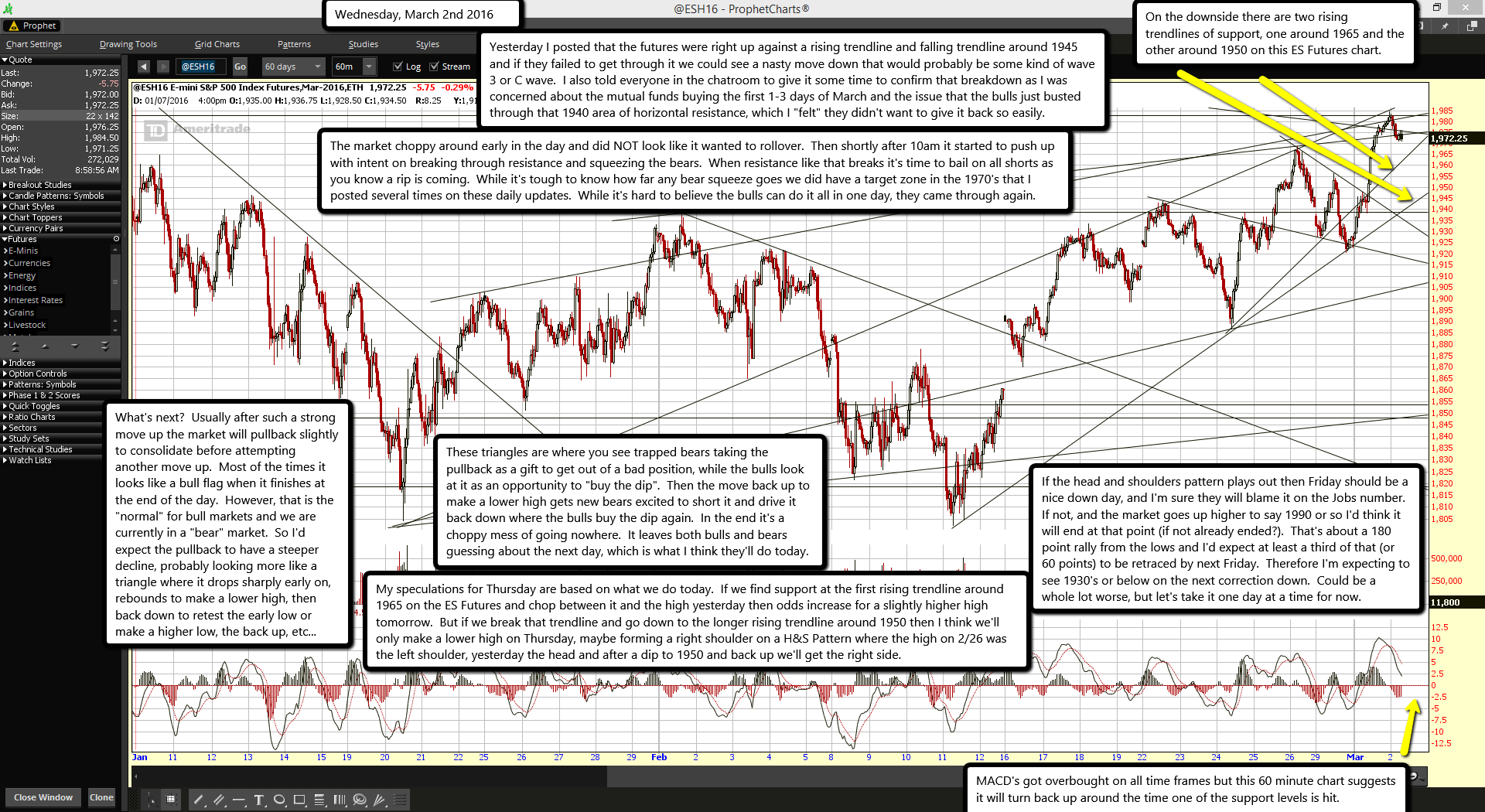
d8115227-9f83-46ad-8437-99cb8e3f04ceOn the downside there are two rising trendlines of support, one around 1965 and the other around 1950 on this ES Futures chart.

MACD's got overbought on all time frames but this 60 minute chart suggests it will turn back up around the time one of the support levels is hit.

Yesterday I posted that the futures were right up against a rising trendline and falling trendline around 1945 and if they failed to get through it we could see a nasty move down that would probably be some kind of wave 3 or C wave.  I also told everyone in the chatroom to give it some time to confirm that breakdown as I was concerned about the mutual funds buying the first 1-3 days of March and the issue that the bulls just busted through that 1940 area of horizontal resistance, which I "felt" they didn't want to give it back so easily.

The market choppy around early in the day and did NOT look like it wanted to rollover.  Then shortly after 10am it started to push up with intent on breaking through resistance and squeezing the bears.  When resistance like that breaks it's time to bail on all shorts as you know a rip is coming.  While it's tough to know how far any bear squeeze goes we did have a target zone in the 1970's that I posted several times on these daily updates.  While it's hard to believe the bulls can do it all in one day, they came through again.

What's next?  Usually after such a strong move up the market will pullback slightly to consolidate before attempting another move up.  Most of the times it looks like a bull flag when it finishes at the end of the day.  However, that is the "normal" for bull markets and we are currently in a "bear" market.  So I'd expect the pullback to have a steeper decline, probably looking more like a triangle where it drops sharply early on, rebounds to make a lower high, then back down to retest the early low or make a higher low, the back up, etc...

These triangles are where you see trapped bears taking the pullback as a gift to get out of a bad position, while the bulls look at it as an opportunity to "buy the dip".  Then the move back up to make a lower high gets new bears excited to short it and drive it back down where the bulls buy the dip again.  In the end it's a choppy mess of going nowhere.  It leaves both bulls and bears guessing about the next day, which is what I think they'll do today.

My speculations for Thursday are based on what we do today.  If we find support at the first rising trendline around 1965 on the ES Futures and chop between it and the high yesterday then odds increase for a slightly higher high tomorrow.  But if we break that trendline and go down to the longer rising trendline around 1950 then I think we'll only make a lower high on Thursday, maybe forming a right shoulder on a H&S Pattern where the high on 2/26 was the left shoulder, yesterday the head and after a dip to 1950 and back up we'll get the right side.

If the head and shoulders pattern plays out then Friday should be a nice down day, and I'm sure they will blame it on the Jobs number.  If not, and the market goes up higher to say 1990 or so I'd think it will end at that point (if not already ended?).  That's about a 180 point rally from the lows and I'd expect at least a third of that (or 60 points) to be retraced by next Friday.  Therefore I'm expecting to see 1930's or below on the next correction down.  Could be a whole lot worse, but let's take it one day at a time for now.

ES Morning Update March 1st 2016

0

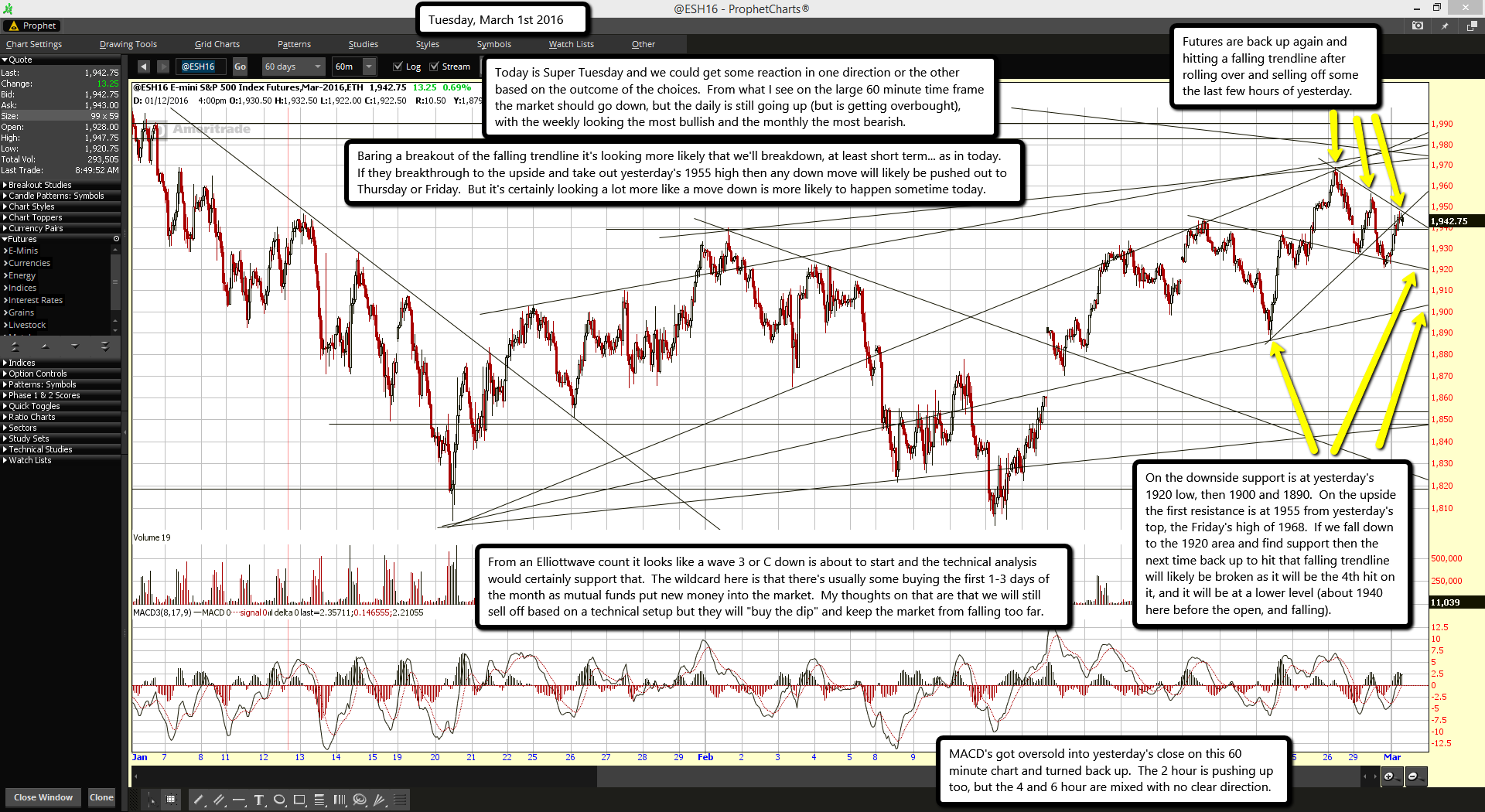
0ffd83f9-2acf-4a3c-9fb4-6e70b4e6736dFutures are back up again and hitting a falling trendline after rolling over and selling off some the last few hours of yesterday.

MACD's got oversold into yesterday's close on this 60 minute chart and turned back up.  The 2 hour is pushing up too, but the 4 and 6 hour are mixed with no clear direction.

Today is Super Tuesday and we could get some reaction in one direction or the other based on the outcome of the choices.  From what I see on the large 60 minute time frame the market should go down, but the daily is still going up (but is getting overbought), with the weekly looking the most bullish and the monthly the most bearish.

Baring a breakout of the falling trendline it's looking more likely that we'll breakdown, at least short term... as in today.  If they breakthrough to the upside and take out yesterday's 1955 high then any down move will likely be pushed out to Thursday or Friday.  But it's certainly looking a lot more like a move down is more likely to happen sometime today.

From an Elliottwave count it looks like a wave 3 or C down is about to start and the technical analysis would certainly support that.  The wildcard here is that there's usually some buying the first 1-3 days of the month as mutual funds put new money into the market.  My thoughts on that are that we will still sell off based on a technical setup but they will "buy the dip" and keep the market from falling too far.

On the downside support is at yesterday's 1920 low, then 1900 and 1890.  On the upside the first resistance is at 1955 from yesterday's top, the Friday's high of 1968.  If we fall down to the 1920 area and find support then the next time back up to hit that falling trendline will likely be broken as it will be the 4th hit on it, and it will be at a lower level (about 1940 here before the open, and falling).

This whole week is getting support from the strength of the weekly chart push up strongly in my opinion and will limit the down moves.  But there's heavy resistance overhead in the 1970's on this ES Futures chart, which I don't see broken any time this week.  Maybe we get up close to it later this week?  It's possible, but all of the smaller time frames want to go back down.  This makes for a chop week as every time they try to fall the weekly chart saves them and pushes back up.  For now, it's a day traders market.  Sell resistance and buy support.

Berkshire Hathaway’s Q4 Earnings Show Buffett Still Has It

0

Wow, Buffett knocked it out of the park:  Berkshire Hathaway 4th-quarter profit up 32 percent.  Berkshire Profit Gains 32% to $5.48 Billion, Capping Record Year

Berkshire’s Earnings: A Surprise Boost From Kraft Heinz, But an Off Year at Geico

Warren Buffett Attacks Wall Street Over ‘Phony’ Earnings

Buffett says it’s possible that the offending analysts “don’t know better.” But more likely, Buffett says, the analysts go along with the phony numbers because they fear losing access to management, which is key to a Wall Street analyst’s job these days. Buffett also says analysts may be swept up by a herd mentality and go along with these inflated financials because everyone else is doing it. None of these reasons lets them off the hook, Buffett says.

“Whatever their reasoning, these analysts are guilty of propagating misleading numbers that can deceive investors,” Buffett writes.

Based on pro-forma earnings, profits for the S&P 500 rose an average of 0.4% in 2015. But if you stick with figures that conform to official accounting rules, profits actually plunged nearly 13%.


Oddly, Buffett’s denouncement of executives who doctor their earnings comes during a section of the his annual letter in which he does a bit of his own selective accounting. Buffett says that Berkshire shareholders would do better ignoring a portion of the company’s amortization costs. Buffett acknowledges the slight contradiction by saying that he gives that advice with “some trepidation.” But he says amortization, unlike compensation, is not a real expense. What’s more, Buffett says investors when calculating Berkshire’s true earnings should include depreciation, which he says is a often true expense, but doesn’t normally get counted.

“When CEOs or investment bankers tout pre-depreciation figures such as EBITDA as a valuation guide, watch their noses lengthen while they speak,” writes Buffett.

And, by the way, to anyone who doubts the value of compounding those slow, steady gains:

I guess I really need to stress this more often because it's so hard for people to get their heads around the value of this strategy because, in the first 5 years - it simply doesn't seem that sexy.  Even if you make a steady 20% a year for 5 years, you go from $100,000 to $120,000 to $144,000 to $172,000 to $207,000 to $250,000 and there will be many points along the way when the market is going against you or when you have a friend tell you their guy has them up 50% that year or whatever and that's TEMPTATION which you have to avoid.

Look at Ackman, for example, his fund was up 40% in 2014 but last year the fund dropped 20.5% and already this year it's down another 17.3% and the gains are all gone - two wasted years.  Why?  Because he's arrogant and he didn't cash out and he stuck with a winning strategy for too long.  Hedge fund managers are often like gamblers at a casino who bet black on the roulette wheel and, if they get a win, they let it ride and then again they let it ride and, if they get black 3 or 4 times in a row, they get to go on TV and act like geniuses and people will throw money at them and they will be treated as heroes.  Even if the 5th time is red and wipes them and their investors out - they simply close down that fund and start another one using their famous name and one-time win to attract new investors.

Think about it, I just told you this but next time Bill Ackman's on TV you'll listen to him as if he knows something.  It's the same thing with Venture Capital firms, they only want to swing for the fences because there's no glory in hitting a bunch of singles and doubles - they all chase the fabled 10-bagger so they can brag about it to their big swinging friends and, sadly, that's just the truth of human nature.

Barry Bonds (cheater), Hank Aaron and Babe Ruth are very, very famous because they are the top 3 home run hitters and yes, we all know Ty Cobb (.366 lifetime) but what about Ed Delahanty (.346)?  Billy Hamilton (.344)?  Harry Heilmann (.342)?  Peter Browning (.341)?  Those guys are all in the top 10 hitters of all time but no home runs so no one remembers.  You have to go really far down the list of home run hitters to find one you've never heard of (Albert Pujols is #14 already!).

Anyway, home runs put fans in the seats and, for hedge funds and VCs, they bring in the investors but home run hitters also tend to lead the league in strikeouts as well - as you have to commit big to swing for the fences.  That's fine in baseball, because after you're wiped out they give you another turn at the bat but it's not fine for individual investors, who spend a lifetime building their investment savings and can't afford to have it wiped out, right?

Babe Ruth isn't wrong and his attitude is fine (he also had a .342 lifetime batting average, he simply missed big when he did miss) - if you are going to get another chance.  The marginal cost of striking out for Babe Ruth is low because he was going to get 8,399 at bats in his lifetime so his 1,330 strikeouts were a cost of doing business along the way.

If we allocate our portfolios correctly and avoid putting all of our eggs in one basket, we too can swing for the fences once in a while because getting wiped out on a small investment is not a big deal compared to the occasional 10-bagger BUT - you have to be realistic about your chances of both and that is where most investors (and fund managers) fail.  

One thing people tend to forget about Berkshire Hathaway is that they made $17.4Bn from the companies they actually run and "only" $6.1Bn in their stock portfolio.  Nothing is better than having a steady flow of income and that allows Berkshire to take the occasional risk in the market, without worrying about seriously impacting the company's future if it doesn't work out.  It also allows Berkshire to ride out market downturns with more cash coming in to press "losing" bets on the way down.

PSW Investments has a similar structure, using the cash-flow from PSW to fund long-term investments in start-up companies.  We don't gamble with money we can't afford to lose but that doesn't mean we don't gamble at all!  It's also the strategy we preach at Philstockworld - playing a conservative, long-term growth strategy with the bulk (80%) of your investing capital and taking shorter-term, opportunistic trades with your remaining investment money.  That way, even if you are wiped out of the short-term funds (-20% of 20% = 4%), if you make just 5% on the long-term funds (5% of 80% = 4%), you still don't lose.

That's also why we tend to use our Short-Term Portfolio to hedge our Long-Term Portfolio, the short-term trades can be quickly entered and exited while we give our long-term positions the time they need to mature.  As of Friday's close, our Long-Term/Short-Term paired portfolios were up over 100% in two years and I noted to Members I would love to just cash out here - as it's easier than managing the bumpy road that lies ahead.

Buffett's top long-term holdings are also up 100% but his 100% is $54Bn while ours are only up $600,000 but he does have 48 more years of growth than we do, so early innings!

In Buffett's recent letter to shareholders, he mentions that the company's growth really took off in the 90s BECAUSE he moved away from the investing model and more into the ownership model.  At PSW Investments, we never thought otherwise but, as Buffett notes, he learned from experience and we, in turn, learned from Buffett.

Buffett talks about "normalized" earning power and that too is something we teach our Members at PSW.  When we are very bullish in our portfolios, generally that would be 70% bullish and maybe, in an extreme (like 2009), 80% but we always leave room for the possibility we could be wrong.  If you are 70/30 bullish and the market drops 50% then your 70 becomes 35 but, because we leverage our hedges, the 30 becomes 60 and your net is 95 while the rest of the market is on a half-priced sale.

If the market, however, goes up 50% then your 70 becomes 140 and your 30 is maybe 15 and that's 155 and you are only slightly ahead of the S&P but we'd rather make 50% in good years and 5% in bad years than go up and down like a yo-yo.  Of course, that's when we're wrong - sometimes we get it right in either direction - as we have for the past two years.

As long as we always have access to cash that allows us to pick up companies when they are on sale, our portfolios are set up for great long-term growth, no matter what market conditions we have to endure over the short run. 

As Buffett notes:  "At Berkshire, we much prefer owning a non-controlling but substantial portion of a wonderful company to owning 100% of a so-so business. It’s better to have a partial interest in the Hope Diamond than to own all of a rhinestone.  Our appetite for either operating businesses or passive investments doubles our chances of finding sensible uses for Berkshire’s endless gusher of cash."

Similarly, when people ask me what's an appropriate amount of money to have to retire I tell them to just keep working as long as they can and let the investment income grow on the side.  The bigger you let your retirement savings get, the less work they will have to do in your golden year and the less risk you will have of having to downgrade your lifestyle down the road (see "How to Get Rich Slowly").

Buffett likes to tend to his core holdings and add "bolt-on" acquisitions, which compliment his core businesses but he makes it clear how please he is to make large acquisitions and outright invites any Fortune 500 company to call him if they are interested in selling (Buffett will not go hostile).  With 30 or 40 more years to go before we're gobbling up F500 companies, we are employing similar techniques in our own modest portfolios.  And, as Buffett wisely notes.

Of course, a business with terrific economics can be a bad investment if it is bought at too high a price. We have paid substantial premiums to net tangible assets for most of our businesses, a cost that is reflected in the large figure we show for goodwill and other intangibles. Overall, however, we are getting a decent return on the capital we have deployed.

Patience is, by far, the hardest thing we have to teach our Members.  Having a long-term outlook is much easier when you are an 85 year-old Billionaire and, keep in mind, Buffett has been doing this since the 60s.  It's not just about age, it's about the experience of actually trading the markets for, let's say 100,000 hours.  At PSW, we use Gladwell's rule of thumb that it takes about 10,000 hours of practice to become an expert trader/investor.  Buffett has put his time in in spades!

Looking forward to our next decade of investing!

Source link

Mortgage rates trending lower — time to stop sitting the fence?

0

Mortgage rates trending lower -- time to stop sitting the fence?

Just a short while ago, it was generally presumed in most financial circles that super-low mortgage rates were a dying breed. There’d been a period of plenty for homebuyers and refinance loan applicants alike, but the general consensus was one of ‘you snooze, you lose’ for want of a better description. After all, it’s hard even for expert analysts to predict interest rate gyrations.

Though this was not the first time pundits warned of this possibility, the fact that the Federal Reserve eventually raised short-term interest rates for the first time in almost a decade cast a pall upon the prospects of potential homebuyers and fence-sitters hoping for low rates. Fears of similar spikes to what happened in 2013 when the Fed began talks of paring its economic stimulus were quite common. However, the opposite has happened, as long-term mortgage interest rates are almost 40 basis points lower from where they were at the start of the year.

As of February 25, 2016, Freddie Mac’s average rate on 30-year fixed-rate mortgages is 3.62 percent, down from 4.01 percent on January 1. That’s a rate that hasn’t been seen in close to a year, and one close enough to all-time record lows. With that in mind, many analysts and economists have revised their forecasts to indicate a more optimistic tenor for mortgage rates.

While HSH.com’s Weekly Mortgage Rates Radar showed a slight increase in 30-year FRMs this week, with rates ticking up five basis points to 3.74 percent, and a bigger (11-basis point) increase for 5/1 hybrid adjustable rate mortgages, HSH vice president Keith Gumbinger believes that a spike in rates is not too likely, and consumers need not panic despite this first weekly increase for calendar 2016.

“While there’s little likelihood of a spike in rates, it’s reasonable to think that there’s potentially more upside than downside for them, especially if the economy continues to chug along,” said Gumbinger in a blog post. “That said, even if they should edge higher, mortgage rates are in a good position to support a positive spring home buying season, provided there are desirable homes to buy at affordable prices.”

Indeed, it looks like the time is right for fence-sitters to start making a move and buying a new home at the current rates. According to Bankrate.com chief financial analyst Gregory McBride, this reduction in interest rates could “create some much-needed breathing room” in families’ household budgets. But considering that nobody can really tell for sure how long rates would stay low, another number-cruncher, Realtor.com chief economist Jonathan Smoke, believes consumers should seize the day as “it’s completely uncertain how long this opportunity (to take advantage of low rates) is going to be there.”

Source link

Mortgage Rates : Right Time to Refinance Your Houses Due to Lowered Mortgage Rates

0

Mortgage Rates – As the New Year we have experienced many good news and the drops in the mortgage rates are one of them. According to a post published in the Washington Post mortgage rates are decreasing day by day and this year especially the following months will be a good time for the house owners to consider refinancing their current houses.

The first decline started in the December, 2015 and this trend still continues for the last three months. Most of the house owners already paid a visit to their banks to discuss the possible opportunities to save money from their current deals.

It is still a mystery whether the rates will continue to drop however we believe that this will be the right time to do what you are planning to do because a quick rise in the rates will make your morale upside down. There are also some citizens who are regretful because they went to their banks to soon right after the decrease in the rates. Which one you will be? Are you going to pay a visit to your bank soon or you will wait a bit more since you believe that the rates will fall more in the following months.

Right Time to Refinance Your Houses Due to Lowered Mortgage Rates

Mortgage rates are falling again

Average long-term U.S. mortgage rates fell last week as anxiety over the global economy persisted. Long-term rates resumed their decline after being unchanged the previous week following six straight weeks of easing.

Mortgage buyer Freddie Mac said Thursday the average rate on a 30-year, fixed-rate mortgage slipped to 3.62 percent from 3.65 percent a week earlier. That puts it well below the 3.80 percent it marked a year ago.

The average rate on 15-year fixed-rate mortgages declined to 2.93 percent from 2.95 percent the previous week.

Mortgage rates have continued to fall despite the Federal Reserve’s decision in December to raise the short-term rate it controls for the first time since 2006.

Mortgage Refinance House

Global economic worries and turbulence in world stock markets have pushed up prices of U.S. government bonds as investors seek safety. That has depressed the yields on the bonds, which mortgage rates follow. The yield on the 10-year Treasury bond has dropped to strikingly low levels below the significant 2-percent mark.

The benchmark yield stood at 1.75 percent Wednesday, down from 1.81 percent a week earlier. The yield fell further to 1.72 percent Thursday morning. That compares with 2.27 percent before the Fed’s rate increase Dec. 16.

Despite the decline in mortgage rates this year, new government data show that Americans stepped back from buying new homes in January, as purchases plunged sharply in Western states where prices are typically higher.

The Commerce Department said Wednesday that new-home sales fell 9.2 ; percent last month to a seasonally adjusted annual rate of 494,000.

To calculate average mortgage rates, Freddie Mac surveys lenders across the country at the beginning of each week. The average doesn’t include extra fees, known as points, which most borrowers must pay to get the lowest rates. One point equals 1 percent of the loan amount.

The average fees for a 30-year mortgage rose to 0.6 point from 0.5 point last week. The fee for a 15-year loan was unchanged at 0.5 point.

Rates on the adjustable five-year mortgage averaged 2.79 percent last week, down from 2.85 percent the previous week. A year ago, the 5-year ARM averaged 2.99 ; ; percent.

With mortgage rates defying all expectations and dropping even lower since the start of the year, this could be a good time for homeowners to consider refinancing, says the Washington Post. Back in December, as the Federal Reserve stood poised to raise interest rates for the first time in years, many sensible homeowners rushed to refinance their properties, locking-in low rates before the expected hike in mortgage rates.

A hike that never came. In fact, those who waited, or just didn’t get themselves organized in time, may now be reaping the rewards, as, contrary to expectations, rates have since dropped to levels approaching their all-time low. According to Freddie Mac, the rate of the average thirty-year fixed mortgage has fallen from 4.01 to 3.62 percent since the beginning of January.

Economists have since adjusted their forecasts for 2016’s rates. Speaking to the Post, Anders Liljehom from Portland said he refinanced his home back in December, just days before the Fed raised rates. At the time, Mr Liljehom was pleased to have “outsmarted” the economy, but mortgage rates are now lower now than when Liljehom refinanced and he said it hurt to know he could have gotten a lower rate if he’d waited:

I could have saved more money if I’d waited […] My interest rate is still quite low, but it does sting a little knowing it could have been lower.

Refinancing your mortgage at a lower rate could save you a lot of money over the years, says a recent San Francisco Chronicle report on refinancing. Refinancing would allow you to divert money saved on interest payments towards other purposes – such as paying for children’s education, carrying out upgrades to increase the value of your home, our investing in more profitable ventures.

However refinancing may not be the best move for absolutely everyone: if you are in the position to pay off your mortgage entirely, this would likely be the best plan of action, as it would allow you to save a large sum of money that you would otherwise pay out in interest on the loan over time.

Although, in the SF Chronicle report, Bernie Katzmann of Vanguard Properties warned that anyone considering this latter option should make sure they have sufficient liquid assets available to cover any unexpected eventualities – such as the need for emergency medical treatment or loss of employment – before deciding to pay off their loan.

Source link

Retirement Planning: 4 Things Baby Boomers Need to Know

0

WwwWith Americans living longer than we used to decades ago, retirement planning has become more important than ever. Fail to plan, save, and invest effectively, and you may find yourself in a precarious financial condition in retirement. This is most important for Baby Boomers, as they're already approaching or living in retirement. Here are four important things they need to know.

Matt Frankel: Baby Boomers are generally thought of as people who were born between 1946 and 1964, so today they would be between about 52 and 70 years old. One common misconception, particularly among younger Baby Boomers, is that Social Security is going "broke." While it's true that Social Security isn't completely sustainable in its current form, I'd like to set the record straight.

Social Security is not bankrupt. The system is simply taking in less money than it's paying out, so the trust funds are being depleted, and the latest projections indicate that the trust funds will be empty in 2034. At this point, the revenue coming in from payroll taxes would still cover about three-fourths of benefits.

Many changes are being proposed to strengthen Social Security, including a handful of potentially negative changes, such as raising the retirement age, cutting benefits for higher-income workers, and decreasing the rate of cost-of-living increases. However, few (if any) politicians want to make any such changes for individuals getting close to retirement.

Finally, history shows that something will likely be done to shore up Social Security before the situation gets much worse. What exactly it will be is anyone's guess at this point, but if you're in the 52-to-70 age group, you should not be worried too much about your future Social Security benefits.

Images

Many retirees will live very long lives -- requiring a substantial nest egg. Photo: Iain Farrell, Flickr.

Dan Caplinger: One thing that many retirees fail to understand is just how long they might live after they retire. A common mistake is to look at life expectancies as of birth, and project them forward. For instance, overall life expectancies have slowly risen from about 70 years half a century ago to 78 years currently, and so many retirees believe that they should plan only to live that long.

The problem with that method is that it ignores the fact that life expectancies at birth account for things that can happen to you before you reach retirement age. In other words, because you've already survived many of the things that can lead to a premature death, your life expectancy at 65 is longer than than the expectancy you would calculate using figures based on birth.

For instance, the tables that the IRS uses to calculate life expectancy at retirement age estimate that those who are 65 can expect to live for 21 years beyond their current age. Those who are 70 have a life expectancy of 17 years.

In planning your investments, it's important to account for the need for growth to stretch your assets as far as they can go. Otherwise, you could end up running out of money when you most need it.

Business Idea

Image: Pixabay

Jason Hall: If you're a Boomer who's set to retire in the next few years, one of the most important things you need to really know is how to live on the expected level of income you'll draw in retirement.

According to the Social Security Administration, the average man recently received $1,488 per month in retirement benefits in 2014, and the average woman received $1,167 per month. And according to Vanguard, one of the largest retirement account managers in the U.S., the median 401(k) balance of the accounts it manages for those 55 and over is less than $77,000. That's good for about $3,100 per year in sustainable income. While these two numbers don't include all of the potential sources of retirement income you may have, you need to understand how much income you'll actually be able to count on in retirement.

But that's just the first step. Once you've established how much income you can count on, you need to start forming the right spending habits before you retire, or you could end up in trouble. If your income will drop significantly in retirement, it's probably a good idea to go ahead and start living on your retirement budget well in advance of actually retiring. Not only will this help you adjust to the level of spending you'll need to become accustomed to, but it will also be one less major change in your life you have to figure out when you actually retire.

Man

It's rarely too late to make your retirement more successful. Image: Pixabay.

Selena Maranjian: If you're not where you should be with your savings for retirement, know that you're not alone. According to a recent survey by BlackRock, the average retirement nest egg for Boomers aged 55 to 65 was just $136,200. If that doesn't seem so bad, imagine withdrawing 4% of it, as many advisors suggest, as your income in your first year of retirement: You'll collect just $5,448.

So what can you do? Well, even if you're only a decade away from retirement, you can make a big difference by getting very serious about saving and investing for tomorrow. The table below shows how much you can accumulate by regularly saving certain amounts. I'll assume that you start with that average nest egg of $136,200:

Starting with an initial stake of $136,200:

Invested Annually Over 10 Years Growing at 8% Growing at 10% Growing at 12%
$5,000 $372,273 $440,924 $521,289
$10,000 $450,501 $528,579 $619,562
$15,000 $528,728 $616,235 $717,835
$20,000 $606,955 $703,891 $816,108

What if you're below average, without that $136,200? Well, you can still accumulate a heck of a lot, by being aggressive. Check it out:

Starting with $0:

Invested Annually Over 10 Years Growing at 8% Growing at 10% Growing at 12%
$5,000 $78,227 $87,656 $98,273
$10,000 $156,455 $175,312 $196,546
$15,000 $234,682 $262,968 $294,819
$20,000 $312,910 $350,623 $393,092

Enjoy looking at the 12% growth columns, because you could earn that kind of return. But the stock market's long-term average is closer to 10%, and many 10-year periods will feature much slower growth. The more you can sock away, though, the more you'll be able to accumulate. It can be well worth working an extra year or two, even, to plump up your savings further. If you just get to $300,000, drawing 4% will amount to $12,000, or $1,000 per month, a rather useful sum.

Don't leave your retirement to chance or to wishful thinking. Read up, learn more, and develop a good plan.

The $15,978 Social Security bonus most retirees completely overlook
If you're like most Americans, you're a few years (or more) behind on your retirement savings. But a handful of little-known "Social Security secrets" could help ensure a boost in your retirement income. In fact, one MarketWatch reporter argues that if more Americans knew about this, the government would have to shell out an extra $10 billion annually. For example: one easy, 17-minute trick could pay you as much as $15,978 more... each year! Once you learn how to take advantage of all these loopholes, we think you could retire confidently with the peace of mind we're all after. Simply click here to discover how you can take advantage of these strategies.

Source link

Experts Weight In as Mortgage Rates Keep Going Down

0

Experts Weight In as Mortgage Rates Plummet to Surprise Lows

Just a short while ago, it was generally presumed in most financial circles that super-low mortgage rates were a dying breed. There’d been a period of plenty for homebuyers and refinance loan applicants alike, but the general consensus was one of ‘you snooze, you lose’ for want of a better description. After all, it’s hard even for expert analysts to predict interest rate gyrations.

Though this was not the first time pundits warned of this possibility, the fact that the Federal Reserve eventually raised short-term interest rates for the first time in almost a decade cast a pall upon the prospects of potential homebuyers and fence-sitters hoping for low rates. However, the opposite has happened, as long-term mortgage interest rates are almost 40 basis points lower from where they were at the start of the year.

As of February 25, 2016, Freddie Mac’s average rate on 30-year fixed-rate mortgages is 3.62 percent, down from 4.01 percent on January 1. That’s a rate that hasn’t been seen in close to a year, and one close enough to all-time record lows. With that in mind, many analysts and economists have revised their forecasts to indicate a more optimistic tenor for mortgage rates.

While HSH.com’s Weekly Mortgage Rates Radar showed a slight increase in 30-year FRMs this week, with rates ticking up five basis points to 3.74 percent, and a bigger (11-basis point) increase for 5/1 hybrid adjustable rate mortgages, HSH vice president Keith Gumbinger believes that a spike in rates is not too likely, and consumers need not panic despite this first weekly increase for calendar 2016.

“While there’s little likelihood of a spike in rates, it’s reasonable to think that there’s potentially more upside than downside for them, especially if the economy continues to chug along,” said Gumbinger in a blog post. “That said, even if they should edge higher, mortgage rates are in a good position to support a positive spring home buying season, provided there are desirable homes to buy at affordable prices.”

Indeed, it looks like the time is right for fence-sitters to start making a move and buying a new home at the current rates. According to Bankrate.com chief financial analyst Gregory McBride, this reduction in interest rates could “create some much-needed breathing room” in families’ household budgets. But considering that nobody can really tell for sure how long rates would stay low, another number-cruncher, Realtor.com chief economist Jonathan Smoke, believes consumers should seize the day as “it’s completely uncertain how long this opportunity (to take advantage of low rates) is going to be there.”

Source link

America’s Nuclear Shield: Time to Modernize?

0
The Navy is planning to replace its aging Ohio-class ballistic nuclear missile submarines, one element of America's nuclear triad that includes strategic bombers and intercontinental ballistic missiles. (US Navy photo)

The Navy is planning to replace its aging Ohio-class ballistic nuclear missile submarines, one element of America's nuclear triad that includes strategic bombers and intercontinental ballistic missiles.

VANDENBERG AIR FORCE BASE, Calif. -- In describing how little room the Pentagon has to extend the life of its decades-old nuclear forces, the top US nuclear war-fighting commander, Navy Adm. Cecil Haney, says "we're at the brick wall stage."

Time to begin modernizing the country's nuclear weapons is running short, he and other Pentagon leaders say. They contend the force is still in fighting shape -- "safe, reliable and effective" is the official mantra. But they also argue the time has come to begin modernizing the force or risk eroding its credibility as a deterrent to attack by others.

They don't face brick wall-like resistance in Congress, but the debate over spending hundreds of billions of dollars to build and field a new generation of nuclear-capable bombers, submarines and land-based missiles is just beginning.

Critics say full-scale modernization is neither affordable nor necessary.

The debate is influenced not only by the perceived need to fully replace aging weapons but also by worries about North Korea's nuclear ambitions and concern over what Defense Secretary Ash Carter calls Russia's "nuclear sabre-rattling."

Robert Work, the deputy secretary of defense, said the Pentagon will need an estimated $18 billion a year between 2021 and 2035 to modernize the three "legs" of the US nuclear triad -- weapons capable of being launched from land, sea and air.

"We need to replace these," Work said. "We can't delay this anymore."

The enormous sums needed are at risk of getting squeezed by high-priority requirements for non-nuclear, conventional weapons. And Work's numbers don't include the billions that would be needed to modernize the nuclear warheads on the business end of missiles and bombs.

"Modernization now is not an option" -- it must happen, Haney, the commander of US Strategic Command, said in an interview on Friday, just hours after watching a test launch of an unarmed Minuteman 3 intercontinental ballistic missile, or ICBM. The Minuteman, which has been on constant 24-hour alert since 1970, has long surpassed its 10-year life expectancy.

Haney said the US stockpile of nuclear warheads is the oldest it has ever been. As head of Strategic Command he is the military's top nuclear war-fighter.

"We have to realize we can't extend things forever," Haney said, noting that the Navy is planning to replace its aging Ohio-class ballistic nuclear missile submarines, while the Air Force intends to build a new nuclear-capable bomber to replace the B-52.

Work said that although the Pentagon is closely monitoring Russia's nuclear modernization, which includes development of new versions of its ICBMs, those moves are not driving US decisions about how quickly and broadly it should modernize its nuclear forces.

Some private analysts, however, see the US and Russia entering a new arms competition.

"It's disturbing how quickly both the United States and Russia are sliding back toward the Cold War, both rhetorically and operationally," said Stephen Schwartz, an independent nuclear policy analyst and author.

"Worse still, both the United States and Russia are now using each other's nuclear programs and military activities to justify and rationalize their own," he added.

Haney and Work both were present Thursday night for the Minuteman 3 test launch, which was the second such test of the year. Work said Friday that the test was successful, with the missile's payload landing within a targeted area of water near Kwajalein Atoll in the south Pacific. He said it was the eighth consecutive successful Minuteman test launch, which would mean the last unsuccessful test was in December 2013, according to a chronology provided by the Air Force.

Source link

Sharp liabilities list covered worst-case scenarios

0

A logo of Sharp Corp is seen above Chinese tourists standing outside an electronics retail store in Tokyo, Japan, February 26, 2016.  REUTERS/Yuya Shino A logo of Sharp Corp is seen above Chinese tourists standing outside an electronics retail store in Tokyo.

Sharp Corp's list of liabilities that prompted Taiwan's Foxconn to suspend signing a takeover deal was an unverified study of worst-case scenario risks, rather than liabilities requiring disclosure, a source briefed on the matter said.

The list, sent to Foxconn on Wednesday, included previously undisclosed potential liabilities worth around 300 billion yen ($2.6 billion), prompting Foxconn founder and billionaire Terry Gou to hold off signing the estimated $5.8 billion deal, separate sources have said.

Reuters was unable to ascertain why the list was sent to Foxconn, formally known as Hon Hai Precision Industry Co. Top Sharp officials had not examined the list and had not planned to share it with Foxconn, the source told Reuters on Saturday, declining to be identified because of the sensitivity of the matter.

The items included unlikely events or risks, and the amount was far higher than contingent liabilities that require disclosure, the source added, without elaborating.

Sharp declined to comment. It said in a statement on Friday that it has been properly disclosing its contingent liabilities, which stood at around 80 billion yen as of end-2015.

Foxconn agreed with Sharp late on Friday to extend a deadline for the takeover talks by one or two weeks beyond Monday's planned expiry, another source said.

If Sharp and Foxconn overcome the latest hitch and sign a deal, it would be the largest acquisition by a foreign company in Japan's insular technology sector.

Source link

Tennessee I-75 closure could last for weeks

0

PIONEER, Tenn. — A rock slide Friday on Interstate 75 near here could keep the major north-south artery closed in both directions for weeks, forcing a 33-mile detour, state highway officials said.

While the slide at mile marker 141.5 about 35 miles north of Knoxville primarily affected northbound lanes, Tennessee Department of Transportation officials closed the road in both directions because debris traveled into the median and they need to evaluate the stability of the slope, spokesman Mark Nagi said.

“We won’t allow a roadway to be open to the public if we feel it presents a danger to the motoring public, and right now that roadway is not safe for travel," Nagi said Saturday.

Officials will spend the weekend evaluating the hillside that gave way, he said. No injuries or rocks hitting cars were reported in the 3:45 p.m. ET Friday call to Campbell County officials.

Almost 1.5 inches of rain fell in the area four days before the slide followed by a half-inch the next day, according to Weather Underground records. And rain, close to an inch Tuesday and more than an inch Wednesday, is forecast in the coming week.

Northbound traffic is being shifted to U.S. 25W at the Caryville exit, mile marker 134, and returns to I-75 at Jellico, mile marker 160, Nagi said.

Southbound traffic will have less of a detour, about 25 miles. Vehicles must leave the interstate at the Jellico exit and use U.S. 25W to Tennessee 297 to Tennessee 63. Vehicles return to I-75 at Pioneer Exit 141, the Campbell County Sheriff's Office said.

Trucks with wide or heavy loads are being advised to detour almost 150 miles: Northbound, they should leave I-75 in Knoxville, head east on I-40 and I-81, then take U.S. 25E at the Morristown exit and rejoin I-75 in Corbin, Ky. Southbound heavy-truck traffic reverses the route.

Source link

Foxconn Acquisition Of Sharp Hits A Snag: Is The $6.2 Billion Deal In Jeopardy?

0
Foxconn

Foxconn and Sharp have agreed to extend the deadline to complete the acquisition talks by up to two weeks due to new information being revealed regarding the latter. Is the deal pushing through, or is it in danger of being cancelled?

Foxconn, an Apple supplier, was reported to have agreed to acquire struggling Sharp for a price of $6.2 billion. While Foxconn was previously only interested in acquiring Sharp's liquid panel display business, a recent report revealed that the purchase would rather be for the whole company.

There were reservations in the deal before Sharp agreed to Foxconn's offer, as the Japanese government hoped to keep the company's technology within the country, and so preferred for Sharp to agree to be purchased by a Japanese entity.

It would seem that these concerns were set aside in the agreement between Foxconn and Sharp. However, new details have emerged that somehow further complicate the matters concerning the acquisition.

The two companies are said to have agreed to extend the deadline for discussions regarding the purchase, as "new material information" has arisen.

The extension will be for an additional one to two weeks, as Foxconn will take time to review the information that was not revealed to the company during the negotiations for the acquisition.

The undisclosed detail is said to be liabilities of Sharp amounting to 300 billion yen, which is equivalent to $2.7 billion. The amount is almost twice that of the 160 billion yen capital of Sharp and much higher compared to the liabilities of only 100 billion yen that Foxconn thought Sharp had when it conducted its due diligence for the deal.

Sharp said in a statement that the company has disclosed its liabilities to Foxconn. Nevertheless, the deal could be in jeopardy as Foxconn did not expect the liabilities at such a level for Sharp. In fact, creditor banks of the company also said that they did not know that Sharp had such liabilities.

A cancellation of the deal would further tarnish the history between the two companies, as back in 2012, Foxconn already agreed to acquire a stake in Sharp before deciding not push through with its plan.

However, if Foxconn is able to work around the situation and continue to acquire Sharp, it would become a more valuable Apple supplier as it could use Sharp's assets to mass produce OLED displays by 2018, which fits the timeline for Apple to adopt the displays to be used in its iPhones. As such, Foxconn would move up from only assembling Apple products to manufacturing parts for Apple, allowing Apple to lessen its reliance on rival Samsung for certain components.

Source link

Mortgage rates suddenly plunge, shocking industry experts

0

Mortgage rates suddenly plunge, shocking industry expertsThe industry had expected an increase due to the Fed's boost of the baseline rate, but that hasn't happened.

Mortgage rates have plunged to start 2016, a surprising twist that could be a big boon to buyers.

The drop could lead to a rush on houses this spring with borrowing costs so low. Rates on a 30-year fixed rate mortgage dipped to 3.62 percent, close to a record and below the 4.01 percent rate in December, according to a Tribune-Review report.

The numbers are based on a weekly survey by mortgage lender Freddie Mac.

It’s a big surprise for industry experts who thought mortgage costs would start rising after the Federal Reserve boosted its baseline interest rate at the end of last year. However, that hasn’t been the case so far in 2016.

Experts think that the ups and downs of the stock market in 2016 might be keeping rates down.

With lower rates in place, buyers are able to buy more expensive homes, and renters could accelerate plans to buy a home for the first time, leading to a stronger housing market.

These realities certainly have manifested themselves in terms of available housing as people snap up homes on the market. Housing inventory at the end of January saw a decline at 2.2 percent lower compared to the same time last year. The amount of homes on the market might not be enough to keep up with the demand.

“Yields on the 10-year Treasury continued their downward trend this week after a small rally the previous two weeks,” said Sean Becketti, Freddie Mac chief economist, in a statement. “The 30-year mortgage responded, falling 3 basis points to 3.62 percent. Since the beginning of 2016, 30-year rates have fallen almost 40 basis points helping housing markets sustain their momentum into this year. Earlier this week, the National Association of Realtors announced existing home-sales were up 4 percent month-over-month in January and up 11 percent from last year.”

Source link

Air Force Secretary Unveils B-21 Bomber

0
The US Air Force's new B-21 bomber will be similar in appearance to the B-2 Stealth Bomber (pictured over St. Louis), which has been in service since 1997. (Air Force photo/Justin Pyle)

The US Air Force's new B-21 bomber will be similar in appearance to the B-2 Stealth Bomber (pictured over St. Louis), which has been in service since 1997.

The Air Force has revealed an artist's rendition of the B-21, a highly secretive, next-generation stealth bomber to replace an aging fleet of older planes flying missions around the world.

Secretary of the Air Force Deborah Lee James unveiled the illustration -- which bears a strong resemblance to the B-2 Spirit stealth bomber -- for the first time on Feb. 26 at an Air Force Association convention in Orlando, Fla.

"We have an image, we have a designation, but here's what we don't have," she told the audience. "We don't yet have a name."

James called on airmen and others to suggest names for the stealthy aircraft under development -- until now known simply as the Long Range Strike-Bomber, or LRS-B.

"The main reason for releasing this picture is to make the program real for legislators who up to now have seen it as kind of an abstraction or concept rather than a concrete item," said Loren B. Thompson, a senior defense analyst with the Virginia-based Lexington Institute and a defense industry consultant.

The Air Force could buy between 80 to 100 of the Northrop Grumman bombers. Costs are not finalized but the program could reach up to $80 billion by one estimate when research and development and procurement are factored in.

Designated as the first "21st-century bomber," the B-21 eventually would replace the workhorse B-52 Stratofortress, first flown in the 1950s, and the swing-wing B-1 Lancer, launched in the 1980s. The new bomber jet would join the fleet in the mid-2020s.

Congressional legislators will scrutinize the secretive bomber because the Air Force cannot afford all the new weapons programs targeted in future years, Thompson said.

"The Air Force is trying to bolster the case for its new bomber in a Washington political culture that is suspicious of anything secret," he said. "Sen. John McCain's statement this week that he would oppose open-ended funding of the bomber's development underscores the political challenge the Air Force faces."

McCain, R-Ariz., is chairman of the Senate Armed Services Committee.

The new design corrects issues with the B-2 that rendered it more detectable in some situations, Thompson added.

"The only thing an adversary can learn from looking at this picture (of the B-21) is that most of their existing radars are going to be useless in being able to detect it," he said.

The B-21 design was chosen over a rival Boeing and Lockheed Martin team to build the next generation jet. Boeing filed a protest with the Government Accountability Office last year over losing the contract, but the GAO this month upheld the Air Force selection of Northrop Grumman.

The Air Force also bypassed the Fighters and Bombers Directorate headquartered at Wright-Patterson and gave oversight of the secretive plane's research and development to the Rapid Capabilities Office in Washington, D.C.

The new stealth bomber would be built to fly from the continental United States and penetrate increasingly sophisticated air defenses of potential adversaries, Air Force officials have said.

Source link

Zenefits Is Laying Off Roughly 250 Employees

0


Zenefits is laying off around 17 percent of its employees, or 250 people, with the layoffs largely concentrated in the company’s sales division, according to an email sent to the company by CEO David Sacks.

“When I became CEO of Zenefits, I promised on Day 1 to reset our culture, refocus our strategy on serving small businesses, and create a new beginning for success in the future,” Sacks wrote. “Today I have to make a very difficult set of decisions about how we do that. In fact, this is the most difficult decision I’ve had to make in my career, but it is necessary for Zenefits to move forward successfully.”

This follows regulatory concerns pertaining to the company — specifically pertaining to an internal program dubbed “the Macro” that allowed employees to pad the hours they said they committed for pre-certification in California, which led to an investigation by the state.

Zenefits as a company has run into regulatory issues across multiple markets as a result of all this. The company allowed unlicensed brokers to sell health insurance, according to a BuzzFeed report. BuzzFeed most-recently reported that 80 percent of the company’s deals in the state of Washington were done by unlicensed brokers.

Compliance issues also led to the company’s CEO, Parker Conrad, leaving both the company and the board of directors. That led Sacks, the former CEO of Yammer — which sold to Microsoft for $1.2 billion — to take over the company and promptly begin clearing house. Zenefits quickly grew to a $4.5 billion valuation over the course of just a few years.

“During my years in Silicon Valley, I’ve seen a number of attempted tech turn-arounds. Frankly, they don’t have a very good track record,” Sacks wrote in the email. “But that’s because those companies had become obsolete technologies; they had lost their product-market fit. That is not Zenefits. Zenefits has made mistakes but it never lost its product-market fit.”

Zenefits gives small- and medium-sized businesses human resource management tools that are supposed to work in a simpler fashion than existing tools. They also began offering payroll services recently, breaching into territory to which other startups like Gusto have been trying to bring a similar model. The company offers its software for free and makes money by receiving commissions.

Sacks explained in the memo that part of the reasoning behind the layoffs was Zenefits’ growth, which was “too fast, stretching both our culture and our controls.” That’s not too surprising for fast-growing startups, though at times it did seem out of control — like having to tell its employees not to have sex in stairwells, according to a report by The Wall Street Journal.

“This reduction enables us to refocus our strategy, rebuild in line with our new company values, and grow in a controlled way that will be strategic for our business and beneficial for our customers,” Sacks wrote.

Source link

ES Morning Update February 29th 2016

0

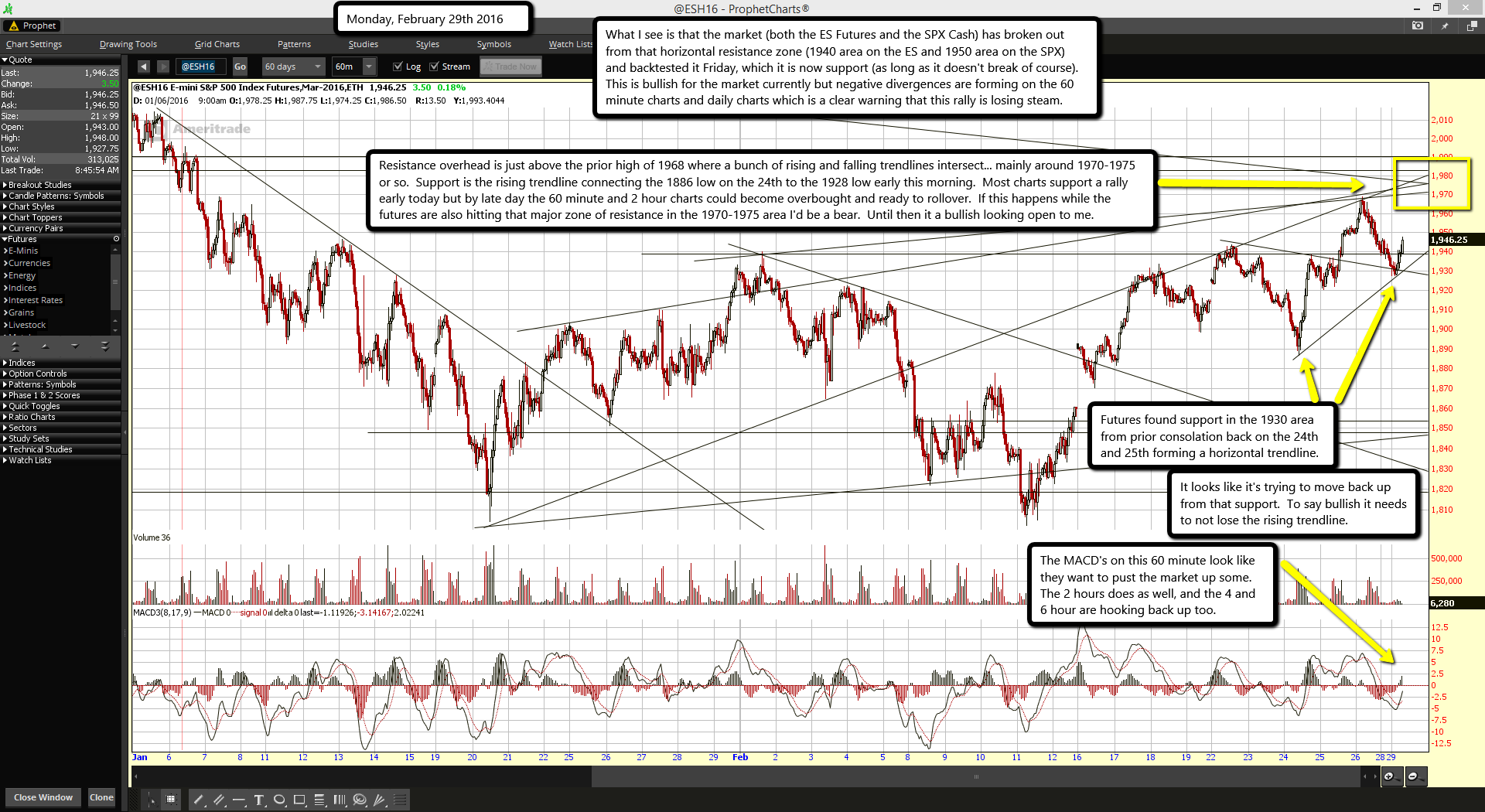
14158118-1814-4373-a4b4-4f027111e458Futures found support in the 1930 area from prior consolation back on the 24th and 25th forming a horizontal trendline.

It looks like it's trying to move back up from that support.  To say bullish it needs to not lose the rising trendline.

The MACD's on this 60 minute look like they want to pust the market up some.  The 2 hours does as well, and the 4 and 6 hour are hooking back up too.

What I see is that the market (both the ES Futures and the SPX Cash) has broken out from that horizontal resistance zone (1940 area on the ES and 1950 area on the SPX) and backtested it Friday, which it is now support (as long as it doesn't break of course).  This is bullish for the market currently but negative divergences are forming on the 60 minute charts and daily charts which is a clear warning that this rally is losing steam.

Resistance overhead is just above the prior high of 1968 where a bunch of rising and falling trendlines intersect... mainly around 1970-1975 or so.  Support is the rising trendline connecting the 1886 low on the 24th to the 1928 low early this morning.  Most charts support a rally early today but by late day the 60 minute and 2 hour charts could become overbought and ready to rollover.  If this happens while the futures are also hitting that major zone of resistance in the 1970-1975 area I'd be a bear.  Until then it a bullish looking open to me.

Freddie Mac (2/25/16) – Rates on all popular mortgages down

0

Freddie Mac (2/25/16) - Rates on all popular mortgages down

Mortgage interest rates for long-term and adjustable-rate products were down on the most recent Freddie Mac survey released Thursday, continuing the downward trend manifested for most of calendar year 2016. Experts attributed this to easing global concerns, as well as encouraging home sales statistics from January 2016.

30-year fixed rate mortgages, which were at 3.65 percent last week, dropped slightly, easing by three basis points to 3.62 percent for the week ended February 25, 2016. One year ago, 30-year FRMs averaged 3.80 percent, or 18 hundredths of a percentage point higher. 15-year FRMs were at 2.93 percent this week, a slight two-basis point downtick from last week’s 2.95 percent, and 14 basis points lower than the year-ago figure of 3.07 percent. Last week, long-term mortgage interest rates didn’t move, following six consecutive weeks of declines.

5-year Treasury-indexed hybrid adjustable-rate mortgages took the biggest fall this week, while remaining relatively flat. Rates for 5-year ARMs edged down from 2.85 percent to 2.79 percent. Last year, 5-year ARMs averaged 2.99 percent.

In his weekly statement, Freddie Mac Chief Economist Sean Becketti attributed this week’s declines to recent figures released by the National Association of Realtors, which showed existing home sales improving considerably last month.

“Yields on the 10-year Treasury continued their downward trend this week after a small rally the previous two weeks. The 30-year mortgage responded, falling 3 basis points to 3.62 percent,” said Becketti. “Since the beginning of 2016, 30-year rates have fallen almost 40 basis points helping housing markets sustain their momentum into this year. Earlier this week, the National Association of Realtors announced existing home-sales were up 4 percent month-over-month in January and up 11 percent from last year.”

Source link

s2Member®