A Delta jet takes off in view of an Alaska Airlines plane that just landed at Seattle-Tacoma International Airport in Washington state.
More than 20,000 passengers were unhappy with their airline experience in 2015, an almost 30 percent increase in displeasure over the year before, the U.S. Department of Transportation reported Thursday.
The number of passengers who filed complaints rose from 15,539 received by DOT’s Aviation Consumer Protection Division in 2014. The final month of last year was a big one for passenger complaints, DOT said, after recording 1,565 dissatisfied customers. That was a 19.6 percent increase from November and a 46.9 percent bump from December 2014.
Complaints are filed with the DOT over all sorts of things connected with flying: flight problems, baggage, reservation and ticketing, refunds, consumer service, disability and discrimination.
Airlines reported an on-time arrival rate of 77.8 percent in December 2015, up from the 75.3 percent on-time rate in December 2014. But that was a decrease from November 2015, when 83.7 percent of flights were on time.
The most on-time airlines in December were Hawaiian Airlines (93 percent on time), Alaska Airlines (85 percent) and Delta Air Lines (83.6 percent). The airlines with the worst on-time performance were Spirit Airlines (68.7 percent), JetBlue Airways (70 percent) and Virgin America (71.1 percent).
For the full year in 2015, airlines recorded an on-time arrival rate of 79.9 percent, up from 76.2 percent in 2014.
In 2015, airlines told DOT they canceled 1.5 percent of their scheduled domestic flights, an improvement over the 2.2 percent cancellation rate in 2014. In 61 instances last year, domestic flights were delayed on the tarmac for more than three hours.
In December, airlines reported that 22.17 percent of their flights were delayed. They told DOT that 5.70 percent of their flights were late because of aviation system delays, compared with 4.84 percent in November; 7.64 percent of delays were caused by late-arriving aircraft, compared with 5.18 percent in November; 6.13 percent by factors, such as maintenance or crew problems, compared with 4.60 percent in November; 0.66 percent by extreme weather, compared with 0.42 percent in November; and 0.06 percent for security reasons, compared with 0.04 percent in November.
Lost baggage has become less of a problem with the advent of bar-coded baggage tags and computer networks that track luggage. But U.S. airlines said baggage was mishandled for four out of every 1,000 passengers in December. For all of 2015, the airlines posted a mishandled baggage rate of 3.24 per 1,000 passengers, down from 2014’s rate of 3.61.
In December, airlines said there were four incidents involving the death, injury or loss of animals while traveling by air, down from the six reports filed in November 2015. For all of 2015, carriers reported 35 animal deaths, injuries to 25 other animals, and three lost animals, for a total of 63 incidents, up from the 45 total incident reports filed for 2014.
Ashley Halsey reports on national and local transportation.
Uber has had a rough time trying to make it in China.
The ride-hailing service is all-but dominant in the United States and popular in many other foreign markets, but it’s found Asia, especially mainland China, difficult to crack. The company faces formidable competition from Chinese-owned rival Didi Kuaidi.
On Thursday Uber CEO Travis Kalanick announced that the company’s Chinese operations are losing more than $1 billion on operational and other costs.
"We're profitable in the USA, but we're losing over $1 billion a year in China," Uber CEO Travis Kalanick told Canadian technology platform Betakit. "We have a fierce competitor that's unprofitable in every city they exist in, but they're buying up market share. I wish the world wasn't that way."
That’s not for lack of trying. Uber China, which focuses on the mainland Chinese market, is separate from Uber’s other operations and is run by Chinese managers. The subsidiary has pulled in $200 million in investments from Baidu, the Chinese search engine, and has some of the highest ride volume worldwide from its Chinese audience. In early February, Uber also partnered with Alipay, an app that lets Chinese users traveling internationally pay for their rides in renminbi (China's official currency) without having to switch currencies.
Uber is the world’s largest ride-hailing service by many accounts, valued at more than $50 billion. But despite the Baidu investment and its own sink of funds, Uber China is finding itself outpaced by Didi Kuaidi nearly every step of the way. Didi Kuaidi was formed when the two biggest ride-hailing apps in China, Didi Dache and Kuaidi Dache, merged, and it’s backed by e-retailer Alibaba and service portal firm Tencent, the two largest Internet companies in China.
At least in the Chinese market, Didi Kuaidi has far more capital than Uber does to spend on expansion in the mainland, having raised raised $2 billion in capital to the $1 billion Uber has set aside for its Chinese ventures. Didi Kuaidi also serves far more riders than Uber China does. One million people a day in Beijing alone use the service. A recent report by Analysys International found that Didi Kuadi dominates the ride-hailing market in China, leading with 83.2 percent of users to Uber’s 16.2 percent.
Didi Kuaidi has moved aggressively in its plans for expansion, and is looking to grow in Uber’s US backyard. In September 2015, it invested $100 million in Uber’s domestic rival Lyft. The two firms are working closely together to build a seamless user experience, where customers can use the same app to hail a car from Lyft when visiting the US or a car from Didi Kauidi when visiting China. Didi Kauidi has inked similar deals with GrabTaxi in Southeast Asia and the ride-hailing service Ola in India.
Uber and Didi Kuaidi have both invested heavily in subsidies for drivers that allow them to offer cheaper fares, and Uber believes that this pricing strategy may pay off in the long run for its Chinese operations. According to Kalanick, company hopes to offer Uber in more than 100 Chinese cities by the end of the year.
Yahoo has admitted what everyone already knew — the company is up for sale.
And to make sure it's taken seriously, Yahoo is bringing in outsiders to drum up interest.
The company announced on Friday the formation of "a Strategic Review Committee of independent directors" to explore "strategic alternatives." Put more plainly, Yahoo has hired bankers and lawyers to field offers that can be presented to the company's board of directors.
The moves come after a particularly dark time for Yahoo, marked by layoffs that are cutting around 15% of its workforce and include the shuttering of many of its content verticals such as food, health and travel.
Yahoo and its CEO Marissa Mayer have faced increasing pressure from activist investors to sell what has been referred to as its "core assets" but really just means its actual business.
Despite remaining a major and powerful web destination, driven by the power of its curated, news-focused homepage, Yahoo's core web advertising business suffered along with the rest of the media industry and efforts to grow into newer areas such as mobile and video have been middling.
The formation of an independent board is a step that could force the company to act if a buyer is found.
Meanwhile, Yahoo has held a sizable stake in Chinese e-commerce company Alibaba, something that made its stock very appealing as a way for U.S. investors to invest by proxy into the company before it went public.
Now that Alibaba is a publicly traded company, Yahoo has been pushed to figure out a way to sell its stake in a way that returns money to shareholders while avoiding a major tax hit. One way to do that is to sell Yahoo's core business to another company.
Maynard Webb, chairman of the board of Yahoo, said that the company is looking at this strategy, nothing it could be the best thing for Yahoo shareholders. Investors tepidly agreed, sending Yahoo shares up 1.7%.
"We believe that pursuing these complementary paths is in the best interests of our shareholders and will maximize value," Webb said in a press release.
Yahoo had previously announced in its most recent quarterly earnings release that it would be considering "strategic alternatives," which is code for selling to the highest bidder.
In thia March 3, 1997 file photo, Yahoo! co-founders David Filo, left, and Jerry Yang hold up a fish prop in Filo's office in Santa Clara, Calif.
Friday's announcement comes after some doubt had been expressed over whether Yahoo's leaders had really been that interested in a sale.
SunTrust analyst Robert Peck on Thursday said in a note that some possible buyers had found little interest from Yahoo, "making them question the seriousness of the firm and management in seeking strategic alternatives."
That sluggishness has been attributed to Mayer, who has publicly and privately shown little interest in making a deal, according to Re/code.
In what could best be described as a bit of mixed messaging, Mayer said that the company would consider a sale but also continue to execute her plans
"As both shareholders and employees, all of us here at Yahoo want to return this iconic company to greatness," she said in the press release. "We can best achieve this by working with the committee to pursue various strategic alternatives while, in parallel, aggressively executing our strategic plan to strengthen our growth businesses and improve efficiency and profitability."
A sale of Yahoo would follow on the purchase of another big first-generation Internet company that had fallen from grace — AOL.
Helmed by CEO Tim Armstrong, who is friendly with Mayer, AOL had gone through something of a reinvention as a digital media company with a heavy emphasis on video.
Armstrong was able take a few acquisitions — most notably online video ad platform Adap.tv — and sell what had at one-time been a company on a steep decline for $4.4 billion to Verizon.
A Walmart store in Secaucus, N.J. The company said same-store sales in the United States rose 0.6 percent in the fourth quarter.
Walmart said profit fell about 8 percent last quarter, and it lowered its sales forecast for this year, citing a strong dollar and the costs of a plan to close more than 200 stores worldwide.
Sales during the recent holiday season slowed from the third quarter, Walmart said on Thursday, and it reported fourth-quarter profit of $4.57 billion, down 7.9 percent from the same period a year ago, on declining revenue and same-store sales.
For the current fiscal year, which began this month, sales are projected to be flat, whereas previous estimates called for growth of 3 to 4 percent.
Walmart is among the big retailers struggling to adapt to the popularity of online shopping. Last month, the company announced plans to close 269 stores, including 154 in the United States, a move that will affect 16,000 workers.
“This past year has been a year of investment, operational improvement and change, even while we delivered solid growth,” said Doug McMillon, Walmart’s president and chief executive. “We do see an underlying strength in our Walmart U.S. business that wasn’t there a year ago.”
Quarterly revenue, which reached $129.7 billion, fell 1.4 percent from the year-ago period, with currency adjustments shaving off $4.8 billion.
Earnings per share were $1.43, compared with $1.53 a year ago. Costs associated with the store closings cut 20 cents off earnings per share, which was partly offset by tax-related gains of 14 cents a share.
For the full fiscal year, profit was $4.57 a share, compared with $4.99 the year before, and revenue was $482.1 billion, compared with $485.7 billion in the year-ago period.
The HSBC headquarters is seen in the Canary Wharf financial district in east LondonBy Lawrence White and Simon Jessop
LONDON (Reuters) - British Finance Minister George Osborne's relief at HSBC's choice of London over Hong Kong as its headquarters is not shared by several top executives who rue a missed opportunity for its China-centered growth strategy.
With its historical roots in China -- HSBC was founded in Hong Kong and Shanghai in 1865 -- Europe's biggest lender has stepped up efforts in recent months to become chief cheerleader for Beijing's 'one belt, one road' infrastructure plan.
"A move to Hong Kong would have sent very positive signals to the region in the longer term," one senior Hong Kong-based executive told Reuters, speaking on condition of anonymity due to the sensitivity of the issue within the bank.
HSBC had a taste of what China's outbound investment drive can offer earlier this month as sole international adviser to state-owned China National Chemical Corp on its $43 billion bid for seeds and fertilizer giant Syngenta, the biggest ever overseas takeover offer by a Chinese company.
China's plan for a new silk road and economic belt, which Beijing envisages spreading from Western China to Central Asia and onwards to Europe, has echoes of The Hongkong and Shanghai Banking Corporation's original 19th century vision, when Thomas Sutherland founded the bank to meet the demands of China's growing business communities and their need for more reliable and sophisticated banking.
Fast forward 150 years and some members of HSBC's management feel a move back to its original hometown of Hong Kong would have helped the bank win more advisory business, along with the financing for some of the huge infrastructure projects expected on China's new silk road.
HSBC's history tells how Sutherland weathered a financial storm in Hong Kong in 1866 by maintaining the bank's payment period for bills of exchange when others were cutting theirs, a move which kept him in business as other banks collapsed.
After Sunday's historic board meeting in London, HSBC said that Asia remained at the heart of the group's strategy, a line a spokeswoman for HSBC reiterated when asked about any divisions within the bank's senior echelons.
HSBC insiders told Reuters the bank had taken into account Chinese sensitivities in timing the announcement of its decision to remain in the UK, waiting until the end of the lunar new year holiday.
"There are senior executives in Asia who were very excited about the possible move...I expect the bank will now do a lot of PR to reinforce the 'we love you messages' to China, having turned them down," an external source familiar with the board and management team's thinking told Reuters.
In conversations both before and after the decision Reuters spoke with nearly a dozen Asia-based executives at the bank who said they would welcome the headquarters moving eastwards.
ASIA PIVOT
HSBC set out a strategy last year to shift up to $230 billion of assets saved by spending cuts elsewhere to Asia, so that it could invest more in the Pearl River Delta and Southeast Asia in particular.
That gave a long-term logic for a move to Hong Kong, despite near-term headwinds such as flagging Chinese economic growth and gyrations in the country's stock markets.
But a move by Britain's Osborne to scrap most of an onerous levy on banks' global balance sheets removed one of the biggest disadvantages of having a London base, appeasing many investors who had pushed for the HQ review.
The make-up of HSBC's board also likely played a part in the outcome, said Chris White, head of equities at Premier Asset Management, which holds shares in the bank.
"If you look at the composition of HSBC's board, it's mainly European, so it shouldn't necessarily be any surprise when they decide that they ought to stay in Europe," he said.
Most prominent among the few non-Europeans on HSBC's board is Hong Kong businesswoman Laura Cha who sits on Hong Kong's Financial Services Development Council advising on how it can improve its status as a financial center. Cha also chaired discussions at the Asian Financial Forum in January on the new silk road plans.
Cha did not respond to an emailed request for comment.
Reuters was not able to ascertain from sources familiar with the meeting whether any board members initially favored a move to Hong Kong. The bank said that the board's final decision on Sunday was unanimous, and most investors now back the choice.
"If they would have decided to move to Hong Kong, I would have had to rethink my position in HSBC," said Joost de Graaf, senior portfolio manager at Kempen Capital Management, which owns shares in HSBC.
While some executives at HSBC in Asia had privately hoped for the move, both they and investors thought that outcome unlikely given China's grimmer market outlook and tightening grip on Hong Kong in recent months.
"I thought it was kind of inevitable they would stay in UK given what is going on in China - currently a Hong Kong listing does not look very attractive for a corporate executive," said an investor at one of the bank's top 20 shareholders.
HSBC Chairman Douglas Flint, HSBC has struggled to strike the right tone on pay.
The bank u-turned on a global pay freeze last week after a protest from employees, saying it would find cost savings elsewhere.
And it’s now u-turned on the u-turn, refreezing salaries for thousands of UK-based managers, according to a report in the Financial Times.
Emma Dunkley reports that most managers in the bank’s UK retail and investment management operations were told they wouldn’t be getting a pay rise this year.
More junior staff will be getting a salary hike, funded from the bank’s bonus pool, according to the FT.
The bank, like most others, is seeking to cut costs and reduce the size of its capital-intensive investment banking operations. It’s aiming to cut around 50,000 jobs and save $5 billion (£3.1 billion) a year by 2017.
HSBC last week also finally chose to keep its headquarters in the UK after a long-running relocation review. The bank, one of the world’s largest by assets, considered Hong Kong, the US, and Canada in its list of new homes.
Willem Buiter offered a chilling prospect this week at a conference in Hong Kong.
“Its not impossible that even [China] some time next year may be looking at negative rates if the slowdown that I anticipate continues,” Citigroup’s chief economist told the bank’s invitees. “It’s not our central scenario but it is a risk.”
If regular investors shiver at the prospect of a China struggling to combat slowing growth to the extent it has to follow Europe and Japan in making people pay to save — and it should send a chill — then China’s indebted companies should be nearing outright panic.
Low growth and low, or no, inflation would rob them of both routes out from under debt burdens that for many groups are already at alarming levels.
Amid all the fears stalking global markets — be they related to China, oil or emerging markets in general — the problem for traders is to ensure they don’t eschew ultimately attractive investment opportunities along with the bad. For Asian markets, facing a Chinese slowdown, Japan’s battle to reflate, slowing global trade and fears over rising debts, this is even more key. Not all face anything like the same combination of the above.
There are high-level signs of investor differentiation already. Fund managers cut extreme negative emerging markets positions last month, according to Bank of America Merrill Lynch’s monthly survey, which nonetheless still put “short EM” the third most crowded trade behind going long the dollar and short oil.
Next comes the need to differentiate between industries. According to Fitch Ratings, 11 per cent of the 302 non-financial companies that it rates in Asia-Pacific carry a negative outlook, up from 8 per cent a year ago. As last year, about 4 per cent of groups could see an upgrade.
Split by industries, the need to sift carefully is even more clear. The proportion of industry sectors with negative outlooks, according to Fitch, has jumped to 42 per cent from 18 per cent. The list can still challenge perceptions, however: Fitch is positive on Chinese housebuilders, whom it thinks will benefit from falling inventories and rising sales — when most people still fear the sector is a debt-ridden disaster.
Country perceptions are worth re-examining too. Indonesia, which as a commodity exporter does not enjoy the same boost from cheaper materials as China does, is in fact one of the best-performing stock markets in the world so far this year. Business confidence in the country has jumped sharply in the past six months, too.
“There’s this misconception that Indonesian companies borrow dollars left, right and centre and are completely irresponsible,” says Herald van der Linde, head of Asia equity strategy at HSBC, who has covered the country for more than 20 years. “That’s not the case. Since the Asian financial crisis, the better companies have mostly kept a check on leverage.”
Asia’s financial crisis largely passed China by — something analysts are noting as corporate debt piles up. Companies that bought assets overseas last year carried an average gross leverage ratio of 5.4, according to data from S&P Global Market Intelligence.
ChemChina, which this month offered $44bn for Syngenta, the Swiss agribusiness giant, carried total debt of almost twice that based on 2014 numbers. As a state-owned entity with the assumed guarantee that carries, ChemChina has access to lending facilities that private companies could not hope to tap.
For now, China’s buying — and borrowing — continues. On Wednesday, Zoomlion Heavy Industry confirmed that it had offered $3.3bn for Terex, a US crane maker — a cash-and debt financed bid that if successful, would increase Zoomlion’s already eye-popping leverage ratios.
The construction machinery maker already carries gross debt of more than 80 times earnings before interest, tax, depreciation and amortisation. Net out its cash on hand and the ratio is more than 40. As a rule of thumb, leverage above about four times would be considered risky.
Yet, also on Wednesday, there were more positive signs. Fosun International, one of China’s best-known serial acquirers with Club Med and Cirque du Soleil in its portfolio among others, cancelled the $462m purchase of Israel’s Phoenix Holdings — in part to keep its leverage down.
In Asia particularly, 2016 is setting up to be a year of exceptions rather than rules. And in markets so nervous and changeable, it will pay to follow individual stories, be they at country or company level, as closely as any trend.
On top of spaghetti, all covered with...wood? Bloomberg News recently reported that some packaged grated Parmesan cheeses contain too little cheese and too much wood-pulp, according to a test conducted by an independent laboratory.
Foodio / Shutterstock / Foodio
The "wood-pulp" mentioned is actually a powdered plant fiber called cellulose that's completely legal in the US and is an FDA approved anti-clumping ingredient for pre-grated cheese. Cellulose is widely used throughout the food industry, helping to make foods like ice cream have a creamier mouthfeel and it's used in good quality grated cheeses, as well as not-so-great quality cheeses.
Since not all cheese is created equal, we turned to Liz Thorpe, cheese expert, consultant and author of The Cheese Chronicles, to get her tips for how to make sure you get real Parmesan every time:
paulista / Shutterstock / paulista
1. Look for the words "Parmigiano-Reggiano" on the rind
"The first thing to know is that Italian Parmigiano-Reggiano and Amerian Parmesan cheese aren't the same thing," says Thorpe. "Parmigiano-Reggiano is a legally protected designation of origin that's used in Europe only for Italian cheese. It can never be sold pre-packaged in a grated form. The beauty of this cheese is that you can always know that you're getting the real thing because the name 'Parmigiano-Reggiano' is burned onto its rind in an unmistakable dotted pattern." This is the top of the line Italian cheese that you want to use in your cooking and and hope to see in restaurants.
2. Buy a wedge from a wheel of cheese rather than pre-grated cheese
Many of us buy grated cheese for its convenience, but "it's super easy to use a microplane and then you're guaranteed a pure product," says Thorpe. "Grate or crumble it yourself—it will taste so much better and you'll use less cheese because it's flavor is so much better."
3. If you're going to buy pre-grated Parmesan, look for American producers with good reputations
"Learn the names of reputable brands that offer pre-grated Parmesan like Sartori and BelGioioso which are both from Wisconsin and Arthur Schuman, Inc. from New Jersey which is the largest importer of hard Italian cheeses," says Thorpe. "Their products are widely available, their quality is really excellent and you can count on their cheeses."
4. In a supermarket, shop for Parmesan in the deli department first
"There are three different tiers of quality: the Parmesan in the deli area, the Parmesan in the dairy case and the Parmesan in the aisle are each different," says Thorpe. "Shop in the deli department first, followed by the dairy case and, as a last resort, the aisle. Cheese is a perishable product and you want your cheese to require refrigeration. If you're buying one that is not refrigerated, there's a reason. A grated product that's shelf stable—that's the lowest product that you could be buying." In other words, make the cheese in a green can your last resort.
5. Buy grated cheese at a specialty foods shop
"A small store buying whole wheels of cheese will grate it on site and there will not be any cellulose added because it doesn't need to have a four-, six- or eight-week shelf life," says Thorpe. Also, if you ask, a small retailer will likely be accommodating and grate the cheese for you.
Technology distributor Ingram Micro Inc. agreed to be acquired for about $6 billion by a unit of Chinese conglomerate HNA Group.
The deal is the latest in a string of investments by Chinese companies in U.S. tech companies, including deals involving U.S. makers of computer chips that have attracted scrutiny on national-security grounds.
Ingram, founded in 1979, is one of the largest distributors of personal computers and other technology products including printers, scanners, TVs, videogame consoles, video monitors and software. The Irvine, Calif., company recently branched into a range of higher-margin professional services.
HNA Group, which claims more than 180,000 employees, evolved from marine shipping into operations that include transportation, logistics, tourism, banking and insurance. Its logistics group includes companies such as Jinhai Heavy Industry Co.
Alain Monié , Ingram Micro's chief executive, said the deal would allow his company to accelerate investments in technology while becoming part of a larger organization with "complementary logistics capabilities and a strong presence in China."
Chinese companies have become more aggressive lately in pursuing deals amid concerns about China's weakening economic growth, investment bankers say.
In January, Zoomlion Heavy Industry Science & Technology Co. offered to buy U.S. crane-maker Terex Corp. for about $ 3.3 billion, an attempt to override an existing deal between Terex and Finland'sKonecranes Oyj.
In December, a group including China Resources Microelectronics Ltd. and Hua Capital Management Co. made an unsolicited bid for Fairchild Semiconductor International Inc., which already had a deal with U.S. chip maker ON Semiconductor Corp.
Fairchild on Tuesday rejected the Chinese proposal, stating a preference for the ON transaction. Fairchild cited, among other factors, risks that the deal would be rejected by U.S. authorities on national-security grounds.
Royal Philips NV in January terminated the planned $2.8 billion sale of most of its lighting components and automotive-lighting unit to a Chinese investor, after the U.S. Committee on Foreign Investment blocked the deal on national-security grounds.
Many technology companies use Ingram to run their supply chains. Ingram, a longtime wholesaler of computer components and peripherals, launched a third-party logistics unit in 2000.
The U.S. company has completed many acquisitions over the years, like a deal for e-commerce fulfillment company Shipwire. It launched a cloud-computing-services portfolio in 2007.
For the nine months ended Oct. 3, Ingram posted sales of $31.7 billion. In late October, it projected fourth-quarter sales of $12 billion to $12.6 billion.
Along with the deal, Ingram Micro is suspending its quarterly dividend payment and its share-repurchase program. Ingram's management team will stay in place, including Mr. Monié , and the company will remain in Irvine, Calif.
The boards of both companies have approved the transaction, which is expected to close in the second half of the year.
NVIDIA Corporation (NASDAQ:NVDA) reported record revenue for the fourth quarter ended January 31, 2016, of $1.40 billion, up 12 percent from $1.25 billion a year earlier, and up 7 percent from $1.30 billion in the previous quarter.
Revenue for fiscal 2016 was a record $5.01 billion, up 7 percent from $4.68 billion a year earlier.
GAAP earnings per diluted share for the quarter were $0.35, inclusive of a restructuring charge of $0.04 per diluted share. Non-GAAP earnings per diluted share were $0.52, up 21 percent from $0.43 a year earlier and up 13 percent from $0.46 in the previous quarter.
GAAP earnings per diluted share for the full year were $1.08, inclusive of restructuring charges of $0.15 per diluted share. Non-GAAP earnings per diluted share were $1.67, up 18 percent from $1.42 a year earlier.
“We had another record quarter, capping a record year,” said Jen-Hsun Huang, co-founder and chief executive officer, NVIDIA. “Our strategy is to create specialized accelerated computing platforms for large growth markets that demand the 10x boost in performance we offer. Each platform leverages our focused investment in building the world’s most advanced GPU technology.
“NVIDIA is at the center of four exciting growth opportunities — PC gaming, VR, deep learning, and self-driving cars. We are especially excited about deep learning, a breakthrough in artificial intelligence algorithms that takes advantage of our GPU’s ability to process data simultaneously.
“Deep learning is a new computing model that teaches computers to find patterns and make predictions, extracting powerful insights from massive quantities of data. We are working with thousands of companies that are applying the power of deep learning in fields ranging from life sciences and financial services to the Internet of Things,” he said.
Capital Return
During the fourth quarter, NVIDIA paid $62 million in cash dividends and received 4.3 million shares in connection with an accelerated share repurchase agreement that it had entered into in the quarter. During fiscal 2016, the company returned to shareholders $800 million in quarterly cash dividends and share repurchases.
For fiscal 2017, NVIDIA intends to return approximately $1.0 billion to shareholders through ongoing quarterly cash dividends and share repurchases.
NVIDIA will pay its next quarterly cash dividend of $0.115 per share on March 23, 2016, to all shareholders of record on March 2, 2016.
Q4 FY2016 Summary
FY2016 Summary
NVIDIA’s outlook for the first quarter of fiscal 2017 is as follows:
Revenue is expected to be $1.26 billion, plus or minus two percent.
GAAP and non-GAAP gross margins are expected to be 57.2 percent and 57.5 percent, respectively, plus or minus 50 basis points.
GAAP operating expenses are expected to be approximately $500 million. Non-GAAP operating expenses are expected to be approximately $445 million.
GAAP and non-GAAP tax rates for the first quarter of fiscal 2017 are both expected to be 19 percent, plus or minus one percent.
Capital expenditures are expected to be approximately $35 million to $45 million.
Fourth Quarter Fiscal 2016 Highlights
During the fourth quarter, NVIDIA achieved progress in each of its platforms.
Gaming:
Announced the GeForce® GTX VR Ready program — in conjunction with PC companies, notebook makers and add-in card providers – to help users discover systems that will provide great virtual reality experiences.
Released NVIDIA GameWorks™ VR, a software development kit for developers of VR software and headsets for gaming.
Professional Visualization:
Datacenter:
Introduced an end-to-end hyperscale datacenter deep learning platform — consisting of two accelerators, the NVIDIA Tesla® M40 and NVIDIA Tesla M4 — that lets web-services companies accelerate deep learning workloads.
Revealed new breakthroughs from leading web-services groups using NVIDIA GPUs:
Facebook is using the NVIDIA Tesla accelerated computing platform to power Big Sur, its next-generation computing system for machine learning applications.
Alibaba’s AliCloud cloud computing business is working with NVIDIA to promote China’s first GPU-accelerated, cloud-based, high performance computing platform.
Google is open-sourcing its TensorFlow deep-learning framework, which can be accelerated on GPUs.
Microsoft’s Computational Network Toolkit was integrated with Azure GPU Lab, enabling neural nets for speech recognition that are up to 10x faster than their predecessors.
Auto:
Launched NVIDIA DRIVE™ PX 2, a powerful engine for in-vehicle artificial intelligence.
Announced that Volvo will use DRIVE PX 2 to power a fleet of 100 Volvo XC90 SUVs that will appear on the road next year in the car manufacturer’s Drive Me autonomous-car pilot program. (Original Source)
Shares of Nvidia jumped nearly 8% in after-hours trading. NVDA has a 1-year high of $33.94 and a 1-year low of $19.09. The stock’s 50-day moving average is $28.60 and its 200-day moving average is $27.34.
On the ratings front, Nvidia has been the subject of a number of recent research reports. In a report released yesterday, Jefferies Co. analyst Mark Lipacis maintained a Buy rating on NVDA, with a price target of $38, which represents a potential upside of 37.4% from where the stock is currently trading. Separately, on January 20, JMP’s Alex Gauna reiterated a Buy rating on the stock and has a price target of $38.
According to TipRanks.com, which ranks over 7,500 financial analysts and bloggers to gauge the performance of their past recommendations, Mark Lipacis and Alex Gauna have a total average return of 9.7% and -2.2% respectively. Lipacis has a success rate of 62.1% and is ranked #132 out of 3610 analysts, while Gauna has a success rate of 45.2% and is ranked #2657.
Overall, one research analyst has rated the stock with a Sell rating, one research analyst has assigned a Hold rating and 4 research analysts have given a Buy rating to the stock. When considering if perhaps the stock is under or overvalued, the average price target is $33.00 which is 19.3% above where the stock closed yesterday.
NVIDIA Corp is a visual computing company, connecting people through the powerful medium of computer graphics. The Company’s reporting segments include GPU and Tegra Processor.
Yahoo's once-iconic San Francisco billboard, pictured here in 2011.
In January of 2014, Yahoo CEO Marissa Mayer's keynote at CES in Las Vegas featured the recently launched Yahoo Tech, the company's technology news "digital magazine." She had hired former New York Times technology columnist David Pogue in October of 2013 as the site's architect and shining star and brought in a stable of other editorial talent to create digital magazines for other "verticals" (food, cars, music, and health among them) as part of her big turnaround strategy for the company. But the turnaround never materialized, and now the sites are being shut down or scaled down.
Dan Tynan, editor-in-chief at Yahoo Tech, revealed his departure in an e-mail to staff published by Politico today. "Well, that was not entirely unexpected," Tynan wrote in the memo. "Eight Hundred and Four days after taking the purple, my career as a Yahoo is over." Politico reported that Yahoo intended to shut down Yahoo Tech along with a flight of other sites.
However, a Yahoo spokesperson told Ars that Yahoo Tech was not being shut down—but several other brands are. And Tynan's departure is part of a broader layoff being announced today. "In early February Yahoo shared a plan for the future, with this new plan came some very difficult decisions and changes to our business," the spokesperson said. "As a result of these changes some jobs have been eliminated and those employees will be notified today. We thank those employees for their outstanding service to Yahoo and will treat these employees with the respect and fairness they deserve."
The purge is part of Mayer's effort to cut costs at Yahoo as the company attempts to develop a strategy to deal with what is both the company's biggest asset and something of a strategic curse—its massive windfall from an investment in the Chinese e-commerce website Alibaba. The company’s board and major investors are keen to cut away the Alibaba holdings from the rest of the company, which has, as Ars reported recently, failed to make money on its own.
After the US government indicated it would not approve a tax-free spinoff of the Alibaba holdings as a separate company, there was talk of spinning off or selling Yahoo's Internet holdings instead. But Mayer advocated for cost-cutting measures to preserve the Internet company. In an earnings call earlier this month, Yahoo executives announced that they were moving to "simplify" Yahoo's information business to focus on the parts of the company that have been most successful: Yahoo News, Yahoo Sports (the platform for Yahoo's growing fantasy sports business), Yahoo Finance, and Yahoo Lifestyle.
The shape of that simplification became apparent today. In a Tumblr post today (Tumblr being another one of Mayer's acquisitions to revive Yahoo), Yahoo global editor in chief Martha Nelson wrote, "To that end, today we will begin phasing out the following Digital Magazines: Yahoo Food, Yahoo Health, Yahoo Parenting, Yahoo Makers, Yahoo Travel, Yahoo Autos and Yahoo Real Estate."
"As we make these changes, we acknowledge the talent and dedication of an extraordinary group of journalists who brought new and newsworthy content to Yahoo," she continued. "While these Digital Magazines will no longer be published, you will continue to find the topics they covered, as well as style, celebrity, entertainment, politics, tech and much more across our network."
Yahoo today said it is shutting down a huge swath of its digital magazines as it rethinks its digital content strategy. A Yahoo spokesperson said Yahoo Tech was not affected by the changes.
According to a memo acquired by Capital New York, Yahoo Tech editor in chief Dan Tynan is leaving the company. Capital New York also reported that Yahoo is shuttering its tech vertical and moving some of its staff to Yahoo’s news vertical. It appears that some of Yahoo’s content verticals — launched at a high-profile CES event in 2014 — were not successful enough to sustain their presence within the greater Yahoo company.
“On our recent earnings call, Yahoo outlined out a plan to simplify our business and focus our effort on our four most successful content areas – News, Sports, Finance and Lifestyle,” the company wrote in a blog post. “To that end, today we will begin phasing out the following Digital Magazines: Yahoo Food, Yahoo Health, Yahoo Parenting, Yahoo Makers, Yahoo Travel, Yahoo Autos and Yahoo Real Estate.”
“In early February Yahoo shared a plan for the future, with this new plan came some very difficult decisions and changes to our business,” a Yahoo spokesperson told TechCrunch. “As a result of these changes some jobs have been eliminated and those employees will be notified today. We thank those employees for their outstanding service to Yahoo and will treat these employees with the respect and fairness they deserve.
Taken together, this isn’t really surprising. Yahoo’s core business has been floundering for the past several years — so much so that the company has signaled that it is potentially for sale. Throughout this time, Yahoo’s stock has plummeted as the company has shown no clear signal to shareholders that it is returning to being a growth company.
Marissa Mayer, a former Googler, took over Yahoo in 2012 — when there was a lot of hope that she could turn the company around as it transitioned to a primarily mobile-driven company centered around a portfolio of brands. The final goal was to return Yahoo, a powerhouse brand in the early days of the Internet, to being a household name.
And, according to everything that’s happened in the past few weeks — including reports of a potential sale — all this is a signal that the strategy in place has not worked. Mayer and Yahoo are in the hot seat, with the company being somewhat buoyed by its big stake in Chinese commerce giant Alibaba, a company worth $163 billion.
This could be part of a larger swath of layoffs happening within the company. During the company’s last earnings report, Yahoo confirmed that it would lay off about 15% of its staff as part of a greater restructuring. Yahoo’s core business has been struggling to the point that the company has also had to downsize in operations internationally. Yahoo also shut down Yahoo Screen, its home for original content like the show “Community,” in January this year.
Update: A Yahoo representative says it is not shutting down Yahoo Tech, but the company listed a slew of magazines that will be shut down. The story, which previously said that the company’s tech vertical would be shuttered, has been updated to reflect Yahoo’s comments.
“We’re going to get this done -- and done quickly -- by any and every means necessary,” Weaver said
Simmering tensions between city and state officials over how quickly to replace lead pipes in Flint flared Wednesday after officials announced different approaches to solving the city's drinking water crisis.
Flint Mayor Karen Weaver said she appreciates support from Michigan Gov. Rick Snyder to move quickly to replace Flint’s lead pipes and his recent budget proposal to partially fund the project. But the mayor said she would not agree to allow the governor’s engineering firm and contractors to do the work.
The governor announced his plan in a news release Tuesday night and is expected today to offer additional details.
Weaver said she welcomed the governor’s interest in working with the city to coordinate removal of the first 30 lead service lines, but noted that much more needs to be done by Snyder and others to secure full funding for her plan.
Weaver's administration intends to begin replacing lead pipes in Flint starting next week. She called Snyder to pressure the state Legislature to move immediately to approve funding for the first phase of her $55 million Fast Start lead pipe replacement plan.
“We’re going to get this done — and done quickly — by any and every means necessary,” Weaver said in a statement. “The people of my city have simply run out of patience, and I have a moral obligation to act.”
Weaver said in a news release that she is working with water infrastructure experts from the Lansing Board of Water and Light to train local Flint workers on lead pipe removal at a vacant property in Flint owned by the Genesee County Land Bank. The training exercise is set to begin next week, she said. House-by-house lead service line removal and replacement operations targeting high-risk households across the city will begin afterward.
On Tuesday, Snyder said the state had signed an agreement with Flint-based engineering firm Rowe to update a study of the water system to identify and assess the city's water lines made from lead. The work would also instruct the firm to help test 400 sentinel sites for lead in drinking water, as well as begin to remove lead lines at 30 sites as a pilot program, according to Dave Murray, the governor's spokesman.
Flint Water Crisis
But the mayor appears to be charting her own course. Late last week, she ousted her police chief, fire chief and city administrator.
Elected last year and recently granted additional powers by a financial control board set up by the state, Weaver said Wednesday that she is pleased that her Fast Start plan has been endorsed by Virginia Tech water expert Dr. Marc Edwards, who is hailed for his role in uncovering the lead levels in Flint’s water supply and has testified before Congress on lead contamination in municipal water systems.
“I will not accept anything less than full removal of all lead pipes from our water system,” Weaver said in a statement. “I continue to hear from Lansing that the people of Flint should wait to see if pipes can be ‘coated.’ I call on Gov. Snyder to end that discussion, and to commit fully to getting the lead out of Flint.”
During the training exercise next week, the Lansing public works department will demonstrate its technology for removing and replacing lead pipes with new copper pipes in half the time and at half the cost of traditional methods, according to the mayor. The Lansing public water and electric utility has refined its technique by removing more than 13,500 lead pipes in Michigan’s capital city over the last 12 years, according to city officials.
Weaver said she is also working closely with the White House and Flint’s representatives in the Michigan Legislature and U.S. Congress to secure full funding for her lead pipe removal project, as well as long-term funding to fully repair the city’s devastated water-distribution system. She called on state and federal lawmakers to move quickly to approve emergency funding for her project while long-term repairs to Flint’s water-distribution system are evaluated.
“Lansing and Washington need to understand that the first and most critical priority is an emergency public health intervention to start getting rid of these pipes immediately,” Weaver said. “Then we can figure out exactly what it will cost over the long term to fix our broken water-distribution system. If we have to replace major components or even the whole system, it will cost an enormous amount of money. Everyone needs to be prepared for that possibility. Let’s start a serious conversation about where that money is going to come from while we get to work removing the pipes.”
If funding to ramp up her Fast Start project is not secured quickly from the state or federal government, Weaver said she may have to take her case directly to the national and international audience.
“If the state and federal governments won’t pay to restore safe drinking water and dignity to the people of my city, I may have to go on national TV and crowdsource the funding on the Internet,” Weaver said.
Flint's switch to using the Flint River as its water supply in April 2014 was followed almost immediately by complaints from residents about discolored, pungent water that had caused a number of ailments. Local and state officials insisted for months the water was safe to drink but reversed course after independent testing discovered unsafe lead levels throughout the system believed to be caused by leaching from lead piping.
Flint is now under a state of emergency because of elevated lead levels that continue to be found in drinking water supplied to city residents. Officials in the Snyder Administration have said that they hope to restore drinking water to the city in stages, with a full assessment of the system completed by mid-April.
Of the city's 56,000 land parcels, about 5,200 have lead service lines, officials have said. But roughly 25,000 parcels have piping of an unknown origin. Determining how much of that piping is lead is a crucial step for any remediation.
The governor's team has advocated a more deliberate approach to assess the condition of the entire water system in Flint first, in order to make sure any pipe removal does not increase the chances of additional lead leaching into the drinking water.
Snyder sent a supplemental budget request to the Legislature, including $25 million to be used for water infrastructure, like pipe replacement in Flint. The governor said Tuesday that other resources could be tapped for additional funds to replace pipes.
A key member of that team is retired National Guard Brig. Gen. Michael McDaniel, who has said he thinks replacing all of the city's lead pipes could be done within a year by 32 crews. McDaniel — who is assisting in coordinating activities between the city, the Lansing Board of Water and Light, state and federal agencies, and other stakeholders — said the project could begin within the next month. But McDaniel reiterated the plan is still in its early phases and much of it is based on "assumptions."
“Flint Mayor Karen Weaver wants this work to be completed as quickly as possible to protect Flint residents,” McDaniel said in a statement Tuesday. “We’ve been working in partnership to identify the areas that need to be addressed immediately and remove lead pipes, bringing peace of mind to Flint families and make sure this never happens again.”
The Flint firm hired by the state is no stranger to the city's water system.
In July 2011, the engineering firm Rowe completed a report titled "Analysis of the Flint River as a Permanent Water Supply for the City of Flint," for then-Mayor Dayne Walling. The report noted that treating river water on a daily basis was going to be challenging and more expensive than treating lake water, but concluded it could be done if improvements to Flint's water treatment plant were made.
Contact Matthew Dolan: 313-223-4743, msdolan@freepress.com or on Twitter @matthewsdolan
Doctors could soon start prescribing an unusual solution to help stroke victims in the US: virtual reality goggles.
That's the hope of Switzerland-based MindMaze, which on Wednesday got a $100 million investment to bring its blend of virtual reality hardware and neuroscience to market. The four-year-old startup's technology has already won approval from regulators in Europe, where its applications for brain injury victims showcase what could soon be possible in the United States.
MindMaze's 34-year-old founder and CEO Tej Tadi explains how: Imagine a stroke victim who's lost control of her left hand but can still move her right hand. After putting on MindMaze goggles, the patient sees a 3-D image, or avatar, of her left hand that moves as she moves her right hand.
"That triggers areas in the brain to say, 'Wait, let's regain control of this hand'," says Tadi. "The hand that was not working now works." And that process of tricking the brain into seeing something that's actually not there in the real world accelerates recovery, he says.
Already in use in Europe, startup MindMaze wants to begin treating American stroke victims using virtual reality this year. Now, it's got $100 million to do it.
Garo/Phanie Sarl/Corbis
This is the year that VR is set to take off. Almost every major tech company -- from Samsung and HTC to Facebook's Oculus and Sony -- has either released a VR headset or plans to do so. Their investments, as well as those made by smaller but well-funded startups like Jaunt, NextVR and Magic Leap, are expected to change the way we play video games and how we watch sports, presidential debates, porn or a Hollywood movie.
The investment in MindMaze, led by multinational conglomerate Hinduja Group, underscores just how VR could shake up medicine. In fact, Hinduja's nine-figure bet places MindMaze, a 55-person company, among the top three best-funded virtual reality startups in the world, according to PitchBook, a venture capital research firm.
"If there's a short list of areas where virtual reality will be really helpful or usable, health care is on that list," says Brian Blau, vice president of research at information technology research firm Gartner.
For Blau, who's been studying virtual reality since the 1990s, the potential impact on health care makes sense. VR works by tricking the brain into believing what it's seeing is three-dimensional and, often, lifelike. More than most other professions or markets, health care demands realism.
"There's so much that needs to be immersive," says Blau.
Since the 1990s, virtual reality has been used to help patients suffering from phobias overcome their fears. One early study showed how VR was a useful tool to help overcome fears of spiders.
Now, the increasingly powerful displays in VR goggles are helping emergency room doctors prepare for situations that are dangerous, costly or simply impossible to replicate in real life.
For example, instead of using actual cadavers, medical students can "work through mock surgeries" in VR, according to PitchBook, whose 2015 report concluded "the use of VR to provide zero-risk environments to conduct training can be invaluable."
To be sure, health care will still play a smaller role in VR than gaming or entertainment, according to Gartner. Only 8 percent of the 121 venture capital investments in virtual reality startups in 2014 and 2015 went to health care projects, according to Pitchbook.
But for millions of Americans suffering from brain injuries and looking to regain control over their limbs, 2016 could be more than just the year that playing Call of Duty or Grand Theft Auto got a lot cooler.
MindMaze won't say how much its device and software will cost in the US. (In Europe, the company's service costs upwards of $30 per month for individuals). But CEO Tadi is confident his solution will soon be in the hands, or on the heads, of patients.
"In 2016, they'll have an FDA-approved medical-grade virtual reality device in clinics," says Tadi.
AkzoNobel announced it has made an offer to acquire BASF’s Industrial Coatings business for €475 million ($528 million USD).
The transaction would include technologies, patents and trademarks, as well as securing supply to customers worldwide. Two manufacturing plants – one in the U.K. and one in South Africa – also will be transferred to AkzoNobel. The business generated revenue of about €300 million ($334 million) in 2015 and supplies products for a number of end uses, including coil, furniture foil and panel coatings, wind energy and general industry and commercial transport.
“This proposed acquisition will strengthen our position in the important coil coatings market and fits well with our existing business, allowing us to offer essential solutions to our customers,” said AkzoNobel CEO Ton Büchner. “We are continuing to deliver on our strategy to achieve our vision of leading market positions delivering leading performance.”
The planned transaction is expected to be complete in the second half of 2016, subject to regular consultation with employee representatives and satisfaction of certain closing conditions, including receipt of required regulatory approval.
Fresh loans since the start of the year prompted analysts to caution against the risks reckless borrowing may pose to China’s financial system. Recent reports warn that China’s debt piles up fast, and there may be hard-to-manage consequences.
Standard & Poor recently noted that the country’s debt, which has seen a big increase relative to its GDP in recent months, may put a strain on its credit ranking. Experts believe that a boost in credit could spell big trouble for the Chinese economy, the currency, and stocks.
Other experts believe that the country’s central bank may have lost regulatory control on credit. As of January, China’s debt mounted to a staggering 3.42 trillion yuan, or 525 billion U.S. dollars.
Analysts believe that the recent loans were only conjectural, but they warned that, if the situation continues, the country may experience a surge in bad debts as businesses would no longer find profitable projects to engage in. Plus, China currently struggles with the slowest economic growth in the past 25 years.
George Magnus of the UBS Group believes that while credit expansion may help the Chinese economy maintain momentum on the short run, it may cause ‘big problems’ later on. Magnus, a chief economic adviser for the USB Group, has accurately forecast the July slump on the Chinese stock market.
Nevertheless, Magnus did not tout the idea of a meltdown. He only counseled cautiousness until the end of the year. China’s debt versus GDP jumped 209 percent in the last quarter. Bloomberg experts noted that it is the highest jump since they started to gather the data in 2003. Bad debt spiked 7 percent at the end of last year to 1.27 trillion yuan.
Currently, China’s S&P credit rating is AA, but according to a report released last fall, the country could be downgraded if the government attempted to boost economic expansion by pumping more credit into investment spending.
Experts, however, do not believe that Beijing may repeat the 2008 and 2009 moves when it urged lenders to lend as much as they could. Yet, analysts are concerned that the country’s leadership is not willing to curb leverage, despite the official rhetoric that they are working to fix the country’s rampant debt.
The People’s Bank of China and several state agencies pledged Tuesday that they would take measures to fight off overcapacity and prevent loans from being granted to ‘zombie’ businesses.
Magnus noted that most of these promises are empty talk since there aren’t any concrete measures set in place to rein in the tidal wave of new credit impacting the economy.
A former U.S. treasury secretary has taken a public stand against high denomination bil
Larry Summers argues in a piece for the Washington Post that large notes like the 500-euro or $100 bill should no longer be issued.
His commentary was inspired by a recently published paper from the Harvard Kennedy School titled, "Making it Harder for the Bad Guys: The Case for Eliminating High Denomination Notes."
In the paper, researchers discuss the flow of money from illegal activities and write that "By eliminating high denomination, high value notes we would make life harder for those pursuing tax evasion, financial crime, terrorist finance and corruption."
Summers largely agrees, recalling similar concerns he expressed about the 500-euro note, which is worth more than $550, when the currency was being planned out.
In fact, he points to the note's nickname as the "Bin Laden"—a point mentioned in the paper—as proof of its link to illegal activities.
The famed economist ultimately states that placing "a moratorium on printing new high denomination notes would make the world a better place."
SAN MATEO, Calif. — The ID passcode to the iPhone the FBI wants Apple to hack for information about one of the San Bernardino, Calif., terrorists was changed less than a day after the government gained possession of it, Apple executives said in a phone briefing with reporters Friday afternoon.
Had the passcode not been changed, Apple said, a backup of the information the government is seeking could have been viewed. It is unclear who changed the Apple ID passcode while it was in the government’s possession, the executive said.
The disclosure was made with a small group of reporters during a 30-minute briefing, including USA TODAY. Apple asked that its executive not be identified because of the sensitive nature of the legal matter.
The call with the reporters marked the latest twist in a now-public dispute between the U.S. government and the world's most valuable company over whether Apple should be forced to break into a phone used by one of the killers in the San Bernardino, Calif. shootings that left 14 dead in December.
On Friday, the Justice Department swung back, filing a motion seeking to force Apple to comply with the court order and saying its refusal was "based on concern for its business model and public brand marketing strategy."
DOJ concurs: password was rest
In the government’s Friday filing, the Justice Department acknowledged that the password was re-set in the hours after the attack by authorities with San Bernardino County. The county owned the phone and provided it to Syed Farook, one of the attackers.
The county action, the government contends, had the effect of eliminating the possibility of a back-up of the device’s contents. The documents also reflect that the government discussed this dilemma with Apple representatives.
Apple had been in regular talks with the government since early January, Apple executives said in an earlier call covered by other news outlets. It proposed four ways to recover the information, including connecting the phone to a known Wi-Fi network.
Apple sent engineers to try that method, but was unsuccessful, Apple said. That was when it was discovered the Apple ID passcode of shooter Syed Rizwan Farook's iPhone 5c had been changed under government custody.
If the FBI is successful in its request, it will open a floodgate of requests from prosecutors nationwide, the executive said, and district attorneys have lined up with hundreds of requests to unlock iPhones to solve criminal cases, the executive said.
The executive said no such request has been made from China or any other country outside the U.S.
The U.S. government has refuted Apple's assertion, an argument echoed by other tech companies including Google and Yahoo, that creating software to unlock the San Bernardino shooter's iPhone would lead to wave of government requests in other criminal cases and make consumer devices more vulnerable to hackers.
In court documents Friday, lawyers for the Department of Justice said the order "does not provide hackers and criminals access to iPhones."
"It does not require Apple to hack its own users or de-crypt its own phones; it does not give the government the power to reach into anyone's device without a warrant or court authorization,'' Justice Department lawyers said.
Data gathered by Manhattan District Attorney Cyrus Vance Jr. in New York City illustrate the legal stakes facing Apple and U.S. law enforcement: Investigators were unable to execute search warrants for suspects' smartphones in approximately 155 cases to date because the devices run on Apple's iOS8 operating system, Vance told USA TODAY.
Thomson ReutersA view shows the Federal Reserve building in WashingtonBy Aaradhana Ramesh
BENGALURU (Reuters) - Growing concerns about weak global growth and inflation are unlikely to deter the U.S. Federal Reserve from tightening policy, according to a Reuters poll that suggested two interest rate hikes are likely this year.
The Fed's December decision to raise rates for the first time in nearly a decade has been under scrutiny recently, with some market players suggesting it was a mistake and that Chair Janet Yellen may have to backtrack.
But most economists disagree.
The poll of over 80 analysts predicted another hike would come in the second quarter and penciled in one more towards the end of the year, which would leave rates between 0.75 and 1.00 percent.
That would be one less rate hike than they forecast in a survey taken last month but still more than financial markets expect, further underscoring the growing divide between the two groups.
"Unless the economy rolls over, there is still a very high likelihood of at least one rate hike this year," said Sam Bullard, senior economist at Wells Fargo.
Analysts who answered an additional question assigned a 75 percent chance of at least one hike this year, in contrast with markets pricing in just a 1-in-3 chance.
Markets predict no move until mid-2017, by which time economists expect the Fed to have raised rates four times to 1.25-1.50 percent.
In her testimony before U.S. Congressional panels last week, Yellen also indicated the Fed is likely to stick to its plan of gradually raising rates this year, despite persistent worries over slowing growth in China and volatile financial markets.
At the December policy meeting the Fed's dot plot, a colloquial name for a chart in the central bank's quarterly "Summary of Economic Projections", suggested four rate rises in 2016. That, however, looked too aggressive for economists who assigned a less than 10 percent probability to that path.
"The Fed dots are very likely to come down again in March. The question is whether the Fed dots remain relevant at all," said Thomas Costerg, senior U.S. economist at Standard Chartered.
Costerg is the only forecaster in the survey who expects the Fed to cut rates by the end of the year and said the risk of a recession is high.
According to the poll median there is a 20 percent chance of a U.S. recession over the next 12 months, up from last month's 15 percent and December's 10 percent.
Annual growth and inflation forecasts for 2016 were also downgraded from last month with growth expected to average 2.2 percent and CPI inflation 1.3 percent, down from January's 2.5 and 1.6 percent respectively.
Core PCE prices - the main inflation gauge monitored by the Fed - will average only 1.5 percent this year and 1.8 percent next, largely unchanged from January's predictions.
"This is as good as it gets and if the Fed wants to have a buffer in the form of higher interest rates ahead of the next recession, now is the time to act," said Handelsbanken's U.S. economist Petter Lundvik.
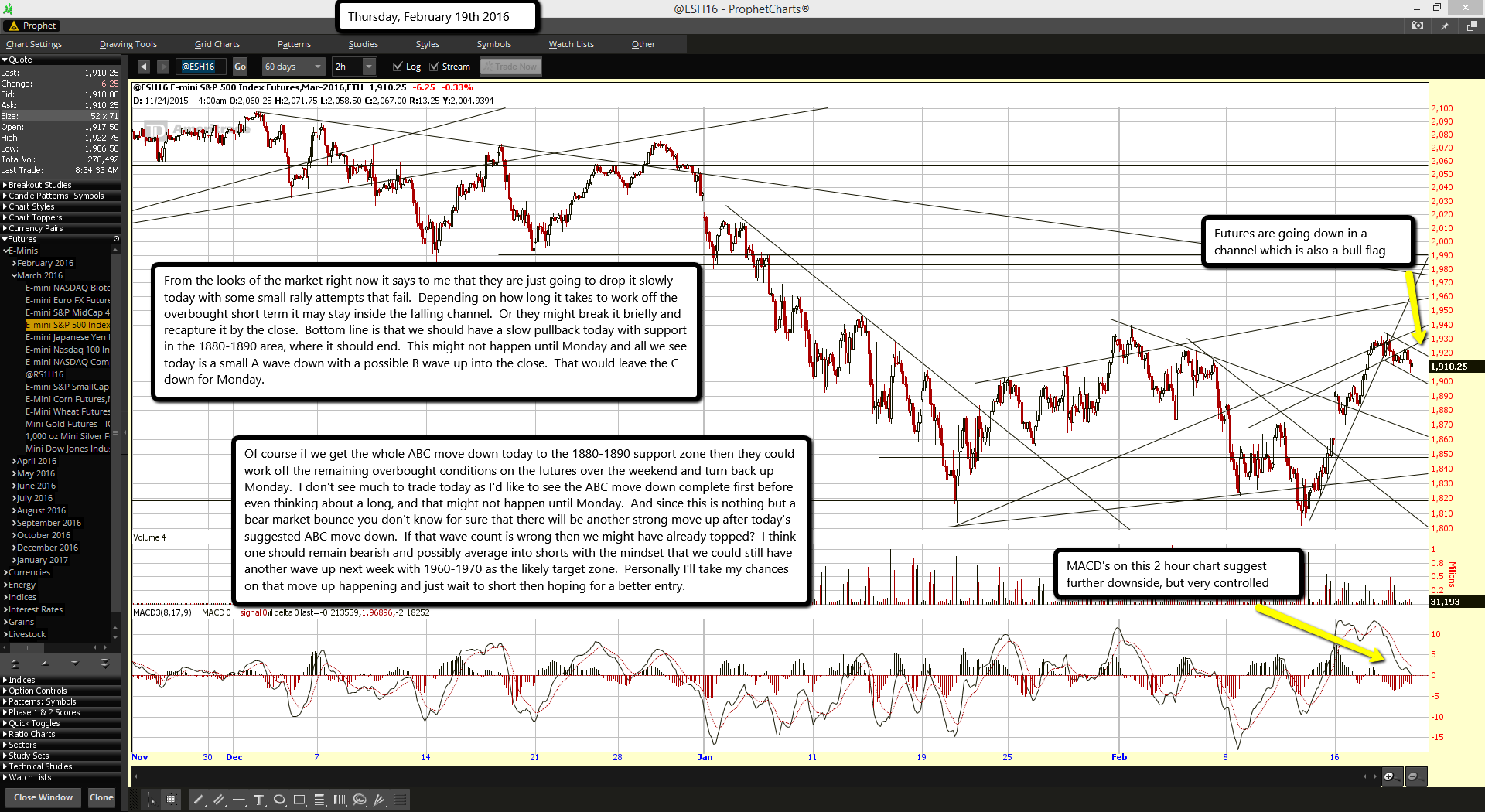
Futures are going down in a channel which is also a bull flag
MACD's on this 2 hour chart suggest further downside, but very controlled
From the looks of the market right now it says to me that they are just going to drop it slowly today with some small rally attempts that fail. Depending on how long it takes to work off the overbought short term it may stay inside the falling channel. Or they might break it briefly and recapture it by the close. Bottom line is that we should have a slow pullback today with support in the 1880-1890 area, where it should end. This might not happen until Monday and all we see today is a small A wave down with a possible B wave up into the close. That would leave the C down for Monday.
Of course if we get the whole ABC move down today to the 1880-1890 support zone then they could work off the remaining overbought conditions on the futures over the weekend and turn back up Monday. I don't see much to trade today as I'd like to see the ABC move down complete first before even thinking about a long, and that might not happen until Monday. And since this is nothing but a bear market bounce you don't know for sure that there will be another strong move up after today's suggested ABC move down. If that wave count is wrong then we might have already topped? I think one should remain bearish and possibly average into shorts with the mindset that we could still have another wave up next week with 1960-1970 as the likely target zone. Personally I'll take my chances on that move up happening and just wait to short then hoping for a better entry.

 A Delta jet takes off in view of an Alaska Airlines plane that just landed at Seattle-Tacoma International Airport in Washington state.
 Ashley Halsey reports on national and local transportation.
 The ride-hailing service is all-but dominant in the United States and popular in many other foreign markets, but it’s found Asia, especially mainland China, difficult to crack. The company faces formidable competition from Chinese-owned rival Didi Kuaidi.


 paulista / Shutterstock / paulista