Wednesday, August 26, 2026
Home Blog Page 73

Lord Rothschild: World seeing “greatest monetary policy experiment in history”

0

57b32151c46188e1668b45bcLow interest rates, negative yields on government debt and quantitative easing are part of the biggest financial experiment in world history, and the consequences are yet unknown, says RIT Capital Partners Chairman Lord Rothschild.

“The six months under review have seen central bankers continuing what is surely the greatest experiment in monetary policy in the history of the world. We are therefore in uncharted waters and it is impossible to predict the unintended consequences of very low interest rates, with some 30 percent of global government debt at negative yields, combined with quantitative easing on a massive scale,” Rothschild writes in the company's semi-annual financial report.

The banker notes this policy has led to a rapid growth of stock markets - US stocks have grown threefold since 2008 - with investments growing and volatility remaining low.

However, the real sector of economy didn’t enjoy such a profit, as “growth remains anemic, with weak demand and deflation in many parts of the developed world,” according to Rothschild.

The billionaire underlined that many risks remain for the global economy with the deteriorating geopolitical situation. Among those risks Rothschild included Britain's vote to leave the European Union, the US presidential election, and China's slowing economic growth. Another risk is global terrorism, which Rothschild says is a consequence of the continuing conflict in the Middle East.

According to a Bank of America Merrill Lynch report in June, interest rates in developed countries, in particular America’s 0.5 percent, are now at the lowest level in 5,000 years. In their battle against deflation, countries such as Sweden, Switzerland or Japan have even turned to negative key lending rates.

Another woe is negative yields on government bonds. In June, 10-year German government bonds dipped below 0 percent for the first time in history. Janus Capital has estimated that global yields are the lowest in 500 years, and the total amount of such bonds is $10 trillion. The investment group’s lead portfolio manager, Bill Gross, is calling it a“supernova that will explode one day.”

Clinton Foundation should stop accepting funds

0

e229021315cca50f510f6a70670042f4In 2014, Chelsea Clinton, left, cohosted a Clinton Foundation event called “Girls: A No Ceilings Conversation,” with her mother, Hillary Clinton.

dYoDxpkALTHOUGH THE CHARITY founded by former President Bill Clinton has done admirable work over the last 15 years, the Clinton Foundation is also clearly a liability for Hillary Clinton as she seeks the presidency. The once-and-maybe-future first family will have plenty to keep them busy next year if Hillary Clinton defeats Donald Trump in November. The foundation should remove a political — and actual — distraction and stop accepting funding. If Clinton is elected, the foundation should be shut down.

Since its founding, the foundation has supported relief in Haiti, global health, and other good causes. It also provided posts or paychecks for some members of the Clinton political team, like Cheryl Mills, Douglas Band, and Huma Abedin, and afforded the former president a platform and travel budget. Many of the foundation’s donations come from overseas, including from foreign governments with troubling human rights records.

The inherent conflict of interest was obvious when Hillary Clinton became secretary of state in 2009. She promised to maintain a separation between her official work and the foundation, but recently released emails written by staffers during her State Department tenure make clear that the supposed partition was far from impregnable. That was bad enough at State; if the Clinton Foundation continues to cash checks from foreign governments and other individuals seeking to ingratiate themselves with a President Hillary Clinton, it would be unacceptable.

Winding down the foundation, and transferring its assets to some other established charity, doesn’t have to hurt charitable efforts. If the foundation’s donors are truly motivated by altruism, and not by the lure of access to the Clintons, then surely they can find other ways to support the foundation’s goals. And in four or eight years, the Clinton family could always form a new foundation and reestablish their charitable efforts.

But as long as either of the Clintons is in public office, or actively seeking it, they should not operate a charity, too. The Clintons themselves seem to realize that. “There’ll clearly be some changes in what the Clinton Foundation does and how we do it,” Bill Clinton said in June. “We’ll just have to cross that bridge when we come to it.” Why wait? The Clintons should move now to end donations to the foundation, and make plans to shut it down in November. Even if they’ve done nothing illegal, the foundation will always look too much like a conflict of interest for comfort.

Delphi, Mobileye to offer driverless car system in 2019 – The Detroit News

0
Delphi Automotive Showcases Its Driverless Car, After Completing Cross Country Trip

Delphi Automotive PLC and Mobileye NV on Tuesday announced plans to jointly develop a fully autonomous vehicle system that the suppliers expect will be ready for production in 2019.

Each company is bringing different technologies to the table to create the driverless car system. Mobileye specializes in real-time mapping, while Delphi specializes in sensors, including cameras, LiDAR and radar, and software. The two companies say automakers will be able to buy the system and install it on a range of vehicle platforms, from small cars to SUVs and crossovers.

Delphi and Mobileye have planned a joint press conference for 9 a.m. Tuesday to discuss the plans.

“This partnership will allow us to give our customers an increased level of automated capabilities faster and more cost effective,” Kevin Clark, Delphi’s CEO, said in a statement. “The collective expertise of our two organizations will accelerate the creation of new approaches and capabilities that would likely not have been possible working alone. This is a win-win for both companies and our customers.”

Mobileye helped provide technology for Tesla’s Autopilot driver assist system, but the two companies split up earlier this year following a fatal crash involving the technology.

Delphi has been experimenting with autonomous car technology for years. Two years ago it demonstrated its autonomous vehicle system in a coast-to-coast drive across the country, and it recently announced a pilot program in Singapore that will feature driverless pods — without a steering wheel or pedals — ferrying passengers around a business park there by decade’s end.

The pair will showcase the fully autonomous vehicle system at the upcoming CES technology trade show in Las Vegas in January, Mobileye said in a release.

“Our partnership with Delphi will accelerate the time to market and enable customers to adopt Level 4/5 automation without the need for huge capital investments, thereby creating a formidable advantage for them,” Amnon Shashua, Mobileye chairman and chief technology officer, said in a statement.

The race to develop driverless cars has recently shifted into high gear.

Ford Motor Co. last week said it will have a fully driverless vehicle available for commercial purposes in 2021, and Uber last week said it will begin offering autonomous car rides in the coming weeks. The California ride-hailing service also purchased Otto, a startup working on self-driving big-rig technology.

General Motors Co. is partnering with Lyft to develop self-driving Chevrolet Bolts, and Fiat Chrysler Automobiles is providing Chrysler Pacificas to Google Inc. to outfit with autonomous technology.

Why Fed won’t hike interest rates until after the elections

0

Statements by U.S. Federal Reserve officials about the timing of next policy moves are part of the holding pattern until presidential elections on November 8. No interest rate increases are likely before then, or immediately thereafter.

The most important reason for such a turn of events is the Fed's recognition that any future monetary policy changes should be part of a medium-term (a period of one to five years) policy mix to stabilize a sharply slowing U.S. economy. The Fed knows that the halving of the economy's growth rate between the first quarter of 2015 (3.3 percent) and the second quarter of this year (1.2 percent) is one more proof that the monetary policy alone cannot carry the entire burden of the country's economic management.

The Fed has to work with the new executive and legislative authorities to stop the destruction of whatever is left of America's sluggish growth dynamics.

Foundations for better growth

Increasing investments in infrastructure, production capacities and human capital are the way forward. That has been a well-known priority during the post-crisis recovery. Unfortunately, it had to come to the grim outlook we are facing now to elevate that long-neglected task to the point of national urgency.

Here is what happened. As aggregate demand began its steady slowdown in the early months of 2015, investments – one-fifth of the economy -- followed the same pattern. But then things got much worse since the start of this year. During the second quarter, total investments declined 3.4 percent from the year earlier, and subtracted 1.68 percentage points from the GDP growth.

Investments are unlikely to rebound in the months ahead. Based on current evidence of weak aggregate demand and a strong import penetration of U.S. markets, one cannot see much need, or incentive, for increasing capital outlays over the near term.
Stock Pickers

There is a similar urgency to address structural problems affecting human capital. In addition to the officially reported 7.8 million people currently out of work, there are 8 million individuals in involuntary part-time jobs or out of the labor force. Of particular concern are the 2 million of long-term unemployed and another 2 million of virtually unemployable persons.

Getting some of these 16 million people back on the payrolls will require a major effort at sustaining labor demand and improving professional qualifications through better education and retraining. More generally, investments in human capital have to be recognized as a fundamental growth factor for the U.S. economy.

An interim conclusion here is this: A growing supply of a better qualified labor force, outfitted with best-practice technologies, is needed to increase America's stagnant productivity, and to raise the economy's potential (and noninflationary) growth rate from the dismal 1.6 percent we have at the moment.

That is the context where the monetary policy will have to play its part to support higher growth of demand, output and employment, and to maintain price stability defined as an inflation rate of 0-2 percent.

Trade policies are another area that needs immediate attention. In the first six months of this year, the U.S. trade deficit was running at an annual rate of $712 billion. That negative trade balance accounts for 4 percent of the economy, and it is currently taking half a percentage point off the growth of the domestic demand.

Trade reviews are OK

These are serious policy issues in an open economy where the external sector represents nearly one-third of GDP.

But investors should be careful here not to fall for campaign trail exaggerations of looming trade wars and their devastating blows to growth and financial markets. Blistering trade disputes are a permanent feature of the world economy. High-profile clashes and trade arbitration procedures are going on all the time. There is, therefore, nothing wrong in suggesting reviews of America's existing trade agreements and trade practices to make sure that they continue to serve the interests of our changing economy.

These reviews are also likely to lead to another look at some of America's economic and industrial policies.

For example, the media have been talking about trade studies indicating that Walmart imported in 2013 some $49 billion worth of goods produced in China. The same studies are reported to have found that Walmart's imports from China have displaced more than 400,000 jobs in U.S. manufacturing industries between 2001 and 2013.

Ross Perot must be saying "I told you so." He was another businessman copiously laughed out of court when he talked, during his presidential election campaign in 1992, about the "giant sucking sound" of American jobs going overseas. Sadly, the numbers are there to show that a demise of many manufacturing industries has caused serious structural imbalances in the American economy.

And that was not just the case of obsolete rust-belt manufacturers. Think of an icon of American industry such as IBM. The venerable Big Blue sold in 2005 its profitable personal computer business because it was deemed unviable as a long-term project. So, the legendary Thinkpads got resurrected under the Chinese Lenovo brand, and the proud new owners just reported a net profit of $173 million in the first quarter of this year, a whopping 64 percent increase from the year earlier. I wonder what the brilliant minds up in Armonk, NY think about that.

The Federal Reserve building in Washington, D.C.

The Federal Reserve building in Washington, D.C.

Investment thoughts

The guessing game about the timing of the Fed's next interest rate increase is a good betting material for day-to-day trading. But that's all it is.

The Fed has done its part in rescuing a badly damaged economy. The rescue job is finished. The growth job is not. The U.S. economy is settling around an unacceptably low 1.6 percent growth potential. And there is not much the Fed alone can do about that.

Investors ready for an act of faith on the profitability of their dollar-denominated assets will have to assess America's entire policy mix, consisting of fiscal, monetary, structural and trade policies. That's the ensemble where the Fed will have to play, with a focus on price stability and the soundness of the financial system it manages.

The stage is set, actors are jostling for positions, but the action won't start until early next spring.

In the meantime, the Fed will have more than enough liquidity on hand to support markets looking for direction. Caution is in order. But catastrophic scenarios are … well, quite unlikely.

ES Morning Update August 23rd 2016

0

b97624b0-e626-4b3e-ba3f-979d1aa8f993

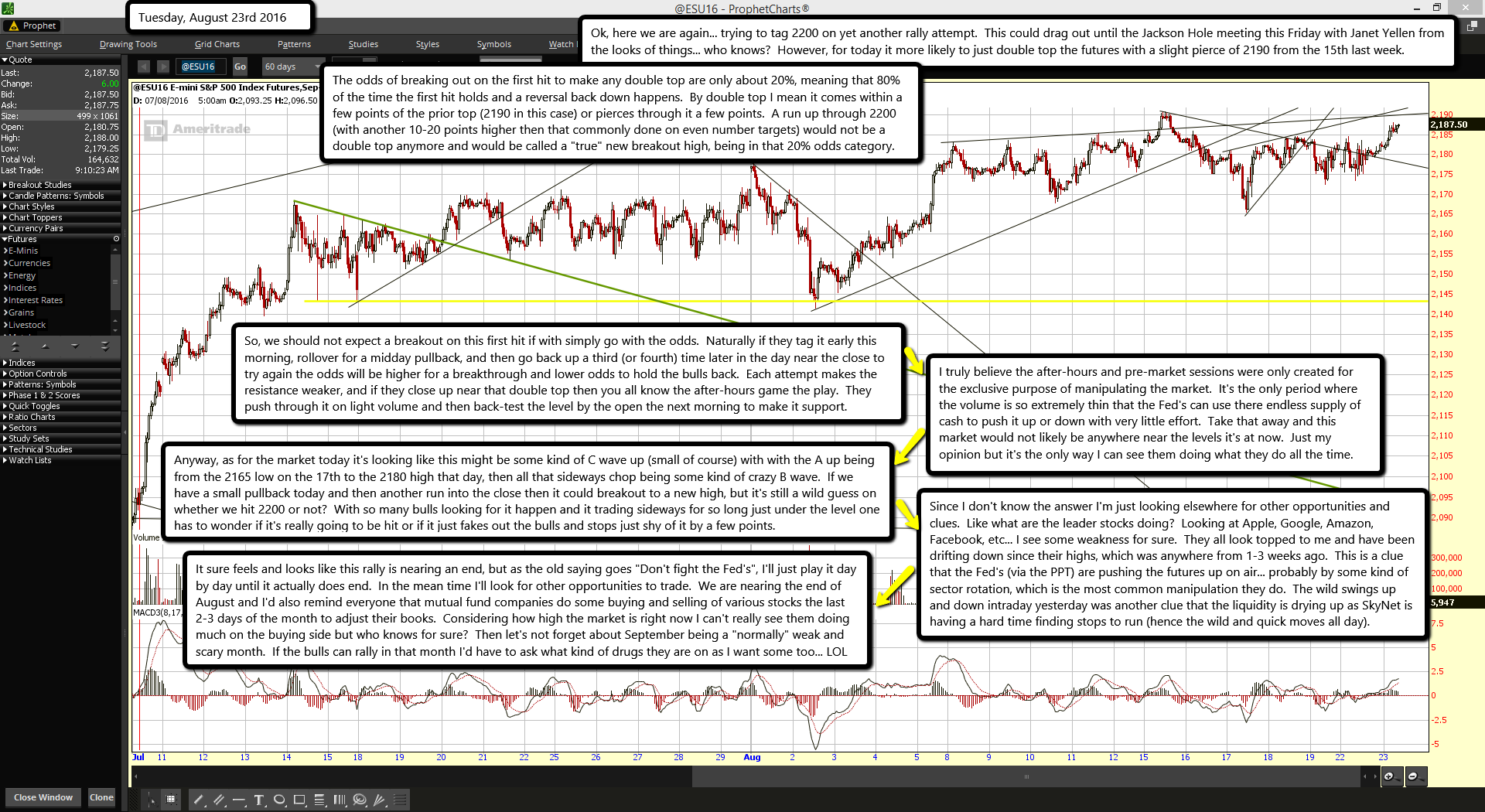
Ok, here we are again... trying to tag 2200 on yet another rally attempt.  This could drag out until the Jackson Hole meeting this Friday with Janet Yellen from the looks of things... who knows?  However, for today it more likely to just double top the futures with a slight pierce of 2190 from the 15th last week.

The odds of breaking out on the first hit to make any double top are only about 20%, meaning that 80% of the time the first hit holds and a reversal back down happens.  By double top I mean it comes within a few points of the prior top (2190 in this case) or pierces through it a few points.  A run up through 2200 (with another 10-20 points higher then that commonly done on even number targets) would not be a double top anymore and would be called a "true" new breakout high, being in that 20% odds category.

So, we should not expect a breakout on this first hit if with simply go with the odds.  Naturally if they tag it early this morning, rollover for a midday pullback, and then go back up a third (or fourth) time later in the day near the close to try again the odds will be higher for a breakthrough and lower odds to hold the bulls back.  Each attempt makes the resistance weaker, and if they close up near that double top then you all know the after-hours game the play.  They push through it on light volume and then back-test the level by the open the next morning to make it support.

I truly believe the after-hours and pre-market sessions were only created for the exclusive purpose of manipulating the market.  It's the only period where the volume is so extremely thin that the Fed's can use there endless supply of cash to push it up or down with very little effort.  Take that away and this market would not likely be anywhere near the levels it's at now.  Just my opinion but it's the only way I can see them doing what they do all the time.

Anyway, as for the market today it's looking like this might be some kind of C wave up (small of course) with with the A up being from the 2165 low on the 17th to the 2180 high that day, then all that sideways chop being some kind of crazy B wave.  If we have a small pullback today and then another run into the close then it could breakout to a new high, but it's still a wild guess on whether we hit 2200 or not?  With so many bulls looking for it happen and it trading sideways for so long just under the level one has to wonder if it's really going to be hit or if it just fakes out the bulls and stops just shy of it by a few points.

Since I don't know the answer I'm just looking elsewhere for other opportunities and clues.  Like what are the leader stocks doing?  Looking at Apple, Google, Amazon, Facebook, etc... I see some weakness for sure.  They all look topped to me and have been drifting down since their highs, which was anywhere from 1-3 weeks ago.  This is a clue that the Fed's (via the PPT) are pushing the futures up on air... probably by some kind of sector rotation, which is the most common manipulation they do.  The wild swings up and down intraday yesterday was another clue that the liquidity is drying up as SkyNet is having a hard time finding stops to run (hence the wild and quick moves all day).

It sure feels and looks like this rally is nearing an end, but as the old saying goes "Don't fight the Fed's", I'll just play it day by day until it actually does end.  In the mean time I'll look for other opportunities to trade.  We are nearing the end of August and I'd also remind everyone that mutual fund companies do some buying and selling of various stocks the last 2-3 days of the month to adjust their books.  Considering how high the market is right now I can't really see them doing much on the buying side but who knows for sure?  Then let's not forget about September being a "normally" weak and scary month.  If the bulls can rally in that month I'd have to ask what kind of drugs they are on as I want some too... LOL

Bill Gates’ net worth hits $90B, proving Thomas Piketty’s point

0

When Thomas Piketty published his 2013 book Capital in the 21st Century, he said that capitalism's primary beneficiaries aren't those who make amazing things that improve the world (as its proponents claim) -- rather, it favors those who have a lot of money to begin with.

One of Piketty's sharpest examples is a comparison of three fortunes: that of L'Oreal heiress Liliane Bettencourt (who has literally not worked a day in her life), Bill Gates the entrepreneur (when he was running Microsoft), and Bill Gates the rich guy (after he quit). Capitalism theory predicts that the greatest rewards will accrue to the second person: Entrepreneur Gates, who founded the world's most profitable company and revolutionized the world.

But the reality is that Bettencourt saw her fortune grow by just as much as Entrepreneur Gates, over the same period, despite the fact that she contributed absolutely nothing to the world's prosperity in that time. What's more, Investor Gates's fortune grew to eclipse that of Entrepreneur Gates, despite the fact that all that growth was made by moving money around, rather than making things that made the world better.

Not long after Capital in the 21st Century's English publication, Bill Gates reviewed the book, saying nice things about it but rejecting its core thesis.

Today, Investor Gates has comprehensively trounced Entrepreneur Gates in receiving reward for capital allocation instead of creation -- it's hard to ask for a neater rebuttal of Gates or affirmation of Piketty. I'm sure Gates is crying into his $90B breakfast cereal.

All large fortunes, whether inherited or entrepreneurial in origin, grow at extremely high rates, regardless of whether the owner of the fortune works or not. To be sure, one should be careful not to overestimate the precision of the conclusions one can draw from these data, which are based on a small number of observations and collected in a somewhat careless and piecemeal fashion. The fact is nevertheless interesting.

-1x-1

Take a particularly clear example at the very top of the global wealth hierarchy. Between 1990 and 2010, the fortune of Bill Gates -- the founder of Microsoft, the world leader in operating systems, and the very incarnation of entrepreneurial wealth and number one in the Forbes rankings for more than ten years -- increased from $4 billion to $50 billion. At the same time, the fortune of Liliane Bettencourt -- the heiress of L'Oréal, the world leader in cosmetics, founded by her father Eugène Schueller, who in 1907 invented a range of hair dyes that were destined to do well in a way reminiscent of César Birotteau's success with perfume a century earlier -- increased from $2 billion to $25 billion, again according to Forbes.

In other words, Liliane Bettencourt, who never worked a day in her life, saw her fortune grow exactly as fast as that of Bill Gates, the high-tech pioneer, whose wealth has incidentally continued to grow just as rapidly since he stopped working. Once a fortune is established, the capital grows according to a dynamic of its own, and it can continue to grow at a rapid pace for decades simply because of its size. Note, in particular, that once a fortune passes a certain threshold, size effects due to economies of scale in the management of the portfolio and opportunities for risk are reinforced by the fact that nearly all the income on this capital can be plowed back into investment. An individual with this level of wealth can easily live magnificently on an amount equivalent to only a few tenths of percent of his capital each year, and he can therefore reinvest nearly all of his income. This is a basic but important economic mechanism, with dramatic consequences for the long-term dynamics of accumulation and distribution of wealth. Money tends to reproduce itself.

-Thomas Piketty, Capital in the 21st Century


Congress Presses Pharmaceutical Company to Explain Surge in Cost of EpiPen

0

It’s back-to-school time — as well as campaign season — and lawmakers are becoming increasingly focused on the growing cost of pens: EpiPens, that is.

Members of Congress are expressing rising alarm about the increasing costs of the lifesaving injection device for people with severe allergies, and they are hearing from anxious parents.

Senator Charles E. Grassley, the Iowa Republican who leads the Judiciary Committee, was the latest to weigh in on Monday, sending a letter to the head of the pharmaceutical company Mylan, which produces EpiPens. Mr. Grassley demanded an explanation for the 400 percent price increase — to as much as $600 — since the company acquired the product in 2007.

“Access to epinephrine can mean the difference between life and death, especially for children,” Mr. Grassley wrote, noting that many of the children who need EpiPens are enrolled in government health care programs. “It follows that many of the children who are prescribed EpiPens are covered by Medicaid, and therefore, the taxpayers are picking up the tab for this medication.”

Senator Amy Klobuchar, Democrat of Minnesota, called earlier for a Judiciary Committee inquiry into the pricing and an investigation by the Federal Trade Commission.

“Many Americans, including my own daughter, rely on this lifesaving product to treat severe allergic reactions,” she wrote to the head of the commission.

In explaining the increase, Mylan has noted that product improvements have driven up the costs of the devices, that most EpiPens are covered by insurance and that the company also provides discounts. But company executives should prepare to answer many more questions from Capitol Hill in the weeks ahead.


ES Morning Update August 22nd 2016

0

3225dbd6-957c-4981-ab07-84ba52632416

Futures are still stuck in a sideways trading range as nothing has changed.  We've been in this range since August 5th and in another range since July 14th, which if you just include them both we've been range-bound for over 2 months now.  Everything is being done to keep the market from collapsing in front of the November elections.  Obviously this is because the elite want Hillary to win and if we tank hard before the elections odds go through the roof that Trump will win.

There's simply no trade available in the SPX that is clear.  The longer the market trades sideways the less bearish it becomes as overbought conditions are reset to become neutral or bullish.  Naturally this doesn't imply some straight up move to that old 230 SPY FP from last year (about 2300 SPX) but it does imply that it's possible that this grind sideways for awhile, then move up some, grind more, rinse and repeat pattern can extend until that FP is reached.

But, I'm certainly not bullish here.  I'm simply neutral until we get a breakout to the upside or a breakdown to the downside.  It's better to look for other opportunities in individual stocks or other ETF's then to guess on the SPX direction.  It's simply traded sideways for too long without breaking down, which severely weakens the bearish case.  Yes, it's manipulated but you can't do anything about that but go with it.  A major sign pointing to less chance of a huge drop is the main stream media still calling for a big correction as we all know that "they" are paid to mislead the sheep (that's us) in the wrong direction.  If they tell you the world is ending you know we aren't going to crash.  It's pretty clear that "they" will do everything possible to keep this market going sideways to up for as long as necessary to negate the bearishness and allow the charts to reset to get another rally started.

The bears have been trying to get this market to drop for 2 months now and failed.  So I just don't see any crash setting up for September/October.  Can we get a pullback in September?  Sure, we are very overbought and massively need one... but keep in mind that "they" want Hillary elected badly and will do everything to keep the pullback to a minimum, meaning there just won't likely be a crash in September.  A correction is possible and likely but not a crash.  However, and this is BIG "However"... if Trump wins the election I'd be very very concerned for a big drop in November.  But considering that power "they" have to rig the elections it seems unlikely that they will allow him to win... even if he does win.

For today/this week I still think we'll make another move higher to try again for that magic 2200 level.  If we could get a move up there (again, it's common to go over a little, like 10-20 points) this week I do think it will be an "exhaustion move" and allow a pullback to start there afterward.  Again, I'm not expecting a crash in September now as that's clearly been manipulated away from "The Powers That Be".  But a correction is possibly after that 2200 level is hit or gotten close to again.

Server receives $500 tip after simple act of kindness

0

A server's simple act of compassion went a long way this week.

Kasey Simmons, who works at a Dallas-area Applebee's restaurant, was waiting in a grocery store checkout line last Monday when he noticed another patron — an older woman — looking dejected.

So Simmons chatted with the woman. When she reached the register, he even paid for her groceries.

"It was only $17, but it's not about the money. It's about showing someone you care," Simmons told a local ABC affiliate.

Server receives $500 tip after simple act of kindness

But Simmons had no idea just how grateful the woman was. The next day, her daughter visited Simmons' workplace — and left a $500 tip on a $0.37 bill.

In a letter written on a restaurant napkin, the daughter explained that the day at the grocery store was a hard one for her mother: it marked the third anniversary of her husband's death.

"My mother did not need you to help her, but you made her year," the daughter wrote.

To clarify: we are not crying; you're crying.

Twitter Says It Suspended 360,000 Suspected Terrorist Accounts in a Year

0

TWITTER IS STILL actively combating terrorism on its platform, and it wants you to know so. Really and truly, the company says, it is making progress.

For Twitter, fighting terrorism on its platform is a particularly sensitive problem. While Facebook has taken a hardline stance on terrorism and removes any and all posts that carry even a trace of suspicious content, Twitter has continually attempted to strike a balance between protecting free speech and cracking down on players who use its service as a way to promote violence or threats. As a recent WIRED feature reported, Twitter is often still the “main engine” for ISIS propagandists to promote their cause and find new recruits.

The company said in a post today that it’s applying an even more aggressive strategy to eradicate violent extremism on its platform. Since the company announced its first efforts to combat terrorism back in February, it says it has suspended an additional 235,000 accounts, bringing the total number of suspensions in violation of its terrorism policy to 360,000 in about a year. According to the company, it is also suspending accounts faster—daily, suspensions are up over 80 percent since last year, which helps to stop dangerous accounts from gaining significant followings. And Twitter is continuing its investment in proprietary spam-fighting tools to identify suspicious accounts, and broadening its partnerships with organizations working to counter violent extremism, including law enforcement agencies around the world.

The response from Twitter comes at a time when it may be feeling particularly defensive. Twitter, after all, is at a crucial point in its life as a company: its business is ailing, and in recent months it has come under fire for what many perceive to be a slow reaction to abuse and harrassment, prompting many high-profile users to leave the platform. Not to mention, as the election cycle continues on, politicians have been putting pressure on the company—and others in Silicon Valley—to acknowledge that social media can indeed be a crucial tool for terrorist groups in the recruitment and radicalization of sympathizers. Twitter needs to show that it not only knows terrorism and abuse is an issue on its platform. It needs to prove it’s doing something about it. This announcement today attempts to address the terrorism problem, but the question of how it will curb abuse on the platform in general remains open.

Brexit Armageddon was a terrifying vision but it simply hasn’t happened

0

Brexit Armageddon was a terrifying vision  but it simply hasn't happened

Unemployment would rocket. Tumbleweed would billow through deserted high streets. Share prices would crash. The government would struggle to find buyers for UK bonds. Financial markets would be in meltdown. Britain would be plunged instantly into another deep recession.

Remember all that? It was hard to avoid the doom and gloom, not just in the weeks leading up to the referendum, but in those immediately after it. Many of those who voted remain comforted themselves with the certain knowledge that those who had voted for Brexit would suffer a bad case of buyer’s remorse.

It hasn’t worked out that way. The 1.4% jump in retail sales in July showed that consumers have not stopped spending, and seem to be more influenced by the weather than they are by fear of the consequences of what happened on 23 June. Retailers are licking their lips in anticipation of an Olympics feelgood factor.

The financial markets are serene. Share prices are close to a record high, and fears that companies would find it difficult and expensive to borrow have proved wide of the mark. Far from dumping UK government gilts, pension funds and insurance companies have been keen to hold on to them.

City economists had predicted an immediate rise in the claimant count measure of unemployment in July. That hasn’t happened either. This week’s figures show that instead of a 9,000 rise, there was an 8,600 drop.

Some caveats are in order. It is still early days. Hard data is scant. Survey evidence is still consistent with a slowdown in the economy in the second half of 2016. Brexit may be a slow burn, with the impact only becoming apparent in the months and years to come.

But it is obvious that the sky has not fallen in as a result of the referendum, and those who said it would look a bit silly. By now, Britain was supposed to be reeling from the emergency budget George Osborne said would be necessary to fill a £30bn black hole in the public finances caused by a plunging economy. The emergency budget is history, as is Osborne.

In a way, Project Fear did work. It put the wind up businesses, making them warier about investing in new kit. And at least some of the people who voted remain did so because they were worried about the economic consequences of leaving. That was hardly surprising, given the regular and lurid warnings – from the Treasury, the Bank of England, the International Monetary Fund and the Organisation for Economic Cooperation and Development – about the dire consequences that would inevitably flow from Brexit.

The British state did an abrupt U-turn on 24 June. Having failed to secure a yes vote, the official position had to change fast. The imperative was to get all those people who had been frightened witless to chill out. Some surveys since the Brexit vote did indeed pick up an abrupt drop in consumer confidence. The government feared a recession of its own making.

So instead of telling the public how hard life was going to be outside the EU, ministers and officials sought to reassure, to administer large doses of soothing balm, to insist that the UK could cope just fine on its own.

The economy would certainly have had a tough time had the Treasury and the Bank of England done nothing in the wake of the referendum, but that was never going to happen. There was no passive acceptance of the result: it was an all-action approach. Before his defenestration by Theresa May, Osborne ditched his plan to run a budget surplus by the end of the parliament, while his successor Philip Hammond has said he might “reset” fiscal policy in the autumn statement. There will now be a more measured – and sensible – approach to reducing the budget deficit.

Meanwhile, Bank of England governor Mark Carney has been sweet-talking the City, making it clear that the banks could have access to unlimited quantities of cheap cash. Interest rates, which stood at 0.5% for more than seven years, have been cut to 0.25%, with a strong hint they will be cut again during the autumn.

Project Everything’s OK has worked well so far. Again, this is understandable. There were millions who thought Project Fear was well over the top, which it was, or didn’t think life could become much tougher. The remain camp was ill-advised to rely so heavily on its warnings of economic Armageddon, when only two regions of the country – London and the south-east – had seen GDP per head rise above the level before the 2008-9 recession. After weighing up the pros and cons, plenty of voters didn’t think they were risking all that much.

As far as it is possible to tell, there was a collective sharp intake of breath in the aftermath of the vote, but then consumers carried on regardless. The latest monthly health-check of household sentiment found a sharp drop in optimism in July followed by a rapid recovery in August. John Lewis and Next – two bellwethers of activity in the high street – say trading has not been affected by Brexit.

This doesn’t mean everything is fine. Britain has deep structural economic problems that would have to be addressed inside or outside the EU. Investment has been weak, productivity has flatlined since the recession, earnings growth is running at half its 4-5% pre-financial crisis level and, except in times of war, the balance of payments deficit has never been higher.

Brexit has forced the government to take a long, hard look at the British economy

Brexit could make some of these challenges more acute. Investment is likely to remain subdued, while the fall in value of the pound since the referendum will push up inflation by making imports more expensive. That will put the squeeze on consumer spending power.

But in other respects, Brexit has been a help. It has forced the government to take a long, hard look at the British economy – something that would not have happened without the shock administered by the referendum. It’s brought home the fact that most of Britain feels disconnected from the economic story peddled by successive governments.

For decades, there’s been a tendency for businesses to meet rising demand by employing cheap labour rather than by investing in modern equipment. Large chunks of the economy are characterised by low skills, low wages, and low productivity. As the Resolution Foundation noted this week, companies that rely on the ability to import low-cost employees from the EU are going to have to rethink their business models. This is not necessarily a bad thing.

The government has responded to Brexit by soft-pedalling on austerity, by contemplating spending more on infrastructure and by committing itself to an industrial strategy. A degree of scepticism is warranted here. The referendum has made change possible: it doesn’t guarantee it will happen. It remains to be seen how many new roads and railways get built, or whether the industrial strategy amounts to anything more than a new name for Whitehall’s business department.

When I voted for Brexit on 23 June, I did so for three reasons: because the European Union is a failed project; because Europe is moving in an increasingly free-market direction; and because I wanted to shake up the status quo. It would take an extremely deep and prolonged recession to make me regret my choice. That prospect seems even more remote than it did eight weeks ago.

Obamacare Is a Money-Loser for Insurers, Who Are Giving Up

0

With almost $2 billion in losses this year, big insurance companies are pulling out of the health-care program.

Last November, when UnitedHealth Group said it expected to post big losses on its Obamacare policies in 2016, rivals such as Anthem and Aetna signaled their Affordable Care Act businesses were doing fine. The Obama administration used that as evidence to refute claims that systemic problems were brewing in its landmark insurance program.

Now, there’s no denying it. The four biggest U.S. health insurers admit they’re each losing hundreds of millions of dollars on their Obamacare plans. Rather than expand coverage, many are pulling out of the exchanges that were set up by the ACA so people can shop for insurance plans, often with the help of government subsidies.

UnitedHealth expects to lose $850 million on Obamacare in 2016, while Aetna, Anthem, and Humana are all on track to lose at least $300 million each on their ACA plans this year, according to company reports and estimates from Bloomberg Intelligence. UnitedHealth says it’s quitting 31 of the 34 states where it sells ACA policies. Humana is exiting 8 of 19 states and reducing its presence to just 156 counties, from 1,351 a year ago. Anthem hasn’t announced plans to change its participation in the program.

On Aug. 15, Aetna said it will stop selling Obamacare plans in 11 of the 15 states where it had participated in the program, reversing its plan to expand into five new state exchanges in 2017. “The exchanges are a mess as they exist today,” says Aetna Chief Executive Officer Mark Bertolini. “They’re losing a lot of money for a lot of people.”

Since its passage in 2010, Obamacare has brought insurance to some 20 million people who previously lacked it, pushing the uninsured rate in the U.S. to a record low. Yet as the law approaches its fourth full year of providing coverage, it’s beginning to show its limitations, particularly when it comes to fostering competition and lowering prices.

When the exchanges open for business on Nov. 1, many consumers will face fewer options and higher prices. On average, insurers are looking to raise premiums by about 24 percent in 2017, estimates Charles Gaba of ACASignups.net, a website that tracks the health-care law. As many as a quarter of all U.S. counties, mainly in rural areas, are at risk of having just a single insurer for next year, according to Cynthia Cox, who tracks the markets for the Kaiser Family Foundation. With Aetna’s exit, one county in Arizona currently has no insurer offering coverage through the ACA for next year.

After surviving numerous legal challenges and attacks by Republicans in Congress, plus a botched rollout in 2013, Obamacare now faces what is perhaps its most serious threat: The program is a clear money loser for the nation’s biggest insurance companies. While Obamacare can compel individuals to buy insurance—a mandate upheld by the U.S. Supreme Court in 2012—the law has no authority to force insurance companies to offer plans through its exchanges.

Obamacare advocates had hoped that big government subsidies to consumers would persuade healthy people to sign up for the ACA plans. But the policies have largely been taken out by older, less healthy people who are more expensive to insure. “What we are left with … is a highly subsidized program for relatively low-income people,” says Dan Mendelson, the CEO of consulting firm Avalere Health. “We’re not getting to the broader vision of a robust private market structure that enables a broad swath of Americans to purchase their insurance.”

President Obama recently revived the idea of introducing a public plan to compete with private insurers, something that was debated and ultimately left out of the final version of the law. He’s also said increased government subsidies could help draw more people into the ACA’s markets. Another option is to simply give insurance companies more government money, but that would require action from a Republican Congress that would rather repeal Obamacare than fix it. “There’s going to be absolutely zero interest among Republicans in bailing out Obamacare by giving it more money,” says Avik Roy, a health-care expert who’s advised Republican presidential candidates Mitt Romney, Rick Perry, and Marco Rubio on health policy.

Insurance companies were hoping that a wave of mergers would help them cope with ACA-related red ink. In July 2015, Aetna struck a deal to buy Humana and Anthem agreed to buy Cigna. But the U.S. Department of Justice sued to block both transactions, saying they’d harm competition. “The synergies from the two mergers would have subsidized a lot of losses,” says Ana Gupte, an analyst at Leerink Partners. “That could have helped them manage some of the pressure they’re seeing on the exchanges.” The big insurance companies are still poised to reap fat profits this year. Analysts estimate that Aetna is on pace to make $2.5 billion in 2016 and UnitedHealth will earn some $7 billion.

Not everyone’s losing money on Obamacare. Centene and Molina Healthcare have been able to turn a profit on the exchanges by offering Medicaid-like health plans. These plans tend to have narrower networks, at lower premiums, than those available from employers.
There are lots of ways to make the ACA’s individual market work better for more insurers. The tough part is figuring out which could surmount political hurdles. Kevin Counihan, who oversees the health insurance markets for the federal government, has raised the idea of creating a special fund to help insurers cover particularly costly patients, perhaps ones who rack up more than $2 million in medical bills in a year. In a blog post, he suggested states could take steps to help insurers by shouldering some of the costs of particularly sick people.

Some insurers want to widen the difference between what they charge their oldest and youngest customers. Under the ACA, premiums for the oldest are typically limited to three times those for the youngest. Widening that ratio would theoretically help draw in more young, healthy people by lowering their premiums, but it would also raise costs for older people. Regulators are also working to improve a program known as risk adjustment, which is supposed to transfer funds from insurers with healthier customers to those with sick ones.
The fate of the exchanges rides, in part, on the November election. While Donald Trump has said he’ll repeal Obamacare, he hasn’t said exactly what would replace it. Hillary Clinton has backed the creation of a public insurance plan, as well as offering people 55 and older the option of buying Medicare coverage.

Joel Ario, a managing director at Manatt Health who worked on the exchanges at the U.S. Department of Health & Human Services, says enrollment is probably high enough to prevent a failure. Still, he says, more can be done. “I think you will see corrective action taken, assuming a Clinton administration,” he says. “We need to do some regulatory tweaking here, maybe more than tweaking.”

The bottom line: Obamacare has no authority to force insurance companies to offer plans; faced with mounting losses, they’re pulling out.

Global central banks dump U.S. debt at record pace

0

Global central banks are unloading America's debt.

In the first six months of this year, foreign central banks sold a net $192 billion of U.S. Treasury bonds, more than double the pace in the same period last year, when they sold $83 billion.

China, Japan, France, Brazil and Colombia led the pack of countries dumping U.S. debt.
Powered by SmartAsset.com.  It's the largest selloff of U.S. debt since at least 1978, according to Treasury Department data.

160516173150-us-debt-dump-780x439

"Net selling of U.S. notes and bonds year to date thru June is historic," says Peter Boockvar, chief market analyst at the Lindsey Group, an investing firm in Virginia.

U.S. Treasurys are considered one of the safest assets in the world. A lot of countries keep their cash holdings in U.S. government bonds.
Many countries have been selling their holdings of U.S. Treasuries so they can get cash to help prop up their currencies if they're losing value.

The selloff is a sign of pockets of weakness in the global economy. Low oil prices, China's economic slowdown and currencies losing value are all weighing down global growth, which the IMF described as "fragile" earlier in the year.

Despite all the selling by these countries, private demand for the bonds has sky rocketed. Demand is so high that the U.S. can afford to pay historically low interest rates. The 10-year U.S. Treasury hit a record low of 1.34% earlier this year, before bouncing back to about 1.58%, currently.

ES Morning Update August 19th 2016

0

96123353-3bf2-49c7-a1fb-a3d5df9d8f13

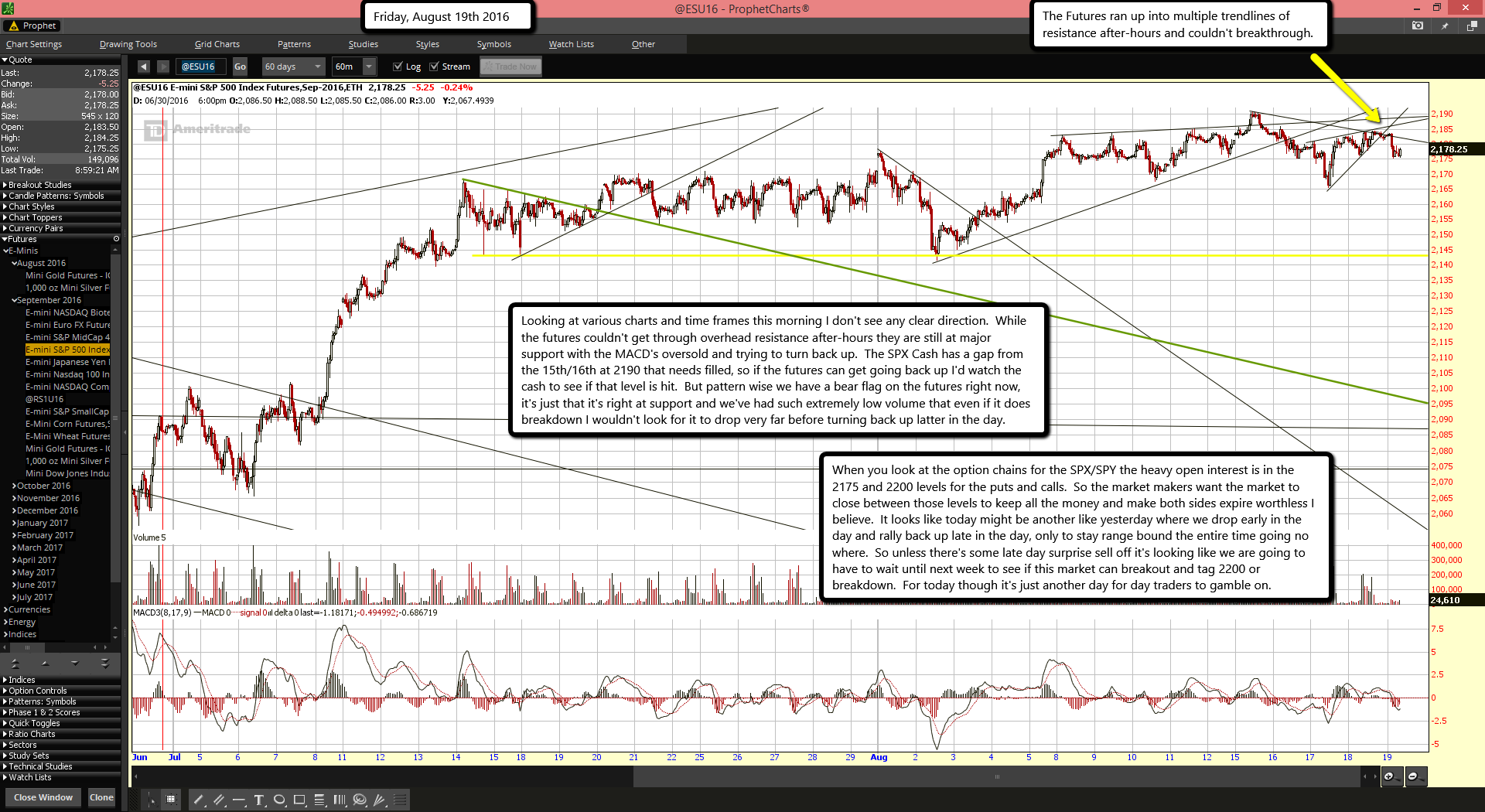
The Futures ran up into multiple trendlines of resistance after-hours and couldn't breakthrough.

Looking at various charts and time frames this morning I don't see any clear direction.  While the futures couldn't get through overhead resistance after-hours they are still at major support with the MACD's oversold and trying to turn back up.  The SPX Cash has a gap from the 15th/16th at 2190 that needs filled, so if the futures can get going back up I'd watch the cash to see if that level is hit.  But pattern wise we have a bear flag on the futures right now, it's just that it's right at support and we've had such extremely low volume that even if it does breakdown I wouldn't look for it to drop very far before turning back up latter in the day.

When you look at the option chains for the SPX/SPY the heavy open interest is in the 2175 and 2200 levels for the puts and calls.  So the market makers want the market to close between those levels to keep all the money and make both sides expire worthless I believe.  It looks like today might be another like yesterday where we drop early in the day and rally back up late in the day, only to stay range bound the entire time going no where.  So unless there's some late day surprise sell off it's looking like we are going to have to wait until next week to see if this market can breakout and tag 2200 or breakdown.  For today though it's just another day for day traders to gamble on.

Hillary Would Give Us a Disastrous Third Obama Term

0

Hillary Would Give Us a Disastrous Third Obama Term

When it comes to unity, the Democrats talk a good game — but in the end they promote disunity because their electability depends on dividing society into groups and inciting anger, resentment and distrust.

I don’t need to cite examples of Democrats’ blaming Republicans for divisiveness and falsely extolling their own aspirations of unity. They are everywhere. It’s what they do, from their talk of our “common humanity,” to their glorification of all kinds of diversity, except diversity of thought, to their proclaimed monopoly on tolerance.

It’s ironic that Democrats get away with this lie. It is Republicans, or at least the conservatives among them, who preach that a rising tide lifts all boats — that economic growth across the board will help the most people.

Democrats simply can’t be honest about economic policy. They have to demonize the wealthy to incite class warfare. They must perpetuate and expand government dependency programs, which means creating incentives for people to remain out of the work force. They must vilify the rich for not paying their fair share of taxes, despite the undeniable fact that upper-income earners pay far more taxes — actual and percentage — and that the lower half of income earners pay no income taxes at all. How much “fairer” can it be for them?

I am old enough to remember then-Senator Barack Obama’s 2008 campaign promise to bring all people together in a spirit of harmony and healing. I also remember him doing just the opposite once elected.

And I remember Obama’s 2012 gamble of appealing directly to minorities and alienating other groups, apparently on the theory that disaffected groups outnumber the sum of all others — or at least that agitating them would increase their turnout and ensure his victory. If a Republican candidate had dared such overt divisiveness, the mainstream media would have tarred and feathered him.

The Democrats are having a field day attacking Trump, and he’s giving them way too much ammunition. But no matter whom Republicans put up, Democrats will viciously disparage them. To them, almost all Republican candidates and officeholders are mean-spirited bigots.

If only Republicans could successfully communicate their case that perpetual malaise, which is the only thing Democrats offer anymore, is unnecessary and correctable. If only they could demonstrate that the Democrats’ socialistic and regulatory policies thwart prosperity for all groups of people — except, ironically, the very wealthy.

But we haven’t made our case, or it’s falling on deaf ears, because Democrats are paying people, in effect, to remain on their plantations. They are encouraging them not to be productive members of society. They are deliberately undermining the nuclear family. They are fomenting envy and disharmony. It’s tragic.

Look at Hillary Clinton’s ballyhooed economic plan. What an utter package of deceit! She tells us she’s going to create more than 10 million new jobs — by continuing the same miserably failed policies of Barack Obama. Obama and Clinton claim they saved the economy from collapse after the 2008 financial crisis, which their policies caused. But eight years later we’ve yet to see appreciable economic growth from this team. For them, 1 percent growth is the new 5 percent. Obamanomics has given us the worst recovery since World War II. Indeed, it is an insult to the term “recovery” to designate this mess as such.

No matter what he says now, President Obama promised his obscene $800 billion “stimulus” package would actually stimulate, and it did the opposite.

But Clinton would continue the ruse, expecting us to believe four more years of this insanity will produce different results. Her five-part plan is more of the same nonsense: 1) Investing in infrastructure. (Deja vu, anyone?) 2) Make college available for all. (But how will graduates get jobs in their recessionary economy?) 3) Make companies share more profits with their employees. (And these people claim they’re not socialists). 4) Make corporations, the wealthy and Wall Street pay their fair share. (I’ve covered this.) 5) Create policies that “support 21st-century families” — equal pay, paid leave, reduced child care costs.

Seriously, which of these strategies could conceivably unleash sustained economic growth? Other than the infrastructure spending (which also won’t create long-term growth), these ideas have nothing to do with expanding the economic pie, but only with redistribution. Not only is Clinton’s five-point plan destined for failure, she will expand the regulatory state, which is smothering small businesses.

If Democrats ever believed in economic growth, they’ve long since abandoned it, going with the myth that we have a finite pie and that they, as Big Sister, must control how it’s allocated, the free market be damned.

I repeat: The Democrats’ viability requires keeping us at each other’s throats. They must divide us. Consider Clinton’s recent shunning of police unions. She is so desperate to retain 90 percent of the African-American vote that she told the 335,000-member National Fraternal Order of Police she won’t seek their endorsement.

The chilling truth is that Hillary Clinton would give us a third Obama term, and I don’t know how we can come back from it.

How Hyperloop One Went Off the Rails

0

The transportation startup is trying to make a pod levitate in a tunnel, but can it rise above founder clashes and employee lawsuits?

800x-1

Hyperloop tubes are displayed during the first test of the propulsion system at the Hyperloop One Test and Safety site on May 11, in Las Vegas.

In December 2014, an engineer with the unlikely name Brogan BamBrogan was in the driveway of his clapboard Los Angeles house, loading up his car for a holiday road trip to Northern California, when venture capitalist Shervin Pishevar messaged him for a favor.

The two were founders of Hyperloop One, a startup building futuristic tubes to zip people from city to city. Shervin Pishevar, a partner at Sherpa Capital, was the money guy; BamBrogan the chief technical officer. Pishevar's brother, Afshin Pishevar, was driving west from Washington to join the company as general counsel, and needed a place to stay. BamBrogan and his wife stopped packing, cleaned the bathroom, and tucked a spare key under the front mat of his Los Feliz home. When they returned a few days later, Afshin Pishevar was still there. Their houseplants were littered with cigarette butts.

Twenty months later, neither BamBrogan nor Afshin Pishevar work at Hyperloop One, and in June, BamBrogan and three other former employees filed a lawsuit against the Pishevar brothers and the company, also naming Chief Executive Officer Robert Lloyd and investor Joseph Lonsdale in the suit. It alleges the men didnt have the companys interests at heart, and also makes claims of assault and defamation. In its countersuit against BamBrogan and the other ex-employees, Hyperloop One said the insurgent employees were trying to start a competing firm. One dispute surrounds a long, looped rope BamBrogan discovered on his office chair one morning, in the shape of a noose or a lasso, depending on your perspective. There is no mystery over who left it there: his former houseguest, Afshin Pishevar.

Startups, including success stories Facebook and Twitter, often suffer founder clashes, executive churn, and squabbles over equity. But at Hyperloop One, a high-profile company spawned from an idea by Tesla founder and CEO Elon Musk, things got very toxic, very fast. The dueling lawsuits and lurid accusations threaten to sully the company's idealistic mission to create a new form of transportation.

A lawyer representing Hyperloop One, Orin Snyder, a partner at Gibson Dunn, said: "We are confident that at the end of the day it will be obvious that their entire lawsuit was a crass publicity stunt based on lies and smears intended to cover up a failed coup and illegal plot to steal intellectual property and create a competing hyperloop company." BamBrogan and his co-plaintiffs deny they were attempting a coup. Through his lawyer David Willingham, Afshin Pishevar denied leaving the cigarette butts in BamBrogan's home.

The company, now run by Lloyd, former Cisco president, is moving forward with plans to make a viable transportation mode out of large pods zooming through tubes. Early next year, Lloyd said, they'll have their "Kitty Hawk moment," aiming to levitate a pod inside a tunnel. The test is crucial for persuading investors to sink more money into Hyperloop, whose projects will likely each cost billions of dollars.

These are big steps for a company thats only 20 months old, he said. Although the events of the past few weeks are not something I would have hoped for, Lloyd believes they will ultimately make the company stronger. We all come together more closely when somebody surprises us, or we feel attacked, he said.

-1x-1

Photos from BamBrogan's lawsuit: BamBrogan, finding the rope on his chair, and security footage of Afshin Pishevar walking through the office with a rope.

In his proposal in 2013, Elon Musk dubbed the hyperloop "a cross between a Concorde and a railgun and an air hockey table, and dared engineers everywhere to build it.

The Hyperloop idea resembles magnetic-levitation trains: magnets levitate driverless circular carriages, a few centimeters above a track, propelled along by an electric motor. Operating inside a low-pressure tube, the theory goes, the Hyperloop would encounter so little resistance that the carriages could whisk along at airplane speeds. If the technology works, commercial Hyperloop routes could open in a few years.

Shervin Pishevar, a well-connected entrepreneur turned venture capitalist, made his name through an early investment in Uber, after having moved to the U.S. from Iran as a child in the late 1970s. He likes to name drop his famous friends, and once flew to Cuba with Musk and actor Sean Penn to try, unsuccessfully, to negotiate for a U.S. political prisoners release.

Inspired by Musk's vision, Shervin Pishevar searched for a technology prodigy to execute it, settling on BamBrogan, a wiry, handlebar-mustachioed former SpaceX engineer. Until 2014, his name had been Kevin Brogan, but he legally changed it to merge names with his wife, Bambi. At Musk's SpaceX, BamBrogan was employee #23, and a polarizing figure. Known back then as K-Bro, he was the cool kid among the brainy engineers. BamBrogan would organize parties and other diversions for the over-worked 20-somethings. He had plenty of enemies there, though, particularly those who did not feel like part of the BamBrogan clique.

Shervin Pishevar offered him six percent of the company and started raising funds, bringing in Lonsdale, co-founder of the data-analysis behemoth Palantir Technologies. BamBrogan began drawing up designs.

BamBrogan instilled a hard-charging, fast-moving culture at Hyperloop One. He angered quickly, but commanded considerable loyalty. Many employees kept fake million-dollar bills with his image on them taped to their desks. A few months after the company had moved into a former factory in Los Angeles, BamBrogan announced another expansion by bursting through a wall wearing a Kool-Aid suit.

Shervin Pishevars brother Afshin worked as a lawyer near Washington for years, with one of his cases landing on Washingtonian Magazines 2014 list of top personal-injury verdicts. That year, tragedy struck when his son died in a flying accident, according to the countersuit. Hyperloop offered a fresh start.

Afshin Pishevar eventually found his own apartment, but he and BamBrogan started butting heads. BamBrogan chafed when he thought Afshin Pishevar was slow with paperwork, according to a person familiar with the situation. Through his lawyer Willingham, Afshin Pishevar said startups sometimes act hastily, entering into agreements against their best interests, and it is the chief legal officers role to make sure actions are within the letter of the law.

Hyperloop One could sometimes feel like college. Workers stayed late, batting around ideas, playing board games, and eating leftovers from the day's catered lunchtacos, curries, burgers. But tight deadlines and regular changes of plan also created stress and led to tiffs, according to former employees. Hyperloop employees often had to tidy up for VIPs arriving for tours. Hosting celebrities like Katy Perry has its perks, but the visits and parties started to wear thin on some. A spokesman for the company, Farrell Sklerov, denied that the events were frequent.

NORTH LAS VEGAS, NV - MAY 11:  (L-R) Hyperloop One Co-Founder & Executive Chairman Shervin Pishevar, Hyperloop One Chief Executive Officer Rob Lloyd and Co-Founder & Chief Technology Officer Brogan BamBrogan speak during the first test of the propulsion system at the Hyperloop One Test and Safety site on May 11, 2016 in North Las Vegas, Nevada. The company plans to create a fully operational hyperloop system by 2020.  (Photo by David Becker/Getty Images,)
Shervin Pishevar, Lloyd, and BamBrogan at the first test of the propulsion system in May.

BamBrogan was for a time the interim CEO of Hyperloop One, but a reluctant corporate leader.

Last summer, the board hired Lloyd, who started in September. The staff had just received raises, and spirits ran high. To celebrate, everyone whacked at a piata that spilled out fake bank notes emblazoned with images of Lloyd and other executives.

Meanwhile, Afshin Pishevar was the subject of several complaints alleging unprofessional outbursts, according to the July lawsuit filed by BamBrogan and other former Hyperloop employees. In one instance, learning of an internal meeting that didn't include him, Afshin Pishevar joined the gathering and in a raised voice demanded to know why he wasn't invited, where one of the participants went to college, and when he had graduated, according to a person present at the meeting. BamBrogan and others hoped Lloyd would rein in Afshin Pishevar. Lloyd declined to discuss Afshin Pishevar's tenure. Through Willingham, Afshin Pishevar denied behaving unprofessionally.

At first, Lloyd promised overhauls, and some hoped that meant the departure of Afshin Pishevar, people familiar with the situation said. Sklerov denied Lloyd ever said he would fire Afshin Pishevar.  

In an interview, Lloyd was reluctant to rehash the past, but made plain he preferred spending time on areas where his big-company background makes a difference, such as negotiating partnerships and hiring top-notch staff. You focus on the things you can control, Lloyd said, speaking generally.

Lloyd oversaw a major funding push, raising an additional $80 million this year, bringing total capital raised to over $100 million. But to some, the fundraising exacerbated another grievance: employee equity. BamBrogan had received additional shares as the company arranged the $80 million fundraising round, according to Hyperloop Ones counterlawsuit, but most employees had not. Some wanted more.

Meanwhile, Lloyd had his own frustrations with BamBrogan, meeting with him on at least five occasions to discuss negative and disruptive behavior," according to the countersuit. BamBrogan said the meetings were to discuss Lloyds performance, not his.

In one instance, BamBrogan smashed a beer bottle when angered, according to the countersuit; BamBrogan acknowledged smashing the bottle outside.

By late spring, BamBrogan believed the time had come to hold a frank discussion with Shervin Pishevar to press him again on the employee equity and other issues. He was able to corner Shervin Pishevar at the test site in the Nevada desert where the company was gearing up to show off its propulsion system. The two exchanged "tough words" about equity, the tours, and other concerns, BamBrogan said, but they agreed to work things out.

The propulsion system test in mid-May was successful: They managed to accelerate a sled on a track to 116 miles per hour in just over a second. Reporters gathered around BamBrogan, Lloyd and Shervin Pishevar embracing. But things were still tense. And back in Los Angeles, little seemed to change.

By late May, a group of top employees decided to take action. They convened in Ripley, a conference room named after the monster-battling character in the movie Alien." They drew up demands, including engineering representation on the board in the form of BamBrogan and engineering president Josh Giegel, more equity for staff, and an end to Shervin Pishevars tenure as executive chairman, according to the litigation. The group hoped that Lloyd, just back from a China business trip, would sign the letter, too. They called him, but he declined.

The company has its own take. In its countersuit, Hyperloop One said BamBrogan, former vice president of business development Knut Sauer, former assistant general counsel David Pendergast, and former finance vice president William Mulholland were seeking to take over the company or start a rival company, even purchasing the domain name Hyperlooptoo.com. The plaintiffs issued a statement labeling the countersuit complete fiction, but added that once their attempted intervention antagonized board members, it wasnt surprising they considered looking for other work.

Lloyd wasn't caught off guard by the letter's demands, but something else gnawed at him. I was surprised by the tone, and the aggression, he said. And suggested there were better ways to work things out.

Board member Justin Fishner-Wolfson was deputized to patch things up.

On May 31, he met for seven hours with the disgruntled employees, having worked over Memorial Day weekend with other board members on a response that incorporated many of the employees demands, including changing equity provisions, according to the countersuit.

The group kept coming to work. On the morning of June 15th, employees who signed the letter were gathering once again in Ripley, preparing to meet with Fishner-Wolfson and Lloyd. BamBrogan entered, wheeling his desk chair. On it rested a rope, looped at the end. To BamBrogan, it was a noose and a threat. The company insists it was a lasso, saying in its countersuit that Afshin Pishevar intended it for someone acting like a cowboy. Through Willingham, Afshin Pishevar said designating the rope a noose amounts to an ill-fated attempt to bolster a meritless lawsuit.

Gathered around the reception desk reviewing security video footage, several staff members watched a grainy image of Afshin Pishevar walking toward BamBrogans desk late the night before, rope in hand. He was angry that BamBrogan had notified Russian investors of the groups grievances shortly before Shervin Pishevar was due to meet with them, according the countersuit.

The countersuit cited a text Shervin Pishevar had sent his brother on the night of the incident: One comment and guidance. Act completely calm and dont show any emotion. Dont say anything negative or provide any ammunition for them to use against us, our family, or our company. Thanks. Willingham declined to comment on the text.

Afshin Pishevar admitted leaving the rope, according to the countersuit. Another person familiar with the situation characterized the rope as a "prank." Prank or threat, within the hour, he was fired and escorted out of the building. The police arrived. Lawyers convened.

By days end, Pendergast was also fired. The next day, BamBrogan, Sauer and Mulholland resigned, and weeks later, they and Pendergast filed their lawsuit alleging breach of fiduciary duty and other claims. Within days, the company responded with its countersuit, also alleging claims including breach of fiduciary duty.

Today, engineering head Giegel holds a board seat and the equity plan for staff has improved. Giegel and six other signatories of the May letter still work at the company. During a recent visit, engineers tinkered with designs on their computers, some hunched over pages of handwritten calculus. In large sheds out back, technicians were cutting through sheets of metal. Hyperloop employs 170 people, set to rise to as many as 250 by years end, Lloyd said.

Lloyd is moving full bore on projects he had been developing long before the employee rebellion, including landing a new chief financial officer. He said he has doubled down on negotiations to enlist new partners, in addition to existing ones such as French railway SNCF and engineering giant Arup. We are the team thats got the capital, thats got the capabilities, he said.

Afshin Pishevar, still in Los Angeles, is taking some time off. So is BamBrogan, who said he still believes in the concept of the hyperloop. The lawsuits are winding their way through the courts.

How to stop the next Bernie Madoff

0

Financial regulators cant do their jobs because they are still using 1930s technology to fight digital crime. Whats needed is data reform and fast

12-12-13 Bernie Madoff Portfolio Magazine

During the fallout of the Madoff Ponzi scheme, the Securities and Exchange Commissions inspector general issued a scathing report on why the agency failed to detect the massive fraud. One of its most damning findings was that multiple SEC offices simultaneously scrutinized Madoff without even realizing it.

From 1992 to 2008, the SEC received at least six complaints about Madoffs firm that should have outed his fraud. The agency conducted two investigations and three examinations over the years. But the left hand didn't know what the right was doing. At one point, according to the inspector general, two examinations were open at the same time in different offices without either knowing the other one was conducting an identical examination. Madoff slipped through the cracks, and Americans lost billions of dollars.

This fraudster was able to fool financial regulators because they are still using 1930s pen and paper technology to handle today's digital challenges. This hurts investors, markets and the regulators own missions. And that's why, along with some 34 other members of the House of Representatives, I am a sponsor of the Financial Transparency Act, HR 2477.

For the most part, the major regulators collect information as plaintext documents, rather than searchable, open data. Many of these documents date back to post-stock market crash compliance regulations passed during the Great Depression.

The SEC alone requires public companies, mutual funds and other entities to file hundreds of different forms, including Exhibit 21, which requires public companies to identify all subsidiaries. Most are uploaded as PDF documents, from which it is notoriously difficult to retrieve valuable information. Some tech companies try using a tedious workaround to extract data from PDFs known as scraping, but it is unreliable. In addition, the SEC still lacks a consistent identification code for each entity it regulates to allow it to quickly view a firms filings, history, and external data sources.

Repeat this same collection process across eight major financial agencies, hundreds of reporting systems, thousands of forms and the scope of the problem becomes clear and a legislative solution is needed.

The Financial Transparency Act requires each of the nine main financial regulators to adopt consistent data fields and formats for the information they are collecting under existing laws.

For certain crucial data fields like identifying regulated entities the Financial Transparency Act also pushes the regulating agencies to coordinate with each other and adopt the same identification code.

Such data standards would create a myriad of benefits.

If the regulators adopted consistent data fields and formats for the information they already collect, instead of using PDF documents, they would have a better chance of catching fraudsters like Bernie Madoff and would make better decisions in crises.

In addition, data standards would help financial regulators more easily detect risk.

In the 1990s, the IRS and state tax authorities worked together to create consistent data fields and formats for individual tax returns. That is what made it possible for companies like Intuit to invent software like TurboTax which is used by many Americans each tax season.

If financial regulators switched from documents to data, then existing software could help banks, public companies and other financial firms automate compliance efforts, just as TurboTax does today for taxpayers.

In fact, if several regulators adopted the same fields and formats, then software could consolidate reporting tasks to all of them. Standardizing data to consolidate reports to multiple regulators is already happening in Australia, the Netherlands, the UK and elsewhere. The United States needs to catch up.

Dumping documents for data would also create new opportunities for the tech industry. Technology firms could republish financial data for investors decisions, analyze it to find hidden risk, and automate reporting to reduce compliance costs.

Why haven't our regulators already figured this out? As the bureaucratic adage goes: Its not my job.

For example, as Commissioner Kara Stein has pointed out, the SEC has no chief data officer responsible for surveying the agency's whole data landscape. Instead, responsibility for data is split between all the dozens of different offices that handle the agency's different reporting regimes.

But there is precedent for a legislative solution like the Financial Transparency Act to bring our regulators into the 21st Century. In 2014 Congress unanimously passed, and President Obama signed, the Data Act which mandates a single, government-wide data structure for federal government spending information. The Data Act means better transparency for taxpayers, better internal government management and automatic reporting for grantees and contractors.

Think of the Financial Transparency Act as a Data Act for financial regulation. It isn't about collecting more or different information from the financial industry and consumers. The federal government already collects enough information on Americans as it is. Instead, this legislation makes better use of the information already being collected, and collects it more efficiently. This improves transparency and cuts down on time consumers and businesses spend each year on unnecessary paperwork.

As seen in the Madoff debacle, the backwardness of US regulators isnt just an embarrassing contrast to the data-driven industry they are supposed to protect. Its actively harming our investors, markets and consumers.

That's why the transformation of financial regulation from outdated documents into searchable data will be good news for those who report or use it. Better decisions by investors and regulators, and lower compliance costs, will translate to faster economic growth and greater consumer confidence in our economy.

I urge my colleagues and the financial industry to get behind the Financial Transparency Act, and help get us into the digital century.

Powerful NSA hacking tools have been revealed online

0

Some of the most powerful espionage tools created by the National Security Agency’s elite group of hackers have been revealed in recent days, a development that could pose severe consequences for the spy agency’s operations and the security of government and corporate computers.

A cache of hacking tools with code names such as Epicbanana, Buzzdirection and Egregiousblunder appeared mysteriously online over the weekend, setting the security world abuzz with speculation over whether the material was legitimate.

The file appeared to be real, according to former NSA personnel who worked in the agency’s hacking division, known as Tailored Access Operations (TAO).

“Without a doubt, they’re the keys to the kingdom,” said one former TAO employee, who spoke on the condition of anonymity to discuss sensitive internal operations. “The stuff you’re talking about would undermine the security of a lot of major government and corporate networks both here and abroad.”

Said a second former TAO hacker who saw the file: “From what I saw, there was no doubt in my mind that it was legitimate.”

The file contained 300 megabytes of information, including several “exploits,” or tools for taking control of firewalls in order to control a network, and a number of implants that might, for instance, exfiltrate or modify information.

The exploits are not run-of-the-mill tools to target everyday individuals. They are expensive software used to take over firewalls, such as Cisco and Fortinet, that are used “in the largest and most critical commercial, educational and government agencies around the world,” said Blake Darche, another former TAO operator and now head of security research at Area 1 Security.

NSA_Phone_Records_Fact_Check-0a56c-899The software apparently dates back to 2013 and appears to have been taken then, experts said, citing file creation dates, among other things.

“What’s clear is that these are highly sophisticated and authentic hacking tools,” said Oren Falkowitz, chief executive of Area 1 Security and another former TAO employee.

Several of the exploits were pieces of computer code that took advantage of “zero-day” or previously unknown flaws or vulnerabilities in firewalls, which appear to be unfixed to this day, said one of the former hackers.

The disclosure of the file means that at least one other party — possibly another country’s spy agency — has had access to the same hacking tools used by the NSA and could deploy them against organizations that are using vulnerable routers and firewalls. It might also see what the NSA is targeting and spying on. And now that the tools are public, as long as the flaws remain unpatched, other hackers can take advantage of them, too.

The NSA did not respond to requests for comment.

“Faking this information would be monumentally difficult, there is just such a sheer volume of meaningful stuff,” Nicholas Weaver, a computer security researcher at the University of California at Berkeley, said in an interview. “Much of this code should never leave the NSA.”

The tools were posted by a group calling itself the Shadow Brokers using file-sharing sites such as BitTorrent and DropBox.

As is typical in such cases, the true identity of whoever put the tools online remains hidden. Attached to the cache was an “auction” note that purported to be selling a second set of tools to the highest bidder: “!!! Attention government sponsors of cyber warfare and those who profit from it !!!! How much you pay for enemies cyber weapons?”

The group also said that if the auction raised 1 million bitcoins — equivalent to roughly $500 million — it would release the second file to the world.

The auction “is a joke,” Weaver said. “It’s designed to distract. It’s total nonsense.” He said that “bitcoin is so traceable that a Doctor Evil scheme of laundering $1 million, let alone $500 million, is frankly lunacy.”

One of the former TAO operators said he suspected that whoever found the tools doesn’t have everything. “The stuff they have there is super-duper interesting, but it is by far not the most interesting stuff in the tool set,” he said. “If you had the rest of it, you’d be leading off with that, because you’d be commanding a much higher rate.”

TAO, a secretive unit that helped craft the digital weapon known as Stuxnet, has grown in the past decade or so from several hundred to more than 2,000 personnel at the NSA’s Fort Meade, Md., headquarters. The group dates to the early 1990s. Its moniker, Tailored Access Organization, suggests a precision of technique that some officials have likened to brain surgery. Its name also reflects how coding whizzes create exquisite tools from scratch, in the same way a fine tailor takes a bolt of wool and fashions a bespoke suit — only the computer geeks more often work in jeans and T-shirts. “We break out the Nerf guns and have epic Nerf gun fights,” one of the former hackers said.

Some former agency employees suspect that the leak was the result of a mistake by an NSA operator, rather than a successful hack by a foreign government of the agency’s infrastructure.

When NSA personnel hack foreign computers, they don’t move directly from their own covert systems to the targets’, fearing that the attack would be too easy to trace. They use a form of proxy server called a “redirector” that masks the hackers’ origin. They use one or more such servers to make it difficult to trace a hack.

“NSA is often lurking undetected for years on the . . . [proxy hops] of state hackers,” former agency contractor Edward Snowden tweeted Tuesday. “This is how we follow their operations.”

At the same time, other spy services, like Russia’s, are doing the same thing to the United States.

It is not unprecedented for a TAO operator to accidentally upload a large file of tools to a redirector, one of the former employees said. “What’s unprecedented is to not realize you made a mistake,” he said. “You would recognize, ‘Oops, I uploaded that set’ and delete it.”

Critics of the NSA have suspected that the agency, when it discovers a software vulnerability, frequently does not disclose it, thereby putting at risk the cybersecurity of anyone using that product. The file disclosure shows why it’s important to tell software-makers when flaws are detected, rather than keeping them secret, one of the former agency employees said, because now the information is public, available for anyone to employ to hack widely used Internet infrastructure.

Snowden, Weaver and some of the former NSA hackers say they suspect Russian involvement in the release of the cache, though no one has offered hard evidence. They say the timing — in the wake of high-profile disclosures of Russian government hacking of the Democratic National Committee and other party organizations — is notable.

Tweeted Snowden: “Circumstantial evidence and conventional wisdom indicates Russian responsibility.” He said that the disclosure “is likely a warning that someone can prove U.S. responsibility for any attacks that originated from this” redirector or malware server by linking it to the NSA.

“This could have significant foreign policy consequences,” he said in another tweet. “Particularly if any of those operations targeted U.S. allies” or their elections.

“Accordingly,” he tweeted, “this may be an effort to influence the calculus of decision-makers wondering how sharply to respond to the DNC hacks.”

In other words, he tweeted, it looks like “somebody sending a message” that retaliating against Russia for its hacks of the political organizations “could get messy fast.”

ES Morning Update August 18th 2016

0

feac66f4-09a0-43e3-ae83-e01822c66167

Note: The 214.25 FP on the SPY from August 4th comes in around this 2141.50 low on August 2nd, which tells me it will be revisited.

Charts are mixed this morning but look like they want to go down early in the day and turn back up later in the day.  If the move up from the low yesterday and sideways trading after-hours counts as a pattern it looks like a weak bull flag.  And since we've had extremely like volume that favors the bulls we have to be cautious on any short and lean toward the bull flag working.  If it does then we should go back up and retest the prior high of 2190... whether we pierce it or not is unknown.  But with the market wanting that 2200 level so bad I have to keep letting it try until it's obvious that it's fail and won't try again.  When that be obvious you ask?  When we break that 2140 support zone is the answer.  Until then we are still stuck in a tight trading zone.

Now with that FP on the SPY from last week of 214.25 that could be our sign that they do plan to retest that 2140 ES Futures zone at some point soon.  The when part is unknown but it could come as early as Friday, but I'm still leaning toward them going up first to retest the all time highs.  Then after that happens we "could" see a late day sell off on Friday, but early next week would be more likely as a time frame to hit that FP.  Back to today's expected move I'll stick will some downward pressure early in the day and depending on how much of a pullback we get I'd then expect a late day rally.  This would be best for the bulls I think.  If they decide to rally up first without some early morning pullback I'd view that as bearish later in the day and expect a drop Friday morning or into the close today.

Basically we are still stuck in a zone where the market wants to go up to 2200 and is trying not to break the 2160 support zone (that's a wide zone from 2150 to 2170, but you get the idea... it's the trading zone we've been in for a month now).  So I would not short here or go long (not that I'd go long anyway up this high... at least not for a position trade, maybe a day trade?).  I'm more interesting in wait for the short "position" trade to setup.  If we could "pin" the SPY at 220 tomorrow and maybe Apple at 110 I'd be very interested in some type of short over the weekend, but in a credit spread of some type to take advantage of the natural weekend decay.  Other then that there's no apparent position trades for today, only day trades.

Soros sent an email to Hillary Clinton about Albania..Clinton did exactly what she was told

0

c48f224888efd83a470a9b3f11aa38d6_XL

download


no text required..just read it..what he demands..and what occurs..but we are the crazy ones to discuss conspiracies involving soros..

s2Member®