Wednesday, August 26, 2026
Home Blog Page 75

The great carbon pricing deception

0

trudeau-cop21-120515Canadian Prime Minister Justin Trudeau. (THE CANADIAN PRESS/Adrian Wyld)

Our governments keep telling us that to reduce industrial greenhouse gas (GHG) emissions linked to man-made climate change, they need more of our money. It’s a ridiculous argument.

The amount of money governments will take from us through carbon pricing -- whether by a carbon tax or cap-and-trade, which is a carbon tax by another name -- has nothing to do with whether emissions will fall.

justin trudeau

We all know when governments get more of our money through carbon pricing, they’ll do what they always do:

They’ll try and fail to pick economic winners and losers.

They’ll subsidize corporations and other special interests in return for their political support.

They’ll waste it on programs that have nothing to do with reducing emissions, like “green” infrastructure.

In reality, the best chance they have of lowering emissions is through a carbon pricing plan known as carbon fee and dividend.

It’s 100% revenue neutral. Government revenues don’t increase by a dollar.

Instead, governments raise taxes on consumption -- sales taxes -- and return all the money to the public through regular dividend cheques, income tax cuts, or a combination of the two.

Carbon fee and dividend isn’t about increasing government revenues, but lowering GHG emissions.

By increasing the cost of goods and services using fossil fuel energy -- meaning virtually all of them -- the government creates a consumer demand for products that consume less energy and are therefore less expensive.

Businesses respond to this demand through innovation in order to increase profits and market share.

Returning 100% of the money governments raise through increased sales taxes in income tax cuts and/or dividend cheques, helps people cope with the higher cost of living carbon pricing brings.

Because the government doesn’t get any extra revenue from the public under a revenue neutral carbon fee and dividend policy, it can’t then throw it at giant corporations and special interest groups to buy their political support for it.

That’s why no government in Canada is advocating a revenue neutral, carbon fee and dividend plan, although B.C. comes closest.

This process still uses the tax system to influence human behaviour. It's still big government at work.

But if politicians were sincere about lowering emissions, this is the route they'd take.


As I said previous guys in this post (https://reddragonleo.com/2016/07/29/democratic-platform-calls-for-carbon-tax-just-like-matt-taibbi-spoke-about-several-years-ago/) the gangsters are heavily pushing this next scheme so they can start the next stock market bubble.  Don't fall for it as it's all a scam.

Red
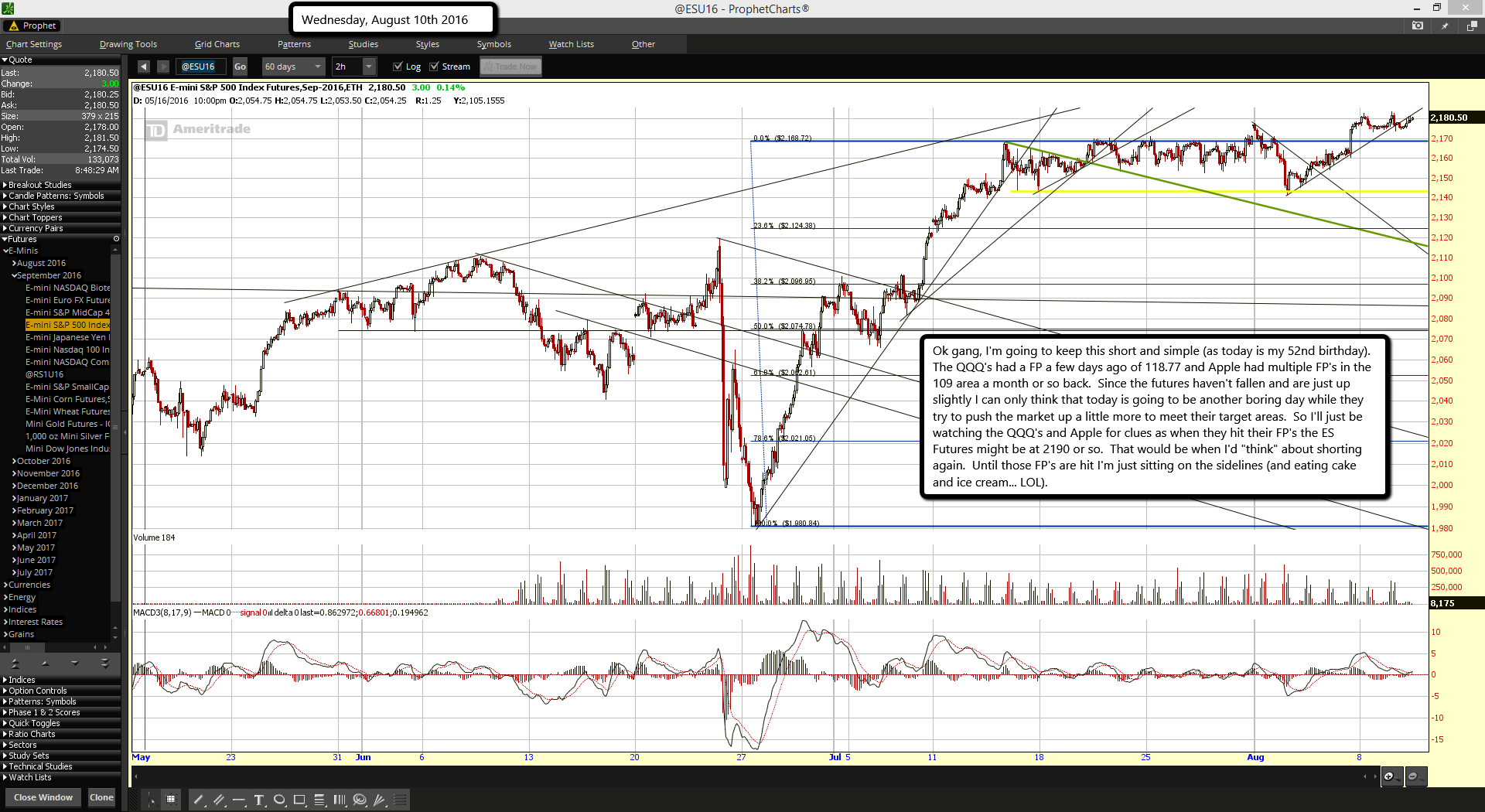
 

ES Morning Update August 10th 2016

0

b554c4c9-c55c-42f5-9c4f-011577fdd97f

Ok gang, I'm going to keep this short and simple (as today is my 52nd birthday).  The QQQ's had a FP a few days ago of 118.77 and Apple had multiple FP's in the 109 area a month or so back.  Since the futures haven't fallen and are just up slightly I can only think that today is going to be another boring day while they try to push the market up a little more to meet their target areas.  So I'll just be watching the QQQ's and Apple for clues as when they hit their FP's the ES Futures might be at 2190 or so.  That would be when I'd "think" about shorting again.  Until those FP's are hit I'm just sitting on the sidelines (and eating cake and ice cream... LOL).

The U.S. Economy Is Suffering From the Same Old Problem

0

A pair of better than expected non-farm payrolls reports affirms that the U.S. economy doesn't have a new problem, that is, a rapid slowdown in job growth  just the same old one: sluggish productivity.

And monetary policymakers will be aiming to ensure that this blight on the U.S. economy disappears as labor slack continues to diminish, according to a Deutsche Bank AG team led by Dominic Konstam. That's because continued low productivity growth likely entails that businesses aren't boosting capital spending to increase output at a time when another input to the production process  labor  is becoming more scarce and more expensive.

One "implication of stubbornly low productivity is that it is critically important for the Fed[eral Reserve] to protect aggregate demand, particularly as the pace of payroll expansion slows with full employment looming," he writes.

Heading into the second quarter of 2016, quarter-on-quarter productivity growth, a measure of the change in output per hour worked, has averaged just 0.7 percent over the past four readings, well shy of its long-run average of 2.2 percent.

Economists expect non-farm productivity to rise 0.4 percent quarter-over-quarter in the second quarter, with fresh data released at 8:30am New York time.

Increases in economic output can only be garnered by boosting the number of aggregate hours worked or by producing more goods and services per hour worked.

The greying of the U.S. population is poised to put the brakes on the rate of growth of labor input as boomers exit the work force. As such, in the absence of productivity growth, the economy might not see much growth at all.

But the Fed is cognizant of the need to have a clean hand-off between a labor market that's running out of slack and capital deepening to help boost productivity, according to Konstam.

"The logic is quite simple: the corporate sector is unlikely to increase investment in the absence of strong (global) final demand, and investment has historically been a requisite for rising productivity," the strategist writes. "The thorny fact is that employees are also consumers, so too much slowing in employment growth could easily depress demand."

A need to spur productivity growth helps explain the Fed's focus on the state of financial conditions, as the level of interest rates, credit spreads, the U.S. dollar, and stock prices, will presumably influence corporate investment decisions  and suggests that the central bank's concerns over these variables won't abate any time soon.

"As long as the labor market is healthy, the Fed could raise rates modestly, but must take care not to create headwinds for aggregate demand that could impede a transition to productivity driven growth," cautions Konstam. "Any new headwinds created by Fed tightening would likely reinforce the existing (downward) trend in real private investment."

The manifold headwinds on productivity growth (a mass retirement of the most experienced workers, a prolonged period of rising oil prices before a sharp retreat, the slow integration of new innovative technologies into the production process, and above all, soft business investment) means policy rates will stay even lower throughout this cycle than the subdued levels monetary policymakers think they'll eventually reach over the long haul, according to Bank of America Merrill Lynch analysts.

"Along with a drop in potential [growth] comes a decline in the equilibrium interest rate. In real terms assuming 2 percent target inflation the Fed has penciled in a long-term real R* of 1 percent with the short-run hovering close to zero," writes BofA's Michelle Meyer, with R* referring to the long-run level of the federal funds rate at which the Fed believes monetary policy would neither be stimulative nor contractionary. "Given the nature of this cycle, we are unlikely to actually reach this estimate of long-run R*."

A pick-up in capital spending by businesses will presumably foster a commensurate rise in productivity, which would allow even companies without a large deal of pricing power to avoid choosing between pressuring their profit margins or raising costs for their customers.

Otherwise, as the Deutsche Bank team writes, "this could well be a cycle that does indeed die of old age," with Corporate America electing to cut jobs to maintain profitability and ultimately fostering a downturn in consumer spending.

New iPhone to Have Dual Camera but No Headphone Jack

0

Apple Inc. is preparing to unveil successors to the iPhone 6S and iPhone 6S Plus as early as next month with more advanced photography capabilities and upgraded hardware in a design similar to that of last years models, according to people familiar with the matter.

The standout features will be a dual-camera system on the larger iPhone, a re-engineered home button that responds to pressure with a vibrating sensation rather than a true physical click and the removal of the devices headphone jack, said the people, who didnt want to be identified discussing unannounced features. Apple declined to comment.

While iPhone demand has waned in recent quarters, partly due to the lull between product launches, the device continues to be the major source of Apples revenue. The new models will be critical to the holiday quarter, and Apple is counting on the phones to prop up sales ahead of an expected iPhone overhaul in 2017, the devices 10th anniversary.

Moving away from the typical two-year iPhone redesign cycle, this years models will look similar to the 6 and 6S, the people said, who added that there will still be noticeable tweaks. The new iPhones will retain the same 4.7-inch and 5.5-inch screen sizes as their predecessors, the first of which was introduced in September 2014. Apple will remove the two innermost antenna lines that run across the back of the current iPhones, the people added.

Sharper Photos

The dual cameras on the larger new iPhone will produce brighter photos with more detail, according to a person who has used a prototype version of the upcoming device. Both sensors, which each capture color differently, simultaneously take a picture, and the device produces a single, merged photograph, said the person.

The dual system sharpens photos taken in low-light environments, the person said. The combination of the merged photos from the two camera sensors also allows users to zoom while retaining more clarity, the person added. The smaller version of the new phones will not include dual lenses, KGI Securities analyst Ming-Chi Kuo said earlier this year.

Home Button

Apple is planning an updated home button for the new models. Current home buttons are switches that physically press into the phone, but the new models will have a pressure-sensitive button that employs so-called haptic feedback, according to the people. This mechanism is similar to that of the trackpads on the latest MacBook line. 9to5Mac reported on the home button design earlier.

The new iPhones will remove the headphone jack in favor of connectivity via Bluetooth and the charging port. That will make room for a second speaker, said the people. Apple started allowing headphone makers to build headphones that can connect via the iPhones charger connector in 2014, the same year the company acquired headphone maker Beats Electronics. Macotakara earlier reported the headphone jacks demise.

The new models will run iOS 10, the new version of Apples mobile operating system coming this fall. The updated software offers interactive widgets to quickly glance at calendar appointments and favorite contacts, new messaging features, a new application for controlling smart home appliances, and a redesigned Apple Music. The new software will also run on current and some past iPhone models.

Apples shares were little changed at $107.78 at 9:36 a.m. in New York. The stock was up 2.1 percent this year through Friday.


Tuition-free college: What students really think about the idea

0

ThinkstockThinkstock

If you have debt, work multiple jobs to pay for tuition and wish college was free, you’re not alone.

A recent Bankrate survey of one thousand people found that 62% of Americans support free tuition at public colleges. And that number is even higher among 18- to 29-year-olds, with 77% in favor of tuition-free education.

It’s no secret that tuition and student debt have been on the rise in recent years.

Between 2014 and 2015, tuition rose 3.6% and 2.9% at private and public colleges, respectively, according to the College Board. Over the past ten years, the increase rate has hovered near 5%. National student debt, meanwhile, has passed $1.3 trillion and continues to climb by thousands of dollars per second, according to MarketWatch’s running counter.

Making college more affordable and student debt less debilitating matters to young voters more now than perhaps ever before, which is why they’re keeping a close eye on the presidential candidates’ prospective policies.

(Graphic: Walbert Castillo)

Over the course of five years, Hillary Clinton would implement a system in which students from families with an annual income of less than $125,000 can attend in-state public colleges or universities at no cost. As the program phases out, immediate attention would be given to students whose families make less than $85,000 annually.

Donald Trump, meanwhile, would take government out of the equation entirely and privatize student loans. In other words, he would have banks handle all student loans. This, he argues, would create more competition among banks and relieve pressure on student loan interest rates.

But some students say successfully tackling the issue requires nuanced thinking. While the majority of those who spoke with USA TODAY College are on board with the concept of tuition-free college, they say other economic factors should be considered before putting proposals into practice.

Herbie Bolimovsky, a senior at the University of Rochester who pays $65,346 per year in tuition, says he would feel more comfortable taking a firm stance on a tuition-free system after seeing an assessment of the proposed policy, which he thinks would require extensive economic research and “in-depth studies.”

Rising University of Virginia senior Brandon Brooks comes from a family that earns close to $125,000 annually, per his estimations. He pays UVA’s in-state tuition of $28,924 primarily through student loans and says he “would probably support Congress using taxpayer money” to make free tuition a reality.

“Free college sounds great — so does free pizza.”

Though Brooks says the policy should come with a stipulation that doubles as an incentive: Students must earn a 3.0 GPA to remain eligible. And even then, he still has concerns.

Brooks says he worries students from low-income families wouldn’t get the leg up they need to succeed with a tuition-free system, citing a recent Brookings Institute study that found the middle and upper middle classes would benefit more than the lower classes. This, he says, sets up students from low-income families for lifelong financial struggle.

“You essentially need a college degree to get a well-paying job,” the political science student says.

Alex Greene, a recent graduate of Hunter College ($6,030 for in-state students), agrees that “everyone should benefit” from a tuition-free system, but says he ultimately finds the concept “really problematic.” The current University of Pennsylvania law student says he wouldn’t want to subsidize the tuitions of students who cannot afford college.

And Griffin Anderson, a rising senior at George Mason University, which costs $11,214 for in-state students, says there’s no simple solution to the problem.

“I can understand the argument for tuition free college,” says Anderson, who estimates his family’s an annual income exceeds $125,000. “But I don’t think (college) should be 100% tuition-free.”

That’s because students who pay their way through schools, he says, ultimately “gain life experience.” But if the government were to implement a tuition-free system, Anderson says it needs to make sure “it’s something that we’re going to be able to pay for with whatever tax revenue we’re allocating to it” — in other words, that it’s a “financially responsible” move.

A simple solution to this complex problem may not exist, but Bolimovsky has just one more small request for lawmakers’ looking to ease the financial burden on students:

“Free college sounds great — so does free pizza.”

Jacob Sonenshine is a student at Hunter College and a USA TODAY College correspondent.


Carvana raises a $160M Series C to expand its online dealership and car vending machines nationwide

0

The used car industry is an interesting business. The market is huge – 45 million used cars are bought each year in the U.S. But the biggest player, CarMax, only controls about 2% of the market – but is still valued at about $12 billion by Wall Street.

So that makes the market not only ripe for disruption, but also extremely lucrative.

Carvana is a used car dealer that thinks it can gain some of this marketshare by bringing an e-commerce approach to the industry. The startup, which we’ve covered before, has brought the entire sales process online. And today the startup is announcing that is has raised a $160M series C to further expand its model across the United States.

A prospective car buyers stars on Carvana’s website, and picks out the exact car they want. The company offers cars in almost every body style and price range, and had about 5,000 available as of last night. There’s no bargaining, but the company consistently offers prices a few thousand dollars better then Kelly Blue Book’s suggested retail price (and lets you compare the two).

All financing and paperwork gets done online, and you have the choice of either having your car delivered or available for pickup at one of the company’s “car vending machines”.

What’s a car vending machine? It’s literally a big glass building that automatically dispenses a car that is preloaded by the company in the days prior to the customer picking it up. Carvana opened their first one in Nashville last year, and will use this funding to open more around the country.

Does a car vending machine sound gimmicky? Of course. But the company explained that it also has a practical purpose, besides being great for advertising. The status quo for Carvana is currently to deliver your new car to your door, which obviously costs more than having you pick it up. So by building a car vending machine in each city the company can save the money they would spend on having employees delivery it to your door.

This $160M in funding follows $140M in equity and $400M in debt previously raised by the company. While Carvana won’t disclose specific investors, they have said that the round had participation from both new and existing institutional investors.

Like previous funding rounds, growth and expansion is where Carvana is planning on spending this money. But with this new funding they are planning to expand and have readily available inventory in over 20+ markets by the end of the year, which will probably require them to shell out a ton of cash for a ton of used cars.

Plus, the company needs to build more physical locations to store (and possibly vend) cars in each of these new cities. As Ernie Garcia, founder and CEO of the company explained, they could choose to grow slower with much less capital, but Carvana (and their investors) believe that they found a solid business model, and want to ramp up and strike while the iron is hot.

Delta: ‘Large-scale cancellations’ after crippling power outage

0

Delta grounds departing flights due to system outage The week got off to a bad start for Delta passengers.

Delta Air Lines flights were grounded for at least six hours early Monday by a global computer system outage, causing large-scale cancellations and stranding hundreds of thousands of passengers.

At 8:40 a.m. ET, Delta said the ground stop had been lifted but that only "limited" departures had resumed. It's expected that flights will be delayed and canceled throughout the day.

"Customers heading to the airport should expect delays and cancellations," Delta warned. "While inquiries are high and wait times are long, our customer service agents are doing everything they can to assist."

Delta(DAL), the world's second largest airline, said the problem was a power outage at its Atlanta hub.

The number of flights and passengers affected by the problem was not immediately available. But Delta, on average, operates about 15,000 daily flights, carrying an average of 550,000 daily passengers during the summer.

The cause of the power outage was not immediately known. U.S. law enforcement officials are working with Delta, a U.S. official told CNN. But there are no indications that a computer hack is responsible. Delta has given indications it does not believe it was hacked.

Getting information on the status of flights was particularly frustrating for passengers.

Delta conceded it was having trouble providing accurate flight status on airport departure boards, at delta.com, the Fly Delta App and from Delta representatives on the phone.

The airline said if a flight is canceled or significantly delayed, passengers will be entitled to a refund, though it did not specify what is considered "significantly" delayed.

Even passengers booked on a flight Monday whose flights are not canceled can make a one-time change to their tickets without the normal fee. But they could have to pay the difference in fare for a new flight. They will need to start travel by this Friday to benefit from the lack of a change fee.

The Joseph family from Suffern, New York, arrived at LaGuardia Airport in New York for a flight to Orlando, the start of a vacation to Disney World for their six children.

"Delta is just saying the systems are down and we are going to be late," said Frantzy Joseph, the family's father.

"We're feeling OK. We're excited to go Disneyworld. We just want to catch the flight," said Claudia Joseph, the family's mother.

Passengers on Twitter reported problems -- including the inability to check in or being stuck on the tarmac -- from airports around the world, including San Francisco, Rome and Athens.

"The airline provided passengers with little information," said New Yorker Carly Hayes, who was due to travel from Fiumicino Airport in Rome to New York's JFK, in an Instagram post.

Jackie Watanabe, who was due to travel from Las Vegas to Minneapolis, tweeted that the airline was handing out blankets to passengers who wanted to get some sleep on the floor of the terminal there.

"I'm not ready to go into camping mode yet, but other passengers are," she said, tweeting a photo of sleeping passengers.

delta delays jackie wantabe

Sean Carson, due to travel from Kona, Hawaii, to Los Angeles, said he had been on a plane for more than four hours. He told CNN the pilot announced earlier that pizza was being delivered.

Reports of delays on social media appeared to have begun around 3 a.m. ET.

Delta's problems come less than three weeks after Southwest Airlines canceled more than 1,000 flights following a system outage.

Facebook takes aim at ad-blocking software

0
facebook screenFacebook has fired a warning shot at ad-blocking software by making changes that will force desktop users to see adverts.

The rising popularity of ad-blockers poses a threat to online businesses that rely on advertising revenue.

The social network told users it understood how annoying ads could be.

It promised to better offer tools for controlling what material does make it through to users' newsfeeds.

"As we offer people more powerful controls, we'll also begin showing ads on Facebook desktop for people who currently use ad blocking software," said Facebook's advertising vice-president Andrew Bosworth in a blog post.

Users will be allowed to customize the types of adverts they see by selecting the brands and businesses they prefer.

"People don't like to see ads that are irrelevant to them or that disrupt or break their experience," Mr Bosworth added.

Ad-blockers do not usually work on mobile devices, which account for most visits to Facebook, but nevertheless prevent advertising worth billions from being seen.

Facebook generated $6.2bn (£4.7bn) in revenue from adverting in the most recent quarter.

About 200 million people worldwide use ad-blocking software on their computers.

The move is likely to rekindle a debate between content providers that rely on advertising revenue and users trying to avoid unwanted commercials.

This is not Facebook's first step at controlling what users see in their newsfeeds.

Earlier this month it took steps to limit "clickbait" stories - articles that carry headlines that make a story seem more interesting than it actually is.

Wholesale inventories up 0.3% in June

0

A forklift operator loads a semi-trailer with pallets of seasoning at the Badia Spices factory in Doral, Florida.

A forklift operator loads a semi-trailer with pallets of seasoning at the Badia Spices factory in Doral, Florida.

U.S. wholesale inventories unexpectedly rose in June on gains in stocks of farm products and other nondurable goods, suggesting an upward revision to the second-quarter economic growth estimate.

The Commerce Department said on Tuesday that wholesale inventories increased 0.3 percent after having been initially estimated as unchanged. Inventories for May were revised up to show a 0.2 percent rise instead of the previously reported 0.1 percent gain.

Economists had forecast wholesale inventories unchanged in June in line with the government's estimate last month. That unchanged reading was incorporated in the advance second-quarter gross domestic product estimate published last month.

The component of wholesale inventories that goes into the calculation of GDP—wholesale stocks excluding autos—increased 0.3 percent in June. That would imply a mild upward revision to the second-quarter GDP growth estimate.

An outright drop in inventory investment subtracted almost 1.2 percentage points from GDP growth in the second quarter, restricting the rise in output to a tepid 1.2 percent annualized rate. Inventories have weighed on GDP growth since the second quarter of 2015 as businesses sell piles of unwanted goods.

In June, wholesale stocks of farm products increased 4.0 percent after rising 6.2 percent in May. Wholesale inventories of drugs surged 4.9 percent after declining 3.8 percent in May. Auto inventories dipped 0.1 percent in June.

Sales at wholesalers jumped 1.9 percent after rising 0.7 percent in May. In June, it would have taken wholesalers 1.33 months to clear shelves, down from 1.35 months in May.

What are markets doing? Check here.

ES Morning Update August 9th 2016

0

b7db5ad5-e0d9-4025-83c9-03f770f2087b

The futures are riding this rising trendline of support still.

The MACD's on this 2 hour chart look ready to turn back up.

Yesterday we had only of the lightest trading days on the SPY that I could find going back the 5 years I looked.  It probably was even longer then that but I never bothered to check.  Point being is that it's very hard for the market to breakdown when the volume is so light.  So even if this rising trendline of support breaks that horizontal support zone around 2160-2170 will be tough to get through.

However, we do still have that FP on the SPY from last Thursday and if that's the downside target then that 2160 support zone will be broken of course.  I'm not sure why I'm talking about the downside as it feels like the Fed's have erased that word from trading and only allow the market to go up.  Every resistance on the upside seems to get broken and all support on the downside holds.  So, assuming nothing changes, we should be looking up I guess as they seem to want 2200 pretty badly.  I don't have any levels on the upside though as we are at all time highs with no resistance above as we've never been this high.  All we have are the even number targets like 2200.  I'm sure there's more levels from rising trendlines but there's no point discussing them until we are up closer.  For now we just know the market wants 2200 pretty badly.

History tells me that when the market wants to get to some even number level (like 2000, 2100, 2200, etc... on the SPX, or 17,000... 18,000... etc... on the DOW) it does this one of two ways.  It will fall short of the target by 10-20 points or pierce through it 15-25 points.  I've noticed this happened many times in the past.  When the market wanted 2000 it stopped at 1991 or so (7/23/2014), then it pulled back and ran back up again to finally bust through and stop at 2019 (9/19/2014).  At that point it rolled over and had a nice correction.

Then later the market wanted 2100 and that time it stopped at 2093 (12/29/2014) and had a nice correction (it also had a nice correction prior to that by stopping at 2079 on 12/5/2014).  Yesterday we tagged 2185 on the SPX Cash, so do we pullback slightly for a day or two and then run back up to hit 2215-2225 and then have a nice correction?  Or do we fail to hit 2200 right now and start a nice correction this week?  Pattern rarely repeat exactly but they are similar, so one of those two scenario's is likely to happen.  We either will start a nice correction by falling short of it or push through it this week and then start a nice correction.  Which one I don't know but if it starts down now (falling short) then the "nice correction" should be 80-100 SPX points.

ES Morning Update August 8th 2016

0

f700fdc1-d058-4ebf-9513-c0576493c54f

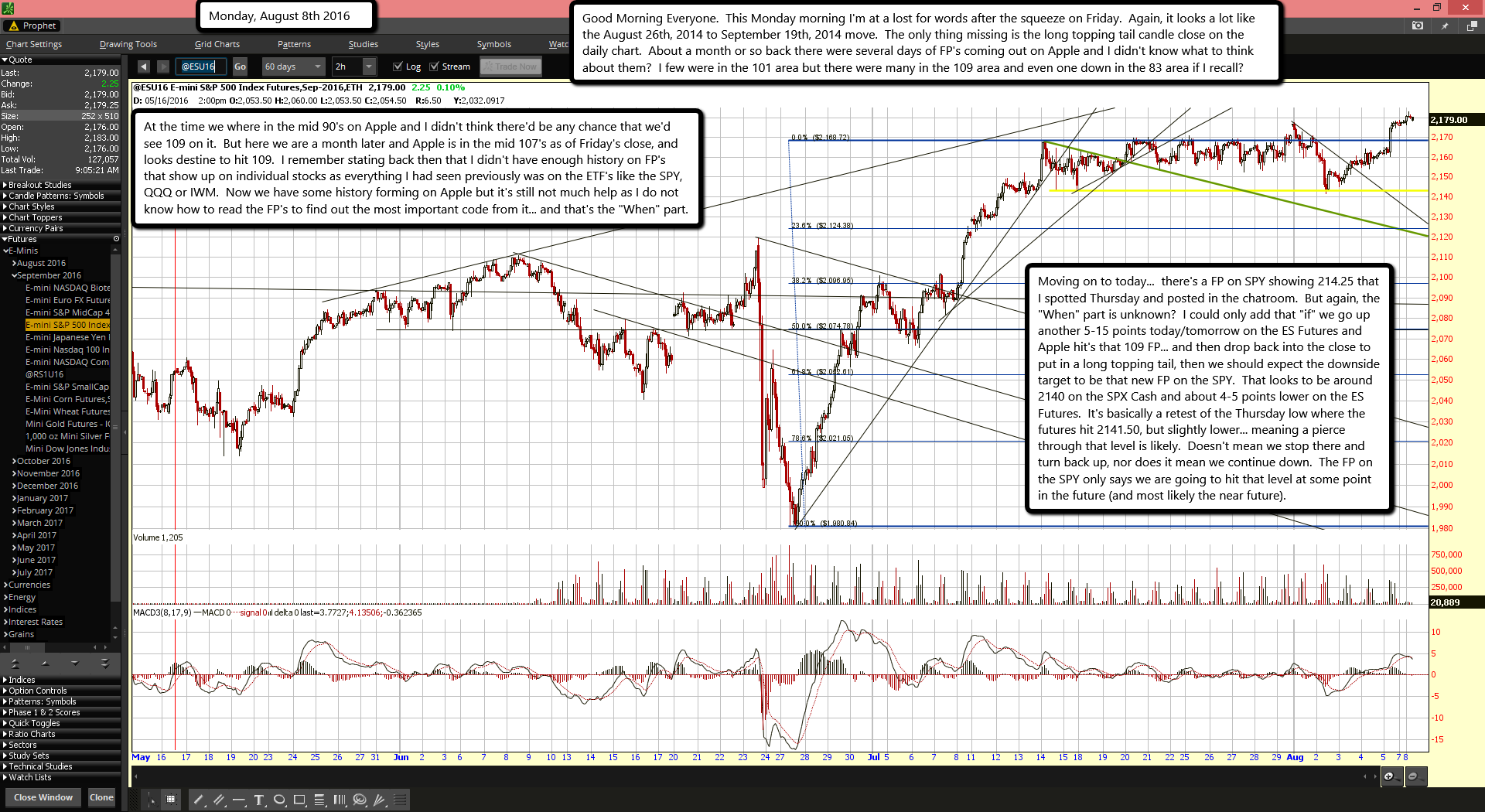
Good Morning Everyone.  This Monday morning I'm at a lost for words after the squeeze on Friday.  Again, it looks a lot like the August 26th, 2014 to September 19th, 2014 move.  The only thing missing is the long topping tail candle close on the daily chart.  About a month or so back there were several days of FP's coming out on Apple and I didn't know what to think about them?  I few were in the 101 area but there were many in the 109 area and even one down in the 83 area if I recall?

At the time we where in the mid 90's on Apple and I didn't think there'd be any chance that we'd see 109 on it.  But here we are a month later and Apple is in the mid 107's as of Friday's close, and looks destine to hit 109.  I remember stating back then that I didn't have enough history on FP's that show up on individual stocks as everything I had seen previously was on the ETF's like the SPY, QQQ or IWM.  Now we have some history forming on Apple but it's still not much help as I do not know how to read the FP's to find out the most important code from it... and that's the "When" part.

Moving on to today...  there's a FP on SPY showing 214.25 that I spotted Thursday and posted in the chatroom.  But again, the "When" part is unknown?  I could only add that "if" we go up another 5-15 points today/tomorrow on the ES Futures and Apple hit's that 109 FP... and then drop back into the close to put in a long topping tail, then we should expect the downside target to be that new FP on the SPY.  That looks to be around 2140 on the SPX Cash and about 4-5 points lower on the ES Futures.  It's basically a retest of the Thursday low where the futures hit 2141.50, but slightly lower... meaning a pierce through that level is likely.  Doesn't mean we stop there and turn back up, nor does it mean we continue down.  The FP on the SPY only says we are going to hit that level at some point in the future (and most likely the near future).

OPEC oil freeze talks may be resurrected

0
EPA AUSTRIA ECONOMY OPEC EBF ENERGY & RESOURCES AUT

The Organization of the Petroleum Exporting Countries may resurrect its heretofore futile attempts to freeze petroleum output in a bid to inject life into oil prices.

OPEC member countries will hold an informal meeting "on the sidelines" of the International Energy Forum from Sept. 26-28 in Algeria, the organization said Monday in a statement.

The meeting comes about a week after oil prices briefly tumbled below $40 per barrel amid renewed fears of a global glut of oil, which had sent the commodity spiraling below $30 per barrel earlier this year before a sharp rebound to above $50 enticed some producers to get back in the game.

OPEC countries have considered an output freeze multiple times over the last year, but have failed to reach a consensus each time, including the latest attempt in June. The group's stranglehold on global oil prices has loosened in recent years amid political tension between Saudi Arabia and Iran, the surge of U.S. production and concerns about global economic growth.

"OPEC continues to monitor developments closely, and is in constant deliberations with all member states on ways and means to help restore stability and order to the oil market," OPEC said Monday.

Despite the stalemate that has gripped OPEC at recent meetings, traders appeared encouraged by the prospect of fresh talks over a deal. The price of West Texas Intermediate oil, the U.S. benchmark, rose 2.1% to $42.66 at 8:17 a.m. Brent crude, the global benchmark, rose 1.9% to $45.09.

"While the last try a few months ago failed spectacularly, declarations from some OPEC countries indicate that another stab at cooperation on a freeze deal may be attempted in September," JBC Energy analysts said Monday in a research note. "This is indicative of the significant pressure some of these producers are under in terms of their economies."

Any encouragement drawn from the possibility of an OPEC freeze may be offset by the prospect of additional U.S. production coming online.

The number of active U.S. oil rigs is up 21% since its May low, according to Goldman Sachs. More U.S. oil could keep prices low.

Bitfinex users set to lose 36% of their holding in bitcoin hack

0
A man walks out of a shop displaying a bitcoin sign during the opening ceremony of the first bitcoin retail shop in Hong Kong.A man walks out of a shop displaying a bitcoin sign during the opening ceremony of the first bitcoin retail shop in Hong Kong.
Bitfinex allows users to trade in several different digital currencies, including bitcoin, and deposit U.S. dollars in their account.

A total of 119,756 bitcoins, worth $70.5 million at today's price, were stolen as a result of a cybersecurity breach.

Bitfinex's decision is likely to disappoint many of the site's users who held assets other than bitcoins, warned Charles Hayter, chief executive and founder of digital currency comparison website CryptoCompare.

"What's disappointing is that the losses seem to be arbitrarily decided with larger operators being offered sweetners to keep them trading - and there is little clarity on BitFinex's company losses," Hayter told CNBC via email.

To compensate users, BitFinex is crediting each account with a digital token that will record how much the customer has lost as a result of the hack. These tokens will either be redeemed in full by the company in the future or they can be exchanged for shares in BitFinex's parent company, iFinex Inc. The statement did not specify any timeframe for the redemption.

"The convertible debt token is a way of kicking the can down the road and finding breathing space for the exchange - it opens up interesting trading possibilities with its junk status as well as a fair few legal ramifications," explained Hayter.

Hayter criticised BitFinex's latest attempt to deal with the situation.

"It's all been desperately scrambled together to give some form of closure - although a lot of their plan has not been fully fleshed out with details thin on the ground," he said.

ES Morning Update August 5th 2016

0

2e3cbd5e-5485-4fb3-9628-35ae2fc93895

The Job's Report:  "US created 255,000 jobs in July vs. 180,000 jobs expected"  Ok guys, this is very likely a "Sell the News" event.  We had a new FP show up yesterday on the SPY (which I posted in the chatroom), so if we start dropping today that might be our target.  I can't imagine traders being happy with the job's numbers as now they will be thinking... "Will the Fed's now raise rates earlier then thought since the economy seems to be better?"  And you know that question is going through their heads right now.

So, let's give the bulls a little running room in the early part of the morning as they might try to take out the stops above the 2170 level and even run to 2177.75 where the prior high was, but it should not hold.  Once all the stops are gone there's nothing left to support the market up at that level and it should roll back over later in the day... that's "if" it makes it up there in the first place, which seems unlikely to me, but I have to point it out as we all know how hard it is to kill the bulls.

As far as wave counts go I still think we had a wave 1 (or A) down from the 2177.75 high to the low of 2141.50, and that's where the wave 2 (or B) up started.  It should end this morning and start the wave 3 down (or C) that should take us to the FP target on the SPY, which is basically a retest of Tuesday low on this ES Futures chart.  If all goes well that wave down end up being just a smaller subwave of this wave 3 (or C) down... like a smaller wave 1, then possibly a late day bounce back up for the smaller wave 2 up, which leaves the smaller wave 3 down on Monday, inside the larger wave 3 (or C).  That's the wave that should break support in the 2140 area.  This all assumes SkyNet will play nice today and allow these nice wave patterns to work, which I can't answer of course.

Inside The Titanic II: Identical Replica Of Titanic To Set Sail In 2018

0

Clive Palmer has an unsinkable dream: to have a replica of the Titanic set sail sometime in 2018. The Australian businessman first began planning the project in 2012, but the original launch was delayed. Now, 106 years after the untimely end of the ship’s namesake, the Titanic II is planned to embark on its maiden voyage from Jiangsu in Eastern China to Dubai.

“The new Titanic will of course have modern evacuation procedures, satellite controls, digital navigation and radar systems and all those things you’d expect on a 21st century ship,” assures James McDonald, the marketing director of Blue Star Line. For example, the new ship will have a 2,700 lifeboat capacity for its 2,435 member crew, as opposed to the original’s lifeboat capacity of 1,178 for its 2,223 passengers.

Grand staircase

Historically, the grand staircase was reserved for first-class passengers

Café Parisien

Built to look like a sidewalk cafe in France, the Café Parisien was also reserved for first class passengers

The Smoking Room, resembling a London gentlemen’s club, was a place for men to relax

The pool

On the original ship, the pool was filled with salt water after the ship had set sail

Marconi room, where “state of the art” technology allowed passengers to send messages

First class stateroom

The first class dining saloon

The first class dining room spanned the entire width of the ship

Second class cabins

Turkish bath, similar to a sauna

The bridge

Third class dining saloon, where passengers ate communally

The dining room’s menu changed daily

The original Titanic

Titanic II

Watch a video about the new ship below:


In case you forgot about the "reason" the Titanic was sunk in the first place I suggest you watch this video:

The Titanic (Olympic) was deliberately sunk to drown the opposition to the federal reserve in 1912 and on 1913 the federal reserve was created and than in 1914 world war 1 started financed in both sides by this federal bank by making money out of thin air in order to build a new world order for Jewish supremacy

What does this say for 2018 you ask? Possibly it's saying that a new Central Bank is coming to replace the Federal Reverse? I'm not sure really but "they" have something planned for this period I'll bet. Maybe it's the currency devaluation year? Just random thoughts...

Red

ES Morning Update August 4th 2016

0

ES Morning Update August 4th 2016

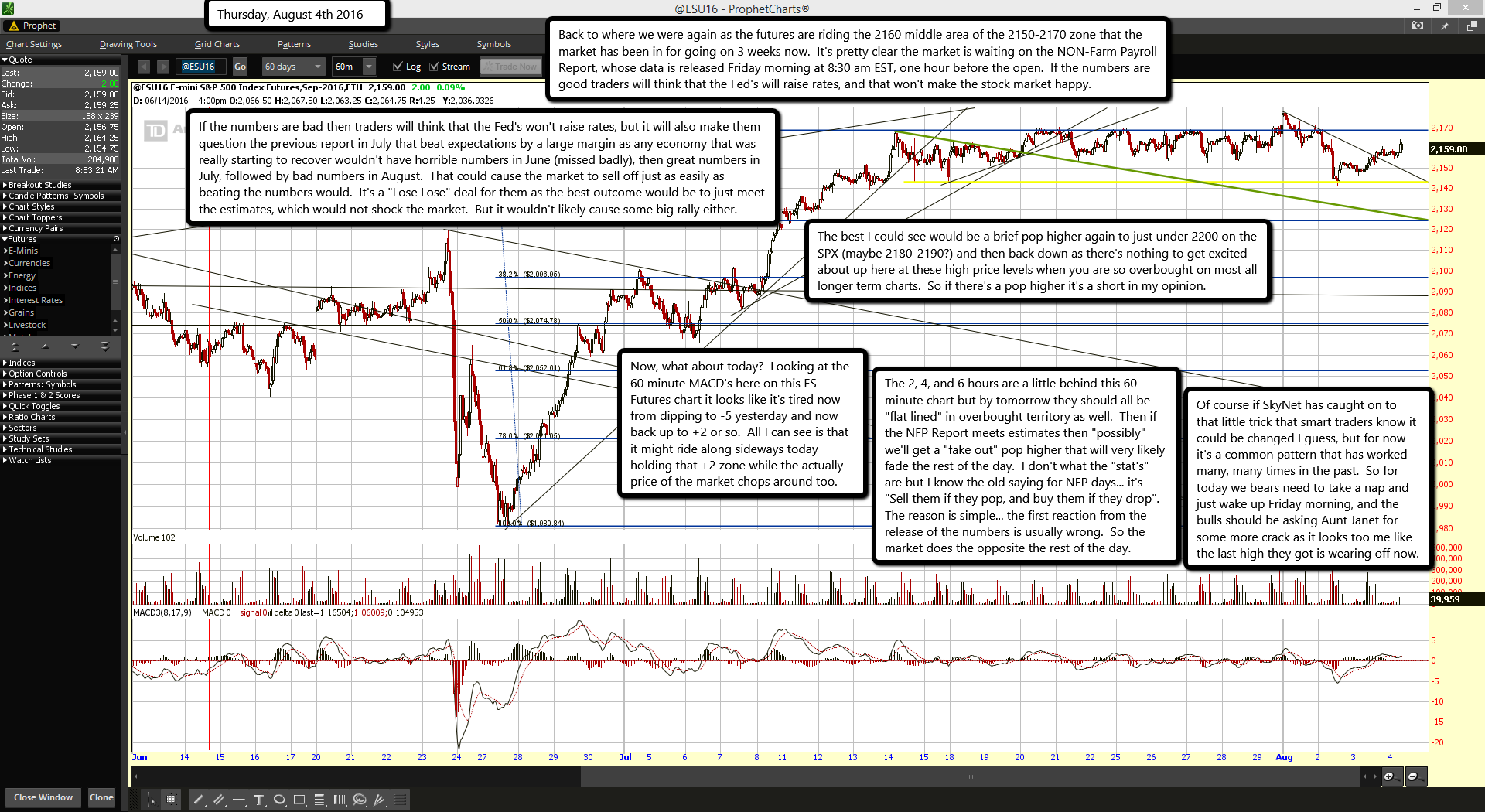
Back to where we were again as the futures are riding the 2160 middle area of the 2150-2170 zone that the market has been in for going on 3 weeks now.  It's pretty clear the market is waiting on the NON-Farm Payroll Report, whose data is released Friday morning at 8:30 am EST, one hour before the open.  If the numbers are good traders will think that the Fed's will raise rates, and that won't make the stock market happy.

If the numbers are bad then traders will think that the Fed's won't raise rates, but it will also make them question the previous report in July that beat expectations by a large margin as any economy that was really starting to recover wouldn't have horrible numbers in June (missed badly), then great numbers in July, followed by bad numbers in August.  That could cause the market to sell off just as easily as beating the numbers would.  It's a "Lose Lose" deal for them as the best outcome would be to just meet the estimates, which would not shock the market.  But it wouldn't likely cause some big rally either.

The best I could see would be a brief pop higher again to just under 2200 on the SPX (maybe 2180-2190?) and then back down as there's nothing to get excited about up here at these high price levels when you are so overbought on most all longer term charts.  So if there's a pop higher it's a short in my opinion.

Now, what about today?  Looking at the 60 minute MACD's here on this ES Futures chart it looks like it's tired now from dipping to -5 yesterday and now back up to +2 or so.  All I can see is that it might ride along sideways today holding that +2 zone while the actually price of the market chops around too.

The 2, 4, and 6 hours are a little behind this 60 minute chart but by tomorrow they should all be "flat lined" in overbought territory as well.  Then if the NFP Report meets estimates then "possibly" we'll get a "fake out" pop higher that will very likely fade the rest of the day.  I don't what the "stat's" are but I know the old saying for NFP days... it's "Sell them if they pop, and buy them if they drop".  The reason is simple... the first reaction from the release of the numbers is usually wrong.  So the market does the opposite the rest of the day.

Of course if SkyNet has caught on to that little trick that smart traders know it could be changed I guess, but for now it's a common pattern that has worked many, many times in the past.  So for today we bears need to take a nap and just wake up Friday morning, and the bulls should be asking Aunt Janet for some more crack as it looks too me like the last high they got is wearing off now.

Trump v. Clinton: Stocks can predict the winner

0

Forget the polls. Wall Street has another way to predict whether Donald Trump or Hillary Clinton will be the next president of the United States.

Keep an eye on the stock market from August 1 through October 31.

presidential election

If stocks go up during that three month stretch, expect Clinton to win. If stocks slide, Trump will likely prevail.

Those critical three months have been astonishingly accurate at predicting the next president, says Sam Stovall, a stock market expert at S&P Global Market Intelligence.

Stovall looked at the data for every presidential election going back to 1944 (FDR v. Dewey). If stocks rose in price from July 31 to October 31, the party that currently controlled the White House won the election 82% of the time.

This year, the key stretch will start on August 1, since July 31 is a Sunday.

Similarly, if stocks (measured by the S&P 500 index that tracks the performance of 500 of America's largest companies) fell, voters opted to kick out the party in power and replace it 86% of the time.

"We all know that prices lead fundamentals. And more times than not, S&P 500 price returns identified whether the incumbent president, or his party, was reelected or replaced," wrote Stovall in his report on elections and the market.

The basic idea is that if the economy is growing and people think the good times will continue, they are likely to want to stick with the same presidential party (in this case the Democrats). If they are fearful, stocks tend to fall, and voters want new leadership.

The only times that the stock market predictor didn't work were in years where a strong third party candidate was involved (e.g. 1968 or 1980) or when there was a surprise geopolitical shock like 1956 when England and France seized the Suez Canal from Egypt.

The third party factor could be make Election 2016 more difficult to predict too. Libertarian Gary Johnson has been polling around 10%.

The stock market is coming into the "presidential predictor stretch" near all-time highs. Wall Street experts have very mixed views on whether it can go up more from here.

Goldman Sachs: Avoid stocks for next 3 months

0


Goldman Sachs thinks the good times may be over for stocks for a little while.

July was great for the market, with the S&P 500 rising nearly 4% and setting seven record closing highs. Fears about Brexit faded, allowing more than 90% of investors to make money last month, according to data shared exclusively with CNNMoney by Openfolio.

But Goldman Sachs is warning that stocks "remain expensive and earnings growth is poor." The influential investment bank downgraded stocks to "underweight" over the next three months.

"Until the growth situation improves, we are not that constructive on equities, particularly after this type of rally," Goldman strategists wrote in a report Sunday.

Growth concerns were magnified on Friday, when investors learned that the U.S. economy grew at sluggish 1.2% pace between April and June. That sobering GDP report dashed hopes for a spring rebound from the first quarter's anemic 0.8% growth pace.

Dow bounces back Brexit

Stocks may be more vulnerable to disappointing news because of how far they've climbed lately. The Dow is currently sitting at 18,400, or roughly 3,000 points above its mid-February low. That's a huge move.

Goldman isn't going out on a limb by warning of possible turmoil in the next few months. History shows the August/September period can be rough for stocks. Those two months are the worst for the S&P 500 in terms of monthly price increases since World War II, according to S&P Global Market Intelligence.

The challenges may be greater this time around. Not only does growth remain elusive for much of the globe, but there is a lot of uncertainty about policy. Goldman cited the Brexit negotiations in Europe, China's attempt to manage its slowdown and the looming presidential election in the U.S.

The other problem is that stocks look pricey. The S&P 500 is trading at 17.87 times its projected earnings over the next 12 months, the loftiest multiple since June 2004, according to S&P.

The bulls are hoping that earnings, the real driver of stock prices, will catch up to the market. While tech companies like Facebook (FB, Tech30) and Amazon(AMZN, Tech30) have reported blockbuster profits, the S&P 500 is still on track to report its fourth consecutive quarter of shrinking earnings.

Even if profits don't rebound, the markets have been supported by extremely low bond yields that make stocks look cheaper by comparison. But many worry that bonds are in the middle of a massive bubble that will eventually reverse.

All of this explains why Goldman Sachs is advising clients to put money into cash. Some investors are doing just that. The average Openfolio portfolio in July held 10.3% in cash, up from 8.2% in May.

But Goldman isn't telling people to keep their money under the mattress. The firm remains neutral on stocks over the next 12 months and told investors to "look for opportunities to re-enter upon pullback in equities."

ES Morning Update August 3rd 2016

0

c2777d0d-c84c-4425-9e72-245d970a54f2

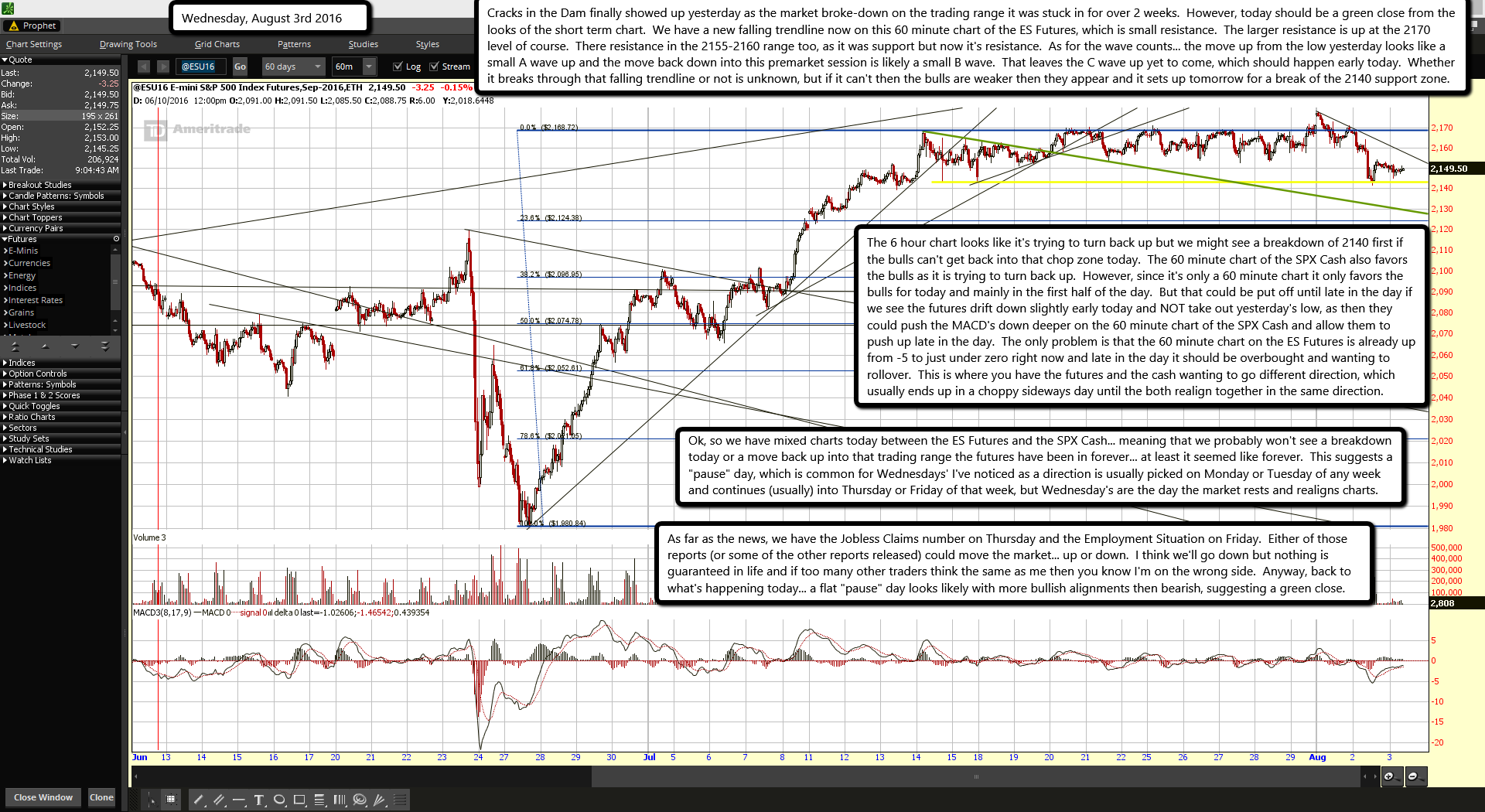
Cracks in the Dam finally showed up yesterday as the market broke-down on the trading range it was stuck in for over 2 weeks.  However, today should be a green close from the looks of the short term chart.  We have a new falling trendline now on this 60 minute chart of the ES Futures, which is small resistance.  The larger resistance is up at the 2170 level of course.  There resistance in the 2155-2160 range too, as it was support but now it's resistance.  As for the wave counts... the move up from the low yesterday looks like a small A wave up and the move back down into this premarket session is likely a small B wave.  That leaves the C wave up yet to come, which should happen early today.  Whether it breaks through that falling trendline or not is unknown, but if it can't then the bulls are weaker then they appear and it sets up tomorrow for a break of the 2140 support zone.

The 6 hour chart looks like it's trying to turn back up but we might see a breakdown of 2140 first if the bulls can't get back into that chop zone today.  The 60 minute chart of the SPX Cash also favors the bulls as it is trying to turn back up.  However, since it's only a 60 minute chart it only favors the bulls for today and mainly in the first half of the day.  But that could be put off until late in the day if we see the futures drift down slightly early today and NOT take out yesterday's low, as then they could push the MACD's down deeper on the 60 minute chart of the SPX Cash and allow them to push up late in the day.  The only problem is that the 60 minute chart on the ES Futures is already up from -5 to just under zero right now and late in the day it should be overbought and wanting to rollover.  This is where you have the futures and the cash wanting to go different direction, which usually ends up in a choppy sideways day until the both realign together in the same direction.

Ok, so we have mixed charts today between the ES Futures and the SPX Cash... meaning that we probably won't see a breakdown today or a move back up into that trading range the futures have been in forever... at least it seemed like forever.  This suggests a "pause" day, which is common for Wednesdays' I've noticed as a direction is usually picked on Monday or Tuesday of any week and continues (usually) into Thursday or Friday of that week, but Wednesday's are the day the market rests and realigns charts.

As far as the news, we have the Jobless Claims number on Thursday and the Employment Situation on Friday.  Either of those reports (or some of the other reports released) could move the market... up or down.  I think we'll go down but nothing is guaranteed in life and if too many other traders think the same as me then you know I'm on the wrong side.  Anyway, back to what's happening today... a flat "pause" day looks likely with more bullish alignments then bearish, suggesting a green close.

Norway to create world’s first floating underwater tunnel (VIDEO)

0
© NPRA

The Norwegian coast may be beautiful but with more than a thousand fjords cutting into it, getting from one place to another often requires lengthy journeys.

Norway’s Public Roads Administration (NPRA) has an ambitious plan to solve the problem by building the world’s first floating submerged tunnel system about 30 meters (100ft) underwater.

© NPRAThe $25 billion project will allow vehicles to travel under the Norwegian Sea avoiding a 21-hour drive along the coastline.


The route from the southern city of Kristiansand to Trondheim in the north currently includes seven ferry crossings. As most of the waterways are wide with the largest a mile deep, it is not feasible to construct a traditional bridge. The tunnel would shorten the trip to just over 10 hours.

The first-of-its kind structure will be made up of two 1,200 meter (4,000ft) curved concrete tubes, floating up to 30 meters (100ft) below the surface. The tubes will be supported by pontoons on the surface and kept stable with connecting trusses. For extra stability, the construction might be bolted to the bedrock as well.

On the surface, there would be wide gaps between the pontoons to allow ferries to pass through.

© NPRA

The first underwater tunnel will connect Oppedal and Lavik, passing through the 1,300 meter (4,300ft) deep, 1,000 meter (3,300ft) wide Sognefjord.

Traveling along the new route would feel like driving through any other tunnel, according to Arianna Minoretti, a senior engineer with the NPRA.

A fjord at sunrise, west of Drammen, Norway © Bob Strong

The submerged construction will be able to cope with rough weather that is typical for the country, according to NPRA. It will also allow easier access to rural communities.

“Having this connection means that people there do not have to wait for a helicopter to go to the hospital,” Minoretti says.

The project is planned to be completed by 2035, and will preserve the landscape for those who still want to take the scenic route, the agency says.

s2Member®