Sunday, October 25, 2026
Home Blog Page 82

Uber fined $900000 in France for running illegal transportation operations with UberPOP

0

Nearly a year after suspending UberPOP in France, Uber will now have to pay a fine. A criminal court in Paris has sanctioned Uber for its UberPOP operations between February 2014 and July 2015. The court is asking for $900,000 (€800,000) — half of it is a suspended sentence. Two of Uber’s executives are also getting fined.

UberPOP has been the most controversial part of Uber in Europe, and many countries have been trying to ban the service. It was banned in Brussels, the Netherlands and, yes, France. But Uber tried to push the limits a bit too much in France.

Last summer, a French anti-Uber protest turned became a guerrilla warfare as taxi drivers were protesting against Uber’s illegal competition with UberPOP.

With UberPOP, anyone could become a driver without any special professional license. Many taxi drivers saw the service as unfair competition. And according to the French law, a service like UberPOP was illegal. So when an UberPOP driver got fined, Uber paid for the fine.

A few days later, in an unrelated investigation, two Uber France executives were arrested for running an illegal taxi company. The two executives were charged with two different allegations.

First, according to them, Uber is running illegal taxi operations. Uber has been struggling with this charge in many countries, starting with the U.S. In 2010, the company had to change its original name from UberCab to Uber as taxi companies didn’t want to create any confusion.

Second, the police said that Uber France was concealing digital documents. It’s hard to tell what the police was looking for when they raided the French office in March 2015. But apparently, some documents were missing and slowed down the investigation.

In July 2015, Uber finally pulled the plug on UberPOP in France — Uber is still operating in France with professional black car drivers.

Uber France CEO Thibaud Simphal and Uber Europe GM Pierre-Dimitri Gore-Coty also got fined by the court in Paris as they’re personally held responsible for UberPOP. They’ll have to pay $34,000 and $23,000 (€30,000 and €20,000). Similarly, half of these fines are suspended sentences.

Uber can still appeal the judgement, but it doesn’t look like UberPOP is coming back in France any time soon. And these fines shouldn’t hurt Uber too much given that the company just raised $3.5 billion.

Source link

Airbnb CEO Chesky vows site overhaul with racism in mind

0

SAN FRANCISCO — Airbnb CEO Brian Chesky opened the company's Open Air technical conference Wednesday by addressing recent racist incidents that have taken place on the $25-billion company's home sharing site.

Beyond expressing outrage at the incidents that have impacted African-Americans and transgender guests, Chesky said the company plans to pursue technological innovations to guard against future discriminatory events.

Chesky did not get specific about what those tech solutions could be, but his presence at the event — which was not listed in the program — speaks to both the urgency and seriousness of the issue for the company. Peer-to-peer start-ups such as Uber and Airbnb rely to an unprecedented degree on individuals behaving in respectable ways. Recent events indicate engineering safeguards against bad behavior may be critical to the continued growth of these businesses.

"There's been a lot of news about prejudice and bias on our platform, and this is a huge issue for us," said Chesky in a brief statement before handing the microphone to vice president of engineering Mike Curtis.

"We have zero tolerance for it and we will take swift action," said Chesky. "In the next months, we will be revisiting the design of our site from end to end to see how we can create a more inclusive platform. We're open to ideas. It's a really, really hard problem and we need help solving it. We want to move this forward. I myself have engaged with people who have been victims of discrimination on the platform. We take this seriously."

Racism represents a new hurdle for the start-up, which to date has been in the news due to its battles with cities such as New York and San Francisco over short-term rental rules. On Tuesday, San Francisco's Board of Supervisors voted unanimously to require short-term rental websites like Airbnb to only post rental listings by residents who have registered with the city. If the city finds the residents haven't registered, Airbnb and rivals face fines up to $1,000 a day, per listing.

San Francisco has a chronic housing shortage and the law is aimed at ensuring that the city's housing stock isn't depleted by landlords who are pulling their residential listings in order to make more money through short-term rentals.

As significant as such zoning issues are for Airbnb, racist hosts could well put a bigger dent in its "Belong Anywhere" slogan. It remains to be seen just how tech innovations can help solve for racist incidents, but Open Air's sessions proposed various ways into the issue with topics such as "Scaling the Human Touch with Machine Learning," "Inequality Across Online and Offline Contexts in the 21st Century" and "Can We Use AI to Achieve Gender Neutrality?"

Rapid advances in machine learning and artificial intelligence suggest that there could be ways to better track racist activity on the site.

On Airbnb, users identify themselves with their real name and a photograph — information some hosts use to avoid renting to African Americans.

A Harvard Business School study found widespread discrimination by Airbnb hosts against guests whose names sounded distinctly black. Black Airbnb users have shared their stories of discrimination under the hashtag #AirbnbWhileBlack, and entrepreneurs have started two temporary lodging services in response to the issue called Noirbnb and Noirebnb. "Noir" is black in French.

An African-American man is suing Airbnb for racial discrimination, alleging it did nothing when he was rejected by a host because of his race. And Airbnb banned a host in North Carolina last week after he used racist language to reject a 28-year-old Nigerian woman trying to reserve his home because she was black.

Earlier this week, Shadi Petosky, a Hollywood producer who identifies as transgender, told USA TODAY that she complained to Airbnb last summer when a Minneapolis "super host" declined her booking because she felt uncomfortable. "They (Airbnb) let it slide," said Petosky.

On Monday, Airbnb said a new program is in the works to recruit more underrepresented minorities in computer science and data science. It also tapped civil rights advocate Laura Murphy, the former head of the American Civil Liberties Union’s Washington D.C. Legislative Office, to help lead a "comprehensive" review of how hosts who rent their homes on Airbnb pick guests.

Curtis noted that "everyday we have the challenge of unconscious bias and other sad realities of the human experience. But we're committed to halting this with every tool at our disposal. Our goal is to create a world where everyone can belong everywhere. We take this seriously and we're taking action. But no one company, and no company at all probably, can solve this problem alone. So we're hoping today we can learn from each other."

As for inclusion within its own walls, Airbnb says it will be conducting a company-wide review of its community that will conclude in September with an eye toward making Airbnb more inclusive. Like most tech companies, Airbnb is staffed mostly by white and Asian males.

"We don't have all the answers, but it's a top priority for us," said David King, Twitter's new director of diversity and belonging. "We're going to train on unconscious bias and intercultural communication with our host community. And we'll examine machine learning models that we can implement to affect change on our platform. We believe smart rules and smart tools can make a difference."

While diversity issues took center stage at the gathering, Airbnb also announced three product additions to its site.

Collaborative Wish Lists allows groups planning a trip to collaborate during the booking process in order to select an option that the group agrees on.

For the 11% of people booking through Airbnb for Business who are booking for someone else, Business Travel Booking allows travel managers and executive assistance greater ease in booking travel for co-workers.

And Multi-Party Reviews is aimed at helping guests establish a reputation with Airbnb hosts, and allows hosts to comment on individual members of a visiting party as opposed to just the person who made the booking.

Source link

ES Morning Update June 9th 2016

0

3adaa20a-0c8c-410a-a4ca-1bc4cd91ad07

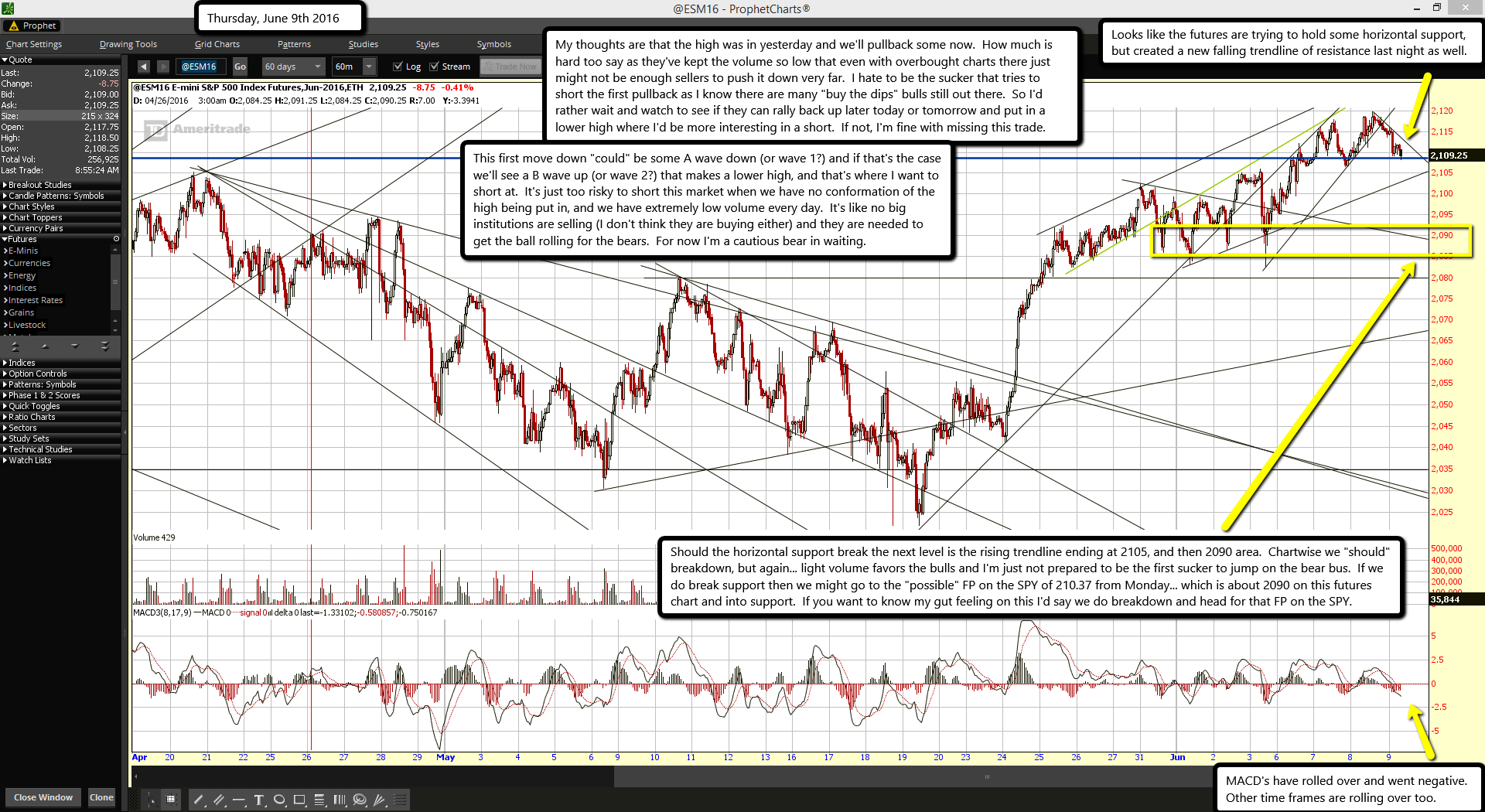
Looks like the futures are trying to hold some horizontal support, but created a new falling trendline of resistance last night as well.

MACD's have rolled over and went negative.  Other time frames are rolling over too.

My thoughts are that the high was in yesterday and we'll pullback some now.  How much is hard too say as they've kept the volume so low that even with overbought charts there just might not be enough sellers to push it down very far.  I hate to be the sucker that tries to short the first pullback as I know there are many "buy the dips" bulls still out there.  So I'd rather wait and watch to see if they can rally back up later today or tomorrow and put in a lower high where I'd be more interesting in a short.  If not, I'm fine with missing this trade.

This first move down "could" be some A wave down (or wave 1?) and if that's the case we'll see a B wave up (or wave 2?) that makes a lower high, and that's where I want to short at.  It's just too risky to short this market when we have no conformation of the high being put in, and we have extremely low volume every day.  It's like no big institutions are selling (I don't think they are buying either) and they are needed to get the ball rolling for the bears.  For now I'm a cautious bear in waiting.

Should the horizontal support break the next level is the rising trendline ending at 2105, and then 2090 area.  Chartwise we "should" breakdown, but again... light volume favors the bulls and I'm just not prepared to be the first sucker to jump on the bear bus.  If we do break support then we might go to the "possible" FP on the SPY of 210.37 from Monday... which is about 2090 on this futures chart and into support.  If you want to know my gut feeling on this I'd say we do breakdown and head for that FP on the SPY.

ES Morning Update June 8th 2016

0

8071c0fc-2656-455d-9b25-4d1a368c58be

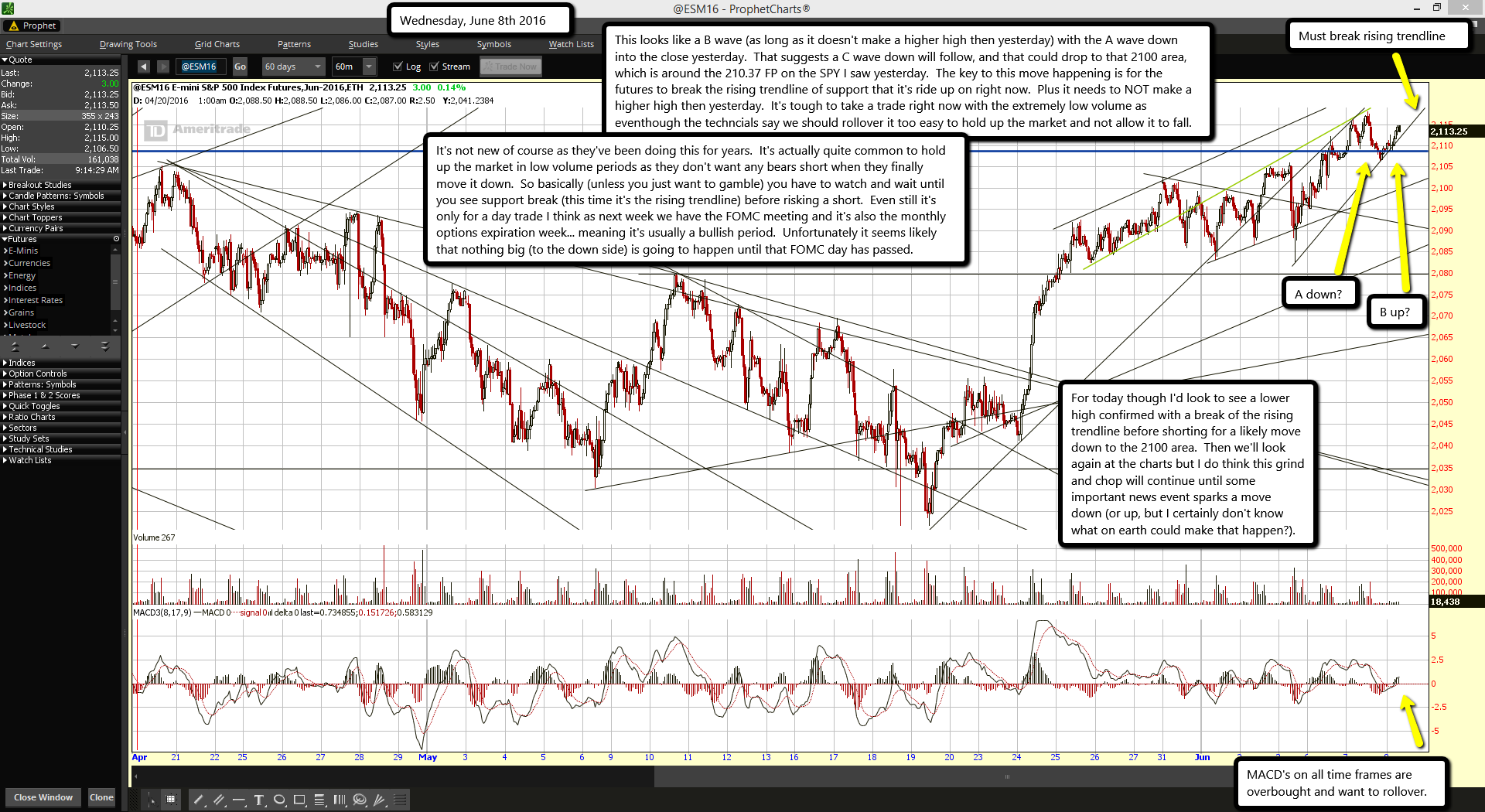
MACD's on all time frames are overbought and want to rollover.

This looks like a B wave (as long as it doesn't make a higher high then yesterday) with the A wave down into the close yesterday.  That suggests a C wave down will follow, and that could drop to that 2100 area, which is around the 210.37 FP on the SPY I saw yesterday.  The key to this move happening is for the futures to break the rising trendline of support that it's ride up on right now.  Plus it needs to NOT make a higher high then yesterday.  It's tough to take a trade right now with the extremely low volume as even-though the techncials say we should rollover it too easy to hold up the market and not allow it to fall.

It's not new of course as they've been doing this for years.  It's actually quite common to hold up the market in low volume periods as they don't want any bears short when they finally move it down.  So basically (unless you just want to gamble) you have to watch and wait until you see support break (this time it's the rising trendline) before risking a short.  Even still it's only for a day trade I think as next week we have the FOMC meeting and it's also the monthly options expiration week... meaning it's usually a bullish period.  Unfortunately it seems likely that nothing big (to the down side) is going to happen until that FOMC day has passed.

For today though I'd look to see a lower high confirmed with a break of the rising trendline before shorting for a likely move down to the 2100 area.  Then we'll look again at the charts but I do think this grind and chop will continue until some important news event sparks a move down (or up, but I certainly don't know what on earth could make that happen?).

ES Morning Update June 7th 2016

0

3fb06ee1-84ff-457b-a6e7-d9f527769640

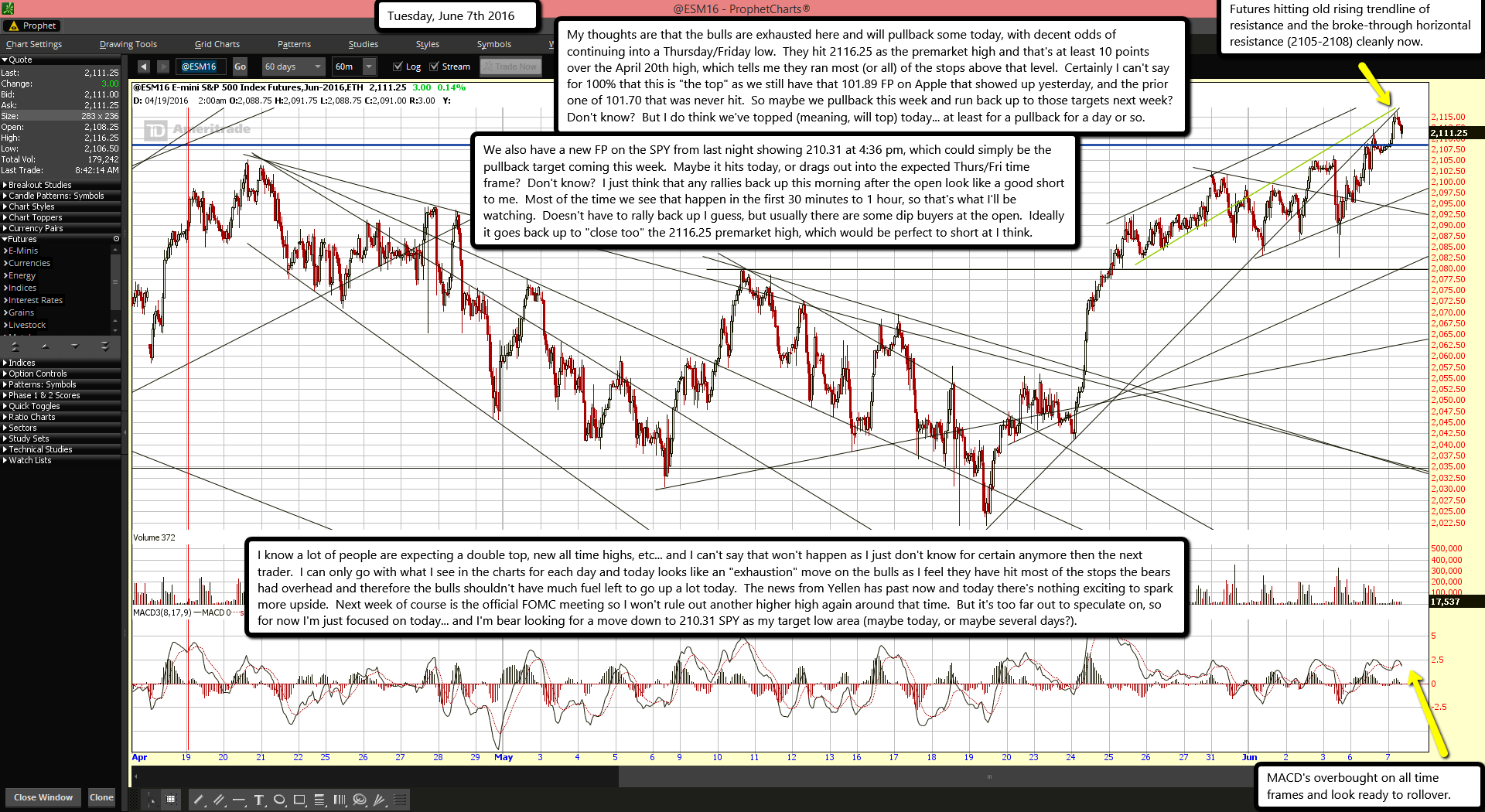
Futures hitting old rising trendline of resistance and the broke-through horizontal resistance (2105-2108) cleanly now.

MACD's overbought on all time frames and look ready to rollover.

My thoughts are that the bulls are exhausted here and will pullback some today, with decent odds of continuing into a Thursday/Friday low.  They hit 2116.25 as the premarket high and that's at least 10 points over the April 20th high, which tells me they ran most (or all) of the stops above that level.  Certainly I can't say for 100% that this is "the top" as we still have that 101.89 FP on Apple that showed up yesterday, and the prior one of 101.70 that was never hit.  So maybe we pullback this week and run back up to those targets next week?  Don't know?  But I do think we've topped (meaning, will top) today... at least for a pullback for a day or so.

We also have a new FP on the SPY from last night showing 210.31 at 4:36 pm, which could simply be the pullback target coming this week.  Maybe it hits today, or drags out into the expected Thurs/Fri time frame?  Don't know?  I just think that any rallies back up this morning after the open look like a good short to me.  Most of the time we see that happen in the first 30 minutes to 1 hour, so that's what I'll be watching.  Doesn't have to rally back up I guess, but usually there are some dip buyers at the open.  Ideally it goes back up to "close too" the 2116.25 premarket high, which would be perfect to short at I think.

I know a lot of people are expecting a double top, new all time highs, etc... and I can't say that won't happen as I just don't know for certain anymore then the next trader.  I can only go with what I see in the charts for each day and today looks like an "exhaustion" move on the bulls as I feel they have hit most of the stops the bears had overhead and therefore the bulls shouldn't have much fuel left to go up a lot today.  The news from Yellen has past now and today there's nothing exciting to spark more upside.  Next week of course is the official FOMC meeting so I won't rule out another higher high again around that time.  But it's too far out to speculate on, so for now I'm just focused on today... and I'm bear looking for a move down to 210.31 SPY as my target low area (maybe today, or maybe several days?).

ES Morning Update June 6th 2016

0

3cf6a80d-0b2a-442f-b1e2-e3433531f10b

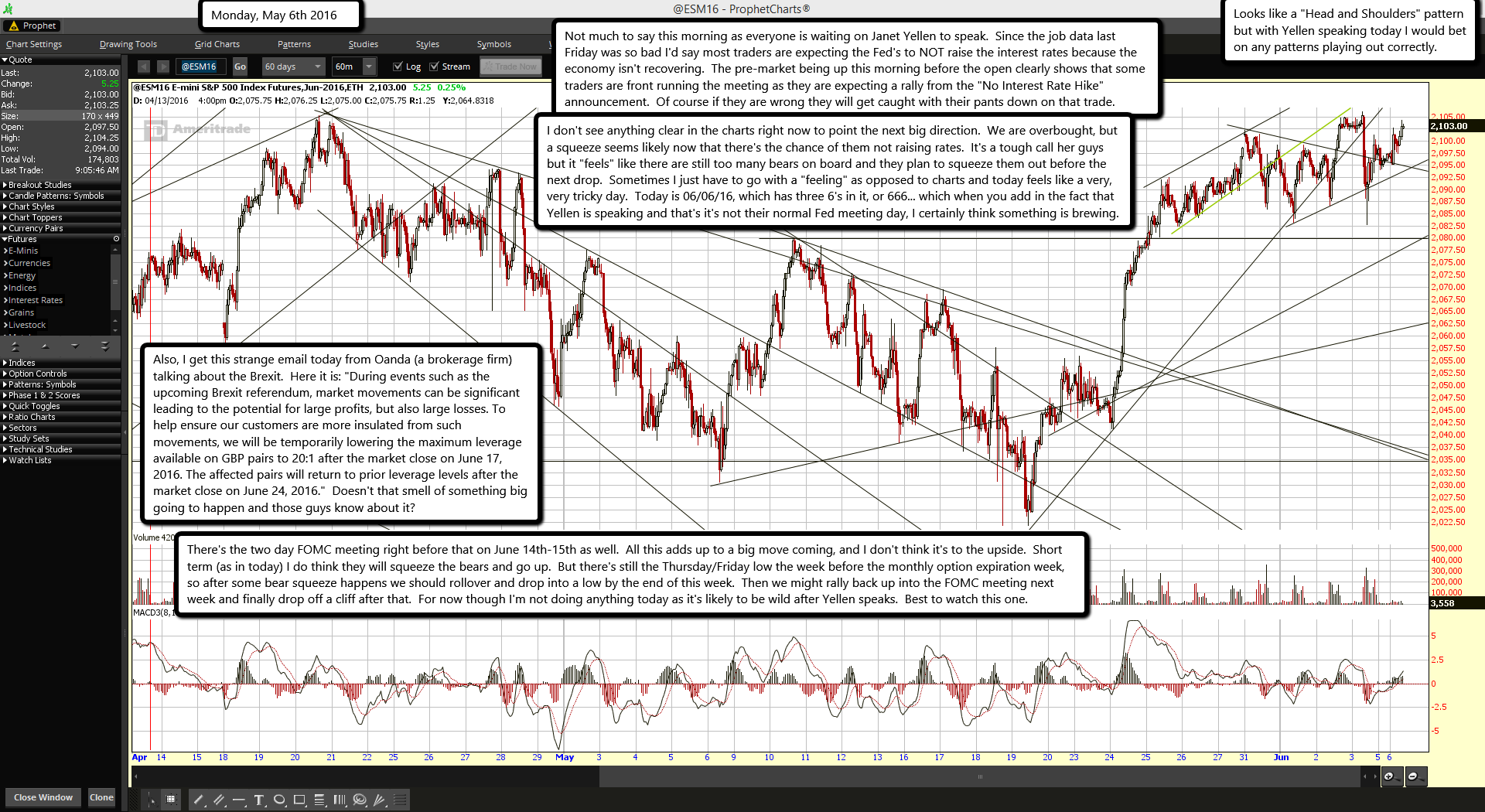
Looks like a "Head and Shoulders" pattern but with Yellen speaking today I would bet on any patterns playing out correctly.

MACD's pointing up on this 60 minute chart and several other time frames as well.

Not much to say this morning as everyone is waiting on Janet Yellen to speak.  Since the job data last Friday was so bad I'd say most traders are expecting the Fed's to NOT raise the interest rates because the economy isn't recovering.  The pre-market being up this morning before the open clearly shows that some traders are front running the meeting as they are expecting a rally from the "No Interest Rate Hike" announcement.  Of course if they are wrong they will get caught with their pants down on that trade.

I don't see anything clear in the charts right now to point the next big direction.  We are overbought, but a squeeze seems likely now that there's the chance of them not raising rates.  It's a tough call her guys but it "feels" like there are still too many bears on board and they plan to squeeze them out before the next drop.  Sometimes I just have to go with a "feeling" as opposed to charts and today feels like a very, very tricky day.  Today is 06/06/16, which has three 6's in it, or 666... which when you add in the fact that Yellen is speaking and that's it's not their normal Fed meeting day, I certainly think something is brewing.

Also, I get this strange email today from Oanda (a brokerage firm) talking about the Brexit.  Here it is: "During events such as the upcoming Brexit referendum, market movements can be significant leading to the potential for large profits, but also large losses. To help ensure our customers are more insulated from such movements, we will be temporarily lowering the maximum leverage available on GBP pairs to 20:1 after the market close on June 17, 2016. The affected pairs will return to prior leverage levels after the market close on June 24, 2016."  Doesn't that smell of something big going to happen and those guys know about it?

There's the two day FOMC meeting right before that on June 14th-15th as well.  All this adds up to a big move coming, and I don't think it's to the upside.  Short term (as in today) I do think they will squeeze the bears and go up.  But there's still the Thursday/Friday low the week before the monthly option expiration week, so after some bear squeeze happens we should rollover and drop into a low by the end of this week.  Then we might rally back up into the FOMC meeting next week and finally drop off a cliff after that.  For now though I'm not doing anything today as it's likely to be wild after Yellen speaks.  Best to watch this one.

JPMorgan Chase Embraces Business Casual

0

The relaxed dress code at JPMorgan Chase reflects the informal style of the technology industry, which now competes with Wall Street companies for recruits.

Wall Street may be known as the home of one of the most buttoned-up industries in the country, but JPMorgan Chase is letting its employees relax a little bit.

The firm told its 237,420 workers on Friday that it was making business casual its everyday dress code, according to an internal memorandum reviewed by DealBook.

The move makes JPMorgan the latest company to acquiesce to the more casual nature of today’s work. Even the most staid of corporations, including General Electric and IBM, have moved away from uniforms of white shirts and dark ties. It is also a nod to the informal style of the tech industry, which has been successful in recruiting workers who might have once preferred more traditional careers.

The tech industry and Silicon Valley have influenced Wall Street fashion in the past, when an earlier generation of dot-com start-ups burned bright. For proof of today’s impact, look at how G.E. is trying to court software developers — not exactly known for wearing double-breasted blazers — in some of its latest commercials.

“More clients are dressing informally, and many parts of our business are already business casual,” JPMorgan’s operating committee wrote in the memo, which was reported on Friday by The Wall Street Journal. “And while it may not be possible to dress business casual at all times or in all areas, we believe having a firmwide guideline is the right thing to do.”

JPMorgan employees have been dressing slightly more casually in recent years, sometimes drawing inspiration from their leadership. Jamie Dimon, the bank’s chief executive, went tieless at a meeting with employees in Bournemouth, England, on Friday. Joining him in the business casual look was George Osborne, the British chancellor of the Exchequer.

Information technology workers and other behind-the-scenes employees already dress more informally. And bankers in certain regions, like Silicon Valley, sometimes wear khakis and sweaters in lieu of Ermenegildo Zegna suits or Diane von Furstenberg dresses. Even the company’s most traditional of deal makers, the former vice chairman James B. Lee Jr. — known for his slicked-back hair and business shirts with white collars and cuffs — directed his bankers to dress in hoodies during the run-up to Facebook’s initial public offering of stock.

Do not expect bankers to switch out their hand-tailored suits for worn denim at their next meeting with a titan of industry as a matter of course, however. The memo specifies that employees should “dress for that client” — which still gives deal makers some sartorial leeway if they are meeting with, say, a technology entrepreneur used to wearing hoodies and sneakers.

And denim generally isn’t considered appropriate, unless the employee has permission to wear it.

Employees at bank branches still need to wear specific Chase apparel, unless the managers have specifically allowed otherwise.

If employees try to push the boundaries of the dress code, they do so at their peril. A set of frequently asked questions about corporate attire warns that if employees are not dressed appropriately, they “may be subject to disciplinary action, up to and including termination of employment.”

Here is what is considered acceptable under JPMorgan’s new guidelines:

• Formal business attire

• Casual pants, capri pants, dresses and skirts of appropriate length for the workplace

• Business-appropriate casual shirts, polo shirts, sweaters, tops and blouses (including JPMorgan or Chase-branded apparel, naturally)

• Dress shoes and dress sandals

• Minimal, tasteful jewelry and fragrances

And here is what is forbidden, even in a casual environment:

• Athletic clothing — sweatpants, sweatshirts, T-shirts, jumpsuits, yoga pants or leggings (the last of which is helpfully defined as “tightfitting stretch pants”)

• Shorts, beachwear, halter tops, tank tops or crop tops

• Flip-flops, clogs, rubber-soled floater sandals or slippers

• Hats or hoods

• Distracting, tight, revealing or exceptionally loose or low-cut clothing

• Torn or frayed clothing or clothing attachments that have profane, offensive or religious messages

• Offensive or distracting visible tattoos, body piercings or unprofessional hair styles

Source link

Investors wait for Yellen speech

0

Federal Reserve Chair Janet Yellen speaks at the Radcliffe Institute for Advanced Studies at Harvard University in Cambridge, Massachusetts, U.S. May 27, 2016. REUTERS/Brian Snyder

With the pace of US job creation slowing to the lowest level since 2010 investors turn their attention to Federal Reserve chair Janet Yellen for clues on the timing of the next interest rate rise. Here’s what to watch in the coming days:

Investors will tune in to Ms Yellen’s speech to the World Affairs Council of Philadelphia on Monday as they continue to digest Friday’s disappointing jobs report. “Markets will be waiting with bated breath to see whether she strikes a more hawkish tone or one of continued cautiousness ahead of the June FOMC meeting,” said economists at Bank of America.

Following weak job growth numbers, expectations for a rate rise in June slid to just 2 per cent, while odds of a move in July nearly halved to 27.5 per cent from a day earlier, according to Bloomberg calculations of movements in federal funds futures.

The slow pace of hiring comes in contrast to recent hawkish commentary from a handful of Fed officials and from comments in the latest Beige Book, which indicated “tight labour markets were widely noted” across the 12 reporting districts.

Investors will also keep an eye on the Jolts report that Ms Yellen tracks. Economists expect there were 5.65m job openings in April, down from 5.76m the previous month.

On the political front investors will keep an eye on US presidential primaries and caucuses in California, Montana, New Jersey, and New Mexico among others.

Some 475 delegates are at stake in the Democratic primary in California where former secretary of state Hillary Clinton will take on Vermont senator Bernie Sanders. According to an average of recent polls compiled by Real Clear Politics, Mrs Clinton has just a 1.5 percentage point lead over her Republican opponent Donald Trump.

Mrs Clinton has accused Mr Trump of pushing a “dangerously incoherent” foreign policy and having a temperament that risked involving the US in a nuclear war.

Geopolitics in the South China Sea, cyber security and economic co-operation are all subjects that Treasury secretary Jacob Lew and secretary of state John Kerry will discuss when they visit Beijing next week.

 
Source link

ES Morning Update June 3rd 2016

0

6c0d2771-97e2-4595-a47c-54d3dab4a0b2

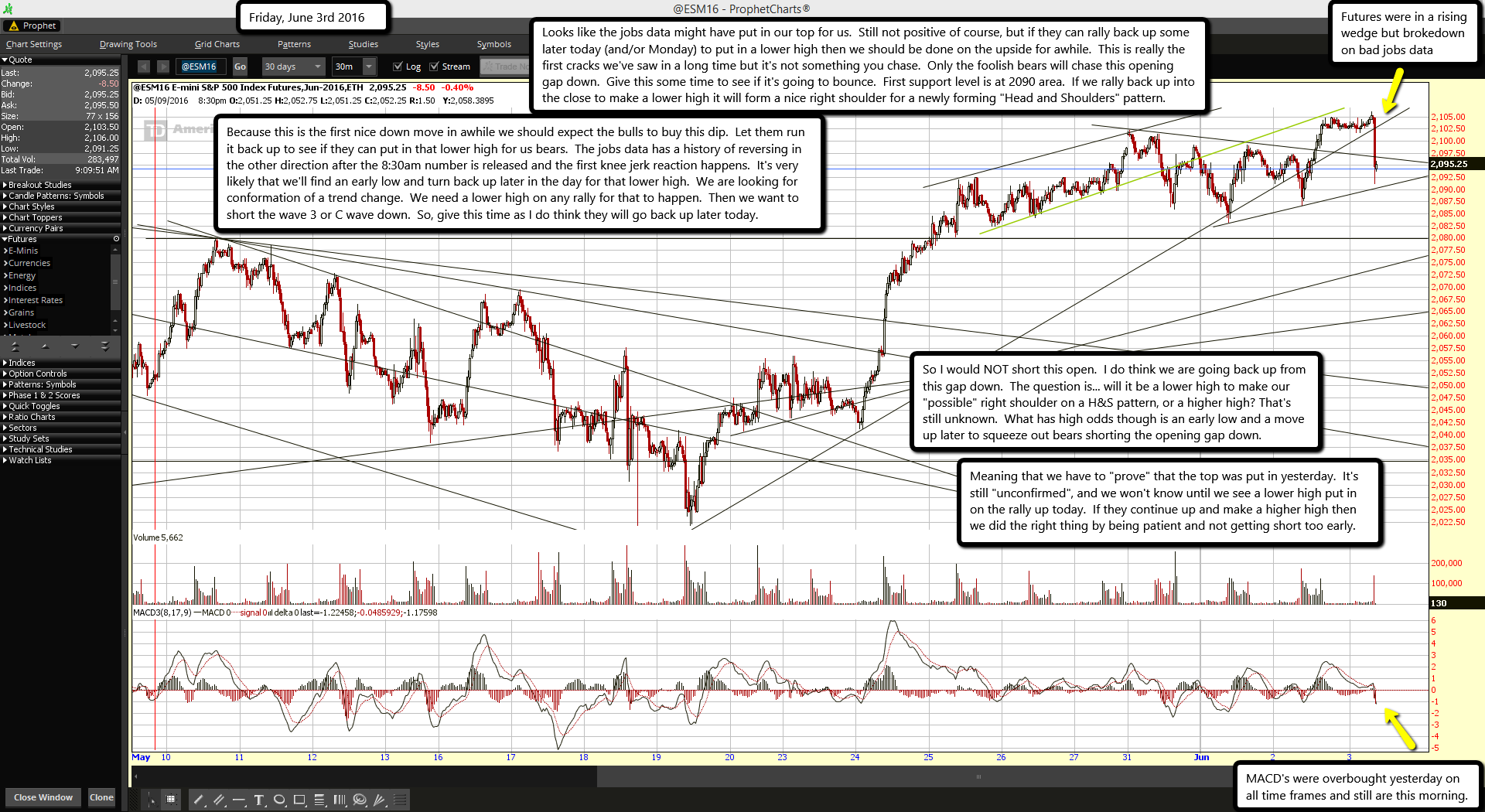
Futures were in a rising wedge but brokedown on bad jobs data

MACD's were overbought yesterday on all time frames and still are this morning.

Looks like the jobs data might have put in our top for us.  Still not positive of course, but if they can rally back up some later today (and/or Monday) to put in a lower high then we should be done on the upside for awhile.  This is really the first cracks we've saw in a long time but it's not something you chase.  Only the foolish bears will chase this opening gap down.  Give this some time to see if it's going to bounce.  First support level is at 2090 area.  If we rally back up into the close to make a lower high it will form a nice right shoulder for a newly forming "Head and Shoulders" pattern.

Because this is the first nice down move in awhile we should expect the bulls to buy this dip.  Let them run it back up to see if they can put in that lower high for us bears.  The jobs data has a history of reversing in the other direction after the 8:30am number is released and the first knee jerk reaction happens.  It's very likely that we'll find an early low and turn back up later in the day for that lower high.  We are looking for conformation of a trend change.  We need a lower high on any rally for that to happen.  Then we want to short the wave 3 or C wave down.  So, give this time as I do think they will go back up later today.

So I would NOT short this open.  I do think we are going back up from this gap down.  The question is... will it be a lower high to make our "possible" right shoulder on a H&S pattern, or a higher high? That's still unknown.  What has high odds though is an early low and a move up later to squeeze out bears shorting the opening gap down.

Meaning that we have to "prove" that the top was put in yesterday.  It's still "unconfirmed", and we won't know until we see a lower high put in on the rally up today.  If they continue up and make a higher high then we did the right thing by being patient and not getting short too early.

ES Morning Update June 2nd 2016

0

cb5d51ce-9af9-4a85-a64a-4bad085ef522

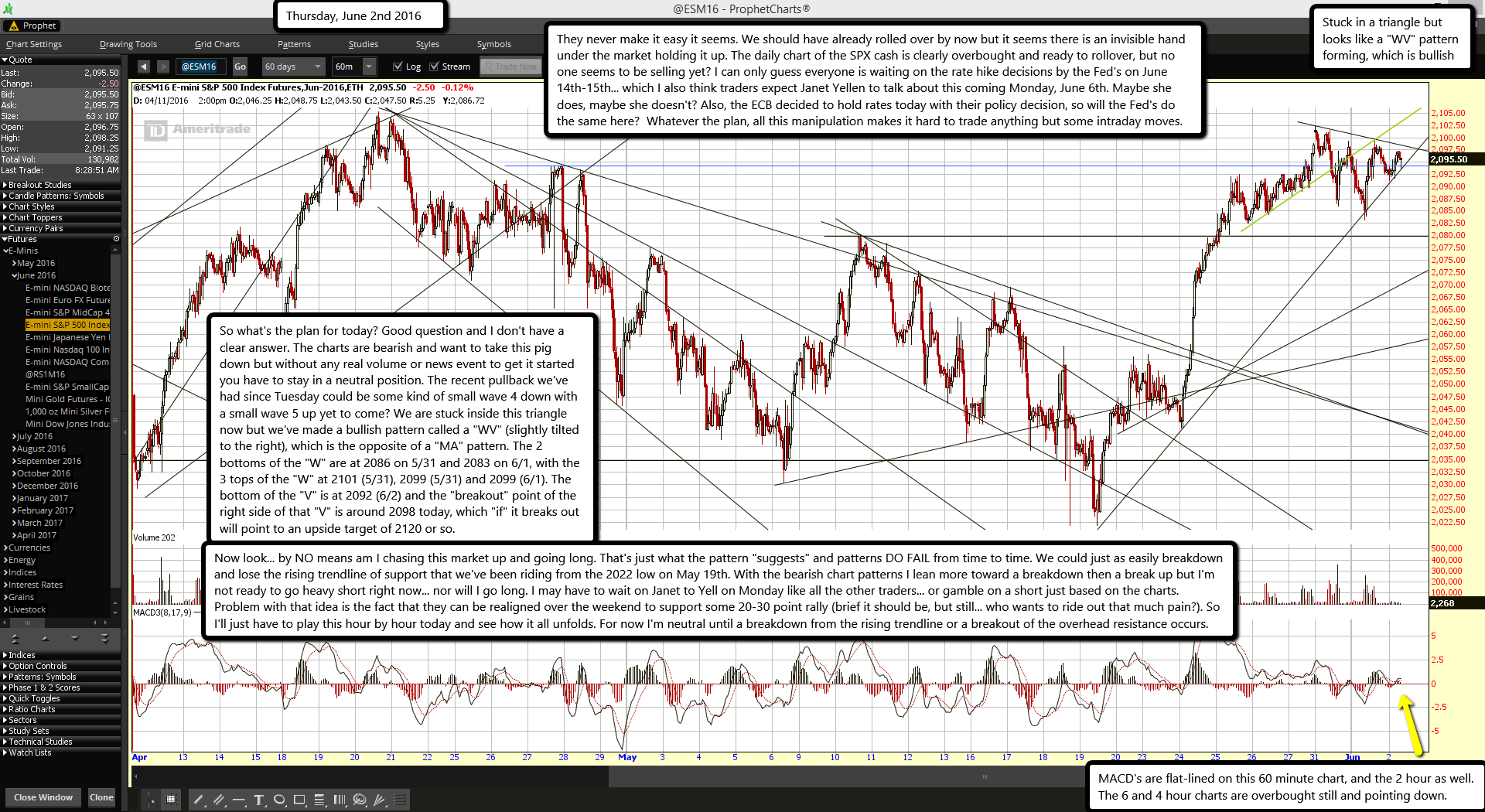
Stuck in a triangle but looks like a "WV" pattern forming, which is bullish

MACD's are flat-lined on this 60 minute chart, and the 2 hour as well. The 6 and 4 hour charts are overbought still and pointing down.

They never make it easy it seems. We should have already rolled over by now but it seems there is an invisible hand under the market holding it up. The daily chart of the SPX cash is clearly overbought and ready to rollover, but no one seems to be selling yet? I can only guess everyone is waiting on the rate hike decisions by the Fed's on June 14th-15th... which I also think traders expect Janet Yellen to talk about this coming Monday, June 6th. Maybe she does, maybe she doesn't? Also, the ECB decided to hold rates today with their policy decision, so will the Fed's do the same here?  Whatever the plan, all this manipulation makes it hard to trade anything but some intraday moves.

So what's the plan for today? Good question and I don't have a clear answer. The charts are bearish and want to take this pig down but without any real volume or news event to get it started you have to stay in a neutral position. The recent pullback we've had since Tuesday could be some kind of small wave 4 down with a small wave 5 up yet to come? We are stuck inside this triangle now but we've made a bullish pattern called a "WV" (slightly tilted to the right), which is the opposite of a "MA" pattern. The 2 bottoms of the "W" are at 2086 on 5/31 and 2083 on 6/1, with the 3 tops of the "W" at 2101 (5/31), 2099 (5/31) and 2099 (6/1). The bottom of the "V" is at 2092 (6/2) and the "breakout" point of the right side of that "V" is around 2098 today, which "if" it breaks out will point to an upside target of 2120 or so.

Now look... by NO means am I chasing this market up and going long. That's just what the pattern "suggests" and patterns DO FAIL from time to time. We could just as easily breakdown and lose the rising trendline of support that we've been riding from the 2022 low on May 19th. With the bearish chart patterns I lean more toward a breakdown then a break up but I'm not ready to go heavy short right now... nor will I go long. I may have to wait on Janet to Yell on Monday like all the other traders... or gamble on a short just based on the charts. Problem with that idea is the fact that they can be realigned over the weekend to support some 20-30 point rally (brief it should be, but still... who wants to ride out that much pain?). So I'll just have to play this hour by hour today and see how it all unfolds. For now I'm neutral until a breakdown from the rising trendline or a breakout of the overhead resistance occurs.

ES Morning Update June 1st 2016

0

9b5fe92c-f9eb-4cdd-aa29-279421ce5268

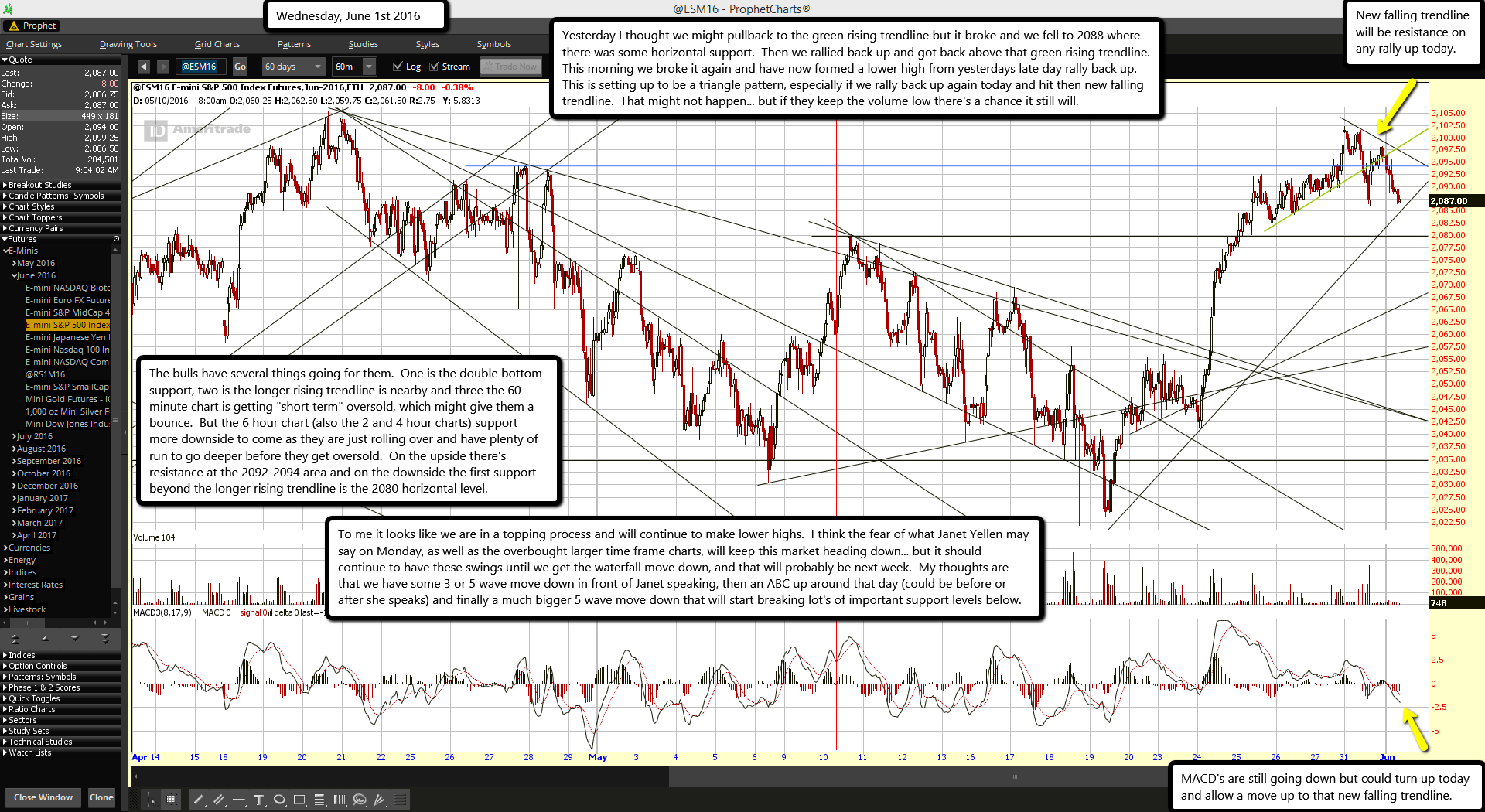
New falling trendline will be resistance on any rally up today.

MACD's are still going down but could turn up today and allow a move up to that new falling trendline.

Yesterday I thought we might pullback to the green rising trendline but it broke and we fell to 2088 where there was some horizontal support.  Then we rallied back up and got back above that green rising trendline.  This morning we broke it again and have now formed a lower high from yesterdays late day rally back up.  This is setting up to be a triangle pattern, especially if we rally back up again today and hit then new falling trendline.  That might not happen... but if they keep the volume low there's a chance it still will.

The bulls have several things going for them.  One is the double bottom support, two is the longer rising trendline is nearby and three the 60 minute chart is getting "short term" oversold, which might give them a bounce.  But the 6 hour chart (also the 2 and 4 hour charts) support more downside to come as they are just rolling over and have plenty of run to go deeper before they get oversold.  On the upside there's resistance at the 2092-2094 area and on the downside the first support beyond the longer rising trendline is the 2080 horizontal level.

To me it looks like we are in a topping process and will continue to make lower highs.  I think the fear of what Janet Yellen may say on Monday, as well as the overbought larger time frame charts, will keep this market heading down... but it should continue to have these swings until we get the waterfall move down, and that will probably be next week.  My thoughts are that we have some 3 or 5 wave move down in front of Janet speaking, then an ABC up around that day (could be before or after she speaks) and finally a much bigger 5 wave move down that will start breaking lot's of important support levels below.

ES Morning Update May 31st 2016

0

d7691f6a-8fa4-4d88-a413-d33dabdfa1bd

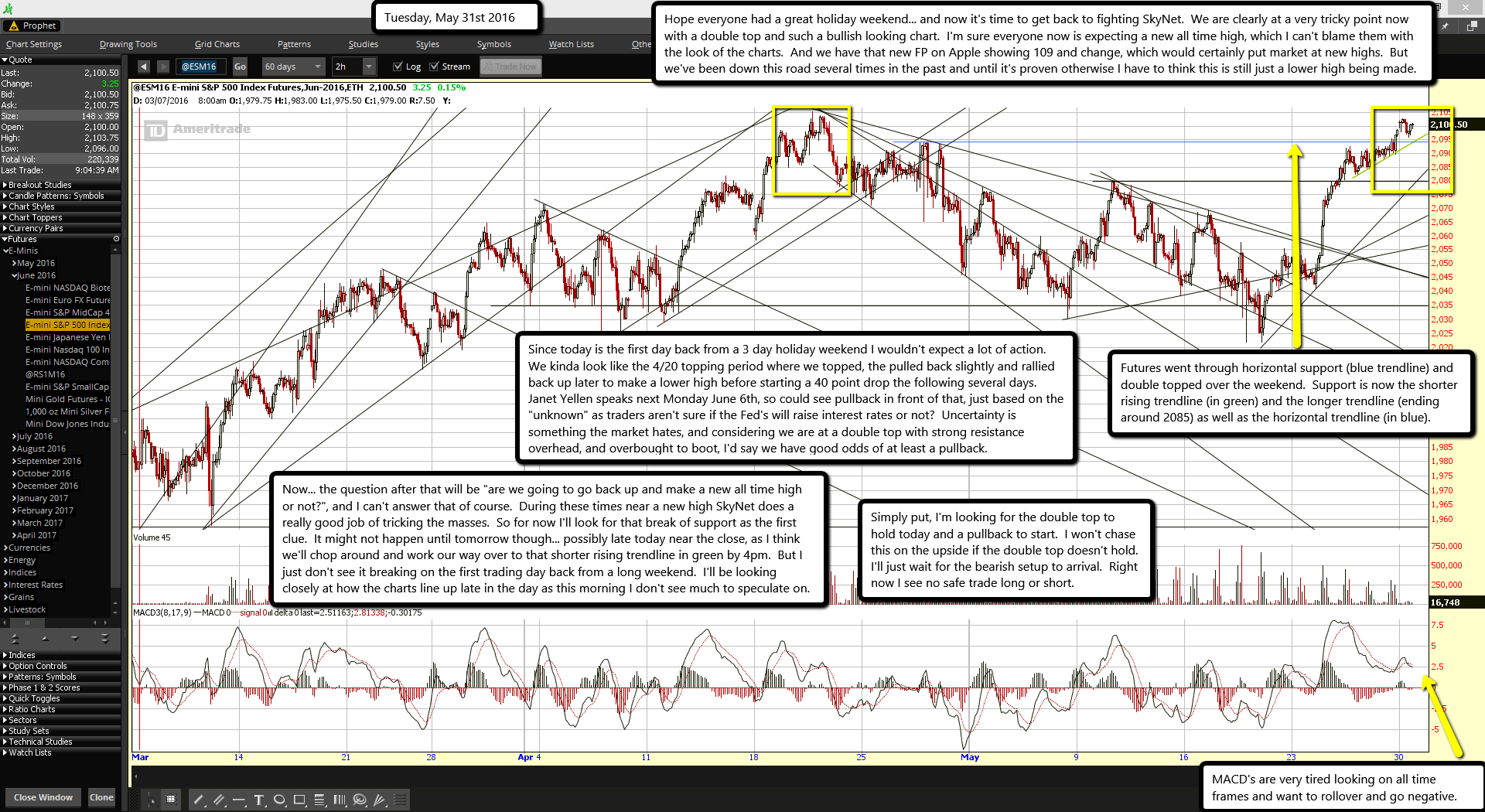
Futures went through horizontal support (blue trendline) and double topped over the weekend.  Support is now the shorter rising trendline (in green) and the longer trendline (ending around 2085) as well as the horizontal trendline (in blue).

MACD's are very tired looking on all time frames and want to rollover and go negative.

Hope everyone had a great holiday weekend... and now it's time to get back to fighting SkyNet.  We are clearly at a very tricky point now with a double top and such a bullish looking chart.  I'm sure everyone now is expecting a new all time high, which I can't blame them with the look of the charts.  And we have that new FP on Apple showing 109 and change, which would certainly put market at new highs.  But we've been down this road several times in the past and until it's proven otherwise I have to think this is still just a lower high being made.

Since today is the first day back from a 3 day holiday weekend I wouldn't expect a lot of action.  We kinda look like the 4/20 topping period where we topped, the pulled back slightly and rallied back up later to make a lower high before starting a 40 point drop the following several days.  Janet Yellen speaks next Monday June 6th, so could see pullback in front of that, just based on the "unknown" as traders aren't sure if the Fed's will raise interest rates or not?  Uncertainty is something the market hates, and considering we are at a double top with strong resistance overhead, and overbought to boot, I'd say we have good odds of at least a pullback.

Now... the question after that will be "are we going to go back up and make a new all time high or not?", and I can't answer that of course.  During these times near a new high SkyNet does a really good job of tricking the masses.  So for now I'll look for that break of support as the first clue.  It might not happen until tomorrow though... possibly late today near the close, as I think we'll chop around and work our way over to that shorter rising trendline in green by 4pm.  But I just don't see it breaking on the first trading day back from a long weekend.  I'll be looking closely at how the charts line up late in the day as this morning I don't see much to speculate on.

Simply put, I'm looking for the double top to hold today and a pullback to start.  I won't chase this on the upside if the double top doesn't hold.  I'll just wait for the bearish setup to arrival.  Right now I see no safe trade long or short.

French police raid Google over tax issue; Monsanto rejects Bayer’s takeover bid

0
A police car is seen outside the Paris offices of Google as French police carry out a search as part of a tax fraud investigation.
TECHNOLOGY French police raid Google over tax issue
Police raided Google’s French headquarters Tuesday looking for evidence of “aggravated tax fraud,” one of Europe’s most conspicuous attempts yet to cast a U.S. technology leader as a manipulative scofflaw.

The probe reflects European indignation looming over Google and other U.S. tech companies as they amass huge amounts of cash while cutting their tax bills through complex maneuvers that shield their profits.

Google issued a statement Tuesday maintaining that it complies with all laws. The company, owned by Alphabet, also said it is cooperating with the French investigation.

Other major tech companies, including Apple and Facebook, also have been skewered in Europe for scrimping on their tax bills. At the end of last year, the U.S. technology sector had stockpiled $777 billion in cash, nearly half of the $1.68 trillion held by non-financial companies in the country, reported a study by Moody’s Investors Service.

Nearly 90 percent of the cash held by five tech companies is being kept in overseas accounts.

France’s investigation is focused on an Ireland subsidiary that enables Google to do business with customers across Europe while minimizing its taxes, known as profit-shifting. European regulators have been pressing companies to pay taxes in the jurisdictions in which they do business.

An anti-corruption unit and 25 information technology experts descended on Google’s Paris office, according to France’s financial prosecutor’s office. French daily Le Parisien said the raid took place at dawn and involved about 100 investigators.

— Associated Press

ACQUISITIONS

Monsanto rejects Bayer’s takeover bid

Monsanto rejected a $62 billion takeover offer from Bayer as too low, while saying it remains open to further deal talks, putting pressure on the German pharmaceutical giant to raise a bid that has already sent its stock tumbling.

“We believe in the substantial benefits an integrated strategy could provide to growers and broader society, and we have long respected Bayer’s business,” Hugh Grant, chief executive of the U.S. seeds company, said in a statement Tuesday. “However, the current proposal significantly undervalues our company and also does not adequately address or provide reassurance for some of the potential financing and regulatory execution risks related to the acquisition.”

Bayer will likely come back with a higher bid, Jonas Oxgaard, an analyst with Sanford C. Bernstein & Co. in New York, said in a note, adding that an offer below $135 per share would be “challenging” for Monsanto to accept.

Buying Monsanto would create the world’s biggest supplier of farm chemicals and seeds.

Also in Business

Source link

Redstone’s Great-Grandchildren Added to Suit

0

Sumner M. Redstone and Phyllis Redstone, then his wife, in 1998.

If you are a Redstone, apparently, you are never too young or too old to be part of a lawsuit.

In new court documents filed Wednesday, directors of National Amusements added Sumner M. Redstone’s two great-grandchildren as so-called nominal defendants to their suit challenging his mental capacity. They also added Phyllis Redstone, 91, as a nominal defendant. She was the first wife of Mr. Redstone, the ailing media mogul. The two divorced after 52 years of marriage.

As nominal defendants, the two children and Phyllis Redstone do not bear any responsibility or fault. They were named in the suit because they are among the beneficiaries of the trust that will control the fate of Mr. Redstone’s $40 billion empire after he dies or is declared incompetent.

The ages of the children are not clear, but both are younger than 6. They are grandchildren of Mr. Redstone’s daughter, Shari Redstone.

Also on Wednesday, lawyers for Philippe P. Dauman, the chief executive of Viacom, and George S. Abrams, a longtime Viacom director, filed a motion with Norfolk Probate and Family Court in Massachusetts to expedite proceedings in the case.

The two men claim in the suit, which was filed Monday, that Mr. Redstone was not competent and was manipulated by his daughter last week when he ejected them from the trust and the board of National Amusements, the private theater chain that controls 80 percent of the voting stock in Viacom and CBS. Lawyers for Mr. Redstone have filed a separate petition in Los Angeles County Superior Court, asking that a judge declare the decisions valid.

Wednesday’s amended complaint included the accusation that Ms. Redstone has “frequently repeated to the Viacom board” that Mr. Dauman should be replaced, as part of her continuing rivalry with him.

In a separate court filing on Wednesday, Mr. Dauman and Mr. Abrams requested a hearing for the earliest available date and that the process of obtaining evidence start immediately.

Rapid legal proceedings were necessary, they said, to protect the assets of the trust and because of what they characterized as the rapid deterioration of Mr. Redstone’s physical and mental health. Mr. Redstone will turn 93 on Friday.

Mr. Dauman and Mr. Abrams proposed that evidence gathering include at least one medical examination of Mr. Redstone and taking the testimony of Shari Redstone. The entire process should be completed within three months, they suggested.

“The substantial assets in the trust are threatened by Shari’s invalid attempt to take over the trust and its controlling interest in NAI,” the motion for expedited proceedings stated, referring to National Amusements. “There can be no doubt that these actions are aimed directly at effectuating control of Viacom.”

Nancy Sterling, a spokeswoman for Shari Redstone, said in a statement, “We are looking forward to an expedited dismissal of this meritless suit.”

Representatives for Mr. Redstone could not immediately be reached for comment.

Mr. Dauman and Mr. Abrams also asked for a trial to be held in no more than four months, or before the end of September. If a judge concurs, that would mean that the Massachusetts proceedings would occur before the Oct. 18 hearing date set for Mr. Redstone’s petition.

Separately, Frederic Salerno, the lead independent director of Viacom put in a new request on Thursday to schedule a meeting with Mr. Redstone. In an email to one of Mr. Redstone’s lawyers, Mr. Salerno outlined an agenda for the meeting: 1. Greetings and pleasantries; 2. A Q&A session on Mr. Redstone’s thought on last week’s board strategy meeting and Paramount; 3. Anything else Mr. Redstone wanted to share; 4. Goodbyes.

Source link

Billionaire Peter Thiel funded Hulk Hogan lawsuit to take down Gawker

0

UPDATE: Gawker responded Thursday afternoon, saying Silicon Valley needs a watchdog, and Gawker Media was the right outlet for the job.

"The refusal to engage in public relations or access journalism—the refusal to lubricate the flow of venture capital—is usually the mark of an outlet’s credibility. For Thiel and his peers in Silicon Valley, such a refusal amounts to repudiating their way of life," Gawker wrote.

END UPDATE:

Wednesday was not a good day for Gawker Media: first, a Florida judge refused to reduce the $140 million in damages awarded by a jury in the invasion-of-privacy suit brought by professional wrestler Hulk Hogan against Gawker for posting a sex tape. The judge then refused to order a new trial.

Ars had described the March verdict as a "life threatening" event for the New York-based network of news and gossip sites. Now it has been revealed that Silicon Valley venture capitalist Peter Thiel, who a decade ago was outed as being "totally gay" by Gawker's now-defunct Valleywag site, has bankrolled Hulk Hogan's litigation.

"It’s less about revenge and more about specific deterrence," Thiel told The New York Times. "I saw Gawker pioneer a unique and incredibly damaging way of getting attention by bullying people even when there was no connection with the public interest."

Thiel, whose net worth is estimated at $2.7 billion, cofounded PayPal and invested early in Facebook. According to Thiel's Wednesday interview:

Mr. Thiel said that Gawker published articles that were “very painful and paralyzing for people who were targeted.” He said, “I thought it was worth fighting back.”

Mr. Thiel added: “I can defend myself. Most of the people they attack are not people in my category. They usually attack less prominent, far less wealthy people that simply can’t defend themselves.” He said that “even someone like Terry Bollea who is a millionaire and famous and a successful person didn’t quite have the resources to do this alone.”

Mr. Thiel said that he had decided several years ago to set his plan in motion. “I didn’t really want to do anything,” he said. “I thought it would do more harm to me than good. One of my friends convinced me that if I didn’t do something, nobody would.”

Mr. Thiel has donated money to the Committee to Protect Journalists and has often talked about protecting freedom of speech. He said he did not believe his actions were contradictory. “I refuse to believe that journalism means massive privacy violations,” he said. “I think much more highly of journalists than that. It’s precisely because I respect journalists that I do not believe they are endangered by fighting back against Gawker.”

Gawker now hopes the verdict would be overturned on appeal. Gawker Media's properties are valued at an estimated $83 million.

Judge Pamela Campbell also denied Gawker's request Wednesday to demand Hulk Hogan's legal team provide documents about Thiel's involvement.

The Thiel financing revelation highlights a dark side of litigation financing. There are numerous venture-backed companies that invest in litigation to profit on payouts, especially in the product liability and personal injury fields. But this is the first time we've seen a venture capitalist financing litigation out of what appears to be spite.

Source link

Report: US Nuclear System Relies On Outdated Technology Such As Floppy Disks

0

Members of the 320th Missile Squadron missile combat crew, work through a scenario in the 90th Operations Support Squadron's Missile Procedure Trainer on F.E. Warren Air Force Base, Wyo., in June 2014. The MPT is a simulator which allows missile crews to practice contingencies they might face while on alert.

Members of the 320th Missile Squadron missile combat crew, work through a scenario in the 90th Operations Support Squadron's Missile Procedure Trainer on F.E. Warren Air Force Base, Wyo., in June 2014. The MPT is a simulator which allows missile crews to practice contingencies they might face while on alert.

The U.S. nuclear weapons system still runs on a 1970s-era computing system that uses 8-inch floppy disks, according to a newly released report from the Government Accountability Office.

That's right. It relies on memory storage that hasn't been commonly used since the 1980s and a computing system that looks like this:

The Department of Defense Air Force Strategic Automated Command and Control System, as pictured in the Government Accountability Office report.

Beyond the nuclear program, much of the technology used by the federal government is woefully outmoded, the report says. About 75 percent of the government's information technology budget goes toward operations and maintenance, rather than development, modernization and enhancement.

"Clearly, there are billions wasted," GAO information technology expert David Powner said at a congressional hearing Wednesday, The Associated Press reports.

The GAO report found that the Pentagon's Strategic Automated Command and Control System — which "coordinates the operational functions of the United States' nuclear forces, such as intercontinental ballistic missiles, nuclear bombers, and tanker support aircrafts" — runs on a IBM Series/1 Computer, first introduced in 1976.

The system's primary function is to "send and receive emergency action messages to nuclear forces," the report adds, but "replacement parts for the system are difficult to find because they are now obsolete."

Pentagon spokeswoman Lt. Col. Valerie Henderson told The Two-Way via email, "This system remains in use because, in short, it still works.

"However, to address obsolescence concerns, the floppy drives are scheduled to be replaced with Secure Digital devices by the end of 2017. Modernization across the entire Nuclear Command, Control, and Communications (NC3) enterprise remains ongoing."

The report also found that the Treasury Department uses 1950s-era assembly language code (which it says is "a low-level computer code that is difficult to write and maintain") on the individual master file ("the authoritative data source for individual taxpayers where accounts are updated, taxes are assessed, and refunds are generated.") The reports adds that the department has no firm plans to modernize the system.

Likewise, the Social Security Administration relies on COBOL ("a programming language developed in the late 1950s and early 1960s") to determine retirement eligibility and amounts, according to the report. However, there are "ongoing modernization efforts" at the agency.

For years, the U.S. nuclear program has faced "low morale, understaffing and equipment shortages," as NPR's Geoff Brumfiel has reported. He said that in 2014, reports came to light that "three nuclear bases had only one special wrench that's needed to put nuclear warheads on missiles." They had to share the wrench between bases — but apparently each base later got its own wrench.

At the time, Geoff pointed out some of the complications that come with a major weapons system "constantly on alert, but ... very unlikely [to ever] be used":

"Frankly, it's easy for the leadership to forget about the missiles and the people responsible for them. And it's easy for those people to sort of get bored and get themselves into trouble. On top of all this, we have a much bigger problem coming down the road. The weapons themselves are aging. The submarines, the bombers, the missiles — they're all going to have to be replaced."
Source link

Sears is losing its last hope for staying in business

0

sears workerSears is in decline.  Sears is imploding.

Sales are continuing to fall and the company's one hope for survival — it's home appliances business — is now in decline.

"This was one of the main areas contributing to the decline – in spite of the fact that across retail as a whole this category grew strongly over the first part of this year," Neil Saunders, CEO of retail consulting firm Conlumino, said in a note on Thursday.

"That Sears is unable to make gains in categories which are growing, and in which it has a more established presence, highlights its main issue: it has fallen out of favor with American shoppers who continue to abandon the chain at a fairly alarming rate."

The department store chain reported Thursday that its profit improved slightly in the most recent quarter due to trimmed expenses, but sales declined 8.3%. Kmart same-store sales dropped 5%, and Sears domestic same-store sales fell 7.1%.

The company said it's now exploring the possible sale of three of its iconic appliance brands including Kenmore, Craftsman, and DieHard.

sears shopperJim Young/ReutersThe Kenmore, Craftsman and DieHard brands “are beloved by the American consumer, and we believe that we can realize significant growth by further expanding the presence of these brands outside of Sears and Kmart,” the company said.

The move could yield some additional revenue for the company, which appeared to please investors. Sears' shares rose more than 4% on Thursday.

But the sale of these iconic brands is an alarming sign for the viability of Sears' retail business.

"It is something of a tacit admission that Sears doesn’t really see much potential to grow these assets within its own retail businesses," Saunders wrote. "This could represent the beginning of the end for Sears as it starts to sell off its 'family assets’ in a bid to ensure that it remains solvent over the medium term."

While Sears considers selling off its appliance brands, rivals like Home Depot and JCPenney are ramping up their investment in the category, which has been growing across the board for most retailers.

Home Depot has been expanding the amount of space in its stores devoted to home appliances, like refrigerators and stoves. The company said sales growth in that category was a major driver behind its 6.5% increase in first-quarter sales.

Meanwhile JCPenney made a massive investment in the space, and started selling home appliances this year after a 33-year hiatus.

After a successful pilot earlier this year, JCPenney will be expanding appliance sales to 500 stores this summer.

Source link

ES Morning Update May 27th 2016

0

de424939-719e-40cf-acb2-4f7716d5fe48

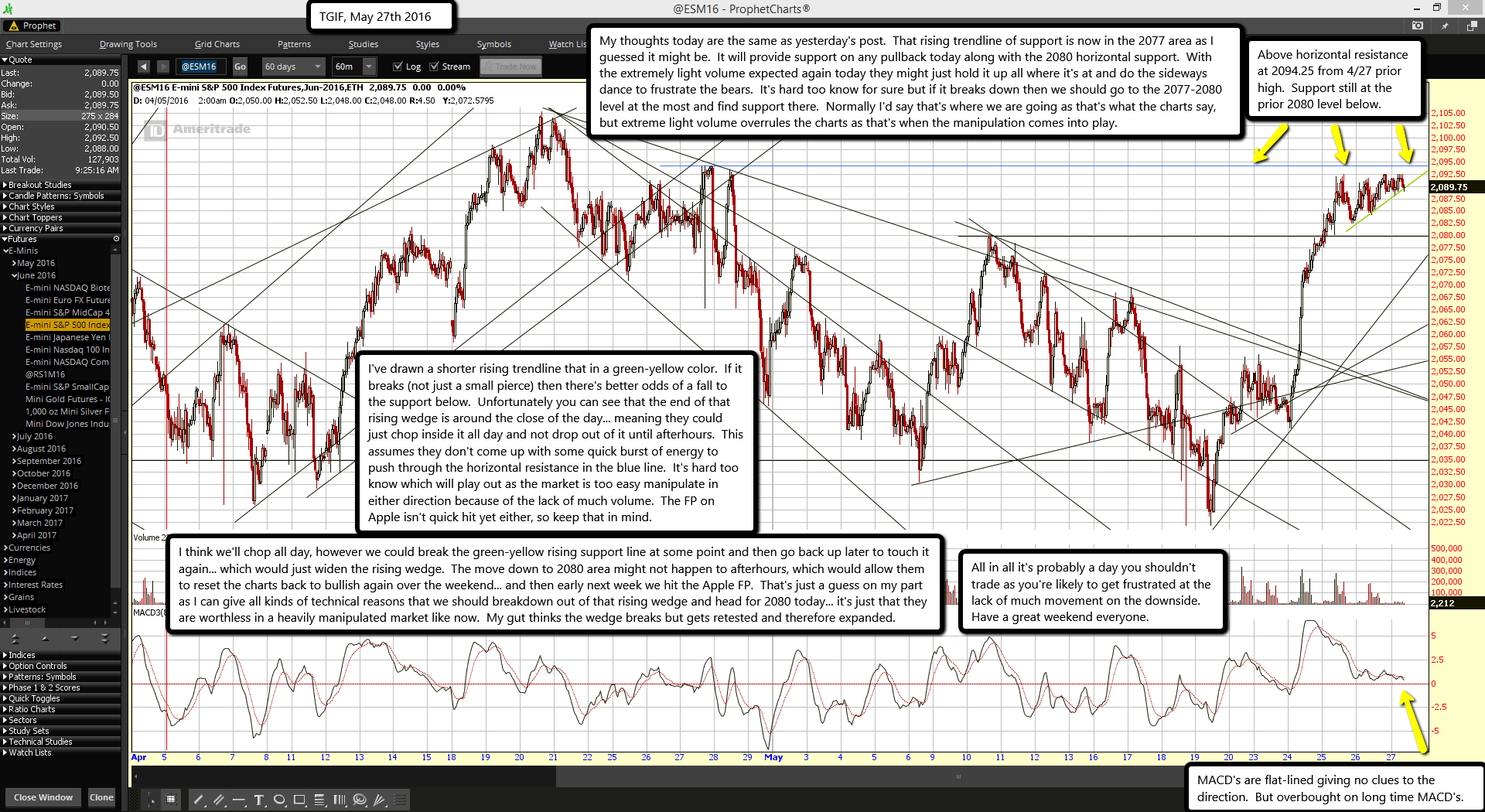
Above horizontal resistance at 2094.25 from 4/27 prior high.  Support still at the prior 2080 level below.

MACD's are flat-lined giving no clues to the direction.  But overbought on long time MACD's.

My thoughts today are the same as yesterday's post.  That rising trendline of support is now in the 2077 area as I guessed it might be.  It will provide support on any pullback today along with the 2080 horizontal support.  With the extremely light volume expected again today they might just hold it up all where it's at and do the sideways dance to frustrate the bears.  It's hard too know for sure but if it breaks down then we should go to the 2077-2080 level at the most and find support there.  Normally I'd say that's where we are going as that's what the charts say, but extreme light volume overrules the charts as that's when the manipulation comes into play.

I've drawn a shorter rising trendline that in a green-yellow color.  If it breaks (not just a small pierce) then there's better odds of a fall to the support below.  Unfortunately you can see that the end of that rising wedge is around the close of the day... meaning they could just chop inside it all day and not drop out of it until afterhours.  This assumes they don't come up with some quick burst of energy to push through the horizontal resistance in the blue line.  It's hard too know which will play out as the market is too easy manipulate in either direction because of the lack of much volume.  The FP on Apple isn't quick hit yet either, so keep that in mind.

I think we'll chop all day, however we could break the green-yellow rising support line at some point and then go back up later to touch it again... which would just widen the rising wedge.  The move down to 2080 area might not happen to afterhours, which would allow them to reset the charts back to bullish again over the weekend... and then early next week we hit the Apple FP.  That's just a guess on my part as I can give all kinds of technical reasons that we should breakdown out of that rising wedge and head for 2080 today... it's just that they are worthless in a heavily manipulated market like now.  My gut thinks the wedge breaks but gets retested and therefore expanded.

All in all it's probably a day you shouldn't trade as you're likely to get frustrated at the lack of much movement on the downside.  Have a great weekend everyone.

For First Time In 130 Years, More Young Adults Live With Parents Than With Partners

0

Men, African-Americans, Hispanics and less educated young people are particularly likely to live with their parents. But across all demographics, more and more people are living with Mom and Dad, Pew found.

For the first time in more than 130 years, Americans ages 18-34 are more likely to live with their parents than in any other living situation, according to a new analysis by the Pew Research Center.

In that age group, 32.1 percent of people live in their parents' house, while 31.6 live with a spouse or partner in their own homes and 14 percent live alone, as single parents or in a home with roommates or renters. The rest live with another family member, a nonfamily member or in group-living situations such as a college dorm or prison.

"Alone/head of household" includes single parents and people who have roommates or renters living with them; "other" includes those living with family members (not parents), with nonfamily members or in group housing.

"Alone/head of household" includes single parents and people who have roommates or renters living with them; "other" includes those living with family members (not parents), with nonfamily members or in group housing.

Pew notes that this is not a record high percentage for the number of young people living at home — in 1940, for instance, approximately 35 percent of people in that age range lived at home.

But back then, living with a spouse or partner was even more popular than that. Today not so: More people choose an alternative living situation, and out of the crowded field of choices, life with Mom and/or Dad has become the top pick for millennials.

Well — some millennials. Men, for starters.

American men ages 18-34 live with their parents 35 percent of the time, and with a spouse or partner 28 percent of the time. For women, the numbers are nearly reversed; 35 percent live with a partner, while 29 percent live with their parents.

Less educated young adults are also more likely to live with their parents than are their college-educated counterparts — no surprise, Pew notes, given the financial prospects in today's economy.

Black and Hispanic young people, compared with white people, are in the same situation.

For black people in particular, the "new" milestone isn't so new at all. Black young adults have been more likely to live with their parents than in any other situation since 1980. Today, 36 percent of black millennials live with their parents, while 17 percent live with a spouse or partner.

Meanwhile, taken as a whole, women, white people, Asian/Pacific Islanders and people with bachelor's degrees are still more likely to live with spouses or partners than with their parents.

But the overall trend is the same for every demographic group — living with parents is increasingly common.

(Young Americans are still less likely to live with their parents than their southern European friends. In Macedonia, more than 70 percent of 18- to 34-year-olds reportedly live at home, Pew says.)

For many millennials, Pew's conclusions might seem both unsurprising and easy to explain: The Great Recession happened, of course!

But the rise in the number of young adults living at home started before the economic crash — and so did the possible contributing factors. Male unemployment has been on the rise for decades, Pew says. Even those who have jobs are making less than they would have in their parents' day — for young men, Pew notes, inflation-adjusted wages have been falling since 1970.

And then fewer young people are married than in decades past. Even accounting for the increased popularity of cohabitation, there are just fewer paired-up 20-somethings and 30-somethings than there used to be.

In general, the study shows how dramatically the living situations of 18- to 34-year-olds have changed since 1880, when the data begin.

Living alone, as a single parent, or with roommates — once a rarity — is now the choice of 14 percent of people in that age group. And a full 25 percent of young men are now living with other family, nonfamily or group quarters.

Male prosperity rose steadily, and more and more men left the nest — until the '60s and '70s, when wages started to drop and more men stayed home.

And women? For decades women who worked were more likely to live with their parents than with a partner or spouse — because wives were discouraged from having jobs, per Pew's straightforward interpretation.

But now more and more young women have jobs, and it's unemployed women who are more likely to live with their parents. And yet, even as female prosperity rose, so did the number of young women living at home.

Pew speculated it might because of men's lower earnings keeping women from marrying and moving out. Seem plausible? The question might make for a fruitful conversation in households across America tonight ... just ask Mom to pass the peas and the theories.

Source link

The long legacy of the floppy disk

0

American missile in silo The Pentagon is not alone in still using floppy disks but unique in using them for its nuclear missile fleet

The technology world may seem to be locked in an endless cycle of renewal - but not when it comes to the floppy disk.

More than 50 years after the technology was invented it has emerged that the US nuclear weapons force uses the disks in the 1970s computer system it still employs.

As it turns out the Pentagon is not alone in retaining an affection, sometimes born of technical necessity, for the humble disk. But why has it survived when so many other technologies have fallen by the wayside?

"They are just too useful," said Ian Rainsford, a spokesman for media firm Verbatim - one of several companies that still makes the disks.

In some industries, floppy disks are used in machines that sit on production lines and those chunks of industrial plants are unlikely to be shut down, changed or updated any time soon, he said.

"A lot of the industrial uses would be things like knitting or crocheting machines, CNC lathes and milling machines and precision cutters," he said.

"The machines driving production have remained the same and the company that developed the original equipment may well have gone out of business," he said.

"They certainly believe that if it isn't broke, don't fix it." he said.

What has changed is the volume of disks Verbatim now produces. It only turns out "thousands" of disks per month, he said, far less than the millions it cranked out in the mid-90s when the technology was ubiquitous.

But, he said, for the customers that do use them they are essential to keep that business going.

"The death of the floppy disk has been heralded many, many times," said Mr Rainsford. "I think once Microsoft started shipping Windows on CDs it was sounded for the first time and that was 21 years ago."

Safety systems

For Kevin Murrell, a director of The National Museum of Computing at Bletchley Park, it is no surprise that floppy disks, and the computers that use them, have stuck around.

"It's a good thing," he said. "It's a good, old proper technology that actually works and is proven.

"We regularly read floppy disks from 40 years ago and they are as good as new," he said.

"Magnetic tape has a real issue because when it is on the reels you have a lot of different layers so you have 'print through'," he said. "This involves the shadow of data on one section of tape being superimposed on the layer above and below. The interference means data quickly gets harder to read.

"We all thought that putting data on CDs would last for ever but that idea went out of the window a long time ago," he added.

And the history of technology is littered with short-lived storage systems, such as Jaz drives and zip drives, that are now obsolete.

By contrast, said Mr Murrell, a floppy is a much more reliable data storage format.  Swapping out computers that control safety systems can be a difficult job

He added: "8in and 5-and-a-1/4in disks are usually a very safe bet."

The same can be said of the computer systems that still use them. More often than not, he said, those older computer systems are running some very sensitive and significant installations such as power stations or air traffic control systems.

These "safety critical" computer systems are built for purpose and would take a huge amount of time and effort to update. As a result, many stay in situ for decades.

An example of this was the Marconi TAC machine used to monitor the reactor at the Wylfa nuclear power station in Anglesey for 38 years. It used 8in disks and was turned off in 2004.

Old machines running computer code written decades ago sit behind the apps and websites of many modern services and sites, said Mr Murrell.

"Occasionally it comes out that software in banking systems is written in Cobol and is 30 years old, but it is still used because it is reliable and still works," he said.

"Would you rather have a system that is proven to work or a machine running Windows 10?" he asked.

Hunting parts

James Bailey, a director at Hyperscale IT which helps firms find parts for old computer systems, said many organisations were running servers and software that was more than a decade old.

"It's a bit like running a vintage car, all the parts are out there in junkyards," he said. "It's just a question of finding them."Many PC makers stopped putting floppy drives into computers years ago

Hyperscale helps firms source power supplies, memory modules and other components to keep those ageing servers going to maintain the services they support.

Companies and other organisations stick with legacy kit because it works and because the time and money they can spend on coding and development is finite.

"If you decide to move that legacy to a new computer system you might miss the chance to innovate in another part of the business," he said.

Firms are often reluctant to spend money updating something that works because the end result will not progress the business.

"If you do update, then you'll end up in the same place at the end of all the work."

Source link

s2Member®