Small business illustration.(Photo: News Journal file photo)
Since 1963, the Small Business Administration has recognized outstanding entrepreneurs and small business owners through National Small Business Week. This year, the Greater Pensacola Chamber and the Florida Small Business Development Center at the University of West Florida are teaming up to promote the positive impact of small businesses on the Pensacola community.
“National Small Business Week provides an opportunity to honor Northwest Florida small businesses for their crucial role in job creation and healthy economic growth,” said Greater Pensacola Chamber President and CEO Clay Ingram. “We are pleased to partner with the Florida SBDC at UWF to show our appreciation and commitment to putting small businesses first.”
National Small Business Week will be celebrated today through Saturday. This year’s theme is Dream Big, Start Small. The Chamber and the Florida SBDC at UWF encourage small businesses to share their success stories and photos on social media with the hashtags #DreamSmallBiz, #PcolaChamber and #FloridaSBDCUWF.
“The Florida SBDC at UWF team is committed to serving local small businesses in our community,” said Kelly Massey, regional director. “For the last six years, we have delivered over 56,689 hours of professional consulting to 13,147 entrepreneurs and small business owners in the Panhandle region. We intend to make those numbers soar even higher within the next six years.”
For more information on National Small Business Week, visit www.sba.gov/nsbw.
To become involved in local promotion of National Small Business Week, contact the Chamber at news@pensacolachamber.com or 438-4081, or the Florida SBDC at UWF at sbdcmarketing@uwf.edu or 474-2528.
Warren Buffett, speaking at Berkshire Hathaway's annual meeting Saturday, told his flock of followers that first-quarter earnings jumped 8.2% to $5.59 billion despite weakness in key insurance and railroad holdings, reiterated he's still on the lookout for big deals like January's $32 billion purchase of Precision Castparts, and advised mom-and-pop investors to build their stock portfolios around low-cost index funds that capture the long-term success of American businesses.
Saturday's event marks the first-time that Berkshire Hathaway and Buffett, the company's chairman and CEO, live streamed its annual shareholders meeting — dubbed the "Woodstock of Capitalism" — around the globe. Roughly 40,000 Berkshire investors made the pilgrimage to Omaha to be there in person.
Heading into the closely watched gathering at the CenturyLink Center, where Buffett, 85, and long-time Berkshire vice chairman Charlie Munger, 92, are fielding questions for hours from journalists, analysts and everyday investors who own a piece of Buffett's Berkshire conglomerate are feeling flush.
Berkshire's A shares (BRK-A) are up 10.7% so far in 2016, soundly topping the 1% gain for the broad U.S. stock market, measured by the benchmark Standard & Poor's 500 stock index.
In the first half of the Q&A, Buffett addressed a wide variety of issues. Topics ranged from:
• The outlook for Precision Castparts, Berkshire's biggest acquisition ever. "Precision," Buffett said, "will do better" under the Berkshire umbrella. Buffett said Precision Castpart's CEO Mark Donegan, who he called an "extraordinary" and "one of a kind" manager, would be freed up to make the business even better post-deal.
• Berkshire's thirst for future acquisitions. "We would love to find another three of four types of Precision Castparts," he said.
• Why auto insurer Geico's quarterly results fared worse than expected and trailed rival Progressive in the first quarter? "The frequency of accidents and the severity, or cost per accident, both of those went up quite suddenly and quite substantially," Buffett said.
• On the meteoric rise of online retailer Amazon.com and its Internet driven marketing power. "Charlie and I are not going to out-Bezos Bezos," said Buffett, referring to Amazon CEO Jeff Bezos.
• His take on the controversy surrounding one of his biggest holdings, Coca-Cola, and its role in causing health effects such as diabetes. Buffett defended Coke and his large daily consumption of Cherry Coke. "I have not seen evidence that I will reach 100 if I switch to broccoli or water," the 85-year-old Buffett said.
• The danger of derivatives to the financial system. Buffett who once famously said derivatives are "financial weapons of mass destruction," said they are still "a danger to the system," especially when used in "large quantities" and under adverse market circumstances big enough to cause "major discontinuity" in markets.
• Financial advice. Buffett, showing data over the past eight years that was part of a debt that shows owning a S&P 500 index fund outperformed five hedge funds by about 40 basis points, or 40%. Ignore the sales pitch from Wall Street, he says. And avoid the high-priced management fees.
"Very few (active fund managers) have an outstanding performance record," Buffet said. "And people you pay to identify them don't know how to identify them."
Added Munger: "Few in the universe exceed the market returns (on a regular basis). It's like finding a needle in a haystack."
When Buffett and Munger return after lunch, they will likely face queries on topics ranging from succession plans at Berkshire to the state of the U.S. economy and the stock market.
Buffett, best known for his stock-picking prowess and investment savvy, in recent years has shifted Berkshire's focus to buying businesses outright. And the deals are getting bigger and bigger.
In January, Berkshire closed on its largest acquisition ever, paying $32 billion for aerospace parts maker Precision Castparts. That mega-deal, which meets Buffett's definition of hunting for "elephants," follows a $12 billion deal for a more than 50% stake in ketchup maker H.J. Heinz a few years back, which has since merged with Kraft Foods of Macaroni & Cheese fame to form Kraft Heinz. Back in 2010, Buffett bought the railroad, Burlington Northern Santa Fe, for $27 billion.
At the end of 2015, Berkshire's top stock holdings included Wells Fargo, Coca-Cola, IBM and American Express. The list of businesses the sprawling conglomerate owns include paint maker Benjamin Moore, battery maker Duracell, insurer Geico and ice cream retailer Dairy Queen, to name a few.
Buffett's holdings touch virtually every corner of the U.S. economy, which makes his commentary that much more relevant.
In the minutes leading up to the webcast, Robert Miles, a Buffett scholar and author, let Yahoo Finance know what makes Buffett special: “He is just a regular guy that speaks the truth, unlike Wall Street."
It was a dreary, rainy day in Omaha, but that didn't keep the Buffett faithful away or dim their mood. Buffett followers came from as far away as Taiwan, Mexico and Australia, many were chanting "Buffett! Buffett! Buffett" in the long line outside the arena despite a driving rain.
Yahoo paid Marissa Mayer $36 million in compensation last year despite the company’s shrinking revenue and profits. The CEO is also expected to receive a huge payout of $55 million if she is terminated after Yahoo is sold.
Yahoo revealed that its CEO Marissa Mayer's pay for 2015 got a significant cut, but still left her a hefty amount to take home.
The executive got nearly $36 million in total compensation, down almost 15 percent from the previous year's $42 million, according to a filing with the Securities and Exchange Commission on April 29.
Her base salary remained at $1 million, with most of the cuts coming from her stock option awards estimated to be valued at $9 million. This was largely the result of a 15 percent drop in Yahoo stock value over the past year. Stock value rises or falls depending on the profitability or failure of a business.
Given all the noise about Mayer's inability to turn her company's fortune around as revenue and profits continue to shrink, her compensation may still be too high. Comparatively, Google CEO Tim Cook's salary of $10.3 million in 2015 is a far cry from Mayer's $42 million in the same year even as Google was operating more profitably.
While her reported pay was $36 million, the Yahoo chief executive actually brought home an amount close to $14 million or just about 39 percent of what was reported because Yahoo's financial performance fell short of the projected goals.
The filing also disclosed that Mayer and other Yahoo executives decided to give up their bonuses in 2015.
Marissa Mayer is getting a lot of attention not only because her tenure at Yahoo may soon be over, but because history could remember her as the person who could not prevent the downfall of the great Yahoo, some analysts observe.
Other industry insiders are seeing hopes in Yahoo, but drastic moves may have to be explored. Sue Decker, a respected business executive who could have been Yahoo CEO, offered some unsolicited advice for the beleaguered Internet company.
Decker said in a CNBC interview on April 29 that Yahoo was involved in so many things without focusing and winning in one or two areas. She mentioned Google's dominance in search and Facebook's social niche, despite the two companies' interest in other areas like video and messaging.
Decker said that the road ahead will be tough for a change in leadership. But it must be done, with Yahoo going private again or becoming part of a much larger company in order to stay focused.
"I hope the next owner can do something to revitalize the spirit of the core things that made Yahoo very, very unique and create a distinction in consumers' minds about why they love Yahoo still," Decker said.
If Mayer is out of the picture as a result of the sale of the company, she could still receive a huge payout of about $55 million. The severance package includes restricted stock units and options and $3 million in cash.
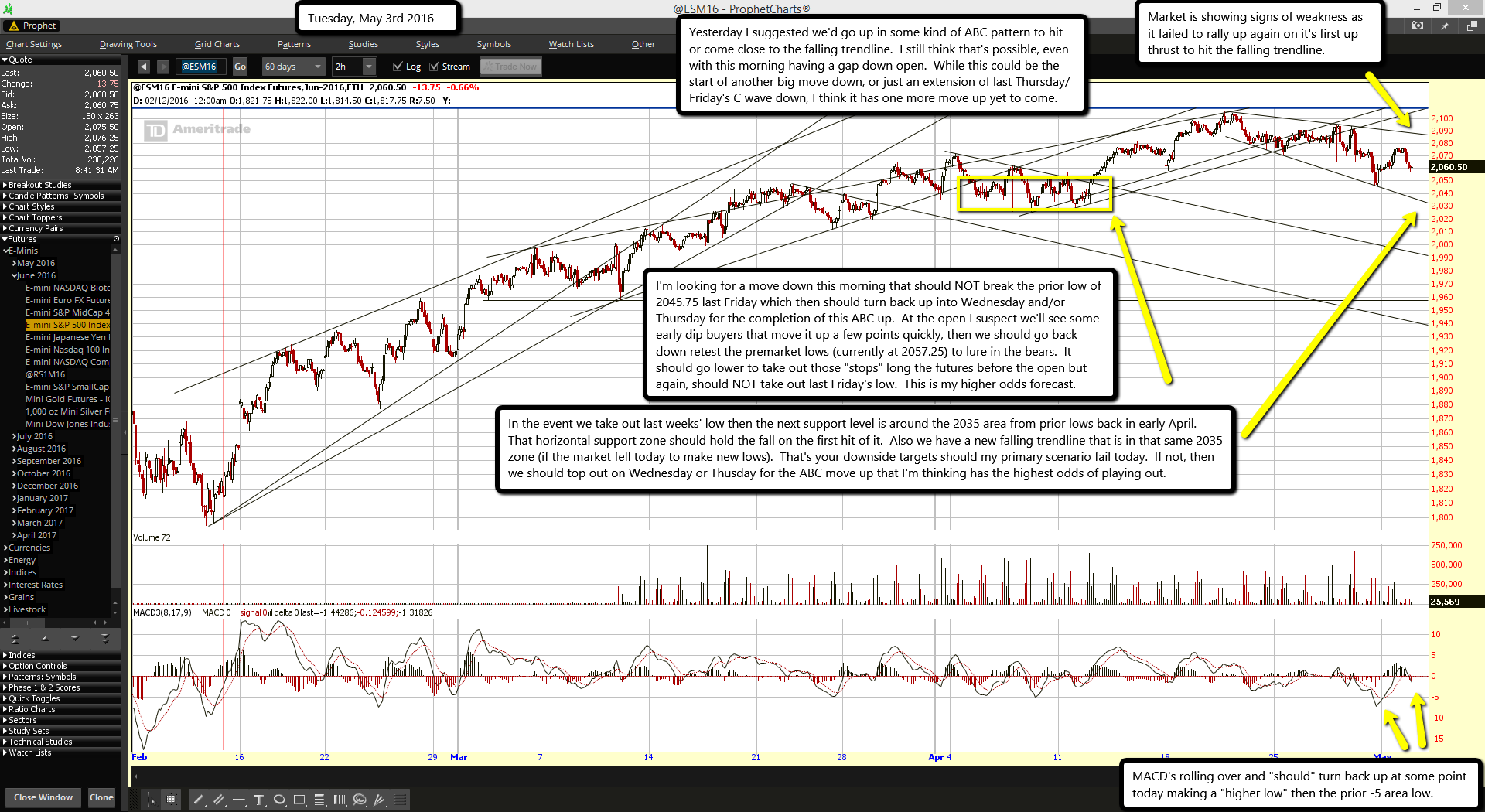
Market is showing signs of weakness as it failed to rally up again on it's first up thrust to hit the falling trendline.
MACD's rolling over and "should" turn back up at some point today making a "higher low" then the prior -5 area low.
Yesterday I suggested we'd go up in some kind of ABC pattern to hit or come close to the falling trendline. I still think that's possible, even with this morning having a gap down open. While this could be the start of another big move down, or just an extension of last Thursday/Friday's C wave down, I think it has one more move up yet to come.
I'm looking for a move down this morning that should NOT break the prior low of 2045.75 last Friday which then should turn back up into Wednesday and/or Thursday for the completion of this ABC up. At the open I suspect we'll see some early dip buyers that move it up a few points quickly, then we should go back down retest the premarket lows (currently at 2057.25) to lure in the bears. It should go lower to take out those "stops" long the futures before the open but again, should NOT take out last Friday's low. This is my higher odds forecast.
In the event we take out last weeks' low then the next support level is around the 2035 area from prior lows back in early April. That horizontal support zone should hold the fall on the first hit of it. Also we have a new falling trendline that is in that same 2035 zone (if the market fell today to make new lows). That's your downside targets should my primary scenario fail today. If not, then we should top out on Wednesday or Thusday for the ABC move up that I'm thinking has the highest odds of playing out.
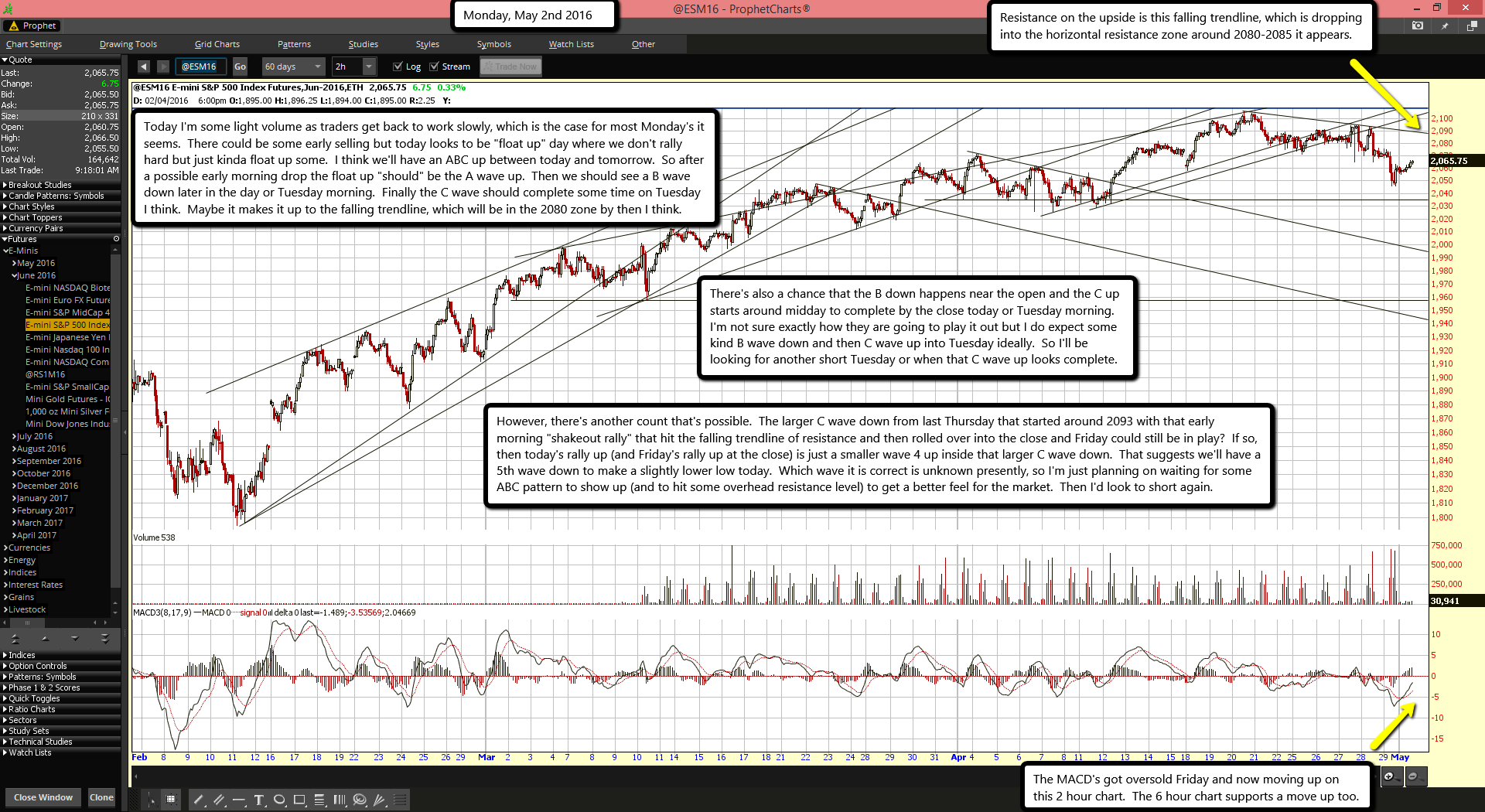
Resistance on the upside is this falling trendline, which is dropping into the horizontal resistance zone around 2080-2085 it appears.
The MACD's got oversold Friday and now moving up on this 2 hour chart. The 6 hour chart supports a move up too.
Today I'm some light volume as traders get back to work slowly, which is the case for most Monday's it seems. There could be some early selling but today looks to be "float up" day where we don't rally hard but just kinda float up some. I think we'll have an ABC up between today and tomorrow. So after a possible early morning drop the float up "should" be the A wave up. Then we should see a B wave down later in the day or Tuesday morning. Finally the C wave should complete some time on Tuesday I think. Maybe it makes it up to the falling trendline, which will be in the 2080 zone by then I think.
There's also a chance that the B down happens near the open and the C up starts around midday to complete by the close today or Tuesday morning. I'm not sure exactly how they are going to play it out but I do expect some kind B wave down and then C wave up into Tuesday ideally. So I'll be looking for another short Tuesday or when that C wave up looks complete.
However, there's another count that's possible. The larger C wave down from last Thursday that started around 2093 with that early morning "shakeout rally" that hit the falling trendline of resistance and then rolled over into the close and Friday could still be in play? If so, then today's rally up (and Friday's rally up at the close) is just a smaller wave 4 up inside that larger C wave down. That suggests we'll have a 5th wave down to make a slightly lower low today. Which wave it is correct is unknown presently, so I'm just planning on waiting for some ABC pattern to show up (and to hit some overhead resistance level) to get a better feel for the market. Then I'd look to short again.
Market hit falling trendline yesterday and rolled over into what appears to be a wave C down.
MACD's are oversold here but have plenty of room to go down more on the higher time frame charts.
Yesterday I said that I thought we were in a C wave down with the open being the smaller wave 1 down inside that C wave. I suggested that we should rally yesterday for the smaller wave 2 up and that it might breakdown into a mini ABC... which it did. I thought we'd only see the mini A and B yesterday and the mini C up to complete the smaller 2 up by Friday morning. I was wrong on the time frame as it did it all yesterday with a clear ABC up to hit the falling trendline by midday. Then the smaller wave 3 down (still inside wave C down) started and took most traders by surprise I think.
So, where are we today. It looks like the smaller wave 3 down (inside wave C down) is either still going on will end shortly after the open. Today is tricky as it's a Friday and it's common to see them hold the market up from some huge move down as they don't want to panic the sheep on a weekend. My best guess is that the sideways chop back up late yesterday and afterhours is some kind of smaller wave 4 and we will complete the C down today with the final "smaller wave 5" down early this morning. Right now it's holding horizontal support around 2065 but it sure looks like it wants to break it. It's a triple bottom too from hitting it yesterday.
I'm thinking that early this morning we'll break that horizontal support around 2065 on the ES Futures and drop to the 2055-2060 area where there was another prior low at 2058.50 on April 18th. If they pierce below there slightly they should take out all the bulls stops' that are long from that level and end the smaller 5th wave down inside the C down. Then the rest of day we should see some move back up to start the next series of ABC's before we go down again next week.
FERC late Wednesday rescinded waivers it granted American Electric Power and FirstEnergy, meaning the controversial power purchase agreements approved by Ohio regulators will be subject to the commission’s affiliate abuse test.
The commission granted a request by the Electric Power Supply Association and others asking it to rescind the affiliate sales waivers it gave AEP in 2014 (EL16-33) and FirstEnergy in 2008 (EL16-34) based on Ohio’s retail choice law.
The commission said despite retail choice, the company’s ratepayers were essentially “captive” customers because the PPAs, approved by the Public Utilities Commission of Ohio on March 31, would impose on them non-bypassable distribution charges.
“These non-bypassable charges present the ‘potential for the inappropriate transfer of benefits from [captive] customers to the shareholders of the franchised public utility,’ and, thus, could undermine the goal of the commission’s affiliate restrictions,” FERC said.
As a result, the PPAs will be subject to FERC’s Edgar test, which will require the companies to prove the lack of affiliate abuse by evidence of head-to-head competition, or benchmarks such as prices that non-affiliated buyers are willing to pay.
That will be a difficult hurdle for the companies to clear, as the PPAs were not subject to competition, and critics say they could impose billions in extra costs on consumers.
FirstEnergy shares dropped 4.85% in after-hours trading. AEP shares were down 1.2%.
Lifeline
FirstEnergy and AEP have said the PPAs are crucial to keeping some of their underperforming coal-fired plants running in the state.
In approving the eight-year contracts, Ohio regulators said they were striving for “rate stability” by building in safeguards intended to protect consumers, modifying the plans to limit bill increases. The commission also added provisions meant to “encourage” grid modernization and retail competition. (See FERC Action Awaited Following PUCO OK on PPAs.)
Although the PPAs guarantee the generators receive revenue streams above current market prices, AEP and FirstEnergy contend the deals will save customers money if natural gas prices increase.
FirstEnergy spokesman Doug Colafella said the company was disappointed in the ruling. “Our affiliate FirstEnergy Solutions was previously granted authorization to conduct transactions with our Ohio utilities in 2008, and the PPA will benefit our customers by protecting them against rising retail prices and volatility in future years.
“We also believe that the PPA complies with existing FERC rules that promote retail shopping, and our Ohio customers will continue to have the ability to choose a competitive supplier. FirstEnergy is evaluating its options, which include seeking rehearing of FERC’s order, as well as filing the PPA for FERC’s review. It’s always been our position that the PPA will satisfy the FERC’s criteria for an affiliate contract.”
AEP did not immediately return requests for comment.
EPSA, the Retail Energy Supply Association, Dynegy, NRG Energy and GenOn Energy Management had asked FERC to rescind the waivers to ensure a Section 205 review of the eight-year PPAs. (See Dynegy, NRG Ask FERC to Void Ohio PPAs.)
In its companion orders, FERC agreed with the complainants that the affected customers are essentially captive. In addition, in the case of FirstEnergy, “the commission addressed the more general concern raised by a protester that FirstEnergy’s electric security plan proposal would create barriers to competition.”
The commission directed AEP and FirstEnergy to revise their market-based rate tariffs within 30 days and file notices of a change in status “addressing whether this change in circumstances affects any other waivers the commission previously granted.”
On Wednesday night, EPSA released a statement saying it was still reviewing the orders.
“Tonight, FERC issued orders (without dissent) granting the complaints EPSA, with support from a broad coalition of consumers, environmental groups and others, filed last January to remove the waivers protecting the controversial Ohio PPAs from full FERC review,” it said. “This means if AEP and FE elect to proceed with the wholesale contracts, they will need to file the PPAs … and show among other things that the deals they negotiated with themselves satisfy FERC’s rules designed to protect against such affiliate abuse.”
FERC said its “fundamental goal in categorizing certain customers as ‘captive’ is to protect customers served by franchised public utilities from inappropriately subsidizing the market-regulated or non-utility affiliates of the franchised public utility or otherwise being financially harmed as a result of affiliate transactions and activities. … Where, as here, circumstances demonstrate that a retail customer has no choice but to pay the costs of an affiliate transaction, they effectively are captive with respect to the transaction.”
FERC did agree with AEP and FirstEnergy on one point, rejecting the complainants’ claim that the PPAs would distort prices in PJM by subsidizing the continued operation of generation that would otherwise retire.
The commission said that PJM bidding behavior was not relevant to the affiliate abuse complaint and thus outside the scope of the cases. However, the commission noted that a third complaint filed by Calpine over the PPAs, in which PJM rules are central, remains pending (EL16-49). The complainants asked FERC to expand PJM’s minimum offer price rule to ensure the PPAs don’t distort May’s 2019/20 Base Residual Auction.
“By this order, we do not prejudge the outcome of that proceeding,” the commission said. (See Generators to FERC: Expand MOPR for Subsidized FE, AEP Plants.)
FERC said its ruling “does not frustrate or usurp the Ohio commission’s role in protecting retail customers. Rather, this commission has an independent role to ensure that wholesale sales of electric energy and capacity are just and reasonable and to protect against affiliate abuse. The commission’s affiliate restrictions protect against captive customers of franchised public utilities cross-subsidizing market-regulated power sales affiliates. The affiliate PPA raises the potential for cross-subsidization from AEP Ohio’s retail customers – who are captive in the sense that they cannot avoid the non-bypassable charge – to AEP Ohio’s market-regulated power sales affiliate, AEP Generation.”
The commission used virtually identical language in its FirstEnergy order.
Reaction
Former Pennsylvania Public Utility Commissioner John Hanger said the rulings “are obviously going to throw a huge monkey wrench in the FirstEnergy and AEP plans.”
Hanger, now a private energy industry attorney, predicted the company’s PPAs “will have a short shelf life.” He applauded FERC’s moves.
FERC, he said, “is not being swept by the powerful forces in state capitals. Electric utilities are the 800-pound gorillas” in state politics, he said.
Former PUCO chairman Todd Snitchler, now with The Alliance for Energy Choice, said Wednesday night he was “obviously pleased” with the rulings after taking a cursory review but wanted more time before commenting further.
“Today, federal regulators stood up for customers and defended fair markets and competition, sending a clear signal to any utility trying to bail out their uneconomic power plants through political prowess,” the Environmental Defense Fund said. “FERC’s decision to block these bailouts will save Ohioans $6 billion while spurring energy innovation and reducing harmful pollution.”
Ohio Consumers’ Counsel Bruce Weston also celebrated the order. “In response to legal action by the Consumers’ Counsel and others, federal officials today provided Ohioans the benefits of competitive markets and lower rates that they did not receive in the state plans filed by FirstEnergy and AEP,” Weston said. “The federal ruling has the potential to save each of several million Ohio electric consumers hundreds of dollars over the next eight years, while protecting the competitive market envisioned by the Ohio legislature in 1999.
Officials already taking stock of redeveloping CityCenter Englewood as 775 workers nearby likely will disappear
As Sports Authority abandons reorganization attempts and pursues the liquidation of its assets, the city of Englewood has already begun girding itself for the loss of what was once its second-largest employer.The retailer's corporate headquarters have been in the Denver suburb since its 2003 merger with Gart Sports, which had been there since the fall of 2001.
Customers enter the Sports Authority flagship "Sports Castle" at 1000 Broadway in Denver on Tuesday, April 26, 2016. (Kathryn Scott Osler, The Denver Post)
Sports Authority had 2,400 employees in Colorado, 772 of them at Englewood corporate headquarters, when it filed for bankruptcy protection in March, company officials said at the time. An earlier round of layoffs in January cut the local workforce by 100, mostly from its corporate offices.
And while it's possible some of the chain's remaining stores may be snapped up at a bankruptcy auction by competitors, Sports Authority will cease to exist as the independent company in need of headquarters that it is today.
"This is a terrible blow to our community," Englewood city manager Eric Keck said Wednesday. "Whenever you lose a primary employer, it has ripple effects throughout the business community. The loss of that daytime population is going to have an impact."
Through Chapter 11 proceedings, the sporting goods chain had hoped to rework its $1.1 billion in outstanding debt and emerge leaner but more competitive.
But on Tuesday, company attorney Robert Klyman told a bankruptcy judge that creditors had made reorganization impossible and that the company would now pursue a sale of its assets.
Keck said city officials have already reached out to the owner of the Sports Authority corporate building, Denver-based Etkin Johnson Real Estate Partners, to gauge their plans for the property.
The building, at 1050 W. Hampden Ave., at the junction of South Santa Fe Drive and Hampden, and across the street from CityCenter Englewood, the mixed-use redevelopment of the old Cinderella City Mall that has struggled with retail vacancies despite its connection to light rail.
"Our desire is to see the ability to bring in another primary employer or multiple primary employers to ensure we have a vibrant and sustainable economy here," Keck said.
Etkin Johnson did not return a call for comment Wednesday.
At one point, Sports Authority had about 900 employees in Englewood, Keck said, making it the city's second-largest employer, behind Swedish Medical Center.
Even though Sports Authority is smaller today, losing a workforce that size across the street from CityCenter is a concern, Keck said.
"It's a challenge," he said, "but also an opportunity to potentially look at this area in a larger light."
In a statement provided Wednesday, Sports Authority said it is "optimistic" about the upcoming bankruptcy sale process. "We have received initial expressions of interest from a number potential buyers."
In bankruptcy filings, the company did request to pay lump-sum retention bonuses to "key non-insider employees" in departments such as accounting, finance, human resources, information technology, legal, operation and sourcing, at a cost of no more than $1.25 million.
The goal was to help combat declining employee morale and unease as well as increase the likelihood that the proceeds received through the sale or liquidation of assets would be maximized.
"It is possible that a number of the (retention program) participants will confront the loss of employment in the near future; therefore it is crucial that the debtors maintain the loyalty of these key employees to deliver their best performance throughout the Chapter 11 cases," the company wrote.
Nixon's Coffee House owner Brad Nixon said that, over the years, both Sports Authority staffers and the company's vendors have been frequent customers of his CityCenter shop.
"We do see quite a few Sports Authority folks come to the coffee shop. We love having them come in and out," he said.
And while he was sad to hear the news, Nixon said he's not too concerned about the long-term impact to his business.
"It will be a change. I do admit it will be a change, but I'm not worried in the long term," Nixon said. "It will make a nice facility for somebody who wants to come along and grab it."
Facebook CEO Mark Zuckerberg(Photo: Martin E. Klimek, USA TODAY)
SAN FRANCISCO — Wall Street is running out of superlatives for Facebook.
"Ace Book." "Moving beyond the friend zone." Those were two of the research notes published by slack-jawed analysts following Wednesday's Street-beating quarterly results that solidified its position as one of the world's most powerful and top-performing technology companies.
Facebook far exceeded expectations for nearly every metric, even as other tech companies disappointed, sending shares soaring 11% to an all-time high of $120.79 and giving the company a $30 billion bump to its market cap.
Facebook is now the sixth most valuable company by market cap in the S&P 500, overtaking Johnson & Johnson.
Of the 49 analysts covering the stock, 45 rate it a "buy" or higher.
Fueling the positive sentiment: Facebook's winning streak in mobile advertising and the rise of video advertising. Facebook has been showing its 1.65 billion users videos that play automatically and it has introduced more advertising on photo-sharing service Instagram.
First-quarter results illustrated the traction Facebook is gaining with advertisers.
Facebook grew revenue 52% to $5.382 billion in the first quarter, topping the $5.25 billion analysts polled by S&P Global Market Intelligence expected. Eighty-two percent of advertising revenue in the first quarter came from mobile.
Facebook is expected to account for about 12% of the $186.81 billion global digital advertising market in 2016, according to research firm eMarketer.
Pivotal Research estimates Facebook will capture 47% of global digital advertising growth and 43% of all advertising growth outside of China in 2016.
"Facebook continues to generate very high and very profitable growth. An extremely rare combination. And we see in Facebook plenty of strong, secular platform growth ahead," RBC Capital analyst Mark Mahaney wrote in a research report.
With more than 1.6 billion monthly active users and more than 1 billion daily active users as well as three million advertisers, Facebook has an "insurmountable competitive edge," says Wedbush Securities analyst Michael Pachter.
"We expect Facebook to continue its rapid growth overseas, and expect it to successfully monetize its under-penetrated Instagram, WhatsApp and Messenger assets over the coming years. Investments in new initiatives position the company for long term growth, and we believe that these initiatives will drive growth over the next decade," he wrote in a research note. "In summary, Facebook is a great company, period."
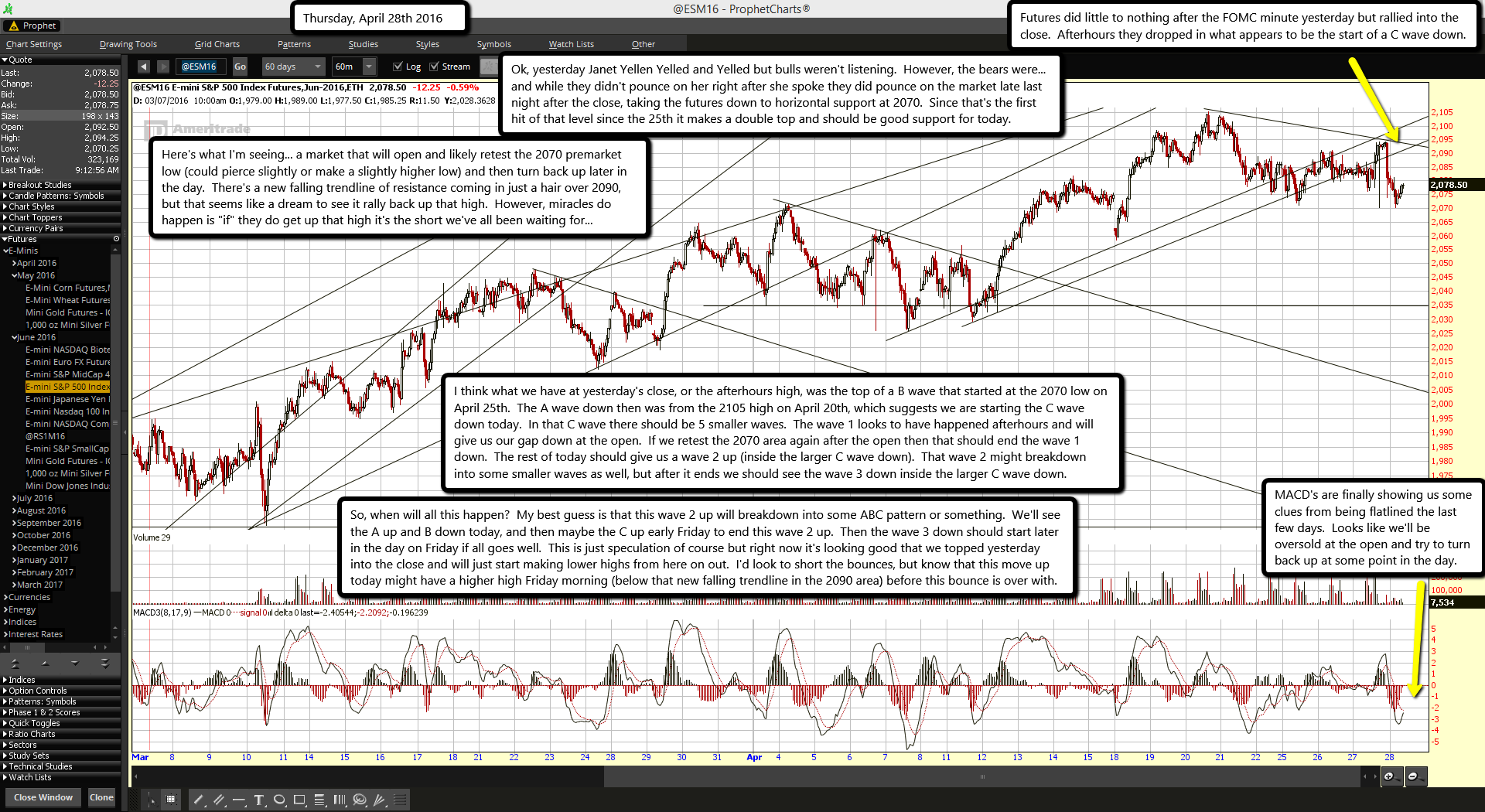
Futures did little to nothing after the FOMC minute yesterday but rallied into the close. Afterhours they dropped in what appears to be the start of a C wave down.
MACD's are finally showing us some clues from being flatlined the last few days. Looks like we'll be oversold at the open and try to turn back up at some point in the day.
Ok, yesterday Janet Yellen Yelled and Yelled but bulls weren't listening. However, the bears were... and while they didn't pounce on her right after she spoke they did pounce on the market late last night after the close, taking the futures down to horizontal support at 2070. Since that's the first hit of that level since the 25th it makes a double top and should be good support for today.
Here's what I'm seeing... a market that will open and likely retest the 2070 premarket low (could pierce slightly or make a slightly higher low) and then turn back up later in the day. There's a new falling trendline of resistance coming in just a hair over 2090, but that seems like a dream to see it rally back up that high. However, miracles do happen is "if" they do get up that high it's the short we've all been waiting for...
I think what we have at yesterday's close, or the afterhours high, was the top of a B wave that started at the 2070 low on April 25th. The A wave down then was from the 2105 high on April 20th, which suggests we are starting the C wave down today. In that C wave there should be 5 smaller waves. The wave 1 looks to have happened afterhours and will give us our gap down at the open. If we retest the 2070 area again after the open then that should end the wave 1 down. The rest of today should give us a wave 2 up (inside the larger C wave down). That wave 2 might breakdown into some smaller waves as well, but after it ends we should see the wave 3 down inside the larger C wave down.
So, when will all this happen? My best guess is that this wave 2 up will breakdown into some ABC pattern or something. We'll see the A up and B down today, and then maybe the C up early Friday to end this wave 2 up. Then the wave 3 down should start later in the day on Friday if all goes well. This is just speculation of course but right now it's looking good that we topped yesterday into the close and will just start making lower highs from here on out. I'd look to short the bounces, but know that this move up today might have a higher high Friday morning (below that new falling trendline in the 2090 area) before this bounce is over with.
The temperature is rising in one of the world's hottest trade disputes.
U.S. Steel Corp(X) has accused dozens of Chinese steel producers of breaking trade rules, and it wants the U.S. International Trade Commission to investigate.
Pittsburgh-based U.S. Steel said regulators should remove "all unfairly traded Chinese steel products" from the U.S. market, claiming the Chinese firms illegally conspired to fix prices, stole trade secrets and circumvented trade duties by using false labels.
"We have said that we will use every tool available to fight for fair trade," U.S. Steel CEO Mario Longhi said in a statement.
China produces half of the world's steel, more than the U.S., European Union, Russia and Japan combined.
As the country's massive economy slows, internal demand for steel is dropping. Beijing now stands accused of dumping its unwanted metal on other markets, forcing rivals to close their plants and killing thousands of jobs.
China has defended itself, saying overcapacity is a global problem brought on by weaker demand. Beijing says it is willing to work toward a solution and has announced 500,000 job cuts in its own steel mills.
Related: Europe tries to protect steel jobs with tariffs on Chinese imports
The U.S. responded in March with a massive duty on Chinese steelmakers. The EU has also imposed a tariff of up to 13% on Chinese imports. Beijing pushed back with "anti-dumping" measures of its own.
While the tit-for-tat exchanges continue, prices remain at extremely low levels. On Tuesday, U.S. Steel posted a sharp decline in sales and a first quarter loss of $340 million.
Related: Cheap Chinese steel has claimed another victim
The petition filed by U.S. Steel is likely to increase tensions further. The ITC has 30 days to decide whether to open an investigation under Section 337 of the Tariff Act of 1930, a rarely used but powerful enforcement tool.
In 2014, a U.S. grand jury indicted five members of China's People's Liberation Army on charges they stole information from U.S. Steel and other American firms.
Arianna Huffington joins Uber’s board of directors
Arianna Huffington, the co-founder and editor in chief of the Huffington Post (and an Uber investor already), has joined Uber’s board of directors, company CEO Travis Kalanick announced today.
As a director, Huffington is in the company of a number of key investors as well as executives like Benchmark general partner Bill Gurley, Uber co-founder Garrett Camp, head of global operations Ryan Graves and former policy and communications head David Plouffe.
The announcement closes out a month of collaborations between long-time friends Kalanick and Huffington, who have spent the better part of April working on projects that bring together Huffington’s work on raising awareness of the risks of sleep deprivation and Kalanick’s work with Uber.
At the beginning of April, the two announced that the Huffington Post was teaming up with Uber and Toyota to end drowsy driving — which Huffington called a silent epidemic. As part of that partnership, Huffington spent a day taking rides with Uber passengers to talk about her book “The Sleep Revolution” and later that day discussed the benefits of sleep with Kalanick in a Facebook Live video.
Huffington brings an “emotional intelligence” the company is lacking to the table, Kalanick wrote in a blog post. Indeed, Huffington’s involvement in the company may help Uber in its quest to soften its image.
From acknowledging its need to “grow up” to rolling out programs that benefit drivers like a feature that enables drivers to find the cheapest fuel options, Uber has made a concerted effort in the past two years to refine its image from that of a ruthless and shadowy tech company to one that is growing and learning from its mistakes.
Whether Uber is disingenuous in its efforts, Huffington’s place on the board may help — to an extent.
Disability advocates, who have worked to shed light on the company’s lack of accessible vehicles, are already questioning whether Huffington’s role on Uber’s board will interfere with HuffPo’s coverage of the company.
“Arianna Huffington’s appointment to Uber’s board raises questions about whether the Huffington Post will provide objective coverage of Uber’s discrimination against wheelchair users in New York,” Dustin Jones, the outspoken founder of United for Equal Access New York, wrote in a statement. “Ms. Huffington must immediately recuse herself from any coverage of Uber or ride-sharing and the Huffington Post must work to expose Uber’s refusal to serve people in wheelchairs.”
“Anything less would be a failure of journalistic ethics for the sole benefit of a multi-billion-dollar company,” he continued.
Wednesday was an interesting day for the stock market. Broad market benchmarks were roughly flat, with a weak technology sector pulling down the Nasdaq but leaving the S&P 500 and Dow Jones Industrials up slightly on the day. Meanwhile, the Federal Reserve chose not to raise short-term interest rates at its April meeting, but it left some market participants with the impression that it might be ready to do so when it next meets at June. Even though the overall market didn't make massive moves, earnings season took its toll on several individual stocks. Among those hit the worst were Twitter (NYSE:TWTR), Buffalo Wild Wings (NASDAQ:BWLD), and H&R Block (NYSE:HRB).
Twitter plunged 16% in the wake of its disappointing quarterly results and future guidance. The social-media company said late Wednesday that revenue grew 36% to $595 million, but investors were expecting even stronger gains on the top line. Adjusted earnings topped the consensus forecast among those following the stock by $0.05 per share, but the range for revenue that Twitter gave for the current quarter was 10% to 13% below what investors were expecting to see. Twitter is having trouble getting advertisers to stick with classic tactics like promoted tweets, and tepid user growth of 5 million brought Twitter's total viewer base to just 310 million, which leaves it well behind its main rivals. Despite multiple efforts to improve visibility through actively marketing the site and making some attempts to improve the user experience, Twitter hasn't been able to make lasting progress that shows up in its financials.
Buffalo Wild Wings declined 11% following its own poor quarterly performance. The restaurant chain reported same-restaurant sales declines of 1.7% at its company-owned locations, although significant expansion in restaurant counts helped push overall revenue up more than 15% and produced a 13% rise in net income. Even though Buffalo Wild Wings kept costs in check, the main concern that investors have is that falling comps suggest that the restaurant chain isn't managing to appeal to as big of a loyal customer base as anticipated. The company also reduced its guidance for full-year earnings by $0.30 to $0.35 per share, and shareholders want to see if new initiatives like happy hours, easier takeout access, and offering an express lunch will pay off in the long run.
Finally, H&R Block sank 14%. The tax preparation firm didn't have a good tax season, actively assisting in the preparation of 12.2 million returns, or almost 6% fewer than it did in the year-earlier period. H&R Block said that the bulk of the decline came from Form 1040EZ returns as well as those containing claims for the Earned Income Tax Credit, and planned price increases weren't sufficient to offset the entire impact of the decline in volume. In addition, software-assisted returns fell 2.6%, with H&R Block saying that competitors were aggressive in marketing their competing software products through discounting. CEO Bill Cobb said that H&R Block would change its strategy next year, but the planned realignments and streamlining of operations didn't convince investors that an immediate turnaround would be guaranteed.
A secret billion-dollar stock opportunity
The world's biggest tech company forgot to show you something, but a few Wall Street analysts and the Fool didn't miss a beat: There's a small company that's powering their brand-new gadgets and the coming revolution in technology. And we think its stock price has nearly unlimited room to run for early in-the-know investors! To be one of them, just click here.
Dan Caplinger has no position in any stocks mentioned. The Motley Fool owns shares of and recommends Buffalo Wild Wings and Twitter. Try any of our Foolish newsletter services free for 30 days. We Fools may not all hold the same opinions, but we all believe that considering a diverse range of insights makes us better investors. The Motley Fool has a disclosure policy.
Target’s policy allows people to choose the restroom that aligns with their gender identities. A new policy over bathroom choice has thrust the retailer Target into the center of a nationwide debate over gender identity, civil rights and privacy.
Last week, Target announced on its website that it would allow transgender employees and customers to choose the restroom and fitting room that corresponded with their gender identities. About a month earlier, North Carolina passed a law restricting bathroom access to transgender people, a bill that set off a national debate that has even extended to the presidential campaign.
The company’s announcement — the most prominent position taken by a national retailer — was greeted by cheers from supporters of transgender rights. It has since also made Target the intense focus of conservative activists, lawmakers and consumers, who oppose the company’s stance, highlighting the potential risks when a company takes a position on a hotly debated social issue.
Some groups have used Target’s announcement as a rallying cry, arguing that Target’s policy threatens the public’s safety. An online petition started by one group, the American Family Association, calling for a boycott of Target stores, has been signed by more than 900,000 people. On Tuesday, the City Council in Oxford, Ala., passed an ordinance forbidding people to use a bathroom that does not match the gender assigned to them at birth. Target has a store in the city.
“I will no longer be shopping at your store and neither will any of my family members and friends,” one person commented on Target’s Facebook page. “You have all lost your minds.”
Equipped with a growing arsenal of digital tools to organize boycotts, spread poor reviews and otherwise negatively impact sales, consumers are increasingly putting pressure on companies to address their concerns. Policies on gender and sexuality have repeatedly become points of contention, putting some businesses on the front lines of battles over social issues.
Last year, for example, a number of companies vocally opposed so-called religious freedom laws intended to give businesses legal cover to deny services to gays and lesbians. Walmart, the nation’s largest retailer, was among the most prominent voices, and its influence was widely credited with pushing the governor in its home state of Arkansas to sign an amended version of the state’s religious freedom bill.
And the head of Chick-fil-A, the restaurant chain, took a position against gay marriage in 2012 only to back off two years later and say that he had not meant to alienate customers.
“Generally speaking, as you saw in the gay marriage debate, the big corporations tend to be out in front of Congress and most of the states in implementing anti-discrimination policies,” said William Eskridge, a professor at Yale Law School and a co-author of “Sexuality, Gender and the Law.”
“The policies generally do not cost the corporations anything or very much, and they create some degree of good will,” he said.
The ordinance in Oxford would make it a misdemeanor for people to use bathrooms that do not correspond to the gender on their birth certificates. Target’s liability in such a situation is unclear.
A company spokeswoman, Molly Snyder, said Target would comply with all local laws. But she also said, “Our belief in and commitment to inclusivity has not changed.”
Ms. Snyder said the company’s policy had applied to employees for years, though it had not been as widely distributed. She referred to the original announcement, which said that Target “regularly” assesses issues that could affect business, guests and employees, and “given the specific questions” raised by recent legislative proposals, “we felt it was important to state our position.”
Target may be betting on a more progressive shift in national attitudes on gender and sexuality. Many states have updated their statutes barring employers from discriminating based on sexual identity to include gender identity, too.
“Making these progressive value statements is a new form of advertising,” said Jonah Berger, an associate professor of marketing at the Wharton School of the University of Pennsylvania.
There may also be more practical benefits than just netting good will: The Equal Employment Opportunity Commission, the federal agency that enforces workplace anti-discrimination laws, has made it clear that blocking workers from using bathrooms that correspond to their gender identities violates federal law.
“Any employer that has a rule to the contrary is going to find itself in very hot water,” said Jillian T. Weiss, a professor of law and society at Ramapo College who has worked on a number of cases involving transgender workplace issues. “Companies have got to be aware that federal law essentially prohibits them from having rules like the one passed in Alabama.”
Other companies, including Barnes & Noble and Hudson’s Bay Company, also have policies explicitly allowing transgender people to use a bathroom that does not correspond to their birth certificate gender.
“We’re hoping that other corporations will see that there is a price to pay, potentially at least, for pushing this L.G.B.T. agenda too far,” said Tim Wildmon, the president of the American Family Association. “We just think this is a bridge too far.”
Facebook CEO Mark Zuckerberg(Photo: Martin E. Klimek, USA TODAY)
SAN FRANCISCO — In an earnings season in which other major tech companies could do very little right, Facebook could do no wrong.
The tech giant delivered relief to Wall Street in the midst of a dismal spate of tech earnings with yet another quarterly earnings beat, this one propelled by its robust mobile advertising business and growing momentum for video advertising.
Facebook seized the opportunity to announce a three-for-one stock split to create a new class of non-voting shares. The stock split is designed to keep Facebook CEO Mark Zuckerberg in control of the tech giant. With the split, Facebook shareholders would receive two non-voting shares for each single share they hold. Shareholders will vote on the proposal at the company's annual meeting on June 20.
Google parent Alphabet issued a special share class in 2014 to give company founders Larry Page and Sergey Brin more freedom to take risks on speculative technologies and new businesses.
Zuckerberg laid out his 10-year vision for Facebook at the company's annual developer conference earlier this month. Among his ambitions: to connect the rest of the world to the Internet, developing artificial intelligence that can automate communication and commerce and turn virtual reality into the next big social platform where friends and family can spend time together.
Zuckerberg and wife Priscilla Chan have also pledged to give away 99% of their Facebook shares to tackle some of the world's most complex problems over the couple's lifetime.
"I'll be able to keep founder control of Facebook so we can continue to build for the long term," Zuckerberg said. "I see more bold moves ahead of us than behind us."
Few investors will object to Zuckerberg's tight control of the company if he can keep delivering street-beating financial results. Facebook has topped estimates in all but one quarter since its initial public offering four years ago.
Shares (FB) soared 9% in extended trading. Facebook reported first-quarter financial results after the markets closed on Wednesday.
Earnings season has been anything but kind to the tech industry — Google, Microsoft, Apple and Twitter are among those whose quarterly results sorely disappointed investors. Coming off a record fourth quarter in which it posted revenue 9% higher than expected, Wall Street had hoped Facebook would be the exception, and it was.
Pivotal Research analyst Brian Wieser pronounced the quarterly performance "stellar."
"With many levers of growth yet to be pulled, we continue to see many reasons to remain highly optimistic in Facebook," said Wieser who raised his price target to $157 from $154.
Fueling the positive sentiment: Facebook's winning streak in mobile advertising and the rise of video advertising. Facebook has been showing its 1.65 billion users videos that play automatically and it has introduced more advertising on photo-sharing service Instagram. First-quarter results illustrated the traction Facebook is gaining with advertisers.
Facebook grew revenue 52% to $5.382 billion in the first quarter. Revenue was expected to be $5.25 billion, up from $3.5 billion a year ago. Eighty-two percent of advertising revenue in the first quarter came from mobile, up from 80% in the fourth quarter. Facebook is expected to account for about 12% of the $186.81 billion global digital advertising market in 2016, according to research firm eMarketer.
Pivotal Research estimates Facebook will capture 47% of global digital advertising growth and 43% of all advertising growth outside of China in 2016.
"And this is before several future engines of growth have begun to scale," including Instagram, messaging apps Messenger and WhatsApp and virtual reality player Oculus, Wieser said.
Profits also soared. Facebook reported earnings of 77 cents per share in the first quarter. Analysts expected Facebook to report earnings per share of 62 cents. Net income was $1.5 billion, up 26%.
Facebook continued to grow its user base. About 1.65 billion people checked Facebook at least once a month during the first quarter compared up from 1.59 billion in the fourth quarter. The average user now spends 50 minutes a day on Facebook, Instagram and Facebook Messenger, the company said.
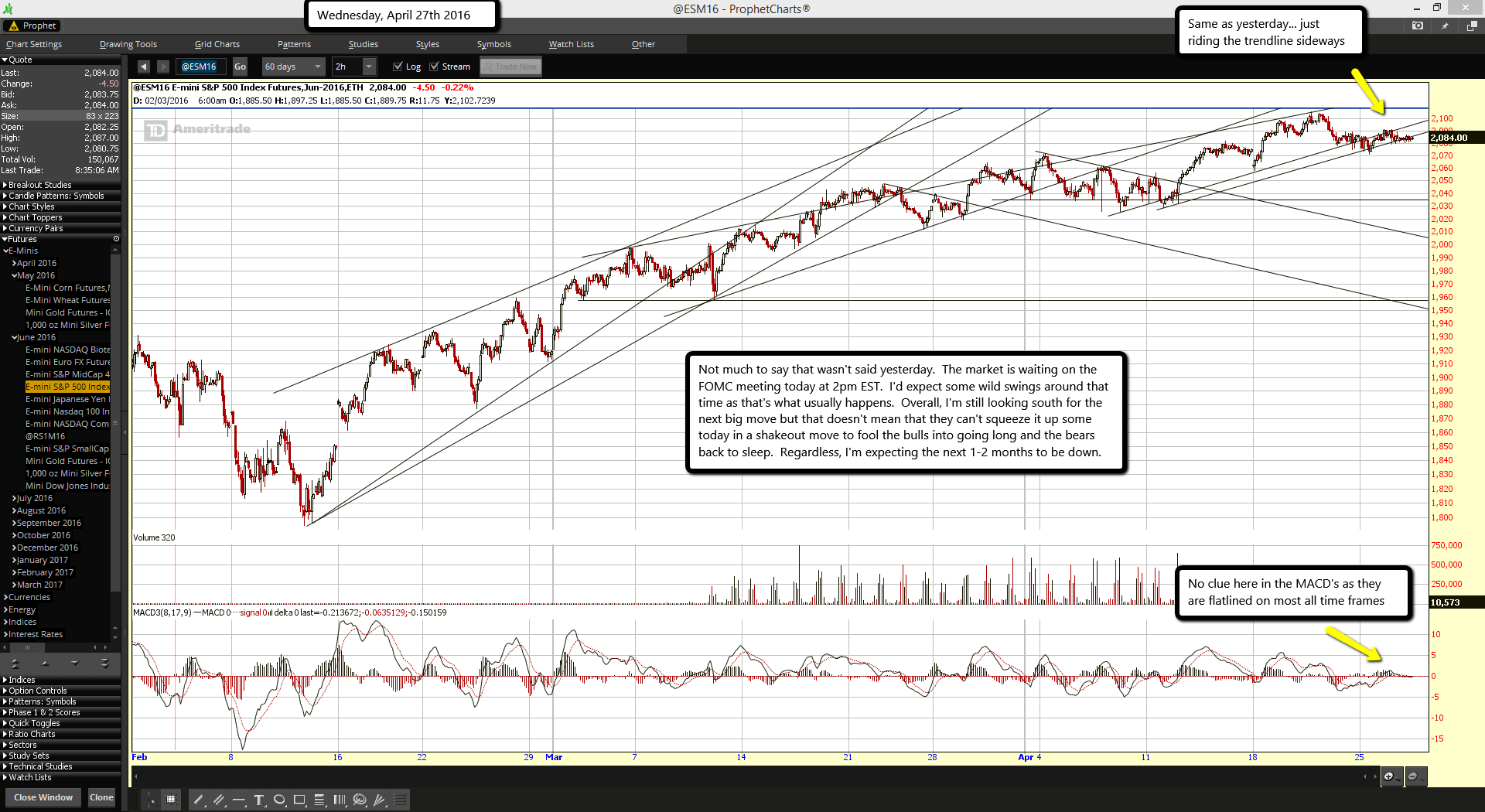
Same as yesterday... just riding the trendline sideways
No clue here in the MACD's as they are flatlined on most all time frames
Not much to say that wasn't said yesterday. The market is waiting on the FOMC meeting today at 2pm EST. I'd expect some wild swings around that time as that's what usually happens. Overall, I'm still looking south for the next big move but that doesn't mean that they can't squeeze it up some today in a shakeout move to fool the bulls into going long and the bears back to sleep. Regardless, I'm expecting the next 1-2 months to be down.
The new submarines will replace Australia's aging fleet of Collins Class vessels
France has been awarded a A$50bn (€34bn; £27bn) contract to build 12 submarines for the Royal Australian Navy.
Australian Prime Minister Malcolm Turnbull announced at a press conference on Tuesday that France had beaten bids from Germany and Japan.
The submarines will be built in Adelaide creating 2,800 jobs, he said.
The decision was based on a 15-month competitive evaluation process that started in February 2015.
"This is securing the future of Australia's navy over decades to come," Mr Turnbull said.
"Australian workers will be building Australian submarines with Australian steel."
Japan was an early frontrunner to win the contract, thanks to former Australian prime minister Tony Abbott's close relationship with Japanese Prime Minister Shinzo Abe.
But Australia's largest-ever defence procurement was awarded to French company DCNS, which proposed to build a modified version of its Barracuda submarine called the Shortfin Barracuda.
The French bid received unanimous support from the various experts in the government's competitive evaluation process, Defence Minister Marise Payne said.
The Shortfin Barracuda is a 4,500-tonne, conventionally powered submarine, whereas the Barracuda weighs 4,700 tonnes and is nuclear powered.
The French design features an advanced pump-jet propulsion system that is supposed to be quieter than propeller propulsion systems.
The Japanese government's bid with a consortium led by Mitsubishi Heavy Industries Ltd proposed building a version of its 4,000-tonne Soryu-class submarine, lengthened by between 6-8m.
The German government's bid with TKMS offered a 4,000-tonne version of an existing 2,000-tonne submarine.
Work on the submarines, which will replace Australia's aging fleet of Collins Class vessels, is expected to continue into the 2050s, according to a Defence White Paper released earlier this year.
Relationship with Japan
The decision to reject the Japanese bid is seen as potentially having ramifications for Australia and Japan's relationship.
Mr Abe was this week reported to be working behind the scenes to shore up the deal, which is said to have foundered because of Japan's inexperience in building military equipment for export.
The Japanese constitution was changed in 2014 to allow the export of military hardware and the lucrative submarine deal with Australia would have been a major victory for Mr Abe.
The Japanese government was also reportedly keen to further deepen its military ties to Australia as a counter to China's rise.
Shared military technology would increase interoperability between the Japanese and Australian fleets.
Mr Turnbull said he had spoken to Mr Abe and was fully committed to the special strategic relationship between Japan and Australia. Source link
Gas crosses the $2 mark but experts say summer prices should be cheapest in 12 yearsA driver waiting for gas at an Exxon station on April 25, 2016, in Teaneck.
By MELANIE ANZIDEI
Staff Writer |
The Record
The average price of gas crept over the $2-a-gallon mark over the weekend in North Jersey for the first time in five months, but is expected to remain low compared with those in recent years even as motorists gear up for summer road trips, according to experts.
Several experts on gasoline prices said they don’t anticipate prices to go above $2.25 for the summer, about 33 cents a gallon less than they were last June.
“It will be the cheapest driving season since summer 2004,” said Tom Kloza, the co-founder and a global head of energy analysis at Oil Price Information Service in Wall Township. According to his service, regular gasoline in North Jersey has not averaged above the $2 mark since Nov. 16.
The average price of gas in the counties of Bergen and Passaic counties was $2.008 on Monday after breaking the $2 barrier on Sunday, according to AAA. The state average was $1.994.
Experts said prices always go up in the spring when the petroleum industry transitions from winter-blend gasoline to a more expensive summer blend, which costs several cents a gallon more to make. And current gas prices in the region have already remained considerably lower than a year ago, when they stood at $2.40 a gallon.
Motorists at a Lukoil Station on Route 46 in Little Falls, where regular gas was selling for $2.24, said they have appreciated the lower costs.
“It used to cost me $100 to fill my tank,” Ricot Jeanbaptiste, 38, who was filling up his GMC Yukon XL truck. He said it now costs $70. Although prices are starting to go up slightly, he said, “They are a lot better than what they used to be.”
Sal Risalvato, the head of a New Jersey association representing gasoline retailers, said that prices are going up because of a combination of factors: The usual increases in switching over to summer blends and an increase in demand, caused by people driving more as a result of lower prices. He said an increase in prices could lead to less demand, which in turn would stop those increases from skyrocketing.
“They can revert back to previous consumption habits,” Risalvato said of motorists.
Both Risalvato the head of the New Jersey Gasoline C Store Automotive Association, and Kloza both said they expect prices to peak at around $2.25.
Kloza said he expects the prices to hover around the $2 for at least several more weeks, adding that some retailers may be reluctant to go above that mark.
“Most people won’t want their numbers to start with a 2,” Kloza said of the retailers, adding that some drivers might seek out prices below the $2 mark. “We’re going to waffle around this number,” he said. “Which means people who want to find gasoline below $2, they can.”
One of the highest prices for a gallon of gas in the region on Monday was $2.75 at a Lukoil station on Wyckoff Avenue in Wyckoff, according to GasBuddy.com, which compiles real-time gas prices submitted by users. But that price appeared to be unusual. No one answered the phone at that station to explain its prices.
Across the country, gas prices appeared to bottom out in February when the national average was slightly below $1.73 a gallon and the state average was about $1.63. The price of regular gas in North Jersey has been rising steadily for several weeks, according to AAA, going from $1.813 a month ago to $1.996 a week ago in the counties of Bergen and Passaic.
Last year, the national average price of gas was $2.40 per gallon, the lowest since 2009 and almost a full dollar cheaper than in 2014, the AAA reported. The association reported that the dropping prices were the result of a large worldwide supply of oil.
NEW DELHI - A massive fire Tuesday gutted the National Museum of Natural History in India’s capital, one of the country’s top museums, an official said.
Firefighters took more than four hours to douse the blaze, which started on the top floor of the six-story museum, New Delhi fire official Harinder Singh said. Thirty-five fire engines were called.
Singh said the entire building was gutted by the blaze.
Environment Minister Prakash Javadekar said the damage caused to the museum was being assessed. An investigation was ordered to determine the cause of the fire.
Five firefighters overcome by heavy smoke were taken to a hospital and released after being treated, Singh said. No other injuries were reported.
Rajesh Panwar, New Delhi’s deputy chief fire officer, said the museum’s fire safety equipment had not been functioning properly, making it more difficult for firefighters to finally bring the blaze under control.
Fires are common in buildings in India due to a lack of proper safety standards.
The state-run natural history museum features thousands of exhibits on plants, animals and mineral wealth in India and around the world.
Nokia’s history as the world’s biggest mobile phone maker is becoming a distant memory, but it’s not out of the gadget business just yet. To build out its health technology business, the company today announced that it has acquired Withings, makers of smart scales, activity trackers, and other health gadgets. Withings is based out of France, and with Nokia in Finland, the transaction was in euros: €170 million to be exact, or around $192 million in U.S. dollars.
The deal is expected to close in Q3 of this year, with Withings becoming a part of Nokia Technologies. It’s a decent return: Withings had raised just under $34 million, with investors including BPIFrance, Idinvest, Ventech and 360 Capital Partners.
The deal is not only a sign of how Nokia still very much believes it more to do in the world of gadgets, but a sign of how the company is going back to its early playbook of building vertically integrated businesses. In this case, buying Withings is not just about the health trackers, blood pressure monitors, thermometers and other objects that consumers will buy, but the bigger business of connecting them and running a wider array of cloud-based services under the hood — otherwise known as the Internet of Things.
“We have said consistently that digital health was an area of strategic interest to Nokia, and we are now taking concrete action to tap the opportunity in this large and important market,” said Rajeev Suri, president & CEO of Nokia, in a statement. “With this acquisition, Nokia is strengthening its position in the Internet of Things in a way that leverages the power of our trusted brand, fits with our company purpose of expanding the human possibilities of the connected world, and puts us at the heart of a very large addressable market where we can make a meaningful difference in peoples’ lives.”
Notably, this is the first acquisition in years at Nokia that’s focused on consumer tech: the last several, including the ingestion of Alcatel-Lucent, have been about building out its mobile back-end and networking businesses.
It’s also a smart move for another part of Nokia’s remaining business: its patents. Nokia may not be making as many new waves in mobile phone patents today as it did years ago, and while it continues to milk those for royalties with companies like Apple, Withings, it says, “will also ensure the ongoing renewal of Nokia Technologies’ world class IPR portfolio.”
While IoT is a very low-margin business compared to other digital consumer services like mobile phones, Nokia notes that healthcare is one of the big opportunities, citing analysts’ forecasts of market CAGR of 37%, making it “the fastest growing health care segment from 2015-2020.”
It’s also an acquisition that is tapping into another trend: we’re living longer and getting more and more conscious of our health, and in some cases we’re not actually getting healthier, with weight issues affecting a lot of our sedentary population, and other illnesses like diabetes growing in prevalence because of wider changes in our diets.
Withings was co-founded by Eric Carreel and Cedric Hutchings in 2008, both of whom appear to be joining Nokia. It employs 200 people in France, the U.S. and Hong Kong.
“Since we started Withings, our passion has been in empowering people to track their lifestyle and improve their health and wellbeing,” said Cédric Hutchings, CEO of Withings. “We’re excited to join Nokia to help bring our vision of connected health to more people around the world.”
For its part, it’s interesting that Withings decided to sell, and to sell to a European tech giant that essentially is a non-player in the activity tracking/health tech business. In the wider market, there may still be question marks over the wider potential for connected devices like activity trackers. Companies like Fitbit have been growing, but slowly. Others like Jawbone have seen their valuations slashed while waiting for the market to really take off.
The question now is whether Withings under Nokia will tap into what’s already out there in terms of consumer interest, or whether they have what it takes to supercharge and lead it.













 A driver waiting for gas at an Exxon station on April 25, 2016, in Teaneck.