Friday, September 25, 2026
Home Blog Page 86

Poison Ranch: The Porter Ranch Gas Blowout

0

Jennifer: “It’s not necessarily the gas; it’s the chemicals they lied about, the benzene and other carcinogens in the well. It was one of those eye-opening things; we were about to go back, and slowly going back to our house for a few hours at a time to clean up and prepare to move back, and one night the kids were there with my mom who was watching them … and my daughter woke up twice that night and threw up, and then you’re thinking, ‘Well is it just the gas, or is my kid just sick? But being that there’s five kids, surprisingly we’re a pretty healthy family. About five days later they read the benzene levels were at 2.4. Now, the legal limit for Benzene is under one, and it was at 2.4 that day. Now looking back I’m like, well, that could have been the reason my daughter threw up twice. Everyone’s mad at the gas company because they can get away with things and just say, ‘Your kid’s probably just sick.’”

Andrew: “There’s no trust of the gas company or regulatory boards. The only group that’s been trustworthy or feasible testing program is the University of California — Los Angeles. The department of public health didn’t know what to do. They basically merged with UCLA to fund their testing.”

Jennifer: “What’s come out clearly, is this facility leaked before the blowout. You have to look at the language the gas company uses. They talk about air levels returning to ‘pre-leak’ levels. What people are starting to realize is that even as of a month ago there were 66 leaks. They’ve just had it return to whatever those levels were. The problem is we only know maybe 10 of the potentially hundreds of chemicals we were exposed to because it’s proprietary and the gas company won’t release it. So we don’t even know what we’re testing for. The leaks are supposed to be resolved. They are not.”

Andrew: “So we still have air-quality issues, and a bigger issue is that everything that was spewed is in the environment now, in trees, on the ground, in your house. They’ve already talked about smaller-than-dust-size particles that can’t be seen. So we don’t know what we’re looking for, but it’s been admitted that it’s around and coated everything. So how are they treating that portion of it? You gotta fix the air, you gotta prove that the ground and homes are clean and safe, and do that over however many square miles of the north valley that you have to handle, and do it in a manner that people believe you when you release results as independently as possible.”

Jennifer: “What’s hard is we have really good friends who turn their noses up at us because they aren’t getting sick. We dealt with lots of close friends who just blindly trusted everything was fine because the gas company said it was fine, and it took some of them four months to where they finally got sick enough to leave.”

David Overton, a 34-year-old software engineer, looks toward his home of five years in Porter Ranch. Citing health concerns for their three children, he and his wife decided to relocate to a hotel until the area is deemed safe again. “My wife and I grew up poor,” he says. “We had to work our entire lives to live here. We’re not sure if it will ever be the same in Porter Ranch, not to mention the impact on home values. People are pretty pissed off about it.”

Alan and Sandy Crawford of Granada Hills join a protest outside of Southern California Gas Company offices on March 22. “The breaking point for us was when we returned home and the kids got sick again. In the hotel we kept up with all the protests and events on Facebook and everything, but it was easy to be removed from it all,” Sandy says. “Once we got back and the nosebleeds started happening again, we decided enough was enough.” Sandy is holding a sign showing their son Diesel with a bloody nose.

Sandy, Chancellor, Diesel, and Alan Crawford stand outside their home in Granada Hills, which they have temporarily vacated due to nosebleeds and other health issues related to the nearby gas leak. Depending on the winds in the canyon, many communities other than Porter Ranch also reported health issues.

“We’ve lived here five years. It’s a great place to raise kids. We don’t want to leave,” Sandy says. “We’re still paying for the hotel because we don’t feel safe fully moving back home yet. We want the gas company to cover our cleaning expenses, the hotel, etc.”

“The regulations have to change,” Alan says. “I knew as soon as I heard that [Governor] Jerry Brown’s sister was on the board of directors for the Southern California Gas Company that’s why they dragged their feet for so long.”

Jitender Singh looks into the back of a moving truck as office supplies are packed up with help from his employees. Singh has run a cyber-security firm out of his house in Porter Ranch for years, but finally decided to relocate temporarily because of the gas leak. “My wife was having symptoms, and a few of my employees complained about feeling sick, so it was time to go,” he says.

University of California-Davis scientist and pilot Stephen Conley steps over cables transferring data from instruments on his plane at Van Nuys airport on January 21 after making another flight over Aliso Canyon to measure methane emissions from the gas leak.

Conley was one of the first scientists to sound alarms to the public about the massive scale of the leak and has been making flights for several weeks to gather data. The flight path goes through windy canyons and heavy turbulence before reaching the invisible cloud of methane and its accompanying foul-smelling compound mercaptan, which is a chemical added to make the odor of natural gas detectable. “I’ve had seven people, other researchers mostly, join me on the flights, and all seven of them have gotten sick on the ride,” he says. “I guess I’ve got a strong stomach.”

Doctor and activist Leah Garland affixes a gas mask at a rally on January 16 demanding the shut down of the Aliso Canyon oil and gas wells.

Gurbux Singh of Chatsworth protests on January 23 outside of the Hilton Hotel in Woodland Hills before a public hearing concerning the natural gas storage facilities in Aliso Canyon. Singh says the community will “keep fighting” until the gas storage facilities surrounding nearby residential areas are permanently shut down.

A member of the Sierra Club environmental group dances with a cutout of California Governor Jerry Brown at a Save Porter Ranch rally at Granada Hills Charter School on January 16. Governor Brown has been criticized for responding slowly to the situation, leaving many to speculate that his lack of response was influenced by his sister Kathleen Brown’s position on the board of director’s for the Southern California Gas Company.

Employees and contractors of the Southern California Gas company huddle to discuss the night’s testing plan of chemical emissions on January 14 near the entrance to the Aliso Canyon storage facility where natural gas had been leaking since October.

Ammar Abukarah, a longtime resident of Porter Ranch, flies his recreational drone over Aliso Canyon to get a better view of the leak site. Many hiking paths into the canyon have been blocked by the Southern California Gas Company security contractors, leaving curious residents like Ammar to resort to other means to satisfy their curiosity.

Gary Yamron of Porter Ranch attempts to visualize methane emissions spewing from Aliso Canyon using an infrared FLIR video camera that costs over $10,000. Yamron works for an environmental equipment rental company and happens to live in the Porter Ranch community that has been severely affected by the gas leaks, so he decided to test out the equipment’s infrared capabilities. A video uploaded to YouTube on December 12 used the same model of FLIR camera to record the otherwise invisible giant cloud of leaking methane.

A man from a cleaning service washes the floors of a recently vacated home on Dunure Place in Porter Ranch on March 26. The home, which is up for sale, was vacated by the previous owners because of the gas leak. This is the second time it has been cleaned, according to the man.

The sun sets over the community of Porter Ranch on the evening of January 28, a few weeks before the largest methane blowout in U.S. history was finally capped less than a mile away. Over 112 days, the leak spewed 100,000 tons of methane into the atmosphere, equivalent to the annual greenhouse gas emissions of half a million cars, and the future is still uncertain for many residents who were affected.

Source link

Healthy job gains expected despite weak report

0

Several top analysts expect the government to report strong job growth on Friday despite a disappointing private-sector survey, a development that would reinforce the belief that the economy is poised to pick up after two weak quarters.

Payroll processor ADP said Wednesday that businesses added 156,000 jobs in April, well below the 195,000 economists expected and a possible red flag that the sluggish economy is finally dragging down the resilient labor market.

But economists project the Labor Department’s survey of the public and private sectors, due out Friday, will record 200,000 job gains for last month, according to the median estimate of those surveyed by Bloomberg. ADP’s tally has often varied significantly from Labor’s, though the two reflect similar broad trends.

High Frequency Economics, Barclays Capital and JPMorgan Chase expect Labor to announce job gains of 240,000 to 250,000 Friday, above the 209,000 monthly average so far this year. They largely point to initial jobless claims, a reliable gauge of layoffs, that continue to hover near 42-year lows. And the Institute for Supply Management said Wednesday that its measure of service-sector employment reflected more hiring last month.

The labor market has held up remarkably well, defying weak economic growth of 1.4% at an annual rate in the fourth quarter of 2015 and a meager 0.6% in this year’s first quarter. A listless global economy, strong dollar and low oil prices have hampered U.S. exports and the production of crude and related products such as steel pipes. Those headwinds typically hamper larger companies more than small businesses, which, the ADP report showed, continued to hire briskly.

Of greater concern is that consumer spending — which makes up 70% of economic activity — also has slowed. That has stoked worries that monthly payroll growth topping 200,000 a month may dip.

Yet Barclays economist Jesse Hurwitz blames the slip in consumption on soft heating demand because of unseasonably warm winter weather and a pullback in torrid auto sales. A report this week revealed that vehicle sales bounced back in April. Solid job growth, low gasoline prices and reduced household debt, should continue to support consumer purchases, economists say.

Meanwhile, both the dollar and oil prices have stabilized, while a sharp retreat in business stockpiling is mostly played out, says Jim O'Sullivan, High Frequency's chief U.S. economist.

Hurwitz also notes that the government has at least partly attributed a pattern of weak first-quarter growth to insufficient seasonal adjustments in the volatile cold-weather months. And many economists believe the labor market provides a better barometer of the economy than gross domestic product, which can be difficult to measure.

A report Friday of at least 200,000 or so payroll gains likely would dispel concerns of a weakening economy, O’Sullivan says.  At the same time, he says, a disappointing tally “is going to be viewed as evidence the (job growth) trend is slowing.” Job gains of 150,000 or fewer likely would help dissuade an already-cautious Federal Reserve from raising interest rates again in June, he says. The Fed lifted its benchmark rate in December for the first time in nine years but has stood pat since.

Source link

NY / Region|Shutdown or Less Service? MTA Weighs 2 Options for L Train Project

0

Crews work on the L train line after Hurricane Sandy damaged it in 2012. The Metropolitan Transportation Authority is considering two options for fixing the line’s tunnel under the East River.

The Metropolitan Transportation Authority is considering two proposals to shut down the L train tunnel between Manhattan and Brooklyn that would close the subway line under the East River or reduce its service by 80 percent, officials said on Wednesday.

The proposals that will be outlined at a public meeting in Brooklyn on Thursday are closing the entire tunnel for a year and a half to repair damage from Hurricane Sandy, or closing one tube at a time over a three-year period. Any shutdown — a growing source of anxiety among people who live along the crowded subway line — would not begin until early 2019, officials said.

If one tube remained open, trains would run every 12 to 15 minutes, up from the current interval of three to four minutes during the morning rush, officials said at a briefing for reporters. Trains could carry about one-fifth of the 225,000 riders who currently take the L train under the river each day.Passengers on an L train last month.

The agency has ruled out making repairs only during nights and weekends because the complex work could not be done in such a narrow window, said Veronique Hakim, the president of New York City Transit, which runs the subway and buses. Building a subway tunnel under the river, as some residents have suggested, would be expensive and take too much time, Ms. Hakim said.

Under either proposal, the authority might run extra buses over the Williamsburg Bridge and add ferry service between Manhattan and Brooklyn. Riders could be directed to other nearby subway routes, including the G and M lines, which would have additional trains to handle more passengers.

The authority’s chairman, Thomas F. Prendergast, and Ms. Hakim planned to present the two options on Thursday during the meeting at the Marcy Avenue Armory. A second public meeting is scheduled for May 12 at the Salvation Army Theater in Manhattan.One option presented by the transportation authority: closing the entire tunnel for a year and a half.

The subway crossing, known as the Canarsie tunnel, was flooded during the 2012 hurricane. Officials said the tunnel required major work to fix crumbling walls and to repair tracks and cables.

Despite the damage, Mr. Prendergast said that the tunnel was safe for riders, and that the agency had conducted regular inspections to look for problems. After receiving input from residents and businesses, the agency plans to decide which option to pursue within three months.

Asked whether he would rather close the whole tunnel at once, Mr. Prendergast said the agency was committed to hearing from the community before making a decision. But he noted that when people learned more about the plans, they often favored a full closing.The second option: closing one tube at a time over three years, with less frequent service.

“I think there is an ‘Aha’ moment they have in their minds, like, ‘Geez if it’s only one in five people you can carry, maybe it would be better to have two tracks,’” Mr. Prendergast said in reference to closing the tracks in both tubes, the more efficient of the two options.

The Canarsie tunnel work could cost $800 million to $1 billion, with the federal government covering much of the project, Mr. Prendergast said.

The briefing was the first time that officials from the authority discussed the plans in detail. Under plans for a full tunnel closing, no L trains would run between the Eighth Avenue stop in Manhattan and the Bedford Avenue stop in Brooklyn. The line would continue to run throughout the rest of Brooklyn.

If one tube were closed at a time, the L line would run in two separate segments: reduced service between Bedford Avenue and Eighth Avenue and nearly regular service between the Lorimer Street and Canarsie-Rockaway Parkway stops.

Asked whether buses might have a dedicated lane over the Williamsburg Bridge so they would not get stuck in traffic, Mr. Prendergast said the idea would be considered. To add capacity to the G line, Ms. Hakim said the agency would add cars to its trains, which are known for being shorter than their platforms.

Source link

Consumer Agency Moves to Assert Bank Customers’ Right to Sue

0

Richard Cordray, director of the Consumer Financial Protection Bureau, pointed out what a major change his agency was poised to bring about. “Many banks and financial companies avoid accountability by putting arbitration clauses in their contracts that block groups of their customers from suing them,” he said in a statement.

The rule would apply only to the consumer financial companies that the agency regulates. It would not apply to arbitration clauses tucked into contracts for cellphone service, car rentals, nursing homes or employment.

“It is a good start,” said Berle M. Schiller, a federal judge in Philadelphia who has been critical of arbitration clauses that dismantle class actions and tip the scales in favor of companies. “Class actions are the only way that companies can be brought to heel.”

The agency’s proposed rule would be the first significant check on arbitration since a pair of Supreme Court decisions in 2011 and 2013 blessed its widespread use. Those decisions signaled the culmination of an effort by a coalition of credit card companies to stop the tide of class-action lawsuits.

The group dusted off a federal law dating to 1925 that formalized arbitration as a means for companies to resolve their disputes with one another. Starting in the early 2000s, the credit card companies began widely using arbitration for disputes with their customers.

As arbitration spread, it drew the ire of prosecutors, judges and officials like Senator Elizabeth Warren, Democrat of Massachusetts, who championed the creation of the consumer protection bureau. The Dodd-Frank law, which overhauled Wall Street and created the bureau, specifically charged the agency with the task of studying arbitration.

Last March, the agency released a 728-page report detailing how few consumers followed through with arbitration once their class actions were blocked.

Removing the Ability to Sue

A New York Times study of the increasing use of arbitration clauses in contracts, which has effectively forced millions of people to sign away their right to go to court.

For the few who did go through with the process, the report also showed the lopsided nature of the rulings. Businesses won bigger judgments against consumers in arbitration — a total of $2.8 million in 2010 and 2011, largely for debt payments — than the consumers obtained in relief, according to the agency’s analysis.

During that period, only 78 arbitration claims resulted in judgments in favor of consumers, who received less than $400,000 in total relief.

The financial industry disputed the findings, arguing that on an individual basis, consumers fare better in arbitration than in class actions. On average, awards in arbitration are 166 times as great as the sums received by individuals participating in a class action, according to the industry’s analysis.

But judges and law professors say that class actions, by their very nature, are meant to help large groups of people recoup small amounts of money — a $35 overdraft fee or a mysterious $5 late fee, for example.

And more broadly, class actions can force companies to change their business practices.

Banks — not all of which use mandatory arbitration clauses — may understand that concept better than most. Banks had to pay more than $1 billion to settle class-action lawsuits, beginning in 2009, that accused them of manipulating their checking account policies to maximize the number of overdraft fees.

Since then, seven of the banks involved in the class actions have adopted mandatory arbitration clauses.

The new rules giving borrowers access to class actions are likely to draw vigorous opposition from the U.S. Chamber of Commerce and other business groups, though they may not be able to do much about them. Their position has been that the consumer agency’s study does not support its conclusions about mandatory arbitration.

“The proposed rule is a wolf in sheep’s clothing,” the U.S. Chamber of Commerce said in a statement. “Now the agency designed to protect consumers is proposing a rule that will end up hurting them.”

Source link

Yahoo loses key AT&T business

0

yahoo headquarters

As Yahoo continues to weigh offers from potential bidders, its current display ad and search business has taken a hit.

AT&T(T, Tech30) said Wednesday that it would be ending part of a 15-year-old deal with the company. It's moving management of its online portal, AT&T applications, and search to another company, Synacor (SYNC).

The Wall Street Journal first reported the break on Wednesday.

AT&T confirmed the split in a statement, saying the transition would take place over the next one to two years. It will not have any impact on AT&T email, which will continue to be hosted by Yahoo (YAHOF).

Related: Yahoo is for sale; bidders line up; Marissa Mayer is toast

"It is another step as we integrate the entertainment and services our customers want. Our customers will not have to take any actions during this transition. This deal does not impact email addresses," said AT&T.

In a news release announcing the new contract, Synacor estimated the revenue from the deal at around $100 million a year after the transition is completed.

Under the expiring deal with Yahoo, visitors to att.net are redirected to att.yahoo.com where they are greeted with a Yahoo search bar and the latest Yahoo news. Yahoo search also appears in other AT&T products.

"We are honored to have been selected from among the contenders AT&T considered in their evaluation process," said Himesh Bhise, Synacor's CEO, in the release.

Yahoo declined to comment on the matter.

Source link

The cost of the massive, 4-month gas leak around Los Angeles has climbed to $665 million

0

FILE - In this Nov. 3, 2015, file photo, provided by Southern California Gas Co., SoCalGas crews and technical experts attempt to safely stop the flow of natural gas leaking from a storage well at the utility's Aliso Canyon facility near the Northridge section of Los Angeles. Sempra Energy says costs from a massive gas leak in Los Angeles have reached 5 million. In an SEC filing in February, SoCalGas, which is owned by Sempra, estimated costs of less than half that, 0 million to 0 million. The massive gas leak that spewed uncontrollably for nearly four months drove thousands of Los Angeles residents to leave their homes. It was capped in late February. (Javier Mendoza/SoCalGas via AP, File)

SoCalGas crews and technical experts attempt to safely stop the flow of natural gas leaking from a storage well at the utility's Aliso Canyon facility near the Northridge section of Los Angeles in November 2015. Sempra Energy says costs from a massive gas leak in Los Angeles have reached $665 million.

The estimated cost of a massive gas well blowout that spewed methane uncontrollably for nearly four months and uprooted 8,000 Los Angeles families has more than doubled to $665 million, Sempra Energy announced Wednesday.

San Diego-based Sempra had estimated costs of $330 million in its annual report in February, but that was before courts forced its Southern California Gas Co. to continue paying to house thousands of relocated residents.

The gas leak at the Aliso Canyon storage facility was the largest-known release of climate-changing methane in U.S. history, according to scientists. It spewed an estimated 107,000 tons of methane over 16 weeks.

The blowout reported Oct. 23 sickened residents in Porter Ranch and surrounding San Fernando Valley suburbs who complained of headaches, nausea, nosebleeds and other symptoms as the foul-smelling gas wafted over neighborhoods.

SoCalGas has pointed out that public health agencies have found the air quality in the area has returned to normal, though many residents have continued to complain of maladies since the leak was capped in February. Some 3,700 households remain in short- or long-term housing, many because of fears of returning until they are assured their homes are clean and safe.

Dennis Arriola, president and chief executive of SoCalGas, said that 54 percent of relocated residents had returned home and more were returning each week.

He said the latest cost estimates, which were included in Sempra's first-quarter earnings, reflected the expectation the company will continue to pay housing for relocated families until June 7 when another court hearing is scheduled.

Judges have repeatedly extended orders for the company to pay relocation costs while the Los Angeles County Department of Public Health tests homes for carcinogens and other compounds found in natural gas.

The company has begun moving families from hotels to apartments, which it said was being done to provide more space and amenities such as kitchens. Arriola said it also allowed the company to cut costs because it won't have to pay $45 per person each day for meals.

gas leak california los angelesA woman holds a sign while attending a public hearing before the South Coast Air Quality Management District (AQMD) regarding a proposed stipulated abatement order to stop a nearby massive natural gas leak, on January 16, 2016 in Granada Hills, near Porter Ranch, California.Arriola said the lion's share of the latest cost estimate — 70 percent — is for relocation expenses. The other 30 percent is split equally between: costs for stopping the leak and investigating its cause; and legal and other costs.

The estimates do not account for possible damages from 138 pending lawsuits or civil or criminal penalties that could be brought by a swarm of government agencies investigating the leak.

The company said it has four types of insurance policies to cover more than $1 billion in costs. In its first-quarter earnings report Wednesday, Sempra said SoCalGas has recorded an insurance receivable of $660 million.

Sempra said the estimated costs had no material impact on earnings in the quarter. Net income for Sempra was down 28 percent from the same quarter last year and earnings fell short of Wall Street expectations.

Arriola said the company expects an investigation into the cause of the leak to be completed by early 2017.

He reiterated plans to complete a battery of tests on the remaining 114 wells at the field so the company can resume storing gas underground.

Aliso Canyon is the largest gas storage facility west of the Mississippi River and a major source of energy for the Los Angeles area. Energy officials have warned of possible blackouts this summer if it is not able to operate.

Source link

Media|Tribune Publishing Says No to Gannett’s $815 Million Offer

0

The Los Angeles Times building. The owner of the newspaper, Tribune Publishing Company, rejected an unsolicited offer from Gannett.

Two weeks after the Gannett Company went public with an unsolicited bid to acquire Tribune Publishing Company, Tribune’s board formally responded with a firm answer: No.

On Wednesday, Tribune Publishing, which owns newspapers including The Los Angeles Times and The Chicago Tribune, sent a letter to Gannett saying its board had unanimously rejected the $815 million takeover offer, which included debt and other liabilities and represented a significant premium above Tribune’s share price.

“The board believes that the price reflected in the proposal understates the company’s true value and is not in the best interests of our shareholders,” the letter said.

Gannett’s bid was an unconventional move in the newspaper industry, and Tribune’s rejection was not surprising. Still, the reply ratchets up the pressure on Gannett, which can now choose to walk away or try to assuage shareholders’ objections.

“This announcement reaffirms our concern from the outset that Tribune’s board never intended to engage with us, necessitating that we make our proposal public,” John Jeffry Louis, chairman of the Gannett board, said in a statement. “It is unfortunate that Tribune’s board would deny their shareholders this compelling, immediate and certain cash value by rejecting our offer without making a counterproposal or otherwise negotiating or providing any constructive feedback.”

Gannett, which owns USA Today, went public on Monday with its intent to solicit so-called withhold votes ahead of Tribune’s annual shareholder meeting. This tactic, infrequently used in the world of deal making, encourages shareholders of the target company to essentially boycott their votes for director nominees. Gannett said it had filed preliminary proxy materials, urging investors to withhold their votes in the election of eight directors. The move is primarily symbolic, in that it will probably not block the nominees from being elected.

“We intend to give Tribune shareholders the opportunity to send a clear message to the Tribune board that its lack of engagement with our board and management team regarding our highly compelling premium offer for $12.25 per share in cash is unacceptable,” Gannett’s chief executive, Robert Dickey, said in the statement on Monday.

Gannett missed the nomination window to submit its own slate of directors, a move that might have put even more pressure on Tribune’s board.

On April 12, Gannett sent a letter to Tribune Publishing’s management team with an offer of $12.25 a share. After waiting two weeks for an answer, Gannett tried to bring Tribune Publishing to the table by disclosing the bid and corresponding letter. If the acquisition were to go through, it would expand Gannett’s portfolio to nearly 120 newspapers and give it more of a presence in major markets, including Los Angeles, Chicago and Baltimore.

But the management team at Tribune seemed to think that remaining independent was the better course. In a statement, Justin C. Dearborn, the chief executive of Tribune Publishing, said the company was “in the early stages of a compelling transformation” and that the board was “confident that the execution of our stand-alone strategic plan will generate shareholder value in excess of Gannett’s proposal.”

During an earnings call with investors on Wednesday, Mr. Dearborn said The Los Angeles Times planned to open seven overseas news bureaus this year.

He also addressed Gannett’s offer.

“I want to be clear that we did not seek or encourage this proposal, and the board has not been trying to sell the company,” he said. “I also want to reiterate that Gannett’s repeated claims that our board did not take this proposal seriously are misleading and disingenuous.

Source link

ES Morning Update May 5th 2016

0

a4d3ae91-7406-4762-a7b6-25fd81697ff8

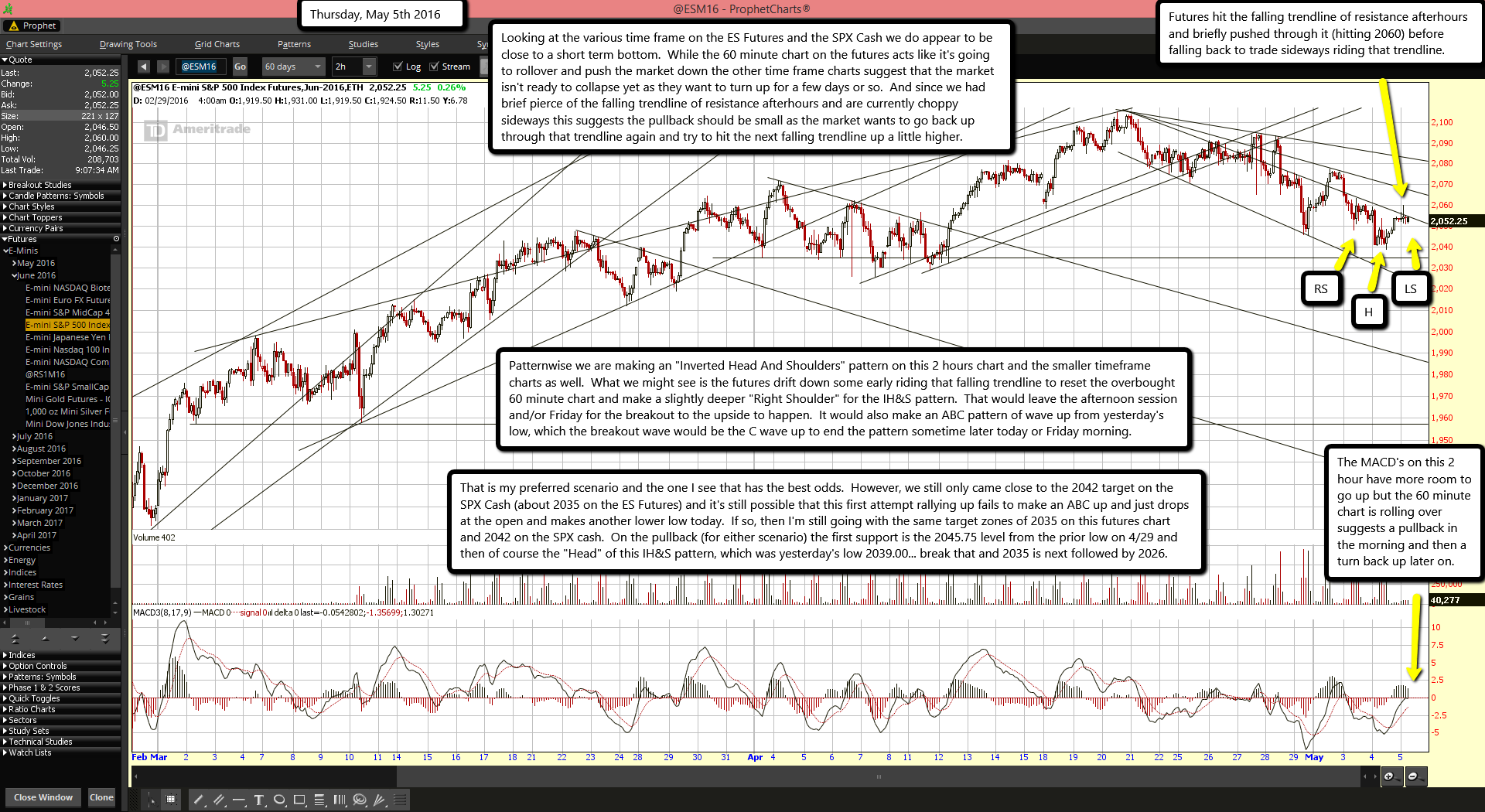
Futures hit the falling trendline of resistance afterhours and briefly pushed through it (hitting 2060) before falling back to trade sideways riding that trendline.

The MACD's on this 2 hour have more room to go up but the 60 minute chart is rolling over suggests a pullback in the morning and then a turn back up later on.

Looking at the various time frame on the ES Futures and the SPX Cash we do appear to be close to a short term bottom.  While the 60 minute chart on the futures acts like it's going to rollover and push the market down the other time frame charts suggest that the market isn't ready to collapse yet as they want to turn up for a few days or so.  And since we had brief pierce of the falling trendline of resistance afterhours and are currently choppy sideways this suggests the pullback should be small as the market wants to go back up through that trendline again and try to hit the next falling trendline up a little higher.

Patternwise we are making an "Inverted Head And Shoulders" pattern on this 2 hours chart and the smaller timeframe charts as well.  What we might see is the futures drift down some early riding that falling trendline to reset the overbought 60 minute chart and make a slightly deeper "Right Shoulder" for the IH&S pattern.  That would leave the afternoon session and/or Friday for the breakout to the upside to happen.  It would also make an ABC pattern of wave up from yesterday's low, which the breakout wave would be the C wave up to end the pattern sometime later today or Friday morning.

That is my preferred scenario and the one I see that has the best odds.  However, we still only came close to the 2042 target on the SPX Cash (about 2035 on the ES Futures) and it's still possible that this first attempt rallying up fails to make an ABC up and just drops at the open and makes another lower low today.  If so, then I'm still going with the same target zones of 2035 on this futures chart and 2042 on the SPX cash.  On the pullback (for either scenario) the first support is the 2045.75 level from the prior low on 4/29 and then of course the "Head" of this IH&S pattern, which was yesterday's low 2039.00... break that and 2035 is next followed by 2026.

Tribune Publishing rejects Gannett’s bid

0
AFP 532481529 A MDF USA CA

Tribune Publishing, which owns the Los Angeles Times, Chicago Tribune and nine other daily newspapers, said Wednesday its board of directors has rejected Gannett's $815 million offer to buy the company.

"Tribune Publishing’s board has unanimously determined that Gannett’s opportunistic proposal understates the company’s true value and is not in the best interests of its shareholders," Tribune said in a statement.

Tribune shares rose 4.4% to $11.50 in after-hours trading.

On April 25, Gannett, which owns USA TODAY and 107 local news properties, revealed its offer to buy Tribune Publishing for $12.25 per share and assume $390 million of Tribune's debt, bringing the total value of the bid to $815 million. Gannett CEO Robert Dickey, who submitted the offer in a private letter to Tribune's board on April 12, said he chose to go public with the offer due to Tribune's "continued refusal to begin constructive discussions with us."

Tribune's board has since hired bankers to review the offer, but its management has maintained that it prefers to run the company on its own with a new strategy formed by Michael Ferro, the company's chairman and its single-largest shareholder, and Tribune CEO Justin Dearborn.

"Tribune Publishing is in the early stages of a compelling transformation, with a well-defined strategic plan to drive increasing monetization of our important brands, capitalize on the global potential of the LA Times and significantly accelerate our conversion of content to revenue through an enhanced digital strategy,” Dearborn said in a statement Wednesday.

Tribune announced Wednesday that it had suffered a loss in the first quarter of this year.

Tribune's board is open to evaluating "any credible proposal," but for now, Tribune will begin executing its strategy that includes investing more in content and deploying "programmatic" advertising-buying technology more widely at its news properties, Dearborn said in a call with analysts Wednesday afternoon. As part of expansion, the L.A. Times plans to open seven foreign bureaus, including outposts in Hong Kong, Seoul and Mexico City.

Dearborn also said the company will create a business unit called Tronc to sell more digital ads. According to the U.S. Patent and Trademark Office’s record on Tribune’s trademarking of the term, the unit’s new services will include “compilation, production and dissemination of advertising matter” and “social media strategy and marketing consultancy services.”

"I believe we have a fundamental advantage in that we create more original curated content," Dearborn said.

“Likely, this will be a test of wills,” said Ken Doctor, a media analyst who writes about the news business at his site, Newsonomics.com. “Tribune chairman Michael Ferro will try to stonewall Gannett, while Gannett must decide how much public and legal pressure it is willing to exercise to win the company. I expect this test of wills will be decided sooner than later. In this case, while Tribune management passions may be high, the numbers are on Gannett's side — and numbers usually triumph in these cases.”

He added, “Given the poor Tribune revenues …Tribune has a hard time justifying a greater value for the company than Gannett has offered.”

As the earnings call began, analysts were told Dearborn wouldn't answer questions about the Gannett offer. Ferro, who became Tribune's board chairman in February after buying a 16.6% stake for $44.4 million and expanded the board to 10 members from seven, didn't participate in the call.

"Gannett’s opportunistic proposal understates the company’s true value and is not a basis for further discussion," Dearborn said. "The board is confident that the execution of our standalone strategic plan will generate shareholder value in excess of Gannett’s proposal.”

Tribune, based in Chicago, also said Wednesday it swung to a loss in the first quarter as rising circulation revenue couldn't offset an advertising sales drop and higher expenses.

Net loss for the three-month period ending March 27 totaled $6.5 million vs. $2.5 million of net profit a year ago.

Per-share earnings, after adjusting for some items, including employee buyout costs, were 23 cents, below 25 cents estimated by analysts who were polled by S&P Global Market Intelligence.

Revenue was relatively flat at $398.2 million.

Advertising sales fell 4.4% to $214.7 million due to "softening" in print ad sales, it said. Circulation revenue rose 11.4% to $121.8 million as the company raised rates. Total digital revenues rose 15% to $55 million.

Source link

Two Tesla Production Chiefs to Leave Ahead of Biggest Challenge Yet

0


Two top manufacturing executives are leaving Tesla Motors Inc., including the global head of production, at a time when the electric-car company is about to release its most important car: the mass-production Model 3.

Greg Reichow, Tesla's vice president of production and one of its highest-paid executives, and Josh Ensign, vice president of manufacturing, will leave the company. A Tesla spokesperson confirmed both departures and said Reichow will remain until his replacement is found.

A person familiar with the situation who isn't authorized to speak about the matter said the executive changes are linked to delays, glitches, and a recall that have bedeviled Tesla's Model X. Tesla denied any connection between the departures and production problems with its SUV. "This is not about the Model X," said a Tesla spokesperson. "After being at Tesla for over five years and leading its production team for the past three years, Greg Reichow has announced his intention to take a leave of absence from Tesla so that he can have a well-earned break."

The latest high-level personnel changes brings to five the total number of Tesla vice presidents who have left the company this year, and Reichow marks the biggest departure. He served as the leader of car production and had been one of Tesla's highest-compensated employees, making almost $6.4 million in cash, stock, and options in the last two years, according to company filings. Tesla did not elaborate on Ensign's plan to leave.

"Greg and the team deserve a lot of credit for building an all-new manufacturing organization from the ground up and for making Model S and Model X a reality," said Tesla Chief Executive Officer Elon Musk in an e-mail to Bloomberg. "We're confident that with the strength of the team, high-quality manufacturing at Tesla will continue." In the same e-mail provided by Tesla, Reichow added: "My belief in Tesla's ability to successfully deliver great cars and inspire the world to drive electric remains as strong as ever."

While Tesla described Reichow's exit as a leave of absence—and other executives have left and rejoined—the company also said Reichow will be involved in handing off his responsibilities to a successor to ensure uninterrupted production.

The launch of Tesla’s Model X, which Reichow helped oversee, was marred by delays. Musk has publicly taken responsibility for what he described as engineering "hubris" that packed too many new features into the first version of the SUV, including the double-hinged "falcon-wing" doors and mono-post seats. The Model X was delayed by more than 18 months, following missed launch dates for previous models. Several thousand of the earliest Model X vehicles were recalled over problems with the seats.

“In retrospect,” Musk said in September, “we would not have had so many features and functionality.”

The company has been working to resolve the problems. Model X deliveries have been increasing, and reviews have been positive. Tesla will report first-quarter earnings after the close of stock trading on Wednesday.

Other senior executives who have left Tesla this year include Michael Zanoni, vice president of finance and worldwide controller; James Chen, vice president of regulatory affairs and deputy general counsel; and Ricardo Reyes, vice president of global communications. Tesla said that of 40 executive positions filled in the last year, only one has left. Half the people who report directly to Musk have been at the company for more than five years.

Reichow joined Tesla in April 2011. He had previously worked at U.S. solar panel manufacturer SunPower for more than seven years, according to his profile posted on LinkedIn, which cited no prior auto industry experience. Ensign joined Tesla in June 2014 after working at Honeywell for more than a decade. Ensign could not immediately be reached for comment.

Next up for Tesla may be its biggest manufacturing and production challenge yet: building the Model 3. The $35,000 mass-market electric car received deposits for 400,000 reservations in the weeks after the March 31 unveiling of the prototype. Before the designated launch date of late 2017, Tesla needs to massively ramp up production capacity—first for the Model X, then for the batteries that power all of Tesla's vehicles, and finally for the Model 3 itself. Much of that effort will now fall to an as-yet-unnamed top production executive.

Two top manufacturing executives are leaving Tesla Motors Inc., including the global head of production, at a time when the electric-car company is about to release its most important car: the mass-production Model 3.

Greg Reichow, Tesla's vice president of production and one of its highest-paid executives, and Josh Ensign, vice president of manufacturing, will leave the company. A Tesla spokesperson confirmed both departures and said Reichow will remain until his replacement is found.

A person familiar with the situation who isn't authorized to speak about the matter said the executive changes are linked to delays, glitches, and a recall that have bedeviled Tesla's Model X. Tesla denied any connection between the departures and production problems with its SUV. "This is not about the Model X," said a Tesla spokesperson. "After being at Tesla for over five years and leading its production team for the past three years, Greg Reichow has announced his intention to take a leave of absence from Tesla so that he can have a well-earned break."

The latest high-level personnel changes brings to five the total number of Tesla vice presidents who have left the company this year, and Reichow marks the biggest departure. He served as the leader of car production and had been one of Tesla's highest-compensated employees, making almost $6.4 million in cash, stock, and options in the last two years, according to company filings. Tesla did not elaborate on Ensign's plan to leave.

"Greg and the team deserve a lot of credit for building an all-new manufacturing organization from the ground up and for making Model S and Model X a reality," said Tesla Chief Executive Officer Elon Musk in an e-mail to Bloomberg. "We're confident that with the strength of the team, high-quality manufacturing at Tesla will continue." In the same e-mail provided by Tesla, Reichow added: "My belief in Tesla's ability to successfully deliver great cars and inspire the world to drive electric remains as strong as ever."

While Tesla described Reichow's exit as a leave of absence—and other executives have left and rejoined—the company also said Reichow will be involved in handing off his responsibilities to a successor to ensure uninterrupted production.

The launch of Tesla’s Model X, which Reichow helped oversee, was marred by delays. Musk has publicly taken responsibility for what he described as engineering "hubris" that packed too many new features into the first version of the SUV, including the double-hinged "falcon-wing" doors and mono-post seats. The Model X was delayed by more than 18 months, following missed launch dates for previous models. Several thousand of the earliest Model X vehicles were recalled over problems with the seats.

“In retrospect,” Musk said in September, “we would not have had so many features and functionality.”

The company has been working to resolve the problems. Model X deliveries have been increasing, and reviews have been positive. Tesla will report first-quarter earnings after the close of stock trading on Wednesday.

Other senior executives who have left Tesla this year include Michael Zanoni, vice president of finance and worldwide controller; James Chen, vice president of regulatory affairs and deputy general counsel; and Ricardo Reyes, vice president of global communications. Tesla said that of 40 executive positions filled in the last year, only one has left. Half the people who report directly to Musk have been at the company for more than five years.

Reichow joined Tesla in April 2011. He had previously worked at U.S. solar panel manufacturer SunPower for more than seven years, according to his profile posted on LinkedIn, which cited no prior auto industry experience. Ensign joined Tesla in June 2014 after working at Honeywell for more than a decade. Ensign could not immediately be reached for comment.

Next up for Tesla may be its biggest manufacturing and production challenge yet: building the Model 3. The $35,000 mass-market electric car received deposits for 400,000 reservations in the weeks after the March 31 unveiling of the prototype. Before the designated launch date of late 2017, Tesla needs to massively ramp up production capacity—first for the Model X, then for the batteries that power all of Tesla's vehicles, and finally for the Model 3 itself. Much of that effort will now fall to an as-yet-unnamed top production executive.


More bad news for Priceline. Outlook stinks

0
Priceline still flying high despite CEO scandal

It's been a tough couple of days for Priceline.

The online travel giant warned on Wednesday that its earnings for the second quarter would fall far below Wall Street's expectations. Priceline's stock plunged nearly 10% in early trading on the news.

The tepid outlook comes just one week after Priceline (PCLN, Tech30) said that its CEO Darren Huston was leaving the company due to an inappropriate relationship with an employee.

Chairman Jeffery Boyd -- who was CEO before Huston -- has returned to the CEO role on an interim basis.

During Priceline's conference call with analysts, Boyd said Priceline has started to look for a permanent CEO but he offered no prediction as to how long the search may take.

Related: Priceline CEO out over affair with employee

Boyd is taking over during a tumultuous time for the travel industry. Boyd said that Priceline was seeing weakness in France following the terrorist attacks in Paris in November. He did not mention last month's Brussels terrorist attacks though.

But chief financial officer Daniel Finnegan noted during the conference call that there was some soft demand in certain international markets due to "safety concerns."

Cantor Fitzgerald analyst Naved Khan said in a report Wednesday morning that Priceline's outlook might be overly cautious due to lingering fears about terrorism following the Brussels attacks.

Investors are also worried about the impact of the Zika virus on travel companies. But Boyd and other Priceline executives did not discuss that as a reason for the weak second quarter guidance.

Related: Brussels terror attacks slam travel sector

Priceline did take a more than $50 million charge in the quarter though -- due to what the company described as the "deteriorating economic and political situation in Brazil."

The political upheaval in Brazil, where many are calling for the ouster of president Dilma Rousseff, could continue to be bad news for Priceline if it leads to fewer people traveling to the upcoming Summer Olympics in Rio later this year.

Priceline, which also owns Booking.com, Kayak and restaurant reservation site OpenTable, isn't the only travel stock that's suffering.

Shares of Expedia (EXPE) are down 9% in 2016 -- despite surging last week following the report of a surprise profit. TripAdvisor (TRIP), which Priceline has a booking partnership with, is down nearly 25%.

Delta(DAL), American (AAL), United Continental (UAL) and most other major airline stocks have been hit hard this year too as investors fret about a slowdown in travel.

Source link

Sprint Shuffles More Numbers Around, Actual Profits Remain Out Of Reach

0

Sprint Corp. (NYSE:S) can spin the numbers however it wants. It can also selectively pat itself on the back for all the ways it outperformed rivals AT&T (NYSE:T) and Verizon (NYSE:VZ) last quarter. What the company can not do, however, is change the absolute number of dollars it has flowing out of its coffers relative to the number it has coming in. And it's from this overarching fiscal perspective where the wireless carrier's first quarter numbers begin to paint a familiar, troubling picture again.

Different, But the Same

In its defense, Sprint is trying to solve a Rubik's Cube. As was the case with the vexing toy from the 80s, every solution the company finds for one aspect of its business disrupts a different aspect of its business. Lower prices draw more customers in, but lower prices make it near impossible to squeeze a profit from those customers. Raining in capital expenditures beefs up the bottom line, but capital spending is necessary to create the network capacity needed to facilitate subscriber growth. Selling assets creates liquidity right now, but creates an even bigger financial burden later.

It's this reality that was largely overlooked on Tuesday following the release of Sprint's Q1 numbers. Shares gained a little more than 5% in the wake of the superficially good news, but upon closer inspection of all the numbers, it becomes clear that very little has changed for the better in terms of successfully marketing a wireless service that's sustainable... let alone profitable.

The highlights: For its fiscal year ending in March, Sprint turned an operating profit for the first time in nine years. It was an operating profit it's only $310 million, and on a net basis the company still lost nearly $2.0 billion. Given where the company was at this point a year ago though, measurable progress could be considered a success... at least in terms of direction.

Ditto for EBITDA. Indeed, last year's EBITDA of $8.1 billion was 36% stronger than the prior year's; the EBITDA in Q4 alone.

And on the cost-cutting front, Sprint touted the fact that it's already realized $1.3 billion worth of its planned $2.0 billion worth of savings for its and selling, general and administrative (SG&A) expenses.

Problem(s): The "D" in its EBITDA -- which isn't included in the company's operating income tally -- is taking a huge toll on the bottom line; the "I" isn't exactly tiny either. And, per-customer revenue is slipping, yet the cost delivering service to those customers isn't. Sprint is still technically on a path to insolvency without significant improvements in the way it attracts, retains, and serves its subscribers. So far, CEO Marcelo Claure only managed to move some things between and on the company's balance sheet and income statement, without making any actual Improvement where they needed to be made.

In that a picture says a thousand words, the graphic below that compare Sprint's Q4-2014 financial snapshot to the Q4-2015 reality tell the tale as well if not better than any written explanation.

Data provided by Thomson ReutersClick to enlarge

What gives? A couple of things.

As for the ramp-up in depreciation expenses, that's simply the result of a switch from a subsidy-driven phone sales model to a lease-driven one. Sprint said it would happen pretty much the way it's panned out. From a bottom-line perspective, the maneuver will be nothing more than a wash in the end.

For the other increased expenses, well, the company may have culled SG&A costs, that means little if it's simply added cost elsewhere (which it did). Last quarter's GAAP net loss grew from -$224 million to -$554 million. The cost-cutting thus far has done more damage than good.

Bottom Line for Sprint

The company, along with a small but vocal group of shareholders (with a vested interest and exiting the positive and eliminating the negative), have already been quick to point out that in the recently-completed quarter the wireless carrier added more postpaid phone subscribers than AT&T or Verizon managed to.

All told, Sprint picked up 22,000 new phone customers as part of an addition of 56,000 new accounts (non-phone included). Verizon lost 8000 postpaid phone accounts during the first quarter, while AT&T lost a whopping 363,000 phone customers.

Nevertheless, AT&T still added 129,000 (net) postpaid accounts of some sort, well Verizon added 640,000 new accounts during Q1.

And unlike Sprint, AT&T and Verizon didn't have to cut prices to rock-bottom levels to win customers over. Sprint's average revenue per postpaid user rolled in at $51.68 last quarter… the lowest figure in years, and accelerating an already alarming trend.

The company could own an entire universe of spectrum, and use it to spur liquidity in a myriad of ways. Until Sprint begins to Garner new customers numbering in the hundreds of thousands rather than the tens of thousands though - and until those new customers each start generating more revenue than they're generating now (which will require its own trend break) - none of the financial engineering will actually matter. At some point Claure must meaningfully grow the business . If it hasn't happened yet….

Disclosure:I/we have no positions in any stocks mentioned, and no plans to initiate any positions within the next 72 hours.

I wrote this article myself, and it expresses my own opinions. I am not receiving compensation for it (other than from Seeking Alpha). I have no business relationship with any company whose stock is mentioned in this article.
Source link

New York City Board Could Freeze One-Year Stabilized Leases for Another Year

0

About 400 tenants and their supporters packed a meeting Tuesday to urge the city’s Rent Guidelines Board to decrease rents.

New York City’s rent-stabilized tenants could see another rent freeze this year for one-year leases after a vote on Tuesday by members of the city’s Rent Guidelines Board.

The board voted 5 to 4 to consider a 0 percent to 2 percent increase on one-year leases — and 0.5 percent to 3.5 percent on two-year leases — when it sets its annual rent guidelines this summer for the approximately one million stabilized apartments in the city. The range is the same as last year, which led to the first rent freeze in the board’s history for one-year leases and a historically low increase of 2 percent on two-year leases.

Last year was the first time all nine members of the board had been appointed by Mayor Bill de Blasio, a Democrat.

“We’re committed to establishing rent adjustments that are fair, grounded in the data, and that reflect real-life conditions in our neighborhoods,” Austin Finan, a spokesman for the mayor’s office, said.

The board’s vote was a preliminary step before public hearings and a final decision on June 27. The final rent levels could go up or down, but the board, which represents both tenants and landlords as well as members of the public, has usually stayed within its proposed range of possibilities in the final vote.

Reports by the rent board’s staff show that the price index of operating costs for rent-stabilized properties decreased 1.2 percent this year and that landlords’ net operating income grew by 3.5 percent in 2014, the most recent data available. It is the 10th straight year that income has outpaced expenses, the research shows.

But landlord groups say that the numbers do not present a full picture of costs and that, especially with the 0 percent or paltry rent increases approved in recent years, many owners are not making enough to maintain their aging buildings.

The Rent Stabilization Association, a landlord group with 25,000 members, had called for a 4 percent increase for one-year leases and 7 percent for a lease of two years.

“It’s time for a reasonable rent increase,” Jack Freund, executive vice president of the group, told the board during testimony at a meeting last month.

There were positive economic signs for tenants, the board’s research shows, with rising employment and wages and fewer evictions last year. Still, the most recent figures in 2014 showed that most rent-stabilized tenants could not afford their apartments, based on the federal standards that consider housing affordable if a household’s rent does not exceed 30 percent of its income.

The median rent and utilities-to-income ratio for stabilized tenants was 36.4 percent, the figures showed.

On Tuesday night, a crowd of about 400 tenants and their supporters packed an auditorium at the CUNY Graduate Center in Midtown Manhattan to chant and wave signs demanding a “rent rollback” and “no more homeless.” The audience grew more contentious when a group of tenants stopped the proceedings by rushing to the front of the auditorium to protest the voting down of a proposal to decrease rents by board members.

“Shame, shame,” the group yelled, among other chants, for about 10 minutes.

“There’s some disappointment, but it’s lower than I thought it would be,” Monica Duke, 49, a tenant from Harlem, said of the board’s decision. “I’m pleased it’s not higher. I’ve seen tenants being evicted in my building and become homeless.”

The new guidelines will be in effect for lease renewals between Oct. 1 and Sept. 30, 2017.

Source link

ES Morning Update May 4th 2016

0

c121d7de-0c28-4d72-be3d-391ecccc1406

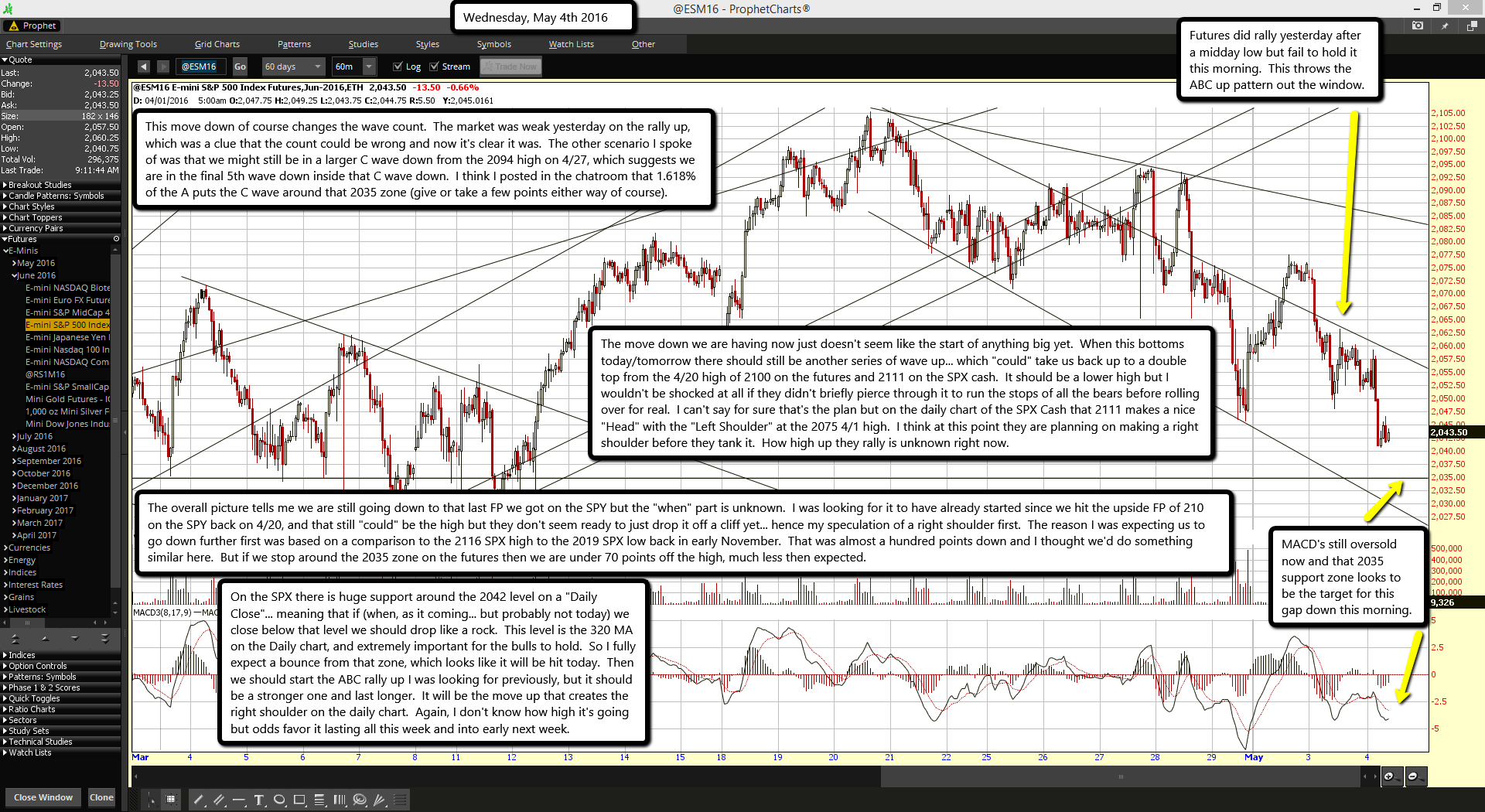
Futures did rally yesterday after a midday low but fail to hold it this morning.  This throws the ABC up pattern out the window.

MACD's still oversold now and that 2035 support zone looks to be the target for this gap down this morning.

This move down of course changes the wave count.  The market was weak yesterday on the rally up, which was a clue that the count could be wrong and now it's clear it was.  The other scenario I spoke of was that we might still be in a larger C wave down from the 2094 high on 4/27, which suggests we are in the final 5th wave down inside that C wave down.  I think I posted in the chatroom that 1.618% of the A puts the C wave around that 2035 zone (give or take a few points either way of course).

The move down we are having now just doesn't seem like the start of anything big yet.  When this bottoms today/tomorrow there should still be another series of wave up... which "could" take us back up to a double top from the 4/20 high of 2100 on the futures and 2111 on the SPX cash.  It should be a lower high but I wouldn't be shocked at all if they didn't briefly pierce through it to run the stops of all the bears before rolling over for real.  I can't say for sure that's the plan but on the daily chart of the SPX Cash that 2111 makes a nice "Head" with the "Left Shoulder" at the 2075 4/1 high.  I think at this point they are planning on making a right shoulder before they tank it.  How high up they rally is unknown right now.

The overall picture tells me we are still going down to that last FP we got on the SPY but the "when" part is unknown.  I was looking for it to have already started since we hit the upside FP of 210 on the SPY back on 4/20, and that still "could" be the high but they don't seem ready to just drop it off a cliff yet... hence my speculation of a right shoulder first.  The reason I was expecting us to go down further first was based on a comparison to the 2116 SPX high to the 2019 SPX low back in early November.  That was almost a hundred points down and I thought we'd do something similar here.  But if we stop around the 2035 zone on the futures then we are under 70 points off the high, much less then expected.

On the SPX there is huge support around the 2042 level on a "Daily Close"... meaning that if (when, as it coming... but probably not today) we close below that level we should drop like a rock.  This level is the 320 MA on the Daily chart, and extremely important for the bulls to hold.  So I fully expect a bounce from that zone, which looks like it will be hit today.  Then we should start the ABC rally up I was looking for previously, but it should be a stronger one and last longer.  It will be the move up that creates the right shoulder on the daily chart.  Again, I don't know how high it's going but odds favor it lasting all this week and into early next week.

Automakers report strong April sales, but their shares fall on economic worries

0
Automobiles for sale at a car dealership in Carlsbad, Calif. Wall Street analysts say the industry is close to a cyclical peak and warned that inventories need to be trimmed.
Detroit automakers reported another month of strong demand from U.S. consumers for trucks and sport-utility vehicles on Tuesday, but their shares dropped as analysts focused on signs the world’s second-largest auto market has little room to grow.Ahead of the final tally for U.S. light vehicle sales in April, General Motors estimated the seasonally adjusted annualized selling rate will be 17.6 million vehicles. That was more than the 17.5 million vehicles expected by analysts polled by Reuters. U.S. auto sales in 2015 hit a record 17.4 million vehicles.

Wall Street analysts say the U.S. auto market is close to a cyclical peak and that more production cuts, which hurt profits, could be needed to keep inventories of vehicles from ballooning later in the year.

“We continue to believe sales growth will be muted this year,” Joseph Spak of RBC Capital said in a note to investors.

Inventory data issued Tuesday pointed to some possible “risk to North American production over the coming months,” Spak added.

The sluggish pace of U.S. economic growth adds to concerns that the auto industry recovery could run out of fuel.

GM and Ford shares were down more than 1 percent, generally in line with the broader market, while Fiat Chrysler Automobiles fell more than 2 percent.

GM and Ford said sales to individual consumers were still growing. But because GM has been cutting back on low-profit sales to rental car companies and other fleets, its overall April U.S. sales fell by 3.5 percent.

GM’s results were among many that highlighted a divide in the market between slumping sales of traditional sedans, and robust demand for pickup trucks and SUVs.

GM said sales of the Chevrolet Silverado pickup truck rose nearly 9 percent in April compared to a year earlier. However, sales of GM’s Cadillac CTS and ATS luxury sedans plummeted 23 percent and 18 percent, respectively.

Other luxury brands also had weak results in April, especially for cars. Toyota’s Lexus luxury division suffered a 26 percent decline in sales of cars such as the large LS sedan, although sales of Lexus brand SUVs rose 20 percent.

German luxury car maker BMW said sales of its BMW brand passenger cars fell 6.5 percent, while its SUV sales fell 9.7 percent.

The chief executives of two leading auto dealer groups, AutoNation and Group 1 Automotive, had warned in April that automakers should start curbing production, particularly of slow-selling luxury sedans.

Still, April U.S. sales for Ford, Honda and Nissan all beat analysts’ expectations. Ford’s sales rose 4 percent from a year earlier, Fiat Chrysler Automobiles was up 5.6 percent and Toyota, No. 3 in the U.S. market, rose 3.8 percent. Honda’s sales rose 14.4 percent.


Source link

McDonald’s Starts Serving Up Garlic Fries in San Francisco

0

McDonald's is amping up its French fries in four locations in San Francisco.

The Golden Arches is offering "Gilroy Garlic Fries" to consumers in the Bay Area for a limited time. The made to order fries are tossed with a puree mix of garlic, olive oil, Parmesan cheese, parsley and salt.

If successful in this small test market, McDonald's will make the specialty fries available in around 250 restaurants throughout the San Francisco Bay Area.

Read More from CNBC: Burger King Rivals Spark Hot Dog War on Twitter

"McDonald's is committed to listening to our customers as seen by All Day Breakfast," Michael Haracz, manager of culinary innovation at McDonald's USA, said in a statement. "We're proud of the work done by local franchisees and the regional team to create this menu item with locally-sourced garlic and we look forward to introducing Gilroy Garlic Fries to our customers in the Bay Area."

The Golden Arches are no stranger to trial runs of potential menu items.

Some 125 stores in Milwaukee are slated to sell Johnsonville Brats for a limited time, seven years after discontinuing the sausages in chains.

Read More: McDonald's Offers All-You-Can-Eat Fries Promotion

The burger giant is also testing out smaller and larger Big Macs in Texas and Ohio restaurants. The Grand Mac is an attempt to compete with chains like Smashburger and Five Guys that serve larger burgers, while the Mac Jr. is simply easier to eat on the go, according to The Street.

In addition, McDonald's will host a limited-time all-you-can eat french fry promotion during the grand opening of its new location in Missouri this July.

Source link

All 17 Sports Authority stores in Arizona could close

0

March 2 -- Howard Davidowitz, chairman at Davidowitz & Associates, and Brian Belski, chief investment strategist at BMO, examine the Chapter 11 filing by Sports Authority and the potential for more bankruptcies in the retail industry.

All 17 Sports Authority stores in Arizona could be sold or close after a decision by the retailer not to pursue a Chapter 11 reorganization.

The filing last week in bankruptcy court in Wilmington, Del., reported originally by Forbes.com, means up to all 450 or so Sports Authority stores nationwide could be liquidated in an auction set for May 16 as the $64 billion sporting-goods industry continues to consolidate.

A previous bankruptcy filing by Sports Authority Holdings, based in Englewood, Colo., indicated that about one-third of the chain's stores would close, including three in the Valley and seven overall in Arizona. The retailer's website lists 17 Arizona stores – 12 in the Valley, three in Tucson and one each in Yuma and Casa Grande.

The company didn't immediately respond to requests for comment. Sports Authority is owned by Leonard Green & Partners, a Los Angeles-based private-equity firm with an array of retailing, medical, health, entertainment and other businesses. In addition to Sports Authority, the company owns three dozen businesses ranging from Aspen Dental, David's Bridal and Jo-Ann Stores to Lifetime Fitness, a dialysis-treatment chain and even the Palms Casino Resort in Las Vegas.

Sporting-goods chains such as Sports Authority primarily sell equipment, footwear and apparel. Sales increases for the industry mirror the low single-digit growth rate for the economy overall, reported the National Sporting Goods Association. Competitors range from Dick's Sporting Goods, Big 5 and REI to mass-market retailers such as Walmart, Target and Amazon.com.

Source link

Halliburton and Baker Hughes Call Off $35 Billion Merger

0

The Justice Department sued last month to block the merger of Halliburton and Baker Hughes.

Halliburton and Baker Hughes, two big oil services providers, have decided to call off their $35 billion merger, a person briefed on the matter said on Sunday, after a long regulatory review that ended with the Justice Department seeking to block the deal.

The deal’s termination could be announced as soon as Sunday night, said the person, who spoke on the condition of anonymity. Halliburton will be required to pay Baker Hughes $3.5 billion as compensation for the breakup, according to the merger agreement. The termination fee, one of the biggest ever, was written into the merger agreement to reassure Baker Highes that Halliburton expected the deal to get done.

Since the merger was announced in November 2014, the oil industry has changed drastically. Commodity prices have plummeted, sending many energy companies into a tailspin, with some nearing bankruptcy. Combining the two oil field services companies may have helped to deter some of the effects from the deteriorating commodity prices. At the time the deal was signed, the companies estimated that they would save billions by combining operations and research and development.

But the Justice Department last month sued to block the deal, saying it would “eliminate vital competition, skew energy markets and harm American consumers.”

The Justice Department’s lawsuit was the latest example of the tough stance taken by the Obama administration against large deals. Last month, the drug company Pfizer abandoned its attempted $152 billion merger with Allergan after the Treasury Department came out with new tax-related rules that eliminated many of the benefits of the deal.

Shares in both Halliburton and Baker Hughes have surged about 20 percent since the Justice Department’s lawsuit was disclosed on April 6. Halliburton has about $10 billion of cash on its balance sheet that it could use toward the breakup fee or potentially other transactions, according to data by S&P Capital IQ.

Halliburton plans to discuss the transaction in greater detail during the company’s earnings call on Tuesday, the person said.

Bloomberg first reported that the deal would be terminated.

Source link

CCSX train derails in Northeast Washington, leaking hazardous chemicals and disrupting travel

0

A CSX freight train derailed in Northeast Washington early Sunday, spilling hazardous chemicals along a busy rail corridor. The wreck stranded some residents away from their homes, forced the closure of a Metro station and snarled traffic as emergency personnel sought to contain the leaks and clear the wreckage.

Officials said 14 rail cars of the 175-car train left the tracks. A rail engineer and a conductor had been aboard the train but were accounted for, authorities said. No evacuations were ordered, and no one was injured.

The cause of the wreck is under investigation, and the Federal Railroad Administration was at the scene Sunday.

Red Line service was suspended between Metro’s NoMa-Gallaudet and Brookland stations, and the Rhode Island Avenue station was closed. At least six blocks of Rhode Island Avenue NE were closed for much of the day.

The derailment occurred about 6:40 a.m. as the train was passing through Washington from Cumberland, Md., en route to Hamlet, N.C., CSX said. The crash site was near Ninth Street NE and Rhode Island Avenue NE. CSX said 94 cars were carrying mixed freight and 81 were empty.

A CSX freight train carrying hazardous material derailed near the Rhode Island Avenue Metro Station. (DC Fire and EMS)

The derailment, about 70 cars into the train, spilled half the liquid contents of a 15,500- gallon tanker containing sodium hydroxide, D.C. Fire and EMS Deputy Chief John Donnelly said. The liquid spilled onto the tracks and seeped into the ground below it.

Officials said there were no air- or water-quality issues at the scene.

CSX spokeswoman Melanie Cost said the company did not have a timeline on the cleanup or restoration of the tracks.

“First let me apologize to the community for the inconvenience and the alarm that the derailment caused this morning,” she said. “Every decision that we’re making is focused on the safety of the responders and the community.”

CSX described sodium hydroxide as a chemical “used to produce various household products, including paper, soap and detergents.” It is a chemical component similar to bleach or Drano, officials said. Two other rail cars were leaking chemicals that officials described as less hazardous.

By mid-morning, D.C. Mayor Muriel E. Bowser (D) said the chemical leak was contained. But more detailed inspections revealed further leaks, according to CSX. In addition to the tank car leaking sodium hydroxide, another tank car was found to be leaking calcium chloride, described as “non-hazardous,” while a third was leaking ethanol “slowly from the base of a valve,” CSX spokeswoman Kristin Seay said.

The wreckage was visible from high-rise apartments near the crash site: A zigzag pattern of mangled tankers and overturned freight cars sat beside the tracks below the Rhode Island Avenue Metro station. A set of wheels, still intact but missing its freight car, sat upright beside the track bed.Emergency personnel work at the scene after a CSX freight train derailed in Washington on Sunday. (Cliff Owen/AP)

Weekdays, the affected tracks are shared by Amtrak, MARC and CSX trains. The tracks also run parallel to the Metropolitan Branch Trail, popular with cyclists and runners. On Sunday, the trail was closed near the site of the derailment, and officials said it would remain closed indefinitely.

Metro spokesman Dan Stessel said barring any unforeseen circumstances, Red Line service would be restored Sunday night.

Stessel said CSX was working to upright a rail car that was leaking ethanol. When the leak is mitigated, he said, the Metro tracks would be turned back over to the agency, which would run test trains and probably restore service soon thereafter.

If for any reason CSX is not able to turn over the scene, Stessel said, “that could affect service into the morning.”

MARC announced major service disruptions for its Brunswick Line on Monday because of the derailment. Its trains will run as far south as Silver Spring, where Metro will accept passengers at no charge to continue their commutes into the District. In addition, the Amtrak line from Washington to Chicago will not run Monday, but the Northeast Corridor lines will run as normal, officials said.

According to the Centers for Disease Control and Prevention, the effects of exposure to sodium hydroxide can include irritated eyes, burning skin, loss of hair and swelling of the lungs. The odorless solid is white or colorless and is usually in flakes, beads or a granular form. Sodium hydroxide is especially dangerous when mixed with water, because the toxin when wet creates heat that can ignite flammable products. It was raining heavily Sunday morning near the crash site.

Donnelly said the amount that leaked did not put District residents at risk.

“The fumes should not cause you any problems, and you should not be able to smell them anywhere else,” he said.

In recent years, Washington residents and elected officials have voiced concerns about rail safety and the risk of having freight trains pass through residential neighborhoods and the seat of the federal government.

Residents of Navy Yard, a formerly industrial neighborhood that is now densely populated, fought a CSX plan to reconstruct the 110-year-old Virginia Avenue Tunnel in Southeast, a key piece of the region’s rail infrastructure that is just a mile away from the U.S. Capitol. CSX is now in the midst of the $170 million project, which includes twin tunnels built to allow for double-stacked trains.

One of the most hotly debated projects in recent years, the tunnel project revived concerns about the safety and security of the city’s railways, prompting the D.C. Council two years ago to allocate funding to conduct a comprehensive rail study that would provide an assessment of all rail service: passenger, commuter and freight.

Some residents say they fear they are at a greater risk of train derailments and that once the tunnel project is completed, CSX will increase the transportation of crude oil and other hazardous materials through the area.

CSX says it rarely transports crude oil through the District and does not carry hazardous substances such as compressed flammable gases and toxic and radioactive materials through the city.

In 2009, rainwater leaking into the Virginia Avenue Tunnel from the Southeast Freeway and Virginia Avenue weakened the earthen floor. A split rail caused the derailment of two locomotives and 13 loaded gondola cars transporting scrap metal. And in the spring of 2014, a CSX freight train derailed in downtown Lynchburg, Va., sending rail cars and burning crude spilling into the James River.

Monte Edwards, a trustee with the Committee of 100 on the Federal City, which serves as a watchdog on transportation and urban planning issues, said Sunday’s spill raised renewed concerns about the viability of shared freight and passenger tracks in the District.

Speaking for himself, he said the spill showed CSX’s disregard for rail safety and inspections in the District.

“This was a hydroxide that they spilled this time. Those are nasty things coming through,” he said, reflecting on what could have happened had the chemical spilled just a short distance south, near the Capitol.

“A spill like that [one] that just occurred here in Northeast, [if] that would occur near a grate or an entrance to a Metro station, it would flood the Metro station,” he said.

The spill underscores the need for the District to devise a comprehensive rail plan, similar to state plans required under the 2008 Passenger Rail Investment and Improvement Act, he said. The District Department of Transportation says it expects a rail plan to be completed as early as this summer.

“We would know what’s coming through,” Edwards said. “We would have inspectors. We would have rail safety officers.”

“We have said all along that derailments are very real and these trains are carrying hazardous materials,” said Maureen Cohen Harrington, a Navy Yard resident and member of DCSafeRails, the organization fighting against CSX transporting hazardous materials through the neighborhood. “And what happened today demonstrated that, and we are well aware that this could have been far worse.”

Peter Hermann, Perry Stein and Ashley Halsey III contributed to this report.
Source link

SBA chief urges respect, support for small businesses

0

Rhonda Abrams, Special for USA TODAY
11:01 a.m. EDT May 1, 2016

XXX Maria Contreras Sweet_001

Since 1963, the first week of May has been designed by the president of the United States as a time to celebrate entrepreneurs.

To mark the start of this year’s Small Business Week, small-business owner and USA TODAY contributor Rhonda Abrams sat down for a discussion with Maria Contreras-Sweet, the current administrator of the U.S. Small Business Administration. Contreras-Sweet, the founder of ProAmerica Bank, talked about technology, small-business lending and elaborated on some of the challenges — and resources — for the nation’s estimated 28 million small businesses.

She also encouraged shoppers to spend at their local stores.

“When you shop at a small business, 64 cents of that dollar stays right in your neighborhood,” she says. In turn, she adds, those stores could become a “destination” for more consumers, leading to more job creation in the community.

“Small businesses should be respected for the role they play: Two out of three net new jobs are created by small businesses,” she says. “This is the time to celebrate small businesses.”

Here are some of other thoughts from Contreras-Sweet:

Q:  What’s a main message that you would like to get out there during Small Business Week?

A:  Let’s level the playing field for small businesses. I see small businesses getting the run around at every turn. When a corporation arrives at a municipality and says, “We’re going to locate here,” that municipality says, “We’re going to give you tax breaks; we’re going to open up this for you.” When a small business shows up in City Hall, (they’re told) “Stand in line, take a ticket.”

We need to address the different needs of small business. We can create unique products, services, programs to be more responsive to the varying Americans across the country that are in different stages of their journey of entrepreneurship.

Q:  How is the SBA already addressing those varying needs?

A:  If someone is in their nascent stage, they can go into one of our Small Business Development Centers and get some counseling. If you’re a woman and you feel more comfortable amongst your peers, we have Women's Business Centers. If you’re a veteran, then you may want to visit one of our Veteran’s Business outreach centers.

Q:  For small businesses, finding and managing technology, keeping up with it, is really overwhelming. How can the SBA help small businesses handle technology-related challenges? 

A:  We recently launched the Small Business Tech Coalition (which provides technology-focused education and resources). We went through process of curating (the technologies small businesses need to get started). You may need Zenefits (which provides an online human resource management system), you may need Salesforce as a CRM (a system for customer relationship management) and you may need Facebook to get your message out. We put together a series of technologies, and over time, we’ll keep refreshing that.

Q:  Virtually every day, I get offers from new “alternative” small-business lenders. Currently, they’re fairly unregulated, some with interest rates as high as 40% to 60% per year. What’s appropriate for the government to do to protect small businesses?

A:  Let me give you three answers. One is that SBA has to use technology to make it easier and more efficient for people to get loans from the SBA. To that end, we put up a program called LINC. It’s like Match.com. Answer 20 questions. We route that to all of our banks in our network, they respond, and now you’re in the driver’s seat.

Next, (current SBA) bankers said our technology was old and antiquated. We’ve invested a lot of time and effort to make sure our portal to the lending institutions is much more efficient.

Thirdly, we’ve been meeting with online solutions (such as institutional investor, peer-to-peer and crowdfunding lenders) OnDeck, Kabbage, Kiva, Kickstarter. We have a duty to make sure there’s no abuse in the system, that people are getting the most rational rates, that there’s transparency, accountability, all the things you would expect us to be doing.

Q: In 2000, the funding for Small Business Development Centers was $88 million — about $122 million in today’s dollars. Last year’s allocation was $115 million. What can you tell us about these training and counseling centers?

A: SBDCs are marvelous resources for small businesses. SBDC consultants are passionate about the work. They help businesses navigate contracts with U.S. government and the corporate supply chain. SBDCs are gearing up and training to navigate small businesses through the international market. We’re bringing more technology capacity into these SBDC centers.

Edited for clarity and content

Follow Rhonda Abrams on Twitter: @RhondaAbrams

Source link

s2Member®