Saturday, October 24, 2026
Home Blog Page 88

Target Steps Out in Front of Bathroom Choice Debate

0

Target’s policy allows people to choose the restroom that aligns with their gender identities.

A new policy over bathroom choice has thrust the retailer Target into the center of a nationwide debate over gender identity, civil rights and privacy.

Last week, Target announced on its website that it would allow transgender employees and customers to choose the restroom and fitting room that corresponded with their gender identities. About a month earlier, North Carolina passed a law restricting bathroom access to transgender people, a bill that set off a national debate that has even extended to the presidential campaign.

The company’s announcement — the most prominent position taken by a national retailer — was greeted by cheers from supporters of transgender rights. It has since also made Target the intense focus of conservative activists, lawmakers and consumers, who oppose the company’s stance, highlighting the potential risks when a company takes a position on a hotly debated social issue.

Some groups have used Target’s announcement as a rallying cry, arguing that Target’s policy threatens the public’s safety. An online petition started by one group, the American Family Association, calling for a boycott of Target stores, has been signed by more than 900,000 people. On Tuesday, the City Council in Oxford, Ala., passed an ordinance forbidding people to use a bathroom that does not match the gender assigned to them at birth. Target has a store in the city.

“I will no longer be shopping at your store and neither will any of my family members and friends,” one person commented on Target’s Facebook page. “You have all lost your minds.”

Equipped with a growing arsenal of digital tools to organize boycotts, spread poor reviews and otherwise negatively impact sales, consumers are increasingly putting pressure on companies to address their concerns. Policies on gender and sexuality have repeatedly become points of contention, putting some businesses on the front lines of battles over social issues.

Last year, for example, a number of companies vocally opposed so-called religious freedom laws intended to give businesses legal cover to deny services to gays and lesbians. Walmart, the nation’s largest retailer, was among the most prominent voices, and its influence was widely credited with pushing the governor in its home state of Arkansas to sign an amended version of the state’s religious freedom bill.

And the head of Chick-fil-A, the restaurant chain, took a position against gay marriage in 2012 only to back off two years later and say that he had not meant to alienate customers.

“Generally speaking, as you saw in the gay marriage debate, the big corporations tend to be out in front of Congress and most of the states in implementing anti-discrimination policies,” said William Eskridge, a professor at Yale Law School and a co-author of “Sexuality, Gender and the Law.”

“The policies generally do not cost the corporations anything or very much, and they create some degree of good will,” he said.

The ordinance in Oxford would make it a misdemeanor for people to use bathrooms that do not correspond to the gender on their birth certificates. Target’s liability in such a situation is unclear.

A company spokeswoman, Molly Snyder, said Target would comply with all local laws. But she also said, “Our belief in and commitment to inclusivity has not changed.”

Ms. Snyder said the company’s policy had applied to employees for years, though it had not been as widely distributed. She referred to the original announcement, which said that Target “regularly” assesses issues that could affect business, guests and employees, and “given the specific questions” raised by recent legislative proposals, “we felt it was important to state our position.”

Target may be betting on a more progressive shift in national attitudes on gender and sexuality. Many states have updated their statutes barring employers from discriminating based on sexual identity to include gender identity, too.

“Making these progressive value statements is a new form of advertising,” said Jonah Berger, an associate professor of marketing at the Wharton School of the University of Pennsylvania.

There may also be more practical benefits than just netting good will: The Equal Employment Opportunity Commission, the federal agency that enforces workplace anti-discrimination laws, has made it clear that blocking workers from using bathrooms that correspond to their gender identities violates federal law.

“Any employer that has a rule to the contrary is going to find itself in very hot water,” said Jillian T. Weiss, a professor of law and society at Ramapo College who has worked on a number of cases involving transgender workplace issues. “Companies have got to be aware that federal law essentially prohibits them from having rules like the one passed in Alabama.”

Other companies, including Barnes & Noble and Hudson’s Bay Company, also have policies explicitly allowing transgender people to use a bathroom that does not correspond to their birth certificate gender.

“We’re hoping that other corporations will see that there is a price to pay, potentially at least, for pushing this L.G.B.T. agenda too far,” said Tim Wildmon, the president of the American Family Association. “We just think this is a bridge too far.”


Source link

Facebook shares surge on strong mobile ad growth

0
635972967780832311-Zuckerberg.JPG

SAN FRANCISCO — In an earnings season in which other major tech companies could do very little right, Facebook could do no wrong.

The tech giant delivered relief to Wall Street in the midst of a dismal spate of tech earnings with yet another quarterly earnings beat, this one propelled by its robust mobile advertising business and growing momentum for video advertising.

Facebook seized the opportunity to announce a three-for-one stock split to create a new class of non-voting shares. The stock split is designed to keep Facebook CEO Mark Zuckerberg in control of the tech giant. With the split, Facebook shareholders would receive two non-voting shares for each single share they hold. Shareholders will vote on the proposal at the company's annual meeting on June 20.

Google parent Alphabet issued a special share class in 2014 to give company founders Larry Page and Sergey Brin more freedom to take risks on speculative technologies and new businesses.

Zuckerberg laid out his 10-year vision for Facebook at the company's annual developer conference earlier this month. Among his ambitions: to connect the rest of the world to the Internet, developing artificial intelligence that can automate communication and commerce and turn virtual reality into the next big social platform where friends and family can spend time together.

Zuckerberg and wife Priscilla Chan have also pledged to give away 99% of their Facebook shares to tackle some of the world's most complex problems over the couple's lifetime.

"I'll be able to keep founder control of Facebook so we can continue to build for the long term," Zuckerberg said. "I see more bold moves ahead of us than behind us."

Few investors will object to Zuckerberg's tight control of the company if he can keep delivering street-beating financial results. Facebook has topped estimates in all but one quarter since its initial public offering four years ago.

Shares (FB) soared 9% in extended trading. Facebook reported first-quarter financial results after the markets closed on Wednesday.

Earnings season has been anything but kind to the tech industry — Google, Microsoft, Apple and Twitter are among those whose quarterly results sorely disappointed investors. Coming off a record fourth quarter in which it posted revenue 9% higher than expected, Wall Street had hoped Facebook would be the exception, and it was.

Pivotal Research analyst Brian Wieser pronounced the quarterly performance "stellar."

"With many levers of growth yet to be pulled, we continue to see many reasons to remain highly optimistic in Facebook," said Wieser who raised his price target to $157 from $154.

Fueling the positive sentiment: Facebook's winning streak in mobile advertising and the rise of video advertising. Facebook has been showing its 1.65 billion users videos that play automatically and it has introduced more advertising on photo-sharing service Instagram. First-quarter results illustrated the traction Facebook is gaining with advertisers.

Facebook grew revenue 52% to $5.382 billion in the first quarter. Revenue was expected to be $5.25 billion, up from $3.5 billion a year ago. Eighty-two percent of advertising revenue in the first quarter came from mobile, up from 80% in the fourth quarter. Facebook is expected to account for about 12% of the $186.81 billion global digital advertising market in 2016, according to research firm eMarketer.

Pivotal Research estimates Facebook will capture 47% of global digital advertising growth and 43% of all advertising growth outside of China in 2016.

"And this is before several future engines of growth have begun to scale,"  including Instagram, messaging apps Messenger and WhatsApp and virtual reality player Oculus, Wieser said.

Profits also soared. Facebook reported earnings of 77 cents per share in the first quarter. Analysts expected Facebook to report earnings per share of 62 cents. Net income was $1.5 billion, up 26%.

Facebook continued to grow its user base. About 1.65 billion people checked Facebook at least once a month during the first quarter compared up from 1.59 billion in the fourth quarter. The average user now spends 50 minutes a day on Facebook, Instagram and Facebook Messenger, the company said.

Source link

ES Morning Update April 27th 2016

0

35bccb90-aa02-4441-9292-305f62e96774

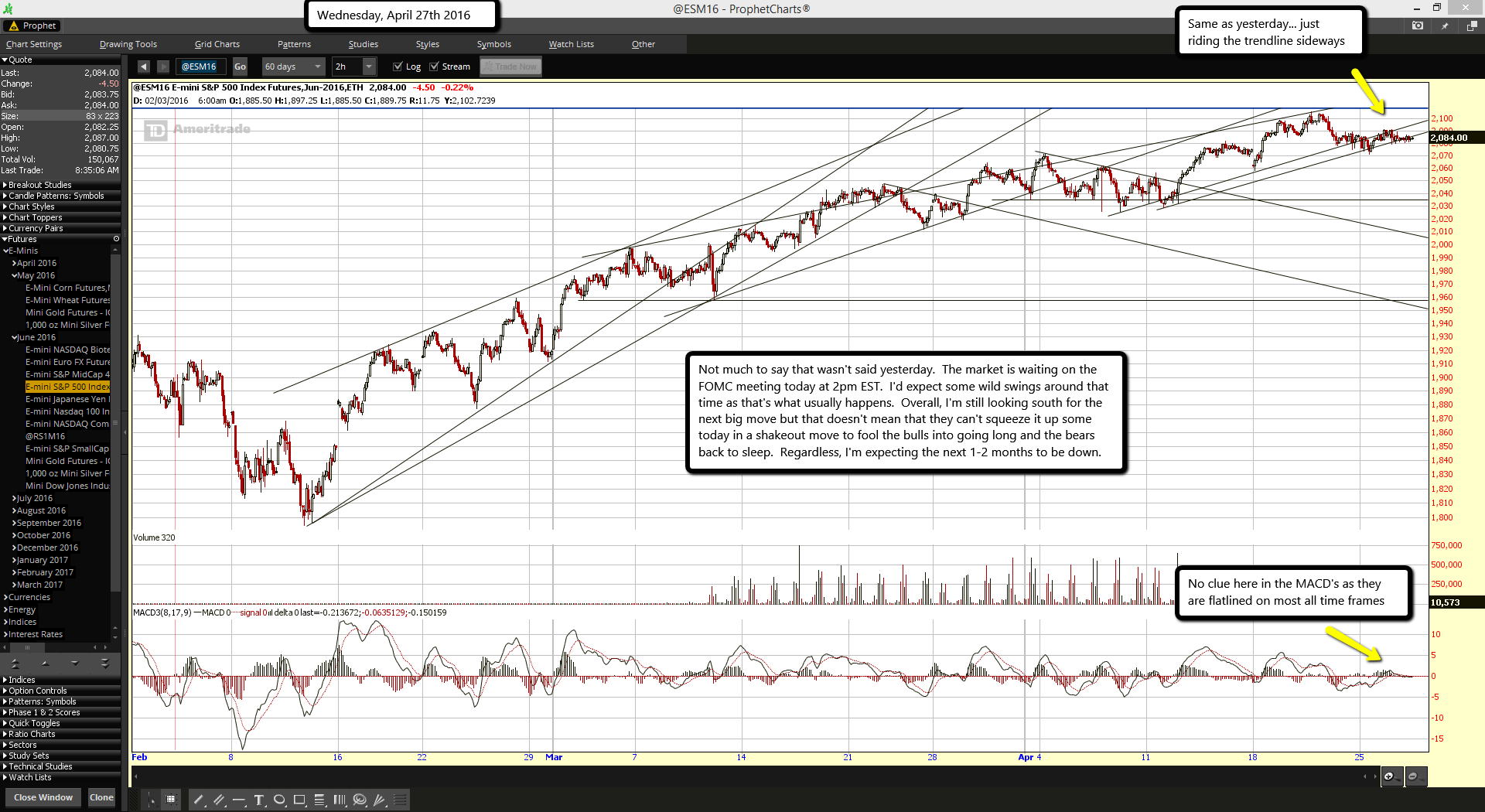
Same as yesterday... just riding the trendline sideways

No clue here in the MACD's as they are flatlined on most all time frames

Not much to say that wasn't said yesterday.  The market is waiting on the FOMC meeting today at 2pm EST.  I'd expect some wild swings around that time as that's what usually happens.  Overall, I'm still looking south for the next big move but that doesn't mean that they can't squeeze it up some today in a shakeout move to fool the bulls into going long and the bears back to sleep.  Regardless, I'm expecting the next 1-2 months to be down.

France wins A$50bn Australia submarine contract

0

File photo of a Collins Class submarineThe new submarines will replace Australia's aging fleet of Collins Class vessels

France has been awarded a A$50bn (€34bn; £27bn) contract to build 12 submarines for the Royal Australian Navy.

Australian Prime Minister Malcolm Turnbull announced at a press conference on Tuesday that France had beaten bids from Germany and Japan.

The submarines will be built in Adelaide creating 2,800 jobs, he said.

The decision was based on a 15-month competitive evaluation process that started in February 2015.

"This is securing the future of Australia's navy over decades to come," Mr Turnbull said.

"Australian workers will be building Australian submarines with Australian steel."

Japan was an early frontrunner to win the contract, thanks to former Australian prime minister Tony Abbott's close relationship with Japanese Prime Minister Shinzo Abe.

But Australia's largest-ever defence procurement was awarded to French company DCNS, which proposed to build a modified version of its Barracuda submarine called the Shortfin Barracuda.

The French bid received unanimous support from the various experts in the government's competitive evaluation process, Defence Minister Marise Payne said.

The Shortfin Barracuda is a 4,500-tonne, conventionally powered submarine, whereas the Barracuda weighs 4,700 tonnes and is nuclear powered.

The French design features an advanced pump-jet propulsion system that is supposed to be quieter than propeller propulsion systems.

The Japanese government's bid with a consortium led by Mitsubishi Heavy Industries Ltd proposed building a version of its 4,000-tonne Soryu-class submarine, lengthened by between 6-8m.

The German government's bid with TKMS offered a 4,000-tonne version of an existing 2,000-tonne submarine.

Work on the submarines, which will replace Australia's aging fleet of Collins Class vessels, is expected to continue into the 2050s, according to a Defence White Paper released earlier this year.

Relationship with Japan

The decision to reject the Japanese bid is seen as potentially having ramifications for Australia and Japan's relationship.

Mr Abe was this week reported to be working behind the scenes to shore up the deal, which is said to have foundered because of Japan's inexperience in building military equipment for export.

The Japanese constitution was changed in 2014 to allow the export of military hardware and the lucrative submarine deal with Australia would have been a major victory for Mr Abe.

The Japanese government was also reportedly keen to further deepen its military ties to Australia as a counter to China's rise.

Shared military technology would increase interoperability between the Japanese and Australian fleets.

Mr Turnbull said he had spoken to Mr Abe and was fully committed to the special strategic relationship between Japan and Australia.
Source link

Gas prices creeping up for summer driving season, but not that far

0

Gas crosses the $2 mark but experts say summer prices should be cheapest in 12 yearsA driver waiting for gas at an Exxon station on April 25, 2016, in Teaneck.A driver waiting for gas at an Exxon station on April 25, 2016, in Teaneck.

The average price of gas crept over the $2-a-gallon mark over the weekend in North Jersey for the first time in five months, but is expected to remain low compared with those in recent years even as motorists gear up for summer road trips, according to experts.

Several experts on gasoline prices said they don’t anticipate prices to go above $2.25 for the summer, about 33 cents a gallon less than they were last June.

“It will be the cheapest driving season since summer 2004,” said Tom Kloza, the co-founder and a global head of energy analysis at Oil Price Information Service in Wall Township. According to his service, regular gasoline in North Jersey has not averaged above the $2 mark since Nov. 16.

The average price of gas in the counties of Bergen and Passaic counties was $2.008 on Monday after breaking the $2 barrier on Sunday, according to AAA. The state average was $1.994.

Experts said prices always go up in the spring when the petroleum industry transitions from winter-blend gasoline to a more expensive summer blend, which costs several cents a gallon more to make. And current gas prices in the region have already remained considerably lower than a year ago, when they stood at $2.40 a gallon.

Motorists at a Lukoil Station on Route 46 in Little Falls, where regular gas was selling for $2.24, said they have appreciated the lower costs.

“It used to cost me $100 to fill my tank,” Ricot Jeanbaptiste, 38, who was filling up his GMC Yukon XL truck. He said it now costs $70. Although prices are starting to go up slightly, he said, “They are a lot better than what they used to be.”

Sal Risalvato, the head of a New Jersey association representing gasoline retailers, said that prices are going up because of a combination of factors: The usual increases in switching over to summer blends and an increase in demand, caused by people driving more as a result of lower prices. He said an increase in prices could lead to less demand, which in turn would stop those increases from skyrocketing.

“They can revert back to previous consumption habits,” Risalvato said of motorists.

Both Risalvato the head of the New Jersey Gasoline C Store  Automotive Association, and Kloza both said they expect prices to peak at around $2.25.

Kloza said he expects the prices to hover around the $2 for at least several more weeks, adding that some retailers may be reluctant to go above that mark.

“Most people won’t want their numbers to start with a 2,” Kloza said of the retailers, adding that some drivers might seek out prices below the $2 mark. “We’re going to waffle around this number,” he said. “Which means people who want to find gasoline below $2, they can.”

One of the highest prices for a gallon of gas in the region on Monday was $2.75 at a Lukoil station on Wyckoff Avenue in Wyckoff, according to GasBuddy.com, which compiles real-time gas prices submitted by users. But that price appeared to be unusual. No one answered the phone at that station to explain its prices.

Across the country, gas prices appeared to bottom out in February when the national average was slightly below $1.73 a gallon and the state average was about $1.63. The price of regular gas in North Jersey has been rising steadily for several weeks, according to AAA, going from $1.813 a month ago to $1.996 a week ago in the counties of Bergen and Passaic.

Last year, the national average price of gas was $2.40 per gallon, the lowest since 2009 and almost a full dollar cheaper than in 2014, the AAA reported. The association reported that the dropping prices were the result of a large worldwide supply of oil.


Fire guts India’s National Museum of Natural History

0

NEW DELHI - A massive fire Tuesday gutted the National Museum of Natural History in India’s capital, one of the country’s top museums, an official said.

Firefighters took more than four hours to douse the blaze, which started on the top floor of the six-story museum, New Delhi fire official Harinder Singh said. Thirty-five fire engines were called.

Singh said the entire building was gutted by the blaze.

Environment Minister Prakash Javadekar said the damage caused to the museum was being assessed. An investigation was ordered to determine the cause of the fire.

Five firefighters overcome by heavy smoke were taken to a hospital and released after being treated, Singh said. No other injuries were reported.

Rajesh Panwar, New Delhi’s deputy chief fire officer, said the museum’s fire safety equipment had not been functioning properly, making it more difficult for firefighters to finally bring the blaze under control.

Fires are common in buildings in India due to a lack of proper safety standards.

The state-run natural history museum features thousands of exhibits on plants, animals and mineral wealth in India and around the world.

Source link

Nokia buys France’s Withings for €170M to ramp up in health tech and IoT

0

Nokia’s history as the world’s biggest mobile phone maker is becoming a distant memory, but it’s not out of the gadget business just yet. To build out its health technology business, the company today announced that it has acquired Withings, makers of smart scales, activity trackers, and other health gadgets. Withings is based out of France, and with Nokia in Finland, the transaction was in euros: €170 million to be exact, or around $192 million in U.S. dollars.

The deal is expected to close in Q3 of this year, with Withings becoming a part of Nokia Technologies. It’s a decent return: Withings had raised just under $34 million, with investors including BPIFrance, Idinvest, Ventech and 360 Capital Partners.

The deal is not only a sign of how Nokia still very much believes it more to do in the world of gadgets, but a sign of how the company is going back to its early playbook of building vertically integrated businesses. In this case, buying Withings is not just about the health trackers, blood pressure monitors, thermometers and other objects that consumers will buy, but the bigger business of connecting them and running a wider array of cloud-based services under the hood — otherwise known as the Internet of Things.

“We have said consistently that digital health was an area of strategic interest to Nokia, and we are now taking concrete action to tap the opportunity in this large and important market,” said Rajeev Suri, president & CEO of Nokia, in a statement. “With this acquisition, Nokia is strengthening its position in the Internet of Things in a way that leverages the power of our trusted brand, fits with our company purpose of expanding the human possibilities of the connected world, and puts us at the heart of a very large addressable market where we can make a meaningful difference in peoples’ lives.”

Notably, this is the first acquisition in years at Nokia that’s focused on consumer tech: the last several, including the ingestion of Alcatel-Lucent, have been about building out its mobile back-end and networking businesses.

It’s also a smart move for another part of Nokia’s remaining business: its patents. Nokia may not be making as many new waves in mobile phone patents today as it did years ago, and while it continues to milk those for royalties with companies like Apple, Withings, it says, “will also ensure the ongoing renewal of Nokia Technologies’ world class IPR portfolio.”

While IoT is a very low-margin business compared to other digital consumer services like mobile phones, Nokia notes that healthcare is one of the big opportunities, citing analysts’ forecasts of market CAGR of 37%, making it “the fastest growing health care segment from 2015-2020.”

It’s also an acquisition that is tapping into another trend: we’re living longer and getting more and more conscious of our health, and in some cases we’re not actually getting healthier, with weight issues affecting a lot of our sedentary population, and other illnesses like diabetes growing in prevalence because of wider changes in our diets.

Withings was co-founded by Eric Carreel and Cedric Hutchings in 2008, both of whom appear to be joining Nokia. It employs 200 people in France, the U.S. and Hong Kong.

“Since we started Withings, our passion has been in empowering people to track their lifestyle and improve their health and wellbeing,” said Cédric Hutchings, CEO of Withings. “We’re excited to join Nokia to help bring our vision of connected health to more people around the world.”

For its part, it’s interesting that Withings decided to sell, and to sell to a European tech giant that essentially is a non-player in the activity tracking/health tech business. In the wider market, there may still be question marks over the wider potential for connected devices like activity trackers. Companies like Fitbit have been growing, but slowly. Others like Jawbone have seen their valuations slashed while waiting for the market to really take off.

The question now is whether Withings under Nokia will tap into what’s already out there in terms of consumer interest, or whether they have what it takes to supercharge and lead it.

Source link

Japan Consortium Misses Out on $38.5 Billion Australian Submarine Deal

0

Submarines used by the Japanese Maritime Self-Defense Forces. The Australian submarine deal would have been the first export by Japan of a major weapon system.

TOKYO — In a blow to Japan’s arms export ambitions, Australia chose a French company on Tuesday to supply a dozen attack submarines for its navy, rejecting a bid from a Japanese consortium that had been seen as the front-runner.

The deal, worth 50 billion Australian dollars, or $38.5 billion, is one of the biggest-ever defense contracts in the Asia-Pacific region. And for a while, conditions seemed to be lining up just right for the Japanese, who were looking to put their little-known submarine industry on the global map.

Japan and Australia, both island nations, rely on submarines for defense. Japan is adept at making the type of quiet-running, diesel-powered vessels the Australians sought. And just two years ago, Japan lifted a self-imposed ban on weapons exports that it had maintained since the end of World War II.

Japanese and Australian leaders, meanwhile — mutually concerned about the growing military might of China — have been touting closer military ties. In 2014, Prime Minister Shinzo Abe of Japan and Tony Abbott, then the prime minister of Australia, signed a defense cooperation agreement that many saw as paving the way for a submarine sale.

So Australia’s choice of the French company, DCNS, over the Japanese manufacturers Mitsubishi Heavy Industries and Kawasaki Shipbuilding was more than a business setback for Japan. A win for Mitsubishi and Kawasaki would not just have secured the first export by Japan of a major weapon system. It would also have been a turning point for Japan’s broader defense policy, which has been mostly inward-looking since its wartime defeat more than 70 years ago.

The conservative Mr. Abe has been trying to change that by loosening decades-old legal restrictions that have prevented the Japanese military from engaging in combat missions abroad, as well as by lifting the ban on arms exports.

“The French offer represented the capabilities best able to meet Australia’s unique needs,” Malcolm Turnbull, the current Australian prime minister, said in announcing the decision in Adelaide, where the vessels will be built. “This is securing the future of Australia’s navy over decades to come.”

The French-designed submarines will eventually replace Australia’s fleet of Collins-class submarines, which were built in the early 1990s, also in Australia, based on a Swedish design. The French vessels are expected to enter service in the early 2030s.

In an accompanying written statement, Mr. Turnbull and Defense Minister Marise Payne said the French submarines offered “superior sensor performance and stealth characteristics, as well as range and endurance similar to the Collins-class submarine.” Other considerations were “schedule, program execution, through-life support and Australian industry involvement.”

A post-mortem had already begun in Japan over the failure of the joint Mitsubishi-Kawasaki bid, after leaks to the news media in Australia in recent weeks suggesting the government in Canberra was cooling on the Soryu-class submarine being offered by the two companies. They were proposing to sell the Australians an enlarged version of the 4,200-ton Soryu, which is powered by a combination of advanced diesel engines and lithium-ion batteries.

Mitsubishi and Kawasaki have built eight of the submarines for the Japanese Navy, the Maritime Self-Defense Forces, and have orders for 12 more. But they have never orchestrated this sort of multinational building project, with assembly taking place in a foreign shipyard — a requirement of the Australian bid.

Gen Nakatani, the Japanese defense minister, said he was “very disappointed” and would seek a detailed explanation from Australia for its choice. He added that Australia would remain “a special strategic partner.”

The Japanese companies have struggled to meet Australian requests to modify the Soryu to make it larger and give it longer range, experts said, and appeared less enthusiastic than the French to share technical secrets with the Australian contractors who would help build the submarines.

“The French were very adroit in putting forward a bid that that was really an industry play, as well as a technical proposal,” said Peter Jennings, executive director of the Australian Strategic Policy Institute. As for the Japanese, he added, “there really was a risk in asking Japan to relocate an entire industrial capability for the first time in modern history.”

The successful French proposal involves swapping an advanced diesel engine for the nuclear power plant normally used in a DCNS-made Barracuda-class submarine, a proven vessel that already has the size and range the Australians were looking for.

The French state owns about two-thirds of DCNS, which is the country’s largest naval contractor, while most of the rest is held by the defense and aerospace group Thales. Jean-Yves Le Drian, the French defense minister, told Europe 1 radio on Tuesday that the deal was “a great victory for the French naval industry” that would provide as many as 4,000 jobs in the Cherbourg region, where the company’s shipyards have been struggling.

Under the administration of former President Nicolas Sarkozy, France built two Mistral-class helicopter carriers for the Russian Navy, but sanctions imposed by Western countries after Russia invaded Crimea and Ukraine scuttled that deal.

ThyssenKrupp Marine Systems of Germany had also bid for the Australian deal.

Given the importance of the submarine project to Australia — Mr. Turnbull called it “a momentous national endeavor” — the French bid ultimately looked like the least risky choice, Mr. Jennings said. He added that Australia might now look for other, smaller defense contracts to open up to Japan, for instance in sonar systems, missile defense or cybersecurity.

“Walk first, then run,” Mr. Jennings said. “This is not something where we can afford to have any false starts.”

Source link

P and G reports a $2.8 billion profit

0

635972269410601704-P-G-towers-long-shot.jpg

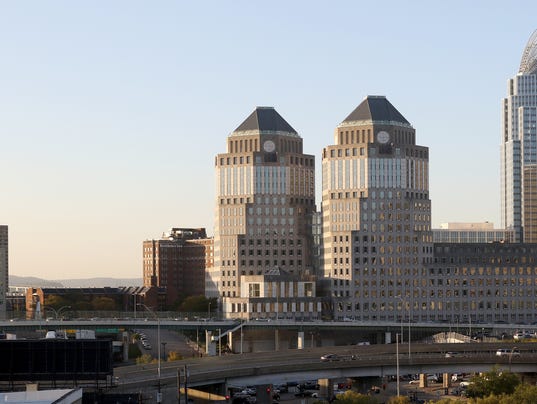
Procter & Gamble on Tuesday reported a $2.8 billion profit for its third quarter ended March 31 – a 28 percent increase from a year ago.

Total sales at the Cincinnati-based consumer products giant dropped 12.7 percent to $15.8 billion, from the same period in 2015. Adjusted for the company's ongoing divestiture of nearly 100 noncore brands, sales declined 7 percent from last year. The company said closely-watched organic sales (a metric that excludes the impacts of mergers, acquisitions and foreign exchange) rose 1 percent.

Wall Street analysts had forecast for P&G to post a $2.2 billion profit for the quarter, excluding one-time items, according to Bloomberg. They also expected sales to be $15.8 billion. Last year, P&G reported a $2.2 billion profit on sales of $18.1 billion in sales.

“We continue to make progress on the transformations we are undertaking to return P&G to balanced

top- and bottom-line growth and maintain strong cash generation,” CEO David Taylor said.

P&G has reclassified more than 40 beauty brands it plans to sell later this year as "discontinued operations" and amended their financial statements to reflect those changes. Had P&G already exited those and other brands already sold off, the company said total sales for the quarter a year ago would have been $16.9 billion.

The brand sale is part of a broader restructuring that has already jettisoned the Duracell batteries brand and Iams pet food and others. Since 2014, P&G has embarked on selling off brands commanding $10 billion in sales to slim down to a $70 billion company doing business under 65 core labels.

The Duracell brand sale to Warren Buffett's Berkshire Hathaway closed in the third quarter. The conglomerate tendered 52 million shares of P&G stock back to the Cincinnati company in exchange for the battery brand.

Based on the stock price at closing and netting out the $1.8 billion P&G was required to reinvest in Duracell before handing it off, the consumer products company got $2.4 billion for the battery brand. But instead of getting a cash infusion, the transaction retired 2 percent of P&G's entire outstanding stock.

Later this year, P&G will close on its divestiture of the beauty brands it has decided to exit, including CoverGirl makeup, Wella and Clairol hair coloring. Those brands doing $6 billion in annual sales will become a separate company that will merge with New York's Coty Inc., which makes Rimmel makeup and is the licensed manufacturer of Calvin Klein and dozens of other fragrances.

Source link

Low oil price pushes BP to $485m loss

0
BP

BP has sunk to a $485m (£334m) loss for the three months to March as low oil prices took their toll.

The loss, on the replacement cost measure, compared with a $2.1bn profit for the same period last year, but was lower than the $2.2bn loss for the three months to December.

The oil giant took a $917m charge for the 2010 Gulf of Mexico oil spill, taking the total to $56.4bn.

It was still unable to estimate its liability for civil claims.

On an underlying basis, which strips out one-off costs, BP reported an adjusted profit of $532m despite expectations for a loss. However, this figure was sharply lower than the $2.58bn profit for the same period last year.

Its refining and trading division reported a profit of $1.8bn, offsetting a $747m loss in oil and gas production.

Brent crude averaged $34 a barrel in the quarter, compared with $44 in the last three months of 2015 and $54 in the first quarter last year.

Chief executive Bob Dudley said he expected global oil supply and demand to balance towards the end of the year, which could help push prices higher.BP shareholders rejected a pay package of almost £14m for chief Bob Dudley earlier this month

"Operational performance is strong and our work to reset costs has considerable momentum and is delivering results," he said.

Earlier this month BP, faced a shareholder revolt when almost 60% voted against its remuneration report, which included a pay deal of $19.6m (£13.8m) for Mr Dudley.

Despite the slide in the oil price, BP held the quarterly dividend at 10 cents a share. Its shares rose 3% to 370.2p in early trading in London.

Steve Clayton, head of equity research at Hargreaves Lansdown, said BP could not afford to keep paying a dividend indefinitely while making a loss: "Ultimately there's only so far the company can travel down this road before it runs out of gas."

"It looks like BP is betting on a rapid return to significantly higher oil prices. If they duly appear, then BP will have protected its shareholders through the tough times. But if oil does not rebound, then BP will become progressively weaker in an environment where strength matters."

Spending cuts

In February, BP reported that annual profits had more than halved to $5.9bn following the collapse in oil prices.

The company cut spending three times in 2015 to $19bn and shed about 10% of its 80,000-strong workforce.

Spending this year should be about $17bn, but could be cut by up to $2bn if oil prices remain depressed.
Source link

FCA to move Ram to Sterling Heights, Jeep to Mexico

0

FCA CEO Marchionne: "We ran the optimization exercise with a very clear view of not losing one unit of sales for Ram and not losing one unit of sales for Jeep."

After months of speculation, Fiat Chrysler CEO Sergio Marchionne confirmed today that the automaker plans to move production of its Ram pickups from Warren to Sterling Heights and will move production of a Jeep SUV from Belvidere, Ill., to Toluca, Mexico.

Those moves and others discussed by Marcionne today are part of a massive plan to shift production of smaller vehicles to Mexico while concentrating on the production of more profitable Jeep SUVs and Ram pickups in the U.S.

Despite some painful temporary layoffs, a multibillion reinvestment plan, the discontinuation of two passenger cars and the movement of a Jeep SUV to Mexico, Marchionne said no U.S. jobs would be lost.

"We have had obviously intense dialogue with our counterparts at the UAW about the implications on head count," Marchionne said. "I confirm now, as we have done with them, that the realignment of the footprint in NAFTA is actually going to yield an increase in manpower."

While most of the plans confirmed by Marchionne today have previously been reported by the Free Press and other media organizations, they had not been confirmed by the company, leading to anxiety among thousands of workers at the automaker's U.S. plants.

Marchionne said today that the overriding principle that guided the massive transformation of FCA's production footprint was to avoid the loss of the ability to make any Ram or Jeep vehicle as the company made a transition to a new or redesigned model.

"I will give you a perfect example. The Warren Truck Plant, which is historically one of the oldest plants we have in the fold of the old Chrysler and now FCA, is a plant that would have had to go through incredible surgery in order for it to accept the new Ram truck," Marchionne said. “So the realignment of the Sterling Heights plant to accept the new Ram ...allowed us to effectively re-lay out the whole manufacturing footprint by not losing one unit."

FCA shocked workers and automotive analysts earlier this year when it announced plans to eventually discontinue production of the Chrysler 200 in Sterling Heights and the Dodge Dart in Belvidere, Ill. Since then, workers in Sterling Heights have spent most of the year on layoff as sales of the Chrysler 200 has dropped by more than 60%.

Now, that plant is scheduled to begin building Ram pickups by 2018.

Meanwhile, Marchionne said Warren Truck will eventually build the Jeep Wagoneer and the Jeep Grand Wagoneer. Until today, Marchionne has not specifically or clearly discussed plans for two different Wagoneer large SUVs.

Marchionne also said today that the automaker will build the replacement for the Jeep Compass and Jeep Patriot at its plant in Toluca, Mexico, with production scheduled to begin during the second half of this year.

FCA has said those two Jeep SUVs will be replaced with a single model but has not revealed the name of the vehicle. The automaker is also preparing to begin production of the Jeep Compass/Patriot replacement at its plant in Pernambuco, Brazil, as it seeks to boost Jeep sales in South America.

Currently, the Compass and Patriot are built in Belvidere, Ill. Marchionne did not discuss the future of that plant. The Free Press has previously reported that the Jeep Cherokee, currently made in Toledo, will be moved to Belvidere.

That will give the automaker the ability to boost production capacity of the Jeep Wrangler and build a Jeep pickup truck in Toledo so it can meet demand for the Wrangler in the U.S. and export a higher volume.

In 2012, when FCA discontinued production of the Jeep Liberty, it lost almost a year of production volume and profits as it retooled the plant to make the new Jeep Cherokee.

At the time, Marchionne vowed he would never make that mistake again – an idea that resurfaced when he talked about the company's planning process today.

"The realignment of the NAFTA footprint was driven by two conditions," Marchionne said. "We ran the optimization exercise with a very clear view of not losing one unit of sales for Ram and not losing one unit of sales for Jeep."

Source link

Chernobyl 30 Years Later: Those Who Live in Its Shadow Still Suffer

0

In the days before the 30th anniversary of the Chernobyl nuclear disaster today, workers hurriedly filled in pot holes and painted lines on the decrepit road to the destroyed nuclear station. They were getting ready for a visit by Ukraine’s president and memorial ceremonies at the site to mark the catastrophic incident on April 26, 1986.

Time has helped bury some of the most obvious effects of the catastrophe. Slowly the forest is breaking up the abandoned towns inside the exclusion zone; the famous “Red Forest,” of irradiated trees turned red by the reactor leak, has been cut down and replanted.

Radiation levels on the surface are often close to background norms, though highly contaminated patches still lurk everywhere. Next year, a giant new containment shell is due to be slid over the shattered reactor, sealing it safe for 100 years.PHOTO: A doll in a childrens gas mask is seen amongst beds at a kindergarten in the abandoned city of Pripyat near the Chernobyl nuclear power plant in Ukraine March 28, 2016.Haunting Images From Chernobyl

But as the workers spruced up the route to the world’s worst nuclear disaster zone, some affected by the accident said with the passing of time their plights were increasingly being downplayed and accused Ukraine’s government of trying to save money by cutting support to them.

The claims throw attention onto the fact that even 30 years on, the long-term health effects of Chernobyl remain intensely disputed.

The disaster, the worst nuclear accident in history, eventually affected 3 million people and forced the evacuation of over 300,000. The reactor was sealed inside an 18-mile exclusion zone, deemed too contaminated for people to live and known now just as the Zone.

The United Nations and the World Health Organization have found that other than the tens of thousands exposed immediately after the accident, there is no evidence to show Chernobyl’s leaked radiation has had a major impact on public health. The International Atomic Energy Association (IAEA) has said radiation levels have fallen by a factor of several hundred and that most contaminated land has been made safe.

But some local doctors and researchers reject this, saying they have documented a growing number of long-term health issues among people living in areas close to the exclusion zone, particularly among children and arguing that even small doses of radiation over long periods is dangerous.

“The level of illness is much higher than in the regions that are not contaminated,” Oksana Kadun, head doctor at Ivankov hospital, the closest to the Zone. Kadun, who is helping with a European Union-funded study tracking the health of 4,000 children in contaminated areas, said she saw increased cases of respiratory problems and immune system deficiency.PHOTO: Reactor No. 4 of the Chernobyl nuclear power plant stands encased in lead and concrete following the accident in April 1986, that released a cloud of radiation that circled the world in Pripyat, Ukraine, July 1988. Mark J. Porubcansky/AP Photo

Reactor No. 4 of the Chernobyl nuclear power plant stands encased in lead and concrete following the accident in April 1986, that released a cloud of radiation that circled the world in Pripyat, Ukraine, July 1988.

With the contaminated regions poor and of little influence, there was little appetite to reopen the issue, Kadun said.

“Few people are talking about this because nobody wants to hear it,” she said.

In the villages of ginger-bread cottages strung along the plain just outside the Zone, where storks build their nests on pylon-tops and people work tiny plots of land by hand, many assume they are poisoned but say they have little way to prove it. Too poor to buy food, most grow their own and forage from ground they know is contaminated.

“What we have, we use,” said Anna Pogorelova, who lives with her two children in what was called the "Fourth Zone" -- an area once considered contaminated but not enough for evacuation.

In many places here, Ukraine’s government pays people compensation for Chernobyl—known by Ukrainians as “coffin money”. But with the country on the edge of default, the government has been curtailing the payments for some and reclassifying areas previously deemed contaminated.

Officials have said they are making tough choices with limited resources, but those affected by the accident say the government is trying to ignore legitimate cases.PHOTO: The police guard on their duty the entrance of Pripyat town four kilometers from the Chernobyl power station, March 6, 1989, three years after the nuclear disaster.Mikhail Metzel/AP Photo

The police guard on their duty the entrance of Pripyat town four kilometers from the Chernobyl power station, March 6, 1989, three years after the nuclear disaster.

“We have the impression that they would rather that we had just gone already,” said Nadezhda Makarevich. Makarevich was evacuated from Pripyat, the town closest to the reactor. On the morning after the explosion, she was washing her windows. Not alerted by the Soviet authorities, she inhaled fallout, suffering radioactive burns on her lungs.

Makarevich is part of a group campaigning for the government to pay support benefits to those poisoned by the accident, as it is obliged by law.

With so many once classified as victims of Chernobyl -- the number of so-called “liquidators,” workers who contained the accident, is around 500,000 -- and the illnesses so long-term, those claiming Chernobyl benefits are often stigmatized as scroungers.

In the villages around the Zone, many say they’re resigned to living on contaminated ground. In any case, they say, radiation is only one of their problems.

“We’re not a big region,” Pogorelova said. “No one pays us any attention.”
Source link

T-Mobile Delivers Robust Customer Growth, Profits in First Quarter

0

T-Mobile US (TMUS - Get Report) delivered strong first-quarter results thanks to robust customer growth that led to solid profitability.

The U.S. wireless carrier reported first-quarter results Tuesday before the markets opened, posting $8.6 billion in total revenues and $0.56 per share in earnings. Wall Street was expecting $8.4 billion in revenue and $0.10 in EPS.

Shares were up in pre-market and initial trading on Tuesday, but have settled and are now down slightly to $40.92.

John Legere, president and CEO of T-Mobile, touted the telco's customer growth.

"I can't think of a better way to start off 2016 than by capturing all of the industry's postpaid phone growth -- again!" he said in a statement on Tuesday. "Our model is working and the business momentum is accelerating across the board."

The third-largest U.S. wireless carrier behind Verizon Communications (VZ - Get Report) and AT&T (T - Get Report) has been steadily adding customers each quarter. In the first quarter, T--Mobile added 2.2 million net customers, marking the twelfth consecutive quarter that T-Mobile has added more than 1 million net customers, and the sixth time in the past seven quarters that it's added more than 2 million customers. It also added more than 1 million net branded postpaid phone customers.

Meanwhile, Ebitda increased 98.1% year-over-year to $2.75 billion, which includes $636 million on a gain from spectrum. Net income also increased, coming in at $479 million, up from a net loss of $63 million over the corresponding period last year.

In addition, T-Mobile shared its guidance for customer outlook and its Ebitda target for the year. The telco is expecting branded postpaid net customer additions to come in between 3.2 million and 3.6 million. Previously, it was anticipating a range of 2.4 million to 3.4 million.

Adjusted Ebitda is expected to be between $9.7 billion to $10.2 billion, which also marks an increase from the previous guidance of $9.1 billion to $9.7 billion.

In order to support customer growth, T-Mobile said it will continue to make improvements to its 4G LTE network. In particular, it will expand Extended Range LTE, which operates on the company's low-band 700 MHz A-Block spectrum and covers about 194 million in more 340 markets. In line with this effort, T-Mobile has already agreed to acquire more 700 MHz A-Block spectrum licenses and plans to expand its 600MHz offerings.

Rival carrier AT&T reports on Tuesday after the markets close. Verizon Communications reported first-quarter earnings last Thursday, coming in just slightly lower than expected by delivering $1.06 EPS and $32.2 billion in revenue, versus analysts' estimate of $1.06 in EPS and revenue of $32.46 billion.

Source link

Apple misses by a mile: Wipes out $43B

0

Apple shares are down 7% after they released disappointing March quarter results.

Apple (AAPL) missed by a mile.

Fanning concerns the world has finally reached a saturation point with smartphones, Apple late Tuesday stunned investors by missing revenue and profit forecasts for the March quarter. It was even worse than widely expected - and expectations were already low.

The company reported adjusted quarterly earnings of $1.90 a share, which is well below the $2 a share expected by analysts. It's not just a matter of just missing forecasts. Profit fell 18% from the same period a year ago. Revenue also missed expectations, falling about 12% to $50.6 billion, the biggest drop in revenue since the third-quarter of 2001, according to data from S&P Global Market Intelligence.

Shares of Apple are getting hit roughly 8% in after-hours trading, tumbling to $96.67. They closed in regular trading at $104.35, or down 0.7%, putting them down 0.9% for the year. The downward move in after-hours trading means the company shed $43 billion in market value based on after-hours trading.

The collapse in Apple's profits and the stock is the latest and biggest problem for increasingly nervous tech investors. Just last week both Google parent Alphabet (GOOGL) and Microsoft (MSFT) missed revenue and earnings forecasts for the first quarter. Trouble in Apple is also a problem for investors at large, since the company is the most valuable stock in the Standard & Poor's 500 giving it a huge effect on the value of the market. Prior to the after-hours selloff, Apple was valued at $579 billion - outstripping any other company in the S&P 500.

Apple is facing the same challenge that's plagued other companies that have become so dominate. The company's sheer size and influence create a practically impossible barrier to growth - as matching its past success and growth is increasingly difficult. Exxon Mobil (XOM), Cisco Systems (CSCO) and Microsoft are all examples of companies that recently become the most valuable in the U.S. that have struggled to maintain growth.

There is at least one bright spot to Apple's sheer size: Cash - and lots of its. Apple ended the March quarter with cash and investments of $232 billion, up 7.4% from the end of 2015. The company also said it was boosting the quarterly dividend 10% to 57 cents a share.

The question is - what will Apple do with its boatload of cash - other than just increasing the dividend ... again.

Source link

Mitsubishi says it has used misleading fuel-economy testing methods for 25 years

0
The logo of Mitsubishi Corporation is displayed at the entrance of the company headquarters building in Tokyo. (Issei Kato/Reuters)

April 26 at 6:37 PM

Japanese carmaker Mitsubishi said Tuesday that it used fuel-economy testing methods that did not comply with Japanese regulations for 25 years, much longer than previously known.

It said that aggressive internal targets may have put pressure on employees to overstate the fuel economy of its vehicles and that it would set up an external committee to investigate the matter.

Japan’s sixth-largest automaker has lost half its market value — some $3.9 billion — since it admitted last week to manipulating test data for four domestic mini-vehicle models, including two it produced for Nissan.

It has also said that more models may have used tests that were not compliant with Japanese standards, prompting concern about ballooning potential compensation costs and fines. The U.S auto safety regulator is seeking information, while Japanese authorities have raided one of the company’s research and development facilities.

Mitsubishi said that it used appropriate testing methods on vehicles sold in the United States and that it had no indications of data manipulation in vehicles sold in other overseas markets.

It said it had been submitting noncompliant data to Japan’s transport ministry since 1991. It previously said such noncompliance went back only to at least 2002.

Ryugo Nakao, executive vice president for Mitsubishi, said Japanese regulations changed in 1991 to require testing methods to better reflect stop-and-go urban driving, but Mitsubishi did not follow that rule change. “We should have switched, but it turns out we didn’t,” he said.

A committee of external experts will report the results of its investigation in three months, he said.

Nakao added that repeatedly raised internal fuel-economy targets during the development of the affected models may have contributed to the cheating. “Judging by what the investigations have shown so far, it seems there was pressure,” he told reporters.

Another executive, Koji Yokomaku, said Mitsubishi raised its fuel economy targets five times in two years while developing the mini-vehicles, reaching 18.14 miles per liter from an initial target of 16.4 miles per liter.

Tetsuro Aikawa, Mitsubishi’s chief operating officer, who was on the engineering team that developed the original eK Wagon, said he had no idea the fuel economy readings were being falsified. “I was totally unaware this was happening,” he said. “It’s a problem that this issue didn’t come up until now.”

The automaker has said it compiled data for fuel-economy tests using U.S. standards, where higher-speed highway driving is common, rather than Japanese standards, where more-prevalent city driving commonly consumes more fuel. Mitsubishi said the U.S. testing method may have been used, as it is shorter and would save time.

The misconduct has revived memories of a scandal more than 15 years ago in which Mitsubishi admitted to systematically covering up customer complaints for more than two decades, bringing the company close to collapse. It was bailed out by other Mitsubishi Group companies.

Senior officials at other Mitsubishi firms say it would be difficult for them to help the carmaker this time, if needed, as they face their own financial squeeze, as well as calls to put shareholder returns above ties with the former Mitsubishi business empire.

Source link

Regulators Approve Charter Communications Deal for Time Warner Cable

0

The combination of Charter Communications, Time Warner Cable and Bright House Networks would be the country’s second-largest broadband provider, with 19.4 million broadband subscribers.

WASHINGTON — Federal regulators on Monday moved to approve Charter Communications’ $65.5 billion acquisitions of Time Warner Cable and Bright House Networks, enabling the creation of a new cable giant as the industry focuses more on broadband as traditional TV declines.

Yet, the orders to approve the deals were coupled with many restrictions that illustrate how regulators are increasingly using their power to further policy goals that are not covered by current regulations for the industry. The Federal Communications Commission and Justice Department imposed mandates on the acquisitions aimed at protecting streaming video companies and providing cheaper broadband services to low-income families, some of which go far beyond regulations for the entire cable and Internet sectors.

The conditions are meant to ensure competition in the nascent online video business and to spread Internet connectivity given that broadband has been deemed a utility. Attaching the restrictions could blunt the power of the combined Charter entity, which becomes the country’s second-largest broadband provider with 19.4 million users and the third-largest cable television provider with 17.4 million customers.

“The cumulative impact of these conditions will be to provide additional protection for new forms of video programming services offered over the Internet,” Tom Wheeler, chairman of the F.C.C., said in a statement. He added that there would be an independent monitor to ensure compliance with the conditions.

Mr. Wheeler circulated his approval order to other F.C.C. commissioners and was expected to get enough votes to close the deals. The deals still await final approval from regulators in California.

The move to approve Charter’s acquisitions is the latest development in the fast-consolidating cable industry. Over the last few years, the industry has greatly shifted from a business controlled by hundreds of regional outfits to one controlled by three major players — Comcast, Charter and Altice, the European company that recently made a deal for Cablevision — that wield more heft over the country’s broadband and entertainment infrastructure. That heft gives the companies more leverage in negotiations with TV companies over programming and distribution deals, as well as more leverage over what crosses their broadband pipes and the future of online video.

“Each player has a lot more scale to shape broadband and online video going forward,” said Amy Yong, an analyst with Macquarie. “About 80 to 90 percent of broadband homes are now in the homes of three players. It is starting to look like a tri-opoly.”

In the last year, the F.C.C. has also increasingly used conditions imposed on merger approvals to advance its regulatory goals. In approving the merger between AT&T and DirecTV last year, for instance, regulators required a building out of more broadband services to millions of households and the offering of cheaper broadband option for low-income homes.

This time, the F.C.C. and Justice Department asked Charter to agree to abstain from negotiations with programmers that would keep shows and movies off competing streaming services like Netflix and Amazon Prime Video.

Charter also promised that for seven years it would not impose data caps on broadband users who can run up big bills when watching online video, and that it would not charge companies like Netflix extra to connect to Charter customers. In addition, Charter agreed to expand its Internet footprint to two million more homes and to offer a cheaper broadband service to low-income households.

Justin Venech, a Charter spokesman, said in a statement that the conditions ensured the company’s “current consumer-friendly and pro-broadband business practices,” adding that the combined entity “will be a leading competitor in the broadband and video markets.”

Regulatory approval would be a major win for Charter, which had circled Time Warner Cable for the last three years. Comcast stepped in with a rival bid for Time Warner Cable that collapsed under regulatory pressure last year. After that, Charter announced its pair of deals for Time Warner Cable and Bright House in May 2015.

The approvals will have enormous implications on the telecommunications, media and technology ecosystem, with the combined company set to have greater influence over program pricing, new technologies in broadband infrastructure, and business models emerging in streaming video. Consumers have also come to rely on the Internet as a utility, but see prices increase with few options for providers.

The prospect of so much combined power by a few companies has drawn protests from consumer groups and some tech companies, most notably Dish Network, which fears its Sling TV streaming video services could be threatened by the Charter mergers.

On Monday, Dish declined to comment on the regulators’ move to approve the Charter deals. Dish is part of the Stop Mega Cable Coalition, which was formed to raise awareness of the harms that could result from the deals, and which on Monday said in a statement that the conditions proposed by the F.C.C. fell short of “addressing all of the threats to competition and consumers posed by this transaction.”

The coalition said Charter should be required to offer a stand-alone broadband service.

Others criticized the F.C.C.’s conditions of approval as overreaching. “At first blush, it appears that the commission may have operated well outside the four corners of the merger application to pursue unrelated matters and policies,” Michael O’Rielly, a Republican commissioner for the agency, said in a statement.

Some consumer advocates also opposed any approval of the deals, fearing that a combined entity would eliminate competition and increase prices for customers.

“Creating broadband monopoly markets raises consumer costs, kills competition, and points a gun at the heart of the news and information that democracy depends upon,” Michael Copps, a former Democratic member of the F.C.C. and a special adviser to the Common Cause public interest group, wrote in an email. “F.C.C. approval of this unnecessary merger would be an abandonment of its public interest responsibilities.”

The F.C.C. has the broad mandate of protecting the public interest, which gives it the ability to create conditions that may seem unrelated to antitrust reviews but could make a deal good for consumers, said Gene Kimmelman, a former antitrust official at the Justice Department who is now president of Public Knowledge, a nonprofit media advocacy group.

“Offering to extend their broadband footprint and offer subsided broadband to some low income customers furthers existing F.C.C. policy efforts and serves the public interest,” he said.

Correction: April 25, 2016 An earlier version of this article gave an outdated value for the Charter Communications deals. They are valued at $65.5 billion, no longer the $88 billion they were valued at when first announced.

Source link

ES Morning Update April 26th 2016

0

cf693c18-9bcc-4a8e-bff4-b6075a905c6f

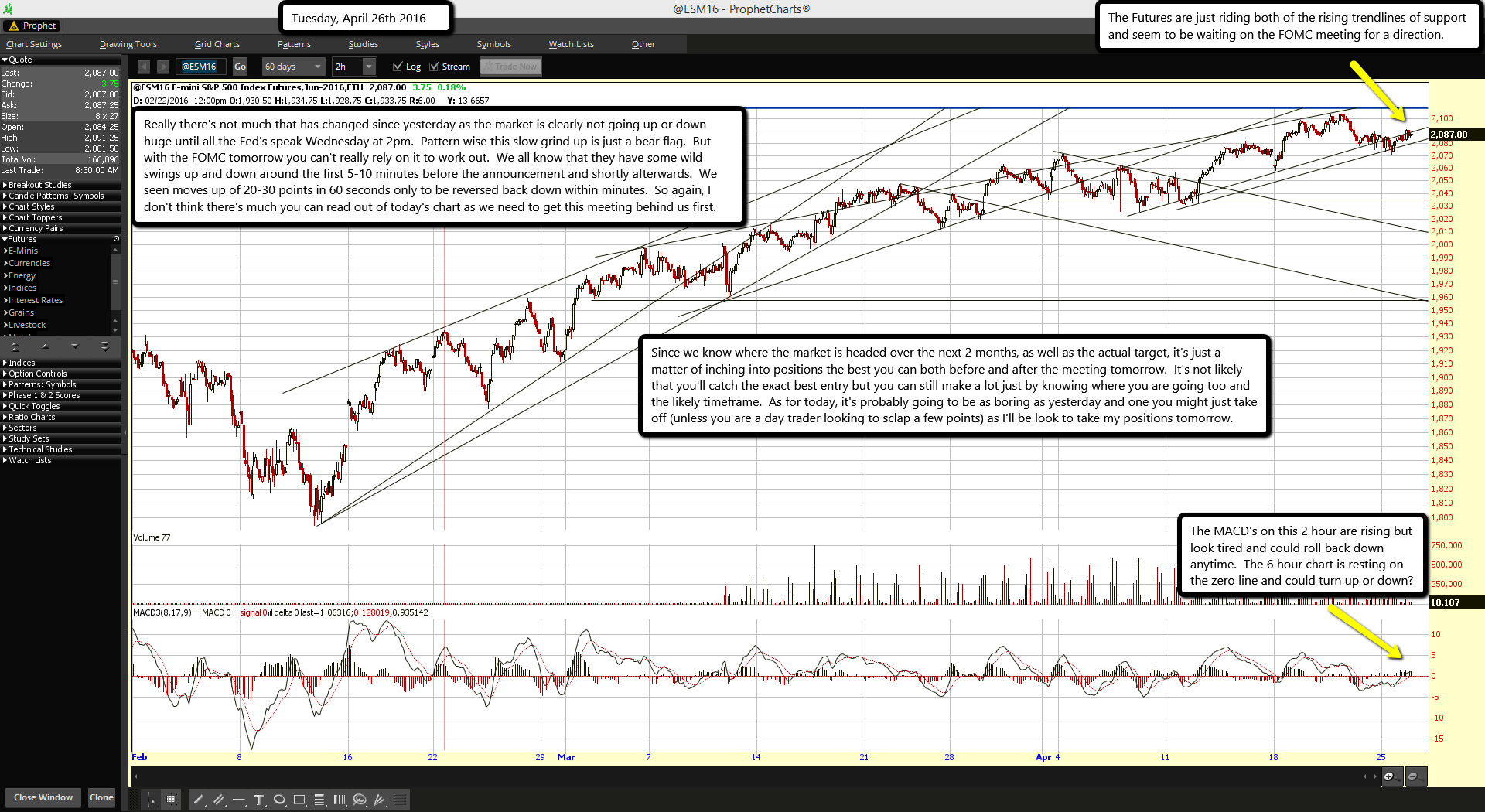
The Futures are just riding both of the rising trendlines of support and seem to be waiting on the FOMC meeting for a direction.

The MACD's on this 2 hour are rising but look tired and could roll back down anytime.  The 6 hour chart is resting on the zero line and could turn up or down?

Really there's not much that has changed since yesterday as the market is clearly not going up or down huge until all the Fed's speak Wednesday at 2pm.  Pattern wise this slow grind up is just a bear flag.  But with the FOMC tomorrow you can't really rely on it to work out.  We all know that they have some wild swings up and down around the first 5-10 minutes before the announcement and shortly afterwards.  We seen moves up of 20-30 points in 60 seconds only to be reversed back down within minutes.  So again, I don't think there's much you can read out of today's chart as we need to get this meeting behind us first.

Since we know where the market is headed over the next 2 months, as well as the actual target, it's just a matter of inching into positions the best you can both before and after the meeting tomorrow.  It's not likely that you'll catch the exact best entry but you can still make a lot just by knowing where you are going too and the likely timeframe.  As for today, it's probably going to be as boring as yesterday and one you might just take off (unless you are a day trader looking to sclap a few points) as I'll be look to take my positions tomorrow.

ES Morning Update April 25th 2016

0

f0c7002f-e11b-4212-9551-ce453cb633f0

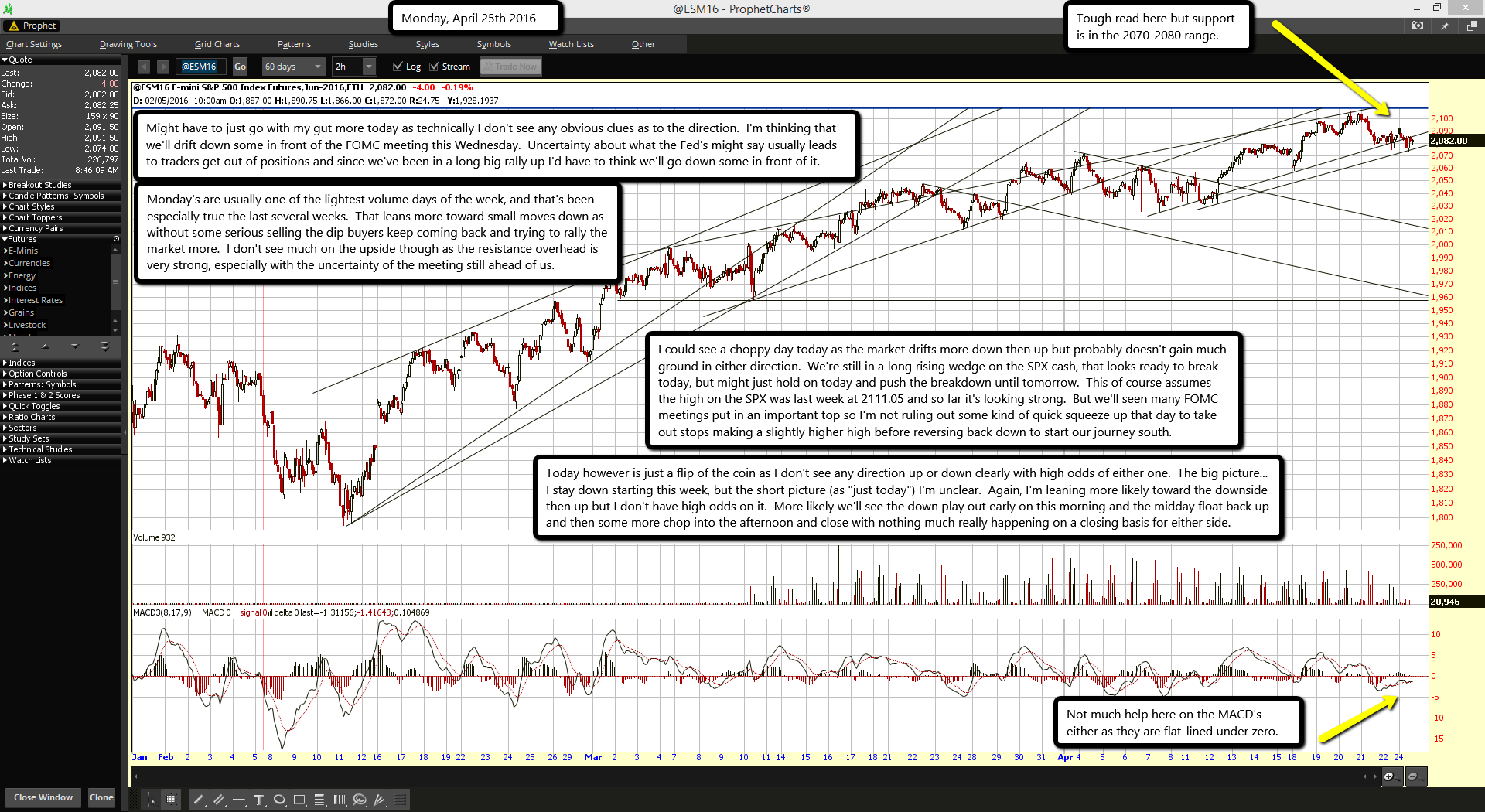
Tough read here but support is in the 2070-2080 range.

Not much help here on the MACD's either as they are flat-lined under zero.

Might have to just go with my gut more today as technically I don't see any obvious clues as to the direction.  I'm thinking that we'll drift down some in front of the FOMC meeting this Wednesday.  Uncertainty about what the Fed's might say usually leads to traders get out of positions and since we've been in a long big rally up I'd have to think we'll go down some in front of it.

Monday's are usually one of the lightest volume days of the week, and that's been especially true the last several weeks.  That leans more toward small moves down as without some serious selling the dip buyers keep coming back and trying to rally the market more.  I don't see much on the upside though as the resistance overhead is very strong, especially with the uncertainty of the meeting still ahead of us.

I could see a choppy day today as the market drifts more down then up but probably doesn't gain much ground in either direction.  We're still in a long rising wedge on the SPX cash, that looks ready to break today, but might just hold on today and push the breakdown until tomorrow.  This of course assumes the high on the SPX was last week at 2111.05 and so far it's looking strong.  But we'll seen many FOMC meetings put in an important top so I'm not ruling out some kind of quick squeeze up that day to take out stops making a slightly higher high before reversing back down to start our journey south.

Today however is just a flip of the coin as I don't see any direction up or down clearly with high odds of either one.  The big picture... I stay down starting this week, but the short picture (as "just today") I'm unclear.  Again, I'm leaning more likely toward the downside then up but I don't have high odds on it.  More likely we'll see the down play out early on this morning and the midday float back up and then some more chop into the afternoon and close with nothing much really happening on a closing basis for either side.

ES Morning Update April 22nd 2016

0

26106302-adaa-49d1-879d-b14c93dc524e

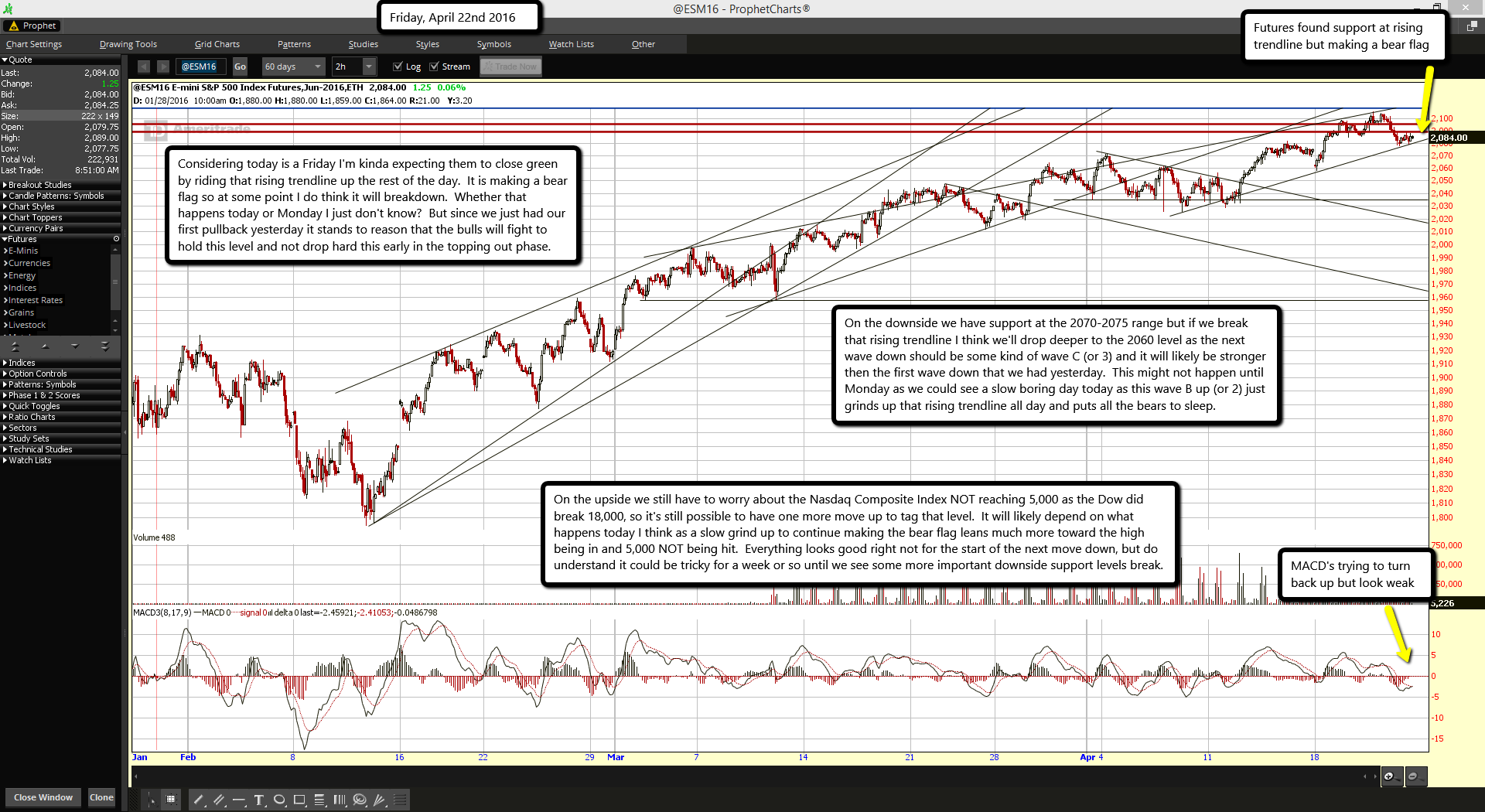
Futures found support at rising trendline but making a bear flag

MACD's trying to turn back up but look weak

Considering today is a Friday I'm kinda expecting them to close green by riding that rising trendline up the rest of the day.  It is making a bear flag so at some point I do think it will breakdown.  Whether that happens today or Monday I just don't know?  But since we just had our first pullback yesterday it stands to reason that the bulls will fight to hold this level and not drop hard this early in the topping out phase.

On the downside we have support at the 2070-2075 range but if we break that rising trendline I think we'll drop deeper to the 2060 level as the next wave down should be some kind of wave C (or 3) and it will likely be stronger then the first wave down that we had yesterday.  This might not happen until Monday as we could see a slow boring day today as this wave B up (or 2) just grinds up that rising trendline all day and puts all the bears to sleep.

On the upside we still have to worry about the Nasdaq Composite Index NOT reaching 5,000 as the Dow did break 18,000, so it's still possible to have one more move up to tag that level.  It will likely depend on what happens today I think as a slow grind up to continue making the bear flag leans much more toward the high being in and 5,000 NOT being hit.  Everything looks good right not for the start of the next move down, but do understand it could be tricky for a week or so until we see some more important downside support levels break.

ES Morning Update April 21st 2016

0

6ffee48e-a5fe-4d4f-947d-86d72d25107c

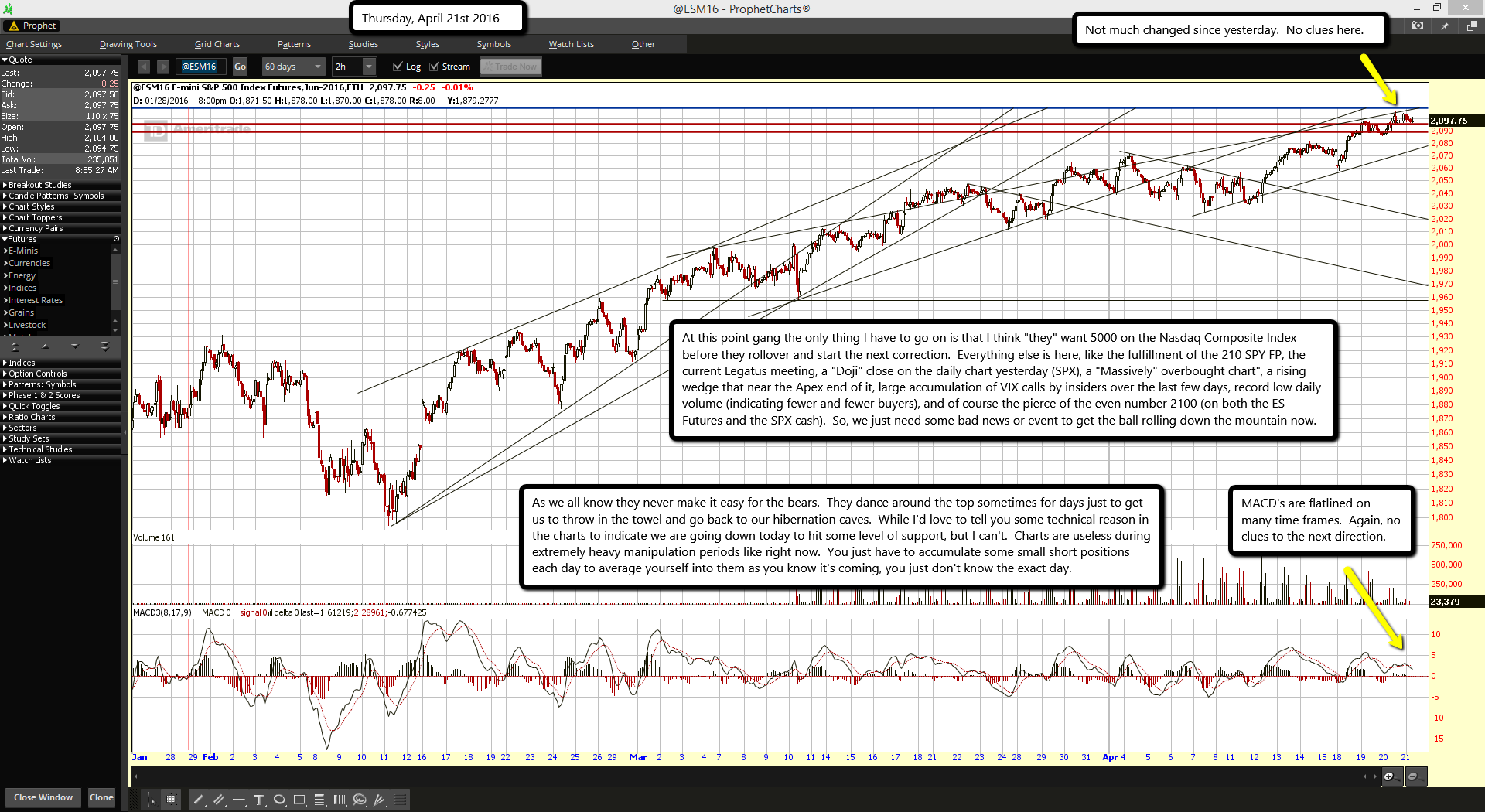
Not much changed since yesterday.  No clues here.

MACD's are flat-lined on many time frames.  Again, no clues to the next direction.

At this point gang the only thing I have to go on is that I think "they" want 5000 on the Nasdaq Composite Index before they rollover and start the next correction.  Everything else is here, like the fulfillment of the 210 SPY FP, the current Legatus meeting, a "Doji" close on the daily chart yesterday (SPX), a "Massively" overbought chart", a rising wedge that near the Apex end of it, large accumulation of VIX calls by insiders over the last few days, record low daily volume (indicating fewer and fewer buyers), and of course the pierce of the even number 2100 (on both the ES Futures and the SPX cash).  So, we just need some bad news or event to get the ball rolling down the mountain now.

As we all know they never make it easy for the bears.  They dance around the top sometimes for days just to get us to throw in the towel and go back to our hibernation caves.  While I'd love to tell you some technical reason in the charts to indicate we are going down today to hit some level of support, but I can't.  Charts are useless during extremely heavy manipulation periods like right now.  You just have to accumulate some small short positions each day to average yourself into them as you know it's coming, you just don't know the exact day.

s2Member®