Saturday, October 24, 2026
Home Blog Page 87

ES Morning Update May 4th 2016

0

c121d7de-0c28-4d72-be3d-391ecccc1406

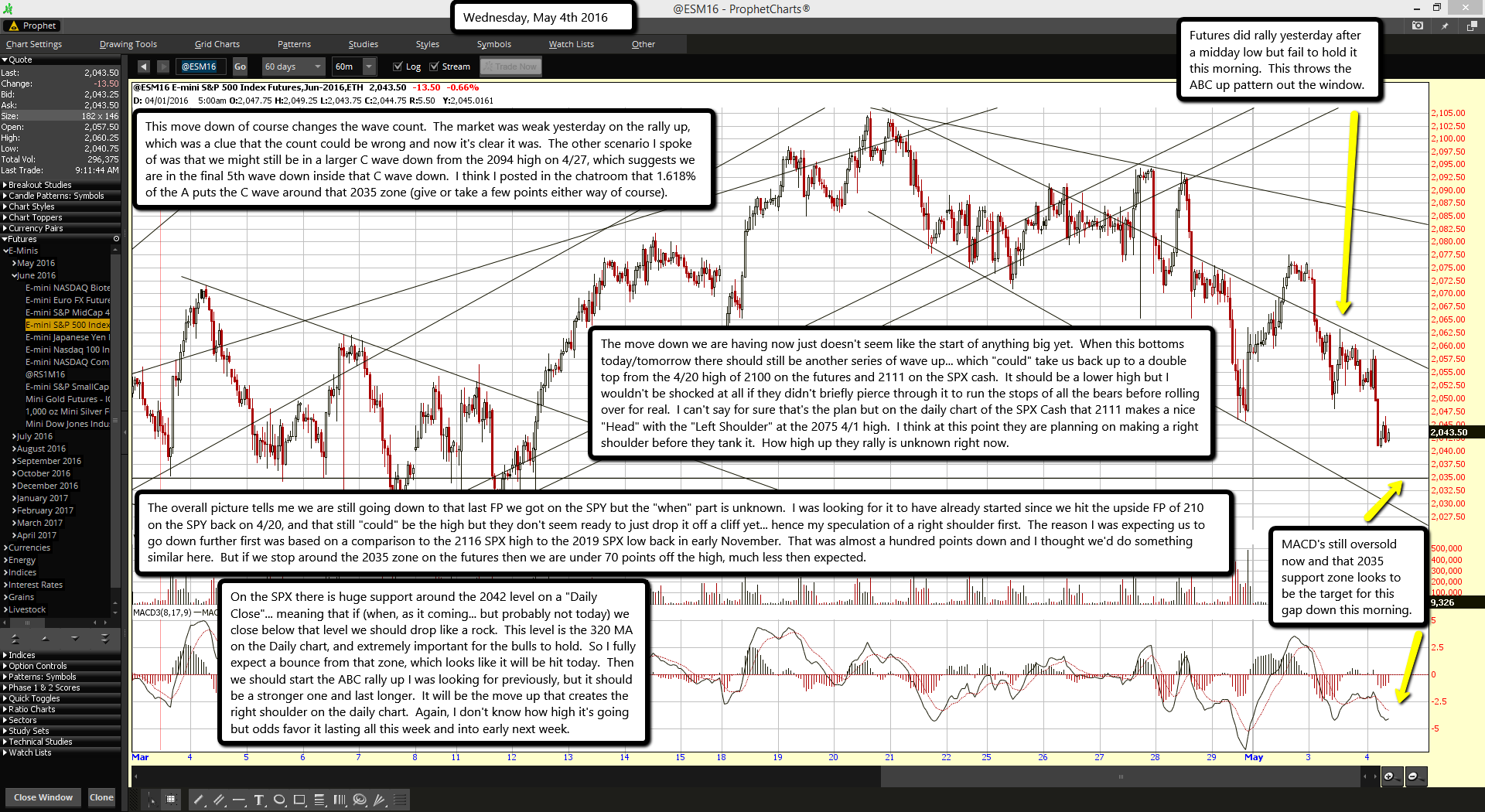
Futures did rally yesterday after a midday low but fail to hold it this morning.  This throws the ABC up pattern out the window.

MACD's still oversold now and that 2035 support zone looks to be the target for this gap down this morning.

This move down of course changes the wave count.  The market was weak yesterday on the rally up, which was a clue that the count could be wrong and now it's clear it was.  The other scenario I spoke of was that we might still be in a larger C wave down from the 2094 high on 4/27, which suggests we are in the final 5th wave down inside that C wave down.  I think I posted in the chatroom that 1.618% of the A puts the C wave around that 2035 zone (give or take a few points either way of course).

The move down we are having now just doesn't seem like the start of anything big yet.  When this bottoms today/tomorrow there should still be another series of wave up... which "could" take us back up to a double top from the 4/20 high of 2100 on the futures and 2111 on the SPX cash.  It should be a lower high but I wouldn't be shocked at all if they didn't briefly pierce through it to run the stops of all the bears before rolling over for real.  I can't say for sure that's the plan but on the daily chart of the SPX Cash that 2111 makes a nice "Head" with the "Left Shoulder" at the 2075 4/1 high.  I think at this point they are planning on making a right shoulder before they tank it.  How high up they rally is unknown right now.

The overall picture tells me we are still going down to that last FP we got on the SPY but the "when" part is unknown.  I was looking for it to have already started since we hit the upside FP of 210 on the SPY back on 4/20, and that still "could" be the high but they don't seem ready to just drop it off a cliff yet... hence my speculation of a right shoulder first.  The reason I was expecting us to go down further first was based on a comparison to the 2116 SPX high to the 2019 SPX low back in early November.  That was almost a hundred points down and I thought we'd do something similar here.  But if we stop around the 2035 zone on the futures then we are under 70 points off the high, much less then expected.

On the SPX there is huge support around the 2042 level on a "Daily Close"... meaning that if (when, as it coming... but probably not today) we close below that level we should drop like a rock.  This level is the 320 MA on the Daily chart, and extremely important for the bulls to hold.  So I fully expect a bounce from that zone, which looks like it will be hit today.  Then we should start the ABC rally up I was looking for previously, but it should be a stronger one and last longer.  It will be the move up that creates the right shoulder on the daily chart.  Again, I don't know how high it's going but odds favor it lasting all this week and into early next week.

Automakers report strong April sales, but their shares fall on economic worries

0
Automobiles for sale at a car dealership in Carlsbad, Calif. Wall Street analysts say the industry is close to a cyclical peak and warned that inventories need to be trimmed.
Detroit automakers reported another month of strong demand from U.S. consumers for trucks and sport-utility vehicles on Tuesday, but their shares dropped as analysts focused on signs the world’s second-largest auto market has little room to grow.Ahead of the final tally for U.S. light vehicle sales in April, General Motors estimated the seasonally adjusted annualized selling rate will be 17.6 million vehicles. That was more than the 17.5 million vehicles expected by analysts polled by Reuters. U.S. auto sales in 2015 hit a record 17.4 million vehicles.

Wall Street analysts say the U.S. auto market is close to a cyclical peak and that more production cuts, which hurt profits, could be needed to keep inventories of vehicles from ballooning later in the year.

“We continue to believe sales growth will be muted this year,” Joseph Spak of RBC Capital said in a note to investors.

Inventory data issued Tuesday pointed to some possible “risk to North American production over the coming months,” Spak added.

The sluggish pace of U.S. economic growth adds to concerns that the auto industry recovery could run out of fuel.

GM and Ford shares were down more than 1 percent, generally in line with the broader market, while Fiat Chrysler Automobiles fell more than 2 percent.

GM and Ford said sales to individual consumers were still growing. But because GM has been cutting back on low-profit sales to rental car companies and other fleets, its overall April U.S. sales fell by 3.5 percent.

GM’s results were among many that highlighted a divide in the market between slumping sales of traditional sedans, and robust demand for pickup trucks and SUVs.

GM said sales of the Chevrolet Silverado pickup truck rose nearly 9 percent in April compared to a year earlier. However, sales of GM’s Cadillac CTS and ATS luxury sedans plummeted 23 percent and 18 percent, respectively.

Other luxury brands also had weak results in April, especially for cars. Toyota’s Lexus luxury division suffered a 26 percent decline in sales of cars such as the large LS sedan, although sales of Lexus brand SUVs rose 20 percent.

German luxury car maker BMW said sales of its BMW brand passenger cars fell 6.5 percent, while its SUV sales fell 9.7 percent.

The chief executives of two leading auto dealer groups, AutoNation and Group 1 Automotive, had warned in April that automakers should start curbing production, particularly of slow-selling luxury sedans.

Still, April U.S. sales for Ford, Honda and Nissan all beat analysts’ expectations. Ford’s sales rose 4 percent from a year earlier, Fiat Chrysler Automobiles was up 5.6 percent and Toyota, No. 3 in the U.S. market, rose 3.8 percent. Honda’s sales rose 14.4 percent.


Source link

McDonald’s Starts Serving Up Garlic Fries in San Francisco

0

McDonald's is amping up its French fries in four locations in San Francisco.

The Golden Arches is offering "Gilroy Garlic Fries" to consumers in the Bay Area for a limited time. The made to order fries are tossed with a puree mix of garlic, olive oil, Parmesan cheese, parsley and salt.

If successful in this small test market, McDonald's will make the specialty fries available in around 250 restaurants throughout the San Francisco Bay Area.

Read More from CNBC: Burger King Rivals Spark Hot Dog War on Twitter

"McDonald's is committed to listening to our customers as seen by All Day Breakfast," Michael Haracz, manager of culinary innovation at McDonald's USA, said in a statement. "We're proud of the work done by local franchisees and the regional team to create this menu item with locally-sourced garlic and we look forward to introducing Gilroy Garlic Fries to our customers in the Bay Area."

The Golden Arches are no stranger to trial runs of potential menu items.

Some 125 stores in Milwaukee are slated to sell Johnsonville Brats for a limited time, seven years after discontinuing the sausages in chains.

Read More: McDonald's Offers All-You-Can-Eat Fries Promotion

The burger giant is also testing out smaller and larger Big Macs in Texas and Ohio restaurants. The Grand Mac is an attempt to compete with chains like Smashburger and Five Guys that serve larger burgers, while the Mac Jr. is simply easier to eat on the go, according to The Street.

In addition, McDonald's will host a limited-time all-you-can eat french fry promotion during the grand opening of its new location in Missouri this July.

Source link

All 17 Sports Authority stores in Arizona could close

0

March 2 -- Howard Davidowitz, chairman at Davidowitz & Associates, and Brian Belski, chief investment strategist at BMO, examine the Chapter 11 filing by Sports Authority and the potential for more bankruptcies in the retail industry.

All 17 Sports Authority stores in Arizona could be sold or close after a decision by the retailer not to pursue a Chapter 11 reorganization.

The filing last week in bankruptcy court in Wilmington, Del., reported originally by Forbes.com, means up to all 450 or so Sports Authority stores nationwide could be liquidated in an auction set for May 16 as the $64 billion sporting-goods industry continues to consolidate.

A previous bankruptcy filing by Sports Authority Holdings, based in Englewood, Colo., indicated that about one-third of the chain's stores would close, including three in the Valley and seven overall in Arizona. The retailer's website lists 17 Arizona stores – 12 in the Valley, three in Tucson and one each in Yuma and Casa Grande.

The company didn't immediately respond to requests for comment. Sports Authority is owned by Leonard Green & Partners, a Los Angeles-based private-equity firm with an array of retailing, medical, health, entertainment and other businesses. In addition to Sports Authority, the company owns three dozen businesses ranging from Aspen Dental, David's Bridal and Jo-Ann Stores to Lifetime Fitness, a dialysis-treatment chain and even the Palms Casino Resort in Las Vegas.

Sporting-goods chains such as Sports Authority primarily sell equipment, footwear and apparel. Sales increases for the industry mirror the low single-digit growth rate for the economy overall, reported the National Sporting Goods Association. Competitors range from Dick's Sporting Goods, Big 5 and REI to mass-market retailers such as Walmart, Target and Amazon.com.

Source link

Halliburton and Baker Hughes Call Off $35 Billion Merger

0

The Justice Department sued last month to block the merger of Halliburton and Baker Hughes.

Halliburton and Baker Hughes, two big oil services providers, have decided to call off their $35 billion merger, a person briefed on the matter said on Sunday, after a long regulatory review that ended with the Justice Department seeking to block the deal.

The deal’s termination could be announced as soon as Sunday night, said the person, who spoke on the condition of anonymity. Halliburton will be required to pay Baker Hughes $3.5 billion as compensation for the breakup, according to the merger agreement. The termination fee, one of the biggest ever, was written into the merger agreement to reassure Baker Highes that Halliburton expected the deal to get done.

Since the merger was announced in November 2014, the oil industry has changed drastically. Commodity prices have plummeted, sending many energy companies into a tailspin, with some nearing bankruptcy. Combining the two oil field services companies may have helped to deter some of the effects from the deteriorating commodity prices. At the time the deal was signed, the companies estimated that they would save billions by combining operations and research and development.

But the Justice Department last month sued to block the deal, saying it would “eliminate vital competition, skew energy markets and harm American consumers.”

The Justice Department’s lawsuit was the latest example of the tough stance taken by the Obama administration against large deals. Last month, the drug company Pfizer abandoned its attempted $152 billion merger with Allergan after the Treasury Department came out with new tax-related rules that eliminated many of the benefits of the deal.

Shares in both Halliburton and Baker Hughes have surged about 20 percent since the Justice Department’s lawsuit was disclosed on April 6. Halliburton has about $10 billion of cash on its balance sheet that it could use toward the breakup fee or potentially other transactions, according to data by S&P Capital IQ.

Halliburton plans to discuss the transaction in greater detail during the company’s earnings call on Tuesday, the person said.

Bloomberg first reported that the deal would be terminated.

Source link

CCSX train derails in Northeast Washington, leaking hazardous chemicals and disrupting travel

0

A CSX freight train derailed in Northeast Washington early Sunday, spilling hazardous chemicals along a busy rail corridor. The wreck stranded some residents away from their homes, forced the closure of a Metro station and snarled traffic as emergency personnel sought to contain the leaks and clear the wreckage.

Officials said 14 rail cars of the 175-car train left the tracks. A rail engineer and a conductor had been aboard the train but were accounted for, authorities said. No evacuations were ordered, and no one was injured.

The cause of the wreck is under investigation, and the Federal Railroad Administration was at the scene Sunday.

Red Line service was suspended between Metro’s NoMa-Gallaudet and Brookland stations, and the Rhode Island Avenue station was closed. At least six blocks of Rhode Island Avenue NE were closed for much of the day.

The derailment occurred about 6:40 a.m. as the train was passing through Washington from Cumberland, Md., en route to Hamlet, N.C., CSX said. The crash site was near Ninth Street NE and Rhode Island Avenue NE. CSX said 94 cars were carrying mixed freight and 81 were empty.

A CSX freight train carrying hazardous material derailed near the Rhode Island Avenue Metro Station. (DC Fire and EMS)

The derailment, about 70 cars into the train, spilled half the liquid contents of a 15,500- gallon tanker containing sodium hydroxide, D.C. Fire and EMS Deputy Chief John Donnelly said. The liquid spilled onto the tracks and seeped into the ground below it.

Officials said there were no air- or water-quality issues at the scene.

CSX spokeswoman Melanie Cost said the company did not have a timeline on the cleanup or restoration of the tracks.

“First let me apologize to the community for the inconvenience and the alarm that the derailment caused this morning,” she said. “Every decision that we’re making is focused on the safety of the responders and the community.”

CSX described sodium hydroxide as a chemical “used to produce various household products, including paper, soap and detergents.” It is a chemical component similar to bleach or Drano, officials said. Two other rail cars were leaking chemicals that officials described as less hazardous.

By mid-morning, D.C. Mayor Muriel E. Bowser (D) said the chemical leak was contained. But more detailed inspections revealed further leaks, according to CSX. In addition to the tank car leaking sodium hydroxide, another tank car was found to be leaking calcium chloride, described as “non-hazardous,” while a third was leaking ethanol “slowly from the base of a valve,” CSX spokeswoman Kristin Seay said.

The wreckage was visible from high-rise apartments near the crash site: A zigzag pattern of mangled tankers and overturned freight cars sat beside the tracks below the Rhode Island Avenue Metro station. A set of wheels, still intact but missing its freight car, sat upright beside the track bed.Emergency personnel work at the scene after a CSX freight train derailed in Washington on Sunday. (Cliff Owen/AP)

Weekdays, the affected tracks are shared by Amtrak, MARC and CSX trains. The tracks also run parallel to the Metropolitan Branch Trail, popular with cyclists and runners. On Sunday, the trail was closed near the site of the derailment, and officials said it would remain closed indefinitely.

Metro spokesman Dan Stessel said barring any unforeseen circumstances, Red Line service would be restored Sunday night.

Stessel said CSX was working to upright a rail car that was leaking ethanol. When the leak is mitigated, he said, the Metro tracks would be turned back over to the agency, which would run test trains and probably restore service soon thereafter.

If for any reason CSX is not able to turn over the scene, Stessel said, “that could affect service into the morning.”

MARC announced major service disruptions for its Brunswick Line on Monday because of the derailment. Its trains will run as far south as Silver Spring, where Metro will accept passengers at no charge to continue their commutes into the District. In addition, the Amtrak line from Washington to Chicago will not run Monday, but the Northeast Corridor lines will run as normal, officials said.

According to the Centers for Disease Control and Prevention, the effects of exposure to sodium hydroxide can include irritated eyes, burning skin, loss of hair and swelling of the lungs. The odorless solid is white or colorless and is usually in flakes, beads or a granular form. Sodium hydroxide is especially dangerous when mixed with water, because the toxin when wet creates heat that can ignite flammable products. It was raining heavily Sunday morning near the crash site.

Donnelly said the amount that leaked did not put District residents at risk.

“The fumes should not cause you any problems, and you should not be able to smell them anywhere else,” he said.

In recent years, Washington residents and elected officials have voiced concerns about rail safety and the risk of having freight trains pass through residential neighborhoods and the seat of the federal government.

Residents of Navy Yard, a formerly industrial neighborhood that is now densely populated, fought a CSX plan to reconstruct the 110-year-old Virginia Avenue Tunnel in Southeast, a key piece of the region’s rail infrastructure that is just a mile away from the U.S. Capitol. CSX is now in the midst of the $170 million project, which includes twin tunnels built to allow for double-stacked trains.

One of the most hotly debated projects in recent years, the tunnel project revived concerns about the safety and security of the city’s railways, prompting the D.C. Council two years ago to allocate funding to conduct a comprehensive rail study that would provide an assessment of all rail service: passenger, commuter and freight.

Some residents say they fear they are at a greater risk of train derailments and that once the tunnel project is completed, CSX will increase the transportation of crude oil and other hazardous materials through the area.

CSX says it rarely transports crude oil through the District and does not carry hazardous substances such as compressed flammable gases and toxic and radioactive materials through the city.

In 2009, rainwater leaking into the Virginia Avenue Tunnel from the Southeast Freeway and Virginia Avenue weakened the earthen floor. A split rail caused the derailment of two locomotives and 13 loaded gondola cars transporting scrap metal. And in the spring of 2014, a CSX freight train derailed in downtown Lynchburg, Va., sending rail cars and burning crude spilling into the James River.

Monte Edwards, a trustee with the Committee of 100 on the Federal City, which serves as a watchdog on transportation and urban planning issues, said Sunday’s spill raised renewed concerns about the viability of shared freight and passenger tracks in the District.

Speaking for himself, he said the spill showed CSX’s disregard for rail safety and inspections in the District.

“This was a hydroxide that they spilled this time. Those are nasty things coming through,” he said, reflecting on what could have happened had the chemical spilled just a short distance south, near the Capitol.

“A spill like that [one] that just occurred here in Northeast, [if] that would occur near a grate or an entrance to a Metro station, it would flood the Metro station,” he said.

The spill underscores the need for the District to devise a comprehensive rail plan, similar to state plans required under the 2008 Passenger Rail Investment and Improvement Act, he said. The District Department of Transportation says it expects a rail plan to be completed as early as this summer.

“We would know what’s coming through,” Edwards said. “We would have inspectors. We would have rail safety officers.”

“We have said all along that derailments are very real and these trains are carrying hazardous materials,” said Maureen Cohen Harrington, a Navy Yard resident and member of DCSafeRails, the organization fighting against CSX transporting hazardous materials through the neighborhood. “And what happened today demonstrated that, and we are well aware that this could have been far worse.”

Peter Hermann, Perry Stein and Ashley Halsey III contributed to this report.
Source link

SBA chief urges respect, support for small businesses

0

Rhonda Abrams, Special for USA TODAY
11:01 a.m. EDT May 1, 2016

XXX Maria Contreras Sweet_001

Since 1963, the first week of May has been designed by the president of the United States as a time to celebrate entrepreneurs.

To mark the start of this year’s Small Business Week, small-business owner and USA TODAY contributor Rhonda Abrams sat down for a discussion with Maria Contreras-Sweet, the current administrator of the U.S. Small Business Administration. Contreras-Sweet, the founder of ProAmerica Bank, talked about technology, small-business lending and elaborated on some of the challenges — and resources — for the nation’s estimated 28 million small businesses.

She also encouraged shoppers to spend at their local stores.

“When you shop at a small business, 64 cents of that dollar stays right in your neighborhood,” she says. In turn, she adds, those stores could become a “destination” for more consumers, leading to more job creation in the community.

“Small businesses should be respected for the role they play: Two out of three net new jobs are created by small businesses,” she says. “This is the time to celebrate small businesses.”

Here are some of other thoughts from Contreras-Sweet:

Q:  What’s a main message that you would like to get out there during Small Business Week?

A:  Let’s level the playing field for small businesses. I see small businesses getting the run around at every turn. When a corporation arrives at a municipality and says, “We’re going to locate here,” that municipality says, “We’re going to give you tax breaks; we’re going to open up this for you.” When a small business shows up in City Hall, (they’re told) “Stand in line, take a ticket.”

We need to address the different needs of small business. We can create unique products, services, programs to be more responsive to the varying Americans across the country that are in different stages of their journey of entrepreneurship.

Q:  How is the SBA already addressing those varying needs?

A:  If someone is in their nascent stage, they can go into one of our Small Business Development Centers and get some counseling. If you’re a woman and you feel more comfortable amongst your peers, we have Women's Business Centers. If you’re a veteran, then you may want to visit one of our Veteran’s Business outreach centers.

Q:  For small businesses, finding and managing technology, keeping up with it, is really overwhelming. How can the SBA help small businesses handle technology-related challenges? 

A:  We recently launched the Small Business Tech Coalition (which provides technology-focused education and resources). We went through process of curating (the technologies small businesses need to get started). You may need Zenefits (which provides an online human resource management system), you may need Salesforce as a CRM (a system for customer relationship management) and you may need Facebook to get your message out. We put together a series of technologies, and over time, we’ll keep refreshing that.

Q:  Virtually every day, I get offers from new “alternative” small-business lenders. Currently, they’re fairly unregulated, some with interest rates as high as 40% to 60% per year. What’s appropriate for the government to do to protect small businesses?

A:  Let me give you three answers. One is that SBA has to use technology to make it easier and more efficient for people to get loans from the SBA. To that end, we put up a program called LINC. It’s like Match.com. Answer 20 questions. We route that to all of our banks in our network, they respond, and now you’re in the driver’s seat.

Next, (current SBA) bankers said our technology was old and antiquated. We’ve invested a lot of time and effort to make sure our portal to the lending institutions is much more efficient.

Thirdly, we’ve been meeting with online solutions (such as institutional investor, peer-to-peer and crowdfunding lenders) OnDeck, Kabbage, Kiva, Kickstarter. We have a duty to make sure there’s no abuse in the system, that people are getting the most rational rates, that there’s transparency, accountability, all the things you would expect us to be doing.

Q: In 2000, the funding for Small Business Development Centers was $88 million — about $122 million in today’s dollars. Last year’s allocation was $115 million. What can you tell us about these training and counseling centers?

A: SBDCs are marvelous resources for small businesses. SBDC consultants are passionate about the work. They help businesses navigate contracts with U.S. government and the corporate supply chain. SBDCs are gearing up and training to navigate small businesses through the international market. We’re bringing more technology capacity into these SBDC centers.

Edited for clarity and content

Follow Rhonda Abrams on Twitter: @RhondaAbrams

Source link

Celebrate National Small Business Week

0

Since 1963, the Small Business Administration has recognized outstanding entrepreneurs and small business owners through National Small Business Week. This year, the Greater Pensacola Chamber and the Florida Small Business Development Center at the University of West Florida are teaming up to promote the positive impact of small businesses on the Pensacola community.

“National Small Business Week provides an opportunity to honor Northwest Florida small businesses for their crucial role in job creation and healthy economic growth,” said Greater Pensacola Chamber President and CEO Clay Ingram. “We are pleased to partner with the Florida SBDC at UWF to show our appreciation and commitment to putting small businesses first.”

National Small Business Week will be celebrated today through Saturday. This year’s theme is Dream Big, Start Small. The Chamber and the Florida SBDC at UWF encourage small businesses to share their success stories and photos on social media with the hashtags #DreamSmallBiz, #PcolaChamber and #FloridaSBDCUWF.

“The Florida SBDC at UWF team is committed to serving local small businesses in our community,” said Kelly Massey, regional director. “For the last six years, we have delivered over 56,689 hours of professional consulting to 13,147 entrepreneurs and small business owners in the Panhandle region. We intend to make those numbers soar even higher within the next six years.”

For more information on National Small Business Week, visit www.sba.gov/nsbw.

To become involved in local promotion of National Small Business Week, contact the Chamber at news@pensacolachamber.com or 438-4081, or the Florida SBDC at UWF at sbdcmarketing@uwf.edu or 474-2528.

Source link

Buffett: Straight talk from ‘Woodstock of Capitalism’

0
AP BERKSHIRE HATHAWAY SHAREHOLDERS A F USA NE

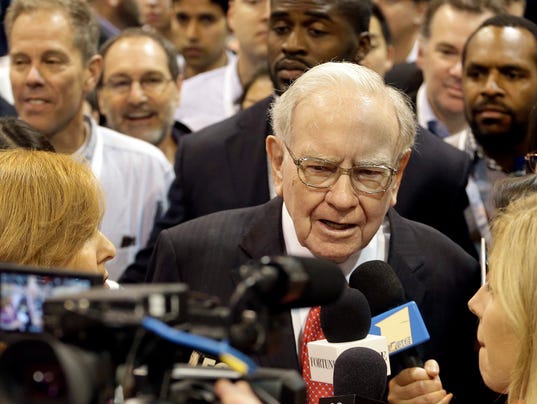
Warren Buffett, speaking at Berkshire Hathaway's annual meeting Saturday, told his flock of followers that first-quarter earnings jumped 8.2% to $5.59 billion despite weakness in key insurance and railroad holdings, reiterated he's still on the lookout for big deals like January's $32 billion purchase of Precision Castparts, and advised mom-and-pop investors to build their stock portfolios around low-cost index funds that capture the long-term success of American businesses.

Saturday's event marks the first-time that Berkshire Hathaway and Buffett, the company's chairman and CEO, live streamed its annual shareholders meeting — dubbed the "Woodstock of Capitalism" — around the globe. Roughly 40,000 Berkshire investors made the pilgrimage to Omaha to be there in person.

Heading into the closely watched gathering at the CenturyLink Center, where Buffett, 85, and long-time Berkshire vice chairman Charlie Munger, 92, are fielding questions for hours from journalists, analysts and everyday investors who own a piece of Buffett's Berkshire conglomerate are feeling flush.

Berkshire's A shares (BRK-A) are up 10.7% so far in 2016, soundly topping the 1% gain for the broad U.S. stock market, measured by the benchmark Standard & Poor's 500 stock index.

In the first half of the Q&A, Buffett addressed a wide variety of issues. Topics ranged from:

• The outlook for Precision Castparts, Berkshire's biggest acquisition ever.  "Precision," Buffett said, "will do better" under the Berkshire umbrella. Buffett said Precision Castpart's CEO Mark Donegan, who he called an "extraordinary" and "one of a kind" manager, would be freed up to make the business even better post-deal.

• Berkshire's thirst for future acquisitions. "We would love to find another three of four types of Precision Castparts," he said.

• Why auto insurer Geico's quarterly results fared worse than expected and trailed rival Progressive in the first quarter? "The frequency of accidents and the severity, or cost per accident, both of those went up quite suddenly and quite substantially," Buffett said.

• On the meteoric rise of online retailer Amazon.com and its Internet driven marketing power. "Charlie and I are not going to out-Bezos Bezos," said Buffett, referring to Amazon CEO Jeff Bezos.

• His take on the controversy surrounding one of his biggest holdings, Coca-Cola, and its role in causing health effects such as diabetes. Buffett defended Coke and his large daily consumption of Cherry Coke. "I have not seen evidence that I will reach 100 if I switch to broccoli or water," the 85-year-old Buffett said.

• The danger of derivatives to the financial system. Buffett who once famously said derivatives are "financial weapons of mass destruction," said they are still "a danger to the system," especially when used in "large quantities" and under adverse market circumstances big enough to cause "major discontinuity" in markets.

• Financial advice. Buffett, showing data over the past eight years that was part of a debt that shows owning a S&P 500 index fund outperformed five hedge funds by about 40 basis points, or 40%. Ignore the sales pitch from Wall Street, he says. And avoid the high-priced management fees.

"Very few (active fund managers) have an outstanding performance record," Buffet said. "And people you pay to identify them don't know how to identify them."

Added Munger: "Few in the universe exceed the market returns (on a regular basis). It's like finding a needle in a haystack."

When Buffett and Munger return after lunch, they will likely face queries on topics ranging from succession plans at Berkshire to the state of the U.S. economy and the stock market.

Buffett, best known for his stock-picking prowess and investment savvy, in recent years has shifted Berkshire's focus to buying businesses outright. And the deals are getting bigger and bigger.

In January, Berkshire closed on its largest acquisition ever, paying $32 billion for aerospace parts maker Precision Castparts. That mega-deal, which meets Buffett's definition of hunting for "elephants," follows a $12 billion deal for a more than 50% stake in ketchup maker H.J. Heinz a few years back, which has since merged with Kraft Foods of Macaroni & Cheese fame to form Kraft Heinz. Back in 2010, Buffett bought the railroad, Burlington Northern Santa Fe, for $27 billion.

At the end of 2015, Berkshire's top stock holdings included Wells Fargo, Coca-Cola, IBM and American Express. The list of businesses the sprawling conglomerate owns include paint maker Benjamin Moore, battery maker Duracell, insurer Geico and ice cream retailer Dairy Queen, to name a few.

Buffett's holdings touch virtually every corner of the U.S. economy, which makes his commentary that much more relevant.

In the minutes leading up to the webcast, Robert Miles, a Buffett scholar and author, let Yahoo Finance know what makes Buffett special: “He is just a regular guy that speaks the truth, unlike Wall Street."

It was a dreary, rainy day in Omaha, but that didn't keep the Buffett faithful away or dim their mood. Buffett followers came from as far away as Taiwan, Mexico and Australia, many were chanting "Buffett! Buffett! Buffett" in the long line outside the arena despite a driving rain.

Source link

Yahoo CEO Marissa Mayer Made $36 Million Last Year Despite $6 Million Pay Cut

0


Marissa Mayer

Yahoo paid Marissa Mayer $36 million in compensation last year despite the company’s shrinking revenue and profits. The CEO is also expected to receive a huge payout of $55 million if she is terminated after Yahoo is sold.

Yahoo revealed that its CEO Marissa Mayer's pay for 2015 got a significant cut, but still left her a hefty amount to take home.

The executive got nearly $36 million in total compensation, down almost 15 percent from the previous year's $42 million, according to a filing with the Securities and Exchange Commission on April 29.

Her base salary remained at $1 million, with most of the cuts coming from her stock option awards estimated to be valued at $9 million. This was largely the result of a 15 percent drop in Yahoo stock value over the past year. Stock value rises or falls depending on the profitability or failure of a business.

Given all the noise about Mayer's inability to turn her company's fortune around as revenue and profits continue to shrink, her compensation may still be too high. Comparatively, Google CEO Tim Cook's salary of $10.3 million in 2015 is a far cry from Mayer's $42 million in the same year even as Google was operating more profitably.

While her reported pay was $36 million, the Yahoo chief executive actually brought home an amount close to $14 million or just about 39 percent of what was reported because Yahoo's financial performance fell short of the projected goals.

The filing also disclosed that Mayer and other Yahoo executives decided to give up their bonuses in 2015.

Marissa Mayer is getting a lot of attention not only because her tenure at Yahoo may soon be over, but because history could remember her as the person who could not prevent the downfall of the great Yahoo, some analysts observe.

Other industry insiders are seeing hopes in Yahoo, but drastic moves may have to be explored. Sue Decker, a respected business executive who could have been Yahoo CEO, offered some unsolicited advice for the beleaguered Internet company.

Decker said in a CNBC interview on April 29 that Yahoo was involved in so many things without focusing and winning in one or two areas. She mentioned Google's dominance in search and Facebook's social niche, despite the two companies' interest in other areas like video and messaging.

Decker said that the road ahead will be tough for a change in leadership. But it must be done, with Yahoo going private again or becoming part of a much larger company in order to stay focused.

"I hope the next owner can do something to revitalize the spirit of the core things that made Yahoo very, very unique and create a distinction in consumers' minds about why they love Yahoo still," Decker said.

If Mayer is out of the picture as a result of the sale of the company, she could still receive a huge payout of about $55 million. The severance package includes restricted stock units and options and $3 million in cash.

Source link

ES Morning Update May 3rd 2016

0

84e2258f-00f7-45da-9c32-10acf42c4ad4

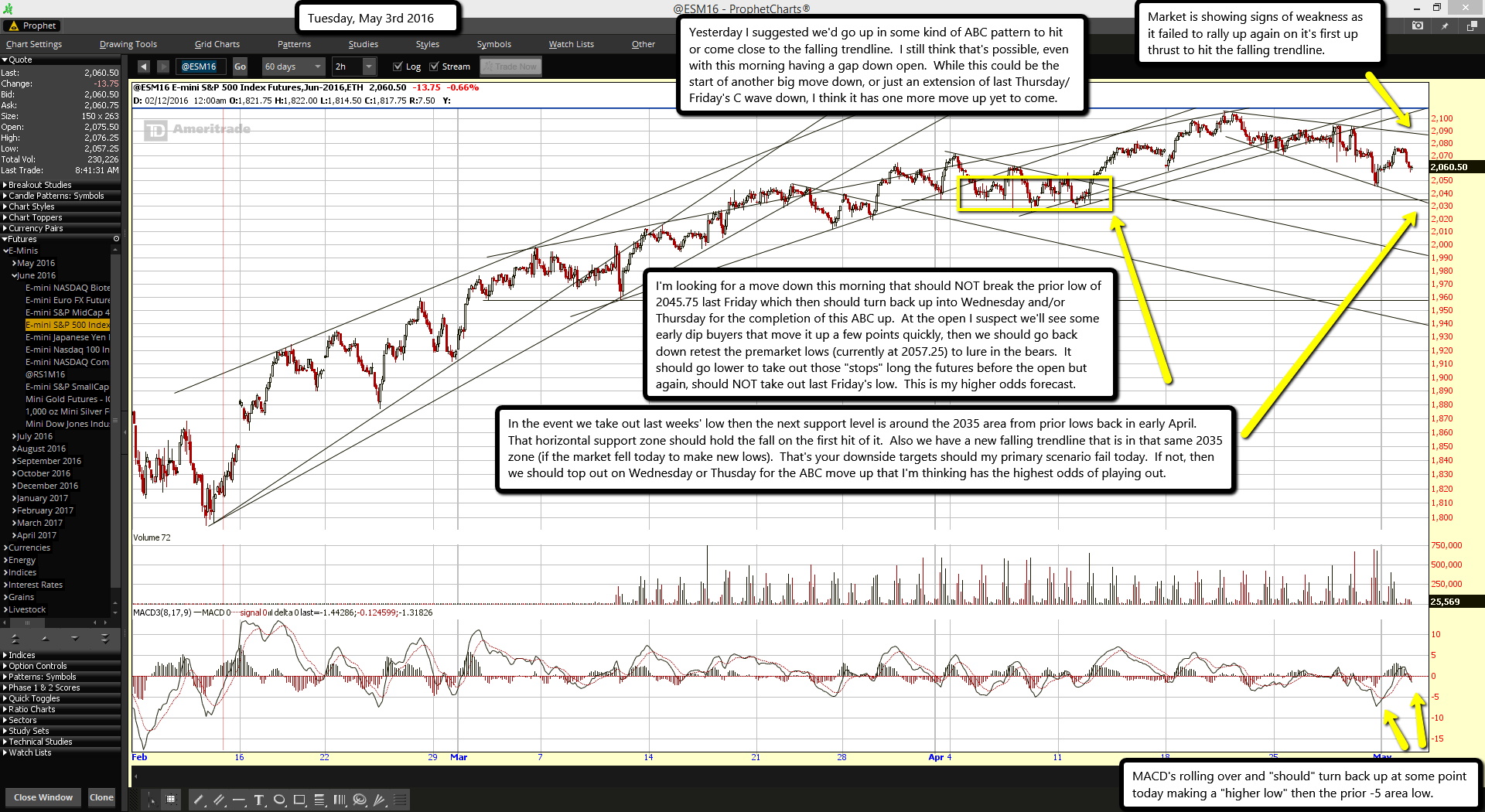
Market is showing signs of weakness as it failed to rally up again on it's first up thrust to hit the falling trendline.

MACD's rolling over and "should" turn back up at some point today making a "higher low" then the prior -5 area low.

Yesterday I suggested we'd go up in some kind of ABC pattern to hit or come close to the falling trendline.  I still think that's possible, even with this morning having a gap down open.  While this could be the start of another big move down, or just an extension of last Thursday/Friday's C wave down, I think it has one more move up yet to come.

I'm looking for a move down this morning that should NOT break the prior low of 2045.75 last Friday which then should turn back up into Wednesday and/or Thursday for the completion of this ABC up.  At the open I suspect we'll see some early dip buyers that move it up a few points quickly, then we should go back down retest the premarket lows (currently at 2057.25) to lure in the bears.  It should go lower to take out those "stops" long the futures before the open but again, should NOT take out last Friday's low.  This is my higher odds forecast.

In the event we take out last weeks' low then the next support level is around the 2035 area from prior lows back in early April.  That horizontal support zone should hold the fall on the first hit of it.  Also we have a new falling trendline that is in that same 2035 zone (if the market fell today to make new lows).  That's your downside targets should my primary scenario fail today.  If not, then we should top out on Wednesday or Thusday for the ABC move up that I'm thinking has the highest odds of playing out.

ES Morning Update May 2nd 2016

0

6c8224d4-9db6-4a93-bf19-8cc34850d4bc

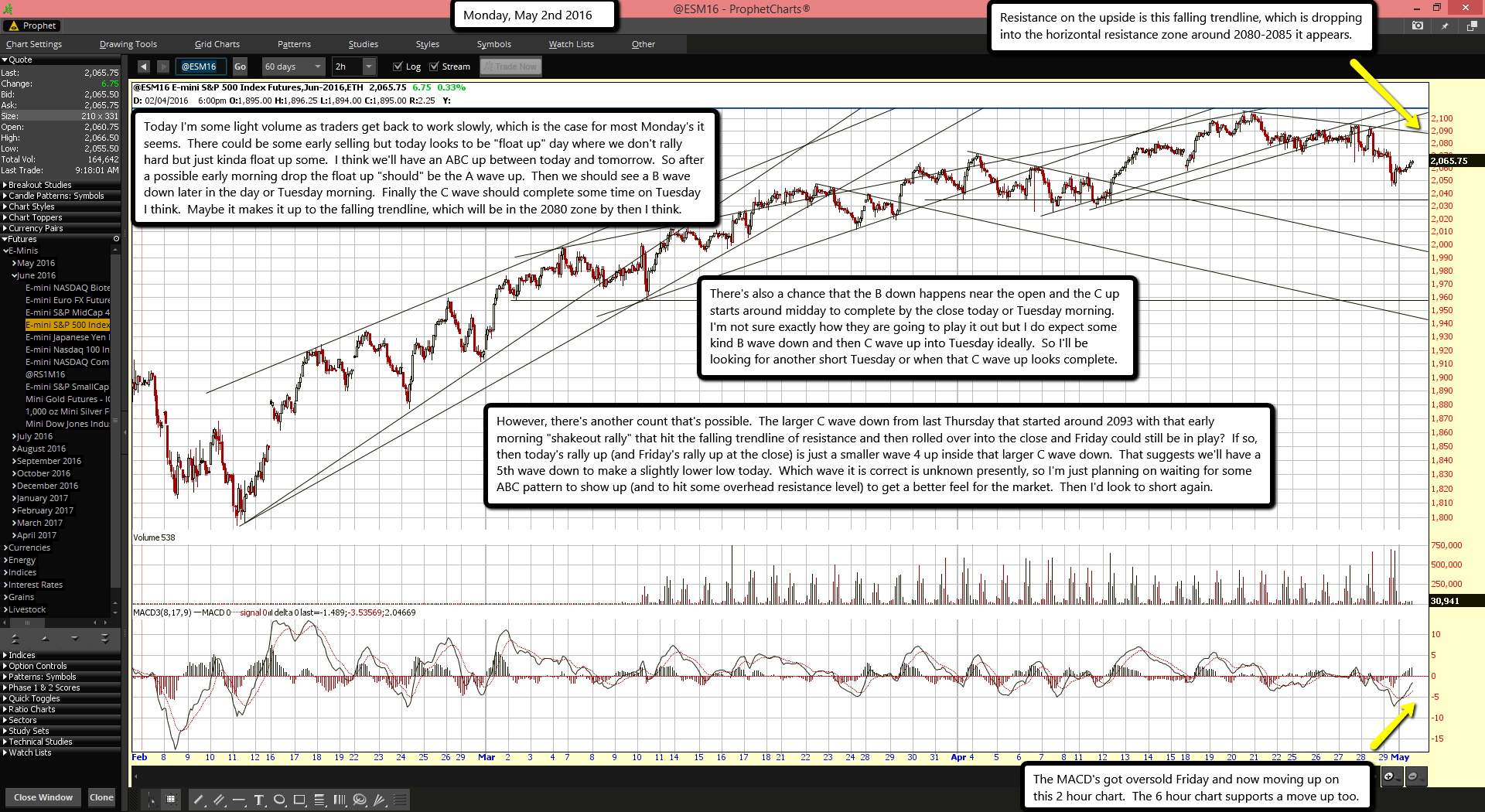
Resistance on the upside is this falling trendline, which is dropping into the horizontal resistance zone around 2080-2085 it appears.

The MACD's got oversold Friday and now moving up on this 2 hour chart.  The 6 hour chart supports a move up too.

Today I'm some light volume as traders get back to work slowly, which is the case for most Monday's it seems.  There could be some early selling but today looks to be "float up" day where we don't rally hard but just kinda float up some.  I think we'll have an ABC up between today and tomorrow.  So after a possible early morning drop the float up "should" be the A wave up.  Then we should see a B wave down later in the day or Tuesday morning.  Finally the C wave should complete some time on Tuesday I think.  Maybe it makes it up to the falling trendline, which will be in the 2080 zone by then I think.

There's also a chance that the B down happens near the open and the C up starts around midday to complete by the close today or Tuesday morning.  I'm not sure exactly how they are going to play it out but I do expect some kind B wave down and then C wave up into Tuesday ideally.  So I'll be looking for another short Tuesday or when that C wave up looks complete.

However, there's another count that's possible.  The larger C wave down from last Thursday that started around 2093 with that early morning "shakeout rally" that hit the falling trendline of resistance and then rolled over into the close and Friday could still be in play?  If so, then today's rally up (and Friday's rally up at the close) is just a smaller wave 4 up inside that larger C wave down.  That suggests we'll have a 5th wave down to make a slightly lower low today.  Which wave it is correct is unknown presently, so I'm just planning on waiting for some ABC pattern to show up (and to hit some overhead resistance level) to get a better feel for the market.  Then I'd look to short again.

ES Morning Update April 29th 2016

0

c640865d-cb59-49e9-8724-c08e1c3c9ecc

Market hit falling trendline yesterday and rolled over into what appears to be a wave C down.

MACD's are oversold here but have plenty of room to go down more on the higher time frame charts.

Yesterday I said that I thought we were in a C wave down with the open being the smaller wave 1 down inside that C wave.  I suggested that we should rally yesterday for the smaller wave 2 up and that it might breakdown into a mini ABC... which it did.  I thought we'd only see the mini A and B yesterday and the mini C up to complete the smaller 2 up by Friday morning.  I was wrong on the time frame as it did it all yesterday with a clear ABC up to hit the falling trendline by midday.  Then the smaller wave 3 down (still inside wave C down) started and took most traders by surprise I think.

So, where are we today.  It looks like the smaller wave 3 down (inside wave C down) is either still going on will end shortly after the open.  Today is tricky as it's a Friday and it's common to see them hold the market up from some huge move down as they don't want to panic the sheep on a weekend.  My best guess is that the sideways chop back up late yesterday and afterhours is some kind of smaller wave 4 and we will complete the C down today with the final "smaller wave 5" down early this morning.  Right now it's holding horizontal support around 2065 but it sure looks like it wants to break it.  It's a triple bottom too from hitting it yesterday.

I'm thinking that early this morning we'll break that horizontal support around 2065 on the ES Futures and drop to the 2055-2060 area where there was another prior low at 2058.50 on April 18th.  If they pierce below there slightly they should take out all the bulls stops' that are long from that level and end the smaller 5th wave down inside the C down.  Then the rest of day we should see some move back up to start the next series of ABC's before we go down again next week.

Updated: FERC Rescinds AEP, FirstEnergy Affiliate-Sales Waivers; Will Review Ohio PPAs

0

http://www.rtoinsider.com/wp-content/uploads/AEP-Conesville-Power-Station-Copyright-Delta-Whiskey-Creative-Commons-web-slider.jpg

By Suzanne Herel and Ted Caddell

FERC late Wednesday rescinded waivers it granted American Electric Power and FirstEnergy, meaning the controversial power purchase agreements approved by Ohio regulators will be subject to the commission’s affiliate abuse test.

The commission granted a request by the Electric Power Supply Association and others asking it to rescind the affiliate sales waivers it gave AEP in 2014 (EL16-33) and FirstEnergy in 2008 (EL16-34) based on Ohio’s retail choice law.

The commission said despite retail choice, the company’s ratepayers were essentially “captive” customers because the PPAs, approved by the Public Utilities Commission of Ohio on March 31, would impose on them non-bypassable distribution charges.

“These non-bypassable charges present the ‘potential for the inappropriate transfer of benefits from [captive] customers to the shareholders of the franchised public utility,’ and, thus, could undermine the goal of the commission’s affiliate restrictions,” FERC said.

As a result, the PPAs will be subject to FERC’s Edgar test, which will require the companies to prove the lack of affiliate abuse by evidence of head-to-head competition, or  benchmarks such as prices that non-affiliated buyers are willing to pay.

That will be a difficult hurdle for the companies to clear, as the PPAs were not subject to competition, and critics say they could impose billions in extra costs on consumers.

FirstEnergy shares dropped 4.85% in after-hours trading. AEP shares were down 1.2%.

Lifeline

FirstEnergy and AEP have said the PPAs are crucial to keeping some of their underperforming coal-fired plants running in the state.

In approving the eight-year contracts, Ohio regulators said they were striving for “rate stability” by building in safeguards intended to protect consumers, modifying the plans to limit bill increases. The commission also added provisions meant to “encourage” grid modernization and retail competition. (See FERC Action Awaited Following PUCO OK on PPAs.)

Although the PPAs guarantee the generators receive revenue streams above current market prices, AEP and FirstEnergy contend the deals will save customers money if natural gas prices increase.

FirstEnergy spokesman Doug Colafella said the company was disappointed in the ruling. “Our affiliate FirstEnergy Solutions was previously granted authorization to conduct transactions with our Ohio utilities in 2008, and the PPA will benefit our customers by protecting them against rising retail prices and volatility in future years.

“We also believe that the PPA complies with existing FERC rules that promote retail shopping, and our Ohio customers will continue to have the ability to choose a competitive supplier. FirstEnergy is evaluating its options, which include seeking rehearing of FERC’s order, as well as filing the PPA for FERC’s review. It’s always been our position that the PPA will satisfy the FERC’s criteria for an affiliate contract.”

AEP did not immediately return requests for comment.

EPSA, the Retail Energy Supply Association, Dynegy, NRG Energy and GenOn Energy Management had asked FERC to rescind the waivers to ensure a Section 205 review of the eight-year PPAs. (See Dynegy, NRG Ask FERC to Void Ohio PPAs.)

In its companion orders, FERC agreed with the complainants that the affected customers are essentially captive. In addition, in the case of FirstEnergy, “the commission addressed the more general concern raised by a protester that FirstEnergy’s electric security plan proposal would create barriers to competition.”

The commission directed AEP and FirstEnergy to revise their market-based rate tariffs within 30 days and file notices of a change in status “addressing whether this change in circumstances affects any other waivers the commission previously granted.”

ferc, puco, ppas, AEP, FirstEnergy
AEP’s Conesville Power Station (© Delta Whiskey, Creative Commons)

On Wednesday night, EPSA released a statement saying it was still reviewing the orders.

“Tonight, FERC issued orders (without dissent) granting the complaints EPSA, with support from a broad coalition of consumers, environmental groups and others, filed last January to remove the waivers protecting the controversial Ohio PPAs from full FERC review,” it said. “This means if AEP and FE elect to proceed with the wholesale contracts, they will need to file the PPAs … and show among other things that the deals they negotiated with themselves satisfy FERC’s rules designed to protect against such affiliate abuse.”

FERC said its “fundamental goal in categorizing certain customers as ‘captive’ is to protect customers served by franchised public utilities from inappropriately subsidizing the market-regulated or non-utility affiliates of the franchised public utility or otherwise being financially harmed as a result of affiliate transactions and activities. … Where, as here, circumstances demonstrate that a retail customer has no choice but to pay the costs of an affiliate transaction, they effectively are captive with respect to the transaction.”

FERC did agree with AEP and FirstEnergy on one point, rejecting the complainants’ claim that the PPAs would distort prices in PJM by subsidizing the continued operation of generation that would otherwise retire.

The commission said that PJM bidding behavior was not relevant to the affiliate abuse complaint and thus outside the scope of the cases. However, the commission noted that a third complaint filed by Calpine over the PPAs, in which PJM rules are central, remains pending (EL16-49). The complainants asked FERC to expand PJM’s minimum offer price rule to ensure the PPAs don’t distort May’s 2019/20 Base Residual Auction.

“By this order, we do not prejudge the outcome of that proceeding,” the commission said. (See Generators to FERC: Expand MOPR for Subsidized FE, AEP Plants.)

FERC said its ruling “does not frustrate or usurp the Ohio commission’s role in protecting retail customers. Rather, this commission has an independent role to ensure that wholesale sales of electric energy and capacity are just and reasonable and to protect against affiliate abuse. The commission’s affiliate restrictions protect against captive customers of franchised public utilities cross-subsidizing market-regulated power sales affiliates. The affiliate PPA raises the potential for cross-subsidization from AEP Ohio’s retail customers – who are captive in the sense that they cannot avoid the non-bypassable charge – to AEP Ohio’s market-regulated power sales affiliate, AEP Generation.”

The commission used virtually identical language in its FirstEnergy order.

Reaction

Former Pennsylvania Public Utility Commissioner John Hanger said the rulings “are obviously going to throw a huge monkey wrench in the FirstEnergy and AEP plans.”

Hanger, now a private energy industry attorney, predicted the company’s PPAs “will have a short shelf life.” He applauded FERC’s moves.

FERC, he said, “is not being swept by the powerful forces in state capitals. Electric utilities are the 800-pound gorillas” in state politics, he said.

Former PUCO chairman Todd Snitchler, now with The Alliance for Energy Choice, said Wednesday night he was “obviously pleased” with the rulings after taking a cursory review but wanted more time before commenting further.

“Today, federal regulators stood up for customers and defended fair markets and competition, sending a clear signal to any utility trying to bail out their uneconomic power plants through political prowess,” the Environmental Defense Fund said. “FERC’s decision to block these bailouts will save Ohioans $6 billion while spurring energy innovation and reducing harmful pollution.”

Ohio Consumers’ Counsel Bruce Weston also celebrated the order. “In response to legal action by the Consumers’ Counsel and others, federal officials today provided Ohioans the benefits of competitive markets and lower rates that they did not receive in the state plans filed by FirstEnergy and AEP,” Weston said. “The federal ruling has the potential to save each of several million Ohio electric consumers hundreds of dollars over the next eight years, while protecting the competitive market envisioned by the Ohio legislature in 1999.

Facebooktwittergoogle_pluslinkedinmailFacebooktwittergoogle_pluslinkedinmail

Source link

Englewood grappling with likely loss of Sports Authority corporate HQ

0

Officials already taking stock of redeveloping CityCenter Englewood as 775 workers nearby likely will disappear


As Sports Authority abandons reorganization attempts and pursues the liquidation of its assets, the city of Englewood has already begun girding itself for the loss of what was once its second-largest employer.The retailer's corporate headquarters have been in the Denver suburb since its 2003 merger with Gart Sports, which had been there since the fall of 2001.

Customers enter the Sports Authority flagship "Sports Castle" at 1000 Broadway in Denver on Tuesday, April 26, 2016.

Customers enter the Sports Authority flagship "Sports Castle" at 1000 Broadway in Denver on Tuesday, April 26, 2016. (Kathryn Scott Osler, The Denver Post)


Sports Authority had 2,400 employees in Colorado, 772 of them at Englewood corporate headquarters, when it filed for bankruptcy protection in March, company officials said at the time. An earlier round of layoffs in January cut the local workforce by 100, mostly from its corporate offices.

And while it's possible some of the chain's remaining stores may be snapped up at a bankruptcy auction by competitors, Sports Authority will cease to exist as the independent company in need of headquarters that it is today.

"This is a terrible blow to our community," Englewood city manager Eric Keck said Wednesday. "Whenever you lose a primary employer, it has ripple effects throughout the business community. The loss of that daytime population is going to have an impact."

Through Chapter 11 proceedings, the sporting goods chain had hoped to rework its $1.1 billion in outstanding debt and emerge leaner but more competitive.

But on Tuesday, company attorney Robert Klyman told a bankruptcy judge that creditors had made reorganization impossible and that the company would now pursue a sale of its assets.

Keck said city officials have already reached out to the owner of the Sports Authority corporate building, Denver-based Etkin Johnson Real Estate Partners, to gauge their plans for the property.

The building, at 1050 W. Hampden Ave., at the junction of South Santa Fe Drive and Hampden, and across the street from CityCenter Englewood, the mixed-use redevelopment of the old Cinderella City Mall that has struggled with retail vacancies despite its connection to light rail.

"Our desire is to see the ability to bring in another primary employer or multiple primary employers to ensure we have a vibrant and sustainable economy here," Keck said.

Etkin Johnson did not return a call for comment Wednesday.

At one point, Sports Authority had about 900 employees in Englewood, Keck said, making it the city's second-largest employer, behind Swedish Medical Center.

Even though Sports Authority is smaller today, losing a workforce that size across the street from CityCenter is a concern, Keck said.

"It's a challenge," he said, "but also an opportunity to potentially look at this area in a larger light."

In a statement provided Wednesday, Sports Authority said it is "optimistic" about the upcoming bankruptcy sale process. "We have received initial expressions of interest from a number potential buyers."

In bankruptcy filings, the company did request to pay lump-sum retention bonuses to "key non-insider employees" in departments such as accounting, finance, human resources, information technology, legal, operation and sourcing, at a cost of no more than $1.25 million.

The goal was to help combat declining employee morale and unease as well as increase the likelihood that the proceeds received through the sale or liquidation of assets would be maximized.

"It is possible that a number of the (retention program) participants will confront the loss of employment in the near future; therefore it is crucial that the debtors maintain the loyalty of these key employees to deliver their best performance throughout the Chapter 11 cases," the company wrote.

Nixon's Coffee House owner Brad Nixon said that, over the years, both Sports Authority staffers and the company's vendors have been frequent customers of his CityCenter shop.

"We do see quite a few Sports Authority folks come to the coffee shop. We love having them come in and out," he said.

And while he was sad to hear the news, Nixon said he's not too concerned about the long-term impact to his business.

"It will be a change. I do admit it will be a change, but I'm not worried in the long term," Nixon said. "It will make a nice facility for somebody who wants to come along and grab it."

Source link

Facebook is now 6th most valuable in S&P 500

0

SAN FRANCISCO — Wall Street is running out of superlatives for Facebook.

"Ace Book." "Moving beyond the friend zone." Those were two of the research notes published by slack-jawed analysts following Wednesday's Street-beating quarterly results that solidified its position as one of the world's most powerful and top-performing technology companies.

Facebook far exceeded expectations for nearly every metric, even as other tech companies disappointed, sending shares soaring 11% to an all-time high of $120.79 and giving the company a $30 billion bump to its market cap.

Facebook is now the sixth most valuable company by market cap in the S&P 500, overtaking Johnson & Johnson.

Of the 49 analysts covering the stock, 45 rate it a "buy" or higher.

Fueling the positive sentiment: Facebook's winning streak in mobile advertising and the rise of video advertising. Facebook has been showing its 1.65 billion users videos that play automatically and it has introduced more advertising on photo-sharing service Instagram.

First-quarter results illustrated the traction Facebook is gaining with advertisers.

Facebook grew revenue 52% to $5.382 billion in the first quarter, topping the $5.25 billion analysts polled by S&P Global Market Intelligence expected. Eighty-two percent of advertising revenue in the first quarter came from mobile.

Facebook is expected to account for about 12% of the $186.81 billion global digital advertising market in 2016, according to research firm eMarketer.

Pivotal Research estimates Facebook will capture 47% of global digital advertising growth and 43% of all advertising growth outside of China in 2016.

"Facebook continues to generate very high and very profitable growth. An extremely rare combination. And we see in Facebook plenty of strong, secular platform growth ahead," RBC Capital analyst Mark Mahaney wrote in a research report.

With more than 1.6 billion monthly active users and more than 1 billion daily active users as well as three million advertisers, Facebook has an "insurmountable competitive edge," says Wedbush Securities analyst Michael Pachter.

"We expect Facebook to continue its rapid growth overseas, and expect it to successfully monetize its under-penetrated Instagram, WhatsApp and Messenger assets over the coming years. Investments in new initiatives position the company for long term growth, and we believe that these initiatives will drive growth over the next decade," he wrote in a research note. "In summary, Facebook is a great company, period."

Source link

ES Morning Update April 28th 2016

0

56f3d313-35b6-4f80-912d-bfa9aca3e93a

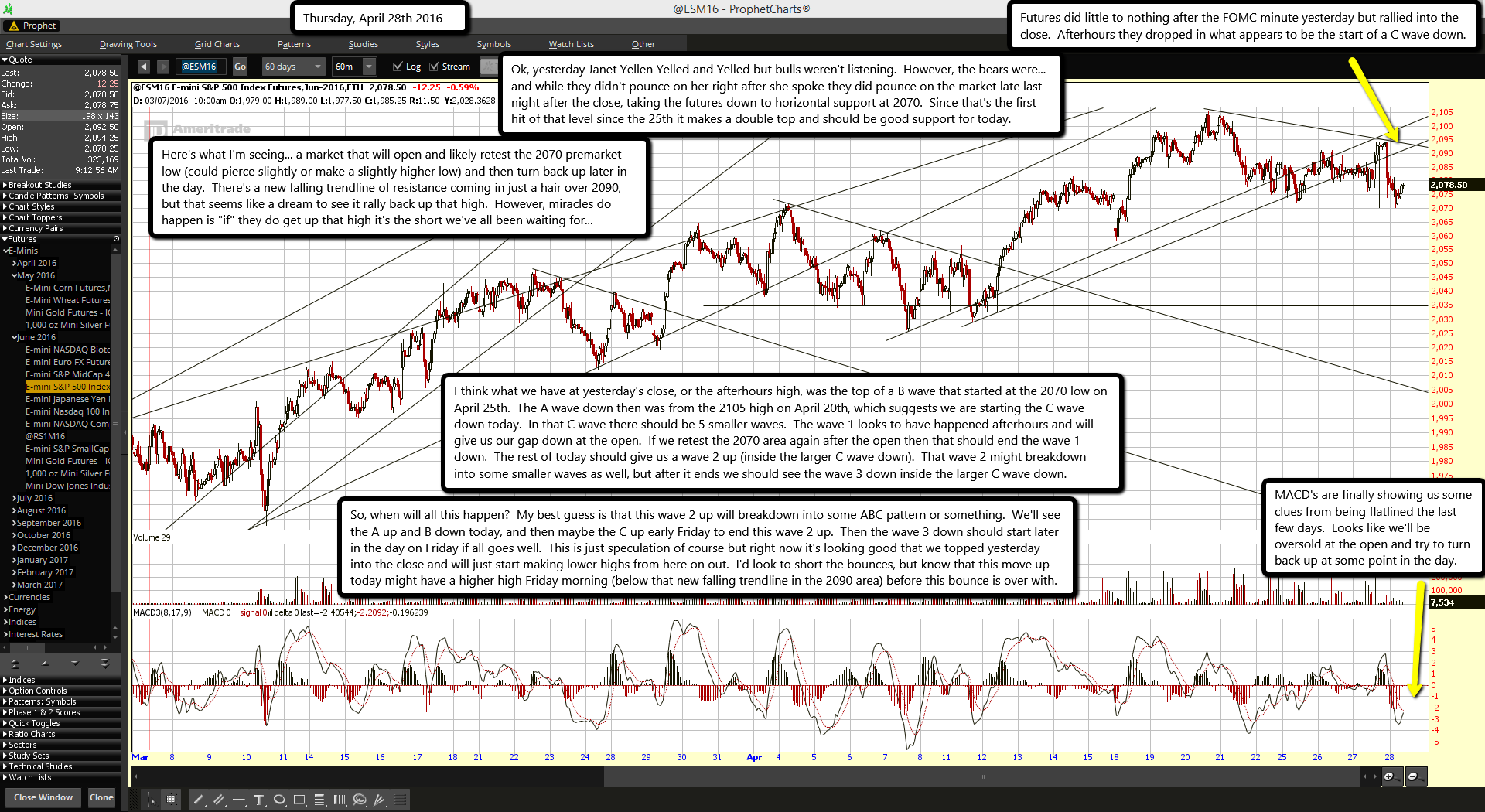
Futures did little to nothing after the FOMC minute yesterday but rallied into the close.  Afterhours they dropped in what appears to be the start of a C wave down.

MACD's are finally showing us some clues from being flatlined the last few days.  Looks like we'll be oversold at the open and try to turn back up at some point in the day.

Ok, yesterday Janet Yellen Yelled and Yelled but bulls weren't listening.  However, the bears were... and while they didn't pounce on her right after she spoke they did pounce on the market late last night after the close, taking the futures down to horizontal support at 2070.  Since that's the first hit of that level since the 25th it makes a double top and should be good support for today.

Here's what I'm seeing... a market that will open and likely retest the 2070 premarket low (could pierce slightly or make a slightly higher low) and then turn back up later in the day.  There's a new falling trendline of resistance coming in just a hair over 2090, but that seems like a dream to see it rally back up that high.  However, miracles do happen is "if" they do get up that high it's the short we've all been waiting for...

I think what we have at yesterday's close, or the afterhours high, was the top of a B wave that started at the 2070 low on April 25th.  The A wave down then was from the 2105 high on April 20th, which suggests we are starting the C wave down today.  In that C wave there should be 5 smaller waves.  The wave 1 looks to have happened afterhours and will give us our gap down at the open.  If we retest the 2070 area again after the open then that should end the wave 1 down.  The rest of today should give us a wave 2 up (inside the larger C wave down).  That wave 2 might breakdown into some smaller waves as well, but after it ends we should see the wave 3 down inside the larger C wave down.

So, when will all this happen?  My best guess is that this wave 2 up will breakdown into some ABC pattern or something.  We'll see the A up and B down today, and then maybe the C up early Friday to end this wave 2 up.  Then the wave 3 down should start later in the day on Friday if all goes well.  This is just speculation of course but right now it's looking good that we topped yesterday into the close and will just start making lower highs from here on out.  I'd look to short the bounces, but know that this move up today might have a higher high Friday morning (below that new falling trendline in the 2090 area) before this bounce is over with.

U.S. Steel accuses China of stealing trade secrets

0
Tata Steel hopes to sell UK business

The temperature is rising in one of the world's hottest trade disputes.

U.S. Steel Corp(X) has accused dozens of Chinese steel producers of breaking trade rules, and it wants the U.S. International Trade Commission to investigate.

Pittsburgh-based U.S. Steel said regulators should remove "all unfairly traded Chinese steel products" from the U.S. market, claiming the Chinese firms illegally conspired to fix prices, stole trade secrets and circumvented trade duties by using false labels.

"We have said that we will use every tool available to fight for fair trade," U.S. Steel CEO Mario Longhi said in a statement.

China produces half of the world's steel, more than the U.S., European Union, Russia and Japan combined.

As the country's massive economy slows, internal demand for steel is dropping. Beijing now stands accused of dumping its unwanted metal on other markets, forcing rivals to close their plants and killing thousands of jobs.

China has defended itself, saying overcapacity is a global problem brought on by weaker demand. Beijing says it is willing to work toward a solution and has announced 500,000 job cuts in its own steel mills.

Related: Europe tries to protect steel jobs with tariffs on Chinese imports

The U.S. responded in March with a massive duty on Chinese steelmakers. The EU has also imposed a tariff of up to 13% on Chinese imports. Beijing pushed back with "anti-dumping" measures of its own.

While the tit-for-tat exchanges continue, prices remain at extremely low levels. On Tuesday, U.S. Steel posted a sharp decline in sales and a first quarter loss of $340 million.

Related: Cheap Chinese steel has claimed another victim

The petition filed by U.S. Steel is likely to increase tensions further. The ITC has 30 days to decide whether to open an investigation under Section 337 of the Tariff Act of 1930, a rarely used but powerful enforcement tool.

In 2014, a U.S. grand jury indicted five members of China's People's Liberation Army on charges they stole information from U.S. Steel and other American firms.

Source link

Arianna Huffington joins Uber’s board of directors

0

Arianna Huffington joins Uber’s board of directors

arianna huffington

Arianna Huffington, the co-founder and editor in chief of the Huffington Post (and an Uber investor already), has joined Uber’s board of directors, company CEO Travis Kalanick announced today.

As a director, Huffington is in the company of a number of key investors as well as executives like Benchmark general partner Bill Gurley, Uber co-founder Garrett Camp, head of global operations Ryan Graves and former policy and communications head David Plouffe.

The announcement closes out a month of collaborations between long-time friends Kalanick and Huffington, who have spent the better part of April working on projects that bring together Huffington’s work on raising awareness of the risks of sleep deprivation and Kalanick’s work with Uber.

At the beginning of April, the two announced that the Huffington Post was teaming up with Uber and Toyota to end drowsy driving — which Huffington called a silent epidemic. As part of that partnership, Huffington spent a day taking rides with Uber passengers to talk about her book “The Sleep Revolution” and later that day discussed the benefits of sleep with Kalanick in a Facebook Live video.

Huffington brings an “emotional intelligence” the company is lacking to the table, Kalanick wrote in a blog post. Indeed, Huffington’s involvement in the company may help Uber in its quest to soften its image.

From acknowledging its need to “grow up” to rolling out programs that benefit drivers like a feature that enables drivers to find the cheapest fuel options, Uber has made a concerted effort in the past two years to refine its image from that of a ruthless and shadowy tech company to one that is growing and learning from its mistakes.

Whether Uber is disingenuous in its efforts, Huffington’s place on the board may help — to an extent.

Disability advocates, who have worked to shed light on the company’s lack of accessible vehicles, are already questioning whether Huffington’s role on Uber’s board will interfere with HuffPo’s coverage of the company.

“Arianna Huffington’s appointment to Uber’s board raises questions about whether the Huffington Post will provide objective coverage of Uber’s discrimination against wheelchair users in New York,” Dustin Jones, the outspoken founder of United for Equal Access New York, wrote in a statement. “Ms. Huffington must immediately recuse herself from any coverage of Uber or ride-sharing and the Huffington Post must work to expose Uber’s refusal to serve people in wheelchairs.”

“Anything less would be a failure of journalistic ethics for the sole benefit of a multi-billion-dollar company,” he continued.

Source link

Why Twitter, Buffalo Wild Wings, and HR Block Slumped Today

0

Twtr Wednesday was an interesting day for the stock market. Broad market benchmarks were roughly flat, with a weak technology sector pulling down the Nasdaq but leaving the S&P 500 and Dow Jones Industrials up slightly on the day. Meanwhile, the Federal Reserve chose not to raise short-term interest rates at its April meeting, but it left some market participants with the impression that it might be ready to do so when it next meets at June. Even though the overall market didn't make massive moves, earnings season took its toll on several individual stocks. Among those hit the worst were Twitter (NYSE:TWTR), Buffalo Wild Wings (NASDAQ:BWLD), and H&R Block (NYSE:HRB).

Twitter plunged 16% in the wake of its disappointing quarterly results and future guidance. The social-media company said late Wednesday that revenue grew 36% to $595 million, but investors were expecting even stronger gains on the top line. Adjusted earnings topped the consensus forecast among those following the stock by $0.05 per share, but the range for revenue that Twitter gave for the current quarter was 10% to 13% below what investors were expecting to see. Twitter is having trouble getting advertisers to stick with classic tactics like promoted tweets, and tepid user growth of 5 million brought Twitter's total viewer base to just 310 million, which leaves it well behind its main rivals. Despite multiple efforts to improve visibility through actively marketing the site and making some attempts to improve the user experience, Twitter hasn't been able to make lasting progress that shows up in its financials.

Buffalo Wild Wings declined 11% following its own poor quarterly performance. The restaurant chain reported same-restaurant sales declines of 1.7% at its company-owned locations, although significant expansion in restaurant counts helped push overall revenue up more than 15% and produced a 13% rise in net income. Even though Buffalo Wild Wings kept costs in check, the main concern that investors have is that falling comps suggest that the restaurant chain isn't managing to appeal to as big of a loyal customer base as anticipated. The company also reduced its guidance for full-year earnings by $0.30 to $0.35 per share, and shareholders want to see if new initiatives like happy hours, easier takeout access, and offering an express lunch will pay off in the long run.

Finally, H&R Block sank 14%. The tax preparation firm didn't have a good tax season, actively assisting in the preparation of 12.2 million returns, or almost 6% fewer than it did in the year-earlier period. H&R Block said that the bulk of the decline came from Form 1040EZ returns as well as those containing claims for the Earned Income Tax Credit, and planned price increases weren't sufficient to offset the entire impact of the decline in volume. In addition, software-assisted returns fell 2.6%, with H&R Block saying that competitors were aggressive in marketing their competing software products through discounting. CEO Bill Cobb said that H&R Block would change its strategy next year, but the planned realignments and streamlining of operations didn't convince investors that an immediate turnaround would be guaranteed.

A secret billion-dollar stock opportunity
The world's biggest tech company forgot to show you something, but a few Wall Street analysts and the Fool didn't miss a beat: There's a small company that's powering their brand-new gadgets and the coming revolution in technology. And we think its stock price has nearly unlimited room to run for early in-the-know investors! To be one of them, just click here.

Dan Caplinger has no position in any stocks mentioned. The Motley Fool owns shares of and recommends Buffalo Wild Wings and Twitter. Try any of our Foolish newsletter services free for 30 days. We Fools may not all hold the same opinions, but we all believe that considering a diverse range of insights makes us better investors. The Motley Fool has a disclosure policy.

Source link

s2Member®