Sunday, July 26, 2026
Home Blog Page 76

MARKET SNAPSHOT: U.S. Stocks End Lower As Crude Oil Re-enters Bear Market

0

Tesla and SolarCity fall after reaching merger deal

U.S. stocks lost momentum to finish mostly lower Monday as crude-oil futures returned to bear-market territory and weaker-than-expected manufacturing data raised doubts about the strength of the economy.

The S&P 500 shed 2.76 points, or 0.1%, to close at 2,170.84 after the large-cap gauge hit a record intraday high of 2,178.29. A 3.3% drop in the energy sector dragged the S&P 500 into negative territory, outweighing modest gains in health-care and tech stocks.

The Dow Jones Industrial Average fell 27.73 points, or 0.2%, to close at 18,404.51.

However, the Nasdaq Composite Index climbed 22.06 points, or 0.4%, to end at 5,184.20, boosted by appetite for tech giants, including a 1.8% jump in shares of Apple Inc. (AAPL).

Meanwhile, losses for crude snowballed, with the U.S. oil benchmark dropping almost 4% and at one point trading below the key $40 level amid worries about a supply glut and subdued demand. Crude oil is now off 21.8% from its peak of $51.23 a barrel hit in early June, signifying a bear market, or drop of at least 20% from a recent peak.

On the economic front, the Institute for Supply Management's closely watched manufacturing index for July fell to 52.6 from 53.2, while construction spending fell 0.6% in June. The Markit manufacturing purchasing managers index for July rose to 52.9 compared with June's 51.3.

"People are nervous as oil crashes below $40, given the context of the weak GDP report and somewhat weak ISM data.  They are back to doubting whether the market's rally is as strong as it could be," said Bruce McCain, chief investment strategist at Key Private Bank.

Prospects for a near-term interest-rate increase by the Federal Reserve have faded since the weak GDP reading on Friday.

Corporate quarterly results will continue to feature prominently this week even as the season winds down, though no major companies reported Monday. So far, about two-thirds of S&P 500 companies have announced quarterly results thus far, with 71% beating on earnings and 57% reporting revenue above estimates.

Fed speakers: The market appeared to brush aside comments from New York Federal Reserve Bank President William Dudley and Dallas Fed President Rob Kaplan, who both argued at separate events Sunday and Monday that an interest-rate hike this year shouldn't be ruled out .

Stocks to watch: Shares in Tesla Motors Inc.(TSLA) and SolarCity Corp.(SCTY) lost ground on news that the companies have reached a merger agreement. SolarCity also released updated guidance.

Meanwhile, Chinese ride-sharing giant Didi Chuxing Technology Co. has agreed to buy the China operations of Uber Technologies Inc.

Uber and investors in its UberChina unit will take a 20% stake in Didi. UberChina is backed by China's search giant

Baidu Inc. (BIDU). Didi's backers include e-commerce group Alibaba Group Holding Ltd. (BABA) and internet giant Tencent Holdings Ltd. (0700.HK)

Shares of Fleetmatics Group PLC. (FLTX) soared 39% on news of a pending acquisition by Verizon.

Energy stocks were the biggest losers in the S&P 500, with all shares in the sector finishing in the red. Murphy Oil Corp.(MUR), Williams Cos.(WMB), Diamond Offshore Drilling Inc.(DO), and Transocean Ltd.(RIG) all fell sharply.

Other markets: European stocks drifted lower while in Asia, stocks finished mixed

The Shanghai Composite Index closing off 0.9% after China's manufacturing Purchasing managers index for July indicated contraction for the first time in five months. Elsewhere, the Nikkei 225 index and other Asian markets rose, benefiting from diminished chances for a U.S. rate increase.

The yen, meanwhile, weakened against the U.S. dollar after disappointing stimulus action from the Bank of Japan last week.

Gold finished modestly higher and silver closed at a two-year high

ES Morning Update August 1st 2016

0

5b1df889-199b-4464-a19e-8fa8c0ebf75c

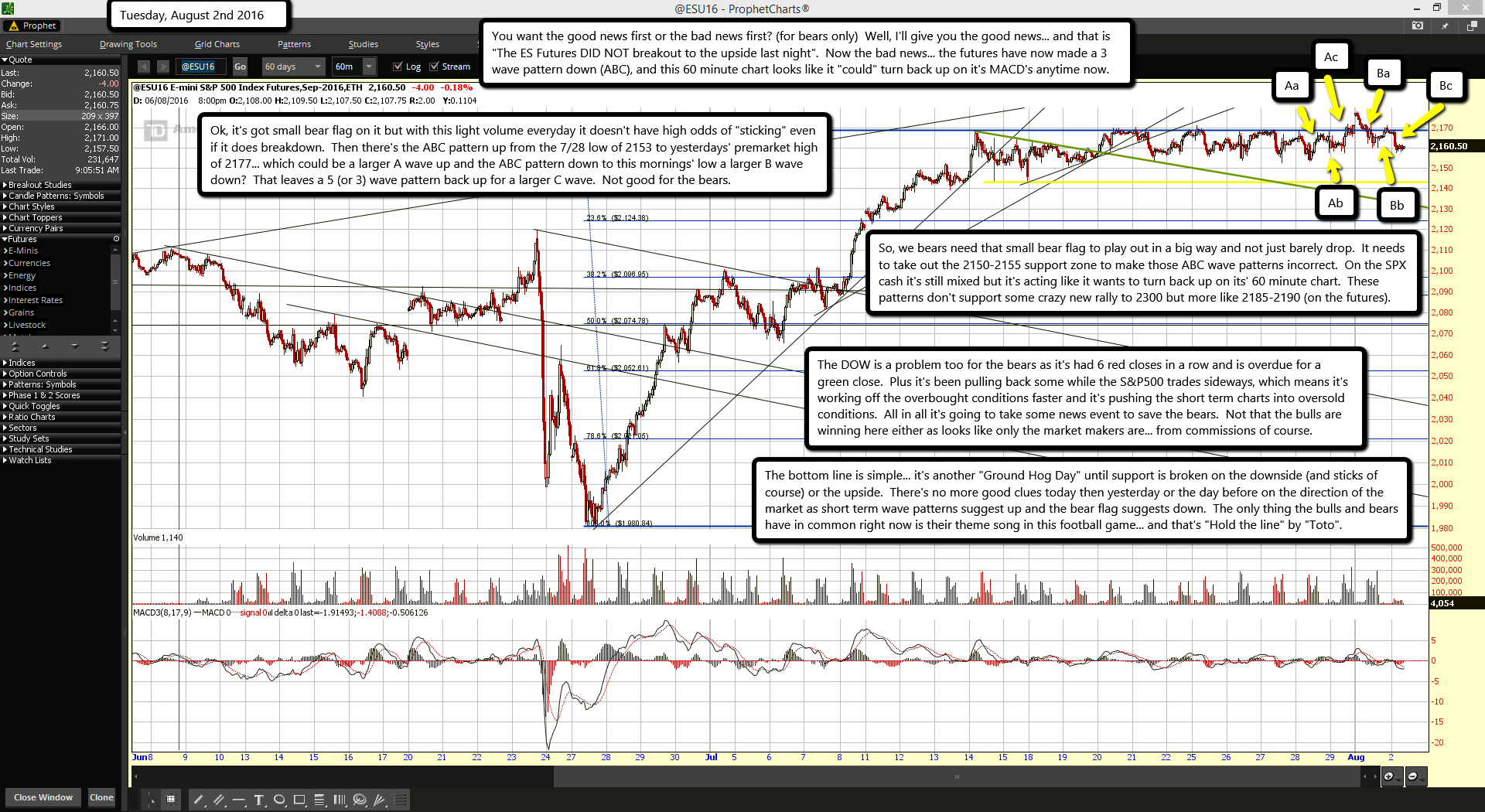
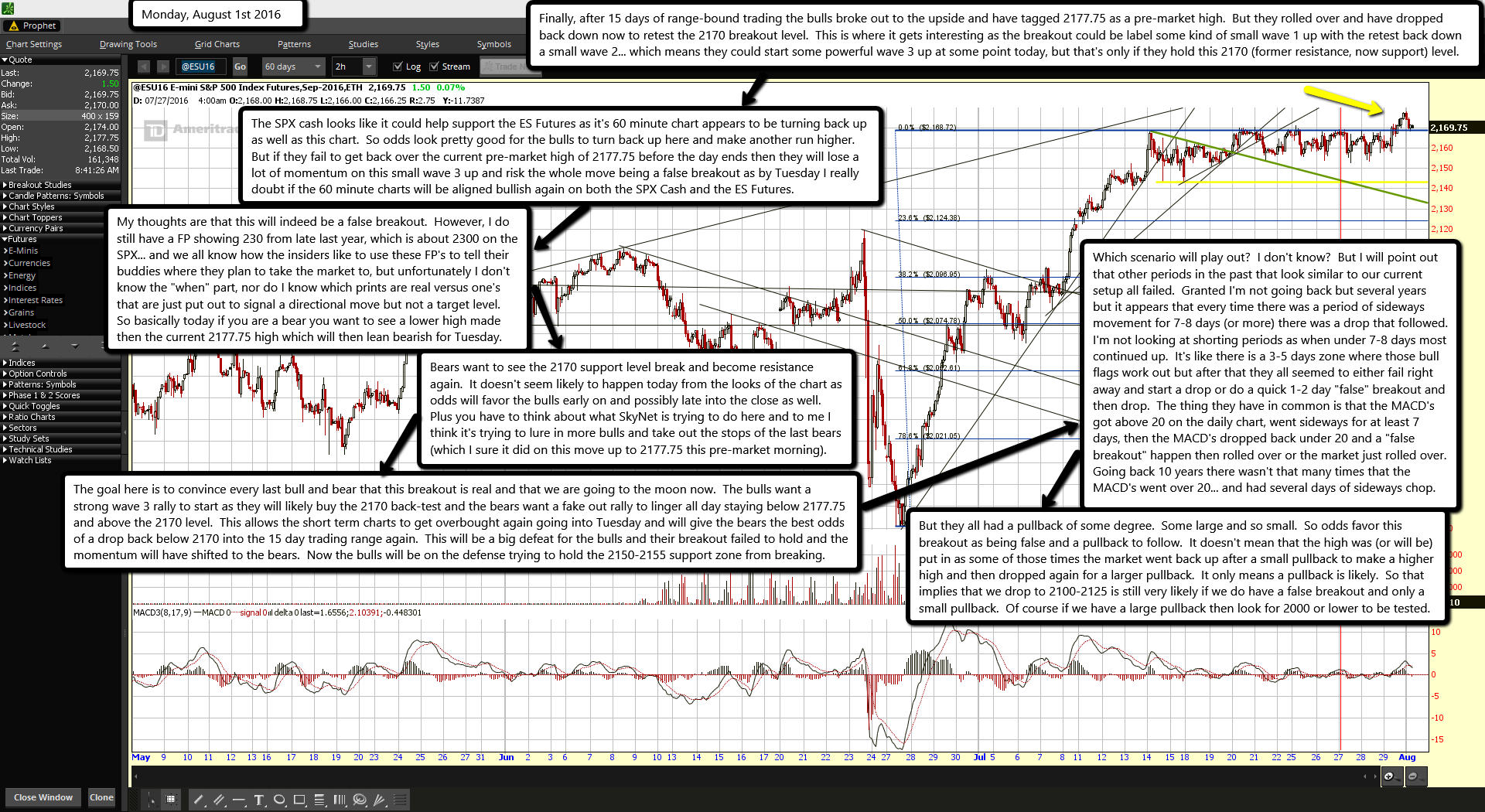
Finally, after 15 days of range-bound trading the bulls broke out to the upside and have tagged 2177.75 as a pre-market high.  But they rolled over and have dropped back down now to retest the 2170 breakout level.  This is where it gets interesting as the breakout could be label some kind of small wave 1 up with the retest back down a small wave 2... which means they could start some powerful wave 3 up at some point today, but that's only if they hold this 2170 (former resistance, now support) level.

The SPX cash looks like it could help support the ES Futures as it's 60 minute chart appears to be turning back up as well as this chart.  So odds look pretty good for the bulls to turn back up here and make another run higher.  But if they fail to get back over the current pre-market high of 2177.75 before the day ends then they will lose a lot of momentum on this small wave 3 up and risk the whole move being a false breakout as by Tuesday I really doubt if the 60 minute charts will be aligned bullish again on both the SPX Cash and the ES Futures.

My thoughts are that this will indeed be a false breakout.  However, I do still have a FP showing 230 from late last year, which is about 2300 on the SPX... and we all know how the insiders like to use these FP's to tell their buddies where they plan to take the market to, but unfortunately I don't know the "when" part, nor do I know which prints are real versus one's that are just put out to signal a directional move but not a target level.  So basically today if you are a bear you want to see a lower high made then the current 2177.75 high which will then lean bearish for Tuesday.

Bears want to see the 2170 support level break and become resistance again.  It doesn't seem likely to happen today from the looks of the chart as odds will favor the bulls early on and possibly late into the close as well.  Plus you have to think about what SkyNet is trying to do here and to me I think it's trying to lure in more bulls and take out the stops of the last bears (which I sure it did on this move up to 2177.75 this pre-market morning).

The goal here is to convince every last bull and bear that this breakout is real and that we are going to the moon now.  The bulls want a strong wave 3 rally to start as they will likely buy the 2170 back-test and the bears want a fake out rally to linger all day staying below 2177.75 and above the 2170 level.  This allows the short term charts to get overbought again going into Tuesday and will give the bears the best odds of a drop back below 2170 into the 15 day trading range again.  This will be a big defeat for the bulls and their breakout failed to hold and the momentum will have shifted to the bears.  Now the bulls will be on the defense trying to hold the 2150-2155 support zone from breaking.

Which scenario will play out?  I don't know?  But I will point out that other periods in the past that look similar to our current setup all failed.  Granted I'm not going back but several years but it appears that every time there was a period of sideways movement for 7-8 days (or more) there was a drop that followed.  I'm not looking at shorting periods as when under 7-8 days most continued up.  It's like there is a 3-5 days zone where those bull flags work out but after that they all seemed to either fail right away and start a drop or do a quick 1-2 day "false" breakout and then drop.  The thing they have in common is that the MACD's got above 20 on the daily chart, went sideways for at least 7 days, then the MACD's dropped back under 20 and a "false breakout" happen then rolled over or the market just rolled over.  Going back 10 years there wasn't that many times that the MACD's went over 20... and had several days of sideways chop.

But they all had a pullback of some degree.  Some large and so small.  So odds favor this breakout as being false and a pullback to follow.  It doesn't mean that the high was (or will be) put in as some of those times the market went back up after a small pullback to make a higher high and then dropped again for a larger pullback.  It only means a pullback is likely.  So that implies that we drop to 2100-2125 is still very likely if we do have a false breakout and only a small pullback.  Of course if we have a large pullback then look for 2000 or lower to be tested.

Democratic Platform Calls for Carbon Tax – Just Like Matt Taibbi Spoke About Several Years Ago

0

The 2016 Democratic Party platform endorses a carbon tax on the American people. The carbon tax language, added at the last minute, states:

“Democrats believe that carbon dioxide, methane, and other greenhouse gases should be priced to reflect their negative externalities, and to accelerate the transition to a clean economy and help meet out climate goals.”

The move by Democrats to impose a carbon tax comes in clear contrast to the 2016 Republican Party platform opposition to any carbon tax:

“We oppose any carbon tax.”

Grover Norquist, President of Americans for Tax Reform, predicts the Democrat call for a carbon tax will have electoral consequences: “When counting to 270 – the number of electoral votes needed to win the presidency – the Republicans may have already won the election in five short words: ‘We oppose any carbon tax.’ Note the overlap between new fracking states – Pennsylvania, Ohio, and Colorado – and the swing states to reach 270 for any candidate.”


In case everyone forgot Matt Taibbi wrote a great article on the Carbon Tax Scam several years ago.  I wrote about it too (https://reddragonleo.com/2010/04/17/weekend-update-31/).  Here's the full PDF to re-read again...

https://reddragonleo.com/World-Bubbles-GoldmanSachs-Taibbi-Rolling-Stone.pdf

I think you'll find out quickly that Killary is going along with the plans of the gangsters that run the world to screw over the public with another big lie to create another stock market bubble.  While I'm not a big fan of Donald Trump I'd say he's ten times better then Killary Clinton.
hillary-for-prison-2016
Just my opinion of course, but if you are thinking about voting for Hillary you should think twice about that as while Trump might not be an angel he's definitely the "lesser of two evils".
Red

ES Morning Update July 29th 2016

0

74a98125-d7cc-4e90-afa4-04f8b5f66b0b

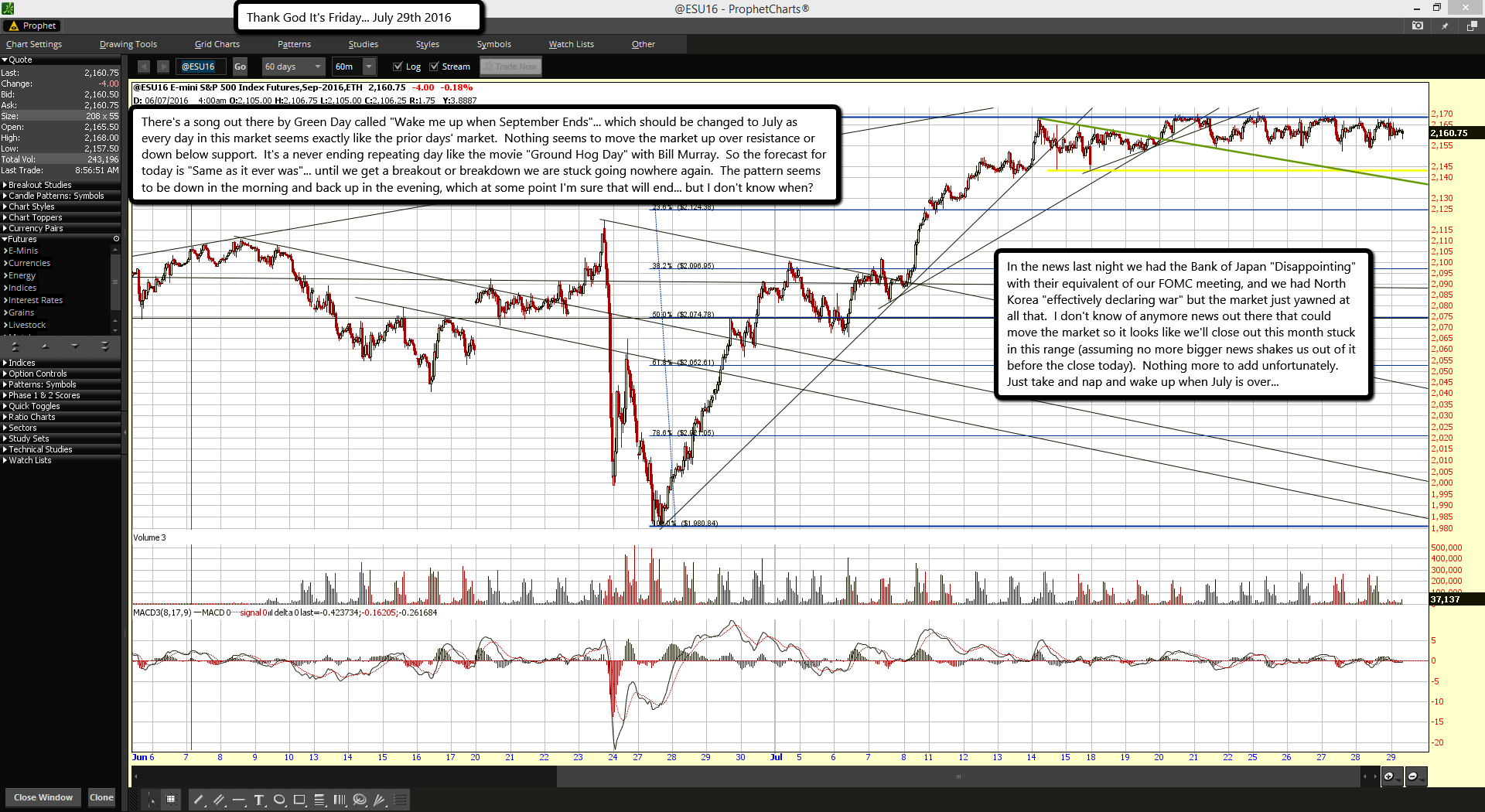
There's a song out there by Green Day called "Wake me up when September Ends"... which should be changed to July as every day in this market seems exactly like the prior days' market.  Nothing seems to move the market up over resistance or down below support.  It's a never ending repeating day like the movie "Ground Hog Day" with Bill Murray.  So the forecast for today is "Same as it ever was"... until we get a breakout or breakdown we are stuck going nowhere again.  The pattern seems to be down in the morning and back up in the evening, which at some point I'm sure that will end... but I don't know when?

In the news last night we had the Bank of Japan "Disappointing" with their equivalent of our FOMC meeting, and we had North Korea "effectively declaring war" but the market just yawned at all that.  I don't know of anymore news out there that could move the market so it looks like we'll close out this month stuck in this range (assuming no more bigger news shakes us out of it before the close today).  Nothing more to add unfortunately.  Just take and nap and wake up when July is over...

Nikkei whipsaws after BOJ disappointment; yen surges against dollar

0

Japan shares whipsawed and the yen surged after the Bank of Japan threw markets a smaller-than-expected bone in a keenly watched decision on Friday.

While the BOJ eased its monetary policy further by increasing its purchases of exchange-traded funds (ETFs), it didn't change interest rates or increase the monetary base, as analysts had widely expected.

The central bank said it would increase its ETF purchases so that their amount outstanding on its balance sheet would rise at an annual pace of 6 trillion yen ($56.7 billion), from 3.3 trillion yen previously.

"The message the BOJ is sending is not so much much 'whatever it takes' as 'monetary policy's pretty much played out'," said Kit Juckes, global fixed income strategist at Societe Generale.

The Japanese yen surged against the dollar after the announcement, with the dollar-yen pair falling as low as 102.85, compared with around 103.75 immediately before the decision. The pair was already volatile before the announcement, touching a session high of 105.33.
At 2:31 p.m. HK/SIN, the dollar was fetching 103.52 yen.

The benchmark Nikkei 225 whipsawed after the decision, tumbling as much as 1.66 percent immediately after the announcement. It quickly retraced the fall, but then spent the remainder of the session volleying between gains and losses. At market close, the Nikkei finished up 92.43 points, or 0.56 percent, at 16,569.27.

In the bond market, Japanese government bonds (JGBs) sold off. The yield on the benchmark 10-year JGB jumped to negative 0.169, from an earlier low of negative 0.276. Yields move inversely to bond prices. Many analysts had expected the BOJ would increase its JGB purchases.

Sean Darby, chief global equity strategist at Jefferies, said in a note that the news on the ETF purchases "should boost sentiment on stocks," but "overall monetary policy will only be marginally changed given that the BOJ's balance sheet expansion has already decelerated."

"The absence of any change on deposit rates will have disappointed those investors seeking a bolder move by the BOJ," said Darby.

Other Asian markets were nearly flat or mostly lower. The ASX 200 in Australia saw a slight gain of 5.80 points, or 0.1 percent, to 5,562.35. In South Korea, the Kospi closed down 4.91 points, or 0.24 percent, at 2,016.19. Hong Kong's Hang Seng index slipped 327.06 points, or 1.47 percent, to 21,847.28.

Chinese mainland markets were lower, with the Shanghai composite closing down 14.94 points, or 0.5 percent, at 2,979.37, while the Shenzhen composite was off by 9.44 points, or 0.48 percent, at 1,941.55.

In Japan, on the fiscal front, Japanese media agency Jiji reported earlier this week that Prime Minister Shinzo Abe was preparing a stimulus package worth 28 trillion yen ($265.30 billion), which exceeded the top-end of initial estimates of around 20 trillion yen.

That made the BOJ's relatively tame moves even more surprising as analysts had said the fiscal stimulus details may have been leaked to pressure the central bank. Additionally, data showing prices fell was released before the market open, which analysts had expected would also put pressure on the central bank to ease further to try to reach its 2 percent inflation target.

Data from Japan's Bureau of Statistics released before market open showed that nationwide, the consumer price index (CPI) fell 0.4 percent on-year, while the core CPI, which excludes fresh food items, dropped 0.5 percent on-year. The so-called core-core CPI, which excludes food and energy items, gained 0.4 percent on-year.

July price figures for Tokyo, which are available a month in advance of the nationwide data, also fell. Core CPI for Tokyo was down 0.4 percent on-year.

Japan's household spending fell 2.2 percent on-year in June, a relatively steep decline compared with a Reuters poll that had predicted a 0.3 percent drop. The country's seasonally adjusted unemployment rate for June was at 3.1 percent, a 0.1 percent drop from the previous month.

But data from Japan's Ministry of Economy, Trade and Industry (METI) showed industrial production rose 1.9 percent, suggesting an uptick in demand.

Prior to the BOJ announcement, Reuters reported trading in the Japanese government bond futures was halted earlier for 20 minutes due to a likely system glitch. Reuters said the Japan Exchange Group was still looking into potential reasons. Trading was resumed at 0113 GMT, reported Reuters.

Pedestrians holding umbrellas while walking past the Bank of Japan (BOJ) headquarters are reflected in a puddle in Tokyo, Japan. Markets expect the Japanese central bank to introduce further stimulus measures on Friday, July 29, 2016, in a bid to prop up Japan's flagging economy.

Tomohiro Ohsumi | Bloomberg | Getty Images
Pedestrians holding umbrellas while walking past the Bank of Japan (BOJ) headquarters are reflected in a puddle in Tokyo, Japan. Markets expect the Japanese central bank to introduce further stimulus measures on Friday, July 29, 2016, in a bid to prop up Japan's flagging economy.

In company news, shares of Nomura closed up 12.54 percent, after Reuters reported the bank was planning a 45 billion yen buyback of up to 2.6 percent of its shares. In its earnings numbers, Nomura said its April-June net profit dropped to 46.83 billion yen, from 68.7 billion yen a year earlier, said Reuters.

Shares of Singapore's DBS Group fell 2.90 percent following reports that the bank expected to recover about 50 percent of its $519 million exposure to the collapse of a big Singapore oilfield services firm, Swiber.

Reuters said Swiber Holdings became the biggest Singapore business so far to fall victim to the oil price slump in the past year, after the company said on Thursday it had filed for liquidation.

During Asian hours, global benchmark Brent futures traded down 0.47 percent at $42.50, while U.S. crude futures were off by 0.51 percent at $40.93 a barrel.

On the earnings front, Japanese electronics maker Sony released earnings for the three months ended June 30, 2016 after market close. Operating profit dropped 42 percent to 56.2 billion yen ($542.7 million) on-year. Sony said the drop was due to deterioration in the semiconductors segment, which was partially offset by the mobile communications and games & network services businesses.

Sony added it booked a net charges of 13.6 billion yen in expenses in the semiconductors business, resulting from the 2016 Kumamoto Earthquakes.

Sony shares closed up 2.82 percent.

In South Korea, industrial output in June fell 0.2 percent on a seasonally adjusted basis on-month, compared with a Reuters poll that expected an uptick of 0.2 percent. Reuters reported that on an annual basis, industrial output rose 0.8 percent in June, after a revised 4.7 percent gain in May.

U.S. stocks closed mostly higher on Thursday, with the Nasdaq composite closing up 15.17 points, or 0.3 percent, at 5,154.98, its highest level of the year so far, helped by gains in major tech names; Facebook and Amazon closed up more than 1 percent each.
The Dow Jones industrial average closed nearly flat at 18,456.35, while the S&P 500 index closed 3.48 points, or 0.16 percent, higher at 2,170.06.

North Korea: U.S. “crossed the red line,” effectively declared war

0

PYONGYANG, North Korea -- North Korea's top diplomat for U.S. affairs told The Associated Press on Thursday that Washington "crossed the red line" and effectively declared war by putting leader Kim Jong Un on its list of sanctioned individuals, and said a vicious showdown could erupt if the U.S. and South Korea hold annual war games as planned next month.

North Korea joins the Trump bandwagon

Han Song Ryol, director-general of the U.S. affairs department at the North's Foreign Ministry, said in an interview that recent U.S. actions have put the situation on the Korean Peninsula on a war footing.

The United States and South Korea regularly conduct joint military exercises south of the Demilitarized Zone, and Pyongyang typically responds to them with tough talk and threats of retaliation.

Han said North Korea believes the nature of the maneuvers has become openly aggressive because they reportedly now include training designed to prepare troops for the invasion of the North's capital and "decapitation strikes" aimed at killing its top leadership.

Donald Trump says he's willing to meet with Kim Jong Un

Han says designating Kim himself for sanctions was the final straw.

"The Obama administration went so far to have the impudence to challenge the supreme dignity of the DPRK in order to get rid of its unfavorable position during the political and military showdown with the DPRK," Han said, using the acronym for North Korea's official name, the Democratic People's Republic of Korea.

"The United States has crossed the red line in our showdown," he said. "We regard this thrice-cursed crime as a declaration of war."

Soldiers shout slogans as they march past a stand with North Korean leader Kim Jong Un and other officials during the parade celebrating the 70th anniversary of the founding of the ruling Workers' Party of Korea, in Pyongyang Oct. 10, 2015.

Soldiers shout slogans as they march past a stand with North Korean leader Kim Jong Un and other officials during the parade celebrating the 70th anniversary of the founding of the ruling Workers' Party of Korea, in Pyongyang Oct. 10, 2015.

Soldiers shout slogans as they march past a stand with North Korean leader Kim Jong Un and other officials during the parade celebrating the 70th anniversary of the founding of the ruling Workers' Party of Korea, in Pyongyang Oct. 10, 2015.

Soldiers shout slogans as they march past a stand with North Korean leader Kim Jong Un and other officials during the parade celebrating the 70th anniversary of the founding of the ruling Workers' Party of Korea, in Pyongyang Oct. 10, 2015. REUTERS/DAMIR SAGOLJ

Although North Korea had already been heavily sanctioned internationally for its nuclear weapons and long-range missile development programs, Washington's announcement on July 6 was the first time Kim Jong Un has been personally sanctioned.

North Korea tries to show its military might

Less than a week later, Pyongyang cut off its final official means of communications with Washington - known as the New York channel. Han said Pyongyang has made it clear that everything between the two must now be dealt with under "war law."

Katina Adams, State Department spokeswoman for East Asia and the Pacific, said the U.S. continues to call on North Korea "to refrain from actions and rhetoric that further destabilize the region and focus instead on taking concrete steps toward fulfilling its commitments and international obligations."

She said the U.S.-South Korea joint military exercises are "defense-orientated" and have been carried out regularly and openly for roughly 40 years, and are designed to maintain stability on the Korean Peninsula. "These exercises are a clear demonstration of the U.S. commitment to the alliance," she said.

South Korea's unification, defense and foreign ministries did not immediately comment.

Kim and 10 others were put on the list of sanctioned individuals in connection with alleged human rights abuses, documented by the United Nations Human Rights Commission, that include a network of political prisons and harsh treatment of any kind of political dissent in the authoritarian state. U.S. State Department officials said the sanctions were intended in part to highlight those responsible for the abuses and to pressure lower-ranking officials to think twice before carrying them out.

Pyongyang denies abuse claims and says the U.N. report was based on fabrications gleaned from disgruntled defectors. Pointing to such things as police shootings of black Americans and poverty in even the richest democracies, it says the West has no moral high ground from which to criticize the North's domestic political situation. It also says U.S. allies with questionable human-rights records receive less criticism.

Han took strong issue with the claim that it was not the U.S. but Pyongyang's continued development of nuclear weapons and missiles that is provoking tensions.

"Day by day, the U.S. military blackmail against the DPRK and the isolation and pressure is becoming more open," Han said. "It is not us, it is the United States that first developed nuclear weapons, who first deployed them and who first used them against humankind. And on the issue of missiles and rockets, which are to deliver nuclear warheads and conventional weapons warheads, it is none other than the United States who first developed it and who first used it."

He noted that U.S.-South Korea military exercises conducted this spring were unprecedented in scale, and that the U.S. has deployed the USS Mississippi and USS Ohio nuclear-powered submarines to South Korean ports, deployed the B-52 strategic bomber around South Korea and is planning to set up the world's most advanced missile defense system, known by its acronym THAAD, in the South, a move that has also angered China.

Echoing earlier state-media reports, Han ridiculed Mark Lippert, the U.S. ambassador to South Korea, for a flight on a U.S. Air Force F-16 based in South Korea that he said was an action "unfit for a diplomat."

"We regard that as the act of a villain, who is a crazy person," Han said of the July 12 flight. "All these facts show that the United States is intentionally aggravating the tensions in the Korean Peninsula."

Han warned that Pyongyang is viewing next month's planned U.S.-South Korea exercises in this new context and will respond if they are carried out as planned.

"Nobody can predict what kind of influence this kind of vicious confrontation between the DPRK and the United States will have upon the situation on the Korean Peninsula," he said. "By doing these kinds of vicious and hostile acts toward the DPRK, the U.S. has already declared war against the DPRK. So it is our self-defensive right and justifiable action to respond in a very hard way.

"We are all prepared for war, and we are all prepared for peace," he said. "If the United States forces those kinds of large-scale exercises in August, then the situation caused by that will be the responsibility of the United States."

Last year's Ulchi Freedom Guardian exercises involved 30,000 American and 50,000 South Korean troops and followed a period of heightened animosity between the rival Koreas sparked by land mine explosions that maimed two South Korean soldiers. In the end, the exercises escalated tensions and rhetoric, but concluded with no major incidents.

Han dismissed calls for Pyongyang to defuse tensions by agreeing to abandon its nuclear program.

"In the view of cause and effect, it is the U.S. that provided the cause of our possession of nuclear forces," he said. "We never hide the fact, and we are very proud of the fact, that we have very strong nuclear deterrent forces not only to cope with the United States' nuclear blackmail but also to neutralize the nuclear blackmail of the United States."

Why Friday May Be One of the Most Interesting Days of the Quarter

0

The world's biggest economies will all be in the spotlight.

A day that's expected to affirm the U.S. consumer's strength could also begin with a step into uncharted unconventional policy by the nation whose demographic trends may serve as an early warning signal of what awaits other advanced economies.

"Tomorrow could be among the most challenging sessions of the third quarter," writes Marc Chandler, head of currency strategy at Brown Brothers Harriman & Co. "The focus is primarily on Japan and Europe, but the U.S. reports its first estimate of second-quarter GDP."

Investors will have a lot on their plates to digest, with a Bank of Japan meeting, the results of stress tests on European banks, as well as new growth figures for the euro area and North America all scheduled to be released.

Analysts at HSBC Holdings Plc in a report on Thursday, citing "high" expectations for the Bank of Japan meeting, see three scenarios: disappointment (causing a sharp weakening in the yen relative to the U.S. dollar in the short-term), greater monetary stimulus (a strong yen in the short-term) and helicopter money.

The analysts write: "For the first two scenarios we would expect the medium term impact on USDJPY to be limited, although the short-term reaction would likely be different". Only helicopter money — a permanent addition to the monetary base — would deliver a weaker yen in the medium-term, they say.

"We still expect the BOJ to cut rates and increase the pace of asset buying modestly," Societe Generale SA analysts write, adding that markets would be "disappointed" if Japan's central bank withheld its monetary firepower.

Brunello Rosa, analyst at Roubini Global Economics, foresees a 10 basis point cut in the deposit rate to minus 20bps, accompanied by asset purchases and policies to ease the pressure on banks grappling with low net interest margins. Rosa writes: "In our view, increases in asset purchases at this stage would likely be limited to risky assets (mainly exchange-traded funds), with increased Japanese government bond purchases an upside risk to accompany the recently announced 28 trillion yen fiscal stimulus boost."

Capping off a big week for the global economy — following the Federal Reserve and BOJ meeting — the European Banking Authority will announce the results of its stress tests on Friday evening, 9pm London time, which is expected to shed light on non-performing loans at Italian lenders.

Separately, annual headline inflation in the euro zone for June is expected to tick into positive territory for the first time since January, notes Brown Brothers Harriman & Co.'s Chandler, and the first estimate of second-quarter GDP growth for the euro area is also due out. The rate of expansion is expected to moderate to 0.3 percent quarter-over-quarter from 0.6 percent in the first three months of the year.

The U.S. consumer is poised to post its best rate of growth in over a decade, but data released on Wednesday give cause to temper expectations on how much headline growth will accelerate.

Following the release of the Census Bureau's advance economic indicators report, the Atlanta Fed GDP Now forecast for second-quarter growth tumbled by half a percentage point to 1.8 percent. The consensus estimate among economists surveyed by Bloomberg is for annualized quarter-over-quarter growth of 2.6 percent.

While the initial print has been subject to heavy revisions, it's the release that tends to move markets the most.

Meanwhile, America's neighbor to the north is slated to report GDP growth for the month of May, with analysts expecting Canada's economy to show a monthly contraction of 0.5 percent as wildfires began to wreak havoc in oil-producing regions of Alberta.

ES Morning Update July 28th 2016

0

4464177d-9828-4191-ae3b-9f40d92b08d6

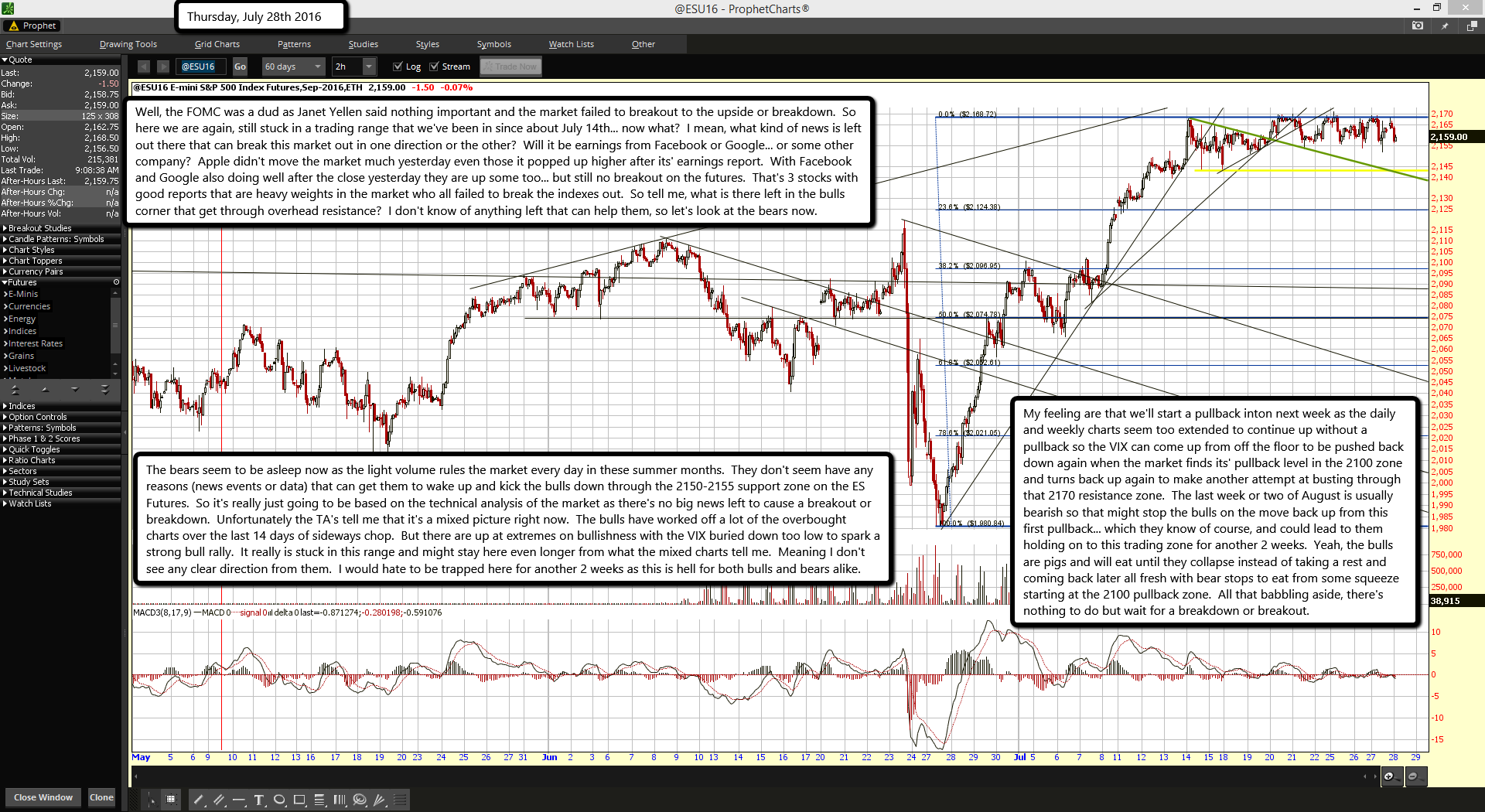
Well, the FOMC was a dud as Janet Yellen said nothing important and the market failed to breakout to the upside or breakdown.  So here we are again, still stuck in a trading range that we've been in since about July 14th... now what?  I mean, what kind of news is left out there that can break this market out in one direction or the other?  Will it be earnings from Facebook or Google... or some other company?  Apple didn't move the market much yesterday even those it popped up higher after its' earnings report.  With Facebook and Google also doing well after the close yesterday they are up some too... but still no breakout on the futures.  That's 3 stocks with good reports that are heavy weights in the market who all failed to break the indexes out.  So tell me, what is there left in the bulls corner that get through overhead resistance?  I don't know of anything left that can help them, so let's look at the bears now.

The bears seem to be asleep now as the light volume rules the market every day in these summer months.  They don't seem have any reasons (news events or data) that can get them to wake up and kick the bulls down through the 2150-2155 support zone on the ES Futures.  So it's really just going to be based on the technical analysis of the market as there's no big news left to cause a breakout or breakdown.  Unfortunately the TA's tell me that it's a mixed picture right now.  The bulls have worked off a lot of the overbought charts over the last 14 days of sideways chop.  But there are up at extremes on bullishness with the VIX buried down too low to spark a strong bull rally.  It really is stuck in this range and might stay here even longer from what the mixed charts tell me.  Meaning I don't see any clear direction from them.  I would hate to be trapped here for another 2 weeks as this is hell for both bulls and bears alike.

My feeling are that we'll start a pullback inton next week as the daily and weekly charts seem too extended to continue up without a pullback so the VIX can come up from off the floor to be pushed back down again when the market finds its' pullback level in the 2100 zone and turns back up again to make another attempt at busting through that 2170 resistance zone.  The last week or two of August is usually bearish so that might stop the bulls on the move back up from this first pullback... which they know of course, and could lead to them holding on to this trading zone for another 2 weeks.  Yeah, the bulls are pigs and will eat until they collapse instead of taking a rest and coming back later all fresh with bear stops to eat from some squeeze starting at the 2100 pullback zone.  All that babbling aside, there's nothing to do but wait for a breakdown or breakout.

Fed Says Risks Have Diminished as It Leaves Rate Unchanged

0

The Federal Reserve left interest rates unchanged while saying risks to the U.S. economy have subsided and the labor market is getting tighter, suggesting conditions are getting more favorable for an increase in borrowing costs.

“Near-term risks to the economic outlook have diminished,” the Federal Open Market Committee said in its statement Wednesday after a two-day meeting in Washington, before repeating language from June that the panel “continues to closely monitor” inflation and global developments. Job gains were “strong” in June and indicators “point to some increase in labor utilization in recent months,” the Fed said.

U.S. central bankers are taking stock of the economy’s progress in the wake of the U.K.’s vote last month to leave the European Union, as well as the large swing from May’s soft labor report to June’s rebound. While Chair Janet Yellen has repeatedly stated that the Fed is likely to raise interest rates gradually, market volatility and the unexpected dip in job gains have delayed such plans.

"It’s kind of an upbeat statement, although guarded," said Roberto Perli, partner at Cornerstone Macro LLC in Washington and former associate director for monetary affairs at the Fed Board. “It’s a sign of a little bit of confidence, if you want, in the outlook going forward."

The committee repeated that it expects “economic conditions will evolve in a manner that will warrant only gradual increases in the federal funds rate.” There was no reference to the specific timing of the next potential rate hike.
Labor Market

Data since the Fed’s June meeting indicate “that the labor market strengthened and that economic activity has been expanding at a moderate rate,” the Fed said. The statement contained three references to recent improvement in the labor market.

The central bank left the target range for the benchmark federal funds rate at 0.25 percent to 0.5 percent, where it’s been since a quarter-point increase in December that ended seven years of near-zero rates.

Household spending “has been growing strongly,” while business investment “has been soft,” the FOMC said. The Fed reiterated that it expects inflation to rise to its 2 percent target over the medium term.
Yellen’s Stewardship

Yellen is defining her term at the central bank with a cautious policy aimed at steering the economy through domestic headwinds such as tight credit and low productivity gains as well as global shocks. The unexpectedly long pause in interest-rate increases has suggested she’s waiting for overwhelming evidence of a strong economy and for international risks to subside.

“You have to view September as a very real possibility for a rate hike, but it’s not our base case,” said Luke Tilley, chief economist at asset manager Wilmington Trust Corp. “If the data comes in fairly strongly ahead of September, they’ve positioned themselves to do something.”

The statement contrasted June’s jobs report with “weak growth in May.” Non-farm payrolls rose by 287,000 jobs in June, dispelling some concern that hiring had slowed, after May’s gain of 11,000. Recent reports on retail sales, housing starts, capacity utilization, and service industries have all beat economists’ expectations.

Yellen wasn’t scheduled to hold a press conference after this week’s meeting. Fed officials next meet Sept. 20-21, and will publish new forecasts and rate projections at the conclusion of that gathering.
George Dissents

Esther George, president of the Kansas City Fed, dissented, reinstating her preference for a quarter-point increase after supporting the decision in June to leave rates unchanged.

All but two of 94 analysts surveyed by Bloomberg News expected the Fed to leave interest rates unchanged at the meeting. Federal funds futures ahead of Wednesday’s statement suggested that traders see close to a 50-50 chance of a rate hike at or before the FOMC’s final meeting this year, in December.

Yellen will speak at the Kansas City Fed’s Jackson Hole, Wyoming, symposium on Aug. 26. That will provide her with an opportunity to discuss the committee’s sense of the economy’s progress.

"The market is going to pay a lot of attention to that speech,” Perli said.

US|US Expands Program to Track Secret Buyers of Luxury Real Estate

0

Multimillion-dollar mansions are spreading in Los Angeles and their international owners are hidden by shell companies

Convinced that money laundering in high-end real estate is a significant problem, the Treasury Department said Wednesday that it would expand a program it put in place earlier this year to identify and track people who purchase real estate in cash, using shell companies.

The expansion means that there will be increased scrutiny of luxury real estate purchases made in cash by buyers in all five boroughs of New York City, counties north of Miami, Los Angeles County, San Diego County, the three counties around San Francisco and the county that includes San Antonio.

The program is part of a broad effort by the federal government to crack down on money laundering and secretive shell companies. The Treasury Department started the examination — known as a geographic targeting order — in March in Manhattan and Miami-Dade County, and officials said the results so far from those cities had persuaded the department to expand across the country.

Specifically, more than 25 percent of the buyers paying in cash and using shell companies have been people who have also been involved in suspicious activity reports, which banks file to the Treasury, Treasury officials said in a call with reporters.

“The information we have obtained from our initial G.T.O.s suggests that we are on the right track,” Jamal El-Hindi, the acting director of the Financial Crimes Enforcement Network within the Treasury, said in a department news release. “By expanding the G.T.O.s to other major cities, we will learn even more about the money laundering risks in the national real estate markets, helping us determine our future regulatory course.”

Among the suspicious transactions that the Treasury Department found tied to sales in New York or Miami this year were a $16 million cash withdrawal, a person involved in counterfeit checks and someone involved in moving $7 million around in shell companies associated with South America, Treasury officials said.

The areas being added to the order are places where buyers frequently purchase luxury real estate using shell companies, the officials said. The dollar values involved purchases of more than $500,000 or more in Bexar County, which includes San Antonio; $1 million in Florida; $2 million in California; $3 million in Manhattan; and $1.5 million in the other boroughs of New York City.

Treasury officials have said that their real estate tracking program was inspired in part by a series last year in The New York Times that examined the rising use of shell companies. The investigation found that real estate professionals, especially in the luxury market, often do not know much about buyers, and it uncovered numerous buyers of high-end real estate who had been subject to government investigations around the world.

One installment of The Times’s investigation documented properties purchased in shell companies by friends and family of the prime minister of Malaysia. Those properties were subject to the largest asset forfeiture order ever in a kleptocracy case, which was announced this month.

Treasury officials said they were already seeing benefits to the program in Manhattan and Miami, citing an increase in suspicious-activity reports being filed by banks, and noting that the Department of Justice is finding the combination of the real estate and banking information to be helpful in its investigations.

Officials said the data collected in these six markets would be used to evaluate a permanent rule in the future.

Facebook crushes Q2 earnings, hits 1.71B users and record share price

0

Coming off an all-time high stock price of $123.34, Facebook in Q2 2016 smashed earnings again. The social network continued steady growth just slightly slower at 3.63% compared to last quarter’s 3.77%, adding 60 million monthly users this quarter to reach 1.71 billion. It scored $6.44 billion in revenue and $0.97 EPS, blowing past estimates of $6.02 billion and $0.82 EPS.

This is Facebook’s 16th beat out of 17 quarters since it went public at $38 per share. Wall Street reacted to the positive earnings with a 7.5% bump in after hours trading to $132.60. It also hit another milestone: 1 billion daily mobile user.

Revenue growth was 59% year over year, which looks favorable compared to competitor Twitter, who yesterday announced its YOY revenue growth sunk to 20% from 60% a year ago. With 84% of ad revenue from mobile, total ad revenue was $6.24 billion.

Facebook DAU Q2 2016

Though the big monthly user count gets the spotlight, Facebook’s daily active user count is a better measure of its health. Total DAUs reached 1.13 billion up 17% for the year, with 1.57 billion mobile MAUs up 20%. What’s especially remarkable is that Facebook’s stickiness, or DAUs divided by MAUs, stayed steady at 66%. That means people aren’t using Facebook less even as it grows and ages.

Facebook’s efficient social network operation raked in $2.05 billion in profit, compared to $719 million a year ago, while average revenue per user is now $3.82, up a big 15% from last quarter. As we detailed last quarter, Facebook has found a way to squeeze more cash out of the developing world, where ARPU grew a sharp 24% to $1.13. 

And after years of success, Facebook has stockpiled $23 billion in cash on hand in case it wants to make any other big acquisitions.

Facebook Mobile DAUs Q2 2016

Facebook hit with bad press while product keeps winning

Facebook’s Q2 was marred by several bouts of negative press. Allegations from anonymous sources suggested it was purposefully suppressing conservative news Trends. Facebook denied the allegations and its internal investigation found no proof, but it vowed to better train Trend curators to avoid bias.

Later, on the behalf of its users, it changed the News Feed algorithm to prioritize posts from friends and family over stories from news publishers and brands. It’s still too early to draw conclusions on the size of the drop in reach and referral traffic for publishers, though Facebook admitted it’d be significant.

Facebook Messenger Growth Graph

Facebook Live continued its growth, pulling some attention from Twitter’s acquisition Periscope that beat it to market last year. Live got new creative expression features and an API to help broadcasters use professional equipment. Meanwhile, video on Facebook continued its ascension, becoming a legitimate YouTube competitor. Mark Zuckerberg wrote in his letter to shareholders that “We’re particularly pleased with our progress in video as we move towards a world where video is at the heart of all our services.”

Facebook’s secondary products enjoyed big milestones. Facebook Messenger hit 1 billion active users, thanks to constant product iteration like the new addition of an end-to-end encryption option, though also the fact that Facebook removed chat from its main app and forced users to download Messenger.

Meanwhile, Instagram reached 500 million users. Its community bristled at the announcement that an algorithmic feed would start highlighting the most popular posts instead of showing a purely reverse chronological stream. But that backlash hasn’t seemed to hurt Instagram too bad.

Facebook ARPU Q2 2016

Overall, it looks like Facebook keeps winning despite its massive size and old age for a social product. It’s got a diversified set of products thanks to acquisitions, and plenty of cash to buy more. The company has figured out how to squeeze more cash out of each user while still adding tons per quarter thanks to emerging markets and its internet access initiatives.

While Snapchat might be pulling away daily life-casting, and Twitter is combining the first and second screens with its livestream deals, Facebook remains the core social network and messaging product of the world.


Beaten-down Apple stock has best day in 2 years

0

Apple doesn't have to do much to wow Wall Street these days.

The iPhone maker provided another sober reminder of how its days of hyper growth are long gone. Apple (AAPL, Tech30) posted its second-straight quarter of shrinking sales, led by another drop in smartphone shipments.

But the bar has been set so low for Apple that the numbers, along with a less dreary forecast for the next few months, were enough to excite Wall Street. Apple stock spiked over 7% on Wednesday, on track for its best day since April 2014. If it surges 9% or more by the end of day, it'd be the biggest advance since at least 2008.

The hugely positive reaction shows how much things have changed for Apple. Just a few years ago, the iconic tech company was held to such high standards that even beating expectations would cause the stock to retreat.

Now, Apple can post a 25% slump in profits, a 16% decline in iPhone sales and further erosion to its margins and it's deemed not as bad as feared.apple stock down

Inside Apple's second quarter of shrinking sales

The lowered-bar for Apple makes sense though. Apple shares slumped 4% last year and, despite Wednesday's big rally, remain down 1% in 2016. Tech stars of today like Facebook (FB, Tech30) and Amazon (AMZN, Tech30) are up sharply the past two years and trading at all-time highs.

Apple's numbers do give shareholders some reason to hope that the worst is over. The iPhone maker expects to generate $45.5 billion to $47.5 billion in revenue next quarter, exceeding what analysts had been calling for.

"We expect slow growth to return and be sustained barring a serious recession," Raymond James analyst Tavis McCourt wrote in a research report.

Even though McCourt still sees "many weak points," he expects "almost all of the concerns to get incrementally better" in 2017. That's why the analyst upgraded his rating on Apple to "outperform" and slapped a $129 price target on the stock. Apple shares would have to soar 24% above current levels to hit that mark.

Beyond the latest numbers, investors love how much of a cash cow Apple has turned into. The company used to hoard its vast sums of cash, but now it's spreading the wealth in the form of fat dividends and share buybacks. Apple returned $13 billion to shareholders last quarter alone and it's completed the vast majority of a $250 billion capital return program.

Apple also had the benefit of reporting results at a time when the markets are in a pretty good mood. U.S. stocks have climbed to record highs in recent weeks and CNNMoney's Fear and Greed Index is currently flashing "extreme greed."

The Apple effect of a few years ago was in full effect on Wednesday. Apple was not only the biggest winner on the Dow, but iPhone suppliers also enjoyed a bounce. Shares of Qorvo (QRVO) and Cirrus Logic (CRUS)rallied more than 4% apiece, while Skyworks Solutions (SWKS) and Broadcom (AVGO) also made headway.

Apple (AAPL): The Worst is Behind Us – Needham Company

0

Needham & Company analyst Laura Martin reiterated a Strong Buy rating and $150 price target on Apple (NASDAQ: AAPL) following Q3 results, proclaiming 'the worst is behind us'.Martin commented, "AAPL reported FY3Q16 revenue of $42.358B (down 15% y/y), and EPS of $1.42 (down 23% y/y).


Both were in line with our estimates. AAPL’s fundamentals momentum should improve in FY4Q16 owing to the introduction of the iPhone 7, plus $400mm (our estimate) of Pokemon Go revenue at 100% margins, which we believe will allow faster EPS growth than guidance. AAPL’s FY1Q17 should benefit from the Christmas sales cycle. In January 2016, AAPL stated that there were 1B active iOS devices in use. We calculate that this is growing by about 50mm annually. Cheaper smartphone models (like the iPhone SE) are attracting record levels of “switchers” from the Android ecosystem. Since our work calculates that iOS churn averages 15% annually (an 8-year iOS stay), this implies improving iOS ecosystem economics."

What they liked most about AAPL’s FY3Q16 included:

  • Services revenue grew 19%y/y to $6B total in FY3Q16, similar to FY2Q16 growth of 20% y/y in FY2Q16, which was up from 15% in FY1Q16. AppStore revenue grew by 37% y/y, and transacting customers hit an all-time high.
  • iPhone units sold hit 40.4mm + channel inventory fell by 500K, implying sell through fell by only 8%, to the low end of AAPL’s target inventory levels. ASP fell to $595 in FY3Q16 thanks to iPhone SE launch, and should improve from here.
  • iPad shipped 9.95mm units, its best quarter in 10 quarters, reporting revenue up 7% y/y, thanks to the high-priced iPad Pro. ½ of iPad pro buyers are for work, and many are purchased as replacements for PC notebooks.
  • Apple Pay (included in services revenue) is tracking up 450% y/y usage, and 3mm locations now accept it. Globally, Apple Pay is in 9 markets and ½ of total transaction volume came from outside the US in Fy3Q16.
  • Return of Capital. AAPL returned $13 billion to investors through share repurchases and dividends in FY3Q16, and declared a $0.57/share dividend.
  • AAPL’sValuation remains compelling (our view) at 10.6x forward year (FY17E) P/E. This is well below the mean S&P500 P/E ratio of 15x.

What they didn’t love about the FY3Q16 call:

  • China revenue fell 33% y/y in FY3Q16, worse than last quarter, after being up 110% y/y last year in FY3Q15.
  • Lowering Estimates to better align with updated management guidance. As a result, we now expect 4Q16 revenue of $46.06B (down 11% y/y and 2% below our previous estimate), and EPS of $1.63 (down 17% y/y and 4% below our previous estimate

For an analyst ratings summary and ratings history on Apple click here. For more ratings news on Apple click here.

Shares of Apple closed at $96.67 yesterday.

China Bans Internet News Reporting as Media Crackdown Widens

0

China’s top internet regulator ordered major online companies including Sina Corp. and Tencent Holdings Ltd. to stop original news reporting, the latest effort by the government to tighten its grip over the country’s web and information industries.

The Cyberspace Administration of China imposed the ban on several major news portals, including Sohu.com Inc. and NetEase Inc., Chinese media reported in identically worded articles citing an unidentified official from the agency’s Beijing office. The companies have “seriously violated” internet regulations by carrying plenty of news content obtained through original reporting, causing “huge negative effects,” according to a report that appeared in The Paper on Sunday.

The agency instructed the operators of mobile and online news services to dismantle “current-affairs news” operations on Friday, after earlier calling a halt to such activity at Tencent, according to people familiar with the situation. Like its peers, Asia’s largest internet company had developed a news operation and grown its team. Henceforth, they and other services can only carry reports provided by government-controlled print or online media, the people said, asking not to be identified because the issue is politically sensitive.

The sweeping ban gives authorities near-absolute control over online news and political discourse, in keeping with a broader crackdown on information increasingly distributed over the web and mobile devices. President Xi Jinping has stressed that Chinese media must serve the interests of the ruling Communist Party.

The party has long been sensitive to the potential for negative reporting to stir up unrest, the greatest threat to its decades-old hold on power. Regulations forbidding enterprise reporting have been in place for years without consistent enforcement, but the latest ordinance suggests “they really mean business,” said Willy Lam, an adjunct professor at the Chinese University of Hong Kong’s Center for China Studies.

Xi’s ‘Crusade’

Xi is cementing his power base and silencing dissenters ahead of a twice-a-decade reshuffle at next year’s party congress. Lam said that he "is really tightening up his crusade to silence opponents in the media."

The regulator will slap financial penalties on sites found in violation of the regulations, the Paper cited the official as saying. A representative of Sohu declined to comment on the report. Tencent, Sina and NetEase didn’t respond to messages and phone calls seeking comment. The cyberspace administration has yet to respond to a faxed request for comment.

The government is now considering ways to exert a more direct form of influence over the country’s online media institutions. In recent months, Chinese authorities have held discussions with internet providers on a pilot project intended to pave the way for the government to start taking board seats and stakes of at least 1 percent in those companies. In return, they would get a license to provide news on a daily basis.

China’s online giants serve content, games and news to hundreds of millions of people across the country -- Tencent’s QQ and WeChat alone host more than a billion users, combined. Online news services however have always operated in a regulatory gray area. They’re not authorized to provide original content and technically aren’t allowed to hire reporters or editors. Still, outlets have recently published investigative stories on official corruption cases, and covered sensitive social issues from demonstrations to human rights. For instance, NetEase ran a feature in April after the party announced an investigation into a senior Hebei provincial official, Zhang Yue. The story was later removed from the internet.

“Current-affairs news” is a broad term in China and encompasses all news and commentary related to politics, economics, military, foreign affairs and social issues, according to the draft version of China’s online information law. The amended draft of the regulation is currently seeking public feedback on the CAC’s official website.

The change in the guidelines on original reporting also comes weeks after China replaced its chief internet regulator. Xu Lin, a former Shanghai propaganda chief who worked briefly with Xi during his half-year stint as Shanghai party boss in 2007, succeeded Lu Wei in June as head of the cyberspace administration.

The regulator has since tightened its grip on online news reports, such as by warning news or social network websites against publishing news without proper verification. In another sign that the government is exerting influence over information, the publishers of a private purchasing managers index suspended that popular gauge without explanation.

— With assistance by Keith Zhai

Oliver Stone: Pokemon Go is a new stage in “Totalitarism” and “Surveillance Capitalism”

0

pokemon-go

Film director Oliver Stone believes that Pokemon Go is a tool capable of collecting massive amounts of data about its users and represents a step towards “robot society”.

The director of Platoon, Wallstreet and JFK was at Comic-Con 2016 in San Diego to discuss his new movie Snowden. Considering the topic of the movie, the panel were discussing the NSA, online privacy and government surveillance. A question from a fan lead Oliver Stone to lash out against today’s newest worldwide phenomenon: Pokemon Go.

“It’s a new level of invasion,” Stone said of the game. “Nobody has ever seen, in the history of the world, something like Google, ever. It’s the fastest-growing business ever, and they have invested huge amounts of money into what surveillance is, which is data-mining. They’re data-mining every person in this room for information as to what you’re buying, what it is you like, and above all, your behavior.”
-CBS News, Oliver Stone: Pokemon Go is “totalitarianism”

Oliver Stone claims that Pokemon Go is yet another step towards “surveillance capitalism”.

“Pokemon Go kicks into that. It’s everywhere. It’s what some people call surveillance capitalism. It’s the newest stage,” he said. “You’ll see a new form of, frankly, a robot society, where they will know how you want to behave and they will make the mockup that matches how you behave and feed you. It’s what they call totalitarianism.”
– Ibid.

"Snowden" panel at Comic-Con 2016 in San Diego.

“Snowden” panel at Comic-Con 2016 in San Diego.

Shortly after the game launch, observers worried about the massive amount of permissions requested by Pokemon Go upon installation. The game indeed requested full access to user’s Google Accounts on iOS. Although game developer Niantic claims to have fixed this issue, the app still collects massive amounts of data.

Niantic may collect — among other things — your email address, IP address, the web page you were using before logging into Pokémon Go, your username, and your location. And if you use your Google account for sign-in and use an iOS device, unless you specifically revoke it, Niantic has access to your entire Google account. That means Niantic could have read and write access to your email, Google Drive docs, and more. (It also means that if the Niantic servers are hacked, whoever hacked the servers would potentially have access to your entire Google account. And you can bet the game’s extreme popularity has made it a target for hackers. Given the number of children playing the game, that’s a scary thought.) You can check what kind of access Niantic has to your Google account here.

It also may share this information with other parties, including the Pokémon Company that co-developed the game, “third-party service providers,” and “third parties” to conduct “research and analysis, demographic profiling, and other similar purposes.” It also, per the policy, may share any information it collects with law enforcement in response to a legal claim, to protect its own interests, or stop “illegal, unethical, or legally actionable activity.”

Now, none of these privacy provisions are of themselves unique. Location-based apps from Foursquare to Tinder can and do similar things. But Pokémon Go’s incredibly granular, block-by-block map data, combined with its surging popularity, may soon make it one of, if not the most, detailed location-based social graphs ever compiled.
– Buzzfeed News, “You Should Probably Check Your Pokémon Go Privacy Settings”

Senator Al Franken, the top Democrat on the Senate Privacy and Technology Subcommittee recently sent a letter to Niantic expressing concerns about privacy.

The letter notes that Pokémon Go collects profile and account information, location data, and data “obtained through Cookies and Web Beacons.” The game also asks permission to do things like control vibration and prevent the phone from sleeping. Franken wants to know what information and functions exist to support and improve services, and what’s being gathered for “other purposes.”

While this release is undoubtedly impressive, I am concerned about the extent to which Niantic may be unnecessarily collecting, using, and sharing a wide range of users’ personal information without their appropriate consent”.
– arstechnica, Sen. Franken asks Pokémon Go creator: Why all the privacy problems?

Some might claim that a bunch of apps already collect all of that information and that there is nothing new under the sun. That is correct. Pokemon Go is simply yet another incremental step towards high tech control, where users are lured to specific locations and tracked during the entire time. In short, it is yet another level of heat in the pot.

If you drop a frog in a pot of boiling water, it will of course frantically try to clamber out. But if you place it gently in a pot of tepid water and turn the heat on low, it will float there quite placidly. As the water gradually heats up, the frog will sink into a tranquil stupor, exactly like one of us in a hot bath, and before long, with a smile on its face, it will unresistingly allow itself to be boiled to death.


You won't find me installing or playing the game...

Red

Pokémon bubble bursts: Nintendo shares plunge over game’s profitability

0

pokemon-go-nintendo

Nintendo stocks dropped dramatically after the company revealed that their stake in Pokémon Go is limited.  Stock plummeted the maximum Tokyo one-day limit of 18 percent on Monday amid concerns that the company’s involvement with the hit-game was misguided.

The company released a statement on Friday after close of trading saying the impact of the game’s success will be “limited”on Nintendo, who own just 32 percent of The Pokémon Company.

View image on Twitter

#Nintendo stock plunges on #TYO after news that they don't actually have that much to do with #Pokemon

Pokémon Go Plus, an accompanying device for the game built by Nintendo, was already factored into the company’s current forecast, according to the statement.

Nintendo’s market value doubled in the two weeks following the release of the augmented reality mobile game which has surpassed Twitter in daily users.

Friday’s statement clarified the company’s actual stake in the game’s success which was a collaboration between The Pokémon Company and Niantic Labs.

Nintendo’s overall stake in the app was estimated to be 13 percent, reported Bloomberg.

Financial analysts have previously warned investors to be cautious of Nintendo stock as they are not the biggest benefactor of the game’s success.

“Nintendo receives royalties for Pokémon titles but surprisingly little direct profit, benefiting instead from the impact of Pokémon titles on hardware sales and penetration," Jay Defibaugh from the CLSA investment group told Business Insider.

This leads me to ask who is more likely to be living in a fantasy bubble: the Pokemon player or the stock market?

The drop in stock price since the announcement wiped $6.7 billion off the company’s market value. Several companies associated with the game also fell, including its launch partner McDonald's Holdings Co. (Japan) who saw their value decline by 12 percent.

It’s a week since Pokémon is a GO... and here’s what it’s done to the world so far (VIDEOS) https://www.rt.com/viral/351699-pokemon-go-game-craze/ 

Photo published for RT International

It’s made Hillary Clinton attempt comedy, is subject to a fatwa in Egypt, and has prompted its fans to invade inappropriate public and private places. Less than a fortnight after its release, the...

Morgan Stanley said Nintendo’s luck could change if the game launches in China, where Google Maps data for the game would not be available. The game would require working alongside Chinese internet companies Alibaba and Baidu, a Shanghai data-analyst told Forbes, “and then there is this issue of getting regulatory approval,”.

China is the world’s largest mobile game market, generating $7 billion in revenue in 2015, according to research companyNewzoo.

ES Morning Update July 27th 2016

0

c77fa2a2-304f-4a5e-b387-cadd44a5cc6e

The futures are back up at the overhead resistance level of 2170 again.  Seems pretty certain that they plan to push through it and squeeze the bears out before rolling back over.  Still won't know anything until after the FOMC meeting today around 2pm of course, but since past meetings produce wild swings in both directions I think we now have high odds of them popping over resistance around the meeting time.  Fed days aren't days you want to play the market as it's too easy to get shaken out.  Where the market ends at today and more importantly Friday is what I'm focused on.  If they pop over and squeeze up another 20+ points and close up near the highs then Thursday should be the end of that move up and we should start down afterwards.  But if we pop over resistance and close back down under it today then we bears should be really excited as that should make the top and the correction should then start afterwards.

Back on Wednesday August 19th, 2015 I remember seeing a fast squeeze up after the Fed meeting that was completed erased by the close as the SPX Cash closed down 16 points that day.  It also marked the start of the 4 day drop into the "Lucy" mini-crash on the 24th (which was told to the insiders in the movie Lucy 2 years in advance as shown on her passport).  I don't recall the Fed's saying anything much at that FOMC meeting that wasn't already known, but maybe they did... can't remember?  This meeting they aren't expected to say much as no one is expecting them to raise rates so maybe something similar happens?

Of course if they surprise us with a rate hike then it's "Katie bar the door" for the bulls.  I'm not expecting that to happen of course but you never know for sure.  Anyway, if you are a bear and short you should expect a squeeze of 20+ over the 2170 resistance zone around the release of the minutes from the Fed's.  Just leave the room if you can't stand to watch it and come back at 4pm to see the results afterwards.  As until this meeting is over with we really don't know the true direction for the next big move.  So, let's let the fat lady finish singing before clapping or booing.

The bizarre and Freudian history behind McDonald’s golden arches

0

First McDonald's franchise
Ray Kroc's original McDonald's in Des Plaines, Illinois had arches on both sides of the building.

McDonald's golden arches have come a long way over the years.

The now iconic logo had its start in 1952, when the McDonald’s brothers were interviewing architects to design the first McDonald's location, reports The Daily Meal.

The first three architects were skeptical of the brother's plan to construct a restaurant with two arches, shaped like semicircles, on each side.

Then, they found Stanley Clark Meston.  Meston designed the McDonald's location to stand out amongst the surrounding buildings, grabbing the attention of hungry drivers who could be convinced to pull over and buy a quick burger. Two golden arches, one on each side of the building, did just that.

Originally, the two arches were not meant to form an "M," as they do today in the chain's logo.  However, as the building design became famous, the chain created a logo intended to be a minimalist view of a McDonald's location, with a slanted roof and two arches lining up to form an M.

old mcdonalds hamburger university

McDonalds

By the late 1960s, McDonald's had ditched the two-arch design, with the golden arches appearing instead on signs. This is the era in which Ray Kroc had taken over the business and was swiftly franchising McDonald’s across the US, using the golden arches as a logo, not as an architectural instruction.

There was, at this point in time, reportedly some discussion regarding the need for a new logo.  However, the change was rejected by a marketing expert for a somewhat bizarre psychological reason, reports the BBC.

vintage mcdonalds cars

The McDonald's Restaurant USA #1 Store Museum is seen in Des Plaines, Illinois.

Apparently, design consultant Louis Cheskin convinced McDonald's to maintain its branding with the argument that with the golden arches carried the "Freudian symbolism of a pair of
nourishing breasts."

Since Cheskin's reported pro-golden arch argument in the '60s, there have been a few
tweaks to the logo as it has traveled around the world.

As the arches have become immediately recognizable, there have been instances in which
McDonald's has allowed differences in color at local restaurants.  In Sedona, Arizona, the arches are
turquoise, to avoid clashing with the surrounding environment.  In Monterey, California, the arches are black, as part of a compromise with the city to create a more "sophisticated" look.

There have been small aesthetic shifts over the years, to make the arches taller or thicker, or to change the shading, but for the most part the arches have remained the same. Across the world, the golden arches mean one thing: McDonald's.


Someone Has Stolen A Radioactive Device From A Car In Connecticut

0

Someone apparently stole a radioactive device from a parked car in Connecticut on Tuesday morning, and local, state and federal law enforcement officers are investigating.

The HAKS Material Testing Group owns the nuclear gauge, which is used to measure soil density at construction sites. It was chained up inside a technician’s vehicle outside his home, Bridgeport police said.

“The reason that we’re so concerned, from a law enforcement angle, is that if this piece of equipment is manipulated a certain way, it could cause a danger to the pubic,” Bridgeport Police Captain Brian Fitzgerald said at an afternoon press conference.

The device features a yellow base and a black “plunger-type handle,” according to the U.S. Nuclear Regulatory Commission.

“The handle is used to extend and then retract the radioactive sources from the shielded position,” the NRC said. “When not in use, the handle is normally locked, with the sources in the retracted, safely shielded position.”

The NRC said the gauge contains small, sealed amounts of radioactive isotopes americium-241 and cesium-137.

Americium-241, or Am-241, is commonly used to measure density and thickness in certain medical, industrial and commercial devices, according to the Centers for Disease Control and Prevention.

“When Am-241 powder is swallowed, absorbed through a wound, or inhaled it can stay in the body for decades,” the CDC states on its website.

Bridgeport PD Police have released surveillance footage of a possible suspect who was seen apparently using the technician's debit card.

The CDC says cesium-137, or Cs-137, is commonly used in medical radiation therapy devices for treating cancer, as well as in industrial devices that detect material thickness and liquid movement. External exposure can cause burns, acute radiation sickness and death.

Exposure to either Am-241 or Cs-137 may increase a person’s risk of developing cancer, according to the CDC.

The thief also stole the employee’s debit card, Fitzgerald said.

The card was used at two locations on Tuesday morning. Surveillance video captured it being used at a Walgreens Redbox, police said.

Anyone who finds the device is urged to leave it alone and report its location to the NRC’s Operations Center at (301) 816-5100.

Twitter dives after mixed Q2: $602M sales, $0.13 EPS, MAUs up 3% 313M

0

Twitter today reported Q2 earnings, and the woe that is its poor user growth continues, with its 313 million monthly active users up just 3% on a year ago, and up less than 1% on its previous quarter.

The company reported revenues of $602 million with adjusted earnings per share of $0.13. While revenues are up 20% on a year ago, the numbers were a miss on sales and a beat on EPS: analysts were expecting $606.8 million in revenue and adjusted earnings of $0.10 per share.

It also reported a Q2 GAAP net loss of $107 million; non-GAAP net income was $93 million.

And Twitter has also published Q3 guidance that also does not speak of big growth ahead: it expects revenues in the range of $590 million and $610 million.

The market is not happy with the numbers: the stock is now down 10% in after-hours trading.

Last quarter, the company reported revenues of $595 million with 310 million MAUs and weak guidance. In other words, sequentially, user growth in terms of MAUs was just under 1%.

This graphic provided by Twitter clearly illustrates the problem: the company — despite its various efforts — has hardly moved in the last quarter, and excepting Q4 has had nearly identical quarters for the last year.

twitter revs

Advertising revenue totalled $535 million, an increase of 18% year-over-year, Twitter said. Mobile advertising revenue continues to lead the way, accounting for 89% of total advertising revenue.

Mobile was also 82% of total MAUs.

While growth was not great overall, in the U.S. it was especially bad: U.S. MAUs were 66 million for Q2, Twitter said, up a mere 1% year-over-year and up only 1 million on the 65 million of the previous quarter.

Internationally, things were slightly better, with MAUs of 247 million for Q2, up 4% year-over-year and up 2 million on the 245 million of Q1. The issue is that generally speaking, if you compare Twitter to other social platforms like Facebook that pick up users abroad to offset some saturation in its home market, international and developing markets should be a much bigger growth engine for Twitter than it is.

Twitter has consistently disappointed the market with its poor user growth, which all but stalled earlier this year. Yesterday, the company seemed to be trying to head off today’s news at the pass by announcing yet another marketing effort to better explain the company and what it’s purpose is for the world at large.

This is something that came up in the shareholder letter, too:

“Twitter is what’s happening now,” CEO Jack Dorsey writes. “Whether it’s breaking news, entertainment, sports, or other everyday topics, seeing what’s happening and watching live events unfold with the conversations around them; that’s the power of Twitter.”

He also noted five priorities for the year: “refining our core service, live-streaming video, creators and influencers, safety, and developers,” and the company believes it has made “meaningful progress” across each of these in the past quarter.

There certainly have been some changes: Twitter has tweaked its basic format by instituting algorithmic changes in the timeline to surface more “sticky” Tweets rather than chronological Tweets; and it has contemplated ways of extending its 140-character limit: these are examples of how the company has tried to address some of the complaints.

The company has also been making a big effort to sign a lot of content deals, specifically around sports, to stream events live on its own platform. It’s still very early days, and one initial effort covering Wimbledon was nearly impossible to find on the site, but it’s an interesting turn for a company that had up until now positioned itself as a place to share links to things, not consume things directly. Whether it works to keep people around for longer is the big question.

And it’s trying to make more headway into new areas like the currently trendy area of VR and AR, such as with its recent acquisition of Magic Pony Technologies.

But the challenges remain. One of the biggies that we’ll be listening for on the call is whether the issue of harassment comes up at all. The company is still working through ways of dealing with so-called trolls who bully others on the platform, trying to walk the fine line between the free speech that Twitter in theory celebrates, and shutting down bad actors.

s2Member®