Friday, September 25, 2026
Home Blog Page 79

After Orlando Massacre, Gun Sale Background Checks Spike in June

0

It has become a familiar pattern in the United States: After a mass shooting, Americans try to stock up on guns.

Background checks for firearm sales spiked in June, the same month a shooter killed 49 people at an Orlando gay nightclub, according to data released by the FBI late last week. This spike in background checks outpaced all previous years by a substantial margin, as seen in the chart below, which compares background checks in June against the previous 10 years

This is not a one-time phenomenon. After past mass shootings, similar spikes have been observed. Though background checks are not exactly the same as gun sales, past analyses have found they are a close proxy for sales.

In particular, after the Sandy Hook Elementary shooting and after the San Bernardino and Colorado Springs shootings — which all occurred just before the holidays — gun background checks for sales increased at rates seen at no other comparable points in the history of the data that the FBI collects and releases to the public about firearm background checks. A disproportionately large number of those checks were for long guns, like those used in recent mass shootings. The year after Sandy Hook went on to beat gun sales records by double-digit margins.

While background checks have spiked after mass shootings, the number of U.S. households with at least one gun has been steadily declining. Gun sales more than doubled between 2002 and 2013, even as household ownership flat-lined.

The following chart, which surveys adults through 2014, shows the decades-long decline in gun ownership, which a survey suggested at the time could be linked to a decline in hunting.

Source link

Chipotle executive turns himself in to face drug charges

0

This Monday, Feb. 8, 2016, photo shows the sign over a Chipotle Mexican Grill in Brandon, Fla. The Chipotle marketing executive leading the chain’s efforts to rebound after an E. coli outbreak was arrested Tuesday, July 5, 2016, on multiple counts of cocaine possession. (Chris O’Meara/Associated Press)

NEW YORK — The Chipotle executive leading the chain’s efforts to rebound after an E. coli outbreak that has sent sales plunging turned himself in Tuesday to face cocaine-possession charges, his lawyer said.

Mark Crumpacker, one of the Mexican food chain’s top executives, heads marketing as its chief creative and development officer. Since the outbreak last year, Chipotle has been trying incentives, coupons and other plans to win customers back.

New York Police Department Sgt. Lee Jones said Crumpacker, 53, was arrested at 9 a.m. Tuesday on seven counts of possession of a controlled substance. Crumpacker’s attorney, Gerald Lefcourt, said Crumpacker was not in New York over the weekend and turned himself in on Tuesday morning.

He was released on $4,500 cash bail and his next court date is Sept. 8, Lefcourt said. Crumpacker did not respond to a message left on his cellphone.

Chipotle Mexican Grill Inc. said late Thursday it placed Crumpacker on leave following a New York Daily News report that he was among 18 customers of a cocaine ring named in an indictment by the Manhattan District Attorney’s Office.

According to the indictment, Crumpacker bought cocaine on multiple dates between Jan. 29 and May 14. During that time, Chipotle was trying to manage the fallout from the E. coli outbreak that had come to light this past fall, as well as other subsequent food scares.

One of the alleged cocaine purchases came on the same day Chipotle temporarily closed a store in Massachusetts amid concerns that some employees had norovirus.

Crumpacker was given a pay package worth $4.3 million last year, according to a filing with the Securities and Exchange Commission.

Chipotle saw sales at established locations drop 30 percent in the first quarter of the year. The efforts to rebound have included coupons for free burritos, a summertime loyalty program, and plans to introduce chorizo as a topping in restaurants nationally.

The company said Crumpacker’s responsibilities have been assigned to other senior managers.

“We made this decision in order to remain focused on the operation of our business, and to allow Mark to focus on these personal matters,” Chipotle said in its statement.

___

Source link

Why Two of Europe’s Biggest Banks Can’t Pass the Stress Test

0

The vast majority of big banks seem to be getting a handle on the costly, labor-intensive and time-consuming stress-testing process. Twenty-nine institutions have cleared the bar in each of the last two years.

For a pair of large banking companies, however, Santander Holdings USA and Deutsche Bank Trust Corp., the stress tests have so far proven to be an unconquerable challenge.

AB063016CCAR[1]

The Federal Reserve Board announced Wednesday that the two were alone in failing this year's Comprehensive Capital Analysis and Review. The results marked the second consecutive failed stress test for the unit of Germany-based Deutsche Bank, and the third straight year that Santander's U.S. arm has flunked.

Both companies met the minimum regulatory capital ratios that are required by the Fed, but they fell short on qualitative grounds, just as they did in 2015. The Deutsche and Santander units were both called out for what the Fed identified as deficiencies in risk-management processes and stress-testing processes, though the Fed also said that both firms have made progress.

Both of the struggling banks are foreign-owned, but observers were split on whether that factor is contributing to their poor results.

Oliver Ireland, a partner at Morrison & Foerster, said that they may be the result of different priorities at the parent company level.

"The U.S. regulators may have the full attention of the U.S. management, but they may not have the same attention of the foreign management," he said.

But Will Newcomer, a vice president at Wolters Kluwer, expressed doubt that European ownership is a factor. "I can't imagine a foreign parent being less interested," he said.

Deutsche and Santander were quick to note that the Fed determined that they have adequate levels of capital. But they also acknowledged that they have work left to do.

"We appreciate the Federal Reserve's recognition of our progress," said Bill Woodley, deputy chief executive of Deutsche Bank Americas, in a press release, "and we will implement the lessons learned this year in order to strengthen our capital planning process for future CCAR submissions."

Scott Powell, CEO of Santander Holdings USA, said in a press release, "We have made progress, but our internal capital planning, stress testing, internal controls, governance and oversight require further improvement to meet our regulators' expectations."

The key question now is what will be the consequences for repeated failures. Santander Holdings USA, a unit of Banco Santander in Spain, is the first bank to fail CCAR three years in a row.

The Fed noted Wednesday that when banks fail the test, they may not make any capital distributions to their shareholders unless expressly authorized by the Fed.

In the past, the Fed has said that banks that demonstrate a chronic inability or unwillingness to correct deficient behavior can also be subject to enhanced regulatory actions, including but not limited to cease-and-desist orders.

But a senior Fed official told reporters Wednesday that the Santander and Deutsche units are committing more resources to the stress-testing process. At the same time, the official acknowledged the possibility that there could be additional consequences if the two banks continue to fail stress tests in future years.

In any event, the stress-testing struggles of Santander and Deutsche do not reflect the experiences of all foreign-owned banks.

BBVA Compass, BMO Financial, HSBC North America and MUFG Americas are among the foreign-owned banks that passed this year's stress test. So did first-time participants BankWest Corp. and TD Group US Holdings, both of which are also owned by foreign banks.

The results were also positive Wednesday for almost all of the large U.S.-based banks. The capital plans submitted by JPMorgan Chase, Wells Fargo, Bank of America, Citigroup and numerous regional banks did not receive an objection from the Fed.

That stamp of approval means that the companies can move forward with their plans for dividends and share repurchases.

The Fed's thumbs-up carried special significance for Ally Financial, which failed the stress tests in 2012 and 2013, and has yet to pay a dividend since going public in 2014. Detroit-based Ally recently emerged from a fight with activist investors who wanted more capital to be sent to shareholders.

Under Ally's capital plan, the firm plans to start paying a quarterly dividend in August, and to repurchase up to $700 million in stock over the next year.

"The inaugural dividend since becoming publicly traded is a critical step in returning capital to Ally shareholders," CEO Jeffrey Brown said in a press release.

Two U.S.-based banks did encounter problems, but both of them still passed the stress tests.

The Fed lodged what it calls a conditional non-objection with respect to Morgan Stanley's capital plan. The investment banking firm is being required to address certain weaknesses and resubmit its capital plan by Dec. 29.

M&T Bank initially fell short of the Fed's minimum required regulatory capital ratios, but the Buffalo, N.Y., company submitted an adjusted capital plan that enabled it to pass.

Overall, the results suggested that seven years after the stress tests were established, they are becoming a more routine exercise for most large banks.

"Over the six years in which CCAR has been in place, the participating firms have strengthened their capital positions and improved their risk-management capacities," Fed Gov. Daniel Tarullo said in a press release.

Starting next year, most regional banks with assets of $50 billion to $250 billion are expected to be exempted from the qualitative portion of the stress tests. The senior Fed official said Wednesday that those firms have made substantial progress in improving their capital planning.

In part one of the stress tests, which was released last week, the Fed concluded that the nation's 33 biggest bank holding companies have added more than $700 billion in common equity capital since 2009.

Part two took into account each bank's specific plan for returning capital to shareholders, rather than relying on a standard formula, as the first part did.

In between last week's results and those released on Wednesday, U.S. banks got a real-life stress test, when global financial markets were rattled by the decision of U.K. voters to leave the European Union. The Brexit outcome was not a specific part of the severely adverse scenario that the Fed established for this year's test, but the scenario did foresee serious recessions in the U.K., the eurozone and the United States.

ES Morning Update July 5th 2016

0

e05edfbd-07c6-4986-9a2b-94133e3158af

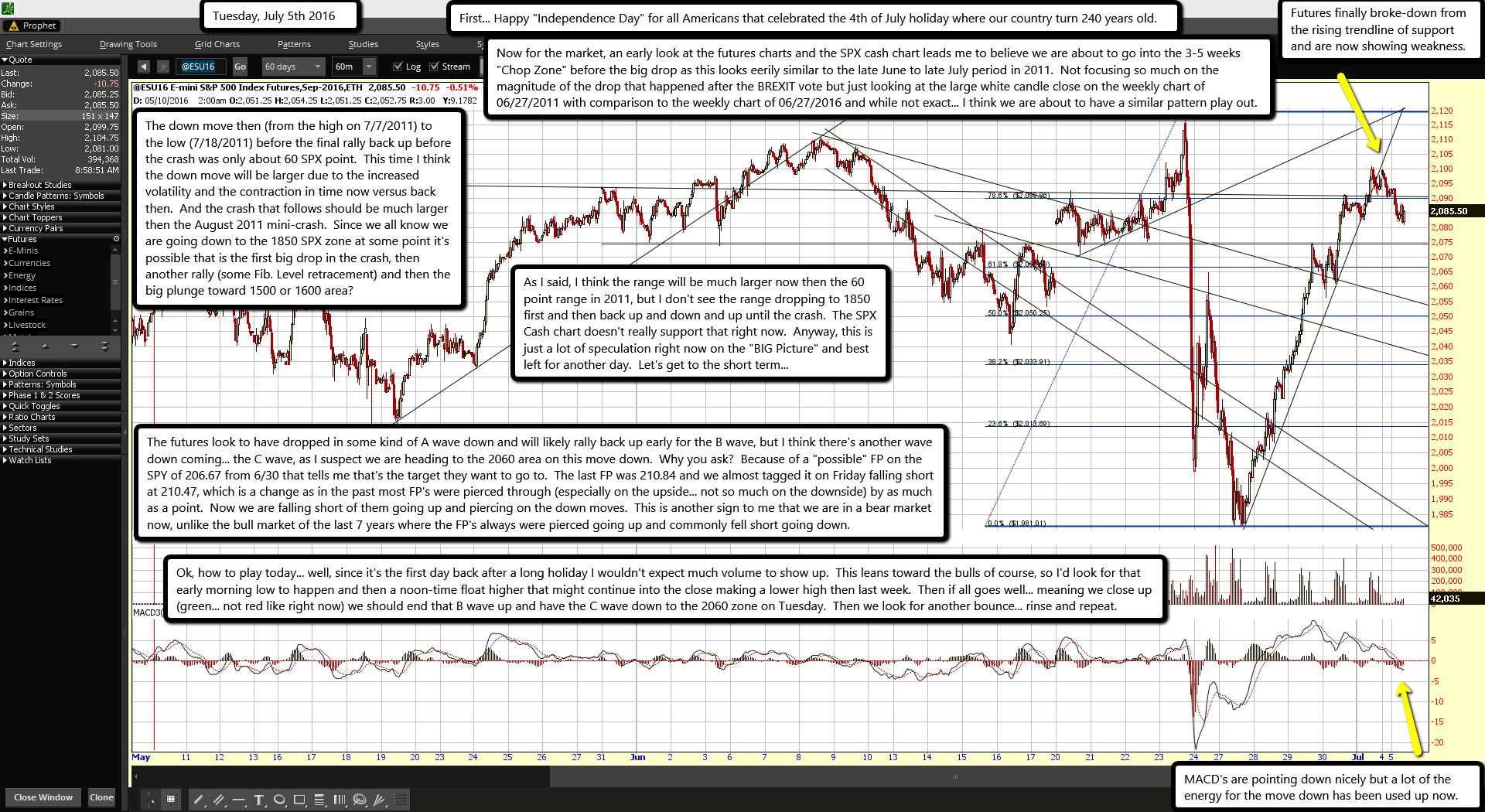
Futures finally broke-down from the rising trendline of support and are now showing weakness.

MACD's are pointing down nicely but a lot of the energy for the move down has been used up now.

First... Happy "Independence Day" for all Americans that celebrated the 4th of July holiday where our country turn 240 years old.

Now for the market, an early look at the futures charts and the SPX cash chart leads me to believe we are about to go into the 3-5 weeks "Chop Zone" before the big drop as this looks eerily similar to the late June to late July period in 2011.  Not focusing so much on the magnitude of the drop that happened after the BREXIT vote but just looking at the large white candle close on the weekly chart of 06/27/2011 with comparison to the weekly chart of 06/27/2016 and while not exact... I think we are about to have a similar pattern play out.

The down move then (from the high on 7/7/2011) to the low (7/18/2011) before the final rally back up before the crash was only about 60 SPX point.  This time I think the down move will be larger due to the increased volatility and the contraction in time now versus back then.  And the crash that follows should be much larger then the August 2011 mini-crash.  Since we all know we are going down to the 1850 SPX zone at some point it's possible that is the first big drop in the crash, then another rally (some Fib. Level retracement) and then the big plunge toward 1500 or 1600 area?

As I said, I think the range will be much larger now then the 60 point range in 2011, but I don't see the range dropping to 1850 first and then back up and down and up until the crash.  The SPX Cash chart doesn't really support that right now.  Anyway, this is just a lot of speculation right now on the "BIG Picture" and best left for another day.  Let's get to the short term...

The futures look to have dropped in some kind of A wave down and will likely rally back up early for the B wave, but I think there's another wave down coming... the C wave, as I suspect we are heading to the 2060 area on this move down.  Why you ask?  Because of a "possible" FP on the SPY of 206.67 from 6/30 that tells me that's the target they want to go to.  The last FP was 210.84 and we almost tagged it on Friday falling short at 210.47, which is a change as in the past most FP's were pierced through (especially on the upside... not so much on the downside) by as much as a point.  Now we are falling short of them going up and piercing on the down moves.  This is another sign to me that we are in a bear market now, unlike the bull market of the last 7 years where the FP's always were pierced going up and commonly fell short going down.

Ok, how to play today... well, since it's the first day back after a long holiday I wouldn't expect much volume to show up.  This leans toward the bulls of course, so I'd look for that early morning low to happen and then a noon-time float higher that might continue into the close making a lower high then last week.  Then if all goes well... meaning we close up (green... not red like right now) we should end that B wave up and have the C wave down to the 2060 zone on Tuesday.  Then we look for another bounce... rinse and repeat.

Science|A Model for ‘Clean Coal’ Runs Off the Tracks

0

DE KALB, Miss. — The fortress of steel and concrete towering above the pine forest here is a first-of-its-kind power plant that was supposed to prove that “clean coal” was not an oxymoron — that it was possible to produce electricity from coal in a way that emits far less pollution, and to turn a profit while doing so.

The plant was not only a central piece of the Obama administration’s climate plan, it was also supposed to be a model for future power plants to help slow the dangerous effects of global warming. The project was hailed as a way to bring thousands of jobs to Mississippi, the nation’s poorest state, and to extend a lifeline to the dying coal industry.

The sense of hope is fading fast, however. The Kemper coal plant is more than two years behind schedule and more than $4 billion over its initial budget, $2.4 billion, and it is still not operational.

The plant and its owner, Southern Company, are the focus of a Securities and Exchange Commission investigation, and ratepayers, alleging fraud, are suing the company. Members of Congress have described the project as more boondoggle than boon. The mismanagement is particularly egregious, they say, given the urgent need to rein in the largest source of dangerous emissions around the world: coal plants.

The plant’s backers, including federal energy officials, have defended their work in recent years by saying that delays and cost overruns are inevitable with innovative projects of this scale. In this case, they say, the difficulties stem largely from unforeseen factors — or “unknown unknowns,” as Tom Fanning, the chief executive of Southern Company, has often called them — like bad weather, labor shortages and design uncertainties.

Many problems plaguing the project were broadly known and had been occurring for years. But a review by The New York Times of thousands of pages of public records, previously undisclosed internal documents and emails, and 200 hours of secretly though legally recorded conversations among more than a dozen colleagues at the plant offers a detailed look at what went wrong and why.

Those documents and recordings, provided to The Times by a whistle-blower, an engineer named Brett Wingo, and interviews with more than 30 current or former regulators, contractors, consultants or engineers who worked on the project, show that the plant’s owners drastically understated the project’s cost and timetable, and repeatedly tried to conceal problems as they emerged.

The system of checks and balances that are supposed to keep such projects on track was outweighed by a shared and powerful incentive: The company and regulators were eager to qualify for hundreds of millions of dollars in federal subsidies for the plant, which was also aggressively promoted by Haley Barbour, who was Southern’s chief lobbyist before becoming the governor of Mississippi. Once in office, Mr. Barbour signed a law in 2008 that allowed much of the cost of building any new power plants to be passed on to ratepayers before they are built.

Seeing so many of the problems from the inside, at least one employee felt the need to speak up.

“I’ve reached a personal tipping point and feel a duty to act,” Mr. Wingo wrote in a 2014 email, which was among several that he sent to officials of Southern Company and Mississippi Power, the state utility that runs the plant, alleging that the company had broken federal law and engaged in corporate fraud. “Hope is not a strategy,” he added. “This is a high-profile project with many misguided enemies, so why give them free ammo?”

In their recorded conversations with Mr. Wingo, at least six senior engineers from the plant said that they believed that the delays and cost overruns, as well as safety violations and shoddy work, were partly the result of mismanagement or fraud.

Brett Wingo, an engineer who was once an advocate for the Kemper project, became a whistle-blower who alleged mismanagement and fraud.

“It has nothing to do with the design, it has nothing to do with the technology, it just has to do with poor project management,” Landon Lunsford, an engineer at the plant, said during one recorded call with Mr. Wingo last December, when they discussed an email from Southern’s legal department telling senior employees to retain all emails because of a continuing S.E.C. investigation.

The company will never admit the project-management problems because they will attract more scrutiny from regulators, Mr. Lunsford said. “As long as they can talk away the results as attributable to something else other than just poor performance, the other public service commissions can’t hold them over the fire as much,” he added.

Officials from Southern Company and Mississippi Power, which is a Southern subsidiary, said that they could not comment on Mr. Wingo’s allegations but that all decisions about cost and budget projections were made by consensus. They also said that Mr. Wingo’s accusations had previously been investigated by the company and could not be substantiated. Mr. Wingo was fired in February, a move that the Occupational Safety and Health Administration later ruled illegal.

Ed Holland, the former chief executive of Mississippi Power, added that one of the project’s biggest mistakes was to start construction with little of the plant designed. “We still believe that from our investors’ standpoint, this was a wise investment to prove the technology,” he said in an interview.

In the end, the Kemper project is a story of how a monopoly utility, with political help from the Mississippi governor and from federal energy officials who pressured state regulators in letters to support the project, shifted the burden of one of the most expensive power plants ever built onto the shoulders of unwitting investors and some of the lowest-income ratepayers in the country.

Kemper’s rising price tag and other problems will probably affect the Environmental Protection Agency’s proposed rules on new power plants, and also play into broader discussions about the best way to counter climate change. E.P.A. regulations in effect require new coal plants to have carbon capture technology but are being held up in federal court partly by arguments that the technology is not cost-effective.

The importance of this technology grows, as well, after President Obama said last week that the United States would join Canada and Mexico in pledging to reach a shared goal of generating 50 percent of North America’s electricity from zero-carbon sources by 2025, up from 37 percent today, with a power mix that includes wind, solar, hydropower, nuclear energy and coal or gas power paired with carbon capture technology.

“The big question with clean coal has always been whether it’s a moonshot or a money pit,” said Charles Grayson, the director of the Bigger Pie Forum, which advocates fiscal conservatism in Mississippi and has been critical of the Kemper project for years. “The Obama administration and my state made a really bad wager in trying to use Kemper to make the economic argument for this technology.”

High Hopes

Coal represents a conundrum: It is among the dirtiest sources of fuel, producing roughly 45 percent of the emissions that contribute to climate change. And yet the world still relies on it for power, with more than a quarter of the electricity used globally coming from coal plants.

Source link

You can buy a ‘ghost town’ in Colorado on Craigslist for $350000

0

Cabin Creek, Colorado a “ghost town” in rural Adams County, east of Denver, is up for sale.

“We’ve had so many people look it`s been amazing,” James Johnson, who currently owns the town, told KDVR-TV. Recently, Johnson placed a “for sale” ad on Craigslist to sell his town.

For the inspiring price of $350,000, a buyer will receive an old service station, a café, an abandoned motel and one small home. At the town’s peak, the cafe served as a hotspot for residents in surrounding the town.

“The couple who owned the town, and ran the cafe, served the best chicken fried steak in the state,” Byers resident Joan Lippett said of the town he once frequented.The cafe in 1973 (Photo: Cabin Creek, Colorado)

But after a murder in the 1970s, the town became a ghost town. “There was some people that they took in, felt sorry for or something, and they found out the couple had money,” Lippett said. “Then everything just, literally, there was nobody here, so these buildings sat totally vacant.  Nothing going on out here for a number of years.”Brooks Eveland, Owner of Cabin Creek 1969 to 1975 (Photo: Cabin Creek, Colorado)
Johnson once had big dreams to capitalize on Route 66 tourism and opportunities, but his wife now wants to retire somewhere else. He’s hoping there is someone with similar aspirations.

“The hardest part out here is you`re not going to get a regular conventional loan on this property.  You say, ‘ghost town’ and they say, ‘What?’,” Johnson said.

Source link

ES Morning Update July 1st 2016

0

d717c4ed-a235-4712-9f8d-b6969eacebb5

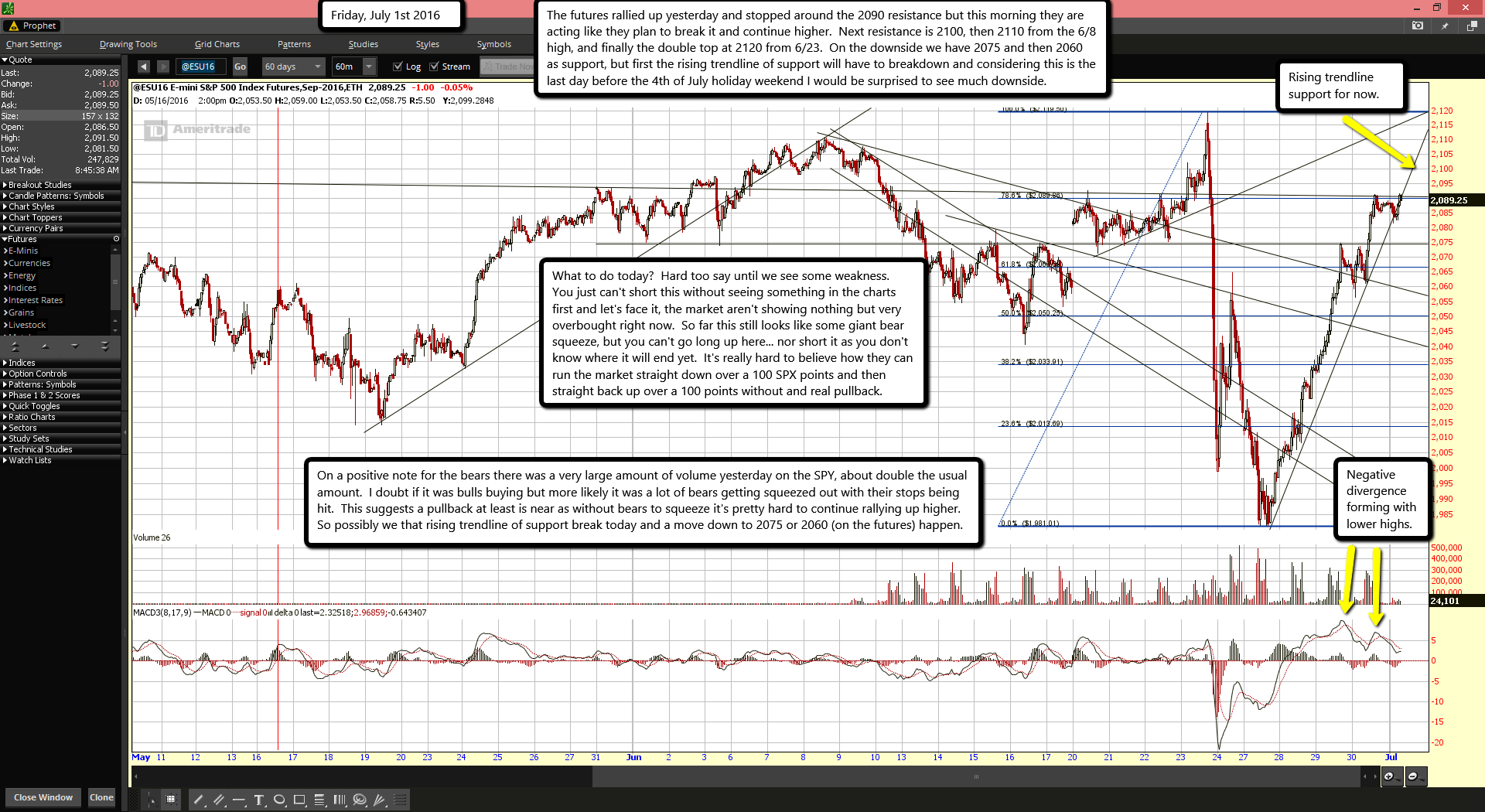
Rising trendline support for now.

Negative divergence forming with lower highs.

The futures rallied up yesterday and stopped around the 2090 resistance but this morning they are acting like they plan to break it and continue higher.  Next resistance is 2100, then 2110 from the 6/8 high, and finally the double top at 2120 from 6/23.  On the downside we have 2075 and then 2060 as support, but first the rising trendline of support will have to breakdown and considering this is the last day before the 4th of July holiday weekend I would be surprised to see much downside.

What to do today?  Hard too say until we see some weakness.  You just can't short this without seeing something in the charts first and let's face it, the market aren't showing nothing but very overbought right now.  So far this still looks like some giant bear squeeze, but you can't go long up here... nor short it as you don't know where it will end yet.  It's really hard to believe how they can run the market straight down over a 100 SPX points and then straight back up over a 100 points without and real pullback.

On a positive note for the bears there was a very large amount of volume yesterday on the SPY, about double the usual amount.  I doubt if it was bulls buying but more likely it was a lot of bears getting squeezed out with their stops being hit.  This suggests a pullback at least is near as without bears to squeeze it's pretty hard to continue rallying up higher.  So possibly we that rising trendline of support break today and a move down to 2075 or 2060 (on the futures) happen.

ES Morning Update June 30th 2016

0

0e23250b-38ac-4467-bf5d-c88deee6536e

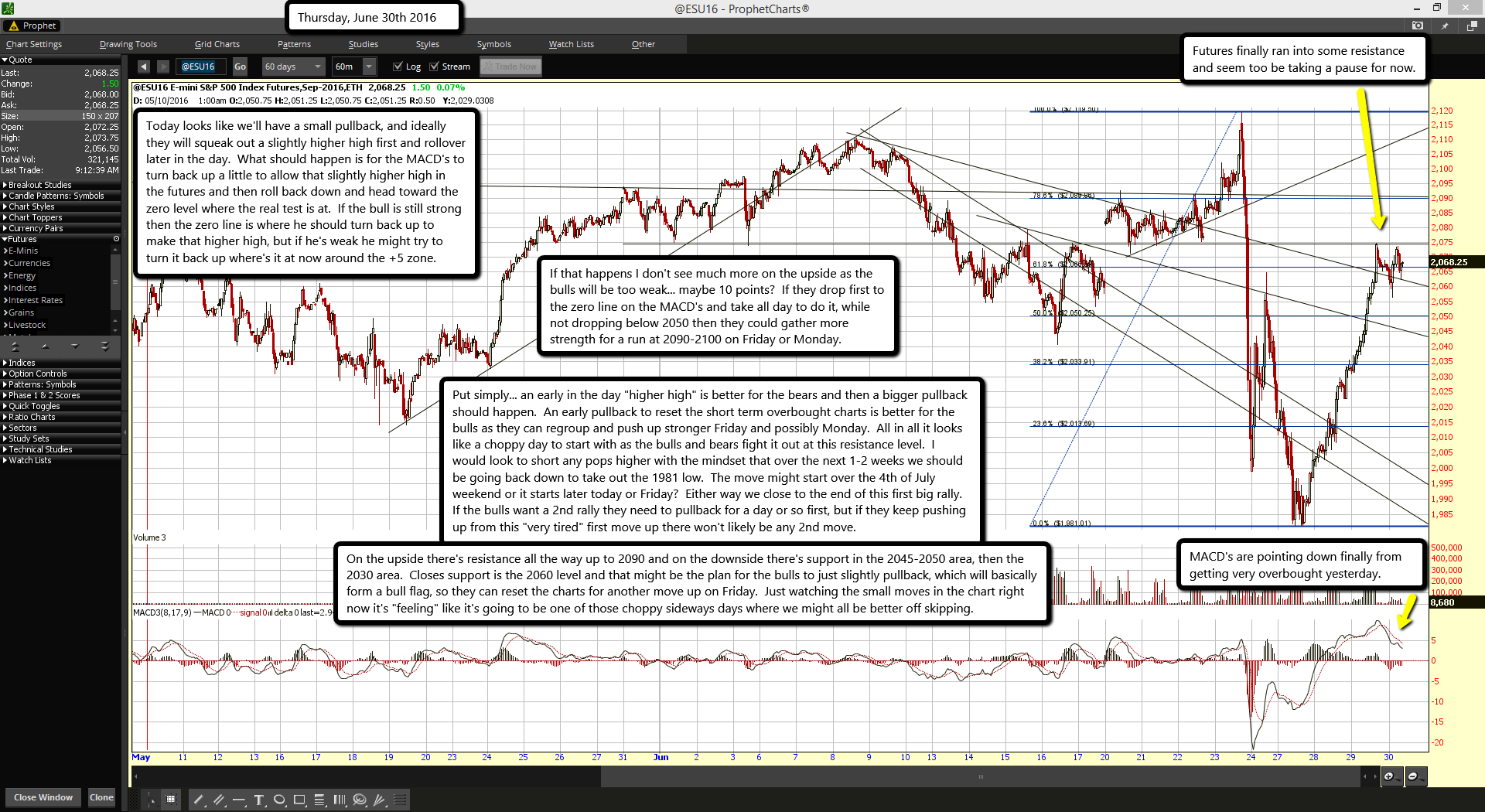
Futures finally ran into some resistance and seem too be taking a pause for now.

MACD's are pointing down finally from getting very overbought yesterday.

Today looks like we'll have a small pullback, and ideally they will squeak out a slightly higher high first and rollover later in the day.  What should happen is for the MACD's to turn back up a little to allow that slightly higher high in the futures and then roll back down and head toward the zero level where the real test is at.  If the bull is still strong then the zero line is where he should turn back up to make that higher high, but if he's weak he might try to turn it back up where's it at now around the +5 zone.

If that happens I don't see much more on the upside as the bulls will be too weak... maybe 10 points?  If they drop first to the zero line on the MACD's and take all day to do it, while not dropping below 2050 then they could gather more strength for a run at 2090-2100 on Friday or Monday.

Put simply... an early in the day "higher high" is better for the bears and then a bigger pullback should happen.  An early pullback to reset the short term overbought charts is better for the bulls as they can regroup and push up stronger Friday and possibly Monday.  All in all it looks like a choppy day to start with as the bulls and bears fight it out at this resistance level.  I would look to short any pops higher with the mindset that over the next 1-2 weeks we should be going back down to take out the 1981 low.  The move might start over the 4th of July weekend or it starts later today or Friday?  Either way we close to the end of this first big rally.  If the bulls want a 2nd rally they need to pullback for a day or so first, but if they keep pushing up from this "very tired" first move up there won't likely be any 2nd move.

On the upside there's resistance all the way up to 2090 and on the downside there's support in the 2045-2050 area, then the 2030 area.  Closes support is the 2060 level and that might be the plan for the bulls to just slightly pullback, which will basically form a bull flag, so they can reset the charts for another move up on Friday.  Just watching the small moves in the chart right now it's "feeling" like it's going to be one of those choppy sideways days where we might all be better off skipping.

What is article 50 BREXIT mean? This video explains it…

0

The only legal way for a Brexit – or for any member state to withdraw from the European Union – is by triggering an obscure and controversial clause in the Lisbon Treaty: article 50. It gives the departing country two years to negotiate the terms of its withdrawal and has never been used before. Tom Clark explains how it works

Dow to cut 700 jobs in central Michigan

0

Global job cuts include Michigan and arrive as the company completes its takeover of Dow Corning amid a pending merger with rival DuPont.

Midland-based Dow Chemical Co. said today that it will cut more than 10 percent of its workforce in Michigan as a result of its takeover of Dow Corning amid a pending merger with rival DuPont.

"These actions are intended to help offset the impacts from restructuring measures Dow will implement to enable faster and more efficient growth of Dow Corning’s Silicones business," the company said in a statement Tuesday morning announcing a global cutback in personnel of about 4% of the company's workforce.

One of Michigan’s largest employers, Dow manufactures a range of products from plastics to paint preservatives, including automotive products. Dow has approximately 53,000 employees globally and about 6,000 employees in Michigan.

The state's Department of Talent and Economic Development is working with Dow and the Midland community to assist the affected employees in finding new jobs. They will be holding sessions both online and in person to connect employees and potential employers, officials said.

"Michigan has faced employment challenges in the past and while the Dow announcement is unfortunate, we believe residents will be well-positioned to find new opportunities as part of the state's continued economic growth," Anna Heaton, spokeswoman for Gov. Rick Snyder, said in an email Tuesday.

Despite the cutbacks in and around Midland of an estimated 700 jobs in an area known as the Great Lakes Bay Region, Dow said that Dow Corning’s total overall corporate charitable giving programs will remain at 2016 levels throughout at least June 1, 2018.

“With the difficult but necessary actions Dow is announcing today to enable faster and more efficient growth from Dow Corning, we are also calling into action multiple efforts to minimize the economic impact on the Great Lakes Bay Region,” Howard Ungerleider, vice chairman and chief financial officer of Dow and chairman of Dow Corning, said in a statement. “We believe, by working together as one community with one singular focus, we can make both Dow and the region stronger and more economically resilient in the future.”Dow Chemical Company chairman and chief executive officer

Dow said about 700 roles in and around Midland will be eliminated from the combined companies.

"These reductions will come from both Dow and Dow Corning, and are part of Dow’s overall cost reduction efforts related to the transaction," the company said.

Notifications to affected employees will start in the coming weeks, and will continue through the end of the third quarter of the year.

Since January, Dow has implemented a hiring slowdown of external hires, which has resulted in a number of open roles. It is possible that some laid-off employees will be able to move into those positions, the company said.

Despite the cutbacks in the region, Dow and Dow Corning office locations will remain open for now. Construction of Dow’s new corporate HQ building will continue as planned, with a scheduled opening at the end of 2017.

The cutbacks in Michigan come as materials maker Dow Chemical plans to shed 2,500 jobs globally after acquiring full ownership of joint-venture Dow Corning.

Dow — which recently finished acquisition of the 50% of silicon manufacturer Dow Corning it did not previously hold — said Tuesday that the cuts will require a charge of about $410 million to $460 million in the second quarter.

Altogether, the company expects to save $400 million in annual costs, up from a previous estimate of $300 million, as well as $100 million in new business opportunities

The company will shutter silicon manufacturing plants in Greensboro, N.C, and Yamakita, Japan, as well as "certain administrative, corporate and manufacturing facilities," Dow said in a statement.

“With these difficult but necessary actions, we are bringing together the best of each company’s talent and technology, accelerating Dow’s strategy to go narrower and deeper into attractive, targeted market sectors, and setting the stage for the new Dow — the world’s leading material science company," Dow CEO Andrew Liveris said in a statement.

Dow shares (DOW) fell 0.1% in pre-market trading to $50.

The cuts are not related to Dow's ongoing attempt to complete its tie-up with chemicals maker DuPont, after which the newly formed DowDuPont is expected to split into three companies. That deal still requires regulatory approvals.

A company spokeswoman Tuesday said it was too early to say whether the DowDuPont merger could lead to additional job cuts in Michigan
Source link

Toyota Recalls 1.4 Million Vehicles for Airbag Problem

0

A Toyota factory in Takaoka, Japan. The automaker also said Wednesday that it was recalling nearly 3 million vehicles worldwide over fuel tank issues.

TOKYO — Toyota Motor said Wednesday it was recalling 1.43 million vehicles worldwide over a possible airbag fault. But it said the components in question had not been manufactured by Takata, the airbag supplier at the heart of the largest safety recall in the history of the car industry.

Toyota, based in Japan, did not name the supplier of the airbags that were subject to the recall announcement. Keeping suppliers’ names private is a common practice among automakers; Takata was named only after the scale and severity of its problems drew intense public scrutiny. In a separate announcement, Toyota also said it was recalling 2.87 million vehicles worldwide over fuel tank issues.

Toyota’s latest recall accompanies heightened consumer anxiety over the safety of airbags.

Automakers have recalled 60 million vehicles in the United States and tens of millions more worldwide to fix the problem with airbags made by Takata, also a Japanese company, whose faulty equipment has been linked to 14 deaths and more than 100 injuries. Takata’s president said on Tuesday that he planned to step down.

Stock Price of Toyota Motor Corp.

The problem with Takata airbags involves their inflaters – metal capsules loaded with propellant that force airbags to deploy nearly instantly in a crash. Takata’s inflaters can rupture violently, sending shrapnel flying toward drivers or passengers.

One of the recalls on Wednesday also involved airbag inflaters. It covers two models of hybrid vehicles, the Prius and the Lexus CT200h, made between 2010 and 2012. The inflaters in their airbags may have a small crack in a weld, Toyota said. The fault could cause the airbags to inflate unexpectedly, sending pieces of the inflater into the cabin.

Toyota said the risk of problems was highest when the inflaters were exposed to high humidity — a factor that has also been implicated in the Takata defect.

Toyota said a manufacturing error was to blame, rather than a design problem. The company said it was not aware of any injuries or deaths related to the latest issues.

The second recall covered a possible fault with a mechanism in vehicles’ fuel tanks that releases evaporated fuel. Toyota said cracks in the mechanism, known as the evaporative fuel emissions control unit, could cause small amounts of fuel to leak when drivers fill up their tanks. The recall covers several models, including Prius hybrids and Corolla compacts produced between 2006 and 2015, Toyota said.

Source link

Brexit: Vodafone says it might leave the U.K.

0

Why this British town voted to leave the EUBritain's vote to leave the European Union may cost it the world's second-largest telecom company.

British industry giant Vodafone (VOD) says it's considering moving its headquarters out of the U.K. following last week's shock referendum result.

The loss of the company, whose stock helps anchor the benchmark FTSE 100, would be a stinging blow for a country that is struggling to come to terms with the economic consequences of a vote to divorce its European neighbors.

Vodafone said in a statement that Britain's EU membership has "been an important factor" in its growth. It added that bedrock EU principles including freedom of movement of people, capital and goods are all vital for regional companies.

"It is ... not yet possible to draw any firm conclusions regarding the long-term location for the headquarters," the company said. "We will continue to evaluate the situation and will take whatever decisions are appropriate in the interests of our customers, shareholders and employees."

Vodafone, whose group headquarters are in London, said the vast majority of its 462 million customers and 108,000 employees are based outside of the U.K. The company earns 55% of its pre-tax revenue in Europe, while only 11% comes from Britain.

There are tremendous levels of uncertainty facing British businesses in the wake of the vote. London must now establish new trading relationships with its major foreign partners, and determine the immigration status of EU migrants currently working in the U.K.

At the company level, aftershocks from the Brexit vote are still being felt widely: Large banks, many of which run their European operations from London's Canary Wharf, are facing some of the biggest headaches.

The credit ratings agency Moody's warned that automakers, manufacturers and food producers in Britain could suffer from higher trade barriers and reduced volumes. It said increased regulatory risk would hit telecom firms, airlines and drug makers.

House builders were tipped as big losers too. Analysts are worried that a sharp decline in consumer confidence will hurt home sales. Foreign buyers might also find London a much less attractive option for property investment.

The FTSE 250, which is made up of mostly mid-sized British companies, has plummeted by nearly 10% since the vote.
Source link

Alphabet’s new board member is a nod to diversity

0

roger ferguson

Apparently the D is for diversity.

Alphabet(GOOGL, Tech30), the parent company of Google, appointed former Federal Reserve vice chairman Roger Ferguson to its board on Wednesday. In addition to bulking up Google's bench of financial expertise, the appointment also marks an important milestone for diversity: Ferguson is Alphabet's first black board member.

"He has a long record of distinguished and thoughtful service in the private and public sectors, and deeply understands how technology can improve the lives of people around the world," Eric Schmidt, Alphabet's executive chairman, said in a statement.

Google has been working to improve the diversity of its workforce through unconscious bias training and expanding the colleges it recruits from in response to renewed media scrutiny about inclusion in the technology industry. On Wednesday, Google also officially opened a new space in its New York office for Black Girls Code, a nonprofit group.

Progress has been slow for Google and its peers. Just 2% of Google's overall workforce is black, while 60% is white, according to its latest internal numbers. But bringing Ferguson on to Alphabet's influential board of directors is a step in the right direction.

Related: Google shareholder calls exec a 'lady CFO,' Twitter erupts

In his current role as president and CEO of TIAA, a financial services company, Ferguson has been praised for making diversity and inclusion a key business focus.

"For us, it's not just a nice to have. It's a must," he said in an earlier statement. "A diverse workforce helps us better understand and address the needs of our customers. It brings a range of experiences and perspectives to the table, which leads to more innovative thinking and better problem-solving."

Google isn't the only tech company diversifying its board. Twitter (TWTR, Tech30) appointed its first black board member, BET CEO Debra Lee, earlier this year after one of its largest investors criticized it as a "country club of old white guys."

Source link

ES Morning Update June 29th 2016

0

6cada986-4936-4155-8ca5-a6b2ae935f38

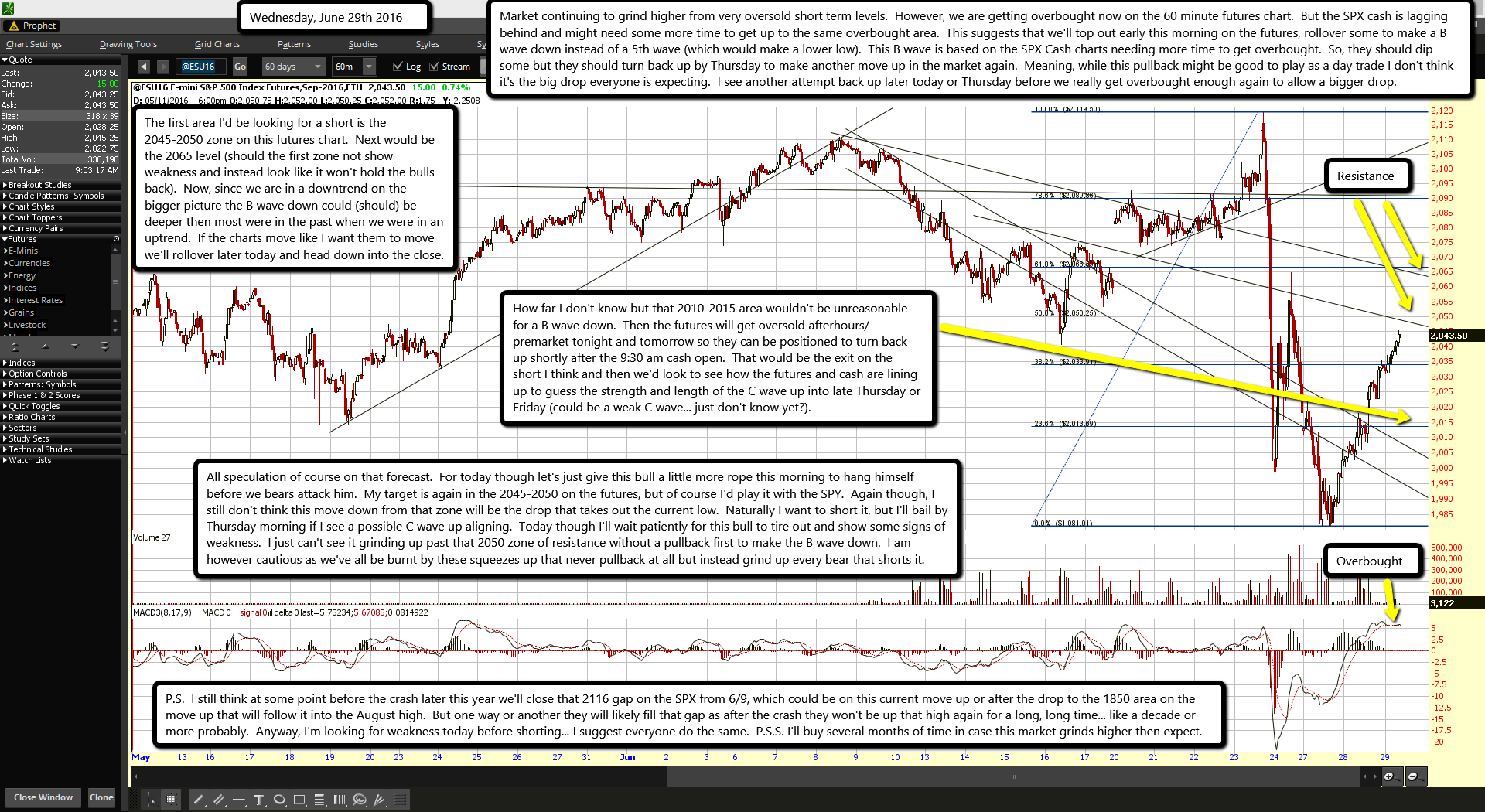
Market continuing to grind higher from very oversold short term levels.  However, we are getting overbought now on the 60 minute futures chart.  But the SPX cash is lagging behind and might need some more time to get up to the same overbought area.  This suggests that we'll top out early this morning on the futures, rollover some to make a B wave down instead of a 5th wave (which would make a lower low).  This B wave is based on the SPX Cash charts needing more time to get overbought.  So, they should dip some but they should turn back up by Thursday to make another move up in the market again.  Meaning, while this pullback might be good to play as a day trade I don't think it's the big drop everyone is expecting.  I see another attempt back up later today or Thursday before we really get overbought enough again to allow a bigger drop.

The first area I'd be looking for a short is the 2045-2050 zone on this futures chart.  Next would be the 2065 level (should the first zone not show weakness and instead look like it won't hold the bulls back).  Now, since we are in a downtrend on the bigger picture the B wave down could (should) be deeper then most were in the past when we were in an uptrend.  If the charts move like I want them to move we'll rollover later today and head down into the close.  How far I don't know but that 2010-2015 area wouldn't be unreasonable for a B wave down.  Then the futures will get oversold afterhours/premarket tonight and tomorrow so they can be positioned to turn back up shortly after the 9:30 am cash open.  That would be the exit on the short I think and then we'd look to see how the futures and cash are lining up to guess the strength and length of the C wave up into late Thursday or Friday (could be a weak C wave... just don't know yet?).

All speculation of course on that forecast.  For today though let's just give this bull a little more rope this morning to hang himself before we bears attack him.  My target is again in the 2045-2050 on the futures, but of course I'd play it with the SPY.  Again though, I still don't think this move down from that zone will be the drop that takes out the current low.  Naturally I want to short it, but I'll bail by Thursday morning if I see a possible C wave up aligning.  Today though I'll wait patiently for this bull to tire out and show some signs of weakness.  I just can't see it grinding up past that 2050 zone of resistance without a pullback first to make the B wave down.  I am however cautious as we've all be burnt by these squeezes up that never pullback at all but instead grind up every bear that shorts it.

P.S.  I still think at some point before the crash later this year we'll close that 2116 gap on the SPX from 6/9, which could be on this current move up or after the drop to the 1850 area on the move up that will follow it into the August high.  But one way or another they will likely fill that gap as after the crash they won't be up that high again for a long, long time... like a decade or more probably.  Anyway, I'm looking for weakness today before shorting... I suggest everyone do the same.  P.S.S. I'll buy several months of time in case this market grinds higher then expect.

ES Morning Update June 28th 2016

0

f42db8b5-0416-4e01-8709-cf731ce471a5

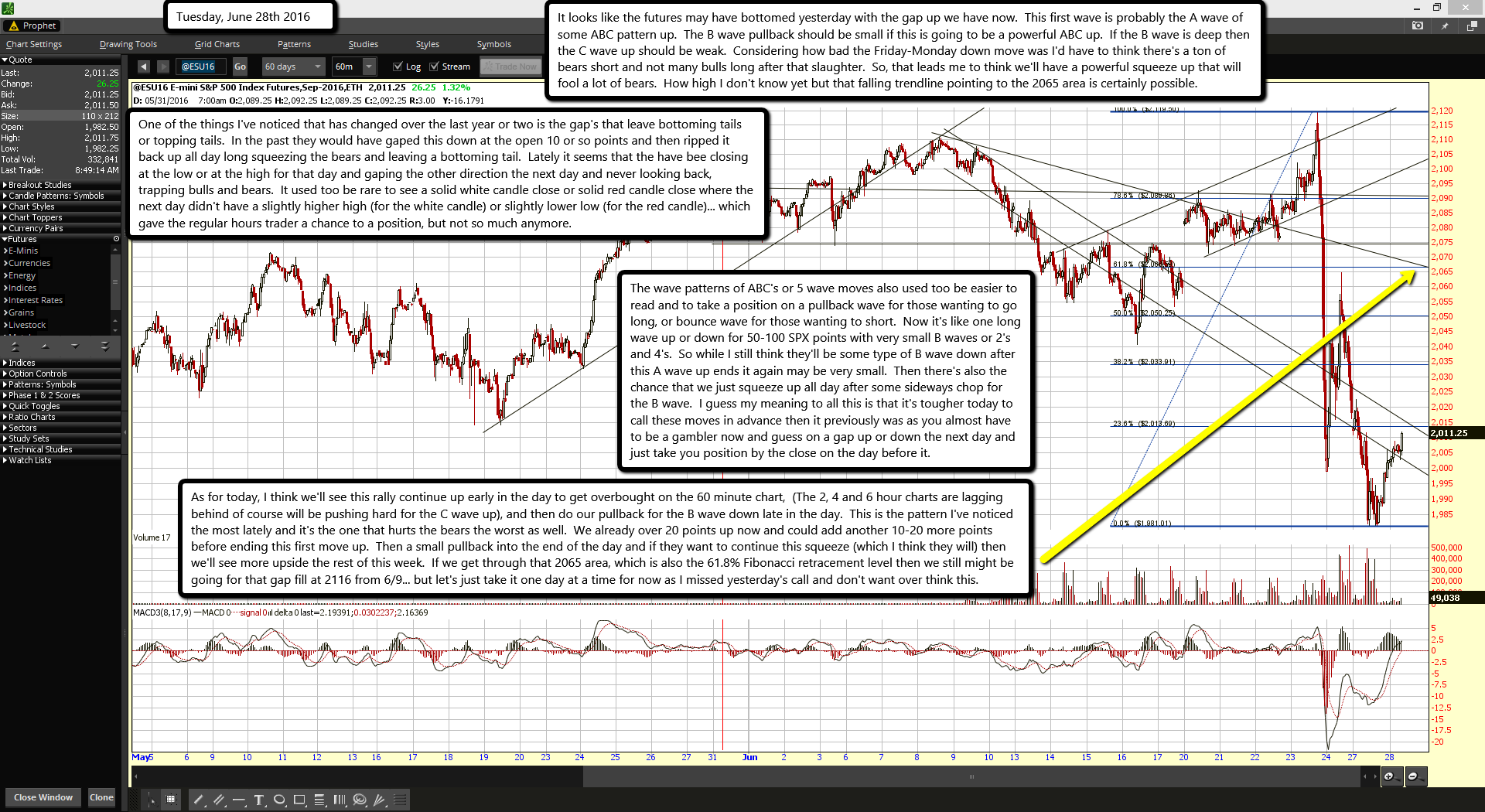
It looks like the futures may have bottomed yesterday with the gap up we have now.  This first wave is probably the A wave of some ABC pattern up.  The B wave pullback should be small if this is going to be a powerful ABC up.  If the B wave is deep then the C wave up should be weak.  Considering how bad the Friday-Monday down move was I'd have to think there's a ton of bears short and not many bulls long after that slaughter.  So, that leads me to think we'll have a powerful squeeze up that will fool a lot of bears.  How high I don't know yet but that falling trendline pointing to the 2065 area is certainly possible.

One of the things I've noticed that has changed over the last year or two is the gap's that leave bottoming tails or topping tails.  In the past they would have gaped this down at the open 10 or so points and then ripped it back up all day long squeezing the bears and leaving a bottoming tail.  Lately it seems that the have bee closing at the low or at the high for that day and gaping the other direction the next day and never looking back, trapping bulls and bears.  It used too be rare to see a solid white candle close or solid red candle close where the next day didn't have a slightly higher high (for the white candle) or slightly lower low (for the red candle)... which gave the regular hours trader a chance to a position, but not so much anymore.

The wave patterns of ABC's or 5 wave moves also used too be easier to read and to take a position on a pullback wave for those wanting to go long, or bounce wave for those wanting to short.  Now it's like one long wave up or down for 50-100 SPX points with very small B waves or 2's and 4's.  So while I still think they'll be some type of B wave down after this A wave up ends it again may be very small.  Then there's also the chance that we just squeeze up all day after some sideways chop for the B wave.  I guess my meaning to all this is that it's tougher today to call these moves in advance then it previously was as you almost have to be a gambler now and guess on a gap up or down the next day and just take you position by the close on the day before it.

As for today, I think we'll see this rally continue up early in the day to get overbought on the 60 minute chart,  (The 2, 4 and 6 hour charts are lagging behind of course will be pushing hard for the C wave up), and then do our pullback for the B wave down late in the day.  This is the pattern I've noticed the most lately and it's the one that hurts the bears the worst as well.  We already over 20 points up now and could add another 10-20 more points before ending this first move up.  Then a small pullback into the end of the day and if they want to continue this squeeze (which I think they will) then we'll see more upside the rest of this week.  If we get through that 2065 area, which is also the 61.8% Fibonacci retracement level then we still might be going for that gap fill at 2116 from 6/9... but let's just take it one day at a time for now as I missed yesterday's call and don't want over think this.

ES Morning Update June 27th 2016

0

f3e25433-9952-4d04-863d-abcd56856518

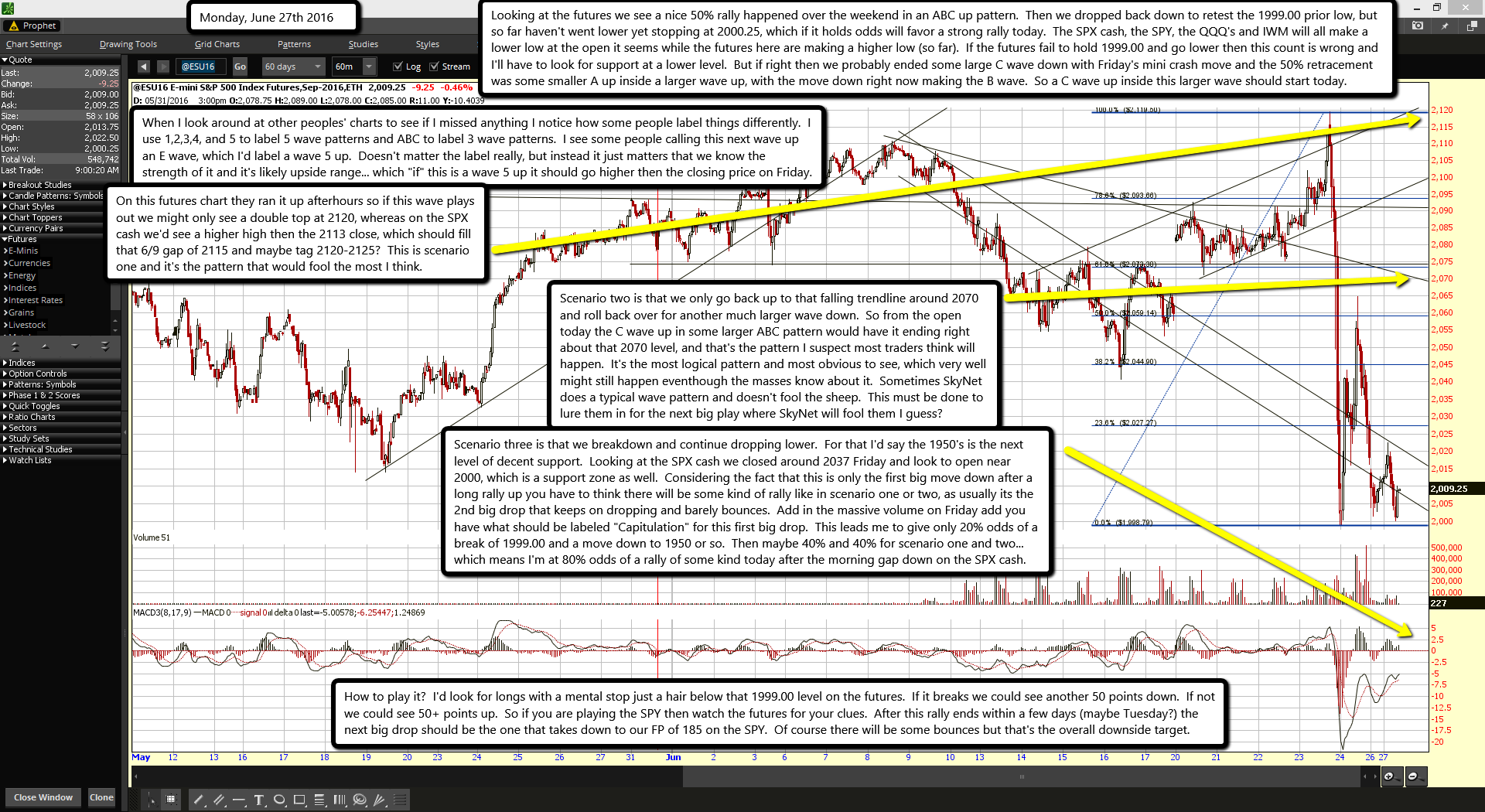
Looking at the futures we see a nice 50% rally happened over the weekend in an ABC up pattern.  Then we dropped back down to retest the 1999.00 prior low, but so far haven't went lower yet stopping at 2000.25, which if it holds odds will favor a strong rally today.  The SPX cash, the SPY, the QQQ's and IWM will all make a lower low at the open it seems while the futures here are making a higher low (so far).  If the futures fail to hold 1999.00 and go lower then this count is wrong and I'll have to look for support at a lower level.  But if right then we probably ended some large C wave down with Friday's mini crash move and the 50% retracement was some smaller A up inside a larger wave up, with the move down right now making the B wave.  So a C wave up inside this larger wave should start today.

When I look around at other peoples' charts to see if I missed anything I notice how some people label things differently.  I use 1,2,3,4, and 5 to label 5 wave patterns and ABC to label 3 wave patterns.  I see some people calling this next wave up an E wave, which I'd label a wave 5 up.  Doesn't matter the label really, but instead it just matters that we know the strength of it and it's likely upside range... which "if" this is a wave 5 up it should go higher then the closing price on Friday.

On this futures chart they ran it up after-hours so if this wave plays out we might only see a double top at 2120, whereas on the SPX cash we'd see a higher high then the 2113 close, which should fill that 6/9 gap of 2115 and maybe tag 2120-2125?  This is scenario one and it's the pattern that would fool the most I think.

Scenario two is that we only go back up to that falling trendline around 2070 and roll back over for another much larger wave down.  So from the open today the C wave up in some larger ABC pattern would have it ending right about that 2070 level, and that's the pattern I suspect most traders think will happen.  It's the most logical pattern and most obvious to see, which very well might still happen even-though the masses know about it.  Sometimes SkyNet does a typical wave pattern and doesn't fool the sheep.  This must be done to lure them in for the next big play where SkyNet will fool them I guess?

Scenario three is that we breakdown and continue dropping lower.  For that I'd say the 1950's is the next level of decent support.  Looking at the SPX cash we closed around 2037 Friday and look to open near 2000, which is a support zone as well.  Considering the fact that this is only the first big move down after a long rally up you have to think there will be some kind of rally like in scenario one or two, as usually its the 2nd big drop that keeps on dropping and barely bounces.  Add in the massive volume on Friday add you have what should be labeled "Capitulation" for this first big drop.  This leads me to give only 20% odds of a break of 1999.00 and a move down to 1950 or so.  Then maybe 40% and 40% for scenario one and two... which means I'm at 80% odds of a rally of some kind today after the morning gap down on the SPX cash.

How to play it?  I'd look for longs with a mental stop just a hair below that 1999.00 level on the futures.  If it breaks we could see another 50 points down.  If not we could see 50+ points up.  So if you are playing the SPY then watch the futures for your clues.  After this rally ends within a few days (maybe Tuesday?) the next big drop should be the one that takes down to our FP of 185 on the SPY.  Of course there will be some bounces but that's the overall downside target.

ES Morning Update June 24th 2016

0

1928ddd8-62f7-4c69-ba8f-1b593e61a8f5

All this week I was looking for the gap to fill from 6/9 around 2115 and that was where I planned to short.  At the last minute of the day yesterday they ran it up hard to 2113.32 and fell short of that gap so I missed the short!  Wow...what a mistake on my part!  Trying to catch the top I missed the move.  I was hesitant to short until that gap fill as I didn't want to ride out that pain of an extra 20 point or so and I missed this huge opportunity.  I guess it's better to be a little early then late it seems.

Not much to say on the technical analysis side or wave counts as clearly this huge move down isn't something you can really chart.  It's a mini-crash wave if you want to call it something.  For anyone that was short in front of I'll say "congratulations" and to take profit today as I'm sure there will be some bounce at some point today so it's good to lock in profits.  It's too early to speculate on next week as this one move has fell so far in one day that it might be like the August 24th, 2015 Lucy crash... meaning that was the low and wild swings up and down followed for several months afterwards.

On another note, I'm really happy for the people that they left the EU as that's what was needed for them, instead of living under a dictatorship like they would have with EU government people being non-elected and appointed where the people had zero ability to get rid of the gangsters.

As for the market today they've wiped out everyone that was long from all the recent prior lows on this move down to the 1999.00 current low on the ES Futures, so I don't think there's much downside left today.  You know how they do it where all or 90% of the move is done overnight so the retail trader misses it.  I have no advice on how to play it today I'd expect some wild moves as the bulls try to rally up and hold the current low and the bears short ever bounce.  After missing the short yesterday I'm going to just watch for now.

SOROS: A vote for Brexit would trigger a crash worse than Black Wednesday

0

George Soros is clear: a vote to ‘Leave’ the EU would trigger a collapse in the British pound worse than “Black Wednesday.”

Writing in The Guardian, the legendary macro trader said Britain currently risks subjecting itself to one of the worst one-day currency collapses in its history if it votes to leave the European Union.

“It is reasonable to assume, given the expectations implied by the market pricing at present, that after a Brexit vote the pound would fall by at least 15% and possibly more than 20%,” Soros writes.

He added (emphasis mine):

“But I don’t think the 1992 experience would be repeated. That devaluation was healthy because the government was relieved of its obligation to ‘defend’ an overvalued pound with damagingly high interest rates after the breakdown of the exchange rate mechanism. This time, a large devaluation would be much less benign than in 1992, for at least three reasons.”

The 1992 incident Soros references, known in financial market history as “Black Wednesday,” is the collapse in the value of the pound after the British government pulled the currency from the European Exchange Rate Mechanism (sort of the euro before the euro) due to the inability of the government to defend the pound’s value against the Deutsche mark.

Soros was among the many traders who had placed massive bets the British pound would drop in value as he believed the government would eventually be forced to pull out of the ERM.

In other words: Soros knows this history.

Soros’ three main points in Monday’s piece are that:

  • With interest rates at a record-low 0.50%, the Bank of England couldn’t cut rates in response to a currency shock.
  • The UK’s current account deficit makes it dependent on foreign capital which could dry up in the event ‘Leave’ wins.
  • A post-Brexit devaluation of the currency would be unlikely to benefit British manufacturing exports as the cheaper pound did in 1992.

On Thursday, Britons will head to the polls to vote in the referendum. Recent polling has shown the ‘Remain’ camp taking a lead against the ‘Leave’ camp, with the most recent poll on Monday night showing ‘Remain’ holding a 53-45 advantage over ‘Leave.’

Following polling out over the weekend showing the spread between ‘Remain’ and ‘Leave’ narrowing, the pound rallied more than 2% against the dollar on Monday, one of its biggest one-day gains since the financial crisis.

And so markets are beginning to see polls and feel better about the prospects we’ll wake up on Friday and things will be as they were in the European Union.

But Soros’ warning is one that many in financial markets are likely to take very seriously.

David Cameron, along with the Treasury, the Bank of England, the International Monetary Fund and others have been attacked by the leave campaign for exaggerating the economic risks of Brexit. This criticism has been widely accepted by the British media and many financial analysts. As a result, British voters are now grossly underestimating the true costs of leaving.

Too many believe that a vote to leave the EU will have no effect on their personal financial position. This is wishful thinking. It would have at least one very clear and immediate effect that will touch every household: the value of the pound would decline precipitously. It would also have an immediate and dramatic impact on financial markets, investment, prices and jobs.

As opinion polls on the referendum result fluctuate, I want to offer a clear set of facts, based on my six decades of experience in financial markets, to help voters understand the very real consequences of a vote to leave the EU.

The Bank of England, the Institute for Fiscal Studies and the IMF have assessed the long-term economic consequences of Brexit. They suggest an income loss of £3,000 to £5,000 annually per household – once the British economy settles down to its new steady-state five years or so after Brexit. But there are some more immediate financial consequences that have hardly been mentioned in the referendum debate.

To start off, sterling is almost certain to fall steeply and quickly if there is a vote to leave– even more so after yesterday’s rebound as markets reacted to the shift in opinion polls towards remain. I would expect this devaluation to be bigger and more disruptive than the 15% devaluation that occurred in September 1992, when I was fortunate enough to make a substantial profit for my hedge fund investors, at the expense of the Bank of England and the British government.

It is reasonable to assume, given the expectations implied by the market pricing at present, that after a Brexit vote the pound would fall by at least 15% and possibly more than 20%, from its present level of $1.46 to below $1.15 (which would be between 25% and 30% below its pre-referendum trading range of $1.50 to $1.60). If sterling fell to this level, then ironically one pound would be worth about one euro – a method of “joining the euro” that nobody in Britain would want.

Brexiters seem to recognise that a sharp devaluation would be almost inevitable after Brexit, but argue that this would be healthy, despite the big losses of purchasing power for British households. In 1992 the devaluation actually proved very helpful to the British economy, and subsequently I was even praised for my role in helping to bring it about.

But I don’t think the 1992 experience would be repeated. That devaluation was healthy because the government was relieved of its obligation to “defend” an overvalued pound with damagingly high interest rates after the breakdown of the exchange rate mechanism. This time, a large devaluation would be much less benign than in 1992, for at least three reasons.

Second, the UK now has a very large current account deficit – much larger, relatively, than in 1992 or 2008. In fact Britain is more dependent than at any time in history on inflows of foreign capital. As the governor of the Bank of England Mark Carney said, Britain “depends on the kindness of strangers”. The devaluations of 1992 and 2008 encouraged greater capital inflows, especially into residential and commercial property, but also into manufacturing investments. But after Brexit, the capital flows would almost certainly move the other way, especially during the two-year period of uncertainty while Britain negotiates its terms of divorce with a region that has always been – and presumably will remain – its biggest trading and investment partner.

Third, a post-Brexit devaluation is unlikely to produce the improvement in manufacturing exports seen after 1992, because trading conditions would be too uncertain for British businesses to undertake new investments, hire more workers or otherwise add to export capacity.

For all these reasons I believe the devaluation this time would be more like the one in 1967, when Harold Wilson famously declared that “the pound in your pocket has not been devalued”, but the British people disagreed with him, quickly noticing that the cost of imports and foreign holidays were rising sharply and that their true living standards were going down. Meanwhile financial speculators, back then called the Gnomes of Zurich, were making large profits at Britain’s expense.

Today, there are speculative forces in the markets much bigger and more powerful. And they will be eager to exploit any miscalculations by the British government or British voters. A vote for Brexit would make some people very rich – but most voters considerably poorer.

I want people to know what the consequences of leaving the EU would be before they cast their votes, rather than after. A vote to leave could see the week end with a Black Friday, and serious consequences for ordinary people.

ES Morning Update June 23rd 2016

0

fe97e579-0f26-4822-8e59-636cb86d848e

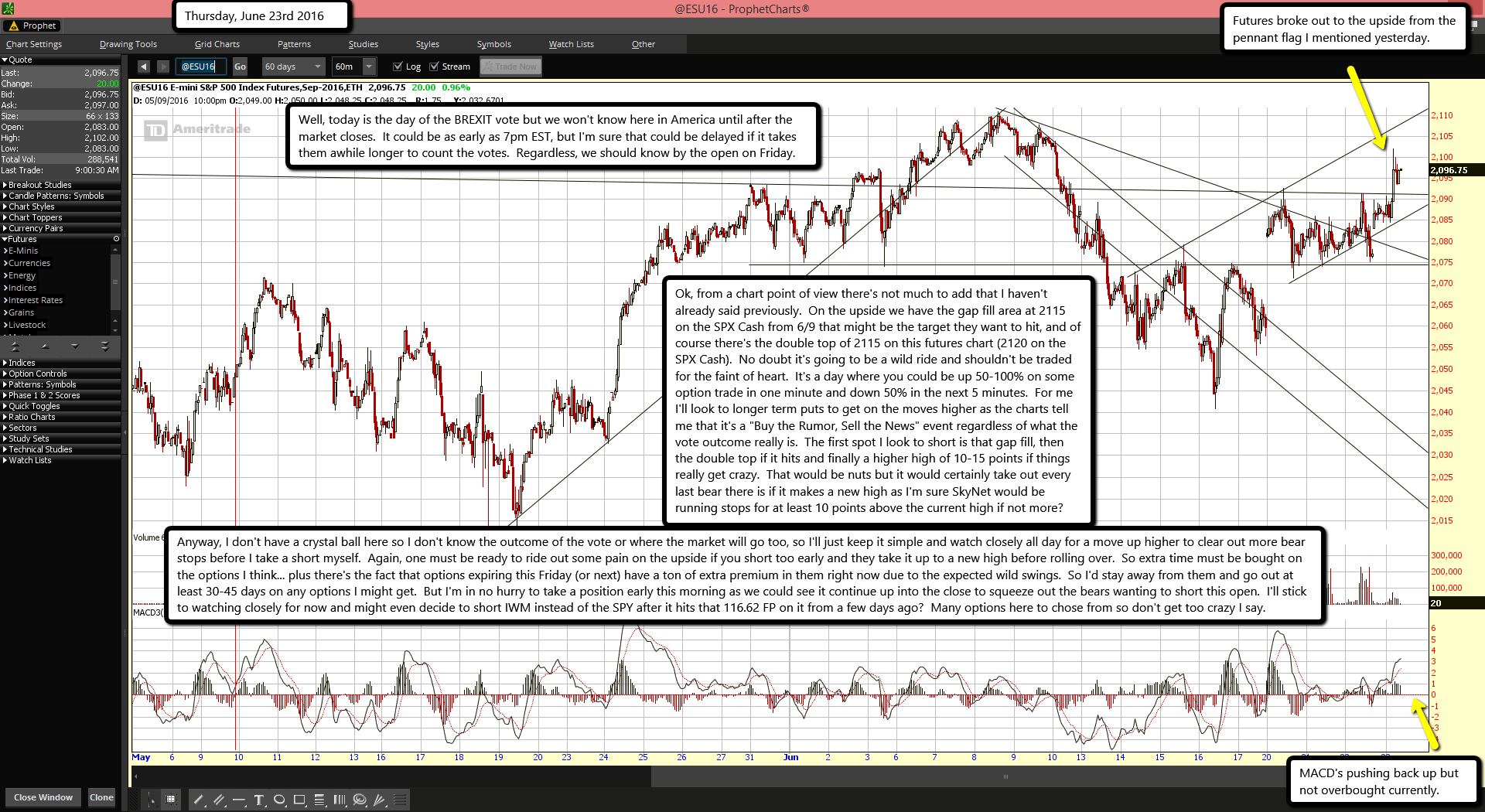
Futures broke out to the upside from the pennant flag I mentioned yesterday.

MACD's pushing back up but not overbought currently.

Well, today is the day of the BREXIT vote but we won't know here in America until after the market closes.  It could be as early as 7pm EST, but I'm sure that could be delayed if it takes them awhile longer to count the votes.  Regardless, we should know by the open on Friday.

Ok, from a chart point of view there's not much to add that I haven't already said previously.  On the upside we have the gap fill area at 2115 on the SPX Cash from 6/9 that might be the target they want to hit, and of course there's the double top of 2115 on this futures chart (2120 on the SPX Cash).  No doubt it's going to be a wild ride and shouldn't be traded for the faint of heart.  It's a day where you could be up 50-100% on some option trade in one minute and down 50% in the next 5 minutes.  For me I'll look to longer term puts to get on the moves higher as the charts tell me that it's a "Buy the Rumor, Sell the News" event regardless of what the vote outcome really is.  The first spot I look to short is that gap fill, then the double top if it hits and finally a higher high of 10-15 points if things really get crazy.  That would be nuts but it would certainly take out every last bear there is if it makes a new high as I'm sure SkyNet would be running stops for at least 10 points above the current high if not more?

Anyway, I don't have a crystal ball here so I don't know the outcome of the vote or where the market will go too, so I'll just keep it simple and watch closely all day for a move up higher to clear out more bear stops before I take a short myself.  Again, one must be ready to ride out some pain on the upside if you short too early and they take it up to a new high before rolling over.  So extra time must be bought on the options I think... plus there's the fact that options expiring this Friday (or next) have a ton of extra premium in them right now due to the expected wild swings.  So I'd stay away from them and go out at least 30-45 days on any options I might get.  But I'm in no hurry to take a position early this morning as we could see it continue up into the close to squeeze out the bears wanting to short this open.  I'll stick to watching closely for now and might even decide to short IWM instead of the SPY after it hits that 116.62 FP on it from a few days ago?  Many options here to chose from so don't get too crazy I say.

Lord Rothschild: Brexit would be “damaging and disorderly”

0

lord-rothschild

http://www.investmentweek.co.uk/investment-week/news/2461651/lord-rothschild-a-brexit-would-be-damaging-and-disoderly?utm_medium=email&utm_campaign=IW.SP_04.Daily_RL.EU.A.U&utm_source=IW.DCM.Editors_Updates

Lord Jacob Rothschild has said leaving the EU could lead to a "damaging and disorderly situation" in the UK as he urged Britons to vote 'remain'.

Writing in a comment piece for the The Times, Lord Rothschild, said readers should not "risk the well being of our country"and European countries are "better off together".

Rothschild (pictured), who chairs the RIT Capital Partners investment trust, refers to his family businesses which originated with five brothers setting up the "first truly international banking system," operating from London, Paris, Vienna, Naples and Frankfurt at the end of the 18th century.

He said: "The brothers, working together to exchange information and ideas, built an extraordinary business that operated across boundaries and cultures.

"150 years later, the foundation of the EEC operated on similar principles, namely that we are stronger and better off together."

Rothschild also alludes to a number of major independent institutions, including the IMF, OECD and the Bank of England, all of which have warned against leaving the EU as it would cause the UK economy to suffer.

The OECD have said UK GDP could fall more than 3% in the case of a Brexit and believes the UK's "economic dynamism and productivity" would suffer.

4071279737_c300,200,50,34,100Commenting on political and foreign policy, Rothschild said we live in a time when "international order based on co-operation is crucial to prosperity and security".

He added: "At present we enjoy being a permanent member of the UN security council and we are essential to the G8 and Commonwealth. But diplomacy, defence, the environment and our values of being a liberal democracy will all be at risk."

He also pointed out that a vote to leave the EU would increase the risk of Scotland calling for another referendum and the future of the UK as a coherent entity will be at stake.

"I can see no good reason why we should accept our playing a diminished role on the world stage," he said.

----------

if "mr burns" thinks its a good idea to stay then i would advise running 180 degrees in the opposite direction..

the doom is flowing heavy now..

"Lord Rothschild, said readers should not "risk the wellbeing of our country"and European countries are "better off together"."

s2Member®