Sunday, October 25, 2026
Home Blog Page 84

ES Morning Update May 18th 2016

0

d9dc8fc2-1e0c-4a32-9956-d4f22791345d

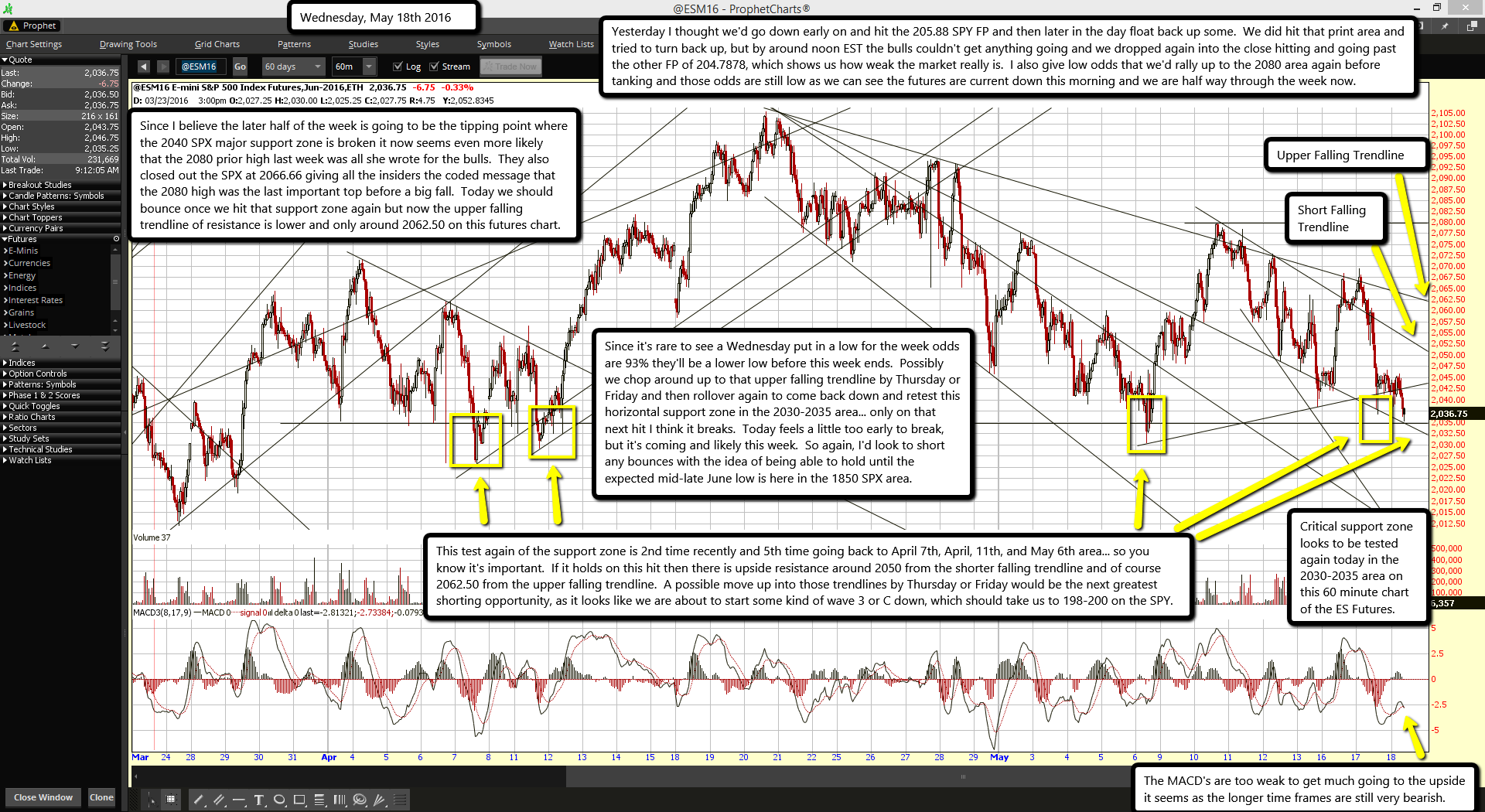
Critical support zone looks to be tested again today in the 2030-2035 area on this 60 minute chart of the ES Futures.

The MACD's are too weak to get much going to the upside it seems as the longer time frames are still very bearish.

Yesterday I thought we'd go down early on and hit the 205.88 SPY FP and then later in the day float back up some.  We did hit that print area and tried to turn back up, but by around noon EST the bulls couldn't get anything going and we dropped again into the close hitting and going past the other FP of 204.7878, which shows us how weak the market really is.  I also give low odds that we'd rally up to the 2080 area again before tanking and those odds are still low as we can see the futures are current down this morning and we are half way through the week now.

Since I believe the later half of the week is going to be the tipping point where the 2040 SPX major support zone is broken it now seems even more likely that the 2080 prior high last week was all she wrote for the bulls.  They also closed out the SPX at 2066.66 giving all the insiders the coded message that the 2080 high was the last important top before a big fall.  Today we should bounce once we hit that support zone again but now the upper falling trendline of resistance is lower and only around 2062.50 on this futures chart.

Since it's rare to see a Wednesday put in a low for the week odds are 93% they'll be a lower low before this week ends.  Possibly we chop around up to that upper falling trendline by Thursday or Friday and then rollover again to come back down and retest this horizontal support zone in the 2030-2035 area... only on that next hit I think it breaks.  Today feels a little too early to break, but it's coming and likely this week.  So again, I'd look to short any bounces with the idea of being able to hold until the expected mid-late June low is here in the 1850 SPX area.

This test again of the support zone is 2nd time recently and 5th time going back to April 7th, April, 11th, and May 6th area... so you know it's important.  If it holds on this hit then there is upside resistance around 2050 from the shorter falling trendline and of course 2062.50 from the upper falling trendline.  A possible move up into those trendlines by Thursday or Friday would be the next greatest shorting opportunity, as it looks like we are about to start some kind of wave 3 or C down, which should take us to 198-200 on the SPY.

ES Morning Update May 17th 2016

0

9d0500d0-de59-4a23-b304-9ea9f8d88a70

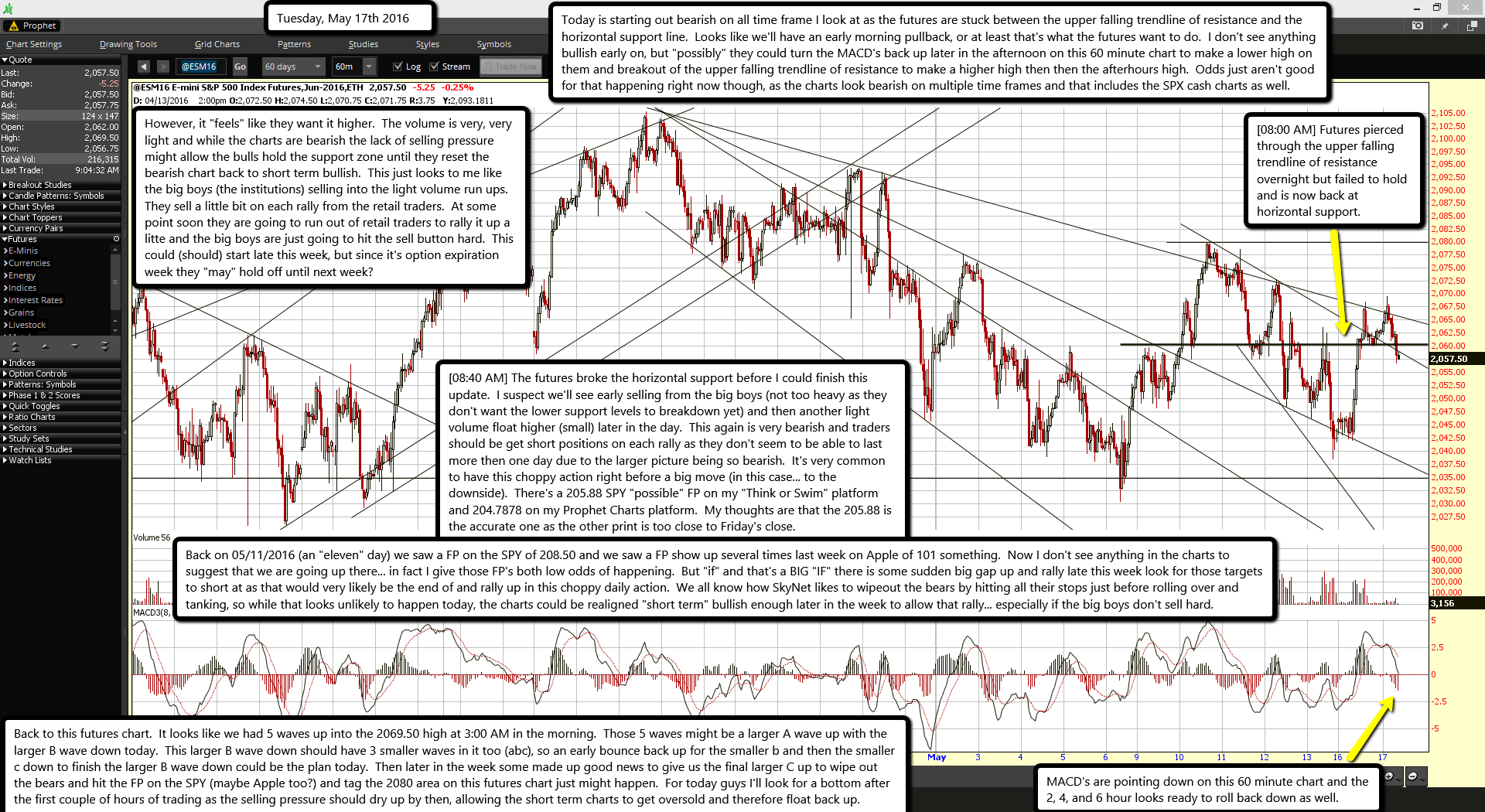
[08:00 AM] Futures pierced through the upper falling trendline of resistance overnight but failed to hold and is now back at horizontal support.

MACD's are pointing down on this 60 minute chart and the 2, 4, and 6 hour looks ready to roll back down as well.

Today is starting out bearish on all time frame I look at as the futures are stuck between the upper falling trendline of resistance and the horizontal support line.  Looks like we'll have an early morning pullback, or at least that's what the futures want to do.  I don't see anything bullish early on, but "possibly" they could turn the MACD's back up later in the afternoon on this 60 minute chart to make a lower high on them and breakout of the upper falling trendline of resistance to make a higher high then then the afterhours high.  Odds just aren't good for that happening right now though, as the charts look bearish on multiple time frames and that includes the SPX cash charts as well.

However, it "feels" like they want it higher.  The volume is very, very light and while the charts are bearish the lack of selling pressure might allow the bulls hold the support zone until they reset the bearish chart back to short term bullish.  This just looks to me like the big boys (the institutions) selling into the light volume run ups.  They sell a little bit on each rally from the retail traders.  At some point soon they are going to run out of retail traders to rally it up a litte and the big boys are just going to hit the sell button hard.  This could (should) start late this week, but since it's option expiration week they "may" hold off until next week?

[08:40 AM] The futures broke the horizontal support before I could finish this update.  I suspect we'll see early selling from the big boys (not too heavy as they don't want the lower support levels to breakdown yet) and then another light volume float higher (small) later in the day.  This again is very bearish and traders should be get short positions on each rally as they don't seem to be able to last more then one day due to the larger picture being so bearish.  It's very common to have this choppy action right before a big move (in this case... to the downside).  There's a 205.88 SPY "possible" FP on my "Think or Swim" platform and 204.7878 on my Prophet Charts platform.  My thoughts are that the 205.88 is the accurate one as the other print is too close to Friday's close.

Back on 05/11/2016 (an "eleven" day) we saw a FP on the SPY of 208.50 and we saw a FP show up several times last week on Apple of 101 something.  Now I don't see anything in the charts to suggest that we are going up there... in fact I give those FP's both low odds of happening.  But "if" and that's a BIG "IF" there is some sudden big gap up and rally late this week look for those targets to short at as that would very likely be the end of and rally up in this choppy daily action.  We all know how SkyNet likes to wipeout the bears by hitting all their stops just before rolling over and tanking, so while that looks unlikely to happen today, the charts could be realigned "short term" bullish enough later in the week to allow that rally... especially if the big boys don't sell hard.

Back to this futures chart.  It looks like we had 5 waves up into the 2069.50 high at 3:00 AM in the morning.  Those 5 waves might be a larger A wave up with the larger B wave down today.  This larger B wave down should have 3 smaller waves in it too (abc), so an early bounce back up for the smaller b and then the smaller c down to finish the larger B wave down could be the plan today.  Then later in the week some made up good news to give us the final larger C up to wipe out the bears and hit the FP on the SPY (maybe Apple too?) and tag the 2080 area on this futures chart just might happen.  For today guys I'll look for a bottom after the first couple of hours of trading as the selling pressure should dry up by then, allowing the short term charts to get oversold and therefore float back up.

Amazon private labels could hit Millennial sweet spot

0
AFP 547531596 I FIN CGO DEU BR

SAN FRANCISCO — Amazon's reported shift into private label grocery offerings takes a page out the basic retail strategy book it's aggressively pursued, often to the chagrin of brick and mortar competitors.

But Amazon has an even bigger incentive than Target and Wal-Mart did when they expanded into private-label products over a decade ago: Millennials.

The generation that's grown up with the Internet has shown more loyalty to distributors — say flight-and hotel-aggregator Kayak.com or delivery services Uber Eats — than the end brand that provides the good or service, says Phil Lempert, a Los Angeles-based consumer analyst who focuses on food trends.

In the case of an Amazon-branded coffee or detergent, Amazon already “owns” the customers' loyalty and trust, which means its own name carries weight, says Lempert. The private label means the item is likely to be cheaper — a draw for America's largest living generation, who are now in their 20s and early 30s.

“Millennials care about quality and price and taste; they’re brand agnostic. It's a sweet spot for Amazon,” he said.

Along with detergent and diapers, the Seattle-based online retailer plans to sell private label nuts, spices, tea, coffee, baby food and vitamins, according to a report in the Wall Street Journal. Amazon would not comment on the report.

The product expansion can help Amazon continue to be the go-to choice for the connected generation, as well as reshape consumer perception about where they can go to get the things they need every day, according to Market Track, a Chicago-based market analysis firm. That's something that traditionally happened in brick and mortar stores but which Amazon wants to move online.

Private labels popular

The move is not completely foreign to Amazon, which already sells electronics accessories and home goods such as bed sheets and knife sets under its Amazon Basics brand.

It's had some missteps in the past. In late 2014 it dabbled in private label grocery items, including baby diapers bundled with wipes called Amazon Elements. Unlike its Amazon Basics label, Elements did not catch on with consumers and the company cancelled the product after customer complaints around a month after launch.

In the grocery world, private label brands are a big money maker. The items are often produced in the same plants as name- brand items but are labeled with a store brand, saving all the cost of advertising and thus allowing them to be sold for less.

A full 88% of consumers say they buy private label, primarily because of price, according to Market Track. If they have to make a decision between a private label and a national brand, and the private label brand has a lower price, they go for the the private label at a rate of 80%, the firm's survey's show.

“Due to Amazon’s size and scale they have the ability to offer pricing that is highly competitive,” said Traci Gregorski, vice president of marketing at Market Track.

All about the Prime

The products will only be available to Amazon Prime members, according to the Wall Street Journal. Members pay $99 a year for two-day delivery, free streaming video and a host of other extras. The build out is part of Amazon’s long term plan to further pull Americans into its retail world with Prime membership.

“The entire Amazon ecosystem revolves around Prime,” said David Smith, an Amazon analyst with Gartner.

That's because Prime members are so lucrative. They  spend on average about $1,100 per year, compared to about $600 per year for non-members, according to Consumer Intelligence Research Partners.

There were 54 million Prime members in the United States at the end of 2015, 21% of the U.S. adult population, a CIRP report from January found.

Amazon itself doesn't disclose Prime membership numbers, beyond saying it has tens of millions of Prime members.

The move shouldn’t have come as a surprise to anyone in the grocery business, where house brands are part of the playbook of every major retail account. They look at what sells and then produce it on their own for higher margins, said Sucharita Mulpuru, a senior Amazon analyst with Forrester.

“It's not like this is as complex as flying to Mars. This is what the club warehouses and Trader Joe's do all day,” she said.

A miss on the names

Some of the brand names Amazon may use for its new lines include Happy Belly, Wickedly Prime, Presto! and Mama Bear, according to the Journal report.

Happy Belly would be the brand for nuts, spices, tea and cooking oil. Wickedly Prime will be the name for snacks while Mama Bear would be the name used for baby food and diapers. Detergents and home goods would fall under the Presto! name.

If those are the names, it's a stumble on Amazon's part, said Lempert..

“"They’re weird, they’re trying to to be too hip and cool,” he said.

Source link

Andrew Left Takes Long Stance on Valeant, Awaiting ‘Bounce’ in Shares

0

It appears Citron Research's Andrew Left is changing tack on beleagured Canadian drugmaker Valeant Pharmaceuticals (VRX).

The activist short seller -- who helped send shares of Valeant into a tailspin last fall -- said in a Monday interview with Real Money that he "wouldn't be surprised if there's a bounce" in the drugmaker's stock, which has fallen more than 90% since last summer.

"I'm long for Valeant, but I also own some out-of-the-money puts," he said, noting he's unfazed by Valeant's decision today to broaden discounts on two drugs, Nitropress and Isuprel. (Out-of-the-money puts are a common investment vehicle used in short selling.) "I don't think they're going to make any decisions that are going to torpedo their company," Left added.

The most important metric in gauging Valeant's recovery, according to Left, will be sales of its flagship Xifaxin, which was obtained as part of Valeant's $11 billion of Salix last April. Robust sales will be crucial to spur growth, especially as Valeant looks to offload a roughly $20 billion debt burden, Left added.

Valeant has long been trying to extricate itself from intense media scrutiny surrounding allegations that its unfairly hiked drug prices to exorbitant levels, with its former CEO, Michael Pearson, appearing before the Senate Special Committee on Aging last month to apologize for having said shareholder interests were his top priority, interests above patient and hospital concerns.

On Monday, its new CEO, Joseph Papa, reiterated his mission to rebrand the company's image as a patient-first drugmaker, as part of his broadening of product discounts.

"I also want to thank the Senate Committee on Aging and the House Committee on Oversight and Government Reform for the attention they have brought to this issue, and specifically to gaps they identified in the previous program," he said in a Monday statement. "We are committed to getting this right."

Source link

Apple buy sign of change at Buffett’s Berkshire

0

Billionaire investor Warren Buffett's Berkshire Hathaway has taken a stake in Apple currently worth $900 million. David Craig for USA TODAY.

Today’s Berkshire Hathaway isn’t your grand-dad’s Berkshire.

Berkshire’s frontman is still billionaire investor Warren Buffett, now 85. But change is afoot at the giant conglomerate, witnessed by a more aggressive move into areas of the stock market that Buffett once steered clear of -- such as tech stocks -- and increasing signs that decisions on what stocks to buy and sell appear to be shifting to investment lieutenants brought in by Buffett himself a few years back.

Buffett’s Berkshire made big news Monday when it revealed in a regulatory filing that in the first quarter it had built a 9.8 million share stake in iPhone maker Apple worth nearly $1.1 billion at the end of March. But as USA TODAY sources had theorized, and which Buffett confirmed to the Wall Street Journal via e-mail, the Apple buy was not the work of the Oracle of Omaha himself, but instead executed by one of the two ex-hedge fund managers he hired a few years ago that now manage a big chunk of Berkshire’s stock portfolio.

Indeed, the Apple stock purchase was likely the brainchild of Todd Combs or Ted Weschler, the money managers Buffett brought in to pick stocks for the conglomerate when he’s gone. The addition of the two stock pickers is resulting in a broadening out of the types of stocks Berkshire invests in – and which ones are jettisoned. Buffett, of course, is better known for his own stock picks, which include iconic American companies such as Coca-Cola and American Express.

The fact that the new Apple position has the fingerprints of either Combs or Weschler all over it suggests that the transition away from everything Buffett is moving forward. Indeed, while Buffett has repeatedly said he loves his job and has no plans to quit, there are signs that the transfer of responsibility on the stock picking side of the business is well underway.

“It continues the transition away from Buffett and the broadening of the portfolio away from areas of the market only Buffett is comfortable with and towards areas that Ted and Todd are comfortable with,” says Jeff Matthews, general partner at hedge fund Ram Partners and an author of Buffett-related books, including Pilgrimage to Warren Buffett’s Omaha.

Buffett's name also made headlines over the weekend and early Monday when he confirmed to CNBC that he would consider helping to finance Quicken Loans' Dan Gilbert's bid to buy Yahoo. But Buffett admitted that tech is still not his thing and that he would not take an equity stake in Yahoo.

"Yahoo is not the type of thing I'd ever be an equity partner in," Buffett told CNBC. "I don't know the business and wouldn't know how to evaluate it, but if Dan needed financing, with proper terms and protections, we would be a possible financing help."

The biggest Buffett-chosen tech stock investment was IBM, which he bought in mass back in 2011. His IBM stake at the end of the third-quarter was $12.3 billion, according to regulatory filings. And despite being underwater on the investment by a sizable amount, Buffett defended his IBM holding at last month’s shareholder meeting and added slightly to his position in the just-completed first quarter by about 200,000 shares, according to SEC filings.

The influence of Combs and Weschler on Berkshire’s holdings were apparent when Buffett recently cited Combs’ stock investment and positive impression of aerospace parts maker Precision Castparts as a key reason why Buffett made Precision its biggest acquisition ever, a $37 billion deal which closed in January.

Still, while things are changing at Berkshire, the investment philosophy of buying established companies with staying power and top-flight management at good prices remains very much the same at Berkshire.

“Honestly, I don’t think (the Apple buy) signifies any dramatic change at Berkshire,” says Matthews. “(Berkshire is) always looking for investments that they think make sense. And they think Apple makes sense. Don’t forget Apple is a great consumer products company with a great business model and strong franchise that’s trading at an attractive valuation.”

What’s changing at Berkshire is the people making many of the buy-and-sell decisions.

“The big takeaway is Buffett is getting less involved in investment decisions but at the same time Berkshire is still looking for what they consider is good value,” says Vahan Janjigian, chief investment officer at Greenwich Wealth Management and author of Even Buffett Isn’t Perfect: What You Can – and Can’t – Learn from the World’s Greatest Investor.

Apple, Janjigian says, is “not Buffett’s kind of investment,” adding that the billionaire investor has “famously” avoided tech stocks in the past.

Building a stake in Apple, however, is a sign the new blood at Berkshire is diversifying into parts of the market that Buffett once avoided.

“Tech has become such a big part of the economy that it would sound foolish to say I would never invest in tech,” Janjigian argues. The information technology sector now accounts for 19.79% of the S&P 500 and is the biggest of the 10 major sectors, according to S&P Dow Jones Indices. At the end of 2015, the weighting of Berkshire’s public tech stock holdings was around 10%, according to S&P Capital IQ.

And even though Apple is a tech stock, the investment still jibes with the Berkshire’s time-tested investment philosophy.

The Apple stock purchases, for example, follows a more than 30% drop in the price of Apple’s shares since its post-split peak of $133 per share on Feb. 23, 2015. It comes at a time when the iPhone maker is selling at a cheap valuation. Apple is also a great brand with a strong management team. With Apple now trading at just 10 times earnings –  well below the broad U.S. stock market valuation of 17 times earnings – it’s not nearly as expensive as some other popular tech stocks selling at outrageous prices relative to earnings.

The Apple purchase “does tell us that the people making many of the investment decisions at Berkshire are picking more modern and up-to-date names that are much more popular with everyone else,” Janjigian  explains. “But these are not companies like Tesla or Amazon which you could make the case are tremendously overvalued. They’re still looking for investments that show value and that they can buy at a cheap price.”

Apple wasn’t the only stock moves Buffett cited in its regulatory filing. Berkshire added to its investment in IBM, which is also trading at an attractive P-E multiple, despite falling about 14% since hitting a 52-week high in May 2015. On IBM, which has consistently bought back its own shares in recent years, and has a well-known brand and CEO that Buffett backs, “Buffett is staying true to his word,” says Robert R. Johnson, president and CEO at The American College of Financial Services. Despite IBM’s poor performance, Buffett told CNBC recently that “we feel fine (about IBM) or we won't own it. I think I can safely say we would be much more likely to buy more in the next 12 to 24 months than we would be to sell shares."

Johnson also had this to say about Berkshire’s other moves:

On selling all of its remaining AT&T stake: “The latest moves are a continuation of recent moves of paring of holdings of AT&T. Likely simply a sale because there were other, more attractive stocks to purchase like Apple and Phillips 66.”

On dumping nearly all of its shares of consumer products maker Procter & Gamble: “It is a terrific company, and has many wonderful brand names, but I believe the valuation over 27 times earnings was simply too rich and the Berkshire team could put that capital to better use in some undervalued companies.”

On reducing its Walmart stake by nearly 950,000 shares to 55.2 million shares. “Walmart’s business model is under pressure. Growth is slowing -- particularly same store sales. There also is pressure to raise employee pay, as Walmart has a very unhappy and increasingly unstable worker base when compared to competitors such as Costco. The WMT model could come under increased pressure as minimum wages rise across the U.S.”

Source link

Apple’s latest billion-dollar business: Venture capital?

0

Apple has a trendy new business that could impact the lives of millions and help it make big money in the future.

No, not the Apple Watch. We're talking about Apple getting into venture capital.

On Thursday night, Apple shocked many by announcing a $1 billion investment in Didi Chuxing, the top ride-hailing service in China.

The investment re-ignited rumors about Apple's intentions to build a car and apparently even caused some relationship issues for the CEO of Uber and his girlfriend. Others framed it as a play to improve Apple's status in China, a key growth market.

But there's a more immediate and less discussed impact. Apple, a business with more than $200 billion in cash and marketable securities, is suddenly acting like a venture capital firm for the first time in years.

"As far as I can tell, Apple’s investment in Didi is its biggest venture investment ever and the first investment since the turn of the century," says Stephanie Cook, a spokesperson for Pitchbook, a data provider for venture capital and private equity deals.

The closest Apple has come to venture capital during those years, according to Cook, has been partnering with the investment firm Kleiner Perkins in 2008 to launch the $100 million iFund for iPhone app developers.

With even a small fraction of its billions in available cash, Apple could cement itself as one of the largest and most influential venture investors in the technology industry, not unlike some of its main competitors.

Google, for example, has launched not one but two venture capital arms, which have invested in prominent businesses like Slack, ClassPass and Didi-rival Uber. (Yes, even when it comes to venture investments, Google and Apple are rivals.) IBM and Twitter have similar investment operations.

This investment tactic allows leading tech companies to build stronger partnerships with promising upstarts, peek into some of their financials and potentially gain a leg-up on acquisitions, as happened when Google backed and later bought Nest.

Apple, never one to relinquish control easily, has shown a preference for acquiring dozens of businesses in recent years rather than backing them with capital and letting them do their thing, as the chart below from VC database CB Insights makes clear.

Apple's investment and acquisition activity leans heavily toward the latter.

"[It's] hard to say whether this is a fundamental change for Apple or not," says Van Baker, an Apple analyst with Gartner. "It could just be Apple putting what is a lot of cash spread around the world to work."

Apple finds itself in a nearly unfathomable position today. It makes more profit per quarter than any business in history, but its once unstoppable sales growth engine is finally showing signs of petering out. The iPhone is flatlining, the iPad is declining fast and it's still unclear whether the Apple Watch is making a dent in sales.

After years of letting its cash pile build up, Apple has shown a willingness to put more of that money to work through massive share buybacks, more frequent acquisitions, increased R&D spending (Apple Car anyone?) and, perhaps for the first time, significant venture capital returns.

"Of course, we believe it will deliver a strong return for our invested capital over time as well," Apple CEO Tim Cook told Reuters about the Didi investment.

Didi may not be as well known in the U.S. as Uber, but it actually delivers more rides (all in China) and represents a similarly promising opportunity for investors. Apple now owns a chunk of a startup valued at around $20 billion — and growing fast.

Anand Sanwal, CEO of CB Insights, points out Apple likely also has "some ownership" now in other leading ride-hailing startups like Lyft, Grab and Olacabs through its Didi investment because Didi has itself invested in and partnered with these services in its efforts to take on Uber globally. 

That's not such a bad investment portfolio, considering Apple is just getting started.

Have something to add to this story? Share it in the comments.

Source link

Gannett raises offer to buy Tribune to $15 per share

0


Tribune Publishing shares plummet after the company revises 2015 revenue, earnings estimates.(Photo: Frederic J. Brown, AFP/Getty Images)

Gannett Co., which owns USA TODAY and more than 100 local news properties nationwide, said Monday it raised its offer to buy Tribune Publishing Co. to $15 per share, dialing up the pressure after its earlier bid was rejected by Tribune’s board of directors despite some shareholders’ call for a negotiation.

The revised offer values Tribune (TPUB), which owns the Los Angeles Times, Chicago Tribune and nine other dailies, at about $479 million. Gannett (GCI) also offered to assume about $385 million of Tribune’s debt, valuing the total deal at about $864 million.

Revised after Gannett met with Tribune shareholders, the heightened offer represents a premium of 99% to Tribune’s closing price of $7.52 per share on April 22, the last trading day before Gannett revealed its initial offer of $12.25.

Shares of Tribune Publishing rose 27% in pre-market trading Monday to $14.52.

"After further review, we have greater confidence in our ability to yield additional operational improvements in this transaction,” Gannett’s CEO Robert Dickey wrote in a letter Monday to Tribune’s board. The McLean, Va.-based company also said it was confident it can receive the antitrust clearance necessary to complete the deal.

Seeking to acquire newspapers and affiliated digital news properties in markets where Gannett lacks a presence, Dickey sent on April 12 a private letter – outlining his all-cash offer -- to Justin Dearborn, Tribune’s CEO, and Michael Ferro, the largest Tribune shareholder who is also its board chairman.

Unable to get a formal negotiation started, Gannett then revealed the offer publicly on April 25, forcing Tribune to hire advisers to begin reviewing the bid. On May 4, Tribune’s board unanimously rejected the offer, saying the company is poised to grow on its own.

In an earnings announcement on the same day, Tribune also told investors and analysts that it was in “the early stages of a compelling transformation” that seeks greater revenue through digital platforms and leveraging the Los Angeles Times brand.

Tribune created a new business unit, called Tronc, that plans to aggregate its in-house digital resources and use software and widgets to better profile its readers for more relevant content and higher digital advertising rates. It also plans to open seven new foreign bureaus for the Los Angeles Times.

Tribune also said on May 4 that its first quarter net loss totaled $6.5 million vs. $2.5 million of net profit in the year-ago period. Revenue remained flat at $398.2 million as print advertising sales continued to tumble.

“By not engaging constructively with Gannett and continuing to pursue an unproven strategy based on its Tronc platform, we believe Tribune is jeopardizing its shareholders’ investment and disregarding their best interests,” Dickey said.

The second-largest shareholder of Tribune, Oaktree Capital, also wasn’t fully convinced of Tribune’s turnaround plan. Earlier this month, the investment firm, which owns about 15% of Tribune, urged Tribune’s management to begin discussions with Gannett.

John Jeffry Louis, chairman of Gannett’s board, intimated that there were other shareholders who were eager to see a deal. “It is evident from our discussions with Tribune shareholders that there is overwhelming support for the companies to engage immediately regarding our proposed transaction,” Louis said Monday.

Sensing growing pressure, Tribune Publishing has adopted a “shareholder rights plan,” known to investors as a poison pill, to thwart Gannett’s bid. Tribune plans to issue new shares if Gannett, or another investor, acquires 20% or more of the company. The move would dilute the acquirer’s stake, thus discouraging in advance any large-stake acquisition plans by an outside investor.

Meanwhile, Gannett is urging Tribune shareholders to withhold their votes next month for election of eight nominees to Tribune’s board of directors.

“By increasing our offer at this time, we are reaffirming Gannett’s belief that this transaction would deliver significant value to both companies’ stakeholders and that the time to act is now,” Louis said.

Source link

Safety concerns remain for Uber, Lyft ride sharing

0

By Dan Russo and Maggie DeBlasis

Capital News Service

Uber 4U by afagen on flickr

In many parts of the country - and indeed, around the world - a ride-booking service is as close and easy to use as launching an app on a smartphone.

But after nearly unimpeded growth in an industry that didn’t exist a decade ago, around 30 U.S. jurisdictions have passed new ride-hailing regulatory legislation, all in the hopes of making services like Uber and Lyft safer for passenger use.

The murders of six victims in Kalamazoo, Mich., in late February, while uncommonly tragic, magnified uncertainties that have faced the ride-hailing industry throughout its meteoric growth. At the top of the list is the safety of its passengers and drivers.

Ride-booking services like Uber and Lyft insist their technology, driver background checks, and two-way rating systems keep their patrons safe, but critics consider those factors and the insurance coverage - or lack thereof - to be the ultimate concern.

Of all the issues facing the ride-booking industry, as well as its competitor, the taxi and limousine services, safety is the paramount concern.

Safety concerns high in poll

In a national poll of 3,000 riders, 81 percent said safety was the chief factor when using either a taxi or a ride-hailing service like Uber or Lyft. The survey was conducted for a taxi-limousine trade association, but the data was collected by FrederickPolls, an Arlington, Va., firm.

SurveyMonkey data found that riders found ride-booking “makes lives easier, but can be seen as expensive and unsafe.”

But industry defenders see the safety issue as overblown.

“There is little evidence that the sharing economy services are more dangerous than traditional taxis,” Matthew Feeney, a policy analyst with the Cato Institute, wrote last year. Cato is a Washington-based libertarian think-tank that generally advocates less government regulation.

“In fact,” Feeney said, “the ridesharing business model offers big safety advantages as far as drivers are concerned. In particular, ride-hailing’s cash-free transactions and self-identified customers substantially mitigate one of the worst risks associated with traditional taxis: the risk of violent crime.”

Empirical data, however, is lacking. Tracking incidents involving ride-booking drivers or passengers is difficult: not all law enforcement agencies collect information the same way and many do not specifically track crimes or incidents related to ride-hailing services.

Maryland law brings equivalent regulation to taxis

February’s Michigan murders involving an Uber driver was a rare deadly case. But several less serious incidents have occurred in the District of Columbia-Maryland-Virginia area within the last three years, according to local police records and news reports examined by Capital News Service.

Maryland passed a law in July that essentially sets the same requirements for taxi services and ride-booking companies on insurance, licensing, and the handling of complaints by passengers.

The sponsor of the law, Sen. Bill Ferguson, D-Baltimore City, said it represented a compromise between state limo and taxi services and ride-booking companies that allows for innovation without risking consumers’ safety.

“It creates a new, more flexible regulating scheme to appropriate and regulate ridesharing services in the state of Maryland,” Ferguson said.

“Ridesharing is enormously popular and has been even when they were operating in more of a gray area,” the lawmaker continued. “(The bill) was a fiercely opposed bill for two years and last year we spent a lot of time working with all the stakeholders - taxis and limos to thinking with insurance regulators and companies and by the end of session last year ... almost everybody was in favor of it.”

Virginia laws, also enacted in 2015, are similar, requiring more in-depth driver background checks - though not fingerprinting, which both Uber and Lyft are fighting in some areas - and the possession of insurance policies.

Uber is not a taxi and vice versa

If anything, the new laws and incidents in the Washington region underscore the general uneasiness toward ride-booking in the industry across the United States, according to critics.

“What we've typically seen with Uber is that they have really only done the bare minimum as required by law when it comes to important issues like safety, background checks and insurance,” said Harry Campbell, an Uber and Lyft driver who quit his job as an engineer to run his blog, TheRideshareGuy.com. Campbell has also written articles on the ride-hailing industry for outlets such as Buzzfeed, the New York Times, and Huffington Post Live.

Most recently, Uber agreed to pay Los Angeles and San Francisco a $25 million settlement in a lawsuit brought by the cities’ district attorneys. TechCrunch reported that the lawsuit claimed the company was “charging a $4 fee for passengers being collected from or going to California airports (and prosecutors) found that the ‘toll’ wasn’t being passed on to the airports…”

As a part of the settlement, Uber has also pledged to stop using certain language claiming that their background checks were top-tier.

“We’ve agreed not to use terms like ‘safest ride on the road’ or describe our background checks as ‘the gold standard,’” the company said in a statement.

At the epicenter of the ride-hailing controversy lie three clear, but intertwining issues: the fundamental difference between ride-booking and the taxi industry; the ride-hailing company’s accountability for their drivers’ and passengers’ safeties; and the uncertainty surrounding the ride-booking platform’s sustainability as a business model.

Matchmaking service

Uber even has a disclaimer at the bottom of its Greater Maryland website that might surprise a lot of its users: “Uber is not a transportation provider.”

The difference at a basic level is that taxi companies usually own their vehicles and employ their drivers, whereas services like Uber and Lyft merely provide a platform for riders and drivers to match and meet up.

“Certainly when I teach, I say Uber is a platform and they are a matchmaking service to make sure that people who want rides and people provide rides can find each other,” said Joe Bailey, a professor in the University of Maryland’s Robert H. Smith School of Business.

“But (Uber and similar services are) not the ones who own the vehicles or (are) providing the transportation service,” he said.

Ride-booking industry defense

In an effort to address demands from federal, state, and municipal agencies for information about its operations, Uber, the leading ride-hailing company, released its first transparency report on April 12.

The report detailed the scope of data that state and federal agencies and law enforcement requested in the second half of 2015, which included information on 50 Uber drivers in Maryland.

Uber, a privately-held company, said it hoped that its report would open “a public debate about the types and amounts of information regulated services should be required to provide to their regulators, and under what circumstances.” Uber alleged that information requests of digital companies often exceeded those of their offline, more traditional counterparts.

“In many cases [agencies] send blanket requests without explaining why the information is needed, or how it will be used,” Uber said in a statement. “And while this kind of trip data doesn’t include personal information, it can reveal patterns of behavior -- and is more than regulators need to do their jobs.”

Uber and the entire ride-hailing industry believe that they are being backed into a corner, attempting to balance the requests of regulatory agencies and public demands for improved safety features, while protecting customer privacy.

According to Uber’s website, all Uber drivers undergo a pre-screening process, including a review of motor vehicle and criminal records, in order to become certified and get paid. The company also maintains a code of conduct for both drivers’ and passengers' safeties.

Technological safety features

Uber spokeswoman Kaitlin Durkosh said that all transportation has its risks, but Uber offers technological safety features that its competitors don’t.

“I think what people often forget is that, just a few years ago, being able to wait safely inside for your ride, knowing who your driver was and when your ride was arriving, didn’t really exist,” Durkosh said. “Furthermore, if you wanted to get somewhere in that moment of time, you probably had to go outside and either hail down a taxi or walk to find a bus or a Metro stop.”

Aside from Uber’s background checks, its technological safeguards include a GPS locator that tracks the service’s car, communication with drivers that don’t require users to provide their phone numbers, and the rider’s ability to share the location, route, and estimated time of arrival with a friend or family member. The company’s app also provides the driver’s first name, photo, license plate number, and rating.

After both the driver and rider rate each other, Uber’s 24-hour safety team reviews each report and looks into any incidents, Durkosh said, though the company’s code of conduct insists that, in case of an emergency, the proper authorities be contacted first.

However, those safety measures don’t always prevent incidents.

Crime incidents include six in Annapolis

The Washington Post reported in July 2014 that Ryan Simonetti, CEO of New York-based Convene, said he was “kidnapped” by an Uber driver in the nation’s capital. According to his Twitter account, Simonetti said he was “held against (his) will, and involved in a high speed chase across state lines with police #Crazy.” An Uber representative confirmed to The Post the driver no longer drives for the company.

In September 2014, the Courthouse News Service reported a Washington, D.C., man sued Uber after being stabbed six times by his driver the previous September.

An off-duty Uber driver admitted to having been drinking in June 2015 when he veered from his side of the road and ran into an oncoming car, killing a Gaithersburg, Md., woman driving, according to Washington’s WJLA-TV.

Those are only three of at least 10 accounts of Uber drivers endangering or allegedly endangering their passengers in the Washington area since 2013, according to police and media reports. Most occurred in Northwest Washington, a handful were recorded in Northern Virginia, and six were reported in Annapolis in 2015, the first year the company serviced the city.

In late February, the Baltimore Sun reported that a convicted drug dealer on supervised release regularly used Uber to transport heroin in Southeast Baltimore. Drug Enforcement Administration agents said in a search warrant they believed the passenger to be moving “10 to 20 kilograms per month.”

Kalamazoo and its effect on business

The Michigan Uber driver, 45-year-old Jason Brian Dalton, was charged with 16 counts at his arraignment, including six counts of murder and one count of attempted murder of a minor.

Despite the horrific violence Dalton is allegedly responsible for, local police confirmed he had no prior criminal record.

“If the person doesn’t have a criminal record, then no background check is going to raise any flags,” Uber’s Durkosh said. “So, as that case has shown, past behavior may not accurately predict how people will behave in the future and that’s where we think our technology features that we have in place can help ensure safety before, during, and after a ride in ways that other transportation options cannot.”

Even with that technological advantage, Campbell said Uber could and should be doing more to spearhead improved safety features.

“As a $60 billion company and a leader of the on-demand economy, I feel they should actually be leading the charge when it comes to these types of issues, instead of taking a backseat,” Campbell said.

Despite safety concerns, Uber’s growth has been spectacular. The company rose from a startup in 2009 to a platform revolutionizing the transportation industry in a short seven years.

Bloomberg Business reported Dec. 3 that the company is valued at $62.5 billion.

The University of Maryland’s Bailey said it is difficult to measure how bad publicity will affect the company’s worth because Uber is not yet publicly traded and its stock cannot be tracked.

“With privately-held companies, it’s very difficult to ascertain kind of what their market capitalization is going to be at any given time,” Bailey explained.

The future

While Uber has been mostly compliant with the wave of new legislation and in some cases has championed technological safety features, the glaring question of accountability persists for both investors and the public, according to Bailey.

Bailey said venture capitalists will look at the events in Michigan as a “stress test” for Uber’s leadership and how they respond.

The long-term effects of the shooting in Michigan are still being felt now, with ride-booking legislation being passed in all but four states as of early April.

But for a company looking to become publicly traded some time in 2016 - the exact date remains unknown - Bailey said one question should be asked: “(Does the Kalamazoo shooting) somehow make the business model that Uber has completely unviable? Or is this a terrible tragedy, but ultimately not the responsibility of the platform like Uber?”

The public’s perception of Uber’s accountability, Bailey said, may “matter more than (the disclaimer) on their website.”

Source link

Bills aim to catch up with Uber, Lyft

0

N.J. bills aim to catch up with Uber, LyftAn Uber driver at San Francisco International Airport. Fingerprinting of drivers - required for New Jersey taxi drivers - is a sticking point between legislators and the company.

An Uber driver at San Francisco International Airport. Fingerprinting of drivers - required for New Jersey taxi drivers - is a sticking point between legislators and the company.

Applications that allow people to use smartphones to summon a driver at a moment’s notice have soared in popularity in recent years.

And as companies like Uber and Lyft have altered the transportation landscape with these ride-hailing services, efforts to regulate them in New Jersey have trailed behind their fast-evolving business models.  As with other technological advances — like electric cars and apps that allow people to rent their homes to vacationers — lawmakers acknowledge they have been playing catch-up.

That may soon change when it comes to ride-hailing platforms.

Lawmakers in both houses of the Legislature last week introduced bills aimed at creating a regulatory framework that they say will allow these companies to operate while imposing new licensing requirements.

“Clearly the industry got ahead of government — there’s no doubt about that,” said Sen. Paul Sarlo, D-Wood-Ridge, sponsor of the Senate bill.  Assemblyman Joseph Lagana, D-Paramus, sponsor of the Assembly bill, agreed it took lawmakers awhile to understand the new business model.

“From the beginning, it was difficult to determine if this was a new transportation company,” Lagana said. “Or is this a technology company?”

The popularity of ride-hailing services “exploded — it blew up,” Lagana said. “What’s happened is we’ve now had to catch up with legislation.”  Assemblyman Tim Eustace, D-Maywood, said the rapid rise of such services as Uber, Lyft and the vacation rental app Airbnb have led him to include the phrase “or current technology,” whenever he drafts a bill.

“So that we leave the door open for using the newest technology as opposed to going back and reinventing the wheel and having to rewrite each law to include what’s permissible,” Eustace said. “It’s almost a waste of money not to include that.”

With the ride-hailing legislation, both the Senate and Assembly bills contain similar requirements on insurance coverage, permit fees and record-keeping inspections. Both give drivers the ability to move freely from one town to another and prevent cities and counties from imposing their own regulations and fees.

But the bills differ in one important respect that could become a flashpoint of contention: the use of fingerprints as the basis for criminal background checks.

The Assembly bill sponsored by Lagana, Troy Singleton, D-Burlington, and John Wisniewski, D-Middlesex, would require that drivers be fingerprinted unless the companies can convince the state police that they have an acceptable alternative background check.

“Isn’t it the best policy to use the gold standard of criminal background checks in determining whether or not a person should be picking up passengers?” Lagana said.  But representatives for Uber and Lyft say they use computer-based criminal background systems that are as effective, if not more so, than the traditional fingerprint-based searches.

Lyft offered a white paper by a former Baltimore police chief who argued that fingerprint background searches are flawed and inefficient.

Both companies have resisted such efforts in other states and cities to the point of withdrawing their business from those areas.

“Any inclusion of fingerprint requirements would kick Uber out of New Jersey, just as similar measures have forced Uber out of Kansas; San Antonio, Texas; Broward County, Fla.; and most recently Austin, Texas,” Uber spokesman Craig Ewer said in an email.  But both companies say they welcome the New Jersey lawmakers’ attempts at regulating their business.

“New Jersey deserves a permanent statewide ride-sharing framework that provides clarity for drivers and passengers,” Lyft spokesman Chelsea Wilson wrote in an email. “We are pleased that the State House is weighing these proposals and are confident that legislators will soon pass one comprehensive ride-sharing solution.”

The Senate bill, sponsored by Sarlo and Sen. Joseph Kyrillos, R-Monmouth, would require drivers to submit to a criminal history check by a “certified background screener.” But it does not include any fingerprint requirements.

“I’m not vehemently opposed to any fingerprinting down the line,” Sarlo said last week. “But I think this is a good starting point.”

But the lack of that provision drew opposition from representatives of the taxi industry and limousine drivers.

“Anything less than a fingerprinted background check is not to be trusted and puts the public at risk,” said Jason Sharenow, president of the Limousine Association of New Jersey.

He noted that limo and taxi drivers as well as a host of other professionals in New Jersey have to be fingerprinted as a requirement of obtaining a license.  The Senate bill is more in line with the laws in 35 states that have adopted some form of ride-hailing legislation. None require fingerprinting, said Douglas Shinkle, transportation program director for the National Conference of State Legislatures.

However, he said that could change now that some cities, including New York and Houston, have adopted the fingerprinting requirement and others, like Atlanta and Los Angeles, have discussed doing so.

Shinkle said most state legislatures had reacted quickly to the fast-emerging ride-hailing businesses.

“They just wanted the basic regulatory framework in place in recognizing the kind of value of these transportation services,” Shinkle said.

New Jersey’s early attempts at drafting regulations got off to a bumpy start in March 2015 when both Uber and taxi drivers staged a noisy, dueling set of protests outside the State House in Trenton. Earlier versions of the Assembly bill stalled and did not come to a floor vote.

Source link

Supplier relations: GM better, but Toyota, Honda lead

0

Toyota and Honda were ranked as the most cooperative automakers by an annual survey of about 500 suppliers.

General Motors made significant improvement in building trust, but auto suppliers again cited Toyota and Honda as the most supplier-friendly automakers, according to an annual survey on relations between manufacturers and suppliers.

The study, scheduled to be released today by Planning Perspectives, a Birmingham firm that has focused on the industry's supplier relations for more than 16 years, was based on surveys from 647 sales personnel from 492 suppliers.

It is regarded as a barometer for competitive collaboration for new technology and a mutual recognition of automakers' and suppliers' need to survive financially.

The six largest automakers in the U.S. — General Motors, Ford, Toyota, Fiat Chrysler, Honda and Nissan — are ranked on a variety of measurements that are folded into a Working Relations Index that runs between 100 and 500. Here are their scores for this year's study with last year's scores in parentheses.
Planning Perspectives is an annual study that asks auto suppliers which automakers are best to work with.

  • Toyota                 332   (336)
  • Honda                 323   (330)
  • Ford                    267   (261)
  • General Motors   250   (224)
  • Nissan                 225   (244)
  • Fiat Chrysler Automobiles  222   (224)

Why does it matter? Aren't purchasing executives trying to get the best components at the lowest possible price?

Yes, but they also need to establish trust and communication with auto suppliers so they can all work toward a better product.

“There are lots of companies in many industries that are working hard to build the best supplier relations they can, because when things get tough, they want to be the customer of choice," said John Henke, CEO of Planning Perspectives and author of the study, now in its 16th year.

To simplify, the automaker that is willing to pay a few more pennies per fastener or sensor may have a higher initial cost, but may later get access first to a new technology from that same supplier.

Or the supplier may be more willing to suggest a way to integrate multiple parts in a way that saves money.

Instead of haggling over the price of a widget, there are long-term benefits when the automaker treats a supplier as a partner rather than as an adversary.

"Automakers will have to invest heavily in new resources and training programs to improve their working relationships with suppliers because suppliers have a significant impact on an automaker's profits," Henke said. "Currently, this investment isn't happening."

Henke said this year's survey sorted the six major manufacturers into three groups: "Toyota and Honda remain on top. Nissan and FCA were worse than everyone else, then Ford and GM are below Honda and Toyota, but significantly better than Nissan and FCA," he said.

Both Ford and GM were given modestly higher marks on the question of: "Is the vice president of purchasing working to build more trusting supplier relations?"

Ford purchasing chief Birgit Behrendt received a score of 2.77 on a scale of 2 to 5, up from 2.61 last year. Steve Kiefer, GM vice president of global purchasing and supply chain, was given 3.01, up from 2.80 last year.

In response to the question: "Are the automaker's purchasers in general working to build more trust?" GM improved to 3.02 from 2.87, while Ford slipped from 3.11 last year to 2.95. Fiat Chrysler was given a score of 2.64, down from 2.71 last year.

Toyota's score on purchaser trust was 3.33, about the same as last year. Honda's improved from 3.32 to 3.37.

"We are committed to strengthening our collaboration with our partners to deliver mutually beneficial, innovative solutions to our customers," said Bob Young, senior vice president for purchasing with Toyota Motor Engineering & Manufacturing of North America.

The premise of Henke's research is that the better relationships enable both automaker and supplier to bring the best technology to market sooner.

GM's Kiefer said his group has changed some of its metrics to get beyond per-unit cost and establish greater trust.

"The messaging we’ve been trying to send to suppliers is, we want the relationship to reflect consistently high quality," Kiefer said. "We want cost to be the result of bringing suppliers into the design process as early as possible."

Beyond traditional suppliers of steel, aluminum, interior features and engine controls, automakers are learning to work with younger companies that develop the sensing and nanotechnology required for the evolution of autonomous vehicles.

Some of these companies are new to the auto industry.

“It takes a very different relationship to enter into contracts with these kinds of companies," Kiefer said. “But what’s really exciting is how fast these new technologies are moving."
Toyota and Honda were found to be the most cooperative automakers by suppliers in the annual Planning Perspectives survey.

Source link

Pfizer says it’s blocking use of drugs for lethal injections

0

This April 6, 2016, file photo shows the Pfizer logo appearing on a screen above its trading post on the floor of the New York Stock Exchange. Pfizer said Friday, May 13, 2016, it was blocking use of its drugs in lethal injections, which means all federally-approved drugmakers whose medications could be used for executions have now put them off limits.
Pharmaceutical company Pfizer said Friday it was blocking use of its drugs in lethal injections, which means all federally approved drugmakers whose medications could be used for executions have now put them off limits.

"Pfizer makes its products to enhance and save the lives of the patients we serve. Consistent with these values, Pfizer strongly objects to the use of its products as lethal injections for capital punishment," the company said in the statement made public on its website Friday.

The company's announcement has limited immediate impact. Its action is an enhancement of a previous policy that follows Pfizer's $15.23 billion purchase of Lake Forest, Illinois-based Hospira Inc. last year. Hospira had previously prohibited the use of its drugs in capital punishment, as have several other drugmakers.

Pfizer shares closed even Friday at $33.19.

The development means the approximately 25 FDA-approved companies worldwide able to manufacture drugs used in executions have now blocked the use of the drugs, according to Reprieve, a New York-based human rights organization opposed to the death penalty.

"Pfizer's actions cement the pharmaceutical industry's opposition to the misuse of medicines," Maya Foa, Reprieve director, said in a statement.

Pfizer's announcement was unlikely to have much effect on executions, which have slowed in recent years as drugmakers' prohibition on the drugs took effect.

However, as recently as last year, records showed that labels of Arkansas execution drugs appeared to indicate that the state's potassium chloride, which stops the heart, was made by Hospira.Pfizer spokeswoman Rachel Hooper said the company couldn't speculate on the impact of its decision.

Ohio, which last executed an inmate in January 2014, has repeatedly pushed back executions while it looks for drugs. It now has more than two dozen inmates with firm execution dates, but no drugs to put prisoners to death with.

Some remaining death penalty states have been using compounded versions of drugs that fall outside of FDA approval.

Texas, with the country's busiest death chamber, obtains its pentobarbital for lethal injections from a supplier the state identifies only as a licensed compounding pharmacy. A law that took effect last year keeps the identity of the drug provider confidential. The state has carried out six executions so far in 2016. At least eight are scheduled for the coming months, including two in June.

Texas is fighting a lawsuit trying to force it to identify drugmakers from April 2014, when attorneys unsuccessfully filed appeals to stop two executions by seeking the identity of the drug providers, and September 2015, when the state's secrecy law took effect.

Similar lawsuits about whether states must identify their providers have been argued in states including Georgia, Arkansas and Missouri.

There have been 14 executions in the U.S. so far in 2016 in five states: six in Texas, five in Georgia and one each in Alabama, Florida and Missouri. Last year, there were 28 in six states.

Some states have passed laws allowing older methods of execution if needed. Last year, Utah approved the use of firing squads for executions if drugs aren't available, while Oklahoma became the first state to approve nitrogen gas for executions if lethal injection drugs become unavailable or are deemed unconstitutional.

In 2014, Tennessee passed a law allowing the use of the electric chair if lethal drugs can't be found. Virginia is debating a similar bill.

The seven drugs affected by Pfizer's policy: pancuronium bromide, potassium chloride, propofol, midazolam, hydromorphone, rocuronium bromide and vecuronium bromide.

Source link

Verizon, unions will return to bargaining table

0

Verizon workers picket in front of a company facility in New York.

Verizon and striking union officials will restart negotiations Tuesday after a meeting with Labor Secretary Tom Perez.

Nearly 40,000 employees -- members of the Communications Workers of America and International Brotherhood of Electrical Workers -- have been on strike for about a month.

But Verizon CEO Lowell McAdam, CWA president Chris Shelton and IBEW president Lonnie Stephenson met in person with Perez in Washington on Sunday after he contacted the company and unions last week. After "an open, frank and constructive dialogue," the parties decided to return to the bargaining table, the department said.

“The best way to resolve this labor dispute is at the bargaining table, and I am heartened by the parties’ mutual commitment to get back to immediate discussions and work toward a new contract,” Perez said in a statement. “I was singularly impressed by the parties’ appreciation that time is of the essence, and their strong commitment to use the collective bargaining process to reach a mutually beneficial resolution.

Union members, employed by Verizon from Massachusetts to Virginia, have decried Verizon for outsourcing and increasing demands on workers despite burgeoning profits. Verizon officials say that employee health care and retirement compromises are needed to help manage costs.


Source link

ES Morning Update May 16th 2016

0

bc33a8b9-3c20-4f1c-b578-6ab519627a50

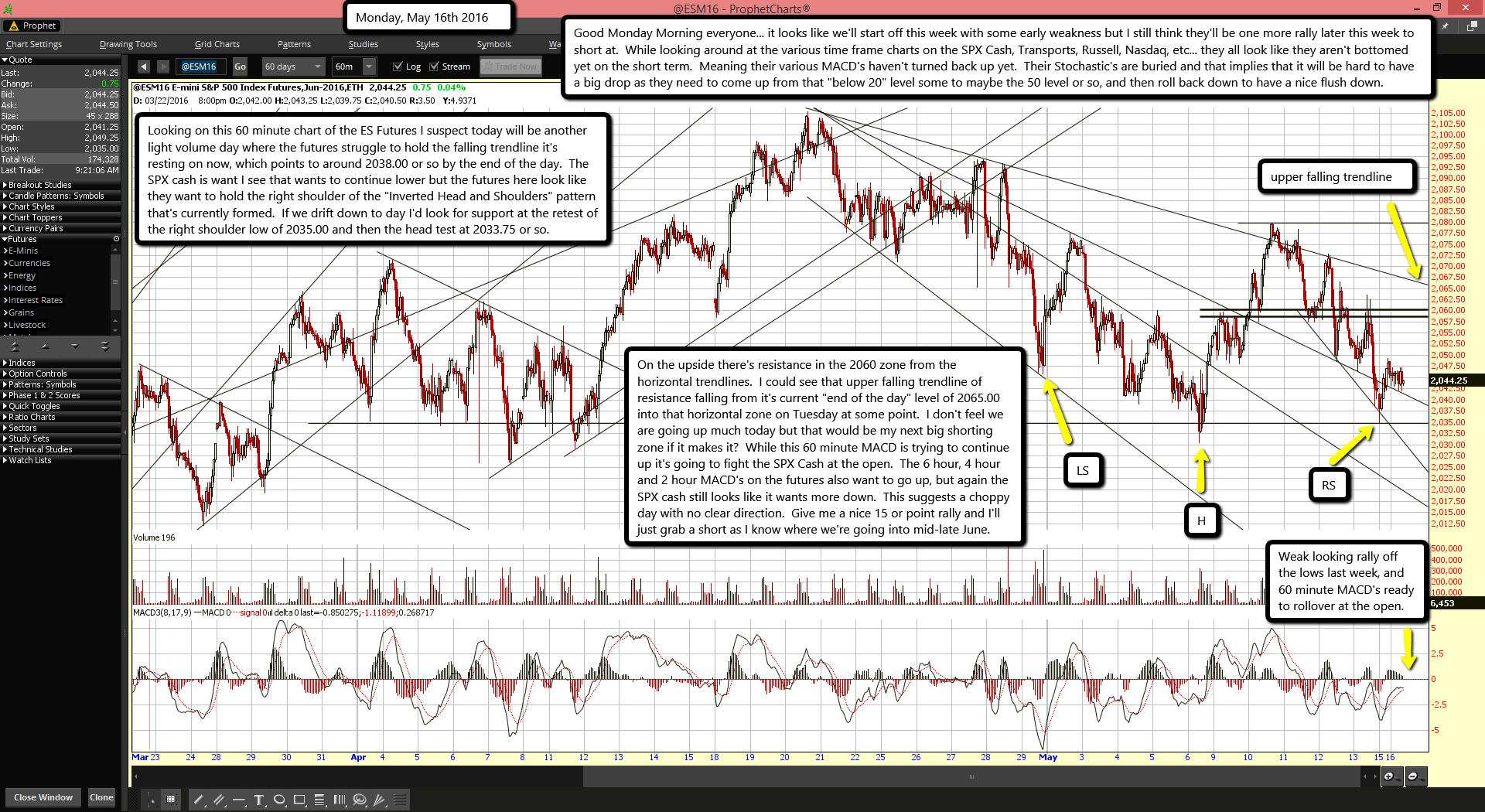
Weak looking rally off the lows last week, and 60 minute MACD's ready to rollover at the open.

Good Monday Morning everyone... it looks like we'll start off this week with some early weakness but I still think they'll be one more rally later this week to short at.  While looking around at the various time frame charts on the SPX Cash, Transports, Russell, Nasdaq, etc... they all look like they aren't bottomed yet on the short term.  Meaning their various MACD's haven't turned back up yet.  Their Stochastic's are buried and that implies that it will be hard to have a big drop as they need to come up from that "below 20" level some to maybe the 50 level or so, and then roll back down to have a nice flush down.

Looking on this 60 minute chart of the ES Futures I suspect today will be another light volume day where the futures struggle to hold the falling trendline it's resting on now, which points to around 2038.00 or so by the end of the day.  The SPX cash is want I see that wants to continue lower but the futures here look like they want to hold the right shoulder of the "Inverted Head and Shoulders" pattern that's currently formed.  If we drift down to day I'd look for support at the retest of the right shoulder low of 2035.00 and then the head test at 2033.75 or so.

On the upside there's resistance in the 2060 zone from the horizontal trendlines.  I could see that upper falling trendline of resistance falling from it's current "end of the day" level of 2065.00 into that horizontal zone on Tuesday at some point.  I don't feel we are going up much today but that would be my next big shorting zone if it makes it?  While this 60 minute MACD is trying to continue up it's going to fight the SPX Cash at the open.  The 6 hour, 4 hour and 2 hour MACD's on the futures also want to go up, but again the SPX cash still looks like it wants more down.  This suggests a choppy day with no clear direction.  Give me a nice 15 or point rally and I'll just grab a short as I know where we're going into mid-late June.

ES Morning Update May 13th 2016

0

a339c81b-437c-45bf-a457-271552b8c0b3

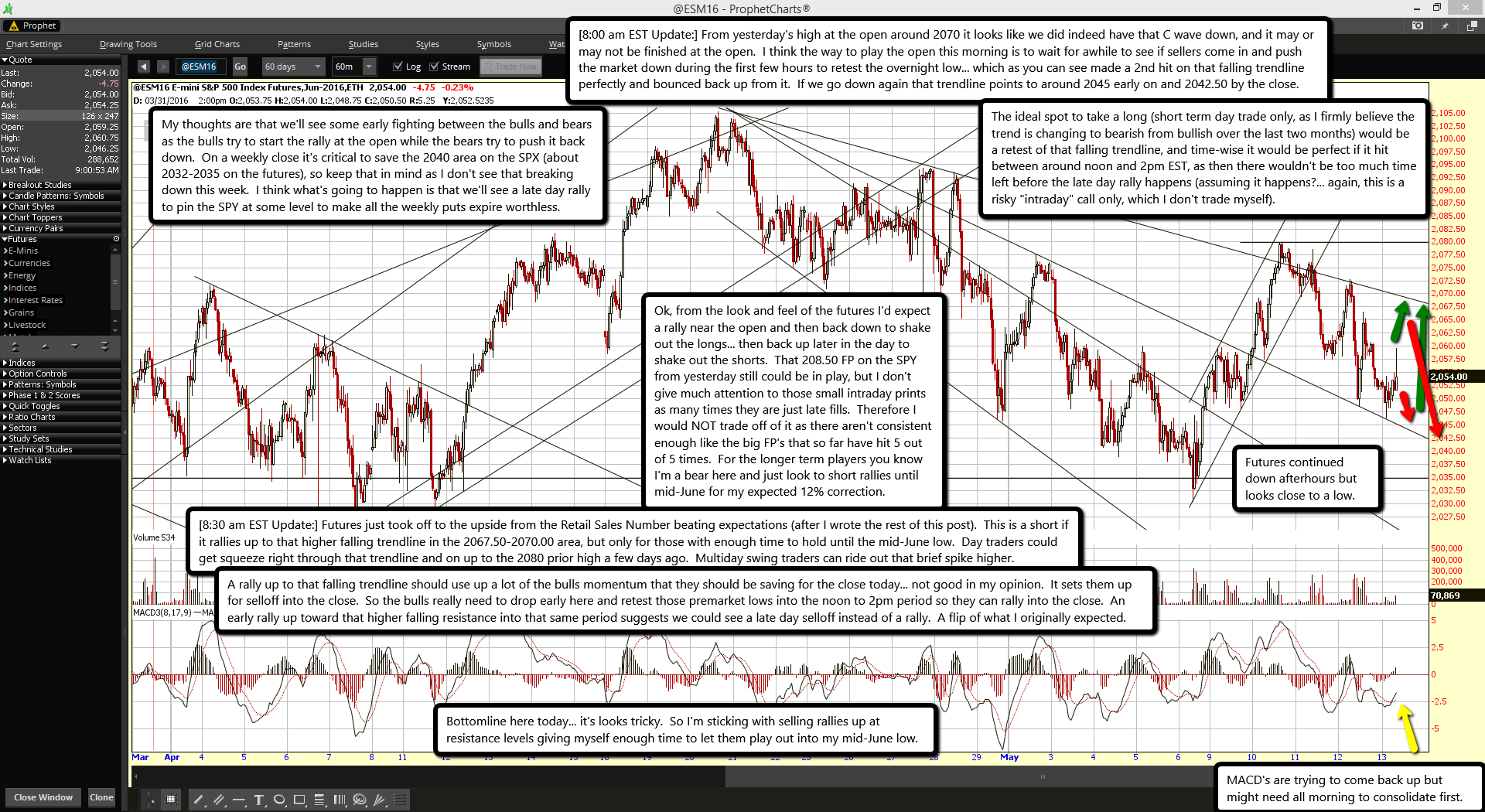
Futures continued down afterhours but looks close to a low.

MACD's are trying to come back up but might need all morning to consolidate first.

[8:00 am EST Update:] From yesterday's high at the open around 2070 it looks like we did indeed have that C wave down, and it may or may not be finished at the open.  I think the way to play the open this morning is to wait for awhile to see if sellers come in and push the market down during the first few hours to retest the overnight low... which as you can see made a 2nd hit on that falling trendline perfectly and bounced back up from it.  If we go down again that trendline points to around 2045 early on and 2042.50 by the close.

My thoughts are that we'll see some early fighting between the bulls and bears as the bulls try to start the rally at the open while the bears try to push it back down.  On a weekly close it's critical to save the 2040 area on the SPX (about 2032-2035 on the futures), so keep that in mind as I don't see that breaking down this week.  I think what's going to happen is that we'll see a late day rally to pin the SPY at some level to make all the weekly puts expire worthless.

The ideal spot to take a long (short term day trade only, as I firmly believe the trend is changing to bearish from bullish over the last two months) would be a retest of that falling trendline, and time-wise it would be perfect if it hit between around noon and 2pm EST, as then there wouldn't be too much time left before the late day rally happens (assuming it happens?... again, this is a risky "intraday" call only, which I don't trade myself).

Ok, from the look and feel of the futures I'd expect a rally near the open and then back down to shake out the longs... then back up later in the day to shake out the shorts.  That 208.50 FP on the SPY from yesterday still could be in play, but I don't give much attention to those small intraday prints as many times they are just late fills.  Therefore I would NOT trade off of it as there aren't consistent enough like the big FP's that so far have hit 5 out of 5 times.  For the longer term players you know I'm a bear here and just look to short rallies until mid-June for my expected 12% correction.


[8:30 am EST Update:] Futures just took off to the upside from the Retail Sales Number beating expectations (after I wrote the rest of this post).  This is a short if it rallies up to that higher falling trendline in the 2067.50-2070.00 area, but only for those with enough time to hold until the mid-June low.  Day traders could get squeeze right through that trendline and on up to the 2080 prior high a few days ago.  Multiday swing traders can ride out that brief spike higher.

A rally up to that falling trendline should use up a lot of the bulls momentum that they should be saving for the close today... not good in my opinion.  It sets them up for selloff into the close.  So the bulls really need to drop early here and retest those premarket lows into the noon to 2pm period so they can rally into the close.  An early rally up toward that higher falling resistance into that same period suggests we could see a late day selloff instead of a rally.  A flip of what I originally expected.

Bottomline here today... it's looks tricky.  So I'm sticking with selling rallies up at resistance levels giving myself enough time to let them play out into my mid-June low.

Why Nissan Taking Control Of Mitsubishi Is A Huge Deal In Asia

0

Why Nissan Taking Control Of Mitsubishi Is A Huge Deal In AsiaMitsubishi Motors headquarters in Japan. Photo credit Getty Images

Beyond the obvious that these two companies are titans in Japanese automotive history, it’s fair to ask how the various tendrils of Mitsubishi Motors and Nissan Motor Company reach throughout many aspects of day-to-day Japanese life. Indeed, it’s fair to ask how this will affect Mitsu’s place in Asia more generally.

It’s easy to go directly to asking what about the cars? Well, it looks like not much will change on that front immediately.

Mitsubishi Isn’t Bowing Out

While most Americans know Mitsubishi as a small, struggling automaker with an aging lineup, things are quite different in Japan and Asia as a whole. Mitsubishi is still quite popular in Japan, and while it has lesser market share than some of the other automakers, three-diamond kei cars (like the eK Wagon, which I used to drive) and superminis (like the Colt, which even includes a RalliArt version) are everywhere.

I also see JDM Outlanders and other Mitsubishi SUVs pretty regularly, and they’re always newer models. Nissan also sells re-badged Mitsubishi microcars, which is part of how the fuel economy cheating scandal came to light. That will certainly continue. And as Nissan CEO Carlos Ghosn said today, the Mitsubishi brand is not just going to disappear.

Why Nissan Taking Control Of Mitsubishi Is A Huge Deal In Asia

One aspect of the Asian business this is unlikely to affect is Mitsubishi’s plans for 30,000 Mirage subcompacts at a factory in the Philippines it purchased from Ford in 2014, which Jalopnik East previously covered. Mitsubishi was hoping to take advantage of tax incentives, but it will need to produce 200,000 vehicles over a period of six years starting this year. Given that Mitsubishi has seen a healthy share of the 2015 30% jump in auto sales in the PH, it’s hard to imagine Nissan going back on the deal.

And this isn’t even acknowledging Mitsubishi’s strong sale numbers of the Triton in Southeast Asia, especially Thailand, or even its somewhat decent numbers in Australia. There are places, in some segments, where the Mitsubishi brand still has tremendous staying power.

The Apology Tour

What we really need to talk about is the cultural aspects of Mitsubishi’s dirty, rotten cheating, because those matter and they let us into some of the rather darker aspects of Japanese collectivist sociocultural processes.

The most immediate fallout of the Mitsubishi scandal is, as is always the case with these sorts of things, a stiffly formal ritual apology played to the press, which serves a sort of a play-acting role more than it addresses problems. This time the Oscar for Best Ritual Sorry went to Mitsubishi’s Aikawa Tetsuro.

And let’s be frank, this is just the latest in a series of corporate scandals not just for the automotive companies, but also within the Japanese corporate world more generally. Corporate malfeasance has been a problem in Japan for an extremely long time, only getting real attention both within and without Japan after the Great Tohoku Earthquake in March of 2011 lead to the well-reported issues at the TEPCO Fukushima nuclear power plant.

Prime Minister Abe Shinzo swept into his second non-consecutive term as the head of the Japanese government with promises to tackle corporate governance, as The Economist has reported from multiple angles:

Government bigwigs, including Mr Abe himself, now offer meetings to foreign activist investors. A new governance code, which came into force this week, seeks to break open the cosy world of the Japanese boardroom by requiring firms to appoint at least two outside directors.

Unfortunately, this is pretty good evidence that whatever the Abe Administration is attempting to do, it isn’t working. Given that Mitsubishi’s cheating was just that—intentional deception—and after Nissan exposed the three-diamond automaker’s underhandedness, it swooped in to take a nice sized chunk in its jaws.

Is it an angel investor? Something like that. Japanese companies aren’t exactly known for the kind of predatory investing that this controlling stake would no-doubt engender in the West.

Other Ramifications

But that doesn’t mean that the embarrassment won’t lead to shame all around as those organizations or individuals associated with Mitsubishi Motors in any capacity seek to avoid being painted with its miscreant brush.Why Nissan Taking Control Of Mitsubishi Is A Huge Deal In AsiaMitsubishi Motors sponsorship sign behind Gamba Osaka defender Hiroki Fujiharu as he reacts after scoring the extra time game winner in his team’s 3-1 victory over Urawa Reds in the 2015 J.League Playoff Semifinal. Saitama, Japan. Image Credit: Dan Orlowitz/Football Channel

Here’s one example, and it comes from the world of soccer. Take the J1 League soccer team, the Urawa Red Diamonds, aka the Reds. (based in my own Saitama).

You might guess from their name that they’re funded by Mitsubishi Motors. This is actually one of the fiduciary ways that the scandal will affect something seemingly completely unrelated to cars. You see, the ownership decisions around the Urawa Reds and the Yokohama F. Marinos is intricately linked to the financial situations and positions of both Nissan and Mitsubishi.

Mitsubishi Motors owns half or so of the Reds, and Nissan has almost three fourths of a rival team, the Yokohama F. Marinos. And, as Japanese soccer expert Dan Orlowitz of Football Channel told Jalopnik, this is a big honking no-no along the lines of an antitrust issue, citing J-League Article 25, Clause 5 stating “that a company with a controlling stake in one club cannot have a direct or indirect controlling stake in another club.” How this will be cleared up remains to be seen.

To understand how this happens, you have to understand just how truly conglomerated and... I hate to even use this term... incestuous Japanese securities holdings (that’s stocks, like the stock market) are.

You might know something like “Mitsubishi makes other stuff, like fighter jets and pencils and TVs.” What you might not know is that Mitsubishi itself is actually a name applied to several different companies that sort of are the same company sort of not, and those companies own parts of other companies (like KFC restaurants in Japan and Kirin Ichiban beer.)

Look, like your Facebook relationship status in high school, it’s complicated. Which means this is probably only the beginning of corporate restructuring across Mitsubishi and Nissan’s holdings in every industrial sector you can imagine.

And that is why Nissan taking a controlling stake in Mitsubishi Motors is... well... big in Japan.

Source link

Wal-Mart (WMT) Stock Slides on Free Two-Day Shipping

0

NEW YORK (TheStreet) -- Wal-Mart  (WMT - Get Report) stock is slumping by 0.38% to $66.16 in pre-market trading on Thursday, as the retailer tests a two-day shipping subscription and builds a regional delivery network in an effort to rival e-commerce giant Amazon.com (AMZN).

Wal-Mart will utilize eight massive e-commerce warehouses throughout the U.S. and rely more heavily on regional carriers to deliver packages, sources told the Wall Street Journal. 

The company will employ regional delivery companies including the East Coast's LaserShip, the West Coast's OnTrac and the Midwest's United Delivery Service to take some of the package deliveries away from FedEx (FDX), which currently handles the majority of its parcels, the Journal adds. These regional carriers charge rates up to a third less than those by national carriers.

Starting today, members of Wal-Mart's ShippingPass program, which grants customers three-day shipping for $50 a year, will receive two-day shipping for $49 per year.

The service is only available by invitation.

Separately, TheStreet Ratings team rates the stock as a "buy" with a ratings score of B+.

Wal-Mart's strengths such as its attractive valuation levels, largely solid financial position with reasonable debt levels by most measures and notable return on equity outweigh the fact that the company has had somewhat weak growth in earnings per share.

You can view the full analysis from the report here: WMT

TheStreet Ratings objectively rated this stock according to its "risk-adjusted" total return prospect over a 12-month investment horizon. Not based on the news in any given day, the rating may differ from Jim Cramer's view or that of this article's author.

Source link

Solar plane makes aviation history like other solo flights in May

0

The Solar Impulse 2, a solar powered plane, knocking down solo flight records much like Charles Lindbergh and Amelia Earhart did decades ago.

Solar Impulse 2, a solar-powered airplane that uses no fuel, is making a nearly 22,000-mile, around-the-world voyage. The journey began March 9, 2015, in Abu Dhabi and is scheduled to end there later this summer. The plane has endured many challenges, including being grounded in Hawaii for the entire winter due to a fried battery, ruined during a historic five-day flight from Japan to Hawaii last summer. Still, that flight set world records of distance and duration for solar aviation, as well as the world record for the longest solo flight ever. A look at the plane, the pilots and some comparisons to two other solo flights that made aviation history:

Solar Impuse 2

Solar cells and batteries

17,248 solar cells, the thickness of a human hair, cover the top of the horizontal stabilizer, fuselage and wings. The cells are protected by a thin layer of UV-resistant, waterproof resin, allowing them to be molded into curvatures of the surface. Energy from these cells gets directed into four high-voltage batteries. The Four high-voltage rechargeable lithium polymer batteries store energy produced by the solar cells. The stored energy allows the aircraft to fly at night. High-density light- weight insulation foam protects the batteries from cold temperatures, which could reduce their capacity. If one of the four motors should fail, battery power can be dispersed among the remaining functional motors.

Enduring long flights in the cockpit

The single pilot cockpit area is spacious enough for oxygen supplies, food and survival equipment, while meeting requirements for flights lasting several days. The absence of a heating/cooling system is offset by high-density thermal insulation that protects the pilot from the elements. The single seat can fully recline, allowing for physical exercises and more legroom during brief naps.

Comparing the planes

Technical advances, since the 1930s, paved the way for conveniences we experience on commercial airlines today. A look at some of the advantages and conditions these brave pilots endured in their effort to make history:

Ryan NYP “Spirit of St. Louis”

For pilot safety, the main fuel tank was incorporated between Charles Lindbergh and the engine. He used open side windows, a compass and periscope to navigate.

Lockheed Model 10 Electra

Amelia Earhart’s plane was customized with four auxiliary fuel tanks for greater range, a navigation system, autopilot, a radio and additional batteries.

Solar Impulse 2

Pilots Bertrand Piccard or André Borschberg must endure freezing temperatures at high altitudes in the single-seat plane, but have state-of-the-art equipment and skilled

ground support at their fingertips.

A matter of altitude

Solar Impulse 2 pilots cruise at 27,000 feet, nearly the height of Mount Everest, in an unpressurized cabin. Temperatures in the cockpit can reach -4 degrees Fahrenheit, a problem neither Lindbergh nor Earhart had to contend with.

Flights that have broken records and aviation barriers

Though Solar Impuse 2 has already broken many records and remains only five stops from the team’s ultimate goal, pioneers before them inspired the nation decades earlier and laid the groundwork for future accomplishments in aeronautic research.

May 20-21, 1927

Charles Lindbergh completes the first solo flight across the Atlantic in Paris.

May 21, 1937

Amelia Earhart, with navagator Fred Noonan, leaves Oakland in an attempt to become the first woman to fly around the world. Following takeoff from Lae, Papua New Guinea, Earhart’s plane vanished after losing radio contact with the Coast Guard cutter Itasca near Howland Island.

March 9, 2015

Pilot André Borschberg, in Solar Impulse 2, lifts off from  Abu Dhabi, United Arab Emirates, beginning its historic journey around the world.

May 2016

Solar Impulse 2 is planning to leave Phoenx, Ariz., for Tulsa, Okla. before heading to New York City, where the plane and crew will be prepared for an Atlantic crossing.

The final stretch

The solar plane is currently expected to cross the Atlantic, making stops in Western Europe or Northern Africa as well as somewhere along the Mediterranean coast, before finishing back in Abu Dhabi, United Arab Emirates.

 
Source link

‘Prepare’ For The Forthcoming Next 7 Months That We Are About to Experience!

0

The FED will not be capable of raising interest rates at all this year!

This is exactly what President Obama, Vice President Biden and Dr. Yellen had discussed in their most secretive meeting which occurred on April 11, 2016: (http://www.zerohedge.com/news/2016-04-10/obama-announces-unexpected-meeting-yellen-following-tomorrows-expedited-procedures-f). President Obama wants his legacy, as the president of the U.S., to be a positive one. The FED will not capable of ‘financial engineering’ the economy into explosiveness, that we all desire. This equation would eliminate the ‘Republicans’ greatest campaign pitch which is that the economy is ‘weak’. Take that theory out of the election process and the ‘Republicans’ will lose their best argument that they have against the Democrats.

Given that both the White House and the FED are working overtime in order to attempt to create a ‘booming economy’ while going into the election.

The FED may be incapable of increasing short term interest rates due its’ policy meetings which coincide with key events that they have been planned on their election calendar.

In June 2016, the FED’s hands will continue be tied, for those same reasons. In addition, there is the British referendum decide whether to remain in the E.U., or not ‘Brexit’. A week after the FED meeting on June 23th, 2016, combined with a rate hike, could spike the dollar. I assure you, that the SPX will not continue to be range bound till election time.

Last week, the U.S. dollar fell by 2%, as the FED signaled it would be slow to raise interest rates, this year. “This year quoting the FED, the committee considers it unlikely to begin the normalization process for at least the next couple of meetings.” This statement sent interest rates plummeting while Treasury Bonds and stock prices surged higher!

While a rate hike during the July 26th-27th, 2016 meeting maybe possible, its’ odds are somewhat reduced due to the fact that there will be no press conference occurring after this meeting. This meeting will coincide with the Democratic National Convention on July 25th-28th, 2016, and, in addition, it will occur within only a few days after the Republican National Convention during July 18th-21st, 2016. The September 20th-21st, 2016 FED meeting is relatively close to the Presidential Election on November 8th, 2016, therefore unless there is strong evidence that the US economy is growing, above trend, and that global financial markets are relatively stable, I expect the FED to refrain from hiking interest rates in September 2016. I highly doubt that the FED will raise interest rates during their November 2016 meeting which occurs only six days before the US elections.

Even though investors desire a clear sense of America's political future, I can assure you that the SPX will not continue to be range bound until election time. By that time, the FED maybe possibility be able to shift their focus, solely on the economy.

If by the December 13th-14th, 2016-time period of the FED meeting, its’ underlying GDP growth were above 2%, then perhaps they could raise interest rates. The futures market essentially is signaling the same scenario. My expectations of any real GDP growth is the risk that the FED does not hike interest rates at all this year:

Chart 1After spiking during the summer of 2015 and again in early January of 2016, the VIX is once again collapsing, however, not for much longer!

It is not a question of if, but when?

Chart 2 Chart 3

Source link

0 to 400 mph in two seconds: Welcome to the age of hyperloop

0

Competing teams will be showing off their Hyperloop prototypes in a bid to see who can build the best, most viable system.

635985729059018206-Hyp.jpeg

Tubes that will eventually be home to Hyperloop One's 750-mph pods sit in the desert north of Las Vegas, where the Los Angeles-based company is conducting tests on its futuristic transportation technology.(Photo: Marco della Cava, USA TODAY)

LAS VEGAS – The co-founders of a start-up aiming to upend earthbound transportation say they've had their Kitty Hawk moment.

Hyperloop One successfully demonstrated Wednesday one key part of how it plans to send people and cargo racing through cushioned tubes at nearly the speed of sound. This transportation alternative, its backers claim, could reduce the journey between Los Angeles and San Francisco to just 30 minutes.

“We are standing on hallowed ground for us,” said Shervin Pishevar, cofounder of Los Angeles-based Hyperloop One, which is among a few companies focused on the hyperloop technology.

What the gaggle of investors and journalists saw from metal risers planted in the desert north of Las Vegas was a lot more rudimentary than artists' rendering of the future, however.

Instead it was more a proof of concept, much like those first airborne moments shared by the Wright Brothers in their airplane.

A bare-metal sled — not a tube — rocketed down a track, with the sled elevated slightly by magnetic levitation technology. It accelerated at 2 g-force before hitting a patch of sand 100 yards down the line.

The total test was just two seconds. But it was enough, Hyperloop One's founders said, to show that technology similar to that used in high-speed maglev trains could be deployed more cheaply, without the steep cost of high-tech trains and rails.

"This is about validating the hardware and software,” said Hyperloop One cofounder and chief technology officer Brogan BamBrogan. “We’re aiming to hit 400 mph in two seconds.

"And by the end of the year hopefully we’ll have a full test, with the sled in a tube accelerating with our custom propulsion.”

That test will also take place here. The team is aiming to build a 3-mile track that will feature tubes elevated above ground by pylons. “This is where hyperloop is getting invented,” said BamBrogan.

BamBrogan noted that humans in a hyperloop pod wouldn’t feel the acceleration as it would happen more gradually, eventually hitting close to 750 mph.

In Los Angeles, the company is testing various levitation methods, based on passive magnetic levitation technology, a version of which is currently in use on high speed maglev trains in Europe and Asia.

"We think we can move cargo by 2019 and passengers by 2021, if we can replicate the kind of support we've gotten here from the county and city of North Las Vegas," said CEO Rob Lloyd.

Indeed, Hyperloop One executives were eager to liken the new mode of transportation to the building of the Transcontinental Railroad in the 19th-century and the race to the moon in the 1960s. But in the former case, development was spurred by a sense of manifest destiny and limitless land. In the latter, a nation's resources fueled the rocket project.

Today, companies such as Hyperloop One and Hyperloop Transportation Technologies, both based in Los Angeles, face hurdles that include land use rights and existing transportation players — train and truck companies — that are financially invested in keeping the status quo.

Hyperloop pioneers counter that their technology will eventually win out due to lower costs (once a hyperloop pod is underway it can sustain its speed with very low energy use) while producing no carbon emissions (a critical element in global warming).

Hyperloop One announced Tuesday that it had secured $80 million in Series B funding to continue its research and development testing, bringing the company's total to nearly $120 million.

The idea for hyperloop first gained momentum in 2013, when SpaceX and Tesla CEO Elon Musk first posited the notion of using magnetic levitation technology to zip travelers between cities hundreds of miles apart at a speed greater than airplane travel. SpaceX is sponsoring a competition to source tech solutions for hyperloop, but will not build a company around the innovation.

Pishevar recounted meeting with Musk, a friend, and asking if he could pursue the tech's commercial potential.

Musk's response? "He said sure, because he was too busy trying to get to Mars anyway," said Pishevar with a laugh.

Source link

Google to restrict ads for payday loans

0

Google announced today that it will no longer allow payday lenders to advertise on its systems because the loans often come with high interest rates and quick repayment requirements that push borrowers into debt.

Payday lenders offer quick cash to low-income people, who are then required to pay back their loans within a short time frame. If they don’t, they face exorbitant interest rates and can quickly fall into debt.

“When reviewing our policies, research has shown that these loans can result in unaffordable payment and high default rates for users,” Google’s director of global product policy David Graff wrote in a blog post announcing the policy change. “This change is designed to protect our users from deceptive or harmful financial products,” he added.

Google has banned categories of ads in the past — it doesn’t allow advertisements for illegal drugs, guns, tobacco, and other products that don’t fall in line with the family friendly image Google tries to project. The company also bans ads that might be risky for its users; it announced that it banned more than 780 million ads last year that were related to counterfeiting or phishing.

Google will define payday lending ads as those that offer loans where repayment is required within 60 days or ones that offer an APR of 36 percent or higher. The policy will go into effect July 13, 2016 and Graff said that it would not impact advertising for other kinds of loans, such as mortgages or student loans.

Advocates have pushed Google to make the adjustment for some time and celebrated the announcement.

“If you’re broke and search the Internet for help, you should not be hit with ads for payday lenders charging 1,000 percent interest,” said Alvaro Bedoya, the executive director of the Center on Privacy and Technology at Georgetown Law. “Today, the world’s largest search engine is saying: ‘We want no part in this.’ Google’s decision to ban these ads sets an industry standard that other internet companies would do well to follow.”

Civil rights groups have lobbied against payday lending in government and in private industry, arguing that lenders disproportionately target people of color and prey upon people’s desperation when they are in difficult financial situations. Roughly a third of states in the U.S. have laws against payday lending.

“Low-income people and people of color have long been targeted by slick advertising and aggressive marketing campaigns to trap consumers into outrageously high interest loans,” explained Wade Henderson, president and CEO of The Leadership Conference on Civil and Human Rights. “This ban puts payday loans in their rightful place alongside explosives and tobacco as dangerous products that deserve the highest level of scrutiny from regulators and businesses alike.”

Bedoya hailed Google’s decision as a civil rights victory and said he hoped other major search engines operated by Yahoo and Microsoft would follow Google’s lead.

However, payday loan ads won’t vanish from Google altogether — AdWords will still display payday lending ads if a user searches for the phrase “payday loan” or other related queries.

Source link

s2Member®