Saturday, July 25, 2026
Home Blog Page 89

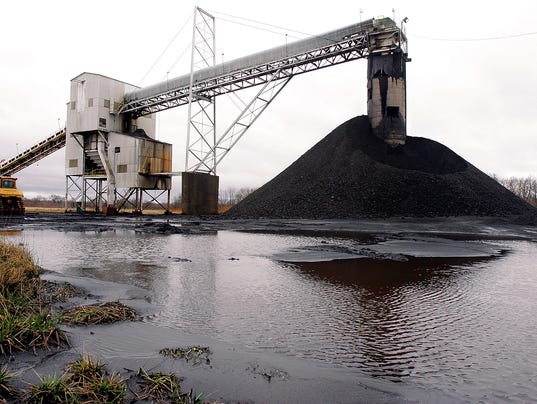
Coal giant Peabody Energy files for Chapter 11 bankruptcy

0

April 13 -- U.S. coal giant Peabody Energy filed for bankruptcy, the most powerful convulsion yet in an industry that's enduring the worst slump in decades.

Peabody Energy climate change settlement

The nation's biggest coal company, Peabody Energy (BTU), filed for Chapter 11 bankruptcy protection on Wednesday as the coal industry grapples with the fallout of low natural gas prices, costly regulations and legacy costs.

Peabody had warned in March that "sustained depressed" coal prices had placed it on the edge of insolvency.

The company also suffered a sharp blow from its exposure to the bankruptcy of former subsidiary Patriot Coal, one of several coal giants to topple into bankruptcy court over the last couple years.

Low natural gas prices, the sluggish Chinese economy and U.S. environmental regulatory pressure have compounded the financial pressures facing coal companies,which include costs such as pensions and retiree health care obligations, analysts say.

Peabody has posted four consecutive yearly losses, including a $2 billion loss in 2015 as revenue fell 17% to $5.6 billion.

The company listed $10.1 billion in debts and $11 billion in assets, including ownership interest in 26 active mines in the U.S. and Australia. Shareholders with at least 5% of the company are Blackrock, Kopernik Global Investors, Vanguard Group and Susquehanna Securities, according to a court filing.

"Through this process, the company intends to reduce its overall debt level, lower fixed charges, improve operating cash flow and position the company for long-term success, while continuing to operate under the protection of the court process," Peabody said Wednesday in a statement.

Trading of the company's shares (BTU), which closed at $2.07 on Tuesday, will be suspended. Two years ago, the stock hit a high of $299.10 in the first quarter of 2014.

"This was a difficult decision, but it is the right path forward for Peabody.  We begin today to build a highly successful global leader for tomorrow," CEO Glenn Kellow said. "This process enables us to strengthen liquidity and reduce debt, build upon the significant operational achievements we've made in recent years and lay the foundation for long-term stability and success in the future."

Peabody said it had secured $800 million in bankruptcy financing from a group that includes secured and unsecured creditors to maintain operations.

Peabody noted that the sale of assets in New Mexico and Colorado had collapsed after a prospective buyer could not complete the deal.

The company hired law firm Jones Day to provide bankruptcy counsel, investment bank Lazard for financial advice and FTI Consulting for restructuring guidance.

Source link

Mickey Mouse-shaped solar facility unveiled at Disney World

0

This April 3, 2016, photo provided by Walt Disney World, shows Disney's Mickey Mouse-shaped solar facility in Lake Buena Vista, Fla. Officials with Disney World, Duke Energy and Disney's private government, flipped on the switch to the Mickey Mouse-shaped solar facility on Tuesday, April 12, 2016. The Mickey Mouse-shaped solar facility is located on 22 acres near Epcot and is made up of about 48,000 solar panels. (Walt Disney World Photo via AP)

LAKE BUENA VISTA, Fla. (AP) - It’s only fitting that solar panels that will help with the power needs of Walt Disney World are shaped like the famous ears of the mouse that started the Disney enterprise.

Officials with Disney World, Duke Energy and Disney’s private government on Tuesday flipped on the switch to a Mickey Mouse-shaped solar facility located on 22 acres near the Epcot theme park.

The facility is made up of 48,000 solar panels and is operated by Duke Energy.

Duke Energy will sell the energy to Disney’s private government, Reedy Creek Improvement District.

In addition to helping power parts of Walt Disney World, the energy will be used to power hotels along Hotel Plaza Boulevard, as well as the Four Seasons Resort.

People rejoice over bridge grand opening

0

Virginia Street is officially open to commuters in downtown Reno, both pedestrians and drivers. It's been a long wait, but many say it was worth it. The bridge is ready to embrace the crowds that have avoided it for so long.

The wait is finally over; let the celebration commence!

"We love how the architecture sets off the post office. It's just a great view here," said one Reno Man.

"It's nice to have access to downtown without having to walk around," said a cyclist going through.

Hundreds gathered for the lighting ceremony, commemorating 10 months of hard work by bridge developers, and patience from commuters and business owners.

"People can see that the building hasn't been abandoned, business is still here and that they can get here," said Sandra Van-Scott, manager at Antique Angel Chapel.

Right next to the temporary cone zone, sits antique angel chapel. It's an example of what almost a year of construction can do to a surrounding business. Van-Scott says they lost about 60 percent of her clients.

"They had the big white cement blockades and the cement walls with the 7-foot plywood walls that went from one end to the other. Folks would come in and be upset with us thinking we closed it off and that we had a magic door that would go under the river and get to the other side," said said.

You can say, it's all water under the bridge now, Just in time for wedding season.

"I'm glad we made it through, I'm glad the bridge opened early," said Van-Scott. "I'm really happy things will be back to normal."

With a wider side walk for pedestrians and a bike lane for cyclists, the Virginia Street Bridge also added artwork along a landing that takes you straight to Truckee River.

Businesses surrounding the are especially excited for summer events, like the wine walks and beer crawls, hoping the bridge will bring more foot traffic into their buildings.

Source link

IRS Admits It Encourages Illegals To Steal Social Security Numbers For Taxes

0

This isn’t exactly the kind of story the IRS wants buzzing around at tax time. The IRS and Justice Department normally want ‘scared straight’ stories just before Tax Day. Ideally, when an indictment or conviction for tax evasion hits the news, it makes you think twice. Somehow, you think just a bit more about all those deductions, or if you really reported all your income, before you sign your return under penalties of perjury.

Instead, we have the top dog at the IRS, the IRS Commissioner himself, admitting that, well, there’s a problem with illegal immigrants and taxes. In fact, the top IRS official this time wasn’t talking about how the IRS wipes some hard drives or can’t find emails. He wasn’t even asking for a bigger budget to give bonuses to IRS employees.

The 9 Most Common Tax Filing Mistakes

This time, he was talking about illegal immigrants, and about the IRS turning a blind eye. Or maybe worse. The IRS actually wants illegal immigrants to illegally use Social Security numbers, he suggested. IRS Commissioner John Koskinen made the surprising statement in response to a question from Sen. Dan Coats, R-Ind., at a Senate Finance Committee meeting. The question was a touchy one. Gee, is the IRS collaborating with taxpayers who file tax returns using fraudulent information? It wasn’t put exactly that way. According to Senator Coats:

What we learned is that … the IRS continues to process tax returns with false W-2 information and issue refunds as if they were routine tax returns, and say that’s not really our job. We also learned the IRS ignores notifications from the Social Security Administration that a name does not match a Social Security number, and you use your own system to determine whether a number is valid.”

Commissioner Koskinen was asked to explain this. He suggested that as long as the information is being used only to fraudulently obtain jobs, the IRS was OK with it. In fact, he said that the IRS actually had an interest in helping the illegal immigrants to crook these rules. In fairness, perhaps it’s just the ‘that’s not my department’ response that abounds in big government. Perhaps this just isn’t the IRS’s problem, but it sure seems odd to have any agency chief encouraging illegal immigrant theft of SSNs.
Source link

House committee unveils Puerto Rico rescue bill with time running out

0

A new draft of legislation to rescue Puerto Rico from the jaws of a debt crisis was released by the House Committee on Natural Resources on Tuesday evening, as the territory’s governor warned that his government did not have enough money to pay for fuel for school buses or police patrol cars, or for therapists for schoolchildren with special needs.

The revised bill includes a provision for a vote by two-thirds of creditors on any particular debt restructuring proposal — a major change that was designed as a concession to conservative Republicans and would give Puerto Rico’s creditors leverage to insist on voluntary settlements.

The threshold is low enough to give a newly created oversight board the power to impose restructuring deals on reluctant creditors, but it it is high enough to potentially bog down restructuring talks.

If the oversight board fails to get the support of two-thirds of creditors, it can turn to a judicial procedure to enforce a settlement.

Rep. Rob Bishop (R-Utah), the committee’s chairman, said in a news release that the bill offers “tools to redirect Puerto Rico from a path of destitution towards a path of prosperity.”

“This is the constitutionally-sound solution that will provide real, long-lasting reform to the Commonwealth while respecting the rights of all parties and creditors,” he said. “It is the island’s best shot to mitigate its financial collapse and future calls for a bailout, which would be untenable.”

House Speaker Paul D. Ryan (R-Wis.) endorsed the bill shortly after its release Tuesday, saying it “protects American taxpayers from bailing out Puerto Rico.” But it was not clear in the hours after the bill’s release whether it would ultimately win the endorsement of the Republican Study Committee (RSC), the influential group of House conservatives that includes most GOP members.

The group’s chairman, Rep. Bill Flores (R-Tex.), said in an interview Tuesday that he had not reviewed the final text of the latest draft but said there appeared to be improvements. “In a perfect world, I’d like to see there can’t be an involuntary cram-down,” he said. “But if we can find a way where there’s a good likelihood of having a consensual restructuring, maybe I can find happiness on this.”

The RSC balked at the previous version of the legislation, casting doubt on whether any Puerto Rico bill could garner the support of a majority of House Republicans — a key threshold for Ryan, who has vowed to abide by the wishes of his party conference. Outside activist groups, notably Heritage Action for America, also have pressured Republicans to reject strong restructuring provisions and require more sweeping economic reforms.

But the bill probably will need Democratic support to pass, and House Minority Leader Nancy Pelosi (Calif.) and other key Democrats have been engaged with the bill’s Republican drafters to address concerns about the powers of the control board created under the legislation.

Those changes included increasing the size of the control board, and changing its political composition and limiting its non-fiscal powers — modifications made, in the words of a Republican committee summary, “to address concerns that it was too colonialist.”

Gov. Alejandro Javier García Padilla, in Washington with a broad delegation of legislators and business people from Puerto Rico, stressed the need for haste. He said that “we are in a humanitarian crisis” and that about 10,000 children have not been able to attend school because of a lack of fuel for buses.

García Padilla said that Puerto Rico’s government owes close to $2 billion to private suppliers of goods and services and that the arrears will climb to $2.2 billion by June 30, when the territory expects to default on its general obligation bonds, considered the safest type of bonds for investors.

The governor called the new version “a step in the right direction.” Earlier, he sharply criticized the first draft of legislation to help Puerto Rico restructure its crushing debt of about $72 billion; that draft created a five-person appointed board to root out waste and corruption, set the island’s budget on a sustainable track and restructure the territory’s debts.

García Padilla said that the board’s structure would be “turning Puerto Rico back to 1900 . . . after the invasion and Spanish American war.” He said “it will make no sense” because it would create a financial control board with the power to impose taxes, fire people from jobs and curtail services without regard to democratically elected officials in Puerto Rico.

But he said the new version of the legislation “incorporates some of our comments with respect to a more balanced calibration of the Board’s powers.”

Some of the investors in Puerto Rican bonds oppose the creation of any bankruptcy-like procedure that could impose a final settlement on a minority of holdout creditors.

A group called the Center for Individual Freedom has spent about $200,000 on television ads in the Washington market, according to the Sunlight Foundation. The ads urge people to “tell Congress” to “stop the Washington bailout of Puerto Rico” — even though the House draft of legislation does not provide any money for Puerto Rico. The Alexandria, Va.-based 501(c)(4) group says on its website that its “mission [is] to protect and defend individual freedoms and individual rights guaranteed by the U.S. Constitution.”

On Monday, Puerto Rico’s government sweetened a January offer to pay creditors, offering to boost its debt-service payments to $1.85 billion a year, up from $1.7 billion a year in the earlier offer. Those payments would equal about 15 percent of projected government revenue in 2021, a level higher than in virtually all mainland U.S. states.

The government also said that an earlier proposal for a “growth bond” that would depend on a certain level of economic growth in Puerto Rico would be replaced with a “capital appreciation bond” that would require payments regardless of economic growth.

But investors would still end up taking deep reductions in the overall payments they are owed.

Last week, Puerto Rico declared a debt moratorium, allowing the governor to temporarily halt debt payments by government and public corporations or impose a stay on bondholder litigation. The moratorium would block a $422 million debt-service payment by the Government Development Bank on May 1, forcing a default.

The credit rating agency Moody’s said in a statement Tuesday that the moratorium “signals the culmination of the US territory’s liquidity crisis and the complexity of negotiating restructuring agreements with holders of the Commonwealth’s debt.”

Steven Mufson covers the White House. Since joining The Post, he has covered economics, China, foreign policy and energy.

Mike DeBonis covers Congress and national politics for The Washington Post. He previously covered D.C. politics and government from 2007 to 2015.

Source link

Amid shifting politics, wind power capacity whooshes higher

0

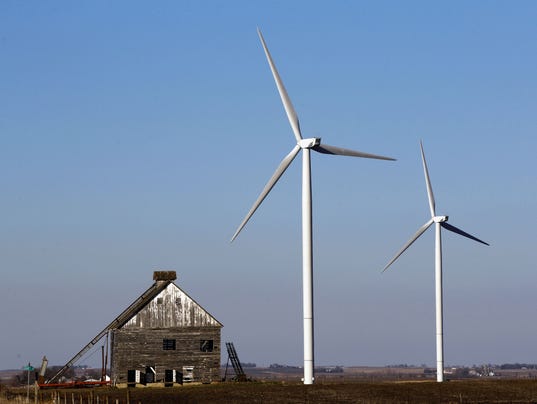
Sleek white wind turbines, 25 stories tall, rise from the plains of West Texas in Big Spring. Texas is one of the windiest states in the nation and the Panhandle and West Texas are the state's windiest regions. Photo: CAROLYN MARY BAUMAN, STF / KRTWASHINGTON - Wind turbine construction in the United States has rebounded to its highest level in three years, in the aftermath of a long political fight over the future of federal tax credits that support renewable energy projects.

More than 8,500 megawatts of wind power capacity was built last year, almost double the 2014 tally, according to a report Tuesday by the American Wind Energy Association. More than 3,600 megawatts of that construction - enough to power about 100,000 homes - was built in Texas, which now counts almost a quarter of the country's wind energy. The surge followed a rush by wind developers to get projects under construction before the end of 2014 out of fear Congress would not renew the tax credit, an uncertainty that has hung over the industry almost since its inception two decades ago.

But industry officials are optimistic that less volatile times are ahead after Congress recently approved a bipartisan deal extending the tax credit through 2019 and government regulation on carbon emissions produced by their fossil fuel competitors is increasing.

"The wind industry has been on a boom-bust cycle going back 20 years," said Jacob Susman, head of sales and marketing at EDF Renewable Energy, which operates wind farms across Texas. "If you look at the Paris agreement and the Clean Power Plan, that gives you a 15-year, maybe 50-year, framework on how we want to see our older, dirtier power facilities replaced with cleaner, modern facilities."
Business

Saudi Arabian Oil Minister Ali Al-Naimi speaks this year in Houston. Saudi Arabia and Russia reportedly are working on an agreement to cut oil production.
Stocks rise broadly, led by gains in the energy sector
Sleek white wind turbines, 25 stories tall, rise from the plains of West Texas in Big Spring. Texas is one of the windiest states in the nation and the Panhandle and West Texas are the state's windiest regions.
Amid shifting politics, wind power capacity whooshes higher
Gasoline may be down over 20 percent from 2015.
Summer gasoline prices to be at their lowest in a dozen years
FILE - In this Tuesday, May 19, 2015, file photo, Valeant Pharmaceuticals CEO J. Michael Pearson poses at the company's annual general meeting in Montreal. Valeant Pharmaceuticals asked its CEO to cooperate with a Senate investigation into drug pricing after he failed to appear for a deposition. The Senate Special Committee on Aging said on April 6, 2016, that it planned to start legal proceedings against Pearson, who is leaving Valeant after months of turmoil for the drugmaker. Pearson is still under subpoena to appear before the committee for an April 27 hearing. (Ryan Remiorz/The Canadian Press via AP, File) MANDATORY CREDIT
In brief: Debt deal gives Chesapeake shares a big lift
Halliburton CEO David Lesar, third from right, rings the New York Stock Exchange opening bell on Nov. 18, 2014. The previous day, Halliburton and Baker Hughes announced their plan to combine, shortly after oil prices began to fall.
With $3.5B fee, a Halliburton-Baker Hughes breakup would be
Exelon's Colorado Bend Generating Station in Wharton is being expanded with a natural gas unit. Natural gas prices are low.
Depressed Texas power prices mean cheap electricity, plant

Last year the Obama administration announced a Clean Power Plan, seeking to cut carbon emission from the power sector more than 30 percent from 2005 levels. Then in December, nearly 200 countries agreed during a meeting in Paris to cut greenhouse gas emissions to prevent the Earth's temperature from rising more than 2 degrees Celsius.

The question now is whether the rapid growth in wind power can be sustained after a sixfold increase in production capacity over the past decade.

Between the tax credit and a sharp decline in turbine costs, running wind turbines became so much more profitable in Texas that there were times in recent years where wind developers would pay utilities to buy their electricity so they could collect the tax credit, which is only paid on power that is delivered

Along the way, new markets have been created. Investment firms have been putting capital into wind farms as a means to protect their investments in traditional natural gas plants against spikes in fuel prices, said Michael Goggin, senior director of research at the American Wind Energy Association.

Also, corporations eager to meet internal environmental goals and get a guaranteed price on their electricity for years to come have been signing on to long-term power deals with wind producers

Google, Procter & Gamble, General Motors, and Mars, the maker of M&M's and other candies, are among dozens of major U.S. corporations buying electricity directly from wind farms in Texas, said Jeffrey Clark, director of the Wind Coalition, an industry group.

"I love to tell people every M&M is made with wind," he said.

For now, analysts are predicting that the rapid pace of construction last year will continue. More than 14,000 megawatts of wind turbines, enough to power about 380,000 homes, are under construction or in the late stages of development, Goggin said.

Under a bipartisan federal budget deal last year that also ended a decades-long ban on U.S. oil exports, the renewable energy tax credit was extended through 2019 - though with shrinking payments to developers beginning next year. In 2017 they will receive 80 percent of the tax credit, down to 60 percent in 2018 and 40 percent in 2019.

The hope among developers is that as the tax credit starts to shrink, President Barack Obama's rule cutting carbon emissions from the power plants fired by natural gas and coal will increase demand for wind power as older coal-fired plants are put out of business.

That rule was stayed by the U.S. Supreme Court in February, pending a ruling on its legality by the justices.

Max Levchin’s Affirm raises $100 million to expand beyond point-of-sale financing

0

Max Levchin

Affirm has raised $100 million in equity funding that the financial technology company will use to develop what it calls “direct-to-consumer” products. The round was led by Founders Fund and includes participation from Lightspeed Venture Partners, Spark Capital, Khosla Ventures, Andreessen Horowitz, Jefferies, and others. The company declined to provide its valuation.

It’s worth noting that this is an equity round, which is contrary to the previous round which included some debt. The company told VentureBeat that it has plans to evolve its offerings, such as new ways to get funds right from the palm of your hands via a mobile app instead of point of sale, and also three new partnerships that it plans to announce next month.

Investments will also be made in building up the number of merchants that currently support Affirm, as well as increasing the company’s capacity to distribute loans.

Founded by PayPal cofounder Max Levchin, Affirm seeks to uproot the financial lending industry. It currently operates at point of sale systems in more than 700 merchant locations around the U.S., underwriting loans in real-time to people using just data like their first and last name, date of birth, and the last four digits of their social security number. It’s available as a payment method, online, and in stores, using technology and analytics as a means of evaluating someone beyond just looking at their FICO score.

The service bills itself as being more transparent that the bank you go to, telling you exactly how much you owe, when it’s due, and more — it’s all in the interest of the user. Affirm doesn’t charge any compounded interest or late fees. It makes its money with simple interest. Recipients make simple payments to settle their accounts.

“I’m building what I hope will be the next generation consumer bank,” Levchin said in an interview. He stated that his company’s vision has been to build “an aspirational truly loved financial institution for everyone. Most large financial institutions don’t enjoy much love or admiration by their own customers, they’ve settled on ways to make money that’s not aligned with their customers.”

After four years, Levchin seems content with where Affirm is at right now in terms of progress. He’s also not thinking about taking the company public. When asked about whether he fears incumbent competing with him, he quipped that it wasn’t possible due to the financial implications and other corporate issues that would be at play, but would be happy if it did: “If Affirm causes the industry to change and stop overcharging and making money on late fees, I would welcome that.”

Right now Affirm is servicing those in the U.S., but there are aspirations to expand internationally. However, Levchin says that there’s “plenty to do” still in the country.

To date, the company has raised approximately $425 million in debt and equity funding.

Affirm is using data to solve hard problems in finance. We make instant lending decisions that make online buying experiences awesome and drive incremental purchases for merchants. Our team brings together a broad experience in payment... read more »

New! Track Affirm's Landscape to stay on top of the industry in 3 minutes a day. Understand the entire ecosystem, monitor innovation, and track deal flows. Learn more.

Source link

Colorado wind power rising; 1880 turbines and Xcel, Vestas plan more

0

Colorado set national records with 54 percent of Xcel's electricity over two 24-hour periods generated by wind

BRIGHTON — Colorado wind power is rising with 1,880 huge turbines erected across the prairie, twisting white blades as long as soccer fields, a cleaner source of energy replacing fossil fuels.

It has reached the point where the wind turbines generated 67 percent of Xcel Energy's Colorado-made electricity for one early morning hour in November, and 54 percent for two 24-hour periods in October
— feats unmatched around the nation, industry officials said Tuesday.

Falling costs, a state mandate, a federal subsidy and sheer momentum are driving the shift to renewable energy.

The proliferation of turbines here — doubling the number in 2009 — reflects a takeoff of wind power nationally that has cut carbon dioxide emissions by 132 million tons, American Wind Energy Association research director Michael Groggin said.

Giant Vestas wind turbine blades loaded on a train awaiting delivery at the plant April 12, 2016. Giant Vestas wind turbine blades loaded on a train awaiting delivery at the plant April 12, 2016. (Andy Cross, The Denver Post)

"That's the equivalent of taking 28 million cars off the road, and this is going to help Colorado comply with the Clean Power Plan," Groggin said.

Shifting from coal and gas to wind power "will help bring the United States into compliance with international climate change commitments. It will show that the U.S. can be a leader," he said.

Politicians and investors are embracing the shift. Long a backer of oil and gas extraction along the Front Range, Gov. John Hickenlooper on Tuesday opened a national industry forum at a Vestas Americas turbine factory
in Brighton — one of four Vestas plants in the state that employ 3,700 workers.

"This is a state issue for us. We view it as one of our highest priorities," Hickenlooper said.

Colorado initially looked to natural gas as bridge away from coal-fired electricity, but "wind is going to take an increasingly large share of that as well," he said.

Today, "wind turbine technician" ranks as the fastest-growing occupation, according to the U.S. Bureau of Labor Statistics.

Utility giant Xcel Energy is playing a key role, purchasing electricity from 21 Colorado wind farms.

"We've cultivated wind as our most cost-effective renewable energy option because we recognize that this source of energy is not only a benefit to the environment but also a major economic driver for the state," Xcel's Colorado operations president David Eves said. "Our plan is to expand our wind offerings to provide hundreds of new jobs for Coloradans, make a billion dollars in new investments, keep energy costs low for our customers, and improve the environment."

On Tuesday, Eves and Vestas Americas chief Chris Brown announced a plan to build Colorado's largest wind farm. If the Public Utilities Commission approves, the eastern plains project would add 300 more wind turbines and produce 600 megawatts of electricity.

Congress has extended the federal government subsidy for the wind power industry until the end of this year, boosting incentives to build before a gradual phase-out.

Xcel supplies 65 percent of Colorado residents and currently generates 2,566 megawatts of electricity from wind, or about 25 percent of demand. In comparison, more than half Xcel's electricity comes from coal and 1 to 2 percent comes from solar sources.

Colorado lawmakers in 2004 initiated change, passing a renewable energy standard requiring public utilities to use wind and solar to produce some of their electricity. Lawmakers twice have increased that percentage. By 2020, 30 percent of electricity must come from renewable sources.

Xcel already averages in "the high 20s," a spokesman said. The surges where 67 percent and 54 percent of electricity came from wind occurred on windy days when overall electricity use by residents was relatively low.

Overall, Colorado utilities on average produce 14 percent of electricity from wind turbines, ranking the state among national leaders. Iowa leads at 31 percent.

One reason wind has advanced is forecasting. National Oceanic and Atmospheric Administration meteorologists analyze energy potential from wind and try to give utility grid operators several hours, and sometimes days, of notice when wind will be strong.

This allows operators to adjust the grid draw wind power, rather than from coal or other sources, when it is available.

Governor Hickenlooper hails rise of wind power at Vestas plant on April 12, 2016.Governor Hickenlooper hails rise of wind power at Vestas plant on April 12, 2016. (Bruce Finley, The Denver Post)

Industry analysts said wind's role will continue to expand.

And Vestas CEO Brown said the massive fiberglass blades made in Brighton may expand, too.

While installation of more transmission lines will be essential, shifting to clean energy in the future will hinge on "capturing more wind" with blades, he said.

Even a 1-meter lengthening of blades that now stretch 100 meters from tip-to-tip could more than double the amount electricity produced, he said.

"We want to have taller towers and bigger blades," he said

Source link

Big oil and gas stock skyrockets 61% in 2 days

0

Ex-Chesapeake Energy CEO dead after car crash

Fears of a catastrophic cash crunch at Chesapeake Energy are fading. Fast.

Chesapeake's(CHK) stock spiked 34% on Tuesday, the biggest one-day gain since the oil and natural gas company went public in 1993.

Investors and analysts are cheering Chesapeake's announcement that its banks have agreed not to yank a credit line worth $4 billion. That's huge because the oil crash has made it more difficult for Chesapeake to pay down its huge debt load of $10 billion.

Chesapeake also bought itself more time with the banks by pushing back its next review by creditors until June 2017... as long as it maintains certain financial metrics.

"This definitely extends the runway for liquidity," said David Holt, an analyst at S&P Global Market Intelligence who raised his price target on Chesapeake to $6 per share from $3.

Chesapeake is considered one of the pioneers of shale energy in the U.S. The company was founded by Aubrey McClendon, who died in a fiery car wreck earlier this year following a federal indictment on bid-rigging charges.

Chesapeake stock soaring oil gas

Related: U.S. oil bankruptcies spike 379%

Other analysts are turning more optimistic on Chesapeake as well. Tudor, Pickering, Holt removed its "sell" rating on Chesapeake on Tuesday, citing the agreement with lenders and the recent surge in oil prices above $42 a barrel.

Citigroup also upgraded Chesapeake's 2017 and 2018 junk bonds to "buy," saying the new agreement gives the company "time to ride out a low commodity price environment."

The enthusiastic reaction on Wall Street underscores how worried investors were about the ability of Chesapeake to survive the downturn. Things got so bad that in February Chesapeake had to put out a statement denying reports it was plotting a bankruptcy filing.

The bad news is that Chesapeake shares are still down nearly 60% over the past year. And the new deal with banks required Chesapeake to pony up lots more collateral to reel back its credit facility. Chesapeake said in a regulatory filing it has pledged "substantially all" of its assets, including mortgages covering 90% of its proved oil and gas properties.

Holt said those concessions mean that while the short-term liquidity worries have eased, longer-term solvency risks remain.

"We think the additional assets pledged for collateral leave little room for error," said Holt.

Source link

Ford looks to Silicon Valley in corporate campus redesign

0

Borrowing a page from the Silicon Valley playbook, Ford Motor is going on a building and renovation spree near Detroit in hopes of creating more inviting and idea-inspiring work spaces.

Ford plans to renovate or build 7.5 million square feet of office space, research facilities and engineering operations, marking the first dramatic overhaul of its home base in six decades. Much of the work will be in the company's historic base of Dearborn, Mich.

Ford CEO Mark Fields said in an interview that the goal is to develop more open workspaces to encourage conversations and collaboration between different divisions — a concept well known to the tech industry that is only recently making its way through the more traditional automotive business.

"People really like being connected and not being in, let’s say, the 1970s and '80s layout where what was more appropriate then was to work in cubicle areas and have your own little personal space," Fields said. "We’re just looking at how they’re living their lives now, staying connected, and we’re saying, ‘how do we do that?’"

The sweeping real estate play — which affects 30,000 employees currently working in 70 separate buildings — is designed to give the company a fighting chance in the war for young professionals as Silicon Valley tech giants with hip corporate campuses hire away the auto industry's most talented engineers to develop autonomous vehicles and electric cars.

It also accelerates a trend among major automakers to inject a fresh dose of innovation into their once-stodgy workplace environments, where PowerPoint presentations and top-down management once prevailed over collaborative working and free-flowing communication.

Ford's corporate-campus overhaul comes as Toyota is preparing a new North American headquarters in Plano, Texas, and as General Motors continues a $1 billion renovation of its Tech Center operation in Warren, Mich.

Ford would not reveal an investment figure but said the spending is contained within its previously disclosed capital plans. Construction will begin within weeks at the research and engineering campus, while work on the headquarters campus will start in 2021. All construction is expected to finish by 2026.

The anchor of the engineering campus will be a new 700,000-square-foot design facility, Ford said.

Steve Morris, a real estate broker and managing principal of Axis Advisors in Farmington Hills, Mich., estimated that the overall project easily represents a $1.2 billion investment.

"It’s a very strong statement about the commitment to community and future of the automobile industry in Michigan," Morris said.

Most of the square footage included in the overhaul is contained within existing buildings, said Donna Inch, CEO of Ford Motor Land Development, the automaker's real estate division. But she said the company would construct several new facilities, as well, but declined to say how many.

Many of the buildings have been only lightly upgraded since they were first built in the 1950s, Inch said.

Altogether, the plan is to locate 30,000 employees at a corporate campus and an R&D campus in Dearborn, Mich., which Henry Ford picked as the hometown for his company in the early 20th Century.

The actual headquarters building won't change much because of its iconic mid-20th Century architecture, Inch said, but it will get certain upgrades such as infrastructure improvements and new windows. Ford also plans to build a new facility for its Ford Credit operation that will be connected to the headquarters.

Fields said Ford is embracing "we space" — open, collaborative workplaces — over "me space," or cloistered offices for individuals and walls separating departments.

"It's a very big transformation," he said.

Collaborative, open work environments in which workers are not assigned a specific desk or share space with others has increased in 82% of companies with more than 5,000 employees since 2009, according to a 2015 survey by the International Facility Management Association.

"There is certainly a fairly significant shift occurring in how people use office spaces to achieve specific goals," IFMA spokesman Jed Link said in an interview. "What Silicon Valley, the Apples and the Googles are doing is making it incredibly visible. They use their workspace in part as a recruiting tool."

Asked whether Ford considered relocating employees elsewhere, Fields and Inch said the company remains committed to Dearborn as its hometown but will continue to grow operations elsewhere, including its Silicon Valley office in Palo Alto, Calif. No employees are moving out of Dearborn, they said.

The plan includes an emphasis on environmental sustainability, with an expectation that the completed campuses will use half the energy that Ford currently uses in Dearborn.

Inch said Ford would try to make every existing building qualify for Leadership in Energy and Environmental Design (LEED) Silver certification from the U.S. Green Building Council, while new buildings would pursue LEED Gold. One facility will generate zero waste, use no fossil fuels and waste no water in a clean-tech showcase.

Like other auto companies, the company will also have autonomous cars running around its campuses. Ford picked architectural firm SmithGroupJJR to handle design. Inch declined to identify contractors.

Source link

ES Morning Update April 13th 2016

0

39b91591-8a4e-4afe-ba9c-92041b48830f

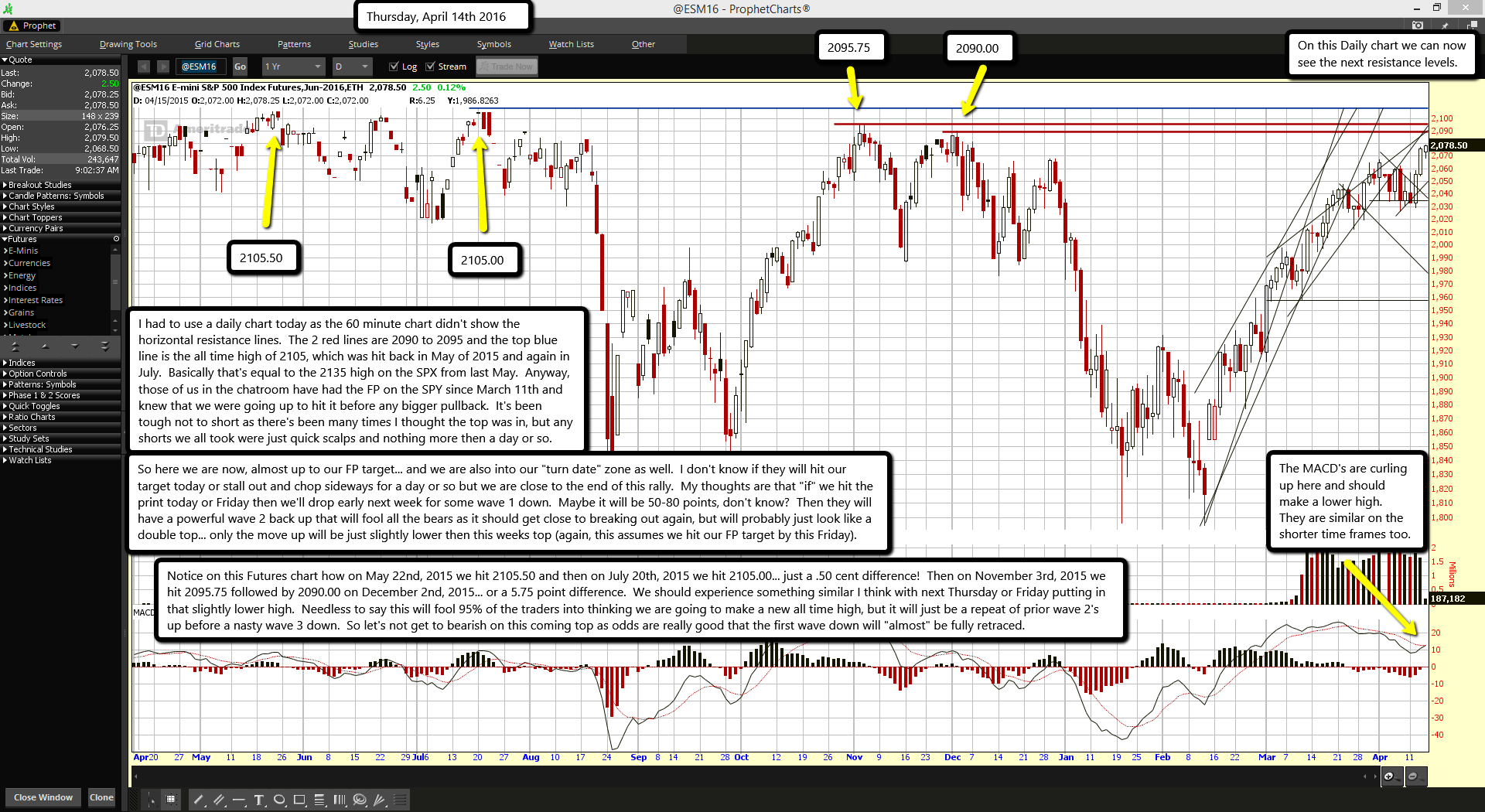
Futures hit 2069.25 as a high, or basically a double top from the 2071.50 high on April 4th.

Bears got teased yesterday with a slight pierce of the rising trendline of support but it quickly reversed and started this squeeze up.

MACD's are overbought on this 60 minute chart suggesting an early pullback but the 2 hour, 4 hour and 6 hour are still pointing up.  This suggests the small pullback will be bought.

Yesterday the charted looked pretty bearish and the daily on the SPX cash was really looking bad.  But today we see a hook back up on that daily chart (not shown here of course) with it's MACD's, and that's really what we need to see happen to create a lower high on them, with a higher high on the actually SPX price, therefore creating a negative divergence and a likely top.  When will this happen?  Hard too say but as early as this Friday is possible?  I personally think will top next week that's where my turn date is at, and several other critical clues I've discussed several times in the chatroom.

Since we are overbought on the 60 minute chart and up near a double top I think we'll see our "high of the day" around the open as it's rare to see a breakthrough on the first hit of any double top... plus we are short term overbought as well.  Therefore I think we'll see some choppy action today as we pullback a little, go back up from the late comer "buy the dippers"... but I don't think it will breakout over the prior high of 2071.50, but instead just bounce around the top area pulling back and going back up several times... but getting no where really.

If the pullback gets going there's good horizontal support in the 2050 area, but again I'm not looking for a big fast move down.  More likely is a choppy up and down action with that zone "maybe" being hit at some point, but it might take all day?  So, to keep it simple, I'm looking for the futures to bang around this double top area but not breakout today.  Pullbacks will likely be bought and probably be shallow.  But all the pullbacks that are bought are the retail sheep who are late to the party and missed the big squeeze yesterday when the support didn't breakdown.  I missed the upside target as I think I said we could see 2060 area if they failed to breakdown and we only got about 2055 by the close, but we hit it afterhours.

History Of The Current Oil Price Crash And Where To Invest

0

Summary

We are currently in an oversupplied oil market but things aren't always what they seem.

Investing in the oil market is simple if you follow a couple of key principles.

2016 is going to be a much better year than 2015, despite what you may see on television.

Why OPEC has failed to act to shore up production and fix this issue.

Introduction

If you are a new or experienced oil investor in a popular oil Exchange Traded Fund (ETF) like (NYSEARCA:USO) or (NYSEARCA:OIL), it can be difficult to understand how the price of oil reached its current level and subsequently where to invest. From time to time, an article is published that provides a history lesson for those that have just tuned into what's going on with the price of oil and oil-related investments. I thought it was about time we had another such article.

Price is truth?

Over the past year, I've been long oil via Linn Energy (NASDAQ:LINE) (NASDAQ:LNCO), BreitBurn Energy Partners (NASDAQ:BBEP), Transocean (NYSE:RIG), First Solar (NASDAQ:FSLR), Legacy Reserves (NASDAQ:LGCY), and Mid-Con Energy Partners LP (NASDAQ:MCEP).

If you look at the volatility represented in the chart below, you could be mistaken for thinking it's a chart of a hot technology stock, not the price of WTI Crude oil for the last 18 months.

To provide some perspective on exactly how big the recent moves in the price of oil have been, this next chart shows the previous 3 years, you can clearly see the difference.

For anyone following financial markets back in 2008, you'll remember crude hitting $140 a barrel. At that time many were calling for even higher prices. Goldman Sachs made their now famous $200 oil claim, and some were even calling for $300.

The chart below shows the price action from 2008 to 2011 with the red lines highlighting the peaks and troughs.

During 2008, there was a significant drop in world oil demand due to the global financial crisis. OPEC subsequently agreed to cut production by 4.2 million barrels at their meeting in December 2008 and oil producers lived happily afterward with prices trading in the $80 to $100 range until late 2014. However, during the years following 2008, U.S. consumers felt very threatened by $4 gas and what a reliance on overseas oil meant. With the U.S. Presidential election campaigns in full swing, chants of "drill, baby, drill" and "drill, drill, drill" became staples of U.S. Republican Presidential candidates. Even though U.S. President Obama didn't feel like the U.S. could fix the issue alone, he pledged to end the "tyranny of oil" in early 2009.

Source link

Worldwide Mac Sales Hold Steady as PC Market Sees Shipments Decline 9.6% in Q1 2016

0

Amid a decline in worldwide PC shipments, Apple's Mac sales have held steady, according to new PC shipping estimates from Gartner. During the first quarter of 2016, Apple shipped 4.6 million Macs worldwide and held 7.1 percent of the market, up from 4.56 million Mac shipments and 6.4 percent of the market during the first quarter of 2015.

While Apple only saw 1 percent worldwide growth, it fared better than the overall PC market, which saw total worldwide shipments of 64.8 million, a 9.6 percent decline from 71.7 million shipments in Q1 2015. Among other vendors, Lenovo and HP saw some of the biggest shipment drops with 12.5 million and 11.4 million shipments in 1Q 2016, down from 13.5 million and 12.5 million, respectively, in the year-ago quarter.

gartner_1Q16_global

Gartner's Preliminary Worldwide PC Vendor Unit Shipment Estimates for 1Q16 (Thousands of Units)
With 7.1 percent of the market, Apple ranked as the number five worldwide vendor, coming in after Lenovo (19.3% share), HP (17.6% share), Dell (14.1% share), and ASUS (8.3% share). Other vendors, not ranked in the top five, accounted for 33.6 percent of the market.

The deterioration of local currencies against the U.S. dollar continued to play a major role in PC shipment declines. Our early results also show there was an inventory buildup from holiday sales in the fourth quarter of 2015," said Mikako Kitagawa, principal analyst at Gartner.

While Apple's worldwide numbers were steady, Mac sales in the United States appear to have dipped slightly. According to Gartner's data, Apple shipped 1.666 million PCs in the United States, for 12.7 percent of the market. That's down from 1.672 million in the year-ago quarter, but market share is up from 11.8 percent.

gartner_1Q16_us

Gartner's Preliminary U.S. PC Vendor Unit Shipment Estimates for 1Q16 (Thousands of Units)
Dell, the number one vendor in the U.S., shipped 3.5 million PCs in Q1 2016 for 26.3 percent of the market, while HP shipped 3.1 million for 23.7 percent of the market. Lenovo saw the greatest growth with 1.9 million shipments and 14.5 percent of the market, while ASUS saw a decline in shipments from 770,000 in Q1 2015 to 667,000 in Q1 2016 for just 5.1 percent of the market.

In the overall U.S. PC market, shipments totaled 13.1 million in the first quarter of 2016, a decline of 6.6 percent compared to the year-ago quarter and the lowest shipment volume in the country in three years.

gartner_1Q16_us_trend

Apple's U.S. Market Share Trend: 1Q06-1Q16 (Gartner)
IDC also released its shipment estimates today, and as is typical, its numbers are different than Gartner's numbers, in part due to the difference in the way Windows-based tablets are counted by each firm. According to IDC, worldwide PC shipments totaled 60.6 million, for an overall decline of 11.5 percent.

While Gartner ranks Apple as number five vendor in worldwide PC shipments, IDC ranks Apple as number four with 4.5 million shipments and 7.4 percent of the market (a decline from 4.6 million shipments in Q1 2015), edging out ASUS's 4.4 million shipments. As for U.S. shipments, IDC puts the total number at 13.625 million, an overall decline of 5.8 percent.

IDC's U.S. shipment estimates are more favorable to Apple, suggesting PC shipments totaling 1.8 million and 13 percent market share for growth of 5.6 percent rather than the slight decline Gartner estimates. Like Gartner, IDC lists Dell (3.5m shipments), HP (3.5m shipments), Lenovo (1.9m shipments), and Apple (1.8m shipments) as the top four PC vendors in the United States, but IDC positions Acer Group (711,000 shipments) as the number five vendor while Gartner lists it as ASUS.

It's important to note that data from Gartner and IDC is preliminary and that the numbers can shift, sometimes dramatically, while other times, the estimates are closer to the actual data. Last year, for example, Gartner estimated Apple's Q1 2015 U.S. PC shipments to be 1.670 million, fairly close to the correct 1.672 million shipment number.
Source link

First price decrease for stamps in nearly a century

0

NATIONAL -- Sending mail just cheaper. As of Sunday, the price of stamps is two cents lower. But it's not good news for the postal service.

It's going to cost them about $2 billion. The postal service says they didn't really have a choice. They've been relying on a surcharge to boost revenue since the recession last decade. The Postal Regulatory Commission says they've gotten enough relief and it's time to get rid of it.


On Sunday, sending a 1 ounce letter went from 49 cents to 47 cents. Any additional ounce will now be 21 cents instead of 22 cents. These are just a couple examples of the cuts.

Postal workers say it it's not a decision they agree with but they'll have to work with it. The postal service doesn't get any tax revenue from it's services. They rely totally on sales to stay afloat.

The last time the price of stamps was lowered was 1919, making this the third time in the country's history that's happened.

Source link

China report sounds alarm on groundwater pollution

0

China report sounds alarm on groundwater pollutionIn this April 6, 2016 photo, a farmer sets up water pipes for trickle irrigation at a cherry garden in Yantai in east China's Shandong province. A government report says more than 80 percent of underground water drawn from relatively shallow wells used by farms, factories and mostly rural households is unsafe for drinking because of pollution from heavy metals and agricultural chemicals.

The Water Resources Ministry study analyzed samples drawn in January from 2,103 wells used for monitoring in the country's major watersheds in its eastern flatlands. (Chinatopix via AP)

More than 80 percent of China's underground water drawn from relatively shallow wells used by farms, factories and mostly rural households is unsafe for drinking because of pollution, a government report says.

The Water Resources Ministry study posted to its website Tuesday analyzed samples drawn in January from 2,103 wells used for monitoring in the country's major eastern flatland watersheds.

The ministry said that of those samples, 32.9 percent were classed as suitable only for industrial and agricultural use, while 47.3 percent were unfit for human consumption of any type. None were considered pristine, although water in wells in the Beijing area was rated better overall than elsewhere in the northeast.

Following the report's release on Monday, officials sought to reassure the public that most household water used by urban Chinese households is safe because it comes from reservoirs, deep aquifers or rivers that are treated to ensure safety.

"The quality of drinking water is good overall," Chen Mingzhong, director of the ministry's Department of Water Resources, told reporters at a news conference.

Most public attention in recent years has focused on heavy air pollution in Chinese cities, although water and soil contamination are also regarded as serious by environmentalists.

Water shortages are also expected to pose an increasing challenge to agriculture, with much of the arid North China Plain reliant on aquifers whose levels are falling fast. China's major lakes are also heavily polluted, largely due to fertilizer run-off and the dumping of untreated factory waste.

Environmental group Greenpeace called the ministry's report "another stark warning of the extent of groundwater pollution in China."

In a statement, Greenpeace's east Asia toxics campaign manager Ada Kong applauded the ministry's recognition of the problem and said taking serious action to tackle the problem was the next step.

"Water pollution in China is every bit as serious an issue as air pollution," Kong said.

Part of the problem is that the Water Resources Ministry and Ministry of Environmental Protection have yet to clarify their roles and responsibilities in carrying out a National Groundwater Pollution Prevention Plan issued in 2011 and promised 34 billion yuan ($5.2 billion) in funding, Kong said.

The authorities should also regularly test the deep groundwater that urban areas rely on, Greenpeace said.
Source link

Alibaba pours a total of $1B into Southeast Asia e-commerce platform Lazada

0

Alibaba just took a big step in its Southeast Asian expansion journey. The company said today that it has pumped a total investment of about $1 billion into Lazada, in a deal that makes it the e-commerce platform’s controlling shareholder.

This includes $500 million in newly-issued equity capital, as well as the purchase of existing shares from Lazada shareholders. Lazada is now valued at $1.5 billion, according to Rocket Internet, which founded the company in 2011.

In separate announcements made at the same time, Rocket Internet, Tesco, and Kinnevik each said that they had sold some of their Lazada shares to Alibaba as part of the transaction. Rocket Internet offloaded a 9.1 percent stake for $137 million. Tesco, meanwhile, sold an 8.6 percent stake for $129 million, and Kinnevik parted with a 3.8 percent stake for $57 million.

This means each company now owns about half as many Lazada shares as it used to. Rocket Internet said its remaining stake is 8.8 percent, while Tesco still holds 8.3 percent and Kinnevik 3.6 percent.

Rocket Internet created Lazada to build an e-commerce business model that would span major Southeast Asian markets, including Indonesia, Malaysia, the Philippines, Singapore, Thailand, and Vietnam. China and India tend to get most of the attention, but Southeast Asia is also one of the most promising e-commerce markets in the world.

Lazada has seen strong sales growth there, but it has also experienced high net operating losses as it tries to achieve profitability.

In Indonesia, Lazada is up against rival marketplaces Tokopedia (which is backed by SoftBank and Sequoia) and MatahariMall. Alibaba’s backing not only gives it a bigger war chest, but may also allow Lazada to take advantage of the Chinese e-commerce giant’s other investments in Southeast Asia, including logistics network SingPost.

Southeast Asia and India are Alibaba’s most important international markets as it expands beyond China, but its investments in Southeast Asian companies may take priority (at least for the short term) if the Indian economy continues to slow.

In a press statement, Alibaba president Michael Evans said, “With the investment in Lazada, Alibaba gains access to a platform with a large and growing consumer base outside China, a proven management team and a solid foundation for future growth in one of the most promising regions for e-commerce globally.”

Source link

Kerry to Promote Benefits of Landmark Trade Pacts

0
Secretary of State John Kerry will promote the benefits of two trade pacts championed by the Obama administration during a Tuesday speech to government, civic and policy leaders in Los Angeles.
The State Department says Kerry will address national security opportunities of the Trans-Pacific Partnership (TPP), a landmark free trade deal among 12 Pacific Rim countries, and the Trade and Investment Partnership (T-TIP), an agreement being negotiated between the U.S. and European Union.
“The Trans-Pacific Partnership is about a lot more than just creating economic opportunities,” said Kerry during an August speech in Singapore. “It is about raising standards,” he added.The U.S. and 11 other countries that make up the TPP are responsible for 40 percent of the world’s economy. Ministers from those countries signed the agreement in February but it still needs U.S. congressional approval.

FILE - A protester shouts slogans during a rally against the Trans-Pacific Partnership (TPP) in Tokyo, Tuesday, April 22, 2014.

FILE - A protester shouts slogans during a rally against the Trans-Pacific Partnership (TPP) in Tokyo, Tuesday, April 22, 2014.

Some U.S. Congress members have voiced concern that the TPP would hurt U.S. trade and investment.  In a March letter to President Barack Obama, a bipartisan group of New York lawmakers said they were “skeptical” that the TPP would “fare better than previous trade agreements.”

They cited provisions of the North American Free Trade Agreement (NAFTA) and said those had resulted in the loss of thousands of jobs in their state.

In a statement, the Office of the U.S. Trade Representative said T-TIP would “help unlock opportunity” for U.S. workers through increased access to European markets. It is unclear if the deal will be completed before President Obama leaves office.

Kerry’s California appearance will wrap up a week-long tour that included stops in Bahrain, Iraq and Afghanistan. He traveled to California from Japan, where he took part in a Group of Seven industrialized nations meeting and visited a World War II memorial site in Hiroshima.

Source link

World Bank: East Asian growth to remain over 6 pct in 2016

0

A worker takes his break on a bulldozer parked near a construction site at the Central Business District of Beijing, Monday, April 11, 2016. China will remain the main driver of growth in Asia this year despite its prolonged slowdown, helped by sustained expansions in other developing countries in the region, the World Bank said Monday. (AP Photo/Andy Wong)A worker takes his break on a bulldozer parked near a construction site at the Central Business District of Beijing, Monday, April 11, 2016. China will remain the main driver of growth in Asia this year despite its prolonged slowdown, helped by sustained expansions in other developing countries in the region, the World Bank said Monday. (AP Photo/Andy Wong)MANILA, Philippines (AP) — Growth in developing East Asia and the Pacific is expected to remain resilient despite the slowdown in China and a gloomy global outlook, the World Bank said Monday.

The U.S.-led development bank forecasts that developing East Asia will expand at a still robust pace of 6.3 percent this year and 6.2 percent in 2017-2018, down from 6.5 percent in 2015 and slightly lower than its forecast in October. The Philippines and Vietnam will lead growth in Southeast Asia.

Indonesia, the biggest economy in Southeast Asia, is forecast to grow by 5.1 percent in 2016, 5.3 percent in 2017, and 5.5 percent in 2018. But that will depend on the success of recent reforms and follow-through on ambitious public investment plans.

China, the world's second-biggest economy, is shifting from export and investment-led growth to a greater reliance on consumer spending. The World Bank's latest estimate puts growth at 6.7 percent this year, 6.5 percent in 2017, and 6.2 percent in 2018, down from 6.9 percent in 2015.

"The resilience of growth of the economies in this region is particularly striking when you realize that this has been achieved against the backdrop of fairly gloomy global growth," said Sudhir Shetty, the bank's chief economist for East Asia and the Pacific region.

But he cautioned that "it's a very volatile time for the global economy."

In 2015, developing East Asia and the Pacific accounted for almost two-fifths of global growth, more than twice the combined contribution of all other developing regions, said Victoria Kwakwa, incoming World Bank East Asia and Pacific Regional Vice President. The 14-country region includes China but excludes India, Japan, South Korea and Singapore.

"The region has benefited from careful macroeconomic policies, including efforts to boost revenue in commodity-exporting countries," she said. "But sustaining growth amid challenging global conditions will require continued progress on structural reforms."

The report called for close monitoring of economic risks, particularly those associated with high levels of debt, price deflation, slower growth in China, and high corporate and household debt in some large economies.

China reported Monday that its inflation remained steady at 2.3 percent in March, while wholesale prices paid by manufacturers, the producer price index, dropped 4.3 percent. To counter that deflationary trend, authorities plan to eliminate much of the country's excess factory capacity, especially in the steel sector.

The World Bank report urged China to continue reforms of its restrictive household-registration system, and to shift public spending from infrastructure toward public services including education, health, social assistance and environmental protection.

Elsewhere in developing Asia, the World Bank said the Philippine economy was expected to expand 6.4 percent in 2016, up from 5.8 percent last year. Vietnam is seen growing 6.5 percent this year, down from 6.7 percent last year.

The Southeast Asian economies most likely to be adversely affected by China's tapering growth include Indonesia, Mongolia, Malaysia, Vietnam, Laos and Myanmar.

Cambodia's growth is forecast at slightly below 7 percent in 2016-2018 due to weaker prices for agricultural commodities, constrained garment exports, and moderating growth in tourism.

"Countries should adopt monetary and fiscal policies that reduce their exposure to global and regional risks, and continue with structural reforms to boost productivity and promote inclusive growth," said Shetty.
Source link

European Union Calls for Big Companies to Disclose More Tax Data

0

Packages at an Amazon warehouse in Brieselang, Germany. Amazon is among several multinational companies that have been the targets of European tax inquiries.

BRUSSELS — European Union authorities called on Tuesday for 6,000 of the world’s largest companies to reveal the tax they pay to each of the bloc’s 28 member countries and to disclose their tax affairs in offshore havens.

The proposal, by the European Commission, the European Union’s executive body, was planned before the recent huge leak of documents from a Panamanian law firm, Mossack Fonseca. But if the European push becomes law, it could help to address the types of tax shelters exposed in the so-called Panama Papers.

The leaked files exposed how some of the world’s richest or most powerful people may have used offshore bank accounts and shell companies to conceal their wealth or avoid taxes.

The European proposal, while in some ways addressing offshore holdings, is primarily aimed at stopping multinational companies from shifting their profits around Europe to lower their tax bills. The biggest impact could be on the way companies that have easily recognized brands, and that are concerned about their public images, manage their taxes in the European Union.

Multinational companies including Amazon, Anheuser-Busch InBev, Apple, Google and Starbucks have been part of investigations by the European Commission into the way countries set taxes.

To become law, the proposal must receive the approval of a majority of European Union governments. The rules would apply only to multinational companies with global revenues greater than 750 million euros a year, or about $855 million.

Rather than establishing a central registry, the proposal would leave it to the bloc’s member states to enforce rules requiring companies to publish tax information on their corporate websites.

While companies with operations in some tax havens would need to give the same level of detail required for their European operations, critics said the proposed rules would still leave major gaps.

Even so, the commission said the information — including the amount of tax companies pay to each country and overseas — would be sufficient to shame companies that shift their profits mainly for tax purposes and would force them to consider changing their business practices.

“This is a carefully thought through but ambitious proposal for more transparency on tax,” said Jonathan Hill, the European commissioner for financial services.

The initiative was “not, of course, focused principally on the response to the Panama Papers,” he added, but “there is an important connection between our continuing work on tax transparency and tax havens that we are building into the proposal.”

Mr. Hill is an ally of Prime Minister David Cameron of Britain, who has been embroiled in political uproar because of money he made through an offshore trust established by his father. That trust was identified in the Panama Papers.

The European Union accelerated its efforts to curb tax avoidance in the wake of the financial crisis, which forced many governments to adopt austerity budgets, reduce public services and raise nominal tax rates.

Critics contend that because tax engineering by big corporations enabled some multinationals to skirt the higher taxes, small businesses and individual citizens bore the brunt of the impact. Politicians and policy makers attuned to that criticism have called for banks and big corporations to pay more tax and to be less secretive about where their money goes.

Margrethe Vestager, the European Union’s competition commissioner, has already ordered the Netherlands to recover back taxes from Starbucks and has told Belgium to do the same in the case of Anheuser-Busch InBev and a number of other companies.

Ms. Vestager could still do the same in a pending case against Apple, which has a similar arrangement with Ireland, and in an inquiry into Amazon, which has a tax arrangement in Luxembourg.

Tuesday’s proposal aims to lift the veil of disclosure rules, which critics say make it too complicated or too expensive for the public to understand how much tax companies pay and where they pay it.

With the changes, companies would need to make the following information available on their websites, broken down by country: the number of employees; net revenue, including money exchanged between third parties and between business units of a group; profit before tax; income tax due and paid each year.

High levels of accumulated earnings, such as profits that are not distributed but are held in certain countries, could be an indicator of attempts to avoid taxes.

The European Commission chose not to make even more information publicly available after business groups warned against putting companies with European operations at a competitive disadvantage to other parts of the world. But for some advocates of tax reform the rules do not go far enough, because companies would mostly be allowed to publish aggregated data about their payments outside the European Union.

“We still won’t know anything about the activities, tax payments and potential tax agreements by multinationals across most of the world,” said Elena Gaita, a policy officer in Brussels for Transparency International, which monitors corruption. “Another problem is that this environment is highly competitive,’’ she said, “so one country may not be a tax haven today but might become one tomorrow.”

The commission said its proposal should be sufficient to allow ordinary citizens to judge whether the tax a company pays in the European Union corresponds to the amount of business it does there.

Source link

Starbucks rolls out a more personalized mobile app along with a revamped Rewards program

0

Starbucks this morning announced the overall of its mobile application, now used by 17 million people, in an effort to create a more personalized experience for its customers. The changes rolled out alongside an overhaul of the company’s popular customer loyalty program, Starbucks Rewards, which is now doling out stars based on dollars spent in stores, rather than how often customers make purchases.

The changes to the rewards program are already receiving some backlash from consumers who are complaining about how much harder it is to now earn free rewards. Customers now earn two stars for every dollar spent, instead of one star per visit. That means they have to earn 125 stars (~$63) to reach a free reward, when before it just took 12.

Starbucks_Rewards_2016_-_Benefits_

It also will require more spending to level up in between the different reward program tiers, which have been reduced from three to two: Green and Gold. Now, customers will need to earn 300 stars to move from Green to Gold, for example.

Other tweaks include the addition of double-star days (4 stars per $1 spent), and a series of strategic partnerships with technology companies including Spotify and Lyft, which will allow customers to earn stars outside of Starbucks. JPMorgan Chase, which powers the Starbucks Rewards prepaid card, will also be involved.

This is a significant overhaul to Starbucks’ loyalty program, which is seen as one of the industry’s best in terms of traction, growth, and its embrace of technology innovations. Starbucks popularized using barcode scanners in its stores to track its customers’ visits and purchases first with plastic cards, and then with smartphones. Its mobile payments platform was adopted well before mainstream advances in mobile payments, like Apple Pay or Square.

Starbucks_Rewards_GIF_2016

Now the company is pushing forward with a Mobile Order & Pay solution that lets customers skip the line by ordering ahead. And it’s experimenting with a delivery service in partnership with Postmates.

The Starbucks mobile app, and the company’s focus on making technology a priority, has had a lot to do with the success of its loyalty program as a whole, as well as the company’s bottom line. The company said this fall that mobile payments accounted for 20 percent of all in-store transactions across the U.S., and Starbucks processes nearly nine million mobile transactions each week.

However, the Starbucks’ app’s focus, to date, has been largely on helping customers find stores, manage their cards, order and pay. That’s now changing.

While one of the notable upgrades is the integration of Mobile Order & Pay with Starbucks Rewards (before, members couldn’t redeem rewards when placing mobile orders), the more noticeable change is to the app’s homepage.

Starbucks_Rewards_2016_-_Dashboard

Following the update, customers will now see an interactive stars display which responds to users’ touches, along with other changes designed to make it easier to track stars and reward levels. Another section shows what’s “Now Playing” in the local store the customer is visiting. As you may recall, Starbucks was already working with Spotify to enhance the app experience when it comes to music – in January, it began allowing customers to save songs heard in-store to the popular music streaming service.

Music will now be better highlighted in the new app, along with guest DJ playlists, says Starbucks.

The app will also began to feature personalized offers based on order history and other factors, and it will introduce more personalized content and features from its strategic partners in the near future, the company says. In addition, Starbucks will allow customers to earn stars outside of Starbucks stores.

These changes speak to Starbucks becoming a larger player in the mobile loyalty and commerce ecosystem as a whole.

Starbucks says the changes may create slower app functionality or stars credited over the next 48 hours as the updated experience rolls out, but it doesn’t believe the majority of customers will be negatively affected by the upgrade.

Source link

s2Member®