Saturday, July 25, 2026
Home Blog Page 90

Verizon strike could idle 40000 workers starting Wednesday

0


Verizon facing strike

Some 40,000 Verizon workers may begin striking Wednesday as they push the telecommunications giant for a new contract limiting outsourcing while increasing pay and improving working conditions.

The strike deadline is 6 a.m. Wednesday, the Communication Workers of America union said Monday.

Verizon (VZ) is the local phone company and broadband internet service provider for millions of East Coast residents, and also provides cell phone service through Verizon Wireless. Its shares closed down 1.1% at $51.61.

“We’re standing up for working families and standing up to Verizon’s corporate greed,” CWA District 1 Vice President Dennis Trainor said in a statement. “If a hugely profitable corporation like Verizon can destroy the good family-supporting jobs of highly skilled workers, then no worker in America will be safe from this corporate race to the bottom.”

Verizon officials said they need more flexibility in managing their business, especially as the landline side of the company declines. They said they’ve trained non-union workers to perform work ranging from line repairs to answering phone calls, and are ready if the union strikes.

"Legacy constraints that may have made sense in the Ma Bell era of phone booths and Princess phones don’t make sense in today’s digital world with high-speed connectivity and dynamic customer demands,” Marc Reed, Verizon’s chief administrative officer, said in a statement. “Union leaders need to realize that there are real issues that will need to be addressed with or without a strike.

The union said New Jersey-based Verizon has earned $1.8 billion in profit for each of the first three months of 2016, and criticized what it characterized as excessive compensation for the company’s leadership team.

Nineteen Democratic U.S. senators and Independent Bernie Sanders wrote a letter to Verizon CEO Lowell McAdam last month urging him to reach a deal with the union.

Like many telecommunications companies, Verizon has been hit hard by the shift away from landline phones and is trying to adjust its staffing to meet current needs. The company said the landline portion of its business generates 29% of the company’s revenue but only about 7% of operating income.

“We urge you to act as a responsible corporate citizen and negotiate a fair contract with the employees who make your company’s success possible,” wrote the senators, who all represent East Coast constituencies.

The last contract expired in August. The union said Verizon has reduced staffing by about 40% over the past decade. The company today has about 177,000 workers in 150 countries. It has about 112 million wireless connections, 7 million fiber-optic Internet customers and 5.8 million fiber-optic television customers, the company said.

Source link

Ford unveils $1.2B redevelopment plan for Dearborn offices

0

Ford has an assortment of nearly 70 disconnected buildings along Oakwood Boulevard and many of those buildings are more than 60 years old.

Ford unveiled sweeping plans today to redevelop dozens of buildings in Dearborn that house more than 30,000 employees in a project that will transform the automaker's presence in the city into two distinct campuses over the next 10 years.

The project, which represents an investment estimated at more than $1.2 billion, is intended to give Ford's employees the work environment and technology necessary to design and develop cars of the future.

In some ways, the massive project, in planning for more than three years, is long overdue.

In addition to its headquarters off Michigan Avenue, Ford has an assortment of nearly 70 disconnected buildings along Oakwood Boulevard, and many of those buildings are more than 60 years old. While some are only a few miles from one another, it isn't always easy to get from one building to another.

"For many of our buildings, this is the first true renovation … since they were originally built," said Ford CEO Mark Fields. "Ford World Headquarters was opened in 1956, and 60% of our buildings are more than 50 years old, so this is a very substantial investment for us."

The 10-year redevelopment project will be spearheaded by Ford Land, Ford's real estate management arm, and architectural firm SmithGroupJJR.

"This is more than an investment in new buildings. It’s an investment in our employees," Fields said. "It consolidates our current fragmented footprint, and transforms it into two centralized campuses."

When it's done, the new campus will include a  circular modern building that, according to Ford, will generate more energy than it consumes. All the buildings will be equipped with the latest environmentally friendly technology, such as geothermal heating and cooling and the ability to generate renewable energy from the sun.

"When you look at our research and development center, it will have a lot of green areas that will link buildings with walking trails, bike paths, covered walkways. We will have autonomous vehicles, and on-demand shuttles and ebikes across the campus," Fields said. "It will look like a very modern, forward-thinking company that takes sustainability and the environment very seriously."

Ford declined to say how much it plans to spend on the project or if it will seek assistance from the State of Michigan.

Steve Morris, a real estate broker and managing principal of Axis Advisors in Farmington Hills, said the project easily represents a $1.2-billion investment and reflects the automaker's confidence in its growth.

"It’s a very strong statement about the commitment to community and future of the automobile industry in Michigan," Morris said.

Mark Woods, chief operating officer at real estate brokerage firm Signature Associates, said Ford Land has a well-established track record of serving as a positive force for real estate development in Dearborn.

"This illustrates a commitment to maintaining their properties and keeping Ford relevant," Woods said. Ford Land's mission "never stops. It’s always with a mind-set of, this is Ford’s home, and they will preserve and protect it."

Ford's decision to update its facilities comes a year after General Motors said it will invest $1 billion in its Warren Technical Center and add about 2,600 jobs over the next four years. GM's Tech Center project will include new design studios, a parking deck for design staff and renovation of research and development offices. Toyota is also in the process of developing a new North American headquarters in Plano, Texas, and is moving many of its employees there from Southern California.

Ford's project includes the renovation or construction of more than 7.5 million square feet of work space, studios and labs. About 4.5 million square feet of that space will be either new or renovated space for research and development.

The centerpiece of the Ford product campus will be a new 700,000-square-foot design center that will include new studios and an outdoor design courtyard.

Most of the existing Ford Research and Engineering Center Campus, originally dedicated by U.S. President Dwight D. Eisenhower in 1953, will be demolished. However, a 14,000-square-foot design showroom that is part of that building will remain intact and will be upgraded to be used as an event venue.

The number of employees in the Ford’s product campus will double from 12,000 to 24,000 as the automaker consolidates its workforce into a more centralized area.

The automaker also plans to update the office space at the Ford World Headquarters building and will build a building for its lending arm, Ford Motor Credit.

Most of the renovations and construction of the new Ford Credit buildings will occur towards the end of the project.

Donna Inch, CEO of Ford Land, said the renovated office space will include a 300% increase in "collaborative work space," or conference rooms and other open meeting areas.

Collaborative, open work environments in which workers are not assigned a specific desk or share space with others has increased in 82% of companies with more than 5,000 employees since 2009, according to a 2015 survey by the International Facility Management Association.

"There is certainly a fairly significant shift occurring in how people use office spaces to achieve specific goals," IFMA spokesman Jed Link said in an interview.

Other key elements of the renovations of the headquarters campus will include:

  • More than 1.3 million square feet of updated work space.
  • Improved connectivity, walkways, covered parking decks and outdoor recreation sites including softball and soccer fields.
  • Enhanced green spaces with planted areas, native species and tree canopy, including a renovation of the Arjay Miller Arboretum started in 1960.

Ford's investment announcement also comes just days after the automaker said it plans to spend $1.6 billion to build a plant to make small cars in Mexico.

Ford took a beating for several days from the UAW, Republican presidential front-runner Donald Trump and others on social media for that decision, even though most other automakers are also expanding in Mexico.

"This timing was driven by our decision over three years ago to look at our facilities," Fields said. "The work starts on Wednesday and is not in response to any news or political whims."

Source link

What is being done to tackle tax-dodging?

0

protestorsThe new proposals would mean that multinationals like Starbucks would have to say where in the EU it makes its money and pays its tax

"Tax-dodging" has become a catch-all term for a range of different practices by individuals and companies.

The "Panama Papers" have focused attention on individuals' use of low-tax, low-regulation jurisdictions. But even before that, the public mood was shifting against the strategies that companies use to minimise their tax bills.

The European Commission has now announced its plans to clamp down on corporate practices that are reducing tax bills, as has the OECD. So what reforms are currently in train to tackle the issue?


What is the problem?

Several multinational companies have been in the headlines over tax. In Europe, Starbucks, Amazon, Apple and Fiat have all been investigated by the European Commission, as have many other companies.

The sluggish economic growth and austerity policies that followed the 2008 financial crisis concentrated minds on ways to collect more taxes from global companies making healthy profits.

Critics accuse the wealthy global elite of playing by different rules.  For example, last October it was revealed that in the UK Facebook paid £4,327 ($6,165) in corporation tax in 2014, less than the average tax bill for a UK worker.

Starbucks had sales of £400m in the UK in 2012 but paid no corporation tax at all and Amazon's UK sales of £3.35bn in 2011 led to a "tax expense" of £1.8m.

Other countries have also expressed concerns.


What is being done about it?

Sally Jones, tax director at Deloitte, says "astonishing" progress has been made over the last few years.

The Organization for Economic Co-operation and Development (OECD) - a leading economic think-tank - has led the way.

Broadly speaking the OECD's plan tackles three issues.

The first is transfer pricing. New guidelines produced by the OECD make sure that there is a connection between a company's business operations, the amount of value it creates and where it books its profits.

These are not new rules but clarify and improve existing ones and they are considered to be a big step forward. The UK's tax law now refers directly to the OECD guidelines to define transfer pricing.

The second change is country-by-country reporting. This requires companies to report the tax they pay, profits, number of employees and some other key pieces of financial information to the tax authority where they are headquartered.

This information is not released to the public, but tax authorities from other countries can ask to see it. Country-by-country reporting came in for UK-based multi-national companies from January this year.

Thirdly, in order to tackle so-called "sweetheart deals" (arranged on a case-by-case basis between a tax authority and a company) any individually arranged deals will be available to other tax authorities for scrutiny.


What exactly is transfer pricing?

The basic principle is you pay tax where you make your product. But if one part of your company sells a product or service to another part of your company you can shift some of your profits from one (higher-tax) jurisdiction to another (lower-tax) one.

For example the European Commission argues that Starbucks was buying coffee beans from its own Swiss subsidiary at an inflated price. That meant Starbucks in Switzerland (a relatively low-tax country) was making more profits, Starbucks in other European countries were making less.


Do the EU rules go further?

The EU Commission says its proposals - not yet approved by EU governments - build on the OECD reforms.

Big multinationals with annual global revenues above €750m (£599m; $853m) would have to open their accounts to public scrutiny - not just to the tax authorities. That would include giants like Google and Starbucks.

They would have to report their EU profits country-by-country. And for those operating in tax havens - in the Commission's phrase, "jurisdictions that don't abide by international good governance standards on tax" - the same detailed reporting rules would apply.

Some business groups complain that such measures will force companies to reveal commercially sensitive information.

And the EU does not yet have an agreed blacklist of tax havens - though it has pledged to put one in place.

The EU says its proposals would cover about 6,500 businesses and 90% of multinational revenues. The European Network on Debt and Development - campaigning for tax justice - disputes that 90% figure, however.

Transparency International said the proposals fell short of true tax transparency and companies would still be able to avoid public scrutiny outside the EU.


So that's problem solved?

There is significant political will behind the changes, with 31 countries signing up to share country-by-country reports in January.

The G20 leaders and finance ministers have all agreed to the OECD's 15-point plan in principle, including China and the United States.

One international tax expert said it seemed China "fully intends to implement" the proposals, but added they seemed to be "about six months off the pace".  The OECD has been working on new tax rules for over two years

US President Barack Obama's administration and US tax authorities are locked in a battle with Congress over who has the right to implement the changes, with the Republican-dominated legislature resisting as the Obama administration tries to push them through.

But progress is certainly being made.  There has been a change in the way the global tax system works and companies are responding. One tax expert who advises some of Britain's biggest companies said: "It's going to change things massively. I talk to these companies on a daily basis about what they need to do to meet this new standard and they are really taking it seriously.

"They know this is the landscape now. This is the way things are and none of them wants to be the company that ends up on the front page of a newspaper for failing to comply with the rules."

Q&A: Panama Papers scandal


What exactly is "tax-dodging"?

Companies and individuals minimise the amount of tax they pay in numerous ways, some are legal, some are not.

Tax planning: Using rules set by government to do things we're supposed to do is tax planning. It is not just ok, but positively encouraged. That ranges from incentives to save for your retirement, to tax breaks that entice companies to invest.

Tax avoidance is legal but means using tax laws in a way that was not intended when they were written. You're ok by the letter of the law if you're avoiding tax, but you're not playing fair. This casts tax planning as a battle of wits and your own conscience.

Tax evasion Tax evasion is illegal. Evading tax is breaking the law to reduce your tax bill and it is a criminal offense. The UK tax authority - HMRC - says it has taken on an extra 200 investigators since 2010 and it prosecuted 1,165 people for tax evasion in 2014/15, up from just 165 in 2010/11. Tax evasion by companies is quite rare.


Source link

ES Morning Update April 12th 2016

0

41a867d0-7427-402e-b83c-cf3de663e00b

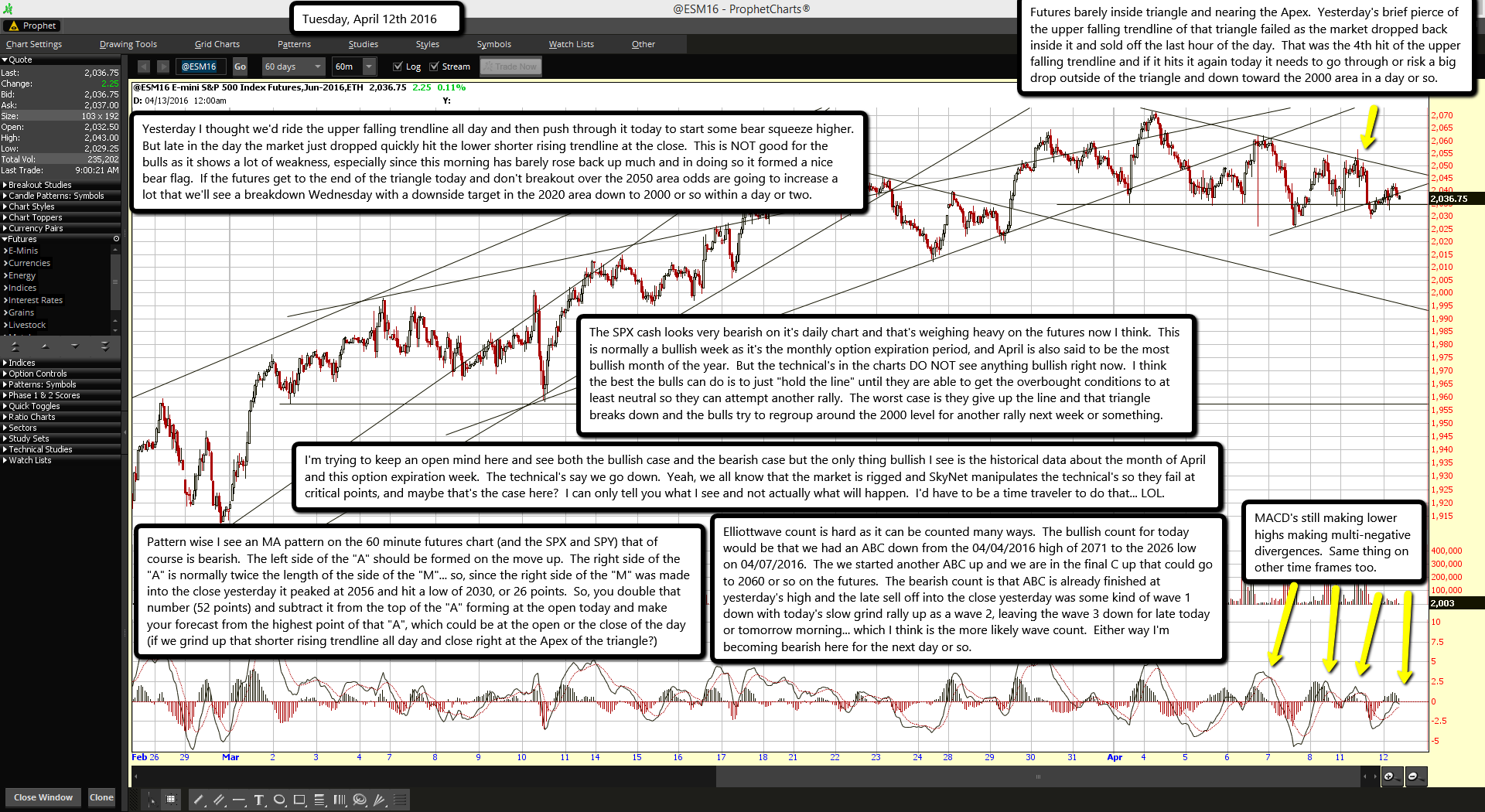
Futures barely inside triangle and nearing the Apex.  Yesterday's brief pierce of the upper falling trendline of that triangle failed as the market dropped back inside it and sold off the last hour of the day.  That was the 4th hit of the upper falling trendline and if it hits it again today it needs to go through or risk a big drop outside of the triangle and down toward the 2000 area in a day or so.

MACD's still making lower highs making multi-negative divergences.  Same thing on other time frames too.

Yesterday I thought we'd ride the upper falling trendline all day and then push through it today to start some bear squeeze higher.  But late in the day the market just dropped quickly hit the lower shorter rising trendline at the close.  This is NOT good for the bulls as it shows a lot of weakness, especially since this morning has barely rose back up much and in doing so it formed a nice bear flag.  If the futures get to the end of the triangle today and don't breakout over the 2050 area odds are going to increase a lot that we'll see a breakdown Wednesday with a downside target in the 2020 area down to 2000 or so within a day or two.

The SPX cash looks very bearish on it's daily chart and that's weighing heavy on the futures now I think.  This is normally a bullish week as it's the monthly option expiration period, and April is also said to be the most bullish month of the year.  But the technical's in the charts DO NOT see anything bullish right now.  I think the best the bulls can do is to just "hold the line" until they are able to get the overbought conditions to at least neutral so they can attempt another rally.  The worst case is they give up the line and that triangle breaks down and the bulls try to regroup around the 2000 level for another rally next week or something.

I'm trying to keep an open mind here and see both the bullish case and the bearish case but the only thing bullish I see is the historical data about the month of April and this option expiration week.  The technical's say we go down.  Yeah, we all know that the market is rigged and SkyNet manipulates the technical's so they fail at critical points, and maybe that's the case here?  I can only tell you what I see and not actually what will happen.  I'd have to be a time traveler to do that... LOL.

Pattern wise I see an MA pattern on the 60 minute futures chart (and the SPX and SPY) that of course is bearish.  The left side of the "A" should be formed on the move up.  The right side of the "A" is normally twice the length of the side of the "M"... so, since the right side of the "M" was made into the close yesterday it peaked at 2056 and hit a low of 2030, or 26 points.  So, you double that number (52 points) and subtract it from the top of the "A" forming at the open today and make your forecast from the highest point of that "A", which could be at the open or the close of the day (if we grind up that shorter rising trendline all day and close right at the Apex of the triangle?)

Elliottwave count is hard as it can be counted many ways.  The bullish count for today would be that we had an ABC down from the 04/04/2016 high of 2071 to the 2026 low on 04/07/2016.  The we started another ABC up and we are in the final C up that could go to 2060 or so on the futures.  The bearish count is that ABC is already finished at yesterday's high and the late sell off into the close yesterday was some kind of wave 1 down with today's slow grind rally up as a wave 2, leaving the wave 3 down for late today or tomorrow morning... which I think is the more likely wave count.  Either way I'm becoming bearish here for the next day or so.

A Yahoo-Daily Mail merger could turn the internet into “the worst kind of tabloid”

0

The company that owns the British tabloid the Daily Mail—and its highly trafficked website—is exploring a potential bid for Yahoo with the help of a private equity backer, the Wall Street Journal reports (paywall). While the Daily Mail & General Trust is just one of dozens of players that may bid for Yahoo, if the company succeeds, news on the internet may never be the same.

Any combination is likely to push the Daily Mail’s trademark brand of incendiary, lightly sourced, heavily borrowed tabloid journalism to Yahoo’s one billion worldwide monthly users. Yahoo’s over 50 local websites, many of them in local languages, help the company draw more total users than any other online company in the world after Google, YouTube, Facebook, and the Chinese search engine Baidu.

The Daily Mail’s high volume of articles, attention-grabbing headlines, and photo-heavy articles have helped it become one of the world’s most-viewed English-language news sites, with more traffic than the New York Times, the Guardian, Huffington Post, and Buzzfeed, according to some measures.

But the company’s numerous critics call it “shameless” and say its model relies heavily on taking other media outlets’ work, printing anonymously sourced gossip, trotting out sexist tropes, and often fanning the flames of religious, racial, and other divides. The company has been the subject of numerous lawsuits in recent years.

After the Daily Mail reported Baria Alamuddin opposed her daughter Amal’s marriage to actor George Clooney because he was not Druze (a Middle Eastern religion) and suggested Amal or Clooney could be killed if they were wed, Clooney responded publicly in USA Today.

The entire story was a fabrication—the elder Ms. Alamuddin is not Druze, nor had she been to Lebanon where the story claimed she was telling friends of her disappointment. But claiming the marriage could result in the death of the bride was another issue:

The irresponsibility, in this day and age, to exploit religious differences where none exist, is at the very least negligent and more appropriately dangerous. We have family members all over the world, and the idea that someone would inflame any part of that world for the sole reason of selling papers should be criminal.

After the Daily Mail apologized and retracted the story, he issued another scathing statement, calling the paper “the worst kind of tabloid” that “makes up its facts” and willingly prints a “premeditated lie.”

In November of last year, the Daily Mail published a cartoon showing refugees and scurrying rats entering Europe. It was compared to Nazi-era propaganda.

2E82312A00000578-3321431-image-a-133_1447721942823-300x213@2x

What DailyMail.com does “goes beyond anything practiced by anything else calling itself a newspaper,” one former writer based in New York wrote on Gawker:

I saw basic journalism standards and ethics casually and routinely ignored. I saw other publications’ work lifted wholesale. I watched editors at the most highly trafficked English-language online newspaper in the world publish information they knew to be inaccurate.

The Daily Mail is suing Gawker for defamation over the piece.

The paper has also been sued by a woman whose photo ran with an article about her being a porn star with HIV (she was neither), as well as by actors Ashton Kutcher and Mila Kunis.

The DMGT, as the paper’s publicly traded parent company is known, is exploring two options, according to the Wall Street Journal.

  • A private-equity partner buys all of Yahoo’s US operation, and the Mail would take over the news and media parts including Yahoo Finance, Yahoo News, and Yahoo Sports.
  • A private equity partner buys all of Yahoo and merges it with Dailymail.com and EliteDaily.com, the tabloid’s web properties.

DMGT executives have not found a private equity partner yet for any deal, and at this stage are merely in talks with six possible backers, the Journal reported.

Source link

Re: Panama Papers palaver

0

Abimbola Adelakun

I read  Abimbola Adelakun article on Thursday entitled, Panama Papers palaver  and what jolted me was the writer’s assertion that tax avoidance was tantamount to “cheating the system”.

To further rub in the narrative of cheating, the word “corruption” was repeatedly used to describe the usage of tax havens for the purpose of tax planning.

My worry is that there are millions of readers who rely on the writer to learn the basics of taxation and financial matters and to deliberately criminalise tax planning is unkind, unhelpful and perhaps, with due respect, misinforming the reading public.

The writer is entitled to her opinion on tax havens but she is not entitled to twist the fact. While for instance, I can state that I do not like sugar, which is my opinion, but I cannot say that sugar is bitter because that sugar is sweet is a fact which cannot be twisted by my dislike for sugar.

Tax havens are legitimate tax planning instruments. As long as no financial, criminal or tax laws are breached,  they are perfectly legitimate. Tax avoidance is not tax evasion. While we can all have our opinions on the morality issues tax havens throw up, it is important we do not substitute our opinions for facts.

Tunde Esan,

legal practitioner/tax consultant,

+23408033246.
Source link

Tsipras demonizes IMF to rally troops for bailout sacrifices

0

Greek Prime Minister Alexis Tsipras arrives to welcome General Secretary of OECD Angel Gurria (not pictured) at the Maximos Mansion in Athens, Greece, March 10, 2016. REUTERS/Michalis KaragiannisThomson ReutersGreek Prime Minister Alexis Tsipras arrives to welcome General Secretary of OECD Angel Gurria at the Maximos Mansion in AthensBy Paul Taylor

BRUSSELS (Reuters) - In Athens, walls have ears.

The leaking of a conference call of International Monetary Fund officials on Greece's latest bailout review has further undermined mutual trust in fraught debt talks, embarrassed the European Commission and infuriated the IMF and Germany.

At stake are the IMF's reputation as a stern enforcer of financial rescue programs meant to make indebted states viable and the European Union's determination to hold the euro zone together and avert another damaging Greek crisis.

Greek Prime Minister Alexis Tsipras exploited the leak at home to demonize the IMF, rally his left-wing Syriza party ahead of more painful sacrifices to secure the next slice of European loans, and try to put his conservative opponents in a corner.

But efforts to drive a wedge between the EU institutions and the IMF, and isolate IMF Europe director Paul Thomsen, a veteran of six years of acrimonious negotiations with Athens, fell flat.

"Each time Tsipras is going to have to compromise, he needs to create an external enemy," said George Pagoulatos, professor of European politics and economy at Athens University. "It's part of his old populist playbook.

"It's smart domestic politics even if it is dumb diplomacy."

After a transcript of the March 19 conversation was posted on Internet site WikiLeaks, Tsipras demanded the IMF explain whether it was plotting to push Greece to the brink of default to make it swallow harsher austerity measures. The text offers little support for such accusations, although the IMF officials do note that Athens only compromises when it runs out of money.

IMF Managing Director Christine Lagarde made clear whom she held responsible, backing her staff and writing to Tsipras: "It is critical that your authorities ensure an environment that respects the privacy of their internal discussions and take all necessary steps to guarantee their personal safety."

The leak highlighted known differences between the IMF and the EU over the state of Greece's third international bailout since 2010, and over how much more Athens needs to do to meet its fiscal targets and make its debt sustainable.

More damagingly, it laid bare the IMF staff's contempt for the European Commission, seen as too soft on the Greeks.

It undercut months of patient efforts by Tsipras and Finance Minister Euclid Tsakalotos to rebuild lenders' trust after the havoc wrought by former Finance Minister Yanis Varoufakis, who sparred acrimoniously with his euro zone colleagues and leaked documents to try to bounce them into concessions.

It also shone a light on a complex, three-dimensional chess game the IMF is playing to try to make Greece accept painful reforms of pensions, taxation and bad loans while pressuring Germany and its allies to grant Athens substantial debt relief.

Put simply, the IMF's position is that the Greek economy is in worse shape than rosy EU forecasts suggest, and that a necessary relaxation of fiscal targets must be balanced by greater debt relief from euro zone lenders.

Since the Europeans refuse an outright debt write-off, known as a "haircut", they will have to stretch out loan maturities for decades and give Athens a 20-year debt service holiday.

Otherwise the numbers won't add up and the program is headed for failure, the IMF says.

"The bottom line is the debt will not be repaid in our lifetime," said Jacob Kirkegaard, senior fellow at the Peterson Institute for International Economics in Washington.

"The IMF is gearing up for new clients in the emerging economies. That is not best done by being soft on Greece. They won't go to the (IMF) board to approve participation in a third Greek bailout without something they think is tough and credible," he said.

Brussels contends that both the economy and Greek compliance with the bailout program are better than the IMF thinks, hence the first review should be concluded soon, allowing Athens to access the next 5 billion euros ($5.70 billion) of loans.

In the transcript, IMF Greece mission chief Delia Velculescu complains that the Commission agrees on joint positions only to back down to the Greeks the next day, giving Athens no incentive to make tough reforms.

Thomsen belittles tax increases proposed by Greece to plug the fiscal gap as "Mickey Mouse stuff". He also suggests German Chancellor Angela Merkel should be made to choose between giving Athens substantial debt relief or seeing the IMF pull out.

Germany, the biggest creditor, is the most reluctant about major debt restructuring. Its parliament insists on a continued IMF presence to enforce budget savings and minimize the need for stretching out loans and freezing interest payments.

How the three-way tug-of-war between the IMF, Greece and Berlin will play out remains uncertain. The sequencing will be tricky, but no side seems to have an interest in walking away.

The Germans are more dependent now on Greece to act as Europe's gatekeeper than they were during last year's crisis over a possible "Grexit" from the euro zone. Berlin needs Athens' cooperation to process and detain migrants and refugees until they can be send back to Turkey.

The Tsipras government has spent much political capital to keep Greece in the euro zone and reach the long sought debt relief negotiations. It cannot afford to alienate the lenders.

And the IMF too does not want to abandon Greece as a black mark on its record.

"Four of the five euro zone bailouts have gone pretty well - an 80 percent success rate. Yet if the IMF walks away from Greece now, everything they've done in Europe will be remembered as a failure," said Kirkegaard.

($1 = 0.8773 euros)

Source link

USPS, Shiny Objects, Recovery, and Recession – What They Think

0

Commentary & Analysis

The USPS exigent price increase has expired, and USPS says they “will lose approximately $2 billion in annual revenue resulting from a price reduction” which they knew was going to expire. The increase was to help “recover for the massive volume and revenue losses resulting from the Great Recession.” Yet, Dr. Joe shows that the declines in USPS volume kept declining after the economic recovery began in mid-2009. Then Dr. Joe talks about recession in light of recent economic data. Yeah, they’ll be calling him Dr. Doom again.

By Dr. Joe Webb
Published: April 11, 2016

The “forced” price reduction by the US Postal Service (read their release) is, as my late mother-in-law used to say with a slight Hungarian accent, “a lotta hooey.” This was the expiration of an increase forced onto postal customers and the public based on the terms of an exigent price increase program to save the USPS when they were in financial trouble. During its time, the USPS was to get their house in order before its planned expiration.

Now, the USPS is claiming it is being shortchanged when in reality its customers were being overcharged. Is this like the slayer of parents asking for the mercy of the court because he was recently orphaned? USPS problems are a long term combination of self-infliction, myopia and a large doses of oversight and regulatory meddling. It’s time to set the USPS free, and let it run as a real business making the hard decisions real businesses have to make.

Instead, they’re backed into a corner. By focusing automation efforts on big postal customers who supply the bulk of their volume, where the savings would be fastest and biggest, they rarely found time to nurture small postal user volume or make aggressive efforts to create new businesses. EDDM is not the answer for everyone.

This is the downside of Pareto analysis. In the 80-20 rule, you focus on the 20 that gives you the 80. But Pareto is a snapshot, and the 20 that gives you the 80 today might be totally different tomorrow. It solves short term problems. Call it the Motorola problem. The company that gave us Six Sigma quality got lost producing defect-free products that the market did not want. Look at the shiny object while a competitor steals your market share.

This inside-out thinking makes great accounting sense quarter-to-quarter as you can show cost-saving acumen, but you neglect the big world outside. There remains little comprehension that their pricing is out of line with competitors, and they are shackled by numerous political rent-seekers who influence their actions in destructive ways.

If this was a real business, especially a publicly traded company, no board of directors would have allowed the precipitous decline in sales to persist without dramatic actions and swift changes in management and strategy. Those management changes would be people from outside of their business, not internal promotions. The USPS is not known as a hotbed of entrepreneurial innovation by its very design. (Lysander Spooner, where are you now that we need you?)

Before anyone mentions the pension payments that were part of the USPS agreements in the past, those are real actuarial costs, and a contractual commitment that was known well in advance. All businesses deal with costs that they cannot control, especially of a regulatory and compliance nature, with much of them hidden in all of their costs. The USPS has many benefits that businesses cannot have, many of them in a report by Robert Shapiro and discussed at the Brookings Institution. As one can imagine, the USPS community hated the “study,” as detractors would use quotes around the word so as to disparage it.

What do they have to show for the exigent price increase? The press release about the recent Annual Compliance Determination said “The majority of products failed to meet service performance targets for FY 2015.” Kudos to the Postal Regulatory Commission for not taking the easy way out and renewing the exigent increase. Whether anything comes of it remains to be seen.

Now a calm look at the data. In last week’s newsletter, the chart of the week looked at Every Door Direct Mail (EDDM). Here are other data for major categories.

It is helpful to look at what has happened to postal volume in ways outside of revenues that cannot be distorted by inflation. In terms of pieces, standard mail has stabilized while others have declined. Had volume kept up with population, it would be 13% higher than in 2001.

In terms of weight, mail is getting lighter. This may be a surprise, but mailers react to price increases by redesigning the nature of their mailings. All postal price changes are reacted to by its customers. Postal costs are not their only costs, nor is the postal service their only choice to reach their target audience.

The per household pieces of mail since 2001 is down -36% (excluding packages), and the total weight of mail delivered per household is down -40%.

The USPS is hampered by law from expanding into other services and from reacting to the actions of competitors. This fosters strategic blindness to market needs as they focus on the services they have and can only get approvals for minor changes to them. USPS says they understand that there are alternatives but they do little to decisively act on their recognition.

The USPS press release said “The PRC granted an exigent surcharge beginning in January 2014… to recover for the massive volume and revenue losses resulting from the Great Recession.” Look at the charts: the volume and revenue losses occurred after the economic recovery began in mid-2009. Standard mail stabilized and even rose for a short time. First class and periodicals continued to decline because postal prices did not keep up with competitive alternatives; they were declining prior to the recession and just continued to do so. During the recovery, mobile media, smartphones, and other technologies kept taking dollars that would previously have supported postal volume. Some first class mail volume was switched to standard mail; in other words, USPS lost a portion of its first class volume to itself as customers attempted to manage their costs.

It’s time to set the USPS free. It needs to become a publicly owned company where half of the stock is held by the union members and their pension funds. It needs a board of directors comprised of owners, not stakeholders, not rent-seekers, and not placeholders. Those whose very livelihoods depend on the growth success of the organization need to be there, not those stretching out its survival.

Until that happens (which is never), here is my advice to printers. Navigating the nature of the USPS and its regulations has always been a special skill rewarded by the marketplace. No matter what the situation, USPS costs will be going up, if not in a nominal sense, but because the cost disparity with other media will continue to widen. That means that data management, customer and prospect analytics for mailers, and automation have to make up for the cost disparities that the USPS is unable to address. There is great interest in new ink jet presses, such as those to be shown at drupa (especially Benny Landa’s efforts) that may deliver new production capabilities that can increase flexibility, reduce production steps (such as eliminate two-pass approaches like digital printing on offset shells), and give print a fighting chance as a mailed medium again. If you are only in the mailing business for part of your volume, seek alliances with mailing specialists who will be able to keep up with the technologies needed to be profitable in this kind of environment. All printers used to do mailings; it is becoming a highly specialized niche that you can’t be successful in with out full commitment. There are few products, like EDDM, that are directly targeted to small business that are appropriate in certain uses, that small print businesses can handle with little sophistication. But big mail will require big data and big automation to balance increasing costs of compliance and postage.

The Economy: Love Those Mixed Messages

GDPNow last +0.1% but it fell because of bad wholesale inventory numbers, which may not be as bad news as it sounds. GDP and net inventories had been out of balance, inflating GDP more than its underlying trend.

There is no doubt a recession is possible and this GDP estimate did seem to attract a lot of attention of analysts claiming that this could indicate the start of a recession. If you really wanted to declare a recession, the last peak of manufacturing using the factory orders data was in mid-2014.

Recessions are always declared after they started and always at the last peak of economic activity. The last time a recession was declared we were eleven months into it. The last recession began in December 2007 and was not declared until November 2008. Many of the economic indicators during that period were good, and the true evidence of the recession did not occur until commodities prices collapsed. This time, commodities prices collapsed already and are starting to rebound.

The old rule of thumb of two consecutive quarters of negative growth was never the official definition of a recession. It’s the task of the National Bureau of Economic Research to declare them, and their guidelines are there for all to see. Here are the key comments; italics and underscores are mine:

“The committee's approach to determining the dates of turning points is retrospective. We wait until sufficient data are available to avoid the need for major revisions. In particular, in determining the date of a peak in activity, and thus the onset of recession, we wait until we are confident that, even in the event that activity begins to rise again immediately, it has declined enough to meet the criterion of depth. As a result, we tend to wait to identify a peak until many months after it actually occurs.”

This means that any businessperson will suspect that a recession is in place before the academics declare it. They have the luxury of sitting around and waiting for data. Business owners do not. Stay vigilant.
Source link

Zirx’s new platform lets auto companies offer their own concierge service

0

More than two months ago, Zirx pivoted away from being an on-demand valet service to focus exclusively on the enterprise. Today, the company announced its launch mobility service, a platform targeting automotive companies to not only manage vehicle transportation logistics, but also provide a better experience to their customers.

Since its founding in 2014, Zirx has focused on helping you park cars, whether you were a private user or a business customer. But the company didn’t see profitability with its valet service so it went all in on the enterprise. With Zirx Mobility Services, it’s providing a full stack logistics offering to auto makers, dealerships, and fleet owners. Services include delivering cars from a customer to be repaired or from one dealership to another, along with many others. Essentially Zirx has white-labeled its valet service specifically for auto companies.

Zirx Mobility Services transportation dashboard

“The automotive industry is in a period of big change, more change than it’s ever had,” Zirx CEO Sean Behr told VentureBeat. “The industry as a whole is worried that people are going to buy fewer cars and that this company called Uber is posing a threat to their bread and butter business. It makes them move in the space to deliver a better customer experience and address this gap in the changing market.”

He described Zirx Mobility Services as a full-service platform, one that gives companies a dashboard to manage requests and an API to integrate into their own apps. In addition to the six cities where Zirx previously offered its consumer service, it has added Boston and Chicago. Behr explained that with his company’s pivot, market expansion is now dictated by demands from companies in those cities.

Zirx Mobility Services is purely business-focused, meaning that consumers can’t use it to have their cars parked — in fact, Zirx has eliminated its parking garages. However, if BMW wanted to offer a service where it would pick up a customer’s vehicle when it needed servicing, gas, or washing, that would be among the capabilities of Zirx’s platform.

Zirx Mobility Services

Zirx’s Mobility Services can manage logistics for multiple vehicles, and its algorithm optimizes the process so agents are used more efficiently. Zirx has moved away from its one-size flat-fee model, saying that a usage-based pricing plan is needed — companies are charged based on the time and distance.

Behr offered this scenario: “Imagine if you rent a car, but find that you need a larger vehicle? They can have a Chevy Tahoe show up at your front door on Friday at 5 p.m., they tell you what it costs, you sign the paperwork, and there you go. Then you get home on Sunday night, the last thing you want to do is bring the car back to the rental car center and fill it up with gas. The company can come pick it up from you for a surcharge…”

Businesses can use Zirx’s web-based console to request Zirx pick up or deliver a vehicle, or integrate Zirx’s mobility service directly into their own platforms through the open API. “Most companies run this stuff with paper and pen,” Behr explained. “It’s a replacement of paper and pen spreadsheets, emails, and print-outs.”

Although he wouldn’t disclose specific names, Behr acknowledged that “a couple dozen” companies have already signed up for Zirx’s service. He also stated that because of Zirx’s pivot, all of the eight markets where it operates are expected to be profitable by May. While the whole company won’t turn a profit by then, Behr said it could sometime this year.

Zirx also announced today that it has partnered with Openbay and BAMA Commercial Leasing on the launch of its mobility services. Openbay specializes in helping you get auto repairs and maintenance done on your vehicles, something that Zirx believes its service can help facilitate — you find a place to take your car to and it’ll have an agent come pick it up and deliver it back. With BAMA Commercial Leasing, Zirx helps to deliver the company’s fleet of vehicles from one place to another.

This isn’t the first time that Behr’s team has had an offering for businesses. In September, Zirx rolled out a subscription program for companies that alleviated the stress employees had when finding parking near their office. Zirx Enterprise, as it was known as, primarily benefited the drivers, not the company. Behr said that the service is still available, but it’s available on a time and usage pricing model, no longer as a fixed fee.

There aren’t any upfront costs to using Zirx’s mobility services, and they are available as of today.

ZIRX is focused on the last mile of a driver’s journey. We are powering an awesome customer experience backed by smart technology that allows field operations to hum. Through an on-demand model a ZIRX agent is intelligently queued to...

New! Track ZIRX's Landscape to stay on top of the industry in 3 minutes a day. Understand the entire ecosystem, monitor innovation, and track deal flows.

Mr. Sean Behr served as Senior Vice President of Global Operations at Adap.tv, Inc and served as its Vice President of Market Operations. Mr. Behr served as Vice President of Product Management of Adap.tv, Inc. Mr. Behr has held variou...

New! Track Sean Behr's Landscape to stay on top of the industry in 3 minutes a day. Understand the entire ecosystem, monitor innovation, and track deal flows.
Source link

Overstock CEO Patrick Byrne takes indefinite leave of absence over Hepatitis C complications

0

patrick byrne overstock

Patrick Byrne, the mercurial CEO of Overstock.com, says that he is taking a leave of absence. It's unclear when -- or if -- he'll return.

Byrne said he contracted Hepatitis C in 1984 in Xinjiang, an autonomous region of China, "when a barefoot doctor sewed up a head wound under less-than-ideal conditions." He says he finished treatment and thinks he can beat the disease, "but only time will tell."

Hepatitis C can lead to long-term health problems, including liver cancer.

In his statement about his leave of absence, Byrne quoted the character Chief Dan George in the Clint Eastwood movie "Outlaw Josey Wales": "I myself never surrendered. But they got my horse, and it surrendered."

Byrne is no stranger to health problems. When he was 22, he was diagnosed with testicular cancer that had metastasized throughout his body. He has had multiple recurrences and complications.

Despite those challenges, Byrne built Overstock.com (OSTK) into a sizable e-commerce power player. Overstock is perpetually profitable, bringing in $1.7 billion in sales in 2015. This year, the company anticipates $40 million in profit, before taxes.

Byrne has made news less for his acumen as a business leader and more for his quirky interests and passions.

In 2013, Overstock became the first major U.S. retailer to accept the digital currency Bitcoin. Byrne said that he was concerned about the possibility of "bad currency wars" in the future. He said the U.S. dollar is being undermined by the Federal Reserve's money policies and by overspending by politicians in Washington. He said he prefers gold to dollars.

Byrne also has gone on a decades-long rampage against naked short-selling, a controversial tactic used by Wall Street investors to place bets against a company's stock. Naked short selling takes place when a trader never actually borrows the stock he or she is shorting.

On its website, Overstock describes Byrne as "a leading voice in a growing movement convinced that powerful interests on Wall Street are destroying American companies for profit -- robbing investors and destabilizing our financial system in the process.

Byrne helped Overstock shareholders file two lawsuits in 2006 and 2007 against naked short-sellers.

Taking over for Byrne as acting CEO will be Mitch Edwards, former CEO of BitTorrent and Skullcandy. Edwards has served as general counsel of Overstock.com for the past six months.

"Mitch is an outstanding full-spectrum entrepreneur who has serving as our general counsel for six months and has learned our business, and understands our efforts to revolutionize the capital markets," Byrne said.

Source link

Gartner: Global PC shipments fell 9.6% in Q1 2016, the first quarter below 65 million units since 2007

0


No surprise here: The PC market started 2016 off poorly. Both Gartner and IDC have noted PC shipments were down globally, again.

Gartner estimates worldwide PC shipments fell 9.6 percent to 64.8 million units in Q1 2016. In fact, the firm notes that this is the first quarter to see below 65 million units since 2007. In other words, Q1 2016 PC shipments were almost a decade-low.

The top five vendors were Lenovo, HP, Dell, Asus, and Apple. As you can see in the chart below, Gartner found that Apple and Asus were the only companies among the top vendors that experienced an increase in PC shipments. Leaders Lenovo and HP saw particularly poor results, though the declines weren’t quite in the double digits.

gartner_pc_shipments_q1_2016

The strength of the U.S. dollar was one of the reasons given for these declines.

“The deterioration of local currencies against the U.S. collar continued to play a major role in PC shipment declines,” Mikako Kitagawa, principal analyst at Gartner, said in a statement. “Our early results also show there was an inventory buildup from holiday sales in the fourth quarter of 2015.”

And as always, the same trends were brought up: PCs are not being adopted in new households like they used to, especially in emerging markets where smartphones rule.

2016 will be the first full year that we’ll see whether Windows 10 can help reverse the PC market’s decline. So far, it doesn’t look good.

Gartner, for example, expects that businesses will start to adopt Windows 10 toward the end of the year.

Source link

Average gas prices still lower here than nationally

0

Average retail gasoline prices in Louisiana have fallen 2.1 cents per gallon in the past week, averaging $1.83/g yesterday, according to GasBuddyLouisiana, LA, April 11- (Gasbuddy.com) - Average retail gasoline prices in Louisiana have fallen 2.1 cents per gallon in the past week, averaging $1.83/g yesterday, according to GasBuddy's daily survey of 2,436 gas outlets in Louisiana.

This compares with the national average that has fallen 1.2 cents per gallon in the last week to $2.04/g, according to gasoline price website GasBuddy.com.

Including the change in gas prices in Louisiana during the past week, prices yesterday were 34.9 cents per gallon lower than the same day one year ago and are 16.0 cents per gallon higher than a month ago.

The national average has increased 15.6 cents per gallon during the last month and stands 34.9 cents per gallon lower than this day one year ago.

According to GasBuddy historical data, gasoline prices on April 11 in Louisiana have ranged widely over the last five years:
$2.18/g in 2015, $3.41/g in 2014, $3.38/g in 2013, $3.81/g in 2012 and $3.63/g in 2011.

Areas nearby Louisiana and their current gas price climate:
Baton Rouge- $1.80/g, down 2.8 cents per gallon from last week's $1.83/g.

Jackson- $1.80/g, down 1.7 cents per gallon from last week's $1.82/g.
New Orleans- $1.82/g, down 1.2 cents per gallon from last week's $1.83/g.

“It’s especially rare in April to see the average price of gasoline dead even or slightly lower in some places than where it was in the prior week… and as encouraging as that news certainly is for U.S. motorists, unfortunately, it’s more of an anomaly than a trend. But it’s still a very good harbinger of the savings 2016 is expected to bring,” said Gregg Laskoski, senior petroleum analyst for GasBuddy.

“What caused it? We've been fortunate that 2016 delivered a successful and largely uneventful transition by refineries to the ‘summer blend’ fuel formulation which has been completed in California and is nearing completion almost everywhere else.

Concurrent output through March and early April matches levels not seen since 2005,” Laskoski added. “So the healthy inventory in advance of demand has helped flatten prices, but we don’t expect that to last when summer travel kicks into high gear.”
Source link

Gas prices flat in RI, up 2 cents in MA – WPRI 12 Eyewitness News

0

istock generic gas pump

PROVIDENCE, R.I. (AP) — The cost of a gallon of gasoline in Rhode Island is holding steady.

The price had increased over the last five weeks. AAA Northeast found in its weekly survey that self-serve, regular gasoline is selling for an average of $2.04 per gallon, the same as last week.

That price is 32 cents lower than the same time a year ago, when a gallon sold for $2.36. Rhode Island’s price is the same as the national average.

AAA found self-serve, regular gas selling for as low as $1.95 per gallon and as high as $2.10 in Rhode Island.

In Massachusetts,  AAA Northeast announced Monday that self-serve, regular has risen 2 cents per gallon in the past week to an average of to $2. It’s the sixth consecutive week of higher prices in Massachusetts.

The Massachusetts price is still 4 cents per gallon lower than the national average and 34 cents lower than it was a year ago. AAA found self-serve, regular selling for as low as $1.89 per gallon and as high as $2.19.

Source link

Alamos Gold, Inc (AGI) Stock Price Will Hit $5.26: Analysts

0

Analysts are weighing in on how Alamos Gold, Inc. (AGI), might perform in the near term. Wall Street analysts have favorable assessment of of the stock, with a mean rating of 2.3. The stock is rated as buy by 3 analysts, with 8 outperform and 4 hold rating. The rating score is on a scale of 1 to 5 where 1 stands for strong buy and 5 stands for strong sell.

For the current quarter, the 10 analysts offering adjusted EPS forecast have a consensus estimate of $-0.03 a share, which would compare with $-0.01 in the same quarter last year. They have a high estimate of $-0.01 and a low estimate of $-0.08. Revenue for the period is expected to total nearly $113.35M from $44.73M the year-ago period.

For the full year, 14 Wall Street analysts forecast this company would deliver earnings of $-0.1 per share, with a high estimate of $-0.03 and a low estimate of $-0.25. It had reported earnings per share of $-0.1 in the corresponding quarter of the previous year. Revenue for the period is expected to total nearly $472.75M versus 355.10M in the preceding year.

The analysts project the company to maintain annual growth of around -28.51 percent over the next five years as compared to an average growth rate of 17.53 percent expected for its competitors in the same industry.

Among the 9 analysts Thomson/First Call tracks, the 12-month average price target for AGI is $5.26 but some analysts are projecting the price to go as high as $7. If the optimistic analysts are correct, that represents a 22 percent upside potential from the recent closing price of $5.74. Some sell-side analysts, particularly the bearish ones, have called for $3.5 price targets on shares of Alamos Gold, Inc..

In the last reported results, the company reported earnings of $-0.08 per share, while analysts were calling for share earnings of $-0.03. It was an earnings surprise of -166.7 percent. In the matter of earnings surprises, the term Cockroach Effect is often implied. Cockroach Effect is a market theory that suggests that when a company reveals bad news to the public, there may be many more related negative events that have yet to be revealed. In the case of earnings surprises, if a company is suggesting a negative earnings surprise it means there are more to come.

Alamos Gold Inc. explores for, mines, develops, and produces gold deposits in the United States and Canada. The company also explores for silver and precious metals. Its principal assets include the Young-Davidson mine, which includes mineral leases and claims totaling 11,000 acres located in Northern Ontario, Canada; the Mulatos mine in the Salamandra concessions; and the El Chanate mine that comprises 22 mineral concessions covering 4,618 hectares situated in the State of Sonora, Mexico. The company also holds interest in a portfolio of development stage projects in Mexico, Turkey, Canada, and the United States. The company was formerly known as AuRico Gold Inc. and changed its name to Alamos Gold, Inc. in July 2015. Alamos Gold, Inc. is headquartered in Toronto, Canada.
Source link

Death toll hits 106 from fireworks blast at India

0

An unidentified man weeps as bodies of victims lie outside a morgue at the Kollam district hospital after a massive fire broke out during a fireworks display at the Puttingal temple complex in Paravoor village, Kollam district, southern Kerala state, India, Sunday, April 10, 2016. Dozens were killed and many more were injured when a spark from an unauthorized fireworks show ignited a separate batch of fireworks that were being stored at the temple complex, officials said. (Jyothiraj. N.S/Associated Press)

April 10 at 10:46 PM

THIRUVANANTHAPURAM, India — Rescue officials on Monday sifted through a Hindu temple in southern India where more than 100 died when a fireworks display - an unauthorized pyrotechnic display that went horribly wrong - swept through for a religious festival packed with thousands.The official death toll so far from the pre-dawn fire on Sunday at the Puttingal temple complex in the village of Paravoor, stood at 106 people with more than 380 others hurt, officials said, but local media reports said the figure was higher.

Scores of devotees ran in panic as the massive initial blast cut off power in the complex, while other explosions sent flames and debris raining down, a witness said. Many people were trapped.

“It was complete chaos,” said Krishna Das of Paravoor. “People were screaming in the dark. Ambulance sirens went off, and in the darkness no one knew how to find their way out of the complex.”

The fire started when a spark from the fireworks show ignited a separate batch of fireworks stored in the temple complex, said Chief Minister Oommen Chandy, the top elected official in Kerala state.

Police were searching for 15 members of the temple board who fled after the accident. Police were investigating for possible charges of culpable homicide, punishable with life imprisonment, and illegally storing a cache of explosives.

Most of the 106 deaths occurred when the building where the fireworks were stored collapsed, Chandy told reporters. About 60 bodies have been identified, he said. TimesNow, an Indian television news channel, put the death toll at 112.

Das said ambulances carried the injured to hospitals in the state capital of Thiruvananthapuram, about 60 kilometers (37 miles) south of Paravoor, as well as the city of Kollam.

Villagers and police pulled many of the injured out from under slabs of concrete.

TV channels showed video of huge clouds of white smoke billowing from the temple, as fireworks were still going off in the sky.

One of the explosions sent huge chunks of concrete flying as far as a kilometer (half a mile), said Jayashree Harikrishnan, another resident.

Rescuers searched the wreckage for survivors, while backhoes cleared debris and thousands of worried relatives went to the temple to search for loved ones.

The temple holds a competitive fireworks show every year, with different groups putting on displays for thousands gathered for the end of a seven-day festival honoring the goddess Bhadrakali, a southern Indian incarnation of the Hindu goddess Kali.

This year, however, authorities in Kollam district had denied temple officials permission to hold the fireworks display, said A. Shainamol, the district’s top official.

“They were clearly told that no permission would be given for any kind of fireworks,” Shainamol told reporters.

Permission was denied over fears the competing sides would try to outdo each other with more and more fireworks and because the temple gets overcrowded during the festival, she said.

Amita Prakash, a resident, said she and some other residents have been trying since 2012 to stop the fireworks display which goes on for hours. “We petitioned state authorities this year also. Some of the organizers threatened my family with harm if I continued with my campaign,” she told reporters.

Chandy, the state’s chief minister, said he had appointed a retired judge to investigate the events leading to the fire and that action would be taken against those who had ignored rules.

Prime Minister Narendra Modi flew in from New Delhi to visit the site and met with Chandy and other Kerala leaders on measures to help the survivors.

Source link

ES Morning Update April 11th 2016

0

3d1941a9-29de-4b04-b72e-f4f79d1b2f23

ES Futures are back at that upper falling trendline of resistance for the 4th time now.

MACD's are pointing up on this 2 hour chart and the 6 hour, 4 hour and 60 minute charts... but they look extended.

Hard too say what will happen today.  The falling trendline of resistance is getting weaker now and could be pierced.  Today would be the best day to do it as Monday's usually have light volume, which favors the bulls.  On the other hand if that trendline holds then we could still be in a C wave down of some kind that could take us to the lower falling trendline around 2000 or so.  I find that hard too believe though as this week is usually a bullish week and today is Monday which again, has light volume and favors the bulls.

The more likely outcome is that the upper falling trendline hold early on today the market just slowly drifts sideways to down riding that trendline until later today or tomorrow morning we see it push through it and continue this rally.  This is more of a gut feeling based on the week of the month being bullish and the day of the week also being bullish (only because it will likely have light volume again).  If it busts through to the upside they could get a nice bear squeeze going so I wouldn't short it at that point.

Unfortunately today just looks more like a typical boring Monday where the biggest move is made before the open and the rest of the is used too reset the overbought short term conditions.  If we rollover I'd look for support in the 2037-2040 area first from a newer shorter rising trendline, then the double bottom at 2026... but again, I give that low odds.  If we drop at all I'd bail out on the newer rising trendline of support.

ES Morning Update April 8th 2016

0

92a52a12-33db-4627-b3d7-c30f3ca39339

Futures looking good for a hit of the newer falling trendline.

MACD's on this 2 hour chart pointing up and are near zero now.  But the SPX Cash chart shows the 60 minute MACD's on it pointing down.  So we are mixed now.

Considering that the C wave down happened yesterday when it pierced the 2035 horizontal support and hit a low of 2026 intraday I have to go back to the drawing board on guessing the wave count.  On one hand that C wave could be finished as it's about as long as the A wave down from the 2072 high, but on the other hand the C wave could be dividing into 5 waves with a much lower target still to come.

If it's dividing then we are clearing in the wave 2 up and the wave 3 down is yet to come. But the technical analysis shows the Full Stochastic on the SPX cash down below 20 on them, which suggests they should "first" turn back up and get back up to the 50-60 area before turning back down.  This happen quickly, like in the first half of today or slowly and take all day.  The MACD's on the 60 minute SPX cash chart should also go back up at least half of today.

This all tells me that while the ES Futures chart is going to run out of steam early this morning (and hit that newer falling trendline of resistance around 2055 area now) the SPX cash is lagging behind in short term oversold territory.  I put this together to mean that there won't be a quick rollover at the open today as the SPX (60 min chart) should keep pushing up at least half of today providing support for the Futures.  Maybe the futures will pullback briefly but the SPX cash should push them back up.

Now the big question is... will it push up through Wednesday's 2060 high or Monday's 2072 high?  If that happens then the ABC down to yesterday's low is all we are going to get for the bears and we are still on track for hitting the SPY fake print from last month and the IWM fake print.  I get the feeling we had our Thurs/Fri low yesterday and any pullback today will be bought.  Sadly for the bears is that the short term SPX chart is oversold and could take all day to work off.  Next week is unknown of course, and I guess that C wave down could drop to the 2010 (on the futures) that I said could happen yesterday.  But I'm thinking yesterday's low will hold today and the newer falling trendline will hold.  Meaning the bulls are too tired up here on the futures chart to push through it and the bears are too tired on the downside of the SPX chart to breakdown hard again today.

Rangebound between that newer falling trendline around 2055 and yesterday's low of 2026 is what I think for today.  Then next week... probably up to the FP's on the SPY and IWM.

ES Morning Update April 7th 2016

0

eefada42-d92e-4534-a445-2179635175ed

New falling trendline should stop any rally back up.

Horizontal trendline has been hit 3 times and gets weaker each hit.

Old falling trendline is about as low as I could see the market going and still stay bullish for next week.

MACD's on this 60 minute chart still pointing down with no signs of turning back up yet.  The 6 hour chart is flatlined and could go either way.

Looking at the daily chart on the SPX (not shown here of course) the 20MA is around 2029 and the 10MA around 2053, so it's pretty clear how important it is for the bulls to NOT lose these on a Daily close.  I do think we'll see the 2053 lost today at least intraday, but the 2029 might not be hit until Friday?  It's pretty bearish looking on the daily chart but if the bulls don't lose 2029 by the close on Friday then we could still see more upside next week.  It is the monthly options expiration next week and that's usually bullish.

For the bears the ideal shorting spot is a move back up to that new falling trendline on this 60 minute chart of the ES Futures.  Depending on when (and if) it hits the level is from 2060 down to 2058 or so near the close.  We clearly have a "Head and Shoulders" pattern and yesterday's rally into the close looks like the B wave up with the A wave down ending at the low of 2035 and starting at the 2071 prior days' high (and the Head for our H&S pattern).  This suggests we are in C wave down now with the opening gap down being the wave 1 down.  So at some point we'll see a wave 2 up (inside C down) so short at, and to hopefully hit the perfect spot of that new falling trendline in the 2058-2060 area.

The technical analysis picture certainly supports a C wave down as it too looks very bearish.  So the odds look good for at least another test of the horizontal trendline of support (for the 4th hit) between today and Friday (if not lower?).  How this plays out today is a tough call but we all know how the Fed's don't like to be blamed for anything, so if I had to guess I'd say we'll hold the horizontal support today (if we even hit it?) and some how do that rally back up for the wave 2 (inside the C down) closer to the end of the day leaving Friday open for a wave 3 down inside a C down.  Bulls are really tired up here and it's going to take several days for them gain any "last breath" to make another run up for that 2080-2100 area everyone is looking for.  It's possible they do it next week as that's the best week of April for the bulls due to it being the monthly option expiration week.  Do it next week or die.  But right now we are bearish with ideal shorts on that wave 2 bounce back up.

ES Morning Update April 6th 2016

0

48970f6d-0bdc-49b2-b236-250113ad6d71

Head And Shoulders on this 2 hour chart

MACD's are mixed between the 6 hour, 4 hours, 2 hour and 60 minute charts.

With the FOMC meeting today at 2pm again we might be directionless until then, but in favor of the bears I think.  If yesterdays move down was some kind of small A wave and the choppy retrace back up to the 2050 area was the B wave then we should see the C wave down today to complete this ABC pattern.  The B wave up looks to small to me but if we breakdown and lose the 2040 area of support then we should be in the C wave down.  Support then is around the 2010 zone.

Now, if we don't see that 2040 support break before the FOMC meeting then we might not be finished with the B wave up and it might pop higher before or after the FOMC, so we are kinda in "no man's land" until we see a clear breakdown or be sure that the B wave up is finished.  Sometimes it's best to just wait until after the FOMC meeting is over to see what the real direction is.  The main thing is that we should still have a low this Thursday or Friday.  So a rally up to say that 2060 area is a short in my opinion.

I tend to think we'll start down and break the 2040 area of support but I just don't have any clear picture to increase the odds to one side or the other.  It's just a flip of coin right now as to where the market will go ahead of the meeting.  After the meeting I'd look to go long around that 2010 support zone or short around the 2060 resistance.  Everything in between is too hard to trade.

ES Morning Update April 5th 2016

0

f8950a8b-3583-4448-bb6f-e346235fbafb

Futures have fallen to the first zone of support in the 2040's

MACD's are into oversold areas and looking ready to turn back up.

Today we'll see if the market can rally up to backtest the lower rising trendline that it broke overnight, which if that happens near the close and the 60 minute and 2 hour charts look overbought then that suggests we had an A wave down yesterday and early today with the expected rally up making the B wave.  This leaves a C wave down into a Thursday/Friday low.

If we continue down then the next support zone is in the 2000-2010 area, but charts suggest we turn back up today... probably after some early up and down chop as the MACD's make the turn upward.  This could last for a few hours in the morning but as long as this area holds (between 2030-2040) it should turn up later today and make a lower high going into the close.

Remember guys that this is the week before the monthly options expiration and a low is commonly put in on the Thurs/Fri of this week.  Then the next week when options expiration happens you commonly see the market rally  up to make all the retail traders hold puts lose as they expire worthless.  It's the old "steal from the poor and give to the rich" motto.  This suggests that we'll go lower this week and rally some next week.  So if we rally up today to backtest prior support then it's very likely a short into Wednesday and Thursday... if not Friday too.

s2Member®