Thursday, September 24, 2026
Home Blog Page 99

Apple versus the FBI: Why the lowest-priced iPhone has the US in a tizzy

0

Apple says the fight is about security and privacy for everyone, about the US government trying to compel a public company, using a 227-year-old law, to compromise its most important products, and about setting a "dangerous precedent" that gives the US authority to ask it and other businesses to change their products in the future.

The FBI and the Department of Justice say it's about making sure Americans aren't in jeopardy, about fighting terrorists who are using increasingly sophisticated communication tools, and about a reasonable request to gain evidence from a single iPhone.

Apple CEO Tim Cook says the FBI wants to build a 'master key' that could be used to unlock hundreds of millions of iPhones. The FBI says it's fighting terrorism and Apple just wants to protect its brand.

Unless Apple CEO Tim Cook gives in or the government backs down, a February 16 court order requiring that Apple build a custom version of its iOS software for the iPhone may turn into one of the most important legal battles over the future of security -- digital security and US national security. Apple has until February 26 to challenge the court's order and says it will fight all the way to the Supreme Court if necessary. Cook argues the "very freedoms and liberty our government is meant to protect" are at stake. The FBI and DOJ counter that all Apple cares about is protecting its business model and brand.

The fight has raised a lot of questions about what's at stake, which technologies are involved and why complying with the government's request is harder than you might think. We've put this FAQ together to help you get up to speed, and we'll keep updating it with new questions and answers. Feel free to add your questions to the comments section below.

Can you recap how we got here?
Earlier this week, US Magistrate Sheri Pym ordered Apple to unlock an iPhone 5C used by Syed Farook, one of two terrorists who gunned down 14 people at a party in San Bernardino, California, in December. Apple, which was cooperating with the FBI to help the agency access data on Farook's work phone, refused. Cook argues that the order goes too far and that bypassing the password means creating a "backdoor" in its iOS mobile operating system that could be used to access every other iPhone.

Why is this particular iPhone so important to the FBI?
The FBI wants to know who Farook was communicating with and which websites he might have visited in the days leading up to the December 2 massacre. Access to computers and personal phones owned by Farook and his wife would help, but the couple smashed their personal phones and removed the hard drive from their computer. Farook's iPhone 5C, given to him by his employers at San Bernardino County in southern California, may be one of their last options.

What's the iPhone 5C?
Introduced in 2013, it was Apple's lowest-priced iPhone, starting at $99 on contract. Though it initially came in models with up to 32 gigabytes of storage, Farook had the least expensive model: an 8GB version that was often given away for free with a paid, two-year wireless contract.

Unlike the higher-end iPhone 5S announced the same year, the iPhone 5C doesn't include a fingerprint sensor that you can use instead of typing in a passcode.

Apple already gave the FBI data that was backed up from Farook's phone to the company's iCloud online storage service. What's the FBI hoping to find now?
Apple was able to give the FBI backups only through October 19, when Farook apparently stopped backing up the phone. That leaves a one-and-a-half month gap in the data between October 19 and December 2, when the massacre occurred. The FBI believes Farook might have intentionally stopped the automatic backups to hide something.

What's stopping the FBI from just browsing through the phone?
It's locked with a passcode. The FBI doesn't have the code, and neither does Apple. The passcode is stored only on the device itself. Because of Apple's built-in security, you have up to 10 tries to enter a passcode. After that, the iPhone wipes itself -- that is, removes all the data stored on the device.

Why can't the FBI just pop out the memory card or hard drive, or use the fingerprint scanner to unlock the phone?
The iPhone 5C doesn't have any of those things. Data is stored on a memory chip that's soldered to the phone's motherboard. And the iPhone 5C doesn't have a fingerprint sensor.

Why can't the FBI just use a supercomputer to crack the password or get data off the memory chip?
It's not that simple. iPhones running 2014's iOS 8 software or the newer iOS 9 protect their data using 256-bit AES encryption. That's the same standard that protects US government computers against brute-force attacks intended to crack into a device. It could take years to recover data by attacking the iPhone's memory chip, Stratechery's Ben Thompson explains.

It's important to note, adds Thompson, that "Apple is not being asked to break the encryption on the iPhone in question...but rather to disable the functionality that wipes the memory when multiple wrong passcodes are entered in a row."

What is encryption? Did Apple create 256-bit AES encryption?
Encryption simply means that information isn't stored in a way that people or computer programs can easily read. It's in code, and to decode it, you need a decryption key. AES, short for Advanced Encryption Standard, is a particularly robust form of encryption that the US government recommends companies use, and one that's been broadly adopted worldwide since it was introduced by the National Institute of Standards and Technology (NIST) in 2002.

Why can't the FBI crack the passcode on the iPhone?
Farook's iPhone was set to automatically erase itself after 10 wrong passcodes were entered in a row. That's a commonly enabled feature on work-issued phones.

Even if the FBI could disable the auto-wipe function, breaking the passcode could take a long time -- a very long time. The iPhone requires a minimum delay of 80 milliseconds between each passcode entry, and wrong entries can extend the delay by minutes at a time. Assuming Farook used a six-digit passcode, Apple estimates it could take 5.5 years to guess. But he might have used a custom combination of letters and numbers. We could die of old age waiting for that.

Besides, there's also the issue of connecting the supercomputer to the iPhone. A unique key built into the iPhone means you can enter passcodes only on the phone itself.

What exactly does the FBI want Apple to do?
The court order asks Apple to create a new, custom version of iOS that runs only on this specific iPhone and that makes three changes to the software. The first two changes would bypass or disable the auto-wipe function and the delay that limits how quickly new passcodes can be entered. The court also asks Apple to add a way to attach a cable or wirelessly connect to the iPhone so the FBI can automatically enter passcodes. That way, the FBI can use a supercomputer to bombard the phone with passcode guesses until it finds the right one.

Is it even possible for Apple to comply with the order?
Security consultant Dan Guido thinks so. But that's not the point, says Apple's CEO. Cook argues that Apple can't just bypass those protections for a single phone and expect other phones to stay safe and secure. "Once created, the technique could be used over and over again, on any number of devices," Cook wrote in an open letter to customers earlier this week. "In the physical world, it would be the equivalent of a master key, capable of opening hundreds of millions of locks."

Even if Apple did produce a version of iOS that could be used only with Farook's phone, it might be easy for bad actors, like malicious hackers and governments, to use or rewrite that code for other phones, senior Apple executives told us Friday.

If only the FBI and Apple have access to the custom version of iOS, how can bad actors get it?
Senior Apple executives believe that if Apple made a "master key" for the iPhone, it would be an irresistible prize for hackers, and that its own servers would inevitably be hacked. They referenced a joke often attributed to former Cisco CEO John Chambers: "There are two types of companies: those that have been hacked, and those who don't know they have been hacked."

Apple also worries that employees inside law enforcement, or inside Apple itself, could steal the technology.

Could the software be used on newer iPhones, which have added security features?
According to Apple, yes. Though all iPhones newer than the iPhone 5C (and the iPhone 5S) have a protection called the Secure Enclave, senior Apple executives told us the Secure Enclave could be disabled or bypassed using a custom version of iOS.

Apple's also worried it will create a precedent if it complies with the government's request; that the government might ask it to defeat any security feature that keeps law enforcement from accessing a newer model of iPhone. If you give a mouse a cookie...

Hasn't Apple complied with requests to unlock phones before?
Apple did help law enforcement officials by allowing them to bypass the lockscreen -- as long as there was a valid subpoena or a search warrant. It had data extraction technology that let the company's engineers bypass a user's passcode and pull information like contacts, calls and messages. And it did so without having to unlock the phone.

But the release of iOS 8 in 2014 changed that. The new software came encrypted by default, which means Apple no longer had the ability to extract data "because the files to be extracted are protected by an encryption key that is tied to the user's passcode, which Apple does not possess," the company wrote in a privacy statement on its website.

The bottom line is that to decrypt the data from Farook's iPhone 5C, you'd need his passcode.

Does the court order let Apple look for another way to get the info the FBI wants?
Yes, it specifically lets Apple find "an alternate technological means" to help the FBI break into the phone. But that alternative doesn't have much wiggle room. It still requires that Apple disable the auto-wipe and passcode delay and create the ability for the FBI to remotely enter passcodes into the phone. Apple believes introducing those security weaknesses could jeopardize other iPhones as well.

Apple had another possible solution: If the FBI placed Farook's phone near a known Wi-Fi network (like the one at his home or his workplace), it might automatically create a new iCloud backup with the missing information. That idea was foiled when investigators reset Farook's iCloud password. Senior Apple executives said Friday that was their best idea for helping the FBI get what it wanted. But now we'll never know if it could have worked.

Apple and the FBI also discussed checking to see if the iPhone was backed up to any other computers, and looking over Verizon call records to see who else Farook might have called. But the government determined Farook's phone hadn't been synced with other computers, and the FBI wanted more data than the carrier's call logs could provide. (This is detailed in footnote 7, page 18, of the DOJ's filing on Friday, which we've posted here.)

What kind of data could the FBI get from Farook's iPhone if it defeats the passcode?
The FBI should be able to access Farook's text messages, iMessages, photos, videos, contact list and call history, plus any audio recordings he might have made. That's the type of data that Apple has agreed to help law enforcement recover (PDF).

Separately, the FBI may be able to see if Farook had any additional email accounts or social-networking accounts. Then the government would have to subpoena the relevant companies for that data.

Why did Apple turn on encryption in the first place?
There are several theories. The New York Times suggests that Cook personally believes it's part of his civic duty to do the right thing by customers where privacy is involved.

The same NYT report says Apple was growing tired of complying with law enforcement requests to hack into its own phones, and decided encryption would "put the keys squarely in the hands of the customer, not the company."

There's also money at stake. After Edward Snowden revealed the extent of government surveillance in 2013, many tech companies were under pressure to show customers that they hadn't been selling their data to the government. As sociology professor Kieran Healy notes, Apple is in a strong position to do that, because the primary thing Apple sells is hardware -- not information. That might get people to buy phones from Apple instead of the competition.

What's the 227-year-old law the government is relying on in its case?
It's using the All Writs Act, which was signed into law by President George Washington in 1789, to get Apple to change its software. The act helped establish the judiciary system in the US, giving federal courts the power to issue orders, which were known as "writs" at the time.

Though the law was drafted with quill pens, it's been used in recent times. In analyzing the current standoff, lawyers and commentators often cite a 1977 case in which law enforcement asked for the help of the New York Telephone Company to monitor phone calls made by suspected gamblers. The Supreme Court ruled for law enforcement in that case.

Over time, use of the All Writs Act has been more or less limited to situations where no other law, statute or provision can be applied, usually because it's extraordinary. As Popular Mechanics notes in an explainer, "the shooter's iPhone passcode is certainly an extraordinary situation, which explains why a law from 1789 is at play in a case about smartphones."

Some also believe the government has been waiting for the right opportunity to force Apple to give it access to iPhone data. "The law operates on precedent, so the fundamental question here isn't whether the FBI gets access to this particular phone," Julian Sanchez, a surveillance law expert at the libertarian-leaning Cato Institute in Washington, DC, told The Guardian earlier this week. "It's whether a catch-all law from 1789 can be used to effectively conscript technology companies into producing hacking tools and spyware for the government."

Where can I read the court order and the DOJ's 40-page request for myself?
We've posted those documents in two stories. You can find the three-page court order here and the DOJ's February 16 request here.

What's next?
Apple had five business days from February 16 to challenge the court's order, but it asked for a three-day extension. Now it reportedly has until February 26 to file. There may well be a lot of legal back and forth, as you'd expect, and the case could even go through the federal court system all the way up to the US Supreme Court. It's up to Apple and the government to decide if they want to appeal, but Apple said it will pursue the case as far as it needs to go, because it's not backing down.

Source link

Swagway tells consumers to stop using its hoverboards

0
Swagway-thumbnail-41 

Following the U.S. government's declaration that hoverboards currently being sold are unsafe, Swagway, one of the most high profile hoverboard brands, is telling consumers to stop using its device.

"In complying with the CPSC's requirements, we ask customers who have purchased a Swagway to refrain from using their boards in the interim," a Swagway spokesperson told Mashable on Saturday.

Although the advisory from Swagway doesn't constitute an official recall of the product (something the CPSC is urging all hoverboard manufacturers to consider), the stunning move on Swagway's part is a major step toward acknowledging the U.S. government's safety concerns. Although, at this point, the company has not offered any details on possible refunds to customers who purchased the device.

"We will issue a recall if necessary, as soon as we fully understand the exact specifics that need to be addressed according to the CPSC requirements and will offer a remedy for our customers accordingly," says Swagway's spokesperson.

Friday's news that all hoverboards now on the market are deemed unsafe by the federal government took many by surprise, despite the rash of fire incidents linked to a number of hoverboards. In most of those incidents, the specific brand of the exploding hoverboard was unclear. However, at least one incident in New York was linked to a Swagway by Michael Brown in Chappaqua, who filed a class action lawsuit against the company after his device burst into flames soon after charging.

The status of that particular lawsuit is unclear, but with the CPSC's official safety notice now a matter of public record, it's possible that other hoverboard manufacturers and retailers could find themselves the target of legal actions by unhappy hoverboard customers.

At present, there are no official sales numbers for hoverboards in the U.S. (there are simply too many brands that aren't being tracked). But the product was one of the most popular electronic devices this past Christmas shopping season.

hoverboard
The hoverboard involved in the Chappaqua incident.

As for Swagway, when directly asked if it planned to order a recall of the device, the company's response referenced Swagways "in transit" rather than the devices that have already been sold.

"We believe our products in transit exceed the new safety standard and are confident that we've addressed any safety concerns as expressed by the CPSC," says Swagway's spokesperson. Nevertheless, until the company receives official safety certification from UL, as advised by the CPSC, it doesn't matter what claims Swagway makes with regard to safety. When and if that happens, the change would be notable. In January, UL singled out Swagway as one of the companies using counterfeit UL marks on its products.

Hours after the news about the CPSC's safety enforcement broke nationally on Friday, Swagway was still sending messages on social media touting its products. And, as of this writing, the company's Facebook and Twitter feeds include no advisory regarding the use of its products, which may be confusing to some customers.

Despite that, for now, Swagway's stance is pretty clear: If you own a Swagway, the company is asking you to stop using it.

"Once we receive feedback on our application to the new safety standards," says Swagway, "we will at that time be able to provide more direction at that time."

Source link

ES Morning Update February 22nd 2016

0

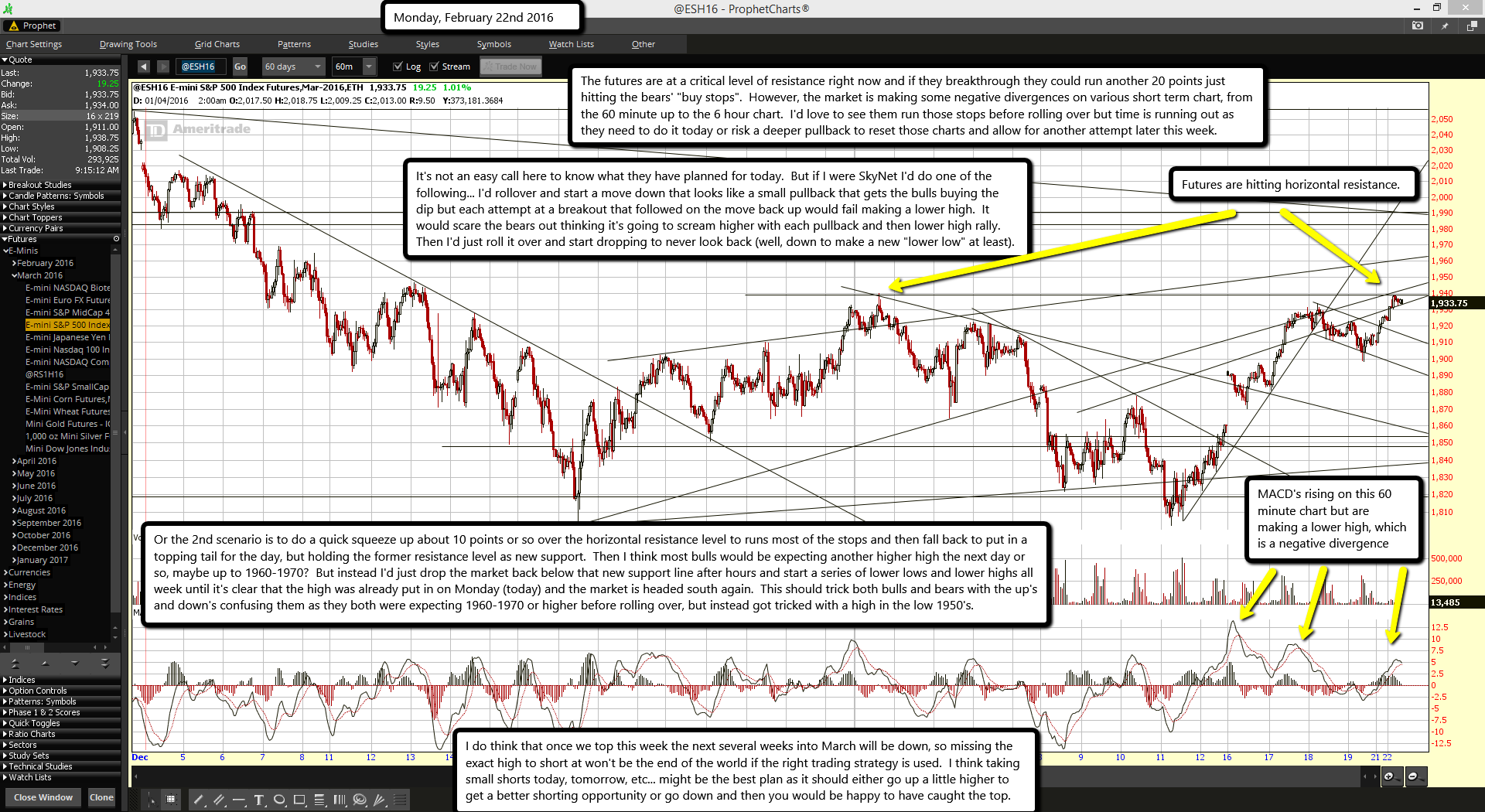
73b14e5a-9e49-45eb-8587-debc8d389494Futures are hitting horizontal resistance.

MACD's rising on this 60 minute chart but are making a lower high, which is a negative divergence.

The futures are at a critical level of resistance right now and if they breakthrough they could run another 20 points just hitting the bears' "buy stops".  However, the market is making some negative divergences on various short term chart, from the 60 minute up to the 6 hour chart.  I'd love to see them run those stops before rolling over but time is running out as they need to do it today or risk a deeper pullback to reset those charts and allow for another attempt later this week.

It's not an easy call here to know what they have planned for today.  But if I were SkyNet I'd do one of the following... I'd rollover and start a move down that looks like a small pullback that gets the bulls buying the dip but each attempt at a breakout that followed on the move back up would fail making a lower high.  It would scare the bears out thinking it's going to scream higher with each pullback and then lower high rally.  Then I'd just roll it over and start dropping to never look back (well, down to make a new "lower low" at least).

Or the 2nd scenario is to do a quick squeeze up about 10 points or so over the horizontal resistance level to runs most of the stops and then fall back to put in a topping tail for the day, but holding the former resistance level as new support.  Then I think most bulls would be expecting another higher high the next day or so, maybe up to 1960-1970?  But instead I'd just drop the market back below that new support line after hours and start a series of lower lows and lower highs all week until it's clear that the high was already put in on Monday (today) and the market is headed south again.  This should trick both bulls and bears with the up's and down's confusing them as they both were expecting 1960-1970 or higher before rolling over, but instead got tricked with a high in the low 1950's.

I do think that once we top this week the next several weeks into March will be down, so missing the exact high to short at won't be the end of the world if the right trading strategy is used.  I think taking small shorts today, tomorrow, etc... might be the best plan as it should either go up a little higher to get a better shorting opportunity or go down and then you would be happy to have caught the top.

Jewel-Osco no longer Sells Essential Everyday Parmesan Cheese

0


Jewel-Osco no longer sells Essential Everyday Parmesan Cheese. The U.S. supermarket chain took the product known as Essential Everyday 100% Parmesan Cheese off the shelves as one independent investigation conducted by Bloomberg found it contains 8.8 percent cellulose or wood pulp.

The Bloomberg investigation was published on February 16th and covered parmesan cheese from several brands and producers. According to the experts in the industry, the results of the Bloomberg investigation mirror concerns voiced nationwide. It’s possible that 20 percent of the parmesan cheese produced in the U.S. is mislabeled as it contains various percentages of cellulose. None of the parmesan cheese labels mentioned the wood pulp.

Cellulose is an additive commonly used in foods such as parmesan cheese to prevent it from clotting. The wood pulp derived additive is used predominantly in grated parmesan cheese such as the Essential Everyday 100% Parmesan Cheese. As a result of the Bloomberg investigation, Jewel-Osco no longer sells Essential Everyday Parmesan Cheese.

According to Dean Sommer who is a cheese technologist with the Center for Dairy Research (Madison, Wisconsin), it is sufficient to use 2 to 4 percent cellulose to prevent grated parmesan cheese from clumping. However, more than enough producers use well above 4 percent cellulose in an unjustified manner. Moreover, cellulose doesn’t appear on the products’ labels.

Jewel-Osco no longer sells Essential Everyday Parmesan Cheese with the supermarket chain recalling the product from all the 185 stores nationwide this Wednesday. Mary Frances Trucco with Jewel-Osco declared for Bloomberg that:

“Our supplier of the parmesan cheese is aware of the issue, and we look forward to learning more about their investigation”.

Meanwhile, the U.S. supermarket chain is replacing the Essential Everyday 100% Parmesan Cheese with the company’s Signature Brand. The Bloomberg investigation was sparked by concerns of the U.S. Food and Drug Administration. The federal regulator looked into Castle Cheese for similarly high levels of cellulose or wood pulp.

The Bloomberg investigation conducted independent tests on other grated parmesan cheese as well. Among them, Walmart’s Great Value Brand, Whole Foods 365 and Kraft’s grated parmesan cheese were under scrutiny.

The independent lab results showed that Walmart’s Great Value 100% Grated Parmesan Cheese contained 7.8 percent cellulose. Kraft’s product contained 3.8 percent cellulose, while Whole Foods contained 0.3 percent cellulose.

[ad_2]

Source link

Swagway tells consumers to stop using its hoverboards

0

[ad_1]

Following the U.S. government's declaration that hoverboards currently being sold are unsafe, Swagway, one of the most high profile hoverboard brands, is telling consumers to stop using its device.

"In complying with the CPSC's requirements, we ask customers who have purchased a Swagway to refrain from using their boards in the interim," a Swagway spokesperson told Mashable on Saturday.

Although the advisory from Swagway doesn't constitute an official recall of the product (something the CPSC is urging all hoverboard manufacturers to consider), the stunning move on Swagway's part is a major step toward acknowledging the U.S. government's safety concerns. Although, at this point, the company has not offered any details on possible refunds to customers who purchased the device.

"We will issue a recall if necessary, as soon as we fully understand the exact specifics that need to be addressed according to the CPSC requirements and will offer a remedy for our customers accordingly," says Swagway's spokesperson.

Friday's news that all hoverboards now on the market are deemed unsafe by the federal government took many by surprise, despite the rash of fire incidents linked to a number of hoverboards. In most of those incidents, the specific brand of the exploding hoverboard was unclear. However, at least one incident in New York was linked to a Swagway by Michael Brown in Chappaqua, who filed a class action lawsuit against the company after his device burst into flames soon after charging.

The status of that particular lawsuit is unclear, but with the CPSC's official safety notice now a matter of public record, it's possible that other hoverboard manufacturers and retailers could find themselves the target of legal actions by unhappy hoverboard customers.

At present, there are no official sales numbers for hoverboards in the U.S. (there are simply too many brands that aren't being tracked). But the product was one of the most popular electronic devices this past Christmas shopping season.hoverboard The hoverboard involved in the Chappaqua incident.

As for Swagway, when directly asked if it planned to order a recall of the device, the company's response referenced Swagways "in transit" rather than the devices that have already been sold.

"We believe our products in transit exceed the new safety standard and are confident that we've addressed any safety concerns as expressed by the CPSC," says Swagway's spokesperson. Nevertheless, until the company receives official safety certification from UL, as advised by the CPSC, it doesn't matter what claims Swagway makes with regard to safety. When and if that happens, the change would be notable. In January, UL singled out Swagway as one of the companies using counterfeit UL marks on its products.

Hours after the news about the CPSC's safety enforcement broke nationally on Friday, Swagway was still sending messages on social media touting its products. And, as of this writing, the company's Facebook and Twitter feeds include no advisory regarding the use of its products, which may be confusing to some customers.

Despite that, for now, Swagway's stance is pretty clear: If you own a Swagway, the company is asking you to stop using it.

"Once we receive feedback on our application to the new safety standards," says Swagway, "we will at that time be able to provide more direction at that time."


[ad_2]

Source link

Chinese Securities Regulator Is Out, but Little May Change

0

[ad_1]

Xiao Gang, China’s top securities regulator, in 2012.

HONG KONG — As China’s economic woes intensified, the nation’s top securities regulator appeared to have the support of the Communist Party leadership, even when his efforts to stabilize the stock markets faltered and in some cases made matters worse. Just weeks ago, he issued a lengthy defense of his record and the securities agency aggressively denied reports he had offered to resign.

But on Saturday, with no warning, Beijing abruptly fired the securities chief, bowing to criticism of the country’s bungled attempts to stem a market rout that started last summer. The dismissal of Xiao Gang, coming in the form of a terse statement from state-run media, represents a rare public reversal for the Communist Party — and a gamble by its leader, Xi Jinping, whose management of the economy has come under growing scrutiny.

Underperforming officials in China often get shuffled to other less-influential jobs or are allowed to resign quietly. Most officials who have been fired of late have been ensnared by the broad crackdown on corruption by Mr. Xi.

Mr. Xi appears to be betting now that in heeding public opinion and replacing Mr. Xiao in such a high-profile fashion he can buy time to limit damage to the party’s reputation from the stock market mess and the broader economic slowdown. But if the problems continue, he risks further undermining faith in his leadership and his government’s ability to navigate a difficult economic transition.

For decades, the party oversaw spectacular growth, buttressing its authoritarian rule and cementing China’s role in the global economic hierarchy. Now growth has fallen to its slowest pace in a quarter-century and the party’s failed attempts to control the markets and the currency are unnerving investors around the world. Mr. Xiao’s dismissal came days before global finance ministers are to meet in Shanghai, expecting answers from China’s leaders on how they will restore global confidence in their ability to competently manage the economy.

Replacing Mr. Xiao is only a first step to cleaning up the mess in the markets. His successor will need to follow up with swift action, to improve the functioning of China’s equity markets and wean them off state intervention, without doing further damage to the economy

“This will be a positive for the stock market, but the key will be the economic policies issued by the government in the next few months,” said Chen Bo, an Beijing-based investor and independent political scholar. Without them, he said, the “short term gains in the stock market in the next couple of months could be followed by another serious slump.”

But Mr. Xiao’s replacement, Liu Shiyu, may not necessarily offer the bold change the markets need. Mr. Liu, the chairman of Agriculture Bank of China chairman, has little experience in equity markets.

The shake-up also does little to solve the underlying problem: a government increasingly under the control of one man, President Xi, who is trying to subdue economic turbulence that has increasingly defied its controls. It is this penchant for control, say investors and analysts, that is driving talent away from the technocratic bureaucracy and rewarding officials who fall in line.

“That’s the problem of a very top-down policy style that’s emerging in China now,” said Victor Shih, a professor at the University of California, San Diego, who studies the confluence of finance and politics in China. “No one dares to challenge whatever preconceived notion the top leadership has.”

China has a wealth of talented financial professionals, many educated at top universities in the United States, who are now entering the prime of their careers. But unlike in the United States, where talented people rotate in and out of government, few of them may be willing to take jobs in the China Securities Regulatory Commission, China’s equivalent of the Securities and Exchange Commission.

The pay is too low and the risks are too high. Mr. Xi’s anticorruption drive in recent months has focused on the financial sector and the securities regulator itself, making it a difficult environment even for officials free of graft, said Mr. Chen, an independent, Beijing-based investor and political scholar.

“The professional makeup of the C.S.R.C. is really not even up close to that of the big brokerages,” Mr. Chen said. “This problem isn’t found only in the equities sector. It’s much more widespread than that.”

Mr. Liu is typical for a top financial official. He spent his career working in government committees and at the central bank.

Fred Hu, the chairman of Primavera Capital Group and the former chairman of Goldman Sachs for China, called Mr. Liu a “highly experienced and results-oriented financial official,” but said he would “find himself in a challenging position,” like his predecessor.

”Over and time again the regulators have struggled to meet some of the difficult tasks — modernizing securities markets, engineering rising equity prices, while protecting investors and ensuring market stability,” Mr. Hu said in an email.

While Mr. Liu has little experience with markets, he does have connections. In the mid-1990s, he worked the state-owned China Construction Bank. The bank, at the time, was was headed by Wang Qishan, who is now overseeing the anticorruption campaign as one of seven members of the Communist Party’s ruling Politburo Standing Committee.

“He’s definitely not a bold reformer,” Mr. Shih said of Mr. Liu.

The new securities chief may be in an impossible position, expected to control inherently uncontrollable markets and take the blame if the efforts fail. The push by Mr. Xi’s government to assert state control over the markets and the economy go against the philosophy of China’s early reformers under Deng Xiaoping, the paramount leader who sought to give more space to the market.

“The approach that they took toward the stock market is telling me that they are not willing to let go control,” Yasheng Huang, a professor of political economy and international Management at M.I.T., said of China’s current leaders in a December interview.

One former Chinese financial official, who requested anonymity so he could freely discuss personnel issues, said Mr. Xiao, the former securities chief, might be heading to a new post to help oversee economic policy under China’s cabinet. The influential magazine Caijing also reported on Saturday that Mr. Xiao may be moving to a new government position.

The shake-up at the securities regulator is also likely to result in renewed questions about the eventual retirement of Zhou Xiaochuan, the head of China’s central bank since 2002.

When Prime Minister Li Keqiang criticized the government’s handling of financial markets at a meeting last Monday of the State Council, China’s cabinet, he cited the government’s management of the currency. The currency falls under the direct purview of the People’s Bank of China.

Mr. Zhou, 68, was widely revered as the man who spearheaded considerable financial deregulation. He also led the country’s currency, the renminbi, to recognition by the International Monetary Fund last November as one of the world’s main reserve currencies.

But Mr. Zhou’s stature suffered following an abrupt 4 percent currency devaluation last August, and continued weakness at the end of the year and into the next. The currency situation greatly alarmed financial markets. Economists and other monetary specialists around the world, including Christine Lagarde, the managing director of the International Monetary Fund, publicly called for the Chinese central bank to communicate better with financial markets.

“He would be a good scapegoat now,” said Minxin Pei, a specialist in Chinese politics at Claremont McKenna College. “Three years ago, it would have been ungrateful” for anyone to suggest that he retire.

[ad_2]

Source link

Deere Cuts Outlook As Sales Wilt

0

[ad_1]

By Bob Tita

Deere & Co. trimmed its revenue and earnings forecast for 2016 as the world's largest supplier of farming machinery continues to trudge through the worst drought in U.S. demand in 15 years.

After a strong run that began last decade for farm equipment and was aided by U.S. tax breaks for equipment, farmers have scaled back their purchases amid lower prices for corn, soybeans and other commodities. Deere's overseas sales also have been hurt by the strong dollar and by economic and political turmoil in Brazil, which had been a strong market for
Deere.

Moline, Ill.-based Deere predicted its equipment sales will fall a steeper 10% this year to more than $23 billion after previously forecasting a 7% decline. The weaker sales outlook followed fiscal first-quarter equipment sales that fell 15% from a year earlier to $4.8 billion. Analysts were looking for $4.9 billion in sales after the company forecast an 11% decline in November.

The company also shaved its net income outlook for the year to $1.3 billion from $1.4 billion previously. The revision implies per-share earnings of about $4.10, according to analysts, who on average had expected the company to earn $4.24 this year.

Deere's stock was recently trading down 4% at $77.02 a share.

Deere is trying to break its profit fall this year with margin-boosting strategies that include cutting equipment inventories and overhead costs, rising prices on equipment and increasing sales of replacement parts and services. Deere acknowledged Friday that executing the plan is becoming more difficult in the face of steep drops in farm and construction equipment. Even with an 11% reduction in first-quarter overhead, Deere's operating profit margin contracted to 7.4% in the quarter ended Jan. 31 from 10.1% a year earlier.

"Our ability to pull costs out relative to any further sales declines will be more challenging," said Tony Huegel, director of investor relations, during a call with analysts on Friday.

Its fiscal first-quarter farm machinery revenue declined 12% from a year earlier to $3.6 billion as operating income from the farm business plunged 46% to $144 million. Deere widened its forecast decline in farm equipment sales for 2016 to a 10% from an 8% decline previously.

The company left its industrywide outlook for retail sales of farm machinery in the U.S. and Canada unchanged at down between 15% and 20% compared with 2015.

Deere's construction and forestry equipment sales during the quarter fell 23% compared with the same period last year to $1.2 billion. Profit from the construction unit plunged 52% to $70 million. Deere now expects construction sales to drop 11% this year from 2015, more than double the decline it had predicted.

"Construction was worse than expected," said Lawrence De Maria, an analyst for William Blair & Co. "We give Deere credit for operating well in a challenging time, but there is little reason for optimism in the next couple of years."

Deere reported a quarterly profit of $254.4 million, or 80 cents a share, down 34% from $386.8 million, or $1.12 a share, a year earlier. Per-share results were helped by lower taxes. Total revenue, including from Deere's finance business, fell 13% to $5.53 billion.

---

[ad_2]

Source link

Virgin Galactic rolls out ‘Unity,’ the second SpaceShipTwo

0

"Please welcome Virgin SpaceShip Unity."

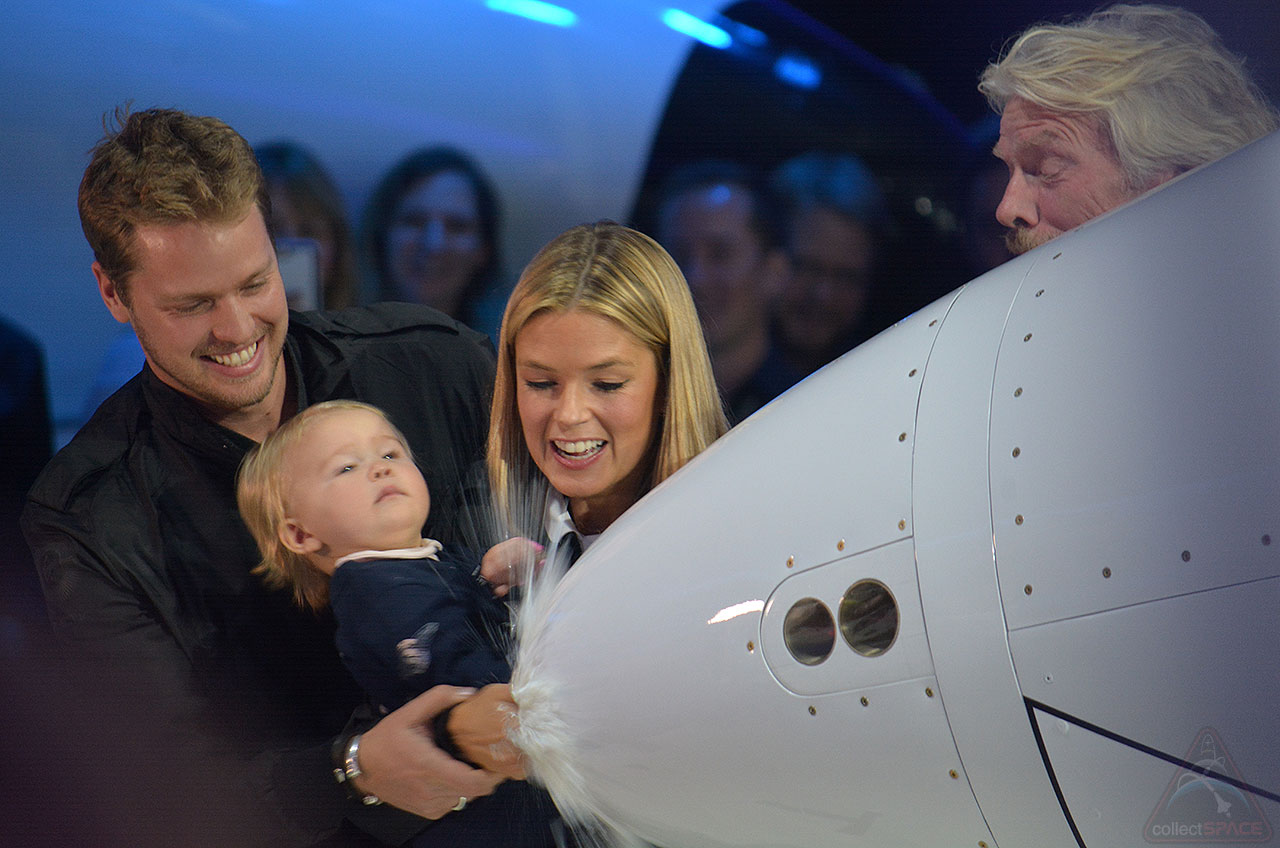
With those words delivered by physicist Stephen Hawking, and the break of a baby's milk bottle across its bow, Virgin Galactic on Friday (Feb. 19) christened the VSS Unity, the second of its SpaceShipTwo sub-orbital spacecraft, during a ceremony at the Mojave Air and Space Port in California.

The first vehicle to be entirely built and assembled by The Spaceship Company, Virgin Galactic's manufacturing arm, the VSS Unity emerged from behind a black curtain inside FAITH, the company's final assembly, integration and test hangar. The space plane, featuring a new silver and white livery, was towed into position by a Range Rover provided by Virgin Galactic's automotive partner, Land Rover.

"Now I'm pretty sure a one-year old has never christened a spaceship before, so we really are in 'virgin' territory," said Richard Branson, Virgin Galactic's founder, referring to his granddaughter, Eva-Deia. "But today seems to be the right time to change that, as we are after all celebrating the birth of two gorgeous babies."

"Clearly, champagne would be inappropriate, [although] it never did me any harm, and certainly hasn't done my wife any harm, so do we have any milk?" asked Branson, who soon after watched on as Eva-Deia, helped by her mother and father, smashed the milk bottle across the nose of the newly-named spaceship.

"I've always believed that having the best looking planes and trains in the world, while not a guarantee of success, is a good start," said Branson. "But our new spaceship has taken that concept to a new level. Isn't she quite beautiful? She is quite stunning."

A better and safer system

Under construction for four years, the VSS Unity succeeds and replaces Virgin Galactic's original SpaceShipTwo, the "VSS Enterprise," which was rolled out in December 2009 and was destroyed during a fatal accident in 2014.

"It has now been 16 months since our flight test accident. That was a hard day," said George Whitesides, the CEO of Virgin Galactic. "It was a moment when years of hard work were put into public doubt and the life of a brave test pilot, a family man and a friend to many of us was lost."

Big banks see the need to shrink – but face a path full of obstacles

0

[ad_1]

A 'Wall St' sign is seen above two 'One Way' signs in New York August 24, 2015. REUTERS/Lucas Jackson  Thomson ReutersA 'Wall St' sign is seen above two 'One Way' signs in New York By Olivia Oran and Anjuli Davies

NEW YORK/LONDON (Reuters) - When the U.S. Federal Reserve's newest policymaker Neel Kashkari dropped a bombshell with a call to break up big banks on Tuesday, it was met with a predictably indignant response from their lobbyists. One described his comments as "blind." But while no one in the executive suites of major global banks would want authorities to force them to split up or downsize, many top bankers acknowledge that their institutions might be better off smaller and simpler. They just worry that any major restructuring could go all wrong because of the way post-financial crisis regulations are applied.

In interviews with Reuters, six senior bankers said they are struggling with the costs and restrictions they face as a result of new regulations, as well as a weak global economy and troubled financial markets. The bankers, who are or recently were in positions ranging from business division head to CEO, spoke on the condition of anonymity so they could be candid without upsetting regulators or investors.

"Fundamentally, the business has to change," said one veteran banker who was on the executive committee of a major European bank until recently. Big banks' shareholder returns have sunk "too low," he said.

These problems are not new, but they have fresh relevance as Deutsche Bank AG confronts questions about its capital adequacy, Barclays PLC faces pressure to break up and CEOs of big U.S. banks struggle with a loss of investor confidence in their stocks.

(For a graphic of U.S. banks' price-to-book ratios, see http://reut.rs/1SG0NDL)

Management teams in the U.S. and Europe are now taking a hard look at dramatic business model changes, but none of the options are particularly attractive, the bankers said.

Merging to cut costs and improve margins is out of the question, given the hurdles banks would likely face from regulators who do not want "too-big-to-fail" institutions getting any bigger. Splitting apart is complicated by capital requirements that would make standalone trading businesses economically unfeasible — and by the fact that there are few, if any, buyers for the assets banks want least.

Some top bankers say they are left with little choice but to muddle through what they fear will be a long, dark period of weak earnings, angry shareholders and gradual shrinkage.

The problem has gotten so bad that Deutsche Bank CEO John Cryan recently said on a public conference call that he'd much rather be CEO of a simpler, retail-focused bank like Wells Fargo & Co , which has only a modest investment banking operation.

"Unfortunately," he said, "there are lots of things I wish for that are not going to come true."

RATCHETING UP CAPITAL

Kashkari's comments, in his first speech as head of the Minneapolis Fed, were surprising because he is a former Goldman Sachs banker, a Republican, and was a senior Treasury official in President George W. Bush's administration during the financial crisis.

They partly echoed the stance of Bernie Sanders, who has also called for big bank breakups and criticized Hillary Clinton, his rival in the struggle to be the Democratic presidential candidate, for being too close to Wall Street. Some of those vying for the Republican nomination have also criticized regulations brought in after the crisis, saying they would repeal the Dodd-Frank reform law.

In an interview with Reuters on Wednesday, Kashkari criticized Dodd-Frank's so-called "living will" rule, which requires banks to show how they can be dismantled in an orderly way if they fail, without creating risk to the broader financial system. Kashkari said he believes the rule would not work in a crisis scenario – that banks would simply be bailed out again.

"I challenge anybody who thinks, in a stressed time, we would put these banks through resolution," he said. "I really don't think it will happen."

One way to force large financial firms to break up is to "aggressively ratchet up" their capital or leverage requirements, Kashkari said. He warned, though, that banks would likely fight hard against any such proposal.

Indeed, Tony Fratto, who worked with Kashkari at the Treasury Department and is now a bank lobbyist at Hamilton Place Strategies, said his former colleague's comments were out of touch with reality.

"This is something like re-opening the barn door after the horse is in the stable," Fratto said. "Love or hate Dodd-Frank, it's simply blind to say that it hasn't significantly improved safety and soundness."

OUT OF ARROWS

Securities analysts and consultants say that banks are in an unenviable position because moves they might have made in the past to improve profitability have been hindered by regulation. As a result, they have struggled unsuccessfully for years to get their returns on equity above single digits.

"In some ways, banks have become bad utilities," said Fred Cannon, a bank stock analyst with KBW. "With utilities, you have strict regulation in what you can do and charge, but in the end investors get a reasonable return. With banks, that last piece hasn't happened."

Bank executives have long argued that weak returns are a "cyclical" issue that should go away when markets begin to flourish again. But as the industry approaches the eighth anniversary of the financial crisis's nadir, questions about whether they face a secular rather than a cyclical profit problem have only grown louder. And top bankers are now wondering how they can possibly grow revenue under a sprawling set of global financial regulations that limit what they do, and sometimes conflict with one another.

(For a graphic showing bank earnings and share price performance, see http://tmsnrt.rs/1mZb4h8)

One common example raised is how new capital rules can penalize banks for being big but also discourage them from getting smaller.

For instance, due to their size, the eight largest U.S. banks must collectively hold $200 billion in extra capital, which weighs on shareholder returns. Included in the capital requirement is a fixed amount each bank must hold to represent "operational risk."

Although the Fed does not explain exactly how it comes up with that figure, it is not just a function of size: Bank of America Corp must hold 25 percent more operational risk capital than JPMorgan Chase & Co , the biggest bank in the country.

Bank of America has said it's taken steps to address the Fed's concerns by cutting back on certain revenue-producing activities that created operational risk. Nonetheless, the bank says it has so far been unable to persuade the Fed to reduce that capital requirement. Its shareholder returns suffer as a result, because revenue is dropping faster than capital costs.

"Every bank is trying to figure out, with bigger capital requirements and profit pressure, how can they create acceptable returns for their shareholders," said John Weisel, an Ernst & Young executive who advises global banks on business strategy.

After years of cost-cutting, he said, CEOs are asking themselves: "We've used all the arrows in our quiver, so what are we going to do next?"

BREAK-UP DEMANDS

European banks are behind their U.S. competitors in addressing a more regulated environment and, in some cases, are flailing around for answers.

Last week, Deutsche Bank shares hit an all-time low on worries that it won't be able to buy back some bonds that can convert into equity. Deutsche regained some value after it outlined plans to repurchase $5.38 billion worth of other bonds, but investors' concerns don't seem to have been entirely assuaged.

Meanwhile, Barclays has come under pressure after a Bernstein analyst wrote an open letter on Feb. 5 imploring CEO Jes Staley to break up the bank.

Rob McDonough, who advises financial institutions on risk management at Angel Oak Consulting Group, says megabanks may have little choice but to get significantly smaller.

"It's too expensive," he said, "for banks to be big."

(Additional reporting by Pamela Barbaglia, Sinead Cruise, Dan Freed and David Henry; Writing by Lauren Tara LaCapra; Editing by Carmel Crimmins and Martin Howell)

[ad_2]

Source link

Virgin Galactic’s SpaceShipTwo Returns After 2014 Tragic Crash

0

[ad_1]

SpaceShipTwo launch

Virgin Galactic returns to the scene with the unveiling of its SpaceShipTwo. The launch came more than a year after the tragic 2014 crash during one of the company's test flights.

Virgin Galactic is determined to bring humans on commercial space flights with the launch of its SpaceShipTwo on Friday at Mojave Air & Space Port in California.

The announcement came 16 months after the tragic 2014 crash during a test flight of the Virgin Space Ship (VSS) Enterprise, the current spaceship's predecessor. The question is, is the company completely ready this time around?

The Grand Return

There is no absolute guarantee for success but by the looks of the unveiling ceremony, the company apears to be determined for triumph.

The event was more than just a launch, it was also a grand party with blasting music, blue party lights and raining cocktails. What's more, Virgin Galactic's founder Richard Branson entered the scene riding atop an SUV.

Even famous astrophysicists Stephen Hawking was part of the launch as his voice was heard over the background as the brand-new commercial spaceship called VSS Unity was revealed.

"It's almost too good to be true," says Branson. He recalls feeling a lump on his throat as tears swelled in his eyes. Overall, he describes the experience as completely overwhelming.

The Fatal Past

Virgin Galactic's past is nothing short of misadventures. After all, errors and unfavorable outcomes are part of ambitious goals, and people cannot expect a company to bring humans to space on commercial flights in just a one-time perfect execution.

The first mishap Virgin Galactic encountered was the explosion of a rocket engine, which caused the lives of three people and injured several others. The project was then put on hold as concerns about the safety of an engine designed to carry people rose. Experts investigated on the matter and made necessary changes to the engine.

Seven years later, Virgin Galactic fell to yet another letdown as one of its pilots named Michael Alsbury died during a test flight. Investigators found that Alsbury deployed a feathering system earlier than necessary on the way down, causing the spacecraft to break apart. Once again, this incident caused the public to question the safety of commercial space flights in general.

Charge It To Experience

The company has vowed to take keen and step-by-step testing before they allow passengers to travel in its spaceship. This is the reason why the company is yet to unveil the official starting date of operations of the VSS Unity.

"When we are confident we can safely carry our customers to space, we will start doing so," says Virgin Galactic.

The company also says there is no other group of people more eager to complete the project as much as its employees. However, the firm reminds the public that this is not a race. It has already exhibited its commitment to perform in-depth testing as it is the correct thing to do and is a key part of success.

Ultimately, Virgin Galactic says there is no easy way to reach the stars, but there is a way and the company is here to find it.

[ad_2]

Source link

Virgin Galactic to roll out new space tourism rocket plane

0

[ad_1]Virgin Galactic to roll out new space tourism rocket planeIn this Sept. 25, 2013, file photo, British entrepreneur Richard Branson poses with the first SpaceShipTwo at a Virgin Galactic hangar at Mojave Air and Space Port in Mojave, Calif. Virgin Galactic will roll out a new copy of its space tourism rocket Friday, Feb. 19, 2016, as it prepares to resume flight testing for the first time since a 2014 accident destroyed the original and killed one of its two pilots.

Virgin Galactic will roll out a new version of its SpaceShipTwo space tourism rocket Friday as it prepares to return to flight testing for the first time since a 2014 accident destroyed the original, killed one of its pilots and set back the nascent industry.

The space line founded by Sir Richard Branson will unveil the craft at California's Mojave Air & Space Port, where it was assembled.SpaceShipTwo is designed to be flown by a crew of two and carry up to six passengers on a high-speed suborbital flight to the fringes of space. At an altitude above 62 miles, passengers will experience a few minutes of weightlessness and see the Earth below.
After years of development, Virgin Galactic appeared to be nearing the goal of turning ordinary civilians into astronauts when the first SpaceShipTwo broke apart on Oct. 31, 2014, during its fourth rocket-powered flight. Wreckage fell to the Mojave Desert floor.
"When we had the accident, for about 24 hours we were wondering whether it was worth continuing, whether we should call it a day," Branson told The Associated Press. He said engineers, astronauts and members of the public helped convince him that space travel is too important to give up on.
The crash investigation found that co-pilot Michael Alsbury prematurely unlocked the so-called feathering system that is intended to slow and stabilize the craft as it re-enters the atmosphere. Alsbury was killed, but pilot Peter Siebold, although seriously injured, parachuted to safety.

 Virgin Galactic to roll out new space tourism rocket planeIn this Sept. 25, 2013, file photo, the first SpaceShipTwo is seen suspended at center beneath its twin-fuselage mother ship at the Virgin Galactic hangar at Mojave Air and Space Port in Mojave, Calif. Virgin Galactic will roll out a new copy of its space tourism rocket Friday, Feb. 19, 2016, as it prepares to resume flight testing for the first time since a 2014 accident destroyed the original and killed one of its two pilots.

The "feathers"—a term derived from the design of a badminton shuttlecock—are tail structures that extend rearward from each wingtip. They are designed to swivel upward at an angle to create drag, preventing a buildup of speed and heat, and then rotate back down to normal flying position as the craft descends into the thickening atmosphere.

A National Transportation Safety Board investigation found that Scaled Composites, a company that was developing SpaceShipTwo with Virgin Galactic and was responsible for its test program, should have had systems to compensate for human error. The NTSB chairman, Christopher Hart, said it wasn't a matter of shortcuts but of not considering a crew member would make the mistake that occurred.

Virgin Galactic subsequently assumed full responsibility to complete the test program.

The company stressed in a statement Thursday its commitment to testing from the level of individual parts on up to the complete craft.

Virgin Galactic to roll out new space tourism rocket planeIn this Nov. 1, 2014 file photo, wreckage lies near the site where a Virgin Galactic space tourism rocket, SpaceShipTwo, crashed in the desert near Mojave, Calif. One of the two pilots aboard was killed. Virgin Galactic will roll out a new copy of its space tourism rocket as it prepares to resume flight testing for the first time since the 2014 accident destroyed the original. The new spacecraft will be unveiled at Mojave Air and Space Port in Mojave Friday, Feb. 19, 2016.(AP Photo/Ringo H.W. Chiu, File)

"Our team's job is to plan out not just the obvious tests but also the strange and inventive ones, to conduct those tests, and to use the data from those tests to re-examine everything about our vehicle to ensure we can take the next step forward," it said.

The company did not project a timeline for actually carrying space tourists, noting that "our new vehicle will remain on the ground for a while after her unveiling, as we run her through full-vehicle tests of her electrical systems and all of her moving parts."

SpaceShipTwo is the successor to SpaceShipOne, the winged rocket plane that won the $10 million Ansari X Prize in 2004 by demonstrating a reusable spacecraft capable of carrying three people could make two flights within two weeks to at an altitude of least 62 miles.

The prize announced in 1996 was intended to spur the development of private manned spaceflight in the same way the Orteig Prize offered in 1919 fostered trans-Atlantic aviation. Charles Lindbergh won that prize with his nonstop flight from New York to Paris in 1927.

Like SpaceShipOne, SpaceShipTwo is carried aloft beneath the wing of a mother ship—a special jet aircraft that releases it at an altitude of about 45,000 feet. After gliding for a few moments, SpaceShipTwo's pilots ignite the rocket engine to send the craft hurtling toward space.

After reaching the top of its suborbital trajectory, the spacecraft begins falling back toward Earth and glides to a landing on a runway.

[ad_2]

Source link

Iowa to give DuPont Pioneer $17M to keep jobs – DesMoinesRegister.com

0

[ad_1]

WASHINGTON — Iowa lost in its bid to secure the agricultural headquarters following the merger between DuPont and Dow Chemical, the culmination of a months-long push to retain a business synonymous with the state's dominant role in U.S. agriculture.

But it will keep 2,600 jobs that are part of DuPont Pioneer in Johnston, Iowa, after signing off on a $17 million incentive package for the chemical giants.

Dow-DuPont announced Friday that the corporate headquarters for the agriculture company it will spin off from the merger will be in Wilmington, Del. The site was selected in large part because of its close ties to the 214-year old DuPont company and deep roots in product discovery.

Wilmington, where DuPont now has its corporate headquarters, would house the agriculture business' chief executive and other key corporate support positions. In addition to Johnston, the agricultural operations will retain a presence in Indianapolis, Ind., which is home to Dow Agrosciences, part of Dow Chemical.

Despite Iowa losing out on the ag headquarters, a DuPont executive pledged that the new agriculture unit will be a "positive" for the state. It won't result in any further job cuts beyond the 10 percent layoffs that have already happened.

Johnston and Indianapolis will both maintain research and development, sales and marketing teams, and business support functions, among other capabilities, officials said.

Dow and DuPont, which are expected to complete their $130 billion merger later this year, plan to then split into three companies within two years — agriculture, material sciences and specialty products.

"There will be some disappointment" in not getting the headquarters, Paul Schickler, president of DuPont Pioneer acknowledged in an interview.

He said by keeping a presence in Iowa, “it’s really a celebration and preservation of those roots as we position ourselves for the future. Similar to 90 years when we started (Pioneer), we were at the birth of an agricultural company and we're able to utilize the same attributes that Henry A. Wallace used to grow into the future.”

Schickler said the new Dow-DuPont agriculture unit "is a great opportunity for Des Moines." By keeping a local presence, the company will be able it to tap into the area's rich background of science, innovation and close relationship with Iowa's farmers, many of whom who are customers of the hometown Pioneer.

As the world's population demands more and healthier food, the result of a growing population, burgeoning middle class and improved dietary and nutritional standards, he pronounced that there is "no doubt about it, growth is going to be in front of this agricultural company."

While Dow and DuPont contemplated the location of the ag headquarters, lawmakers in Iowa and Indiana mounted a full press to boost their odds, with Gov. Terry Branstad, Sen. Chuck Grassley and others talking with executives of both companies.

In a letter last month to DuPont CEO Ed Breen and Dow CEO Andrew Liveris, Iowa’s six lawmakers in Washington touted Iowa’s role in agriculture, the World Food Prize and local universities among the reasons Iowa should be selected.

The announcement Friday from Dow and DuPont drew mixed reviews from Iowa lawmakers.

Branstad said he was "proud" that executives recognized what Iowa has to offer and selected the state for a part of its newly formed agriculture company.

"We are anxious to help DowDuPont experience success in Iowa by providing a foundation to build on and a business climate that nurtures growth,” he said.

But Sen. Joni Ernst called the decision "disappointing for our state and also difficult, particularly for the hard working Iowans who were laid off and their families." She was hopeful that despite not having the headquarters, the new company will spur job creation in Iowa.

The Iowa Economic Development Authority moved approved $16 million in incentives for the new company Friday. The state offered a $2 million forgivable loan and up to $14 million in research activities tax credits.

The city of Johnston is expected to vote on its own $1 million incentive package at a specially called meeting Friday afternoon. And Polk County is expected to provide a $238,000 forgivable loan.

All told, the company will receive more than $17 million in state and local incentives, which IEDA Director Debi Durham characterized as "extremely modest."

While she and other officials competed for the global headquarters, she said Iowa still wins in maintaining its seed and bio-science presence in Johnston. Though executives will be based in Delaware, she said "key leadership decision-makers" will be in Iowa alongside research and development teams.

"And I don’t see that that changes today, right?" she said. "I believe that decision making as it relates to research and decision making, that connection to the farmer is still going to be here in our backyard."

The state's tax credits apply for the 250 to 500 research and development jobs the company expects to retain in Johnston, though it must keep 500 positions to cash in on the full incentive package from the state.

Though DuPont Pioneer has laid off some 175 people in recent weeks, Durham said the company has committed to maintaining its current level of about 2,600 employees.

"They can't be below that or obviously they jeopardize the incentives on the cash side," she said. "We believe right now we’re at a point of stabilization, and now we’re at a point poised for growth."

The new agriculture company would create the nation’s largest agricultural business, surpassing Monsanto Co., the world’s largest seed operation. The ag business would be worth nearly $20 billion, based on the units’ combined 2014 revenue.

Chad Hart, an Iowa State University agricultural economist, said many in the state lobbying for the headquarters expected Dow and DuPont to pick between Indianapolis or Johnston.

“The company went a third direction that I don’t think ether Iowa or Indiana expected,” he said. “We lost to somebody we didn’t know was even in the race.”

The biggest change for Iowa, Hart said, is that for decades the state has grown accustomed to having both the corporate headquarters and the research and development arm of Pioneer in one location.

While the location of the headquarters out of state might not mean a lot in terms of jobs, it increases the chance that corporate executives in Delaware could decide to make changes that may not have been made if both operations were located together in Iowa.

“It brings more uncertainty into the future,” he said.

Pioneer, purchased by DuPont in 1999, has been an important Iowa company since Henry A. Wallace founded it in 1926. DuPont Pioneer employs about 3,400 workers in Iowa, and has been an important cog in the Iowa economy and symbolic of the state’s dominant position as a major U.S. producer of corn, soybeans, ethanol and other commodities.

The seed and chemical industry has been undergoing a broad wave of consolidation amid a backdrop of a slumping agricultural economy that has squeezed farm income and forced producers to cut back on seed, fertilizer, equipment and other inputs for their operations.

Monsanto, Deere & Co. and Pioneer have all announced job cuts as a result of the downturn.

For its part, Iowa documents show DuPont Pioneer has cut about 175 jobs since December, the majority of which have come because of the farm economy and not the merger, according to DuPont. The company has not determined whether further cuts will come locally as a result of the merger.

Farmers and ranchers are expected to see income fall 3 percent to $54.8 billion in 2016, the Agriculture Department said last week. That would drop net farm income to its lowest level since 2002, tumbling 56 percent from its recent high of $123.3 billion just three years ago, when tight supplies and strong global demand for commodities led to record profits.

Faced with falling revenues and growing pressure to cut costs while finding the next big breakthrough, agribusiness companies such as Dow and DuPont have looked to mergers as a way to save money and spur innovation. Earlier this month, government-owned China National Chemical Corp. announced it was buying seed and pesticide maker Syngenta AG for $43 billion, a deal that came about five months after Monsanto dropped its own bid to take over the Swiss-based company.

[ad_2]

Source link

DOJ: Telecom giant paid millions in bribes

0

[ad_1]

WASHINGTON — One the world's largest telecommunications company's and its subsidiary agreed to fines and forfeitures with U.S. and Dutch authorities totaling more than $800 million to resolve a long-running bribery scheme involving a government official in Uzbekistan, Justice Department officials announced Thursday.

Manhattan U.S. Attorney Preet Bharara said VimpelCom, headquartered in Amsterdam, and its Uzbek-based subsidiary Unitel LLC, made "bribery a foundation of their business model” throughout Uzbekistan.

More than $114 million in bribes, according to federal prosecutors, was funneled to the Uzbek official during a six-year period by the firm, which issues publicly-traded securities in the U.S. The companies concealed the bribes through various payments to a shell company that some VimpelCom and Unitel officials knew was owned by the recipient of the bribe payments.

"The bribes were paid on multiple occasions between approximately 2006 and 2012 so that VimpelCom could enter the Uzbek market and Unitel could gain valuable telecom assets and continue operating in Uzbekistan,'' according to the agreement.

The case, brought under the Foreign Corrupt Practices Act, represents one of the largest such efforts to recover proceeds from a foreign government official, Assistant Attorney General Leslie Caldwell said.

Federal prosecutors said VimpelCom admitted that it falsified its books and attempted to conceal the bribery by classifying payments as equity transactions, consulting fees another transactions. When the company's board of directors sought to assess the firm's corruption vulnerability by hiring outside legal counsel, some company officials withheld information rendering the assessment "worthless.''

VimpelCom CEO Jean-Yves Charlier said resolution of the matter has been a "top priority.''

"While this has been a very challenging experience for our business and our employees, we are pleased to have now reached settlements with the authorities,'' Charlier said. "The wrongdoing, which we deeply regret, is unacceptable. We have taken, and will continue to take, strong measures to embed a culture of integrity across the group.''

[ad_2]

Source link

Xiao Gang, China’s Top Securities Regulator, Ousted Over Market Tumult

0

[ad_1]

Xiao Gang, who was replaced as chairman of the China Securities Regulatory Commission, had been criticized for allowing a speculative bubble to form in the country’s stock market.

HONG KONG — China’s top securities regulator, Xiao Gang, has been replaced, the official Xinhua News Agency announced on Saturday, after facing stinging criticism for amplifying the country’s stock market turbulence.

Just days ago, Prime Minister Li Keqiang castigated the country’s financial regulators for their handling of a steep plunge in stocks since last June and an erosion in the value of China’s currency.

The China Securities Regulatory Commission, led by Mr. Xiao, 57, has taken a big dose of blame for the problems.

He attracted significant criticism for allowing a speculative bubble to form, in which share prices more than doubled in a year. When it burst last summer, those shares gave up all of their gains, hurting millions of families who had borrowed heavily to buy stocks.

As stocks sank, the regulator also intensified the market mayhem. Two measures, intended to stabilized stocks, have been widely blamed for producing a weeklong rout in China’s stock markets that unsettled investors around the world.

Why China Is Rattling the World

China’s economy is faltering, prompting concerns that are now shaking global stock markets.

Mr. Xiao defended himself in a long statement on his agency’s website in mid-January, analyzing the causes of his country’s recent financial sector difficulties. He said the turbulence in China’s markets, including another nose dive in share prices last summer, was partly caused by the inexperience of investors and the immaturity of the local market.

But he also conceded that recent troubles reflected an “imperfect trading system, flawed market mechanisms and inappropriate supervision systems,” together with an exodus of seasoned personnel from his agency.

Mr. Xiao will be succeeded by Liu Shiyu, 54, chairman of the Agricultural Bank of China and a former deputy governor of the People’s Bank of China, according to the news agency.

Mr. Liu was trained in engineering at Tsinghua University, but started a career in the state banking sector in the 1980s, according to the news agency.

His task will not be an easy one.

Anticorruption investigators have been scrutinizing the agency, trying to ascertain whether staff members tipped off friends about their decisions, particularly during the market’s fall last summer. New rules also make it hard for the spouses and children of regulators to live overseas, even though the regulatory agency has also been widely accused of lacking workers with international experience and connections.

But the biggest challenge for Mr. Xiao’s successor may be a lack of autonomy. The senior leadership in Beijing gave little latitude to Mr. Xiao, and it is likely to vet and second-guess his successor as well.

“Even changing him is not going to change the system,” said Hao Hong, the chief strategist at the Bank of Communications International, the overseas arm of one of China’s largest banks. “I don’t see how someone else will want to take his job; he has a very unenviable position.”

Mr. Xiao, who earned an undergraduate degree from Hunan University and a master’s degree in law from Renmin University, spent much of his career in finance.

He started at the People’s Bank of China in 1981. At the central bank, he held several posts, including director general of the fund planning department and the monetary policy department, working his way up to deputy governor.

In 2003, he moved to the state-owned Bank of China, where he served as chairman of the board and secretary of the party committee. While he was at the Bank of China, he described the rapid growth of country’s shadow-banking sector as “fundamentally a Ponzi scheme.”

Mr. Xiao took over at the securities regulator in March 2013, putting him at the helm during the rise and the fall of the Chinese stock markets.

When the markets started tumbling, Mr. Xiao’s agency rolled out a raft of measures to help stabilize the situation. He halted initial public offerings of stock and banned share sales by large stakeholders.

The regulator’s efforts worked for a while, but they started to backfire in January.

Mr. Xiao’s agency introduced so-called circuit breakers for its stock market on the first trading day of this year. The circuit breakers mandated that markets would close for 15 minutes if share prices fell 5 percent and would close for the day if they fell 7 percent.

It was intended to provide a cooling-off period. But in practice, it added to the anxiety in the markets.

As markets began sustained slides, investors rushed to sell as many shares as possible before the circuit breakers could shut down trading. The thresholds were hit in quick succession, twice during the first week of trading in January.

Further policy measures only added to investors’ confusion. The ban of share sales was supposed to expire, and the country’s central bank was pushing down the value of the currency.

As China’s stock markets and the value of the renminbi tumbled faster, the country’s leaders ended up scrapping all three policies in less than 24 hours. The circuit breakers were repealed, the ban on sales of shares by large stakeholders was extended, and the central bank intervened decisively in currency markets to halt any further drop in the renminbi.

“It was a correct strategy to take market-stabilizing measures against unusual movements in stocks and the currency last year.” Prime Minister Li said last Monday of the State Council, China’s cabinet, according to the government-controlled Beijing News. “Looking back, the major responsible departments took inadequate actions and had internal management issues.”

[ad_2]

Source link

Why Yellen, Fed may be heartened by CPI data

0

[ad_1]

Fed Chairwoman Janet Yellen

WASHINGTON (MarketWatch) — Federal Reserve Chairwoman Janet Yellen will be heartened by the surprise jump in the core consumer price index as it confirms what she told Congress last week that prices would rise over the medium term.

The data “validates the Fed’s view that inflation is alive and kicking” said Omair Sharif, economist at SG Americas Securities in New York.

Core prices are up 2.2% over the past 12 months, the biggest increase since the summer of 2012.

Although too much inflation is viewed as dangerous for the economy, Fed officials think that a 2% inflation rate is best for the economy to grow.

Inflation has been trending below that target for the past four years. Low inflation is a signal of weak demand in the economy and raises fears of actual decline in prices or deflation, which can damage an economy, especially one with high debt burdens like the United States.

The Fed’s 2% inflation target is based on a different inflation measure, the personal consumption expenditure index, which tends to run a bit more slowly than the CPI.

Over the last six months, that gap has been pronounced.


Core inflation as measured by the consumer price index is accelerating, but an alternative gauge favored by the Federal Reserve hasn't risen as much, at least so far.

But economists at Bank of America Merrill Lynch said the details of the CPI suggest a pickup in the core PCE to 1.6% year-on-year, which would be the highest level since September 2014.

Yellen told Congress last week that she still expects inflation to rise to the 2% target over the medium term despite the market turmoil and market measures of inflation that have steadily declined.

Jim Glassman, economist at J.P. Morgan Chase, said the CPI data will bolster Yellen’s preferred gradual path of rate hikes.

The Fed “doesn’t want to wake up and find out interest rates are not in the right zip code,” Glassman said.

“Most of us have ruled out the Fed until June. But that’s because the stock market is down 10%,” he said. “The market can shift on you.”

Financial markets had taken any Fed rate hike off the table this year.

Ian Shepherdson, chief U.S. economist at Pantheon, said that if inflation continues at the current rate of increase, core CPI inflation will be 2.8% a year from now.

“Needless to say, the market’s current fed funds projections are not remotely consistent with inflation at that pace, or anything like it,” he said.

But other economists thought the gain in the CPI was more one-off than sustained in nature.

Richard Moody, chief economist at Regions Financial Corp., said there is less inflation pressure in the economy than implied by the CPI report.

“Before the inflationistas – who have been warning about a surge in inflation since the very first day of the very first round of the Fed’s QE program – take a victory lap, and before anyone else starts to worry the U.S. is on the road to becoming Venezuela...we’d suggest holding off,” he said.

The Fed is expected to remain on hold at its next meeting in March given the turbulence in the financial markets since the start of the year.

At their policy meeting in January, Fed officials said this tightening was acting like interest rate increases on the economy, minutes show.

Even economists who think the Fed should hike in March don’t think they will raise interest rates.

“It feels like most of the members of the FOMC have already made up their minds that they want to delay” in March, said Stephen Stanley, chief economist at Amherst Pierpont Securities.

“I am convinced that when the dust clears, we will look back and say that the Fed made a mistake.”

[ad_2]

Source link

Inflation flat in January, but some price pressure on consumers is building

0

[ad_1]Consumers don’t have to spend as much on necessities because of low inflation on things like gas and clothes.

WASHINGTON (MarketWatch) — Cheaper gasoline and moderating grocery prices kept inflation in check in January, but expenses for medical care and housing are rising.

The consumer price index was flat last month, the government said Friday. Economists polled by MarketWatch had expected a seasonally adjusted 0.1% decline.

Over the past 12 months the main CPI has risen by an unadjusted 1.4%, double the rate in December. That’s the fastest pace since late 2014.

Core prices are up 2.2% in the same span, the biggest increase since the summer of 2012.


Energy prices fell 2.8% in January, led by another drop in gasoline. Fueling up is cheaper than it has been in years, with gas costing less than $2 a gallon in many parts of the country.

Food prices were unchanged in January as the cost of most staples fell, the Labor Department said. The cost of groceries is rising at a much slower rate after spiking in late 2014 and early 2015.

Yet excluding food and energy, so-called core consumer prices jumped 0.3% to mark the biggest gain since August 2011.

Higher medical care and housing expenses, the two largest costs for many Americans, were behind the increase.

The cost of medical care jumped 0.5% in January and it’s risen 3.3% in the past 12 months, the highest rate in three years.

The cost of shelter — owning a home or renting an apartment — has climbed 3.2% in the past year. And rental costs are rising at the fastest pace since 2007.

Although inflation is still quite low, pressure is beginning to build and that’s likely to continue as gasoline prices stabilize. A huge plunge in oil last year drove inflation to fresh post-recession lows.

Real or inflation-adjusted hourly wages, meanwhile, rose 0.4% in January. They have increased by a mediocre 1.1% in the past 12 months.

[ad_2]

Source link

Gucci sales rise helps owner Kering to higher earnings

0

[ad_1]


Luxury group Kering CEO Francois-Henri Pinault speaks to the media during the full year 2015 results presentation in Paris, Friday, Feb. 19, 2016. The French luxury group reported better than expected sales.

PARIS — The French luxury group Kering, owner of brands like Gucci and Yves Saint Laurent, saw its earnings rise last year as demand in Europe and Japan offset a decline in struggling developing economies in Asia and Latin America.
The Paris-based company said its net income rose to 696 million euros ($771 million) in 2015 from 528 million euros a year earlier. Revenue increased 15 percent to 11.58 billion euros.

Sales rose for Gucci, which had lagged in recent quarters, as well as for other major brands, including Puma streetwear.

CEO and Chairman Francois-Henri Pinault noted Friday that the improvements come despite “a more complex economic and geopolitical environment.”

He expects more growth in 2016, despite the financial turmoil in many high-growth markets, particularly China.

[ad_2]

Source link

A Gas Leak Is Capped, but Neighbors Are Wary

0

[ad_1]

The Porter Hill neighborhood of Los Angeles sits below the Aliso Canyon natural gas storage facility.

LOS ANGELES — With a mix of pride and great relief, state officials here announced on Thursday that the leaking natural gas well near the Porter Ranch neighborhood — which over the last four months had pumped thousands of tons of methane and other chemicals into the atmosphere, sickening residents and prompting more than 6,000 households to flee — had finally been capped permanently.

Testing showed that air quality had returned to normal, according to state officials. But for some angry residents of the wealthy planned community at the northern edge of Los Angeles’s San Fernando Valley, nothing short of the gas field’s closing will be enough.

Officials say they have capped the well releasing methane and other chemicals into the atmosphere around the site.

“We have two words in response to today’s announcement: Flint, Michigan,” said Matt Pakucko, one of the founders of the group Save Porter Ranch, which is planning a rally on Friday in support of closing the gas field. “Those people were told by these kinds of officials, ‘The water is fine. Drink it.’ People are still getting sick here.”

Families who relocated to hotels or other short-term housing to escape the noxious fumes will have eight days to return home, before the gas company stops reimbursing them.

Officials for the Southern California Gas Company estimated that it had already spent up to $300 million since the blowout, much of it on attempts to plug the leak and paying for residents’ housing. That figure does not include legal costs from the dozens of lawsuits that have been filed against the company or any penalties the government orders it to pay.

At a news conference on Thursday, state and local officials announced measures that would be taken to make sure that residents were safe.

All wells at the Aliso Canyon storage facility must pass state inspection before any more gas can be injected into the field, officials said. Air quality testing would continue in the area. And an investigation into how the blowout occurred would begin.

“Gas emissions are controlled and air quality has returned to normal levels,” said Jason Marshall, chief deputy director of the California Department of Conservation. “I understand the tremendous concern for the safety of this community.”

Common complaints from exposure to the gas have included headaches, nausea and nosebleeds, which health officials said are short-term effects caused by chemicals added to the gas, so that humans can smell a leak. Those effects should stop now that the leak was over, they said.

“All the levels that we’ve looked at are below health levels of concern, so we do not anticipate that there will be any long-term health effects in the community,” said Jeffrey Gunzenhauser, interim health officer for the Los Angeles County Health Department.

Many residents, however, were far from convinced. Sandi Naiman, 66, has been living in a hotel in nearby Woodland Hills, where she takes care of her 2-year-old grandson. A severe asthmatic, she had developed chronic sinus problems since the leak began, she said, and got sicker every time she went home. She felt she had little choice but to go back.

“Can I afford to stay in a hotel? No,” Ms. Naiman said. “I’m nervous. We don’t feel safe with the gas company there. We’d like them out of there.”

State lawmakers have promised new regulations for all oil and gas storage — including much stricter well inspections and requirements for subsurface safety valves — which they say will help prevent another leak like the one in Aliso Canyon. The leak — which engineers believe was caused by a rupture in a 7-inch injection 500 feet below the surface — was discovered on Oct. 23. The governor declared a state of emergency in January.

Representative Brad Sherman, a Democrat who lives in Porter Ranch and represents the area, said the Aliso Canyon gas field should be monitored 24 hours a day with infrared cameras, which would show on the Internet if any gas was leaking.

“There is a long way to go before this city and this community is going to want to see new gas put in Aliso Canyon,” Mr. Sherman said earlier this week.

Few officials have proposed entirely shutting down the gas field, which accounts for nearly a quarter of California’s natural gas storage capacity. Even with the facility operating far below capacity, energy officials said they were concerned about power failures in Los Angeles.

Dennis V. Arriola, the president of Southern California Gas, said the company would do what it could to reverse the environmental damage that was caused.

At its peak in late November, the leaking well was spewing more than 50 tons of methane into the atmosphere each hour. Southern California Gas, a division of Sempra Energy, has agreed to fund a program to mitigate the effects of the escaped methane, a potent greenhouse gas.

“All of that will be covered by the company, not by ratepayers,” Mr. Arriola said. “We will be using company resources.” (Mr. Arriola also noted the company’s $1 billion insurance policy, which may cover some of the costs.)

Originally, the company planned to give residents only two days to return home once the leak was stopped; that timeline was extended to eight days, under an agreement with the city attorney’s office.

Residents complained that this is still not enough time. Some have called for house-by-house indoor testing, to make sure that none of the chemicals from the well have seeped into furniture or carpets.

Darren Hallihan, 43, said he and his girlfriend planned to sell their home and move away from Porter Ranch. .

“It’s just hard to feel safe up there, knowing that this is going to continue to go on,” he said. “You don’t know if this stuff is seeping slowly into the area.”

[ad_2]

Source link

How Tim Cook Became a Bulwark for Digital Privacy

0

[ad_1]

Timothy D. Cook, Apple’s chief, testifying before Congress in 2013. “We feel we must speak up in the face of what we see as an overreach by the U.S. government,” he wrote in an open letter published this week.

SAN FRANCISCO — Letters from around the globe began pouring into the inbox of Timothy D. Cook not long after the publication of the first revelations from Edward J. Snowden about mass government surveillance.

Do you know how much privacy means to us? they asked Apple’s chief executive. Do you understand?

Mr. Cook did. He was proud that Apple sold physical products — phones, tablets and laptops — and did not traffic in the intimate, digital details of its customers’ lives.

That stance crystallized on Tuesday when Mr. Cook huddled for hours with lawyers and others at Apple’s headquarters to figure out how to respond to a federal court order requiring the company to let the United States government break into the iPhone of one of the gunmen in a San Bernardino, Calif., mass shooting. Late Tuesday, Mr. Cook took the fight public with a letter to customers that he personally signed.

“We feel we must speak up in the face of what we see as an overreach by the U.S. government,” wrote Mr. Cook, 55. “Ultimately, we fear that this demand would undermine the very freedoms and liberty our government is meant to protect.”

Mr. Cook’s standoff with law enforcement officials is indicative of his personal evolution from a behind-the-scenes operator at Apple to one of the world’s most outspoken corporate executives. During that time, he has moved a once secretive Silicon Valley company into the center of highly charged social and legal issues. While Mr. Cook’s predecessor, Apple co-founder Steven P. Jobs, was considered a business icon, he never took aggressive positions on such matters as Mr. Cook now has.

Being at loggerheads with the United States government is risky for Apple and may draw a torrent of public criticism of the world’s most valuable company at a time when its growth rate has significantly decelerated.

Yet people who know Mr. Cook said he did not believe he had a choice but to be vocal. Mr. Cook, who became Apple’s chief executive in 2011, has long said that businesses and their leaders should think of themselves as important members of civic society. In September, he emphasized that this responsibility “has grown markedly in the last couple of decades or so as government has found it more difficult to move forward.”

Mr. Cook “says what he believes, especially in difficult situations,” said Don Logan, the former chairman of Time Warner Cable who has been friends with Mr. Cook since he became chief executive of Apple, bonding over their shared alma mater, Auburn University. Of Mr. Cook’s opposition to the court order, Mr. Logan said: “Tim is currently dealing with a very difficult situation and he knows the decision he has made has lots of ramifications, good or bad. But he wants to do the right thing.”

Apple declined to make Mr. Cook available for an interview. The company is preparing to file an opposition brief against the court order.

Mr. Cook’s ideas about civic duty were partly formed during his childhood in rural Alabama. In a speech at the United Nations in 2013, he recounted how Ku Klux Klansmen had once burned a cross on the lawn of a black family’s home and how he yelled for them to stop. “This image was permanently imprinted in my brain, and it would change my life forever,” he said.

At Apple, which he joined as a senior executive in 1998, Mr. Cook was a quiet figure for much of the period when he worked for Mr. Jobs, a showman who prized secrecy at the company. After Mr. Jobs stepped down because of ailing health, Mr. Cook began making Apple more open, publishing an annual report on suppliers and working conditions for more than a million factory workers.

In 2014, Mr. Cook revealed he was gay, a move widely seen as making a statement about gay rights. Last year, he wrote an editorial decrying religious freedom laws that had been proposed in more than two dozen states that would let people skirt anti-discrimination laws that conflicted with their religious beliefs.

His outspokenness has drawn criticism, with some investors questioning how nonbusiness initiatives — including some of Apple’s environmental moves — would contribute to the company’s bottom line. Mr. Cook responded at a shareholder meeting that it is important for Apple to do things “because they’re just and right.”

Privacy has long been a priority for Mr. Cook. At a tech conference in 2010, he said Apple “has always had a very different view of privacy than some of our colleagues in the Valley.” He cited the iPhone’s feature that shows where a phone — and presumably its user — is and said fears about abuse and stalking had compelled the company to let consumers decide whether or not their apps could use their location data.

Mr. Cook’s views on privacy hardened over time as customers globally began entrusting more personal data to Apple’s iPhones. At the same time, Apple was growing tired of requests from government officials worldwide asking the company to unlock smartphones.

Each unlocking request was carefully vetted by Apple’s lawyers. Of those deemed legitimate, Apple in recent years required that law enforcement officials physically travel with the gadget to the company’s headquarters, where a trusted Apple engineer would be called to unlock the device in a secure S.C.I.F., or secure compartmented information facility. Processing these requests was extremely tedious. More worrisome, the data stored on its customers iPhones was growing more personal, including photos, messages and bank, health and travel data.

And some government officials were not exactly instilling confidence in Apple’s engineers. In one case, law enforcement officials rushed a phone to Apple’s headquarters for unlocking, only for the engineers to discover their target had not enabled the device’s passcode feature.

So Mr. Cook and other Apple executives resolved not only to lock up customer data, but to do so in a way that would put the keys squarely in the hands of the customer, not the company. By the time Apple rolled out a new mobile operating system, iOS7, in September 2013, the company was encrypting all third-party data stored on customers’ phones by default.

“People have a basic right to privacy,” Mr. Cook has said.

By then, Mr. Snowden’s disclosures about how the National Security Agency had cozied up to some tech companies and hacked others to gain user data were reverberating worldwide. The disclosures included revelations of a comprehensive, decade-long Central Intelligence Agency program to compromise Apple’s products; C.I.A. analysts tampered with the products so the government could collect app makers’ data. In other cases, the agency was embedding spy tools in Apple’s hardware, and even modifying an Apple software update that allowed government analysts to record every keystroke.

Letters from alarmed Apple customers started flooding into Mr. Cook’s inbox, fortifying his stance on privacy. Apple’s eighth mobile operating system, iOS8, which rolled out in September 2014, made it basically impossible for the company’s engineers to extract any data from mobile phones and tablets.

For officials at the world’s law enforcement agencies, the new software was a clear signal that Apple was growing defiant. A month after iOS8’s release, James Comey, the director of the F.B.I., told an audience at the Brookings Institution that Apple had gone “too far” with the expanded encryption, arguing that the operating system effectively sealed off any chance of tracking kidnappers, terrorists and criminals.

Government agencies began to press Apple and other tech companies for so-called back doors that could bypass strong security measures. With tensions rising, some form of technical compromise — whether in the form of a chip, a back door or a key — was off the table by 2015.

At Apple, Mr. Cook and others continued to work with investigators to the extent the company could and complied with court orders. Last October, a federal judge in New York said the government was overstepping its boundaries by using a centuries-old law, the All Writs Act, as the basis for its request that Apple open an iPhone for a drug investigation. Apple’s lawyer sided with the judge in the case. The matter has not been resolved.

After December’s San Bernardino attack, Apple worked with the F.B.I. to gather data that had been backed up to the cloud from a work iPhone issued to one of the assailants, according to court filings. When investigators also wanted unspecified information on the phone that had not been backed up, the judge this week granted the order requiring Apple to create a special tool to help investigators more easily crack the phone’s passcode and get into the device.

Apple had asked the F.B.I. to issue its application for the tool under seal. But the government made it public, prompting Mr. Cook to go into bunker mode to draft a response, according to people privy to the discussions, who spoke on condition of anonymity. The result was the letter that Mr. Cook signed on Tuesday, where he argued that it set a “dangerous precedent” for a company to be forced to build tools for the government that weaken security.

“Compromising the security of our personal information can ultimately put our personal safety at risk,” he wrote. “That is why encryption has become so important to all of us.”

Far from backing down from the fight, Mr. Cook has told colleagues that he plans to accelerate plans to encrypt everything stored on Apple’s myriad devices, services and in the cloud, where the bulk of data is still stored unencrypted.

“If you place any value on civil liberties, you don’t do what law enforcement is asking,” Mr. Cook has said.

[ad_2]

Source link

Facebook and Twitter Announce Support for Apple in Backdoor Dispute With FBI

0

[ad_1]

Both Facebook and Twitter today joined the ranks of a growing number of tech companies announcing support for Apple's decision to oppose a government order that would require it to weaken the security of its iOS devices. The FBI is demanding Apple create a version of iOS that would let it crack the passcode on the iPhone 5c used by San Bernardino shooter Syed Farook, something Apple has called a "dangerous precedent."

iphone5c-header
In a tweet shared this afternoon, Twitter CEO Jack Dorsey thanked Tim Cook for his leadership and said the company stands with Apple. In the tweet, Dorsey also links to Cook's strongly worded open letter that calls the FBI's software request "too dangerous to create."Facebook announced its support through a statement shared with USA Today, which says the company will "fight aggressively" against government requirements to weaken security. Facebook says the FBI's demands "would create a chilling precedent."

"We condemn terrorism and have total solidarity with victims of terror. Those who seek to praise, promote, or plan terrorist acts have no place on our services. We also appreciate the difficult and essential work of law enforcement to keep people safe," the statement reads. "When we receive lawful requests from these authorities we comply. However, we will continue to fight aggressively against requirements for companies to weaken the security of their systems. These demands would create a chilling precedent and obstruct companies' efforts to secure their products."

The dispute between Apple and the FBI centers around the FBI's request for a new version of iOS that would disable certain passcode security features on the shooter's iPhone 5c. The FBI has made three demands of Apple, which are as follows:

1. Eliminate the auto-erase function that wipes an iPhone if the wrong passcode is entered 10 times.
2. Eliminate the delay that locks the FBI out of the iPhone if the wrong passcode is entered too many times in a row.
3. Implement a method that would allow the FBI to electronically enter a passcode using software.

While the government has suggested the software tool will be used to unlock only the device in question, Apple and other technology companies believe that it sets a precedent that could lead to similar unlocking requests in the future or a general demand to weaken overall encryption for electronic devices. Tim Cook has called the FBI's demands an "overreach" by the U.S. government that would "undermine the very freedoms and liberty our government is meant to protect."

The implications of the government's demands are chilling. If the government can use the All Writs Act to make it easier to unlock your iPhone, it would have the power to reach into anyone's device to capture their data. The government could extend this breach of privacy and demand that Apple build surveillance software to intercept your messages, access your health records or financial data, track your location, or even access your phone's microphone or camera without your knowledge.

Apple has gained a number of backers over the course of the last few days. Google CEO Sundar Pichai previously announced support for Apple, calling the FBI's request a "troubling precedent" in a statement released yesterday. Apple also has the support of WhatsApp CEO Jan Koum and several advocacy groups, including the Electronic Frontier Foundation, Fight for the Future, and the American Civil Liberties Union. Apple customers have created petitions and are attending rallies held in support of Apple's willingness to fight for privacy protections.

[ad_2]

Source link

s2Member®