Thursday, September 24, 2026
Home Blog Page 98

US home sales climbed in January despite weaker economy

0

In this Tuesday, Feb. 16, 2016, photo, In this Tuesday, Feb. 16, 2016, photo, "For Sale" signs are stacked up outside a new complex of townhouses in Houston. On Tuesday, Feb. 23, 2016, the Standard & Poor's/Case-Shiller 20-city home price index is released.

U.S. home sales are climbing. Prices are rising, too. So the outlook for the housing market is golden, right?

Not entirely.

A series of reports released Tuesday pointed to potential cracks in the foundations of America's residential real estate market.

On the one hand, job growth and low mortgage rates have fueled demand and boosted sales to levels that were last glimpsed in the waning months of the housing bubble nine years ago. Those gains could spur more construction and additional spending on furniture and renovations that could help lift the economy.

Yet the number of homes for sale has fallen. With demand for homes up and supply down, prices have risen faster than incomes. Because many homes have become unaffordable for would-be buyers, further gains may be unsustainable.

"The real takeaway from the numbers is that despite demand being high, the future is looking somewhat muted for homebuyers," said Ralph McLaughlin, chief economist at the real estate firm Trulia.

This mismatch between supply and demand arrives at a delicate moment. Global pressures have roiled the stock market and hurt exports. That's meant that the economy must lean more heavily on consumers — including home buying — to extend its 6½-year-old recovery from the Great Recession.

A snapshot of the housing market points to some concerns:

— Sales of existing homes rose 0.4 percent last month to a seasonally adjusted annual rate of 5.47 million, the National Association of Realtors said Tuesday. Those gains build on a strong 2015. Sales last year reached a nine-year peak, evidence of healthy demand that has led some economists to predict that the real estate sector will keep improving.

But the report also shows a shortage of available homes. The number of home listings in January fell 2.2 percent from a year ago. The result is that those shopping for homes have fewer options and must pay elevated prices. The median home sales price was $213,800 in January, an 8.2 percent annual increase from a year ago.

— Price increases are concentrated in some of the hottest job markets, according to Standard & Poor's/Case-Shiller 20-city home price index. Home values are up 11.4 percent in Portland, 10.3 percent in San Francisco and 10.2 percent in Denver. Yet even Detroit, which has been emerging from municipal bankruptcy, notched a year-over-year gain of 7.1 percent in December.

— Strong demand showed some hints of weakening ahead of the spring sales season. The share of Americans looking to buy a home within six months reached a six-month low, according to the Conference Board's consumer confidence index. That percentage sank to 5.3 percent for February from 7.4 percent in January.

Solid demand for housing has failed to coax more homeowners to list their properties. Many are reluctant to sell. They're enjoying savings from low mortgage rates, and many lack enough equity to comfortably upgrade to another house. The consequence is that would-be buyers now face both rising prices and more competition from others looking to buy.

"So far, sales have been bulletproof to price increases, but this is unsustainable in a slowly growing economy unless inventory improves," said Nela Richardson, chief economist at the real estate brokerage Redfin.

Sales have been buttressed so far by a stable job market. Employers have added a healthy 2.67 million jobs over the past year, and the unemployment rate has fallen to a low 4.9 percent. Pay growth has been less robust, though it has accelerated somewhat, with a 2.5 percent increase from a year ago.

But it remains unclear whether the pace of job gains will endure amid signs that U.S. economic growth has dwindled. China's slowdown and troubles in such other emerging economies as Brazil and Russia have triggered a sharp decline in commodity prices such as oil. Those price drops, in turn, have driven a downturn in U.S. stock prices and a rise in the dollar's value to levels that have hurt exports.

Still, for now, the global chaos may have helped boost home sales. As many investors have shifted money into the safety of 10-year U.S. Treasury notes, the cost of borrowing has dropped for both the government and homebuyers. Mortgage rates tend to track the yields on long-term Treasurys.

Mortgage buyer Freddie Mac said the average rate on a 30-year fixed-rate mortgage remained near record lows last week — 3.65 percent, significantly less than the historic average of roughly 6 percent.

Source link

Oil prices extend losses in Asia – Financial Express

0

oil price Oil prices fell further in Asia today after OPEC kingpin Saudi Arabia shut the door on an output cut to ease the global crude supply glut, touting only a freeze in production.

Oil prices fell further in Asia today after OPEC kingpin Saudi Arabia shut the door on an output cut to ease the global crude supply glut, touting only a freeze in production.

Traders were cautious ahead of the release later today of data on US commercial crude stockpiles which have been rising for weeks, indicating softer demand in the world’s top energy consumer.

US benchmark West Texas Intermediate (WTI) for delivery in April was down 56 cents, or 1.76 per cent, at USD 31.31 and Brent crude for April fell 33 cents, or 0.99 per cent, at USD 32.94 a barrel.

WTI tumbled 4.6 per cent and Brent tanked 4.1 per cent yesterday.

“We think that it’s inevitable that oil prices move back below the USD 30 market soon as supply continues to outstrip demand and inventory levels are very high,” Jason Wong, a currency strategist in Wellington at Bank of New Zealand Ltd said in an e-mail to clients, according to Bloomberg.

Bernard Aw, market strategist at IG Markets in Singapore said there was a “litany of oil-negative comments”.

He added: “Saudi oil minister said the country will not reduce output, while Iran said the Saudi-Russia pact is ‘ridiculous’ amid plans to raise Iranian oil output”.

Saudi Arabia and Russia — the world’s top oil producing nations – had earlier proposed to freeze output if other producers followed suit.

But Iranian Oil Minister Bijan Zanganeh described the proposal as a “very funny joke” as production levels vary among oil producers.

“These developments reinforced my view that there is unlikely to be any concrete plans to ease the supply glut in the near term. Any solutions may be demand-led when the global economy picks up pace,” Aw told AFP.

While trimming production may be out of the picture for now, Saudi Oil Minister Ali Al-Naimi said he remained hopeful other producers would join a tentative freeze to January output levels it had agreed with Russia, Qatar and Venezuela last week.

He said freezing output was more realistic than cutting because “not many countries are going to deliver, even if they say they will cut production”.

Source link

Shake-Up Atop Tribune After a Big Investor Arrives

0

Jack Griffin helped oversee Tribune Publishing’s spinoff from its parent company, now called Tribune Media.

After taking over as the chief executive of Tribune Publishing in 2014, Jack Griffin withstood a string of controversies and criticisms and a decline in the company’s share price to about $7 from nearly $25.

The one thing he could not survive was a new investor who initially seemed like a potential savior.When Michael Ferro, a Chicago entrepreneur and the majority owner of The Chicago Sun-Times, took a $44 million stake in Tribune Publishing in early February, many there thought the move might give Mr. Griffin more cash to pursue acquisitions and more leverage to stave off potential takeover bids. At the time, Mr. Griffin described the investment as one that would help Tribune Publishing execute its strategic plan. The company owns The Chicago Tribune, The Los Angeles Times and The Hartford Courant, among other newspapers.

Less than three weeks later, Mr. Griffin has been abruptly replaced. The news, first reported by Politico, was announced in a filing with the Securities and Exchange Commission early Tuesday. Mr. Griffin will be succeeded by Justin C. Dearborn, the former chief executive of Merge Healthcare, and a close associate of Mr. Ferro.

Current and former Tribune Publishing staff members, speaking on condition of anonymity, attributed the move to Mr. Ferro. The company declined to comment on Mr. Griffin’s departure.

In a subsequent statement, Mr. Griffin said he had laid the foundation for the future success of the company and that “the timing is right for a new leader to come on board and lead Tribune Publishing through its next phase of transformation.”

Mr. Griffin helped oversee Tribune Publishing’s spinoff from its own parent company, now called Tribune Media, after years of turmoil. But he has been criticized recently by, among others, current and former members of the staff, and by civic leaders in Los Angeles, for cost-cutting that they said endangered The Times and for the lack of a clear plan to turn around the company’s newspapers. They are struggling, as are many in the industry, as precipitous downturns in print advertising are not being made up by digital revenue.

In a memo to staff members on Tuesday, the company said that Mr. Dearborn believed “that Tribune Publishing has a significant opportunity to leverage technology to increase the value of our content and distribution channels.” Before his appointment, Mr. Dearborn accompanied Mr. Ferro to some Tribune Publishing meetings, according to a person briefed on the matter who spoke on the condition of anonymity.

Mr. Ferro, who also became board chairman upon making his investment, said in a statement, “The board thanks Jack Griffin for his significant contributions and wishes him the best of luck in his future endeavors.”

Robert Feder, who operates an independent website and has covered the news media in Chicago for decades, said it seemed clear that Mr. Ferro was “carrying out a strategy that he had planned from the beginning to take over the company.” Mr. Ferro, he said, was expected to make further executive changes, which could include “most of the people who were top executives around Griffin.” The plans, he said, could be unveiled early next month, around the time of the company’s earnings call.

Mr. Griffin’s departure represents the latest upheaval for Tribune Publishing’s newspapers. The Tribune Company, its corporate antecedent, was bought by the Chicago billionaire Sam Zell for $8.2 billion in 2008. Less than a year later, in the face of reports of erratic management, it tipped into bankruptcy, listing $7.6 billion in assets against a debt of $13 billion.

In 2014, after years of dealing with the bankruptcy and its fallout, the company spun its newspaper assets out into a separate company, Tribune Publishing, which it left with $350 million in debt. Mr. Griffin, who had consulted on the company’s spinoff, was appointed chief executive.

The Los Angeles Times, its flagship newspaper, responsible for the largest portion of the company’s revenue, has waged a continuing battle with its ownership through the years. Two former top editors — including Dean Baquet, now the executive editor of The New York Times — left after refusing to cut newsroom jobs. Despite their efforts, the newsroom, once staffed by 1,200 people, declined to about 500.

And late last year, Mr. Griffin fired Austin Beutner, the recently appointed publisher of the newspaper, who had injected a sense of optimism into the newsroom, after the two disagreed about strategy.

Many of those who protested Mr. Beutner’s firing have held out hope that the Los Angeles billionaire Eli Broad, who previously expressed an interest in leading a group to buy The Times as an act of civic benevolence, would do just that. It was not immediately clear on Tuesday what impact the change in Tribune leadership might have on the newspaper’s future.

In the Times newsroom on Tuesday the feeling was one of resignation from afar. The journalists, said one person who was there, had been through this before.

Source link

Justice Department Wants Apple to Unlock Nine More iPhones

0

The Manhattan district attorney, Cyrus R. Vance Jr., foreground, and New York City’s police commissioner, William J. Bratton, behind him, say they have about 175 iPhones they have been unable to unlock.

WASHINGTON — The Justice Department is demanding Apple’s help in unlocking at least nine iPhones nationwide in addition to the phone used by one of the San Bernardino, Calif., attackers.

The disclosure appears to buttress the company’s concerns that the dispute could pose a threat to encryption safeguards that goes well beyond the single California case.

Apple is fighting the government’s demands in at least seven of the other nine cases, Marc J. Zwillinger, a lawyer for the company, said in a letter unsealed in federal court on Tuesday.

“Apple has not agreed to perform any services on the devices,” Mr. Zwillinger wrote. Starting in December, the letter says, Apple has in a number of cases objected to the Justice Department’s efforts to force its cooperation through a 1789 statute known as the All Writs Act, which says courts can require actions to comply with their orders.

In the San Bernardino case, prosecutors have cast their demands for Apple to help them unlock the iPhone used by Syed Rizwan Farook — one of the attackers in the December rampage, in which 14 people were killed — as a limited effort in response to an unusual situation.

Still, “no one should be surprised that we’re investigating other cases and looking for assistance in those other cases,” a law enforcement official said on Tuesday.

Since challenging a judge’s demand in the San Bernardino case, which called for Apple to create a special tool to help investigators more easily crack the phone’s passcode, the company has repeatedly asserted that such a move could not be done in isolation.

“Once created, the technique could be used over and over again, on any number of devices,” Apple’s chief executive, Timothy D. Cook, said in a letter to customers. And in a note on its website on Monday, Apple said law enforcement agencies nationwide “have hundreds of iPhones they want Apple to unlock if the F.B.I. wins this case.”

Apple has long maintained that it would hand over data to comply with a court order when it was technically able to do so. In a report covering the first six months of 2015, Apple said it had received nearly 11,000 requests from government agencies worldwide for information on roughly 60,000 devices, and it provided some data in roughly 7,100 instances.

But while the data backed up on Apple’s iCloud service is readily accessible by the company, it has made the security on the iPhone itself increasingly hard to crack.

Because a number of the newly disclosed cases remain sealed, Apple’s letter did not describe the types of crimes at issue. But they appear to involve run-of-the-mill prosecutions for offenses like drug trafficking and pornography, rather than a high-profile terrorism investigation, officials said.

The newly disclosed cases are in New York, Chicago, Los Angeles, San Francisco and Boston.

The existence of the other demands came to light in a drug-trafficking case in Federal District Court in Brooklyn, where prosecutors are seeking access to the data held in an iPhone linked to a methamphetamine distribution ring.

The owner of the phone, Jun Feng, 45, has pleaded guilty to conspiracy in the case. But prosecutors have pushed ahead anyway with their efforts to force Apple to unlock his phone, in part because they maintain that it could lead them to other drug suspects.

The two sides are awaiting a ruling from Magistrate Judge James Orenstein on whether Apple should be forced to cooperate. Before issuing a ruling, Judge Orenstein wanted Apple to detail other pending requests from prosecutors.

The Brooklyn drug-trafficking case has been dwarfed by the fight in California. But national security lawyers say the Brooklyn case remains important, because Judge Orenstein’s decision is expected to be the first to offer a broad examination of the government’s authority under the All Writs Act to force Apple to unlock passcode-protected iPhones.

The judge has indicated skepticism over the government’s demands. Initially, Apple agreed to a formal order to help the Justice Department gain access to Mr. Feng’s phone, but Judge Orenstein balked, questioning whether the All Writs Act could be used that way. He invited Apple’s lawyers to raise objections.

While his ultimate decision will not be legally binding in California, it could influence the legal arguments there. And an appeal by either side has the potential to work its way through the federal court system to become significant case law.

Law enforcement officials around the country are anxiously watching the cases in both Brooklyn and California to see how their own investigations might be affected.

At a news conference last week after the debate erupted in California, the New York City police commissioner, William J. Bratton, and the Manhattan district attorney, Cyrus R. Vance Jr., said they had collected about 175 iPhones, in investigations, that they have been unable to unlock.

Mr. Vance rejected the notion that Apple should be forced to cooperate only in certain prominent crimes.

“What we discover is that investigation into one crime often leads into criminal activity in another, sometimes much more serious than what we were originally looking at,” he said.

Source link

Starbucks Revamps Loyalty Program To Count Dollars Spent, Not Number Of Visits

0
Starbucks

The new Starbucks Rewards program will count the dollars that customers spend instead of the number of transactions in giving out stars that can be collected for a free food item or drink. Low spenders are not welcoming the change, which will highly benefit customers that spend more.

Starbucks is revamping its loyalty program to make it easier for big spenders to gain rewards, as the new program will now be counting the dollars spent by customers as opposed to the number of times they have visited.

In the current My Starbucks Rewards program, customers earn stars for every transaction they make in Starbucks, regardless of the amount they spent. After accumulating 12 stars, customers are entitled to a free drink or food item of their choice.

Beginning April, Starbucks will be awarding stars to customers based on how much they spend in the store. In the renamed Starbucks Rewards program, every dollar that they spend will net the customer two stars, and a free drink or food item can be cashed in after collecting 125 stars. This would mean that, under the new program, customers will have to spend $62.50 to get their reward.

Customers who are low spenders, such as those who usually only purchase the $2 regular drip coffee, are getting the short end of the stick in the new program. They will now need to make more than 30 visits to Starbucks before they get their free drink or food item, as opposed to the current program that allows them to get their reward after only spending $24 over 12 visits.

On the other hand, customers who regularly purchase drinks and food items for their families or for team meetings, for example, will be able to accumulate enough stars for rewards faster and more often.

According to Starbucks, there are 11 million members of the company's loyalty program, with each member spending three times as much on average compared to non-members. The number of members is less than one out of every six Starbucks customers though, which is a rate that is lower compared to other companies with similar programs in other industries.

Starbucks chief strategy officer Matthew Ryan said that the change in the program is the most requested one, and is being depended upon to entice more customers to join Starbucks Rewards.

With all that said, the company is still facing some backlash on social media due to the new program. Understandably, loyal Starbucks customers that are not big spenders are unhappy about the change.

Source link

Starbucks’ new rewards program isn’t for the frugal

0

With the new Starbucks rewards system, money matters.

On Monday, Starbucks announced a new rewards program that will begin in April. The program will reward customers based on dollars spent at Starbucks locations and shift away from rewarding frequent visits. The decision was based on consumer demand, according to Starbucks, but has caused a backlash from customers on Twitter.

The new rewards system has the potential to aid big spenders to more quickly earn free rewards. But for customers getting a quick drink to go? They’ll have to spend more to qualify.

“If you always buy only one beverage or pastry when you visit Starbucks, it might mean taking a little longer to get a free reward than you do today,” it states on the Starbucks website.

The current Starbucks reward system is based on visits. Each visit results in a customer being rewarded with one star. With 30 stars customers reach Gold status, after which every 12 stars results in a free reward. At a minimum, a Gold customer could earn a free reward by spending about $24 and buying a cup of regular coffee over 12 visits. For people buying more expensive drinks, it would still take 12 visits.

Under the revamped rewards system rolling out in April, every dollar spent at Starbucks will gain a customer 2 stars, according to the website. It will take customers 300 stars to reach Gold level and 125 stars to gain a free reward. At a minimum, Gold customers would need to spend $62.50 and for customers only buying a cup of coffee, it would take more than 30 visits to reach a free reward. A Gold customer buying more expensive drinks would earn a free reward faster.

In other words: spend more money and you will earn a reward even faster under the new system.

The change in rewards system comes as many fast food establishments have been shedding programs that offer cheap food and replacing them with programs to boost the dollar per order amount. In November 2015, McDonald’s ditched its dollar menu in exchange for a McPick 2 menu, where customers can pick two items for $2. Wendy’s also ended its dollar menu and became the first burger chain to test a “4 for 4” menu nationally, which Business Insider credits with helping to achieve a 4.8 percent boost in sales in the fourth quarter.

Starbucks could be leveraging its popular reward system aiming at the same goal: upping the amount, even slightly, of how much customers spend when they order.

Last month, Starbucks reached more than 11 million customers using their loyalty program, a growth of 23 percent over the last year, according to The Associated Press. Current loyalty rewards members spend about three times more than non-members.

Starbucks has stated that the new plan will also offer new ways to earn reward stars, including Double-Star Days and other as yet undisclosed methods.

“You’ll be able to collect Stars in so many places, from Starbucks and Teavana stores to the grocery aisle, even in your inbox. Soon we’ll be launching new ways for you to earn even more Stars, both in and out of our stores,” it says on the website.

Source link

This Is How An Illinois Lab Is Testing Hoverboards For Explosions Risks

56
Hoverboard

Underwriters Laboratories is the company tapped by the United States government to issue certifications for the new safety standards concerning hoverboards. So far, no hoverboard has received the certification.

The United States government, through the Consumer Product Safety Commission, has deemed hoverboards as unsafe as of now, as new safety standards have been released for the personal transportation devices.

Despite reports that certain models and brands of hoverboards carry fire and explosion risks, the devices have still been very popular. However, companies and retailers are now being urged to take all hoverboards off the market until they have received testing to see if they pass the new standards. Amazon is one such retailer that has taken down listings of hoverboards in its website.

The independent product testing company tapped to check if hoverboards fall in line with the new safety standards is Underwriters Laboratories, located in Northbrook, Illinois. The lab will be issuing UL 2272, the new certification that will focus on the safety of the hoverboards in terms of their electrical system, batteries and chargers.

UL Consumer Safety Director John Drengenberg noted that hoverboards are usually powered by 20 lithium ion cells within their battery packs, and the lab is subjecting these cells to different kinds of tests to see how they can hold up.

Tests include pushing nails straight into the middle of the cells and applying indirect heat to them. In a demonstration of the two tests, the cell exploded into flames. That is only one cell, so it would be easy to imagine how much damage a battery pack made of 20 cells would do when all of them would explode at once.

Another test drops hoverboards from 1 meter above the ground, while another test traps the wheel of the device in a vice for 7 hours. If the hoverboard would overheat over the time, then it would not pass the standard.

These are not all the tests that hoverboards will be subjected to, but on first glance, they may seem a bit over the top. However, these tests were designed this way to eliminate low-quality devices easily.

Drengenberg said that there is no new technology in hoverboards, with the only new thing being the combination of these technologies. UL has previously accused hoverboard maker Swagway of using UL certification stickers on their products despite the certification only being on some of the parts of the hoverboards, and not on the hoverboard as a complete product.

"It's how the whole system works together that matters," Drengenberg noted. "It shouldn't be impossible to make a safe hoverboard, but so far there isn't a single hoverboard that's been certified."

Yes, that's right. No hoverboards have yet been certified for the new safety standards, and it could be some time before the first safe hoverboards are determined.

Source link

ES Morning Update February 24th 2016

31

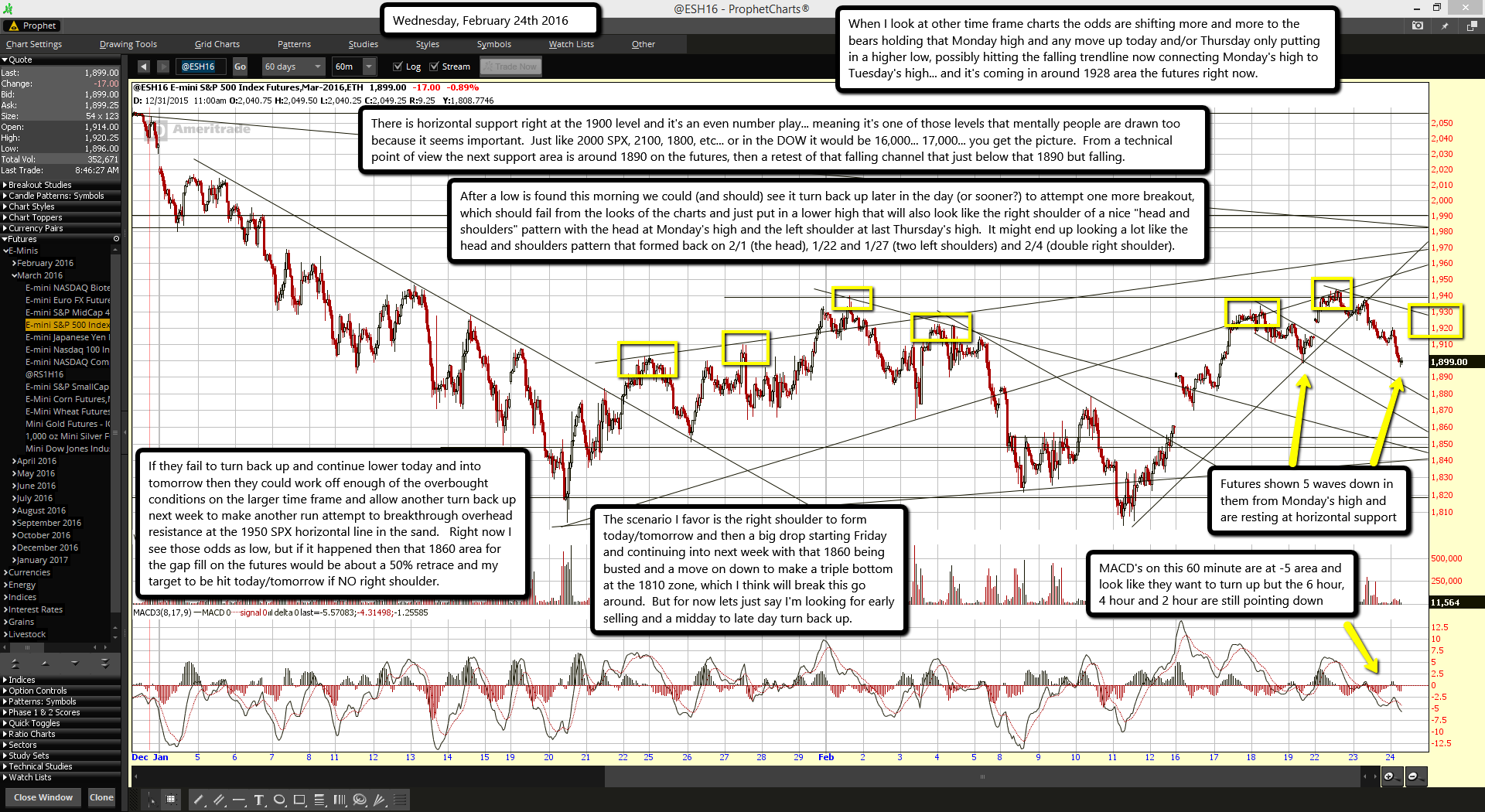
ee638338-f61a-4766-bf40-628c95bbf358Futures shown 5 waves down in them from Monday's high and are resting at horizontal support

MACD's on this 60 minute are at -5 area and look like they want to turn up but the 6 hour, 4 hour and 2 hour are still pointing down

When I look at other time frame charts the odds are shifting more and more to the bears holding that Monday high and any move up today and/or Thursday only putting in a higher low, possibly hitting the falling trendline now connecting Monday's high to Tuesday's high... and it's coming in around 1928 area the futures right now.

There is horizontal support right at the 1900 level and it's an even number play... meaning it's one of those levels that mentally people are drawn too because it seems important.  Just like 2000 SPX, 2100, 1800, etc... or in the DOW it would be 16,000... 17,000... you get the picture.  From a technical point of view the next support area is around 1890 on the futures, then a retest of that falling channel that just below that 1890 but falling.

After a low is found this morning we could (and should) see it turn back up later in the day (or sooner?) to attempt one more breakout, which should fail from the looks of the charts and just put in a lower high that will also look like the right shoulder of a nice "head and shoulders" pattern with the head at Monday's high and the left shoulder at last Thursday's high.  It might end up looking a lot like the head and shoulders pattern that formed back on 2/1 (the head), 1/22 and 1/27 (two left shoulders) and 2/4 (double right shoulder).

If they fail to turn back up and continue lower today and into tomorrow then they could work off enough of the overbought conditions on the larger time frame and allow another turn back up next week to make another run attempt to breakthrough overhead resistance at the 1950 SPX horizontal line in the sand.   Right now I see those odds as low, but if it happened then that 1860 area for the gap fill on the futures would be about a 50% retrace and my target to be hit today/tomorrow if NO right shoulder.

The scenario I favor is the right shoulder to form today/tomorrow and then a big drop starting Friday and continuing into next week with that 1860 being busted and a move on down to make a triple bottom at the 1810 zone, which I think will break this go around.  But for now lets just say I'm looking for early selling and a midday to late day turn back up.

Jack Griffin, Chief Executive of Tribune Publishing, Is Replaced – New York Times

92

Jack Griffin helped oversee Tribune Publishing’s spinoff from its parent company, now called Tribune Media.

After taking as the chief executive of Tribune Publishing in 2014, Jack Griffin withstood a string of controversies and criticisms and a decline in the company’s share price to about $7 from nearly $25. The one thing he could not survive was a new investor who initially seemed like a potential savior.

When Michael Ferro, a Chicago entrepreneur and the majority owner of The Chicago Sun-Times, took a $44 million stake in Tribune Publishing in early February, many there thought the move might give Mr. Griffin more cash to pursue acquisitions and more leverage to stave off potential takeover bids. At the time, Mr. Griffin described the investment as one that would help Tribune Publishing execute its strategic plan. The company owns The Chicago Tribune, The Los Angeles Times and The Hartford Courant, among other newspapers.

Less than three weeks later, Mr. Griffin has been abruptly replaced. The news, first reported by Politico, was announced in a filing with the Securities and Exchange Commission early Tuesday. Mr. Griffin will be succeeded by Justin C. Dearborn, the former chief executive of Merge Healthcare, the company said.

Current and former Tribune Publishing staff members, speaking on condition of anonymity, attributed the move to Mr. Ferro. The company declined to comment on Mr. Griffin’s departure.

In a subsequent statement, Mr. Griffin said he had laid the foundation for the future success of the company and that “the timing is right for a new leader to come on board and lead Tribune Publishing through its next phase of transformation.”

Mr. Griffin helped oversee Tribune Publishing’s spinoff from its own parent company, now called Tribune Media, after years of turmoil. But he has been criticized recently by, among others, current and former members of the staff, and by civic leaders in Los Angeles, for cost-cutting that they said endangered The Times and for the lack of a clear plan to turn around the company’s newspapers. They are struggling, as are many in the industry, as precipitous downturns in print advertising are not being made up by digital revenue. The company’s stock price has fallen to about $7.20 Tuesday afternoon from nearly $25 in 2014.

In a memo to staff members on Tuesday, the company said that Mr. Dearborn believed “that Tribune Publishing has a significant opportunity to leverage technology to increase the value of our content and distribution channels.” Before his appointment, Mr. Dearborn accompanied Mr. Ferro to some Tribune Publishing meetings, according to a person briefed on the matter who spoke on the condition of anonymity.

Mr. Ferro, who also became board chairman upon making his investment, said in a statement, “The board thanks Jack Griffin for his significant contributions and wishes him the best of luck in his future endeavors.”

Robert Feder, who operates an independent website and has covered the news media in Chicago for decades, said it seemed clear that Mr. Ferro was “carrying out a strategy that he had planned from the beginning to take over the company.” Mr. Ferro, he said, was expected to make further executive changes, which could include “most of the people who were top executives around Griffin.” The plans, he said, would most likely be unveiled early next month, around the time of the company’s earnings call.

Mr. Griffin’s departure represents the latest upheaval for Tribune Publishing’s newspapers. The Tribune Company, its corporate antecedent, was bought by the Chicago billionaire Sam Zell for $8.2 billion in 2008. Less than a year later, in the face of reports of erratic management, it tipped into bankruptcy, listing $7.6 billion in assets against a debt of $13 billion.

In 2014, after years of dealing with the bankruptcy and its fallout, the company spun its newspaper assets out into a separate company, Tribune Publishing, which it left with $350 million in debt. Mr. Griffin, who had consulted on the company’s spinoff, was appointed chief executive.

The Los Angeles Times, its flagship newspaper, responsible for the largest portion of the company’s revenue, has waged a continuing battle with its ownership through the years. Two former top editors — including Dean Baquet, now the executive editor of The New York Times — left after refusing to cut newsroom jobs. Despite their efforts, the newsroom, once staffed by 1,200 people, declined to about 500.

And late last year, Mr. Griffin fired Austin Beutner, the recently appointed publisher of the newspaper, who had injected a sense of optimism into the newsroom, after the two disagreed about strategy.

Many of those who protested Mr. Beutner’s firing have held out hope that the Los Angeles billionaire Eli Broad, who previously expressed an interest in leading a group to buy The Times as an act of civic benevolence, would do just that. It was not immediately clear on Tuesday what impact the change in Tribune leadership might have on The Times.

In the Los Angeles Times newsroom on Tuesday the feeling was one of resignation from afar. The journalists, said one person who was there, had been through this before.

Source link

Bertha resumes digging under Seattle

0

SEATTLE – Bertha, the machine boring the State Route 99 tunnel under Seattle, resumed tunneling Tuesday after being shut down for more than a month due to safety concerns.

WSDOT announced Seattle Tunnel Partners resumed digging after getting conditional permission to lift the “suspension for cause” that halted tunneling.

The state ordered STP to stop digging January 14 after a sinkhole formed behind Bertha. The hole was 35 feet long, 20 feet wide and 15 feet deep. Two days before that, a barge used to haul dirt from construction partially tipped, damaging a pier.

“As part of the conditions for lifting the suspension for cause, STP will be permitted to tunnel forward and install approximately 25 concrete tunnel rings. During this time, they must demonstrate that they have implemented a number of changes to ensure they can safely continue mining,” WSDOT said in a press release.

Those changes include:

  • Updated tunnel work and quality plans, including calculations of the amount of soil removed during excavation of each tunnel ring
  • Realignment of key personnel within their quality assurance program
  • New quality assurance protocols
  • New personnel at key positions within the tunneling operation
  • Restructured daily tunneling meetings that include additional participants and protocols

Barging activities will still be restricted for the time being and soil will be removed by truck.

WSDOT says the lifting of the suspension is conditional. Bertha will dig 160 feet. If the new requirements show that everything is working OK, Bertha will dig another 100 feet. That’s where there will be a final maintenance stop which could last several weeks.

After that, Bertha will dig beneath the Alaskan Way Viaduct. That stretch of highway will be closed for about two weeks during digging. The date of that closure has not yet been determined. From there, Bertha will be digging under downtown Seattle.

The contractor now has an opportunity to show progress during this test period, prior to tunneling under the viaduct and underneath Seattle,” said Gov. Jay Inslee.

Bertha spent two years idle underground while undergoing repairs. It resumed moving on Dec. 23, 2015, but was stopped less than a month later after the sinkhole and barge incidents.

The tunnel was originally scheduled to be open by now. Due to the two year hiatus, the tunnel is now expected to open in spring 2018. Much of the work on the north end, where the tunnel will exit, has continued during the shutdown.

Source link

London Stock Exchange in Merger Talks With Deutsche Börse

0

Even after Deutsche Börse failed to merge with the N.Y.S.E., it has struck a number of acquisitions.

Four years ago, Deutsche Börse called off an effort to merge with the parent of the New York Stock Exchange, after European antitrust regulators threatened to block the combination.

Now, the German market operator is willing to try another deal — this time with the London Stock Exchange.

The two exchanges said on Tuesday that they were in talks to combine in an all-stock deal, potentially uniting two of the biggest European market operators and creating a new giant in an industry that has rapidly consolidated.

“The boards believe that the potential merger would represent a compelling opportunity for both companies to strengthen each other in an industry-defining combination, creating a leading European-based global markets infrastructure group,” the two said in a joint regulatory statement.

In the last decade, numerous market operators have pursued ever-bigger scale through mergers. Both of the big, old names in American exchanges, the N.Y.S.E. and the Nasdaq, are the products of mergers themselves: the Big Board with Euronext and then the IntercontinentalExchange, and the Nasdaq with the OMX Group of Sweden.

Under the terms of the proposed merger disclosed on Tuesday, shareholders in the LS.E. would receive 0.4421 of a new share in the combined company for every L.S.E. share they own. Their counterparts at Deutsche Börse would receive one share of the new company for each of their shares, giving the 54.4 percent of the united market operator over all.

The new company’s board would be evenly divided between directors of each of the two companies.

Shares of the L.S.E. were up nearly 17 percent in Tuesday trading in London. In Frankfurt, shares of Deutsche Börse were up 7.4 percent.

The two are no strangers to deal-making. Even after Deutsche Börse failed to merge with the N.Y.S.E. — clearing the path for the Big Board to sell itself to the IntercontinentalExchange — it has struck a number of acquisitions.

The L.S.E. has played both acquirer and potential target, not least with Deutsche Börse itself. The two discussed plans to merge in 2000, though no deal emerged, and then four years later, Deutsche Börse made an unsuccessful bid for its London-based rival.

Other exchange operators, including OMX and Nasdaq, also made bids for the L.S.E. that the British firm rejected.

Instead, the L.S.E. has struck acquisitions like those of Borsa Italiana of Milan and Russell Investments, the owner of the Russell stock market indexes. The London exchange also sought to acquire TMX, the parent of the Toronto stock exchange, though that deal was scuttled by investors in the Canadian firm.

Robey Warshaw is advising the L.S.E., while Perella Weinberg Partners is advising Deutsche Börse.

Source link

Consumer confidence falls to seven-month low

0

Consumers aren’t as optimistic about the economy in early 2016 as they were last fall.

WASHINGTON (MarketWatch) — Consumers confidence fell in February to the lowest level in seven months, as American became a bit more pessimistic about business conditions. Turmoil in stock markets probably also increased anxiety.

The consumer confidence index dropped to 92.2 from a revised 97.8 in January, the Conference Board said Tuesday. Economists polled by MarketWatch had projected the index to fall to 96.9.

The present situation index, a measure of current conditions, slid to 112.1 from 116.6.

The future expectations index declined to 78.9 from 85.3.

“Consumers’ assessment of current conditions weakened, primarily due to a less favorable assessment of business conditions,” said Lynn Franco, director of economic indicators at the Conference Board. “Consumers’ short-term outlook grew more pessimistic, with consumers expressing greater apprehension about business conditions, their personal financial situation, and to a lesser degree, labor market prospects.

Still, the survey also suggests that consumers believe the economy “will continue to expand at a moderate pace in the near term,” Franco added.

Source link

New London rail line to be named Elizabeth Line after queen

0

Britian’s Queen Elizabeth II, centre, talks to Transport Secretary Patrick McLoughlin, left, and Mayor of London Boris Johnson, centre, during a royal visit to the construction site of the new Bond Street Crossrail Station in central London, Tuesday Feb. 23, 2016. The Queen is scheduled to tour the Crossrail project which will provide new links through new tunnels under Central London, opening in 2018, (Dominic Lipinski / PA via AP) UNITED KINGDOM OUT - NO SALES - NO ARCHIVES (Associated Press)

February 23 at 7:36 AM

LONDON — A new rail line under London is to be named in honor of Queen Elizabeth II.

Developers say the project known as Crosssrail will be named the Elizabeth Line when it opens in December 2018. When it is finished, the line will run for more than 60 miles (100 kilometers) from east to west, including a 13-mile (21-kilometer) underground stretch through London.

The monarch, who turns 90 in April, unveiled a sign with the purple “Elizabeth Line” logo on a visit to a Crossrail tunnel on Tuesday.

Several London transit lines already have royal connections. The Jubilee subway line was named in honor of Elizabeth’s Silver Jubilee marking 25 years on the throne in 1977, while the Victoria Line and Victoria railway station are named after Queen Victoria.

Copyright 2016 The Associated Press. All rights reserved. This material may not be published, broadcast, rewritten or redistributed.

Source link

ES Morning Update February 23rd 2016

0

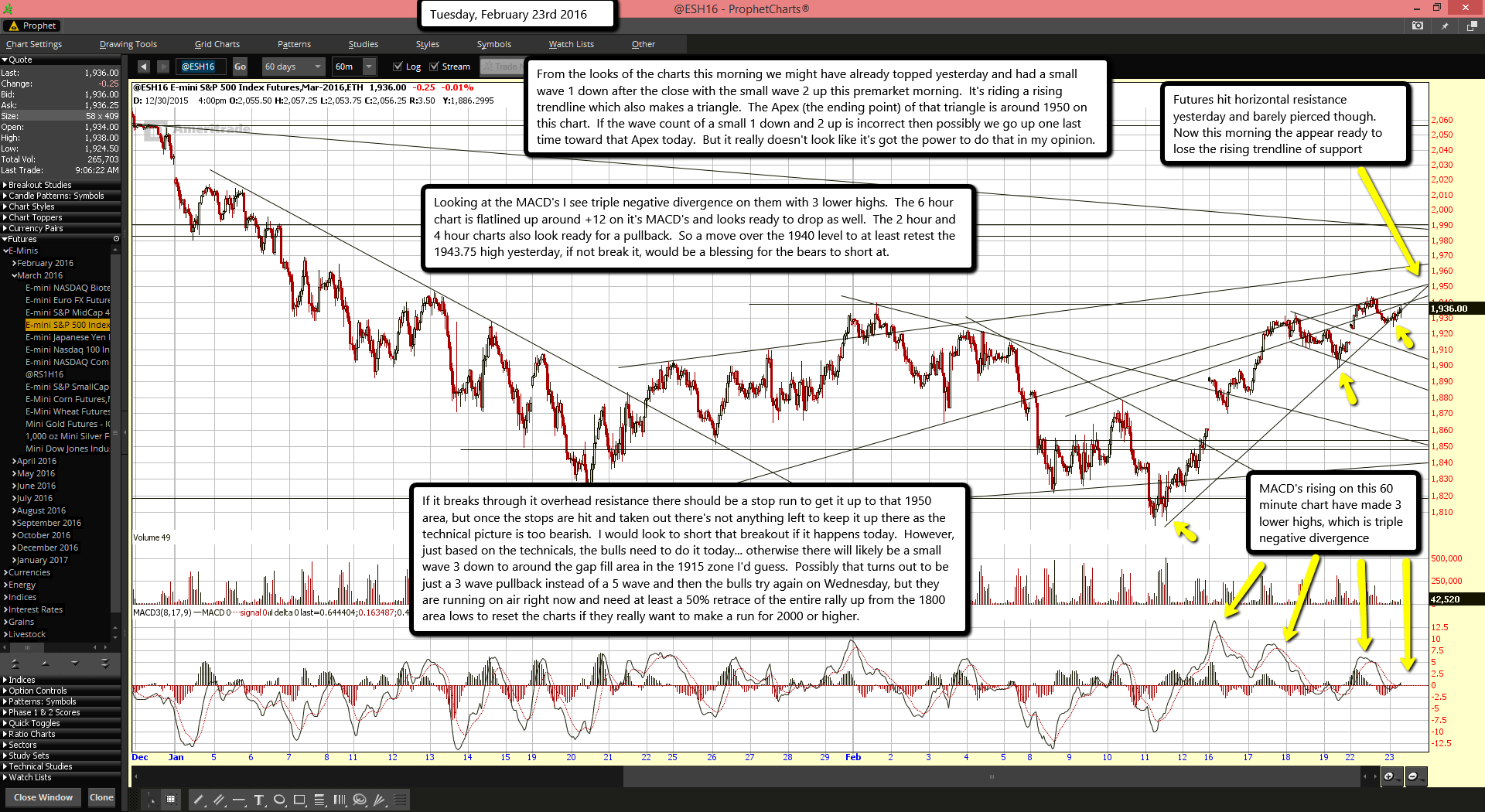
016e8f5f-3bda-48bd-8f0a-157cee316451Futures hit horizontal resistance yesterday and barely pierced though.  Now this morning the appear ready to lose the rising trendline of support

MACD's rising on this 60 minute chart have made 3 lower highs, which is triple negative divergence

From the looks of the charts this morning we might have already topped yesterday and had a small wave 1 down after the close with the small wave 2 up this premarket morning.  It's riding a rising trendline which also makes a triangle.  The Apex (the ending point) of that triangle is around 1950 on this chart.  If the wave count of a small 1 down and 2 up is incorrect then possibly we go up one last time toward that Apex today.  But it really doesn't look like it's got the power to do that in my opinion.

Looking at the MACD's I see triple negative divergence on them with 3 lower highs.  The 6 hour chart is flatlined up around +12 on it's MACD's and looks ready to drop as well.  The 2 hour and 4 hour charts also look ready for a pullback.  So a move over the 1940 level to at least retest the 1943.75 high yesterday, if not break it, would be a blessing for the bears to short at.

If it breaks through it overhead resistance there should be a stop run to get it up to that 1950 area, but once the stops are hit and taken out there's not anything left to keep it up there as the technical picture is too bearish.  I would look to short that breakout if it happens today.  However, just based on the technicals, the bulls need to do it today... otherwise there will likely be a small wave 3 down to around the gap fill area in the 1915 zone I'd guess.  Possibly that turns out to be just a 3 wave pullback instead of a 5 wave and then the bulls try again on Wednesday, but they are running on air right now and need at least a 50% retrace of the entire rally up from the 1800 area lows to reset the charts if they really want to make a run for 2000 or higher.

Google CEO Sundar Pichai Just Got a $199 Million Stock Grant

0


Google Chief Executive Sundar Pichai received restricted stock worth about $199 million, according to a regulatory filing by Google parent company Alphabet.

Pichai, who took over in August, received a grant for 273,328 Class C Google stock units on Feb. 3. The valuation is based on the stock’s closing price on that date.

On the same day, Pichai sold 375 Class A common shares at a price of $786.28 each, and 3,625 Class C capital stock at a price of $768.84 each, the filing said.

Source link

How much Obama’s oil tax would add to the price of gasoline

0


It’s obvious that a $10-a-barrel tax on oil would translate into higher prices for gasoline at the pump. But how much higher?

The White House on Thursday said President Barack Obama will propose a $10-a-barrel tax on each barrel of oil to pay for clean transportation projects. The tax, which will be part of the budget request Obama sends to Capitol Hill next week, would be paid by oil companies and gradually phased in over five years. The measure, however, isn’t expected to go far.

But if it were to be enacted, it probably wouldn’t be the oil companies that feel the most pain.

“This proposal would trickle down and be a $10 per barrel tax on motorists—or 20 to 25 cents per gallon on refined fuels,” said Patrick DeHaan, senior petroleum analyst at GasBuddy.com. “To me it’s clear: this is not something oil companies are going to absorb.”

Opinion: Oil-tax proposal steps on White House jobs message.

And the impact of the tax would grow over time. DeHaan created a chart to show just how big a toll he expects the tax would take on gasoline consumers through 2023, if it were passed.

“As with almost every tax increase on fossil fuels, whether at the state or federal level, it will likely be completely passed to consumers in the years ahead,” he said.

And it won’t just impact gasoline prices, but also diesel, jet fuel, heating oil and others, DeHaan said. “It could stifle production to some degree, though to a lesser degree as long as the tax applies to imported oil as well.”

The proposal comes at the worst time for the oil market, which has already seen prices drop by more than 70% from their highs above $106 in June of 2014. On Friday, West Texas Intermediate crude CLH6, -2.27%  settled at $30.89 a barrel.

Read: This is how the oil rout’s ‘endgame’ might play out.

A global glut of crude supplies cratered prices in the last year and a half, and global production has yet to show any significant declines as major oil producers play a game of “you cut first” with output amid a battle to retain market share.

Also see: Oil output barely dented despite crude’s plunge

It’s a “time of fierce competition in the global oil market and heavy job losses in the industry,” said Brian Milne, energy editor and product manager at Schneider Electric.

Earlier this month, BP PLC BP, -0.49%  said it would cut another 3,000 jobs by the end of 2017 after reporting a full-year loss of $5.2 billion. Royal Dutch Shell RDS.A, +0.29% RDS.B, +0.25%  this week reported its worst profits in over a decade.

For an industry that has already lost 60% of its gross income, it doesn’t make sense to “slap a tax on it that would take another 10% of their gross income,” said Charles Perry, chief executive officer of energy-consulting firm Perry Management.

That will eventually result in a “mass plugging of the many already marginal wells,” as well as the “need to expand the network of bankruptcy courts,” he said.

So why bring up the prospect of an oil tax right now?

Obama is adamant about the advantages the tax will create. “We’ll look back and say that was a smart investment. It’s right to do it now, when gas prices are really low,” he said Friday.

Read: Oil-tax proposal steps on White House jobs message

Milne said Obama may think he can “slip the tax through…without many realizing that they’re paying the government more to fuel their vehicles and warm their houses” because oil and gasoline prices are low right now.

On Friday afternoon, the average price for regular gasoline at pump stood at $1.747 a gallon, according to GasBuddy. That’s down 40.5 cents from last year’s average of $2.152. Gasoline futures RBH6, -3.78%  also dropped below $1 a gallon on Friday for the first time since late 2008.

Read: Gasoline prices may be about to spike

The tax is “certainty a hot topic,” said DeHaan. “Motorists should be eyeing this carefully.”

Source link

ViaSat’s shares jump on possible airline deal

0

Shares of satellite Internet outfit ViaSat surged nearly 12 percent Tuesday on speculation that American Airlines might use the Carlsbad company to supply in-flight Wi-Fi on some of its commercial jets.

The news stemmed from a contract dispute between American and its current in-flight Wi-Fi provider – Chicago-based Gogo – that could open the door for the Dallas-based airline to switch to ViaSat for some domestic flights.

Gogo’s stock price tumbled 27 percent on the news.

The contract spat is nuanced, but it highlights the growing importance of high speed Wi-Fi to airline passengers. According to a recent survey by Honeywell, two-thirds of passengers said the availability of Wi-Fi was a factor when they selected a flight. A study by the Airline Passenger Experience Association found that better in-flight connectivity was the second most desired upgrade that passengers want – trailing only more comfortable seats.

A relative newcomer to the market, ViaSat powers satellite in-flight Wi-Fi for JetBlue, Virgin America and some United Continental aircraft, with about 450 commercial jets in the sky. It delivers more bandwidth – up to 12 megabits per second to each seat – than older inflight Wi-Fi technology. That allows passengers to stream Netflix or Amazon Prime shows to their computers or tablets while in the air.

photo
Carlsbad's ViaSat delivers high-speed in-flight Wi-Fi to JetBlue's fleet in North America. It also supplies satellite Wi-Fi to Virgin American and some United Continental Holdings aircraft.
Carlsbad's ViaSat delivers high-speed in-flight Wi-Fi to JetBlue's fleet in North America. It also supplies satellite Wi-Fi to Virgin American ...

Carlsbad's ViaSat delivers high-speed in-flight Wi-Fi to JetBlue's fleet in North America. It also supplies satellite Wi-Fi to Virgin American and some United Continental Holdings aircraft.

Gogo is the leading supplier of in-flight Wi-Fi, with more than 2,300 aircraft using its air-to-ground technology. Customers include Delta, United, Alaska Airlines, Air Canada and AeroMexico.

The air-to-ground system doesn’t deliver as much bandwidth as satellite systems. Gogo provides 3 megabits to 10 megabits per second to be shared between all passengers on the plane, which can lead to clunky Web surfing if too many devices hook up.

Gogo is rolling out a new satellite based service called 2Ku, which it says will match ViaSat’s performance. The system has been installed on one AeroMexico jet, with orders in the pipeline for 800 additional planes from various airlines, according to Gogo spokesman Steve Nolan.

Last week, American Airlines filed a legal action in a Texas state court saying under terms of its 2012 air-to-ground contract with Gogo, it had the right to terminate the deal before it expired "if an in-flight connectivity provider other than Gogo began offering a better service," according to court documents.

American named ViaSat as the company providing better Wi-Fi.

"We are always looking at what products we can provide our customers to meet their needs on-board our aircraft, and that includes connectivity," said Casey Norton, a spokesman for American Airlines. "We notified Gogo that a competitor has made an offering, and we will evaluate all of our options."

Gogo declined comment on the lawsuit. But it did say under the contract terms, it has the right to make a counter offer on the roughly 200 aircraft covered by the contract.

"We plan to submit a competing proposal to install our latest satellite technology — 2Ku — on this fleet,"Gogo said in a filing with securities regulators. "We believe that 2Ku is the best performing technology in the market and look forward to discussing our offer with American."

Gogo said it plans to utilize capacity on around 180 Ku-band satellites globally to deliver its 2Ku service.

ViaSat declined to comment on the dispute. But Keven Lippert, ViaSat’s head of satellite systems, said the company-owned satellites have the capacity to deliver exponentially more bandwidth than rival satellites.

For example, ViaSat-1, which was launched in 2011, has 150 gigabits per second maximum bandwidth. Today’s Ku-band Internet satellites have 1 to 3 gigabits maximum capacity, said Lippert.

ViaSat-2 is scheduled to launch next year. It will have close to 300 megabits per second maximum throughput.

"It boils down to math," said Lippert. "You can say you can provide 100 megabits per second, and you can do that for one aircraft. But when you have hundreds of aircraft and passengers video streaming, the capacity of your network becomes important. If you don’t have a lot of capacity, your service breaks down."

ViaSat’s shares ended trading up $7.36 to $69.81 on the Nasdaq exchange.

Source link

US, Cuba sign deal on commercial flights

0


cubaflightsap.jpg

The U.S. Department of Transportation opened bidding by American air carriers on as many as 110 U.S.-Cuba flights a day. (AP)

The United States and Cuba on Tuesday signed a deal restoring commercial air traffic for the first time in five decades, allowing of dozens of new daily flights to bring hundreds of thousands more American travelers a year to the island as early as this fall.

Immediately after the signing, the U.S. Department of Transportation opened bidding by American air carriers on as many as 110 U.S.-Cuba flights a day - more than five times the current number. All flights operating between the two countries today are charters.

Barring other major announcements, the restart of commercial flights will be the most significant development in U.S.-Cuba trade since Presidents Barack Obama and Raul Castro announced in late 2014 that they would begin normalizing ties after a half-century of Cold War opposition. The Obama administration is eager to make rapid progress on building trade and diplomatic ties with Cuba before the president leaves office. The coming weeks are seen as particularly crucial to building momentum ahead of a trip he hopes to make to Havana by the end of March.

"Today is a historic day in the relationship between Cuba and the U.S.," U.S. Transportation Secretary Anthony Foxx said after he and Transportation Minister Adel Yzquierdo Rodriguez signed the deal in a ceremony at Havana's Hotel Nacional. "It represents a critically important milestone in the U.S. effort to engage with Cuba."

The U.S. Department of Transportation expects to award the new routes by the summer. The winning airlines then must negotiate their own deals with Cuba.

Yzquierdo declined an interview request but Foxx said after meeting with the Cuban minister that he believed Cuba was eager to restore commercial air service as quickly as possible.

"Every indication I have in the conversations we've had today is that the Cubans want to move as fast as we're able to move," Foxx said. "People will actually be able to go buy a ticket and fly to Cuba on a commercial airline. That's a pretty big step. We haven't been able to do that in 50 years."

The agreement allows 20 regular daily U.S. flights to Havana, in addition to the current 10-15 charter flights a day. The rest would be to other Cuban cities.

Nearly 160,000 U.S. leisure travelers flew to Cuba last year, along with hundreds of thousands of Cuban-Americans visiting family, mostly on expensive, frequently chaotic charter flights out of Florida.

"The adoption of this memorandum is an important step that will soon permit the establishment of regular flights between the United States and Cuba," Yzquierdo Rodriguez at the signing ceremony.

Commercial flights make travel to Cuba far easier for U.S. travelers, with features such as online booking and 24-hour customer service that are largely absent in the charter industry.

U.S. visitors to Cuba will still have to qualify under one of the travel categories legally authorized by the U.S. government. Tourism is still barred by law, but the number of legal reasons to go to Cuba — from organizing professional meetings to distributing information to Cubans — has grown so large and loosely enforced that the distinction from tourism has blurred significantly.

Commercial travel will give travelers the ability to simply check an online box on a long list of authorized categories.

The deal does not contemplate flights by Cuba's national airline to the United States, where lawyers for families and businesses that have sued Havana over decades-old property confiscations are eager to freeze any of its assets that they can get their hands on.

American Airlines spokesman Matt Miller said the company plans to bid on routes from Miami and other unspecified "American hubs."

"We applaud the Administration for making commercial air service a priority," American chairman Doug Parker said in a written statement. "American looks forward to submitting a Cuba service proposal to the Department of Transportation in the coming weeks."

United Airlines is also looking to serve Havana from some of its hubs, spokesman Luke Punzenberger said. The carrier's major hubs include Chicago, Houston, Washington and Newark, New Jersey. It currently does not fly charters to Cuba.

"Assuming service is approved, United customers will benefit from United's expanded global route network and new opportunities for leisure and business travel to Cuba," the airline said.

JetBlue Airways said it was eager to offer service between "multiple" cities in the United States and the island, with spokesman Doug McGraw saying that "interest in Cuba has reached levels not seen for a generation."

Source link

DuPont, Dow to Keep Headquarters in Place as They Combine, Split

0

DuPont Co. and Dow Chemical Co. plan to stick by their longtime hometowns as the chemical giants combine and then split into three separate companies, resolving some uncertainty that has loomed over the giant merger for employees and local officials.

Wilmington, Del., DuPont's home since its founding in 1802, will be the base for two planned companies, one handling agricultural products and the other electronic components and biosciences. Midland, Mich., Dow's home since 1897, will retain the material-sciences company, the companies said on Friday.

Dow and DuPont executives said that keeping corporate bases in Michigan and Delaware was the most efficient way to run the three businesses in the future, relying on employees and infrastructure already there. The deal, which would create a company with a combined market value of about $104 billion, aims to eliminate $3 billion in combined costs before separating into three publicly traded companies within three years.

The agricultural company's name will include DuPont, while the material sciences company's name will include Dow, according to the companies.

The headquarters decision is a victory for Wilmington, where DuPont and other big employers have slashed jobs and operations in recent decades. The merger deal raised concerns that DuPont's presence would be further reduced in the city of 72,000, and DuPont in late December announced plans to lay off 1,700 employees in Delaware as part of a plan to save $700 million before the Dow combination.

"It's welcome news because we really didn't know what was going to happen," said Richard Heffron, president of the Delaware State Chamber of Commerce. "A lot of people were pessimistic." Mr. Heffron credited efforts by Delaware Gov. Jack Markell and members of the U.S. Congress for successfully wooing Dow and DuPont.

Keeping the material sciences company in Midland, Mich., which the companies had signaled earlier, is "good news for us," said Maureen Donker, mayor of the city of 42,000. "As they go through this transformation, we'll continue to [work with them] to make sure we don't miss any opportunities that would arise," she said.

The governors of Iowa and Indiana said they welcomed the commitment from Dow and DuPont to keep major agricultural functions in their states. The Iowa Economic Development Authority on Friday approved a $2 million loan and $14 million in tax credits on the condition that the agricultural spinoff keep 500 research and development jobs in the Des Moines area.

The Indiana Economic Development Corp. is discussing job-related incentive packages with the companies, but hasn't yet finalized the terms, a spokeswoman for the group said.

Source link

T-Mobile’s latest purchase means your call won’t drop when you go inside

0


t-mobilefastestnetwork.jpg
T-Mobile has been rapidly improving its network since it started the Uncarrier marketing strategy by acquiring loads of low-frequency wireless spectrum.

T-Mobile is gobbling up low-frequency radio airwaves so that video of "The Walking Dead" playing on your phone doesn't stall when you walk into your basement.

T-Mobile on Wednesday said it had acquired more of the spectrum in the low-frequency 700 MHz band as it seeks to catch up to rivals Verizon Wireless and AT&T in coverage. The company plans to put the spectrum to use in the next 12 to 18 months, and said it would allow it to reach 48 million more people.

The additional spectrum should extend its coverage footprint and improve service indoors, two issues that long dogged T-Mobile subscribers. It's part of an arms race by the carriers in stocking up spectrum, all to ensure that your phone calls don't drop and your mobile videos stream stutter-free.

T-Mobile has been shaking up the wireless industry for more than two years, offering no-interest device financing, free international data, unlimited access to video streaming, and plans without service contracts. On Wednesday, it reported a fourth-quarter profit of $297 million, or 34 cents a share after adding 2.1 million new customers.

Historically, the Bellevue, Washington, company has offered poor coverage outside of urban areas as well as inside buildings. But the company has worked quickly to close the gap by acquiring low-frequency spectrum that allows signals to easily penetrate through obstacles like walls and offers wider coverage.

Executives say the low-frequency spectrum already in use has helped the company retain customers, catapulting it to the top of customer satisfaction surveys from companies like JD Power and Associates.

T-Mobile has made huge strides in the past several quarters reducing its so-called churn rate, or the rate at which customers drop its service. For the fourth quarter of 2015, this rate fell to 1.46 percent for is postpaid customers, or customers who pay their bills at the end of the month. A year ago, its churn rate was 1.74 percent.

"It's seems obvious, but this is one of the things that's driving up satisfaction and driving down churn," T-Mobile's CEO John Legere said on the company's earnings call Wednesday.

The latest purchase is part of T-Mobile's ongoing strategy to obtain as many spectrum licenses in this low-frequency range as it can to bolster its coverage and reliability. But T-Mobile executives admit that the deals it's been making on the secondary market won't be enough to keep up with demand and give consumers the coverage they need wherever they go.

"The strategy has been to leverage spectrum we already have and buy what we can on the secondary market," Neville Ray, T-Mobile's chief technology officer, said in an interview. "But there isn't much left to run at."

For that, T-Mobile is hoping to acquire a significant amount of spectrum in the government's upcoming auction of airwaves taken from the TV broadcasters.

"We've always said whatever spectrum we get in the secondary market is an enhancement," Ray added. "That's why we have filed to participate in the upcoming auction."

T-Mobile lobbied aggressively for rules in the auction that favor smaller players such as itself. A few months ago, the company looked like it would dominate bidding on spectrum the FCC had carved out especially for smaller players. But now the company will likely face stiff competition from some deep-pocketed new rivals.

Cable giant Comcast confirmed earlier this month it plans to participate in the auction. There are also several investment firms that will be bidding on this spectrum.

T-Mobile has said previously it will go into the auction with a $10 billion budget. With additional bidders, prices are likely to be high, which may hamper how much spectrum T-Mobile is able to acquire.

Executives were unable to address specific questions about the auction, due to the FCC's quiet period rules. But chief financial officer Braxton Carter said in an interview that the company has a lot of experience bidding in competitive government spectrum auctions.

"In the past, we've have been smart and prudent in how we tackle auctions," he said. "And we haven't allowed ourselves to bid irrationally."

Source link

s2Member®