Thursday, September 24, 2026
Home Blog Page 104

This is the big problem Obama’s $10 per barrel tax on oil

0

[ad_1]

U.S. President Barack Obama walks past a pumpjack on his way to deliver remarks on energy independence at Maljamar Cooperative Association Unit in New Mexico, March 21, 2012. Obama is travelling to Nevada, New Mexico, Oklahoma and Ohio for events on his energy initiative.

Presidential budget requests are always more political documents than genuine legislative proposals, typically containing items that everybody involved knows will never find their way into law. However, for his last budget proposal, President Obama is floating an idea so out of the realm of possibility that it makes a mission to Mars look tame.

Specifically, Obama will ask Congress to slap a $10 per barrel “surcharge” – read tax – on oil.

You could be forgiven for thinking that this is just a lame duck Obama trolling Congress – trying to provoke a reaction just for the sheer hell of it. But according to reporting in Politico today, now confirmed by the White House, the proposal is for real and is part of a larger green transportation initiative.

The timing of the proposal is curious, considering what the recent nosedive in crude oil prices has been doing to U.S. producers. As recently as this week, the price per barrel has been below $30, less than a third of the $90-plus it was selling for 18 months ago. The steep drop in prices has made it a challenge for higher-cost U.S. producers to remain profitable.

The effect of a $10 tax on each barrel sold in the U.S. would be to raise the prices on oil, and by extension gasoline. When prices go up, consumption falls, and in this case it will fall without any of the benefit of the price increase accruing to producers.

In fact, the Obama administration appears to be selling the plan, in part, based on the impact it would have on oil producers. The surcharge, the administration toldPolitico, would be “paid by oil companies.”

Of course, believing that oil companies will pay the fee with no effect on consumer prices requires also believing that the producers won’t pass their increased cost on to refiners, who won’t in turn pass their costs on to the public. In other words, it requires suspending belief in basic economics.

There are strong arguments that petroleum products, primarily gasoline, are greatly under-taxed in the U.S., because of the damage carbon emissions do to the environment and because of the cost of maintaining the country’s transportation infrastructure. That we should be raising taxes on oil now, when prices are so low, is a defensible policy position. Pretending it will have no effect on consumers is not.

The $10 fee is meant to fund a $300 billion push to invest in new infrastructure, as well as a range of technologies meant to reduce the amount of carbon that is emitted into the atmosphere in the U.S. every year.

The odds of Congress approving a $10 per barrel tax on oil – in an election year, no less – are exactly the same as Republicans backing a Constitutional amendment to allow Obama to run for a third term: zero.

[ad_2]

Source link

Cheap oil is creating windfalls for consumers, but also killing jobs and shaking up global governments

0

[ad_1]
Cheap oil will be sticking around for a while.

That reality is wreaking havoc and causing uncertainty for some governments and businesses, while creating financial windfalls for others.

Less-expensive crude is delighting consumers in some regions, while leading to widespread job losses elsewhere.

Oil has fallen from $107 to around $30 in the past 19 months. Furious production by the U.S. and OPEC led to an oversupply.

Recently, a sluggish global economy has spurred concerns about demand.

A recovery in oil prices depends on when supply and demand can get close to equilibrium. It could be a rocky ride.

In a recent research note, Goldman Sachs predicted “the path to a rebalanced market will be protracted and arduous.”

The U.S. government forecasts Brent crude, the international benchmark, will average $40 a barrel this year.

Bank of America Merrill Lynch is a bit higher, at $46.

An oil pump stands as the Saudi Hawks Aerobatic Team of the Royal Saudi Air Force performs during the Bahrain International Airshow in Sakhir, Bahrain, on Jan. 23. (AP Photo/Hasan Jamali, File)

MIDEAST

Saudi Arabia and Iraq have been furiously pumping oil, per OPEC’s decision to maintain robust production.

Their hope is that the 12-year lows in crude prices will push more expensive producers, such as U.S. shale drillers, out of the market.

OPEC’s production rose by an average 1 million barrels a day in 2015.

Now Iran, free of Western sanctions, plans to boost production by 500,000 barrels a day.

Saudi Arabia cut back on some fuel subsidies and anticipates an $87 billion budget shortfall this year.

It’s dipping into reserves to finance a war in Yemen.

An initial public offering of at least a part of the giant state-run Saudi Arabian Oil Co. is under consideration.

Iraq diverted money from construction projects to fund a costly war against the Islamic State.

Baghdad also started discussions with international oil companies operating in the oil-rich south to revisit the terms of their service contracts.

Iran’s economy was slowed by the sanctions over its contested nuclear program.

While sanctions relief has been slow to reach the average Iranian, the country is aggressively moving forward with business deals.

– Jon Gambrell, Dubai, United Arab Emirates; Sinan Salaheddin, Baghdad, Iraq

A salesperson looks out of her fashion accessories shop near Qianmen Street, a popular tourist spot, in Beijing on Jan. 20. (AP Photo/Andy Wong, File)

ASIA

China’s economy grew by 6.9 percent in 2015, the country’s slowest rate in 25 years, raising concerns about global economic strength and contributing to the oil price decline.

Still, China’s economy is hardly collapsing.

The International Energy Agency predicts oil consumption in China will grow 3.4 percent this year, down from 6 percent in 2015.

With a growing emphasis on the services sector, China should see less oil demand from heavy industry and construction.

That will likely be offset by growing car ownership and more demand for petrochemicals.

China is the world’s fifth-biggest oil producer, but financially strapped state-owned oil companies are likely to cut production.

For most of Asia, plunging oil prices have alleviated heavy costs for imported oil and gas. For exporting nations, low oil helps and hurts.

Auto exports to countries such as the U.S. are profitable.

But countries such as Brazil and Russia are tightening their belts after splurging on consumer goods from Asia when commodity prices soared.

In Japan, consumers are paying less for energy, but lower energy prices are hindering the government’s battle against deflation.

– Elaine Kurtenbach, Tokyo; Joe McDonald, Beijing.

A man walks into a jewelry shop that is holding the last few days of its sales in central London on Jan. 21. (AP Photo/Alastair Grant, File)

EUROPE

Low oil prices are a boost to the European economy, which is a net importer of oil and gas. It helps consumers in two ways: by making fuel cheaper and lowering the cost of making goods.

That lower cost feeds through to help bring down consumer prices in shops.

Analysts at Capital Economics say lower oil prices boosted GDP in the 19-country union by about 1 percentage point last year.

That’s significant, considering the European Central Bank forecasts the eurozone economy grew 1.5 percent in 2015.

However, the low prices hinder the European Central Bank’s effort to get inflation back up toward to around 2 percent.

Some fear that a prolonged period of low inflation can encourage consumers to put off spending in the knowledge that goods won’t get more expensive.

– Carlo Piovano, London; David McHugh, Frankfurt, Germany

People wait in line to buy groceries at government regulated prices in Caracas, Venezuela, on Jan. 27. (AP Photo/Ariana Cubillos, File)

LATIN AMERICA

Across Latin America, drilling projects are being shelved and governments are slashing spending.

The IMF is predicting a second straight annual contraction in the region’s economies.

The last time growth was negative for two straight years was in the debt crisis of the 1980s, which was partly fueled by an oil bust.

Venezuela is the nation hardest hit.

The government earns 95 percent of its export income from oil – and its economy was already unraveling before the plunge in oil prices.

Long lines for food and other scarce goods are commonplace.

In Colombia, oil income is expected to be practically nil in 2016. For smaller countries in Central America and the Caribbean that import oil, the lower prices are a relief.

– Joshua Goodman, Bogota, Colombia

Scott Mills finishes fueling up an American Airlines jet at Dallas/Fort Worth International Airport in Grapevine, Texas, in August 2015. (AP Photo/LM Otero, File)

NORTH AMERICA

U.S. households have saved hundreds of dollars on gasoline and heating oil. That’s money they can spend in other areas of the economy.

Businesses such as airlines that burn large amounts of fuel have reaped savings in the billions.

But energy-company profits have plunged, as have their stocks.

Layoffs and spending cuts by oil drillers have offset some of the boost from steady consumer spending.

Meanwhile, states such as Alaska and North Dakota need to plug big budget gaps.

The Energy Department expects a decline in U.S. oil production, but says oil will only average $38 this year.

For new mines in Alberta, Canada’s oil sands to cover costs, oil needs to be $85 to $95 a barrel, according to IHS Global Insight.

Western Canadian Select oil sands crude recently traded around $15.

Canadian oil companies have slashed budgets, laid off tens of thousands of workers and cut dividends.

A Bank of Canada report says companies see dramatic change for the global industry, with weaker companies restructuring or exiting the oil business, while healthier companies buy distressed assets.

Canada’s dollar is down 20 percent versus its U.S. counterpart.

Prices for imported groceries have risen and Canadians are reconsidering a U.S. vacation.

Mexico is better insulated nowadays from an oil collapse. Oil accounts for 20 percent on national revenue, compared with 40 percent up until 2012.

However, the country has postponed or canceled some oil projects, and delayed auctions for deep water exploration and production oil contracts, as part of its historic energy reform.

– David Koenig, Dallas; Rob Gillies, Toronto; Eduardo Castillo, Mexico City.

RUSSIA

Russia’s economy shrank by 3.7 percent last year, its worst contraction since 2009. Oil and gas together contribute about half of state revenues. The government now anticipates cuts to the budget for fiscal 2016, which is based on an oil price of $50 per barrel. Poorer Russians are already feeling the squeeze from falling wages and last year’s rapid rise in food prices, driven by Russia’s “anti-sanctions” ban on Western food.

There is government talk of partly privatizing state companies, but powerful state corporation bosses likely would object. Meanwhile, costly plans to drill in the Arctic, once a source of pride for the Russian government, are on ice.

Even so, Russian oil production hit a post-Soviet high of 11.1 million barrels a day in 2015, according to the International Energy Agency, which expects production to tail off somewhat as 2016 proceeds.

– James Ellingworth, Moscow

AFRICA

These are sobering times for Africa’s two biggest oil producers. Oil previously provided 80 percent of government revenue in Nigeria and 70 percent in Angola. Nigeria’s 2016 budget is double that of 2015 and based on $38 oil, so the government plans to borrow heavily.

Angola’s budget is based on a price of $40, down from an earlier benchmark of $81. Both countries’ currencies have plunged against the dollar. The depreciation has resulted in higher food prices.

Now both countries are trying to diversify their economies. Nigeria’s government has vowed to focus more on agriculture, mining and massive infrastructure developments to create jobs. The two countries will reap some savings by cutting fuel subsidies.

[ad_2]

Source link

ES Morning Update February 8th 2016

0


f4fcc159-1463-4aab-97f5-3ea9036ed085
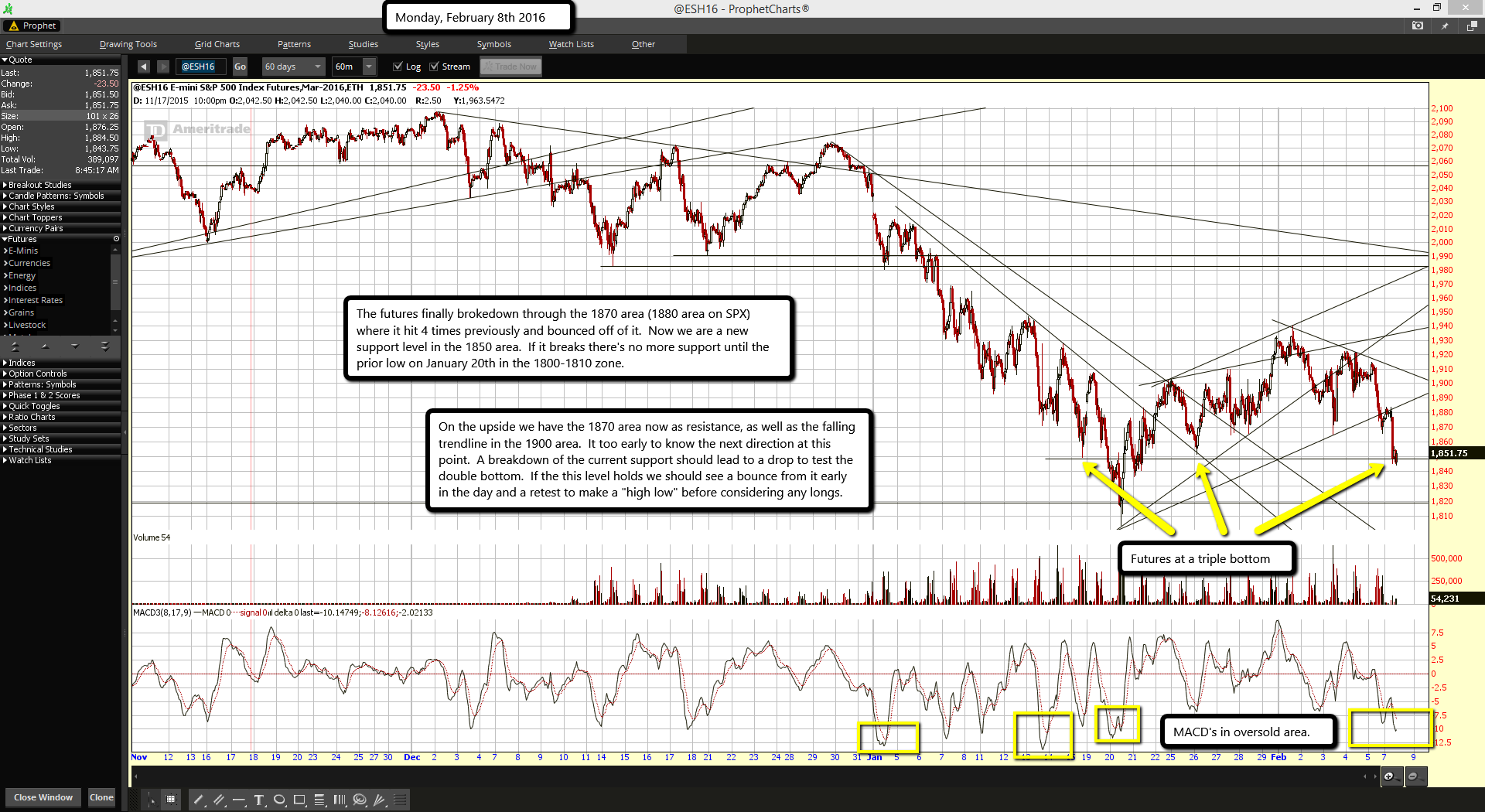
Futures at a triple bottom

MACD's in oversold area.

The futures finally broke-down through the 1870 area (1880 area on SPX) where it hit 4 times previously and bounced off of it.  Now we are a new support level in the 1850 area.  If it breaks there's no more support until the prior low on January 20th in the 1800-1810 zone.

On the upside we have the 1870 area now as resistance, as well as the falling trendline in the 1900 area.  It too early to know the next direction at this point.  A breakdown of the current support should lead to a drop to test the double bottom.  If the this level holds we should see a bounce from it early in the day and a retest to make a "high low" before considering any longs.

How Sumner Redstone Went From Army Cryptographer to Media Mogul

0

[ad_1]

Sumner Redstone, then executive chairman of CBS and Viacom, was honored with the 2,467th star on the Hollywood Walk of Fame in 2012.


As Sumner M. Redstone cedes the chairman posts at CBS and Viacom, one of the business world’s most combative moguls is quietly stepping off the corporate stage.

For decades, Mr. Redstone proved one of the most voluble media titans, even in an industry full of outsize personalities like Rupert Murdoch and Barry Diller. A lawyer by training, he transformed his family’s movie theater business through savvy and daring into an entertainment empire that runs from the Paramount movie studio to CBS to Comedy Central and Showtime.

Mr. Redstone was born in Boston in 1923. His father, Max, who sold linoleum from the back of a truck, eventually bought a drive-in movie theater with his savings, then bought several more. Meanwhile, his son proved an academic whiz, graduating from the Boston Latin public school and then Harvard in three years. After a stint in Washington as a cryptographer for the United States army, Mr. Redstone returned to Harvard to earn a law degree. He initially stuck with the law, becoming a special assistant to the United States attorney general and then a partner at a Washington law firm. But business called in 1954, and he turned to the family’s movie theater business, eventually named National Amusements.

Business Career: Defying Death, Then Beating Out Rivals

In 1958, he sued major Hollywood studios for the right to show first-run movies at drive-ins, which were then considered a dumping ground for rerun films. The drive-ins soon gave way to movie theaters with multiple screens — Mr. Redstone named them multiplexes.

In 1979, he famously staved off death during a fire at the Copley Plaza hotel in Boston, clinging to a window ledge on an upper floor as “the fire shot up my legs,” as he put it in his memoirs. With third-degree burns over nearly half of his body, Mr. Redstone underwent numerous operations despite warnings that he might never return to a normal life.

Eight years after the fire, Mr. Redstone bought Viacom for $3.4 billion in a hostile takeover, exhibiting the kind of daring maneuvering that was to mark his career; he put the movie theater business up as collateral for the huge amount of loans required for the deal. In 1994, he added Paramount to his growing empire, fighting off both Mr. Diller and the telecommunications billionaire John C. Malone in a pitched battle. In 2000, Viacom then paid over $37 billion to buy CBS, reuniting the two businesses decades after separating and creating a true colossus astride the media landscape. In 2005, Mr. Redstone decided to split the company in two, again separating CBS from Viacom.

For a decade, Mr. Redstone went through a series of top executives at Viacom. He fired Frank J. Biondi Jr. in 1996, Mel Karmazin quit in 2004, and Tom Freston was ousted in 2006 and replaced by Philippe P. Dauman, the current chief executive who took over as executive chairman from Mr. Redstone on Thursday.

A damaged corridor of inside the Copley Plaza hotel in Boston after the fire in 1979.

In 1994, Mr. Redstone, right, added Paramount to his growing empire, fighting off both Barry Diller and the telecommunications billionaire John C. Malone in a pitched battle.

Mr. Redstone in 2003. For a decade, he went through a series of top executives at Viacom.

Shari Redstone, Mr. Redstone’s daugher, in 2004 inside the a theater run by National Amusements, the family business.

Recent Years: House-Bound in a Gated Community

In the early 2000s, Mr. Redstone established an irrevocable trust that would determine the future of his companies when he died or was incapacitated. In 2006, he had Paramount end its relationship with Tom Cruise because he felt the actor’s public behavior was hurting his value to the studio.

In November 2014, he participated in a company conference call for the last time.

A year later, a former companion of Mr. Redstone’s filed suit in Los Angeles challenging his mental competence, disclosing embarrassing details of his physical condition. The filing prompted renewed scrutiny of Mr. Redstone’s ability to serve as chairman of Viacom and CBS, positions he resigned from this week.

These days Mr. Redstone is mostly housebound at his mansion in the gated community of Beverly Park in Los Angeles. He receives occasional visits from his daughter and her family, as well as Viacom officials, including Mr. Dauman. People in the entertainment industry also stop by. Robert Evans, a film producer with longstanding ties to Paramount Pictures, is among those who regularly see Mr. Redstone, an assistant to Mr. Evans said — either attending movie screenings or just stopping by to visit.

Last year, a planned 92nd birthday party for Mr. Redstone on the Paramount lot was canceled, and was held instead at a smaller venue near his home.


[ad_2]

Source link

Workers’ wages up, but slower job growth worries financial markets

0

[ad_1]

American workers have begun to see a notable pickup in their paychecks after years of stagnation, with wages increasing at their fastest rate since the end of the Great Recession.

Government data released Friday showed that average earnings spiked 12 cents an hour in January, the second-biggest jump in at least a decade. As a result, wages have risen at an annualized rate of 2.9 percent over the past six months.

Still, the question remains whether those gains will be sustained or will prove to be another blip in the nation’s bumpy economic recovery. Hiring surged at the end of last year, giving workers more leverage to seek better wages. But Friday’s data also showed that job growth slowed in January to 151,000 positions — a solid number but less than analysts had expected.

The unemployment rate dipped to 4.9 percent, a milestone in the nation’s recovery since unemployment peaked at 10 percent during the recession.

“This is very consistent with a recovery that’s moving in the right direction,” Labor Secretary Thomas Perez said in an interview. “We’re getting close to the summit of the mountain, but we’re not yet there.”

Financial markets reacted badly to the news, with the Standard & Poor’s 500 falling 35.4 points, or 1.85 percent, to 1880 and the technology-heavy NASDAQ plunging 146.4 points, or 3.25 percent, to 4363.14. Investors’ anxieties may have been driven by different, and potentially, conflicting concerns: That job growth was slowing, indicating a softer economy, and that higher wages would spur inflation, leading the Federal Reserve to hike rates.

Before the recession, wages were growing at an annual rate of about 3.5 percent. But then millions of workers lost their jobs and the jobless rate skyrocketed. Since 2010, wage growth has flat-lined at roughly 2 percent despite a dramatic drop in unemployment.

That stubborn stagnation has exacerbated the country’s rising inequality in wealth and income. Workers’ wages remained stuck even as U.S. stock markets notched record highs in recent years. Weak hourly earnings also signaled to some economists that America’s work force was still in distress.

January’s data showed little change for several of the hardest-hit corners of the job market. About 2.1 million people have been out of work for six months or longer, about the same number as in June. Another 6 million have part-time jobs but would prefer full-time work. Hundreds of thousands have become so discouraged by their job prospects that they have stopped looking.

One key measure did show some improvement: The size of the work force increased slightly, nudging the participation rate up to 62.7 percent after falling last year to the lowest level in a generation.

“Job creation and wage growth need to be far stronger, and they need to remain strong for a longer period of time, before the economy is close to full employment,” said Elise Gould, senior economist at the left-leaning Economic Policy Institute.

Still, the recent wage gains, capped by the surprising uptick in January, provide some reassurance that the American recovery remains healthy in the face of turmoil in global financial markets at the start of the year. Expectations for world economic growth have dimmed, and fears are rising that weakness overseas — particularly in China — could spill over onto U.S. shores.

Richard Moody, chief economist at Regions Financial Corp., said January’s data indicates that the slow and steady expansion since the Great Recession remains on track.

“The economy continues to muddle along, even though now and again it’s prone to a misstep,” Moody said.

Economists have been warning that America’s job market will cool off. In the final months of 2015, the labor market was roaring, adding an average of 279,000 jobs each month, the fastest pace of the year. Employers went on a hiring spree even as the broader economy slowed to a crawl, dragged down by weak exports and a drop-off in business investment.

Those blockbuster gains are not sustainable. Estimates of economic growth this quarter remain below 2 percent, making a more modest pace of hiring inevitable. Many analysts think that the country needs only about 100,000 jobs a month to hold the unemployment rate steady.

In January, the retail, restaurant and health-care sectors booked the biggest gains. Retailers added 58,000 jobs in January, while restaurants and bars hired 47,000. The health-care sector expanded by 37,000 positions.

Manufacturing delivered the biggest surprise, adding 29,000 jobs after almost no change during 2015. The industry has been hammered as a stronger dollar dampened international demand for U.S. goods and plunging oil prices led to mass layoffs. The transportation sector shed 20,000 jobs in January after strong seasonal hiring the previous month.

The improvement in the labor market was one of the key drivers of the Fed’s decision to raise interest rates in December for the first time in nearly a decade. The move was intended to be a sign of the central bank’s faith in the health of the U.S. economy, and the Fed expected to slowly withdraw its historic support for the recovery over the next few years.

But the recent volatility in financial markets, coupled with disappointing economic growth, is casting doubt on whether the Fed will continue its campaign. The odds that the central bank will make a move in March increased slightly after Friday’s jobs report, but investors still overwhelmingly think that the Fed will take a pass.

“Risks are tilted to the downside — it is still easier to see the [Fed] slowing down the rate of increases then speeding them up,” wrote Goldman Sachs economists Jan Hatzius and Zach Pandl, who predicted that the central bank will hike rates three times this year.

But some Fed officials have cautioned against overreacting to market movements. In a speech Thursday night, Loretta Mester, president of the Federal Reserve Bank of Cleveland, said she believes that the economy remains fundamentally sound.

“Until we see further evidence to the contrary, my expectation is that the U.S economy will work through the latest episode of market turbulence and soft patch to regain its footing for moderate growth,” she said.

Ylan Q. Mui is a financial reporter at The Washington Post covering the Federal Reserve and the economy.

[ad_2]

Source link

Medicaid across US a matter of when, not if, says federal health chief

0

[ad_1]

635902826567109918-IMG-2410-2-.JPG

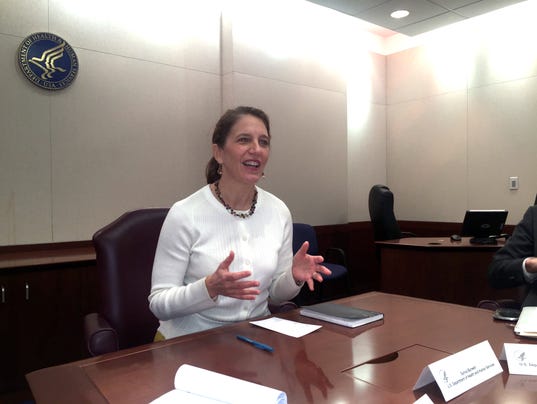
The 4 million new people who signed up for insurance on the federal HealthCare.gov exchange for 2016 are one of several signs the open enrollment period that ended Sunday was a success, Health and Human Services Secretary Sylvia Burwell said Friday.

Burwell's comments marked her last press briefing to summarize an Affordable Care Act open enrollment. By this time next year, there will be Obamacare but no more Obama administration.

As further evidence of the administration's successes, Burwell also pointed to her continued discussions with states considering expanding Medicaid to all of those earning too little to get subsidized ACA plans.

These talks, she says, show it's not if states will expand Medicaid but rather "a question of when."  She cited two main factors for this: The higher rate of hospital closures in states that haven't expanded Medicaid and howmany people left without coverage are working.

"Helping people who are working and playing by the rules is something that is an important concept most people agree on," she said.

Brian Blase, a former Republican congressional aide now with the free market Mercatus Institute, says he's "surprised 20 states still haven’t expanded Medicaid" since the federal government is paying states for all of the new enrollees.

The remaining states haven't expanded Medicaid, Blase says, because they worry the cost "trajectory is unsustainable" and HHS could eventually cut its money to states, which would in turn force them to drop people from Medicaid.

Burwell  says she will be leaving the ACA enrollment process in far better shape than she found it in. The technological problems that hurt the website when it opened in October 2013 are mostly a memory, identity verification has been improved, and the final tally for signups on the federal and state exchanges was 12.7 million people.

The number of new enrollees addresses a complaint from insurers that their customers have more health problems than expected and that they game the system to get care and then drop their plans once they receive treatment.

These "news," as Burwell called them, "can leaven the risk pool. They weren’t the people who were most in need."

Next steps for the agency will be to continue to reform the costly way health care is delivered in this country, including by testing ways to incorporate social services into the efforts, Burwell says. This includes new research into the benefits of linking patients to social services, which she says builds on the move towards healthcare that focuses on quality and value over the quantity of treatments.

"We need to fundamentally think about how we can deliver health care differently," she said.

That includes "helping people connect with services differently," she said. One of the most important hires many doctors and hospitals make, she said, are people who make sure people take their medications, connect them with behavioral health providers or help them with housing or food.

Many of hospital costs are driven by people who need such social services, use emergency rooms frequently and are enrolled in both Medicare and Medicaid.  She cited hospitals that have reduced ER visits by linking people with housing and other services.

"We are on this path towards change," she said.

Burwell also said "quality and affordability" of health care remains a concern of hers and must be a goal of consumers as they continue to shoulder more of the costs of their own care.

Quality is getting hard to find, however. A report out Friday by the Robert Wood Johnson Foundation found more than half of hospitals reduced the number of insurance networks they were in for 2016. The percent of hospitals that were only in-network with one ACA exchange plan increased from 7% in 2015 to 20% in 2016. When compared to U.S. News & World Report's most highly-rated hospitals, RWJF found nearly all were in-network with at least one exchange plan.

[ad_2]

Source link

Wages Rise as US Unemployment Rate Falls Below 5%

0

[ad_1]

The American economy’s jobs machine cooled in January but still performed well enough to push unemployment to an eight-year low and deliver some much-needed wage gains for ordinary workers.

The Labor Department said Friday that payrolls rose by 151,000 in January, a falloff from the year-end sprint that helped make 2015 the second-best year for job creation since the late 1990s.

Analysts said that the slowdown might push the Federal Reserve to postpone another interest rate increase when it meets next month, but signs of a tighter labor market suggested that policy makers would be looking closely at incoming data.

“We are likely to have to two rate hikes this year, probably in June and December,” said Diane Swonk, an independent economist in Chicago, “but the wage gains are important, so March can’t be ruled out.”

Related Coverage

Given the big jump in payrolls late last year, as well as much colder weather last month after the warmest December on record, some payback in January was to be expected.

A job applicant at a military job fair in Washington in January. The economy added 2.65 million jobs last year, but many Americans say they do not feel it.

“The headline number was a bit of a disappointment but not too bad, and the rest of the report suggests steady improvement,” said Michael Hanson, a senior economist at Bank of America Merrill Lynch. “The financial markets are leery, but the labor market still looks like it’s continuing to grow.”

President Obama, who has been frustrated that he has not received the credit he feels he deserves for the country’s improving economy, said the jobs numbers were more signs of progress.

“After reaching 10 percent in 2009, the unemployment rate has now fallen to 4.9 percent even as more American joined the job market last month,” he said. “Americans are working.”

Investors have been edgy lately, concerned about weakness in China, plunging oil prices and a series of reports suggesting that the American economy may have hit an air pocket in recent weeks.

The latest figures on the job market — plus a slight fall in the unemployment rate to 4.9 percent, from 5 percent in December — suggest that some modest strength persists. January was the first time since February 2008 that the unemployment rate fell below 5 percent, just before the collapse of Bear Stearns set the stage for the financial crisis.

To be sure, markets are mercurial, foreseeing recessions that never come to pass and assuming the good times will go on right up until the music stops.

“We don’t think the economy is sliding into a recession,” said Michael Gapen, chief United States economist at Barclays. “We do think the unemployment rate will continue to drift lower and that will support wage growth.”

Last month, average hourly earnings rose 0.5 percent, leaving wages up 2.5 percent over the last 12 months. That was the best showing since January 2015, and it suggested some of the benefits from the falling unemployment rate were beginning to flow to ordinary workers.

For all the concerns about growth in 2016, the Main Street economy appears to be on a fairly solid footing.

Since the beginning of 2010, the American economy has gained nearly 14 million jobs, with healthy increases more recently in better-paying sectors like professional and business services as well as construction. Even as employers had been hiring at a healthy pace, they were only sparingly handing out substantial raises.

All of these crosscurrents — steady hiring but anxious markets, falling unemployment but flat wages — underscore the delicate task now facing the Fed.

The central bank raised short-term interest rates in December, confident that the economy could withstand the impact of a quarter-point tightening in monetary policy after almost a decade of near-zero rates.

But the sell-off in global stock markets, as well as disappointing retail sales and a gloomier trade balance, has prompted some experts to conclude that the Fed won’t move imminently.

Ms. Swonk said the report for January has ammunition for Fed officials who favor a rate-tightening sooner rather than later, as well as those who are more dovish. The jump in average hourly earnings last month might be evidence that wage pressures are building, ultimately setting off more inflation, while the slowdown in payroll growth is an indicator that the economy is nowhere near overheating.

Continue reading the main story

The overall picture in Friday’s report obscures spots of real strength, along with some real pain.

In a reversal after weakness in the second half of 2015, the manufacturing sector surged last month, adding 29,000 jobs. The strong dollar and weak export markets in Asia and Europe had hurt factory employment, but some experts suggested that the worst may now be over.

“It’s a sign the manufacturing sector may be stabilizing,” said Scott Anderson, chief economist at Bank of the West in San Francisco. While the factory sector in the United States is not nearly the size it once was, it is an important creator of better-paying jobs for less-educated workers who have fared poorly in the recovery.

The construction industry, another source of higher-paying jobs for blue-collar workers, also held up well, adding 18,000 jobs, despite colder weather, which can hold up new building.

The biggest surprise, Mr. Anderson said, was that after months of strength, the service sector faded, highlighted by a 38,500 drop in education services.

The overall figures for job creation, as well as the sector-by-sector data, are likely to be revised in future months as more data comes in. On Friday, the big job gain in December was revised downward by the Labor Department, while November’s payroll data was revised upward, reducing payrolls by 2,000 for the final two months of 2015.

The three-month trend in job creation, which economists tend to regard as more meaningful because it smoothes out the month-to-month fluctuations, stands at 231,000, which is more than enough to keep the unemployment rate moving lower.

The proportion of Americans who are in the labor force, which has been stuck at lows not seen since the late 1970s, ticked up slightly in January.

As has been the case since the current recovery began in mid-2009, the most-educated workers are doing best in today’s job market: The unemployment rate for college graduates was unchanged in January at 2.5 percent, while joblessness ticked upward to 7.4 percent for people without a high school diploma.

For the winners, especially in parts of the country where unemployment is very low, Wall Street’s nervousness seems misplaced.

“It’s a very tight labor market, and we continue to hire,” said Dave Rozenboom, president of First Premier Bank in Sioux Falls, S.D. “The economy is as strong as it has ever been here.”

With a state unemployment rate of 2.9 percent in late 2015, employers are feeling pressure to increase wages to attract and retain workers, he said.

Starting salaries for workers who handle credit card customer service and collections recently went to $13 an hour from $11.75, Mr. Rozenboom said. Hospitals and construction firms in the region are also hiring.

Sioux Falls’s situation may be unusually strong, but the upward trajectory in employment over all in the United States suggests to some analysts that the owners of smaller businesses know something that the Wall Street pessimists don’t.

“We think the recession talk is overdone and that labor markets are the primary signal that suggests the economy is healthier than people think,” Mr. Gapen of Barclays said. “There is weakness in places tied to energy and in the industrial Midwest, but it’s not widespread and doesn’t suggest there is a more systemic problem.”


[ad_2]

Source link

Market view of next US rate hike shifts into 2016 after jobs data

0

[ad_1]

A man walks past the snow-covered grounds of the U.S. Federal Reserve in Washington January 26, 2016. REUTERS/Jonathan ErnstThomson ReutersA man walks past the snow-covered grounds of the U.S. Federal Reserve in WashingtonBy Ann Saphir

The U.S. Federal Reserve is increasingly likely to raise interest rates this year, traders bet on Friday, as a long-awaited surge in wages finally materialized and the unemployment rate dropped to an eight-year low.

U.S. short-term interest-rate futures contracts fell, suggesting traders are now pricing in about a 50 percent chance that the U.S. central bank will next raise rates in December, up from about 20 percent before the report.

They had been expecting the Fed to wait until well into next year before raising rates, on worries that a global market selloff sparked by slowing growth in China could create headwinds for the U.S. economy, pushing inflation even farther below the Fed's 2 percent goal.

U.S. job gains slowed more than expected in January as the boost to hiring from unseasonably mild weather faded, but average hourly earnings rose 0.5 percent and the unemployment rate fell to 4.9 percent from 5.0 percent, the Labor Department said on Friday in its monthly employment report.

The report "makes the case that inflation is possible in the U.S. against the backdrop of a lot of the financial turmoil that we've been seeing," said Aaron Kohli, interest rate strategist at BMO Capital Markets in New York.

The Fed raised rates by a quarter of a percentage point in December, the first hike in nearly a decade, and issued economic projections suggesting four rate hikes in 2016. Most economists now see that scenario as overly aggressive, and traders since January had begun to bet against even one rate hike this year.

Traders are pricing in a 12 percent chance of a rate hike at the Fed's next policy-setting meeting in March.

But some analysts are warning against complacency, with the jobless rate around the level that many economists and Fed officials see as the lowest rate that can be sustained before inflation pressures start to build.

"With the drop in the jobless rate and the spike in earnings, the risk of a rate hike in March can’t be fully ignored as markets have done," Steven Ricchiuto, chief economist for Mizuho Securities, told clients in a note.

(Reporting by Ann Saphir with reporting by Karen Brettell in New York; Editing by Chizu Nomiyama, Frances Kerry and Paul Simao)

[ad_2]

Source link

Stocks tumble after weak jobs report; Dow drops about 150 – USA TODAY

0

[ad_1]

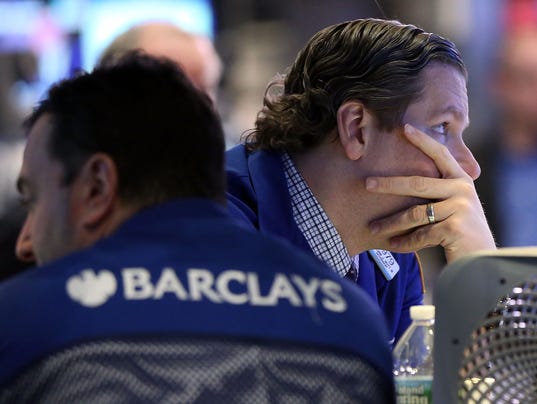
GTY 508041646 A FIN MAX USA NY

Stocks fell in morning trading Friday as the Dow dropped more than 100 points after the release of a weak January jobs report, a key data point that shows a downshift in the U.S. economy amid global economic turbulence and which adds further uncertainty to Federal Reserve interest rate policy.

The government reported that 151,000 new jobs were created last month, below the 190,000 jobs economists had forecast. The unemployment rate ticked lower to an eight-year low of 4.9%, down from 5% in December. The job count in November was revised up 28,000 to 280,000, but the blockbuster December jobs report was downgraded 30,000 to 262,000. Another key data point was the 0.5% rise in average hourly wages.

Given the market turbulence to start the new year, so-called "Jobs Friday" holds even more weight on Wall Street as it provides a first glimpse into the state of the employment market following the recent market and economic tumult around the globe.

In late morning trading, the Dow Jones industrial average, which has patched together two straight days of gains, was down 150 points, or 1%. The broader Standard & Poor's 500 was down 1.1% and the Nasdaq composite was 1.9% lower. All three major stock indexes were slightly higher in pre-market trading before the release of the jobs number.

Investors are analyzing the jobs number closely, as the not too strong, not too weak print could put the Federal Reserve back in play for a March rate hike. At the start of the year the Fed was eyeing four quarter-point rate hikes totaling 1%, but the early-year tumult in markets has resulted in Wall Street dialing back its expectations, with many investors betting on fewer rate hikes and ruling out another hike next month.

Kate Warne, investment strategist at Edward Jones, says, on balance, the employment report was positive and suggests still solid jobs growth and an economy still on track for modest growth, despite the miss on the headline number. She notes that the three-month average for job creation is a still-solid 231,000.

What the report did not do is reduce uncertainty or provide clarity for markets as to what the Fed will do next, nor will it reduce all recession-related fears, Warne adds.

The jobs report, Warne says, still puts the Fed on track to raise rates at some point this year, "but it doesn’t give the market any signal about whether they will move in March or if they will continue to take a lot of time to make the next move."

The lack of clear signal is seen in the different reactions from Wall Street. Barclays downgraded the number of rate hikes it expects this year to two from three.

Chris Gaffney, president of EverBank World Markets, said today's jobs report won’t change the current market thoughts on a March increase, adding that we still won’t see any action on rates by the Fed in March."

In contrast, Steven Ricchiuto, chief economist at Mizuho Securities USA, says today's jobs report keeps a March rate hike on the table. "The data leaves open a March rate hike by the Fed," Ricchiuto told clients in a note, "especially if markets calm down as they tend to do after a period of volatility."

On the question of recession, Warne says the jobs report suggests the economy is still growing modestly, which "helps dampen recession fears, but not enough to eliminate them."

The jobs report comes amid another tough quarter for U.S. corporate earnings, with fourth-quarter 2015 profits on track to contract more than 4%. A slowdown in overall economic growth is also worrying investors.

Wall Street was also digesting more volatile price swings in the oil patch Friday, with a barrel of U.S.-produced crude trading as high as $32.45 and as low as $30.92 a barrel. At 10:50 a.m. ET, oil was up 0.1% to $31.81.

European stocks were lower as the broad Stoxx Europe 600 was down 0.2%. The German DAX was down 0.6% and the CAC 40 in Paris fell 0.6%.

Asian stocks finished mixed. The Nikkei 225 in Japan closed down for a fourth straight session, falling 1.3%. Stocks in Hong Kong rose 0.6% and shares of the Shanghai composite in mainland China dipped 0.7%.

[ad_2]

Source link

Job growth slows in Jan. as unemployment rate hits 8-year low

0

[ad_1]

U.S. employers added 151,000 jobs in January. That's a sharp deceleration from recent months, as companies shed education, transportation and temporary workers. The Labor Department says the jobs gains were enough for the unemployment rate to fall.

Payroll growth slowed in January after a string of impressive gains as employers added 151,000 jobs, raising concerns that troubles overseas may be dampening business confidence and rattling the U.S. economy.

The unemployment rate, which is calculated from a different survey, fell to 4.9% from 5%, the Labor Department said Friday. That's the lowest rate since February 2008. A big gain in employment more than offset a large increase in the labor force, which includes Americans working and looking for jobs.

Economists surveyed by Bloomberg expected 190,000 job gains, according to their median forecast.

Some analysts, however, expected employment growth to slow after a blockbuster fourth-quarter that saw the economy add well over 250,000 jobs a month. Goldman Sachs said the totals were likely inflated by unusually warm weather and it expected some payback in January. High Frequency Economics noted that seasonal adjustments are particularly challenging in January, when payrolls typically shrink after the holiday shopping season.

"There's too much noise" in the report to provide a meaningful signal about the health of the labor market, says Steven Blitz, chief economist of investment firm ITG. He says the Federal Reserve, which raised interest rates last month for the first time in nine years, will -likely wait until February's payroll report for a clearer gauge of employment as it weighs further hikes this year.

Businesses added 158,000 jobs, led by gains in retail, restaurants, healthcare and manufacturing. Federal, state and local governments lost 7,000.

Job gains for November and December were revised down by a total 2,000. Labor also made relatively small, annual revisions that pushed up total job gains for 2015 by 85,000.

Average hourly wages rose 12 cents to $25.39, and are up 2.5% the past year, possibly reflecting an acceleration as the labor market tightens. In another encouraging sign, the average work week edged up to 34.6 hours from 34.5 hours. Employers typically increase the hours of existing workers before adding new ones.

Other labor-market indicators have suggested job growth sputtered last month. Surveys of both the manufacturing and service sectors showed significantly weaker hiring. And initial jobless claims, a reliable measure of layoffs, rose. The reports have raised concerns that the struggles of manufacturers stemming from a weak global economy, strong dollar and low oil prices may be spreading to the previously healthy service sector, which comprises about 80% of economic activity.

At the same time, payroll processor ADP said businesses added 205,000 jobs last month, raising hopes that Labor's report would tally sturdy gains as well.

After months of job losses or modest gains, Labor said, manufacturers added a healthy 29,000 jobs last month in a sign that the negative effects of global weakness and low oil prices may be easing.  But oil companies continued to lay off workers, shedding a net 7,000 jobs last month.

Retailers added 58,000 jobs; restaurants, 47,000; health care, 37,000.

Professional and business services added just 9,000 jobs, but that partly reflects a 25,000 drop in temporary workers following the busy shopping season.

And payrolls in transportation and warehousing fell by 20,000, largely because of unusually large layoffs among couriers and messengers after strong seasonal hiring the previous two months, Labor said.

The government said last week the economy grew just 0.7% in the fourth quarter as the global troubles and oil's downturn hammered exports and business investment. But job growth held up well as services firms such as restaurants and financial firms continued to ramp up hiring. Some economists say the labor market is easier to measure than gross domestic product and a better barometer of the economy's health.

Many economists expect payroll growth to naturally slow this year as the near-normal unemployment rate leaves a smaller pool of available workers.

[ad_2]

Source link

VW, Reeling From Emissions Scandal, Delays Reporting Earnings

0

[ad_1]

The Volkswagen Tower in Hanover, Germany. The company will probably be required to pay billions of dollars, if not tens of billions, in fines and legal settlements.

Credit Julian Stratenschulte/European Pressphoto Agency

FRANKFURT — Volkswagen said on Friday that it would delay reporting its annual earnings and move back the date of its annual shareholders’ meeting because of uncertainty about the cost of its diesel emissions scandal.

The highly unusual delays reflect how difficult it is for the company to prepare accurate financial statements in the face of official investigations in the United States and other countries and lawsuits by thousands of aggrieved Volkswagen owners.

A news conference to present the annual earnings had been scheduled for March 10, and the annual meeting had been scheduled for April 21.

Volkswagen will probably be required to pay billions of dollars, if not tens of billions, in fines and legal settlements, as well as the cost of recalling 11 million vehicles equipped with illegal software intended to deceive official emissions tests. But analysts say the exact cost is impossible to predict.

The company acknowledged in September that it had installed so-called defeat devices in cars with diesel engines, including about 600,000 in the United States, to get around limits on nitrogen oxide pollutants linked to lung ailments.

Volkswagen said it would stick with plans to present an internal report in late April on who was responsible for the deception.

The company said it would announce new dates for the report and for the meeting as soon as possible.

Volkswagen also said that operating profit in 2015 would be about the same as in 2014, in line with earlier forecasts.


[ad_2]

Source link

Obama proposes $10 a barrel tax on oil producers

0

[ad_1]

President Barack ObamaUS oil firms would have to pay a tax of $10 (£6.85) on every barrel of oil they produce under a White House budget proposal to be announced next week.

The funds raised would be spent on green transportation projects.

However, the proposal is unlikely to make it through the Republican-controlled Congress.

The move would also be unpopular with many voters, as adding $10 to the cost of oil would drive up the cost of petrol.

The White House said the tax would raise $20bn a year (£13.7bn) to expand the national transit systems and invest in low-carbon technologies.

"By placing a fee on oil, the President's plan creates a clear incentive for private sector innovation to reduce our reliance on oil and at the same time invests in clean energy technologies that will power our future," the White House said.

As the proposal is unlikely to receive funding, it is being seen as an effort by the White House to raise the issue of transportation.
[ad_2]

Source link

Average US Mortgage Interest Rates Decline for 5th Straight Week

0

[ad_1]

Average U.S. mortgage interest rates declined for the fifth week in a row, Freddie Mac reported February 4, 2016.

Mortgage Interest RatesMortgage interest rates are now at the lowest level since late April 2015. Experts claim financial market volatility has pushed rates down.

A 30-year, fixed-rate mortgage loan averaged 3.72 percent, with an average 0.6 point for the week ending February 4, 2016, down from the previous week when the interest rate for the same loan averaged 3.79 percent. A 30-year, fixed-rate mortgage – the choice for most first-time homebuyers – averaged 3.59 percent during the same period last year.

•The average 15-year, fixed-rate mortgage was 3.01 percent, with an average 0.5 point, a decline from 3.07 percent last week. A year ago at this time, the 15-year, fixed-rate mortgage loan, a popular loan term for homeowners who want to refinance, averaged 2.92 percent.

•A five-year, Treasury-indexed hybrid adjustable-rate mortgage (ARM) averaged 2.85 percent, with an average 0.4 point. The ARM was down from last week when it averaged 2.90 percent. This time last year the 5-year ARM averaged 2.82 percent.

"Market volatility – and the associated flight to quality – continued unabated this week. The yield on the 10-year Treasury dropped another 15 basis points, and the 30-year mortgage rate fell 7 basis points as well, to 3.72 percent," Sean Becketti, chief economist for Freddie Mac said. "Both the Treasury yield and the mortgage rate now are in the neighborhood of early-2015 lows. These declines are not what the market anticipated when the Fed raised the Federal funds rate in December. For now, though, sub-4-percent mortgage rates are providing a longer-than-expected opportunity for mortgage borrowers to refinance."

[Rich Rosa is a co-founder of Buyers Brokers Only, LLC and an exclusive buyer agent. He wrote the preceding post.]

The Ultimate Massachusetts First-time Homebuyer Checklist

[ad_2]

Source link

Despite billions in fresh cash, Symantec will cut costs and go into debt

0

[ad_1]

Symantec Inc. just completed the sale of its Veritas storage business for $5.3 billion in after-tax proceeds, following a late discount. On Thursday, the security-software company also announced a fresh investment of $500 million from Silver Lake Partners.

This company appears to be rolling in gold like Scrooge McDuck, so how does it celebrate? By cutting costs, including potential future staff changes, and going into debt.

Huh?

Basically, Symantec SYMC, -0.52% will push all of the proceeds from the Veritas sale back to investors, with plans for an immediate special dividend of $4 a share — costing $2.7 billion — and $2.3 billion in share buybacks, which adds to $2.1 billion in stock repurchases executed since April 2014. Because some of the proceeds of the Veritas deal are overseas, Symantec will use Silver Lake’s $500 million — which will get the investment firm a board seat — as well as raise debt to pay off its total $5.5 billion shareholder-return plan, the company confirmed Thursday.

Meanwhile, Symantec will look to cut $400 million in costs from its business during the next two years, a process that could eventually include layoffs.

“Over a two-year time period, we will achieve most of the cost savings in a few ways — removing stranded costs from the Veritas sale, continuing to modernize our infrastructure, simplifying our processes and managing our portfolio,” a Symantec spokesperson said. “These efforts may change the way we work and, in some cases, change the need for, or scope of, certain roles.”

The cash return to investors can be seen as payback for believing in Symantec during a rough few years, as the company struggled to succeed with Veritas — which it agreed to buy in 2004 for nearly twice what it agreed to sell it for in 2015 — and saw young startups capitalize on businesses’ growing security needs while Symantec focused on a shrinking consumer business.

Symantec Chief Executive Michael Brown has refocused the business on enterprise sales, but revenue and profit continue to shrink. Quarterly results released Thursday showed sales dropped 6% from the same quarter a year ago, and net income fell 23%. Through three quarters of its fiscal year, Symantec sales have fallen 11% against the year before, while profit has declined 37%.

“Overall, growth remains a challenge for Symantec, but cost cutting is exactly what the doctor ordered and investors will like this news,” FBR Capital Markets analyst Daniel Ives said Thursday afternoon, adding that the Silver Lake investment will also be welcomed by the Street.

Investors’ payback comes with a big cost, however: Symantec’s war chest for potential acquisitions.

As the company rebuilds its business with a focus on selling to companies instead of consumers, a necessity as attackers have increasingly moved to large-scale attacks against corporate networks, it could have shopped for fresh talent among the gaggle of security startups in Silicon Valley and beyond. Startup valuations appear to be adjusting to a point where acquisitions would be more palatable for established companies like Symantec, but the type of move that could make a significant difference will be difficult without cash to close the deal.

Brown said the capital-return program won’t limit flexibility for acquisitions, but admitted that recent small acquisitions were the model for future moves.

“We’re going to continue to be very judicious as we think about, ‘What are the right assets?’” Brown said on Thursday’s conference call. “They need to be tightly aligned with the strategy and they need to make financial sense.”

Going into debt while bringing in nearly $6 billion doesn’t seem to make financial sense, but investors jumped at the short-term rewards Symantec promised Thursday, pushing the stock 9% higher in after-hours trading. That move takes only a small bite out of Symantec’s 25.1% drop over the past year, however, and the security firm will still have to figure out its long-term growth issues without the financial ammunition its latest deals could have provided.
[ad_2]

Source link

Existing Homeowners Are Not Taking Advantage of Historically Low Rates

0

[ad_1]

MoneyJust when the industry thought mortgage interest rates could not get any lower, they dropped further for the fifth consecutive week to unexpected lows.

This might seem to provide existing homeowners with a perfect chance to refinance; however, the data suggests that they are not taking advantage of this opportunity.

Freddie Mac's Primary Mortgage Market Survey (PMMS) showed that mortgage rates deceased "amid ongoing market volatility" and troubled Treasury yields. The report showed that the 30-year fixed mortgage rate is at its lowest point since April 30, 2015 when it averaged 3.68 percent.

For the week ending February 4, 2016, the 30-year fixed-rate mortgage (FRM) averaged 3.72 percent with an average 0.6 point, according to the survey. Last week it averaged 3.79 percent and a year ago at this time, the 30-year FRM averaged 3.59 percent.

Freddie Mac said that the 15-year FRM this week averaged 3.01 percent with an average 0.5 point, down from 3.07 percent last week. One year ago, the 15-year FRM averaged 2.92 percent.

The 5-year Treasury-indexed hybrid adjustable-rate mortgage (ARM) averaged 2.85 percent this week with an average 0.4 point, down from last week when it averaged 2.90 percent, the report noted. A year ago, the 5-year ARM averaged 2.82 percent.

pmms_chart (1)"These declines are not what the market anticipated when the Fed raised the Federal funds rate in December," said Sean Becketti, Chief Economist at Freddie Mac. "For now, though, sub-4-percent mortgage rates are providing a longer-than-expected opportunity for mortgage borrowers to refinance."

Becketti continued, "Market volatilityand the associated flight to qualitycontinued unabated this week. The yield on the 10-year Treasury dropped another 15 basis points, and the 30-year mortgage rate fell 7 basis points as well, to 3.72 percent. Both the Treasury yield and the mortgage rate now are in the neighborhood of early-2015 lows."

Although mortgage interest rates continue remain at historical lows, however, potential buyers and refinancers are steering clear of the housing market.

For the week ending January 29, 2016, mortgage applications decreased 2.6 percent from one week earlier, according to the Mortgage Bankers Association's (MBA) Weekly Mortgage Applications Survey.

Matthew Pointon, Property Economist at Capital Economics, noted that the low interest rates "might seem counterintuitive given that the Fed hiked interest rates in December. But the flight to safety triggered by the turmoil in the oil and equity markets has pushed down Treasury yields and therefore mortgage rates. And although we think rates will increase this year, a strong labor market and easing in lending standards will ensure applications for home purchase see further gains."

[ad_2]

Source link

‘Pharma bro’ Shkreli stays silent before Congress, calls lawmakers ‘imbeciles’ in tweet

0

[ad_1]

Martin Shkreli, the controversial former CEO known as "Pharma Bro," was subpoenaed to testify on Capitol Hill Feb. 4., but repeatedly invoked his Fifth Amendment right not to incriminate himself. (AP)

This story has been updated.

Martin Shkreli has left the building.

Shkreli, the former chief executive of Turing Pharmaceuticals, who gained notoriety for jacking up a little-known drug's price, was excused from a House hearing on drug prices after he refused to answer any questions -- other than how to pronounce his name correctly, or to confirm that, yes, he was listening.

After minutes of refusal to answer questions, during which Shkreli fidgeted, looked away and appeared to smirk at times, he gave his parting remarks on Twitter:

Five minutes were set aside for opening remarks that could shed light on Shkreli's controversial decision to raise the price of Daraprim, a drug for a rare but severe infection that afflicts people with compromised immune systems. But Shkreli declined to make any. Instead, Rep. Jason Chaffetz (R-Utah), chairman of the House Committee on Oversight and Government Reform, began asking him questions about patients affected by the price and remarks he had made previously. Shkreli gave the same composed answer to each question:

"On the advice of counsel, I invoke my Fifth Amendment privilege against self-incrimination and respectfully decline to answer your question," Shkreli said. Repeatedly.

Shkreli didn't come willingly to Thursday's hearing. He was compelled by a subpoena that he threatened to ignore and that his lawyers argued against vehemently.

Wearing a slim-cut black jacket, Shkreli sat at the end of a row of witnesses called before the committee with hands folded, fidgeting a bit and smiling uncomfortably at times -- tics his attorney, Benjamin Brafman, called the "nervous energy" of the 32-year-old former hedge fund manager, not meant to show disrespect to any member of Congress.

Rep. Elijah Cummings (D-Md.) described Turing as a "Ponzi scheme" in his opening remarks, saying the research and development that Turing has claimed it is doing to justify its high prices is simply research on which new drugs it could acquire to raise their prices.

Shkreli smirked.

"It's not funny, Mr. Shkreli. People are dying," Cummings said.

During a hearing on drug pricing Feb. 4, Rep. Elijah Cummings (D-Md.) told controversial hedge fund manager Martin Shkreli that steep drug price rises are "not funny" because "people are dying." (AP)

One of the few questions he did answer, asked by Rep. Trey Gowdy (R-S.C.), was whether the congressman had pronounced Shkreli's last name correctly.

When Gowdy told Shkreli he could answer questions without incriminating himself, since they would not bear on the securities fraud charges being brought against him in a separate matter, he said, "I intend to follow the advice of my counsel, not yours."

Eventually, Shkreli was excused, trailed by a media scrum.

The hearing focused on two companies that drove up the price of drugs they didn't invent -- by more than 5,000 percent in the case of Daraprim. After Shkreli's departure, the rest of the witnesses testified. Among them was Turing's current chief commercial officer, Nancy Retzlaff. Howard Schiller, the interim chief executive of Valeant Pharmaceuticals International, another company that has been accused of operating more like a hedge fund than a drug company, appeared. Janet Woodcock, the director of the Center for Drug Evaluation and Research at the Food and Drug Administration, and Mark Merritt, the president of the Pharmaceutical Care Management Association, a trade group that represents pharmacy benefit companies, was also present.

Turing and Valeant both turned over tens of thousands of pages of documents. Some highlights were presented in two memos released earlier this week. Although there are fascinating details taken from internal emails that draw back the curtain on the tactics of drug pricing, the main finding thus far is simple: Both companies strove to maximize profits.

There are still thousands of pages of documents for the committee to mine for clues about how to prevent a practice that has been called "price gouging." But at least so far, the evidence appears to echo the revelations of a previous Senate investigation of an $84,000 hepatitis C drug. That company, Gilead, also sought to maximize profits, even as its price affected patients' access to the drug.

High drug prices hit a nerve with the public and with politicians, but so far, congressional hearings have generated lots of buzz and few solutions.

Carolyn Johnson is a reporter covering the business of health. She previously wrote about science at The Boston Globe.

[ad_2]

Source link

Stocks rise for 2nd straight day as Dow up 80

0

[ad_1]

If you like roller coaster rides, 2016 has been your type of stock market. When will the volatility end? Adam Shell with America’s Markets.

Financial markets remained volatile Thursday as the Dow and S&P 500 managed to close higher for a second straight day in choppy trading.

U.S. stocks are fighting to gain traction in the new year, as a growth scare continues to hang over global markets and volatility in the energy patch persists.

The Dow Jones industrial average rose 80 points, or 0.5%, to close at 16, 417 and the broader Standard & Poor's 500 stock index managed to post a 0.1% gain, rising 2 points to 1915. The tech-heavy Nasdaq composite rose 6 points, or 0.1%, to 4510.

Volatility in oil prices continued to keep markets on edge as oil prices pulled back after surging 8% Wednesday. After falling as low as $31.68 per barrel earlier in the session Thursday, the price of U.S.-produced crude jumped as high as $33.60 before retreating again to close at $31.72, down 1.7%.

Investors encountered some fresh negative news on economic growth in the U.S. and the eurozone. Citing a slowdown in China and emerging markets and negative fallout from the refugee crisis, the European Union trimmed its 2016 eurozone growth forecast to 1.7%, down from 1.8%.

The EU growth downgrade dragged down shares in Europe, where Germany's DAX index fell 0.4% and the broad Stoxx Europe 600 was off 0.1%.

Mixed U.S. economic data added to the more pessimistic sentiment. Initial jobless claims in the most recent week rose 8,000 to 285,000 and fourth-quarter 2015 U.S. productivity fell 3%, worse than the 2% drop expected.

Not even continued weakness in the U.S. dollar -- which had been super strong this year and hurting commodities and U.S. multinationals in the process -- could lift stocks Thursday. After a sizable drop in the dollar Wednesday, the Wall Street Journal dollar index was down another 0.9% against a basket of foreign currencies Thursday and the euro spiked higher versus the dollar.

Asian stocks were were mixed. Shares of Japan's Niikei 225 fell 0.9%, while stocks in Hong Kong rose 1% and shares in mainland China's Shanghai composite jumped 1.5%.

[ad_2]

Source link

Media mogul Sumner Redstone resigns from Viacom, a day after stepping down at CBS – Washington Post

0

[ad_1]
A day after stepping down from CBS Corp. amid reports of declining health, media mogul Sumner Redstone on Thursday also resigned as board chairman at Viacom, the massive entertainment company he controls that includes cable channels such as MTV and Nickelodeon and the Paramount Movies studio.

But unlike at CBS, where longtime CBS executive Leslie Moonves took over with widespread support, the Viacom transition already has hit a bump, revealing a rift in Redstone’s sprawling media empire – which he built over 50 years from a small chain of movie theaters into a conglomerate worth $40 billion.

Viacom’s board elected Viacom CEO Philippe Dauman, the protégé of the 92-year-old Redstone, to the vacated leadership post over the objections of Redstone’s daughter Shari Redstone. She cast the lone dissenting vote. Her father voted in favor of Dauman.

Shari Redstone, who holds the title of vice board chair, lodged her objections to Dauman in a statement issued Wednesday, saying the company needs an independent leader not connected with the Redstone family trust.

The Redstone family company National Amusements owns about 80 percent of the voting stock in both CBS and Viacom. Upon Redstone’s death, the stake in National Amusements is set to pass to a trust controlled by seven trustees, including Shari Redstone and Dauman.

Doubts about future control of the family company have grown alongside reports of Redstone’s health problems.

He stopped making public appearances about a year ago. In November, a former longtime companion of Redstone named Manuela Herzer alleged in a Los Angeles court filing that his mental acuity had been diminished to “faint shadows of what they had once been for the once vital, towering figure.” That characterization was countered by Dauman, among others, who asserted the mogul was alert and attentive.

The dispute comes as Viacom’s media properties have struggled in the face of intensifying competition. Viacom’s stock price has plummeted 33 percent since April.

After the board’s vote on Thursday, Shari Redstone vowed to continue the fight.

“Shari is going to continue to advocate for what she believes to be in the best interests of Viacom shareholders,” her publicist said in a statement.

Viacom board member William Schwartz issued a statement supporting Dauman, saying in part: “In choosing a successor to Sumner, the Board considered the need for seasoned leadership in this time of unprecedented change, Philippe’s business experience and unparalleled knowledge of Viacom, and his long-term vision for the Company. We believe his becoming Executive Chairman is in the best interests of the company and all shareholders.”

Todd C. Frankel is a reporter covering people and policy. You can follow him on Twitter: @tcfrankel.

[ad_2]

Source link

ES Morning Update February 5th 2016

0

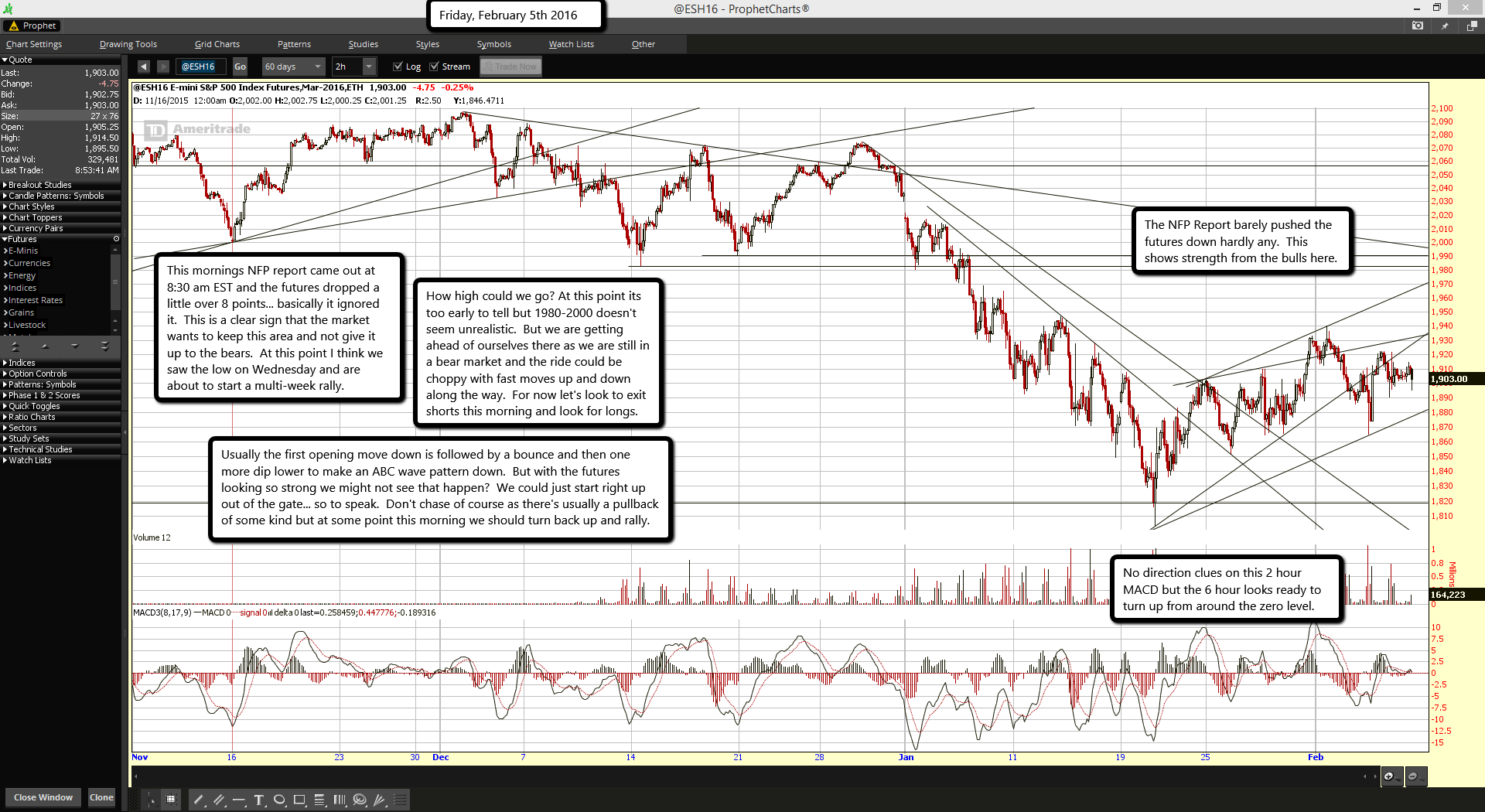
07a927ef-1890-4693-ad18-02bc48cacb88The NFP Report barely pushed the futures down hardly any.  This shows strength from the bulls here.

No direction clues on this 2 hour MACD but the 6 hour looks ready to turn up from around the zero level.

This mornings NFP report came out at 8:30 am EST and the futures dropped a little over 8 points... basically it ignored it.  This is a clear sign that the market wants to keep this area and not give it up to the bears.  At this point I think we saw the low on Wednesday and are about to start a multi-week rally.

How high could we go? At this point its too early to tell but 1980-2000 doesn't seem unrealistic.  But we are getting ahead of ourselves there as we are still in a bear market and the ride could be choppy with fast moves up and down along the way.  For now let's look to exit shorts this morning and look for longs.

Usually the first opening move down is followed by a bounce and then one more dip lower to make an ABC wave pattern down.  But with the futures looking so strong we might not see that happen?  We could just start right up out of the gate... so to speak.  Don't chase of course as there's usually a pullback of some kind but at some point this morning we should turn back up and rally.

SS UNITED STATES To Crystal?

0

[ad_1]

After 47 years, the impossible dream may finally be realized for a retired American icon. Will she sail again?

When the SS United States Conservancy announced that there were new plans for the salvation of the SS United States, most understandably assumed that meant in some sort of static form as a casino, hotel or even an office space/floating storage unit. For most, just seeing the ship get a second chance at life again was enough. But this morning, hope arises once more that the historic liner will actually sail again.

P1040626 copy

Indeed, there was a cryptic message from a friend aboard the CRYSTAL SERENITY last night leaking the news but now it is official: Crystal Cruises has announced that it intends to “Save The SS UNITED STATES”!

Why does this make sense? Over a decade ago, there were many studies done to attest whether the ship could be re-purposed for cruising under the NCL banner. At that time, the ship’s then-owner, Norwegian Cruise Line, was a subsidiary of Genting-owned Star Cruises, whose chairman Tam Sri Lim Kok Thai was especially keen on the project. Now that Genting owns Crystal, the dream is alive again and yet more feasible especially since Genting also owns the Lloyd Werft shipyard in Bremerhaven.

After being “dormant” for years, Crystal is already in the midst of an unprecedented expansion under Genting with a luxury airline, a new “yacht” cruise ship, a deluxe river cruise line and two giant Polar-class luxury cruise newbuilds on its plate. The SS UNITED STATES’ revival would actually add a completely new facet to the company in that the ship was built in the U.S. and could operate between U.S. ports to comply with the Jones Act.

The return of the ship to active cruising is not set in stone. But for now, there is hope as Crystal covers the ship’s $60,000 per month mooring fees in Philadelphia to conduct a new feasibility study. If all goes as intended, a few purists will have their field day as the SS UNITED STATES will not re-emerge as the same ship but as a vastly rebuilt, modern cruise ship that accommodates a mere 800 guests. According to the press release, “She will boast 400 suites measuring approximately 350-square-feet with dining, entertainment, spa and other luxury guest amenities that are true to the ship’s storied history. Features of the original SS United States such as the Promenade and Navajo Lounge will be retained, while new engines and sophisticated marine technology will be installed to maintain her title as the fastest cruise vessel in the world.”

United States by Crystal Cruises in NYC copy

Proposed itineraries for the SS UNITED STATES would include transatlantic voyages and cruises from key U.S. ports as well as world cruises.

“Crystal’s ambitious vision for the SS United States will ensure our nation’s flagship is once again a global ambassador for the highest standards of American innovation, quality and design,” said Susan Gibbs, executive director of the SS United States Conservancy and granddaughter of the ship’s designer, William Francis Gibbs. “We are thrilled that the SS United States is now poised to make a triumphant return to sea and that the ship’s historical legacy will continue to intrigue and inspire a new generation.”

“The prospect of revitalizing the SS United States and reestablishing her as ‘America’s Flagship’ once again is a thrilling one. It will be a very challenging undertaking, but we are determined to apply the dedication and innovation that has always been the ship’s hallmark,” says Crystal President and CEO Edie Rodriguez. “We are honored to work with the SS United States Conservancy and government agencies in exploring the technical feasibility study so we can ultimately embark on the journey of transforming her into a sophisticated luxury cruise liner for the modern era.”

Adds Rodriguez: “It is truly a privilege for the world’s most awarded luxury cruise line to be entrusted with the opportunity of restoring a ship that served as a symbol of patriotism and maritime supremacy and bring her into the modern day, while also giving guests a taste of a bygone era of luxury travel.”

Crystal has appointed retired U.S. Coast Guard Rear Admiral Tim Sullivan to head the project. According to the press release, “With 36 years of active service, Admiral Sullivan has extensive experience in ship operations as a Commanding Officer of numerous Coast Guard cutters, and over the years has engaged in high level of interaction with a myriad of U.S. government agencies and international regulatory entities.”

“Tim’s integrity and leadership will help ensure the feasibility study is conducted with appropriately wide consultation, and rigorous adherence to both safety and environmental awareness,” said Rodriguez.

Meanwhile, according to the press release, “The Conservancy will continue to expand its curatorial and archival collections as it advances its mission of educating the public about the SS United States’ history. The organization will work with Crystal to establish shipboard displays and other educational programs. Planning is also underway for a land-based museum dedicated to preserving the legacy of America’s Flagship along with broader design, innovation, and discovery themes. The museum will feature a wide range of original artifacts and historic components from the ship’s heyday.”

By coincidence, MaritimeMatters’ Co-Editor Peter Knego has just disembarked Crystal Cruises’ award-winning, deluxe CRYSTAL SERENITY and is in the midst of posting reports from the voyage, a seventeen night Miami to Los Angeles transcanal sailing.

[ad_2]

Source link

s2Member®