Sunday, July 26, 2026
Home Blog Page 80

ES Morning Update June 15th 2016

0

fede3542-839f-428f-a79a-f84b445ecc3c

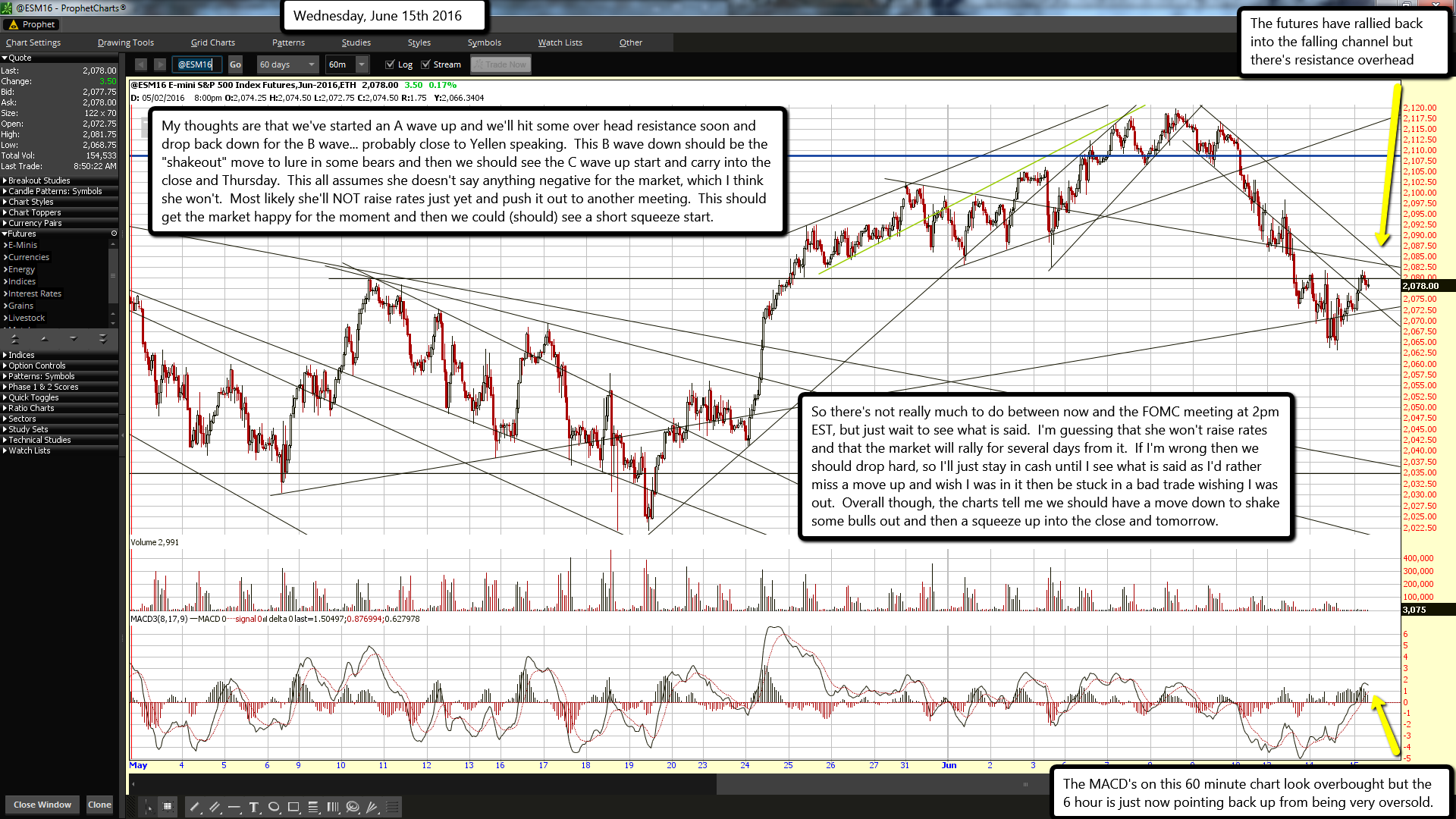
The futures have rallied back into the falling channel but there's resistance overhead

The MACD's on this 60 minute chart look overbought but the 6 hour is just now pointing back up from being very oversold.

My thoughts are that we've started an A wave up and we'll hit some over head resistance soon and drop back down for the B wave... probably close to Yellen speaking.  This B wave down should be the "shakeout" move to lure in some bears and then we should see the C wave up start and carry into the close and Thursday.  This all assumes she doesn't say anything negative for the market, which I think she won't.  Most likely she'll NOT raise rates just yet and push it out to another meeting.  This should get the market happy for the moment and then we could (should) see a short squeeze start.

So there's not really much to do between now and the FOMC meeting at 2pm EST, but just wait to see what is said.  I'm guessing that she won't raise rates and that the market will rally for several days from it.  If I'm wrong then we should drop hard, so I'll just stay in cash until I see what is said as I'd rather miss a move up and wish I was in it then be stuck in a bad trade wishing I was out.  Overall though, the charts tell me we should have a move down to shake some bulls out and then a squeeze up into the close and tomorrow.

Twitter tunes up SoundCloud with a fresh investment

0

Twitter has invested in the audio streaming company SoundCloud, according to multiple reports.

The investment, first reported by Recode, unites the two companies roughly two years after a botched buyout would have joined SoundCloud’s audio armory to Twitter’s social media platform.

Both companies have fallen on hard times, with Wall Street punishing Twitter’s lackluster growth and SoundCloud saying earlier in the year that it needed the cash infusion to stay alive.

According to a Financial Times report, Twitter’s venture arm made a $70 million investment at a $700 million valuation.

SoundCloud did not respond to a request for comment at the time of publication, but sent the following statement.

“We can confirm that Twitter has made an investment in SoundCloud. Both companies facilitate and inspire contemporary culture to happen in real time while reaching millions of people around the world. This investment will enable SoundCloud to remain focused on building value for creators and listeners alike, and to continue the global rollout of many company initiatives such as our recently launched subscription service, SoundCloud Go.

The audio streaming company has been hard at work signing licensing deals with music labels as it tries to drum up interest in its $9.99 monthly subscription service.

For many emerging artists, SoundCloud has become a popular vehicle for self-promotion, but the company has struggled to turn that popularity into cash.

Meanwhile, Twitter, which may be taking a beating on Wall Street hasn’t been shy about spending cash through its relatively new venture capital arm.

The company’s corporate investment arm has backed the android-based operating system developer Cyanogen; VenueNext, which is angling to improve the event experience for the millennial set, and Swirl, which provides in-store marketing tools.

Source link

Federal court upholds FCC’s net neutrality rules

0

The Federal Communications Commission's net neutrality rules remain in effect with backing in federal courts — for now, at least.

Opponents of the FCC's rules for the Open Internet, or net neutrality, plan to take their challenge to the Supreme Court.  "We have always expected this issue to be decided by the Supreme Court, and we look forward to participating in that appeal," said AT&T General Counsel David McAtee in a statement after the U.S. Court of Appeals for the D.C. Circuit ruled 2-1 Tuesday in favor of the FCC's rules.

AT&T was among many companies and groups that filed a suit in 2015 challenging the rules. It was among several cases consolidated into originating cases filled by USTelecom, a trade association that counts among its members AT&T and Verizon, and Alamo Broadband, a fixed wireless broadband service in the San Antonio, Tex. area.

Those suits — and supportive filings from other cable and telecom Net providers — had asked the court to vacate the FCC's rules as an overreach of authority by the agency. If allowed to stand, the rules would inflict the Internet with "heavy-handed, public-utility-style regulation designed for 19th-century railroads and 1930s telephone monopolies," they said in court documents.

Net neutrality and the FCC's ability to regulate the Internet is an issue that has been debated for years and, with more legal challenges on the way, will likely continue. The agency proposed this latest set of rules because its 2010 provisions were tossed out by a federal court in 2014 after Verizon challenged them.

Among strident Net Neutrality supporters is Netflix, which issued a statement Tuesday congratulating the "millions of consumers" who participated in the dialogue. "Now the FCC has clear authority to hold ISPs to these openness rules and turn its attention to policies that support an affordable, faster Internet."

Opponents remain concerned about the repercussions of the FCC's ability to regulate broadband Internet service like a public utility such as electricity or water.  “For the U.S. to remain the global mobile leader, we need rules that help promote consumer access to 5G and the Internet of Things without subjecting the wireless industry to investment-chilling public utility regulation," said the CTIA, the wireless industry trade group that also filed a legal challenge to the FCC's rules.

The main purpose of this commission's Open Internet measures, passed in February 2015 and supported by President Obama, were to prohibit Internet service providers (ISPs), mainly large cable or telephone companies, from blocking and slowing the transmission of content and from the practice of "paid prioritization," paying an ISP for faster delivery of content.

Consumer groups began voicing concerns that ISPs might give favorable treatment to their offerings or require consumers or content providers to pay for "fast lanes" for fast passage on broadband networks.

FCC Chairman Tom Wheeler, who championed the rules and cast one of the three commission votes to pass the rules, called the ruling "a victory for consumers and innovators who deserve unfettered access to the entire web, and it ensures the Internet remains a platform for unparalleled innovation, free expression and economic growth."

While considering the Open Internet issue, the FCC got about 4 million comments, a record. Amid that process, President Obama publicly made his own voice heard, saying that he preferred strong rules "protecting net neutrality and ensuring that neither the cable company nor the phone company will be able to act as a gatekeeper, restricting what you can do or see online."

The Court of Appeals split ruling followed the same party lines as the commission's vote. The judges nominated by Democratic presidents -- Judge Sri Srinivasan by Obama and Judge David Tatel by President Clinton, voted in favor, while Judge Stephen Williams, nominated by President Reagan, dissented.

When the FCC voted in February 2015, Commissioners Mignon Clyburn and Jessica Rosenworcel, joined Wheeler -- all are Democrats -- in approving the rules, while Commissioners Ajit Pai and Michael O'Rielly, the two Republicans on the commission, voted against it.

Source link

US|Obama Denounces Donald Trump for His ‘Dangerous’ Mind-Set

0

Obama’s Statement on ISIS and Orlando

President Barack Obama spoke on the Islamic State and on the Orlando shooting following a meeting with his security council.

WASHINGTON — President Obama on Tuesday angrily denounced Donald J. Trump for his rhetoric in the aftermath of the shooting massacre in Orlando, Fla., saying the presumptive Republican presidential nominee was peddling a “dangerous” mind-set that recalls the darkest periods in American history.

“We hear language that singles out immigrants and suggests entire religious communities are complicit in violence,” Mr. Obama said at the Treasury Department. His statement came after a meeting with his national security team on the status of the American effort against the Islamic State, which the president said had been dominated by discussion of the Orlando rampage.

“Where does this stop?” the president said of Mr. Trump’s approach, noting that he had proposed a ban on admitting Muslims into the United States, and that the Orlando assailant, like perpetrators of previous domestic terrorist attacks in San Bernardino, Calif., and Fort Hood, Tex., was an American citizen.

Trump and Clinton on Orlando Shooting Hillary Clinton’s and Donald J. Trump’s responses to the massacre in Orlando, Fla., highlighted their differences on gun control and immigration.

“Are we going to start treating all Muslim-Americans differently? Are we going to start subjecting them to special surveillance? Are we going to start discriminating against them because of their faith?” Mr. Obama said, his voice rising during his most direct condemnation yet of Mr. Trump. “Do Republican officials actually agree with this?”

The president, who has steadfastly refused to use the term “radical Islam” to describe the Islamic State, which is also known as ISIS or ISIL, bitterly rejected criticism from Mr. Trump and other Republicans about failing to use the phrase.

“If there’s anyone out there who thinks we’re confused about who our enemies are, that would come as a surprise to the thousands of terrorists who we’ve taken off the battlefield,” Mr. Obama said. “There’s no magic to the phrase ‘radical Islam.’ It’s a political talking point, it’s not a strategy.”

The president said he would not use the wording because he was unwilling to give the Islamic State the victory of accepting their vision of themselves as leaders of a holy war between Islam and the West.

What Happened Inside the Orlando Nightclub

A gunman killed 49 people and wounded 53 at a crowded gay nightclub in Orlando, Fla., early Sunday in the deadliest mass shooting in American history. Here is an account of what happened based on statements from public officials and witnesses.

Orlando Ocean FLORIDA Gunman lived in Fort Pierce West Palm Beach

Orlando 441 Site of shooting 527

Timeline of the Attack

Before 2 a.m. Omar Mateen, a resident of Fort Pierce, Fla., a city about 120 miles from Orlando, parked his van outside Pulse, a gay nightclub.

Pulse

Nightclub Entrance Patio Parking lot S. ORANGE AVE.

The New York Times; photograph by Chris O'Meara/Associated Press
2:02 a.m. He entered the club armed with an AR-15-type assault rifle, a handgun and many rounds of ammunition, and opened fire, said Chief John Mina of the Orlando Police Department.

An off-duty officer working for the nightclub responded and engaged in a gun battle with the gunman near one of the entrances.

Restrooms Main dance floor Patio Main entrance Additional officers responded and entered the gun battle.

Restrooms The gunman retreated to a bathroom where the police believed he had four to five hostages.

About 15 to 20 people were in the adjacent restroom. Some patrons who were hiding called the police and texted friends and family for help.

Gunman was barricaded in one of the bathrooms with several hostages. Women’s restroom Men’s restroom Main dance floor Patio Main entrance

A SWAT team and an armored vehicle arrived. A team of crisis negotiators began to talk with the gunman.

At one point, the gunman made a 911 call, beginning a series of conversations with the police during which he pledged allegiance to the Islamic State. He also made statements about bomb vests and explosives, which spurred the officials’ decision to launch a rescue operation.

5 a.m. The police tried to blow a hole in the outer wall of the restroom, but it did not penetrate the wall completely.

Police breached the wall with an armored vehicle. Women’s restroom Men’s restroom Main dance floor Patio Main entranceNext, officers used an armored vehicle to punch a hole in the wall, allowing hostages to flee. The gunman also emerged from the hole, armed with a handgun and a long gun. He was killed in a shootout with the police.

Nightclub_Shooting_Orlando_2.jpg

One officer was shot in the head, but his Kevlar helmet prevented serious injury, Chief Mina said. At least 30 people were found alive.

Graphic: What Happened Inside the Orlando Nightclub

“If we fall into the trap of painting all Muslims with a broad brush and imply that we are at war with an entire religion, then we are doing the terrorists’ work for them,” Mr. Obama said.

Mr. Obama is scheduled to travel to Orlando on Thursday to visit with the surviving victims and the families of those killed in the rampage on Sunday morning

On Tuesday, he called on Congress to enact gun restrictions that it has so far resisted, including the resurrection of a ban on assault weapons and a measure that would bar the ability to purchase guns to those on no-fly lists because of suspected terrorist ties.

“Enough talking about being tough on terrorism,” Mr. Obama said. “Actually be tough on terrorism and stop making it as easy as possible for terrorists to buy assault weapons.”

Source link

Jack Ma says Alibaba wants to more than double its revenue to one trillion dollars by 2020

0

Alibaba Group’s goal is to become the equivalent of the world’s fifth-richest country in four years. Founder and chairman Jack Ma laid out the company’s ambitions during its first Investor Day, which took place this morning at its headquarters in Hangzhou, China.

In order to do that, Alibaba will have to more than double the $463 million in gross merchandise value it made last fiscal year. Achieving one trillion dollars in GMV by 2020 would make the Alibaba the equivalent of the world’s fifth-largest country by gross domestic product, Ma claimed, after the United States, China, the European Union, and Japan.

E-commerce alone, however, will not be enough to take it that far. Ma told investors that Alibaba’s growth strategy revolves around Aliyun, its cloud computing and big data unit. In fact, Alibaba “is not a retail business, we are a data business,” he said, and everything it does now—including financial services like Alipay and investing in logistics—is to gather yet more data.

But Alibaba is still pumping a lot of money into e-commerce (for example it recently invested $1 billion into Lazada to build its online retail business in Southeast Asia), even as it focuses on big data, and investors have worried about how the impact on its profits.

Ma admitted that“we don’t know how to make money off data today, but we know nobody can live without data in the future.” He also cautioned that its shift in strategy means Alibaba Group should not be judged solely on GMV because the metric—which is how revenue for e-commerce companies is measured and compared—will become increasingly outdated as it moves beyond its marketplaces.

“Fifteen years ago, I had a problem with my venture capitalist investors. They kept asking, in 2001, 2002, what is your revenue, what are your page views? At that time page views was the business model, then click rate was the business model,” Ma said.

“Then in 2005, we started giving something called GMV that we learned from eBay. Investors needed it so we gave it to them and it became standard. But in our heart, we know this is not the only index,” he added.

Saving Alibaba’s international reputation

Alibaba’s goal is to serve two billion people by 2020. This means needs to quickly expand beyond China, which currently has a population of about 1.36 billion. Ma says he expects about 30 percent of Chinese consumers will never use Alibaba’s services, so it has to find 1.2 billion users in other countries.

In addition to Southeast Asia, Alibaba is also eyeing India and has made major investments in e-commerce companies like Paytm. Alibaba has struggled to establish a foothold in the U.S., however (its Amazon competitor, 11 Main, closed in June 2015 just one year after it began operating). Despite opening data centers in the U.S., Aliyun is likely to run into similar problems as it goes up against AWS, Microsoft Azure, and Google Cloud.

Talking about Alibaba’s U.S. prospects put Ma on the defensive. “People ask, ‘Jack, are you frustrated and upset by the stock price? Yes and no,” he said.

“I can understand because we are a company from China and we are doing something that nobody has done before in history and very, very few people have used our service in America. Good things always take time and patience.”

Alibaba also has to fight its reputation for enabling counterfeiters if it wants to woo customers outside of China. The company is the constant target of reprimands from the U.S. and Chinese governments. Both have complained that Alibaba does not do enough to prevent IP theft.

Despite that, Ma claimed during his speech that Alibaba is the “world’s leading fighter of counterfeiting” and that its anti-counterfeiting measures have put 700 people in prison over the last three years and led to the closure of “millions of shops.”

Fighting against knockoffs is “fighting against human nature,” Ma added. Furthermore, thanks to the large number of original equipment manufacturers in China, many fake goods are “better quality and better price than the real ones.”

He insisted that Alibaba is also a victim. For every fake product sold on its platform, Alibaba loses five customers.

“I promise that we are more and more confident than ever that we can solve the problem. We cannot solve the problem 100 percent because we are fighting against human nature,” he said. “But we can solve the problem better than any government, any organization, anyone in the world.”

Source link

ES Morning Update June 14th 2016

0

4a0e728e-671a-4f61-b3a2-bd895f5a056d

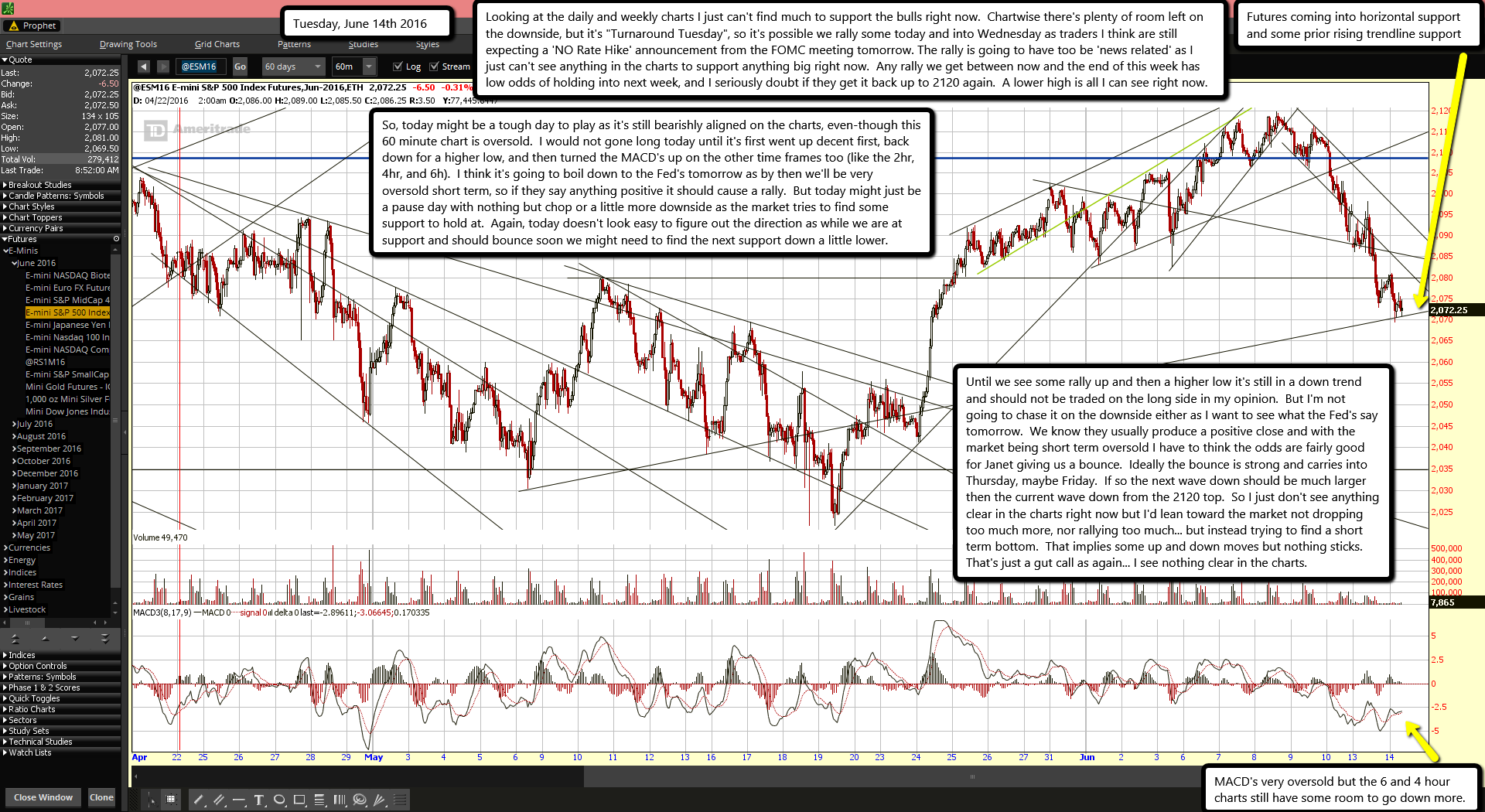
Futures coming into horizontal support and some prior rising trendline support

MACD's very oversold but the 6 and 4 hour charts still have some room to go down more.

Looking at the daily and weekly charts I just can't find much to support the bulls right now.  Chartwise there's plenty of room left on the downside, but it's "Turnaround Tuesday", so it's possible we rally some today and into Wednesday as traders I think are still expecting a 'NO Rate Hike' announcement from the FOMC meeting tomorrow. The rally is going to have too be 'news related' as I just can't see anything in the charts to support anything big right now.  Any rally we get between now and the end of this week has low odds of holding into next week, and I seriously doubt if they get it back up to 2120 again.  A lower high is all I can see right now.

So, today might be a tough day to play as it's still bearishly aligned on the charts, even-though this 60 minute chart is oversold.  I would not gone long today until it's first went up decent first, back down for a higher low, and then turned the MACD's up on the other time frames too (like the 2hr, 4hr, and 6h).  I think it's going to boil down to the Fed's tomorrow as by then we'll be very oversold short term, so if they say anything positive it should cause a rally.  But today might just be a pause day with nothing but chop or a little more downside as the market tries to find some support to hold at.  Again, today doesn't look easy to figure out the direction as while we are at support and should bounce soon we might need to find the next support down a little lower.

Until we see some rally up and then a higher low it's still in a down trend and should not be traded on the long side in my opinion.  But I'm not going to chase it on the downside either as I want to see what the Fed's say tomorrow.  We know they usually produce a positive close and with the market being short term oversold I have to think the odds are fairly good for Janet giving us a bounce.  Ideally the bounce is strong and carries into Thursday, maybe Friday.  If so the next wave down should be much larger then the current wave down from the 2120 top.  So I just don't see anything clear in the charts right now but I'd lean toward the market not dropping too much more, nor rallying too much... but instead trying to find a short term bottom.  That implies some up and down moves but nothing sticks.  That's just a gut call as again... I see nothing clear in the charts.

Making donations for Orlando victims? Watch for scams

0

In the wake of the Orlando attack, the deadliest shooting in U.S. history, charities will be reaching out for contributions on behalf of victims and Americans will be opening up their pocketbooks.

But the Better Business Bureau of Central Florida cautions that potential donors should exercise caution.

(The latest on the Orlando shootings.)Making donations for Orlando victims? Watch for scams photo

A mourner attends a vigil for victims of a shooting at a gay nightclub in Orlando, Florida the previous day, in front of the United States embassy in Berlin, Germany. (Photo by Adam Berry/Getty Images)

“Tragedy inspires people to give, and this terrible tragedy is drawing incredible response already from people all around the world” said H. Art Taylor, president and CEO of the BBB Wise Giving Alliance. “The best way to help the victims, their families, and the people of Orlando is to make sure that donations end up where they belong.”

Who are the victims in the Orlando nightclub shooting?

Beware of scams and unauthorized requests, said Taylor.

He suggested following these guidelines:

1. Thoughtful Giving

Take the time to check out the charity to avoid donating to a questionable or poorly managed effort. The first request for a donation may not be the best choice. Be proactive and find trusted charities that are providing assistance.

2. State Government Registration

About 40 of the 50 states require charities to register with a state government agency (usually a division of the State Attorney General’s office) before they solicit for charitable gifts. If the charity is not registered, that may be a significant red flag.

3. Respecting Victims and Their Families

Organizations raising funds should get permission from the families to use either the names of the victims and/or any photographs of them. Some charities raising funds for the Colorado movie theater victims did not do this and were the subject of criticism from victims’ families.

4. How Will Donations Be Used?

Watch out for vague appeals that don’t identify the intended use of funds. For example, how will the donations help victims’ families? Also, unless told otherwise, donors will assume that funds collected quickly in the wake of a tragedy will be spent just as quickly. See if the appeal identifies when the collected funds will be used.

5. What if a Family Sets Up Its Own Assistance Fund?

Some families may decide to set up their own assistance funds. Be mindful that such funds may not be set up as charities. Also, make sure that collected monies are received and administered by a third party such as a bank, CPA or lawyer. This will help provide oversight and ensure the collected funds are used appropriately (e.g., paying for funeral costs, counseling, and other tragedy-related needs.)

6. Advocacy Organizations

Tragedies that involve violent acts with firearms can also generate requests from a variety of advocacy organizations that address gun use. Donors can support these efforts as well but note that some of these advocacy groups are not tax exempt as charities. Also, watch out for newly created advocacy groups that will be difficult to check out.

7. Online Cautions

Never click on links to charities on unfamiliar websites or in texts or emails. These may take you to a lookalike website where you will be asked to provide personal financial information or to click on something that downloads harmful malware into your computer. Don’t assume that charity recommendations on Facebook, blogs or other social media have already been vetted.

8. Financial Transparency

After funds are raised for a tragedy, it is even more important for organizations to provide an accounting of how funds were spent. Transparent organizations will post this information on their websites so that anyone can find out and not have to wait until the audited financial statements are available sometime in the future.

9. Newly Created or Established Organizations

This is a personal giving choice, but an established charity will more likely have the experience to quickly address the circumstances and have a track record that can be evaluated. A newly formed organization may be well-meaning but will be difficult to check out and may not be well managed.

10. Tax Deductibility

Not all organizations collecting funds to assist this tragedy are tax exempt as charities under section 501(c)(3) of the Internal Revenue Code. Donors can support these other entities but keep this in mind if they want to take a deduction for federal income tax purposes. In addition, contributions that are donor-restricted to help a specific individual/family are not deductible as charitable donations, even if the recipient organization is a charity.

Source link

Johnson Controls doubling car battery output in US

0

Johnson Controls said Monday it plans to invest $445 million to double production capacity of its advanced car batteries in North America and also to build a new battery plant in China.

The investments will help JCI boost output of its absorbent glass mat batteries -- a technologically advanced car battery that is more expensive than a conventional lead acid battery but can better handle the strain of frequent engine restarts and the ever-increasing electrical load placed on car batteries.

The two investments -- $245 million to double its battery output and $200 million for a factory in China -- are part of a larger, five-year plan.

JCI said it plans to invest a total of $780 million globally by 2020 to expand production of absorbent glass mat batteries.

“Johnson Controls is the leader in battery manufacturing and we are committed to investing in our factories, our employees and our customers, to ensure that we remain the leader when it comes to innovative technology, quality products and strong customer partnerships,” said Joe Walicki, president of Johnson Controls Power Solutions.

Absorbent glass mat batteries are used in vehicles with start-stop technology, which can tax a car battery because the electrical system still uses energy from the battery when the vehicle turns off.

JCI told analysts today it expects the percentage batteries sold globally that will be paired with start-stop systems will increase from about 24% now to more than 60% by 2020.

That growth will occur because start-stop systems exist, work well, are easy to adopt in new vehicles and will help automakers meet stricter regulations.

"We expect start-stop to become ubiquitous," Walicki said. "We are going to reach the tipping point on start-stop capacity between now and 2020."

In China, Johnson Controls is forming a joint venture with Binzhou Bohai Piston, an auto parts affiliate of Beijing Automotive Industry Group. The new battery plant in China will be built and operated by that joint venture Binzhou, Shandong Province, and will eventually employ 650 people.

The new plant will be JCI's fourth in China.

According to JCI, 50%, or about 15 million new vehicles, will be equipped with start-stop functionality in China by 2020.

JCI also predicts that China will represent 50% of all automotive battery growth over the next 10 years.

Milwaukee-based JCI is among the world's largest manufacturers of automotive batteries. About one-third of all new cars sold are equipped with a JCI battery and a 74% of all aftermarket automotive batteries are made by the company.

JCI, which also makes heating and cooling systems for buildings and energy storage systems, is in the middle of trying to complete a merger with Ireland-based Tyco, a provider of electronic security systems, fire protection, detection and suppression systems, sprinklers and fire extinguishers.

The deal is designed to create a company that will focus primarily on products for buildings, from controls and heating and cooling equipment to security and fire suppression equipment. The new company is projected to have $30 billion in annual sales.

JCI also is simultaneously planning to spin off its automotive seating business into a standalone company called Adient.

Source link

US budget deficit shrank in May

0

FILE - In this Monday, Aug. 8, 2011, file photo, a statue of former Treasury Secretary Albert Gallatin stands guard outside the Treasury Building in Washington. On Friday, June 10, 2016, the Treasury Department releases federal budget data for May. (Jacquelyn Martin, File/Associated Press)

WASHINGTON — The federal government’s budget deficit shrank sharply in May because of a calendar quirk. But even with latest improvement, the deficit for the first eight months of this budget year is larger than last year.The Treasury Department said Friday that the deficit last month totaled $52.5 billion, down from a deficit of $84.1 billion in May 2015. However, much of the result reflected nearly $40 billion in May benefits that were paid in April because May 1 fell on a Sunday.

For the first eight months of this budget year, the deficit totals $407.1 billion, an 11 percent increase over the $366.8 billion deficit recorded for the same period last year.

The Congressional Budget Office is forecasting that this year’s deficit will end up being 21.9 percent higher than last year.

Last year’s deficit dropped to $439 billion, the smallest deficit in eight years. It’s a significant improvement from the first four years of the Obama administration when the deficits topped $1 trillion annually, reflecting the impact of a deep recession on government tax revenues and various efforts the government was making to jump-start economic growth and stabilize the nation’s banking system.

But CBO projects that deficits will keep growing over the next decade and will once again top $1 trillion annually beginning in 2022. Much of the increase in deficits will reflect higher costs for Social Security and Medicare as millions of baby boomers retire.

So far this budget year, which began on Oct. 1, government receipts total $2.14 trillion, an increase of 1.7 percent over the same eight months last year. Government outlays total $2.55 trillion, an increase of 3.1 percent over the same period a year ago.

Source link

ES Morning Update June 13th 2016

0

4c048ee7-830e-433e-92f0-308aea1b360e

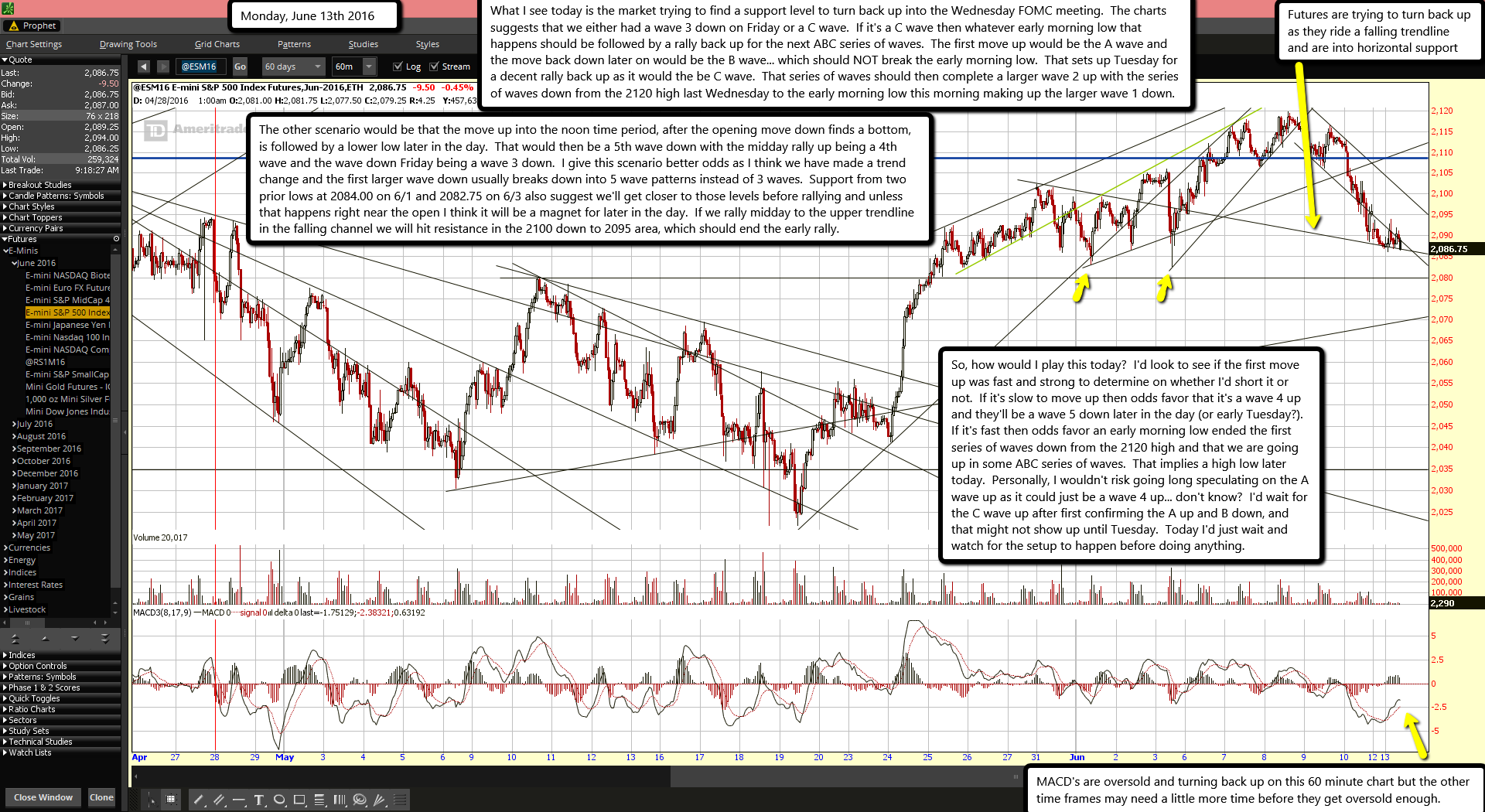
Futures are trying to turn back up as they ride a falling trendline and are into horizontal support

MACD's are oversold and turning back up on this 60 minute chart but the other time frames may need a little more time before they get oversold enough.

What I see today is the market trying to find a support level to turn back up into the Wednesday FOMC meeting.  The charts suggests that we either had a wave 3 down on Friday or a C wave.  If it's a C wave then whatever early morning low that happens should be followed by a rally back up for the next ABC series of waves.  The first move up would be the A wave and the move back down later on would be the B wave... which should NOT break the early morning low.  That sets up Tuesday for a decent rally back up as it would the be C wave.  That series of waves should then complete a larger wave 2 up with the series of waves down from the 2120 high last Wednesday to the early morning low this morning making up the larger wave 1 down.

The other scenario would be that the move up into the noon time period, after the opening move down finds a bottom, is followed by a lower low later in the day.  That would then be a 5th wave down with the midday rally up being a 4th wave and the wave down Friday being a wave 3 down.  I give this scenario better odds as I think we have made a trend change and the first larger wave down usually breaks down into 5 wave patterns instead of 3 waves.  Support from two prior lows at 2084.00 on 6/1 and 2082.75 on 6/3 also suggest we'll get closer to those levels before rallying and unless that happens right near the open I think it will be a magnet for later in the day.  If we rally midday to the upper trendline in the falling channel we will hit resistance in the 2100 down to 2095 area, which should end the early rally.

So, how would I play this today?  I'd look to see if the first move up was fast and strong to determine on whether I'd short it or not.  If it's slow to move up then odds favor that it's a wave 4 up and they'll be a wave 5 down later in the day (or early Tuesday?).  If it's fast then odds favor an early morning low ended the first series of waves down from the 2120 high and that we are going up in some ABC series of waves.  That implies a high low later today.  Personally, I wouldn't risk going long speculating on the A wave up as it could just be a wave 4 up... don't know?  I'd wait for the C wave up after first confirming the A up and B down, and that might not show up until Tuesday.  Today I'd just wait and watch for the setup to happen before doing anything.

Oil companies face worker shortages after 350000 layoffs

0

There could be a growing shortage of skilled workers in the oil industry.

That may seem counterintuitive in an industry that has been rapidly shedding workers, with more than 350,000 people laid off in the oil and gas industry worldwide.

Texas is one place feeling the pain. Around 99,000 direct and indirect jobs in the Lone Star state have been eliminated since prices collapsed two years ago, or about one third of the entire industry. In April alone there were about 6,300 people in oil and gas and supporting services that were handed pink slips. Employment in Texas’ oil sector is close to levels not seen since the aftermath of the financial crisis in 2009. "We're still losing big chunks of jobs with each passing month," Karr Ingham, an Amarillo-based economist, told The Houston Chronicle.

But the damage to the oil industry’s workforce could be exactly why companies could face a skills shortage in the months and years ahead.

North Dakota had nearly 1,000 drilled but uncompleted wells as of March, and more companies are showing some signs that they might step up completions now that oil prices are above $50 per barrel. But they might find it difficult to ramp up the rate of completions if they cannot field enough workers. There are only about eight fracking crews left in the state, down from 45 two years ago, according to Reuters. Fracking crews are brought in to frack and complete wells for oil producers.

A recent survey of oil companies in the Bakken revealed concerns from the industry about the dismantling of fracking crews. “Even if prices went to $100 per barrel of oil, you don’t have any frack crews available to complete all the wells that need fracking,” one survey respondent told Hart Energy Market Intelligence.

One oil worker recently interviewed by Reuters illustrates the problem for places like the Bakken. John Ritchart, a worker that was responsible for heating water for a fracking crew, packed up and left North Dakota, moving back to Washington State after his pay was cut by 30 percent. “I can feed two people at home for a month for what it costs me to eat in Williston for a week,” Ritchart told Reuters. “I can’t afford to stay here.” The city of Williston, located in the heart of the Bakken, saw its population shrink by 16 percent since the summer of 2015.

At a recent industry conference in North Dakota, a top executive at Hess Corp. said that dismantling crews can be counterproductive. “If you just stop your entire operation, you send all your contractors home, you lose all your completion supervisors and you end up in a situation where you have to start all over again,” Gerbert Schoonman, Hess vice president in the Bakken, said at the Williston Basin Petroleum Conference in May.

But the thousands of laid off engineers, technicians, geologists, and rig workers won’t sit around waiting for oil prices to rebound. Many are moving on to find work in other states and in other industries. In Texas, some laid off oil workers are increasingly finding work in the solar industry, which may not pay as much as working in the oil fields, but does offer more stability. One solar company in San Antonio told Marketplace that about a quarter of the resumes they receive come from workers who lost jobs in the oil and gas industry. The problem for solar companies is finding workers that are truly leaving oil and gas and not just waiting for a rebound.

As thousands of out-of-work oil and gas veterans find other jobs, there could be a shortage of skilled workers if drilling picks back up.

“There is going to be within the next, I think, six months to a year a real competitive war for the best and the brightest in this industry,” Les Csorba, a partner at the Houston office of Heidrick & Struggles, said in an interview with Houston Public Media. “You are seeing the baby boomer generation retiring, so you have an aging population within the energy sector…you are seeing an increased demand for technical competence and expertise.”

But the damage from two years of low oil prices is also doing its part. “Obviously we are going to see a number of defections from the energy industry. Young people that came into the business are now leaving because they are afraid of the cyclical nature of the industry,” Csorba said.

Source link

Egg producers pledge to stop grinding up male chicks after hatching

0

Egg Producers Pledge to Stop Grinding Up Male Chicks After Hatching

You've probably heard about female chickens being kept in poor conditions, laying eggs in cages too small for them to spread their wings. But American hatcheries pledged Thursday to end a different controversial practice — one involving male chickens.

Across the industry and the world, when male chicks are born to egg-laying hens, they're immediately slaughtered. The advocacy group that brokered the deal in the U.S. notes male chicks are often put through what's basically a grinder.

Click here for more of the day's top headlines.

These male chicks can't lay eggs, nor were they bred to grow large enough, or quickly enough, to be sold as meat.

But United Egg Producers, a group that speaks for hatcheries that turn out 95 percent of U.S. eggs, has pledged to stop culling by 2020, or when it's "economically feasible" and an alternative is "commercially available."

Cage-free hens at Organic Valley farms:

Cage-free chickens stand in a fenced pasture on the Francis Blake organic farm, Wednesday, Oct. 21, 2015, near Waukon, Iowa. Blake gathers an average of 2,500 dozen eggs a week from his flock of 5,000 cage-free hens. An increasing customer demand for more eggs from chickens free from cages has left U.S. egg farmers with the question of whether to spend millions of dollars to convert or build cage-free barns. (AP Photo/Charlie Neibergall)

A chicken struts inside a fenced pasture on the Francis Blake organic farm, Wednesday, Oct. 21, 2015, near Waukon, Iowa. Blake gathers an average of 2,500 dozen eggs a week from his flock of 5,000 cage-free hens. An increasing customer demand for more eggs from chickens free from cages has left U.S. egg farmers with the question of whether to spend millions of dollars to convert or build cage-free barns. (AP Photo/Charlie Neibergall)

Eggs laid by cage-free chickens sit in a holder after being sorted by Francis Blake on his organic farm, Wednesday, Oct. 21, 2015, near Waukon, Iowa. Blake gathers an average of 2,500 dozen eggs a week from his flock of 5,000 cage-free hens. An increasing customer demand for more eggs from chickens free from cages has left U.S. egg farmers with the question of whether to spend millions of dollars to convert or build cage-free barns. (AP Photo/Charlie Neibergall)

Francis Blake sorts eggs laid by cage-free chickens on his organic farm, Wednesday, Oct. 21, 2015, near Waukon, Iowa. Blake gathers an average of 2,500 dozen eggs a week from his flock of 5,000 cage-free hens. An increasing customer demand for more eggs from chickens free from cages has left U.S. egg farmers with the question of whether to spend millions of dollars to convert or build cage-free barns. (AP Photo/Charlie Neibergall)

Francis Blake talks about his cage-free chicken operation on his organic farm, Wednesday, Oct. 21, 2015, near Waukon, Iowa. Blake gathers an average of 2,500 dozen eggs a week from his flock of 5,000 cage-free hens. An increasing customer demand for more eggs from chickens free from cages has left U.S. egg farmers with the question of whether to spend millions of dollars to convert or build cage-free barns. (AP Photo/Charlie Neibergall)

Francis Blake watches his cage-free chickens roam in a fenced pasture on his organic farm, Wednesday, Oct. 21, 2015, near Waukon, Iowa. Blake gathers an average of 2,500 dozen eggs a week from his flock of 5,000 cage-free hens. An increasing customer demand for more eggs from chickens free from cages has left U.S. egg farmers with the question of whether to spend millions of dollars to convert or build cage-free barns. (AP Photo/Charlie Neibergall)

Cage-free chickens walk in a fenced pasture on the Francis Blake organic farm, Wednesday, Oct. 21, 2015, near Waukon, Iowa. Blake gathers an average of 2,500 dozen eggs a week from his flock of 5,000 cage-free hens. An increasing customer demand for more eggs from chickens free from cages has left U.S. egg farmers with the question of whether to spend millions of dollars to convert or build cage-free barns. (AP Photo/Charlie Neibergall)

A warning sign is seen on a door in a chicken house on the Francis Blake organic farm, Wednesday, Oct. 21, 2015, near Waukon, Iowa. Blake gathers an average of 2,500 dozen eggs a week from his flock of 5,000 cage-free hens. An increasing customer demand for more eggs from chickens free from cages has left U.S. egg farmers with the question of whether to spend millions of dollars to convert or build cage-free barns. (AP Photo/Charlie Neibergall)

A cage-free chicken looks out at the egg sorting area on the Francis Blake organic farm, Wednesday, Oct. 21, 2015, near Waukon, Iowa. Blake gathers an average of 2,500 dozen eggs a week from his flock of 5,000 cage-free hens. An increasing customer demand for more eggs from chickens free from cages has left U.S. egg farmers with the question of whether to spend millions of dollars to convert or build cage-free barns. (AP Photo/Charlie Neibergall)

Cage-free chickens walk in a fenced pasture on the Francis Blake organic farm, Wednesday, Oct. 21, 2015, near Waukon, Iowa. Blake gathers an average of 2,500 dozen eggs a week from his flock of 5,000 cage-free hens. An increasing customer demand for more eggs from chickens free from cages has left U.S. egg farmers with the question of whether to spend millions of dollars to convert or build cage-free barns. (AP Photo/Charlie Neibergall)

The pledge isn't to let these male chicks live, though. It's largely to keep them from being born.

Researchers in the Netherlands have been working on technology that could identify the sex of a chicken on the ninth day of incubation. This would allow farmers to terminate males before they hatch.

The U.S. may become one of the leaders in effectively eliminate culling. An anti-culling bill was presented to Germany's parliament but voted down in March.

According to The Guardian, more than 3 billion male chicks are killed within hours of hatching each year.

Source link

Orlando Pulse club attack: gunman identified as police investigate motive

0

Gunman who opened fire with assault rifle, and equipped with suspicious device, reportedly a 29-year-old US citizen

The gunman behind a suspected terrorist attack that killed 50 people at an LGBT nightclub in Orlando is believed to be Omar Mateen, 29, from Florida, a US citizen of Afghan heritage.

The gunman opened fire at the Pulse Club in the early hours of Sunday, taking hostages, killing many and injuring 53. Raising the alarm in the early hours of Sunday morning, staff at the venue posted on Facebook: Everyone get out of pulse and keep running. .

Orlando confirmed police said the shooting was being treated as an act of domestic terrorism. The FBI said it had a positive identification of the shooter but it was not releasing a name as it was in the process of notifying his family.

The gunman was killed during a shootout with police as they broke into the nightclub to rescue 30 people held hostage there. No motive for the attack has been offered by police. The Guardian has not been able to independently verify the identity of the shooter.

Police initially said about 20 people had been killed and 42 injured in the attack, but later revised the toll up to 50 dead and 53 hospitalised, the latter including one police officer who had been shot in the head and whose life had been saved by his Kevlar helmet. They said the gunman was armed with an assault rifle, handgun and some kind of device.

At a press conference on Sunday morning, an FBI spokesman said investigators believed the attacker may have had extremist beliefs, but cautioned that they were pursuing multiple leads.

Orlando Police (@OrlandoPolice) June 12, 2016

Shooting at Pulse Nightclub on S Orange. Multiple injuries. Stay away from area. pic.twitter.com/5Di2mc6XUY

An explosion was heard at the club at about 5am local time, which police said was a distractionary device used as part of the rescue mission to get to the hostages. The explosion caused some panic on the ground, which led to Orlando police tweeting to say it had been a controlled explosion and warning the media about reporting inaccuracies.

Police said the incident began at 2am when the gunman started firing and an officer on duty at the club exchanged shots with him. They said it then descended into a hostage situation. The situation was resolved three hours later when a Swat team stormed the nightclub after receiving messages from club patrons who were hiding in the club while the gunman was still at large.

A little after 0500 hours we made a decision to go in and conduct a rescue. We were being contacted by people in the bathroom, about 15 people. Our biggest concern was future loss of life, said John Mina, the chief of police.

Several explosives and an armoured vehicle were used to break through a wall of the nightclub and rescue approximately 30 hostages. The suspect was shot by a police officer during this intervention.

Orlando Police (@OrlandoPolice) June 12, 2016

We can confirm this is a mass casualty situation. Support from local/state/federal agencies. We expect to brief media shortly.

Orlando Police (@OrlandoPolice) June 12, 2016

Pulse Shooting: The shooter inside the club is dead.

Police said several suspicious devices were found in and around the nightclub, including one on the gunman and one on his car.

This is an incident, as I see it, that we can definitely classify as a domestic terrorism incident, said the Orange County sheriff, Jerry Demings.

When asked whether the suspect was thought to have any affiliation with Islamic State, the FBI assistant agent in charge, Ron Hopper, said: We do have suspicions that the individual may have leanings toward that ideology. When pushed as to what led him to believe that, he clarified that all possibilities were being investigated.

Earlier in the evening one witness told Sky News there had been more than 100 people inside the venue for the clubs Latin night when the gunman entered the building and began firing into the ceiling and into the crowd.

Richard Negroni said: We just heard shots, it was less than a minute, it felt longer. There was a brief pause and we just ran. Everybody was just faces to the floor. I had someone over me, I really didnt see [how many gunmen there were]. All I can tell you was the club was packed, there were over 100 people there, if the gunman came in through the front door people were injured or worse.

In a Facebook post, Negroni wrote that the shooter opened fire at about 2am and people on the dancefloor and bar got down on the floor. He said some people near the bar and back exit managed to escape quickly.

Pulse nightclub, Orlando, Florida

Mina Justice told the Associated Press that her 30-year-old son Eddie, who was in the club when the attack took place, texted her asking her to call the police. Justice said Eddie had run into a bathroom to hide. He then texted her: Hes coming.

The next text said: He has us, and hes in here with us, she said. That was the last conversation.

Orlandos mayor, Buddy Dyer, praised the efforts of law enforcement agencies, saying that many were saved by [their] heroic efforts.We had a crime that will have a lasting effect, we need to stand strong, we need to support victims and their families, he said.

The
The scene of the shooting at the Pulse nightclub in Orlando. Photograph: EPA

Family members were waiting throughout the morning to hear about the safety of their loved ones. Many of the injured were brought to the Orlando regional medical center (ORMC) located close to the nightclub, and they announced in the early hours of the morning that they were in lockdown and admitting entry only to essential workers. They have since instructed those who believe their family might have been brought there to come to the family meeting area at the hospital.

Staff at the club posted a message on Facebook thanking people for their concern during the nights tragic event.

As soon as we have any information we will update everyone, read the Facebook statement. Please keep everyone in your prayers as we work through this tragic event. Thank you for your thoughts and love.

Witnesses describe Pulse nightclub terror shooting

Read more: http://www.theguardian.com/us-news/2016/jun/12/orlando-shooting-nightclub-pulse-gunman

Has Oil Risen Too Far Too Fast?

0

Oil Pump At Sunset

Crude oil has been on a remarkable run since bottoming out earlier this year. After crashing into the mid-$20s to start the year, crude has rocketed higher passing $50 a barrel this week despite the fact that OPEC hasn't done a thing to help the oil market. Instead, what has fueled crude's surge is a combination of temporary supply outages and the growing belief that supply and demand will move back into balance by the end of the year due to the anticipation for steep global production declines. That said, if those catalysts don't hold it's quite possible that crude could give up some of its recent gains.

Supply disruptions mount

One of the big weights on the price of crude over the past year was the fact that there was an abundance of oil supply on the market thanks in part to limited supply disruptions. That has changed this year after growing political unrest in places like Libya, Venezuela, and Nigeria caused output in those countries to come offline. Nigeria's oil industry, in particular, has been hard hit after militants blew up a number of oil wells and pipelines.

In fact, just this week militants blew up another Chevron (NYSE:CVX) oil well in the country. It was the fourth attack in as many weeks on a facility operated by Chevron, which has also had to halt operations at a 160,000 barrel a day export facility. Because of these militant attacks nearly half of Nigeria's 2.4 million barrels per day of production is currently off-line, with militants threatening to cut Nigeria's oil output down to zero.

On top of these geopolitical supply disruptions, wildfires in Canada knocked out a third of that country's oil production at the peak, or well over 1 million barrels per day. Some of those facilities are just starting to come back online, with ConocoPhillips (NYSE:COP), for example, recently restarting one of its key facilities in the region. However, it could be another month before ConocoPhillips and its peers are back to their pre-fire production levels. Further, the fires are not completely extinguished and have recently threatened additional facilities in the country causing several producers to shut down production.

These supply disruptions have clearly had an impact on the price of oil this year. However, as Canada's oil industry gets back up to its prior peak it will add more supplies to a still oversupplied market. Likewise, if the attacks in Nigeria cease that country could start resuming some of its lost output. In other words, these supply disruptions aren't likely to be permanent.

An uncertain forecast

The other big fuel driving oil prices higher this year is the belief that global oil production will decline due to a significant underinvestment in new supplies, with U.S. production expected to see the deepest drop. In fact, in the International Energy Agency's latest oil market report it has revised its forecast for the fall of non-OPEC production. It now sees this output declining by 800,000 barrels per day from last year's average, which is 100,000 barrels per day steeper than its prior forecast.

Having said that, oil production from several U.S. producers has come in well above their own expectations, which is leading many to increase their production guidance for the balance of the year. Production at Pioneer Natural Resources (NYSE:PXD), for example, averaged 222,000 barrels of oil equivalent per day, or BOE/d, during the first quarter, which was well above its guidance range of 211,000 to 216,000 BOE/d for the quarter. Because of this Pioneer Natural Resources increased its production growth outlook for 2016, with it now expecting to grow its output by 12%, up from its prior view of 10% growth. Not only that, but with oil over $50 a barrel the company is seriously considering adding additional rigs, which could boost its output even more by the end of the year. Further, Pioneer Natural Resources was far from the only producer to increase its full-year production guidance, which suggests that oil production might not decline as much as the IEA and other analysts expect.

Investor takeaway

While the price of crude oil has surged in recent weeks, downside risks still remain. Not only was its recent rally ignited by what could just be temporary supply outages, but full year decline projections might not come to fruition due to stronger-than-anticipated production from shale. In other words, there is still the risk that oil might not be done going down, which is why investors could be better off steering clear of riskier oil stocks for the time being.

A secret billion-dollar stock opportunity
The world's biggest tech company forgot to show you something, but a few Wall Street analysts and the Fool didn't miss a beat: There's a small company that's powering their brand-new gadgets and the coming revolution in technology. And we think its stock price has nearly unlimited room to run for early in-the-know investors! To be one of them, just click here.

Source link

Uber takes U-turn, lets riders schedule trips in advance

0

Passport, check. Toothbrush, check. Scheduled Uber pickup, check.

The ride-hailing company announced that users on their way to the airport, or in need of any pre-scheduled ride, will be able to reserve one up to 30 days in advance. The service started Thursday in Seattle, the home of Microsoft, and will expand to other “top business travel cities,” Uber wrote on its blog.

Uber is not the first ride-hailing service to offer this feature. Lyft announced in May it has started to test a similar program in San Francisco, while Gett has offered scheduled-ahead service for more than a year where it operates, USA Today reported.

As these companies upend the taxi and limousine industries, Uber’s announcement shows that it, Lyft, and Gett have found that they shouldn’t discard too many taxi and limo features in the name of “on-demand.”    

“Even though we’re an on-demand company, we totally get it,” Tom Fallows, Uber’s director of global experiences, told Wired.com. “Sometimes you just want that extra reassurance that your Uber will be there when you want to leave.”

Through Uber’s new feature, a user will be able to schedule a ride 30 minutes to 30 days in advance. The feature will be offered to start just through Uber X, its less expensive, private vehicle option. A user can cancel any time before their ride is on its way, at no cost to them. Pre-scheduling won’t impact drivers, who will not be able to match with riders ahead of time, according to The Boston Globe. And users won’t be able to avoid surge pricing, in which the cost of a ride climbs at peak hours, either.

Schedule-ahead service is a reversal of Uber’s long-held stance about how, and when, it serves its customers.

“Uber is an on-demand service,” it writes on its website, on a page titled “Can I make a reservation?” “Use the Uber app to request a trip when you’re ready to ride. There’s no need to make a reservation in advance.”

Travis Kalanick, Uber’s chief executive, reaffirmed this mindset in September, when he spoke one-on-one with Salesforce CEO Mark Benioff at the cloud computing company’s Dreamforce conference.

“Do you schedule time with your shower?” said Mr. Kalanick, when asked by Mr. Benioff if Uber would introduce scheduled rides, reported Forbes.

And yet, ever since it started six years ago, Uber said it has received requests from customers for pre-scheduled rides  “so they can rest assured that an Uber will be available when they need it, even if it’s for a 4 a.m. ride to the airport,” wrote Uber in Thursday’s blog post.

Taxis and limos have long offered schedule-ahead services. In fact, it’s a foundation of the limousine industry. Gett, which operates in Europe, Russia, Israel, and New York City, recognized this when it launched the service more than a year ago. Lyft was next. It started to pilot service in San Francisco about two weeks ago, and plans to expand it to other cities sometime this summer, reported PC Magazine. Lyft, though, will allow users to reserve a ride up to 24 hours in advance, compared to up to 30 days through Uber.

Uber introduced pre-scheduling in part to keep up with its rivals. Yet it’s also an indication that ride-hailing companies are learning they can’t do away with too much of the traditional model.

“If you want to really, truly upend the market, then you have to focus on perfecting the tools people use to create change,” wrote Kevin Harrington, the inventor of the infomercial, in a Forbes article. “In the end, companies don’t upend markets – customers do.”

Source link

4 Facts About Retirement Every Baby Boomer Should Know

0

With our nation's population of baby boomers going strong at roughly 76 million, it's estimated that a good 10,000 baby boomers turn 65 every day. What this means is that more and more boomers are getting closer to retirement, and with that comes a host of important decisions. If you're a baby boomer, here are four key retirement facts to help you navigate this significant milestone.

Older Couples Carrying Carpet

1. People are living longer

According to the Social Security Administration, the average 65-year-old man today can expect to live until age 84.3, while the average 65-year-old woman today can expect to live until age 86.6. Of course, these are just averages. The Social Security Administration also reports that about one out of every four 65-year-olds today will live past 90, while one out of every 10 will live past 95.

While increased life expectancies are a good thing in theory, they pose a financial challenge to today's retirees. Living longer means needing more savings to cover life's expenses in retirement -- savings that many boomers are sorely lacking.

2. Most baby boomers are behind on retirement savings

While there are certainly exceptions, most boomers have a lot of catching up to do when it comes to retirement savings. According to a 2016 report from the Insured Retirement Institute (IRI), only 55% of baby boomers have begun saving independently for retirement.

Among those who have saved, 42% admit to having less than $100,000 socked away. And while $100,000 might seem like a decent sum at first glance, over the course of 20 years, that translates into less than $7,000 a year in retirement income.

3. You probably can't live off Social Security alone

The National Academy of Social Insurance reports that a good 65% of beneficiaries rely on Social Security for the majority of their retirement income, and that it's the only source of income for almost 25% of those 65 and older. The IRI study confirms these findings, with 59% of boomers stating that they expect Social Security to serve as a significant source of income once they exit the workforce.

While Social Security can provide a nice stream of income for retirees, it's only designed to replace about 40% of the average worker's pre-retirement income. Most people need 70% to 80% of their pre-retirement income once they stop working, which means that relying on Social Security alone can leave them with a pretty sizable gap. In 2015, the average monthly Social Security benefit was $1,335, which is just not enough for many people to live on.

4. Many baby boomers worry they won't have enough money in retirement

Confidence among baby boomers regarding retirement is waning. According to the IRI study, only 24% of baby boomers are confident they'll have enough savings to last throughout retirement. This is the lowest level of confidence since IRI began its study in 2011, at which point 37% of boomers expressed the same level of confidence.

Of course, it's not necessarily the case that boomers are growing more pessimistic. Rather, it could be that many are getting more realistic about their finances and retirement needs. And on a positive note, some boomers are taking steps to improve their financial picture.

During the past year, 30% of boomers postponed their retirement plans, and 26% say they're now aiming to retire at age 70, or later. This is a pretty big jump from 2011, when only 17% of boomers planned to retire at or after 70.

Take action now

If you're on the verge of retirement, and aren't confident about your savings, you still have some options for improving your financial outlook. For starters, consider working a few extra years to build up more savings. For 2016, anyone 50 and older can contribute up to $24,000 to a 401(k), and $6,500 to an IRA. If your employer offers a matching program, that's even more (free) money coming your way for retirement.

Here's another benefit of postponing retirement and working a few extra years. If you hold off on taking Social Security past your full retirement age -- which, for baby boomers, is either 66 or 67, depending on the year you were born -- you'll get an 8% increase in benefits for every year you postpone up until age 70, at which point this incentive runs out. And that 8% increase isn't just temporary; it will remain in effect for as long as you continue to receive Social Security benefits.

Deciding when to retire is a major decision not to be taken lightly. Before you jump in, take a hard look at your goals and finances to see where you stand. You may find that an extra year or two of working could mean the difference between a comfortable retirement and one that starts on financially shaky ground.

The $15,834 Social Security bonus most retirees completely overlook
If you're like most Americans, you're a few years (or more) behind on your retirement savings. But a handful of little-known "Social Security secrets" could help ensure a boost in your retirement income. For example: one easy trick could pay you as much as $15,834 more... each year! Once you learn how to maximize your Social Security benefits, we think you could retire confidently with the peace of mind we're all after. Simply click here to discover how to learn more about these strategies.

Source link

How Would Bernie Sanders Change Social Security?

0

Bernie Sanders Ss

It's no secret that presidential candidate Bernie Sanders wants to expand Social Security. In fact, he introduced legislation last year intended to do just that. Here are the details of Sanders' stance on Social Security, how he wants to expand the program, and how he intends to pay for it.

Bernie Sanders' position on Social Security

Sanders believes that Social Security has been a highly successful program, for the most part. For one thing, the senior citizen poverty rate in the U.S. is 10% today, down from nearly 50% before Social Security started. Social Security has also paid all of the benefits it has ever promised and has done so in a timely manner.

However, he feels there is still a lot of work to be done and that Social Security is more important now than ever, since more than one-third of seniors are practically 100% dependent on their Social Security benefits. In Sanders' mind, no retiree should be living in poverty and Social Security should be expanded for all retirees. He also believes cost-of-living adjustments should be more reflective of the actual inflation rate experienced by seniors.

The current state of Social Security

As I've written before, Social Security is unsustainable in its current form, but it's far from "broke" or "in crisis," as many in the media would have you believe. In fact, between the money in the Social Security trust fund and the payroll taxes coming in, Social Security can pay every cent it's promised to current and future retirees until 2034, and three-fourths of those benefits afterwards, according to the Social Security Trustees' report.

Having said that, it's what happens after 2034 and in the meantime that's the concern. Only being able to pay three-fourths of benefits after that date means that Social Security isn't completely sustainable in its current form, so changes will need to be made to preserve retirees' benefits. There are only two main ways to fix it – benefit reductions or tax increases.

How Sanders wants to fix Social Security

Not only does Sanders want to preserve benefits; he wants to expand Social Security for most retirees. In 2015, Sanders introduced a bill known as The Social Security Expansion Act, which would make the following changes:

  1. An average $65-per-month benefit increase for most Social Security recipients.
  2. A change in the index used for cost-of-living adjustments from the Consumer Price Index for Urban Wage Earners and Clerical Workers to the Consumer Price Index for the Elderly. The CPI-E has grown 0.2% faster on average than the CPI-W currently being used.
  3. An increase in the minimum benefit amount for lifetime low-income workers.

This expansion would be paid for by two tax increases on high-income Americans. First, all earned income above $250,000 would be subject to the payroll tax (it isn't now), which is 6.2% for both employers and employees. Second, investment income, such as capital gains and dividends, above $250,000 would also be subject to a 6.2% tax.

According to the legislation, not only would these increases be enough to fund the proposed expansion, but it would also extend the solvency of Social Security for the next 45 years (50 years, according to Sanders' campaign website).

What it could mean to you

Unless you're in the upper income brackets, Sanders' plan wouldn't result in higher Social Security taxes for you and your family.

Lower-income workers would experience the biggest change. As of 2015, the minimum Social Security benefit for a worker with 30 or more "years of coverage" is $829.80 per month ($9,957.60 per year). The federal poverty level for individuals is currently $11,880, and since one of the primary objectives of Sanders' plan is to dramatically reduce the number of seniors living in poverty, it's likely that the new minimum benefit would make up the difference.

For most other Social Security beneficiaries, the $65 monthly increase could result in a significant lifestyle boost. This translates to $780 per year, and since the average Social Security benefit for a retired worker is just over $16,000 per year, this represents a "raise" of nearly 5%.

To sum it up, Sanders' Social Security plan is to raise taxes on the top 1.5% of earners, while increasing Social Security benefits for virtually everyone else.

The $15,834 Social Security bonus most retirees completely overlook
If you're like most Americans, you're a few years (or more) behind on your retirement savings. But a handful of little-known "Social Security secrets" could help ensure a boost in your retirement income. For example: one easy trick could pay you as much as $15,834 more... each year! Once you learn how to maximize your Social Security benefits, we think you could retire confidently with the peace of mind we're all after. Simply click here to discover how to learn more about these strategies.

Source link

This Snapshot of Social Security’s Investment Holdings Shows Why the Program Is in Trouble

0

Retired Senior Couple Looking Over Bills Getty

The importance of Social Security simply cannot be overstated, especially for today's retirees. Tens of millions of people rely on Social Security benefits right now, and tens of millions more are counting on it being there when they need it in the future. Yet when you take a close look at the program, you can see some flaws that could endanger its ability to provide the financial support you need in retirement.

Social Security is vital for a majority of seniors

When Gallup questioned retirees about their reliance on the program, nearly 6 in 10 admitted that it was a major source of their monthly income. Another 3 in 10 pegged Social Security income as a minor source. A similar study conducted even more recently by the Insured Retirement Institute on pre-retiree baby boomers found almost identical data, with 59% of boomers expecting Social Security to be a major source of their income. This was up from 43% when IRI last asked boomers about their expected reliance on the program.

Yet, for such a vital program, Social Security is hardly on solid footing. A major uptick in the number of seniors retiring due to boomers leaving the workforce is going to add tens of millions of new beneficiaries to the program in the decades to come. This is expected to push the worker-to-beneficiary ratio from 2.8-to-1 in 2015 to 2.1-to-1 by 2035. Also, people are living longer than ever -- and while that's great for us, that's bad news for the Social Security Trust, which is already strained.

The result? According to the Social Security and Medicare Board of Trustees, the Old-Age, Survivors and Disability Insurance Trust Fund is expected to exhaust its cash reserves, which currently sits at $2.83 trillion as of the end of April 2016, by 2034. To be clear, this doesn't mean the program will then be bankrupt. What it does mean is that if lawmakers choose not to put forth a workable solution to bring in more revenue and/or reduce benefits, a benefit cut of up to 21% could be needed to sustain the program an additional 55 years. Not exactly an ideal scenario for seniors who are dependent on Social Security income as their primary source to pay their bills.

This Social Security snapshot reveals a big concern

But there's another concern with the OASDI besides the ongoing retirement of baby boomers that's often overlooked. A problem that I'd opine is just as serious. Namely, the investment holdings of the OASDI Trust.

G
Image source: Social Security Administration.

Above you can see a snapshot of the investment holdings of the OASDI as of the end of April 2016, all $2.83 trillion worth. As you'll note, the OASDI only invests in special issue bonds and certificates of indebtedness, which are offered by the federal government just for trusts and are not available to the public. In the past, the OASDI did invest in publicly traded bonds backed by the U.S. government, but ceased doing so many years ago.

As you can see from the OASDI's investment holdings, it's currently earning as average yield of 3.206%, which is indeed higher than the current rate of inflation. But there's a dilemma. The Federal Reserve has been walking on eggshells for more than seven years due to weakened U.S. and global economic performance. The result is that we've seen near-historic low lending rates in the U.S. pretty much since Dec. 2008. Again, that's great for the consumer who's looking to buy a home, or the business looking to take on debt in order to expand, but it's terrible news for seniors and the OASDI, which are reliant on interest-bearing assets.

Take a look above and you'll see that the highest interest-bearing assets are all due to mature within the next six years (and many by the end of 2017). The remainder of the OASDI's investment holdings are in interest-bearing special issues with yields of 1.375% to 4% that could, in many cases, stretch out an additional 14 years. In fact, the bonds with the furthest maturity dates are all at sub-3% interest rates. While secure, the income generated from these bonds simply isn't cutting it. In other words, the Federal Reserve's long-term accommodative monetary policy is potentially expediting the exhaustion of the OASDI's excess cash reserves.

You need a Plan B

What the above data adds to an already lopsided argument is that you need to have a Plan B available when you retire. Simply hedging your bets on Social Security probably isn't going to be a wise move, even if you manage to work until age 70 and maximize your benefit payout.

Instead, regardless of your age, you'll need to focus on the bread and butter of retirement: saving more and investing wisely.

Worried Millennial Woman Holding Piggy Bank Getty

Nowadays, it's not enough to simply sock some money away and hope it performs well in an investment portfolio. With so many seniors reliant on Social Security, and baby boomers expected to be reliant on Social Security, it obvious that people aren't optimizing their savings. It's somewhat understandable considering that boomers and current retirees didn't have the ease of use that comes with budgeting software when they were saving for retirement. However, there are no valid excuses anymore. Budgeting software is practically everywhere, and with about 30 minutes and a few clicks you can have a straightforward plan to optimize and adjust your saving habits on a month-to-month basis.

A few suggestions you may want to consider to truly ignite your savings potential include setting up an automatic money transfer on a weekly, biweekly, or monthly basis that transfers money to an investment account to hold yourself accountable. Accountability can also be improved by getting everyone in your household, including kids, grandkids, and grandparents, involved with budgeting. The more you surround yourself with people who have similar goals, the more likely you'll be to succeed.

Senior Magnifying Glass Dollar Signs Getty

On the investment end, the wisest thing you can do is contribute to tax-savvy retirement tools. Matching a 401(k) contribution from your employer is often a smart move, since you're essentially being given free money, though you'll owe taxes on your 401(k) once you begin making withdrawals during retirement. More employers are using 401(k) matches as a talent retention tool, so make sure you're taking advantage of yours if one is offered.

By a similar token, a Roth IRA can be a great investment tool for people of all ages. A Roth IRA allows your money to grow tax-free for life, although you'll want to ensure you meet the income requirements that allow you to contribute to a Roth IRA. Of course, if you earn too much, you're likely not going to be counting on Social Security and living paycheck-to-paycheck in the first place. A Roth IRA also has no restrictions on age for continued contributions, and there's no required minimum distribution as with a 401(k) or Traditional IRA, meaning your money can continue to grow if you choose to let it do so.

In sum, Social Security will be there for you when you retire, but make sure it's not your only option when you hang up your work gloves for good.

The $15,834 Social Security bonus most retirees completely overlook
If you're like most Americans, you're a few years (or more) behind on your retirement savings. But a handful of little-known "Social Security secrets" could help ensure a boost in your retirement income. For example: one easy trick could pay you as much as $15,834 more... each year! Once you learn how to maximize your Social Security benefits, we think you could retire confidently with the peace of mind we're all after. Simply click here to discover how to learn more about these strategies.

Source link

Solar Impulse 2, airplane powered by sun’s energy, lands in New York City

0

NEW YORK -- Solar Impulse 2, the solar-powered airplane on a globe-circling voyage that began more than a year ago in the United Arab Emirates, reached a milestone Saturday, completing a trip across the United States with a Statue of Liberty fly-by before landing in New York.

The Swiss-made plane landed at John F. Kennedy International Airport at 4 a.m. after a 4 hour 41 minute flight of about 165 miles from Lehigh Valley International Airport in Pennsylvania. Its trip across the U.S. mainland began April 24, when Solar Impulse landed in San Francisco from Hawaii.

"Si2 is now safe in New York, JFK airport ... Our new home is Hangar 19 in John F. Kennedy International Airport!" the pilots' logbook read.

Solar Impulse 2, the solar airplane piloted by Swiss adventurer Andre Borschberg, flies over Manhattan on June 11, 2016, shortly before landing at John F. Kennedy airport.

Solar Impulse 2, the solar airplane piloted by Swiss adventurer Andre Borschberg, flies over Manhattan on June 11, 2016, shortly before landing at John F. Kennedy airport.

Andre Borschberg, Jean Revillard/SI2/Handout via Reuters

Pilots Andre Borschberg, who flew the plane to New York, and Bertrand Piccard, who will start the next leg of the journey, expect to leave "soon" to cross the Atlantic Ocean for Europe or South Africa on their way to completing an aviation engineering feat to advance environmentally compatible technology.

They take turns piloting the plane and sometimes sleep in 20-minute shifts. Piccard said on "CBS This Morning: Saturday" that he uses "self-hypnosis" to be able to go into "a very deep regeneration very quickly" and that Borschberg uses yoga techniques to keep his energy up.

"It's a question of mindset," Borschberg said. "You know, when you board the airplane, you think five days' flight is going to be long, it will be very long. If you think it's a great experience, something fantastic, something special, something for you, it's completely different."

Across the U.S., they stopped in Phoenix; Tulsa, Oklahoma; Dayton, Ohio, home of aviation pioneers Orville and Wilbur Wright; and Allentown, Pennsylvania.

The Solar Impulse 2's wings, which stretch wider than those of a Boeing 747, are equipped with 17,000 solar cells that power propellers and charge batteries. The plane runs on stored energy at night. Ideal flight speed is about 28 mph, although that can double during the day when the sun's rays are strongest.

The plane originally was scheduled to head to the Big Apple Monday night but showers and thunderstorms moving through the area caused it to be grounded.

The trip began in March 2015 from Abu Dhabi, the capital of the United Arab Emirates, and made stops in Oman, Myanmar, also known as Burma, China and Japan. The plane had a five-day trip from Japan to Hawaii, where the crew was forced to stay in Oahu for nine months after the plane's battery system sustained heat damage on its trip from Japan.

Source link

Gawker files for Chapter 11 bankruptcy protection

0

Peter Thiel, tech billionaire and co-founder of PayPal, spent $10 million helping Hulk Hogan win his case against Gawker Media. (Daron Taylor,Jhaan Elker/The Washington Post)

Gawker Media Group, the parent of the news and gossip site Gawker, filed for Chapter 11 bankruptcy protection Friday and put itself up for sale, two moves designed to limit the financial fallout since losing a $140.1 million privacy-invasion lawsuit to professional wrestler Hulk Hogan in March.

Gawker has appealed the judgment against the company, its chief executive, Nick Denton, and its former editor, A.J. Daulerio, and had asked that it be reduced or stayed while its appeal is pending.

But on Friday, the judge in the case, Pamela Campbell, denied Gawker’s request for a stay, triggering Gawker’s bankruptcy-protection filing and its auction plans. It has no plans to cease operations while it appeals.

In addition to Gawker, Gawker Media owns six other Web brands, including the sports site Deadspin and the tech blog Gizmodo. It was founded in 2002 by Denton, a former staffer at the Financial Times.Nick Denton, founder of Gawker, talks with his legal team before Terry Bollea, a.k.a. Hulk Hogan, testifies in court, in St. Petersburg, Fla., on March 8. (John Pendygraft, pool/Reuters

Gawker identified Ziff Davis, an all- digital media company, as the first bidder for its assets; people close to the company said Ziff has offered $90 million. But Ziff Davis’s bid isn’t final: Under a court-supervised auction, Gawker would be free to accept higher offers.

Like all publishers, Ziff Davis, perhaps best known as the publisher of PC Magazine, has been hurt by the decline in print advertising, and it has attempted to recast itself on the Web through such sites as AskMen.com, Computer Shopper and ExtremeTech.

“We are encouraged by the agreement with Ziff Davis, one of the most rigorously managed and profitable companies in digital media,” Denton said, in a statement. “A combination would marry Ziff Davis’ strength in e-commerce, licensing and video with [Gawker Media’s] premium media brands.”

A Chapter 11 filing, which requires the approval of a bankruptcy court, protects a company’s assets from creditors and enables it to reorganize its finances under the court’s supervision. Many companies, including General Motors, have survived after filing under Chapter 11 of the bankruptcy code.

Gawker’s largest unsecured creditor is Hogan.

Hogan, whose real name is Terry Bollea, sued Gawker in 2012 after it posted excerpts of a sex tape featuring him and Heather Clem, the wife of a friend. After a two-week trial, a Tampa jury awarded Hogan a total of $140.1 million in general and punitive damages.

The legal dispute took on a new coloration last month when billionaire technology investor Peter Thiel — a target of Gawker stories — revealed that he had bankrolled Hogan’s suit. The revelation suggested that Thiel was intent on financially crippling the company as payback for its reporting on him.

Thiel, a co-founder of PayPal and a Facebook board member, has long been upset with the site’s coverage of him, particularly a 2007 story by a now-defunct Gawker-owned site that disclosed he is gay.

Thiel said he has spent as much as $10 million to secretly support Hogan’s lawsuit. In an interview with the New York Times, he said Gawker published articles that were “very painful and paralyzing for people who were targeted,” adding: “I thought it was worth fighting back.”

The bankruptcy filing won’t prevent Gawker from appealing the Hogan verdict, said Christopher Ward, vice chairman of the bankruptcy practice at the Polsinelli law firm in Wilmington, Del. However, the filing will give Gawker the opportunity to argue that it isn’t required to post the $50 million bond that Campbell, the judge, ordered while Gawker’s appeal moves forward, he said. Gawker’s attorneys have already sought relief from the bond from an appeals court.

Ward also said the bankruptcy code allows Gawker to change course and forgo a sale if “circumstances warranted,” such as winning the Hogan case on appeal.

As a practical matter for the news media, the bankruptcy filing “intensifies what’s been the message of the Hogan case all along — that in this day and age, the media can’t necessarily be as confident as they once were that they can publish with impunity,” said Samantha Barbas, an associate professor at the University of Buffalo’s law school.

Over the past four decades, she said, the Supreme Court has gradually extended greater liability protection to media organizations. But Gawker’s legal ordeals suggest that “freedom of the press and the First Amendment may no longer be near-absolute shields for the media. . . . The Hogan episode indicates that the tide may be beginning to turn” in law and public opinion.

Source link

s2Member®