Sunday, July 26, 2026
Home Blog Page 71

ES Morning Update September 14th 2016

0

a6ecf79f-27c2-4c2e-8805-589086b5cc8f

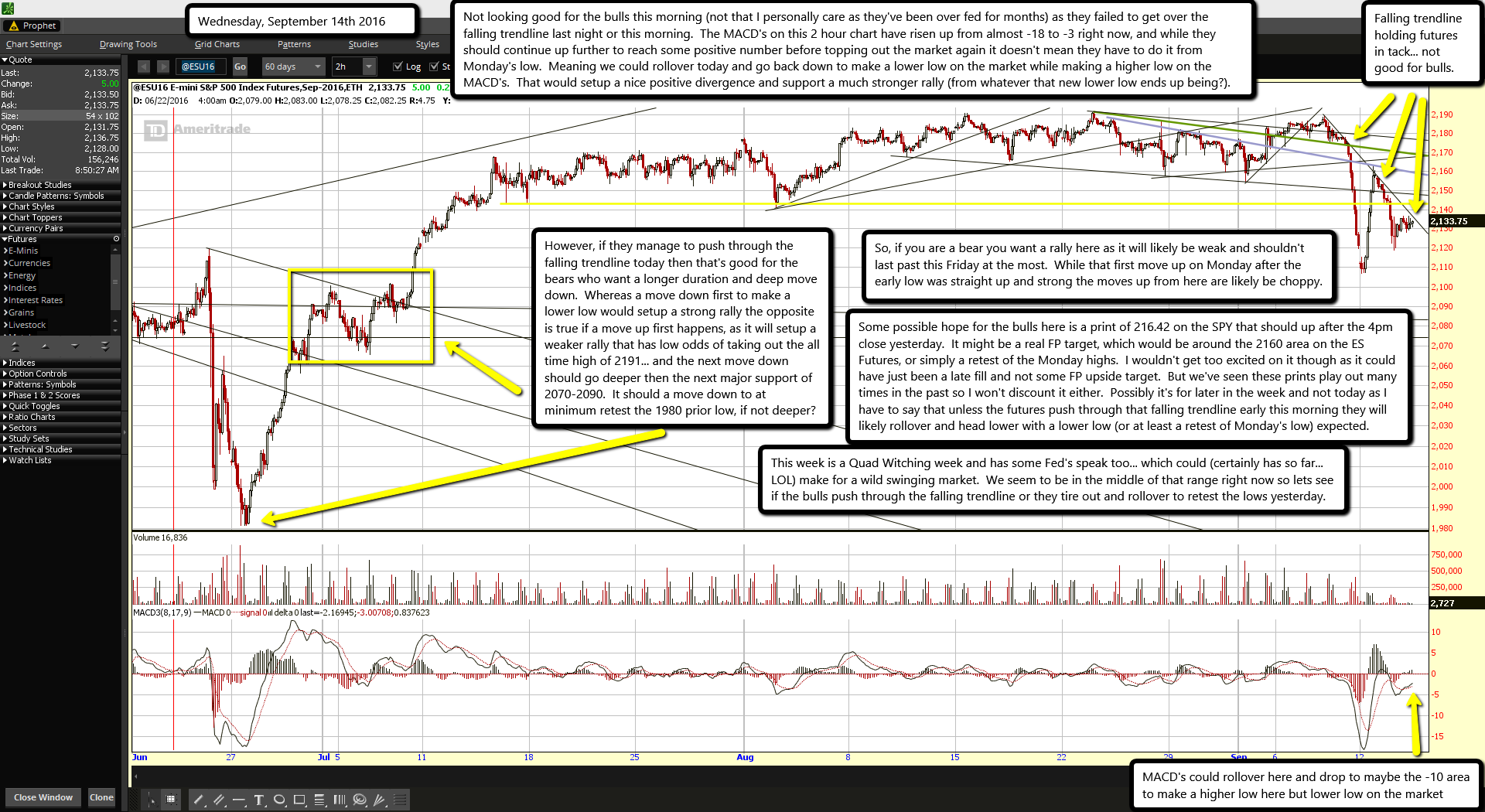
Falling trendline holding futures  in tack... not good for bulls.

MACD's could rollover here and drop to maybe the -10 area to make a higher low here but lower low on the market

Not looking good for the bulls this morning (not that I personally care as they've been over fed for months) as they failed to get over the falling trendline last night or this morning.  The MACD's on this 2 hour chart have risen up from almost -18 to -3 right now, and while they should continue up further to reach some positive number before topping out the market again it doesn't mean they have to do it from Monday's low.  Meaning we could rollover today and go back down to make a lower low on the market while making a higher low on the MACD's.  That would setup a nice positive divergence and support a much stronger rally (from whatever that new lower low ends up being?).

However, if they manage to push through the falling trendline today then that's good for the bears who want a longer duration and deep move down.  Whereas a move down first to make a lower low would setup a strong rally the opposite is true if a move up first happens, as it will setup a weaker rally that has low odds of taking out the all time high of 2191... and the next move down should go deeper then the next major support of 2070-2090.  It should a move down to at minimum retest the 1980 prior low, if not deeper?

So, if you are a bear you want a rally here as it will likely be weak and shouldn't last past this Friday at the most.  While that first move up on Monday after the early low was straight up and strong the moves up from here are likely be choppy.

Some possible hope for the bulls here is a print of 216.42 on the SPY that should up after the 4pm close yesterday.  It might be a real FP target, which would be around the 2160 area on the ES Futures, or simply a retest of the Monday highs.  I wouldn't get too excited on it though as it could have just been a late fill and not some FP upside target.  But we've seen these prints play out many times in the past so I won't discount it either.  Possibly it's for later in the week and not today as I have to say that unless the futures push through that falling trendline early this morning they will likely rollover and head lower with a lower low (or at least a retest of Monday's low) expected.

This week is a Quad Witching week and has some Fed's speak too... which could (certainly has so far... LOL) make for a wild swinging market.  We seem to be in the middle of that range right now so lets see if the bulls push through the falling trendline or they tire out and rollover to retest the lows yesterday.

Senators urge ‘immediate’ hearings on Wells Fargo sales practices

0

Wells Fargo is taking more heat over revelations its employees opened millions of fraudulent customer accounts to meet sales goals, with a group of U.S. senators calling Monday for “immediate” hearings to investigate the matter.

ES Morning Update September 13th 2016

0

d3918ba4-dc6b-41d5-994d-11fa3fce9674

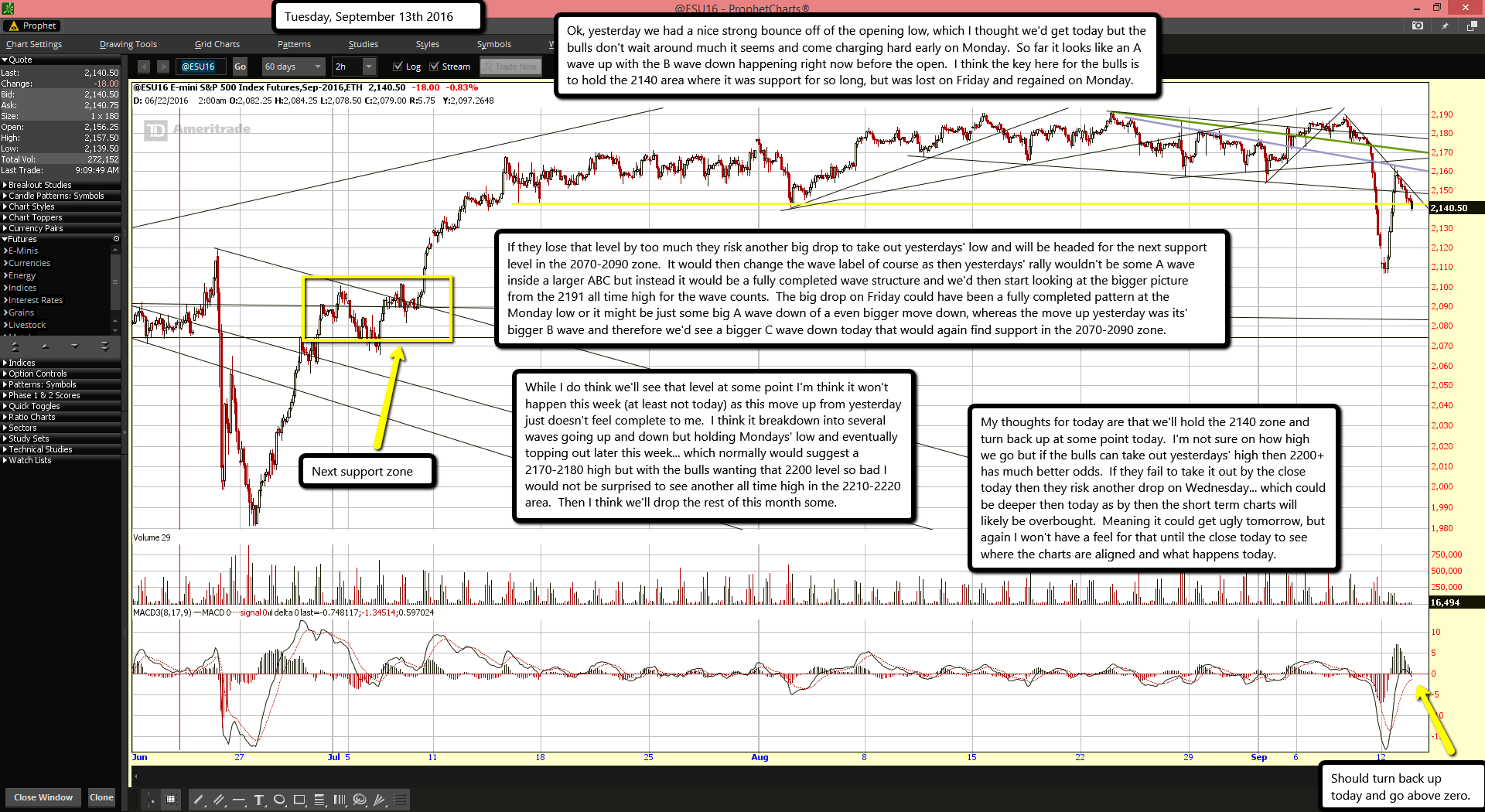
Ok, yesterday we had a nice strong bounce off of the opening low, which I thought we'd get today but the bulls don't wait around much it seems and come charging hard early on Monday.  So far it looks like an A wave up with the B wave down happening right now before the open.  I think the key here for the bulls is to hold the 2140 area where it was support for so long, but was lost on Friday and regained on Monday.

If they lose that level by too much they risk another big drop to take out yesterdays' low and will be headed for the next support level in the 2070-2090 zone.  It would then change the wave label of course as then yesterdays' rally wouldn't be some A wave inside a larger ABC but instead it would be a fully completed wave structure and we'd then start looking at the bigger picture from the 2191 all time high for the wave counts.  The big drop on Friday could have been a fully completed pattern at the Monday low or it might be just some big A wave down of a even bigger move down, whereas the move up yesterday was its' bigger B wave and therefore we'd see a bigger C wave down today that would again find support in the 2070-2090 zone.

While I do think we'll see that level at some point I'm think it won't happen this week (at least not today) as this move up from yesterday just doesn't feel complete to me.  I think it breakdown into several waves going up and down but holding Mondays' low and eventually topping out later this week... which normally would suggest a 2170-2180 high but with the bulls wanting that 2200 level so bad I would not be surprised to see another all time high in the 2210-2220 area.  Then I think we'll drop the rest of this month some.

My thoughts for today are that we'll hold the 2140 zone and turn back up at some point today.  I'm not sure on how high we go but if the bulls can take out yesterdays' high then 2200+ has much better odds.  If they fail to take it out by the close today then they risk another drop on Wednesday... which could be deeper then today as by then the short term charts will likely be overbought.  Meaning it could get ugly tomorrow, but again I won't have a feel for that until the close today to see where the charts are aligned and what happens today.

Wells Fargo Exec Who Headed Phony Accounts Unit Collected $125 Million

0

Months ago, CEO John Stumpf praised the executive in hot water as “a standard-bearer” for the bank.

Wells Fargo & Co’s WFC -0.37% “sandbagger”-in-chief is leaving the giant bank with an enormous pay day—$124.6 million.

In fact, despite beefed-up “clawback” provisions instituted by the bank shortly after the financial crisis, and the recent revelations of massive misconduct, it does not appear that Wells Fargo is requiring Carrie Tolstedt, the Wells Fargo executive who was in charge of the unit where employees opened more than 2 million largely unauthorized customer accounts—a seemingly routine practice that employees internally referred to as “sandbagging”—to give back any of her nine-figure pay.

On Thursday, Wells Fargo WFC -0.37% agreed to pay $185 million, including the largest penalty ever imposed by the Consumer Financial Protection Bureau, to settle claims that that it defrauded its customers. The bank’s shareholders will ultimately have to swallow the cost of that settlement. The bank also said it had fired 5,300 employees over five years related to the bad behavior.

Tolstedt, however, is walking away from Wells Fargo with a very full bank account—and praise. In the July announcement of her exit, which made no mention of the soon-to-be-settled case, Wells Fargo’s CEO John Stumpf said Tolstedt had been one of the bank’s most important leaders and “a standard-bearer of our culture” and “a champion for our customers.”

On Thursday, Richard Cordray, the head of the CFPB, had a different take, “It is quite clear that [the actions of Tolstedt’s unit] are unfair and abusive practices under federal law,” said Cordray. “They are a violation of trust and an abuse of trust.”

A spokesperson for Wells Fargo said that the timing of Tolstedt’s exit was the result of a “personal decision to retire after 27 years” with the bank. The spokesperson declined to comment on whether the bank was considering clawing back Tolstedt’s back pay.

In a statement following the settlement, Wells Fargo said, “Wells Fargo reached these agreements consistent with our commitment to customers and in the interest of putting this matter behind us. Wells Fargo is committed to putting our customers’ interests first 100% of the time, and we regret and take responsibility for any instances where customers may have received a product that they did not request.”

Shortly after the financial crisis, big banks in the nation, including Wells Fargo, promised that their top bankers would not be able to keep large paydays if it was found that those rewards were gained through harmful conduct. It was supposed to be the stick to the carrot of Wall Street bonuses. But the latest example of fraud at Wells Fargo shows that the big banks are unwilling to wield those sticks, especially when it comes to their top executives.

It is not clear how closely, or at all, Tolstedt was responsible for or even aware of the widespread abusive tactics at the bank. Neither the CFPB nor the Los Angeles City Attorney’s office, which sued the bank, named Tolstedt directly. Wells Fargo said the 5,300 firings happened over five years, and included managers as well as employees. It’s likely that Tolstedt managed as least part of that purge. But in bringing the charges, an official from the CFPB said Wells Fargo was aware of the behavior for longer than it should have, without putting a stop to it.

What’s more, Tolstedt ran the community banking division of the bank, which included its retail banking and credit card divisions, during the entire period in which the customer abuse was alleged, which goes back to 2011. The CFPB said about three quarters of the unauthorized accounts opened by employees of Wells Fargo were bank deposit accounts. Another 565,000 were unauthorized credit card applications. Tolstedt took over the division in 2008, after Wells Fargo merged with Wachovia during the financial crisis.

Tolstedt was a regular on Fortune‘s Most Powerful Women list. She was replaced on this year’s list by Mary Mack, who is taking over her job at the bank.

Tolstedt was regularly praised for her unit’s ability to get customers to open numerous accounts. For a number of years, Wells Fargo’s proxy statement, which details executive pay, cited high “cross-selling ratios” as a reason that Tolstedt had earned her roughly $9 million in annual pay. For instance, in Wells Fargo’s 2015 proxy statement, the company said that its compensation committee had authorized Tolstedt’s $7.3 million stock and cash bonus that year, because “under her leadership, Community Banking achieved a number of strategic objectives, including continued strong cross-sell ratios, record deposit levels, and continued success of mobile banking initiatives.”

Later that year, the L.A. City Attorney’s office sued the bank because of its sales tactics, saying that many of the abusive practices came from intense pressure on Wells Fargo’s employees to get customers to open up numerous accounts. A separate class action of former employees alleges they were fired for not meeting cross-selling goals, or going along with the aggressive sales tactics.

Earlier this year when Wells Fargo released its annual proxy statement, it once again said that in order to justify her multimillion dollar bonus, Tolstedt’s division had “achieved a number of strategic objectives.” But this time, for the first time in years, cross-selling wasn’t listed as one of them.

When Tolstedt leaves Wells Fargo later this year, on top of the $1.7 million in salary she has received over the past few years, she will be walking away with $124.6 million in stock, options, and restricted Wells Fargo shares. Some of that hasn’t vested yet. But Tolstedt gets to keep all of it because she technically retired. Had she been fired, Tolstedt would have had to forfeit at least $45 million of that exit payday, and possibly more.

Wells Fargo’s proxy statement says that the bank has “strong recoupment and clawback policies,” and that the bank will revoke bonus pay if it is found that the conduct of an executive resulted in representational harm to the bank, or that the executive was not able to “identify or manage” risks in his or her division. But there is no sign that Wells Fargo is going to ask Tolstedt to return even a sliver of her stock jackpot.

“This appears to be exactly the situation that clawback provisions were created for,” says Dennis Kelleher, president of Better Markets, a group that lobbies for more regulation of the big banks. “If they don’t apply here, when will they apply.”

On Wall Street, the carrots are still widely handed out. The sticks, however, remain out of sight.


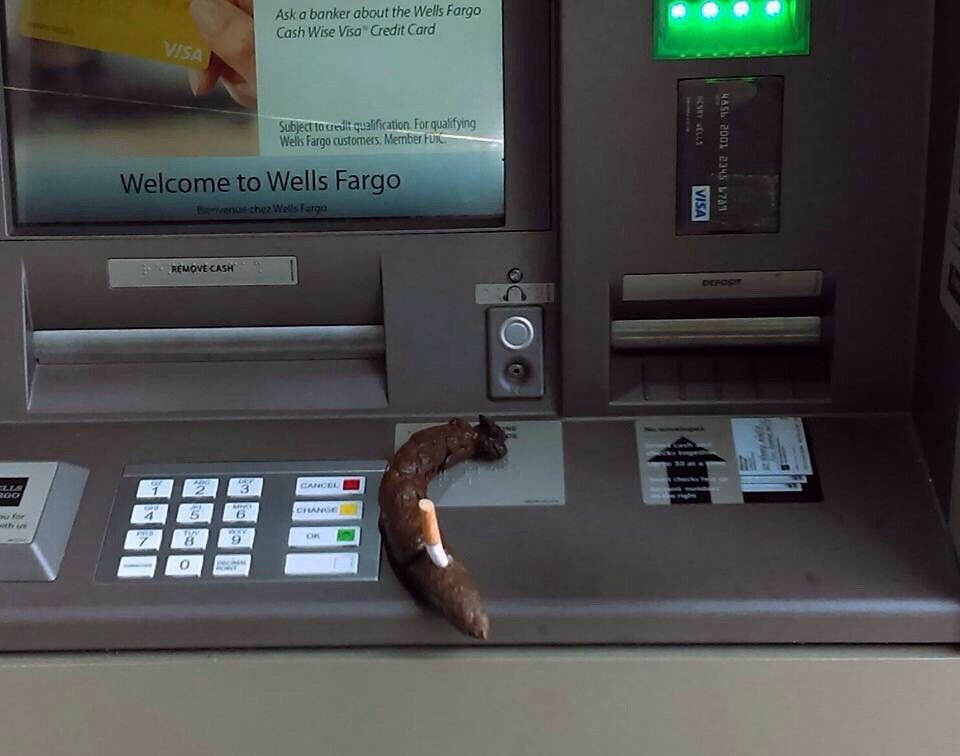
And how does the public feel about this you ask?  I'd say this photo says it all..

wells-fargo-shit

Red

ES Morning Update September 12th 2016

0

cfb3d35d-26b9-46bd-a8f0-475b5bbaa1dd

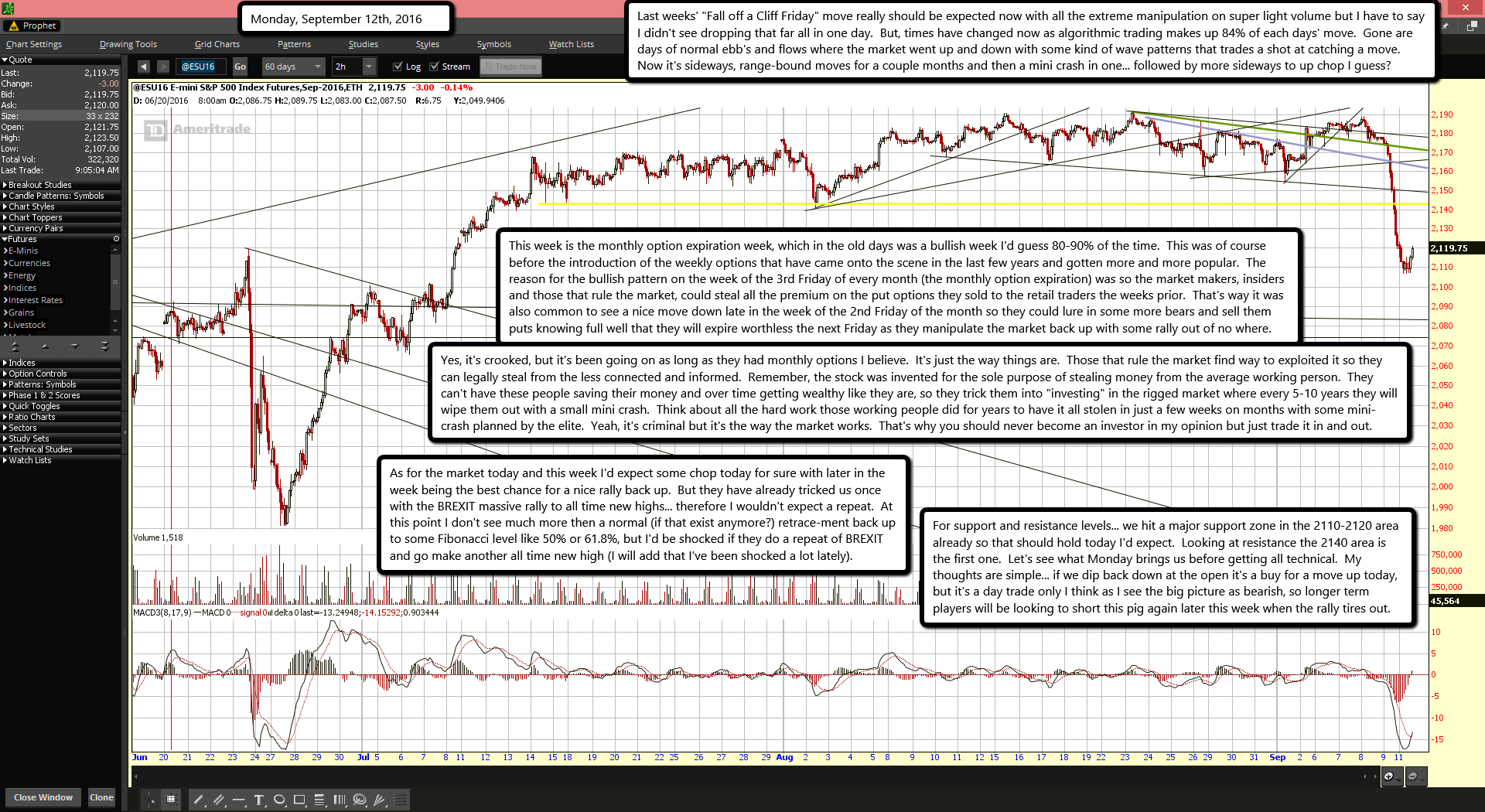
Last weeks' "Fall off a Cliff Friday" move really should be expected now with all the extreme manipulation on super light volume but I have to say I didn't see dropping that far all in one day.  But, times have changed now as algorithmic trading makes up 84% of each days' move.  Gone are days of normal ebb's and flows where the market went up and down with some kind of wave patterns that trades a shot at catching a move.  Now it's sideways, range-bound moves for a couple months and then a mini crash in one... followed by more sideways to up chop I guess?

This week is the monthly option expiration week, which in the old days was a bullish week I'd guess 80-90% of the time.  This was of course before the introduction of the weekly options that have came onto the scene in the last few years and gotten more and more popular.  The reason for the bullish pattern on the week of the 3rd Friday of every month (the monthly option expiration) was so the market makers, insiders and those that rule the market, could steal all the premium on the put options they sold to the retail traders the weeks prior.  That's way it was also common to see a nice move down late in the week of the 2nd Friday of the month so they could lure in some more bears and sell them puts knowing full well that they will expire worthless the next Friday as they manipulate the market back up with some rally out of no where.

Yes, it's crooked, but it's been going on as long as they had monthly options I believe.  It's just the way things are.  Those that rule the market find way to exploited it so they can legally steal from the less connected and informed.  Remember, the stock was invented for the sole purpose of stealing money from the average working person.  They can't have these people saving their money and over time getting wealthy like they are, so they trick them into "investing" in the rigged market where every 5-10 years they will wipe them out with a small mini crash.  Think about all the hard work those working people did for years to have it all stolen in just a few weeks on months with some mini-crash planned by the elite.  Yeah, it's criminal but it's the way the market works.  That's why you should never become an investor in my opinion but just trade it in and out.

As for the market today and this week I'd expect some chop today for sure with later in the week being the best chance for a nice rally back up.  But they have already tricked us once with the BREXIT massive rally to all time new highs... therefore I wouldn't expect a repeat.  At this point I don't see much more then a normal (if that exist anymore?) retrace-ment back up to some Fibonacci level like 50% or 61.8%, but I'd be shocked if they do a repeat of BREXIT and go make another all time new high (I will add that I've been shocked a lot lately).

For support and resistance levels... we hit a major support zone in the 2110-2120 area already so that should hold today I'd expect.  Looking at resistance the 2140 area is the first one.  Let's see what Monday brings us before getting all technical.  My thoughts are simple... if we dip back down at the open it's a buy for a move up today, but it's a day trade only I think as I see the big picture as bearish, so longer term players will be looking to short this pig again later this week when the rally tires out.

5,300 Wells Fargo employees fired over 2 million phony accounts

0

Everyone hates paying bank fees. But imagine paying fees on a ghost account you didn't even sign up for.

That's exactly what happened to Wells Fargo customers nationwide.

On Thursday, federal regulators said Wells Fargo (WFC) employees secretly created millions of unauthorized bank and credit card accounts -- without their customers knowing it -- since 2011.

The phony accounts earned the bank unwarranted fees and allowed Wells Fargo employees to boost their sales figures and make more money.

"Wells Fargo employees secretly opened unauthorized accounts to hit sales targets and receive bonuses," Richard Cordray, director of the Consumer Financial Protection Bureau, said in a statement.

Wells Fargo confirmed to CNNMoney that it had fired 5,300 employees over the last few years related to the shady behavior. Employees went so far as to create phony PIN numbers and fake email addresses to enroll customers in online banking services, the CFPB said.

The scope of the scandal is shocking. An analysis conducted by a consulting firm hired by Wells Fargo concluded that bank employees opened over 1.5 million deposit accounts that may not have been authorized.

The way it worked was that employees moved funds from customers' existing accounts into newly-created ones without their knowledge or consent, regulators say. The CFPB described this practice as "widespread." Customers were being charged for insufficient funds or overdraft fees -- because there wasn't enough money in their original accounts.

Additionally, Wells Fargo employees also submitted applications for 565,443 credit card accounts without their customers' knowledge or consent. Roughly 14,000 of those accounts incurred over $400,000 in fees, including annual fees, interest charges and overdraft-protection fees.

The CFPB said Wells Fargo will pay "full restitutions to all victims."

Wells Fargo is being slapped with the largest penalty since the CFPB was founded in 2011. The bank agreed to pay $185 million in fines, along with $5 million to refund customers.

"We regret and take responsibility for any instances where customers may have received a product that they did not request," Wells Fargo said in a statement.

Wells Fargo has the highest market valuation among any bank in America, worth just north of $250 billion. Berkshire Hathaway (BRKA), the investment firm run legendary investor Warren Buffett, is the company's biggest shareholder.

Of the total fines, $100 million will go toward the CFPB's Civil Penalty Fund, $35 million will go to the Office of the Comptroller of the Currency, and another $50 million will be paid to the City and County of Los Angeles.

"One wonders whether (the CFPB) penalty of $100 million is enough," said David Vladeck, a Georgetown University law professor and former director of the Federal Trade Commission's Bureau of Consumer Protection. "It sounds like a big number, but for a bank the size of Wells Fargo, it isn't really."

Wells Fargo confirmed to CNNMoney that the 5,300 firings took place over several years. The bank listed 265,000 employees as of the end of 2015.

"At Wells Fargo, when we make mistakes, we are open about it, we take responsibility, and we take action," the bank said in a memo to employees on Thursday.

wells-fargo

The CFPB declined to comment on when the investigation began and what sparked it, citing agency policy. "We don't comment on how we uncover these matters," a spokesman said.

As part of the settlement, Wells Fargo needs to make changes to its sales practices and internal oversight.

Customers are fuming. Brian Kennedy, a Maryland retiree, told CNNMoney he detected an unauthorized Wells Fargo account had been created in his name about a year ago. He asked Wells Fargo about it and the bank closed it, he said.

"I didn't sign up for any bloody checking account," Kennedy, who is 57 years old, told CNNMoney. "They lost me as a banking customer and I have warned family and friends."

"Consumers must be able to trust their banks," said Mike Feuer, the Los Angeles City Attorney who joined the settlement.

Feuer's office sued Wells Fargo in May 2015 over allegations of unauthorized accounts. After filing the suit, his office received more than 1,000 calls and emails from customers as well as current and former Wells Fargo employees about the allegations.

Wells Fargo declined to say when it hired a consulting firm to investigate the allegations. However, a person familiar with the matter told CNNMoney the bank launched the review after the L.A. lawsuit was filed.

Even though the Wells Fargo scandal took place nationally, the settlement with L.A. requires the bank to specifically alert all its California customers to review their accounts and shut down ones they don't recognize or want.

"How does a bank that is supposed to have robust internal controls permit the creation of over a half-million dummy accounts?" asked Vladeck. "If I were a Wells Fargo customer, and fortunately I am not, I'd think seriously about finding a new bank."

The market is doing something it’s never done before

0

The S&P 500 just set a mild milestone.

Over the 40 days through Wednesday, the S&P 500's highest and lowest closes have been just 1.75 percent apart. It's the first time that has ever happened in the history of S&P data, which goes back to 1928, according to Paul Hickey, co-founder of Bespoke Investment Group.

"It's been one of the deadest summers ever, and that's what the numbers are showing," Hickey said Thursday on CNBC's "Trading Nation."

The summer didn't start out dull, what will the United Kingdom's shocking vote in June to leave the European Union. This led to a profound market dip, followed by a comeback that was just as profound, before a more recent period of intense quiescence began.

"Since early summer, we've seen three different extremes," Hickey noted.

While some have seen the market's quiet as a source of concern, history appears to show something different.

"A lack of volatility in the market is usually accompanied by positive returns," he said. "One of the periods that was closest to this narrow [in terms of the market range] was in the mid-1960s; the market did very well in the '60s, and that was a good period of calm."

Of course, since stocks tend to drop faster than they rise, this may not properly state the causation. It may simply be that positively trending markets tend to be quiet ones.

Either way, Hickey warns that "eventually that period of calm will end, and it will be followed by a short-term sell-off than a spike higher," simply because that is what has always happened in the past.

"But it is what it is, and it's nice to enjoy it while it lasts."

ES Morning Update September 9th 2016

0

94f500fb-278b-43a0-a63c-47325cdbbe63

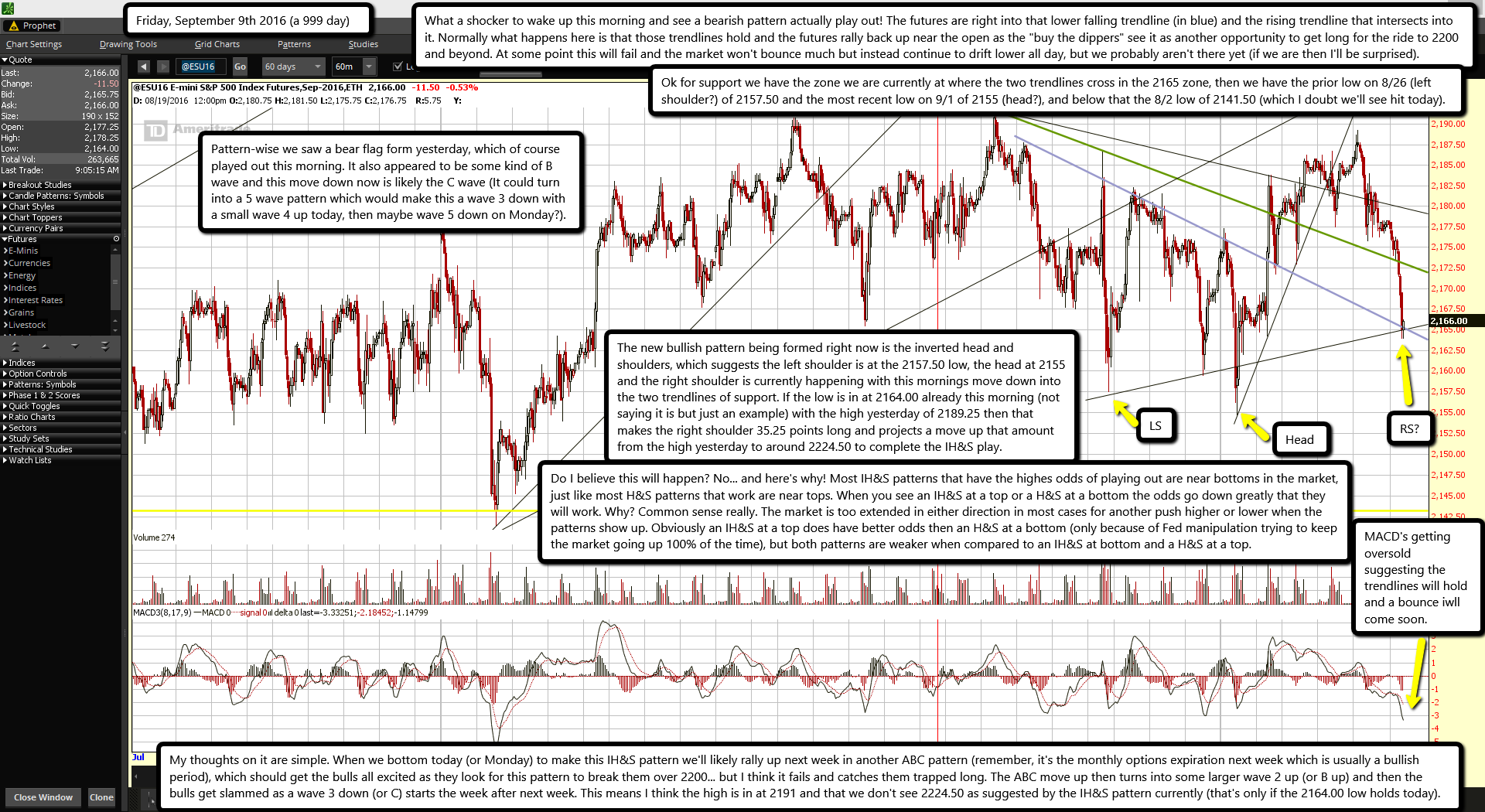
What a shocker to wake up this morning and see a bearish pattern actually play out! The futures are right into that lower falling trendline (in blue) and the rising trendline that intersects into it. Normally what happens here is that those trendlines hold and the futures rally back up near the open as the "buy the dippers" see it as another opportunity to get long for the ride to 2200 and beyond. At some point this will fail and the market won't bounce much but instead continue to drift lower all day, but we probably aren't there yet (if we are then I'll be surprised).

Ok for support we have the zone we are currently at where the two trendlines cross in the 2165 zone, then we have the prior low on 8/26 (left shoulder?) of 2157.50 and the most recent low on 9/1 of 2155 (head?), and below that the 8/2 low of 2141.50 (which I doubt we'll see hit today).

Pattern-wise we saw a bear flag form yesterday, which of course played out this morning. It also appeared to be some kind of B wave and this move down now is likely the C wave (It could turn into a 5 wave pattern which would make this a wave 3 down with a small wave 4 up today, then maybe wave 5 down on Monday?).

The new bullish pattern being formed right now is the inverted head and shoulders, which suggests the left shoulder is at the 2157.50 low, the head at 2155 and the right shoulder is currently happening with this mornings move down into the two trendlines of support. If the low is in at 2164.00 already this morning (not saying it is but just an example) with the high yesterday of 2189.25 then that makes the right shoulder 35.25 points long and projects a move up that amount from the high yesterday to around 2224.50 to complete the IH&S play.

Do I believe this will happen? No... and here's why! Most IH&S patterns that have the highes odds of playing out are near bottoms in the market, just like most H&S patterns that work are near tops. When you see an IH&S at a top or a H&S at a bottom the odds go down greatly that they will work. Why? Common sense really. The market is too extended in either direction in most cases for another push higher or lower when the patterns show up. Obviously an IH&S at a top does have better odds then an H&S at a bottom (only because of Fed manipulation trying to keep the market going up 100% of the time), but both patterns are weaker when compared to an IH&S at bottom and a H&S at a top.

My thoughts on it are simple. When we bottom today (or Monday) to make this IH&S pattern we'll likely rally up next week in another ABC pattern (remember, it's the monthly options expiration next week which is usually a bullish period), which should get the bulls all excited as they look for this pattern to break them over 2200... but I think it fails and catches them trapped long. The ABC move up then turns into some larger wave 2 up (or B up) and then the bulls get slammed as a wave 3 down (or C) starts the week after next week. This means I think the high is in at 2191 and that we don't see 2224.50 as suggested by the IH&S pattern currently (that's only if the 2164.00 low holds today).

San Antonio Mattress Store Unleashes Fury Over Its 9/11’Twin Tower Sale’

0

SAN ANTONIO, TX -- Perhaps more than any other tragedy that has befallen the U.S., as it relates to 9/11 it will always be too soon -- too soon to make a joke, mock or exploit the tragedy for commercial gain.

San Antonio Mattress Store Unleashes Fury Over Its 9/11'Twin Tower Sale' [VIDEO]

Yet in Texas, one retailers didn't get the memo, shilling mattresses while depicting the fallen towers with pillows to advertise its 9/11 sale. The Sept. 11 date falls on a Sunday this year, prompting the retailer to tie its weekend sale to the remembrance.

The Miracle Mattress store in San Antonio, near the Leon Valley suburb, has unleashed a storm of protest over its commercial ahead of the sale. One Facebook user posted a video of the commercial, sharing it with television station KENS 5.

The commercial shows a pitch woman raving about the firm's planned "Twin Tower Sale," alerting customers they can buy any size mattress on the day of remembrance at a twin-mattress price.

As the commercial spot winds to an end, two men behind her -- seemingly excited that even a king-sized mattress can be purchased at a twin-mattress price -- tumble on an adjacent bed, knocking over two towers made of pillows in the process.

"We will never forget," the pitch woman says in mock solemnity.

Reaction to the commercial was swift. "This is beyond disgusting and disrespectful," one person posted on the Facebook thread. Another predicted the backlash might have the company back in the airwaves soon, for a going-out-of-business sale.

Company officials have since reportedly apologized.

This year marks the 15th anniversary on the Sept. 11, 2001 attack by terrorists. A series of four coordinated attacks by the Islamic extremist group al-Qaeda -- including the flying of passenger jets into the World Trade Center towers -- killed 2,996 people and injured 6,000 others.

Former CFO of real estate fund charged with fraud

0

AP ASSEMBLY SPEAKER ARREST A USA NY

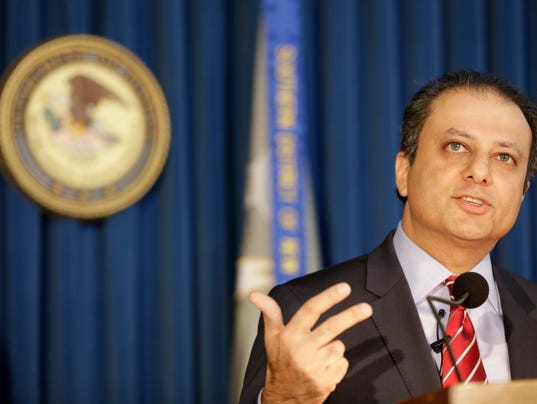
U.S. Attorney Preet Bharara said former executives of Real estate investment trust VEREIT were charged with accounting fraud.(Photo: Mary Altaffer, AP)

The former chief financial officer of VEREIT has been charged with falsely inflating the financial results of the real estate investment trust by about $13 million to meet its guidance in 2014, Manhattan US Attorney Preet Brahrara said Thursday.

Brian Block, 44, was charged with securities fraud, conspiracy to commit securities fraud and making false filings and certifications with the Securities and Exchange Commission.

Also charged was Lisa McAlister, 52, the company’s former chief accounting officer who pled guilty on June 29 and is cooperating with the government. Each executive faces securities fraud and false filing charges that carry a maximum prison term of 20 years, and conspiracy and false statement charges that each carry a maximum term of five years.

The fraud allegedly occurred in 2014, when VEREIT was called American Realty Capital Partners.

Before filing the company’s first-quarter earnings, Block and McAlister learned from another employee that they had used a method that erroneously inflated the firm’s income before non-cash depreciation and amortization and excluding certain one-time charges, according to an indictment unsealed in federal court.

After the first-quarter filing, the employee told Block and McAlister that the income was overstated by about 3 cents a share. But Block did not advise the company’s audit committee of the error, which put the company on track to meet its full-year guidance. The executives then used the same “misleading calculations” to calculate the second quarter measure of income, the U.S. Attorney’s office said.

In  total, their actions overstated American Realty Capital’s income by $13 for the first six months of 2014, the indictment said.

“All market investors are entitled to be told the truth from publicly traded companies when those investors are making decisions about where to invest their funds,” Bharara said in a statement.


Corruption is just normal business in this world I guess...

Why do I get the feeling nothing will really be done here?

Red

ES Morning Update September 8th 2016

0

69f79485-f41f-4edd-8cfa-76eb9c3149a6

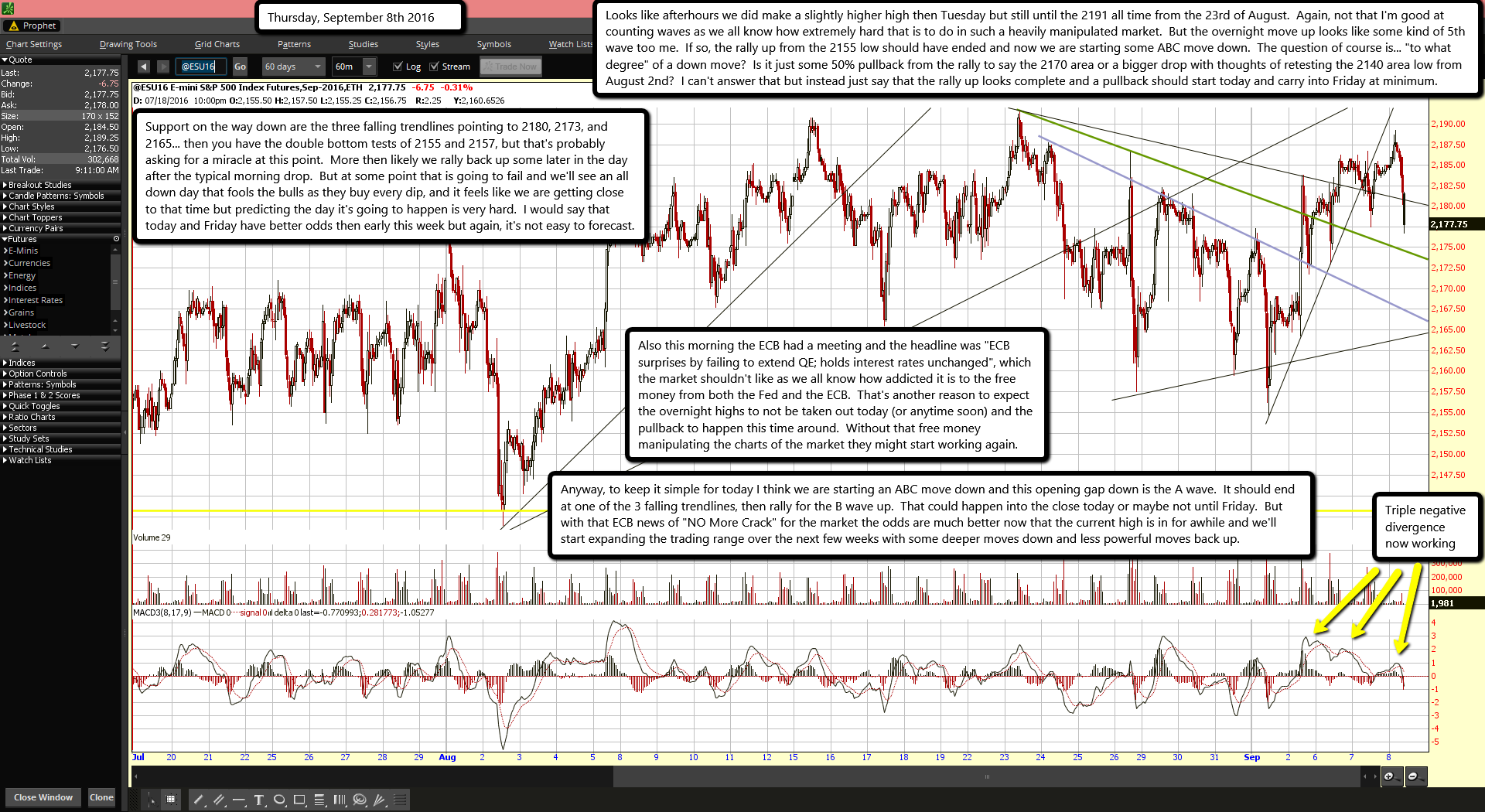
Looks like afterhours we did make a slightly higher high then Tuesday but still until the 2191 all time from the 23rd of August.  Again, not that I'm good at counting waves as we all know how extremely hard that is to do in such a heavily manipulated market.  But the overnight move up looks like some kind of 5th wave too me.  If so, the rally up from the 2155 low should have ended and now we are starting some ABC move down.  The question of course is... "to what degree" of a down move?  Is it just some 50% pullback from the rally to say the 2170 area or a bigger drop with thoughts of retesting the 2140 area low from August 2nd?  I can't answer that but instead just say that the rally up looks complete and a pullback should start today and carry into Friday at minimum.

Support on the way down are the three falling trendlines pointing to 2180, 2173, and 2165... then you have the double bottom tests of 2155 and 2157, but that's probably asking for a miracle at this point.  More then likely we rally back up some later in the day after the typical morning drop.  But at some point that is going to fail and we'll see an all down day that fools the bulls as they buy every dip, and it feels like we are getting close to that time but predicting the day it's going to happen is very hard.  I would say that today and Friday have better odds then early this week but again, it's not easy to forecast.

Also this morning the ECB had a meeting and the headline was "ECB surprises by failing to extend QE; holds interest rates unchanged", which the market shouldn't like as we all know how addicted it is to the free money from both the Fed and the ECB.  That's another reason to expect the overnight highs to not be taken out today (or anytime soon) and the pullback to happen this time around.  Without that free money manipulating the charts of the market they might start working again.

Anyway, to keep it simple for today I think we are starting an ABC move down and this opening gap down is the A wave.  It should end at one of the 3 falling trendlines, then rally for the B wave up.  That could happen into the close today or maybe not until Friday.  But with that ECB news of "NO More Crack" for the market the odds are much better now that the current high is in for awhile and we'll start expanding the trading range over the next few weeks with some deeper moves down and less powerful moves back up.

Bayer offers $65bn to win control of Monsanto

0


Bayer logo

Germany's Bayer has raised its offer for Monsanto to $65bn (£49bn), or $127.50 a share, in a bid to create a global seeds and pesticides giant.

Bayer said it was in advanced talks with Monsanto, but warned there was no guarantee a deal would result.

Its initial offer of $122 a share in May was rejected by the US firm for being "financially inadequate".

The record all-cash offer valued Monsanto at $62bn (£43bn at the time).

Bayer raised its offer to $125 a share in July but was again rebuffed.

Combining Bayer and Monsanto would create the world's biggest agricultural supplier and be a market leader in the US, Europe and Asia.

Bayer's farm business produces seeds as well as chemicals to combat weeds and insects, but it is better known for its healthcare products such as Aspirin and Alka-Seltzer.

Monsanto is primarily known for its genetically modified seeds for crops including corn, soybeans, cotton, wheat and sugar cane. Such seeds have attracted criticism from some environmental activists.

Peppers grow in a greenhouse operated by Monsanto's seeds division in Bergschenhoek, the Netherlands

The higher offer comes amid a wave of mergers in the agriculture sector.

Rivals including Dow Chemical, DuPont and Syngenta have all announced tie-ups recently, although some have yet to be cleared by regulators.

The drop in commodity prices has put pressure on companies such as Monsanto, with farmers' cutting orders for supplies.

However, a Bayer takeover of Monsanto could raise US competition concerns because of the sheer size of the combined company and the control it would have over the global seeds and sprays markets.

Farming groups have raised concerns that such mergers could lead to fewer choices and higher prices.

Insiders said that although the two companies were close to reaching an agreement on price, they had yet to agree on a strategy on how to deal with potential regulatory hurdles.

Corn harvester

Shares in Bayer have fallen by close to a fifth this year and ended at €94.24 on Monday, valuing the company at €78bn.

Monsanto has risen 9% since the start of the year and closed on Friday at $107.44, making it worth just over $47bn. Wall Street was closed on Monday for the Labor Day holiday.


Isn't it nice to see a drug company like Bayer, (who everyone has surely taken an aspirin from time to time) buyout a company known for poisoning the public with GMO's and pesticides?  Just think... the next time you take an aspirin it might contain poisons in it (or does it already?)

Red

ES Morning Update September 7th 2016

0

04dae3ad-48c4-42b5-9ebf-114328fb61cc

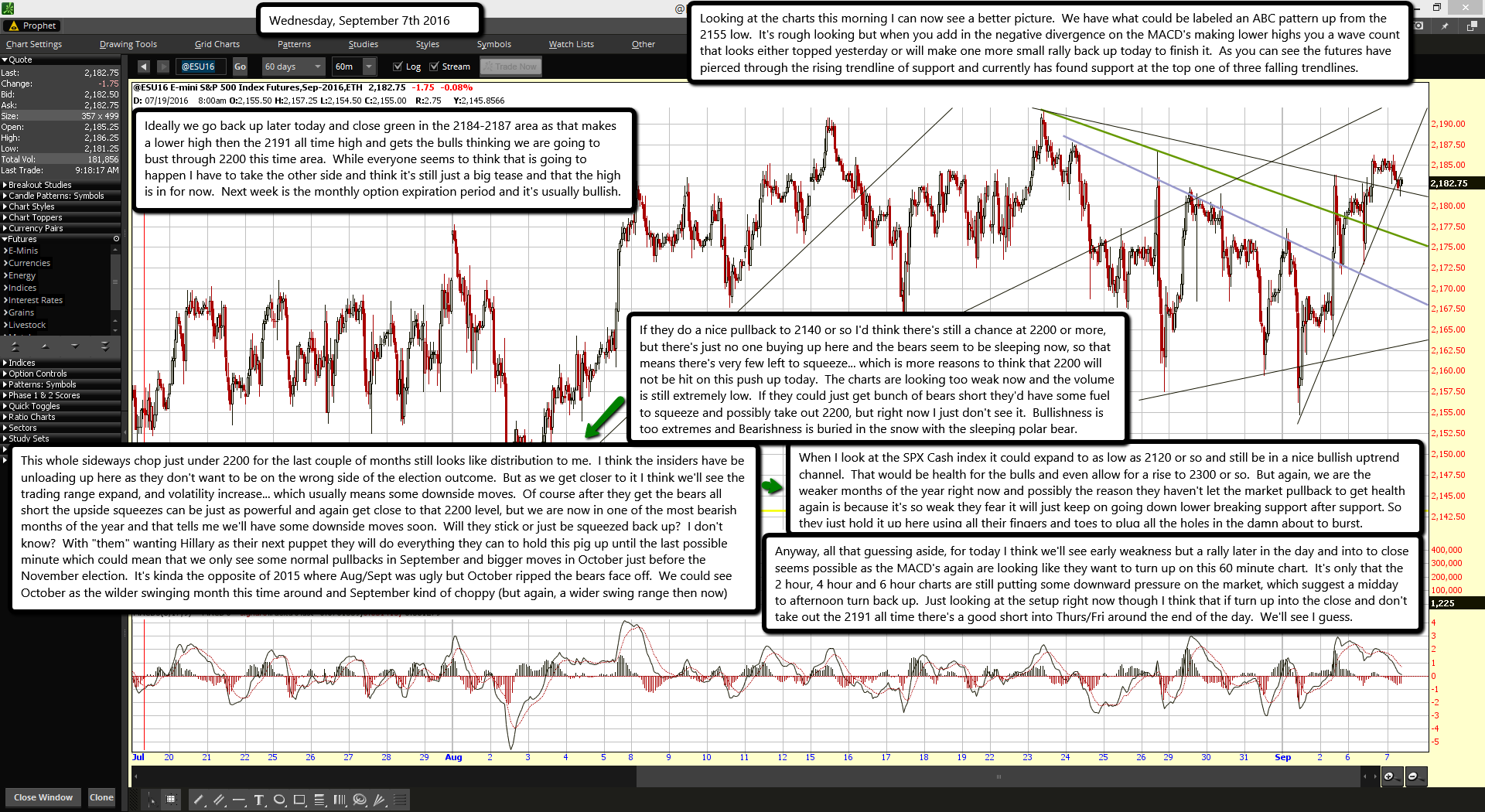
Looking at the charts this morning I can now see a better picture.  We have what could be labeled an ABC pattern up from the 2155 low.  It's rough looking but when you add in the negative divergence on the MACD's making lower highs you a wave count that looks either topped yesterday or will make one more small rally back up today to finish it.  As you can see the futures have pierced through the rising trendline of support and currently has found support at the top one of three falling trendlines.

Ideally we go back up later today and close green in the 2184-2187 area as that makes a lower high then the 2191 all time high and gets the bulls thinking we are going to bust through 2200 this time area.  While everyone seems to think that is going to happen I have to take the other side and think it's still just a big tease and that the high is in for now.  Next week is the monthly option expiration period and it's usually bullish.

If they do a nice pullback to 2140 or so I'd think there's still a chance at 2200 or more, but there's just no one buying up here and the bears seem to be sleeping now, so that means there's very few left to squeeze... which is more reasons to think that 2200 will not be hit on this push up today.  The charts are looking too weak now and the volume is still extremely low.  If they could just get bunch of bears short they'd have some fuel to squeeze and possibly take out 2200, but right now I just don't see it.  Bullishness is too extremes and Bearishness is buried in the snow with the sleeping polar bear.

This whole sideways chop just under 2200 for the last couple of months still looks like distribution to me.  I think the insiders have be unloading up here as they don't want to be on the wrong side of the election outcome.  But as we get closer to it I think we'll see the trading range expand, and volatility increase... which usually means some downside moves.  Of course after they get the bears all short the upside squeezes can be just as powerful and again get close to that 2200 level, but we are now in one of the most bearish months of the year and that tells me we'll have some downside moves soon.  Will they stick or just be squeezed back up?  I don't know?  With "them" wanting Hillary as their next puppet they will do everything they can to hold this pig up until the last possible minute which could mean that we only see some normal pullbacks in September and bigger moves in October just before the November election.  It's kinda the opposite of 2015 where Aug/Sept was ugly but October ripped the bears face off.  We could see October as the wilder swinging month this time around and September kind of choppy (but again, a wider swing range then now).

When I look at the SPX Cash index it could expand to as low as 2120 or so and still be in a nice bullish uptrend channel.  That would be health for the bulls and even allow for a rise to 2300 or so.  But again, we are the weaker months of the year right now and possibly the reason they haven't let the market pullback to get health again is because it's so weak they fear it will just keep on going down lower breaking support after support. So they just hold it up here using all their fingers and toes to plug all the holes in the damn about to burst.

Anyway, all that guessing aside, for today I think we'll see early weakness but a rally later in the day and into to close seems possible as the MACD's again are looking like they want to turn up on this 60 minute chart.  It's only that the 2 hour, 4 hour and 6 hour charts are still putting some downward pressure on the market, which suggest a midday to afternoon turn back up.  Just looking at the setup right now though I think that if turn up into the close and don't take out the 2191 all time there's a good short into Thurs/Fri around the end of the day.  We'll see I guess.

Negative interest rates coming to the Fed?

0

Negative interest rates are spreading like a virus. Central banks in the Eurozone, Switzerland, Sweden, and Japan all have below-zero policy rates. “NIRP,” as economists call a negative interest rate policy, is a desperation move—but the only move those central banks have.

The Federal Reserve hasn’t followed—yet. When the next recession strikes, I believe Janet Yellen will choose to break the zero lower bound. The rationale was laid out in Jackson Hole. Look behind the headlines and you’ll see the Fed already preparing for NIRP.

In theory, negative rates should encourage consumers and businesses to spend more freely and stimulate growth. It hasn’t worked out that way. NIRP just punishes savers and makes everyone miserable.

The Fed Moves Slowly

Major Fed policy changes unfold very slowly. Remember “The Taper” plan to end quantitative easing? Ben Bernanke first floated the idea in May 2013. It took until October 2014—a full 18 months—to finally end the bond-purchasing program. And then it was another 14 months before the Fed hiked rates with a baby step in December 2015.

The Fed shouldn’t let markets dictate its decisions, but we all know it does. They start hinting months, even years ahead of time in hopes markets will adjust slowly. Sometimes it works.

With NIRP, there’s another complication: The Fed hasn’t done this before. It needs to get ready.

Learning the NIRP Ropes in Jackson Hole

What better way to learn the NIRP ropes than from fellow central bankers who have actually done it? The Fed’s recent Jackson Hole retreat was an opportunity. And sure enough, they had a session on Negative Nominal Interest Rates.

The lead presenter, Marvin Goodfriend of Carnegie Mellon University, is an unabashed NIRP proponent. His paper “makes the case for unencumbering interest rate policy so that negative nominal interest rates can be made freely available and fully effective as a realistic policy option in a future crisis.”

Janet Yellen didn’t bring in Goodfriend for entertainment. She wanted to learn how to implement NIRP. Yellen’s own Jackson Hole speech had a footnote describing a monetary policy rule (to replace the Taylor Rule) that would have sent rates down to -9% in late 2008. It is clearly on her mind.

I believe the Fed wants to have NIRP as a policy option when the next recession begins. Having NIRP in the toolbox does not mean they will actually use it, but it does mean they haven’t ruled it out. The previously unthinkable is now fully thinkable.

Fed Staff Finds Legal Authority

Something else also suggests the Fed is considering NIRP. In congressional testimony last February, Janet Yellen said she had “not fully investigated” the legal issues of a negative rate strategy.

Asked again about NIRP in June, Yellen stated flatly the Fed does have legal authority to use negative rates. She denied plans to do it, but said there was no legal barrier.

So what happened between February and June?

It sure looks like the Fed’s counsel developed some kind of legal justification for NIRP. That doesn’t mean they will do it, of course. It does though strongly suggest Yellen wants to have a NIRP contingency plan ready to pull out if necessary.

Yellen Is Ready for NIRP

I don’t think Yellen will take us down to -9% like the model in her footnote describes. I do think she is mentally prepared to go below zero if she sees no better alternatives that fit within her economic philosophy. I feel very confident she and her colleagues won’t take rates much higher from here. I think we will see 0% again and then lower before we see +2%.

Look, a recession is coming. This recovery, feeble as it has been, is already long in the tooth. I think we have the real potential to enter at least a mild recession no later than the end of 2017 triggered by events in Europe. What will the Fed do then?

They are making those plans right now. If you think 2008–2009 was a wild ride, then fasten your seatbelt. The next crisis will be even wilder.


Last week, Fed vice-chair Stanley Fischer brought the Orwellian “Negative Interest Rate Policy” a step closer to American reality with his endorsement of the unconventional and economy-destabilizing tactic inherent in his comment that “it seems to be working.”

While that comment in and of itself seems innoccuous enough, could it be that the Fed is actually getting ready to repress Americans financially by foisting the policy onto them?

Arizona-based economist John Mauldin seems to think so. In a recent contribution to Yahoo Finance, he opined, “I believe the Fed wants to have NIRP as a policy option when the next recession begins. Having NIRP in the toolbox does not mean they will actually use it, but it does mean they haven’t ruled it out. The previously unthinkable is now fully thinkable.”

Mauldin isn’t the only market commentator who thinks the Fed is starting to think the unthinkable.

Federal Reserve chair Janet Yellen.

Perennial Fed critic Peter Schiff of Euro Pacific Capital also thinks the Fed is running out of options, and that Zero Interest Rate Policy will soon morph into Negative Interest Rate Policy.
Related

“The Fed is going to go negative because they want to do something stimulative to try and boost the economy so the Republicans — or someone like Donald Trump — don’t just walk away with the election,” Schiff told Business Insider in January this year.
Advertisement

While Fischer himself suggested that the Fed was not needing to look at negative rates for the United States because it wasn’t required, economic numbers going into the September meeting, including jobs data and the Institute for Supply Management’s manufacturing index.

Bloomberg reported that “Signs of softness have caused markets and economists to walk back their expectations of an imminent rate increase time and again — and market-implied probabilities of a rate hike are basically in line with where they were last September.”

Election on the horizon

With the November federal election a mere two months away, will the Fed risk a volatile reaction in markets ahead of that date? It is extremely unlikely, given that the entire political establishment is on tenterhooks over the possibility that Trump could walk away with the election. The last thing Fed chairman Janet Yellen will want to be seen doing is providing ammo to Trump as the rhetoric heats up closing in on election day.

So that leaves December as the next date toward which “will they or won’t they” speculation can be directed. Should Trump prevail, the ensuing economic turmoil would certainly cause a negativization of interest rates in the U.S., as central bankers are forced to deploy the only new weapon in their arsenal since stimulus.

But what are the chances of a Trump win? While polls suggest it is a near impossibility, the Brexit outcome should serve as a warning against being too smug in one’s certainty of the result.

James West is an investor and the author of the Midas Letter, an investing research report focused on Canadian markets. The views expressed here are his own and are presented for general informational purposes only — they should not be construed as advice to invest in any securities mentioned.


Related:

Negative rates will stay for another five years, JPMorgan warns

Equity valuations between Japanese and European banks will converge with quantitative easing (QE) programs and negative interest rate policies set to continue for the long term, according to a team at JPMorgan.

"QE reduces lending rates to negative and we are going to expect negative lending rates until 2021," Kian Abouhossein, head of European banks equity research at JPMorgan told CNBC Tuesday.

"So as long as that is the case, margins will not improve. Sixty percent of revenues is net interest income and as long as that's the case earnings will not improve. So return on equity is very low."

European banks are more akin to their Japanese counterparts and less like Wall Street, warns JPMorgan, who has detailed how a negative interest rate policy has led to ongoing pressure on revenues and profit margins. Europe has seen a balance sheet recession since the economic crisis of 2008, it said, highlighting that a 10.9 percent increase in reserves at these banks has failed to increase lending to the wider economy.

"QE has worked initially and helped to stabilize asset prices, and to lower funding cost for banks …. However, the secondary long-term effects of QE are manifesting themselves in the form of pressure on revenues for European Banks with customer margins in euro area declining from 2.5 percent in 2011 to 1.8 percent in 2015," the report said.

The European Central Bank (ECB), the Danish National Bank (DNB), the Swedish Riksbank, and the Swiss National Bank (SNB) have all pushed key short-term policy rates into negative territory. A negative interest rate policy, or NIRP, essentially charges banks to hold cash at a central bank in the hope that they will instead lend to the real economy. Many expect banks to pass on this disincentive to save to its customers by trimming rates or by ramping up borrowing costs. The policy is increasingly being seen as a viable option for central bankers after Japan's move below zero earlier this year.

While this stimulates growth in some cases, negative rates put pressure on other sectors of the economy. A number of leading analysts have called for a balance of monetary and fiscal measures in order to slowly get the economy out of "QE infinity" – a paradox whereby low rates and seemingly endless rounds of bond-buying programs encourage cheap borrowing.

Alberto Gallo, head of macro strategies and manager of the Algebris Macro Credit Fund, told CNBC last week that for the global economy to exit this QE infinity trap, government action and reforms to improve productivity are needed.

"Many governments are reluctant to accept the need for these measures, often instead implementing policies that win votes but compound the distortions of easy monetary policy e.g. housing affordability programmes, mortgage subsidies," he said.

Without an adequate fiscal response from governments, growing imbalances make it harder to withdraw stimulus, warned Gallo.

However, profit margins are not the only problems that banks in Europe are facing currently.

"There are two factors," Abouhossein told CNBC. "Operationally it is cost cutting and second is finding a price for non-performing loans. Non-performing loans need to come off the balance sheet. We have 700 billion euros($781 billion) of non-performing loans, half of that in southern Europe, 30 percent in Italy so we need to clean up."

Italian policymakers and European Union (EU) officials have been pondering how to improve Italy's fragile banking system in recent months, which has been bogged down by non-performing loans estimated to total around 360 billion euros ($401 billion).

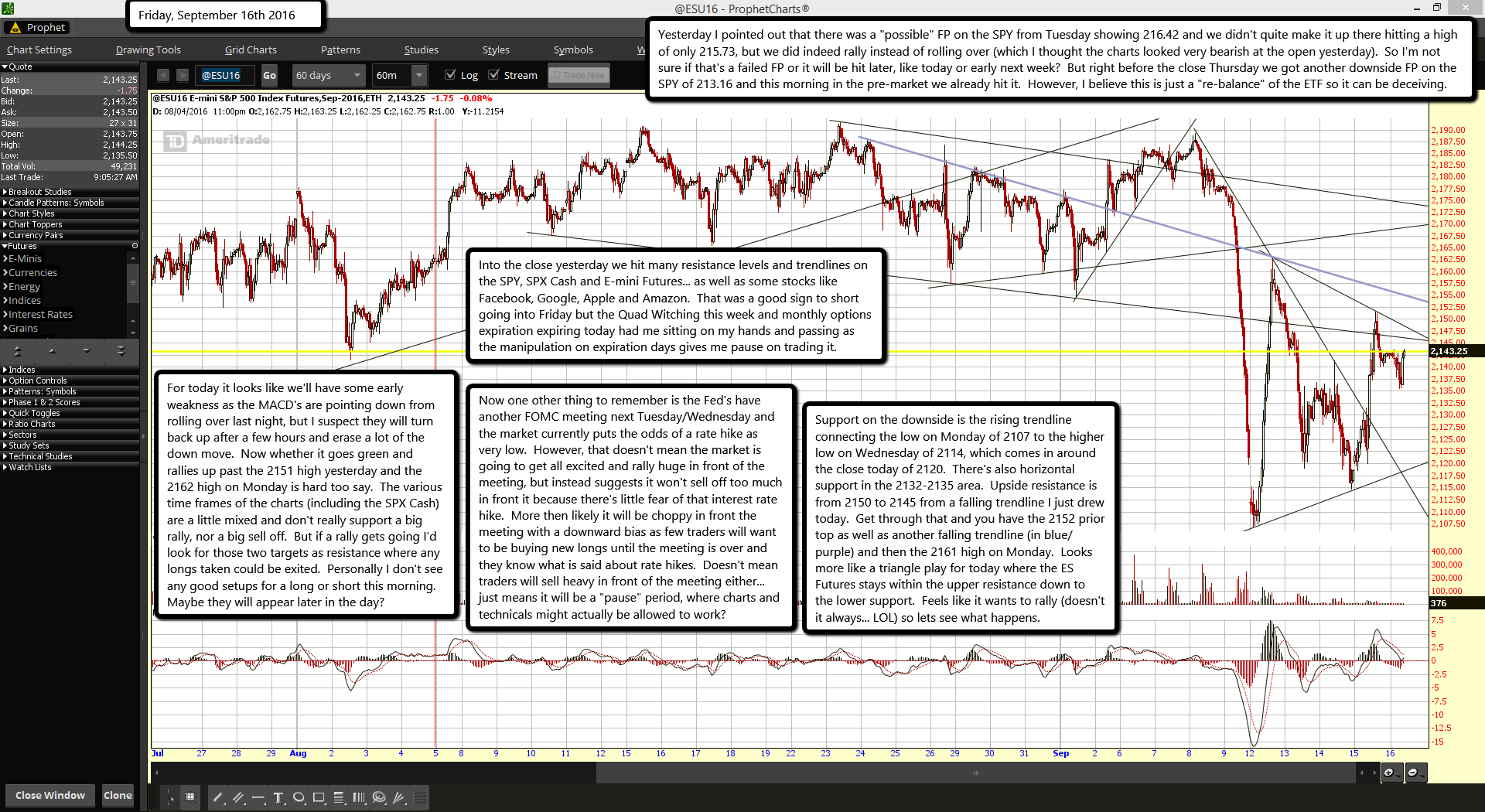
ES Morning Update September 6th 2016

0

fe458b37-c7fa-4f0d-8638-52805d7e890f

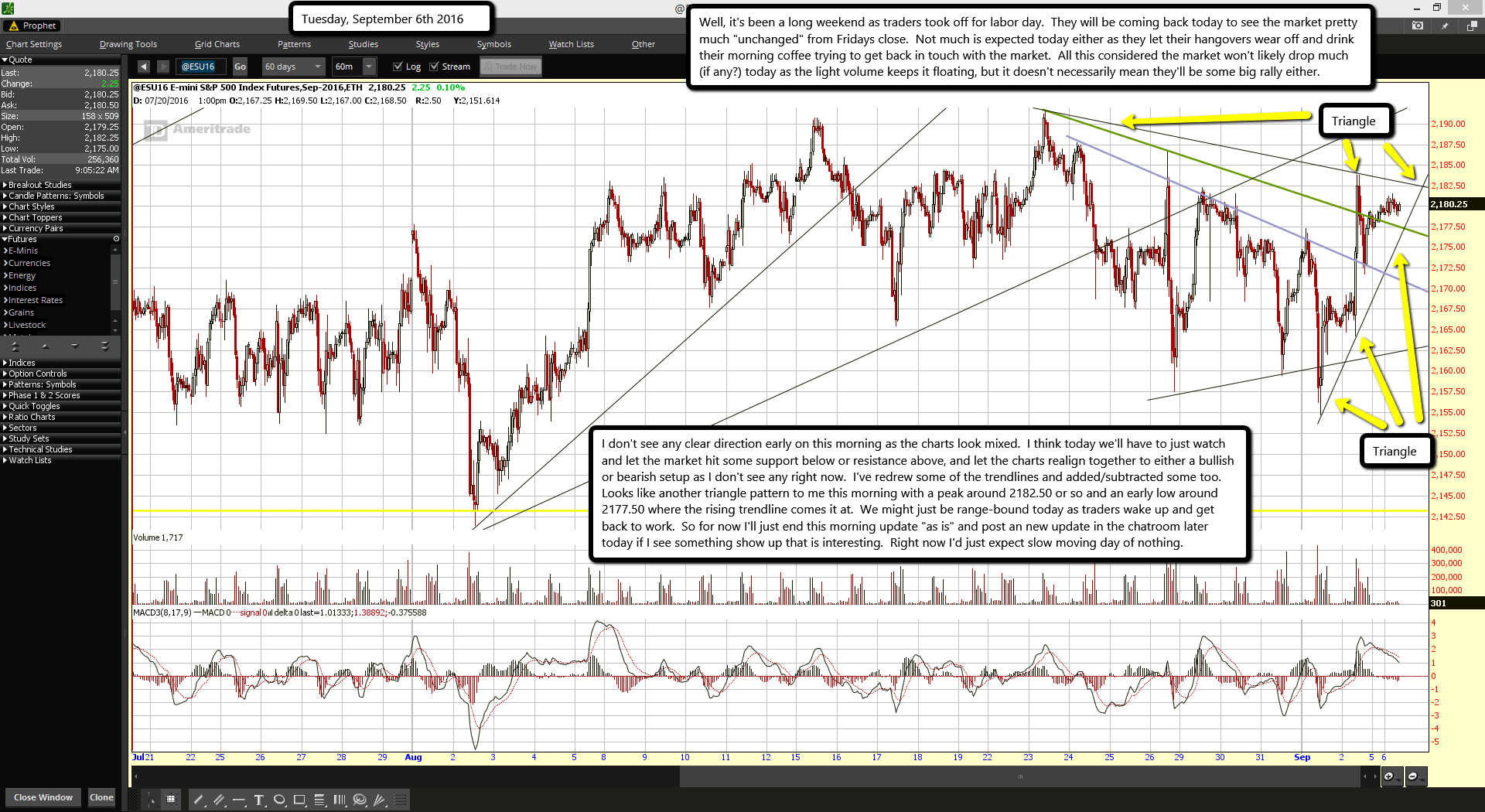
Well, it's been a long weekend as traders took off for labor day.  They will be coming back today to see the market pretty much "unchanged" from Fridays close.  Not much is expected today either as they let their hangovers wear off and drink their morning coffee trying to get back in touch with the market.  All this considered the market won't likely drop much (if any?) today as the light volume keeps it floating, but it doesn't necessarily mean they'll be some big rally either.

I don't see any clear direction early on this morning as the charts look mixed.  I think today we'll have to just watch and let the market hit some support below or resistance above, and let the charts realign together to either a bullish or bearish setup as I don't see any right now.  I've redrew some of the trendlines and added/subtracted some too.  Looks like another triangle pattern to me this morning with a peak around 2182.50 or so and an early low around 2177.50 where the rising trendline comes it at.  We might just be range-bound today as traders wake up and get back to work.  So for now I'll just end this morning update "as is" and post an new update in the chatroom later today if I see something show up that is interesting.  Right now I'd just expect slow moving day of nothing.

ES Morning Update September 2nd 2016

0

9063bc61-8861-469e-8c01-6108add8ed68

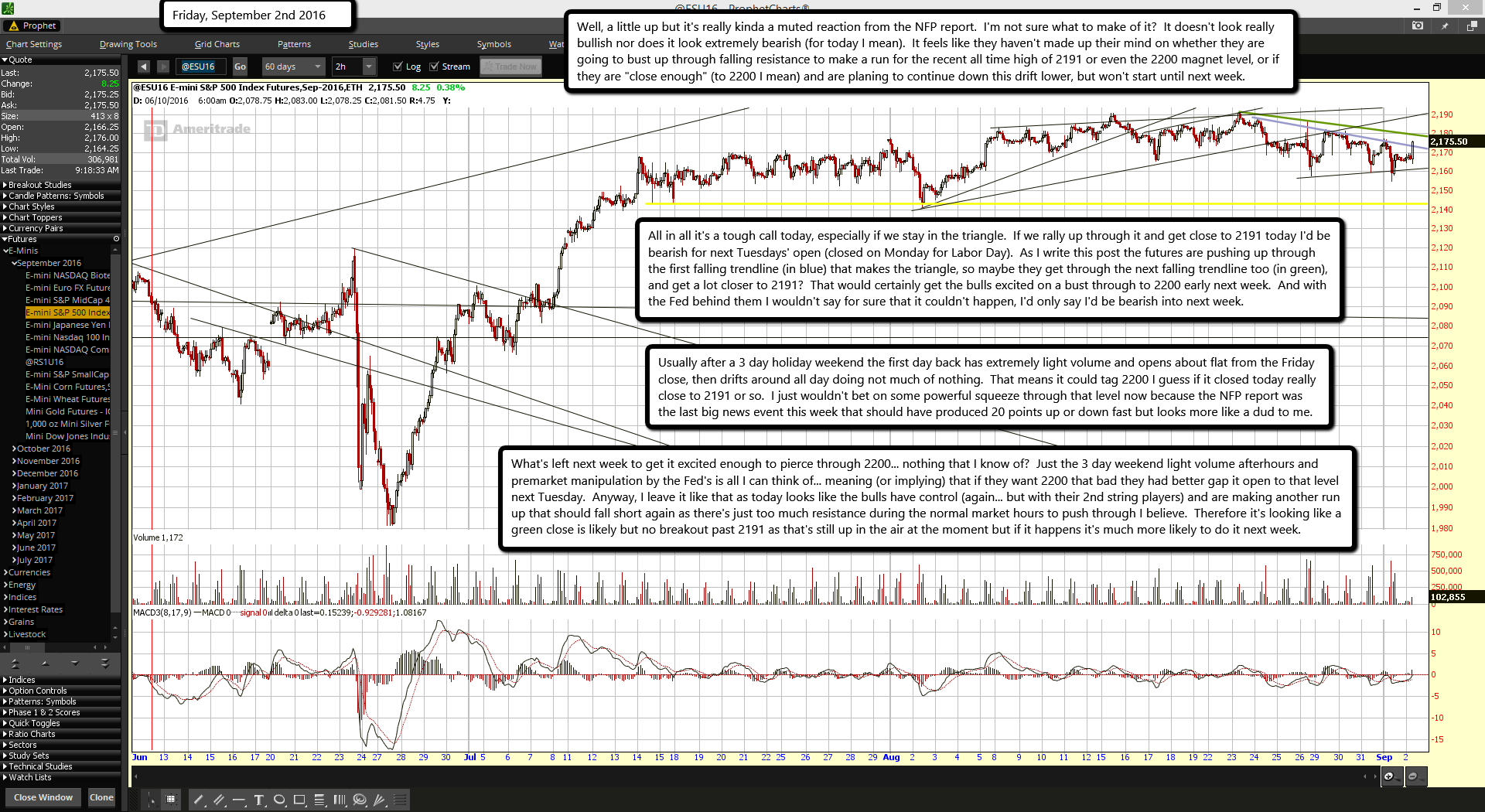
Well, a little up but it's really kinda a muted reaction from the NFP report.  I'm not sure what to make of it?  It doesn't look really bullish nor does it look extremely bearish (for today I mean).  It feels like they haven't made up their mind on whether they are going to bust up through falling resistance to make a run for the recent all time high of 2191 or even the 2200 magnet level, or if they are "close enough" (to 2200 I mean) and are planing to continue down this drift lower, but won't start until next week.

All in all it's a tough call today, especially if we stay in the triangle.  If we rally up through it and get close to 2191 today I'd be bearish for next Tuesdays' open (closed on Monday for Labor Day).  As I write this post the futures are pushing up through the first falling trendline (in blue) that makes the triangle, so maybe they get through the next falling trendline too (in green), and get a lot closer to 2191?  That would certainly get the bulls excited on a bust through to 2200 early next week.  And with the Fed behind them I wouldn't say for sure that it couldn't happen, I'd only say I'd be bearish into next week.

Usually after a 3 day holiday weekend the first day back has extremely light volume and opens about flat from the Friday close, then drifts around all day doing not much of nothing.  That means it could tag 2200 I guess if it closed today really close to 2191 or so.  I just wouldn't bet on some powerful squeeze through that level now because the NFP report was the last big news event this week that should have produced 20 points up or down fast but looks more like a dud to me.

What's left next week to get it excited enough to pierce through 2200... nothing that I know of?  Just the 3 day weekend light volume afterhours and premarket manipulation by the Fed's is all I can think of... meaning (or implying) that if they want 2200 that bad they had better gap it open to that level next Tuesday.  Anyway, I leave it like that as today looks like the bulls have control (again... but with their 2nd string players) and are making another run up that should fall short again as there's just too much resistance during the normal market hours to push through I believe.  Therefore it's looking like a green close is likely but no breakout past 2191 as that's still up in the air at the moment but if it happens it's much more likely to do it next week.

ES Morning Update September 1st 2016

0

30cfa251-fd28-4da0-87f0-dd5f1f24c4a6

I've deleted some trendlines so we could see the triangle clearer.  Basically we are still inside this triangle with the new purple falling trendline as the primary resistance that the futures seem to keep hitting on the upside and then rolling over.  The green falling trendline above that was created connecting the exact highs on the 23rd and 26th, but the market doesn't seem to see it or think it's important right now.  So when and if it's hit the resistance it "should" provide will probably be weaker then it I'd normally think.  There's still no clear direction inside this triangle as the market just waits for the jobs data Friday morning.

On the short term the SPX 60 minute chart has completely erased the overbought conditions and looks oversold to neutral.  The Daily chart is pointing down nicely on the MACD from high around +20 to in the +5 to +8 range right now.  It could turn back anytime or continue lower.  Most of the times in the past it would get much closer to the zero level before turning back up, which leads me to think we might have a "one day" wonder move up on the market from the Friday reaction to the NFP report but it shouldn't hold more then a few days.  For a decent multiday rally to start I do think that daily chart will need to at least touch the zero level if not go negative on it's MACD's, which means the price level of the SPX cash should at minimum retest the August 2nd low, if not lower.

What does all that imply you ask?  It suggests that "if" Friday's data doesn't produce a move down to that 08/02 low (around 2140 on the ES Futures) and instead produces a bear squeeze that either falls short of the 2191 all time, pierces it, tags 2200 or even runs up another 10 or 20 points, that 08/02 low would then only be a brief bounce spot on the next trip down as the likelihood of it breaking after tagging 2200+ first would be greatly increased.  At that point I'd expect much lower prices.  But if the bulls allow that 2140 area to be hit first they could get another strong rally going in September that could (should) easily take out 2200 I believe.  At that point I might even think it's possible to hit 2300 or so.

It's all about "from where" do they start that rally?  If the start it from a level like where we are going to be today at the open then odds favor the bears as the rally should exhuast itself if it some how hits and/or pierces 2200 into early next week. But if the bulls take it down on Friday to that lower level of 2140 or so, then I think they will have much strong odds of a longer lasting rally... which we all know that's what they want as they don't want the market to collapse before they can get their puppet Krooked Killary elected.  It's such a joke that we voters don't have any choices for president.  But that's the whole purpose of the two party system in the first place... to control both sides so that the elite win regardless of which party gets in.  Enough about that...

My thoughts for today are that we'll once again stay range-bound between the lower rising trendline in this triangle and the current falling trendline that the futures tagged overnight.  The bigger move will very likely happen Friday morning with the NFP reports numbers at 8:30 am EST before the cash market opens

Since I still think this market is following a pattern similar to the Aug/Sept 2014 period I'm expecting a strong move up to tag 2200 at some point, but I don't know when.  Then I think we drop for several weeks.  I'm just guessing that "they" will use this NFP report as the spark to produce this last squeeze up like they did back on September 16th-19th, of 2014.  This is just a gut call, nothing more.  Again, there's no clear direction right now.

Justice Department Challenges Deere’s Planned Deal With Monsanto

0

Purchase of planting equipment line would harm competition, lawsuit says...

The Justice Department filed a lawsuit in an Illinois federal court, asking a judge to block Deere’s planned deal with Monsanto.

The Justice Department on Wednesday filed a lawsuit challenging Deere & Co.’s planned acquisition of a line of high-tech farming equipment from Monsanto Co. , saying the deal would suppress competition for technology that allows farmers to plant crops at higher speeds.

At issue is a deal from last November in which Deere said it agreed to pay an undisclosed sum to buy Monsanto’s Precision Planting equipment business.

The Justice Department said Monsanto’s equipment line had been a leading innovator in high-speed planting technology, with Deere as its only significant competitor.

“If this deal were allowed to proceed, Deere would dominate the market for high-speed precision planting systems and be able to raise prices and slow innovation at the expense of American farmers who rely on these systems,” said Renata Hesse, the acting head of the Justice Department’s antitrust division.

The department filed the lawsuit in an Illinois federal court, asking a judge to block the deal.

Deere and Monsanto said they would vigorously fight the lawsuit, calling the Justice Department’s concerns misguided and saying that the companies had cooperated fully with the U.S. antitrust review.

“The proposed acquisition benefits farmers by accelerating the development and delivery of new precision equipment solutions that help farmers increase yield and productivity,” officials for the companies said in a joint statement. They said competition among high-tech planter developers is “strong and growing” and that their deal would benefit farmers by speeding the development of new planting equipment, some of which could be used to retrofit older machinery and save farmers money.

Deere said upon finalizing the deal, it would “preserve Precision Planting’s independence to ensure innovation and speed-to-market.”

The case is the latest from Obama administration antitrust enforcers who have been particularly active in the twilight of their tenure.
Advertisement

The Justice Department is currently litigating challenges to two major health insurance mergers: Anthem Inc. ’s acquisition of Cigna Corp. ; and Aetna Inc. ’s deal to combine with Humana Inc. Earlier this year it blocked Halliburton Co. ’s acquisition of oil-field-services rival Baker Hughes.

The department also is continuing to review the proposed merger of Dow Chemical Co. and DuPont Co.

Agricultural giants such as Monsanto, Deere, DuPont and Cargill are jockeying with venture capital-powered startups to capture a growing stream of data flowing off U.S. farms, enabled by cutting-edge combines and planters that collect detailed information on seeding rates and crop yields. Data-powered products and services are one way for agricultural companies to offset slumping sales in their core business lines.

Some farmers are looking to sensors and big-data services as a way to trim costs as a multiyear slide in commodity prices has U.S. farm incomes on track this year to hit their lowest point since 2009, according to the U.S. Department of Agriculture.

The Justice Department lawsuit could deal a blow to Deere’s ambitions to expand its suite of high-tech farm offerings as farmers are sharply scrutinizing their spending on everything from machinery to seeds and insecticides. Deere last year signed a string of small deals, purchasing a French planter company and forming a joint venture centered on farm-management software. Both are aimed at helping farmers maximize efficiency as crop prices continue to grind along at low levels.

Monsanto acquired Precision Planting for $210 million in 2012 as part of a broader push into data-powered farming services, hastened a year later when the seed giant paid $930 million for the weather modeling startup Climate Corp. Since then Monsanto has expanded Climate’s range of algorithm-powered advisory services and struck data-sharing agreements with software developers and farmer cooperatives.

Both Deere and Monsanto are building virtual networks that collect and sift data on farmers’ crop yields, equipment use and farm management, to formulate advice on how to grow bigger crops at lower cost. Alongside Monsanto’s planned sale of Precision Planting to Deere, the companies struck a connectivity agreement that would make it easier for farmers to link their Deere machinery with Monsanto’s Climate unit.


It's sad to see companies like John Deere even talking to evil corporations like Monsanto, who we all know are poisoning the skies with chem-trails and selling GMO seeds.

Very sad...

Red

ES Morning Update August 31st 2016

0

989c0b38-812e-4463-a732-9e98a6f3ae5b

The futures seem to be in a triangle now and at the (new) rising trendline that makes the bottom part of the triangle.  Normally I'd say it will breakdown as the MACD's on this 60 minute chart and larger time frames are all acting like they want to rollover in what could be a nasty C wave down.  But we have to factor in the Friday numbers that the market is waiting on, which will likely continue to keep this market range-bound.

So if the rising trendline clearly breaks I'd look for a retest of the 2168 level as first support and then the 2157 low that formed the head on this inverted head and shoulders pattern that I see in this chart.  Overall I do think "they" are hold it up for a long as possible.  It's very rare to trade in such a tight range for so many days without a breakout or breakdown.  In fact I watched a video yesterday that said the last time the market traded for at least 30 days in a 1 1/2% trading range was in 1965... so yeah, there's something going on behind the scenes.

There were many times the market should have rolled over and dropped hard but was saved.  There was even a few times that it should have bust out to hit 2200 and beyond, but I'm sure that was stopped by heavy selling by the insiders that I believe have been quietly dumping for the last two months now.  So you have the PPT saving the market on the downside when the charts have aligned bearish and big institutions selling on the upside when the charts align bullish... and we have extremely light volume day in and day out in the market.

Looks to me like SkyNet is the only one playing each day as clearly the retail public isn't buying, nor does it seem that the big funds or institution are?  So we wait and wait and wait for the government to decide on what the next direction in the market is.  Will they pull another rabbit out of a hat and get some crazy rally up to that old FP of 230 on the SPY (about 2300 on the futures and SPX) or will they roll it over after this Friday?  I guess we all need to go listen to what Jim Cramer has to say and just do the opposite.

Anyway, for today there's still that resistance overhead from a falling trendline (in green) that's pointing to around 2180 today (if the market rallies, but it's not looking good so far) and support again at 2168 and then 2157.  Pattern-wise it looks like an Inverted Head and Shoulders pattern but wave count wise it looks like we might be in some C wave down that takes out the 2157 low and goes for the 2140 area.  It's a bullish pattern and bearish wave count, so not much help there.

I'd just look to short any rally up to the falling green trendline and doesn't take out the 2182.50 "possible" high of the B wave up, as if we are in a C wave down it should have 5 smaller waves inside it which the wave 1 of that C down was at yesterday's low and we should now be in the wave 2 up of that C down.  If it stops shy of the B high at the close today then we could see the wave 3 down inside the C down tomorrow, and that will be one nasty wave!  Of course if this wave count is wrong then the IH&S pattern might play out and we rally up to 2200 or more.  But keep in mind that this IH&S pattern was formed at a topping zone and not a bottoming area.  The odds on it playing out are much less because we are already so overbought.  Doesn't mean it won't work but odds are much, much better when the market has bottomed and forms the pattern.  Anyway, I'm just watching patiently for what the close will bring us today as we could have a very nice drop tomorrow if we can get a small rally up today that doesn't take out 2182.50 (which again I think is the B wave high with the A wave low at 2158).

Nearly 10,000 Chipotle workers join class action wage theft lawsuit

0

There’s a new outbreak at Chipotle: Furious workers.

Nearly 10,000 current and former Chipotle employees have joined a class-action wage theft lawsuit against the Mexican fast food franchise, court records show.

The suit started two years ago with a former manager in Colorado, but as of last week it has wrapped in 9,961 workers. That’s the equivalent of nearly one-fourth of the franchise’s current workforce.

The initial complaint, filed in September 2014, accused the company of forcing workers into unpaid overtime after they clocked out for their shifts.

Chipotle exec surrenders to authorities following coke bust

Workers also said they had to “attend mandatory after-shift meetings” and complete closing cleanups off the clock.

“To reduce this expense and maximize profit, Chipotle maintains a company-wide policy of not paying hourly-paid restaurant employees for all time worked, and encouraging its general managers to require that work be performed off the clock,” the suit says.

“Chipotle implements its policy with a system of reward and punishment. Payroll budgets are set that realistically can be met only if hourly restaurant employees work off the clock.”

The restaurants use a system that clocks out employees automatically at 12:30 a.m., even if they are staying longer. Managers then fail to document the hours — or are pressured not to, the complaint says.

Fired Chipotle worker who complained on Twitter wins ruling

The suit demands a jury trial for full overtime compensation for all workers involved in the case.

The Denver-based company, which pulled in $4.5 billion in revenue last year, has previously denied cheating its workers. Reps did not immediately return messages from the Daily News.

The suit snowballed as Chipotle faced another crisis — an E. coli outbreak that spread to restaurants in 11 states between November 2015 and January 2016, sickening 55 people.

Chipotle faced a criminal investigation in California for the contamination's, and the U.S. Food and Drug Administration investigated the outbreak — but never determined the cause.

Chipotle temporarily closed dozens of its franchises during the fast food plague, and shuttered all of its 1,900-plus locations one day for safety. The company never said how much money it lost from the outbreak. As news of the outbreak spread, Chipotle’s stock dipped nearly 30%.

s2Member®