Sunday, July 26, 2026
Home Blog Page 72

Google Is Winning the Fight for PayPal’s Business

0

It could potentially beat out Amazon and Microsoft.

Alphabet’s Google GOOGL -0.49% is close to winning PayPal as a client for its cloud business, potentially beating out Amazon and Microsoft, CNBC reported on Tuesday.

While Google is the front-runner, the online payments processor is evaluating the other providers and hasn’t made any decision yet, CNBC reported, citing people familiar with the matter.

However, PayPal PYPL -0.78% may not move its technology infrastructure in the fourth quarter, the peak period for online commerce, CNBC said.

PayPal has some existing business with Amazon Web Services, according to the CNBC report.

Google has been trying to beef up its presence in cloud computing, a market dominated by Amazon and Microsoft.

Google landed Home Depot HD -0.33% as a client in March, highlighting the momentum its cloud business has gained under the leadership of Diane Greene, a co-founder of VMWare VMW -1.34% . Greene joined Google late last year.

Google also counts popular messaging app Snapchat and the world’s biggest paid music streaming service, Spotify, as clients.

Overall, Google was the No. 4 player in cloud infrastructure services last year with a 4% market share, according to Synergy Research.

Amazon’s AWS cornered 31% of the market, while Microsoft’s Azure had 9% and IBM IBM -0.20% 7%.

Google, PayPal, Amazon AMZN -0.48% and Microsoft MSFT -0.36% did not respond immediately to a request for comment.

Apple’s $14.5 Billion EU Bill May Pressure U.S. on Tax Overhaul

0

The European Union’s finding that Apple Inc. owes Ireland more than $14 billion in back taxes reveals the high cost the U.S. Treasury may pay by failing to keep pace in a global effort to stem corporate tax avoidance -- and Apple might represent only the first major U.S. loss.

The EU commissioner for competition said Tuesday that Apple’s tax arrangement with Ireland constitutes anti-competitive “state aid” to the company. If Apple ultimately has to pay billions in taxes to Ireland, the iPhone maker may be able to reduce its U.S. taxes by using foreign-tax credits available under U.S. law. Apple executives and Irish officials have said they plan to challenge the EU’s order.

The EU is already conducting similar investigations of other major U.S. corporations, including McDonald’s Corp. and Amazon.com Inc. Additionally, legal experts say that if the precedent for such EU orders is upheld on appeal, regulators may give harsher scrutiny to the hundreds of tax ruling letters that Luxembourg issued to major U.S. companies, including the Walt Disney Co. and Koch Industries Inc. Some of those agreements gave companies a chance to slash billions from their tax liabilities at home and abroad.

No ‘Special Deals’

Amazon, through a spokesman, declined to comment. Representatives for McDonald’s, Disney and Koch didn’t immediately respond to requests for comment. Apple’s chief executive officer, Tim Cook, said in a statement: “We never asked for, nor did we receive, any special deals.”

At stake for the U.S. Treasury Department is some of the potential tax revenue on more than $2 trillion in profit that U.S. multinationals have parked overseas. While the EU isn’t directly targeting that cash hoard, the state-aid cases could significantly reduce the revenue that the U.S. government could collect from it. The U.S. tax code, which sets a top corporate income tax rate of 35 percent, allows companies to defer paying that tax on their foreign income until they decide to bring it home via “repatriation.” Over the past few years, the U.S. Congress and President Barack Obama’s administration have been unable to agree on a plan to induce companies to repatriate their earnings at a reduced tax rate. Obama has proposed 14 percent; House Republicans this year proposed 8.75 percent.

Revenue Transfer

The delay may be costly: Federal law also gives companies credits for the foreign taxes they’ve paid, which they can use to reduce their U.S. taxes -- subject to certain restrictions. The precise effect is unclear, but U.S. Treasury officials have voiced concern that if U.S. companies are forced to pay large new tax bills to European governments, they may be able to use such credits -- effectively transferring revenue from U.S. to European coffers.

The prospect that EU regulators might force U.S. multinationals to pay taxes to countries that helped them avoid taxes at home prompted displeasure from Obama’s White House and from members of Congress Tuesday. But if U.S. policy makers saw new urgency in the large tax bill that was handed to Apple, there was little immediate sign of compromise.

 “Instead of standing by and allowing other countries to deliver multibillion-dollar tax bills to American companies, Washington should act now to ensure this doesn’t happen again,” said U.S. Representative Kevin Brady, the chairman of the tax-writing House Ways and Means Committee. Brady, a Texas Republican, called the EU’s decision “a predatory and naked tax grab” that took advantage of what he called a “broken” U.S. tax code.

‘Awful’ Decision

“That’s why House Republicans are moving forward with our tax reform blueprint built for growth that will allow more companies to operate in our country, hire our workers and help grow our economy,” Brady said. House Speaker Paul Ryan called the EU decision “awful” and said it “should be a spur to action.”

White House Press Secretary Josh Earnest, meanwhile, said Obama would “continue, over his next four months remaining in office, making his case” and pushing Congress to address the issue.

The EU’s decision was surprising for its blunt language and high assessment of Apple’s Irish tax liability, but it’s far from certain that Apple will ever pay the $14.5 billion bill. The company, along with the Irish government, has announced plans to appeal the ruling to the European Union’s general court. Legal experts say the EU’s use of antitrust statutes to regulate tax avoidance is a novel enough strategy that it could be struck down.

Dutch Appeal

Already, the Dutch government is appealing an earlier EU order that it collect 30 million euros in taxes from Starbucks Corp. Linda Mills, a spokeswoman for the coffee chain, said in an e-mail that the difference was that “today’s Apple decision is in the billions vs. ours which (pre appeal) scaled only in the millions.”

But with the potential for a continued EU crackdown, tax specialists expect pressure will escalate for the U.S. government to take action before overseas governments take major bites from companies’ offshore earnings.

“Since the U.S. has been very slow to enact reform and get revenue, the status quo has allowed the Europeans the opportunity to move in and get tax money for their governments,” said Kimberly Clausing, a professor at Reed College and an expert in international taxation. “I can’t imagine that this is going to be allowed to continue indefinitely.”

Singapore-Bound

For businesses, the ruling’s long-term impact was unclear. Because it’s subject to appeal, many accountants and corporate tax lawyers said it was too soon to tell whether it would encourage changes in U.S. multinationals’ tax strategies. For example, the effect on corporate inversions, in which U.S. companies move their tax addresses offshore by merging with foreign firms, remained undefined.

But Raymond Wiacek, an international tax lawyer at Jones Day in Washington, said the decision would prompt some multinationals -- particularly technology and pharmaceutical companies with valuable intellectual property -- to seek out new offshore tax havens.

“You don’t have to use Ireland as your base country -- people are moving to Singapore,” Wiacek said. That shift will accelerate unless Congress lowers the U.S. corporate tax rate from 35 percent, which is one of the world’s highest. Singapore taxes companies on profit derived both in Singapore and elsewhere at 17 percent.

Amazon’s Change

Amazon, which awaits the European commission’s finding on whether its own tax deal with Luxembourg constituted improper state aid, has stopped using its shell company there. That company had received royalty payments from Amazon’s subsidiaries in other European countries, effectively moving their profit to Luxembourg. Amazon officials have declined to say what motivated that change.

With the U.S. presidential election two months away, it’s likely that any U.S. effort to overhaul its international tax system will take place during the administration of Obama’s successor. Republican Donald Trump has proposed to tax companies’ offshore earnings at a reduced rate of 10 percent. Trump also proposes to cut the top corporate tax rate to 15 percent, while ending companies’ ability to defer U.S. taxes on overseas earnings. Democrat Hillary Clinton hasn’t offered a specific proposal on international taxation.

Neither campaign immediately responded to a request for comment on the issue Tuesday. Regardless, some observers believe the U.S. will move to enact a new repatriation tax rate no matter who wins the Nov. 8 election.

‘Inevitable’ Feature

“There’s a fair amount of general agreement that repatriation would be a feature of broader tax reform under a new president, which I would say is inevitable,” Jon Traub, the managing principal of tax policy at Deloitte Tax LLP, the tax arm of accounting firm Deloitte LLP told Bloomberg News last week.
As one of the most popular and recognizable brands in the U.S., Apple has thus far avoided congressional action that would alter its tax planning -- despite a U.S. Senate panel’s investigation that focused on accounting strategies the company had used to avoid what officials called billions of dollars a year in federal taxes.

The Senate Permanent Subcommittee on Investigations held hearings in which then-chairman Carl Levin, a Michigan Democrat, chastised Apple for “seeking the Holy Grail of Tax Avoidance.” They ended with committee members telling Apple CEO Tim Cook how much they loved their iPhones. The hearings led to no substantial legislative changes to the tax code. According to EU officials Tuesday, the effective tax rate for Apple’s main Irish subsidiary has dropped since the Senate hearings: from 0.5 percent in 2011 to .005 percent in 2014.

‘Completely Made Up’

Apple CFO Luca Maestri disputed those figures Tuesday, saying that the commission’s depiction of Apple’s effective tax rate was “completely made up.” Maestri said the EU had calculated incorrectly by neglecting to include all of the $400 million in taxes the company paid in Ireland in 2014 and by improperly attributing offshore profit to Apple’s Irish subsidiaries.

In Europe, the Apple case is likely to bring heightened pressure to continue the crackdown. While the state-aid cases might slow cooperative international efforts to reach agreement on comprehensive tax policies, they have nonetheless appealed to the populist sentiment in Europe -- and may spur U.S. companies and policy makers to take action.“The arguments are poorly construed, and often target the wrong entities or the wrong countries, but the cases nonetheless are spectacular political statements,” said Romero Tavares, an economics professor at the Vienna University of Economics and Business. He recently published a paper titled, “The Intersection of EU State Aid Cases and U.S. Tax Deferral: A Spectacle of Fireworks, Smoke and Mirrors.”

“Therefore I do believe more cases will come up, more companies will be scrutinized and not only in the Silicon Valley, but across the board,” Tavares said. “The amounts involved are astronomical.”

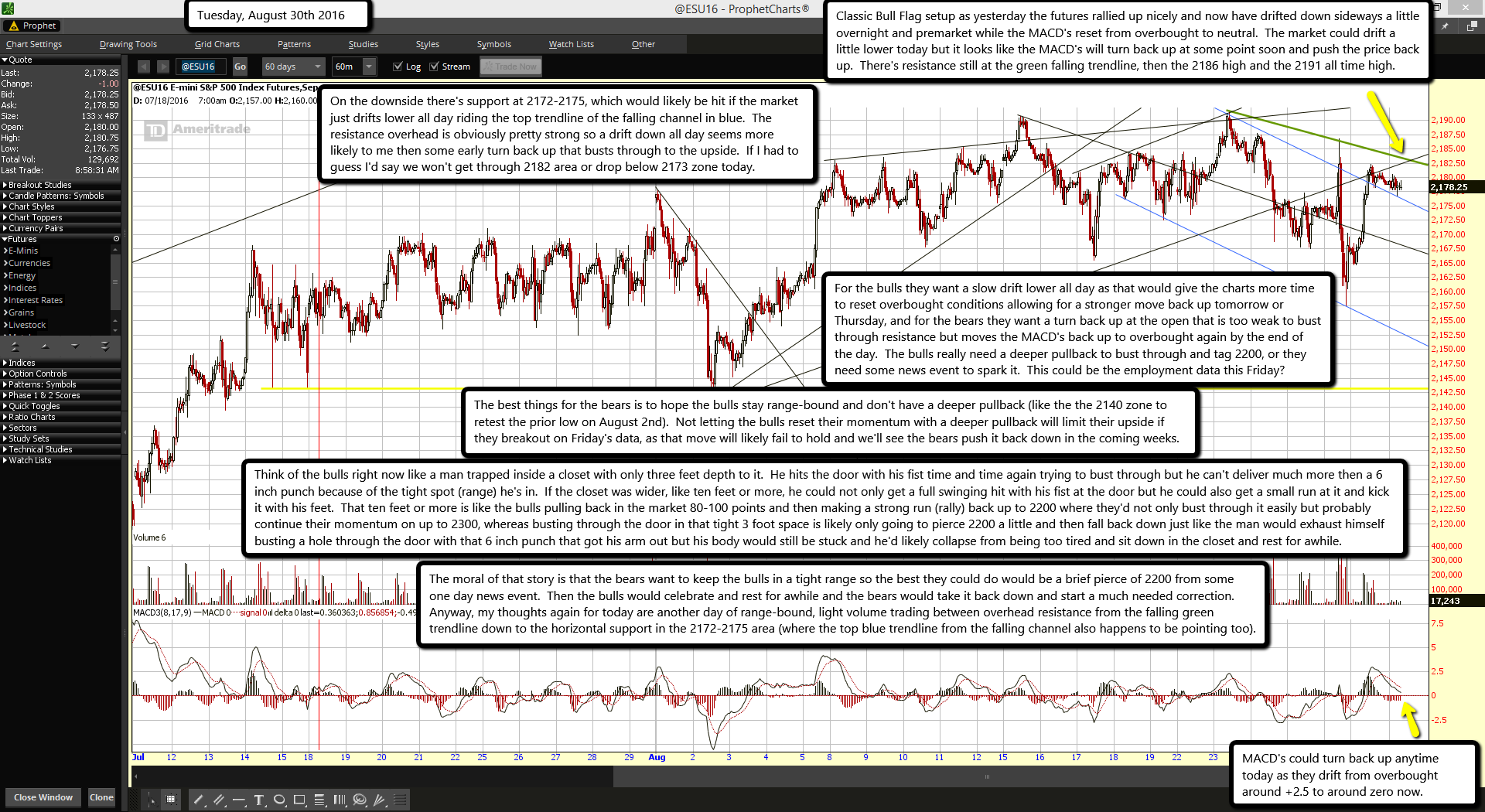
ES Morning Update August 30th 2016

0

a3b7b712-d35c-4c9a-8562-ab8980cabe26

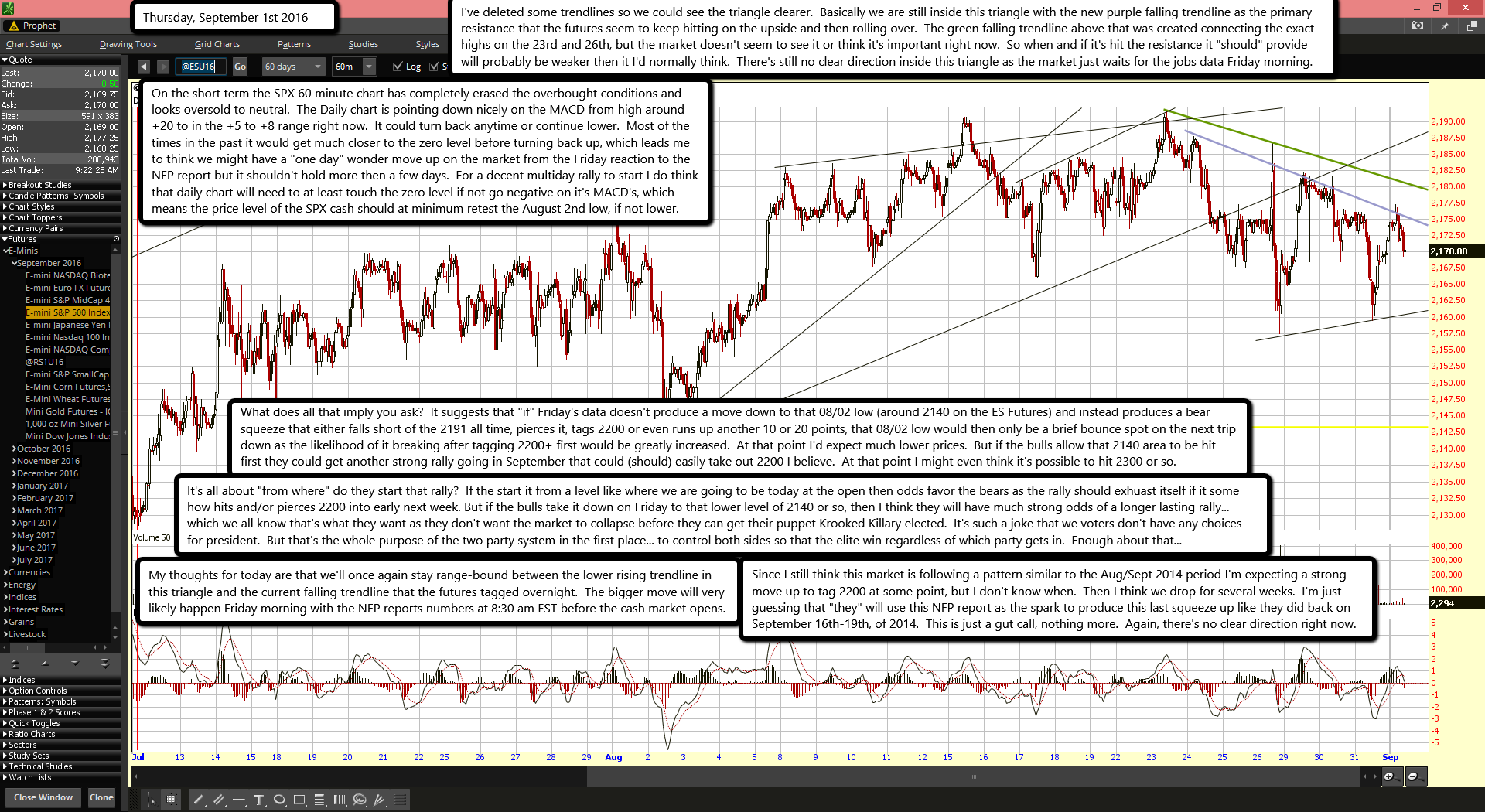
Classic Bull Flag setup as yesterday the futures rallied up nicely and now have drifted down sideways a little overnight and premarket while the MACD's reset from overbought to neutral.  The market could drift a little lower today but it looks like the MACD's will turn back up at some point soon and push the price back up.  There's resistance still at the green falling trendline, then the 2186 high and the 2191 all time high.

On the downside there's support at 2172-2175, which would likely be hit if the market just drifts lower all day riding the top trendline of the falling channel in blue.  The resistance overhead is obviously pretty strong so a drift down all day seems more likely to me then some early turn back up that busts through to the upside.  If I had to guess I'd say we won't get through 2182 area or drop below 2173 zone today.

For the bulls they want a slow drift lower all day as that would give the charts more time to reset overbought conditions allowing for a stronger move back up tomorrow or Thursday, and for the bears they want a turn back up at the open that is too weak to bust through resistance but moves the MACD's back up to overbought again by the end of the day.  The bulls really need a deeper pullback to bust through and tag 2200, or they need some news event to spark it.  This could be the employment data this Friday?

The best things for the bears is to hope the bulls stay range-bound and don't have a deeper pullback (like the the 2140 zone to retest the prior low on August 2nd).  Not letting the bulls reset their momentum with a deeper pullback will limit their upside if they breakout on Friday's data, as that move will likely fail to hold and we'll see the bears push it back down in the coming weeks.

Think of the bulls right now like a man trapped inside a closet with only three feet depth to it.  He hits the door with his fist time and time again trying to bust through but he can't deliver much more then a 6 inch punch because of the tight spot (range) he's in.  If the closet was wider, like ten feet or more, he could not only get a full swinging hit with his fist at the door but he could also get a small run at it and kick it with his feet.  That ten feet or more is like the bulls pulling back in the market 80-100 points and then making a strong run (rally) back up to 2200 where they'd not only bust through it easily but probably continue their momentum on up to 2300, whereas busting through the door in that tight 3 foot space is likely only going to pierce 2200 a little and then fall back down just like the man would exhaust himself busting a hole through the door with that 6 inch punch that got his arm out but his body would still be stuck and he'd likely collapse from being too tired and sit down in the closet and rest for awhile.

The moral of that story is that the bears want to keep the bulls in a tight range so the best they could do would be a brief pierce of 2200 from some one day news event.  Then the bulls would celebrate and rest for awhile and the bears would take it back down and start a much needed correction.  Anyway, my thoughts again for today are another day of range-bound, light volume trading between overhead resistance from the falling green trendline down to the horizontal support in the 2172-2175 area (where the top blue trendline from the falling channel also happens to be pointing too).

The coming wave of Apple-ficial intelligence

0


The depth of Apple’s commitment to AI has started to manifest itself since the summer of 2016. In a recent essay Stephen Levy manifests those efforts in greater detail than before.

Back in June, I wrote: “Apple is going to continue its investments in improving UX through technologies in the AI stack… Expect more AI in Apple’s products. But I would be surprised to see large-scale open source efforts, of the kind we have seen from Google or Facebook. Open source has rarely been Apple’s bag.”

New in Levy’s piece gets more granular including the following nuggets.

  • Apple runs a neural net locally on the iPhone.
  • This neural net weighs 200Mb and trains itself in real-time, but especially overnight, using the GPUs in Apple’s iPhone device.
  • Apple cites owning the silicon design (from the far-sighted acquisition of PA Semiconductor, I guess) as a driver of improved learning performance.
  • They replaced oldskool voice recognition  (hidden Markov models) by a deep learning approach back in 2014.
  • Apple uses third-party sourced data to generalise training of things like photo recognition. This happens on-device.

Given the level of Apple’s acquisitions in this area (see 💡 my tweetstorm from May 2016 which covers this, and was prior to the Turi deal), their recent senior hirings and more than 280 job openings for hardware & software engineers with machine learning experience it is reasonable to say Apple is going for it.  (Fascinated to learn more about “Proactive Intelligence”, their new AI-enriched interface paradigm which sounds a bit Weave.Ai/Google Now like.)

One open question raised by the Levy piece is whether Apple’s mental model around privacy is a bug or feature when it comes to artificial intelligence.

Apple doesn’t share user data. And Apple’s global models are built not on this shared user data but on externally & expensively sourced data. And Apple doesn’t seem to send much user data back to the cloud to be learned from on super deep networks running on GPU clusters.

The traditional argument would be that it is a bug. Leveraging data network effects allows you to build better, more defensible products faster. Tesla’s network learning (EV#31) is a great example of this. As is Facebook’s capability in face & object detection. And keeping things on a local GPU denies your neural nets of the value of lots of GPUs (particularly for training).

The counter argument would be that user-privacy may increasingly be a differentiating feature which allows you to sell more stuff. Apple is wealthy and paying for tons of training data doesn’t make a dent in its cash pool. And, in any case, model performance often tends to a limit beyond which additional training data doesn’t help you.

Here’s my fast take on this. Apple’s approach to user privacy is may start to look more like a bug than a feature but it may not make a difference right now.

Apple’s approach to user privacy is may start to look more like a bug than a feature but it may not make a difference right now.

  • Externally sourced training data can’t keep up with novel use cases generated by real users. So your external training takes a long time to improve your overall performance. An Apple car training locally will generally have worse training data than a network Tesla whose models draw on edge cases from across the world. Worse performance means a worse product means worse market share means…
  • Their introduction of differential privacy which Levy discusses suggests they see the value of data network effects and are finding a way to grab that data while staying true to the user privacy promise. What I don’t know is whether differential privacy provides sufficiently good data. I’d recommend reading this essay at High Scalability which looks in more depth at deep learning in Apple Photos and differential privacy.
  • Andrew Ng, Baidu’s deep learning czar, has pointed out that deep learning performance doesn’t seem to flatten out as you add more data. You can just make the network deeper and the model continues to get more performant.
  • Consumers won’t care. For better or worse they won’t care enough especially when given the choice of products that feel more ‘magical’.

Right now (and perhaps for the next few years) this probably won’t hinder Apple. But their approach to user privacy might start to hurt the user experience they strive to deliver.

Now that would be an interesting tension.

Uber Loses at Least $1.2 Billion in First Half of 2016

0

After touting profitability in the U.S. early this year, the ride-hailing company is said to post second-quarter losses exceeding $100 million.

The ride-hailing giant Uber Technologies Inc. is not a public company, but every three months, dozens of shareholders get on a conference call to hear the latest details on its business performance from its head of finance, Gautam Gupta.On Friday, Gupta told investors that Uber's losses mounted in the second quarter. Even in the U.S., where Uber had turned a profit during its first quarter, the company was once again losing money.In the first quarter of this year, Uber lost about $520 million before interest, taxes, depreciation and amortization, according to people familiar with the matter.

In the second quarter the losses significantly exceeded $750 million, including a roughly $100 million shortfall in the U.S., those people said. That means Uber's losses in the first half of 2016 totaled at least $1.27 billion.Subsidies for Uber's drivers are responsible for the majority of the company's losses globally, Gupta told investors, according to people familiar with the matter. An Uber spokesman declined to comment.

Uber in Hungary.

Uber in Hungary.
Photographer: Akos Stiller/Bloomberg

"You won't find too many technology companies that could lose this much money, this quickly," said Aswath Damodaran, a business professor at New York University who has written skeptically of Uber's astronomical valuation on his blog. "For a private business to raise as much capital as Uber has been able to is unprecedented."

Bookings grew tremendously from the first quarter of this year to the second, from above $3.8 billion to more than $5 billion. Net revenue, under generally accepted accounting principles, grew about 18 percent, from about $960 million in the first quarter to about $1.1 billion in the second.

Uber also told investors during the call that it was changing how it calculates UberPool's contribution to revenue in the second quarter, which had the effect of increasing revenue.

 Uber's losses and revenue have generally grown in lockstep as the company's global ambitions have expanded. Uber has lost money quarter after quarter. In 2015, Uber lost at least $2 billion before interest, taxes, depreciation and amortization. Uber, which is seven years old, has lost at least $4 billion in the history of the company.

It's hard to find much of a precedent for Uber's losses. Webvan and Kozmo.com—two now-defunct phantoms of the original dot-com boom—lost just over $1 billion combined in their short lifetimes. Amazon.com Inc. is famous for losing money while increasing its market value, but its biggest loss ever totaled $1.4 billion in 2000. Ube rexceeded that number in 2015 and is on pace to do it again this year.

"It's hardly rare for companies to lose large sums of money as they try to build significant markets and battle for market share," said Joe Grundfest, professor of law and business at Stanford. "The interesting challenge is for them to turn the corner to become profitable, cash-flow-positive entities."

The second quarter of 2016, which ended in June, could represent a nadir for Uber. The company's losses will likely fall. In July, it cut a deal with its largest global competitor, Chinese ride-hailing behemoth Didi Chuxing, washing its hands of its massive losses in that country. Didi gave Uber a 17.5 percent stake in its business and a $1 billion investment in exchange for Uber's retreat. Uber lost at least $2 billion in two years in China, people familiar with the matter told Bloomberg in July. Uber won't see any losses from China on its balance sheet after August, the company said on Friday's investor call.

The Didi app.

The Didi app.
Photographer: Qilai Shen/Bloomberg

Uber’s backers range from venture capital firms like Benchmark to the investment bank Goldman Sachs. Altogether, Uber has raised more than $16 billion in cash and debt. Its latest valuation is a whopping $69 billion. The company has effectively redistributed at least $1 billion to the Chinese working class in the form of heavy subsidies to drivers there. "Uber and Didi Chuxing are investing billions of dollars in China and both companies have yet to turn a profit there," Uber Chief Executive Officer Travis Kalanick wrote in a letter announcing the company's departure from China.

Uber has been engaged in a fierce price war with Lyft Inc. this year, and that has also contributed to the enormous losses. Uber told investors on Friday's call that it's willing to spend to maintain its market share in the U.S. The company told investors that it believes Uber has between 84 percent and 87 percent of the market in the U.S., according to a person familiar with the matter.

Lyft said its market share in major U.S. cities is more than 20 percent and has grown substantially since last year. "Uber's alleged market share is a misleading and skewed statistic given that they offer service in more markets than Lyft," a spokeswoman for Lyft wrote in an e-mail.

One Uber investor said that he was expecting the company to continue losing money in the U.S. for the next quarter or two. But Lyft, a much smaller company by trip volume, looks to be losing more money than Uber in the U.S. Lyft has told investors that it will keep its losses under $50 million a month, Bloomberg reported in April. That would be about $150 million in a quarter. Uber's U.S. losses totaled about $100 million in the second quarter of this year. In July, Uber delivered 62 million rides to Lyft's 13.9 million. Uber's subsidies were spread over more rides.

Uber has about $8 billion in the bank and will soon receive $1 billion in cash from Didi, according to a person familiar with the matter. Uber also has access to a $2 billion credit line and a $1.2 billion loan.

"I think what Uber is trying to do is, 'Hey, look, we're going to take the losses up front in order to get to disproportionate scale,'" said Robert Siegel, lecturer in management at Stanford's business school. "The question is when they can get to profitability."

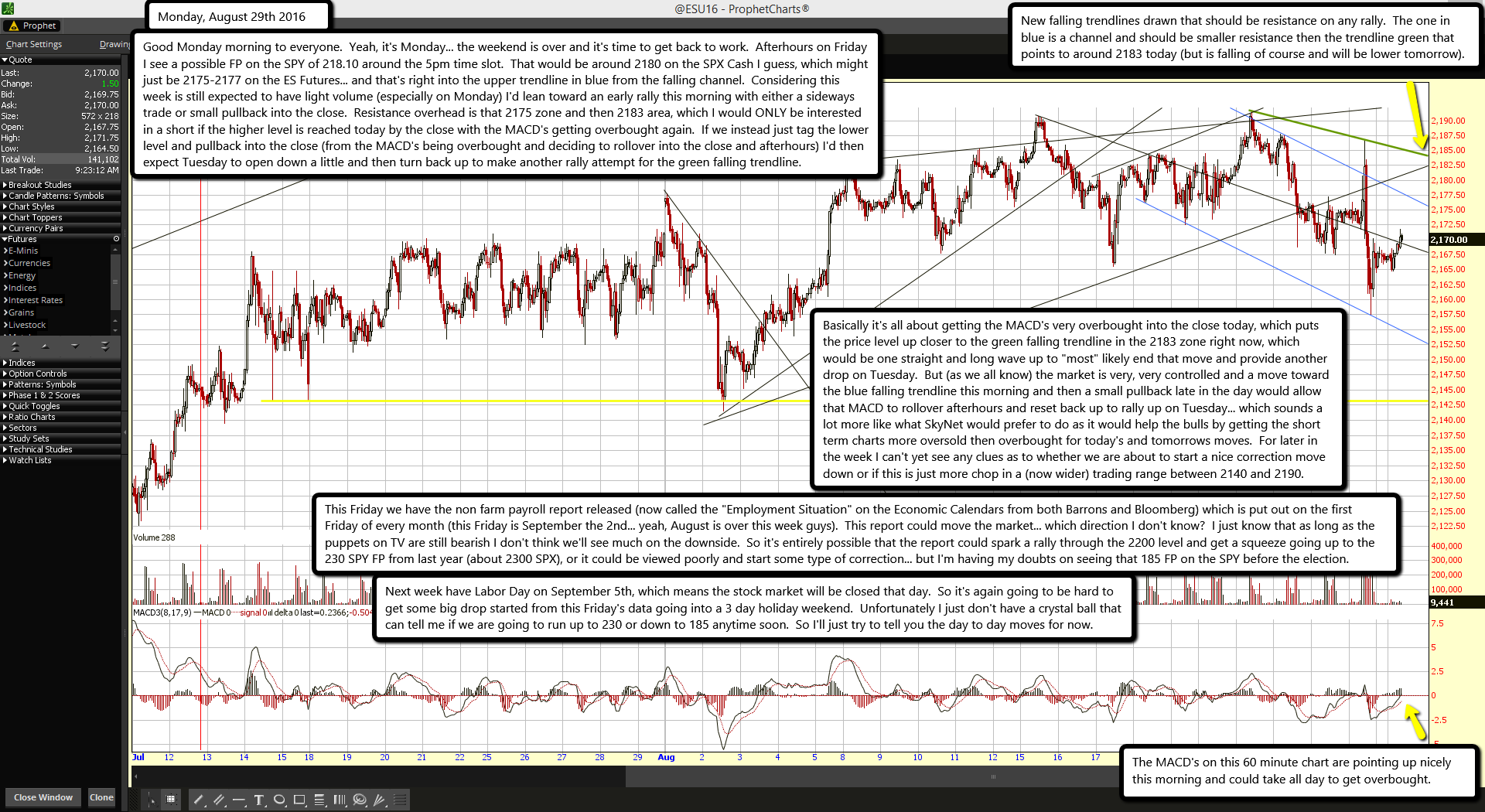
ES Morning Update August 29th 2016

0

b491e871-9ca3-446a-8c48-4d78cb5ee249

New falling trendlines drawn that should be resistance on any rally.  The one in blue is a channel and should be smaller resistance then the trendline green that points to around 2183 today (but is falling of course and will be lower tomorrow).

The MACD's on this 60 minute chart are pointing up nicely this morning and could take all day to get overbought.

Good Monday morning to everyone.  Yeah, it's Monday... the weekend is over and it's time to get back to work.  Afterhours on Friday I see a possible FP on the SPY of 218.10 around the 5pm time slot.  That would be around 2180 on the SPX Cash I guess, which might just be 2175-2177 on the ES Futures... and that's right into the upper trendline in blue from the falling channel.  Considering this week is still expected to have light volume (especially on Monday) I'd lean toward an early rally this morning with either a sideways trade or small pullback into the close.  Resistance overhead is that 2175 zone and then 2183 area, which I would ONLY be interested in a short if the higher level is reached today by the close with the MACD's getting overbought again.  If we instead just tag the lower level and pullback into the close (from the MACD's being overbought and deciding to rollover into the close and afterhours) I'd then expect Tuesday to open down a little and then turn back up to make another rally attempt for the green falling trendline.

Basically it's all about getting the MACD's very overbought into the close today, which puts the price level up closer to the green falling trendline in the 2183 zone right now, which would be one straight and long wave up to "most" likely end that move and provide another drop on Tuesday.  But (as we all know) the market is very, very controlled and a move toward the blue falling trendline this morning and then a small pullback late in the day would allow that MACD to rollover afterhours and reset back up to rally up on Tuesday... which sounds a lot more like what SkyNet would prefer to do as it would help the bulls by getting the short term charts more oversold then overbought for todays and tomorrows moves.  For later in the week I can't yet see any clues as to whether we are about to start a nice correction move down or if this is just more chop in a (now wider) trading range between 2140 and 2190.

This Friday we have the non farm payroll report released (now called the "Employment Situtaion" on the Economic Calendars from both Barrons and Bloomberg) which is put out on the first Friday of every month (this Friday is September the 2nd... yeah, August is over this week guys).  This report could move the market... which direction I don't know?  I just know that as long as the puppets on TV are still bearish I don't think we'll see much on the downside.  So it's entirely possible that the report could spark a rally through the 2200 level and get a squeeze going up to the 230 SPY FP from last year (about 2300 SPX), or it could be viewed poorly and start some type of correction... but I'm having my doubts on seeing that 185 FP on the SPY before the election.

Next week have Labor Day on September 5th, which means the stock market will be closed that day.  So it's again going to be hard to get some big drop started from this Friday's data going into a 3 day holiday weekend.  Unfortunately I just don't have a crystal ball that can tell me if we are going to run up to 230 or down to 185 anytime soon.  So I'll just try to tell you the day to day moves for now.

Global central bankers, stuck at zero, unite in plea for help from governments

0
A man rides a bicycle past the Bank of Japan (BOJ) building in Tokyo March 18, 2009. REUTERS/Yuriko Nakao/File Photo

Central bankers in charge of the vast bulk of the world's economy delved deep into the weeds of money markets and interest rates over a three-day conference here, and emerged with a common plea to their colleagues in the rest of government: please help.

Mired in a world of low growth, low inflation and low interest rates, officials from the Federal Reserve, Bank of Japan and the European Central Bank said their efforts to bolster the economy through monetary policy may falter unless elected leaders stepped forward with bold measures. These would range from immigration reform in Japan to structural changes to boost productivity and growth in the U.S. and Europe.

Without that, they said, it would be hard to convince markets and households that things will get better, and encourage the shift in mood many economists feel are needed to improve economic performance worldwide. During a Saturday session at the symposium, such a slump in expectations about inflation and about other aspects of the economy was cited as a central problem complicating central banks' efforts to reach inflation targets and dimming prospects in Japan and Europe.

A picture illustration of crumpled kuna, Dollar and euro banknotes, taken in Zagreb January 18, 2011. REUTERS/Nikola Solic

ECB executive board member Benoit Coeure said the bank was working hard to prevent public expectations about inflation from becoming entrenched "on either side" - neither too high nor too low. But the slow pace of economic reform among European governments, he said, was damaging the effort.

"What we have seen since 2007 is half-baked and half-hearted structural reforms. That does not help supporting inflation expectations. That has helped entertain disinflationary expectations,” Coeure said.

Bank of Japan governor Haruhiko Kuroda said he is in regular talks with Japanese Prime Minister Shinzo Abe about opening Japan to more immigration and other politically sensitive changes needed to improve potential growth, currently estimated at only around one percent annually.

Fed Chair Janet Yellen devoted the final page of her keynote talk on possible monetary policy reforms to a list of fiscal and structural policies she feels would help the economy.

Fiscal policy was not on the formal agenda for the conference, but it was a steady part of the dialogue as policymakers thought through policies for a post-crisis world. One of the central worries is that households and businesses have become so cautious and set in their outlooks - expecting little growth and little inflation - that they do not respond in expected ways to the efforts central banks have made.

That has included flooding the financial system with cash, and voicing a steady commitment to their inflation targets in an effort to make people believe they will be met.

Kuroda acknowledged that household expectations have not moved, and said the BOJ was prepared to continue its battle to figure out how to shift them. In modern monetary theory, households and business expectations are felt to play a defining role in spending and investment decisions, and thus in shaping inflation and growth.

"Japanese inflation dynamics remain vulnerable," Kuroda said. "It could be that long-term inflation expectations are yet to be anchored in Japan" at the bank's 2 percent target.

The concern about expectations is a paradox. The Fed for example fought a difficult battle with inflation in the 1970s, hiking interest rates to recession-provoking levels and eventually winning a war of credibility over its ability to rein in price increases.

The headquarters of the European Central Bank (ECB) is illuminated with a giant euro sign at the start of the "Luminale, light and building" event in Frankfurt, Germany, March 12, 2016.     REUTERS/Kai Pfaffenbach/File Photo
The headquarters of the European Central Bank (ECB) is illuminated with a giant euro sign at the start of the "Luminale, light and building" event in Frankfurt, Germany, March 12, 2016. REUTERS/Kai Pfaffenbach/File Photo

Some central bankers remain fearful of clipping that cord.

But they also are hunting for ways to jolt the economy out of its doldrums, and a fiscal push is a possible tool.

In a lunch address by Princeton University economist Christopher Sims, policymakers were told that it may take a massive program, large enough even to shock taxpayers into a different, inflationary view of the future.

"Fiscal expansion can replace ineffective monetary policy at the zero lower bound," Sims said. "It requires deficits aimed at, and conditioned on, generating inflation. The deficits must be seen as financed by future inflation, not future taxes or spending cuts."

It was not clear whether such ideas will catch on. But there was a broad sense here that the other side of government may need to up its game.

Brexit may send EU ‘down the drain’ – German vice chancellor

0

Sigmar Gabriel

Germany's vice-chancellor has warned the future of the EU could be in doubt if the UK's exit is handled badly.

Sigmar Gabriel said the EU would go "down the drain" if other states followed Britain's lead and that the UK could not keep the "nice things" about Europe while taking no responsibility.

It comes as Theresa May summoned ministers for a meeting on Wednesday to discuss ideas for the UK's withdrawal.

Downing Street said Brexit was "top" of the prime minister's agenda.

But a report in The Sunday Times suggested her cabinet was split over leaving the single market.

The UK voted to leave the European Union in a referendum vote on 23 June.

Mr Gabriel, who is also economy minister in Germany's governing coalition and Chancellor Angela Merkel's deputy, told a news conference that as a result, the world now regarded Europe as an unstable continent.
'Deep trouble'

"Brexit is bad but it won't hurt us as much economically as some fear - it's more of a psychological problem and it's a huge problem politically," he said.

"If we organise Brexit in the wrong way, then we'll be in deep trouble, so now we need to make sure that we don't allow Britain to keep the nice things, so to speak, related to Europe while taking no responsibility."

Mrs Merkel has met a number of European leaders during the past week to prepare the ground for a September summit focused on the EU's future post-Brexit.

She has said remaining member states must listen to each other carefully and avoid rushing into policy decisions.

Meanwhile, Mrs May is due to begin drawing up blueprints for Brexit on Wednesday, when she hosts cabinet ministers at Chequers, the prime minister's country retreat in Buckinghamshire.

BBC political correspondent Chris Mason said Mrs May would hear different answers to the question "what does Brexit actually mean?" from around the cabinet table and in Parliament.
Trade talks

It comes as a new cross-party group called Open Britain was launched.

In a joint article for the group in the Sunday Times, three former ministers from the Conservatives, Labour and the Liberal Democrats accept that the free movement of people cannot continue, but they warn against "pulling up the drawbridge."

Sigmar Gabriel, surrounded by people, flicking his middle finger in the direction of the camera

Mr Gabriel also said on Sunday that trade talks between the EU and the US had "de facto failed".

The plan - known as the Transatlantic Trade and Investment Partnership or TTIP - aimed to remove or reduce a wide range of barriers to EU-US trade and investment.

However, the move has been controversial in many of countries involved, including Germany and the UK. Critics say TTIP is driven by big business and would be bad for jobs, consumers and the environment.

In 14 rounds of talks, the two sides had not agreed on a single common chapter out of 27 being discussed, Mr Gabriel said.

"In my opinion the negotiations with the United States have de facto failed, even though nobody is really admitting it," said Mr Gabriel.
'Don't submit'

He suggested Washington was angry about a deal the EU struck with Canada, because it contained elements the US does not want to see in the TTIP.

"We mustn't submit to the American proposals," said Mr Gabriel, who is head of Germany's centre-left Social Democratic Party, which is in coalition with Mrs Merkel's centre-right Christian Democratic Union.

The BBC's Andrew Walker said ending the negotiations would not be a decision for Mr Gabriel, as he is the leader of centre-left Social Democratic Party, which is in coalition with Mrs Merkel's centre-right Christian Democratic Union.

Nonetheless, Mr Gabriel is an important voice and his view that TTIP has in effect failed is a sign of just how much political difficulty it faces, our correspondent added.

He has also been forced to defend his actions after he flicked the middle finger to a group of right-wing protesters earlier this month.

Sigmar Gabriel said his only mistake was not using both hands, and told his critics to think about what they would do if faced with 12 "young, aggressive, swearing and ready-for-violence Nazis".

Mr Gabriel had been confronted by the hecklers in northern Germany.

Tesla’s Elon Musk says new car battery is a milestone

0

Elon Musk

Tesla Motors has unveiled a new battery pack for the performance versions of its Model S and X cars that will extend the range and mean faster acceleration.

Elon Musk, chief executive of the electric car maker, hailed the upgraded battery as a "profound milestone".

He said the battery cell chemistry is the same, but the reconfigured product stored more energy in the same space.

Tesla, which this month posted a steeper-than-expected loss, is adding a new sedan car to its sports line-up.

Mr Musk claimed that the new 100-kilowatt hour battery pack means high-end versions of the Model S sedan, called the P100D, will be the world's fastest accelerating car in production.

It will do 0-60mph in 2.5 seconds. He said there were faster cars on the market, but these were limited-run vehicles, while the Tesla is aimed at the mass market, he said.

"These are very profound milestones and I think will help convince people around the world that electric is the future," he said on a conference call with journalists.

The new battery extends the range of performance versions of the new Model S well beyond 300 miles (482.8 km), from about 290 miles, Tesla said.

Mr Musk said that in cool weather, a driver could travel from San Francisco to Los Angeles - a nearly 400 mile drive - without recharging.

Fatal crash

In May, Tesla said it was stepping up production plans for its upcoming Model 3 mass-market sedan and would build a total of 500,000 all-electric vehicles in 2018, two years ahead of schedule.

The Model S and X vehicles with the upgraded batteries will help fund the more affordable Model 3 still in development, Mr Musk said. The performance versions of the S and X without the new battery currently start at $108,000 and $115,500, respectively.

But the company also warned that investment would ramp up as well.

Tesla has been under investigation from US safety regulators following a fatal crash in Florida earlier this year involving its drive-assistance feature known as Autopilot.

Mr Musk said a software update of the feature is nearing completion, adding that it will result in "material improvements in the autonomy of the car."

Apple could be on the hook for $US19 billion in taxes

0

Tim Cook CongressThe European Commission is expected to levy a judgment against Apple in the next few months that could total in the billions of euros.

JP Morgan has estimated that Apple could be on the hook for as much as $19 billion, the Financial Times reports.

The Commission is accusing Apple of striking a sweetheart tax deal with Ireland, in which the iPhone maker would move its profits to wholly-owned Irish subsidiaries to avoid American corporate taxes.

Apple has one major defender in its corner, though: The U.S. Treasury, and by extension, the Obama administration.

The U.S. Treasury released a white paper on Monday, commissioned by Treasury Secretary Jack Lew, that did not mince words while defending American companies, specifically Apple, but also including Starbucks and Amazon.

It says the Brussels-based investigation of Apple is “supranational” and essentially accused the European Commission of executing a power grab and unfairly targeting American companies.

Here’s the money quote from the paper, emphasis added:

“The U.S. Treasury Department continues to consider potential responses should the Commission continue its present course. A strongly preferred and mutually beneficial outcome would be a return to the system and practice of international tax cooperation that has long fostered cross-border investment between the United States and EU Member States.”

Tax is one of the biggest and most touchy policy issues for Apple. Congress investigated Apple’s tax arrangements in 2013, which led to CEO Tim Cook testifying before the Senate.

Apple has billions of dollars held offshore that it would love to bring back to the United States, but Cook has said he thinks the current system is unfair.

“The money that’s in Ireland that he’s probably referring to is money that is subject to U.S. taxes. The tax law right now says we can keep that in Ireland or we can bring it back,” Cook told the Washington Post. “We’ve said at 40 per cent, we’re not going to bring it back until there’s a fair rate. There’s no debate about it. Is that legal to do or not legal to do? It is legal to do. It is the current tax law.”

“It’s important for everyone to understand that the allegation made in the E.U. is that Ireland gave us a special deal. Ireland denies that,” Cook said.

Based on the release of Wednesday’s paper, it sounds like Apple can continue to rely on the Treasury’s support while navigating this multi-billion trans-Atlantic spat.

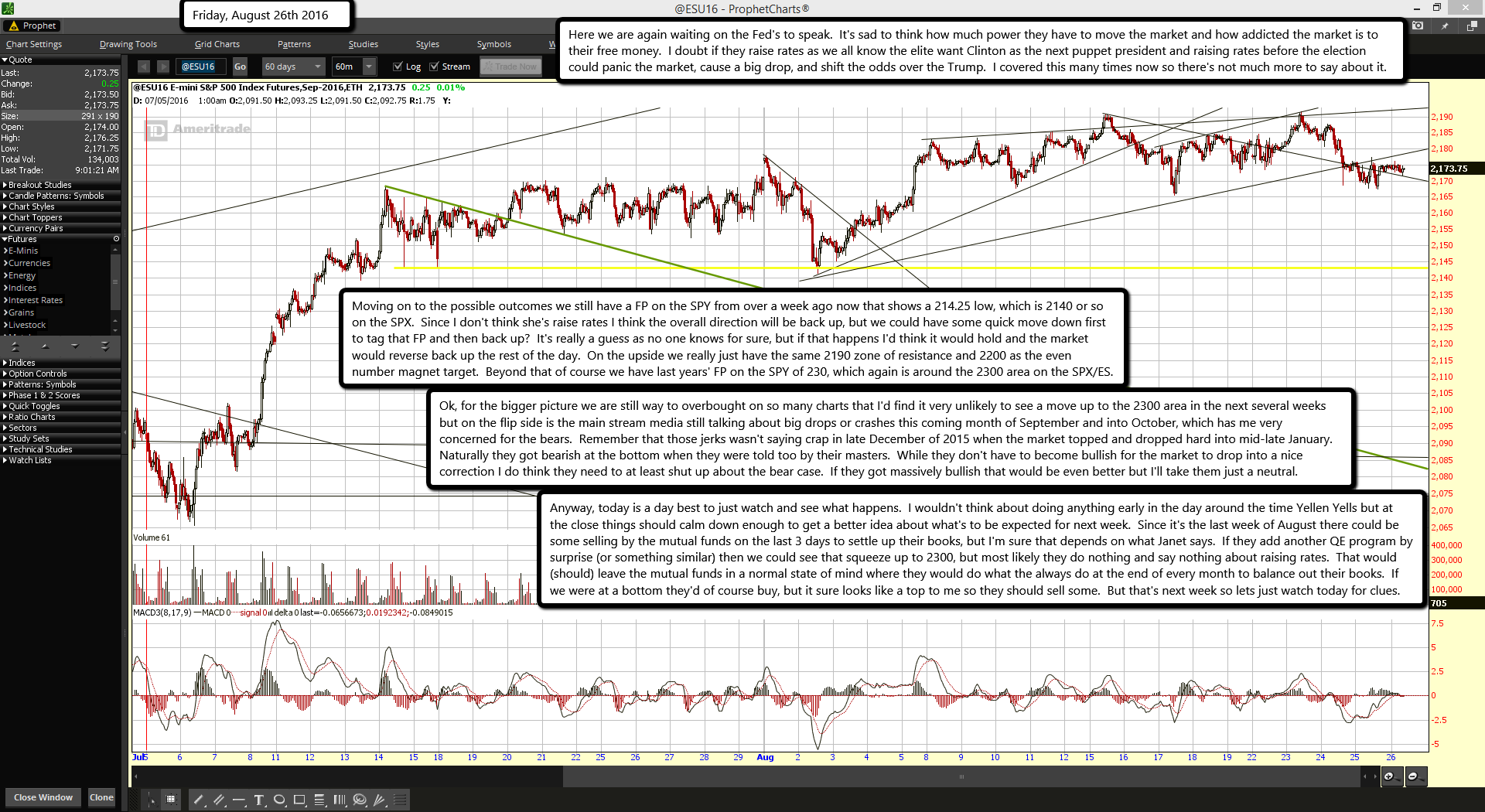
ES Morning Update August 26th 2016

0

b5d022b3-635d-4141-aa13-3b674491fb02

Here we are again waiting on the Fed's to speak. It's sad to think how much power they have to move the market and how addicted the market is to their free money. I doubt if they raise rates as we all know the elite want Clinton as the next puppet president and raising rates before the election could panic the market, cause a big drop, and shift the odds over the Trump. I covered this many times now so there's not much more to say about it.

Moving on to the possible outcomes we still have a FP on the SPY from over a week ago now that shows a 214.25 low, which is 2140 or so on the SPX. Since I don't think she's raise rates I think the overall direction will be back up, but we could have some quick move down first to tag that FP and then back up? It's really a guess as no one knows for sure, but if that happens I'd think it would hold and the market would reverse back up the rest of the day. On the upside we really just have the same 2190 zone of resistance and 2200 as the even number magnet target. Beyond that of course we have last years' FP on the SPY of 230, which again is around the 2300 area on the SPX/ES.

Ok, for the bigger picture we are still way to overbought on so many charts that I'd find it very unlikely to see a move up to the 2300 area in the next several weeks but on the flip side is the main stream media still talking about big drops or crashes this coming month of September and into October, which has me very concerned for the bears. Remember that those jerks wasn't saying crap in late December of 2015 when the market topped and dropped hard into mid-late January. Naturally they got bearish at the bottom when they were told too by their masters. While they don't have to become bullish for the market to drop into a nice correction I do think they need to at least shut up about the bear case. If they got massively bullish that would be even better but I'll take them just a neutral.

Anyway, today is a day best to just watch and see what happens. I wouldn't think about doing anything early in the day around the time Yellen Yells but at the close things should calm down enough to get a better idea about what's to be expected for next week. Since it's the last week of August there could be some selling by the mutual funds on the last 3 days to settle up their books, but I'm sure that depends on what Janet says. If they add another QE program by surprise (or something similar) then we could see that squeeze up to 2300, but most likely they do nothing and say nothing about raising rates. That would (should) leave the mutual funds in a normal state of mind where they would do what the always do at the end of every month to balance out their books. If we were at a bottom they'd of course buy, but it sure looks like a top to me so they should sell some. But that's next week so lets just watch today for clues.

As central bankers gather, some at Fed make interest rate rise case

0

As central bankers converge on this mountain resort Thursday for an annual conference on monetary policy, a couple of top Federal Reserve officials took the chance to renew a push for interest-rate hikes, citing improvement in employment and inflation.

U.S. Federal Reserve Chair Janet Yellen holds a press conference following the Fed’s two-day Federal Open Market Committee (FOMC) policy meeting in Washington June 15, 2016. REUTERS/Kevin Lamarque

"The case is strengthening" for a rate hike, Dallas Fed President Robert Kaplan told CNBC television, whose open-air studio here overlooks the craggy peaks of the Grand Teton National Park.

"And you should conclude from that in the not-too-distant future ... I think we're moving toward being able to take another step."

Kansas City Fed President Esther George, whose bank has hosted the conference here since 1978, had an even stronger message.

"I think it's time to move," she told Bloomberg TV.

The Fed raised interest rates for the first time in nearly a decade in December, but has kept them on hold since then on concern that headwinds from abroad and financial market volatility at home could hurt growth.

Recent strong readings on the U.S. labor market, and signs that inflation is finally beginning to pick up, have begun to encourage some policymakers to believe that rates should rise, if not as soon as September's policy meeting then at least before the end of the year.

Investors are awaiting a speech on Friday morning by Fed Chair Janet Yellen for more definitive clues about the timing of an interest rate rise.

But not all Fed policymakers are on board for a rate hike soon.

Chicago Fed President Charles Evans, who is at Jackson Hole for the conference, has long called for patience in raising rates so as to give inflation a better chance of reaching the Fed's 2.0-percent target sooner.

Traders currently put chances of a December rate hike at about 42 percent.

The call to raise rates stands in stark contrast to the likely next moves from many other global central banks whose representatives are meeting here, including policymakers at the central banks for Europe and Japan, where prolonged economic weakness has all but ruled out any near-term contemplation of tighter monetary policy.

It also is anathema to the dozens of activists planning to protest outside of the lodge where the three-day conference begins later on Thursday. Fed Up, a network of community organizations and labor unions, will meet with George and half a dozen other policymakers later in the day to air their concern about the impact higher rates will have on America's poor.

How Walmart Won Back Shoppers From Dollar General

0

The world’s largest retailer hit its dollar store competitor, hard.

Dollar General DG -17.63% has been cutting prices by about 10% on hundreds of staples like milk and eggs as it looks to keep customers who are drifting back to Walmart. WMT -1.40%

The dollar store was one of the fastest growing retailers in the years after the Great Recession as low-income shoppers looked for lower prices and closer stores to spend less on gas. On Thursday it reported comparable sales increased 0.7%, well below the 2.6% growth analysts were expecting, according to Consensus Metrix.

And Dollar General said fewer shoppers had come into its stores. In contrast, last week, Walmart said shopper traffic rose at its U.S. stores for the eighth straight quarter, helped by aggressive pricing that boosted its grocery business. Walmart gets some 55% of its revenue from food.

That aggressive pricing proved painful for Walmart rivals beyond Dollar General: Target TGT -1.28% said it had trouble enticing customers with its fresh food.

Dollar General slashed prices 10% on average on about 450 of its best-selling items across 2,200 stores during the quarter, Chief Executive Todd Vasos said on a conference call. And Vasos said more price cuts could be in the offing.Dollar General operates 12,500 stores. The retailer has said it wants to boost its store base by about 50% to 20,000 stores in four years.

“We believe that these price reductions are meaningful and recognizable to our consumers,” Vases told Wall Street analysts. “We are committed to further price moves as appropriate over time.”

Dollar General shares plummeted as much as 17% on Thursday. Dollar Tree, DLTR -9.93% which defeated Dollar General in a bitter battle to buy Family Dollar two years ago, also reported lower-than-expected business. It shares also fell sharply.

Walmart has been cutting prices, so-called “price investments” in retail parlance, on hundreds of products across categories, putting pressure on dollar stores. What’s more, Walmart’s efforts to upgrade its fresh food area looks to be getting some customers to trade back up.

The price war with Walmart comes at a time so-called food deflation is already pinching all these chains’ sales and profit margins: Dollar General said prices for milk fell 8% and more than 50% for eggs during the quarter.

Adding to the pressure on Dollar General were cuts in food-stamp programs as seven states, all governed by Republicans, ended benefits earlier than they had to.

Those states ended waivers for some able-bodied recipients that were made in 2009, at the height of the Great Recession. According to the U.S. Department of Agriculture, there were 43.5 million Americans enrolled in May in Supplemental Nutrition Assistance Program, as the food stamp program is federally known, compared to 47.5 million in 2012, when it peaked. And by some estimates, another 500,000 people will fall off this year from a program that disproportionately hurts dollar store shoppers.

ES Morning Update August 25th 2016

0

053a3f62-5ddd-41ef-995e-40f55c98eeeb

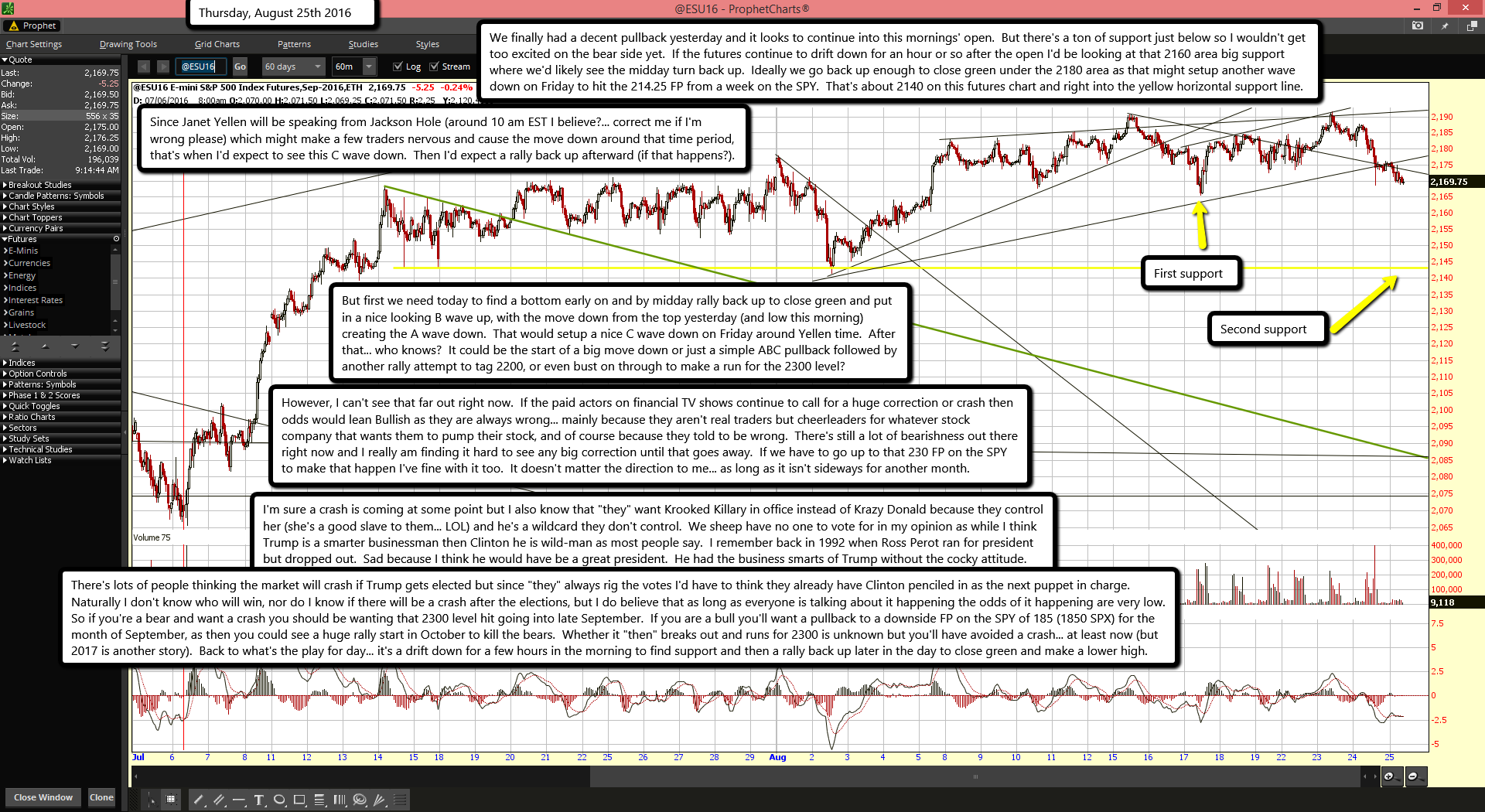
We finally had a decent pullback yesterday and it looks to continue into this mornings' open.  But there's a ton of support just below so I wouldn't get too excited on the bear side yet.  If the futures continue to drift down for an hour or so after the open I'd be looking at that 2160 area big support where we'd likely see the midday turn back up.  Ideally we go back up enough to close green under the 2180 area as that might setup another wave down on Friday to hit the 214.25 FP from a week on the SPY.  That's about 2140 on this futures chart and right into the yellow horizontal support line.

Since Janet Yellen will be speaking from Jackson Hole (around 10 am EST I believe?... correct me if I'm wrong please) which might make a few traders nervous and cause the move down around that time period, that's when I'd expect to see this C wave down.  Then I'd expect a rally back up afterward (if that happens?).

But first we need today to find a bottom early on and by midday rally back up to close green and put in a nice looking B wave up, with the move down from the top yesterday (and low this morning) creating the A wave down.  That would setup a nice C wave down on Friday around Yellen time.  After that... who knows?  It could be the start of a big move down or just a simple ABC pullback followed by another rally attempt to tag 2200, or even bust on through to make a run for the 2300 level?

However, I can't see that far out right now.  If the paid actors on financial TV shows continue to call for a huge correction or crash then odds would lean Bullish as they are always wrong... mainly because they aren't real traders but cheerleaders for whatever stock company that wants them to pump their stock, and of course because they told to be wrong.  There's still a lot of bearishness out there right now and I really am finding it hard to see any big correction until that goes away.  If we have to go up to that 230 FP on the SPY to make that happen I've fine with it too.  It doesn't matter the direction to me... as long as it isn't sideways for another month.

I'm sure a crash is coming at some point but I also know that "they" want Krooked Killary in office instead of Krazy Donald because they control her (she's a good slave to them... LOL) and he's a wildcard they don't control.  We sheep have no one to vote for in my opinion as while I think Trump is a smarter businessman then Clinton he is wild-man as most people say.  I remember back in 1992 when Ross Perot ran for president but dropped out.  Sad because I think he would have be a great president.  He had the business smarts of Trump without the cocky attitude.

There's lots of people thinking the market will crash if Trump gets elected but since "they" always rig the votes I'd have to think they already have Clinton penciled in as the next puppet in charge.  Naturally I don't know who will win, nor do I know if there will be a crash after the elections, but I do believe that as long as everyone is talking about it happening the odds of it happening are very low.  So if you're a bear and want a crash you should be wanting that 2300 level hit going into late September.  If you are a bull you'll want a pullback to a downside FP on the SPY of 185 (1850 SPX) for the month of September, as then you could see a huge rally start in October to kill the bears.  Whether it "then" breaks out and runs for 2300 is unknown but you'll have avoided a crash... at least now (but 2017 is another story).  Back to what's the play for day... it's a drift down for a few hours in the morning to find support and then a rally back up later in the day to close green and make a lower high.

Fischer Signals 2016 Rate Hike With Economy Nearing Fed Goals

0

Federal Reserve Vice Chairman Stanley Fischer signaled that a 2016 rate hike is still under consideration, saying the U.S. economy is already close to meeting the central bank’s goals and that growth will gain steam.

“We are close to our targets,” Fischer said in a speech at the Aspen Institute in Aspen, Colorado on Sunday. “Looking ahead, I expect GDP growth to pick up in coming quarters, as investment recovers from a surprisingly weak patch and the drag from past dollar appreciation diminishes,” he added, without giving explicit views on his rate outlook.

Fischer’s remarks come less than a week before Fed Chair Janet Yellen speaks Aug. 26 at an annual symposium hosted by the Kansas City Fed in Jackson Hole, Wyoming. Investors are looking for clues from central bankers on the timing of potential interest-rate increases amid modest economic growth, strong job gains, and only moderate increases in inflation.

“It would be quite an event if Fischer went out so close to Yellen’s speech this week and said something” the Fed Chair disagrees with, said Roberto Perli, a partner at Cornerstone Macro LLC and former Fed board economist. “While I don’t expect Yellen to provide much rate guidance in Jackson Hole, I think she will echo Fischer’s upbeat assessment of the U.S. economy.”

The central bank boosted borrowing costs for the first time in seven years in December, and has left the benchmark lending rate unchanged at its five meetings so far this year. On Sunday, Fischer said the behavior of employment has been “remarkably resilient” even as the economy has passed through several shocks, while GDP growth has been “mediocre at best.”

While the economy has done “less well” in moving toward the Fed’s 2 percent inflation target, Fischer said the central bank’s preferred price benchmark, minus food and energy costs, at 1.6 percent was “within hailing distance of 2 percent.”

Fed officials at their most recent policy meeting in July debated progress on inflation, with most continuing to forecast it would rise to their 2 percent target over the medium term versus a minority group which saw downside risks to prices, minutes from the gathering showed.

“He is pushing back a little bit against the views of the market and some of his more dovish colleagues,” said Michael Hanson, senior global economist at Bank of America in New York. “He is saying it makes sense to consider some additional normalization of rates.”

Fischer spent much of his speech discussing the slowdown in worker output per hour, or productivity, noting that it increased 1.25 percent per year on average from 2006 to 2015, compared with 2.5 percent from 1949 to 2005.

“A 1.25 percentage point slowdown in productivity growth is a massive change, one that, if it were to persist, would have wide-ranging consequences for employment, wage growth, and economic policy more broadly,” he said.

Fischer said monetary policy isn’t equipped to boost productivity growth. He said the “key” to boosting output per hour “is more likely to be found in effective fiscal and regulatory policies,” citing improved public infrastructure, better education, and incentives for private investment.

Fed officials raised the benchmark lending rate to a range of 0.25 to 0.5 percent in December. In June, their median estimate predicted at least two hikes this year. Investors see roughly 50-50 odds of a rate increase by year-end, according to the prices of federal funds futures contracts. The rate-setting Federal Open Market Committee next meets Sept. 20-21, and will convene again in November and December.

Reading Fischer’s speech, “you would say they are ready to move,” said Daniel Thornton, a former St. Louis Fed research economist who now works independently. “It seems that he is trying to hint in that direction, but I don’t think they will do anything before the election” in November.

Watch Next: What Have Markets Priced In for a Fed Move?

ES Morning Update August 24th 2016

0

0358df7d-8ecc-40e9-a5d9-b288974b4207

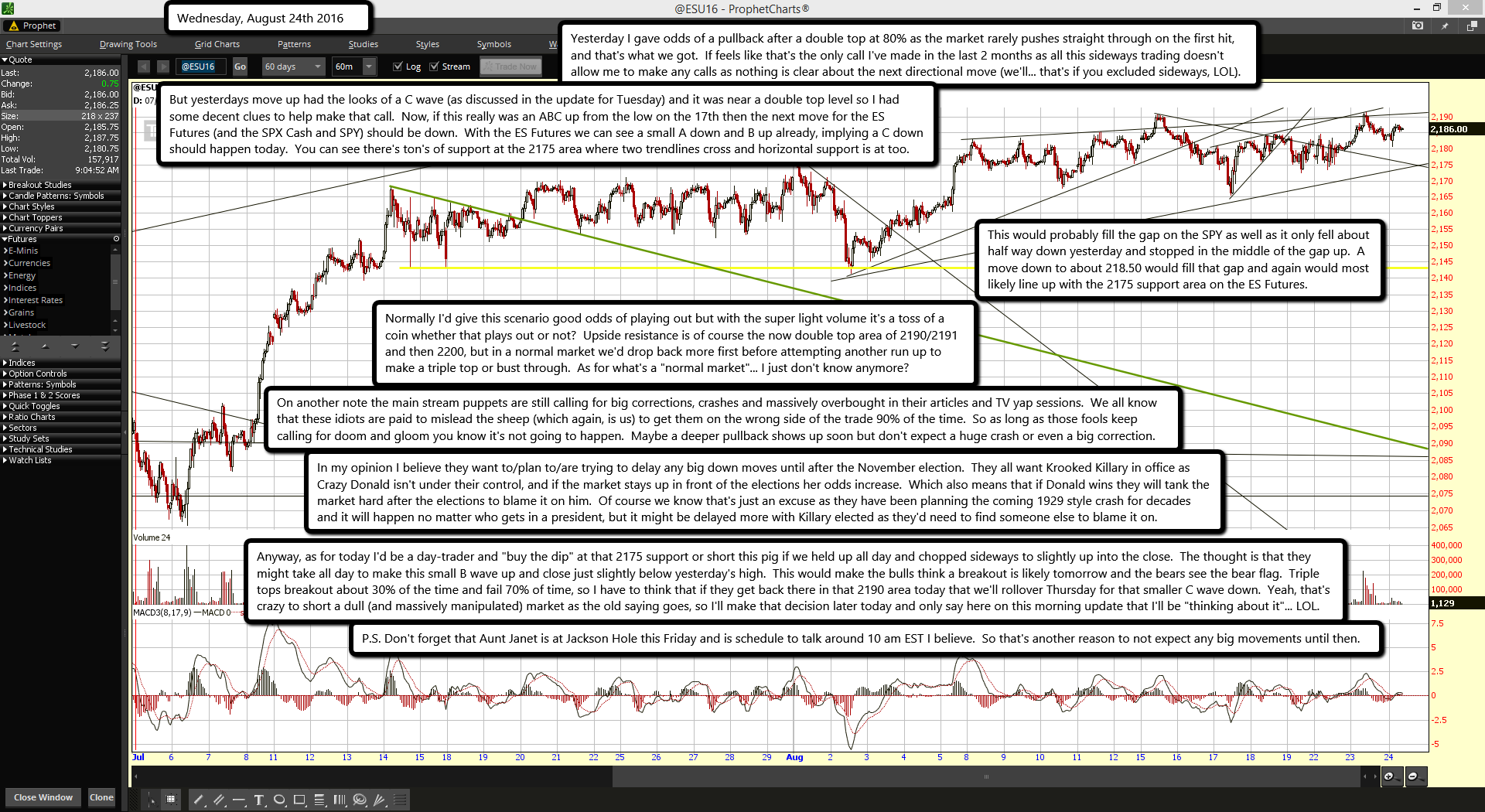
Yesterday I gave odds of a pullback after a double top at 80% as the market rarely pushes straight through on the first hit, and that's what we got.  If feels like that's the only call I've made in the last 2 months as all this sideways trading doesn't allow me to make any calls as nothing is clear about the next directional move (we'll... that's if you excluded sideways, LOL).

But yesterdays move up had the looks of a C wave (as discussed in the update for Tuesday) and it was near a double top level so I had some decent clues to help make that call.  Now, if this really was an ABC up from the low on the 17th then the next move for the ES Futures (and the SPX Cash and SPY) should be down.  With the ES Futures we can see a small A down and B up already, implying a C down should happen today.  You can see there's ton's of support at the 2175 area where two trendlines cross and horizontal support is at too.

This would probably fill the gap on the SPY as well as it only fell about half way down yesterday and stopped in the middle of the gap up.  A move down to about 218.50 would fill that gap and again would most likely line up with the 2175 support area on the ES Futures.

Normally I'd give this scenario good odds of playing out but with the super light volume it's a toss of a coin whether that plays out or not?  Upside resistance is of course the now double top area of 2190/2191 and then 2200, but in a normal market we'd drop back more first before attempting another run up to make a triple top or bust through.  As for what's a "normal market"... I just don't know anymore?

On another note the main stream puppets are still calling for big corrections, crashes and massively overbought in their articles and TV yap sessions.  We all know that these idiots are paid to mislead the sheep (which again, is us) to get them on the wrong side of the trade 90% of the time.  So as long as those fools keep calling for doom and gloom you know it's not going to happen.  Maybe a deeper pullback shows up soon but don't expect a huge crash or even a big correction.

In my opinion I believe they want to/plan to/are trying to delay any big down moves until after the November election.  They all want Krooked Killary in office as Crazy Donald isn't under their control, and if the market stays up in front of the elections her odds increase.  Which also means that if Donald wins they will tank the market hard after the elections to blame it on him.  Of course we know that's just an excuse as they have been planning the coming 1929 style crash for decades and it will happen no matter who gets in a president, but it might be delayed more with Killary elected as they'd need to find someone else to blame it on.

Anyway, as for today I'd be a day-trader and "buy the dip" at that 2175 support or short this pig if we held up all day and chopped sideways to slightly up into the close.  The thought is that they might take all day to make this small B wave up and close just slightly below yesterday's high.  This would make the bulls think a breakout is likely tomorrow and the bears see the bear flag.  Triple tops breakout about 30% of the time and fail 70% of time, so I have to think that if they get back there in that 2190 area today that we'll rollover Thursday for that smaller C wave down.  Yeah, that's crazy to short a dull (and massively manipulated) market as the old saying goes, so I'll make that decision later today and only say here on this morning update that I'll be "thinking about it"... LOL.

Lord Rothschild: World seeing “greatest monetary policy experiment in history”

0

57b32151c46188e1668b45bcLow interest rates, negative yields on government debt and quantitative easing are part of the biggest financial experiment in world history, and the consequences are yet unknown, says RIT Capital Partners Chairman Lord Rothschild.

“The six months under review have seen central bankers continuing what is surely the greatest experiment in monetary policy in the history of the world. We are therefore in uncharted waters and it is impossible to predict the unintended consequences of very low interest rates, with some 30 percent of global government debt at negative yields, combined with quantitative easing on a massive scale,” Rothschild writes in the company's semi-annual financial report.

The banker notes this policy has led to a rapid growth of stock markets - US stocks have grown threefold since 2008 - with investments growing and volatility remaining low.

However, the real sector of economy didn’t enjoy such a profit, as “growth remains anemic, with weak demand and deflation in many parts of the developed world,” according to Rothschild.

The billionaire underlined that many risks remain for the global economy with the deteriorating geopolitical situation. Among those risks Rothschild included Britain's vote to leave the European Union, the US presidential election, and China's slowing economic growth. Another risk is global terrorism, which Rothschild says is a consequence of the continuing conflict in the Middle East.

According to a Bank of America Merrill Lynch report in June, interest rates in developed countries, in particular America’s 0.5 percent, are now at the lowest level in 5,000 years. In their battle against deflation, countries such as Sweden, Switzerland or Japan have even turned to negative key lending rates.

Another woe is negative yields on government bonds. In June, 10-year German government bonds dipped below 0 percent for the first time in history. Janus Capital has estimated that global yields are the lowest in 500 years, and the total amount of such bonds is $10 trillion. The investment group’s lead portfolio manager, Bill Gross, is calling it a“supernova that will explode one day.”

Clinton Foundation should stop accepting funds

0

e229021315cca50f510f6a70670042f4In 2014, Chelsea Clinton, left, cohosted a Clinton Foundation event called “Girls: A No Ceilings Conversation,” with her mother, Hillary Clinton.

dYoDxpkALTHOUGH THE CHARITY founded by former President Bill Clinton has done admirable work over the last 15 years, the Clinton Foundation is also clearly a liability for Hillary Clinton as she seeks the presidency. The once-and-maybe-future first family will have plenty to keep them busy next year if Hillary Clinton defeats Donald Trump in November. The foundation should remove a political — and actual — distraction and stop accepting funding. If Clinton is elected, the foundation should be shut down.

Since its founding, the foundation has supported relief in Haiti, global health, and other good causes. It also provided posts or paychecks for some members of the Clinton political team, like Cheryl Mills, Douglas Band, and Huma Abedin, and afforded the former president a platform and travel budget. Many of the foundation’s donations come from overseas, including from foreign governments with troubling human rights records.

The inherent conflict of interest was obvious when Hillary Clinton became secretary of state in 2009. She promised to maintain a separation between her official work and the foundation, but recently released emails written by staffers during her State Department tenure make clear that the supposed partition was far from impregnable. That was bad enough at State; if the Clinton Foundation continues to cash checks from foreign governments and other individuals seeking to ingratiate themselves with a President Hillary Clinton, it would be unacceptable.

Winding down the foundation, and transferring its assets to some other established charity, doesn’t have to hurt charitable efforts. If the foundation’s donors are truly motivated by altruism, and not by the lure of access to the Clintons, then surely they can find other ways to support the foundation’s goals. And in four or eight years, the Clinton family could always form a new foundation and reestablish their charitable efforts.

But as long as either of the Clintons is in public office, or actively seeking it, they should not operate a charity, too. The Clintons themselves seem to realize that. “There’ll clearly be some changes in what the Clinton Foundation does and how we do it,” Bill Clinton said in June. “We’ll just have to cross that bridge when we come to it.” Why wait? The Clintons should move now to end donations to the foundation, and make plans to shut it down in November. Even if they’ve done nothing illegal, the foundation will always look too much like a conflict of interest for comfort.

Delphi, Mobileye to offer driverless car system in 2019 – The Detroit News

0
Delphi Automotive Showcases Its Driverless Car, After Completing Cross Country Trip

Delphi Automotive PLC and Mobileye NV on Tuesday announced plans to jointly develop a fully autonomous vehicle system that the suppliers expect will be ready for production in 2019.

Each company is bringing different technologies to the table to create the driverless car system. Mobileye specializes in real-time mapping, while Delphi specializes in sensors, including cameras, LiDAR and radar, and software. The two companies say automakers will be able to buy the system and install it on a range of vehicle platforms, from small cars to SUVs and crossovers.

Delphi and Mobileye have planned a joint press conference for 9 a.m. Tuesday to discuss the plans.

“This partnership will allow us to give our customers an increased level of automated capabilities faster and more cost effective,” Kevin Clark, Delphi’s CEO, said in a statement. “The collective expertise of our two organizations will accelerate the creation of new approaches and capabilities that would likely not have been possible working alone. This is a win-win for both companies and our customers.”

Mobileye helped provide technology for Tesla’s Autopilot driver assist system, but the two companies split up earlier this year following a fatal crash involving the technology.

Delphi has been experimenting with autonomous car technology for years. Two years ago it demonstrated its autonomous vehicle system in a coast-to-coast drive across the country, and it recently announced a pilot program in Singapore that will feature driverless pods — without a steering wheel or pedals — ferrying passengers around a business park there by decade’s end.

The pair will showcase the fully autonomous vehicle system at the upcoming CES technology trade show in Las Vegas in January, Mobileye said in a release.

“Our partnership with Delphi will accelerate the time to market and enable customers to adopt Level 4/5 automation without the need for huge capital investments, thereby creating a formidable advantage for them,” Amnon Shashua, Mobileye chairman and chief technology officer, said in a statement.

The race to develop driverless cars has recently shifted into high gear.

Ford Motor Co. last week said it will have a fully driverless vehicle available for commercial purposes in 2021, and Uber last week said it will begin offering autonomous car rides in the coming weeks. The California ride-hailing service also purchased Otto, a startup working on self-driving big-rig technology.

General Motors Co. is partnering with Lyft to develop self-driving Chevrolet Bolts, and Fiat Chrysler Automobiles is providing Chrysler Pacificas to Google Inc. to outfit with autonomous technology.

Why Fed won’t hike interest rates until after the elections

0

Statements by U.S. Federal Reserve officials about the timing of next policy moves are part of the holding pattern until presidential elections on November 8. No interest rate increases are likely before then, or immediately thereafter.

The most important reason for such a turn of events is the Fed's recognition that any future monetary policy changes should be part of a medium-term (a period of one to five years) policy mix to stabilize a sharply slowing U.S. economy. The Fed knows that the halving of the economy's growth rate between the first quarter of 2015 (3.3 percent) and the second quarter of this year (1.2 percent) is one more proof that the monetary policy alone cannot carry the entire burden of the country's economic management.

The Fed has to work with the new executive and legislative authorities to stop the destruction of whatever is left of America's sluggish growth dynamics.

Foundations for better growth

Increasing investments in infrastructure, production capacities and human capital are the way forward. That has been a well-known priority during the post-crisis recovery. Unfortunately, it had to come to the grim outlook we are facing now to elevate that long-neglected task to the point of national urgency.

Here is what happened. As aggregate demand began its steady slowdown in the early months of 2015, investments – one-fifth of the economy -- followed the same pattern. But then things got much worse since the start of this year. During the second quarter, total investments declined 3.4 percent from the year earlier, and subtracted 1.68 percentage points from the GDP growth.

Investments are unlikely to rebound in the months ahead. Based on current evidence of weak aggregate demand and a strong import penetration of U.S. markets, one cannot see much need, or incentive, for increasing capital outlays over the near term.
Stock Pickers

There is a similar urgency to address structural problems affecting human capital. In addition to the officially reported 7.8 million people currently out of work, there are 8 million individuals in involuntary part-time jobs or out of the labor force. Of particular concern are the 2 million of long-term unemployed and another 2 million of virtually unemployable persons.

Getting some of these 16 million people back on the payrolls will require a major effort at sustaining labor demand and improving professional qualifications through better education and retraining. More generally, investments in human capital have to be recognized as a fundamental growth factor for the U.S. economy.

An interim conclusion here is this: A growing supply of a better qualified labor force, outfitted with best-practice technologies, is needed to increase America's stagnant productivity, and to raise the economy's potential (and noninflationary) growth rate from the dismal 1.6 percent we have at the moment.

That is the context where the monetary policy will have to play its part to support higher growth of demand, output and employment, and to maintain price stability defined as an inflation rate of 0-2 percent.

Trade policies are another area that needs immediate attention. In the first six months of this year, the U.S. trade deficit was running at an annual rate of $712 billion. That negative trade balance accounts for 4 percent of the economy, and it is currently taking half a percentage point off the growth of the domestic demand.

Trade reviews are OK

These are serious policy issues in an open economy where the external sector represents nearly one-third of GDP.

But investors should be careful here not to fall for campaign trail exaggerations of looming trade wars and their devastating blows to growth and financial markets. Blistering trade disputes are a permanent feature of the world economy. High-profile clashes and trade arbitration procedures are going on all the time. There is, therefore, nothing wrong in suggesting reviews of America's existing trade agreements and trade practices to make sure that they continue to serve the interests of our changing economy.

These reviews are also likely to lead to another look at some of America's economic and industrial policies.

For example, the media have been talking about trade studies indicating that Walmart imported in 2013 some $49 billion worth of goods produced in China. The same studies are reported to have found that Walmart's imports from China have displaced more than 400,000 jobs in U.S. manufacturing industries between 2001 and 2013.

Ross Perot must be saying "I told you so." He was another businessman copiously laughed out of court when he talked, during his presidential election campaign in 1992, about the "giant sucking sound" of American jobs going overseas. Sadly, the numbers are there to show that a demise of many manufacturing industries has caused serious structural imbalances in the American economy.

And that was not just the case of obsolete rust-belt manufacturers. Think of an icon of American industry such as IBM. The venerable Big Blue sold in 2005 its profitable personal computer business because it was deemed unviable as a long-term project. So, the legendary Thinkpads got resurrected under the Chinese Lenovo brand, and the proud new owners just reported a net profit of $173 million in the first quarter of this year, a whopping 64 percent increase from the year earlier. I wonder what the brilliant minds up in Armonk, NY think about that.

The Federal Reserve building in Washington, D.C.

The Federal Reserve building in Washington, D.C.

Investment thoughts

The guessing game about the timing of the Fed's next interest rate increase is a good betting material for day-to-day trading. But that's all it is.

The Fed has done its part in rescuing a badly damaged economy. The rescue job is finished. The growth job is not. The U.S. economy is settling around an unacceptably low 1.6 percent growth potential. And there is not much the Fed alone can do about that.

Investors ready for an act of faith on the profitability of their dollar-denominated assets will have to assess America's entire policy mix, consisting of fiscal, monetary, structural and trade policies. That's the ensemble where the Fed will have to play, with a focus on price stability and the soundness of the financial system it manages.

The stage is set, actors are jostling for positions, but the action won't start until early next spring.

In the meantime, the Fed will have more than enough liquidity on hand to support markets looking for direction. Caution is in order. But catastrophic scenarios are … well, quite unlikely.

s2Member®